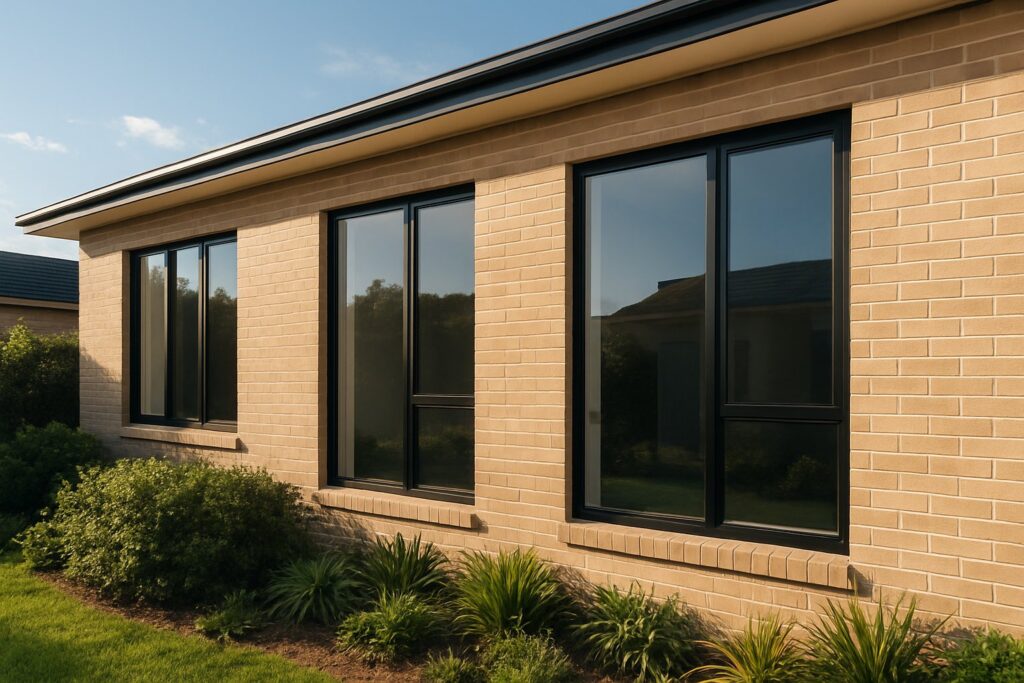
What Is a Fixed Aluminium Louver Window
Every building needs to breathe. A fixed aluminium louver window provides that breath permanently, without relying on anyone to open or close it. Unlike operable louvre systems with adjustable blades, a fixed louver locks its aluminium blades at a set angle within a rigid frame, delivering constant airflow and filtered light while keeping rain, debris, and intruders out.
Definition and Core Function
A fixed aluminium louver window is a non-operable ventilation unit consisting of permanently angled aluminium blades secured within an extruded aluminium frame. The blade angle is engineered to permit controlled airflow and diffused light entry while rejecting direct weather ingress. Because no moving parts exist, the system offers superior structural integrity and a near-zero maintenance profile.
The concept is straightforward: air passes freely between the angled blades, but rain striking the outer face is deflected downward by the blade overlap. This passive design makes fixed louvers ideal wherever continuous ventilation must operate unattended, day and night, in all weather conditions.
Key Components of a Fixed Louver Window
Understanding the anatomy helps when it comes time to specify or compare products. A typical fixed louver panel includes:
- Frame extrusion — the perimeter aluminium section that houses the blades and connects to the building structure
- Blade profiles — individual aluminium slats set at a fixed pitch angle, available in flat, elliptical, or aerofoil cross-sections
- Blade spacing (pitch) — the centre-to-centre distance between blades, which determines free-area ratio and visual screening
- Fixing clips or blade carriers — internal components that lock each blade into position within the frame
- Mullions — vertical or horizontal intermediate members that divide larger openings into manageable panel sizes
- Drainage provisions — channels and weep slots at the sill that direct any captured water back to the exterior
How Fixed Louvers Differ from Other Window Types
Aluminum window louvers sometimes get confused with other facade elements, so a quick distinction is useful. Operable louvre windows let occupants rotate blades open or closed, which adds mechanical complexity, more maintenance, and potential points of failure. Standard glazed windows seal the opening entirely, sacrificing ventilation for weather tightness. Perforated metal screens offer visual screening but lack the directional rain rejection that angled blades provide.
Fixed louvers sit in a unique position: they combine permanent ventilation with weather defence and physical security, all without a single hinge, actuator, or seal that can wear out. That absence of moving parts is what defines their long-term reliability. Alum louvers of this type routinely outlast operable alternatives by decades in demanding environments, from coastal facades to industrial plant rooms.
Of course, choosing a fixed system means committing to a single blade angle and airflow rate. That trade-off raises an important question: when does a fixed configuration outperform an adjustable one, and what factors tip the decision?
Fixed vs Operable Aluminium Louver Windows Compared
The answer depends on how much control occupants actually need over airflow, and whether that control justifies the added complexity. Both fixed and operable aluminium louver windows serve the same fundamental purpose — ventilating a space while managing weather exposure — but they achieve it through very different engineering philosophies. One locks performance in at the factory. The other hands control to the end user, along with every maintenance obligation that comes with moving parts.
Functional Differences Between Fixed and Operable Systems
A fixed system delivers permanent ventilation at a predetermined blade angle. The airflow rate never changes, which means the building receives consistent cross-ventilation regardless of whether anyone is present to manage it. This makes fixed louvers the natural choice for unoccupied or hard-to-reach spaces where set-and-forget performance matters most.
Operable systems, by contrast, allow occupants to rotate blades from fully open to fully closed. That adjustability is genuinely useful in habitable rooms where people want to respond to changing weather — closing blades during a storm, opening them wide on a calm day. However, the mechanism that enables this flexibility introduces hinges, linkage bars, handles or actuators, and sealing gaskets that all require periodic servicing.
Security is another point of divergence. Windows with louvers that operate typically rely on friction locks or key-operated handles to resist forced entry. Fixed blades, welded or mechanically crimped into the frame, offer inherently higher resistance to tampering because there is simply no mechanism to defeat. For ground-floor applications, car parks, and plant rooms, this passive security advantage is significant.
Weather resistance follows a similar logic. A fixed louver’s blade overlap and angle are engineered as a system — tested and rated for rain penetration at specific wind pressures. Operable blades, even when closed, depend on gasket compression to seal, and gaskets degrade over time. In exposed locations, a fixed awning or louver panel will maintain its rated weather performance for decades without adjustment.
Comparison Table of Fixed vs Operable Louver Windows
| Criteria | Fixed Louver Windows | Operable Louver Windows |
|---|---|---|
| Airflow control | Constant, set at manufacture | Variable, adjusted by occupant or BMS |
| Maintenance requirements | Minimal — periodic cleaning only | Moderate — hinges, linkages, seals need servicing |
| Indicative cost range (AUD, supply only) | $350–$800 per m² | $600–$1,400 per m² |
| Security level | High — no operable mechanism to compromise | Moderate — depends on locking hardware |
| Weather sealing | Engineered blade overlap; no gaskets to degrade | Gasket-dependent; performance declines over time |
| Expected lifespan | 30–50+ years with quality finish | 20–35 years (mechanism life often shorter than frame) |
| Ideal applications | Plant rooms, car parks, substations, facades, subfloor ventilation | Habitable rooms, kitchens, bathrooms, classrooms |
| Mechanical complexity | None — zero moving parts | Moderate to high — linkages, actuators, or manual hardware |
When to Choose Fixed Over Operable
Not every opening needs adjustability. In many cases, a fixed configuration delivers better long-term value precisely because it removes variables. Consider specifying fixed aluminium louvres when:
- Constant ventilation is non-negotiable — mechanical plant rooms, electrical switchrooms, and car parks require airflow 24/7 regardless of occupancy or weather.
- The space is unoccupied or unmanned — nobody is available to adjust blades, and automated actuators add cost and failure points.
- Security is a primary concern — ground-floor openings, detention facilities, and utility enclosures benefit from blades that cannot be forced open.
- Maintenance access is limited or expensive — high-level facades, remote substations, and multi-storey plant screens where scaffold access for servicing is impractical.
- Budget must account for whole-of-life cost — the lower upfront price and near-zero servicing cost of fixed systems often win over decades compared to operable alternatives.
- A fixed awning window or louvre is part of a broader facade strategy — architects integrating fixed window awnings into shading or screening compositions need predictable, unchanging geometry for the design to read correctly.
Where occupants genuinely need to modulate airflow — bedrooms, living areas, classrooms — operable systems earn their higher price. But for the majority of commercial and industrial openings, fixed aluminium louver windows deliver the performance required without the ongoing cost of complexity.
Whichever system you choose, the blade profile running through it shapes everything from wind noise to rain rejection. That geometry deserves a closer look.
Blade Profile Types and How They Affect Performance
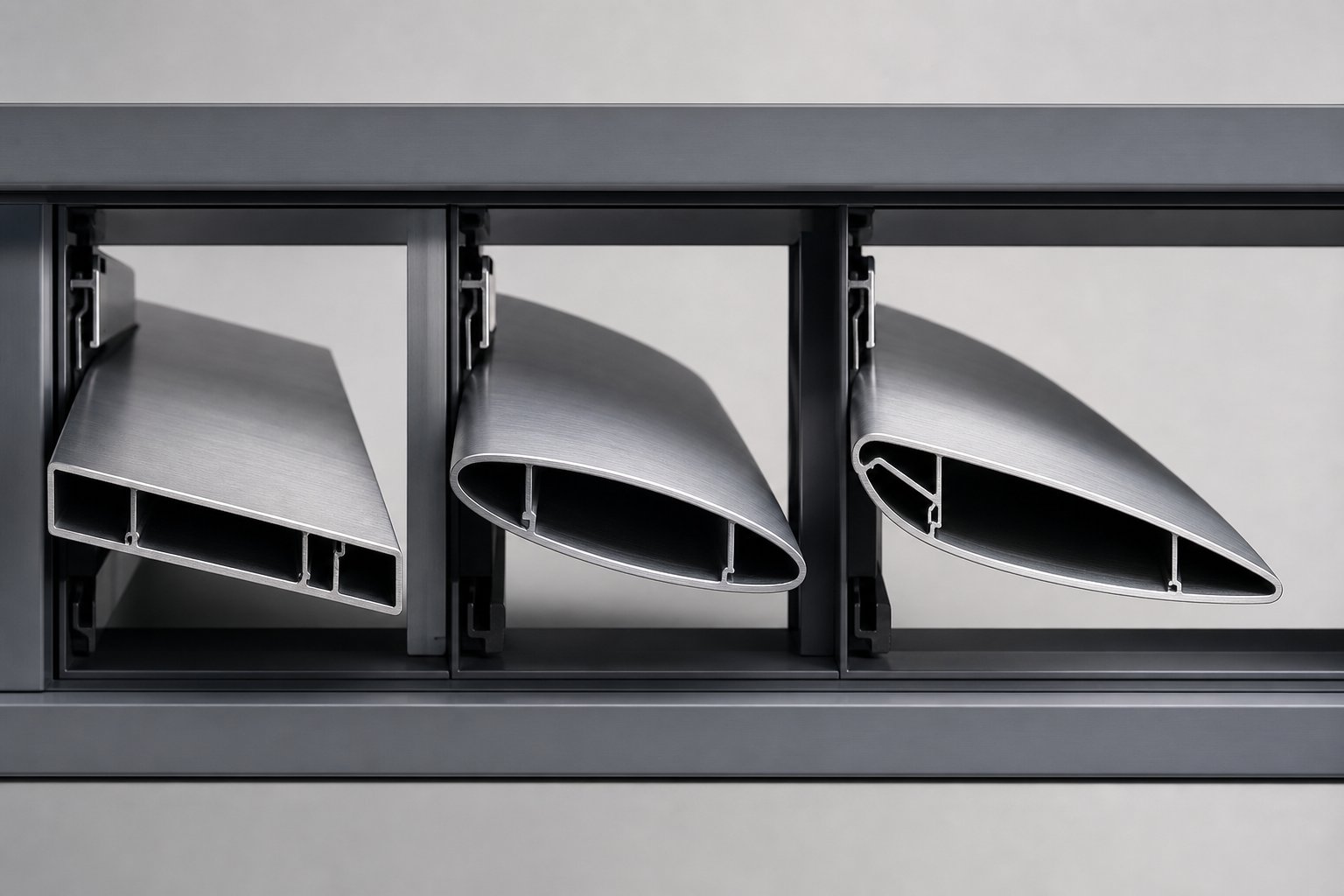
Blade geometry is not a cosmetic choice. The cross-sectional shape of each aluminium blade determines how air moves through the panel, how much noise it generates under wind load, and how effectively it rejects driven rain. Three primary profiles dominate the market, each engineered for different performance demands. Choosing the wrong one can mean excessive wind noise on an exposed facade or inadequate rain defence in a coastal application.
Flat Blade Profiles
Flat blades are the simplest and most economical option. Each blade is a straight, rectangular extrusion — easy to manufacture, easy to install, and effective at standard blade angles for basic rain rejection. In calm to moderate conditions, they perform well and deliver a clean, utilitarian appearance.
The trade-off shows up when wind speeds rise. A flat surface creates sharper pressure differentials as air passes over and under the blade, generating turbulence and audible noise. In exposed locations or upper storeys, this can become problematic. Flat-profile aluminum louvered panels are best suited to sheltered applications: plant rooms, basement car parks, subfloor ventilation, and service enclosures where acoustic performance is less critical and budget matters most.
Elliptical Blade Profiles
An elliptical blade features a gently curved cross-section — thicker at the centre, tapering toward the edges. This shape smooths airflow across the blade surface, reducing the turbulence that flat profiles create. The result is noticeably lower wind noise at equivalent free-area ratios, plus improved rain defence because the curved geometry encourages water to sheet off rather than pool.
Extruded aluminum louvers with elliptical profiles are a common specification for commercial facades, multi-residential screening, and any application visible to occupants or the public where noise and aesthetics both matter. They sit in the mid-range for cost and offer a strong balance between performance and economy. The aluminum louver frame supporting elliptical blades typically uses the same extrusion system as flat-blade variants, so switching profiles rarely requires a different framing solution.
Aerofoil Blade Profiles
Aerofoil sections borrow their geometry from aircraft wing design. The teardrop cross-section — rounded leading edge, tapered trailing edge — delivers the smoothest possible airflow path. Wind passes over and under the blade with minimal separation, which translates to the lowest noise generation of any profile type and superior structural performance under high wind pressures.
Because the hollow or foam-filled aerofoil shape offers an exceptional strength-to-weight ratio, these blades can span greater distances between mullions without deflecting. That makes them the go-to specification for high-rise facades, cyclone-prone regions in northern Queensland and the NT, and noise-sensitive applications near residential boundaries. Aluminum louver panels with aerofoil blades also provide the best acoustic attenuation, making them suitable where rooftop plant noise must be screened from neighbouring properties.
The premium is real — aerofoil profiles cost more to extrude and fabricate — but in demanding environments, they earn that premium through decades of quieter, stronger, more weather-resistant service.
Blade Profile Comparison
| Performance Criteria | Flat Blade | Elliptical Blade | Aerofoil Blade |
|---|---|---|---|
| Wind noise | Higher — turbulence at blade edges | Moderate — smoother airflow path | Lowest — minimal flow separation |
| Rain rejection | Good at standard angles | Very good — curved surface sheds water | Excellent — aerodynamic shape deflects driven rain |
| Typical free area | 45–55% | 40–50% | 35–45% |
| Maximum structural span | Up to ~1,200 mm | Up to ~1,500 mm | Up to ~2,000 mm+ |
| Relative cost | $ (lowest) | $$ (mid-range) | $$$ (premium) |
| Best applications | Plant rooms, car parks, subfloor | Commercial facades, screening | High-rise, cyclone zones, acoustic barriers |
Profile selection is ultimately driven by the conditions the louver will face and the performance it must deliver. A sheltered car park does not need aerofoil blades any more than a 20-storey coastal facade should rely on flat ones. Matching the aluminum louver frame and blade profile to the specific environment is what separates a well-specified system from one that underperforms from day one.
That environment varies enormously depending on where the louver sits — a residential subfloor opening faces very different demands than a rooftop mechanical plant screen or an architectural facade element. The application itself shapes the specification.
Applications Across Residential and Commercial Projects
A subfloor vent and a 40-storey facade screen look nothing alike, yet both can be served by the same fundamental product: a fixed aluminium louver window engineered to suit its specific environment. The versatility of these systems spans the entire building spectrum, from modest homes needing reliable underfloor airflow to complex commercial developments where ventilation, acoustics, and aesthetics must work in concert. Where the louver sits determines what it needs to do — and understanding that relationship is what separates a good specification from a generic one.
Residential Applications
In domestic construction, fixed louvers solve a simple problem: how to keep air moving through spaces that nobody actively manages. Most homeowners want ventilation that works quietly in the background without creating security vulnerabilities or letting weather in. Fixed systems deliver exactly that.
Common residential uses include:
- Subfloor ventilation — maintaining airflow beneath timber-framed floors to prevent moisture buildup, mould growth, and structural decay. Fixed louvre window panels set into the foundation wall provide continuous cross-ventilation without any occupant intervention.
- Bathroom and laundry exhaust openings — allowing humid air to escape wet areas permanently, supplementing mechanical exhaust fans and reducing condensation damage to linings and finishes.
- Garage ventilation — dispersing vehicle fumes and regulating temperature in enclosed garages, particularly important for attached garages where fumes could migrate into living areas.
- Pool enclosures — managing chloramine vapour and humidity in indoor pool rooms, where constant airflow protects both occupants and the building fabric from corrosive moisture.
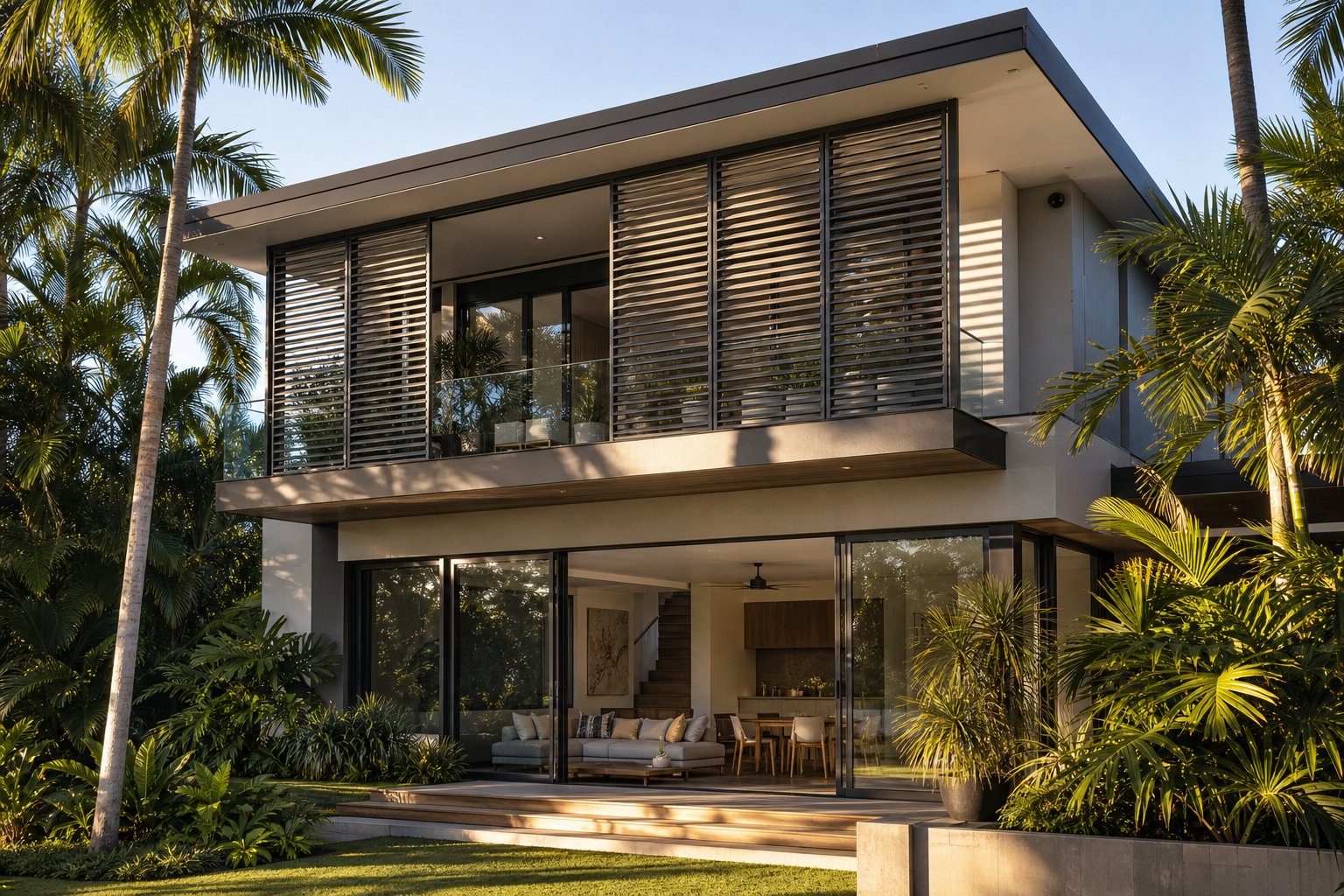
- Balcony privacy screening — providing visual separation between apartments or from street level while still permitting breeze and natural light to reach outdoor living spaces. External aluminium louvres on balconies are increasingly common in medium-density developments across Australian cities.
Security is a recurring theme in residential specification. Ground-floor openings fitted with outdoor louvers offer genuine physical resistance to intrusion because the blades cannot be removed or pried open from the outside. For families concerned about break-ins through ventilation openings, a fixed system eliminates the weak point that operable hardware can sometimes present.
Commercial and Industrial Applications
Performance expectations step up considerably in commercial and industrial settings. Airflow volumes are larger, wind loads are often higher, acoustic constraints are tighter, and compliance documentation must stack up against rigorous building certification requirements. Fixed aluminium louver windows in these environments are not decorative additions — they are critical building services infrastructure.
Typical commercial and industrial applications include:
- Plant room ventilation — providing combustion air for boilers and generators, cooling air for mechanical equipment, and general exhaust to prevent heat buildup in enclosed plant spaces.
- Mechanical services screening — concealing rooftop chillers, cooling towers, and ductwork from public view while maintaining the free area those systems need to operate efficiently.
- Car park exhaust systems — meeting code-required ventilation rates for underground and multi-level car parks, typically using large-format louver panels integrated into facade walls or vent shafts.
- Electrical switchroom ventilation — dissipating heat from transformers and switchgear to keep equipment within rated operating temperatures, often with specific free-area requirements dictated by the electrical engineer.
- Acoustic louvres for rooftop plant — attenuating noise from mechanical equipment before it reaches neighbouring properties, particularly critical for developments near residential boundaries where council noise limits apply.
In these settings, louvers outdoor on building facades must often satisfy multiple performance criteria simultaneously: adequate free area for airflow, acceptable rain penetration under design wind pressures, structural adequacy for ultimate wind loads, and sometimes fire or acoustic ratings as well. The specification process here is considerably more involved than selecting a residential vent.
Architectural and Facade Applications
Architects increasingly use fixed louvers as design elements in their own right — not just functional necessities hidden behind landscaping. A well-detailed louver screen can articulate a facade, control solar gain, provide privacy, and contribute to a building’s visual identity all at once. This dual role as both performance element and design feature explains why aluminum louvered shading systems have become so prevalent in contemporary Australian architecture.
Key architectural applications include:
- Decorative screening — creating rhythm and depth on otherwise flat facades, with blade spacing and angle chosen as much for visual effect as for ventilation performance.
- Sun shading integration — positioning fixed louver panels over glazed facades to reduce solar heat gain, particularly on west-facing elevations where afternoon sun drives cooling loads. Louvered window awnings serve both shading and ventilation functions in a single element.
- Building facade articulation — using changes in louver orientation, blade size, or panel proportion to break up large commercial facades and express different functional zones within the building.
- Visual privacy for multi-residential developments — screening balconies, corridors, and communal areas from overlooking neighbours or busy streets. Outdoor louvres at carefully chosen angles maintain outlook for residents while blocking sightlines from outside.
- Louvre awnings and canopy elements — extending louver panels beyond the building line as overhead shading structures that protect walkways and entries while maintaining an open, ventilated feel.
What makes these architectural applications distinct is the scrutiny they receive. A louver hidden in a plant room need only perform. A louver on a public facade must perform and look intentional — the finish quality, blade alignment, and frame detailing all face far closer inspection. Architects working with fixed louvre systems on visible facades typically specify tighter tolerances, premium finishes, and coordinated colour palettes that relate to other facade materials.
Across all three categories — residential, commercial, and architectural — one truth holds: the application defines the specification, not the other way around. A system that excels as a car park exhaust louver may be entirely wrong as a balcony privacy screen, even though both are technically fixed aluminium louver windows. Getting the right outcome depends on understanding not just what the product is, but how it fits into the building, how it’s sized, and how it connects to the surrounding structure.
Sizing, Spacing, and Installation Requirements for Fixed Louvre Windows
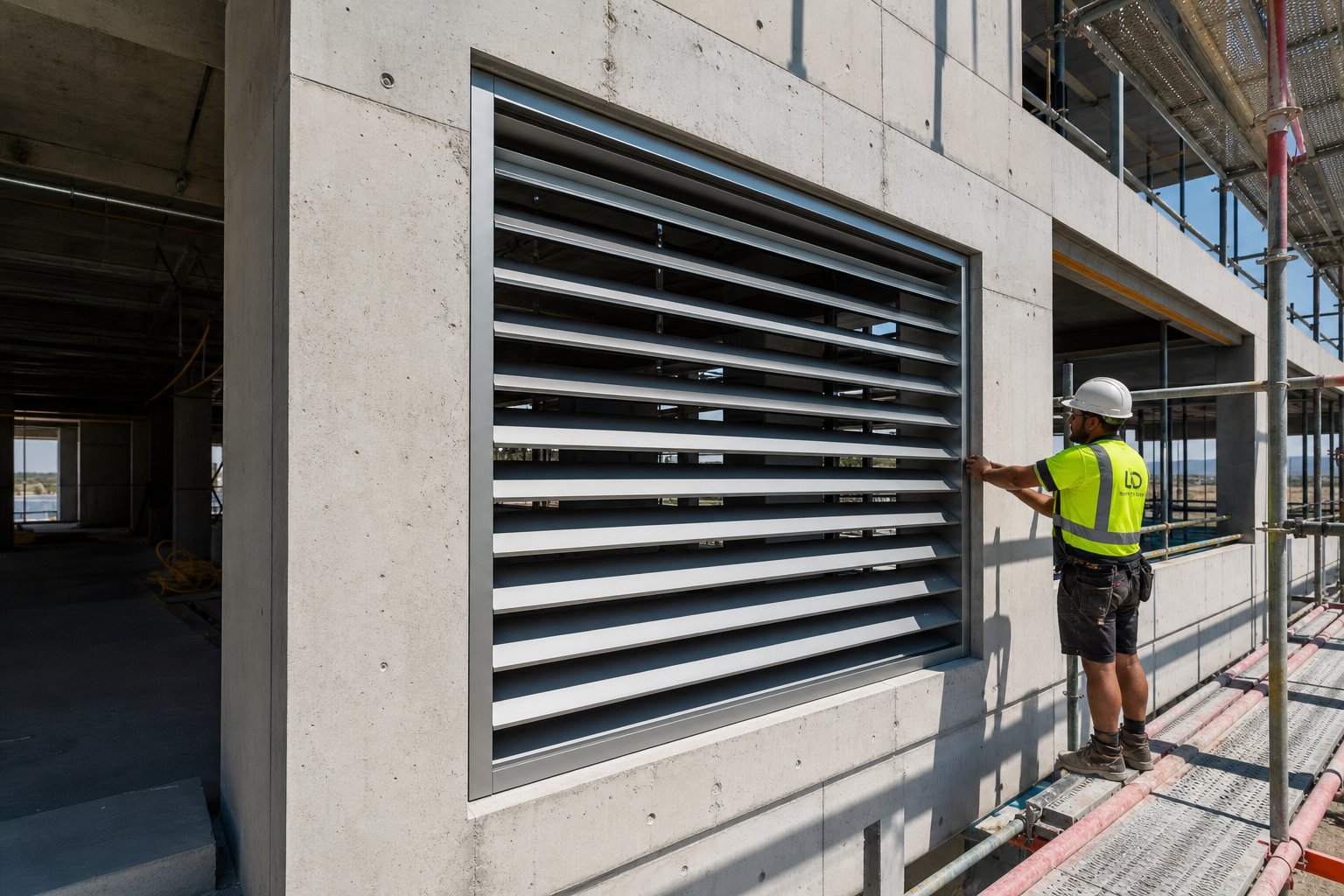
Fitting a louver into a building is not the same as fitting a standard window. A fixed louvre window has no sash, no glass, and no compression seals — its performance depends entirely on how accurately it is sized for the opening, how its blades are spaced for the required airflow, and how the panel connects to the surrounding structure. Get these details right and the system performs quietly for decades. Get them wrong and you inherit water ingress, structural inadequacy, or ventilation shortfalls that no amount of remedial work fully corrects.
Standard Sizes and Custom Configurations
Most manufacturers offer fixed aluminium louvres in standard modular panel sizes — typically ranging from 600 mm to 1,200 mm wide and up to 2,400 mm tall for single-span panels. These stock dimensions suit common openings in plant rooms, car parks, and residential subfloor vents, keeping lead times short and costs predictable.
For non-standard openings, custom manufacturing is routine. Aluminium extrusion is inherently flexible, so panels can be fabricated to virtually any rectangular dimension within structural limits. The real constraint is not the frame size but the blade span — the unsupported distance each blade must bridge between frame jambs or intermediate mullions. Exceed the maximum span for a given blade profile and the blade will deflect under wind load, compromising both structural integrity and weather performance.
Blade spacing — the centre-to-centre pitch between adjacent blades — is the other critical sizing decision. It directly controls two competing outcomes:
- Free-area ratio — the percentage of the panel’s total area that is open to airflow. Wider spacing increases free area, allowing more air through per square metre of panel.
- Visual screening — tighter spacing reduces sightlines through the panel, improving privacy and concealment of equipment behind the louver.
Common blade pitches range from 25 mm to 75 mm centre-to-centre. A 50 mm pitch with a standard blade angle typically delivers around 45–50% free area — a good general-purpose balance. Tighter pitches (25–35 mm) suit privacy screens and architectural facades where visual closure matters more than maximum airflow. Wider pitches (60–75 mm) suit industrial ventilation where moving large air volumes is the priority and appearance is secondary.
The trade-off is always the same: more air means less screening, and more screening means less air. Specifiers need to confirm the required airflow volume with the mechanical engineer before locking in blade pitch, rather than defaulting to a standard spacing that may underperform.
Structural and Frame Integration Requirements
An aluminum fixed louver panel is only as secure as its connection to the building. Unlike a glazed window that sits within a dedicated window frame and relies on compression gaskets, a louver panel must transfer significant wind loads through its fixings into the surrounding structure — and it must do so while accommodating the thermal movement that aluminium naturally undergoes.
Three primary fixing methods are used to integrate fixed louver panels into wall systems:
- Face-fixed — the louver frame is secured to the face of the surrounding wall or structural opening using through-bolts or heavy-duty screws. This is the simplest method, common in masonry, concrete, and steel-framed openings. The frame sits proud of the wall surface.
- Reveal-fixed — the panel is set within the depth of the wall opening, with fixings through the frame jambs into the reveal. This produces a flush or recessed appearance and is typical in architectural applications where a clean facade line matters.
- Structurally glazed or cassette-mounted — the louver panel clips into a carrier frame that is pre-installed within a curtain wall or unitised facade system. This method suits high-rise commercial projects where panels are installed from inside the building.
Regardless of method, tolerance management is critical. Aluminium frames are manufactured to tight dimensional tolerances (typically ±1.5 mm), but building openings — especially in concrete or masonry — can vary by 10 mm or more. Specifiers should allow for packing, shimming, and adjustable brackets to bridge this gap without distorting the louver frame, which would bind blades and compromise drainage.
Structural adequacy of the supporting wall or frame also needs verification. A large louver panel under design wind pressure can impose substantial point loads at each fixing location. For lightweight framing — steel stud walls or timber frames — additional nogging or backing plates may be required. In curtain wall applications, the mullion and transom sections must be engineered to accept the louver panel’s dead weight plus wind load reactions, much like an awning metal frame must be designed to handle both gravity and lateral forces simultaneously.
Weatherproofing and Drainage Considerations
Water management around a fixed louvre window differs fundamentally from a sealed glazed unit. The louver is intentionally open — it cannot be made watertight. Instead, the design philosophy is controlled water management: accept that some water will enter the blade zone under driven rain, and ensure it drains away before reaching the building interior.
Blade angle and overlap are the first line of defence. At a typical blade angle of 45 degrees with adequate overlap between adjacent blades, rain penetration remains minimal up to moderate wind pressures. As wind-driven rain intensity increases, some water inevitably passes through — which is why the drainage system behind the blades matters as much as the blades themselves.
A complete weatherproofing strategy for fixed aluminium louvres addresses every junction between the panel and the building envelope:
- Head flashing — a metal flashing above the louver panel that directs water running down the wall face away from the top of the frame, preventing it from entering behind the panel.
- Jamb seals — compressible foam or silicone sealant between the louver frame jambs and the wall reveal, blocking wind-driven rain from bypassing the panel edges.
- Sill drainage — the most critical detail. The louver frame sill must incorporate a drained cavity or weep system that collects any water passing through the blades and directs it to the exterior face of the wall below. Blocked or undersized drainage is the single most common cause of water damage behind louver installations.
- Panel junction seals — where multiple louver panels stack vertically or sit side by side, the joints between panels need weathering treatment. Spigot joints with internal drainage channels or external cover plates prevent water tracking between panels.
- Back pan or secondary drainage tray — in critical applications where zero water ingress is required (electrical switchrooms, data centres), a sealed metal tray behind the louver catches any residual water and drains it externally. This acts as a fail-safe independent of the louver’s own rain rejection.
For installations that function similarly to fixed aluminum awnings — projecting from the building face to shade openings below — the same drainage principles apply, but gravity works in your favour. Water captured on the blade surfaces runs to the lowest point of the awning metal frame and drips clear of the wall, provided the sill detail includes an adequate drip edge.
Specifiers should request rain penetration test data from the louver manufacturer, tested to AS 4420.5 or equivalent, at the design wind pressure for the project’s specific location and height. A louver that performs well at 150 Pa may fail at 300 Pa — and coastal or elevated sites routinely see pressures well above that threshold.
Sizing, spacing, and installation detailing are where specification translates into real-world performance. But performance is not only about keeping water out and letting air through — it also involves how the louver system interacts with the building’s thermal envelope, particularly on conditioned facades where energy efficiency is at stake.
Thermal Performance and Energy Efficiency of Aluminium Sun Shade Louvres
A fixed aluminium louver window is an intentional opening in the building envelope. That openness delivers ventilation, but it also creates a direct thermal pathway between inside and outside. On a conditioned facade — where air conditioning or heating maintains interior comfort — the louver’s interaction with solar gain, airflow, and conductive heat transfer becomes a genuine design consideration, not an afterthought.
Solar Heat Gain and Shading Performance
When fixed louvers sit outboard of glazed facades, they function as louvered sun shades, intercepting solar radiation before it reaches the glass behind. The shading coefficient — a measure of how much solar energy the system blocks — depends primarily on blade angle, blade spacing, and blade depth. Steeper angles and tighter pitches block more sun but reduce free area and daylight penetration.
Orientation matters enormously in the Australian context. North-facing facades receive high-angle sun that horizontal or near-horizontal blades reject effectively. West-facing facades are far more challenging: the low afternoon sun strikes at steep angles that can pass between blades unless the pitch is tight or the blade angle is specifically tuned for that orientation. Aluminum sunshade louvers on western elevations typically require closer spacing or deeper blade profiles than identical systems facing north, which is why a single specification rarely suits all facades of the same building.
Louvered sunshades positioned correctly can reduce solar heat gain on the glazing behind by 50–80%, depending on geometry and orientation. That reduction translates directly into smaller mechanical cooling plant and lower energy consumption across the building’s operational life.
Natural Ventilation and Energy Savings
Beyond shading, fixed louvers enable passive ventilation strategies that displace mechanical cooling entirely during mild conditions. A building designed with adequate louver free area on opposing facades can harness cross-ventilation driven by wind pressure differentials or stack effect — warm air rising and exhausting through high-level openings while cooler air enters at lower levels.
Free-area ratio is the critical metric here. A louver panel with 45% free area passes significantly less air than one with 55% free area at the same wind pressure. Building energy modelling software — used to demonstrate NatHERS compliance or Green Star credits — accounts for fixed louver systems by calculating effective ventilation rates based on free area, opening location, and prevailing wind data. Specifying a louvered awning or fixed louver panel with insufficient free area can undermine an entire natural ventilation strategy on paper, forcing the design back toward mechanical systems.
Thermal Bridging Considerations
Aluminium conducts heat roughly 1,500 times more readily than timber. Where a louver frame penetrates an insulated wall assembly on a conditioned facade, it creates a thermal bridge — a shortcut for heat to bypass the insulation layer. In winter, this bridge bleeds warmth outward. In summer, it conducts heat inward.
The fundamental tension in specifying fixed louvers on conditioned facades is this: the system must be open enough to ventilate effectively, yet its frame connections must not compromise the thermal envelope that the rest of the facade works so hard to maintain. Solving this requires treating the louver as part of the thermal strategy from the outset, not as a hole punched through it after the fact.
Mitigation strategies include polyamide thermal break strips within the frame extrusion, isolating the interior face from the exterior face. Some systems use a sub-frame arrangement where the louver panel connects to an outer carrier that is thermally separated from the inner wall lining. In practice, the severity of the issue depends on context. Fixed louvers serving non-conditioned spaces — plant rooms, car parks, bin stores — have no thermal envelope to protect, so thermal bridging is irrelevant. The concern applies specifically to conditioned facades where aluminum sun shade louvers or ventilation panels penetrate insulated wall build-ups.
Getting the thermal balance right is one piece of the performance puzzle. But performance also has to survive the forces acting on the louver over its service life — wind pressure, fire exposure, and noise transmission all demand their own compliance evidence.
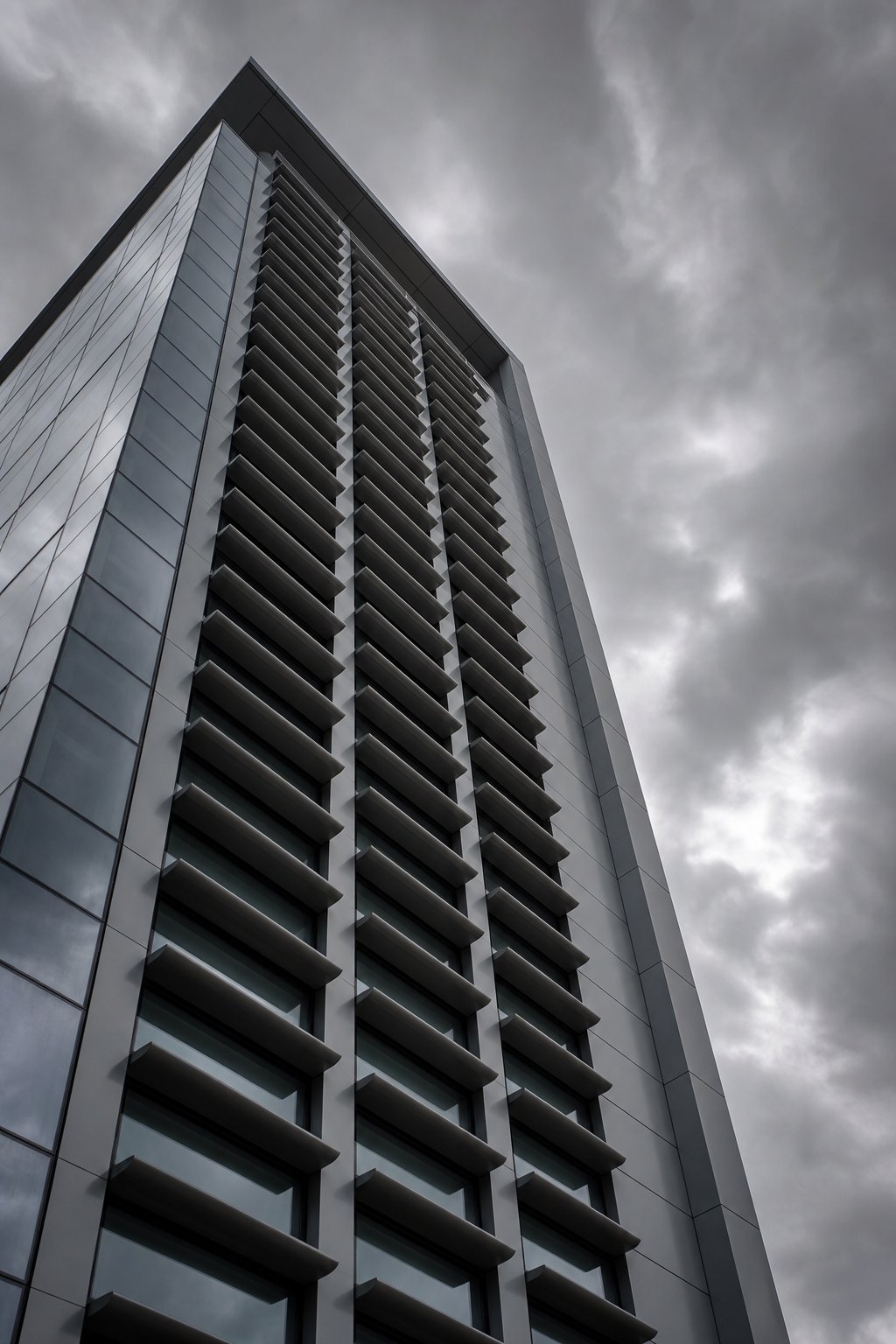
Wind Load Ratings and Building Code Compliance for Exterior Aluminum Louvers
Compliance evidence is not optional documentation — it is the proof that a fixed aluminium louver window will survive the forces your building will actually experience. Wind pressure, fire, and noise each carry their own testing regimes, rating systems, and regulatory triggers. A louver that lacks verified ratings for the conditions it faces is not just underspecified; it is a liability waiting for the next storm, the next fire compartment audit, or the next noise complaint to expose it.
Wind Load Ratings and Testing Standards
Every exterior aluminum louver mounted on a building facade must resist wind pressure — both positive pressure pushing inward and negative suction pulling outward. The magnitude of that pressure depends on the building’s height, geographic wind region, terrain category, shielding, and the louver’s position on the facade. Corner zones and upper storeys experience significantly higher pressures than sheltered mid-facade locations at lower levels.
In Australia, wind load requirements for fixed louver systems derive from AS/NZS 1170.2 (Structural design actions — Wind actions), which defines design wind speeds and pressure coefficients for the project’s specific location and building geometry. The louver itself is then tested and rated under AS 4420 (Windows — Methods of test), which includes procedures for structural adequacy under uniform pressure loading.
Two limit states govern the rating:
- Serviceability limit state (SLS) — the pressure at which the louver begins to deflect beyond acceptable limits but suffers no permanent damage. Blades may bow slightly under load but return to their original position once pressure subsides. This threshold protects against operational issues like water ingress caused by temporary blade deflection.
- Ultimate limit state (ULS) — the pressure at which structural failure occurs: blades detach, frames buckle, or fixings pull out. The system must resist ULS pressures without catastrophic failure that could endanger people below. ULS ratings are typically 1.5 to 2 times the SLS value, depending on the importance level of the building.
Three physical factors determine a louver’s wind load capacity more than anything else: blade span (the unsupported length between frame jambs or mullions), blade wall thickness, and fixing method. A longer span with the same blade section will deflect more under identical pressure. Thicker-walled extrusions resist bending better but add weight and cost. And the fixing detail — how blades connect to the frame and how the frame connects to the structure — must transfer the full wind reaction without fastener failure.
For buildings in cyclone-prone regions of northern Queensland, the Northern Territory, and parts of Western Australia, wind pressures can exceed 3,000 Pa at ultimate limit state. Aluminum wall louvers specified for these locations need heavy-duty blade profiles (typically aerofoil sections), reduced spans, and engineered fixing details with hold-down capacity verified by structural calculation. Standard catalogue products rated for temperate capital city conditions will not suffice in these environments.
Fixed metal awnings and projecting louver elements face additional complexity. Unlike flush-mounted panels, a projecting louver — similar in form to cantilever awnings — experiences both direct wind pressure on its face and uplift forces on its underside. The cantilevered fixing detail must resist overturning moments as well as direct pressure, which typically demands heavier brackets and closer fixing centres than a simple face-mounted panel. Fixed canopy metal awnings incorporating louver blades require the same structural rigour, with connections engineered to handle combined gravity loads and wind uplift simultaneously.
Fire Rating and Smoke Control
Not every louver needs a fire rating, but when one does, the consequences of getting it wrong are severe. Fire-rated louvers are required wherever a ventilation opening penetrates a fire compartment boundary — the walls and floors that contain fire spread within a building for a specified period. The National Construction Code (NCC) defines these boundaries and the fire resistance levels (FRL) they must achieve.
A standard fixed aluminium louver window offers no inherent fire resistance. Aluminium melts at approximately 660°C, well below the temperatures reached in a developed fire. Where fire separation is required, the louver must be paired with an intumescent fire damper or a motorised smoke/fire damper mounted directly behind the blade assembly. In normal conditions, the damper remains open, allowing airflow through the louver. When triggered by heat or smoke detection, the damper closes and seals the opening, maintaining compartment integrity for the rated period — typically 60, 90, or 120 minutes depending on the NCC requirement.
Smoke control is a related but distinct requirement. Smoke exhaust systems in basements, car parks, and atriums rely on louvers to provide makeup air or exhaust pathways during a fire event. These louvers must remain open and structurally intact while exposed to hot smoke — a different demand from fire separation, which requires closure. Specifiers need to distinguish clearly between:
- Fire separation louvers — paired with dampers that close to maintain compartment boundaries
- Smoke exhaust louvers — designed to remain open and functional during fire conditions, often requiring higher-temperature-rated aluminium alloys or steel blade construction
Certification to AS 1530.4 (Methods for fire tests on building materials — Fire-resistance tests) applies to the complete assembly: louver plus damper, not the louver alone. Requesting test evidence for the specific combination proposed — not just generic damper certification — is essential during procurement.
Acoustic Performance Ratings
Sound passes through a louver far more readily than through a solid wall or glazed window. That is an inherent consequence of the open area that makes ventilation possible. However, the degree of sound attenuation varies significantly between louver types, and in noise-sensitive applications — near residential boundaries, hospitals, schools, or entertainment precincts — the acoustic rating of the louver system becomes a critical specification item.
Acoustic performance for louvers is expressed as a weighted sound reduction index (Rw) measured in decibels. A standard fixed louver with flat blades and 50% free area might achieve an Rw of only 10–15 dB — modest attenuation that does little to control noise from mechanical plant. Purpose-designed acoustic louvers, using aerofoil blades with sound-absorbing infill material and reduced free area, can achieve Rw ratings of 20–35 dB, which represents a substantial reduction in transmitted noise.
Blade profile selection directly affects acoustic performance. Aerofoil sections with hollow cores allow acoustic infill (mineral wool or foam) to be inserted within the blade, absorbing sound energy as it passes through. Elliptical blades offer moderate improvement over flat profiles due to smoother airflow and less turbulence-generated noise. Flat blades provide the least attenuation and can actually generate additional noise under wind load due to turbulent flow at their sharp edges.
The trade-off, as always, involves free area. Acoustic louvers achieve their ratings partly by restricting the open area available for airflow — often down to 25–35%. Mechanical engineers must account for this reduced free area when sizing openings, which typically means larger louver panels to maintain the required ventilation rate. Cantilever awnings or projecting louver screens can sometimes accommodate the larger panel area needed for acoustic performance without consuming additional wall space, by extending the louver zone beyond the building line.
When evaluating suppliers, verify that the following standards and certifications are current and applicable to the specific product being offered:
- AS/NZS 1170.2 — Wind actions (defines the design pressures the louver must resist)
- AS 4420 — Methods of test for windows (structural, water penetration, and air infiltration testing)
- AS 2047 — Windows and external glazed doors in buildings (performance requirements, applicable where louvers form part of the window system)
- AS 1530.4 — Fire resistance tests (for fire-rated louver and damper assemblies)
- AS 1191 — Acoustics — Method for laboratory measurement of airborne sound insulation (for Rw ratings)
- NCC Section C (Fire resistance) and Section J (Energy efficiency) — compliance pathways that may reference louver performance
- Cyclone testing certification — for projects in wind region C or D, evidence of testing to the specific ultimate limit state pressures required
- Product-specific wind pressure test reports — not generic claims, but reports identifying the exact blade profile, span, and fixing detail tested
A supplier who cannot produce current test reports for the product configuration you are specifying is asking you to accept unverified performance claims. In compliance terms, that gap transfers risk from the manufacturer to the specifier and builder — a position no project team should accept willingly.
Ratings and certifications confirm what a louver can withstand. But surviving extreme events is only part of the long-term picture. How the system ages — how its finish holds up, how little attention it demands over decades of service — determines whether that initial specification investment continues to pay off year after year.
Maintenance, Lifespan, and Long-Term Value of Aluminium Louvered Shutters Exterior
Ratings tell you what a louver can survive. Finish selection and maintenance practice determine how long it looks and performs like it should. Aluminium does not rust — that is its fundamental advantage over steel — but it is not immune to degradation. Surface oxidation, coating breakdown, and sealant failure all occur over time, and the rate depends heavily on the environment and the protective finish system applied at manufacture.
Expected Lifespan by Finish Type
The aluminium substrate itself is remarkably durable. Left uncoated, it forms a thin oxide layer that protects against further corrosion in mild environments. But on a building facade, appearance matters as much as structural survival, and that is where finish selection drives longevity.
Three finish systems dominate the market for fixed aluminium louver windows:
- Powder coating — the most common finish for residential and standard commercial applications. Quality polyester powder coatings carry warranties of 10–15 years against chalking, fading, and peeling in urban and light-industrial environments. In aggressive coastal locations (within 1 km of breaking surf), standard powder coatings degrade faster, and marine-grade formulations or more frequent maintenance become necessary.
- Anodising — an electrochemical process that converts the aluminium surface into a hard, integral oxide layer rather than applying a coating on top. Anodised finishes are extremely scratch-resistant and weather well in most Australian climates, with expected service lives of 20–30 years. They perform particularly well in coastal zones because the oxide layer is part of the metal itself, not a film that can delaminate.
- PVDF (polyvinylidene fluoride) coatings — the premium option for high-exposure facades. PVDF finishes, often marketed under brand names like Dulux DuraFlex or similar fluoropolymer systems, resist UV degradation, chemical attack, and colour fade far longer than standard powder coatings. Warranties of 20–25 years are typical, with actual service lives often exceeding 30 years on well-maintained installations.
Environment is the multiplier. A louver in a sheltered suburban setting will outlast an identical product on an exposed coastal headland by a significant margin, regardless of finish type. Specifiers should match the finish system to the corrosion category of the site — AS 2312 provides guidance on atmospheric corrosivity classifications across Australian environments.
Maintenance Requirements for Fixed Louvers
This is where fixed systems genuinely distinguish themselves from operable alternatives. No hinges to lubricate. No linkage bars to adjust. No actuators to recalibrate. No gaskets to replace. The absence of moving parts eliminates the entire mechanical servicing regime that operable louvers demand throughout their life.
What remains is straightforward: periodic cleaning and visual inspection. For most installations, that means washing blade surfaces with mild detergent and fresh water to remove accumulated dirt, salt deposits, and biological growth. The cleaning removes contaminants that would otherwise attack the protective finish over time — particularly salt in coastal areas, which accelerates coating breakdown if left to accumulate.
Beyond cleaning, inspection should focus on two areas where degradation can occur silently: sealant joints between the louver frame and the building structure, and the mechanical fixings that hold the panel in place. Sealant has a finite life — typically 15–20 years for quality silicone — and will eventually crack, shrink, or lose adhesion. Fixings in coastal environments can suffer from galvanic corrosion if dissimilar metals are in contact, particularly stainless steel fasteners in direct contact with aluminium without isolating washers.
Compared to decorative aluminum shutters exterior or operable window shutter aluminium systems — both of which involve hinges, latches, and sometimes motorised components — a fixed louver’s maintenance profile is remarkably lean. The following schedule covers most installations:
- Every 6 months (coastal or industrial sites) — wash all blade and frame surfaces with fresh water and mild detergent to remove salt and pollutant deposits
- Every 12 months (urban and suburban sites) — general wash-down of blade surfaces; inspect drainage channels and weep holes for blockages
- Every 2–3 years — inspect sealant joints for cracking, shrinkage, or loss of adhesion; check fixing integrity and look for signs of galvanic corrosion at fastener locations
- Every 5 years — detailed condition assessment of coating finish, looking for chalking, micro-cracking, or localised coating loss; clean and re-seal any failed sealant joints
- Every 10–15 years — assess whether recoating or localised touch-up is warranted based on finish condition; replace any degraded sealant runs in full
That is the entire maintenance programme. For a building owner accustomed to servicing operable aluminum shutter hardware, motorised louvre actuators, or timber window components, the simplicity is striking.
Total Cost of Ownership Considerations
Upfront cost comparisons between louver systems often mislead because they ignore what happens after installation day. A fixed aluminium louver window typically costs less than an equivalent operable system at purchase — no mechanism, no actuator, no complex hardware — and then costs dramatically less to maintain over its service life.
Consider a typical commercial plant room louver over a 30-year building life. The fixed system requires periodic cleaning and perhaps one sealant replacement cycle. The operable alternative requires the same cleaning plus regular mechanism servicing, gasket replacements every 8–12 years, and potentially actuator replacement at least once. On a multi-storey facade where scaffold or abseil access is needed for any maintenance activity, the cost difference compounds rapidly — each site visit carries a significant access cost regardless of how minor the work itself might be.
Alternatives with lower initial cost — painted steel louvers, for instance, or aluminum louvered shutters exterior with operable blades — often appear cheaper at tender stage but accumulate higher whole-of-life expenditure through repainting cycles, corrosion remediation, or mechanism overhauls. Aluminum shutters exterior in fixed configurations avoid these ongoing costs entirely, which is why lifecycle cost analysis consistently favours quality aluminium fixed systems for any application where adjustability is not genuinely required.
The long-term value proposition is simple: invest appropriately at specification stage — in the right alloy, the right finish for the environment, and the right installation detail — and the system repays that investment through decades of reliable, low-cost service. Skimp on any of those elements, and the savings evaporate into premature remedial work.
Understanding lifespan and maintenance costs completes the performance picture. The remaining question is practical: how do you translate all of this knowledge — blade profiles, wind ratings, finish systems, drainage details — into a coherent specification that delivers the right product for your project?
How to Select and Specify the Right Fixed Aluminium Louvre System
Knowledge without action is just research. Everything covered so far — blade profiles, wind ratings, thermal performance, finish systems, drainage details — only delivers value when it translates into a specification document that tells a manufacturer exactly what your project needs. The gap between understanding louver performance and actually procuring the right system comes down to a structured approach: know what to specify, know what to ask, and know who can deliver it.
Key Specification Criteria Checklist
A well-written louver specification eliminates ambiguity. It gives tenderers a clear performance target and gives you a measurable basis for evaluating what they offer. Work through these criteria in order — each decision informs the next:
- Determine the required free-area ratio — confirm with the mechanical engineer how much open area the louver must provide to meet ventilation rates. This single number drives blade pitch, panel sizing, and overall opening dimensions. Without it, every other decision is guesswork.
- Select the appropriate blade profile for site conditions — match flat, elliptical, or aerofoil geometry to the wind exposure, acoustic requirements, and aesthetic expectations of the application. Exposed upper-storey facades and cyclone regions demand aerofoil. Sheltered plant rooms can use flat profiles economically.
- Confirm wind load requirements — calculate design wind pressures for the specific building location, height, and facade zone using AS/NZS 1170.2. Specify both serviceability and ultimate limit state ratings the louver must achieve, and request test evidence to those exact pressures.
- Specify the finish system for the project environment — match powder coating, anodising, or PVDF to the site’s corrosion category. Coastal projects within 1 km of surf need marine-grade finishes or anodising. Inland urban sites can use standard polyester powder coat confidently.
- Verify compliance certifications — require current test reports for wind resistance (AS 4420), rain penetration at design pressure, acoustic rating (where applicable), and fire damper integration (where required). Generic brochure claims are not certification.
This sequence works because each step narrows the field. By the time you reach step five, you are evaluating specific products against defined performance criteria rather than comparing brochures full of unsubstantiated marketing language.
Questions to Ask Your Louver Supplier
A specification only works if the supplier can actually deliver against it. These questions separate manufacturers with genuine capability from those reselling generic product with limited technical support:
- Can you provide current, project-specific wind pressure test reports for the blade profile and span I am specifying — not generic catalogue data?
- What blade profiles are available, and what is the maximum unsupported span for each at my required wind pressure rating?
- What finish systems do you offer, and what warranty applies for my site’s corrosion category?
- Do you supply aluminium louvre windows with integrated drainage systems, or is drainage detailing left to the installer?
- Can you provide acoustic test data (Rw rating) for the specific louver configuration proposed?
- What is your current lead time for custom-sized aluminium louvres, and does that change for non-standard finishes?
- Do you offer project support — shop drawings, structural calculations, installation guidance — or is the product supply-only?
- If my project also requires aluminum awning windows, facade panels, or balustrade systems, can you supply those from the same product range to ensure finish consistency and coordinated detailing?
That last question matters more than it might seem. Projects rarely need louvers in isolation. The same facade often incorporates aluminium louvres alongside glazed windows, aluminum awnings for windows, entry doors, and screening elements. When these come from different suppliers with different alloy batches, different powder coat lines, and different frame systems, colour matching becomes difficult and interface detailing becomes the builder’s problem to solve on site.
Finding a Supplier With a Complete Product Range
The most efficient procurement path — particularly for commercial and multi-residential projects — runs through suppliers who offer integrated aluminium systems rather than standalone louver products. A supplier providing fixed louvers, aluminum awning windows, sliding doors, facade framing, and balustrades from a single coordinated range eliminates the colour-matching headaches, reduces the number of trade interfaces on site, and simplifies warranty accountability.
MEICHEN, for example, supplies fixed aluminium louver systems alongside their complete range of aluminium windows, doors, facade systems, and balustrades for Australian building projects. For builders and architects coordinating multiple aluminium elements across a facade, sourcing from a single provider like MEICHEN means one set of shop drawings, one powder coat batch, and one point of contact when questions arise during installation. That coordination saves time during procurement and reduces risk during construction — practical benefits that compound across larger projects with dozens or hundreds of openings.
Whether your project involves a single aluminum window awning above a residential entry or hundreds of square metres of acoustic louver screening on a commercial tower, the specification process remains the same: define performance requirements first, then find a supplier whose product range, testing evidence, and project support capability match what the building actually demands. A fixed aluminium louver window is only as good as its spec — and a spec is only as good as the supplier standing behind it.
Frequently Asked Questions About Fixed Aluminium Louver Windows
1. What is the difference between a fixed and operable aluminium louver window?
A fixed aluminium louver window has permanently angled blades locked into the frame, providing constant ventilation with zero moving parts. Operable louver windows allow occupants to rotate blades open or closed using handles or actuators. Fixed systems offer superior security, longer lifespan (30-50+ years versus 20-35 years for operable), and near-zero maintenance since there are no hinges, linkages, or gaskets to service. However, they cannot adjust airflow — the ventilation rate is set at manufacture. Choose fixed when constant unattended ventilation is needed, such as plant rooms, car parks, or subfloor spaces. Choose operable when occupants need to modulate airflow in habitable rooms.
2. How do I choose the right blade profile for a fixed aluminium louver?
Three blade profiles serve different conditions. Flat blades are the most economical, suited to sheltered locations like plant rooms and basement car parks where wind noise is not a concern. Elliptical blades feature a curved cross-section that reduces turbulence and noise, making them ideal for commercial facades and multi-residential screening. Aerofoil blades offer the highest structural strength, lowest wind noise, and best rain rejection — specified for high-rise buildings, cyclone-prone regions, and noise-sensitive applications near residential boundaries. Match the profile to your site’s wind exposure, acoustic requirements, and budget. A sheltered ground-floor opening rarely justifies aerofoil cost, while an exposed upper-storey facade should not rely on flat blades.
3. What maintenance do fixed aluminium louver windows require?
Fixed aluminium louvers require minimal maintenance compared to operable systems. For coastal or industrial sites, wash blade and frame surfaces every six months with fresh water and mild detergent to remove salt deposits. Urban and suburban installations need annual wash-downs plus drainage channel inspections. Every two to three years, check sealant joints and fixing integrity for signs of degradation or galvanic corrosion. A detailed coating assessment every five years identifies any chalking or micro-cracking. The entire regime involves no mechanical servicing — no lubrication, no gasket replacement, no actuator recalibration — which is why whole-of-life costs are significantly lower than operable alternatives, particularly on multi-storey facades where access costs are high.
4. What wind load ratings should I specify for fixed aluminium louvers in Australia?
Wind load requirements are calculated using AS/NZS 1170.2 based on your building’s geographic wind region, height, terrain category, and facade zone position. Louvers must satisfy both serviceability limit state (SLS) — where blades deflect but recover without damage — and ultimate limit state (ULS) — where the system must not fail catastrophically. Cyclone-prone regions in northern Queensland, the NT, and parts of WA can see ultimate pressures exceeding 3,000 Pa, requiring heavy-duty aerofoil blades with reduced spans and engineered fixings. Always request product-specific wind pressure test reports from your supplier for the exact blade profile, span, and fixing detail you are specifying, tested to AS 4420.
5. Can fixed aluminium louvers improve a building’s energy efficiency?
Yes, in two ways. When positioned outboard of glazed facades, fixed louvers act as sun shades that can reduce solar heat gain by 50-80%, lowering mechanical cooling loads significantly. The shading effect depends on blade angle, spacing, and facade orientation — west-facing elevations in Australia need tighter blade pitches than north-facing ones due to low afternoon sun angles. Second, fixed louvers enable passive cross-ventilation strategies that can displace mechanical cooling during mild conditions. Building energy modelling for NatHERS compliance or Green Star credits accounts for louver free-area ratios when calculating natural ventilation performance. Suppliers like MEICHEN offer integrated aluminium louver and facade systems that coordinate shading, ventilation, and glazing performance across the full building envelope.
More Window & Door Guides