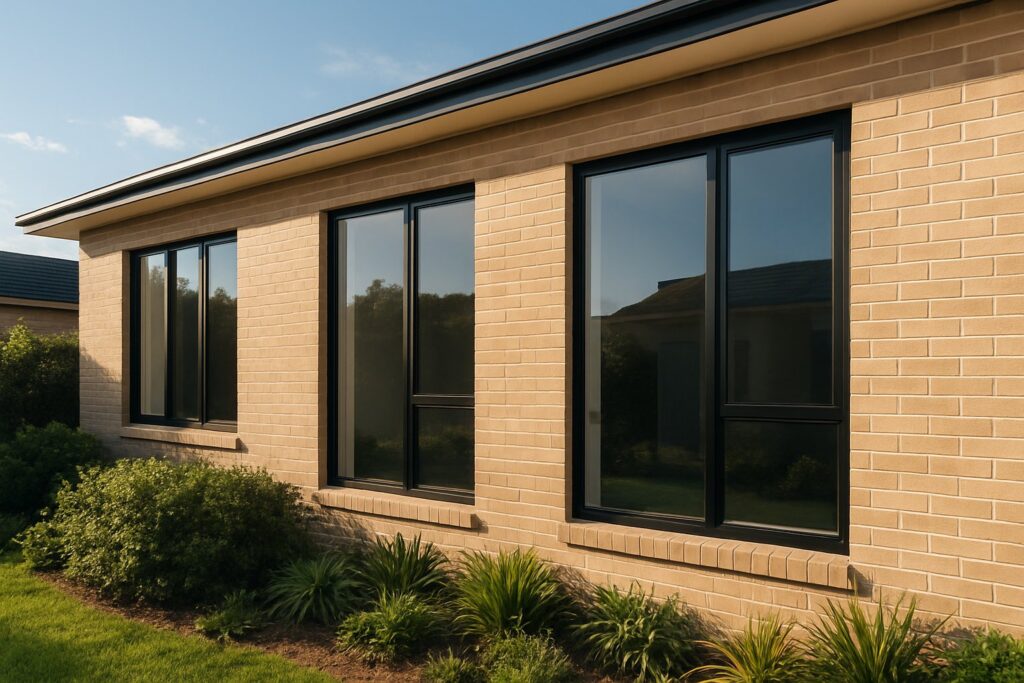
What Aluminium Window Security Grilles Are and Why They Matter
If you have ever wondered what is a window grill in the context of genuine property protection, the answer goes well beyond those thin decorative bars you see on heritage cottages. Aluminium window security grilles are purpose-built barriers designed to prevent forced entry through window openings while resisting cutting, prying, and impact attacks. They sit in a category of their own, distinct from ornamental trims that serve only a visual role.
Aluminium window security grilles are fixed or operable barrier systems constructed from extruded or welded aluminium sections, engineered to resist forced entry while offering corrosion resistance, lightweight installation, and powder-coated colour matching to complement building facades.
What Are Aluminium Window Security Grilles
At their core, these grilles consist of solid or hollow aluminium bars, tubes, or flat sections joined by welding or mechanical fastening into a rigid frame. That frame is then anchored to the window reveal, the surrounding wall, or the window frame itself using tamper-resistant fixings. The result is a physical barrier rated to withstand sustained attack from common break-in tools. Unlike a simple safety grill intended to stop accidental falls, security grilles for windows are tested against deliberate force.
Decorative vs High-Security Grilles
A common misconception is that all window grates serve the same purpose. Decorative grilles use thinner material, lighter gauge sections, and standard screws. They look attractive but offer minimal resistance to a determined intruder. Genuine security grilles use thicker-walled extrusions, reinforced corner joints, and concealed or one-way fixings that cannot be removed from the outside. The distinction matters because choosing the wrong category leaves a property vulnerable despite the visual appearance of protection.
Why Aluminium as a Material Choice
Aluminium brings three practical advantages to security grille construction. First, it is roughly one-third the weight of steel, which means less structural load on window frames and surrounding masonry, particularly relevant for older Australian brick veneer and weatherboard homes. Second, it forms a natural oxide layer that resists corrosion without ongoing treatment, a significant benefit in coastal areas from Sydney’s eastern suburbs to Perth’s beachside corridors. Third, aluminium accepts powder-coating readily, opening up virtually unlimited colour options that integrate with existing window frames rather than clashing with them.
The idea that aluminium is too weak for security work is outdated. Modern alloy grades used in security grilles deliver impressive strength-to-weight ratios, and the extrusion process allows engineers to design cross-sections that maximise rigidity exactly where force is applied. These are not flimsy window grates. They are engineered barriers that happen to look far better than the prison-bar aesthetic most people picture when they hear the word “security grille.”
Still, material choice is only one piece of the puzzle. The type of grille you select, whether fixed, hinged, sliding, or retractable, determines how that material performs in your specific situation.
Types of Aluminium Security Grilles and When to Use Each
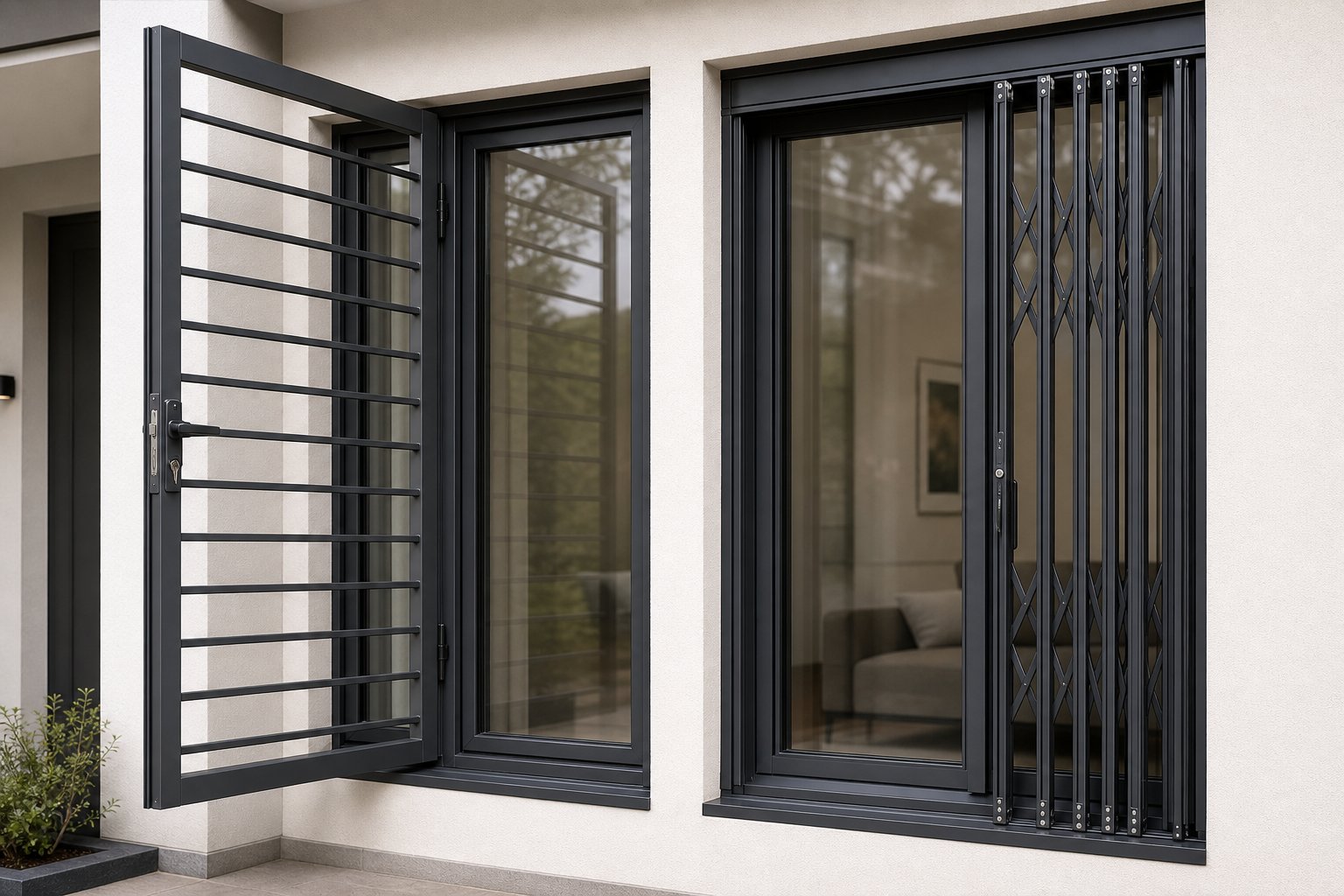
Not every window faces the same threat, and not every occupant has the same access needs. A basement window in a laneway-facing Melbourne apartment demands a different solution than a wide shopfront in suburban Brisbane. The five main types of security window grilles each solve a specific problem, and picking the wrong one creates either a safety hazard or a security gap.
Fixed Aluminium Security Grilles
Fixed grilles are permanently anchored to the wall or reveal with no moving parts. They deliver the highest resistance to forced entry because there are no hinges, latches, or tracks that an intruder can exploit. For ground-floor windows that never need to serve as an exit, such as narrow bathroom windows or storage-area openings, fixed grilles are the simplest and most cost-effective window security grill option.
The trade-off is obvious. A fixed grille cannot be opened from inside during a fire or other emergency. In bedrooms, living areas, and any room where occupants sleep, this limitation makes fixed grilles unsuitable unless alternative egress routes exist nearby.
Removable and Hinged Options
Removable grilles attach with keyed bolts or quick-release pins, allowing the entire panel to be taken off when access is needed. They suit seasonal situations, think holiday homes left unoccupied for months, where grilles go on before departure and come off on return. Security is solid when installed, but the system relies on the owner actually fitting them.
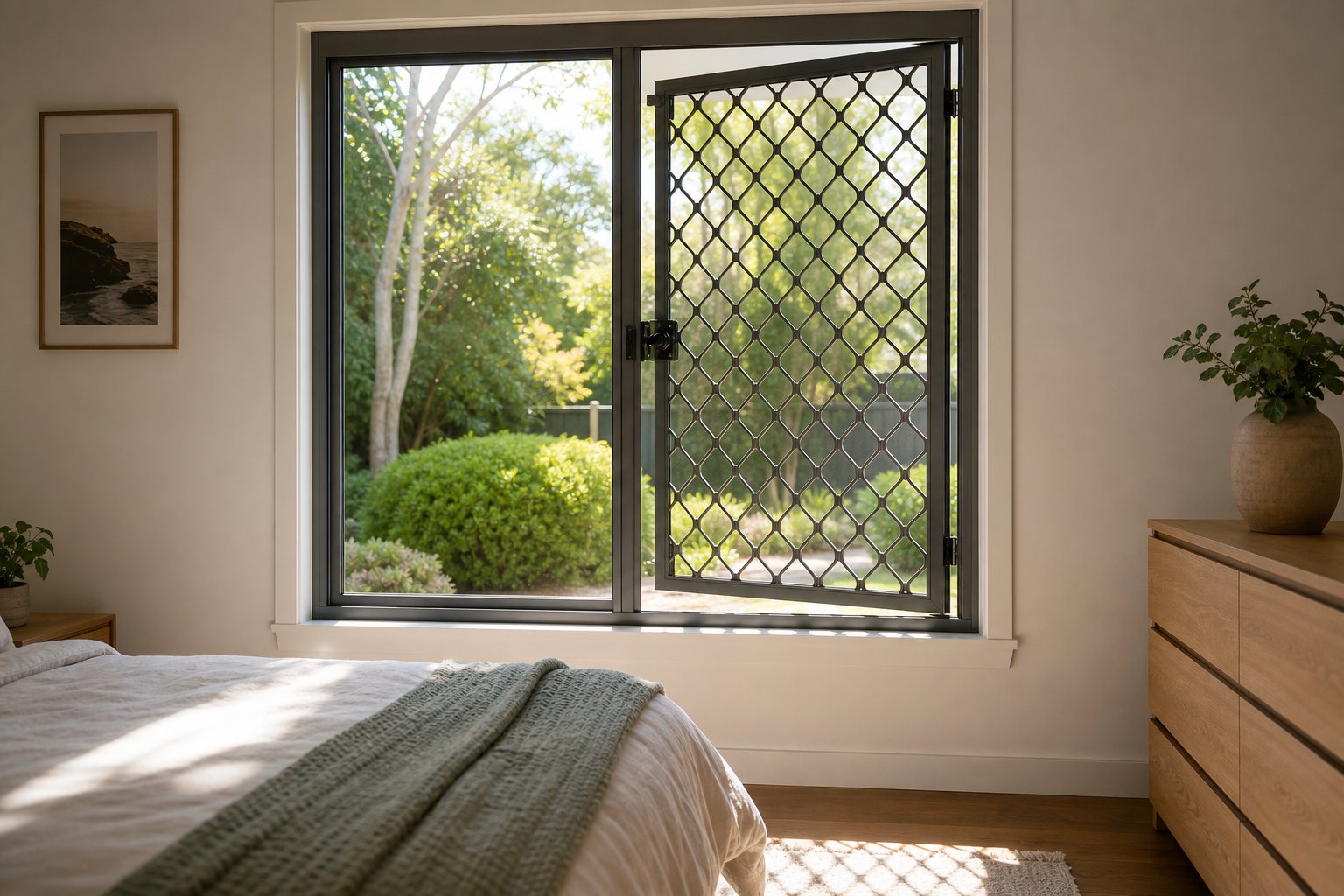
Hinged grilles swing open like a gate, secured by a lock when closed. They strike the balance most Australian homes need: strong deterrence during daily life, with a clear escape path during emergencies. A keyed or thumb-turn lock on the inside lets occupants open the grille in seconds. Fire authorities across Australian jurisdictions generally accept hinged grilles as egress-compliant provided the release mechanism does not require tools or special knowledge to operate.
Sliding and Retractable Window Grilles
Sliding grilles run on top and bottom tracks, stacking to one side when opened. They work well for wide openings, such as external window grilles on commercial shopfronts or large residential sliding windows, where a hinged panel would protrude too far into a walkway or balcony.
Retractable window grilles take the concept further. Their concertina or lattice design folds into a compact stack at one side of the frame, virtually disappearing when not deployed. During business hours or daylight, the grille stays folded and the facade looks unobstructed. At night or when the premises are unoccupied, it extends across the full opening. The visual impact is minimal, though the folding mechanism introduces more moving parts, which means slightly higher maintenance over time.
| Grille Type | Security Level | Egress Compliance | Aesthetic Impact | Cost Range | Best Application |
|---|---|---|---|---|---|
| Fixed | High | Non-compliant (no opening) | Moderate | Low | Non-habitable rooms, storage areas, basements |
| Removable | High (when fitted) | Compliant (when removed) | Low (when removed) | Low–Medium | Holiday homes, seasonal properties |
| Hinged | High | Compliant (with quick-release lock) | Moderate | Medium | Bedrooms, living areas, residential ground floors |
| Sliding | Medium–High | Compliant (slides open) | Moderate | Medium–High | Wide openings, shopfronts, commercial premises |
| Retractable | Medium | Compliant (folds open) | Low (folds away) | High | Retail frontages, heritage buildings, design-sensitive facades |
Each type occupies a clear niche. The real question most property owners face is not which grille looks best in isolation, but which one satisfies both their security requirements and the material demands of their specific climate and budget.
Aluminium vs Steel vs Wrought Iron for Window Security
Climate, budget, and the wall your grille bolts into all influence which metal grille makes sense. Four materials dominate the market, each with a distinct performance profile that matters far more than raw strength alone.
Aluminium vs Steel Security Grilles
Mild steel is the traditional choice for a steel grille, and for good reason. It is strong, widely available, and relatively inexpensive to fabricate. A steel security grille resists cutting and prying with brute material hardness that aluminium cannot match on a like-for-like section size. But steel carries penalties. It weighs roughly three times more per square metre, which places significant load on window reveals, particularly in older brick veneer or weatherboard homes common across Australian suburbs. Installers often need heavier anchors and sometimes structural reinforcement around the opening.
Corrosion is the bigger long-term issue. Steel rusts the moment its protective coating is compromised. A scratch from a ladder, a chip from hail, or simple UV degradation of paint exposes bare metal to moisture. In coastal zones from the Gold Coast to Fremantle, unprotected steel can show surface rust within a single wet season. Aluminium’s natural oxide layer regenerates when scratched, making it effectively self-healing against corrosion without any applied coating at all.
Powder-coating further separates the two. On aluminium, powder coat bonds to the oxide layer and typically lasts fifteen to twenty years in Australian conditions before needing attention. On steel, the same coating sits over a primer that must first arrest any oxidation. If that primer fails at any point, rust creeps beneath the powder coat from the inside out, a problem that is invisible until the finish bubbles.
Wrought Iron and Stainless Steel Alternatives
Wrought iron delivers a classic aesthetic that suits heritage-listed properties and period homes. Its hand-forged look is difficult to replicate in other materials. However, wrought iron is the heaviest option, demands regular repainting, and offers limited colour versatility since most finishes are brush-applied rather than powder-coated. For metal window grates on a Victorian terrace in inner Melbourne, wrought iron may be the only visually appropriate choice, but the maintenance commitment is substantial.
Stainless steel sits at the premium end. Grade 316 stainless resists corrosion even in direct salt spray, making it theoretically ideal for beachfront apartments. The catch is cost, often two to three times the price of aluminium for equivalent coverage, and limited colour options since stainless is typically left in its natural brushed or polished finish. It also cannot be powder-coated using standard processes, which restricts facade integration.
Which Material Suits Your Climate and Budget
For most Australian residential projects, aluminium’s strength-to-weight ratio hits the practical sweet spot. It installs without structural modification, survives coastal and humid subtropical climates with minimal upkeep, and accepts any powder-coat colour to blend with existing window frames. Steel makes sense where maximum brute-force resistance is the priority and the owner accepts ongoing maintenance. Wrought iron belongs on heritage properties where appearance outweighs practicality. Stainless steel suits high-budget, high-exposure commercial installations where long-term corrosion immunity justifies the premium.
| Property | Aluminium | Mild Steel | Wrought Iron | Stainless Steel (316) |
|---|---|---|---|---|
| Weight per m² (relative) | Low | High | Very High | High |
| Corrosion Resistance | Excellent | Poor (without coating) | Poor | Excellent |
| Strength Rating | Good | Very High | High | Very High |
| Maintenance Frequency | Very Low | High (repaint every 3–5 yrs) | High | Very Low |
| Colour Options | Unlimited (powder coat) | Wide (powder coat or paint) | Limited (brush paint) | Very Limited (natural finish) |
| Relative Cost | Medium | Low–Medium | Medium–High | High |
Metal grilles made from any of these four materials can stop an intruder. The difference lies in what happens over the following decade: how much repainting you face, whether your wall can carry the load, and how well the grille ages against your local climate. Those practical realities determine where each metal grill type genuinely belongs, and they also shape where on your property the grilles should be installed in the first place.
Where Aluminium Security Grilles Make the Most Sense
Knowing which metal to choose is only half the decision. The other half is figuring out whether grilles are the right answer for your specific openings, or whether a different security layer would serve you better. Context matters. A ground-floor bedroom window in a laneway-facing Sydney terrace faces a completely different risk profile than a fourth-floor apartment balcony door.
Residential Applications for Ground and Basement Windows
Most residential break-ins target the path of least resistance, and that usually means ground-floor or basement windows hidden from street view. Security grids for windows at these vulnerable points create a physical barrier that forces an intruder to spend time and make noise, two things they actively avoid. Rear-facing windows, side passages, and below-grade basement openings are the highest-priority locations for aluminium grilles in any home.
Rental properties add another layer. Landlords in Australia have obligations under residential tenancy legislation to provide premises that are reasonably secure. Ground-floor units in older walk-up blocks often lack modern locking hardware, and aluminium security grilles offer a durable upgrade that satisfies duty-of-care requirements without ongoing maintenance burden for property managers.
Commercial and Retail Security Grille Uses
Commercial premises face different threats. Shopfronts need after-hours protection that disappears during trading. Warehouses require permanent coverage over louvre windows and ventilation openings. Office parks in industrial estates often specify commercial window security bars across accessible ground-level glazing as part of their insurance compliance. In each case, the combination of security grilles and gates across entries and window openings creates a layered perimeter that satisfies both insurers and local crime prevention guidelines.
When Other Security Solutions May Be Better
Aluminium grilles are not always the strongest answer. Some situations call for alternatives that offer less visual impact or address threats that a physical grille cannot solve.
Aluminium grilles are the strongest choice when:
- Ground-floor or basement windows are accessible from laneways, car parks, or concealed areas
- The property is unoccupied for extended periods (holiday homes, seasonal rentals)
- Insurance requirements specify physical barrier protection on openings
- Commercial premises need after-hours shopfront security that opens during trade
- Coastal or humid climates rule out ferrous metals due to corrosion risk
Alternatives may outperform grilles when:
- Upper-storey windows are inaccessible without a ladder, where a monitored alarm system provides sufficient deterrence
- Heritage overlays or body corporate rules prohibit visible external fixtures, making a security mesh screen for windows a less obtrusive option
- The primary threat is impact rather than forced entry, where laminated or toughened glass handles the load without any external addition
- Full facade transparency is essential for retail display, where internal security film combined with sensor alarms may be preferable
- Budget constraints are severe and the risk level is low, where upgraded window locks and sensor lighting deliver adequate protection at a fraction of the cost
Self-qualifying early saves time and money. If your situation lands firmly in the first list, the next consideration is ensuring your chosen grille meets fire safety codes and building regulations, a topic that catches many property owners off guard.
Building Codes, Fire Safety, and Legal Requirements
A security grille that traps occupants during a house fire is not a security measure. It is a liability. This is the tension every property owner must resolve: how to stop intruders from getting in without preventing people from getting out. Australian building regulations take this tension seriously, and getting it wrong carries consequences that range from council orders to remove non-compliant installations through to criminal negligence charges in the worst-case scenario.
Security grilles for doors and windows must never prevent occupants from escaping during an emergency. Any grille covering a required egress window or exit must be operable from the inside without keys, tools, or special knowledge.
Fire Safety and Emergency Egress Requirements
The National Construction Code (NCC) sets the baseline for emergency egress across all Australian states and territories. For residential buildings, the NCC requires that bedrooms and habitable rooms have access to an exit path that does not rely on a key or removable device. A fixed grille bolted permanently over a bedroom window violates this principle outright.
Hinged grilles with internal thumb-turn releases satisfy egress requirements because occupants can swing the grille open in seconds, even in darkness or smoke. The mechanism must not require fine motor skills or prior knowledge. Children, elderly residents, and guests unfamiliar with the property all need to operate it instinctively. Some manufacturers offer panic-bar style releases for commercial applications, similar to those found on fire doors, which activate with a single push.
Sliding and retractable grilles also comply provided they move freely without a lock engaged from the inside during occupied hours. The critical distinction is between a door window security grill that locks with a key versus one that uses an internal-only latch. If a key is required to open the grille from inside, it fails the egress test regardless of how strong or well-designed the unit is.
Building Code Compliance for Security Grilles
Beyond egress, local council regulations add another layer. Each state and territory interprets the NCC slightly differently, and individual councils may impose additional requirements. In Queensland, for example, properties in cyclone-rated areas must ensure that any external fixture, including security grilles, can withstand specified wind loads without becoming dangerous projectiles. In bushfire-prone zones rated BAL-29 or above, external metal fixtures may need to meet ember-attack resistance criteria.
Heritage overlays present a separate challenge. Properties listed on state or local heritage registers often require development application (DA) approval before any external modification, including the installation of a security grill for door window openings or facade-facing windows. Councils in areas like inner Sydney, Melbourne’s heritage suburbs, and historic Queensland townships routinely reject applications where grilles visually compromise a listed facade.
Commercial installations face stricter scrutiny. The NCC’s commercial building provisions require that all required exits remain unobstructed at all times during occupation. A shopfront fitted with security grilles for doors and windows must have those grilles fully retracted or opened before the premises are occupied by staff or public. Automated systems with timer controls or fire-alarm integration help commercial operators meet this requirement without relying on manual procedures each morning.
Landlord and Tenant Legal Considerations
Landlords occupy a legally complex position. Residential tenancy legislation in every Australian state requires landlords to provide and maintain premises in a reasonable state of repair, including security. If a ground-floor rental property has a history of break-in attempts, a tenant may reasonably request that the landlord install security grilles. Conversely, a landlord cannot install fixed grilles that compromise egress without the tenant’s informed consent and code compliance.
Tenants also have the right to quiet enjoyment of the property. Installing grilles that make windows inoperable, block natural light excessively, or create a sense of confinement may breach this right. The practical solution is hinged or operable grilles that the tenant can open during the day and secure at night, preserving both safety and liveability.
Body corporate and strata schemes add further complexity for apartment buildings. External modifications typically require committee approval, and many schemes have by-laws specifying acceptable colours, styles, and installation methods to maintain uniform building appearance.
Steps to verify compliance before installation:
- Identify which windows in your property are required egress points under the NCC (typically all bedrooms and habitable rooms without alternative exits).
- Contact your local council to confirm whether a development application or building approval is needed for external grille installation in your area.
- Check whether your property falls under heritage, bushfire (BAL), or cyclone-rated overlays that impose additional requirements.
- Select a grille type that allows internal opening without keys or tools for all egress-required windows.
- Confirm that your chosen installer provides documentation of compliance with relevant Australian Standards and the NCC.
- For rental properties, notify tenants in writing before installation and confirm the grille type does not restrict their use of required exits.
- For strata properties, submit a modification request to the body corporate committee and obtain written approval before proceeding.
Sorting out compliance before you order a single grille prevents costly rework. It also sets you up for the next practical step: measuring your window openings accurately so the grilles you have chosen actually fit the spaces they need to protect.
How to Measure Windows for Security Grille Installation
A perfectly specified grill for windows becomes an expensive paperweight if the measurements are wrong. Aluminium grilles are fabricated to order, and most manufacturers will not accept returns on custom-sized panels. Getting this step right the first time saves weeks of delay and hundreds of dollars in remake fees.
Before you pick up a tape measure, gather everything you need in one go:
- Steel tape measure (minimum 3 m length)
- Spirit level (600 mm or longer)
- Pencil for marking reference points
- Notepad or phone for recording dimensions
- Step ladder if measuring above reach height
Measuring for Internal vs External Grille Fitting
The first decision is whether your window security grills will sit inside the reveal (reveal-fit) or across the face of the surrounding wall (face-fit). Each approach requires a different measurement method.
For a reveal-fit installation, you are measuring the clear opening between the internal edges of the window reveal. Take width measurements at three points: top, middle, and bottom. Do the same for height on the left, centre, and right. Use the smallest dimension in each direction. Older Australian homes, particularly brick veneer and rendered masonry, often have reveals that are not perfectly square, so a single measurement at one point can be off by 5 mm or more.
Face-fit grilles mount on the wall surface surrounding the window. Here, you measure the overall area you want the grille to cover, typically extending 30 mm to 50 mm beyond the reveal edge on each side. This overlap ensures the fixing bolts anchor into solid masonry or framing rather than the reveal edge itself, which is often too thin to hold window security grill bars under load.
Window Type Considerations for Sizing
Different window styles affect where a grille can sit and how much clearance it needs. Casement windows swing outward, so an external face-fit grille must allow enough standoff for the sash to open fully. A window metal grill mounted flush against the frame would block the casement from functioning.
Sliding windows are simpler since nothing protrudes, but you still need to confirm whether the grille will cover the full frame or just the operable panel. Awning windows hinge at the top and push outward at the bottom, requiring similar standoff consideration to casements. Fixed windows are the most straightforward since nothing moves, and the grille can sit as close to the glass line as the fixings allow.
Common Measurement Mistakes to Avoid
Tolerance is where most DIY measurements go wrong. A grille ordered at the exact reveal dimension will not fit because it leaves zero clearance for insertion. Standard practice is to deduct 3 mm to 5 mm from each side for reveal-fit panels, giving enough room to position the frame without forcing it.
Follow this sequence to keep your measurements accurate and complete:
- Check the reveal or wall surface with a spirit level to identify any lean or bow before measuring.
- Measure width at three heights and record the smallest figure.
- Measure height at three positions and record the smallest figure.
- Note the depth of the reveal if fitting internally, as this determines the maximum grille frame thickness.
- Measure any obstructions such as window handles, hinges, or sensors that the grille must clear.
- Confirm whether the window opens inward, outward, or slides, and record the required standoff distance for external grilles.
- Double-check all figures by measuring a second time before submitting your order.
Precise measurements give your fabricator exactly what they need to produce window security grill bars that drop into place without modification. With dimensions locked in, the next consideration is how to make those grilles look like they belong on your building rather than bolted on as an afterthought.
Customisation, Colours, and Architectural Style Options
A security grille that fits perfectly but clashes with your facade still fails the brief. The whole point of choosing aluminium over steel or wrought iron is the freedom it gives you to match colours, profiles, and patterns to your building rather than settling for whatever comes off the shelf in black or white. Thoughtful design turns a security addition into an architectural feature, and that distinction is what separates grilles that protect your home from grilles that diminish it.
Powder-Coating Colours and Finish Options
Powder coating is where aluminium truly outperforms other metallic grills in terms of visual flexibility. The process electrostatically bonds dry pigment to the aluminium surface, then cures it in an oven to create a finish that resists chipping, fading, and chalking for fifteen years or more in Australian UV conditions. Unlike wet paint on steel, powder coat does not peel or blister when exposed to moisture cycling.
The colour range is essentially unlimited. Standard palettes from major powder-coat suppliers cover everything from Monument and Woodland Grey through to Surfmist, Paperbark, and bold primary tones. Custom colour matching is available for projects that need to hit a specific RAL or Colorbond shade. Matt, satin, and gloss finishes each change how the same colour reads on a facade, with matt finishes reducing visual prominence and gloss finishes adding definition to detailed patterns.
Selecting a grille colour that matches your aluminium window frame creates a cohesive look where the security element virtually disappears into the window system. For guidance on frame colour options and how different profiles coordinate across a full window package, MEICHEN’s aluminium windows page outlines the colour, hardware, and style choices available for Australian residential and commercial builds.
Pattern Designs from Diamond to Contemporary
Pattern selection shapes how a grille interacts with your building’s character. Diamond grill windows are among the most popular residential choices because the repeating diagonal geometry adds visual interest without feeling heavy or institutional. A window diamond grill works particularly well on Federation and Edwardian homes where decorative lattice was already part of the original design language.
Beyond diamond window grilles, the range of available patterns covers nearly every architectural era:
- Colonial bar: Evenly spaced vertical and horizontal bars forming a grid. Suits heritage cottages, Queenslanders, and period renovations where simplicity and symmetry define the facade.
- Vertical bar: Clean parallel uprights with no horizontal cross-members. Complements modern minimalist homes and commercial buildings where strong vertical lines dominate.
- Horizontal bar: Parallel rails running across the opening. Works well on mid-century modern homes and contemporary single-storey designs with wide, low window proportions.
- Diamond lattice: Intersecting diagonal bars creating a repeating diamond pattern. Ideal for Federation, Art Deco, and traditional suburban homes seeking a decorative security layer.
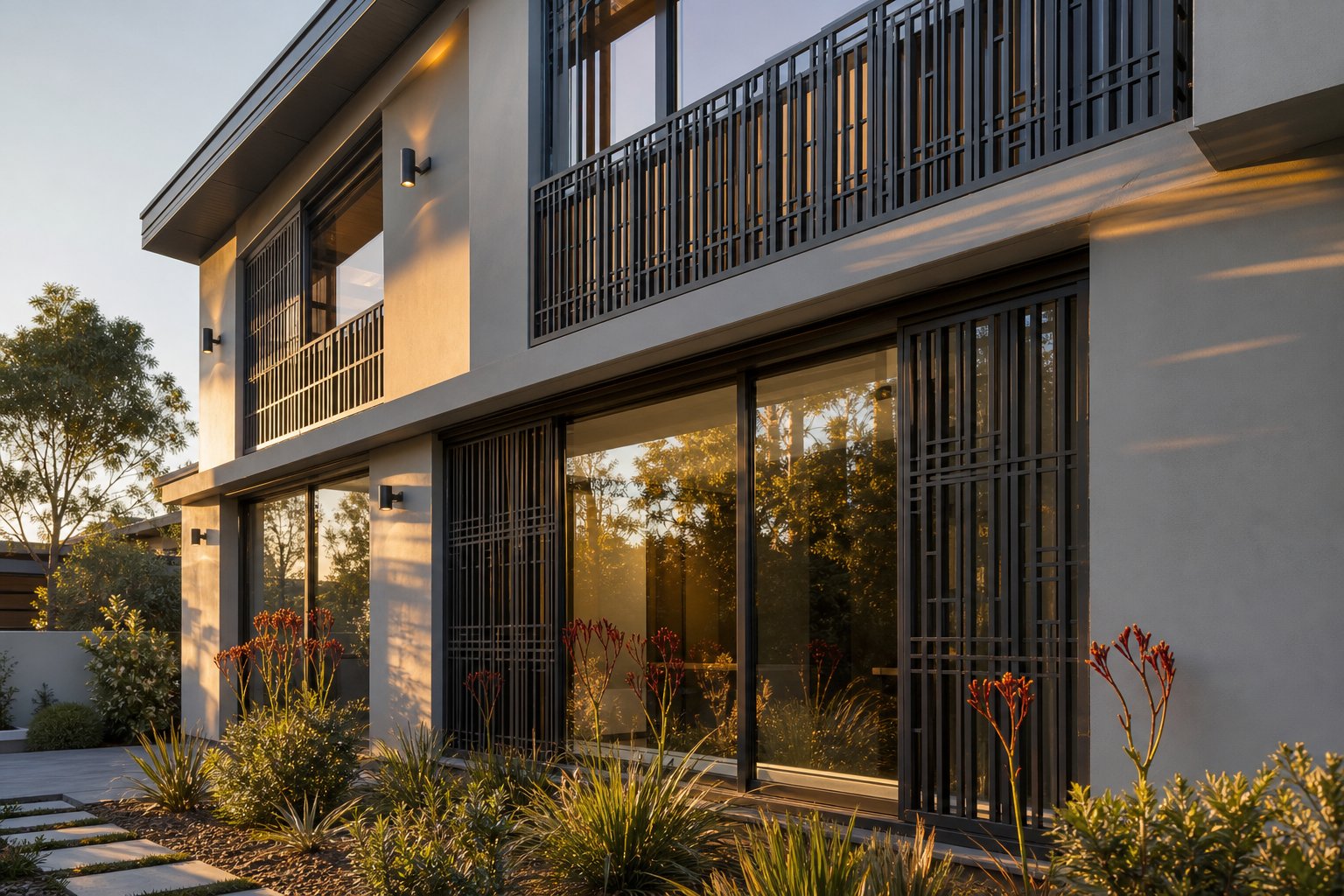
- Contemporary geometric: Asymmetric or abstract arrangements using mixed bar widths and angles. Suits architect-designed homes and new builds where the grille becomes a deliberate design statement rather than a purely functional addition.
Matching Grilles to Your Window Frame and Architecture
The most successful installations treat the grille as part of the window system rather than something bolted over it. That means aligning bar thickness with the window frame’s sight lines, matching the powder-coat colour exactly, and choosing a pattern scale that suits the window proportions. A large picture window can carry a bold geometric pattern, while a narrow bathroom opening looks better with simple vertical bars that do not visually crowd the glass.
For heritage properties, subtle patterns in dark tones recede against the facade and let original architectural details remain the focal point. For contemporary builds with slim-profile aluminium frames, a grille with matching slender bars maintains the clean aesthetic the architect intended. The key principle is proportion: grille elements should echo the visual weight of the window frame they protect, never overpower it.
Getting colour and pattern right transforms the perception of security grilles from a reluctant compromise into a deliberate design choice. That same attention to aesthetics also influences something less visible but equally important: how the market values your property and how insurers assess your risk profile.
Property Value, Insurance, and Investment Considerations
Security grilles protect more than glass. They also protect your financial position, though the relationship between physical security upgrades and property economics is more nuanced than most owners realise. Whether you are weighing up the cost of installation against potential insurance savings, trying to attract quality tenants to a ground-floor unit, or navigating strata approval for an apartment block, the financial case for aluminium security grilles depends heavily on context.
Insurance and Risk Assessment Benefits
Home and contents insurers assess risk based on the likelihood and potential severity of a claim. Properties in areas with higher burglary rates attract higher premiums, and visible physical security measures can shift that assessment in your favour. Security grills fitted to vulnerable ground-floor and basement openings signal to an insurer that the property presents a harder target, which may translate into reduced premiums or more favourable policy terms.
The extent of any discount varies between insurers and is never guaranteed. Some providers offer explicit discounts for properties with approved security upgrades, while others factor it into their broader risk model without itemising the benefit. The practical step is to notify your insurer after installation and ask whether the upgrade affects your premium. At minimum, having secure window grills documented on your policy strengthens your position if you ever need to make a claim, demonstrating that you took reasonable steps to prevent the loss.
Commercial properties often see a more direct relationship. Business insurance policies in retail and industrial sectors frequently specify minimum physical security requirements for ground-level openings. Meeting those requirements with aluminium grilles can be the difference between standard cover and a policy loaded with exclusions or excess penalties for inadequate security.
Impact on Property Value and Resale Appeal
The effect of window security panels on resale value is not straightforward. It depends on the local market, the quality of the installation, and how well the grilles integrate with the property’s overall appearance.
Factors that positively influence property value:
- Well-designed grilles that complement the facade and appear intentional rather than reactive
- Powder-coated finishes matched to window frames, creating a cohesive look buyers perceive as a quality upgrade
- Properties in areas where security is a known concern, where grilles reassure buyers rather than alarm them
- Operable grilles (hinged or retractable) that demonstrate code compliance and do not trigger concerns about safety or feeling enclosed
- Professional installation with concealed fixings and clean lines that suggest the work was done properly
Factors that could negatively impact property value:
- Poorly matched colours or dated patterns that make the property look institutional or neglected
- Fixed grilles on bedroom windows that raise immediate red flags about fire safety compliance
- Excessive coverage where grilles appear on every opening including upper storeys, suggesting the area is unsafe
- Cheap installations with visible raw fixings, misaligned frames, or surface corrosion that signal deferred maintenance
- Grilles that block natural light significantly, making interiors feel darker and smaller in listing photos
The principle is simple: security upgrades that look like thoughtful design decisions add value. Security upgrades that look like desperate reactions to crime subtract it. Aluminium’s powder-coating versatility and slim profiles give it a clear advantage here over bulkier steel or wrought iron alternatives that are harder to make visually discreet.
Rental Properties and Strata Considerations
For investment properties, security grilles serve a dual purpose. They protect the asset itself and they attract tenants who prioritise safety. Ground-floor apartments in urban areas, particularly those facing laneways, car parks, or poorly lit common areas, can be harder to lease without visible security measures. A security grate on vulnerable windows gives prospective tenants confidence, especially single occupants or families with young children who might otherwise pass on an otherwise suitable unit.
Landlords should weigh the installation cost against reduced vacancy periods and the ability to attract longer-term tenants willing to pay a modest premium for a property that feels secure. The ongoing maintenance cost of aluminium is negligible compared to steel, which matters for investment properties where every maintenance call erodes yield.
Strata and body corporate schemes introduce approval hurdles that can delay or derail installation plans. Most strata by-laws classify external grilles as a common property modification or at least an alteration affecting external appearance. That means a formal application to the owners corporation, often accompanied by specifications showing colour, pattern, and fixing method. Some schemes mandate a uniform grille style across all units to maintain building consistency, while others prohibit external grilles entirely in favour of internal security screens.
Before committing to a purchase for a strata property, request a copy of the relevant by-laws and check whether previous grille approvals exist as precedent. A consistent approach across the building, where all owners use the same colour and pattern, is far more likely to gain committee approval than a one-off installation that breaks the facade uniformity.
Financial considerations rarely exist in isolation. The insurance benefit, the rental appeal, and the resale impact all feed back into the same core question: which grille, installed where, delivers the best return for your specific property type and ownership situation. Answering that question clearly is what turns research into a confident purchase decision.
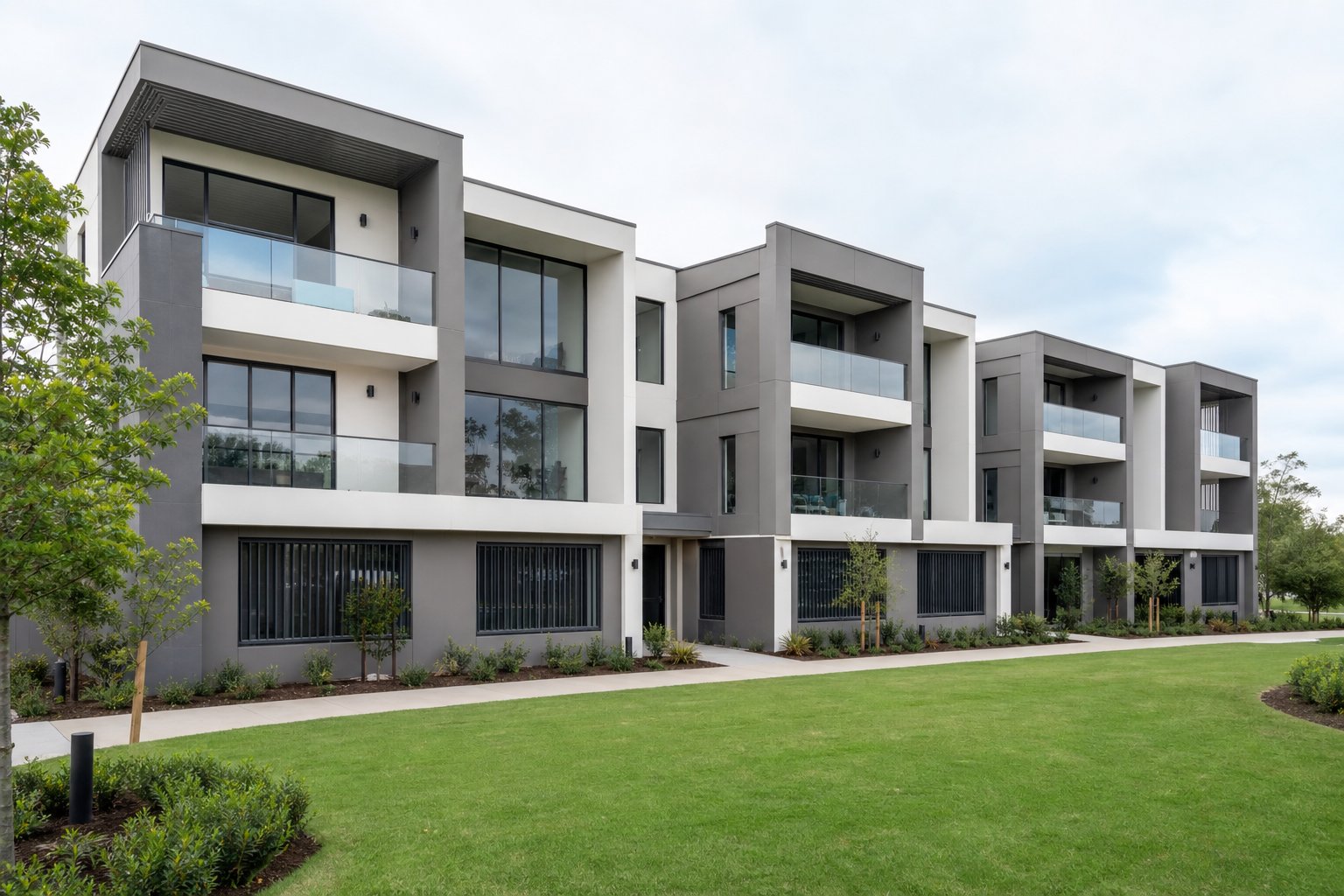
Choosing the Right Grilles for Your Next Project
Research only delivers value when it translates into a clear action plan. Whether you are a homeowner protecting a ground-floor renovation, a landlord upgrading a portfolio of rental units, or a project manager specifying security grills for windows across a commercial fitout, the decision sequence is the same. What changes is the weight you place on each factor.
Decision Framework for Homeowners
Residential projects benefit from working through the variables in a logical order rather than jumping straight to browsing window grills for sale online. Skipping steps leads to grilles that do not fit, fail code, or clash with the facade.
- Assess which openings genuinely need a security grille based on accessibility, visibility from the street, and your local risk profile.
- Confirm egress requirements for each window under the NCC, eliminating fixed grilles from any bedroom or habitable room without an alternative exit.
- Check council, heritage, and strata approvals before committing to a style or supplier.
- Select the grille type (hinged, sliding, retractable) that balances your security needs with daily liveability.
- Take accurate measurements using the reveal-fit or face-fit method appropriate to your installation.
- Choose a powder-coat colour and pattern that integrates with your existing window frames and architectural style.
- Engage an installer who provides written compliance documentation and warranty coverage.
One step that homeowners often overlook is coordinating the security grille specification with their window system from the outset. Choosing your aluminium windows and grills on windows together ensures matched colour profiles, correct standoff dimensions, and fixing points engineered into the frame rather than improvised on site. MEICHEN’s aluminium windows page is a practical starting point for understanding how frame types, colour options, and hardware selections affect grille compatibility across residential and commercial builds.
Commercial and Multi-Unit Project Considerations
Commercial teams and multi-unit developers face additional complexity. Specifications need to satisfy insurance requirements, fire-safety audits, and often a design review panel simultaneously. The security grille becomes one line item in a broader facade package, and it must align with the glazing schedule, the colour palette, and the building’s operational procedures for opening and closing each day.
For multi-unit residential projects, specifying a single grille style and colour across all ground-floor units avoids future body corporate disputes and creates a uniform streetscape that supports property values rather than undermining them. Builders and architects working at this scale benefit from selecting window systems where security grill for windows integration is considered at the design stage rather than retrofitted after handover.
Next Steps for Your Security Grille Project
Every successful installation starts with the same foundation: a clear understanding of what you need, where it goes, and what rules apply. The decision framework above keeps the process sequential and prevents expensive backtracking. Move through it methodically, and you will end up with a security grille that does exactly what it should: protect your property without compromising the facade you worked hard to create.
Frequently Asked Questions About Aluminium Window Security Grilles
1. Are aluminium security grilles strong enough to stop a break-in?
Modern aluminium alloys used in security grilles deliver high strength-to-weight ratios through engineered extrusion profiles that maximise rigidity at stress points. Combined with tamper-resistant fixings and reinforced corner joints, aluminium grilles resist cutting, prying, and sustained impact from common break-in tools. While mild steel offers greater raw hardness per section size, aluminium’s practical security performance is more than adequate for residential and most commercial applications, particularly when paired with proper installation into solid masonry or structural framing.
2. Do window security grilles comply with fire safety regulations in Australia?
Compliance depends on the grille type and installation location. Under the National Construction Code, any grille covering a required egress window in a bedroom or habitable room must be operable from inside without keys, tools, or special knowledge. Hinged grilles with internal thumb-turn releases, sliding grilles, and retractable models all satisfy this requirement when correctly specified. Fixed grilles are only code-compliant on non-habitable openings or windows where alternative exit paths exist. Property owners should confirm requirements with their local council before installation.
3. How much do aluminium window security grilles cost in Australia?
Costs vary based on grille type, size, pattern complexity, and powder-coat finish. Fixed grilles sit at the lower end of the price range, while retractable and sliding models command a premium due to their mechanical components. Custom colour matching and intricate geometric patterns also add to the cost. For accurate pricing, obtain quotes based on your specific window measurements and chosen specifications. Supply-and-install pricing from professional fabricators typically includes measurement, manufacture, powder coating, delivery, and fitting with compliant fixings.
4. Can I install security grilles on a strata or body corporate apartment?
External grille installation on strata properties typically requires formal approval from the owners corporation or body corporate committee. Most schemes classify external grilles as modifications affecting common property appearance, requiring a written application with specifications showing colour, pattern, and fixing method. Some buildings mandate a uniform grille style across all units, while others prohibit external grilles entirely in favour of internal security screens. Check your scheme’s by-laws and look for precedent approvals before purchasing.
5. What is the difference between security grilles and security mesh screens?
Security grilles use solid aluminium bars, tubes, or flat sections welded or mechanically fastened into a visible grid pattern. They provide a strong physical barrier and allow airflow between bars. Security mesh screens use a fine woven stainless steel or aluminium mesh stretched across a frame, offering a less obtrusive appearance that looks similar to a standard flyscreen while still resisting cutting and impact. Mesh screens suit properties where heritage overlays or body corporate rules prohibit visible bar-style fixtures, though they generally carry a higher cost per square metre than equivalent aluminium grilles.
More Window & Door Guides