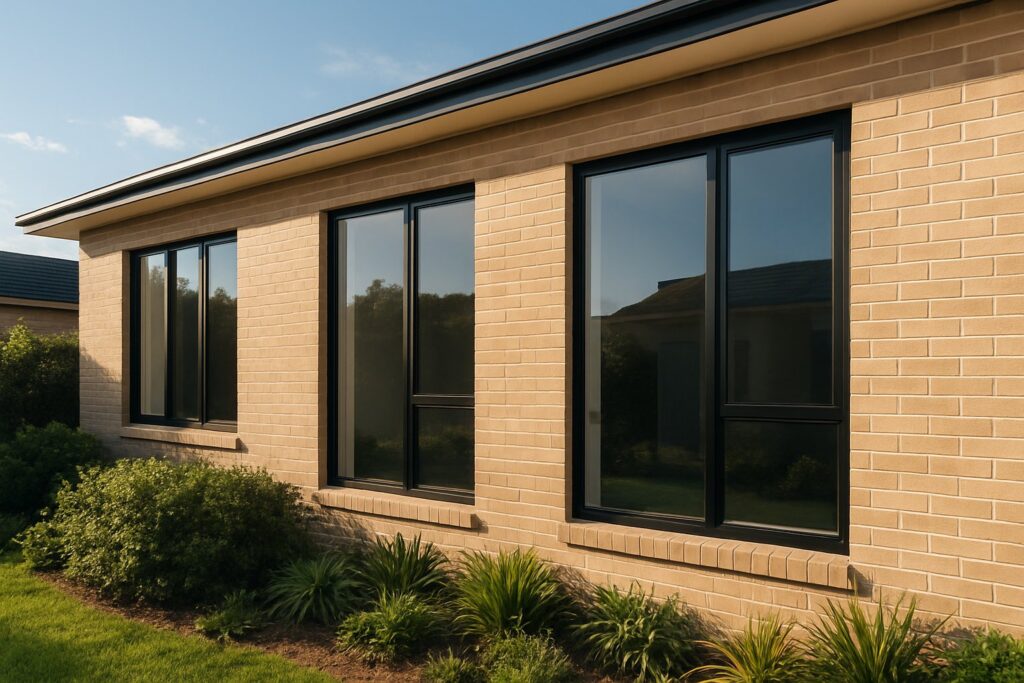
What Are Aluminium Bifold Windows and Why Do Sydney Homes Love Them
Picture a Saturday afternoon in Paddington. A terrace kitchen opens completely to the courtyard, no wall between the cook and the guests gathered around the outdoor table. That full-width opening is an aluminium bifold window at work — and it is one of the most sought-after upgrades across Sydney properties right now.
An aluminium bifold window consists of individual glass panels connected by hinges and mounted on a top and bottom track. When you unlock and push the panels, they fold back on each other in concertina fashion, stacking neatly to one side of the opening. The result is a near-complete clear span where a wall or traditional window once stood. Unlike a sliding window that only ever gives you half the opening, or a casement sash that swings outward and obstructs the space beside it, a bifold can deliver up to 90 percent of the opening width as usable, unobstructed air and light.
This article is designed to be the honest guide suppliers rarely provide. You will learn exactly how these windows function, what drives their cost in the Sydney market, how to match frame materials and glass types to your specific climate exposure, and which questions separate a well-informed buyer from an easy sale.
How Aluminium Bifold Windows Work
The folding mechanism relies on a series of hinged panels — anywhere from two to seven — that travel along a head and sill track. Each panel pivots at the hinge point, allowing adjacent panels to fold flat against one another. The entire set then slides to one end of the track and parks against the wall or jamb.
Aluminium plays a critical structural role here. Its strength-to-weight ratio means the frame profiles can remain slim while still supporting large, heavy glass panes. Slimmer frames translate to more glass area and thinner sightlines, which is exactly why architects and designers favour aluminium over bulkier alternatives for bifold window panel configurations that span two metres or more per leaf.
Common configurations include:
- 2-panel — ideal for a kitchen servery pass-through (roughly 1.2 m to 1.8 m wide)
- 3-panel — suits a breakfast bar opening or compact living room (approximately 2.4 m wide)
- 4 to 5-panel — covers a standard living area connection to a deck or balcony (3 m to 4.5 m)
- 6 to 7-panel — creates a full wall opening for large entertaining spaces (5 m to 6 m+)
Panels can stack left, stack right, or split from the centre and fold to both sides, giving designers flexibility to work around furniture layouts or adjacent walls.
Why Sydney Properties Favour Bifold Designs
Sydney’s housing culture revolves around outdoor living. Harbour-side apartments chase uninterrupted water views. Inner-west terraces fight for every square metre of perceived space. Northern Beaches homes lean into coastal breezes. In each scenario, a bifold window solves the same problem: it removes the barrier between inside and outside without consuming floor or wall space the way a hinged door would.
A sliding window typically opens only 50 percent of its frame width. A bifold window opens up to 90 percent. That difference transforms a room from having a view to being part of the landscape.
For compact terraces in Surry Hills or Balmain, that extra opening ratio is not a luxury — it is the difference between a cramped galley kitchen and an entertainer’s space that breathes. For larger homes in the Hills District or along the Eastern Suburbs coastline, it means living areas that genuinely merge with alfresco zones during the warmer months and seal up tight when a southerly rolls in.
The appeal is not just aesthetic. When fully opened, aluminium bifold windows Sydney homeowners install allow maximum cross-ventilation, reducing reliance on air conditioning during spring and autumn — a practical benefit in a city where mild weather stretches across much of the year.
Still, choosing the right configuration involves more than picking a panel count. Cost, climate exposure, glass specification, and compliance all play a role — factors the following sections break down in detail.
Pricing Factors for Aluminium Bifold Windows in Sydney
Pricing is the one area where most Sydney suppliers stay deliberately vague. You will find glossy images and broad claims about lifestyle, but try to get a straight answer on how much bifold windows cost in Sydney and you hit a wall of “it depends” responses. That is partly fair — costs genuinely vary — but you deserve to understand why they vary so you can read a quote with confidence rather than guessing whether it represents good value.
Rather than inventing a single dollar figure that would be meaningless for your specific opening, let’s break down what actually moves the needle on price.
Key Factors That Drive Bifold Window Pricing
Every bifold window quote in Sydney is shaped by a handful of variables. Some have a modest effect; others can double the total. The table below organises these so you can see which decisions carry the most financial weight.
| Factor | Impact on Price | Why It Matters |
|---|---|---|
| Number of panels | High | Each additional panel adds frame material, hardware, hinges, and glass. A 6-panel system costs substantially more than a 3-panel unit — not just double, because engineering complexity also increases. |
| Overall opening width | High | Wider openings may require structural lintel upgrades and heavier-duty tracks, adding both product and labour cost. |
| Glass specification | Medium to High | Single glazing is the baseline. Double glazing adds roughly 25 to 35 percent to the glass cost, and options like Low-E coatings, laminated interlayers, or tinted glass push the price further. Hipages notes that single-pane windows are about 25 to 35 percent less expensive than double-glazed equivalents. |
| Powder coat colour and finish | Low to Medium | Standard colours (black, white, Surfmist) are typically included in base pricing. Custom colours, Dulux powder coat matching, or woodgrain finishes attract a surcharge. |
| Hardware grade | Medium | Standard residential hardware suits most inland homes. Marine-grade stainless steel hardware — essential within a few kilometres of the coast — adds cost but prevents premature corrosion failure. |
| Thermal break technology | Medium | Thermally broken aluminium frames use a polyamide barrier to reduce heat transfer. They cost more than standard frames but improve energy performance and may be needed to meet NCC requirements. |
| Custom vs standard sizes | Medium to High | Standard modular sizes are manufactured in batches and priced accordingly. Custom dimensions require individual engineering and fabrication, which always costs more. |
| Installation complexity | High | Ground-floor replacement in an accessible brick veneer home is straightforward. Upper-storey installation requiring scaffolding, structural modifications, or heritage-sensitive detailing can add thousands to the labour component. |
As a rough reference point, higher-end aluminium bifold windows in Australia can sit around $1,250 per square metre for supply only, though this figure shifts depending on the specification choices above. Labour typically accounts for 30 to 50 percent of the total installed cost, so a supply-only price never tells the full story.
How to Compare Quotes from Sydney Suppliers
Three quotes land in your inbox. One is $8,000, another is $12,000, and the third sits at $14,500. The instinct is to lean toward the cheapest. Resist that impulse until you know exactly what each quote includes — and what it leaves out.
A reliable bifold window quote should clearly separate these line items:
- Supply vs supply and install — Some quotes cover product only. If installation is not listed, you will need to source and pay an installer separately.
- Removal and disposal of existing windows — This is physical work that takes time. If the quote does not mention it, assume it is an extra charge.
- Scaffolding or elevated access — Required for first-floor or above installations. Can add $1,000 or more depending on height and duration.
- Flashing and waterproofing — Critical for keeping water out of the wall cavity. A quote that omits flashing detail may deliver a cheaper number but leave you exposed to moisture problems.
- Structural work — If the new opening is wider than the existing one, a steel lintel and associated building work will be needed. This should be itemised or explicitly excluded.
- Council or certification fees — Relevant for heritage overlays, strata properties, or openings that change the building envelope. Not always applicable, but worth confirming.
The key principle when comparing quotes is to ensure you are evaluating like-for-like specifications. A lower price often reflects a simpler glazing package, basic hardware, or a narrower scope of works rather than genuine savings. Ask each supplier to confirm the glazing type, hardware brand, powder coat standard, and whether their price includes all finishing work.
One final tip that catches many buyers off guard: custom sizes cost more than standard modules every time. If your opening can be designed around a manufacturer’s standard panel dimensions during the planning stage, you will save money without compromising on quality or aesthetics. Discuss this with your supplier early — before the brickwork is set.
Understanding what drives aluminium bifold windows cost in Sydney is only half the equation. The frame material itself introduces another layer of decision-making — because aluminium is not the only option, and knowing where it genuinely outperforms the alternatives helps you spend with certainty rather than assumption.
Aluminium Compared to Timber and uPVC Bifold Frames
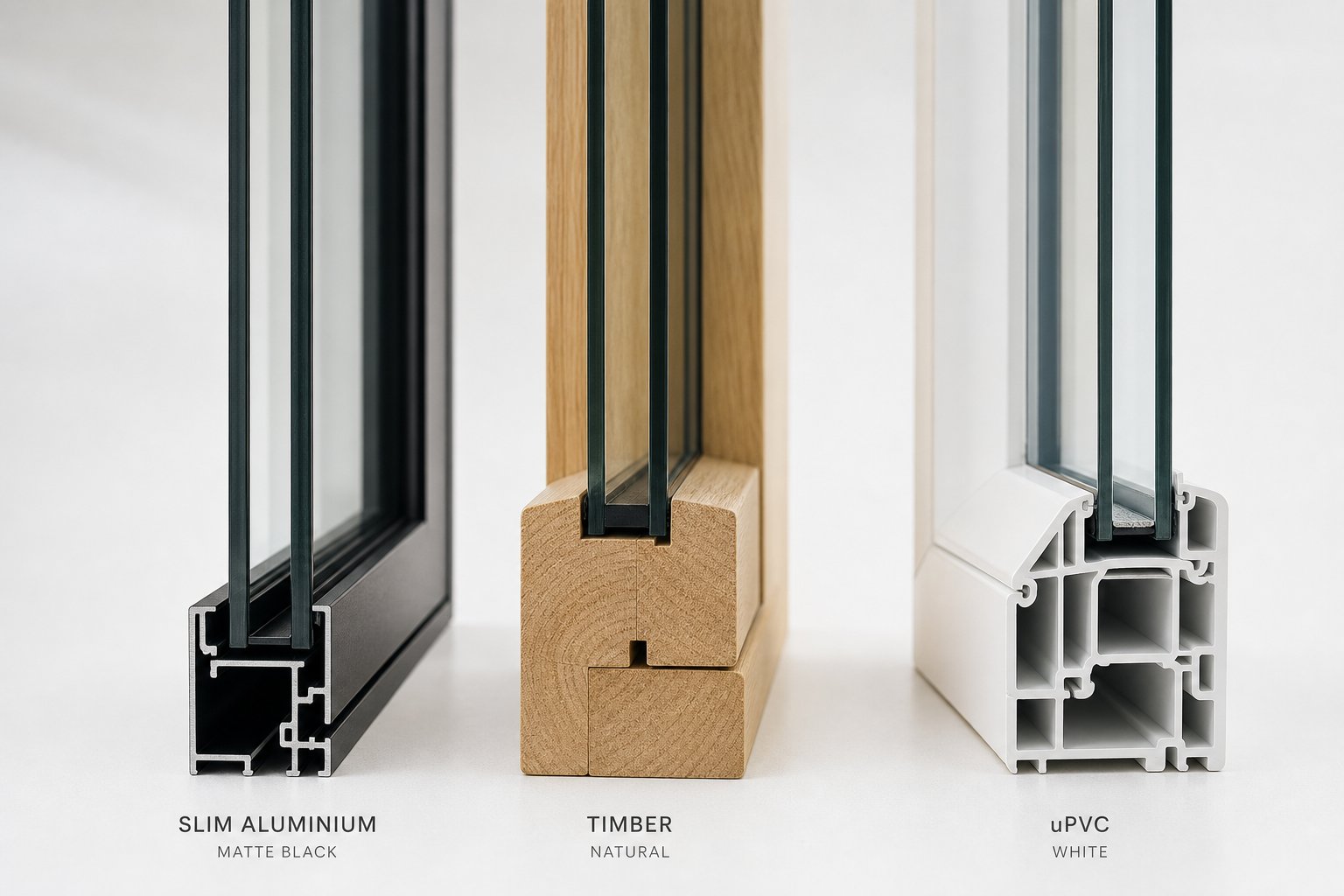
Knowing what drives the price is useful, but it does not answer a more fundamental question: is aluminium actually the right frame material for your bifold windows? Timber has its advocates. uPVC has its price appeal. And composite frames try to split the difference. Each material behaves differently under Sydney’s mix of coastal salt, UV intensity, and summer heat — so the best frame material for bifold windows in Sydney depends on where you live and how much ongoing effort you are willing to invest.
The table below lays out an honest side-by-side comparison across the factors that matter most for Sydney properties.
Aluminium vs Timber vs uPVC for Sydney Conditions
| Criteria | Aluminium | Timber | uPVC |
|---|---|---|---|
| Durability | Excellent. Resists warping, cracking, and rot. Maintains structural integrity for decades with minimal degradation. | Good if maintained. Susceptible to rot, swelling, and termite attack without regular protective treatment. | Moderate. Can become brittle or discolour after prolonged UV exposure, which is a real concern in Sydney’s climate. |
| Maintenance | Very low. Occasional wash with soapy water. Powder coat finish does not require repainting. | High. Requires sanding, repainting, or re-staining every few years to prevent moisture damage. | Low. No painting needed, though discolouration from UV is difficult to reverse once it occurs. |
| Thermal Performance | Lower inherent insulation due to aluminium’s conductivity. Significantly improved with thermal break technology. | Naturally strong insulator. Timber’s low conductivity provides good thermal resistance without additional engineering. | Good insulator. Multi-chamber profiles offer solid thermal resistance out of the box. |
| Cost | Mid to high. Varies with powder coat, hardware grade, and thermal break inclusion. | High to very high. Premium material plus ongoing maintenance costs over the window’s lifetime. | Low to mid. Lower upfront cost, but limited lifespan may reduce long-term value. |
| Aesthetic Options | Extensive. Powder coating available in virtually any colour. Slim profiles maximise glass area. | Classic warmth and character. Natural grain suits heritage and traditional homes. | Limited. Typically white or a small range of colours. Bulkier profiles reduce visible glass area. |
| Suitability for Coastal Sydney | Excellent when paired with marine-grade hardware and quality powder coating. Corrosion-resistant finishes are specifically designed for salt-air environments. | Poor unless heavily treated. Salt air accelerates timber decay and paint deterioration significantly. | Moderate. Will not corrode, but UV degradation is accelerated in exposed coastal positions. |
When Aluminium Is the Strongest Choice
The comparison above reveals a pattern: aluminium does not win every single category, but it wins the combination that matters most for Sydney’s conditions. Here is why it dominates the bifold market specifically.
Slimmer sightlines, larger panels. Aluminium’s strength-to-weight ratio allows manufacturers to engineer profiles that are narrower than timber or uPVC while still supporting heavy double-glazed panels. In a bifold configuration spanning four or five leaves, those few extra millimetres of glass per panel add up to a noticeably more open, light-filled result.
Coastal resilience without the effort. Aluminium window frames offer coastal durability that timber simply cannot match passively. A properly powder-coated aluminium frame paired with stainless steel hardware handles salt exposure within a few kilometres of the shoreline — no seasonal repainting or sealing ritual required. For investment properties, holiday rentals, or owners who would rather spend weekends at the beach than maintaining window frames, that low-effort longevity is a genuine advantage.
Recyclability. Aluminium is 100 percent recyclable without losing strength or quality. For sustainability-conscious buyers weighing uPVC vs aluminium windows in Australia, this is a meaningful differentiator — old aluminium frames can be repurposed endlessly, whereas uPVC recycling remains limited in practice.
The thermal performance question. This is the one area where aluminium draws criticism. Raw aluminium conducts heat readily — roughly 1,000 times more than timber. Left unaddressed, that conductivity allows summer heat to migrate through the frame and winter warmth to escape. But modern thermally broken aluminium frames solve this by inserting a continuous polyamide barrier between the interior and exterior profiles. This insulating strip physically separates the two aluminium faces, reducing frame U-values from around 5.8 W/m²K down to between 2.5 and 1.5 W/m²K depending on the system. The result brings aluminium’s thermal performance much closer to timber and uPVC, particularly when combined with double glazing and Low-E coatings.
Thermal break technology does add cost — but for many Sydney homes, especially those needing to meet current NCC energy efficiency requirements, it is no longer optional. It is the engineering detail that lets aluminium compete on comfort while retaining all its structural and aesthetic advantages.
Choosing the right frame material is one decision. Matching that frame to your specific microclimate — salt air on the Eastern Suburbs coastline, scorching western Sydney summers, or bushfire risk in the Hills — introduces another layer of complexity that generic supplier brochures rarely address.
Sydney Climate Challenges That Affect Your Bifold Window Choice
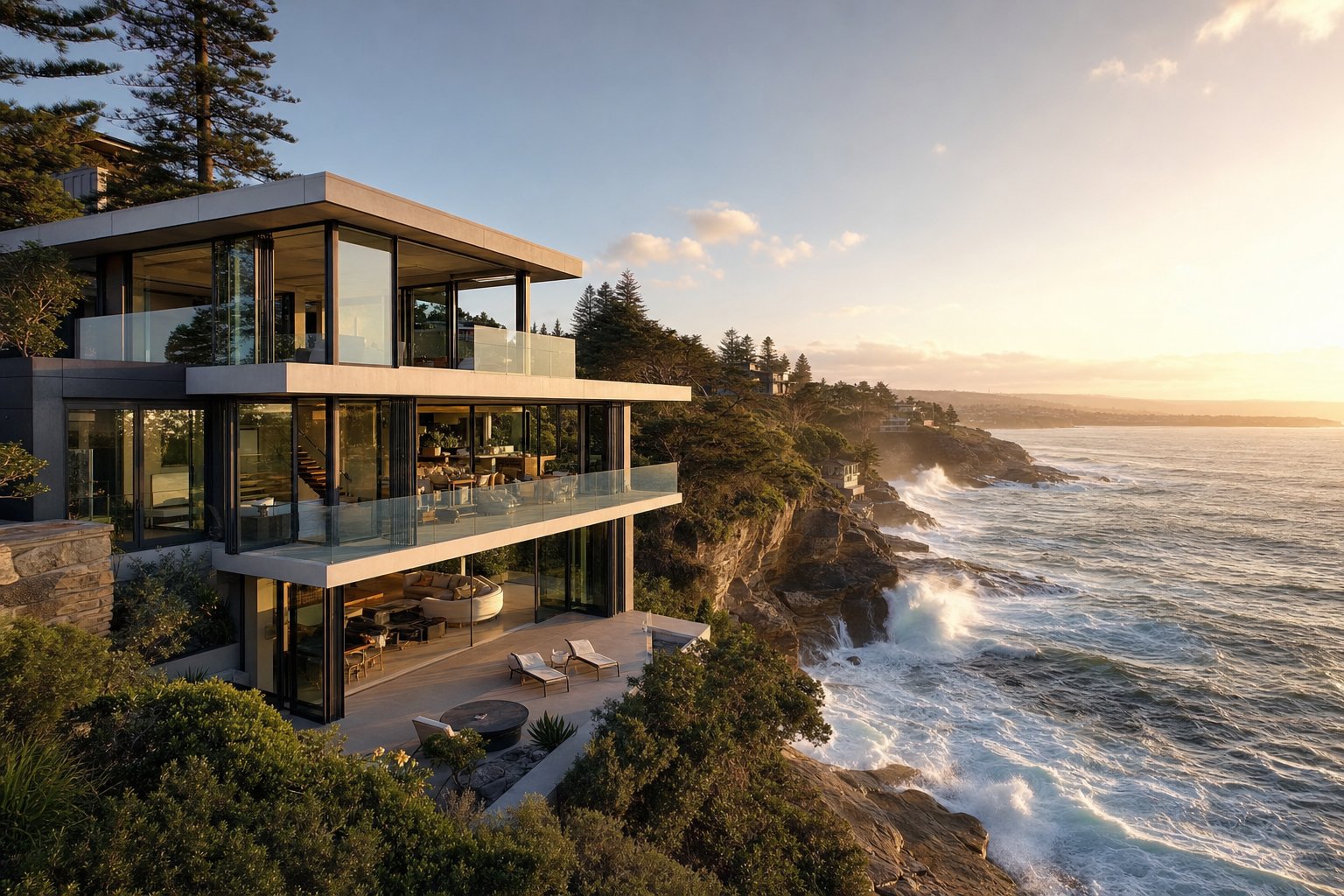
Sydney is not one climate. It is half a dozen microclimates packed into a single metro area, and each one attacks window systems differently. A bifold window specified perfectly for a sheltered Marrickville terrace may corrode within years if installed in a Coogee apartment facing the ocean. Suppliers who treat the entire city as a single condition are setting you up for premature failure — or unnecessary overspend.
Understanding your specific exposure zone is the single most important step before locking in a product specification.
Coastal Corrosion and Salt Air Resistance
Salt-laden air is the silent enemy of any metal-framed window near the coast. Chlorides in sea spray penetrate microscopic pores in inadequate finishes and trigger pitting corrosion that eats into the aluminium over time. The closer your property sits to breaking surf, the more aggressive the attack — and the higher the specification you need.
Distance from the coastline determines your corrosion exposure category:
- Within 1 km of surf — severe exposure. Requires marine-grade powder coating at 60 to 120 microns thickness, certified to Qualicoat Class 2 or Class 3. Standard architectural coatings will chalk and deteriorate within a few seasons. All hardware must be marine-grade stainless steel.
- 1 to 10 km from the coast — moderate exposure. Qualicoat Class 1.5 or higher is advisable. Standard stainless steel hardware handles most conditions, though properties on elevated, wind-exposed ridgelines may still warrant marine-grade upgrades.
- Beyond 10 km inland — low salt exposure. Standard architectural powder coating performs well. Hardware selection can focus on durability and function rather than corrosion resistance specifically.
For bifold windows in coastal Sydney homes, the hardware question is just as important as the frame finish. Hinges, rollers, locks, and tracks cop direct salt contact every time you open and close the panels. Cheap zinc-plated fittings will seize or pit within a couple of years in a Bondi or Manly installation. Ask every supplier about their corrosion warranty — not just the frame warranty, but separate coverage for hardware and seals. If they cannot provide a specific answer, that tells you something about how seriously they take salt air resistant aluminium windows.
Wind Load Ratings and Western Sydney Heat
Coastal exposure is not just about salt. Headland properties, hilltop homes, and upper-storey apartments in exposed positions face elevated wind loads that directly affect structural specification. Under AS2047, every external window must be rated to withstand the design wind pressure calculated for its exact location and height above ground. These pressures are determined using AS/NZS 1170.2, and they vary significantly across Sydney depending on terrain category, shielding, and topography.
A bifold window on the tenth floor of a Dee Why apartment block faces far greater wind pressure than the same product installed at ground level in a protected Strathfield courtyard. Larger bifold configurations — five, six, or seven panels — are particularly sensitive to wind load because each panel acts as a sail under pressure. Wind load rated windows that comply with AS2047 for high-exposure positions typically require heavier-walled aluminium profiles (2.0 mm or above) and reinforced track systems to maintain structural integrity without excessive deflection.
Shift inland to western Sydney and the challenge flips. Penrith, Richmond, and the broader Cumberland Plain regularly endure summer temperatures above 40°C — significantly hotter than the moderated eastern suburbs. That extreme heat makes thermal performance and glazing selection critical for comfort and energy bills. Western Sydney heat resistant windows need thermally broken frames combined with high-performance glazing (Low-E coatings or tinted glass on western and northern elevations) to prevent interiors from becoming unbearable without constant air conditioning.
Then there are the bushfire zones. Parts of the Hills District, Ku-ring-gai, Northern Beaches fringes, and the Sutherland Shire fringe carry Bushfire Attack Level (BAL) ratings under AS3959. Aluminium holds a genuine advantage here: metal frames are accepted across all BAL categories up to and including BAL-40, while uPVC requires metal reinforcement at higher ratings and timber faces additional treatment obligations. Bushfire rated bifold windows in Sydney need to combine compliant aluminium framing with appropriately thick toughened or laminated glazing, ember-resistant seals, and metal mesh screening at BAL-29 and above.
Every Sydney suburb falls somewhere on this exposure spectrum. Here is a quick reference for the major zones:
- Eastern Suburbs and Inner Harbour — primary concern is salt air corrosion. Specify marine-grade powder coat and stainless steel hardware.
- Western Sydney (Penrith, Blacktown, Liverpool) — primary concern is extreme summer heat. Prioritise thermally broken frames and solar-control glazing.
- Northern Beaches (Manly to Palm Beach) — dual concern of wind exposure and salt. Higher wind load ratings plus marine-grade finishes are both essential.
- Hills District and North-West — combination of bushfire risk and summer heat. BAL-rated systems with strong thermal performance cover both threats.
- Sutherland Shire (southern fringe) — mixed exposure depending on elevation. Coastal-facing properties need salt protection; bushland-adjacent homes need BAL compliance.
The practical lesson is straightforward: your suburb dictates your specification. A supplier who does not ask about your property’s distance from the coast, its BAL rating, or its wind exposure category before quoting is skipping the most important part of the process. These environmental factors shape everything from frame profile thickness to hardware grade to glass type — which leads directly to the next consideration: what glass you actually put inside that frame.
Glass Options and Energy Efficiency for Sydney Bifold Windows
The aluminium frame gives your bifold window its structure. The glass defines how it actually performs — thermally, acoustically, and visually. Yet glazing selection is often treated as an afterthought, reduced to a checkbox on a supplier’s order form. In reality, the glass you choose has more influence on comfort, energy bills, and regulatory compliance than almost any other element of the specification.
Single vs Double Glazing vs Low-E Glass
At its simplest, glazing choice comes down to how many layers of glass sit between your living space and the outside air, and what coatings or treatments are applied to those layers.
Single glazing is a single pane of glass — typically 4 mm to 6 mm thick. It offers minimal thermal resistance. Heat passes through readily in summer and escapes quickly in winter, forcing your heating and cooling systems to work harder. For new builds and major renovations in Sydney, single glazing is increasingly difficult to justify under current energy requirements.
Double glazing sandwiches two glass panes with an insulating air or argon gas gap between them — commonly 12 mm to 16 mm wide. That trapped air pocket dramatically reduces heat transfer. A standard double-glazed unit can halve the thermal conductance (U-value) compared to single glazing, meaning less heat entering in summer and less warmth escaping in winter. Double glazed bifold windows in Sydney have shifted from premium upgrade to expected baseline for most projects.
Low-E (low emissivity) glass takes double glazing further by adding a microscopically thin metallic coating to one of the pane surfaces. This coating reflects radiant heat while still allowing visible light through. Low-E glass for bifold windows is particularly effective because it lets you maintain large, light-filled openings without turning the room into a greenhouse on a hot January afternoon. The coating can be tuned for different orientations — more on that below.
Under the National Construction Code’s current 7-star NatHERS requirement, glazing performance is one of the most influential factors in whether a home passes or fails its energy rating. The NCC does not mandate double glazing outright, but the thermal modelling used for compliance — which assesses each window’s U-factor and Solar Heat Gain Coefficient (SHGC) individually — makes it very difficult to achieve 7 stars with single-glazed bifold windows unless the home has exceptional passive design in every other area. NSW uses the BASIX framework for its compliance pathway, and the NSW Planning Portal confirms that glass and frame type selection directly influences both heating and cooling load calculations.
For energy efficient aluminium windows achieving NCC compliance, the combination of thermally broken frames, double glazing with an appropriate air gap, and orientation-specific Low-E coatings represents the most reliable path. Homes that get NatHERS modelling done early can target their glazing spend precisely where it counts rather than blanket-upgrading every opening.
Choosing Glass Based on Orientation and Privacy
Not every bifold window in your home faces the same direction, and not every direction demands the same glass. Orientation dictates what the sun does to your glass — and that determines which coating or treatment delivers the best balance of light, heat, and comfort.
North-facing openings receive the most consistent solar exposure through the year. In winter, that sun is welcome — it heats the room passively and reduces energy consumption. In summer, eave shading typically blocks the high sun angle. Low-E coatings on north-facing glass help you capture useful winter warmth while reflecting excessive radiant heat on days when the shading does not fully cover the glass. A higher SHGC rating works well here because you want solar gain in the cooler months.
West-facing openings are the most punishing in Sydney’s climate. Late afternoon summer sun hits at a low angle that eaves cannot block, pouring heat directly into living spaces. Tinted glass, laminated glass with a solar-control interlayer, or Low-E coatings with a lower SHGC rating all help reduce that solar heat gain. If your bifold window faces west, this is not the place to economise on glazing.
East-facing openings catch morning sun — generally pleasant, but early summer heat can still be uncomfortable. A moderate Low-E specification balances light and warmth without over-blocking.
South-facing openings receive minimal direct sun. Here, the priority shifts to thermal insulation rather than solar control. A low U-value glass minimises heat loss without needing heavy tinting or reflective coatings that would reduce an already limited natural light supply.
Privacy considerations layer on top of orientation. Ground-floor bifold windows facing a street, laneway, or neighbouring property may need obscured, frosted, or translucent glass options to maintain privacy when panels are closed — without sacrificing natural light. Satinised or acid-etched glass provides diffused light transmission while blocking sightlines, and it can be applied to selected panels within a multi-panel configuration rather than the entire opening.
Acoustic Performance for Busy Roads and Flight Paths
Thermal performance dominates the glazing conversation, but noise is the issue that actually keeps people awake. Sydney is a noisy city. Inner-city terraces sit metres from bus routes. Apartments under flight paths into Kingsford Smith cop regular jet noise. And homes along arterial roads deal with a constant low-frequency hum that standard glass barely dents.
Sound travels through glass by vibrating the pane, and thinner, lighter glass vibrates more easily. A standard 4 mm single-glazed window achieves an STC (Sound Transmission Class) rating of roughly 27 to 30 — enough to muffle a quiet conversation but nowhere near adequate for traffic or aircraft noise. Upgrading to laminated or dual-pane acoustic glazing can push that rating above 45, cutting perceived loudness by more than half.
Three mechanisms do the heavy lifting in acoustic bifold windows suited to flight path areas across Sydney:
- Glass thickness and mass — thicker panes (6 mm or 6.38 mm laminated) resist vibration better than thinner ones, blocking more sound energy.
- Air gap in double glazing — the sealed cavity between panes interrupts sound transmission. Wider gaps (16 mm to 20 mm) perform better acoustically than narrow ones.
- Laminated interlayer — a PVB (polyvinyl butyral) or acoustic-grade resin layer bonded between two glass sheets adds mass and dampens vibration. It is especially effective against low-frequency noise from traffic and aircraft engines.
- Asymmetric pane thickness — using different glass thicknesses on each side of a double-glazed unit (for example, 4 mm outer and 6 mm inner) prevents both panes from resonating at the same frequency, improving overall sound reduction.
For homes directly under approach paths or beside six-lane roads, combining laminated glass with a generous air gap in a double-glazed unit offers the strongest acoustic result. It also delivers solid thermal performance as a bonus — a useful coincidence that means you rarely need to choose between quiet and comfortable.
Here is a quick-reference summary of the main glass types and their primary benefit:
- Clear single glazing (4–6 mm) — maximum light transmission at lowest cost; minimal thermal or acoustic benefit.
- Clear double glazing (air-filled) — roughly halves heat transfer compared to single glazing; moderate noise reduction.
- Double glazing with argon fill — improves thermal insulation by approximately 5 to 15 percent over air-filled units; same acoustic benefit.
- Low-E double glazing — reflects radiant heat while allowing visible light through; ideal for managing solar gain on sun-exposed elevations.
- Laminated glass (single or double) — adds mass and a damping interlayer for superior acoustic control; also provides safety glazing compliance under AS1288.
- Tinted glass — reduces solar heat gain and glare; useful on west-facing openings where direct afternoon sun is a problem.
- Obscured or frosted glass — diffuses light for privacy on street-facing or neighbour-facing panels without blocking daylight.
The right glass is rarely one type applied across every panel. A well-specified bifold window uses different treatments on different leaves depending on their orientation, exposure, and function — something worth discussing with your supplier before they default to a single specification across the board.
Glass performance matters most when the window is closed. But bifold windows spend much of their life open, connecting living spaces to decks, gardens, and entertaining areas. How that connection works in practice — and the configurations that make the most of it — depends on what you are actually trying to achieve with the opening.
Popular Ways Sydney Homeowners Use Bifold Windows
Every bifold window serves the same basic function — panels fold, space opens. But the way that opening transforms a room depends entirely on the application. A two-panel kitchen pass-through operates nothing like a six-panel living room wall, and the specification for each reflects a completely different set of priorities. Seeing how other Sydney properties use these configurations helps you pin down the right panel count, opening width, and sill height for your own project.
Kitchen Servery Windows That Open to the Outdoors
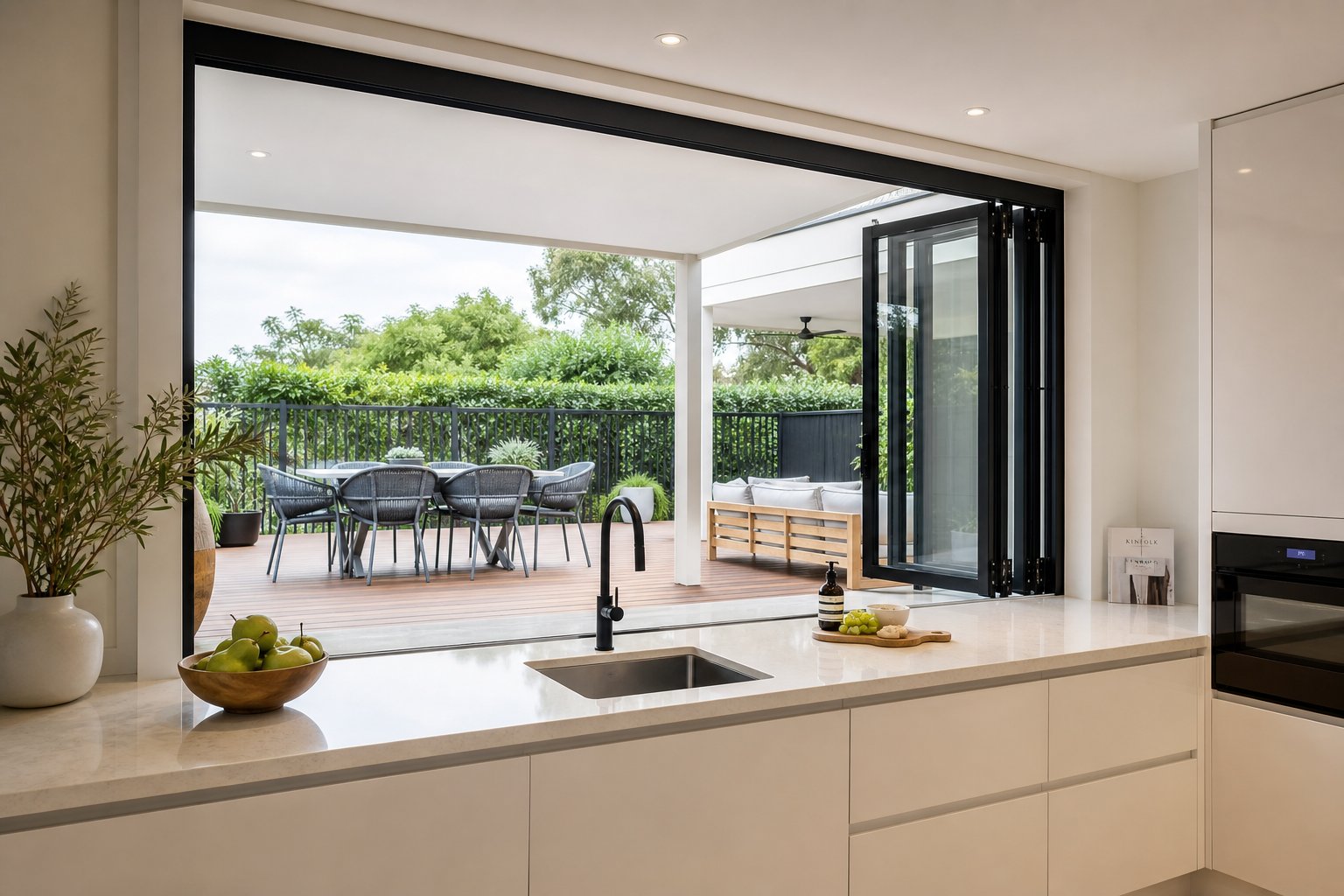
The bifold servery window is one of the most practical upgrades a Sydney kitchen can receive. A compact 2 or 3-panel configuration replaces a section of exterior wall above the benchtop, creating a pass-through opening between the kitchen and an outdoor entertaining area, deck, or garden bar. When the panels fold back, the kitchen counter becomes a natural serving surface — food and drinks pass straight through without anyone walking around to the back door.
Sizing matters here more than in larger installations. The window sill needs to sit flush with — or just below — your internal benchtop height, typically around 900 mm from the finished floor. An external shelf or counter on the outside face completes the servery effect, giving guests somewhere to rest plates and glasses. Most servery-style bifold windows use 2 to 3 panels spanning roughly 1.2 m to 2.4 m wide, which is enough to serve a crowd without requiring structural lintel work that wider openings demand.
Three-panel setups fold neatly to one side, leaving the entire counter clear. Two-panel versions suit tighter spaces — think a galley kitchen in a Balmain terrace where even 1.5 m of open servery access changes the dynamic of a Saturday barbecue.
Living Room and Alfresco Connections
Scale the concept up and bifold windows become entire walls that disappear. Configurations of 4 to 7 panels spanning 3 m to 6 m or more are the go-to choice for living areas that open onto a deck, courtyard, or pool zone. This is where bifold windows for alfresco entertaining deliver their full impact — the boundary between lounge and outdoor space simply ceases to exist on a mild Sydney evening.
Full-width installations work particularly well in homes where the indoor floor level sits close to the outdoor surface. A flush or near-flush threshold removes the step-over barrier, letting foot traffic move freely between zones. For larger spans (five panels and above), split-fold configurations — panels folding to both ends from a central opening point — keep stacked panels from dominating one side of the opening.
These wider systems also benefit from considering furniture placement early in the design process. Panels stack roughly 150 mm to 200 mm deep per leaf, so a 6-panel system needs around 900 mm to 1,200 mm of clear wall beside the opening for the folded stack. Ignoring that dimension is a common planning mistake that forces homeowners to rearrange rooms after installation.
Commercial and Hospitality Applications
Sydney’s cafe and bar culture practically demands bifold windows. Walk along any busy strip — Crown Street in Surry Hills, Manly Corso, or Bronte Road — and you will find commercial bifold windows on cafe and restaurant frontages folded fully open, blurring the line between indoor dining and footpath seating. The hospitality sector favours bifold systems because they open entire facades in seconds, creating an inviting streetscape presence that draws foot traffic in.
For commercial applications, the specification leans heavier: thicker aluminium profiles to handle daily operation by staff and patrons, commercial-grade hardware rated for tens of thousands of cycles, and toughened safety glass that meets both AS1288 and council requirements for public-facing openings. Many councils require balustrade-height barriers or lockable restrictions on lower panels in elevated positions.
Here are the most common bifold window configurations and their typical panel counts matched to approximate opening widths:
- 2-panel — 1.2 m to 1.8 m opening. Best for kitchen servery windows and compact pass-throughs.
- 3-panel — 1.8 m to 2.7 m opening. Suits larger servery setups, breakfast bars, and small cafe counters.
- 4-panel — 2.7 m to 3.6 m opening. Common in living rooms connecting to a balcony or modest deck.
- 5-panel — 3.6 m to 4.5 m opening. Works for medium entertaining areas and restaurant frontages.
- 6-panel — 4.5 m to 5.4 m opening. Full living room walls and larger commercial facades.
- 7-panel — 5.4 m to 6.3 m opening. Maximum residential spans and wide hospitality frontages.
These widths assume standard panel sizes around 600 mm to 900 mm per leaf. Wider individual panels are possible with aluminium framing — up to around 1,000 mm — but heavier panels increase hardware load and may require upgraded track systems.
Matching your project to the right configuration is the starting point. Turning that configuration into a finished installation involves a process with its own sequence, timelines, and compliance requirements — steps that vary depending on whether your property sits in a heritage zone, a strata scheme, or a straightforward freestanding home.
Installation Process and Building Compliance in Sydney
You have settled on a configuration, chosen your glass, and confirmed your climate exposure. The next question is practical: what actually happens between placing an order and watching those panels fold open for the first time? The bifold window installation process in Sydney follows a predictable sequence, but each stage has details that catch unprepared homeowners off guard.
From Site Measure to Final Installation
A typical bifold window project moves through these stages from first enquiry to completion:
- Initial consultation — You discuss your opening size, use case, and budget with the supplier. They assess whether your project is a straightforward replacement or involves structural changes. Allow 1 to 2 days.
- Site measure — A technician visits your property to document exact opening dimensions, check for irregularities in the surrounding wall, and note access conditions. This visit usually takes 1 to 2 hours and forms the basis of your final quote.
- Engineering checks — The supplier confirms wind load requirements for your specific location under AS/NZS 1170.2, verifies lintel adequacy above the opening, and determines whether structural reinforcement is needed. For wider openings replacing load-bearing walls, a structural engineer’s report may be required.
- Approval and order confirmation — You approve the final specification, sign off on the quote, and pay the deposit. Any required council applications are lodged at this point.
- Manufacturing — Standard bifold window lead time in Sydney typically runs 3 to 5 weeks for common configurations. Custom sizes, non-standard colours, or specialty glazing may push this to 6 to 8 weeks during peak periods.
- Pre-installation preparation — In the days before installation, clear furniture from the work area, remove curtains or blinds, protect flooring with drop sheets, and confirm that installers will have power access for tools.
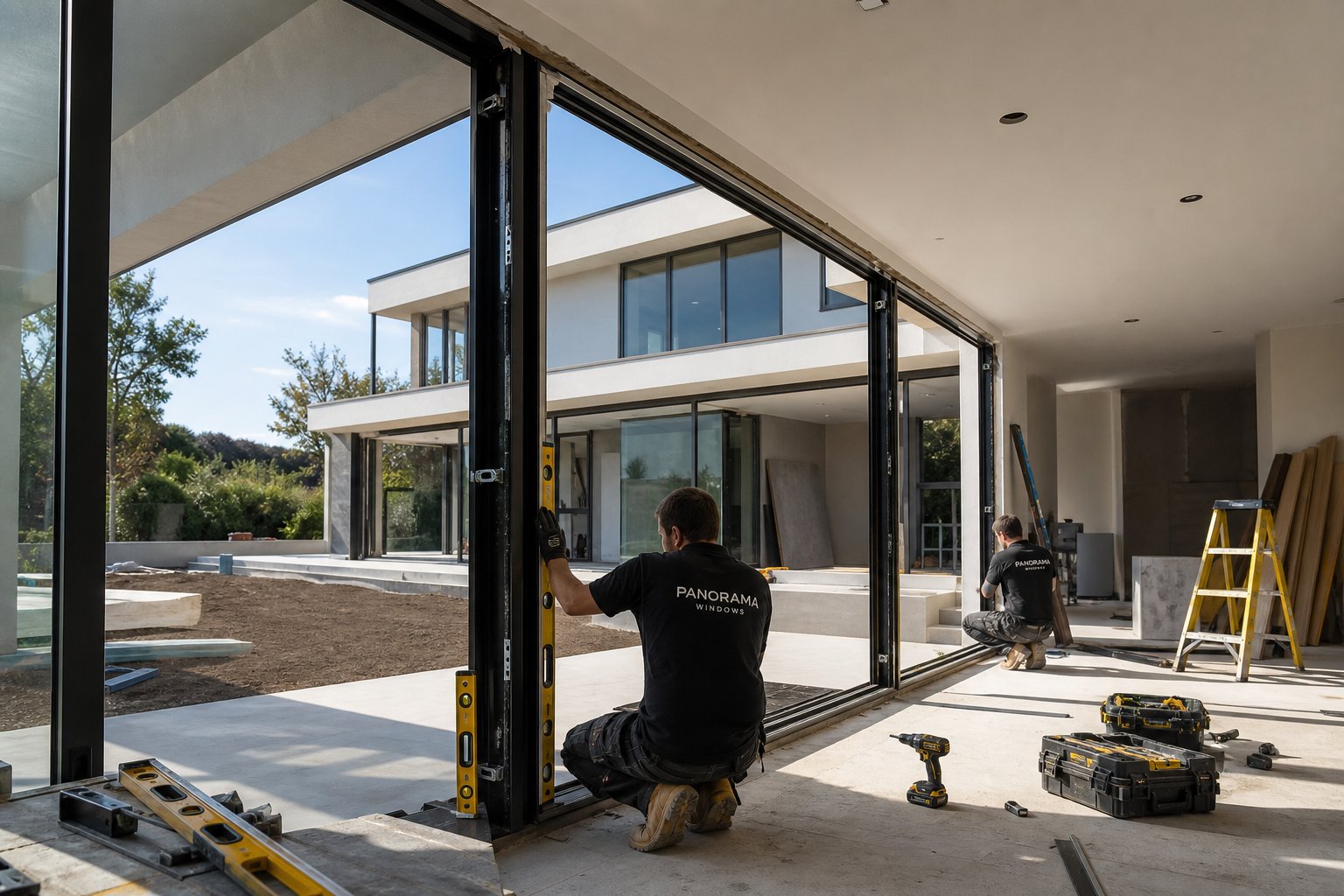
- Installation day — Removal of existing windows, fitting of the new frame and track, hanging panels, glazing adjustments, and sealing. A standard 4 to 5-panel residential bifold typically takes a full day. Wider or upper-storey installations may extend into a second day.
- Final inspection and handover — The installer tests every panel’s operation, checks seals, and walks you through locking mechanisms and maintenance. You receive compliance documentation and warranty paperwork.
End to end, most residential projects span 4 to 8 weeks from signed quote to finished installation. The manufacturing phase accounts for the bulk of that wait — the physical install itself is relatively quick provided the preparation work is done properly.
Sydney Council Approvals and Compliance
One of the most common questions homeowners ask is: do I need council approval for new windows in Sydney? The answer depends on the scope of change.
Like-for-like replacements — swapping existing windows for new ones of the same size and type — generally do not require approval. But bifold windows rarely fall into that category. If you are enlarging an opening, altering the external facade, or changing the structural envelope, you will likely need either a Complying Development Certificate (CDC) issued by a private certifier or a full Development Application (DA) through your local council.
Situations that almost always trigger approval requirements:
- Heritage conservation areas — Properties in heritage zones (common across inner Sydney councils like City of Sydney, Woollahra, and Hunters Hill) face strict rules about exterior changes. Even replacing a window with a different style may require a DA.
- Strata buildings — Any change to common property or the external appearance of a unit typically requires strata committee approval before you even approach council.
- Structural modifications — Widening an opening to accommodate a larger bifold span means removing wall material and installing a new lintel. This is structural work and requires certification at minimum.
- Overlooking and privacy — New windows that overlook neighbouring properties may need council assessment to confirm compliance with privacy setback controls.
Beyond council approval, every bifold window installed in NSW must meet two non-negotiable Australian Standards. AS2047 governs performance — it prescribes wind load ratings, water penetration resistance, and air infiltration limits for the complete window assembly. AS2047 compliant bifold windows carry a label or certificate confirming they have been tested and rated for the design pressures relevant to your site. AS1288 covers safety glazing — it dictates where toughened or laminated glass must be used based on panel size, height from floor, and risk of human impact.
Your installer should provide compliance documentation for both standards at handover. If they cannot, that is a red flag worth taking seriously — non-compliant windows create liability issues and can derail future property sales or insurance claims.
Knowing the process protects you from timeline surprises. But there is another layer of protection that comes from asking the right questions before you commit to any supplier — questions that reveal whether a product and its installer will genuinely deliver on the promises made during the sales conversation.
Essential Questions to Ask Your Bifold Window Supplier
A polished showroom and a confident sales pitch do not guarantee that the product arriving at your property will perform as promised. The gap between marketing language and actual specification is where homeowners get caught — and the only way to close that gap is to ask pointed, specific questions that force suppliers to commit to details in writing.
This bifold window supplier checklist covers the two areas where vague answers cost you most: product specification and installation aftercare. Print it, save it on your phone, or email it to every supplier you are considering. Their willingness to answer clearly tells you as much as the answers themselves.
Questions About Product Specification
Product brochures describe benefits. You need to understand engineering. These questions dig beneath the surface language and reveal whether a system is genuinely suited to your property’s demands.
- Does the frame use thermal break technology, and what material is the break made from? Polyamide (nylon) thermal breaks are the industry standard for thermally broken aluminium windows in Australia. Ask what width the break is — wider breaks (typically 20 mm to 35 mm) offer better insulation. If the supplier cannot name the thermal break material or its width, the system may not have one at all.
- What hardware brand is used, and is it rated for coastal or marine environments? Hardware is where cheap systems fail first. Named brands with published salt spray test results (typically 1,000+ hours under ASTM B117) indicate serious specification. Generic unbranded hardware is a gamble.
- What is the maximum panel weight the system supports? Heavier panels accommodate thicker double glazing and laminated glass without stressing rollers or tracks. A system rated for 80 kg to 100 kg per panel gives you flexibility for acoustic or high-performance glass upgrades later.
- What corrosion warranty applies for properties within 1 km of the coast? A general “10-year frame warranty” means nothing if it excludes salt-exposure damage in the fine print. Ask for the specific coastal warranty terms and whether hardware is covered separately.
- Can you provide AS2047 compliance documentation for the specific configuration being quoted? Every bifold window installed in NSW needs a tested and certified performance rating matching your site’s wind load and water penetration requirements. If the supplier hesitates on this, move on.
- What powder coat specification is applied, and does it meet Qualicoat or AAMA standards? For coastal properties, minimum 60-micron thickness certified to Qualicoat Class 2 or higher is the benchmark. Standard architectural coatings are insufficient within a few kilometres of the ocean.
- What panel configurations and ventilation options does the system offer? Some systems restrict how panels can be arranged or limit which panels operate independently for ventilation. Flexible configurations matter if you want partial opening on mild days without folding the entire wall back.
Well-documented product pages make this evaluation easier. Systems like the MEICHEN MA65 Bifold Window provide an example of the kind of detail buyers should expect upfront — wide opening capability, flexible ventilation configurations, and documented performance for both residential and commercial applications. When a supplier publishes this level of specification publicly, it signals confidence in the product and saves you from dragging answers out during a sales meeting.
Questions About Installation and Aftercare
A beautifully engineered window installed poorly is just an expensive problem. These questions establish whether the people fitting your bifold system are qualified, accountable, and backed by meaningful warranty protection.
- Are your installers licensed and insured, and can you provide their licence numbers? In NSW, window installation that involves structural work requires a licensed builder or appropriately licensed tradesperson. Ask for the specific licence class and verify it through NSW Fair Trading’s online register.
- What are the separate warranty terms for frame, hardware, glass, and seals? These components fail at different rates. A 10-year frame warranty paired with a 12-month seal warranty means you are covering the most failure-prone elements out of your own pocket within a year. Look for balanced coverage — ideally 10+ years on the frame, 5 to 7 years on hardware, and at least 2 to 5 years on seals and weatherstripping.
- What is the current manufacturing lead time, and does that include installation scheduling? Lead times shift with demand. Get a written commitment at the point of order — verbal estimates given during initial consultations are not binding. Confirm whether the quoted lead time covers the full period to installation day or just delivery to site.
- Who handles remediation if issues arise post-installation — the supplier, the installer, or a third party? Some suppliers subcontract installation and disclaim responsibility once the window leaves the factory. You want a single point of contact who owns the outcome from order through to aftercare. Split responsibility creates finger-pointing when something goes wrong.
- What does your defect rectification process look like, and what is the typical response time? A warranty is only as good as the process behind it. Ask how defects are reported, what the expected timeframe for assessment is, and whether temporary fixes are provided while replacement parts are manufactured.
- Do you provide compliance certificates at handover, including AS2047 and AS1288 documentation? This is not optional. Without these certificates, you have no proof that your windows meet Australian Standards — a problem that surfaces during resale, insurance claims, or building inspections.
- Is there a maintenance schedule, and what voids the warranty? Most aluminium bifold warranties require periodic cleaning and lubrication of tracks and hardware. Failure to maintain — particularly in coastal zones where salt accumulates — can void coverage. Get the maintenance requirements in writing so you know exactly what is expected.
A supplier who answers every question on this checklist without deflection or discomfort is telling you something important: they stand behind what they sell. A supplier who gets evasive, changes the subject, or promises to “send that through later” (and never does) is telling you something equally important.
The questions protect you before purchase. But even armed with the right answers, there are specification mistakes that trip up experienced renovators — errors that only become apparent once the window is installed and the opportunity to change course has passed.
Common Mistakes to Avoid When Choosing Bifold Windows
Asking the right questions gets you most of the way to a solid decision. But knowledge alone does not prevent every misstep — especially when suppliers are happy to let you sign off on a specification that works on paper but fails in practice. The costliest bifold window mistakes rarely involve choosing the wrong colour or panel count. They involve invisible engineering shortfalls that surface months or years after installation, when fixing them means starting over.
Specification Mistakes That Cost Sydney Homeowners
Underestimating wind load requirements. This is the mistake with the most serious structural consequences. A bifold window rated for a sheltered suburban position will flex, leak, or fail outright when installed on an exposed upper storey or headland site. Wind pressure increases dramatically with height and exposure — a sixth-floor harbourside apartment experiences loads several times greater than a ground-floor courtyard opening two suburbs inland. If your supplier has not calculated wind load to AS/NZS 1170.2 for your exact position, you are gambling with a system that may not hold up in the first major storm.
Choosing hardware that cannot handle the panel weight. Double-glazed or laminated panels in a full-height bifold configuration can weigh 60 to 100 kg each. Cheap rollers and hinges rated for lighter loads will wear prematurely — panels start dragging on tracks, locks misalign, and the entire system feels sluggish within a few years. The fix is not a quick adjustment; it usually means replacing the entire hardware set or, in severe cases, rehanging panels on an upgraded track. Ask what panel weight the system is engineered for and confirm that your chosen glazing falls within that limit.
Ignoring thermal performance in favour of aesthetics. Slim, non-thermally-broken aluminium profiles look elegant. They also conduct heat directly through the frame, creating condensation in winter and radiant heat gain in summer. For a bifold spanning 4 or 5 metres — representing a significant portion of your wall — the thermal penalty is not trivial. It shows up as higher energy bills, uncomfortable rooms, and potential non-compliance with NCC energy requirements that could complicate future resale or renovation approvals.
Not confirming structural adequacy of the lintel. Widening an opening or replacing a smaller window with a full-width bifold transfers load differently through the wall above. The existing lintel may not span the new width safely. If structural assessment is skipped and the lintel sags under load, you get cracking in the brickwork, binding panels, and an expensive remediation job involving temporary propping, new steel, and re-rendering. A structural engineer’s sign-off before manufacturing begins costs a fraction of fixing the problem after the fact.
Specifying inadequate corrosion protection for your location. Homeowners 3 or 4 kilometres from the coast often assume they are far enough from salt air to use standard finishes. That assumption holds until the first sustained onshore wind carries spray further than expected. If your property has any coastal line-of-sight, the conservative approach — marine-grade hardware and a higher-spec powder coat — is cheap insurance against a full hardware replacement in five years.
Making Your Final Decision with Confidence
Avoiding mistakes is half the equation. The other half is a clear, methodical decision process that prevents emotion or sales pressure from steering you toward a specification that does not serve your property. This bifold window decision checklist distils everything covered in this guide into a sequence you can follow from first thought to signed contract.
- Define your opening size and use case. Measure the available width and height. Decide whether you need a servery pass-through, a full living room wall, or a commercial frontage. Your use case determines panel count, sill height, and stacking direction.
- Identify your climate exposure. Determine your distance from the coast, your property’s wind exposure category, whether you sit in a bushfire-prone area (check your BAL rating), and which direction the opening faces. These factors dictate hardware grade, powder coat specification, glazing type, and frame profile requirements.
- Set a realistic budget that includes installation. Supply-only pricing is misleading. Factor in removal of existing windows, structural work if needed, scaffolding for upper-storey access, flashing, and any council or certification fees. Add a 10 to 15 percent contingency for unforeseen complications discovered during demolition.
- Decide on glazing based on orientation and performance needs. North-facing and west-facing openings demand different glass strategies. Acoustic requirements, privacy needs, and NCC compliance all influence the glazing package. Do not accept a supplier’s default glass across all panels without understanding what each elevation demands.
- Request detailed, itemised quotes from at least three suppliers. Compare like-for-like. Ensure every quote specifies the same glazing type, hardware grade, thermal break inclusion, powder coat standard, and scope of installation works.
- Ask the specification and aftercare questions from the previous section. Any supplier who cannot provide clear written answers to those questions is not offering the transparency your investment deserves.
- Verify compliance documentation before signing. Confirm that the quoted system carries AS2047 testing for your site’s wind load and that glazing meets AS1288 safety requirements. Insist on receiving these certificates at handover — not a verbal assurance that they exist somewhere.
- Confirm warranty terms in writing, including what voids coverage. Ensure you understand maintenance obligations and that hardware, seals, and frame are each covered for reasonable periods relevant to your exposure zone.
Following this sequence does not guarantee perfection, but it eliminates the most common and expensive errors. Every step forces a supplier to commit to specifics rather than generalities — and specifics are where good products separate from mediocre ones.
As a practical next step, explore dedicated product pages that publish the engineering detail discussed throughout this guide. The MEICHEN MA65 Bifold Window, for example, addresses several of the factors covered here — wide opening spans, flexible ventilation configurations, and suitability for both residential and commercial applications — with specifications available before you ever speak to a salesperson. That kind of upfront transparency is what informed buyers should look for when shortlisting systems for their Sydney project.
The right aluminium bifold window, properly specified and installed, will serve your home for decades. The wrong one — chosen in haste, specified without regard for your local conditions, or installed by unqualified hands — becomes a recurring headache. Take the time to get the specification right. Your future self, standing in a living room that opens seamlessly to the outdoors on a perfect Sydney afternoon, will be glad you did.
Frequently Asked Questions About Aluminium Bifold Windows in Sydney
1. How much do aluminium bifold windows cost in Sydney?
Aluminium bifold window pricing in Sydney varies based on panel count, glass specification, hardware grade, and installation complexity. Higher-end aluminium bifold systems can sit around $1,250 per square metre for supply only, with labour typically adding 30 to 50 percent on top. A 4-panel residential installation might range from $8,000 to $14,500 fully installed depending on whether it includes double glazing, thermally broken frames, marine-grade hardware, scaffolding, structural work, and flashing. Custom sizes always cost more than standard modular dimensions, so designing your opening around a manufacturer’s standard panel widths during planning can reduce costs without compromising quality.
2. Do I need council approval to install bifold windows in Sydney?
Like-for-like window replacements generally do not require council approval in Sydney. However, bifold windows often involve enlarging an opening or altering the external facade, which typically requires either a Complying Development Certificate (CDC) from a private certifier or a full Development Application (DA) through your local council. Properties in heritage conservation areas, strata buildings requiring changes to common property, projects involving structural modifications such as new lintels, and new windows that overlook neighbouring properties almost always trigger approval requirements. Every bifold window installed in NSW must also comply with AS2047 for performance and AS1288 for safety glazing regardless of whether council approval is needed.
3. Are aluminium bifold windows suitable for coastal Sydney homes?
Aluminium bifold windows are an excellent choice for coastal Sydney properties when specified correctly. Properties within 1 km of surf require marine-grade powder coating at 60 to 120 microns thickness certified to Qualicoat Class 2 or 3, paired with marine-grade stainless steel hardware. Homes 1 to 10 km from the coast need Qualicoat Class 1.5 or higher with standard stainless hardware. The key is matching the specification to your exact distance from the coastline. Systems like the MEICHEN MA65 Bifold Window are designed with the flexibility to accommodate coastal-grade hardware and finishes. Always ask suppliers for a separate corrosion warranty covering hardware and seals, not just the frame.
4. What is the difference between single glazing and double glazing in bifold windows?
Single glazing uses one pane of glass (4 to 6 mm thick) offering minimal thermal or acoustic resistance. Double glazing sandwiches two panes with an insulating air or argon gas gap of 12 to 16 mm between them, roughly halving heat transfer compared to single glazing while also reducing noise. Under the current National Construction Code 7-star NatHERS requirement, single-glazed bifold windows are extremely difficult to justify for new builds or major renovations in Sydney. Adding Low-E coatings to double glazing further improves performance by reflecting radiant heat while allowing visible light through. For homes near busy roads or flight paths, laminated glass with acoustic interlayers can push sound transmission ratings above STC 45.
5. How long does it take to install aluminium bifold windows in Sydney?
The full timeline from signed quote to completed installation typically spans 4 to 8 weeks for residential projects. Manufacturing accounts for the bulk of that wait at 3 to 5 weeks for standard configurations, extending to 6 to 8 weeks for custom sizes or non-standard colours during peak periods. The physical installation of a standard 4 to 5-panel residential bifold usually takes one full day, though wider spans or upper-storey installations requiring scaffolding may extend into a second day. Additional time should be allowed if structural lintel work, council approvals, or heritage assessments are required before manufacturing can begin.
More Window & Door Guides