Understanding the Real Disadvantages of Aluminium Windows
Aluminium remains one of the most widely used window framing materials across Australian homes, from 1970s brick veneer builds in Melbourne’s suburbs to contemporary coastal projects in Queensland. Its strength-to-weight ratio, slim sightlines, and resistance to rot make it genuinely appealing. But popularity does not equal perfection, and homeowners asking whether aluminium windows are good or bad deserve more than a sales pitch in either direction.
This article takes a different approach. Rather than steering you toward a purchase or away from one, we break down the common problems with aluminium windows by cause, symptom, severity, and practical fix. Some of these issues are inherent to the metal itself. Others trace back to poor manufacturing, budget hardware, or sloppy installation. The distinction matters because the solutions differ completely.
Why Aluminium Window Problems Deserve a Closer Look
Aluminium window issues vary dramatically by age and quality. A single-glazed frame from the early 1980s shares almost nothing in common with a modern thermally broken system aside from the base metal. Yet online discussions tend to lump every era together, creating confusion for homeowners trying to diagnose what is actually going wrong in their home. A structured, problem-by-problem breakdown cuts through that noise and helps you identify which issues apply to your specific situation.
Material Properties That Create Issues
Three characteristics of aluminium as a material drive most of the challenges homeowners encounter. First, its thermal conductivity sits around 237 W/mK, making it an exceptional heat conductor, roughly 1000 times more conductive than uPVC. Second, its rigidity means it transmits vibrations rather than absorbing them. Third, when aluminium contacts dissimilar metals like steel or brass in the presence of moisture, galvanic corrosion accelerates hardware deterioration.
Problems inherent to aluminium as a material and problems caused by poor installation or low-quality manufacturing are fundamentally different issues requiring different solutions. Treating them as one category leads to misdiagnosis and wasted money.
Each section that follows isolates a specific aluminium window disadvantage for homeowners, explains the underlying mechanism, identifies what you will see and feel when it occurs, and outlines what can realistically be done about it. That high thermal conductivity, for instance, triggers a cascade of performance failures that go well beyond a cold frame on a winter morning.
Thermal Conductivity and Condensation Failures
Aluminium conducts heat at approximately 160 to 200 W/m·K, compared to uPVC at just 0.15 W/m·K. That is over 1000 times the difference. In practical terms, your aluminium window frame acts as a direct thermal highway between the air outside and the conditioned space inside your home. Heat rushes out in winter, pours in during summer, and the frame itself becomes the weakest thermal link in your building envelope.
How Condensation Forms on Aluminium Frames
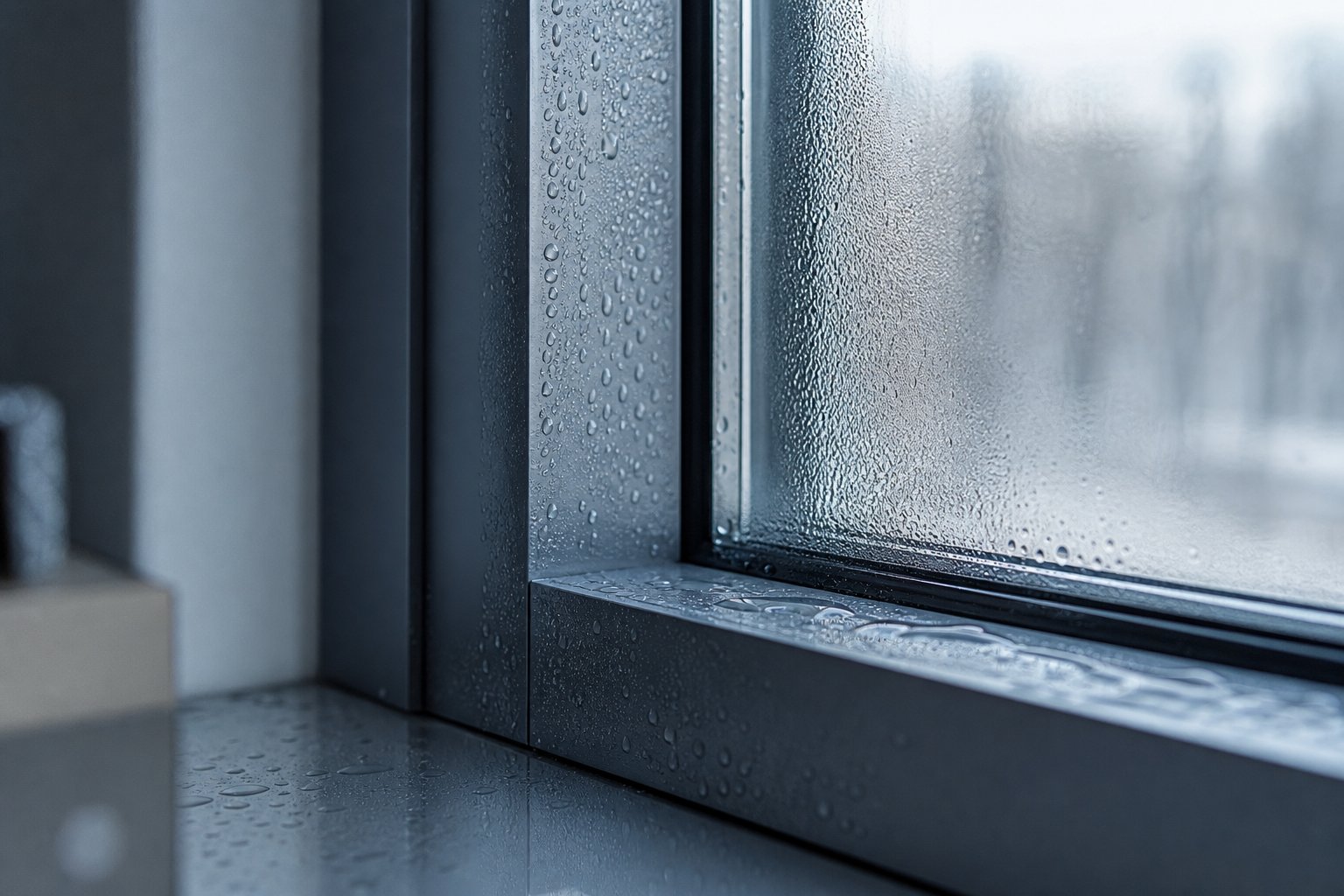
Why do aluminium windows sweat inside? The answer is straightforward physics. On a cold Melbourne winter night, an aluminium frame without a thermal break drops to near-outdoor temperature on its interior surface. Meanwhile, the air inside your home carries moisture from cooking, breathing, and showering. When that warm, humid indoor air contacts the cold frame surface and the surface temperature falls below the dew point, water condenses directly onto the metal.
This is not a defect in the traditional sense. It is aluminium behaving exactly as its material properties dictate. The frame is simply too thermally conductive to stay warm on the inside when the outside is cold. Over time, persistent condensation leads to pooling water on sills, mould growth in surrounding plaster, and deterioration of timber reveals or paintwork adjacent to the frame.
Cold Bridging and Energy Loss Explained
Cold bridging in aluminium window frames means the metal profile creates an uninterrupted conductive path through your wall. Even if your walls are well insulated and your glass unit performs adequately, that aluminium frame bleeds energy at a rate your insulation cannot compensate for. In winter, heat escapes outward through the frame. In summer, external heat conducts inward, forcing your air conditioning to work harder.
The measurable impact shows up in U-values. A standard aluminium frame without a thermal break typically delivers a frame U-value (Uf) of 3.5 to 7.0 W/m²K. Compare that to uPVC frames at 1.0 to 1.8 W/m²K, and the scale of the problem becomes clear. The frame alone can drag your whole-window thermal performance well below what good glazing would otherwise deliver.
When Thermal Performance Fails Building Standards
Under the NCC 2025, residential buildings must achieve a minimum NatHERS 7-star energy rating. Window selection feeds directly into compliance modelling through WERS-rated performance data. For cooler climate zones like Melbourne (Zone 6), typical U-value targets sit at or below 2.0 W/m²K for the whole window. Non-thermally-broken aluminium frames, with their Uf of 5.5 to 7.0 W/m²K, make hitting that target virtually impossible regardless of what glazing you specify behind them.
This creates a real compliance headache for renovators replacing windows in older homes. If your council requires the replacement to meet current NCC energy provisions, a like-for-like swap of old aluminium for new non-broken aluminium may not pass. The aluminium window thermal performance U-value simply cannot satisfy modern energy standards without intervention.
Homeowners dealing with these aluminium window condensation problems typically notice a cluster of symptoms:
- Water droplets or streaming moisture on the interior face of aluminium frames, particularly on cold mornings
- Black mould growth on window reveals, sills, or surrounding plasterboard
- Noticeable cold drafts radiating from the window area even when fully closed
- Higher-than-expected heating and cooling bills relative to the home’s insulation level
- Colour differences or staining on walls and curtains adjacent to the frames
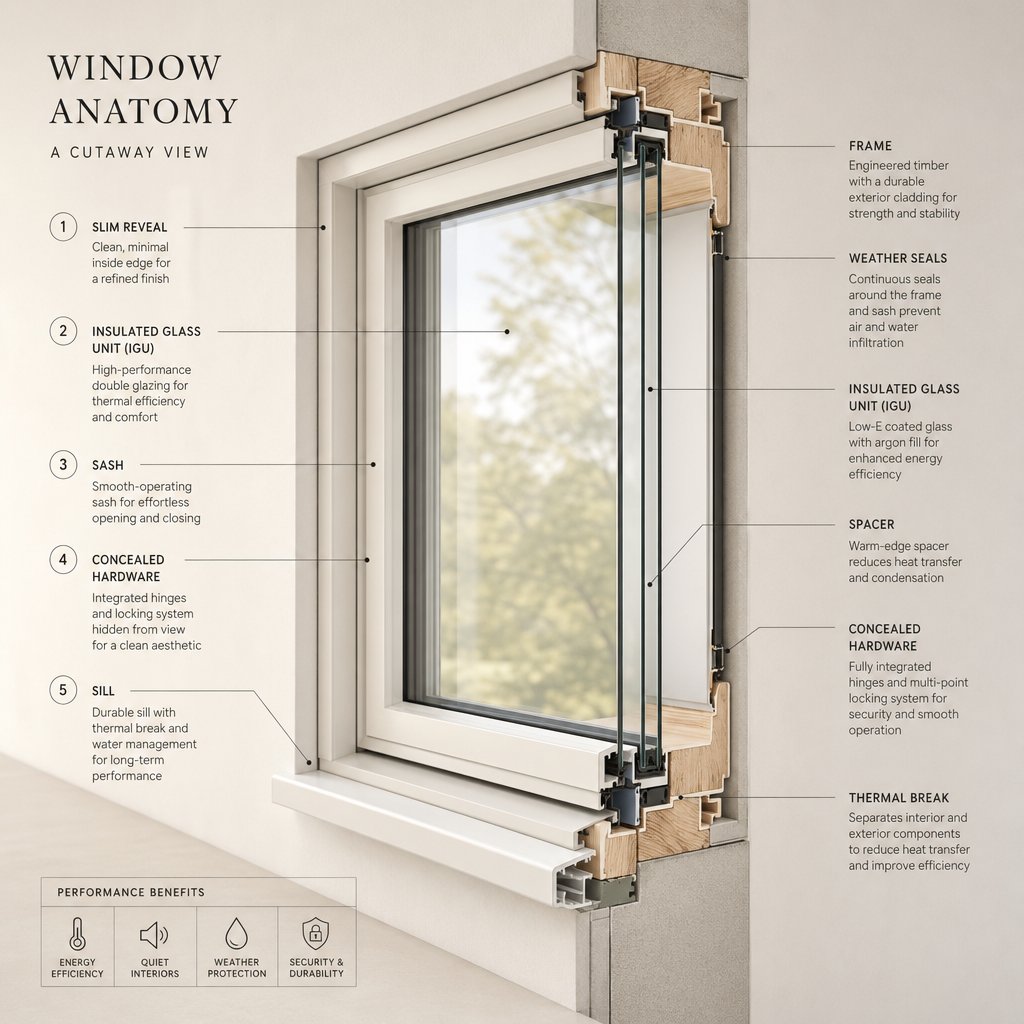
Thermally broken aluminium profiles were engineered specifically to interrupt this conductive path. The concept is simple: a strip of polyamide (PA66), a low-conductivity plastic, is inserted between the interior and exterior aluminium sections of the frame. This polyamide barrier breaks the thermal bridge, allowing the inside face of the frame to stay closer to room temperature while the outside face responds to external conditions independently. With a 28 to 40 mm polyamide break, frame U-values drop dramatically into the 1.4 to 2.5 W/m²K range, bringing aluminium back into compliance territory and significantly reducing condensation risk.
The thermal break does not eliminate aluminium’s conductivity. It redirects it. Heat still moves freely through each aluminium section, but the polyamide strip forces it to take a much longer, more resistant path between inside and outside. How effectively this works depends on the width of the break, the quality of the polyamide, and whether the overall window system, including glazing and seals, supports that improved frame performance.
Condensation and cold bridging are the most common starting point for homeowners searching for how to stop condensation on aluminium windows. The answer, in most cases, is not a surface treatment or a dehumidifier. It is addressing the thermal bridge itself, either through retrofitting secondary glazing, improving ventilation to lower indoor humidity, or ultimately replacing non-broken frames with thermally broken systems. The underlying physics will not change, but the engineering response to it can.
That engineering response, however, only controls heat flow. Sound travels through aluminium by a different mechanism entirely, and the fixes that solve thermal performance do surprisingly little for noise.
Noise Insulation Problems Most People Overlook
Aluminium’s thermal conductivity gets plenty of attention, but its acoustic behaviour rarely enters the conversation. That gap in awareness costs homeowners comfort, particularly those living near busy roads, flight paths, or rail corridors across Australian cities. The same physical rigidity that makes aluminium structurally strong also makes it an efficient transmitter of sound vibrations, and the difference compared to other frame materials is more significant than most people realise.
Why Aluminium Transmits More Sound Than Other Frame Materials
Sound moves through materials as vibration. A frame that absorbs and dampens those vibrations blocks more noise than one that passes them straight through. Aluminium is stiff and dense, which means vibrations travel through it with minimal energy loss. uPVC, by contrast, is softer and features multi-chambered internal profiles that break up and absorb sound energy before it reaches the interior side of the frame.
Think of it this way: tap an aluminium frame and it rings. Tap a uPVC frame and the sound dies almost immediately. That difference in damping capacity reflects how each material handles the constant barrage of airborne noise from traffic, wind, and neighbourhood activity. Timber sits somewhere between the two, offering natural damping from its fibrous structure and density, though it lacks the engineered chambers of uPVC.
Aluminium profiles are also thinner. That slimness is a selling point aesthetically, giving you more glass and narrower sightlines. But thinner walls mean less mass for sound waves to push through, and fewer internal cavities to disrupt vibration paths. The result is that standard aluminium frames contribute less acoustic resistance to the overall window assembly than equivalent uPVC or timber sections.
Single-Glazed Aluminium and Road Noise
Older single-glazed aluminium windows, still common in Australian homes built through the 1970s and 1980s, represent the worst-case scenario for noise. A single pane of glass offers almost no acoustic barrier on its own, and the aluminium frame does nothing to compensate. Do aluminium windows block road noise in this configuration? Barely. The thin glass vibrates freely, the rigid frame transmits that vibration into the surrounding wall, and gaps from worn weatherstripping or aged seals allow sound to bypass the assembly entirely.
Even a gap the width of a pen tip can compromise acoustic performance significantly. Operable aluminium windows, casements, awnings, and sliders, inherently have more seal points than fixed panels. Each hinge, lock point, and meeting rail introduces a potential sound leak. Fixed aluminium windows consistently outperform operable ones acoustically because they eliminate those junction gaps, relying on a single continuous seal between glass and frame.
Acoustic Ratings Compared Across Frame Types
Sound Transmission Class (STC) ratings measure how effectively a window assembly reduces airborne sound. A higher STC number means more noise blocked. While glazing type dominates the overall rating, the frame material plays a supporting role that shifts the baseline up or down. The STC rating of aluminium window frames tends to sit below uPVC equivalents when all other variables, glazing, seal quality, and installation, remain equal.
The table below compares general acoustic characteristics across the three common frame materials based on their inherent material properties:
| Characteristic | Aluminium | uPVC | Timber |
|---|---|---|---|
| Material density | High (approx. 2,700 kg/m³) | Low (approx. 1,300–1,450 kg/m³) | Moderate (varies by species, 400–700 kg/m³) |
| Vibration damping capacity | Low — stiff, resonant | High — soft, multi-chambered | Moderate — fibrous, naturally absorbent |
| Internal air chambers | Typically none or minimal | Multiple (3–7 chambers common) | None, but fibrous mass compensates |
| Profile wall thickness | Thinner (slim sightlines) | Thicker (bulkier profiles) | Thickest (largest frame footprint) |
| Typical acoustic contribution | Lower frame-level sound resistance | Higher frame-level sound resistance | Moderate to high frame-level resistance |
A few caveats worth noting. Glazing selection still dominates overall acoustic performance. Laminated glass with a PVB interlayer dramatically improves STC ratings regardless of frame type. Modern aluminium systems paired with acoustic glazing can achieve respectable noise reduction, but the frame itself contributes less to that result than a uPVC or timber frame would in the same configuration. For homeowners prioritising the best window frame material for noise reduction alone, uPVC holds a measurable edge at equivalent price points.
The aluminium vs uPVC sound insulation gap narrows with high-end thermally broken aluminium systems, partly because the polyamide thermal break adds a small degree of vibration interruption. But the improvement is modest compared to the thermal gains. If aluminium windows noise insulation problems are a primary concern, addressing the glazing specification and seal integrity delivers more return than frame upgrades alone.
Noise performance, though, is only one dimension of how an aluminium window ages. The visible exterior tells its own story over time, and the powder coating that gives these frames their colour has a lifecycle that many homeowners never think about until it starts to fail.
Powder Coating Degradation and Colour Fading Over Time
Fresh from the factory, a powder-coated aluminium frame looks immaculate. The finish is smooth, uniform, and tough enough to resist casual scratches. It is easy to assume that appearance will hold indefinitely. But powder coating is not a permanent shield. It is a polymer film bonded to metal, and like any polymer exposed to the elements, it degrades on a timeline dictated by chemistry, climate, and coating quality. Understanding how long powder coating lasts on windows depends entirely on which type was applied and what environment it faces daily.
How UV Exposure Causes Chalking and Colour Fade
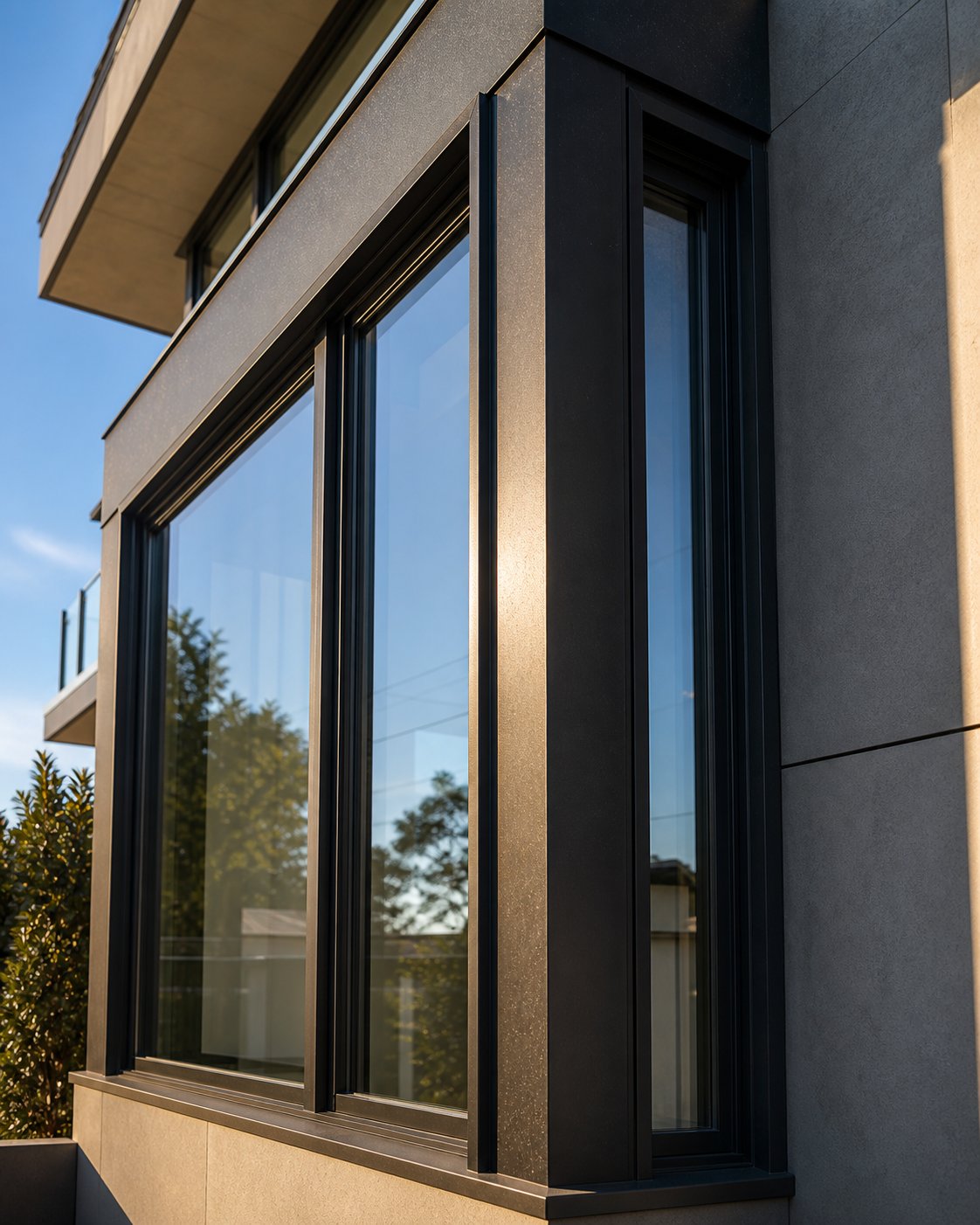
Ultraviolet radiation is the primary destroyer of powder coatings. Over years of sun exposure, UV energy breaks down the chemical bonds in the coating’s resin and pigments. The first visible sign is usually chalking: a fine, powdery residue that forms on the surface as the binder deteriorates and releases pigment particles. Run your finger across an ageing aluminium frame on the sun-exposed side of your home, and that white or coloured dust on your fingertip is the coating slowly disintegrating at the molecular level.
Colour shift follows. Prolonged UV exposure degrades the binder and pigments, causing fading and discolouration that intensifies with time. Darker colours, particularly deep charcoals, blacks, and navy shades popular on contemporary Australian homes, show fading more visibly because the contrast between original and degraded pigment is stark. White and lighter colours still degrade at a similar chemical rate, but the visual change is less obvious since chalking residue blends with the base colour.
Eventually, if left unaddressed, the coating progresses past chalking into micro-cracking and delamination. At this stage, the finish lifts away from the aluminium substrate in flakes or sheets, typically starting at edges, joints, and corners where mechanical stress concentrates. Once the bare metal is exposed, oxidation and corrosion follow quickly, especially in humid or coastal conditions.
Expected Lifespan of Different Coating Qualities
Not all powder coatings deliver the same durability, and this is where many homeowners get caught out. A window marketed as “powder coated” could carry any one of several chemically distinct finishes with vastly different outdoor lifespans. Powder coatings for architectural applications generally fall into three performance tiers:
Standard polyester coatings are the entry-level option. They suit interior applications well and can handle low-demand exterior use, but they lack the UV stabilisers needed for prolonged harsh sun exposure. On windows facing north or west in Australian conditions, standard polyesters may show noticeable chalking within 5 to 10 years. These coatings meet baseline specifications but were never designed for decades of intense outdoor weathering.
Super durable polyester coatings represent the mid-tier. Formulated with enhanced UV resistance, they typically carry a 10-year colour and gloss warranty when applied by a certified applicator. Most residential aluminium windows in Australia ship with this grade, and in temperate climates like Sydney or Melbourne, they deliver a realistic outdoor life of 15 to 20 years before significant aesthetic decline.
Fluoropolymer (PVDF) coatings sit at the top. These high-performance finishes use fluorine-based chemistry that resists UV breakdown far longer than polyester alternatives. Fluoropolymer powder coatings typically carry a 20-year colour and gloss warranty and are specified for demanding commercial and high-end residential projects. They cost more upfront but extend the interval before recoating becomes necessary, particularly in aggressive climates.
On average, a well-applied powder coating in moderate conditions lasts between 15 and 20 years with minimal maintenance. But that figure assumes a quality application on properly prepared aluminium in a benign environment. Change any of those variables and the timeline contracts.
Climate Zones Where Degradation Accelerates
Australia’s climate diversity means powder coating performance varies enormously depending on where your home sits. Three environmental factors accelerate degradation beyond normal UV ageing:
Coastal salt air. Homes within a few kilometres of the ocean face relentless chloride exposure. Salt from seawater, sent airborne by breaking waves and scattered by wind, deposits on frame surfaces and attacks both the coating and any exposed aluminium beneath it. Coastal aluminium window coating degradation does not just fade the colour; it undermines adhesion between coating and substrate. In areas like the Gold Coast, Sunshine Coast, or Perth’s western suburbs, standard polyester coatings often fail years earlier than they would 20 kilometres inland.
Tropical UV intensity. Northern Queensland, the Top End, and parts of Western Australia receive significantly higher annual UV doses than southern states. Windows on north and west elevations in Cairns or Darwin absorb punishing solar radiation year-round. In these regions, chalking onset can arrive 30 to 40 percent faster than in Melbourne or Hobart, making fluoropolymer-grade coatings a practical necessity rather than a luxury upgrade.
Industrial pollutants. Homes near heavy industry, power generation, or major transport corridors face airborne chemical exposure that attacks coatings from a different angle. Sulphur compounds, particulate fallout, and acidic deposits interact with the coating surface, accelerating chemical breakdown independently of UV damage. Industrial zones around Newcastle, Wollongong, or Gladstone present this additional challenge.
Homeowners should watch for these early warning signs that their aluminium window powder coating is deteriorating:
- A dull, chalky surface texture where the coating once felt smooth and glossy
- Visible colour inconsistency between the sun-exposed face and shaded sides of the same frame
- Micro-cracking visible under close inspection, particularly at mitre joints and corners
- Aluminium window powder coating peeling at edges, hardware cutouts, or drainage slots
- White powdery residue transferring to your hand when you wipe the surface
- Bubbling or blistering near the base of frames where moisture pools
The frustrating reality is that aluminium window frame chalking and fading often progresses so gradually that homeowners do not notice until the damage is advanced. Coastal properties deserve an annual visual inspection as a minimum, while inland homes in moderate climates can generally stretch to every two or three years. Regular cleaning with mild soap and water removes salt and pollutant deposits before they accelerate chemical breakdown, extending coating life at minimal cost.
Coating degradation is a surface problem, visible and cosmetic before it becomes structural. But beneath that fading exterior, the mechanical components holding your window together face their own wear timeline, driven by forces that no powder coating can protect against.
Hardware and Mechanical Failures You Should Expect
Frames and coatings get all the attention, but the components that actually make your window function, the hinges, locks, handles, and friction stays, wear out on their own timeline. These mechanical parts bear repeated stress every time you open, close, or lock a window. And because aluminium interacts chemically with other metals, the deterioration can accelerate in ways that timber or uPVC frames rarely experience.
Hinge Fatigue and Friction Stay Failures
Friction stay hinges do the heavy lifting in aluminium casement and awning windows. Unlike simple pivot hinges, they use a multi-arm sliding mechanism that distributes the sash weight across several components while holding the window open at any angle. That complexity gives them more potential failure points.
The most common aluminium window hinge problems and repair scenarios involve friction loss, rivet loosening, and track deformation. Over thousands of open-close cycles, the internal friction surfaces wear down. The window that once held firmly at a 45-degree angle starts drifting closed on its own. Rivets connecting the hinge arms gradually develop play, introducing wobble and uneven load distribution. In heavier double-glazed sashes, the sliding track itself can bend if the hinge was undersized for the weight it carries, a surprisingly common issue when budget hardware gets paired with premium glazing.
Sash drop is the end-stage failure. When the friction stay can no longer support the sash weight, the window panel sags when opened, creating gaps between sash and frame that compromise both weather sealing and security. For friction stay replacement on aluminium windows, the challenge is matching the exact arm length, load rating, and mounting pattern required by the specific profile system. Unlike timber windows where you can often rout a new hinge pocket, aluminium frames demand precise dimensional compatibility.
Windows with integrated flyscreens face additional hardware stress. Every time you open the screen to access the window behind it, or operate both together in the case of integrated designs, you double the mechanical wear cycle. In homes where windows get opened and closed multiple times daily for ventilation, particularly in Queensland and northern NSW where screens are essential, friction stays can fatigue noticeably faster than in temperate climates where windows stay shut for months at a time.
Lock Mechanisms and Handle Wear Patterns
Aluminium window lock mechanism failure typically follows a predictable pattern. Multi-point espagnolette locks, common on casement and awning windows, rely on a central handle driving multiple locking points simultaneously through a connected rod or cam system. When one component wears or corrodes, the entire mechanism binds.
Handles themselves wear at the spindle connection. The square spindle that links handle to gearbox develops play over time, eventually spinning freely without engaging the lock. Sliding window latches face different issues: the spring-loaded catch weakens, failing to secure the sash against the frame and allowing rattling in wind.
The proprietary nature of aluminium window hardware compounds repair difficulty. Unlike standardised timber window fittings, each aluminium system manufacturer machines their profiles to accept specific hardware geometries. A lock from one brand rarely fits another’s profile without modification. When your windows are 15 or 20 years old and the original manufacturer has changed their product range, or exited the market entirely, sourcing compatible replacement parts can become a genuine obstacle. Many homeowners discover this only when a simple handle replacement turns into a full-day search for discontinued fittings.
Galvanic Corrosion Between Dissimilar Metals
Aluminium sits high on the galvanic series, making it anodic (more reactive) relative to most metals it contacts in a window assembly. When steel screws, brass fittings, or zinc-plated hardware sit against the aluminium frame in the presence of moisture, an electrochemical reaction begins. The aluminium around the contact point corrodes preferentially, producing white powdery oxidation, while the fastener itself can also degrade rapidly depending on its composition.
This galvanic corrosion of aluminium window hardware is particularly aggressive in coastal environments. Salt-laden moisture acts as an electrolyte, supercharging the reaction. Carbon steel screws fixing friction stays to aluminium frames represent one of the most common failure points. As industry specialists note, the corrosive reaction can cause fasteners to degrade to the point of breakage, resulting in hardware detachment from the frame.
The typical failure timeline for hardware affected by galvanic corrosion follows a recognisable progression:
- Initial stiffness in operation — slight resistance when opening or closing, often dismissed as normal settling or attributed to dirt in the track
- Increasing difficulty opening or closing — the mechanism requires noticeably more force, handles feel gritty or catch mid-travel, and windows no longer glide smoothly
- Visible corrosion at contact points — white powdery deposits appear around screw heads, hinge mounting plates, or lock keeper plates where dissimilar metals meet
- Eventual mechanism failure — screws shear, hinges detach from the frame, or lock components seize entirely, leaving the window inoperable or insecure
The fix, in principle, is straightforward: use only austenitic stainless steel fasteners (SUS304 for most applications, SUS316 for coastal zones) throughout the window assembly. Stainless steel sits close to aluminium on the galvanic series, minimising the electrochemical potential difference and dramatically slowing corrosion. The cost difference per fastener is negligible, but many budget window manufacturers still use carbon steel or zinc-plated alternatives to shave production costs. That saving at the factory becomes a homeowner’s maintenance headache a few years down the track.
Hardware failures are mechanical and chemical, problems you can feel in a stiff handle or see in a corroded screw head. But the broader picture of aluminium window performance depends heavily on something less tangible: when your windows were manufactured. The era of production shapes which problems dominate and how severe they become.
How Problems Change With Window Age and Era
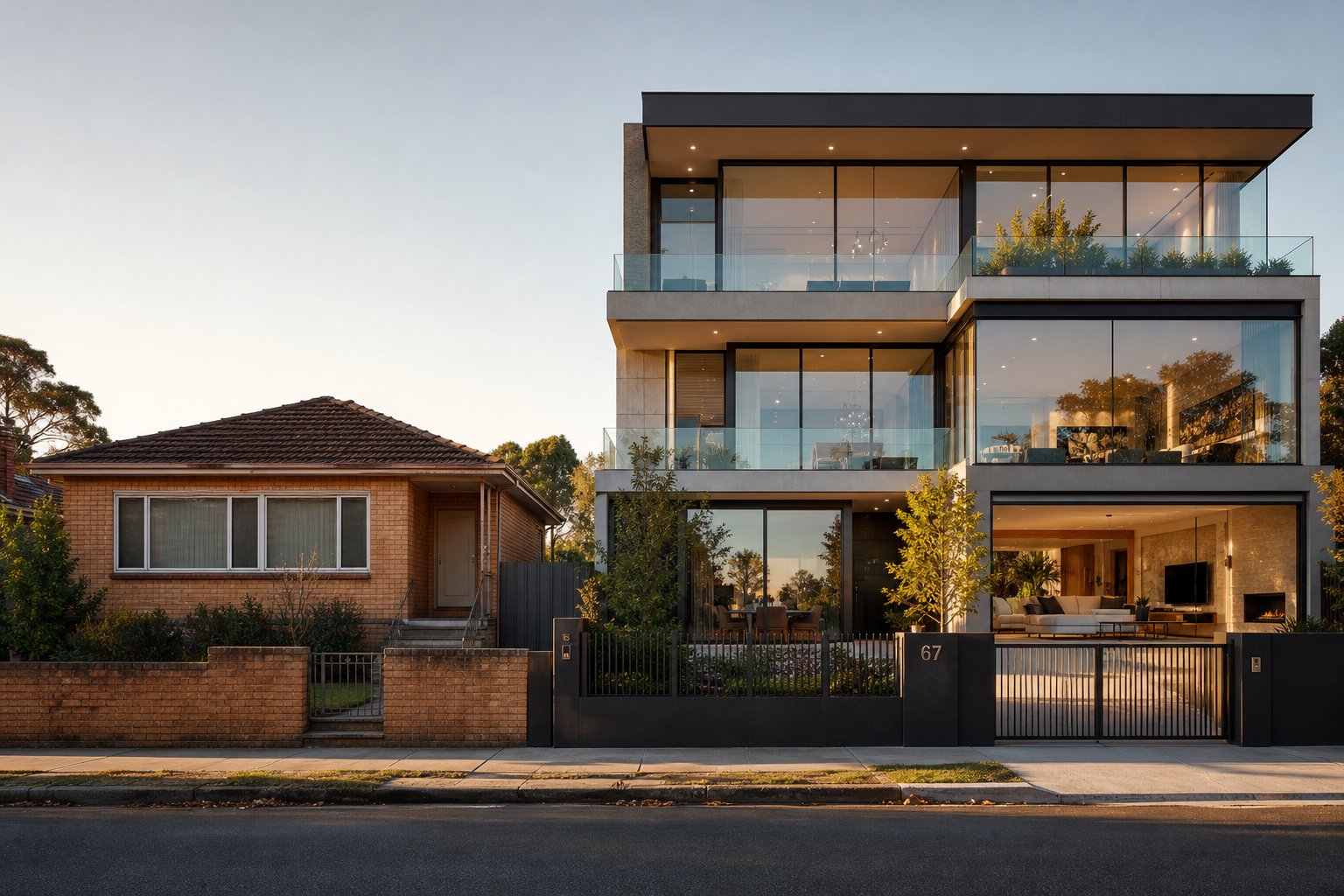
Not all aluminium windows carry the same baggage. A frame installed in a Sydney fibro cottage in 1978 and a thermally broken system fitted to a new Melbourne townhouse share a base metal, but almost nothing else. Their glazing, seals, hardware, coatings, and thermal engineering sit decades apart in sophistication. Yet online forums, review sites, and even some trade publications treat them as interchangeable when listing aluminium window complaints. That conflation misleads homeowners into condemning a material for problems that belong to a specific era of manufacturing.
Understanding which generation your windows belong to changes the conversation entirely. It shifts the question from “are aluminium windows bad?” to “are my aluminium windows past their useful life?” The answer depends on era-specific weaknesses that have evolved dramatically over time.
Problems Specific to Pre-1990s Aluminium Windows
The old aluminium window problems from the 1970s and 1980s trace back to a simple reality: thermal performance was not a design priority. These frames were installed during a surge of residential adoption from the 1950s through the 1980s, when aluminium gained popularity for its modern aesthetic, corrosion resistance, and low maintenance compared to timber. Energy efficiency regulations barely existed, and no one was measuring U-values at the residential level.
The result was single-glazed aluminium with no thermal break whatsoever. A solid aluminium extrusion ran uninterrupted from outside to inside, holding a single pane of 3 mm or 4 mm glass with basic putty or rubber glazing beads. Single glazed aluminium window issues from this era are severe and compounding:
- Extreme condensation on interior frame surfaces through every cold night, leading to chronic mould and timber rot in surrounding reveals
- Near-zero acoustic insulation, with road noise and neighbourhood sounds passing through virtually unimpeded
- Hardware built to lighter tolerances using mild steel fasteners, now corroded and often seized beyond repair
- Basic anodised or early-generation powder coatings that have long since chalked, faded, or delaminated
- Single-point locks and rudimentary latches that offer minimal security by current standards
- No weather seals, or perished rubber strips that no longer make contact with the sash
These windows were fit for purpose in their era. Building codes did not demand thermal performance, and energy was cheap. But by current standards, they fail on nearly every measurable metric. For homeowners wondering when to replace old aluminium windows, the answer for this generation is usually clear: if the frames are original pre-1990s non-broken aluminium, replacement delivers returns across comfort, energy, security, and compliance simultaneously.
Mid-Era Aluminium Windows From the 1990s-2000s
The 1990s introduced the first widespread use of thermal breaks in Australian residential aluminium, though adoption was uneven. Budget builders often continued specifying non-broken profiles well into the 2000s, while project homes and architect-designed builds increasingly adopted basic polyamide-interrupted sections. Double glazing became more common during this period, but air-filled units with 6 mm to 10 mm cavities were standard rather than the wider argon-filled gaps used in current systems.
Mid-era windows represent a mixed bag. The thermal break, where present, addressed the worst condensation and cold bridging behaviour. But early-generation breaks were narrower, typically 12 mm to 20 mm of polyamide, delivering moderate improvement without approaching modern thermal standards. Hardware quality improved with stainless steel fasteners becoming more common, though plenty of installations still used zinc-plated components that have since corroded in coastal and humid zones.
Powder coating technology was more mature by the late 1990s, with super durable polyesters becoming the residential norm. Windows from this era often retain serviceable coatings even after 20-plus years in moderate climates, though sun-hammered northern and western elevations tell a different story. The critical weakness of this generation is seal degradation. Rubber and EPDM weatherstrips from this period are reaching or passing their functional life, resulting in air infiltration, water ingress during driving rain, and rattling in wind.
Issues That Persist Even in Current Systems
Modern high-performance thermally broken aluminium systems have solved many historical problems through engineering. Wide polyamide breaks of 28 mm to 40 mm, argon-filled double or triple glazing, multi-point locking, and advanced EPDM compression seals deliver measurable performance that satisfies NCC energy provisions and incorporates advanced thermal break technology as standard. But some challenges remain inherent to the material regardless of era:
- Thermal conductivity within each aluminium section — the break interrupts the bridge, but each half of the profile still conducts heat freely along its length, creating localised thermal effects at corners and junctions
- Sound transmission through the frame — polyamide breaks add marginal acoustic benefit, but aluminium’s stiffness still transmits vibrations more readily than uPVC or timber alternatives
- Galvanic corrosion potential — wherever dissimilar metals contact aluminium in the presence of moisture, electrochemical degradation remains a risk if fastener and hardware specification is poor
- Powder coating as a finite finish — even fluoropolymer-grade coatings degrade under UV exposure over decades; no current coating technology offers a permanent solution
- Expansion and contraction — aluminium’s thermal expansion coefficient is roughly twice that of steel and glass, meaning frames move relative to their glazing and fixings through seasonal temperature cycles, stressing seals over time
The difference between thermally broken vs non thermally broken aluminium is not subtle. It represents a generational leap in engineering that eliminates the most damaging historical problems while acknowledging that material-level characteristics persist. The table below puts that progression into perspective:
| Problem Area | 1970s–80s (Non-Broken, Single Glazed) | 1990s–2000s (Basic Thermal Break) | Modern (High-Performance Thermally Broken) |
|---|---|---|---|
| Thermal performance | Very poor — Uf 5.5–7.0 W/m²K | Moderate — Uf 3.0–4.5 W/m²K | Good — Uf 1.4–2.5 W/m²K |
| Condensation risk | Severe — daily occurrence in cool climates | Moderate — reduced but not eliminated | Low — rare in normal humidity conditions |
| Hardware durability | Poor — mild steel, basic mechanisms | Moderate — mixed fastener quality | Good — stainless steel, multi-point locks |
| Coating longevity | Expired — most well beyond service life | Declining — approaching end of life | Current — 15–25+ years expected |
| Acoustic rating | Very poor — single glazed, no seals | Moderate — double glazed, basic seals | Moderate to good — improved but still below uPVC |
| Weather seal integrity | Failed or absent | Degrading — EPDM past service life | Intact — compression seals within lifespan |
The pattern is clear. Each generation resolved the most urgent failures of the one before it, but aluminium’s material properties set a floor beneath which no amount of engineering can push certain metrics. Thermal breaks cannot make aluminium stop conducting heat; they can only prevent that conductivity from bridging between inside and out. Better coatings cannot make UV disappear; they can only resist its effects longer. The improvements are genuine and substantial, but they operate within physical limits.
For homeowners sitting with pre-1990s frames, the cost of living with those limitations compounds year after year through energy loss, maintenance, and declining comfort. For those with mid-era windows, the decision is more nuanced: seals and hardware may be replaceable, extending useful life without full replacement. And for anyone specifying new aluminium today, the question shifts from whether problems exist to how much those residual issues actually cost over the window’s lifetime compared to alternative materials.
Total Cost of Ownership vs uPVC and Timber Alternatives
Upfront price is a poor predictor of what windows actually cost you. A cheaper frame that needs replacing twice inside 50 years, or one that bleeds energy every winter, quietly outspends the more expensive option that lasts the distance. Are aluminium windows worth the investment? The answer depends on how you account for maintenance, energy loss, repair complexity, and replacement frequency across the full ownership period, not just the purchase receipt.
Energy Cost Impact Over a Typical Ownership Period
Energy loss is the silent budget line most homeowners ignore. As covered earlier, non-thermally-broken aluminium frames carry frame U-values of 3.5 to 7.0 W/m²K, dramatically higher than uPVC at 1.0 to 1.8 W/m²K or timber at 1.2 to 1.4 W/m²K. That gap translates directly into heating and cooling costs. Research from the UK Energy Saving Trust estimates that replacing inefficient windows can save up to $290 AUD per year for a detached home, with savings scaling by dwelling type. Australian energy prices and our more extreme summer cooling loads can push those figures higher still, particularly for west-facing windows in Brisbane or Perth absorbing intense afternoon solar gain.
Thermally broken aluminium narrows the energy gap considerably, achieving U-values between 0.9 and 1.5 W/m²K that approach high-spec uPVC. But older non-broken aluminium accumulates energy losses year after year. Over a 20 or 30-year ownership span, the aluminium windows long term cost of ownership rises substantially through higher utility bills alone, even before touching maintenance or replacement.
Maintenance and Repair Frequency Compared
Aluminium window maintenance costs over time are genuinely low in direct comparison to timber. No painting, no sealing, no rot treatment. A wash with mild soapy water a few times a year keeps coatings cleaner and extends their service life. On that front, aluminium and uPVC are roughly equivalent in maintenance demand.
Where aluminium diverges is repair complexity. When hardware fails or seals degrade, the proprietary nature of aluminium profiles makes sourcing replacement parts harder and more expensive than for standardised uPVC systems. A friction stay replacement on a 15-year-old aluminium window can involve tracking down discontinued fittings or modifying alternatives to fit machined tolerances. Timber repairs are labour-intensive but use universally available materials. uPVC hardware is more standardised across manufacturers, making like-for-like replacement straightforward.
Timber demands the most ongoing attention. Repainting or resealing every 5 to 7 years is non-negotiable. Skip those maintenance cycles and hardwood deteriorates into a liability rather than a long-term asset. That recurring labour cost, whether DIY or professional, compounds significantly over decades.
Replacement Cycles and Material Longevity
The aluminium vs uPVC windows lifetime cost calculation hinges on how many replacement cycles each material requires over a building’s life. Industry data indicates that uPVC typically lasts 20 to 30 years before seals fail and frames warp beyond repair. Aluminium, with minimal structural degradation, can reach 45 years or more. Well-maintained timber stretches to 40 to 60 years but only with diligent upkeep.
Over a 60-year horizon, which roughly matches the lifespan of a well-maintained timber window or a quality aluminium frame, uPVC likely requires two full replacement cycles. Aluminium may need one late-life replacement or significant refurbishment. Timber survives the full span but absorbs decades of maintenance labour. On a whole-life cost basis, aluminium is often the cheapest option, though this assumes thermally broken profiles that avoid the energy penalty of older systems.
The framework below lays out how these factors relate across materials. Rather than fixed dollar figures, which shift with market conditions and regional labour costs, it gives you the structural comparison needed to assess your own situation:
| Cost Factor | Aluminium (Thermally Broken) | uPVC | Timber |
|---|---|---|---|
| Expected lifespan | 45+ years | 20–30 years | 40–60+ years (with maintenance) |
| Upfront cost (relative) | Mid to high | Low to moderate | High |
| Maintenance frequency | Minimal — periodic cleaning | Minimal — periodic cleaning | High — repaint/reseal every 5–7 years |
| Repair complexity | High — proprietary parts, precise tolerances | Low to moderate — standardised hardware | Moderate — universal materials, labour-intensive |
| Energy efficiency impact | Good with thermal break; poor without | Very good — inherently low conductivity | Good — naturally insulating |
| Replacement cycles (over 60 years) | One or none | Two to three | One or none (if maintained) |
| End-of-life recyclability | Excellent — infinitely recyclable at 95% recovery | Limited — recycling infrastructure improving but still constrained | Moderate — biodegradable but not reusable as framing |
Aluminium’s recyclability deserves specific mention. It can be recycled indefinitely without loss of quality, and the recycling infrastructure in Australia is well-established. That is a genuine environmental advantage over uPVC, which still faces limited end-of-life recycling pathways domestically. However, this sustainability benefit operates at end-of-life. During the window’s operational decades, energy losses from poor thermal performance, particularly in non-broken profiles, can offset the environmental credit aluminium earns through recyclability.
Total cost calculations are not universal. They shift with climate zone (a Darwin home loses far more through thermal bridging than a Hobart home gains through passive solar), window orientation (west-facing glass drives cooling costs in summer), dwelling type, and critically, whether the aluminium system uses a thermal break. A non-broken aluminium frame in a heating-dominated climate accumulates energy costs that a thermally broken equivalent simply does not. The framework above gives you the structure; your specific variables fill in the numbers.
Cost, of course, only matters if the problems can be solved. And for most of the issues covered so far, modern engineering has developed direct answers, systems designed specifically to close the performance gaps that older aluminium left wide open.
How Modern Thermally Broken Systems Address These Problems
Every problem discussed so far, condensation, cold bridging, energy loss, acoustic weakness, coating failure, hardware corrosion, traces back to either material limitations or manufacturing shortcuts. Modern thermally broken aluminium systems tackle both simultaneously through engineering that did not exist when those early frames went into Australian homes. The thermally broken aluminium window benefits are not theoretical improvements on a spec sheet. They are measurable responses to documented failures, verified through testing protocols that hold manufacturers accountable.
How Thermal Break Technology Solves Conductivity Issues
The polyamide thermal break is the single most consequential engineering advance in aluminium window design. A reinforced nylon strip, typically 24 mm to 35 mm wide and manufactured from glass-fibre-reinforced PA66, sits between the interior and exterior aluminium sections of the frame. This barrier has a thermal conductivity of approximately 0.3 W/mK compared to aluminium’s 237 W/mK, creating a near-complete interruption of the conductive path.
Do thermally broken windows stop condensation? In most normal humidity conditions, yes. By keeping the interior frame surface close to room temperature rather than letting it plummet toward outdoor conditions, the surface stays above the dew point. Moisture in indoor air no longer has a cold surface to condense on. The improvement is dramatic: traditional aluminium frames achieve U-values of 4.0 to 6.0 W/m²K, while thermally broken systems routinely deliver 0.8 to 2.0 W/m²K, representing a 70 to 85 percent improvement in thermal efficiency.
Advanced systems now incorporate multi-chamber profiles within the thermally broken design. These internal air spaces act as additional insulation layers, boosting thermal resistance and adding a modest degree of acoustic dampening that standard aluminium profiles lack entirely.
Double Glazing and Gas Fills for Energy Performance
A thermal break alone does not make a high-performance window. The frame must work in concert with the glazing system to deliver whole-window performance that satisfies modern aluminium windows energy efficiency standards. Current systems pair thermally broken profiles with double or triple glazing featuring argon gas fills, low-emissivity coatings, and warm-edge spacer bars.
Argon gas, roughly 34 percent less conductive than air, fills the cavity between panes to reduce convective heat transfer. Low-E coatings reflect radiant heat back into the room during winter while limiting solar heat gain in summer. Warm-edge spacers replace the old aluminium spacer bars that created their own thermal bridge at the glass perimeter. Together, these components push whole-window U-values into the range that satisfies NCC minimum 7-star energy rating requirements for new residential builds across Australian climate zones.
The synergy matters. A thermally broken frame paired with basic single glazing underperforms. A high-spec insulating glass unit set in a non-broken frame still suffers cold bridging at the perimeter. Only when the system is engineered holistically, frame, break, glazing, seals, and hardware working together, does the performance reach its potential.
Compliance Standards That Guarantee Minimum Performance
Engineering solutions only deliver confidence when backed by independent verification. This is where aluminium window compliance certifications in Australia separate high-performing systems from marketing claims. The regulatory framework covering window performance includes AS 2047 for structural and weatherproofing requirements, AS 1288 for glazing selection, WERS for energy rating, and the overarching NCC provisions that set minimum thermal performance thresholds.
Certified systems undergo rigorous testing for air permeability, water penetration under pressure, wind load resistance, thermal transmittance, and acoustic attenuation. Each test generates documented evidence that the window performs as specified under defined conditions. For architects, builders, and specifiers, this documentation eliminates guesswork. Rather than relying on material assumptions or manufacturer assurances, they can verify that a system addresses the specific problems outlined throughout this article.
Manufacturers who invest in comprehensive compliance documentation, such as the performance data available on MEICHEN’s Compliance and Certifications page, give project professionals a direct way to confirm that specified systems meet current Australian standards for energy efficiency, weather resistance, condensation management, and durability. That transparency matters because it connects the engineering back to measurable outcomes.
Key performance areas where certified modern systems differ from problematic older aluminium:
- Thermal performance — verified U-values meeting NCC climate zone requirements, with thermal break integrity confirmed through testing
- Weather resistance — tested water penetration and air infiltration under pressure loads matching local wind exposure conditions
- Condensation management — interior surface temperatures maintained above dew point in standard operating conditions
- Acoustic rating — documented sound reduction values allowing informed specification for noise-sensitive sites
- Structural integrity — load-tested frames suitable for high-wind zones, upper-storey applications, and large openings without deflection
The gap between a modern certified thermally broken system and an old non-broken frame is not incremental. It is generational. The material is the same, but the engineering, testing, and accountability surrounding it have transformed what aluminium can deliver in a residential or commercial envelope. Knowing that these solutions exist, however, still leaves homeowners with the practical question of what to do about their current windows, and when the answer is repair, upgrade, or full replacement.
When to Repair, Upgrade, or Replace Your Aluminium Windows
Diagnosing the problem is one thing. Deciding what to do about it is another. Not every failing aluminium window warrants ripping out and starting fresh. Some issues respond to targeted repairs that extend useful life by years. Others signal that the system has passed the point where incremental fixes make financial or performance sense. The aluminium window repair or replace decision comes down to a clear-eyed assessment of what is actually failing, how severely, and whether a fix addresses the root cause or merely delays the inevitable.
Signs Your Aluminium Windows Need Immediate Attention
Certain symptoms demand action regardless of budget or timing preferences. Visible window failure, including cracked glass, warped frames, or seals that have separated from the profile entirely, compromises both safety and weatherproofing. Water pooling inside the frame, black mould spreading beyond the window reveal, or hardware that no longer secures the sash closed all represent conditions where delay compounds damage and cost.
Less obvious but equally urgent: condensation between double-glazed panes indicates seal failure within the insulating glass unit. The window is no longer performing its thermal function. Difficulty opening or closing suggests structural deformation or advanced hardware corrosion that worsens with every operation cycle. And if you feel distinct drafts with windows fully closed and locked, the weather seals have failed beyond what cleaning or adjustment can restore.
Repair vs Replace Decision Framework
The decision is not binary. Between full replacement and doing nothing sits a range of interventions: hardware replacement, seal renewal, reglazing, or secondary glazing addition. The right choice depends on which generation your windows belong to and what is actually failing.
For mid-era windows from the 1990s and 2000s with thermally broken frames still structurally sound, replacing degraded EPDM seals and worn friction stays can restore much of the original performance at a fraction of replacement cost. The frame itself may have decades of life remaining. For pre-1990s non-broken single-glazed aluminium, however, repairs address symptoms while the fundamental thermal and acoustic deficiencies persist unchanged. No amount of new hardware makes a non-broken frame stop conducting heat.
When weighing up your situation, prioritise decision criteria in this order:
- Safety concerns — cracked glass, failed hardware leaving windows insecure, or structural damage to frames that could fail under wind load. These override every other consideration.
- Energy compliance requirements — if you are renovating and council requires compliance with current NCC provisions, non-thermally-broken aluminium will not pass regardless of condition. Replacement becomes mandatory for approval.
- Comfort and performance — chronic condensation, persistent drafts, excessive road noise, or energy bills disproportionate to your home’s insulation level. These indicate the system is no longer fit for purpose even if structurally intact.
- Aesthetics and property value — chalked coatings, faded colour, and dated profiles reduce street appeal and resale potential. Valid reasons to replace, but lowest priority compared to safety and performance failures.
Choosing a Compliant Replacement System
If the decision lands on replacement, the question shifts to how to choose compliant replacement windows that will not repeat the problems you are solving. This is where specification quality separates a lasting upgrade from a sideways move.
For homeowners, the minimum checklist is straightforward: thermally broken profiles with a polyamide break of at least 24 mm, double glazing with argon fill and low-E coating, multi-point locking hardware in stainless steel, and compression weather seals rated for your exposure conditions. Every component should carry documentation showing compliance with AS 2047 for structural and weather performance.
For builders, developers, and specifiers, the bar sits higher. Project-level accountability demands verified test reports, not just manufacturer claims. Systems specified for aluminium window replacement for energy efficiency need documented U-values, WERS ratings, and evidence of testing under pressure loads matching the site’s wind classification. Resources like MEICHEN’s Compliance and Certifications documentation give professionals a single reference point to verify that a system meets current Australian standards across energy efficiency, weather resistance, acoustic performance, and durability, directly addressing the failure modes outlined throughout this article.
The risk of choosing poorly is real. Non-compliant windows expose property owners to safety failures, legal penalties, higher energy costs, and reduced property value. Checking for AS 2047 performance labels, AGWA certificates, and NATA-accredited test reports is not bureaucratic box-ticking. It is the mechanism that guarantees you are not installing tomorrow’s problem today.
The material itself is not the problem. Specification quality, thermal engineering, and certified compliance separate problematic aluminium windows from high-performing ones. Every issue covered in this article has an engineered solution, but only when that solution is verified, documented, and correctly installed.
Aluminium remains a genuinely excellent framing material when the system surrounding it matches the demands of your climate, your site, and current Australian standards. The problems are real, but so are the answers. Armed with a clear understanding of what is failing and why, you can make the repair, upgrade, or replacement decision with confidence rather than guesswork.
Frequently Asked Questions About Aluminium Window Problems
1. Why do my aluminium windows sweat on the inside in winter?
Interior sweating occurs because aluminium conducts heat roughly 1000 times more than uPVC. On cold nights, the interior frame surface drops close to outdoor temperature. When warm, humid indoor air contacts that cold metal, moisture condenses directly onto it. Non-thermally-broken frames are most affected because the aluminium runs uninterrupted from outside to inside, creating a direct thermal bridge. Thermally broken profiles with a polyamide barrier keep the interior surface closer to room temperature, significantly reducing or eliminating condensation under normal humidity levels.
2. How long does powder coating last on aluminium window frames?
Powder coating longevity depends on the coating grade and your local climate. Standard polyester coatings may show chalking within 5 to 10 years on sun-exposed faces. Super durable polyester, the most common residential grade in Australia, typically lasts 15 to 20 years in moderate conditions. Fluoropolymer (PVDF) coatings offer the longest life at 20-plus years, even in demanding environments. Coastal salt air, tropical UV intensity, and industrial pollutants all accelerate degradation. Regular cleaning with mild soapy water helps extend coating life by removing corrosive deposits before they cause chemical breakdown.
3. Are aluminium windows worse than uPVC for noise insulation?
In general, yes. Aluminium is stiff and resonant, meaning it transmits sound vibrations rather than absorbing them. uPVC profiles feature multiple internal air chambers that break up and dampen vibration energy before it reaches the interior side. Aluminium also uses thinner profile walls, offering less mass for sound waves to push through. However, glazing selection dominates overall acoustic performance. Laminated glass with a PVB interlayer dramatically improves noise reduction regardless of frame type, and modern thermally broken aluminium paired with acoustic glazing can achieve respectable sound attenuation for most residential situations.
4. When should I replace my old aluminium windows instead of repairing them?
Replacement makes stronger financial and performance sense when your frames are pre-1990s non-thermally-broken aluminium. These systems fail on thermal performance, acoustics, security, and energy compliance simultaneously, and no repair addresses the fundamental lack of a thermal break. For mid-era windows from the 1990s-2000s with structurally sound thermally broken frames, targeted repairs like seal renewal and hardware replacement can extend useful life cost-effectively. Immediate replacement is warranted when you see cracked glass, structural frame deformation, failed sealed units showing internal condensation, or hardware that no longer secures the window closed.
5. Do thermally broken aluminium windows meet current Australian energy standards?
Modern thermally broken aluminium systems with wide polyamide breaks (24 mm to 35 mm), argon-filled double glazing, low-E coatings, and warm-edge spacers routinely achieve whole-window U-values that satisfy NCC minimum 7-star NatHERS energy rating requirements. These systems are tested and certified against AS 2047 and rated through WERS, providing documented evidence of compliance. Manufacturers offering comprehensive compliance documentation, such as MEICHEN’s certified performance data, give builders and specifiers verified proof that their aluminium window systems meet current Australian standards for energy efficiency, weather resistance, and durability.
More Window & Door Guides