What Actually Defines Quality in Aluminium Windows
Ask ten window salespeople what makes the best quality aluminium windows and you will get ten different answers, most of them conveniently pointing toward whatever they sell. The problem is not dishonesty. It is that quality in aluminium fenestration is genuinely multi-dimensional, and few people in the industry bother explaining the full picture.
This guide exists to change that. Rather than ranking brands or listing products, it teaches you how to assess aluminium window quality yourself, using measurable criteria that apply regardless of manufacturer or price point.
Why Most Buyers Misjudge Aluminium Window Quality
The most common mistake is treating brand reputation as a proxy for performance. A recognisable name tells you something about market presence but nothing about alloy composition, thermal break width, or coating certification grade. Another frequent misjudgement is confusing visual appeal with structural integrity. A sleek, slim profile might look premium in a showroom, yet its wall thickness and alloy grade determine whether it will perform under real wind loads and decades of daily operation.
Aesthetic appeal matters, but it sits downstream of engineering decisions that are harder to see and rarely discussed at the quoting stage.
The Six Pillars of Aluminium Window Quality
To understand what makes aluminium windows high quality, you need a unified framework rather than a scattered checklist. Every measurable quality factor falls within one of these six pillars:
- Material Grade — The specific aluminium alloy and temper used in extrusion, which dictates strength, corrosion resistance, and surface finish potential.
- Manufacturing Precision — Corner joint construction, drainage engineering, CNC tolerances, and fabrication consistency.
- Thermal Performance — Thermal break technology, strip width, chamber design, and whole-window U-value ratings.
- Surface Treatment — Powder coating or anodising certification level, pre-treatment quality, and long-term colour stability.
- Hardware Integration — Hinge type, locking mechanism grade, handle quality, and how hardware affects security and daily usability over decades.
- Glazing Quality — Sealed unit construction, spacer bar type, gas fill retention, and glazing bead design for water management.
Each pillar is independently verifiable. You can check specifications, request test data, and physically inspect samples against these criteria. That is what separates evidence-based assessment from salesroom impressions.
The framework starts at the molecular level, with the aluminium itself, because every other quality decision builds on that foundation.
Aluminium Alloy Grades and Real-World Performance
Most window quotes list “aluminium frame” as if that tells you something meaningful. It does not. Aluminium is a family of alloys, each engineered for different performance characteristics. The specific alloy grade in your window profiles determines how strong they are, how well they resist coastal corrosion, how smoothly they accept powder coating, and whether they can be extruded into the precise shapes that modern fenestration demands.
Three alloys dominate the window industry: 6060, 6063, and 6061. They all belong to the 6xxx series (aluminium-magnesium-silicon), meaning they are heat-treatable and share a baseline of good corrosion resistance. But the differences between them matter more than most buyers realise.
Understanding 6060 vs 6063 vs 6061 Alloy Grades
The best alloy for aluminium window frames is not necessarily the strongest one. That counterintuitive fact catches many people off guard. In fenestration, extrudability and surface finish quality often matter more than raw tensile strength, because windows require complex profile geometries, tight tolerances, and flawless coating adhesion.
6063-T5 and 6063-T6 are the industry standard for architectural window profiles. This alloy provides an excellent balance of strength, corrosion resistance, and surface quality. It extrudes smoothly into the intricate multi-chamber shapes that thermal break systems require, and it accepts both anodising and powder coating with a uniform, attractive finish. For the vast majority of residential and commercial window applications across Australia, 6063 is the correct choice.
The difference between 6063-T5 and 6063-T6 comes down to heat treatment. T5 temper means the aluminium was cooled from the extrusion process and then artificially aged. T6 involves a full solution heat treatment followed by quenching and artificial ageing, producing higher yield and ultimate tensile strength. In practical terms, 6063-T6 delivers roughly 31 KSI (approximately 214 MPa) yield strength compared to 21 KSI (approximately 145 MPa) for T5. That extra strength allows engineers to design slimmer profiles that still meet wind-load requirements, which is why premium systems often specify T6 for structural members while using T5 for secondary components like glazing beads.
6060 sits below 6063 in mechanical strength but offers exceptional extrudability and dimensional accuracy. It works well for decorative or light-duty components within a window system, think trim pieces and non-structural accessories, but lacks the rigidity needed for primary frame members in Australian conditions where wind loads and thermal cycling are significant.
6061 goes the other direction. It is the strongest of the three, with tensile strength reaching 290 to 320 MPa in T6 temper. However, its higher magnesium and silicon content makes it harder to extrude into complex shapes, and its surface finish after anodising tends toward a duller, less uniform appearance. You will find 6061 in windows designed for extreme structural demands, large spans in high-wind zones or cyclone-rated applications in northern Queensland, but it is not the default choice for standard residential fenestration.
| Property | 6060-T6 | 6063-T6 | 6061-T6 |
|---|---|---|---|
| Tensile Strength (MPa) | 180 – 215 | 205 – 240 | 290 – 320 |
| Corrosion Resistance | Excellent | Excellent | Good (may need surface treatment) |
| Extrudability Rating | Exceptional | Excellent | Moderate |
| Surface Finish Quality | Very smooth, uniform | Smooth, uniform | Duller, less consistent |
| Typical Window Application | Decorative trims, light-duty profiles | Primary frames, sashes, structural members | Large-span or high-wind structural sections |
A manufacturer specifying 6063-T5 or T6 transparently on their technical data sheets is giving you a quality signal. One that lists only “aluminium” without further detail is hiding information you need to make an informed decision.
How Wall Thickness Affects Structural Integrity
Alloy grade tells you what the material can do per unit of cross-section. Wall thickness determines how much material is actually there to do the work. Both factors combine to define real-world structural performance.
The standard minimum wall thickness for residential aluminium window profiles is 1.2 mm. For high-rise, commercial, or wind-exposed environments, reinforced profiles of 1.4 to 1.6 mm are specified. These are not arbitrary numbers. They reflect the minimum cross-sectional area needed to resist wind pressure, support glazing weight, and maintain operational integrity over decades of use.
Here is where budget systems cut corners. A profile with 1.0 mm wall thickness might technically pass a basic compliance test under controlled laboratory conditions. But real windows face sustained wind loads during storms, repeated thermal expansion and contraction across Australian summers and winters, and the mechanical stress of thousands of opening and closing cycles. Thinner walls flex more under these forces. Over time, that flexion compromises seal integrity, loosens hardware fixings, and allows water ingress at joints.
For larger window openings, common in contemporary Australian home design, wall thickness becomes even more critical. A 2.4-metre-wide sliding door panel exerts substantially more stress on its frame than a standard 600 mm casement. The profile must resist deflection under its own glazing weight plus wind pressure without permanent deformation. Specifying adequate wall thickness for the span is a hallmark of quality engineering.
When evaluating aluminium window wall thickness requirements for your project, ask for the profile cross-section drawings. Quality manufacturers publish these openly. If the information is difficult to obtain, that reluctance itself tells you something about how the system was designed and for whom.
The alloy and wall thickness together form the skeleton of your window. But a strong skeleton still needs precise assembly to perform, which is where manufacturing process quality enters the equation.
Manufacturing Process Indicators That Signal Quality
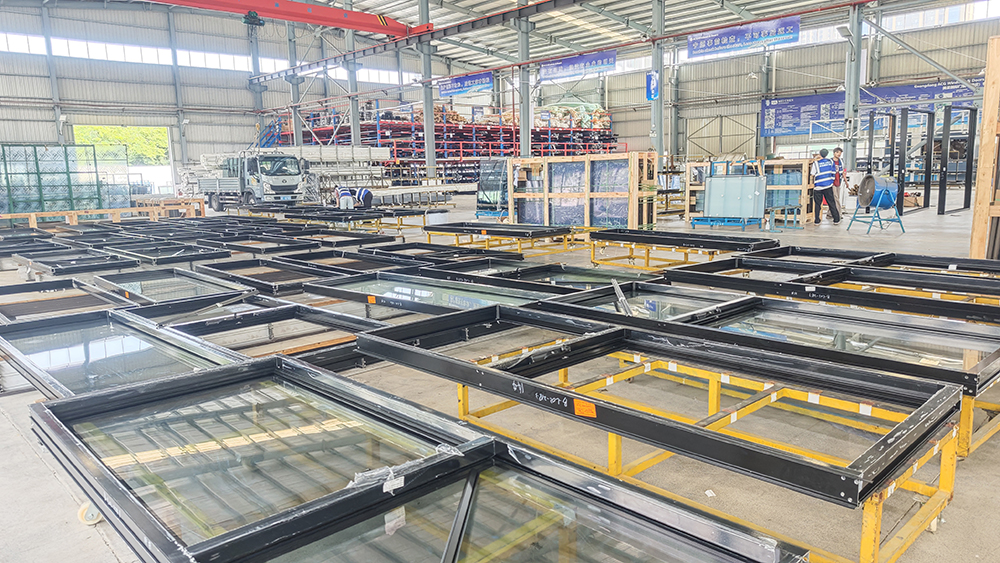
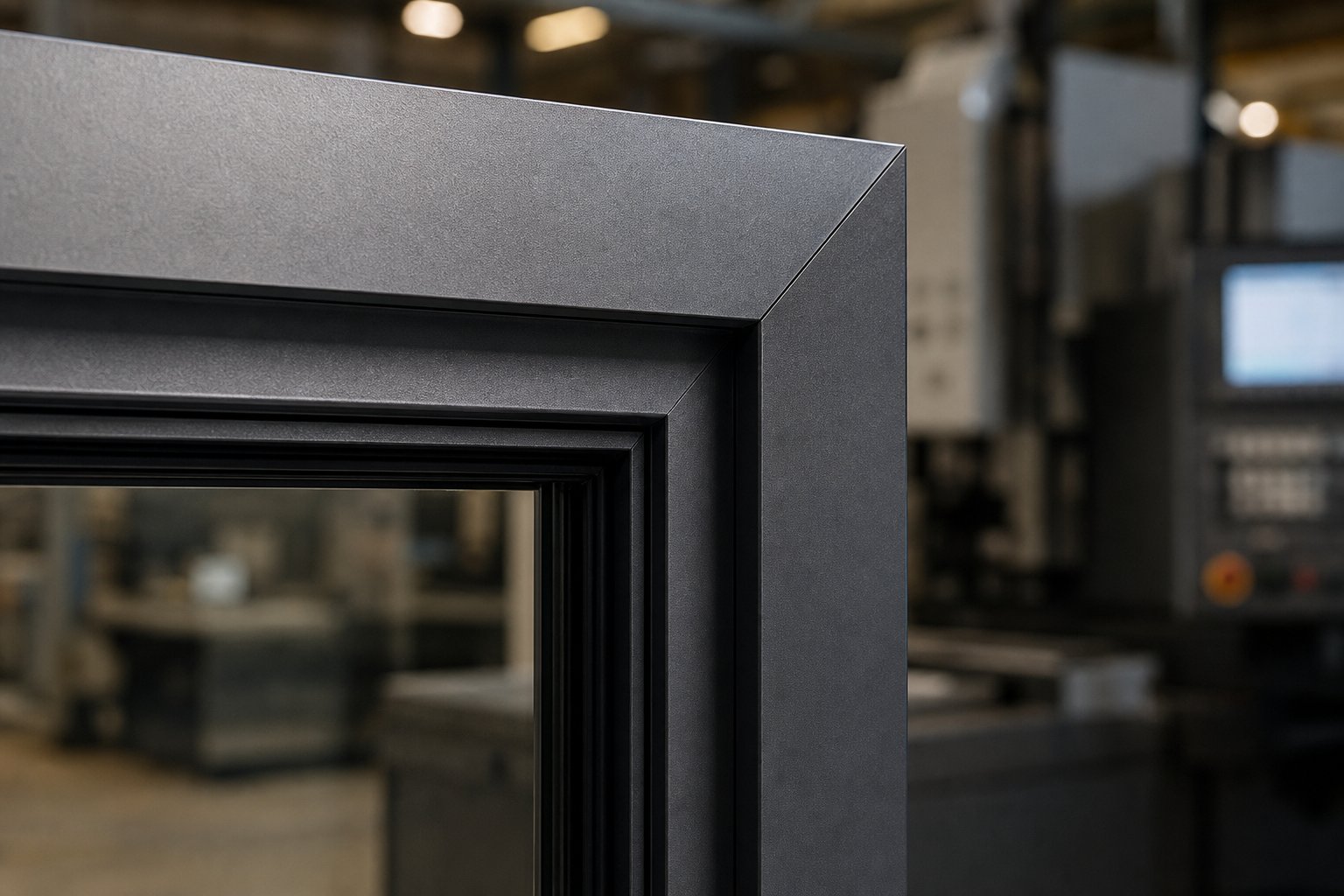
A premium alloy extruded to generous wall thickness can still produce a mediocre window if it is poorly fabricated. Manufacturing is where design intent meets physical reality, and it is also where the gap between budget and premium systems becomes visible to anyone who knows where to look. Learning how to identify quality aluminium windows at the fabrication level protects you from paying premium prices for average workmanship.
Welded Corners vs Mechanical Joints
Every aluminium window frame has four corners, and each one is a potential failure point. The way those corners are joined is one of the clearest aluminium window manufacturing quality signs you can assess without any technical instruments.
Budget systems typically rely on simple mechanical connectors, a metal cleat or screw that holds two mitre-cut profiles together. These joints are fast to assemble and inexpensive, but they carry inherent weaknesses. Mechanical connections can loosen over time due to daily operation, thermal cycling, and wind-load stress. As the joint loosens, gaps form. Those gaps allow water ingress, air leakage, and in humid coastal environments common across much of Australia, filiform corrosion beneath the powder coating.
Higher-quality systems address this vulnerability through multiple reinforcement strategies. Crimped corners with injected polyurethane-based adhesives create both a mechanical interlock and a chemical bond, dramatically increasing rigidity and weather resistance. The best aluminium window corner joint types combine crimping with hydrolysis-resistant adhesive plus a hybrid coating applied to the raw cut edges, protecting the exposed aluminium from corrosion in the capillary gaps where moisture collects. IFT Rosenheim-approved corner adhesives, for example, have demonstrated 1680 hours of salt spray resistance on raw aluminium, a figure relevant to anyone building near the Australian coastline.
In a showroom or when inspecting a sample, run your finger along the internal corner joint. A quality joint feels flush and uniform. You should see no visible gap, no rough adhesive squeeze-out, and no exposed raw aluminium at the mitre cut. If you can see daylight through the corner or feel a step between the two profiles, the fabrication standard is below what you should accept for any system marketed as premium.
Drainage Systems and Weatherstrip Design
Water will reach your window frame. Rain driven by wind, condensation forming on cold surfaces, even cleaning water running down the glass. Quality is not about preventing water contact entirely. It is about managing water so effectively that it never reaches the interior.
Premium aluminium window systems use pressure-equalised drainage chambers. These engineered channels collect any water that penetrates the outer weather seal and direct it back outside through concealed weep slots. The key design principle is that the drainage chamber operates at equal pressure to the exterior, preventing wind-driven rain from being pushed further inward. Budget systems often rely on a single seal barrier with basic gravity drainage, a design that fails under sustained high wind combined with heavy rain, exactly the conditions Australian east-coast storms deliver regularly.
The gasket material holding those seals in place matters just as much as the drainage design behind them. Three materials dominate the fenestration industry: EPDM, silicone, and TPE (thermoplastic elastomer). Understanding the difference between EPDM vs silicone window gaskets helps you gauge how long those seals will actually last.
EPDM (ethylene propylene diene monomer) is the workhorse of the window seal industry. It offers excellent resistance to ozone, UV radiation, and weathering, with high abrasion and tear resistance. EPDM gaskets in quality windows routinely last 20 to 30 years without significant degradation, maintaining their compression set and elasticity through Australian temperature extremes. Its water resistance is considered the highest of any commercial rubber compound.
Silicone gaskets offer superior heat resistance and remain flexible across a wider temperature range (from -60°C to over 200°C). However, silicone has lower tear and abrasion resistance than EPDM, making it more vulnerable to damage during window operation or maintenance. Silicone also costs substantially more. Its primary advantage in fenestration is longevity in extreme UV exposure, making it a sensible choice for north-facing facades in high-UV Australian climates where EPDM might degrade faster.
TPE gaskets are the budget alternative. They can be co-extruded directly with the aluminium profile, reducing manufacturing steps and cost. But TPE generally has a shorter service life than EPDM, with reduced UV stability and a greater tendency to take a permanent compression set over time. In a window expected to perform for 40-plus years, TPE seals may need replacement within 10 to 15 years.
Precision Tolerances in Fabrication
A well-designed window system with quality alloys, engineered drainage, and premium gaskets can still underperform if it is fabricated without adequate precision. This distinction between system design and fabrication execution is critical and often overlooked.
CNC cut aluminium window profiles deliver consistent, repeatable accuracy that manual cutting simply cannot match. Standard wall thickness tolerances for quality aluminium profiles sit at ±0.15 mm to ±0.25 mm, with straightness deviation controlled to 1 mm per metre of length. When profiles are then cut and assembled, CNC machinery maintains mitre angles within fractions of a degree, ensuring gaskets seat uniformly, hardware aligns correctly, and sealed units fit without stress points.
Manual cutting introduces human variability. Even skilled fabricators working with quality saw blades produce inconsistencies across a production run. Those fractional misalignments compound at the assembly stage. A mitre cut that is 0.5 degrees off-angle creates a visible gap at the corner joint. A profile cut 1 mm too long forces the assembler to compress the seal, creating uneven pressure that accelerates gasket fatigue in that location.
The downstream effects multiply over time. A window that operates smoothly on day one but develops stiffness, drafts, or water leaks within five years often traces back to fabrication imprecision rather than design failure. This is why two windows built from identical system components can perform very differently, the fabricator’s equipment, quality control protocols, and tolerance standards make the difference.
When inspecting any aluminium window, whether in a showroom or on delivery, these red flags indicate poor manufacturing quality:
- Visible sealant overflow or smearing around corner joints
- Uneven gaps between sash and frame, varying across the perimeter
- Rough-cut or burred edges on aluminium profiles, especially around drainage slots
- Misaligned hardware where handles, hinges, or locks do not sit flush or parallel
- Inconsistent gasket seating, with sections that bulge, twist, or pull away from the profile groove
- Visible daylight or felt air movement through closed corner joints
- Powder coating chips or thin spots near cut edges and machined holes
Any single item on this list is a concern. Multiple items together suggest systemic fabrication problems rather than a one-off defect, and they indicate a manufacturer whose quality control does not match their marketing claims.
Manufacturing precision delivers the physical structure, but a window must also manage energy transfer. The component responsible for that task, the thermal break, carries its own set of quality variables that separate code-minimum systems from genuine high-performance fenestration.
Thermal Break Technology and Energy Performance
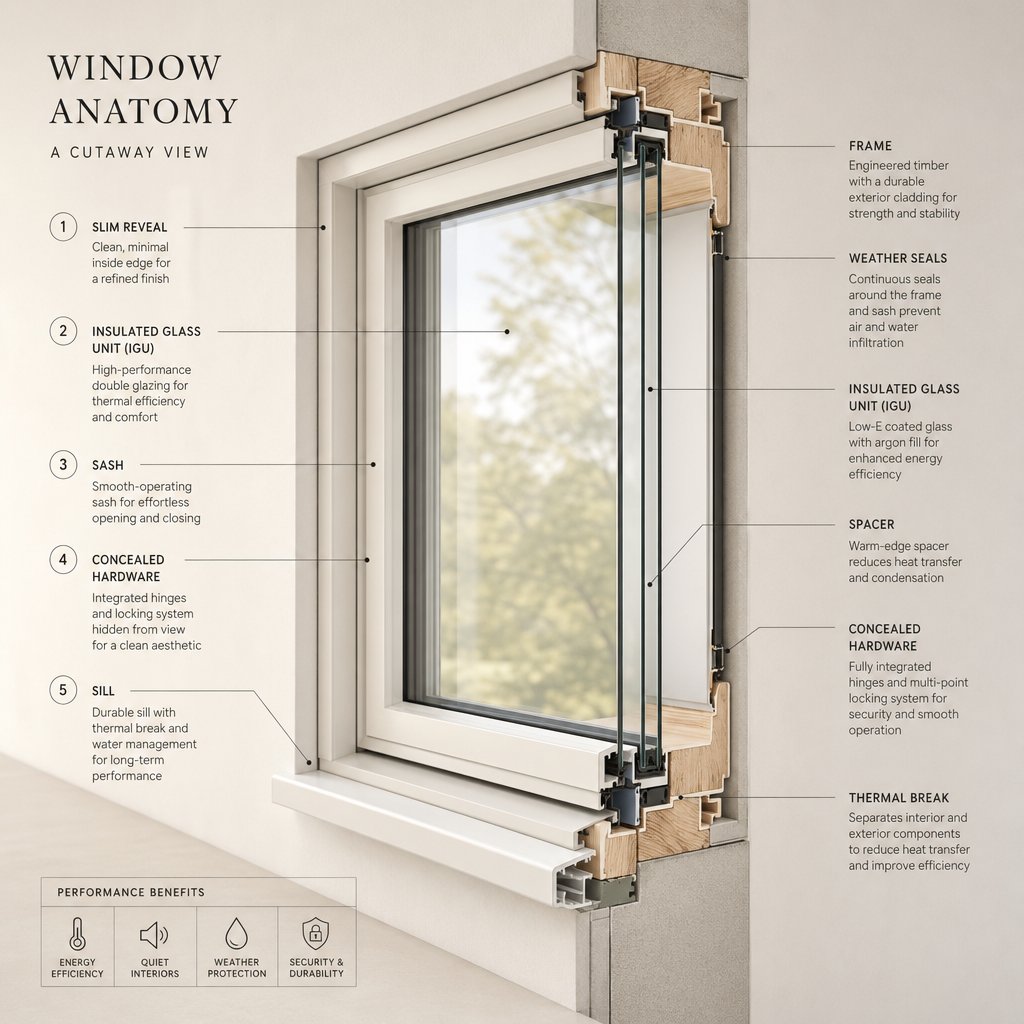
Aluminium conducts heat roughly 1,000 times faster than timber and 200 times faster than uPVC. Without intervention, a solid aluminium frame acts as a thermal highway, bleeding energy from your home in winter and funnelling heat inward during summer. The intervention is a thermal break: an insulating barrier engineered into the profile that splits the frame into separate interior and exterior sections, dramatically slowing heat transfer across the frame.
Understanding how thermal breaks work in aluminium windows is essential because this single component transforms aluminium from an energy liability into a high-performance system. Two primary technologies exist, and the differences between them affect performance, longevity, and cost.
Polyamide Strips vs Pour-and-Debridge Systems
The dominant system in premium polyamide thermal break aluminium windows uses precision-manufactured strips of PA66 (polyamide 6.6) reinforced with 25% glass fibre. These strips are mechanically crimped into dovetail grooves machined into the aluminium extrusions, creating a permanent bond that maintains structural integrity while providing a thermal conductivity of approximately 0.3 W/mK compared to aluminium’s 237 W/mK. That is a reduction in conductivity by a factor of nearly 800.
Strip width is the critical variable for thermal break strip width performance. A 20 mm polyamide strip delivers adequate performance for basic compliance, but premium systems use strips ranging from 24 mm to 35 mm or wider. Each additional millimetre of strip width lowers the frame’s U-value, but it also introduces engineering challenges. A wider thermal break creates a longer unsupported span between the aluminium sections, requiring careful profile geometry and glass fibre reinforcement to maintain structural rigidity under wind loads and operational stress.
The alternative approach, pour-and-debridge, takes a fundamentally different manufacturing path. Liquid polyurethane resin is poured into a channel within a single aluminium extrusion, allowed to cure into a solid thermal barrier, and then the aluminium bridge connecting the two halves is machined away. This creates complete thermal separation with excellent mechanical interlocking between the polyurethane and aluminium.
Pour-and-debridge systems offer manufacturing precision and consistency, and the cured polyurethane forms an intimate bond with the aluminium profile walls. However, polyamide strip systems generally achieve better thermal performance per millimetre of break width due to the lower thermal conductivity of glass-fibre-reinforced PA66 compared to standard polyurethane. For this reason, most systems targeting Passive House or high-performance energy ratings in Australian climate zones use polyamide strip technology.
How to Identify Quality Thermal Break Construction
When evaluating any thermally broken aluminium window, four measurable indicators separate premium from basic construction:
- Strip width in millimetres — Ask for the actual measurement. Systems below 20 mm offer minimal improvement; 24-35 mm represents mid-to-premium range; above 35 mm targets Passive House certification.
- Glass fibre content — Quality polyamide strips contain 25% glass fibre reinforcement. Lower percentages reduce structural strength and dimensional stability across temperature cycles.
- Number of chambers — Multi-chamber profiles create additional air pockets within the frame, each acting as a supplementary thermal barrier and improving acoustic performance.
- Continuity at joints — Premium systems maintain an unbroken thermal break through corner joints and mullion connections. Budget systems often interrupt the thermal break at these junctions, creating thermal bridges that undermine the entire profile’s performance.
These four factors feed into the metric that ultimately matters: the U-value. With aluminium window u-value ratings explained simply, lower numbers mean less heat transfer and better insulation. But which U-value you look at changes everything.
Three distinct U-value measurements apply to windows. Ug measures the glazing only, describing heat transfer through the glass itself. Uf measures the frame only, isolating the performance of the aluminium profile and its thermal break. Uw measures the whole window as an installed unit, combining frame, glazing, spacer edge effects, and the proportional areas of each component.
Salespeople often quote Ug values because glazing technology delivers impressively low numbers (0.5-1.1 W/m²K for quality double or triple glazing). Frame-only Uf values also appear in marketing because a well-designed thermal break produces flattering figures in isolation. But neither tells you how the complete window actually performs in your wall.
The only U-value that reflects real-world energy performance is Uw, the whole-window value. It accounts for how frame and glazing interact, how spacer bars create edge losses, and how the ratio of frame to glass area affects overall heat transfer. A window with an excellent Uf but poor spacer detailing or excessive frame proportion can still deliver a disappointing Uw. Always compare systems using whole-window Uw values measured to the same reference size.
For context, the Passive House Institute certifies windows with installed Uw values at or below 0.80 W/m²K for cool-temperate climates. Standard code-compliance aluminium windows in Australia typically sit between 2.0 and 4.0 W/m²K. Premium thermally broken systems achieve 1.0 to 1.8 W/m²K, representing a 50-75% improvement over basic aluminium frames. The gap between a 1.2 and a 2.5 Uw window compounds across every square metre of glazing in your home, every hour of every day, for decades.
Thermal break quality is what separates aluminium windows suitable for genuine high-performance building from those that merely tick a compliance box. But even the best thermal break cannot compensate for a surface finish that degrades within years, exposing the aluminium beneath to the elements. The coating system applied over that engineered frame carries its own hierarchy of quality standards.
Surface Finish and Powder Coating Quality Standards
Your window’s powder coating is not decorative flair. It is the first line of defence against UV degradation, salt air corrosion, and decades of Australian weather. A poor coating fails visibly — chalking, fading, peeling — but it also fails invisibly beneath the surface, allowing oxidisation to attack the aluminium substrate long before you notice cosmetic damage. Understanding powder coating quality grades for windows lets you distinguish between finishes that look identical on day one but behave very differently by year ten.
Qualicoat and Qualanod Certification Standards
Two international quality label organisations govern surface treatments on architectural aluminium. Qualicoat sets standards for organic coatings (powder coating and liquid paint), while Qualanod governs anodising quality. Both operate through a licensing system: coating applicators undergo routine independent inspections to verify that their processes, equipment, and materials meet defined specifications. This is third-party verification, not self-declared compliance.
Qualicoat certified aluminium windows carry a finish that has passed a rigorous battery of laboratory and real-world exposure tests. The certification does not simply assess the powder itself — it evaluates the entire application process from substrate pre-treatment through to final cure. A licensed applicator must demonstrate consistent performance across all of these parameters:
- Minimum coating thickness — 60 microns minimum for Class 1, measured at multiple points across the profile to ensure consistent coverage in recessed areas and corners
- Adhesion — Cross-hatch and pull-off tests verifying the coating bonds permanently to the pre-treated aluminium surface
- Hardness — Pencil hardness or Buchholz indentation testing to confirm resistance to scratching and mechanical damage
- Gloss retention — Measured after accelerated weathering and natural Florida exposure testing, with minimum retention thresholds at defined time intervals
- UV and weathering resistance — Natural exposure panels set at 5° South in Florida’s subtropical climate, the globally accepted benchmark for simulating long-term outdoor degradation
- Salt spray resistance — Extended salt fog chamber testing (minimum 480 hours for Class 1) to evaluate corrosion protection in marine and coastal environments
- Boiling water resistance — Immersion testing to assess adhesion integrity under extreme moisture and thermal stress
- Resistance to mortar and acids — Simulating construction-phase exposure and atmospheric pollutant contact
The critical distinction most buyers never encounter is the Qualicoat Class 1 vs Class 2 difference. Class 1 coatings provide good architectural performance and suit the majority of residential applications with moderate environmental exposure. They must retain a minimum of 50% gloss after 12 months of Florida exposure — equivalent to roughly one year of intense subtropical weathering.
Class 2 coatings, often called “hyperdurable,” use more expensive resin chemistry engineered for exceptional long-term colour and gloss stability. The performance requirement jumps significantly: 75% gloss retention after 12 months, 60% after 24 months, and 50% after 36 months of the same Florida exposure. That three-year Florida standard translates to decades of real-world performance in Australian conditions.
When should you specify Class 2? Coastal properties in salt-air environments, north-facing facades receiving intense UV year-round, dark or saturated colours (which are inherently more susceptible to fading), and any application where you expect the finish to remain visually consistent for 30-plus years without refinishing. For sheltered or south-facing elevations in temperate climates, Class 1 delivers excellent value with a realistic service life well beyond 20 years when properly maintained.
How Surface Finish Affects Long-Term Value
The powder coating itself only performs as well as the substrate preparation beneath it allows. This is the element most often overlooked in the specification process — pre-treatment of the aluminium surface is what determines whether a coating stays bonded for decades or begins lifting within years.
Powder coatings are air-permeable at a microscopic level. If the pre-treatment is poorly applied or missing entirely, atmospheric moisture gradually reaches the aluminium substrate through the coating film. Oxidisation begins beneath the surface, eventually pushing the coating away from the metal and causing blistering, flaking, or filiform corrosion that tracks visibly beneath the finish. No amount of coating thickness compensates for inadequate pre-treatment.
Quality pre-treatment involves multi-stage chemical cleaning to remove all oils, oxides, and contaminants from the raw extrusion, followed by a conversion coating that seals the aluminium surface and provides a chemical key for the powder to grip. Modern systems use chrome-free conversion coatings (titanium or zirconium-based), which meet environmental regulations while delivering adhesion performance comparable to the older chromate processes. Each stage is monitored for chemical concentration, temperature, and immersion time — variables that a Qualicoat-licensed applicator must control within documented tolerances.
Colour stability reveals pre-treatment and powder quality faster than any other visual indicator. Uncertified coatings applied over minimal pre-treatment begin chalking within three to five years in Australian UV conditions, particularly on north and west-facing surfaces. Chalking appears as a whitish residue on the surface — the binder in the powder coat degrades under UV radiation and migrates to the surface, dulling the colour and reducing gloss. It signals that degradation has begun, not that the coating has catastrophically failed, but it is a clear marker of aluminium window finish longevity standards not being met.
Certified coatings on properly pre-treated substrates resist this process for decades. The premium powder compositions use fluoropolymer-modified or super-durable polyester resins that absorb UV energy without chemical breakdown, maintaining their original appearance with nothing more than periodic washing.
Sublimation wood-grain and textured finishes deserve separate consideration. These decorative coatings involve transferring a printed film onto the powder-coated surface through heat and vacuum, building up a realistic timber appearance on the aluminium substrate. The quality variables multiply: the base coat must be uniform and adequately cured, the sublimation film must use UV-stable inks, and the transfer process must achieve complete contact without air pockets or creasing. Textured finishes (such as matt, satin, or sand-grain effects) are less susceptible to visible chalking than high-gloss smooth coatings, which can be an advantage in harsh exposure conditions, but they also make it harder to detect early degradation during maintenance inspections.
Ultimately, a window’s surface finish is not an aesthetic afterthought. It is an engineered protective system with measurable, certifiable quality grades. When a manufacturer specifies Qualicoat Class 1 or Class 2 coating applied by a licensed facility, they are committing to a documented standard that independent inspectors verify. When they simply state “powder coated” without further detail, you have no way to know what is actually protecting your investment from decades of Australian sun, salt, and storm.
Beneath that coating and thermal break, though, the components you interact with daily — the glass, the seals holding it in place, and the hardware you operate every time you open a window — carry their own quality hierarchies that quietly determine whether your windows still function smoothly in year twenty.
Glazing Integration and Hardware That Lasts Decades
A window frame is only as good as the glass it holds and the mechanisms that operate it. You could specify premium alloy, flawless fabrication, a 34 mm polyamide thermal break, and Qualicoat Class 2 coating — and still end up with a window that fogs, leaks, or jams within a decade if the sealed glazing unit, spacer bars, and hardware are treated as afterthoughts. These components carry the heaviest operational load in daily life, yet they receive the least attention during the sales process.
Sealed Unit Quality and Gas Fill Retention
The sealed glazing unit — two or three panes bonded together with a gas-filled cavity between them — delivers most of a window’s thermal and acoustic performance. It is also the component most likely to fail over time. Industry data suggests a failure rate of approximately 1% after ten years when units are properly fabricated and installed. That sounds low until you consider that a typical Australian home has 15 to 25 windows: statistically, at least one unit may develop permanent fogging within its service life.
Permanent fogging — a milky film on the internal glass surfaces you cannot clean — signals hermetic seal failure. Moisture vapour has overwhelmed the desiccant and condensed inside the cavity. The causes are well understood: degraded edge seals allow humid air to infiltrate, water pooling around perimeter seals accelerates sealant breakdown, and repeated thermal cycling (daytime heating followed by night cooling) softens adhesive bonds over thousands of cycles.
Double glazed unit failure prevention starts with two construction details: the spacer bar system and the dual-seal configuration.
The spacer bar sits at the perimeter of the sealed unit, separating the glass panes at a precise distance while holding desiccant that absorbs residual moisture trapped during manufacture. Traditional aluminium spacer bars are cheap and structurally rigid, but aluminium’s high thermal conductivity creates a cold bridge at the glass edge. That cold bridge causes perimeter condensation on the interior pane — the familiar ring of moisture that forms around the edge of poorly specified windows on cold mornings.
Warm edge spacer bars for aluminium windows replace that conductive metal bridge with low-conductivity materials, dramatically reducing edge heat loss and condensation risk. The thermal improvement is measured through psi-values (ψ), which quantify the linear thermal transmittance at the glass-spacer-frame junction. Lower ψ-values mean less heat escaping at the perimeter, directly improving the whole-window Uw rating discussed in the previous chapter.
| Spacer Type | Typical ψ-value (W/mK) | Thermal Conductivity | Condensation Risk | Typical Application |
|---|---|---|---|---|
| Aluminium | 0.08 – 0.11 | High (160 W/mK) | High | Budget residential, utility glazing |
| Stainless Steel | 0.05 – 0.08 | Moderate (15 W/mK) | Moderate | Mid-range residential and commercial |
| Composite Polymer | 0.03 – 0.05 | Low (0.2 – 0.4 W/mK) | Low | Premium residential, high-performance projects |
| Foam-based (e.g. flexible foam bar) | 0.03 – 0.04 | Very Low (0.14 – 0.22 W/mK) | Very Low | Passive House, thermally critical applications |
The difference between an aluminium spacer at ψ 0.10 and a foam-based warm edge spacer at ψ 0.03 may seem small in isolation. But multiplied across the total perimeter length of every sealed unit in a home — often 50 to 80 linear metres — the cumulative effect on energy loss and condensation is substantial. For the best quality aluminium windows, specifying warm edge spacers is non-negotiable.
Seal integrity determines how long the gas fill and desiccant remain effective. Quality sealed units use a dual-seal system: a primary seal of polyisobutylene (PIB butyl) applied directly to the glass and spacer surfaces creates a moisture vapour barrier, while a secondary structural seal of polysulphide, polyurethane, or silicone bonds the assembly together and provides mechanical strength. The primary seal blocks moisture ingress; the secondary seal holds the unit together under wind loads and thermal stress. Both must be continuous without voids, air pockets, or poor corner fill.
Argon gas fills the cavity in most quality sealed units, reducing convective heat transfer between panes by roughly 30% compared to air. The sealed unit must retain that gas over decades. Well-fabricated dual-sealed units lose approximately 1% of their gas fill per year — meaning after 20 years, an argon-filled unit still retains around 80% of its original fill, well above the threshold where thermal performance begins to degrade noticeably. Units with poor seal integrity lose gas faster, and once argon concentration drops below approximately 80-85%, the thermal benefit diminishes significantly.
Hardware Quality and Long-Term Operation
Hardware is to a window what the drivetrain is to a vehicle. The frame provides structure, the glass provides performance, but hardware delivers function. You interact with it daily — opening, closing, locking, adjusting — and that repetitive mechanical load across 20 to 30 years is where budget compromises reveal themselves fastest.
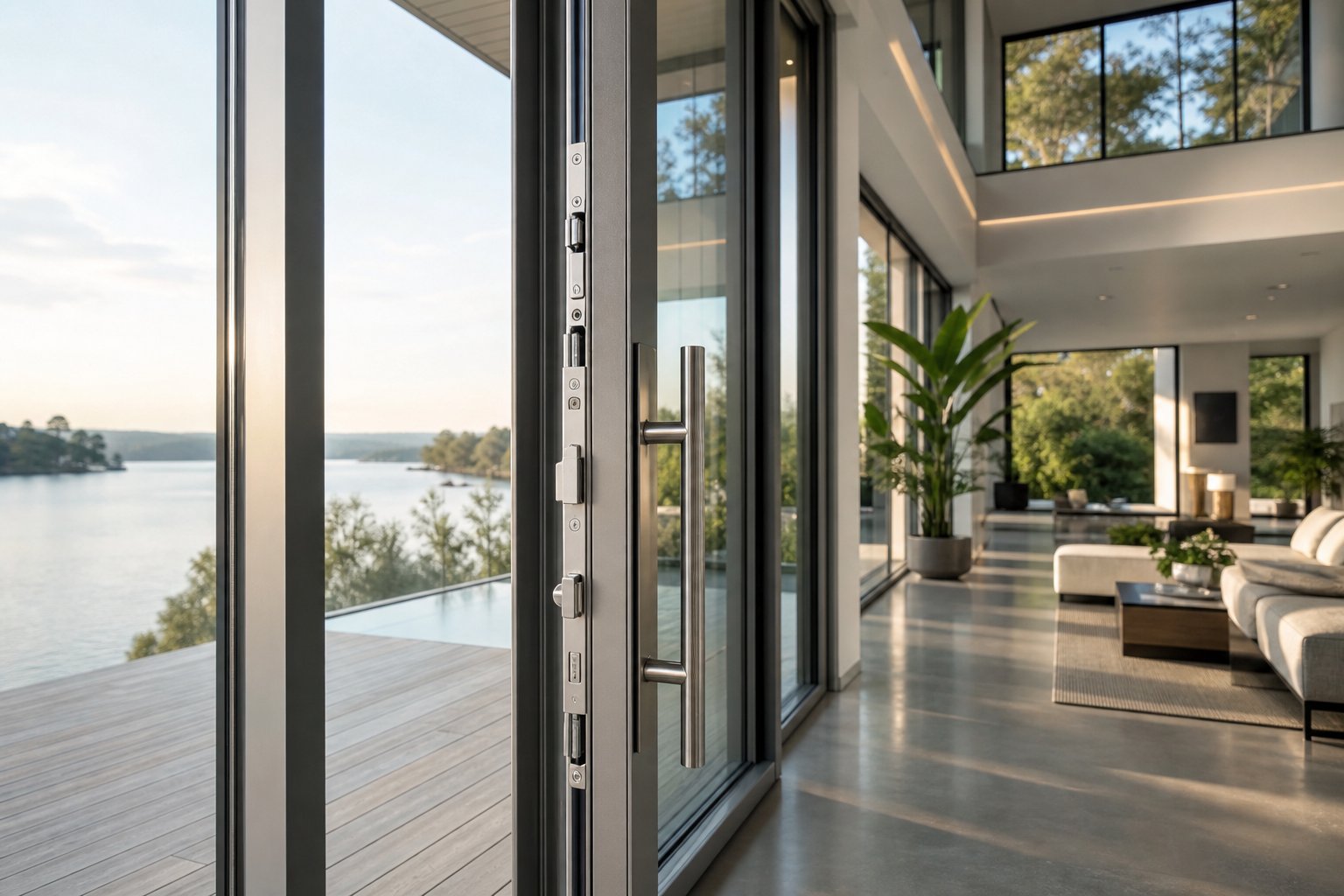
For casement windows, friction stay hinges control the sash movement. Quality friction stays use stainless steel slide channels (SS304 grade minimum for coastal Australian environments) with precision-machined friction pads that maintain consistent resistance throughout the operating arc. They carry a rated weight capacity — typically 12 kg, 20 kg, or 28 kg depending on sash size — and exceeding that capacity guarantees premature wear, sagging, and eventual failure to hold the sash in the open position.
The best hardware for aluminium casement windows combines friction stays rated well above the actual sash weight with multi-point espagnolette locking. An espagnolette system engages locking points at multiple positions around the sash perimeter (typically three to five points for a standard casement), pulling the sash evenly against the weather seals when closed. This even compression prevents the localised seal distortion that single-point locks create, where one section over-compresses while distant sections barely contact the gasket at all.
Handle quality correlates directly with daily satisfaction. Die-cast zinc alloy handles with a plated or powder-coated finish are standard for mid-range systems. Premium systems specify solid aluminium or stainless steel handles with precision internal mechanisms. The differentiator is the internal spindle and cam mechanism — cheap handles develop play within a few years as the cam wears, resulting in a sloppy feel and incomplete locking engagement. Quality mechanisms maintain tight tolerances across 50,000 or more operating cycles.
Sliding windows and doors demand different hardware: rollers, tracks, and interlocking systems. Nylon or stainless steel wheeled rollers rated for the panel weight, with adjustable height for fine-tuning after installation, separate systems that glide effortlessly at year fifteen from those that grind and stick after year five. As one industry commentator notes, fitting 20 kg-rated rollers to a 70 kg door panel — a common budget shortcut — is a guaranteed path to premature failure.
Aluminium window hardware quality grades are rarely discussed transparently at the quoting stage, but they determine whether your windows still feel precise and secure in two decades or whether they feel loose, stiff, or compromised. Ask what brand and grade of hardware is specified. If the answer is vague or generic, treat it as a warning.
Glazing Bead Design and Water Management
The glazing bead — the profile section that locks the sealed unit into the frame — serves three functions simultaneously: it secures the glass, manages water at the glass-to-frame junction, and determines whether the sealed unit can be replaced without external access. How this component is designed reveals a manufacturer’s commitment to long-term serviceability and security.
Internally beaded aluminium windows have the glazing bead accessible only from inside the building. This means the sealed unit cannot be removed from the exterior, providing a genuine security advantage over externally beaded systems where the glass can theoretically be popped out from outside. For ground-floor residential applications, internal beading is the standard expectation for any system claiming premium positioning.
Externally beaded systems do exist, typically in commercial applications where internal access for reglazing is impractical (curtain walls, high-level fixed lights). They rely on the bead clip design and sealant to resist removal, but the security compromise is inherent. When comparing internally vs externally beaded aluminium windows for residential projects, internal beading is the quality choice unless specific access constraints dictate otherwise.
Water management at the glazing rebate is equally critical. The sealed unit sits on small plastic or nylon packers that create a drainage gap between the glass edge and the frame. Proper placement of these packers — using what glaziers call the toe-and-heel technique — transfers the weight of the glass diagonally through the frame, preventing racking (where the frame distorts into a parallelogram under the glass weight). Correct packer placement also ensures drainage channels remain clear, allowing any moisture that reaches the rebate to escape rather than sitting against the sealed unit’s edge seal.
This connection between glazing installation and sealed unit longevity is often underestimated. A sealed unit sitting in trapped water — even intermittently — degrades its edge seal years earlier than one in a well-drained rebate. The best frame design in the world cannot compensate for poor glazing practice, which is why quality manufacturers specify packer positions and drainage requirements in their installation manuals and often provide pre-formed drainage bridges within the rebate.
Together, glazing integration and hardware form the operational interface of your windows — the components you see, touch, and rely on daily. Their quality determines whether the engineering embedded in alloy, thermal break, and coating translates into decades of reliable, effortless performance. But knowing what to look for is only half the equation. Verifying that a manufacturer actually delivers these quality indicators consistently requires a different kind of evidence: independent certification and documented compliance.
Certifications That Prove Aluminium Window Quality Claims
Every manufacturer claims quality. Brochures are full of it, websites lead with it, and salespeople repeat it with conviction. But claims without evidence are just marketing. Independent certification exists precisely to separate verified performance from polished language. Learning how to verify window manufacturer certifications gives you something far more reliable than a salesperson’s assurance: documented, third-party-tested proof that a product does what it promises.
Certification means a product was physically tested in an accredited laboratory under controlled conditions, and that it met or exceeded defined performance thresholds. It does not mean a manufacturer filled out a form or declared compliance internally. That distinction matters enormously — self-declaration carries no accountability, while independent certification puts a manufacturer’s reputation and legal standing behind specific, measurable results.
Key Certifications and What They Actually Test
Different regions enforce different aluminium window performance testing standards, but the core questions are universal: does the window resist wind? Does it keep water out? Does it seal against air leakage? Can it be operated without excessive force?
In Australia, AS2047 is the mandatory standard governing windows and external glazed doors in buildings. AS2047 aluminium window certification Australia requires products to pass a battery of tests under the AS 4420 series:
- Deflection Test (AS 4420.2) — Positive and negative pressures simulate wind loads, measuring how much the frame deflects without permanent deformation
- Operating Force Test (AS 4420.3) — Verifies that opening sashes can be operated without undue physical effort, ensuring accessibility and daily usability
- Air Infiltration Test (AS 4420.4) — Measures air leakage through the closed window to ensure energy and acoustic efficiency
- Water Penetration Resistance Test (AS 4420.5) — Confirms no water enters the building interior at the required design pressure, simulating wind-driven rain
- Ultimate Strength Test (AS 4420.6) — Applies extreme pressures beyond normal service loads to confirm the window does not fail structurally under peak conditions
All windows and glazed doors in an external wall must comply with AS2047, and compliance with AS 1288 (Glass in Buildings) is embedded within it. If a window arrives on site without compliance labelling to either standard, the Australian Glass and Window Association’s guidance is unambiguous: do not use it. Send it back.
In Europe, the BS EN 14351-1 window certification requirements cover similar ground — air permeability, watertightness, resistance to wind load, and operating forces — but classify results across performance grades rather than a pass/fail threshold. Products carry CE marking under the Construction Products Regulation, with declared performance values for each characteristic. This allows specifiers to select windows matched to specific exposure conditions rather than relying on a single compliance tier.
North American standards consolidate under AAMA/WDMA/CSA 101/I.S.2/A440, which classifies products into performance grades (Residential, Light Commercial, Commercial, and Architectural) based on design pressure ratings. Each grade carries increasing requirements for structural strength, air leakage limits, and water resistance thresholds. The system provides a clear hierarchy that ties product capability to intended application.
Regardless of jurisdiction, the principle remains constant: certification means tested performance, not asserted performance.
How to Verify a Manufacturer Holds Valid Certification
Knowing that standards exist is only useful if you can confirm a specific manufacturer actually meets them. This verification step is where many buyers stop short, accepting a logo on a website or a verbal assurance at face value. A more rigorous approach takes minutes and saves years of potential problems.
First, understand the difference between system certification and fabricator certification. A window system (the engineered profile design, thermal break, hardware package) may be tested and certified at the system level by the profile designer. But the fabricator — the company that cuts, assembles, glazes, and delivers your actual windows — must also maintain quality standards during manufacturing. A certified system assembled by an uncertified fabricator can still fail. Both levels of certification matter.
Second, recognise that certifications have expiry dates and scope limitations. A test report from 2015 may not cover a product variant introduced in 2022. A certification for a fixed-light window does not automatically extend to a casement or awning configuration from the same system. Valid certification is current, specific, and traceable.
When evaluating any aluminium window manufacturer, these questions cut through marketing and establish whether genuine compliance documentation exists:
- Can you provide a current test report with a specific reference number and accredited laboratory identification?
- Does your certification cover the specific window type, size, and configuration I am specifying?
- Is your system certified, your fabrication facility certified, or both?
- What is the test report date, and does it reflect the current product version?
- Can I verify your certification status independently through the relevant certification body’s database?
- What performance ratings were achieved for air infiltration, water penetration, and structural wind load?
- Do you publish your compliance documentation publicly, or only upon request?
That last question is revealing. Manufacturers confident in their testing results make compliance data readily accessible — it is a competitive advantage, not something to gate behind a sales enquiry. Companies like MEICHEN, for example, publish their compliance and certification documentation publicly, allowing architects, builders, and specifiers to review performance data and verify standards alignment before a conversation even begins. That transparency signals a manufacturer whose products can withstand scrutiny, not one relying on trust alone.
For Australian projects, the National Construction Code (NCC) references AS2047 as the compliance pathway for external windows. Builders and certifiers can request evidence of compliance at any point during construction. If a manufacturer cannot produce valid documentation on demand, that inability creates liability for everyone in the project chain — from the specifier who nominated the product to the builder who installed it.
Documented compliance transforms the window selection process from subjective brand preference into evidence-based decision-making. It allows architects and specifiers to compare products on verified performance data rather than brochure promises. And it protects homeowners by ensuring the windows in their walls have actually been proven to do what the salesperson said they would.
Certification confirms that a window system performs to defined standards within its material category. But the broader question — whether aluminium is the right material choice compared to uPVC or timber-composite alternatives — requires a different kind of comparison, one grounded in measurable quality metrics rather than material loyalty.
Aluminium vs uPVC vs Timber-Composite on Quality Metrics
Material choice is often framed as a matter of taste. Aluminium looks modern, timber feels warm, uPVC fits a budget. But taste does not keep water out during a coastal storm or maintain thermal performance across three decades of Australian summers. A genuine aluminium vs uPVC windows quality comparison needs to move past subjective preference and into measurable territory: how long does each material actually last, what thermal values does it achieve, and how does it behave in the specific climate where your home sits?
Lifespan and Maintenance Cycles Compared
Service life is the single metric that reshapes every cost calculation. A window that lasts 40 years at moderate cost outperforms one that lasts 20 years at low cost — you buy the cheaper option twice.
A life cycle assessment by Napier University surveyed 22 UK housing authorities on real-world window performance. The findings align closely with Australian industry experience: aluminium windows returned a mean estimated service life of 43.6 years, timber 39.6 years, and PVC just 24.1 years. Aluminium-clad timber performed best at 46.7 years, though it carries periodic interior maintenance that pure aluminium does not require.
These are not theoretical projections. They reflect windows in service across variable climates, maintained (or neglected) by real occupants. The aluminium window lifespan vs timber windows gap narrows when timber receives consistent repainting every five to seven years — but that maintenance burden is precisely what most Australian homeowners want to avoid.
Climate accelerates the divergence. uPVC is sensitive to both UV radiation and sustained heat. Accelerated ageing tests in the same study showed severe discolouration of PVC samples after UV exposure, while powder-coated and anodised aluminium remained unaffected. In Queensland and northern Australia, where UV intensity is among the highest globally, uPVC degradation timelines compress. Embrittlement, discolouration, and seal failure arrive earlier than the 25-year median suggests. Aluminium windows for coastal environments face salt air rather than UV as the primary threat, but a quality powder-coated or anodised finish (as covered in the previous chapters) manages salt exposure effectively for the frame’s full service life.
Timber-aluminium composite addresses both vulnerabilities by pairing an aluminium exterior shell (weather protection) with a timber interior (thermal comfort and aesthetics). The exterior aluminium cladding eliminates external painting cycles while the timber inside never faces direct weather exposure. The trade-off is cost and weight — composites are the most expensive framing option and significantly heavier than either standalone material.
Thermal Performance and Structural Strength Trade-offs
A decade ago, aluminium’s thermal conductivity was a legitimate weakness. That gap has closed substantially. Modern thermally broken aluminium vs uPVC u-values now overlap in the same performance band. Quality thermally broken aluminium systems achieve frame U-values of 0.8 to 2.0 W/m²K, while uPVC multi-chamber profiles range from 0.7 to 1.5 W/m²K. In whole-window terms — the metric that actually matters in your wall — both materials routinely deliver Uw values between 1.2 and 1.6 W/m²K when paired with quality double glazing and warm edge spacers.
Where aluminium pulls decisively ahead is structural capability. The material’s strength-to-weight ratio allows frame profiles 40-60% slimmer than equivalent uPVC sections while supporting substantially larger glass spans. A thermally broken aluminium frame can hold a 3-metre-wide fixed pane with minimal deflection; achieving the same span in uPVC requires steel reinforcement that adds weight, compromises thermal break continuity, and still produces a visibly chunkier profile. For contemporary Australian home design — where open-plan living, indoor-outdoor flow, and expansive glazing are standard expectations — this structural advantage is not cosmetic. It is functional.
Weight matters for operability too. Large sliding or bi-fold door panels in uPVC become increasingly heavy and cumbersome as size increases, demanding heavier-duty (and costlier) hardware to maintain smooth operation. Aluminium panels at the same dimensions weigh less and operate more easily across their lifespan.
Recyclability seals a final environmental distinction. Aluminium is infinitely recyclable without quality degradation — recycled aluminium requires only about 7% of the energy needed for primary production from bauxite ore. At end of life, aluminium windows retain significant scrap value and re-enter the material stream cleanly. uPVC recycling is more complex due to additive compounds, stabilisers, and steel reinforcement within the profiles. While uPVC recycling programs exist, the process is less established and the resulting material often downcycles into lower-grade applications rather than returning to window-grade product.
Timber scores well on embodied energy (far lower than both aluminium and uPVC at initial production) and carbon sequestration, but its shorter practical service life in Australian conditions — unless rigorously maintained — offsets some of that initial environmental advantage when assessed across a full lifecycle.
| Quality Metric | Thermally Broken Aluminium | uPVC (Multi-Chamber) | Timber-Aluminium Composite |
|---|---|---|---|
| Typical Lifespan | 40 – 60 years | 20 – 30 years | 40+ years |
| Achievable Uw Value (W/m²K) | 1.2 – 1.8 | 1.0 – 1.5 | 1.0 – 1.4 |
| Maximum Practical Span Width | 3.0 m+ (fixed); 1.8 m (operable) | 1.5 – 2.0 m (reinforced) | 2.5 m+ (fixed) |
| Maintenance Frequency | Periodic cleaning only | Periodic cleaning only | Exterior: none; Interior timber: every 7 – 10 years |
| Recyclability | 100% (infinite cycles, no quality loss) | Partial (complex, often downcycled) | Aluminium: 100%; Timber: compostable/reusable |
| Relative Cost Bracket (Supply) | Mid – Premium | Budget – Mid | Premium – High Premium |
Regional climate should guide your final decision rather than generic material preference. In coastal NSW, Queensland, or Western Australia, aluminium’s corrosion resistance (with certified coating) makes it the lowest-risk long-term choice. In alpine regions of Victoria or the ACT, where winter temperatures demand maximum thermal resistance and condensation management is critical, timber-composite interiors offer a warmer internal surface that reduces condensation risk on the frame. In mild, sheltered suburban environments with moderate budgets, quality uPVC performs well within its 25-year service window — provided UV exposure is not extreme and the system is properly specified with steel reinforcement for structural adequacy.
No material wins across every metric simultaneously. But when the criteria shift from initial price alone to total lifecycle performance — durability, thermal capability, design flexibility, maintenance burden, and environmental responsibility — thermally broken aluminium consistently occupies the strongest overall position for Australian conditions. The question then becomes not which material, but which quality tier within that material delivers the right balance for your specific project.
Building Your Quality Assessment Framework
Material comparisons clarify what aluminium can achieve relative to alternatives. The final step is knowing how to choose aluminium window quality tier within the material itself — separating budget systems from mid-range and premium offerings using criteria you can measure, verify, and hold a manufacturer accountable to.
Budget, Mid-Range, and Premium Systems Defined
Three distinct tiers exist in the Australian aluminium window market, and the boundaries between them are not defined by price tags or brand names. They are defined by measurable specifications.
Budget systems use standard 6063-T5 profiles at 1.2 mm wall thickness with no thermal break. Powder coating sits at 40–60 microns without Qualicoat certification. Hardware is typically unbranded zinc alloy or low-grade stainless with single-point locking. Sealed units, where fitted, use aluminium spacer bars and basic single-seal construction. Warranties are short and vaguely worded — often one to two years covering “manufacturing defects” without specifying what qualifies.
Mid-range systems step up to 1.4–1.6 mm wall thickness with optional thermal break profiles (20–24 mm polyamide strip). Coating reaches 60–80 microns, often from a Qualicoat Class 1 licensed applicator. Hardware is branded SS304 stainless with multi-point locking. Sealed units use stainless steel or composite warm-edge spacers with dual-seal construction. Warranties separate frame (5–10 years), coating (10–12 years), and hardware (3–5 years) into distinct documented commitments.
Premium systems specify 1.6–2.0 mm profiles in 6063-T6 with thermal breaks of 24–35 mm or wider. Coating is Qualicoat Class 2 hyperdurable at 80–120 microns. Hardware comes from European specialists (Roto, Siegenia, or equivalent) in SS316 marine grade with espagnolette multi-point engagement. Sealed units use composite polymer or foam-based warm-edge spacers with argon fill and dual-seal butyl-plus-silicone construction. Warranties explicitly cover frame structural integrity (10+ years), powder coat adhesion and colour retention (15–20 years), sealed unit hermetic failure (10 years), and hardware mechanism (7–10 years) as separate documented guarantees.
That warranty structure is a quality signal in itself. When you are assessing what to look for in an aluminium window warranty, the key indicator is specificity. A single blanket “10-year warranty” that bundles everything under vague terms provides no actionable protection. Meaningful coverage names the failure modes it covers — corner joint separation, coating delamination, gas fill depletion, hinge mechanism wear — with distinct durations and claim procedures for each component. If the warranty document reads like a marketing statement rather than a technical commitment, it will behave like one when you need it.
Matching Quality Tier to Project Requirements
Premium does not always mean necessary. Budget does not always mean wrong. The appropriate tier depends on the application, and over-specifying wastes money just as under-specifying creates future problems.
Budget systems suit genuinely low-exposure applications: internal partition glazing, garage or shed windows, utility rooms with minimal weather exposure, or rental properties where the owner plans to sell within five years. They are not appropriate for habitable rooms in climate zones requiring energy efficiency compliance under the NCC.
Mid-range covers the majority of standard residential projects. For homes in mild to moderate Australian climates, with typical window sizes (under 1.5 m wide), moderate wind exposure, and standard compliance requirements, a well-fabricated mid-range system delivers reliable performance across its 20-year service expectation without premium cost.
Premium becomes necessary when the project demands more: premium aluminium windows for large openings exceeding two metres wide, facades exposed to direct coastal salt air, acoustic-critical locations near arterial roads or flight paths, multi-storey residential with high wind-load requirements, or any project where documented performance data is needed for specification and certification. Passive House targets, BAL-rated bushfire zones, and cyclone regions all push specification into premium territory by default.
One critical caveat applies across all tiers: installation quality can override product quality entirely. A premium window system installed with insufficient fixings, poor flashing integration, or inadequate perimeter sealing will underperform a mid-range system installed meticulously by an experienced glazier. The frame-to-structure junction — where the manufactured window meets the built wall — is where most real-world failures originate, regardless of what the window itself is capable of in a test laboratory.
Over 20 to 30 years, quality degradation follows predictable patterns. Gaskets lose elasticity and compression set increases, reducing seal pressure. Hardware mechanisms accumulate wear in pivot points and locking cams. Sealed units gradually lose gas fill through micro-diffusion at edge seals. Powder coating begins UV degradation at the molecular level long before visible chalking appears. Each of these processes is slower in premium systems — better materials degrade more slowly — but none stops entirely. Initial quality choices compound over time: a window that starts with marginal seal pressure reaches failure threshold years before one that starts with generous compression. Every specification shortcut taken at purchase accelerates one or more of these degradation pathways.
To apply everything this guide has covered in a single evaluation process, use this aluminium window quality assessment checklist when comparing any system:
- Confirm the alloy grade and temper — request written specification showing 6063-T5 or T6 for structural members.
- Verify wall thickness — ask for profile cross-section drawings with dimensions; reject anything below 1.4 mm for habitable rooms.
- Inspect corner joint construction — look for crimped and adhesive-bonded joints rather than simple mechanical screw connections.
- Measure the thermal break — ask for the strip width in millimetres and confirm PA66 with 25% glass fibre reinforcement.
- Check coating certification — request the Qualicoat licence number or equivalent documentation from the coating applicator.
- Identify the hardware brand and grade — confirm stainless steel grade (304 minimum, 316 for coastal) and locking type (multi-point preferred).
- Assess sealed unit construction — confirm warm-edge spacer type, dual-seal system, and gas fill specification.
- Request the whole-window Uw value — compare systems on the same reference size; reject claims based only on Ug or Uf in isolation.
- Demand valid certification documentation — verify AS2047 compliance with traceable test report numbers from an accredited laboratory.
- Evaluate warranty specificity — confirm separate documented terms for frame, coating, hardware, and sealed unit, each with named failure modes and explicit durations.
Every item on this list is verifiable. None requires trusting a salesperson’s word. Specifiers working on Australian projects can cross-reference manufacturer claims against publicly available compliance data — companies like MEICHEN demonstrate this approach by publishing performance documentation and standards alignment openly, enabling evidence-based specification decisions rather than brand-loyalty defaults.
The best quality aluminium windows are not the ones with the most impressive brochure or the highest price. They are the ones where every claim can be traced back to a test report, every component has a documented specification, and every warranty term names exactly what it covers. Armed with this framework, you can assess any system on its engineering merit — and that is a conversation no salesperson expects you to be equipped for.
Frequently Asked Questions About Aluminium Window Quality
1. What alloy grade should quality aluminium windows use?
The industry standard for quality aluminium window frames is 6063-T5 or 6063-T6. This alloy delivers the ideal balance of structural strength, corrosion resistance, and surface finish quality for fenestration applications. The T6 temper provides approximately 214 MPa yield strength compared to 145 MPa for T5, allowing slimmer profiles that still meet wind-load requirements. Manufacturers who transparently specify their alloy grade on technical data sheets signal confidence in their material quality. If a supplier lists only ‘aluminium’ without further detail, that lack of transparency should prompt further questioning before you commit.
2. How do I identify high-quality aluminium windows in a showroom?
Focus on observable manufacturing indicators rather than aesthetics alone. Run your finger along internal corner joints — they should feel flush and uniform with no visible gaps, rough adhesive squeeze-out, or exposed raw aluminium. Check for consistent gasket seating without bulging or twisting, even gaps between sash and frame around the full perimeter, and hardware that sits flush and parallel. Red flags include visible sealant overflow, rough-cut edges around drainage slots, and powder coating chips near cut edges. Multiple defects together suggest systemic fabrication problems rather than isolated issues.
3. What is the difference between Qualicoat Class 1 and Class 2 powder coating?
Qualicoat Class 1 is the standard architectural grade requiring minimum 60-micron coating thickness and 50% gloss retention after 12 months of Florida exposure testing. It suits most residential applications with moderate environmental exposure. Class 2, known as hyperdurable, uses superior resin chemistry requiring 75% gloss retention after 12 months and 50% after 36 months of the same testing. Class 2 is recommended for coastal properties in salt-air environments, north-facing facades receiving intense UV, dark or saturated colours, and any application where finish consistency beyond 30 years is expected without refinishing.
4. How long do aluminium windows last compared to uPVC and timber?
Independent life cycle assessments show aluminium windows achieve a mean service life of approximately 43 years with minimal maintenance — periodic cleaning only. uPVC windows average around 24 years before degradation becomes problematic, particularly in high-UV Australian conditions where embrittlement and discolouration accelerate. Timber windows last around 39 years but require repainting every five to seven years to maintain that lifespan. Timber-aluminium composite systems can exceed 46 years, though interior timber surfaces still need periodic treatment. For Australian conditions, aluminium’s combination of longevity and low maintenance makes it the strongest lifecycle performer.
5. What certifications should Australian aluminium windows have?
In Australia, all external windows must comply with AS2047, which requires independent laboratory testing for wind-load deflection, air infiltration, water penetration resistance, operating force, and ultimate structural strength under the AS 4420 test series. Compliance with AS 1288 (Glass in Buildings) is also mandatory. Valid certification means a product was physically tested in an accredited lab and met defined thresholds — not that a manufacturer self-declared compliance. You can verify claims by requesting traceable test report numbers, confirming the report covers your specific window type and size, and checking the certification body’s database independently. Manufacturers like MEICHEN publish their compliance documentation publicly at meichenwindows.com.au/compliance, demonstrating the transparency that supports evidence-based specification.
More Window & Door Guides