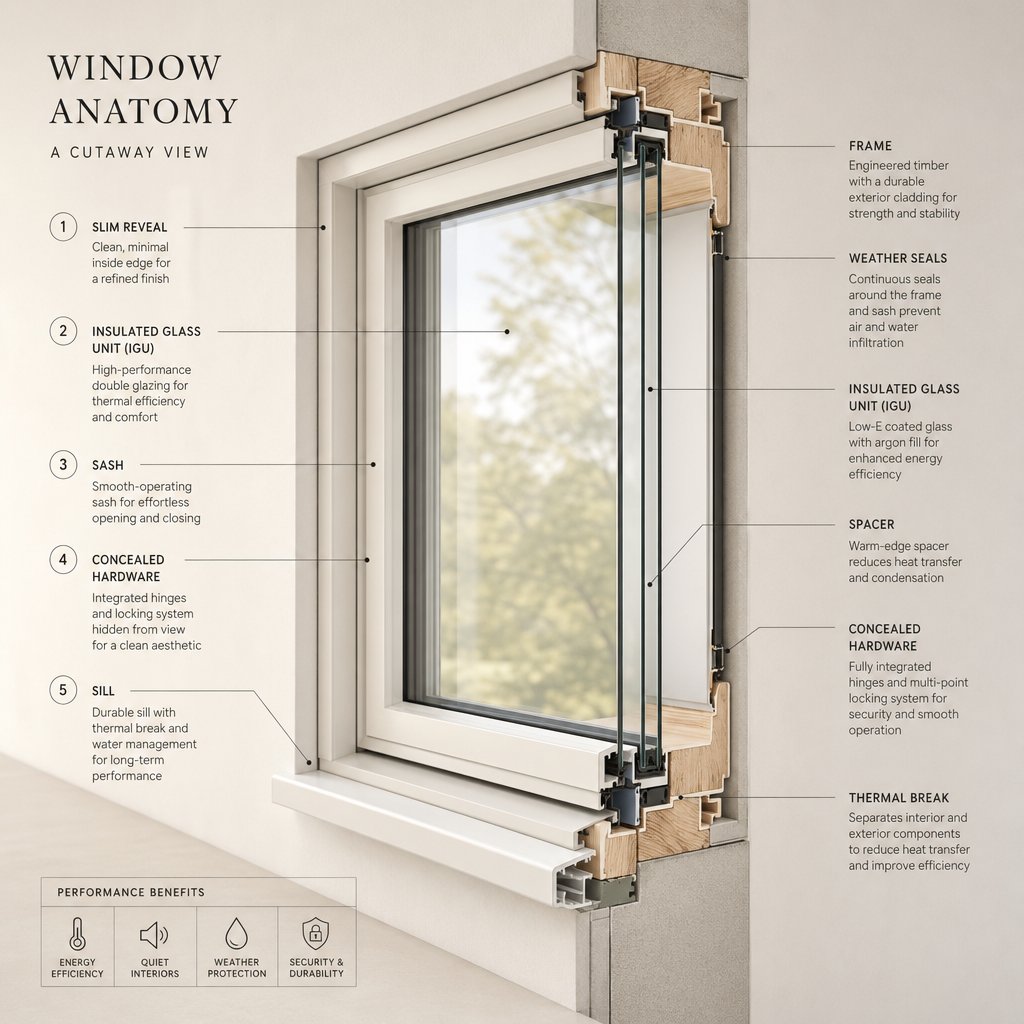
What Is Powder Coating on Aluminium Windows
Every aluminium window frame you see on a modern Australian home has a protective finish. That finish determines how the frame looks on day one and whether it still looks sharp after a decade of sun, salt air, and rain. For the vast majority of residential and commercial projects, that finish is powder coating.
Powder coating is a dry finishing process in which finely ground particles of pigment and resin are applied electrostatically to an aluminium frame, then cured under heat to form a continuous, chemically bonded protective layer. Unlike liquid paint, it contains no solvents and produces zero VOCs.
What Powder Coating Actually Means for Aluminium Frames
Think of it this way: a spray gun gives the dry powder particles a negative electrical charge. The aluminium profile is grounded, so it carries a positive charge. Opposites attract. The charged powder wraps evenly around the frame, clinging to edges, corners, and recessed details before the whole assembly enters a curing oven. Heat melts the particles, fuses them together, and triggers a chemical cross-linking reaction that locks the coating to the metal surface. The result is a uniform, hard-wearing film that cannot simply peel or flake away the way a brush-applied paint might.
Powder coated aluminium windows carry this factory-applied finish from the moment they leave the production line. It is not a site-applied afterthought; it is an engineered part of the window system.
How It Differs From Paint and Anodizing at a Glance
Liquid paint relies on solvents to carry pigment onto a surface, then evaporates as it dries. That evaporation releases volatile organic compounds and often leaves an inconsistent film thickness. Anodizing takes a different path entirely, converting the aluminium surface itself into a hard oxide layer through an electrochemical bath. It produces a distinctive metallic appearance but limits colour choice to a narrow range of silvers, bronzes, and blacks.
Powder coating windows sits between these two approaches. It delivers the broad colour flexibility that anodizing cannot, while offering a tougher, more uniform finish than conventional wet paint. For coated aluminium frames destined for Australian conditions, from coastal Queensland to inland Victoria, that combination of durability and design freedom is exactly why the process dominates the architectural window market.
This article covers the full journey of aluminium windows powder coating, from the critical pre-treatment step most people never hear about, through application, colour selection, climate-specific specification, maintenance, and cost. Whether you are a homeowner choosing frames for a renovation, a builder specifying for a multi-dwelling project, or an architect detailing a facade, the goal is the same: a finish that performs as long as the window itself.
Powder Coating vs Painting Aluminium Windows
One of the most common questions homeowners ask during a renovation is straightforward: can you paint aluminium windows? The short answer is yes, technically you can. The longer answer is that liquid paint on aluminium creates a set of problems that powder coating simply does not have, and understanding why saves you from a repaint cycle every few years.
Why Painting Aluminium Frames Underperforms
Aluminium is a smooth, non-porous metal. Paint does not naturally want to grip it. Even with careful sanding, etching, and a specialist metal primer, a brush or spray-applied liquid coating sits on the surface rather than bonding into it. That mechanical grip weakens over time, especially under Australian UV intensity, and the result is peeling, flaking, and chalking that can appear within months if preparation is imperfect.
Painting anodised aluminium window frames introduces an extra layer of difficulty. The existing oxide layer resists adhesion even more aggressively, meaning additional abrasion and specialised primers become mandatory before any topcoat goes on. Film thickness is another weak point. A brush leaves ridges; a spray gun deposits unevenly around corners and rebates. Those thin spots become the first failure points when moisture and UV find their way in.
Then there is the environmental side. Liquid paints rely on solvent carriers, volatile organic compounds that evaporate during application and drying. On-site painting generates overspray waste that cannot be reclaimed, and the fumes pose health risks in enclosed spaces. For a finish that may only last three to five years before touch-up is needed, the trade-off is hard to justify.
The Technical Advantages of Powder Over Liquid Paint
Powder coating sidesteps every one of those limitations. The electrostatic charge wraps dry powder uniformly around the entire profile, including edges and recesses that a brush cannot reach consistently. Curing at 150 to 200 degrees Celsius triggers a chemical cross-link that fuses the coating to the metal at a molecular level, producing a bond far stronger than surface adhesion alone. The finished film typically measures 60 to 150 micrometres, three to six times thicker than a standard wet paint application, delivering superior chip and scratch resistance.
Because no solvents are involved, the process emits virtually zero VOCs. Overspray powder is collected and reused, so material waste drops dramatically compared to liquid systems. And polyester resin formulations, the standard choice for architectural aluminium, resist UV degradation far longer than conventional acrylic or enamel paints exposed to direct sunlight.
| Criteria | Powder Coating | Liquid Paint |
|---|---|---|
| Adhesion method | Chemical cross-link via heat cure | Mechanical grip on primed surface |
| Typical film thickness | 60–150 micrometres | 20–40 micrometres per coat |
| Durability (exterior) | 15–25+ years before re-coating | 3–7 years before touch-up or repaint |
| VOC emissions | Virtually zero | Moderate to high (solvent-based) |
| Colour consistency | Uniform across entire profile | Varies with application technique |
| Maintenance frequency | Periodic wash only | Regular inspection and touch-up |
The gap between these two approaches is not marginal. For powder coated aluminium windows leaving a factory line, the finish is engineered to match the lifespan of the frame itself. A site-applied paint job, no matter how carefully executed, simply cannot replicate that level of integration. The real question is not whether you can paint aluminium windows, but whether doing so makes sense when a factory-bonded alternative exists that outperforms it on every measurable criterion.
Performance like this does not happen by accident, though. It depends entirely on what happens to the aluminium before the powder ever touches it.
The Pre-Treatment Process That Determines Coating Longevity
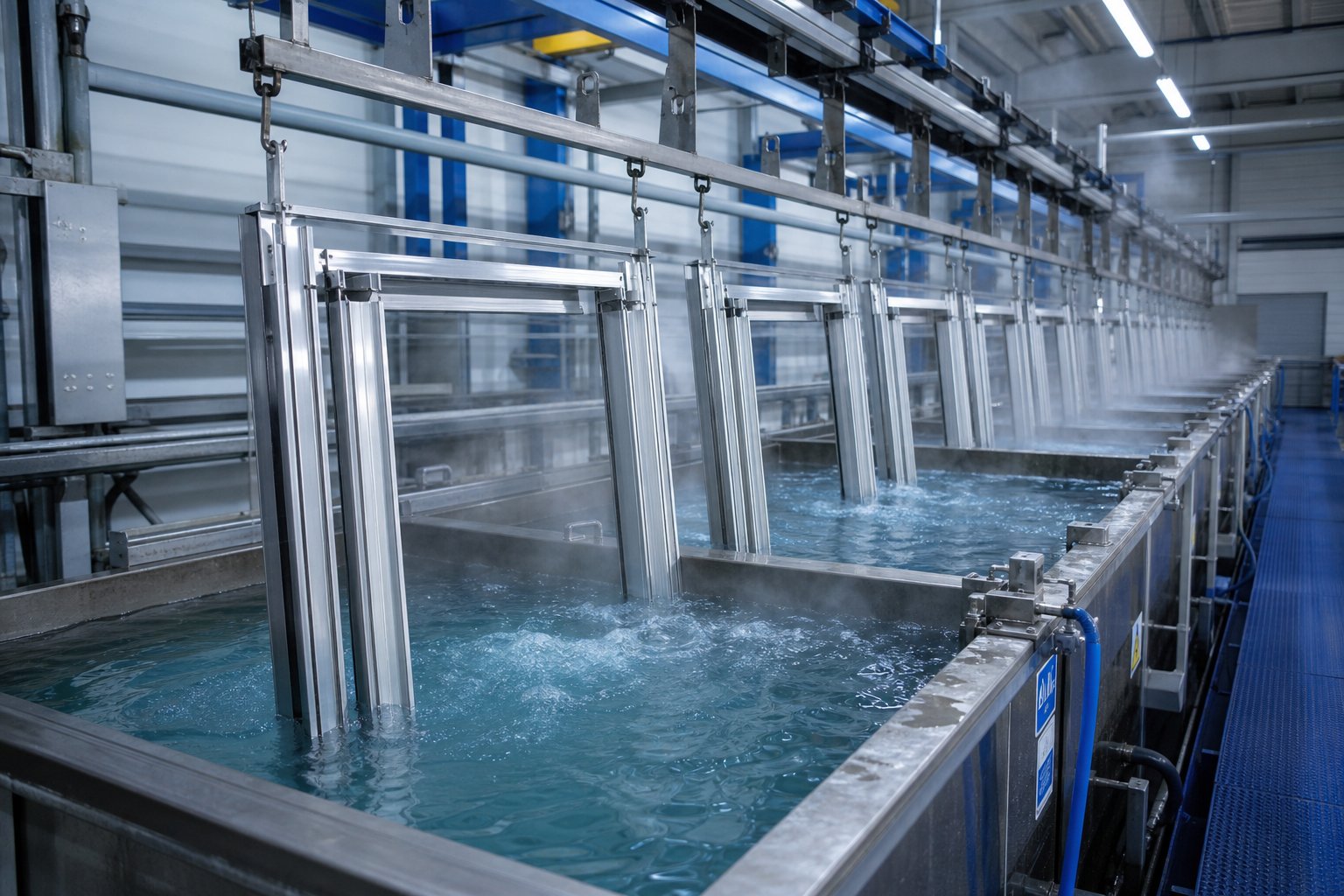
A powder coated aluminium window can look flawless on delivery day and still fail within a few years. The difference between a finish that lasts two decades and one that peels after three winters almost always traces back to a single phase: pre-treatment. This is the step most homeowners never see, yet it is the single biggest factor in whether an aluminium window frame coating holds or lets go.
Aluminium naturally forms an oxide layer the moment it contacts air. Left untreated, that oxide acts as a barrier, preventing the powder coating from achieving a true bond with the metal beneath. Over time, oxidation continues under the finish, forcing it away from the surface. Pre-treatment eliminates that risk by cleaning, etching, and chemically sealing the aluminium before any powder is applied.
Degreasing and Surface Preparation Steps
The powder coating pre-treatment process follows a strict sequence. Skip a stage or rush through it, and the entire system is compromised. Here is how a quality architectural coater prepares aluminium profiles:
- Alkaline degreasing — Removes oils, greases, and manufacturing residues from the extrusion process. Alkaline cleaners break down organic contaminants by converting them into water-soluble forms, leaving the metal free of anything that could block adhesion.
- Rinse — Flushes away loosened contaminants and residual cleaning chemicals so they do not interfere with the next stage.
- Acid etching — Strips the natural aluminium oxide layer and lightly roughens the surface at a microscopic level. This creates a uniform profile that gives the conversion coating something to grip.
- Rinse — Removes acid residues and dissolved oxides, preventing salt deposits from forming on the freshly etched surface.
- Conversion coating — Applies a thin chemical film that seals the reactive aluminium surface, dramatically improving both adhesion and corrosion resistance. This layer acts as the bridge between bare metal and powder.
- Deionised water rinse — A final rinse using purified water eliminates mineral salts and impurities that could cause blistering or adhesion loss during curing.
Each stage builds on the one before it. Residual grease left after degreasing will block the acid etch. A poor etch leaves oxide patches that the conversion coating cannot penetrate. Contaminated rinse water deposits salts that create weak spots under the finished film. The chain is only as strong as its weakest link.
Chrome-Free Conversion Coatings and Why They Matter
For decades, chromate-based conversion coatings were the industry standard for aluminium coated with architectural powder finishes. Hexavalent chromium delivered excellent corrosion resistance, but it is also a known carcinogen and serious environmental hazard. Regulatory pressure has driven a global shift away from these systems. In the UK, chromates are no longer permitted in architectural powder coating processes, and Australian coaters have followed the same trajectory toward chrome-free alternatives.
Modern chrome-free systems, typically based on zirconium or titanium chemistry, are engineered to match or exceed the performance of their chromate predecessors. They form an ultra-thin passivation layer that seals the aluminium surface without the toxic legacy. QUALICOAT-licensed applicators, recognised globally as the benchmark for architectural coating quality, have successfully used chrome-free pre-treatment for over twenty years with no compromise in durability.
For anyone specifying powder coated aluminium windows, the takeaway is simple: ask your supplier whether they operate a multi-stage pre-treatment line and whether their conversion coating system is chrome-free and certified. A coater who cannot answer those questions clearly may not have the infrastructure to deliver a finish that lasts. The powder itself is only half the story. What happens in those chemical baths beforehand is what separates a coating that endures from one that quietly fails beneath the surface.
Step-by-Step Powder Coating Application Process
With the aluminium profile cleaned, etched, and sealed by conversion coating, it moves directly into the application booth. Timing matters here. Any delay between pre-treatment and powder application risks re-oxidation or surface contamination, so quality coaters run a continuous line from chemical baths to spray booth without interruption.
Electrostatic Application and Film Thickness Control
The principle behind electrostatic powder coating windows is elegantly simple. A spray gun feeds dry powder through a charging electrode that imparts a negative electrical charge to each particle. The aluminium profile hangs from an earthed conveyor, giving it a positive ground. Charged particles accelerate toward the grounded metal and wrap around the entire profile, covering front faces, edges, and recessed channels in a single pass.
Operators control three primary variables at the gun: voltage, current, and powder flow rate. For flat or gently curved window profiles, voltage typically sits between 50 and 80 kV. Recessed areas like drainage slots or hardware pockets require reduced current (around 20 to 25 microamps) to prevent back-ionisation, a phenomenon where excessive charge build-up repels incoming powder and creates bare spots.
Film thickness is the critical quality metric. For architectural aluminium window frames, industry standards call for a minimum of 60 microns on exposed surfaces, with a target range of 60 to 100 microns for standard residential and commercial applications. Coastal projects demanding extra protection push that to 89 to 127 microns through a two-coat system. Too thin and the film cannot resist UV or moisture penetration. Too thick and the surface develops orange peel texture or cracks during thermal cycling.
Curing Parameters for Architectural Aluminium Profiles
Curing transforms loose powder into a hard, chemically cross-linked film. The profiles travel by conveyor into a gas-fired or electric oven where heat triggers a molecular reaction within the resin. This is not simply drying; it is a permanent chemical change that cannot be reversed.
The critical distinction that separates professional coaters from backyard operations is measuring peak metal temperature rather than oven air temperature. Aluminium conducts heat rapidly, but complex profiles with varying wall thicknesses reach target temperature at different rates. A data logger attached to the thickest section confirms the substrate itself has hit the required cure point.
Standard polyester powders used on window frames cure at 180 to 200 degrees Celsius with dwell times of 10 to 20 minutes at peak metal temperature. For two-coat coastal specifications, the first coat cures at a shorter dwell (approximately 5 to 10 minutes at 180 to 200 degrees Celsius) before the second coat is applied and cured for a longer period of 22 to 35 minutes depending on temperature.
| Process Parameter | Standard Single Coat | Two-Coat Coastal Specification |
|---|---|---|
| Film thickness target | 60–100 microns | 89–127 microns (combined) |
| Gun voltage | 50–80 kV | 50–80 kV per coat |
| Cure temperature (peak metal) | 180–200°C | 180–200°C per coat |
| Dwell time at peak temperature | 10–20 minutes | 1st coat: 5–10 min; 2nd coat: 22–35 min |
| Quality test method | Eddy-current thickness gauge + crosshatch adhesion | Same, plus salt spray testing |
Undercuring leaves the film soft and vulnerable to scratching and chemical attack. Overcuring causes brittleness, colour shift, and reduced adhesion. Both are invisible to the naked eye on delivery day but reveal themselves within months of service.
Polyester vs Other Powder Types for Windows
Not every powder chemistry suits exterior window applications. The choice of resin system determines how the finish responds to ultraviolet radiation, and in Australia’s climate, UV resistance is non-negotiable.
Polyester powder is the standard for powder coat aluminium frames destined for outdoor exposure. Its molecular structure resists UV breakdown, maintaining colour stability and gloss retention for well over a decade under direct sunlight. Superdurable polyester formulations extend that performance further, meeting international benchmarks for colour retention after years of accelerated weathering.
Epoxy powders offer superior chemical and abrasion resistance but degrade rapidly under UV exposure, yellowing and chalking within months outdoors. They have no place on window frames. Hybrid epoxy-polyester blends sit between the two but still lack the UV stability required for full exterior service. Fluoropolymer (PVDF) powders represent the premium tier, delivering exceptional weathering performance for high-specification commercial facades, though at a significantly higher material cost than polyester.
For the vast majority of Australian residential and commercial powder coated aluminium windows, a quality polyester or superdurable polyester formulation provides the right balance of longevity, colour range, and value. The resin choice, combined with correct film thickness and precise curing, produces a finish engineered to outlast the building’s mortgage.
What that finish looks like, though, opens an entirely different conversation. Colour and texture options for architectural powder coatings have expanded dramatically, giving architects and homeowners a palette that anodising and wet paint simply cannot match.
Colour Selection and Finish Options for Powder Coated Windows
Choosing a powder coating specification is only half the decision. The other half is deciding what your aluminium window frame colours will actually look like against your facade, your landscaping, and the light conditions unique to your site. The RAL colour system makes that decision precise and repeatable, while finish options from matte to high gloss shape how the colour behaves in practice.
Understanding RAL Codes and Custom Colour Matching
RAL is a standardised colour matching system used globally across the architectural coatings industry. Each shade carries a unique numeric code, so when you specify RAL 7016 for your window frames, the coater in Melbourne delivers the exact same anthracite grey as a coater in Perth. There is no ambiguity, no reliance on colour names that shift between suppliers.
The RAL Classic range offers over 200 colours, and extended palettes push that number past 450 when metallic, pearl, and custom-matched options are included. For architects specifying RAL colours aluminium windows across a multi-dwelling development, this standardisation eliminates batch variation. Every frame on every storey matches precisely, regardless of when it was coated.
Custom colour matching is also possible. If a project requires a specific corporate colour or a shade that sits between standard RAL references, coaters can formulate bespoke powder to match a physical sample. Lead times increase slightly, and minimum order quantities may apply, but the flexibility exists for projects that demand it.
One practical tip: always request a physical powder-coated sample panel rather than relying on screen colours or printed swatches. Powder coat colours for windows look different under fluorescent warehouse lighting than they do in direct Australian sunlight, and a test panel held against your brickwork or cladding reveals the true interaction.
Popular Finishes for Residential and Commercial Projects
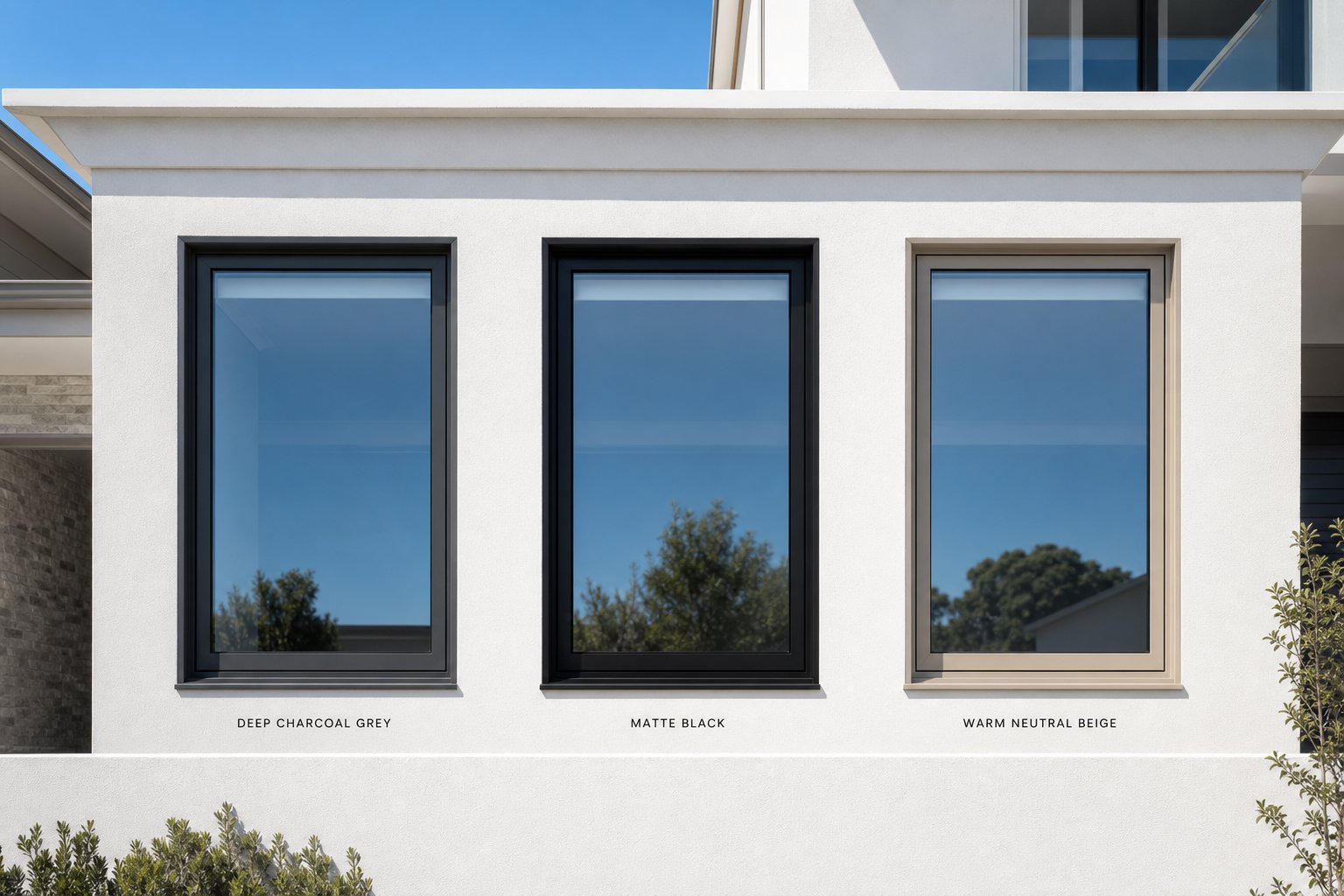
Across Australian residential and commercial builds, certain colour families consistently dominate specification sheets. Contemporary architecture favours deeper, muted tones that anchor glazing within a facade without competing with the glass itself. Here are the most popular choices and where they work best:
- Anthracite and charcoal greys (RAL 7016, RAL 7024) — The dominant choice for modern Australian homes. These deep greys pair naturally with rendered walls, timber cladding, and concrete finishes. They frame glass without visual heaviness.
- Jet black (RAL 9005) — A bold, high-contrast option for minimalist facades and steel-look designs. Increasingly specified in matte or textured finishes to reduce fingerprint visibility and soften glare.
- Traffic white (RAL 9016) — Timeless for coastal homes, Hamptons-style builds, and heritage-adjacent projects. Brightens interiors and makes window openings feel larger.
- Warm neutrals (RAL 7039 Quartz Grey, RAL 1019 Grey Beige) — Gaining ground in premium residential work. These earthy tones complement natural stone, exposed concrete, and warm timber without the starkness of pure grey.
- Deep greens and blues (RAL 6009 Fir Green, RAL 5003 Sapphire Blue) — Specified for character homes, heritage restorations, and architect-led residences seeking personality without loudness.
- Monument and woodland grey — Colorbond-matched shades popular across Australian projects where window frames need to coordinate with roofing and fascia.
Beyond colour, the powder coating finish options you select affect both appearance and day-to-day practicality. Gloss level is measured by light reflectivity, and each level carries trade-offs:
- Matte (0–20% reflectivity) — Soft, contemporary look with minimal glare. Hides minor surface dust and fingerprints well. Ideal for dark colours on large-format windows where reflected light could distract.
- Satin (20–40% reflectivity) — The most popular architectural finish in Australia. Balances visual warmth with easy cleaning. Shows less dirt than high gloss while still reading as a refined, finished surface.
- High gloss (80%+ reflectivity) — Delivers a sleek, polished appearance and is the easiest to wipe clean. However, it reveals every dust particle, water spot, and surface imperfection. Best suited to sheltered locations or smaller accent windows rather than full facades exposed to weather.
For most Australian homes, a satin finish in a mid-to-dark grey strikes the practical sweet spot: it looks sharp from the street, forgives coastal salt haze between washes, and ages gracefully under intense UV. Lighter colours in gloss finishes suit protected elevations where regular cleaning is straightforward.
Colour and finish define the visual identity of your windows, but they also need to survive the environment they face. A jet black matte frame on a north-facing coastal elevation in Far North Queensland encounters very different stresses than the same frame on a sheltered southern wall in Hobart, and the coating specification should reflect that difference.
Durability by Climate and How to Verify Coating Quality
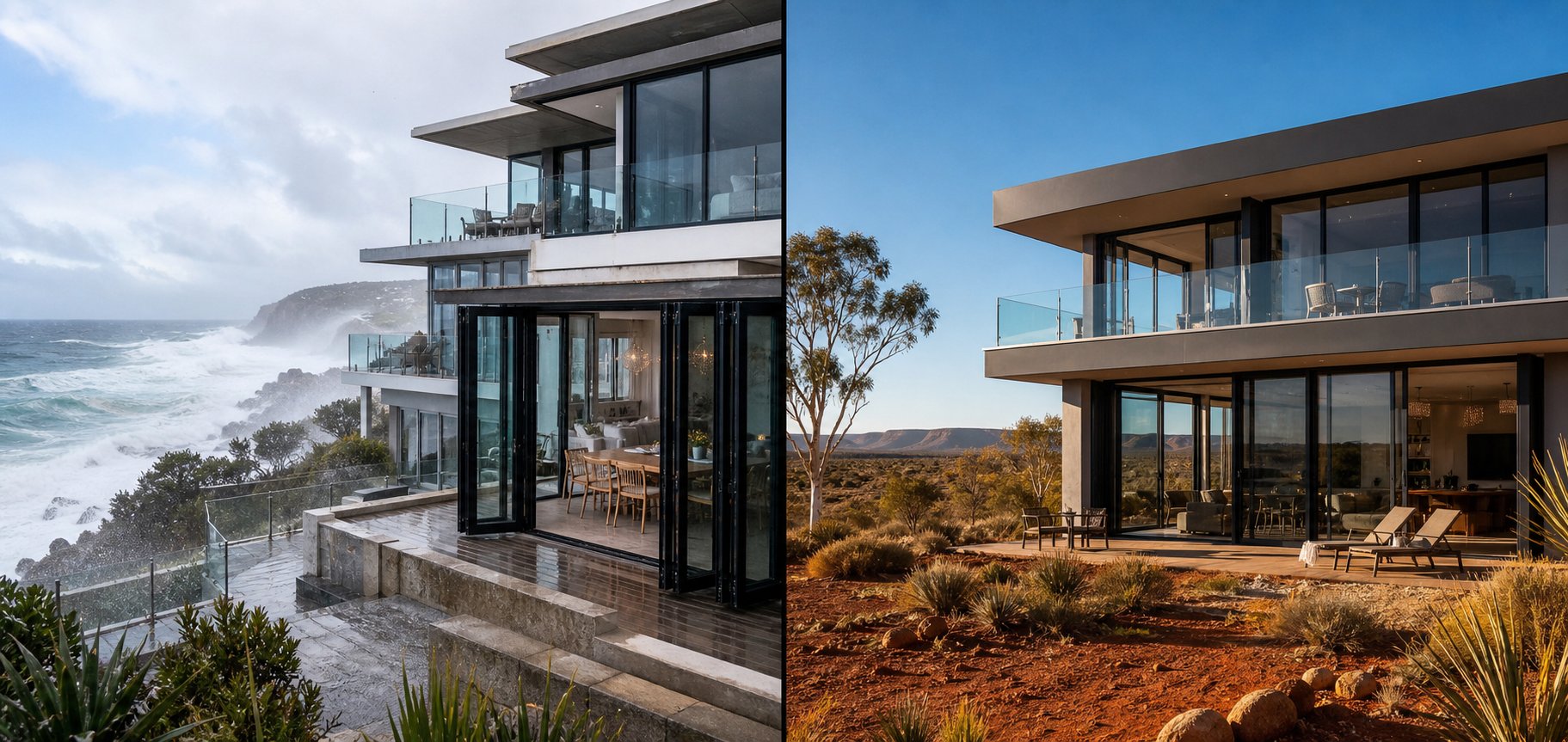
A powder coated aluminium window installed 500 metres from the ocean in Cairns faces a radically different assault than one sheltered behind a brick veneer in suburban Adelaide. Salt-laden air, relentless UV, cyclonic rain, and extreme heat cycling each attack the coating through different mechanisms. Specifying the same coating grade for both locations is a gamble, and it is one that shows up as chalking, blistering, or delamination years before the frame itself has any structural issue.
So how long does powder coating last? The honest answer is that it depends entirely on matching the specification to the environment. Get it right, and you can expect 15 to 25 years of service with minimal maintenance. Get it wrong, and visible degradation can appear within five.
Matching Coating Specifications to Australian Climate Zones
Australia’s geography throws almost every climate challenge at building materials simultaneously. A useful framework groups conditions into four broad exposure categories, each demanding a different approach to powder coating durability on aluminium frames.
Coastal salt spray (within 1 km of breaking surf) — Salt is the primary aggressor. Airborne chlorides settle on frame surfaces and work into any micro-defect in the coating film, initiating filiform corrosion beneath the finish. Coastal aluminium window coating specifications typically call for a two-coat system (primer plus topcoat) achieving 89 to 127 microns total film thickness, applied over a rigorous multi-stage pre-treatment. Enhanced conversion coatings and more frequent cleaning schedules extend service life in these zones.
Tropical (high UV, high humidity, cyclone-prone regions) — Northern Queensland, the Top End, and coastal WA above Geraldton combine intense ultraviolet radiation with sustained humidity. Powder coating excels in tropical environments because its thick, solvent-free film seals the metal surface against moisture penetration while UV-stable polyester resins resist the colour fade and chalking that destroy liquid paints within a few seasons. Superdurable polyester formulations are the minimum standard here, and darker colours benefit from higher-grade powders to offset accelerated heat absorption.
Arid and inland (extreme heat cycling) — Central and western NSW, inland Queensland, and much of South Australia experience daily temperature swings of 20 to 30 degrees Celsius. The aluminium substrate expands and contracts with each cycle, and the coating must flex without cracking or losing adhesion. Standard polyester powders handle this well provided film thickness stays within the 60 to 100 micron range. Excessively thick coatings become brittle under repeated thermal stress.
Temperate (mild UV, moderate rainfall) — Southern Victoria, Tasmania, and the ACT present the least aggressive conditions. A standard single-coat polyester system at 60 to 80 microns, applied over proper pre-treatment, delivers reliable performance for decades. These environments are forgiving, but that does not justify cutting corners on pre-treatment or cure parameters.
| Climate Zone | Primary Threat | Recommended Coating System | Minimum Film Thickness | Expected Service Life |
|---|---|---|---|---|
| Coastal (within 1 km of surf) | Salt spray corrosion | Two-coat (primer + superdurable polyester topcoat) | 89–127 microns total | 15–20 years |
| Tropical (high UV, high humidity) | UV degradation + moisture | Single or two-coat superdurable polyester | 60–100 microns (single); 89–127 microns (two-coat) | 15–25 years |
| Arid / inland | Thermal cycling + UV | Single-coat superdurable polyester | 60–100 microns | 20–25 years |
| Temperate | Moderate UV + rainfall | Single-coat standard or superdurable polyester | 60–80 microns | 20–30 years |
These ranges assume correct pre-treatment, proper cure, and a maintenance regime of periodic washing. Neglect any one of those factors and the service life drops regardless of how premium the powder formulation is.
Certifications and Quality Marks to Verify
Specifications on paper mean nothing without independent verification. Several certification systems exist to confirm that a coater’s process, materials, and finished product meet defined performance benchmarks. When evaluating suppliers, look for these marks:
Qualicoat — An international quality label specifically for liquid and powder coatings on architectural aluminium. Qualicoat Class 2 powders offer superior UV resistance and improved gloss retention compared to Class 1, making them the preferred standard for exposed Australian applications. Qualicoat certification covers the entire process chain: pre-treatment, application, and curing. A licensed applicator undergoes regular audits and must demonstrate compliance with strict performance criteria including accelerated weathering tests equivalent to years of subtropical exposure.
AS 3715 — The Australian Standard for thermoset powder coating on architectural aluminium. It defines requirements for pre-treatment, film thickness, adhesion, hardness, and weathering resistance. Any reputable Australian coater should be able to confirm compliance with this standard.
AAMA 2604 and 2605 equivalents — While these are American Architectural Manufacturers Association standards, they provide a useful performance benchmark. AAMA 2604 requires five years of accelerated outdoor exposure testing; AAMA 2605 demands ten years. Australian specifiers increasingly reference these grades when defining powder coating warranty windows for commercial projects, particularly in harsh coastal or tropical zones.
When assessing a supplier’s warranty, ask pointed questions. What accelerated weathering test data supports their claimed service life? Does the warranty cover colour retention and gloss retention, or only adhesion failure? Is the warranty conditional on a specific cleaning regime? A ten-year powder coating warranty that excludes colour fade is far less valuable than a shorter warranty that covers the full spectrum of coating performance.
Reputable coaters will provide test certificates showing salt spray hours (typically 1,000+ hours for coastal specs), QUV accelerated weathering results, and crosshatch adhesion data. If a supplier cannot produce this documentation, treat their durability claims with scepticism regardless of how competitive their pricing appears.
Certification and climate-matched specification protect your investment at the point of purchase. Protecting it over the following decades, though, comes down to how the finished frames are treated once they are installed and exposed to the real world.
Maintaining and Repairing Powder Coated Aluminium Frames
A well-specified coating matched to its climate zone can deliver decades of service, but only if the frames receive basic ongoing care. The good news is that powder coated aluminium windows and powder coated doors are genuinely low maintenance. A simple routine keeps the finish performing as intended, and knowing what to look for early prevents small issues from becoming expensive re-coating jobs.
Routine Cleaning and Care Schedule
Salt, airborne dust, pollen, and pollution settle on frame surfaces constantly. Left in place, these deposits trap moisture against the coating and gradually degrade its protective film. Regular washing removes contaminants before they cause harm. The frequency depends on your exposure:
- Coastal properties (within 1 km of surf) — Wash frames every 2 to 3 months. Salt is corrosive and attacks fittings and seals if left sitting on the surface.
- Urban and suburban homes — Every 3 to 6 months is sufficient for most locations.
- Sheltered or rural sites — Twice a year keeps frames in excellent condition.
- Cleaning solution — Mild dishwashing liquid diluted in warm water. Nothing stronger is needed or advisable.
- Cleaning tools — Soft cloth, sponge, or microfibre towel. Rinse thoroughly with clean water afterward to remove all soap residue.
- Drainage holes — Check the small weep holes at the base of each frame during cleaning. Clear any blockages with a cotton bud or soft brush so water drains freely.
- Hardware and seals — Wipe hinges, handles, and rubber seals at the same time. Lubricate moving parts annually with a silicone-based spray.
Equally important is knowing what to avoid. Steel wool, abrasive pads, and scrubbing brushes scratch the powder coating surface and expose the metal beneath. Harsh solvents, bleach, turpentine, and heavy-duty spray cleaners strip the finish or cause discolouration. Pressure washers used too close force water past seals and can damage the coating film itself. Stick to soft materials and gentle detergents, and the finish will reward you with years of trouble-free performance.
Recognizing Coating Degradation and Repair Options
Even the best coating eventually shows its age. Catching degradation early gives you more repair options and lower costs. Watch for these signs during your regular cleaning routine:
- Chalking — A fine powdery residue on the surface when you run a finger across it. This indicates UV breakdown of the resin’s outer layer. Mild chalking is cosmetic; heavy chalking signals the protective film is thinning.
- Colour fade — Noticeable difference between exposed and sheltered sections of the same frame. Common on north-facing elevations with intense sun exposure.
- Chips and scratches — Localised damage from impact, hardware installation, or building work. Small chips expose bare aluminium to moisture and can initiate corrosion if left untreated.
- Blistering or flaking — Coating lifting away from the substrate. This typically points to a pre-treatment failure or moisture trapped beneath the film. Professional assessment is needed.
For minor chips and scratches, a touch-up repair using a colour-matched paint applied over a lightly sanded and primed area is practical and cost-effective. Clean the damaged spot, sand gently with fine-grit paper, apply a metal primer, then brush or spray thin coats of matching paint. Multiple thin layers outperform a single thick application every time.
Full re-coating becomes the better path when degradation is widespread, when flaking covers large areas, or when the underlying aluminium shows signs of corrosion. At that point, the question shifts to how to repaint aluminium windows properly. The existing powder coat must be sanded to create a mechanical key, cleaned with a solvent to remove contaminants, primed with a product formulated for powder-coated metal, and then topcoated with a high-quality acrylic urethane or epoxy paint designed for exterior metal surfaces. It is a labour-intensive process, and for extensive damage, professional applicators deliver more reliable results than DIY attempts.
Knowing how to paint aluminium windows that already carry a factory finish is useful, but prevention remains far cheaper than cure. A consistent wash schedule and prompt attention to chips keeps most powder coated frames looking sharp for their full expected service life, delaying any need for restoration by years or even decades.
Maintenance costs are minimal, but they do factor into the broader financial picture. Understanding how powder coating compares to alternative finishes on a lifecycle cost basis helps justify the upfront specification decision.
Cost Comparison of Aluminium Window Finishing Methods
Maintenance effort is one side of the ownership equation. The other is what you pay upfront and what the finish costs you over its full service life. Aluminium window finishing methods vary significantly in both initial outlay and long-term value, and the cheapest option at the point of purchase rarely stays cheapest once you factor in repainting, touch-ups, and premature replacement.
Upfront Cost Differences Between Finishing Methods
Four finishing systems dominate the Australian aluminium window market: standard powder coating, anodising, wet spray painting, and PVDF (fluoropolymer) coating. Each occupies a different price bracket, driven by process complexity, material cost, and the infrastructure required to apply it.
Wet painting carries the lowest upfront aluminium window finish cost. A site-applied liquid system requires minimal equipment and no specialised oven, which keeps the per-frame price down. The trade-off is a thinner, less durable film that demands earlier and more frequent maintenance.
Powder coating sits in the mid-range. The process requires electrostatic spray equipment, a multi-stage pre-treatment line, and a curing oven, all of which represent capital investment for the coater. That infrastructure cost is spread across high production volumes, keeping per-unit pricing competitive for residential and commercial window orders. The powder coating cost for aluminium windows is typically moderate relative to the decades of service it delivers.
Anodising commands a premium. The electrochemical bath process is more complex, slower, and demands tighter quality control. Anodising generally costs more than powder coating due to this process complexity and the specialised equipment involved. It also limits colour options to metallic hues, which may or may not suit the project aesthetic.
PVDF coatings represent the top tier. These fluoropolymer systems deliver exceptional weathering resistance for high-specification commercial facades, but the raw material cost of PVDF resin is substantially higher than polyester powder, and application often requires a two-coat or three-coat system. For most residential projects, PVDF is overkill. It makes financial sense on landmark commercial buildings where the facade is difficult to access for future maintenance and the design life target exceeds 30 years.
Lifecycle Value and Long-Term Cost of Ownership
Upfront price tells only part of the story. A powder coating vs anodising cost comparison shifts dramatically when you extend the timeline to 20 or 30 years and include maintenance, repair, and re-finishing expenses.
Wet paint may save money at installation, but a repaint cycle every five to seven years accumulates labour, material, and disruption costs that quickly overtake the initial saving. Over a 25-year window, a homeowner could face four or five repaint cycles, each requiring scaffolding, surface preparation, and days of work.
Powder coating requires only periodic washing and occasional touch-up of isolated chips. No full re-coating is typically needed within the first 15 to 25 years when the specification matches the climate zone. That near-zero maintenance cost makes it the strongest lifecycle value proposition for the majority of Australian projects.
Anodising delivers similarly low maintenance, needing only soap-and-water cleaning. Its longer potential lifespan (20 to 30+ years) partially offsets the higher upfront cost, but the limited colour palette and difficulty of on-site repair reduce its flexibility. If the anodised finish is damaged, restoration is complex and expensive compared to a powder coat touch-up.
| Finishing Method | Relative Upfront Cost | Expected Lifespan | Maintenance Cost | Best-Use Scenario |
|---|---|---|---|---|
| Wet spray paint | Lowest | 3–7 years before repaint | High (frequent repainting) | Temporary structures, tight budgets, interior-only frames |
| Powder coating (polyester) | Moderate | 15–25 years | Low (periodic wash + rare touch-up) | Residential and commercial windows in all climate zones |
| Anodising | Higher | 20–30+ years | Low (periodic wash only) | High-end architectural features, metallic aesthetic, harsh environments |
| PVDF (fluoropolymer) | Highest | 25–40+ years | Very low | Premium commercial facades, landmark buildings, extreme exposure |
For the typical Australian residential build or renovation, powder coating delivers the optimal balance between upfront affordability, colour freedom, and long-term durability. Anodising earns its place on projects where a metallic finish is central to the design intent and the budget supports the premium. PVDF belongs in the conversation only when project scale and exposure severity justify its cost. And wet paint? It remains a viable short-term solution for budget-constrained situations, but it is not a like-for-like alternative to any factory-applied system.
Knowing where each finish sits on the cost-performance spectrum makes the specification conversation with your window supplier far more productive. The next step is understanding exactly what to ask and how to evaluate the systems on offer.
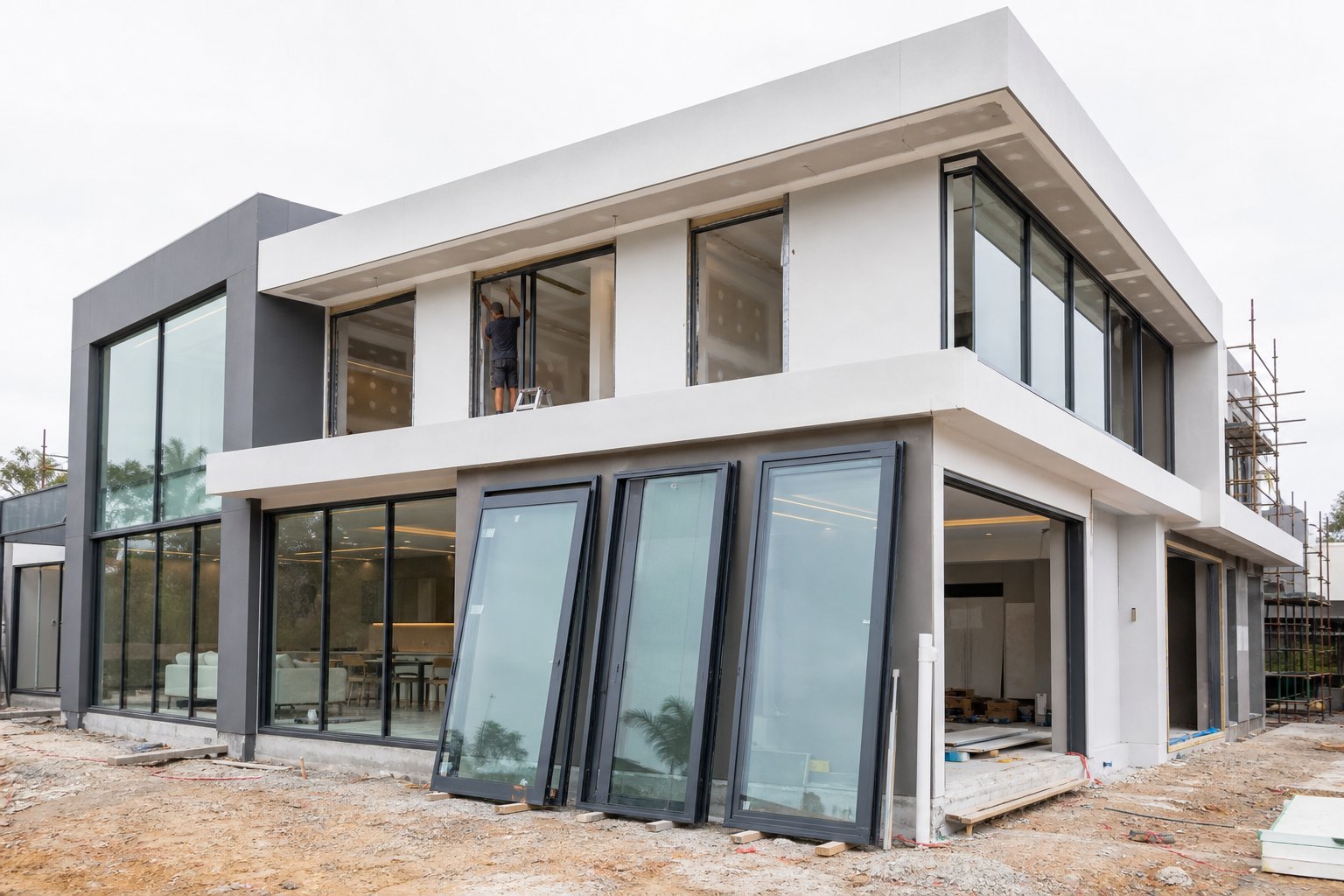
How to Specify Powder Coated Aluminium Windows for Your Project
Understanding coating systems, climate zones, and lifecycle costs gives you the knowledge to make a strong specification decision. Translating that knowledge into a clear brief for your window supplier is where theory becomes a real building outcome. Whether you are ordering powder coated aluminium windows for a single-storey renovation or a multi-residential development, the questions you ask and the criteria you evaluate determine whether the finished product lives up to its potential.
What to Ask Your Window Supplier About Powder Coating
Not every window supplier controls their own coating process. Some manufacture frames in-house and send them to a third-party coater. Others operate vertically integrated facilities where extrusion, pre-treatment, powder application, and assembly happen under one roof. Both models can deliver excellent results, but you need to understand which model you are dealing with and what quality controls sit behind it.
The following questions cut through marketing language and reveal whether a supplier’s aluminium window specifications genuinely match the performance claims on their brochure:
- What pre-treatment process do you use? — Look for a multi-stage system including alkaline degreasing, acid etch, and chrome-free conversion coating. A supplier who cannot describe their pre-treatment line in detail may not control or audit it closely enough.
- What powder chemistry is applied to exterior frames? — Polyester or superdurable polyester is the correct answer for Australian conditions. Epoxy or hybrid powders on exterior windows are a red flag.
- What film thickness do you target, and how is it verified? — Expect 60 to 100 microns for standard applications, 89 to 127 microns for coastal two-coat systems. Ask whether they use eddy-current thickness gauges on every batch.
- Do you hold Qualicoat licensing or comply with AS 3715? — Independent certification confirms the entire process chain meets defined performance benchmarks. Without it, you are relying on the supplier’s word alone.
- What does your coating warranty cover? — Clarify whether the warranty addresses adhesion only, or also colour retention and gloss retention. Ask about exclusions and whether a specific maintenance regime is required to keep the warranty valid.
- Can you provide accelerated weathering test data? — Salt spray hours, QUV exposure results, and crosshatch adhesion scores demonstrate real performance rather than theoretical claims.
- What colour and finish options are available, and what are the lead times for custom colours? — A supplier with a broad standard palette and the ability to match custom RAL codes or Colorbond shades gives you design flexibility without project delays.
These questions are not adversarial. A confident supplier welcomes them because they separate serious buyers from price-only shoppers, and they give the supplier a chance to demonstrate genuine capability.
Evaluating Factory-Finished Aluminium Window Systems
Beyond the coating itself, the window system as a whole determines whether your custom powder coated windows perform as a complete unit. A flawless finish means little if the frame distorts during installation, the hardware fails within two years, or the glazing seals leak under wind pressure. Evaluating powder coated window suppliers means assessing the full package: frame engineering, glass specification, hardware quality, and how the coating integrates with all of those components.
Here is what to prioritise when comparing factory-finished systems:
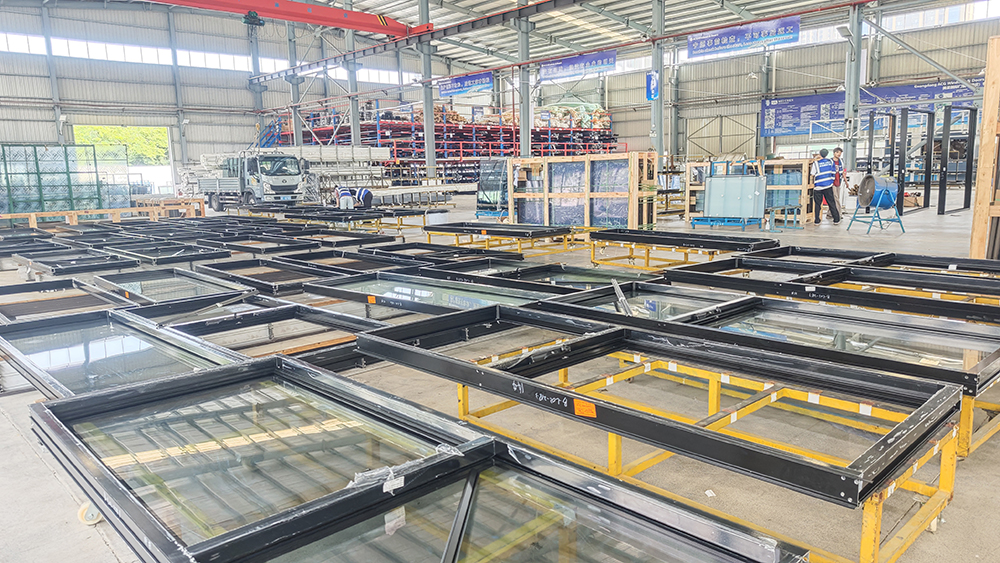
- Integrated coating and assembly process — Suppliers like MEICHEN offer factory-finished aluminium window systems where powder coating, frame fabrication, glazing, and hardware installation happen within a controlled production environment. This integration reduces handling damage, ensures coating integrity around hardware cutouts, and delivers a project-ready product that arrives on site needing only installation.
- Custom colour capability for project cohesion — Large residential or commercial builds often require frames to coordinate with specific facade materials. Suppliers offering full RAL and custom colour matching, combined with multiple finish options, give architects and builders the freedom to execute a design vision without compromise.
- Window type range — Evaluate whether the supplier manufactures the full spectrum of configurations your project needs: fixed, casement, awning, sliding, bi-fold, and stacking doors. Sourcing all window types from a single supplier ensures consistent colour matching, hardware compatibility, and warranty coverage across the entire building envelope.
- Performance testing and compliance documentation — Reputable manufacturers conduct or commission air tightness, water penetration, and wind load testing on their window systems. Ask for test reports that demonstrate compliance with AS 2047 and relevant NCC requirements for your climate zone.
- Batch traceability and quality control records — Factories with disciplined QC systems maintain records linking each window unit back to its coating batch, cure data, and inspection results. This traceability matters if a warranty claim arises years after installation.
- Project support and lead time transparency — For ordering powder coated aluminium windows on a construction timeline, clear communication about production schedules, custom colour lead times, and delivery logistics prevents costly site delays. Suppliers who provide dedicated project coordination for builders and developers signal operational maturity.
The difference between a commodity window and a project-ready system often comes down to how tightly the supplier controls the relationship between coating, fabrication, and final assembly. A window that arrives with its powder coating already cured, hardware fitted, glass sealed, and drainage tested eliminates multiple points of failure that plague site-assembled alternatives.
For Australian homeowners planning a renovation, the practical path is straightforward: identify a supplier whose coating specification matches your climate zone, whose colour range suits your design, and whose production model delivers fully finished units ready for installation. For builders and architects managing multi-dwelling or commercial projects, add batch consistency, compliance documentation, and project coordination capability to that checklist.
Aluminium windows powder coating is not a single decision. It is a chain of decisions, from pre-treatment chemistry through resin selection, film thickness, cure parameters, colour, and ongoing maintenance, each link reinforcing the next. Get the specification right at the start, verify it through certification and testing data, and partner with a supplier who controls the full process. That is how a powder coated finish delivers on its promise: a protective layer engineered to last as long as the frame it covers, looking as sharp in year fifteen as it did on the day it left the factory.
Frequently Asked Questions About Aluminium Windows Powder Coating
1. Can you paint aluminium windows instead of powder coating them?
You can apply liquid paint to aluminium windows, but it underperforms compared to powder coating on every measurable criterion. Aluminium is smooth and non-porous, so paint relies on mechanical grip rather than a chemical bond. This leads to peeling, flaking, and chalking within a few years, especially under Australian UV intensity. Powder coating creates a chemically cross-linked film 60 to 150 microns thick that bonds at a molecular level during heat curing, delivering 15 to 25 years of service versus three to seven years for liquid paint. The process also produces zero VOCs and allows overspray to be reclaimed, making it both more durable and more environmentally responsible.
2. How long does powder coating last on aluminium windows?
Service life depends on matching the coating specification to your climate zone. In temperate areas like southern Victoria or Tasmania, a standard single-coat polyester system can last 20 to 30 years. Coastal properties within one kilometre of breaking surf face aggressive salt spray corrosion, so a two-coat system with superdurable polyester is recommended, delivering 15 to 20 years of reliable performance. Tropical regions with high UV and humidity suit superdurable polyester formulations lasting 15 to 25 years. These figures assume correct pre-treatment, proper curing, and a routine washing schedule. Neglecting any of these factors shortens the lifespan regardless of powder quality.
3. What is the pre-treatment process for powder coating aluminium windows?
Pre-treatment is a multi-stage chemical preparation sequence that determines whether the coating bonds permanently or fails prematurely. It typically involves alkaline degreasing to remove oils and manufacturing residues, a rinse, acid etching to strip the natural oxide layer and roughen the surface microscopically, another rinse, application of a chrome-free conversion coating that seals the reactive aluminium and creates a chemical bridge for the powder, and a final deionised water rinse to eliminate mineral deposits. Each stage builds on the previous one, and skipping or rushing any step compromises the entire system. Always ask your supplier whether they operate a certified multi-stage pre-treatment line.
4. How much does powder coating aluminium windows cost compared to other finishes?
Powder coating sits at a moderate upfront cost relative to other aluminium window finishing methods. Wet spray painting is the cheapest initially but requires repainting every three to seven years, accumulating significant labour and material costs over time. Anodising costs more than powder coating due to its complex electrochemical process and specialised equipment, though it offers a longer potential lifespan of 20 to 30 years with a metallic aesthetic. PVDF fluoropolymer coatings are the most expensive, suited to premium commercial facades with design lives exceeding 30 years. For most Australian residential and commercial projects, powder coating offers the strongest lifecycle value, combining broad colour choice with 15 to 25 years of low-maintenance performance.
5. What colours and finishes are available for powder coated aluminium windows?
Powder coated aluminium windows offer over 200 standard RAL colours, with extended palettes exceeding 450 shades including metallics and pearls. Custom colour matching to physical samples or corporate colours is also available from capable suppliers like MEICHEN, who provide factory-finished aluminium window systems with full RAL and Colorbond-matched options. Popular choices in Australian architecture include anthracite grey (RAL 7016), jet black (RAL 9005), traffic white (RAL 9016), and warm neutrals. Finish options range from matte (minimal glare, hides dust) through satin (the most popular architectural finish balancing aesthetics and practicality) to high gloss (sleek but shows every mark). Satin finishes in mid-to-dark tones suit most Australian conditions.
More Window & Door Guides