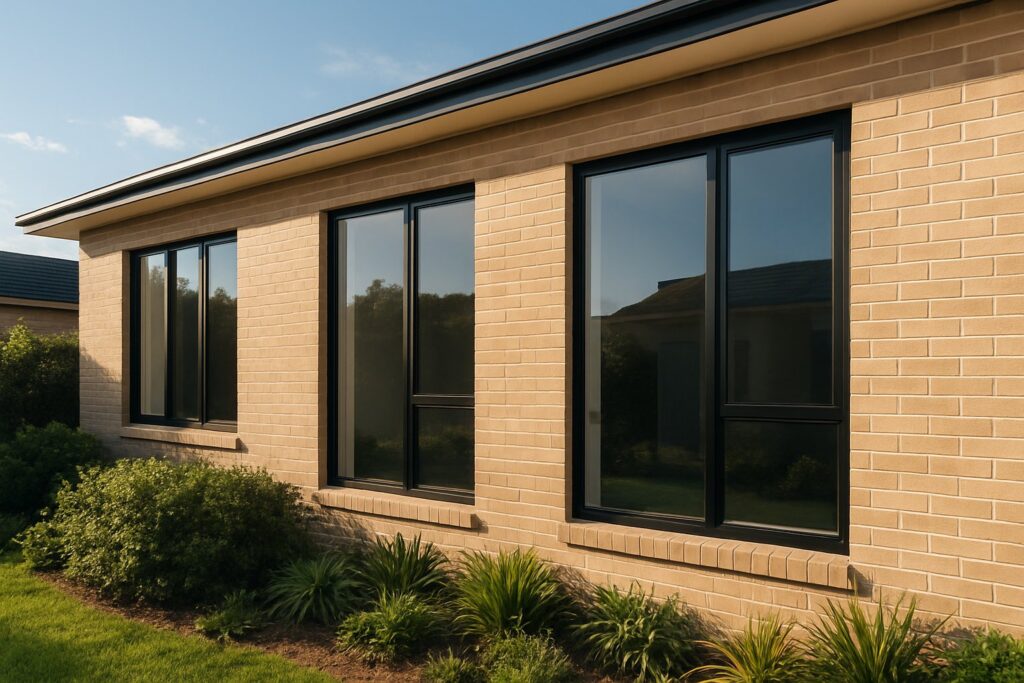
What Is an Aluminium Window with Frame and Why It Matters
An aluminium window with frame is the complete, ready-to-install assembly that includes extruded aluminium profiles forming the outer perimeter, one or more sashes holding the glass, integrated hardware for operation and locking, weatherseals for air and water resistance, and the glazing unit itself. Every component works together as a single system designed to manage light, ventilation, security, and thermal comfort within a building opening.
Most product pages jump straight to pricing or colour swatches. This guide takes a different approach. It treats aluminium windows as a material category worth understanding on a structural and performance level before you commit to a purchase. The frame is not just a border around glass — it is the engineered skeleton that determines how long your windows last, how much energy they waste, and how much design freedom your architect actually has to work with.
What Makes Up an Aluminium Window Assembly
Every aluminium window shares a core set of components, regardless of whether it slides, swings, or stays fixed:
- Head — the horizontal profile across the top of the frame, anchoring the unit into the wall opening above
- Sill — the bottom horizontal profile, engineered with drainage channels to direct water outward
- Jambs — the two vertical side profiles connecting head to sill
- Sash rail — the movable or fixed inner frame that holds the glass pane securely in place
- Glazing bead — the snap-fit or screw-fixed trim that locks glass into the sash rebate
- Weatherstrip — EPDM or rubber gaskets seated in grooves along contact points to seal against wind, rain, and dust
Mullions (vertical dividers) and transoms (horizontal dividers) may also appear in larger openings, distributing structural load while allowing architects to create multi-panel configurations from a single rough opening.
Why Understanding Frame Materials Matters for Your Build
Choosing between aluminium, timber, and uPVC is not a cosmetic decision. The frame material directly shapes four outcomes that define your window’s value over its lifetime.
First, thermal performance. Metal conducts heat far more readily than timber or plastic, which is why thermal break technology — covered later in this article — exists specifically for aluminium frames. Second, aesthetics. Because aluminium profiles are formed through an extrusion process (pushing heated metal through precision-shaped dies), manufacturers can produce slimmer sightlines, tighter curves, and custom cross-sections that timber and uPVC simply cannot match at equivalent strength. Third, structural capacity. Aluminium’s strength-to-weight ratio allows larger spans of uninterrupted glass, giving you floor-to-ceiling windows and window frames that remain rigid under high wind loads without bulky reinforcement. Fourth, long-term cost. Windows in aluminium demand far less maintenance than timber and outlast uPVC by decades in harsh Australian conditions — a factor that shifts the cost equation when you think beyond the initial quote.
Each of these outcomes depends not just on the material itself, but on how the frame is designed, assembled, and finished — factors that vary enormously between manufacturers and profile systems.
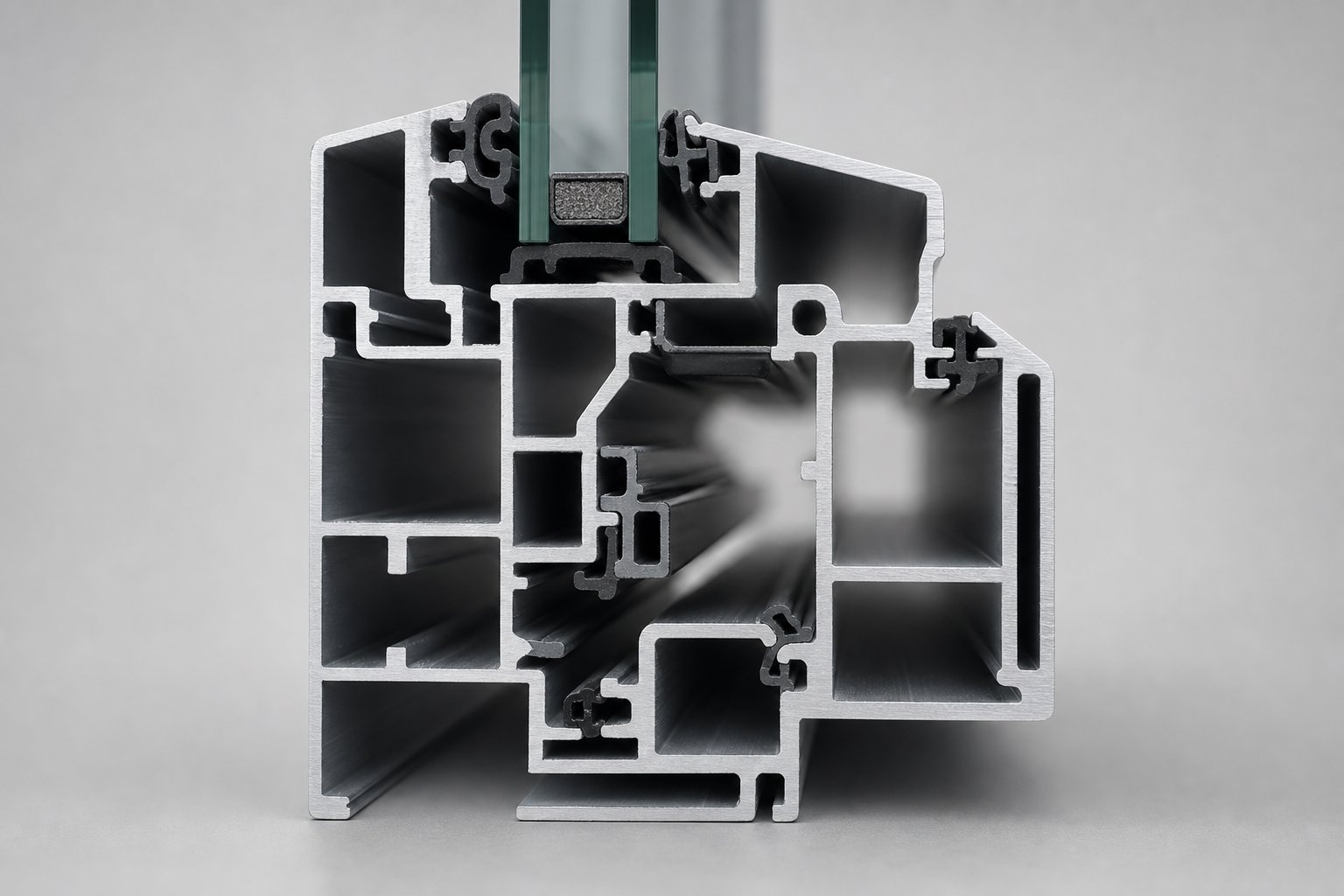
How Aluminium Window Frames Are Constructed
The performance differences between aluminium window frames come down to how profiles are shaped, how deep they run, and how corners are joined. These manufacturing decisions — often invisible once the frame is installed — determine whether a window metal frame holds up for a decade or half a century.
The Extrusion Process and Profile Design
Every aluminium window frame starts as a cylindrical billet of aluminium alloy (typically 6063 for architectural applications). The billet is heated to around 400–500°C until it becomes malleable but not molten. A hydraulic press then forces this heated metal through a precision-machined steel die under enormous pressure — anywhere from 800 to 2,500 tonnes depending on the profile complexity. What emerges on the other side is a continuous length of aluminium shaped exactly to the die’s cross-section.
This is what makes aluminium window framing so flexible from a design standpoint. The die determines the profile’s geometry, and dies can be engineered to produce virtually any cross-sectional shape. A casement window needs a different internal structure than a sliding window. Fixed panels can use simpler profiles since there are no moving parts to accommodate. Sliding frames require integrated tracks and interlock chambers. Because each profile is extruded as a single continuous piece, the resulting alu frames carry consistent material properties and dimensional accuracy along their full length.
Inside these profiles, you will typically find multiple hollow chambers rather than solid metal. These internal chambers serve a structural purpose — they increase the moment of inertia (resistance to bending) without adding proportional weight. A multi-chamber aluminum window frame can be significantly stiffer than a solid profile of equivalent mass, which is why modern aluminium frames feel light yet resist deflection under load.
Frame Depth, Wall Thickness, and Structural Ratings
Frame depth is the measurement from the exterior face of the profile to the interior face. For residential aluminium window frames, this typically ranges from 40mm for slim-line systems through to 70mm or more for high-performance units. That variation matters for two reasons.
First, deeper frames accommodate wider thermal breaks — the insulating barriers that prevent heat transfer through the metal. A 40mm profile leaves limited room for thermal separation, while a 70mm profile can house thermal break strips up to 39mm wide, dramatically improving energy performance. Second, deeper profiles handle larger glass panes and higher wind loads. The relationship is straightforward: more depth means more structural material resisting deflection when wind pressure acts on the glass area.
Wall thickness — the actual thickness of the aluminium in the extruded profile — plays a parallel role. Thicker walls (typically 1.6mm to 2.0mm for residential, up to 3.0mm for commercial) deliver higher wind load ratings. Testing against standards like AS 2047 in Australia confirms that frame stiffness, which depends on both profile depth and wall thickness, directly determines how much the frame deflects under wind pressure. Thinner-walled profiles create those slim sightlines architects favour, but they suit smaller openings or lower wind-load zones rather than exposed coastal sites.
Corner Joints and Assembly Methods
A metal window frame is only as strong as its weakest connection, and that is almost always the corner. Two primary methods join aluminium profiles at their mitred corners:
Mechanical crimping uses internal cleats or spigots inserted into the hollow profile chambers, then the aluminium is pressed or swaged around them to lock the joint. This is the most common method for residential aluminum window frames. It is fast, cost-effective, and produces clean external corners. The trade-off is that mechanically crimped corners can loosen over time due to thermal cycling and daily operation, potentially allowing water ingress at the joint.
Corner adhesives and hybrid joining address this weakness. Quality manufacturers apply polyurethane-based adhesives into the joint during assembly, bonding the aluminium permanently while also sealing the exposed cut edges against filiform corrosion — a type of under-coating corrosion that starts at unprotected aluminium edges in humid climates. The combination of mechanical fastening plus adhesive creates joints that resist both movement and moisture penetration over the frame’s full service life.
When assessing any aluminium window system, ask how corners are joined and whether cut edges are sealed. These details separate frames that remain watertight after 30 years from those that develop leaks within five.
| Profile Type | Approximate Frame Depth | Typical Glass Thickness Accommodated | Best Application |
|---|---|---|---|
| Slim-line residential | 40–45mm | Up to 20mm (double glazed) | Small to mid-size openings, low wind zones, modern facades requiring minimal sightlines |
| Standard residential | 52–60mm | Up to 28mm (double or triple glazed) | General residential, moderate wind zones, balanced thermal and structural performance |
| Heavy-duty commercial | 65–75mm+ | Up to 40mm+ (triple glazed or laminated) | Large spans, high wind zones, multi-storey buildings, cyclone-rated applications |
Profile depth alone does not guarantee performance — it simply defines what is physically possible within the frame. The real question is how that depth is used: how much space goes to thermal break material, how the internal chambers are arranged for stiffness, and whether the corner joints can maintain the frame’s integrity across decades of weather exposure.
Pros and Cons of Aluminium Framed Windows
Profile engineering and corner joinery determine build quality, but the broader question most people are really asking is simpler: should I choose aluminium at all? The honest answer depends on your project, your climate, and what trade-offs you can live with. Here is a clear breakdown — no spin, just material facts.
Strengths of Aluminium as a Frame Material
Aluminium earns its place in residential and commercial projects because of a set of measurable advantages that competing materials struggle to replicate simultaneously:
- Exceptional strength-to-weight ratio — aluminum frame windows can span wider openings with slimmer profiles, putting more glass and less frame in your line of sight. A typical aluminium sash is roughly a third the weight of an equivalent timber sash, yet handles equal or greater wind loads.
- Design flexibility through extrusion — because profiles are formed by pushing heated alloy through custom dies, manufacturers can produce curves, angular geometries, and bespoke cross-sections that suit everything from heritage arches to sharp-edged contemporary facades.
- Dimensional stability — aluminium does not warp, swell, shrink, or bow in response to humidity or temperature swings. The frame you install is the frame you have in 30 years, assuming proper specification.
- Full recyclability without quality loss — aluminium can be melted and re-extruded indefinitely. The recycled material retains its structural properties, which makes it one of the genuinely circular building materials available.
- Resistance to rot, rust, and insect damage — unlike timber, there is no risk of termite attack or fungal decay. Unlike steel, aluminium forms a protective oxide layer that prevents corrosion from progressing into the material.
- Virtually unlimited colour range — powder coating allows any RAL colour match, plus woodgrain and textured finishes. Colour is baked on at high temperature, so it resists UV fading for decades.
- Equal suitability across residential and commercial applications — the same material system scales from a single bathroom awning window to a full commercial aluminium windows curtain wall spanning multiple storeys.
Limitations and Honest Trade-Offs
No material is without compromise. Metal framed windows carry specific disadvantages that buyers should weigh before committing:
- High thermal conductivity — aluminium conducts heat roughly 1,000 times faster than timber and several hundred times faster than uPVC. Without a quality thermal break, a metal window frame becomes a highway for energy loss. Thermally broken systems address this, but break width and quality vary enormously between manufacturers.
- Condensation potential in cold climates — if the thermal break is inadequate or missing, interior frame surfaces can drop below dew point in winter, causing moisture to form. This is a design-specification issue rather than an inherent flaw, but it catches buyers who opt for cheap, non-thermally-broken systems.
- Higher upfront cost than basic uPVC — a well-specified aluminium system typically costs more per opening than an entry-level vinyl window. The gap narrows over the lifecycle due to aluminium’s longevity and lower maintenance, but it remains a real factor for tight budgets.
- Less visual warmth than timber in heritage contexts — for Queenslander restorations or period cottages where council requirements call for traditional aesthetics, metal windows can feel out of place. Woodgrain sublimation finishes help, but they rarely fool a trained eye up close.
Who Benefits Most from Aluminium Frames
Aluminium framed windows deliver the strongest return in specific project types. If your build ticks several of the following boxes, the material is likely the right fit:
Modern architectural designs where slim sightlines and large glass areas define the aesthetic. Large openings — bifold runs, stacking sliders, floor-to-ceiling fixed panels — where structural rigidity matters more than raw insulation. Coastal environments from the NSW South Coast to tropical Queensland, where salt air destroys timber and warps vinyl over time. Low-maintenance priorities, particularly for investment properties, holiday homes, or commercial buildings where ongoing upkeep budgets are limited. And commercial applications — shopfronts, office buildings, multi-residential developments — where metal frame windows offer the structural span and fire-rating versatility the project demands.
If your project instead involves a small inland cottage with heritage overlay requirements and a very tight budget, timber or even uPVC might serve you better at the outset. The material choice is not about which is universally superior — it is about which aligns with your specific performance needs, environment, and long-term cost expectations.
Of course, even the best aluminium frame becomes a liability if its thermal performance is poorly specified. That single factor — how effectively the frame resists heat transfer — separates a high-performing system from one that drives up energy bills year after year.
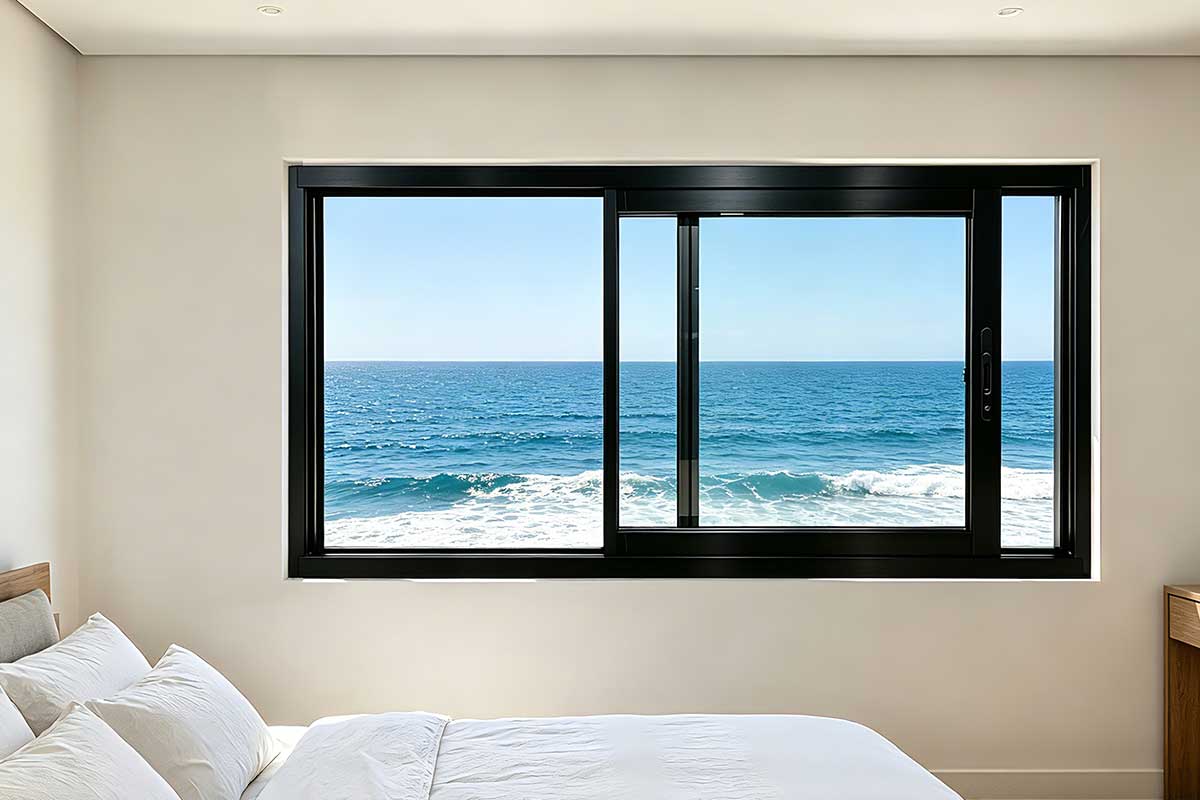
Thermal Break Technology and Energy Performance Explained
Aluminium conducts heat at roughly 160 W/m·K — approximately 1,000 times faster than uPVC and 5,000 times faster than timber. Left uninterrupted, that conductivity turns the frame into an open channel for energy transfer in both directions. In summer, exterior heat rides straight through into your conditioned interior. In winter, paid-for warmth leaks outward through the metal. A thermal break is the engineering solution that makes aluminium competitive with any frame material on energy performance. Without one, even the most expensive glazing unit is undermined by the frame surrounding it.
A thermal break is a strip of insulating polymer — typically glass-fibre-reinforced polyamide (PA66) — inserted between the interior and exterior aluminium profiles. It physically separates the two halves of the frame, creating a barrier with a thermal conductivity of just 0.3 W/m·K. That is over 500 times lower than the aluminium it divides. The result is a composite profile that retains full structural integrity while dramatically slashing heat transfer through the frame.
How Thermal Breaks Work Inside the Frame
Two primary methods exist for integrating the polyamide barrier into the aluminium profile:
Mechanically crimped polyamide strips — the dominant method in quality residential and commercial systems. The aluminium extrusion is produced as two separate profiles (interior and exterior) with precision-machined channels. Polyamide strips, typically ranging from 14.8mm to 34mm wide depending on the target performance, are inserted into these channels. A knurling or crimping process then mechanically locks the polyamide to the aluminium, creating a single structural unit from three separate components.
Pour-and-debridge — an older technique where a liquid polyurethane resin is poured into a channel within a single aluminium extrusion. Once cured, a section of aluminium bridging the two halves is cut away (debridged), leaving the hardened resin as the sole thermal connection. This method is simpler but generally produces narrower thermal breaks with lower insulating performance than crimped polyamide strips.
The width of the break matters enormously. A wider polyamide strip means a longer thermal path between exterior and interior aluminium — and thermal resistance scales directly with that distance. A standard aluminium frame without any break carries a frame U-value (Uf) of roughly 5.0–7.0 W/m²·K. Adding a 24mm thermal break drops this to 1.8–2.5 W/m²·K. Premium profiles with 34mm+ breaks and foam insulation inserts achieve Uf values of 0.8–1.2 W/m²·K — territory that matches high-performance timber.
Thermal break quality varies enormously between manufacturers and is the primary differentiator in aluminium frame performance. Two frames that look identical from the outside can differ by a factor of three or more in thermal resistance depending on break width, polyamide grade, and internal cavity design. Always ask for the Uf value — not just the glazing U-value — when comparing systems.
Single Pane vs Double Pane and Frame Interaction
Frame thermal performance and glazing performance are not independent — they interact as a system. The whole-window U-value (Uw) accounts for both the frame and the glass, weighted by their respective areas. This is where the relationship between frame specification and glazing investment becomes critical.
Single pane aluminium windows — still found in older Australian homes built before modern energy codes — typically deliver whole-window U-values above 6.0 W/m²·K. They represent the weakest thermal link in any building envelope. For homeowners looking to replace aluminum windows from the 1970s or 1980s, the performance gap between those original single-pane units and a modern thermally broken system with aluminum double pane windows is substantial: a reduction from 6.0+ down to 1.8–2.5 W/m²·K is common.
The trap many buyers fall into is pairing expensive double or triple glazing with a non-thermally-broken frame. A quality insulated glass unit (IGU) might achieve a centre-of-glass U-value of 1.1 W/m²·K, but if it sits inside a frame conducting heat at 5.0+ W/m²·K, the whole-window figure suffers badly. Industry data indicates up to 40% of a home’s heating energy escapes through windows, and the frame is often the primary culprit — not the glass. Aluminium window replacement projects that upgrade glazing without addressing frame thermal performance frequently deliver disappointing energy savings.
Conversely, a thermally broken frame paired with Low-E coated double glazing and argon gas fill creates a complete thermal envelope. Whole-window U-values of 1.8–2.2 W/m²·K become routinely achievable — enough to satisfy even the 7-star NatHERS requirements that apply to new Australian homes and major renovations from May 2025.
Reading Energy Ratings and Making Comparisons
Comparing replacement aluminum windows across different manufacturers and frame materials can feel opaque without understanding how ratings work. In Australia, the Window Energy Rating Scheme (WERS) provides the standardised framework.
WERS rates products on several metrics, but the two most important for thermal performance are:
- U-value (W/m²·K) — measures how readily heat passes through the complete window assembly. Lower numbers mean better insulation. A whole-window Uw of 2.0 is roughly twice as thermally resistant as one rated 4.0.
- Solar Heat Gain Coefficient (SHGC) — measures how much solar radiation passes through on a scale of 0 to 1. Higher SHGC is desirable for north-facing glass in cooler climates (free winter warmth), while lower SHGC suits west-facing openings that cop harsh afternoon sun in summer.
NatHERS energy modelling tools — including FirstRate5, BERS Pro, and AccuRate — all accept WERS-rated data as inputs. Without WERS certification, energy assessors must use generic default values that are deliberately conservative. That means a non-rated window can force compensatory measures elsewhere in the build: thicker wall insulation, smaller glazing areas, or reduced design ambition. A WERS-rated thermally broken aluminium window simply does its job within the model, giving your assessor accurate figures to work with.
For anyone considering aluminum retrofit windows to upgrade an older home’s performance, this rating system also provides the clearest way to quantify improvement. Comparing the WERS data of your proposed replacement windows aluminium system against the generic defaults assigned to existing single-pane frames shows, in measurable terms, exactly how much thermal performance you gain — and how that translates to NatHERS star rating improvements for the whole dwelling.
Thermal break technology is the invisible factor that separates an aluminium frame performing at timber-equivalent levels from one haemorrhaging energy. But performance is only one dimension of the frame. The finish applied to that aluminium surface determines both the aesthetic and the long-term durability of the system under Australian UV and weather exposure.
Aluminium Window Frame Colours and Finish Options Explained
The surface finish on an aluminium frame is not decorative afterthought — it is a functional layer that determines how well the profile resists UV degradation, salt exposure, scratching, and colour fade over decades of Australian weather. Two dominant finish technologies serve different aesthetic and performance goals, and understanding both helps you make a colour choice you will not regret in ten years.
Powder Coating — The Industry Standard
Powder coating accounts for the vast majority of aluminium window frame colours on residential and commercial projects. The process works by spraying electrostatically charged polyester-based powder onto an earthed aluminium profile. The charged particles cling uniformly to every surface, including recesses and edges. The coated frame then enters a curing oven at around 180–200°C, where the powder melts, flows, and chemically cross-links into a continuous, sealed film typically 60–80 microns thick.
What happens before the powder hits the aluminium matters just as much. Qualicoat UK & Ireland emphasises that the pre-treatment stage — cleaning, etching, and applying a conversion coating — is what creates the bond between finish and substrate. Without proper pre-treatment, powder coat can peel, blister, or allow filiform corrosion to creep beneath the surface. When specifying aluminium windows, look for frames coated by a Qualicoat-licensed applicator. These coaters undergo random third-party inspections twice annually, ensuring consistent quality regardless of the colour you choose.
The practical result is a finish that resists UV chalking, chipping, and chemical attack across a virtually unlimited palette. Black aluminum windows, white aluminum windows, bold reds, subtle greys — any RAL colour is achievable, plus woodgrain sublimation textures that mimic timber. Powder-coated finishes typically maintain appearance for 15–20 years in moderate conditions, though coastal or high-UV environments can shorten that window without enhanced coat thickness.
Anodizing for Natural Metallic Finishes
Anodizing takes a fundamentally different approach. Rather than adding a coating on top of the aluminium, it transforms the metal’s own surface into a dense aluminium oxide layer through an electrochemical process. The frame is submerged in an acid electrolyte bath, and an electrical current triggers oxidation that grows the natural oxide layer from a few nanometres thick to 15–25 microns — creating an integral barrier that cannot peel or delaminate because it is part of the metal itself.
This oxide layer is exceptionally hard. Anodized aluminum windows offer superior scratch resistance compared to powder-coated equivalents, making them well-suited to high-traffic commercial environments and coastal installations where airborne sand and salt would abrade a softer finish. Colour options are more limited than powder coating — silver, champagne, bronze aluminum windows tones, and black are the standard palette — but the resulting metallic depth has a quality that pigmented coatings cannot replicate.
Anodized finishes can last over 25 years with minimal maintenance, outperforming powder coating in longevity and UV resistance. The trade-off is a narrower colour range and generally higher cost per square metre of coated surface.
Choosing Colours for Different Architectural Styles
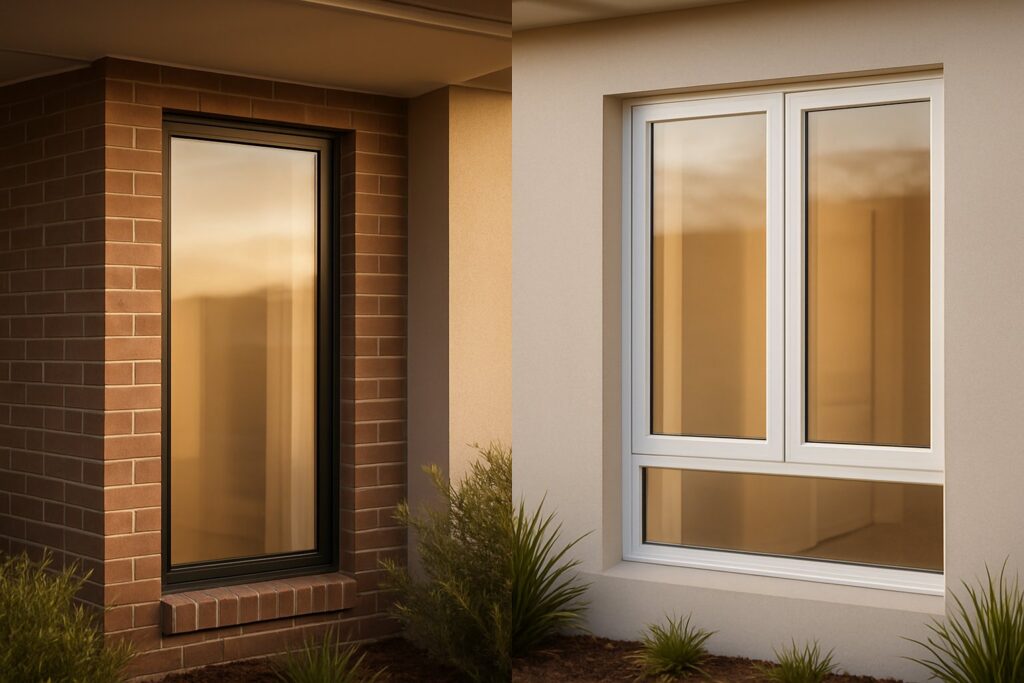
Colour selection is where thin frame windows and finish technology converge to define a building’s character. Matte black frames — the dominant choice for modern window frames in contemporary Australian builds — create bold contrast against rendered walls and maximise the visual impact of slim aluminium profiles. White suits traditional and coastal aesthetics, offering a crisp, familiar look that pairs easily with weatherboard or brick veneer. Natural anodized tones in champagne or bronze complement mid-century and industrial-inspired designs, where the metallic honesty of the material itself becomes part of the visual language.
Dual-colour options let you run one finish externally and another internally — charcoal outside to suit the streetscape, white inside to match interior trim, for example. Woodgrain sublimation applies a photographic timber pattern over a base powder coat, giving aluminium the visual warmth of timber without the maintenance burden. These hybrid approaches expand what is achievable with aluminium window frame colours without compromising the material’s structural advantages.
| Finish Type | Durability | Colour Range | Scratch Resistance | Cost Level | Best Application |
|---|---|---|---|---|---|
| Powder coating (standard) | 15–20 years | Virtually unlimited (full RAL range) | Good | Moderate | General residential and commercial; any colour requirement |
| Powder coating (enhanced coastal) | 15–20 years with thicker film build | Full RAL range | Good | Moderate–High | Within 1km of coast; high-UV exposure zones |
| Anodized (architectural grade) | 25+ years | Limited (silver, bronze, black, champagne) | Superior | High | High-traffic commercial; coastal; premium residential where metallic aesthetic is desired |
| Woodgrain sublimation | 15–20 years (substrate is powder coat) | Timber-look patterns (various species) | Good | High | Heritage overlays; projects wanting timber aesthetics without maintenance |
Your finish choice locks in both the maintenance trajectory and the visual identity of the frame for its service life. But how that finish holds up depends heavily on where the window sits — coastal salt spray, inland UV, or cold-climate condensation each stress the surface in different ways.
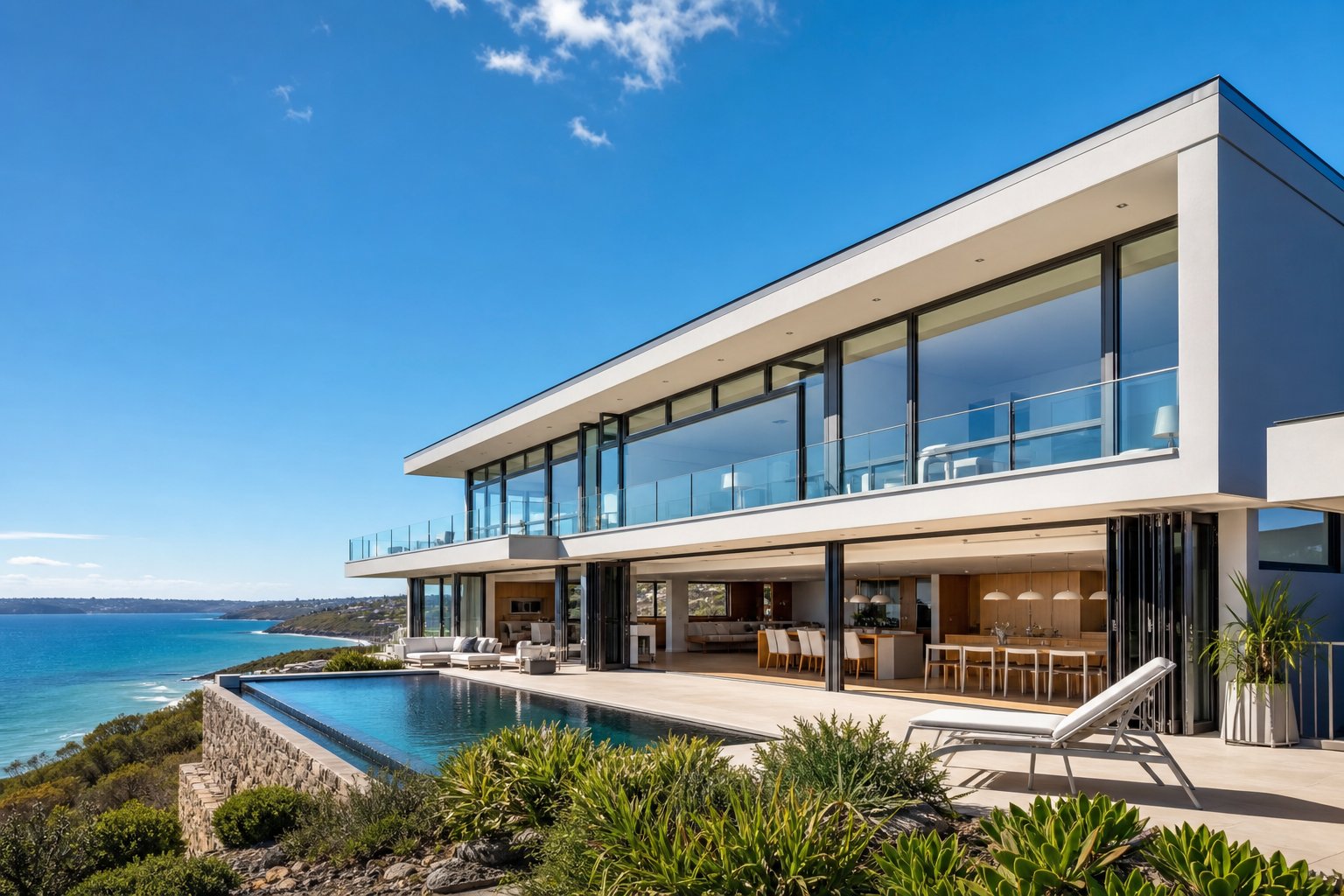
Climate Performance and Corrosion Resistance by Region
A powder-coated black frame that performs flawlessly in suburban Melbourne may deteriorate within a decade on a beachfront in Noosa. The same aluminium alloy, the same profile depth, the same thermal break — but a completely different outcome because the environment changed and the specification did not. Climate is the single biggest variable that determines how long an aluminium window with frame actually lasts, and most buyers never think to ask how their local conditions should shape their specification choices.
Aluminium itself does not rust. Unlike steel, which forms flaky iron oxide that eats progressively deeper into the base metal, aluminium reacts with oxygen to form a thin, stable oxide layer — just a few nanometres thick — that bonds tightly to the surface and shields the metal beneath. This natural passivation is why old aluminum window frames from the 1970s still exist in recognisable form even without protective coatings. But “does not rust” is not the same as “immune to all corrosion.” Specific environments introduce specific attack mechanisms, and each demands a tailored response.
Coastal and High-Humidity Environments
Salt spray is the primary aggressor. Airborne chloride ions from breaking waves can travel several kilometres inland, and when they deposit on aluminium surfaces, they penetrate the natural oxide layer at weak points — scratches, unprotected cut edges, and areas where moisture pools. The result is pitting corrosion: small craters that deepen over time and eventually compromise both appearance and seal integrity.
For residential aluminum windows within 1km of the coastline, specification choices need to account for this. The aluminum window frame material itself makes a difference. Standard architectural alloy 6063-T5 performs adequately in sheltered coastal positions, but properties with direct ocean exposure benefit from 6060-T5 or alloys with enhanced magnesium content that stabilise the oxide layer against chloride attack. Research into marine-grade aluminium systems confirms that alloy selection is the foundational decision — coatings protect the surface, but the alloy determines how the base metal responds if that surface is ever breached.
Beyond alloy choice, coastal applications demand enhanced powder coat thickness. Standard architectural coatings run 60–80 microns. For direct coastal exposure, specifiers should look for minimum 80–100 micron film build, ideally from a coater meeting the equivalent of high-performance durability standards that guarantee salt spray resistance exceeding 4,000 hours. Anodized finishes also perform exceptionally in salt environments because the oxide layer is integral to the metal rather than adhered on top — there is nothing to delaminate.
Hardware matters too. Every hinge, lock, roller, and fastener in a coastal aluminium window must be 316-grade marine stainless steel. Standard zinc-plated or 304-grade hardware will corrode far faster than the frame itself, creating ugly staining and eventual mechanical failure. Galvanic corrosion — an electrochemical reaction that accelerates when dissimilar metals contact each other in the presence of a salt-water electrolyte — is the hidden risk. Separating aluminium from any steel or copper components with nylon bushings or isolating gaskets prevents this reaction from starting.
Extreme Heat and UV Exposure
Inland and northern Australia deliver a different challenge: sustained temperatures exceeding 40°C, relentless UV radiation, and dramatic thermal cycling between scorching days and cool nights. Here, aluminium’s dimensional stability becomes a genuine advantage over competing materials.
uPVC softens as temperatures rise. Its glass transition point sits around 80°C, and dark-coloured uPVC frames in direct sun can reach surface temperatures approaching that threshold. The result is subtle warping, seal compression, and gradual loss of square that worsens over repeated summers. Timber swells and shrinks with humidity cycles, stressing joints and paint films. Aluminium does neither. Its coefficient of thermal expansion is predictable and manageable through standard allowances in the frame design, and it maintains full structural rigidity regardless of surface temperature.
UV degradation targets the coating rather than the metal. Quality powder coat finishes resist UV chalking and colour shift for 15–20 years even under harsh Australian sun. For west-facing elevations that cop relentless afternoon exposure, specifying a coating system with enhanced UV stabilisers — or opting for anodized finishes that are inherently UV-proof — extends appearance retention well beyond standard expectations.
Thermal breaks play a different but equally critical role in hot climates. Rather than preventing heat escaping outward (the cold-climate concern), they block radiant and conducted heat from migrating inward through the metal frame. A non-thermally-broken aluminium profile exposed to 60°C surface temperatures in full sun will transfer that heat directly to the interior frame surface, raising cooling loads and making the frame uncomfortably hot to touch. Thermally broken commercial aluminium windows and residential systems alike prevent this inward heat path, keeping interior surfaces close to room temperature regardless of what is happening on the outside face.
Cold Climates and Condensation Management
Southern Australia — from Hobart through the Victorian highlands and into alpine zones — introduces the condensation challenge. When exterior temperatures drop well below interior temperatures, any thermally conductive surface on the warm side of the building can cool below dew point. Moisture in the indoor air then condenses directly onto that surface, pooling at sills, staining frames, and potentially encouraging mould growth in surrounding wall cavities.
Thermal break width becomes the deciding factor. A non-metallic barrier separating interior and exterior frame halves limits heat flow so inner surfaces stay warmer and drier, directly reducing condensation potential. In cold climates, narrower breaks (14–18mm) may still allow the interior aluminium to reach dew point on the coldest nights. Wider breaks of 24–34mm maintain interior surface temperatures comfortably above condensation thresholds even during extended cold snaps. This is why the same profile system configured with a wider thermal break suits Hobart while a standard break width handles Sydney without issue.
Drainage engineering provides the backup system. Quality aluminium frames incorporate sloped sill chambers, weep holes, and pressure-equalised cavities that channel any incidental moisture — whether from condensation or wind-driven rain — safely to the exterior. Blocked drainage paths are among the most common causes of premature seal failure in metal windows residential installations. Keeping weep holes clear and sill channels free of debris is a simple maintenance task that directly protects the frame’s long-term integrity.
Indoor humidity management also plays a role. Kitchens, bathrooms, and laundries generate significant moisture loads. Exhaust ventilation, trickle vents, and maintaining relative humidity between 30–50% reduce the condensation burden on the window frame itself. Even the best thermally broken system will struggle if indoor humidity consistently sits above 60% in a cold environment.
Climate should drive specification choices — not the other way around. The same aluminium frame system configured with a different alloy, a different coating thickness, a different thermal break width, and different hardware grade suits vastly different environments. Asking your supplier how they adapt their standard system for your specific exposure conditions is the single most important question in the specification process.
Replacing old aluminium windows from the pre-thermal-break era with modern, climate-appropriate systems is one of the most effective upgrades for both comfort and longevity. Those original frames were often specified identically regardless of location — a one-size-fits-all approach that left coastal homes corroding and alpine homes dripping with condensation. Today’s systems offer the configurability to match the material precisely to the conditions it will face.
Climate determines how long your frame lasts, but it does not operate in isolation. How aluminium compares against timber, uPVC, and composite materials under the same conditions — and where each holds a genuine advantage — shapes the final decision for any project weighing its options.
Aluminium vs Timber vs uPVC Frame Materials Compared
Knowing how aluminium performs in your specific climate is half the equation. The other half is understanding where it genuinely outperforms competing frame materials — and where it does not. Every project involves trade-offs, and the right frame depends on your priorities: maximum glass area, lowest lifetime cost, best raw insulation, or something in between.
Aluminium vs Timber Frames
Timber is a natural insulator. Its cellular structure traps air, giving even softwood frames U-values of 1.2–1.4 W/m²K without any engineered thermal break. Aluminium frames need thermally broken profiles to approach that territory. On pure thermal performance alone, timber wins.
But timber demands commitment. Repainting every 5–7 years is non-negotiable if you want to prevent moisture ingress and UV breakdown. Neglect a maintenance cycle, and rot sets in — particularly in humid coastal or tropical Queensland conditions. Aluminium requires nothing beyond an occasional wash with soapy water. Over a 40-year span, that maintenance gap represents thousands of dollars and dozens of hours saved.
Design flexibility also diverges. Aluminium’s extrusion process produces slimmer profiles (as narrow as 35mm) capable of spanning wider openings than timber can achieve without bulky sections. Timber’s minimum practical sightline sits around 55–65mm. For contemporary homes where walls of glass define the architecture, aluminum frames deliver more view and less frame.
Where timber excels is heritage contexts. Conservation overlays across many Australian councils mandate natural materials for visible facades. Timber also carries an aesthetic warmth that metal cannot fully replicate — even with woodgrain sublimation finishes. For Queenslanders, Federation homes, and character cottages, it remains the contextually appropriate choice.
A hybrid approach bridges the gap. Aluminum clad wood windows pair a timber interior with an extruded aluminium exterior shell. You get the warmth and insulating properties of wood inside, with the weather resistance and low maintenance of metal clad windows outside. The trade-off is higher cost and slightly thicker profiles due to the dual-material construction. Wood clad aluminum windows suit premium renovations where interior aesthetics and exterior durability both matter.
Aluminium vs uPVC Frames
uPVC dominates budget-driven projects for good reason. Multi-chambered vinyl profiles deliver excellent thermal performance (U-values from 1.2 W/m²K) at the lowest upfront price point. For standard bedroom and bathroom windows in moderate climates, uPVC performs well.
The limitations surface as ambitions grow. uPVC profiles require minimum sightlines of 70–80mm to maintain structural integrity — roughly double the width of slim-line aluminium. That extra frame bulk reduces visible glass area by up to 20% in the same opening. For large-span windows and frames — bifolds, stacking sliders, floor-to-ceiling panels — uPVC simply cannot deliver the unsupported widths aluminium handles. Typical maximum unsupported span for uPVC sits around 1.2m compared to 1.8m for aluminium.
Longevity separates them further. Quality aluminium systems last 40–50 years. uPVC typically reaches end-of-life at 20–30 years, with colour fade, seal degradation, and brittleness becoming issues earlier on sun-exposed elevations. In Australian conditions with high UV, that lifespan gap can widen. When you factor in the cost of full replacement at year 25, the total cost of ownership often favours aluminium despite its higher initial price.
Recyclability is another clear differentiator. Aluminium recycles infinitely with no quality loss. uPVC can be recycled approximately 10 times before degradation, and recycling infrastructure for vinyl windows remains limited in Australia compared to aluminium scrap markets.
Aluminium vs Composite and Fibreglass
Fibreglass (or glass-reinforced polyester) frames are a newer entrant with strong thermal credentials. They offer excellent dimensional stability, thin profiles, and U-values competitive with timber — all without the maintenance burden. On paper, fibreglass looks like it might challenge aluminium across the board.
In practice, availability limits the comparison. Fibreglass frames carry higher upfront costs (typically 12–15% more than vinyl) and far fewer manufacturers supply the Australian market compared to aluminium. Lead times tend to be longer, custom colour options are more restricted, and the long-term performance track record in Australian conditions — particularly under extreme UV and thermal cycling — remains shorter than aluminium’s proven 40–50 year history.
For projects that prioritise raw thermal performance above all else and where budget is flexible, fibreglass deserves consideration. For projects that need design flexibility, proven longevity, unlimited colour options, and an established local supply chain, aluminium remains the stronger all-round proposition.
| Criteria | Aluminium (thermally broken) | Timber (hardwood) | uPVC | Fibreglass/Composite |
|---|---|---|---|---|
| Strength-to-weight | Excellent | Moderate | Low–Moderate | Very Good |
| Thermal performance (Uf) | 1.6–2.5 W/m²K (without break: 5.0+) | 1.2–1.4 W/m²K | 1.2–1.4 W/m²K | 1.2–1.6 W/m²K |
| Maintenance needs | Minimal (wash only) | High (repaint every 5–7 years) | Minimal (wash only) | Low (occasional repaint optional) |
| Lifespan estimate | 40–50+ years | 30–60 years (species-dependent) | 20–30 years | 40–50 years (limited local data) |
| Recyclability | 100% infinite recycling | Biodegradable / reusable | ~10 cycles before degradation | Limited recycling pathways |
| Minimum profile sightline | 35mm | 55–65mm | 70–80mm | 45–55mm |
| Maximum unsupported span | ~1.8m | ~1.2–1.4m | ~1.2m | ~1.5m |
| Relative cost bracket | Medium–High | High | Low–Medium | Medium–High |
No single material wins every category. Aluminium dominates on span capability, profile slimness, recyclability, and low maintenance — the factors that matter most for modern designs and large openings. Timber leads on raw thermal performance and heritage suitability. uPVC wins on initial cost. Fibreglass balances thermal performance with thin profiles but lacks aluminium’s market maturity and colour flexibility.
The aluminum clad window concept — wrapping timber in an aluminium exterior — demonstrates that these materials are not always mutually exclusive. Hybrid systems let you pick the strengths of each where they matter most: wood’s insulating warmth on the interior, aluminium’s durability on the weather face. Whether pure aluminium or an aluminum clad hybrid suits your project depends on which performance characteristics sit at the top of your priority list — and how much ongoing maintenance you are willing to accept in exchange.
Material selection sets the foundation, but how you care for your chosen frame over the following decades determines whether it reaches its full potential lifespan or falls short.
Maintenance, Lifespan, and Sustainability of Aluminium Frames
Aluminium earns its reputation as a low-maintenance frame material — but low maintenance is not the same as no maintenance. The difference between a frame that lasts 30 years and one that performs well beyond 50 comes down to a handful of simple, periodic tasks that most homeowners can handle without professional help. Neglect them, and even premium aluminium joinery degrades faster than the material itself warrants.
Routine Maintenance and Cleaning Methods
The single most effective maintenance action is also the simplest: washing. Every three months, wipe down frame surfaces with a soft cloth or sponge using warm water and a mild liquid detergent — standard dishwashing liquid works perfectly. Rinse with clean water and allow to air dry. This removes accumulated dirt, salt deposits, pollution residue, and organic matter before any of it has time to attack the powder coat surface or settle into drainage channels.
Industry maintenance guidelines stress avoiding abrasive tools — steel wool, scouring pads, scrapers, and aggressive solvents all damage powder-coated finishes permanently. If your frames sit within a coastal zone or near industrial areas, increase the washing frequency to every 6–8 weeks. Salt crystallises on surfaces between rain events, and the longer it sits, the more aggressively it attacks the coating layer.
Beyond surface cleaning, three additional tasks keep the system functioning properly:
Hardware lubrication — hinges, rollers, locking mechanisms, and sliding tracks benefit from a light application of silicone-based lubricant every six months. Avoid petroleum-based oils that attract dust and gum up over time. Well-lubricated hardware operates smoothly and avoids the excessive force that stresses frame joints.
Weatherseal inspection — EPDM and rubber gaskets compress and harden gradually with age and UV exposure. Run your finger along the seals annually, checking for cracks, permanent compression, or sections that have pulled free from their grooves. Replacing a worn seal costs a fraction of repairing water damage caused by a failed one.
Drainage clearance — those small weep holes and sloped sill channels exist to direct water outward. Construction debris, insect nests, dust, and leaf litter block them silently. Check and clear drainage paths at least twice a year, particularly after building work or heavy storm seasons.
- Spring: Full frame wash, clear drainage paths of winter debris, inspect weatherseals for cracking or compression set, lubricate all hardware
- Summer: Quick wash focusing on salt and dust buildup, check exposed west-facing frames for any coating chalking, ensure drainage is not blocked by dried organic matter
- Autumn: Frame wash before winter, remove fallen leaves from sill tracks and drainage channels, lubricate rollers and locks before cold weather stiffens mechanisms
- Winter: Monitor for condensation pooling on sills (indicates seal or thermal break issues), keep tracks clear of moisture buildup, spot-clean any visible salt deposits after storms
Expected Lifespan and What Affects Longevity
Quality aluminium frames routinely last 40–60 years when properly specified for their environment and maintained with the basic tasks above. Some commercial installations from the 1960s remain in service today — though those early systems lacked thermal breaks and modern coatings, the underlying aluminium alloy proved its durability across six decades of weather exposure.
Several factors shorten that potential lifespan well below what the material can deliver:
Poor specification for the environment — a standard coating system installed 200 metres from the ocean, or a non-thermally-broken frame in an alpine climate, introduces stress the system was never designed to handle. This is the most common reason people need to replace aluminium windows prematurely. The material did not fail — the specification did.
Neglected hardware — seized hinges force users to wrench sashes open, stressing corner joints. Worn rollers grind tracks. Failed locks leave windows unsecured and rattling in the wind. Hardware is typically the first component that needs replacement in an aluminium window system, usually around the 15–20 year mark depending on usage and environment.
Failed weatherseals — rubber gaskets have a shorter lifespan than the aluminium they seal. Expect to replace primary weatherseals at least once during the frame’s service life, typically around 20–25 years. This is normal maintenance, not a defect — but ignored seals lead to water ingress that corrodes hardware, damages sills, and compromises the wall cavity.
Blocked drainage — pooling water inside frame chambers accelerates corrosion at unprotected internal surfaces, particularly at mechanically crimped corners where cut aluminium edges are exposed. Keeping drainage functional is the simplest way to prevent the most common failure mode in older installations.
For homeowners weighing an aluminum frame window replacement project — whether upgrading old aluminum windows from the 1980s or addressing failed seals in a more recent system — understanding these failure modes helps distinguish between frames worth refurbishing and those due for full aluminum windows replacement. If the core aluminium profiles remain dimensionally stable and corrosion-free, replacing hardware and seals often extends service life by another 15–20 years at a fraction of the cost of complete replacement.
Recyclability and Sustainability Credentials
Aluminium carries a genuine sustainability advantage that few building materials can match: it recycles infinitely without any degradation in structural properties. The alloy melted from an end-of-life window frame produces new extrusions indistinguishable in performance from those made with primary aluminium. No downcycling, no quality loss, no limit on the number of times the material can loop through the system.
The energy argument is equally compelling. Primary aluminium production is energy-intensive, but recycling requires only about 5% of that original energy input. Every tonne of recycled aluminium avoids roughly 9 tonnes of CO2 emissions compared to primary production. End-of-life aluminium window frame kits and complete frame assemblies retain significant scrap value precisely because the recycling economics are so favourable — scrap aluminium is actively sought by smelters rather than treated as waste.
This circularity increasingly matters for project approvals. Green building certification systems like Green Star (Australia’s primary rating tool), BREEAM, and LEED all reward materials with high recycled content, low embodied energy in ongoing use, and clear end-of-life recyclability pathways. Aluminium joinery contributes positively across multiple assessment categories: energy efficiency through thermally broken profiles, daylight access through slimmer frames allowing larger glass areas, and circular economy credentials through full recyclability. Environmental Product Declarations (EPDs) — increasingly requested by specifiers — document these lifecycle impacts transparently.
For builders and developers targeting sustainability benchmarks, selecting aluminium window supplies from manufacturers who source recycled-content billets and operate under certified environmental management systems strengthens the project’s overall rating. The aluminum frame for glass in a certified green building is not just structural hardware — it is a documented contributor to the building’s environmental performance score.
Manufacturers like MEICHEN offer aluminium window systems designed with longevity as a core engineering goal — performance-rated profiles, quality hardware selections, and finish systems suited to Australian coastal and inland conditions. Their range provides a practical starting point for homeowners and project teams looking to match frame specification to both environmental demands and sustainability objectives.
Maintenance keeps your frames performing. Material recyclability ensures they contribute value even at end-of-life. But between those two bookends sits the practical challenge most buyers face right now: translating all of this technical knowledge into a specification that actually suits their project — the right profile, the right glass, the right finish, ordered from the right supplier.
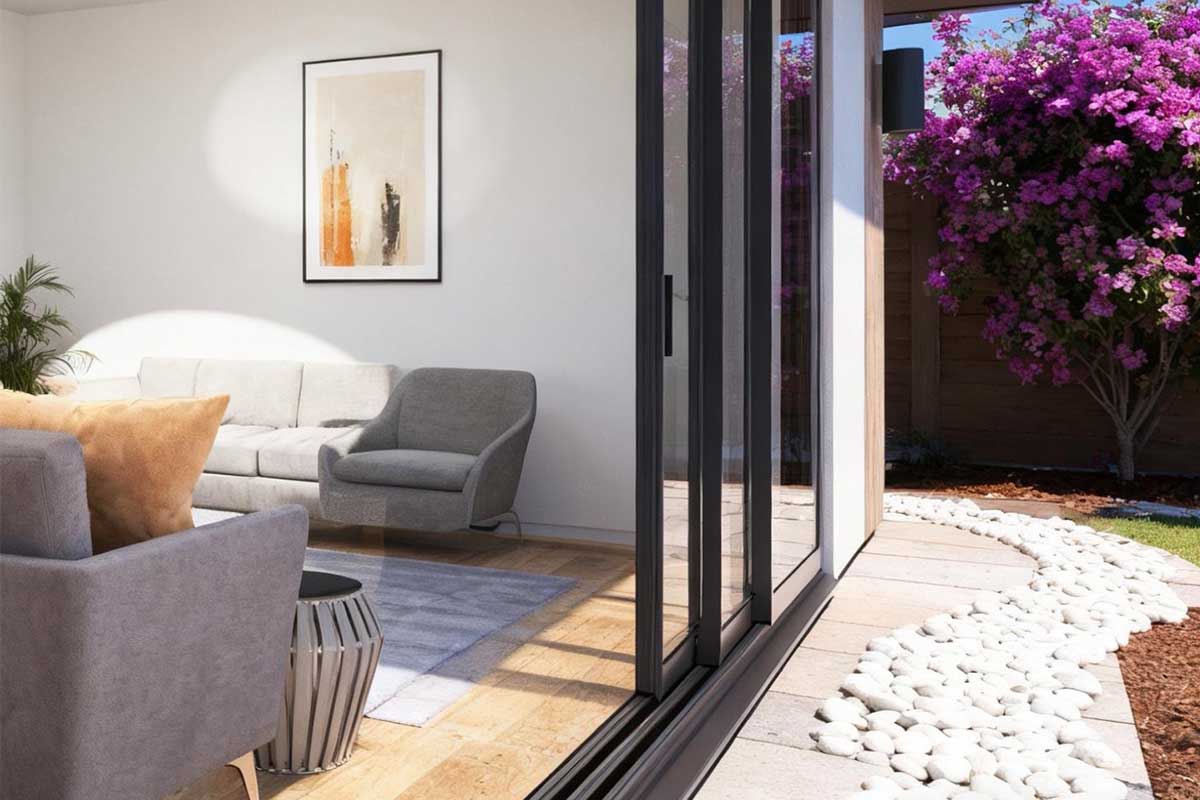
Choosing the Right Aluminium Window System for Your Project
Technical knowledge only creates value when it translates into decisions. You understand thermal breaks, alloy grades, coating systems, and maintenance requirements — but when you sit down with a supplier or architect to finalise your window schedule, none of that matters unless you can connect it to specific choices for your specific build. A beachfront renovation in Byron Bay demands a fundamentally different specification from a double-storey new build in suburban Melbourne, even though both use the same base material.
This section maps what you have learned onto the practical decisions that determine whether your aluminium windows perform as intended — or become an expensive compromise.
Matching Window Style to Application
Different rooms, different functions, different window types. The profile system you select needs to accommodate the operating style that suits each opening in your floor plan.
Aluminum casement windows remain the default for bedrooms and living areas across most Australian residential builds. Hinged on one side and swinging outward, they provide excellent ventilation, a tight compression seal when closed, and clean sightlines that suit both contemporary and transitional facades. The frame profile for a casement needs robust hinge reinforcement and a deep rebate to accommodate quality multi-point locking hardware.
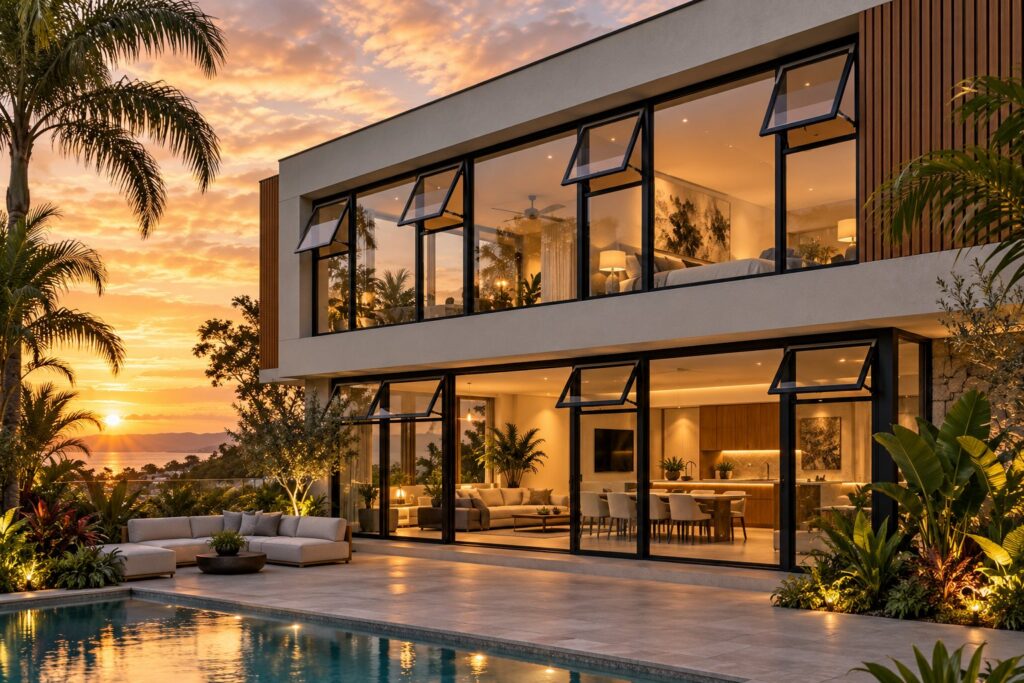
Awning windows hinge at the top and project outward — ideal for bathrooms, laundries, and any room where you want airflow during rain without water entry. They work well at higher positions on walls and combine neatly with fixed panels below for light-plus-ventilation configurations.
Aluminium sliding windows suit wide openings where outward projection is impractical. Ground-floor rooms facing walkways, balconies, or boundary setbacks benefit from sliders that move horizontally within the frame plane. Larger aluminum sliding windows are common in apartment developments and coastal homes prioritising unobstructed views over maximum ventilation area.
Fixed panels deliver the slimmest sightlines of any window type because there is no operable hardware to house. Use them for feature glazing, stairwells, and high-level light capture where ventilation is handled elsewhere. Custom aluminum windows in fixed configurations can span floor-to-ceiling heights with profiles as narrow as 35mm face width.
Double-hung windows — where both upper and lower sashes slide vertically — suit heritage renovations and period homes where council overlays mandate traditional proportions. Modern aluminium double-hung profiles replicate the look of timber originals while delivering contemporary thermal and acoustic performance.
Frame profile choice connects directly to operating type. A sliding window needs integrated tracks, interlocking meeting stiles, and different drainage geometry than a casement. An awning demands a head-hinged sash configuration with friction stays rated for the sash weight. Specifying the wrong profile system for your intended operating type creates problems that no amount of adjustment on site can resolve — so confirm compatibility early in the design process.
Key Specifications to Discuss with Your Supplier
Walking into a supplier meeting without clear specification parameters is like briefing a builder without drawings. The following decisions should be resolved — or at least consciously discussed — before any order is placed:
- Profile system and depth — determines structural capacity, maximum glass size, and sightline width. Slim-line (40–45mm) suits small to mid-size openings in sheltered positions. Standard (52–60mm) handles most residential applications. Heavy-duty (65mm+) is necessary for large spans, high wind zones, or cyclone-rated regions.
- Thermal break type and width — the single biggest factor in energy performance. Mechanically crimped polyamide strips outperform pour-and-debridge systems. Break width of 24mm minimum suits most Australian climate zones; cold-climate projects in Tasmania or alpine Victoria benefit from 34mm+ breaks.
- Glazing configuration — double glazed Low-E with argon fill is the current standard for NCC compliance. Triple glazing adds cost but may be justified in extreme climates or where NatHERS targets exceed 7 stars. Laminated glass is required where safety glazing rules apply (low sills, doors, overhead panels).
- Frame finish and colour — powder coat for unlimited colour choice, anodized for superior scratch resistance and coastal durability, or woodgrain sublimation for heritage contexts. Specify the performance tier (standard vs coastal-rated) based on distance from the ocean and orientation.
- Hardware grade — 316 marine stainless steel within 1km of the coast, 304 stainless or zinc alloy for sheltered inland positions. Hardware quality directly affects operational lifespan and security ratings.
- Weather rating and wind load class — determined by your site’s wind classification under AS 4055 and confirmed through AS 2047 testing of the specific window configuration. Exposed coastal and elevated sites require higher ratings than sheltered suburban positions.
- Installation method — new construction (frame installed into a rough opening during the build) vs retrofit (new frame fitted into an existing opening, often over or in place of old aluminium windows). Retrofit installations may require packers, sub-sills, or modified reveals, and the supplier needs to know this upfront to size frames correctly.
Each of these decisions interacts with the others. A deeper profile accommodates wider thermal breaks and thicker glazing units simultaneously. A coastal-rated finish paired with marine-grade hardware and enhanced alloy creates a cohesive system rather than a collection of individually adequate components. Your supplier should be helping you navigate these interdependencies — not just taking an order for what you think you want.
Finding the Right Aluminium Window Partner for Your Project
The gap between aluminium window suppliers who simply take measurements and ship product, and those who actively support your project from design through delivery, determines whether the specification process feels overwhelming or manageable. For anyone searching for aluminium windows near me or aluminum windows near me, proximity matters less than capability. A local distributor stocking limited standard sizes cannot serve a project the same way an integrated fabricator with engineering depth can.
What separates a capable supply partner from a basic order-taker:
Custom sizing capability — your openings are rarely catalogue dimensions. A supplier limited to standard sizes forces compromises in your design or expensive site modifications to accommodate fixed product dimensions. Aluminum window manufacturers operating as fabricators cut, assemble, and glaze to your exact measurements.
Range of window types — projects rarely need only one style. A typical home might combine casement windows in bedrooms, awning windows in wet areas, fixed panels in stairwells, and aluminium sliding windows across the living area. A supplier covering the full range fabricates everything from the same profile system, ensuring consistent sightlines, colour match, and hardware logic across the entire window schedule.
Thermal performance options — the ability to offer both standard and thermally broken profiles, with varying break widths, means the supplier can match specification to climate zone rather than offering a single system regardless of where it is being installed.
Colour flexibility — full RAL range powder coating, dual-colour options (different interior and exterior finishes), and access to anodized or woodgrain alternatives give you design freedom without supplier limitations dictating aesthetic outcomes.
Project support from design through installation — reviewing architectural drawings, confirming wind load compliance, producing shop drawings, coordinating delivery against your construction programme, and providing post-installation warranty support. This level of engagement prevents the specification errors and timing failures that generate budget blowouts.
MEICHEN’s aluminium window range demonstrates what an integrated supply approach looks like in practice — custom aluminium window systems spanning casement, awning, sliding, fixed, and double-hung configurations, with thermally broken options, full colour flexibility, and project-based coordination suited to Australian residential and commercial builds. Their model covers the full cycle from system recommendation through manufacturing, quality control, and delivery — the kind of transparency that lets builders and homeowners track where their order sits rather than chasing status updates.
Whether your project is a three-window bathroom renovation or a 150-opening multi-residential development, the evaluation criteria remain consistent. Ask for AS 2047 test reports on your specific configurations. Confirm lead times against your construction programme. Request references from projects of similar scale. And verify that the supplier actually fabricates what you need rather than subcontracting it to a third party you have never vetted.
The aluminium window with frame that fights rust, heat, and time is not a single product — it is a system of deliberate choices, each reinforcing the others. Alloy grade protects against corrosion. Thermal break width manages energy transfer. Coating specification resists UV and salt. Hardware grade ensures operation over decades. Profile depth delivers structural integrity under load. And the supplier you choose determines whether all of those choices are made well, made consistently, and delivered to site in a form that performs as promised. Get the specification right, partner with the right fabricator, and the frame does exactly what it was engineered to do — quietly outperforming every other material in your building for the next half-century.
Frequently Asked Questions About Aluminium Windows with Frames
1. How long does an aluminium window with frame last in Australian conditions?
A properly specified aluminium window with frame typically lasts 40 to 60 years in Australian conditions. Longevity depends on matching the specification to your environment — coastal homes need marine-grade alloys, enhanced powder coat thickness, and 316 stainless steel hardware, while inland installations with standard coatings and regular washing can exceed 50 years. Hardware and weatherseals are usually the first components needing replacement at around 15 to 25 years, but the aluminium profiles themselves remain structurally sound for decades longer. Manufacturers like MEICHEN design their aluminium window systems with Australian climate demands in mind, offering performance-rated profiles and hardware suited to both coastal and inland projects.
2. Are aluminium window frames energy efficient without a thermal break?
Without a thermal break, aluminium frames conduct heat roughly 1,000 times faster than uPVC, resulting in frame U-values of 5.0 to 7.0 W/m2K — far too high for modern energy standards. Adding a quality polyamide thermal break of 24mm or wider reduces this to 1.6 to 2.5 W/m2K, making thermally broken aluminium competitive with timber frames. In Australia, meeting NCC 2022 requirements and achieving 7-star NatHERS ratings effectively requires thermally broken aluminium paired with Low-E double glazing. The thermal break width matters: wider strips (34mm+) suit cold climates like Tasmania, while standard 24mm breaks handle most mainland climate zones effectively.
3. What maintenance do aluminium window frames need?
Aluminium frames require minimal but consistent maintenance. Wash frame surfaces every three months with warm water and mild detergent, increasing to every six to eight weeks in coastal zones where salt crystallises on surfaces. Lubricate hinges, rollers, and locks with silicone-based lubricant every six months. Inspect EPDM weatherseals annually for cracking or compression set, and clear weep holes and sill drainage channels at least twice yearly. Avoid abrasive cleaners, steel wool, or petroleum-based oils. Following this routine keeps powder-coated finishes intact and hardware operating smoothly across the frame’s full service life.
4. How do aluminium windows compare to uPVC windows for Australian homes?
Aluminium outperforms uPVC on strength, span capability, profile slimness, longevity, and recyclability. Aluminium profiles as narrow as 35mm can span up to 1.8 metres unsupported, compared to uPVC’s 70 to 80mm minimum sightline and roughly 1.2-metre maximum span. Quality aluminium systems last 40 to 50 years versus 20 to 30 years for uPVC, which degrades faster under Australian UV exposure. uPVC wins on initial cost and raw thermal performance without thermal breaks. However, when you factor in replacement costs at year 25 and the performance of thermally broken aluminium, total cost of ownership often favours aluminium for Australian conditions.
5. What is the best aluminium window finish for coastal properties in Australia?
For properties within one kilometre of the coastline, two finish options perform best. Enhanced powder coating with a minimum 80 to 100 micron film build from a Qualicoat-licensed applicator provides the broadest colour choice with strong salt spray resistance exceeding 4,000 hours. Architectural-grade anodizing offers superior scratch resistance and 25-plus year durability because the oxide layer is integral to the metal rather than applied on top — making it impossible to delaminate. Both options should be paired with marine-grade 6063-T5 alloy and 316 stainless steel hardware. MEICHEN’s aluminium window range includes coastal-rated finish options designed specifically for Australian salt-air environments.
More Window & Door Guides