Addressing the Real Concerns Behind Aluminium Door Safety
You have probably heard it before. Aluminium is too thin. It bends easily. A solid timber or steel door would keep your family safer. These aluminium door safety concerns circulate through renovation forums and builder conversations, and they make homeowners hesitate, sometimes for good reason and sometimes based on outdated information.
Here is the short answer: modern aluminium doors are engineered from high-grade alloy profiles, fitted with multi-point locking systems, and tested against forced entry, fire, and extreme weather. They are not the flimsy aluminium screen doors of decades past. The material used in residential and commercial door systems today bears little resemblance to what most people picture when they hear the word “aluminium.”
Why Homeowners Question Aluminium Door Safety
The doubt is understandable. Aluminium feels light in your hand, and lightness gets mentally linked to weakness. But architectural aluminium profiles are extruded into rigid, hollow sections that resist bending and levering far better than their weight suggests. The question of whether aluminium doors are safe for homes comes down to engineering, hardware quality, and installation, not the raw material alone. Comparing aluminium vs timber door safety without accounting for lock systems, glass grade, and frame construction misses the full picture.
Aluminium has been the dominant framing material in Australian residential and commercial construction for decades, trusted in everything from high-rise curtain walls to cyclone-rated coastal homes.
What This Guide Covers Beyond Break-In Resistance
Most online resources stop at whether aluminium doors are secure enough against burglars. This guide goes further. We cover forced-entry resistance, fire performance, child safety features, storm and cyclone ratings, material comparisons, red flags that signal a poorly specified door, and long-term maintenance that keeps safety ratings intact. If you are weighing up whether aluminium is genuinely safe or just marketed that way, the detail ahead will give you a clear, evidence-based answer.
How Aluminium Doors Resist Forced Entry and Break-Ins
Security starts at the point of contact between a door and its frame. A determined intruder applies force in specific, predictable ways, and the engineering behind modern aluminium doors is designed to counter each one. The combination of multi-point locking hardware, high-grade alloy frames, and reinforced profiles means aluminium door forced entry resistance is far higher than most homeowners expect.
Understanding how these systems work mechanically helps you evaluate whether a particular door is genuinely secure or just looks the part.
How Multi-Point Locking Systems Protect Your Home
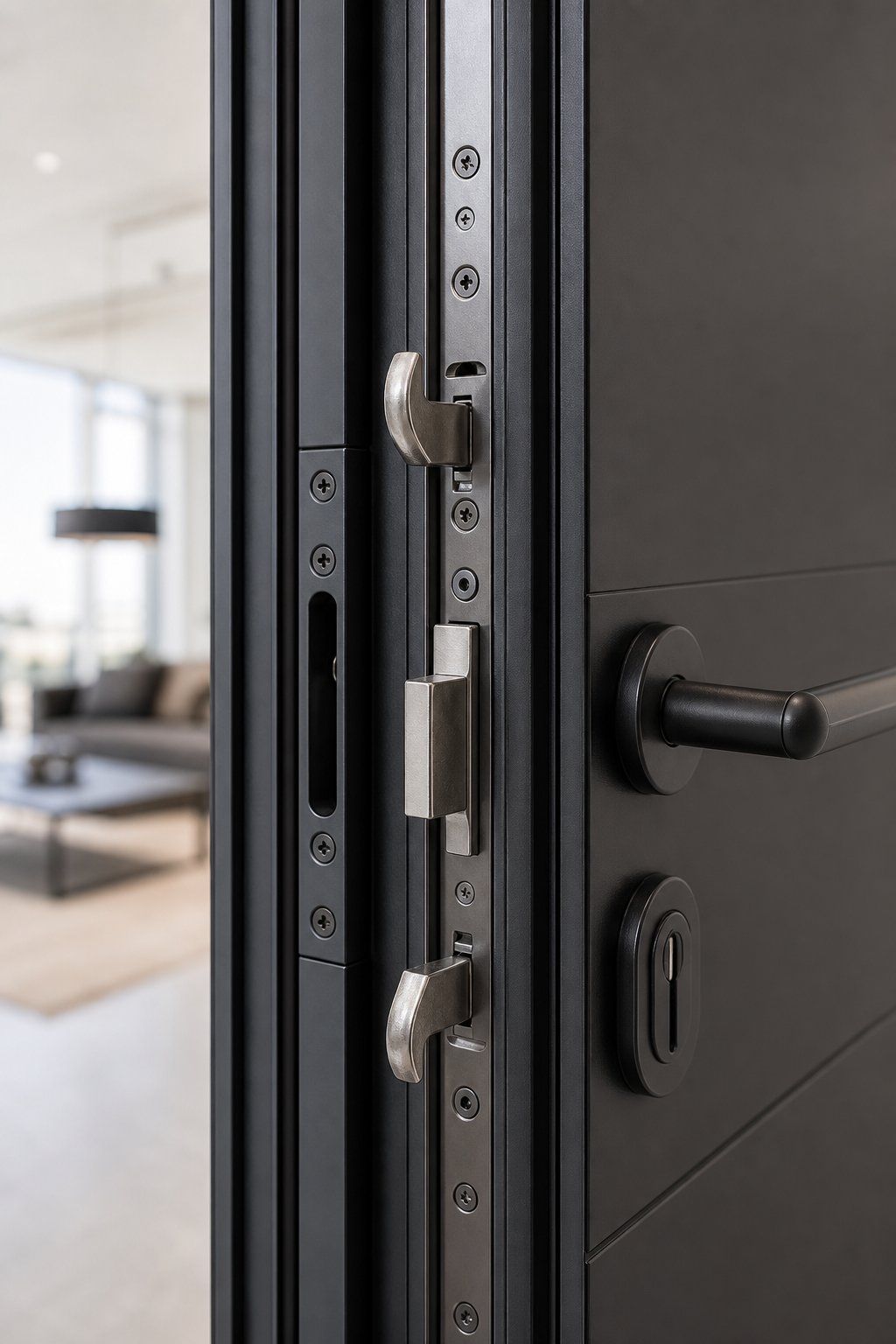
A single deadbolt secures your door at one point. Force applied above or below that bolt can flex the door away from the frame, creating enough of a gap to compromise the seal entirely. An aluminium door multi-point locking system eliminates this vulnerability by engaging the door into the frame at three, five, or even seven positions along its full height.
When you lift the handle and turn the key, a central gearbox drives multiple locking elements simultaneously into corresponding keep plates mounted in the frame. The door gets pulled tight against its weatherseals at every engagement point, distributing load evenly and removing the weak spots that single-lock doors leave exposed.
The mechanical components of a quality multi-point locking system include:
- Central gearbox (lock case): the mechanism housed inside the door edge that converts handle and key movement into vertical motion along the lock strip
- Hook bolts: curved steel hooks that swing out from the door edge and grip behind the keep plate, resisting pulling or levering attacks
- Deadbolts: solid rectangular bolts, typically at the primary locking position, that extend deep into the frame for direct resistance against force
- Roller cams or mushroom cams: compression elements that pull the door tightly into the frame, improving both seal compression and anti-lift resistance
- Keep plates: reinforced steel plates recessed into the frame at each locking point, providing the anchor that bolts and hooks engage with
- Anti-snap, anti-bump cylinder: the euro-profile cylinder that operates the mechanism, ideally rated against common attack methods
For standard residential doors, three to five locking points are considered the baseline for genuine security. Taller doors or those in higher-risk locations benefit from five to seven points. The best locks for aluminium doors combine hook bolts at the top and bottom positions with a central deadbolt, creating a configuration that resists both levering and brute-force impacts.
Alloy Grades and Frame Strength Explained
The aluminium in your door frame is not a single pure metal. It is an alloy, a blend of aluminium with small amounts of magnesium, silicon, and other elements that dramatically change its mechanical behaviour. Two alloy grades dominate the door and window industry: 6063 and 6060.
6063-T6 aluminium delivers tensile strength between 190 and 240 MPa with yield strength of 145 to 185 MPa. Its higher magnesium content (0.45 to 0.9 percent) gives it a structural advantage that makes it the preferred choice for load-bearing and security-critical applications. This is the grade you want in a door frame that needs to resist levering tools without deforming.
6060-T6 sits slightly lower, with tensile strength of 160 to 210 MPa and yield strength of 130 to 165 MPa. It offers better formability for complex profile shapes but trades away some rigidity. For decorative or non-structural elements, 6060 works well. For the primary frame members that determine aluminium door frame strength for security, 6063 is the stronger specification.
Both alloys share the same elastic modulus of approximately 69 GPa, meaning they resist deflection equally under light loads. The difference shows up under sustained or concentrated force, exactly the kind applied during a break-in attempt. A 6063 frame profile resists permanent deformation at higher loads before yielding, giving occupants more time and giving intruders more difficulty.
Critically, both grades offer excellent corrosion resistance when powder coated or anodised, so aluminium door frame strength for security does not degrade over time the way timber can rot or steel can rust in coastal environments.
How Aluminium Resists Common Break-In Methods
Police reports consistently identify three primary techniques used in residential break-ins: lock snapping, frame levering, and glass attack. Each targets a different weak point, and a well-specified aluminium door system addresses all three.
Lock snapping exploits a design flaw in standard euro-profile cylinders. Intruders grip the exposed cylinder with pliers or a wrench, snap it at its weakest point, then manipulate the remaining mechanism to retract the bolts. The counter-measure is straightforward: specify an anti-snap cylinder with a sacrificial break line that, when snapped, leaves the operating cam protected and the lock still engaged. Quality aluminium door systems pair this with a cylinder guard or escutcheon plate that prevents tools from gripping the cylinder in the first place.
Frame levering involves inserting a crowbar or flat tool between the door edge and the frame, then applying force to bend the frame away from the locking points. This is where aluminium’s rigid, hollow extrusion profiles and multi-point engagement work together. A single-point lock concentrates all resistance at one spot, making levering effective. With hooks and bolts engaged at multiple heights, the force required to separate the door from the frame multiplies significantly. The reinforced keep plates anchored into the frame further resist deformation at each locking position.
Glass attack bypasses the frame and lock entirely. An intruder smashes the glazing panel, reaches through, and unlocks the door from inside. The defence here is not the aluminium frame itself but the glass specification: laminated safety glass holds together when struck, preventing reach-through access even after impact. Lockable handles that require a key from both sides add a secondary barrier. How secure aluminium doors are against break-ins depends as much on glass grade and handle specification as on the frame and lock hardware.
Together, these layered defences mean a properly specified aluminium door does not rely on a single component for security. Each element covers the weakness of another, creating a system that is far more resistant to opportunistic and targeted attacks than any single feature alone could achieve.
Security Standards and Certifications Decoded
Multi-point locks and strong alloy frames matter, but how do you verify that a door actually performs under attack rather than just looking secure on paper? That is where security certifications come in. They translate marketing claims into tested, measurable performance, and understanding them is the fastest way to determine what security rating aluminium doors should have for your project.
The challenge is that certification labels get thrown around loosely. Some suppliers reference standards without ever submitting a product for independent testing. Knowing the difference between a genuinely certified door and one that merely claims compliance can save you from a costly mistake.
What PAS 24 Testing Actually Puts Your Door Through
PAS 24 is a publicly available specification published by BSI (British Standards Institution) that defines enhanced security performance for doors and windows. It is widely referenced in Australian specifications for residential projects, particularly where builders or architects want a recognised benchmark beyond the minimum requirements of AS 2047 for windows and doors.
When a door is tested to PAS 24, it faces two distinct phases of attack designed to simulate what an opportunist burglar would attempt in real conditions.
The first phase (Annex A) targets the security hardware and cylinder. Trained testers use three predefined toolboxes containing tools commonly carried by opportunist burglars. They attack the locking cylinder, attempt to manipulate the hardware, and try to disengage the mechanism from the exterior side. Strict time limits govern each attack sequence, with rest periods that allow the tester to change tools and rethink their approach. If entry is gained at any point, the door fails.
The second phase (Annex B) tests the physical structure of the doorset itself. This includes:
- Soft body impact tests: a pendulum mass swung into the door to simulate shoulder-barging or kicking
- Hard body impact tests: concentrated strikes to test panel integrity and resistance to localised force
- Cutting attacks: attempts to saw or cut through the door leaf or frame
- Mechanical load tests: sustained levering pressure applied to frame edges and locking points to test deformation resistance
- Manipulation attacks: attempts to disassemble or disengage ironmongery from outside
- Manual vulnerability check: a final inspection conducted with full knowledge of the door’s construction, probing any remaining weak points
The critical detail here is that PAS 24 tests the complete doorset as a system, not individual components in isolation. The frame, lock, cylinder, hinges, glazing, and seals must all work together to resist entry. A strong lock in a weak frame still fails. This system-level approach is what makes PAS 24 aluminium door testing a meaningful indicator of real-world security rather than a theoretical rating.
Understanding Burglar Resistance Classes EN 1627-1630
Where PAS 24 provides a pass-or-fail benchmark, the European standard EN 1627-1630 offers a graduated scale. It defines six resistance classes (RC1 through RC6), each representing a progressively more severe attack scenario with heavier tools and longer testing durations.
The standard actually comprises four linked tests:
- EN 1627: defines the overall requirements and classification system
- EN 1628: static load testing, where pressure is applied to critical points to measure deformation and structural weakness
- EN 1629: dynamic load testing, where a heavy swinging mass simulates brute-force impacts like kicks or shoulder charges (applied up to RC3)
- EN 1630: manual burglary testing, where trained operatives attempt physical break-in using predefined tool sets within strict time limits
For residential aluminium doors in Australia, RC2 and RC3 represent the most relevant aluminium door burglar resistance ratings. RC2 protects against simple hand tools like screwdrivers and pliers, while RC3 resists crowbars and heavier prying tools. Higher classes (RC4 to RC6) are typically specified for commercial premises, jewellers, banks, and high-security facilities where professional, targeted attacks are a realistic threat.
The philosophy behind EN 1627-1630 is time-based deterrence. Each resistance class guarantees a minimum delay before entry can be achieved. The longer a door holds, the greater the chance an intruder abandons the attempt or is detected. For homeowners weighing up aluminium door security certification in Australia, an RC2 or RC3 rating provides strong evidence that a door will resist the tools and techniques used in the vast majority of residential break-ins.
Self-Declared Compliance vs Third-Party Certification
This distinction trips up many buyers. A manufacturer can state that their door is “designed to meet PAS 24” or “compliant with EN 1627” without ever submitting a sample for independent testing. That is self-declaration, and it carries no independent verification.
Third-party certification means an accredited, independent testing body has physically tested the product, verified its performance, and issued a certificate confirming compliance. Schemes like Certifire and Certisecure in the UK, or NATA-accredited testing in Australia, provide this independent assurance. The manufacturer’s contact details, the scope of what was tested, and the specific configurations covered are all documented.
Why does this matter? Because a door’s security performance depends on the complete assembly. A test certificate confirms that a specific combination of frame profile, lock hardware, cylinder, hinges, and glazing passed together. Change one component, say swapping to a cheaper cylinder or thinner profile, and the certification no longer applies. Self-declared compliance offers no such traceability.
When evaluating suppliers, ask for the certificate number, the testing laboratory, and the exact configuration tested. A reputable supplier will provide this without hesitation.
Your Minimum Safety Specification Checklist
Knowing what to ask for puts you in control of the conversation with any door supplier. Use this checklist as a baseline when requesting quotes or evaluating product specifications for your project:
- Security certification level: request evidence of PAS 24 certification or EN 1627-1630 RC2 minimum, with a third-party test certificate and laboratory name
- Lock type: multi-point locking system with a minimum of three engagement points (hook bolts plus deadbolt), operated by a single handle lift and key turn
- Cylinder rating: anti-snap, anti-bump, anti-pick, anti-drill euro-profile cylinder, minimum one-star rating under TS 007 or equivalent
- Glass grade: laminated safety glass to AS 1288 for any glazed panel accessible from outside, with a minimum 6.38 mm laminated pane for ground-floor applications
- Hinge specification: minimum three heavy-duty hinges for standard height doors, with concealed or security-pinned hinges that prevent removal when the door is closed
- Frame fixing: mechanical fixings into structural substrate at maximum 600 mm centres, not foam-only installation
- Alloy grade: 6063-T6 aluminium for primary frame members
- Weatherseal integrity: continuous perimeter seals that maintain compression when all locking points are engaged
Any supplier unwilling to confirm these specifications in writing is a red flag worth paying attention to. Aluminium door security certification in Australia is not just about the label on a brochure. It is about verified, documented performance that you can hold a supplier accountable to.
Certifications tell you what a door can withstand in a laboratory. But real-world safety extends beyond burglary resistance, and one area almost entirely absent from competitor guides is how aluminium performs when fire is the threat.
Fire Safety Performance of Aluminium Doors
Burglary resistance dominates the conversation around door safety, yet fire kills more Australians in their homes each year than break-ins do. Whether aluminium doors are fire safe is a question almost no competitor guide addresses, and it deserves a thorough answer. The material’s behaviour in fire is fundamentally different from timber, and understanding that difference changes how you evaluate door safety as a whole.
How Aluminium Behaves During a Fire
Aluminium melts at approximately 660°C. That sounds alarming until you compare it to timber, which reaches ignition temperature between 220°C and 260°C and actively fuels a fire once alight. The critical distinction is this: aluminium does not burn. It may soften and eventually melt under extreme, sustained heat, but it does not ignite, does not produce flames, and does not add fuel load to a building fire.
Testing by the Aluminum Association under ASTM E136 confirmed that aluminium alloys commonly used in construction, including 6063 (the standard grade for door and window frames), passed non-combustibility testing with no flaming and negligible weight loss when heated to 750°C for 30 minutes.
This matters in practical terms. A timber door in a house fire becomes part of the problem, feeding flames and accelerating spread. An aluminium door does not contribute combustible material to the event. When comparing aluminium vs timber fire resistance doors, the difference is not subtle. Timber burns. Aluminium does not.
It is worth noting that aluminium’s non-combustibility applies to the solid profiles used in door frames. Composite products that bond aluminium with polymeric cores or flammable insulation must be assessed as a complete assembly, not on the aluminium component alone. This distinction was reinforced after investigations into cladding fires in Australia and the UK confirmed that the aluminium sheets themselves did not burn; only the bonded polymer materials did.
When Fire-Rated Aluminium Doors Are Required
Not every aluminium door needs a formal fire rating. Standard residential entry doors and patio sliders in detached houses typically fall outside fire-rated aluminium door requirements. But specific locations within a building trigger mandatory fire resistance levels (FRLs) under the National Construction Code (NCC).
Common scenarios where an aluminium door fire rating is required in Australia include:
- Apartment corridor doors: separating individual units from common escape routes, typically requiring an FRL of -/60/30 or -/30/30 depending on building class
- Garage-to-house entries: the door between an attached garage and habitable rooms must resist fire and smoke spread, usually requiring a minimum -/60/30 rating
- Commercial stairwell and corridor doors: forming part of fire compartmentation in Class 5 to 9 buildings
- Doors in buildings with multiple classifications: where different fire compartments adjoin
Fire-rated aluminium door systems achieve their ratings through intumescent seals that expand in heat to block smoke passage, fire-resistant glazing (typically borosilicate or gel-interlayer glass), and frame designs tested as complete assemblies to Australian Standards. The door, frame, hardware, seals, and glazing must all be covered by the same fire test certificate. Swapping any component can void the rating entirely.
Thermal Conductivity Concerns in Fire Scenarios
The most common fear about aluminium in fire is heat transfer. Aluminium conducts heat roughly 1,000 times faster than timber, so the concern that an aluminium door could transmit dangerous temperatures to the unexposed side is not unreasonable on the surface.
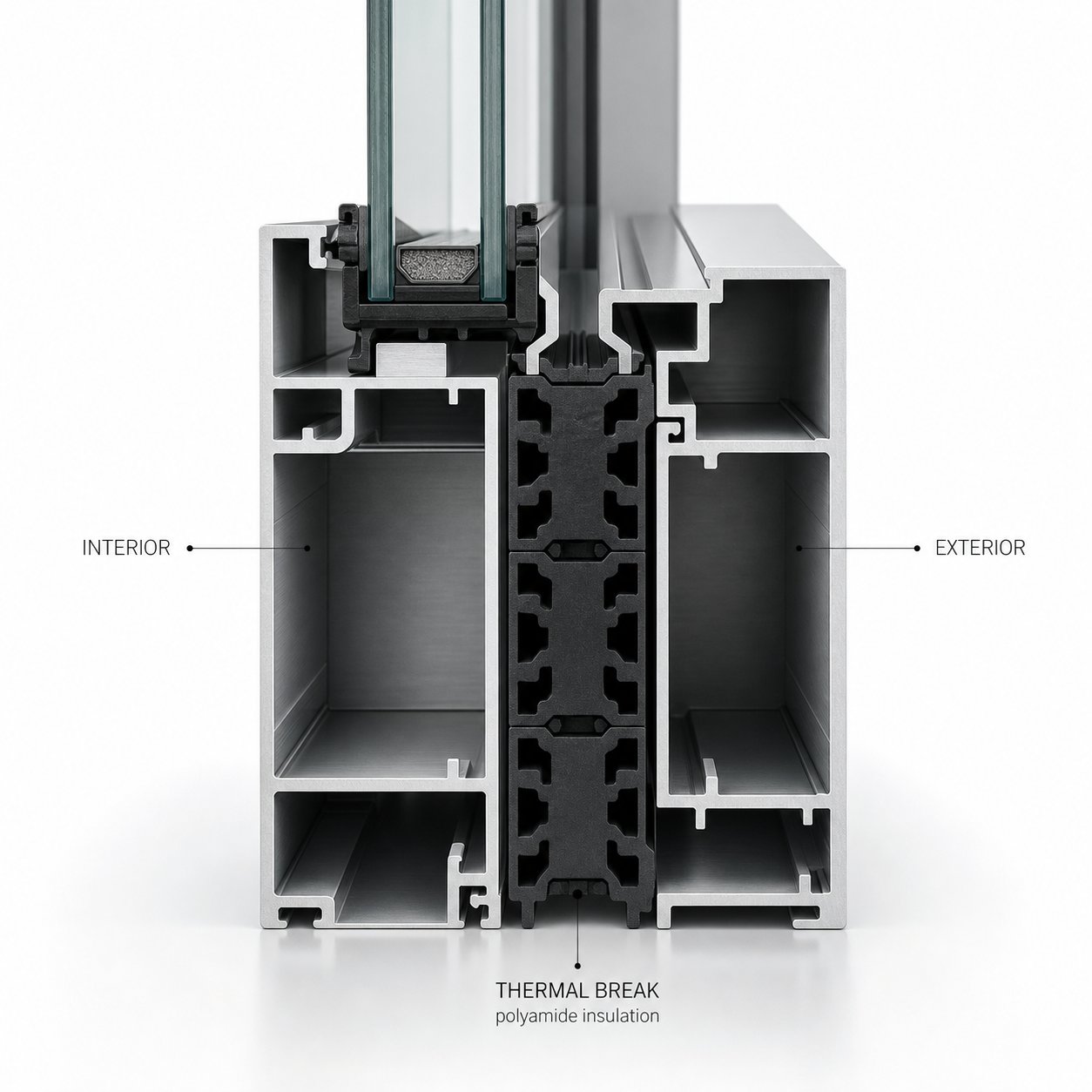
In practice, modern door systems manage this through thermal break technology. A thermal break is a strip of low-conductivity polyamide or fibreglass-reinforced material inserted between the interior and exterior aluminium profiles, creating a physical barrier to heat flow. Research published in Fire Safety Journal found that aluminium frames with thermal protection delayed critical temperature rise significantly compared to unprotected profiles, with protected frames avoiding thermal degradation within the first 40 minutes of standard fire exposure.
However, thermal breaks introduce a complexity. The polyamide material degrades at lower temperatures than aluminium itself (typically between 300°C and 400°C), which can affect structural integrity before the aluminium frame reaches its own failure point. For fire-rated applications, door systems are engineered with intumescent compounds and steel reinforcement that compensate for thermal break degradation, maintaining the assembly’s integrity for the rated duration.
For standard residential aluminium doors not in fire-rated locations, the thermal break serves its primary purpose of energy efficiency. In a fire scenario, the door’s role shifts from containment to non-contribution. It will not ignite, will not spread flame, and will not generate toxic combustion gases the way timber or uPVC doors can. That passive safety benefit applies to every aluminium door regardless of its formal fire rating.
Fire performance is one dimension of safety that rarely makes it into buying guides. Another gap, equally overlooked, is how aluminium doors perform for the smallest and most vulnerable occupants of a home.
Child Safety and Family-Friendly Aluminium Door Features
A door that resists burglars and withstands fire still poses risks if it can trap a toddler’s fingers or shatter into dangerous shards at child height. Aluminium door child safety features rarely appear in buying guides, yet for families with young children, these details matter as much as any security certification. The good news is that modern aluminium door systems offer a range of protective features, some built into the profile design itself and others available as hardware additions.
Here is what to look for when specifying aluminium doors for a family home:
- Finger-safe gaskets and anti-trap profiles on the hinge side of hinged doors
- Soft-close or slow-close damping mechanisms that prevent slamming
- Restricted opening devices that limit swing or slide travel
- Safety glass compliant with AS 1288 in all panels accessible to children
- High-mounted locks and handles positioned beyond a child’s reach
- Child-proof aluminium sliding door locks with secondary latches or key-operated restrictors
Finger-Safe Gaskets and Anti-Trap Design
The hinge edge of any swinging door creates a closing gap that can crush small fingers with surprising force. Standard aluminium hinged doors leave this gap exposed, and children are drawn to exactly this spot, gripping the frame edge while watching a door swing shut.
Finger-safe aluminium door gaskets address this by covering the hinge-side gap with a flexible, continuous shield that prevents fingers from entering the pinch zone. These gaskets are typically made from durable rubber or flexible PVC and run the full height of the door on the hinge edge. Some aluminium profile systems integrate the anti-trap geometry directly into the frame extrusion, eliminating the gap entirely rather than covering it after the fact.
For homes with toddlers, finger guards fitted along the hinge edge are particularly important in high-traffic areas like kitchens, living rooms, and playrooms where doors open and close frequently and children are most likely to be nearby. Full-length guards offer maximum protection, while shorter models provide a more discreet option for less busy doorways.
Soft-close hinges complement gasket protection by controlling the speed at which a door shuts. Built-in hydraulic dampers guide the door gently to its closed position, eliminating the sudden slam that causes most finger-trapping injuries. These are especially valuable in nurseries and bedrooms, where a door blown shut by a breeze can catch a child off guard. Unlike foam pinch guards that wear out and fall off, integrated soft-close mechanisms are a permanent solution built into the hinge hardware itself.
Glass Safety Standards for Family Homes
Glass is often the weakest point in any door system, and for families, the risk is not just break-in but breakage at child level. A toddler running into a glass panel, throwing a toy, or falling against a door can shatter ordinary annealed glass into lethal shards. This is why safety glass requirements for aluminium doors are governed by strict Australian Standards.
AS 1288 (Glass in Buildings) specifies that all glazing in doors and sidelights, as well as any glass panel with a finished floor level within 300 mm of the base, must use safety glazing materials compliant with AS/NZS 2208. Two types qualify:
Toughened (tempered) glass is heated to approximately 600°C and rapidly cooled, creating a rigid outer layer that makes it four to five times stronger than standard annealed glass. When it does break, it shatters into small, blunt, cube-like granules rather than jagged shards. The minimum thickness for framed toughened glass is 4 mm, increasing to 6 mm for partly framed or frameless applications. Toughened glass handles impact well but offers no post-breakage barrier. Once shattered, the opening is completely exposed.
Laminated glass bonds two or more glass layers with a tough polyvinyl butyral (PVB) or ionoplast interlayer. When struck, the glass may crack but the fragments adhere to the interlayer, holding the panel together and maintaining a physical barrier. For family homes, laminated glass provides a dual benefit: it resists penetration during a break-in attempt and prevents a child from falling through a broken panel. A standard 6.38 mm laminated pane (two layers of 3 mm glass with a 0.38 mm interlayer) meets Grade A safety glazing requirements under AS 1288.
For ground-floor aluminium doors in homes with young children, laminated glass is the stronger specification. It satisfies both security and child safety concerns simultaneously, maintaining its barrier function even after impact damage.
Restricted Opening and Soft-Close Systems
Sliding and bi-fold aluminium doors present a different child safety challenge. Their large panels and smooth operation make them easy for small children to open unsupervised, creating fall risks on elevated decks or access to unsecured pool areas.
Restricted opening mechanisms limit how far a sliding or hinged door can travel. For sliding doors, child-proof aluminium sliding door locks typically include a secondary latch or key-operated restrictor that holds the panel at a fixed opening width, usually 100 mm or less, allowing ventilation while preventing a child from passing through. Foot-operated or high-mounted releases ensure adults can override the restriction quickly.
For hinged aluminium doors, chain restrictors or arm-style limiters cap the swing angle. Positioned at adult height (above 1,500 mm from finished floor level), these devices keep the door’s opening within a safe range while remaining inaccessible to young children. The height placement of primary locks and handles matters too. Handles mounted at standard 1,000 mm height are within reach of most four-year-olds. Specifying key-locking handles or adding a secondary high-level deadbolt at 1,500 mm or above prevents unsupervised access to balconies, pools, and driveways.
These features do not compromise the door’s security or weather performance. They layer family-specific protection on top of the structural and hardware safety already built into the system. And while child safety addresses the human vulnerability inside a home, the next critical question is how aluminium doors hold up against the forces that threaten from outside: extreme weather and storm events.

Weather Resistance and Structural Safety in Extreme Conditions
A door that keeps intruders out but buckles under cyclonic wind gusts is not a safe door. In Australia, where coastal homes face salt-laden gales and tropical regions endure Category 5 cyclones, weather performance is not a comfort feature. It is a safety requirement. A failed door during a storm becomes an uncontrolled opening that allows destructive wind pressure inside the building envelope, turning furniture into projectiles and potentially collapsing internal walls or lifting the roof structure.
So are aluminium doors safe in high winds? The answer depends on the system’s tested wind load rating, its impact resistance classification, and how well the configuration suits the exposure conditions of your site.
Wind Load Ratings and Storm Performance
Every external door installed in Australia must meet the structural performance requirements of AS 2047, which specifies wind load resistance based on the building’s geographic location, terrain category, height above ground, and shielding from surrounding structures. Wind pressure ratings are expressed in Pascals (Pa) or kilopascals (kPa), and they define the maximum positive and negative pressure a door system can withstand without permanent deformation or failure.
Aluminium’s inherent rigidity gives it a structural advantage here. A 6063-T6 aluminium frame profile maintains its shape under sustained wind pressure because the material does not creep or flex progressively the way plastics do. uPVC frames, by contrast, rely on internal steel reinforcement to achieve comparable wind ratings, and that reinforcement adds weight without matching the dimensional stability of a solid aluminium extrusion. Under cyclic pressure, where gusts repeatedly load and unload the frame over hours, uPVC can develop micro-deflections at the corners where the plastic meets its steel core. Aluminium profiles, being a single homogeneous material, distribute load evenly across the entire section.
For cyclone-rated aluminium doors in northern Queensland, the Northern Territory, and parts of Western Australia, wind load ratings of 3.0 kPa to 4.5 kPa (and higher for upper storeys) are common requirements. Standard residential doors in non-cyclonic regions typically need ratings between 1.5 kPa and 2.5 kPa. The performance label on a compliant door will show these values, and they should match or exceed the site-specific requirements calculated by your engineer or specified in the NCC for your wind region.
Impact Resistance for Coastal and Cyclone Zones
Wind speed alone does not tell the full story. During severe storms, airborne debris becomes the real threat. A sheet of corrugated roofing, a broken tree branch, or even gravel propelled at high velocity can puncture a door system that handles static wind pressure perfectly well.
Impact resistance testing simulates these conditions. Large missile tests launch a heavy timber projectile (equivalent to a piece of framing timber) at the door assembly at speeds representing cyclonic debris. Small missile tests replicate the effect of gravel and smaller objects striking at high velocity. A door that passes both maintains its structural integrity and prevents breach of the building envelope, which is the critical safety threshold during a cyclone.
Aluminium door storm resistance for coastal homes also accounts for corrosion. Salt air degrades unprotected metals rapidly, and a corroded frame loses structural capacity over time. Powder-coated aluminium profiles resist marine corrosion far better than bare steel reinforcement inside uPVC frames, which can rust from within if moisture penetrates the plastic shell. For homes within 1 km of the coastline, this long-term corrosion resistance is not cosmetic. It is a factor in whether the door maintains its rated wind and impact performance five, ten, or twenty years after installation.
A door’s structural integrity under extreme conditions is only as reliable as its weakest component. Frame strength, glazing specification, hardware engagement, and installation fixings must all be rated for the same wind and impact loads. A single under-specified element can cause the entire assembly to fail when it matters most.
Why Weatherproofing Is a Safety Concern
Water ingress during storms creates immediate electrical hazards, slip risks, and long-term structural damage to surrounding wall framing. AS 2047 tests water penetration resistance by applying a controlled water spray while simultaneously pressurising the door’s exterior face, simulating wind-driven rain. The door must prevent water from reaching the interior face at the rated pressure level.
Aluminium sliding doors and bi-fold configurations handle wind loads differently from standard hinged doors, and this affects both their wind rating and their water resistance. A hinged door transfers wind load directly through its hinges and lock engagement points into the surrounding frame and structure. The load path is short and direct. Sliding doors distribute load across their track system and interlock points, which means the track engineering and roller hardware become critical structural elements rather than just operational components. Bi-fold doors, with their multiple folding panels and intermediate hinges, present the most complex load path. Each panel junction is a potential flex point, and the system’s wind rating depends on the stacking configuration, panel width, and the strength of the top track from which the panels hang.
For this reason, aluminium door wind load ratings in Australia vary significantly between door types even within the same product range. A hinged door from a given manufacturer might achieve a 3.5 kPa rating while the bi-fold variant in the same profile system rates at 2.5 kPa. Specifying the correct configuration for your site’s wind region is not optional. It is the difference between a door that protects your family during a storm and one that becomes the point of failure.
Weather performance establishes whether a door holds up against nature. But how does aluminium compare to other materials across all safety dimensions, from fire to forced entry to long-term durability? That broader comparison reveals where each material genuinely excels and where it falls short.
Aluminium vs Other Door Materials for Safety and Security
Knowing how aluminium performs in isolation is useful. Knowing how it stacks up against every other material on the market is what actually drives a confident decision. Each door material brings trade-offs, and the safest door material for Australian homes depends on which combination of security, fire resistance, weather durability, and longevity matters most for your specific project.
This comparison strips away the marketing language and looks at measurable attributes: how rigid is the frame under attack, what locks can it accept, how does it behave in fire, and how long does it maintain its safety performance before degradation sets in?
Aluminium vs uPVC vs Timber vs Steel Security Comparison
The five materials commonly used for external doors in Australian residential construction are aluminium, uPVC, timber, composite, and steel. Each has a distinct structural profile that determines its security ceiling.
Aluminium delivers high frame rigidity from its extruded hollow profiles without relying on internal reinforcement. The 6063-T6 alloy used in quality door frames resists levering and deformation at loads that would permanently bend uPVC. It accepts multi-point locking systems natively, with the frame’s dimensional stability ensuring lock engagement remains precise over decades. Aluminium is 67% lighter than steel yet maintains impressive security levels thanks to its strength-to-weight ratio. It does not warp, rot, swell, or shrink with temperature and humidity changes, so locking points never drift out of alignment.
uPVC is the most affordable option but ranks as the weakest common door material for forced-entry resistance without additional reinforcement. The plastic profiles rely on galvanised steel inserts to achieve structural rigidity, and over time, thermal cycling can cause micro-deflections at corner welds. Lock compatibility is good when steel-reinforced, but the frame material itself offers less resistance to crowbar attacks than aluminium or steel. uPVC can warp in sustained Australian heat, particularly on north-facing elevations, which compromises both seal integrity and lock alignment.
Timber offers excellent natural strength in solid hardwood species like jarrah, spotted gum, or meranti. A well-constructed timber door resists impact and forced entry effectively, and the material accepts virtually any lock type including traditional mortice deadlocks favoured by Australian insurers. The weakness is longevity. Timber requires ongoing maintenance to prevent moisture ingress, rot, and swelling that gradually degrades both structural integrity and lock function. In coastal or tropical climates, maintenance cycles shorten considerably. Comparing aluminium vs timber door durability and safety over a 20-year window reveals a widening gap as timber ages and aluminium remains dimensionally stable.
Composite doors combine a timber or foam core with a glass-reinforced plastic (GRP) skin and often include steel reinforcement. This layered construction delivers strong impact resistance, reportedly up to ten times greater than basic uPVC. Composite doors are popular in the UK market and gaining traction in Australia for front entry applications. Their multi-material construction provides good insulation and security, though long-term performance data in harsh Australian UV conditions is still limited compared to aluminium’s proven track record.
Steel is the hardest material to breach by force. A solid steel door with a steel frame offers the highest raw resistance to cutting, levering, and impact. However, steel doors are heavy, prone to corrosion without meticulous coating maintenance, conduct heat and cold aggressively, and offer limited design flexibility for residential applications. They dominate commercial and industrial security but are rarely specified for standard Australian homes due to thermal performance issues and aesthetic limitations.
| Attribute | Aluminium | uPVC | Timber | Composite | Steel |
|---|---|---|---|---|---|
| Frame Rigidity | High (self-supporting hollow extrusions) | Low-Medium (requires steel reinforcement) | Medium-High (species dependent) | High (steel-reinforced core) | Very High (solid or hollow steel sections) |
| Forced-Entry Resistance | High (resists levering and deformation) | Low without reinforcement; Medium with upgrades | Medium-High (solid hardwood) | High (multi-layer construction) | Very High (hardest to breach) |
| Fire Rating | Non-combustible; fire-rated systems available | Self-extinguishing but produces toxic fumes | Combustible; burns and adds fuel load | Varies; GRP skin resists ignition but core may burn | Non-combustible; excellent fire performance |
| Weather Durability | Excellent (corrosion-resistant, no warping) | Good short-term; degrades under UV and heat | Poor-Medium (requires regular maintenance) | Good (GRP skin resists moisture) | Poor without coating (rusts in coastal/humid areas) |
| Maintenance Required | Minimal (occasional cleaning and lock lubrication) | Low initially; hardware replacement needed over time | High (painting, sealing, hardware checks) | Low-Medium (periodic cleaning) | Medium-High (rust prevention, recoating) |
| Expected Lifespan | 40-60+ years | 15-25 years | 20-60 years (maintenance dependent) | 30-40 years | 50+ years (if maintained) |
| Insurance Acceptance | Widely accepted with multi-point locks | Accepted with anti-snap cylinders | Accepted with BS 3621 equivalent mortice locks | Widely accepted (often preferred) | Excellent acceptance for high-security |
The table makes one thing clear: no single material wins every category. Steel leads on raw forced-entry resistance but fails on weather durability and thermal performance. Timber offers natural beauty and strength but demands ongoing investment to maintain its safety credentials. Aluminium occupies a distinctive position, delivering high security, non-combustible fire performance, exceptional weather durability, and minimal maintenance across a lifespan that outlasts most other options. For Australian conditions specifically, where UV exposure, coastal salt air, and temperature extremes accelerate material degradation, aluminium’s stability over decades gives it a practical safety advantage that compounds over time.
For homeowners and builders comparing materials for Australian residential and commercial projects, suppliers like MEICHEN offer both thermal break and non-thermal break aluminium door systems across sliding, hinged, and bi-fold configurations. This range allows you to match the door type and thermal performance to your climate zone and project requirements without compromising on the security and durability advantages aluminium provides.
How Door Material Affects Home Insurance
Your choice of door material has a direct relationship with your home insurance policy, and not just in the obvious way. Insurers assess risk based on how likely a successful break-in is, and door specification is one factor in that calculation.
Most Australian home insurers require external doors to meet minimum security hardware standards to validate coverage. The typical baseline includes:
- A deadlock or multi-point locking system on all external doors
- Key-operated locks (not just snib or latch locks) on doors accessible from ground level
- Security-rated cylinders that resist common attack methods
- Locks that comply with relevant Australian Standards or equivalent international certifications
Aluminium door home insurance requirements are generally straightforward to meet because the material natively supports multi-point locking systems and maintains lock alignment over its full lifespan. Insurers rarely penalise aluminium as a material choice. The concern is always about the hardware fitted to the door rather than the frame material itself.
Where material choice can affect premiums is in the broader risk profile. A home with doors and windows that hold recognised security certifications (PAS 24, or equivalent tested to AS 2047 with enhanced security provisions) may qualify for reduced premiums with some insurers. The logic is simple: certified doors reduce the probability of a successful claim. Some insurers offer discounts of 5 to 15 percent on contents insurance for homes with independently certified security hardware throughout.
Timber doors can create complications if maintenance has lapsed. A swollen or warped timber door that no longer engages its lock properly is technically unsecured, and an insurer could dispute a claim if the door’s condition contributed to the break-in. Aluminium and composite doors avoid this scenario because their dimensional stability means lock engagement does not deteriorate with age or weather exposure.
uPVC doors require specific attention to cylinder specification. Standard euro-profile cylinders fitted to many budget uPVC doors are vulnerable to snapping, a technique so common that some insurers now explicitly require anti-snap cylinders as a policy condition. Failing to upgrade leaves a potential gap in coverage that many homeowners do not discover until they make a claim.
Which Material Offers the Best Long-Term Safety Value
Safety value is not just about the purchase price. It is the total cost of maintaining a door’s protective performance over its installed life. A cheaper door that needs hardware replacement at year ten, repainting at year five, and full replacement at year twenty represents a higher lifetime safety cost than a more expensive door that maintains its ratings for forty years with minimal intervention.
On this basis, the aluminium vs uPVC door security comparison tilts decisively toward aluminium for long-term value. uPVC’s lower upfront cost is offset by a shorter lifespan (15 to 25 years versus 40 to 60+ for aluminium), progressive degradation under UV exposure, and the need for hardware upgrades to maintain adequate security as the frame ages.
Timber offers excellent security when new and well-maintained, but the ongoing cost of preservation, particularly in coastal, tropical, or high-UV environments, adds up. A jarrah front door that is not resealed on schedule can develop moisture damage that compromises both the timber’s structural integrity and the lock mortice housing. The safety value equation for timber is heavily maintenance-dependent.
Composite doors deliver strong security at a mid-range price point and require less maintenance than timber. Their relatively recent introduction to the Australian market means long-term performance data under local conditions (extreme UV, sustained heat, coastal exposure) is still accumulating. Early indications are positive, but aluminium’s multi-decade track record in Australian construction provides a level of proven reliability that newer materials have not yet matched.
Steel wins on absolute forced-entry resistance but loses on practicality for most residential applications. The weight, thermal conductivity, corrosion risk, and limited aesthetic options make it a specialist choice rather than a mainstream residential solution.
For the majority of Australian homes, aluminium represents the strongest intersection of security performance, fire safety, weather resistance, longevity, and low maintenance cost. It is not the cheapest option at purchase, and it is not the single hardest material to physically breach. But across every safety dimension measured over a realistic ownership period, it consistently delivers the most balanced and reliable protection. MEICHEN’s range of aluminium door systems, spanning thermal break options for energy-sensitive projects through to ultra-slim profiles for maximum glass area, demonstrates how the material adapts to diverse project requirements without sacrificing the core safety advantages that make it a sound long-term investment.
Material comparisons reveal where aluminium sits in the broader landscape. But even the best material fails if the door itself is poorly made or badly installed. The next section covers the warning signs that indicate an aluminium door is not delivering the safety it should.
Warning Signs That an Aluminium Door Is Not Safe
A high-grade aluminium alloy, a reputable brand name, and a multi-point lock mean nothing if the door was installed poorly, fitted with substandard hardware, or has simply aged past its effective safety life. The material itself does not fail. The system around it does. Knowing how to check if an aluminium door is safe requires looking beyond the surface and inspecting the details that most homeowners never think to question.
These red flags apply whether you are assessing an existing door in a home you have just purchased, evaluating a supplier’s quote for a new build, or deciding whether your ageing aluminium doors still offer adequate protection.
Installation Failures That Compromise Security
Poor installation is the single most common reason an aluminium door underperforms on security. The frame might be excellent. The lock might be certified. But if the door was not fitted correctly into the structural opening, none of that engineering matters when force is applied.
Aluminium door installation safety problems typically fall into a few predictable categories. Gaps between the frame and the surrounding wall structure allow a crowbar to gain purchase. Misaligned locking points mean bolts do not fully engage their keep plates, reducing the effective holding force by half or more. Inadequate fixings, such as relying on expanding foam alone rather than mechanical anchors into solid substrate, mean the entire frame can be levered out of the opening without ever defeating the lock.
Here are the signs of an aluminium door that is not secure due to installation failures:
- Visible daylight gaps between the frame and the wall or between the door leaf and the frame when closed, particularly around locking points
- Door leaf movement when you push or pull the closed door at the top or bottom corners, indicating the frame is not rigidly fixed
- Locking points that do not fully engage: lift the handle and check whether hook bolts and deadbolts extend completely into their keep plates without resistance or misalignment
- Frame fixings at wide spacing (greater than 600 mm apart) or fixings into plasterboard or timber packers rather than structural masonry or steel
- Foam-only installation with no visible mechanical fixings through the frame into the surrounding structure
- Uneven gaps around the door perimeter, suggesting the frame was not plumbed and squared during installation
- Weatherseals that do not compress evenly when the door is locked, indicating the frame is twisted or the door leaf is not sitting true
A properly installed aluminium door should feel solid and immovable when locked. There should be no rattle, no flex, and no visible gaps. The frame should be mechanically fixed at maximum 600 mm centres into structural substrate, with packers and seals ensuring even contact. If your door fails any of these checks, the installation, not the door itself, is the weak link.
Cheap Hardware Red Flags to Watch For
Budget doors cut costs in places you cannot see from the showroom floor. The profile might look identical to a premium product, but the wall thickness of the aluminium extrusion, the lock mechanism inside the door edge, and the cylinder sitting in the handle plate tell a very different story under attack.
Watch for these indicators of compromised hardware quality:
- Single-point lock instead of multi-point: if your door secures with only one latch or deadbolt at handle height, it offers minimal resistance to levering at the top and bottom edges
- Standard euro cylinder protruding more than 3 mm beyond the handle plate, making it vulnerable to lock snapping with basic pliers or a wrench
- No anti-snap, anti-bump, or anti-drill markings on the cylinder, indicating a basic, unrated barrel that can be defeated in under 30 seconds
- Thin-gauge aluminium profiles: press the frame firmly with your thumb. Quality residential profiles use minimum 1.6 mm wall thickness for structural members. Budget products drop to 1.2 mm or less, which deforms more easily under crowbar pressure
- Lightweight, hollow-sounding door leaf that flexes when pushed firmly in the centre, suggesting minimal internal reinforcement
- No certification documentation: the supplier cannot provide a test certificate number, testing laboratory name, or specific configuration details for the security rating claimed
- Generic or unbranded lock hardware with no manufacturer markings, model numbers, or traceability
- Hinges with exposed, removable pins on the exterior side, allowing the door to be lifted off its hinges without defeating the lock at all
The cylinder deserves particular attention. As noted in security industry guidance, lock snapping exploits a fundamental flaw in standard euro cylinders. Burglars grip the exposed portion, apply torque to snap the cylinder at its weakest point, then manipulate the remaining mechanism to retract all locking bolts, including multi-point systems. An anti-snap cylinder with a sacrificial break line prevents this by leaving the operating cam protected even after the outer section is broken away. If your aluminium door has a standard, unrated cylinder, upgrading it is the single most impactful security improvement you can make, often for less than $150.
When Old Aluminium Doors Need Replacing
Aluminium doors installed in the 1980s and 1990s were built to different standards than what is available today. They typically featured single-point locks, basic cylinders, single-glazed panels, and thinner profile sections. Many are still structurally sound because aluminium does not rot, warp, or corrode significantly under normal conditions. But structurally sound is not the same as safe by current standards.
The question of when to replace old aluminium doors versus retrofitting hardware depends on several factors:
- Profile wall thickness: if the existing frame uses profiles thinner than 1.4 mm, upgrading hardware will not compensate for the frame’s reduced resistance to levering
- Lock compatibility: older aluminium doors often use proprietary lock cases that cannot accept modern multi-point mechanisms without significant modification to the door leaf
- Glass specification: single-glazed panels with ordinary annealed glass represent both a security and a safety hazard. Reglazing with laminated safety glass is possible if the rebate depth accommodates the thicker pane, but not all older profiles allow this
- Seal condition: perished or missing weatherseals cannot be replaced on all older profile systems, and without effective seals, even new locks cannot pull the door tight enough for full engagement
- Hinge wear: sagging doors with worn hinge pins create misalignment that prevents locking points from engaging their keeps, and replacement hinges for discontinued profiles may not be available
As a general rule, if the door accepts a modern multi-point lock retrofit, has adequate profile thickness, and can be reglazed with safety glass, upgrading the hardware is cost-effective and delivers a meaningful security improvement. If two or more of those conditions cannot be met, replacement with a current-specification door system is the safer and more economical long-term path.
Doors manufactured before Australian Standards tightened security and safety glazing requirements carry inherent limitations that no amount of hardware upgrading fully resolves. The profiles were not designed to resist the forces that modern certification testing applies, and the glass was not specified to prevent reach-through access after breakage. Recognising these limitations honestly is the first step toward making your home genuinely secure rather than just feeling secure.
Identifying red flags tells you where a door stands today. The next consideration is whether a door that passes inspection now will still perform safely in five, ten, or twenty years, and what maintenance keeps it there.
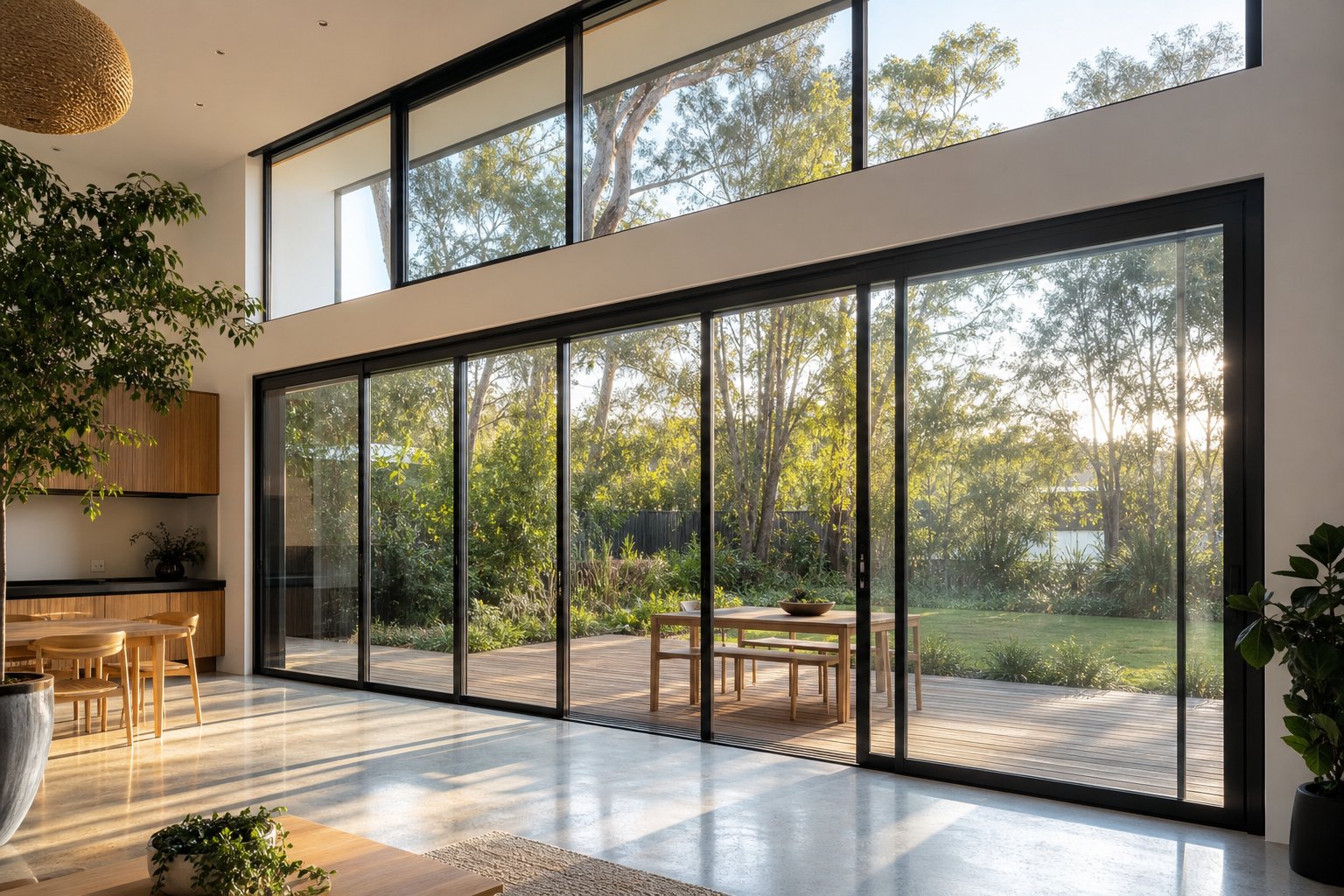
Long-Term Safety and Maintaining Your Aluminium Doors
A door that scores well on every safety metric at installation only stays safe if its performance holds over time. Timber swells, splits, and rots. uPVC yellows, becomes brittle, and warps under sustained UV. Steel rusts from the inside out in humid coastal air. Aluminium does none of these things, and that stability is precisely why aluminium door long-term durability and safety outperforms competing materials across realistic ownership periods of 20, 30, even 40 years.
But “low maintenance” does not mean “no maintenance.” Locking mechanisms, seals, and hinges are mechanical components subject to wear regardless of the frame material housing them. The difference is that aluminium gives those components a dimensionally stable, corrosion-free home that does not accelerate their degradation.
How Safety Features Hold Up Over Decades
Do aluminium doors stay secure over time? The frame itself does. Aluminium’s natural oxide layer, reinforced by powder coating or anodising, prevents the surface corrosion that weakens other materials. A quality powder-coated finish lasts 15 to 20 years before showing any cosmetic wear, and the structural alloy beneath remains unaffected far longer. Unlike timber, where moisture ingress gradually softens the wood around lock mortices and hinge screws, aluminium profiles maintain their original wall thickness and rigidity decade after decade.
The mechanical hardware is where age shows first. Multi-point lock gearboxes contain moving steel components that can stiffen without lubrication. Roller cams lose their spring tension after tens of thousands of cycles. Cylinders accumulate internal wear that makes key operation rougher. None of these issues are unique to aluminium doors, but they do require periodic attention to preserve the door’s tested security rating.
Gaskets and weatherseals degrade faster than the frame or hardware. Rubber and EPDM seals lose elasticity over 8 to 12 years, reducing the compression that pulls the door tight against its locking points. When seals flatten or crack, even a fully engaged multi-point lock cannot draw the door leaf firmly enough into the frame to eliminate movement. That movement, even a millimetre or two, reduces the effective holding force of hook bolts and cams.
The practical takeaway: the aluminium frame will outlast every other component in the system. Maintaining safety over decades means servicing the hardware and seals, not worrying about the structural material itself.
Maintenance That Preserves Your Door’s Security Rating
A consistent aluminium door maintenance schedule keeps mechanical components functioning at their rated capacity. The tasks are simple, infrequent, and require no specialist tools. Here is a practical checklist based on industry maintenance guidance adapted for Australian conditions:
- Every 3 months: Wipe tracks and threshold channels clear of dirt, leaves, and grit that can obstruct roller travel or prevent full door closure on sliding systems
- Every 6 months: Lubricate all locking points, hinges, and the central gearbox with a silicone-based spray or light machine oil. Avoid petroleum-based lubricants on rubber seals
- Every 6 months: Operate the multi-point lock slowly and visually confirm that every hook bolt, deadbolt, and cam extends fully into its keep plate without resistance or misalignment
- Every 12 months: Inspect weatherseals and gaskets around the full door perimeter. Press them with a fingertip to check for elasticity. Replace any sections that are cracked, flattened, or permanently compressed
- Every 12 months: Check hinge screws for tightness and inspect hinge pins for wear. A sagging door indicates hinge degradation that will progressively misalign locking points
- Every 12 months: Clean the door frame and leaf with mild detergent and water to remove salt deposits, pollution residue, or organic matter that can trap moisture against the powder coating
- Every 2 to 3 years: Have a locksmith or door specialist inspect the cylinder for internal wear, test key operation smoothness, and confirm anti-snap features remain intact
- Every 5 years: Assess the powder coating for chips, scratches, or chalking. Touch up any exposed aluminium to maintain the protective barrier, particularly on coastal properties where salt exposure is constant
This schedule takes less than 30 minutes per session for most tasks. Compare that to timber doors, which demand sanding, priming, and repainting every two to three years in exposed Australian conditions, or steel doors that need rust treatment and recoating on a similar cycle. How to maintain aluminium door security is genuinely straightforward, and the time investment is minimal relative to the protection it preserves.
Choosing an Aluminium Door System Built for Long-Term Safety
Everything covered in this guide, from forced-entry resistance and fire performance to child safety, cyclone ratings, and material comparisons, points to a consistent conclusion. Aluminium doors are safe when they are properly specified, correctly installed, and maintained with basic periodic care. The material does not degrade, does not burn, does not warp, and does not lose its structural capacity over time. It provides a stable platform for high-security hardware that remains aligned and functional for decades.
The red flags discussed earlier, thin profiles, single-point locks, poor installation, missing certifications, are not failures of aluminium as a material. They are failures of specification and workmanship. A well-engineered aluminium door system, built from adequate profile thickness with certified multi-point hardware and safety glazing, delivers a level of holistic safety that few other materials can match across the same timeframe.
For homeowners, builders, and architects seeking aluminium door solutions engineered for Australian conditions, MEICHEN’s range of aluminium door systems spans sliding, hinged, bi-fold, and ultra-slim configurations in both thermal break and non-thermal break options. These systems are designed for low maintenance and long-term building value, making them a practical starting point for projects where durability, energy performance, and lasting security all need to work together across decades of Australian weather and daily use.
Frequently Asked Questions About Aluminium Door Safety
1. Are aluminium doors easy to break into?
Modern aluminium doors are not easy to break into when properly specified. Quality systems use 6063-T6 alloy frames with multi-point locking mechanisms that engage at three to seven positions along the door height. Combined with anti-snap cylinders, laminated safety glass, and reinforced keep plates, a well-engineered aluminium door resists common break-in techniques including lock snapping, frame levering, and glass attack. The key factor is specification quality rather than the material itself. Doors with PAS 24 certification or EN 1627 RC2 ratings have been independently tested against sustained physical attack and proven to resist entry.
2. How do aluminium doors compare to timber and steel for home security?
Aluminium sits between timber and steel in raw forced-entry resistance but outperforms both when you factor in long-term reliability. Steel offers the highest brute-force resistance but corrodes in coastal environments and conducts heat poorly. Timber provides strong initial security but degrades over time through moisture damage, swelling, and rot, which gradually compromises lock alignment. Aluminium maintains its dimensional stability for 40 to 60 years without warping or corroding, meaning locking points stay precisely aligned throughout its lifespan. For Australian conditions with high UV, salt air, and temperature extremes, aluminium delivers the most consistent safety performance over realistic ownership periods.
3. Do aluminium doors meet Australian fire safety requirements?
Aluminium is classified as non-combustible under ASTM E136 testing, meaning it does not ignite, produce flames, or add fuel to a building fire. While standard residential aluminium doors in detached homes typically do not require a formal fire rating, fire-rated aluminium door systems are available for locations mandated by the National Construction Code, such as apartment corridor doors, garage-to-house entries, and commercial stairwells. These systems achieve their ratings through intumescent seals, fire-resistant glazing, and tested assemblies. Compared to timber doors that actively burn and uPVC that produces toxic fumes, aluminium offers a significant passive fire safety advantage in any installation.
4. What security rating should I look for when buying aluminium doors in Australia?
For residential aluminium doors in Australia, look for PAS 24 certification as a minimum benchmark or EN 1627 RC2 rating for standard homes and RC3 for higher-risk locations. Critically, ensure the certification is third-party tested rather than self-declared by the manufacturer. Ask suppliers for the test certificate number, the independent testing laboratory name, and the exact door configuration covered. Beyond certification, specify multi-point locking with at least three engagement points, an anti-snap euro cylinder, laminated safety glass to AS 1288, and minimum three heavy-duty hinges. MEICHEN’s aluminium door systems offer configurations designed to meet these security benchmarks for Australian residential and commercial projects.
5. How long do aluminium doors stay secure before needing replacement?
Aluminium door frames maintain their structural integrity and security performance for 40 to 60 years or more because the material does not rot, warp, corrode, or lose rigidity over time. However, mechanical components like lock gearboxes, cylinders, and weatherseals require periodic maintenance to preserve their rated performance. Lock lubrication every six months, seal inspection annually, and cylinder assessment every two to three years keeps the system functioning at its tested capacity. Unlike timber doors that need repainting every few years and can develop rot around lock mortices, or uPVC that degrades under UV exposure within 15 to 25 years, aluminium provides the most stable long-term platform for security hardware.
More Window & Door Guides