Aluminium vs Wood Doors and Why the Answer Depends on You
Are aluminium doors better than wood? It depends on where you live, what you value, and how much weekend maintenance you’re willing to tolerate. That’s not a cop-out — it’s the honest starting point for a decision that affects your home’s comfort, security, and long-term running costs.
Homeowners, builders, and architects across Australia face this question at every new build and renovation. The answer shifts depending on whether you’re fitting aluminium entrance doors to a coastal property in Queensland or selecting a solid timber front door for a heritage home in Melbourne’s inner suburbs. Neither material wins outright in every scenario.
Why This Comparison Matters for Your Project
Door material choice locks you into decades of consequences. A poor match between material and environment leads to warping frames, blown energy budgets, or maintenance cycles that eat into your weekends year after year. The stakes are higher than most product comparisons suggest — particularly when aluminium doors and windows represent a significant portion of your building envelope.
This is a balanced, evidence-based comparison designed to help you make an informed decision for your specific situation — not a supplier pitch dressed up as advice.
What We Compare and How
We evaluate aluminium and wood across the dimensions that actually determine whether you’ll be satisfied five, ten, or twenty years from now:
- Thermal performance and energy efficiency
- Durability across Australian climate zones
- Total cost of ownership over the life of your home
- Security and break-in resistance
- Environmental sustainability
- Aluminium door design possibilities versus timber aesthetics
Each section draws on material science, real-world performance data, and climate-specific considerations relevant to Australian conditions. The goal is straightforward: give you enough clarity to choose the right aluminium door or timber door for your project without second-guessing the decision later.
The place to start is understanding what each material actually brings to the table at a fundamental level — because not all wood doors are created equal, and modern aluminium systems bear little resemblance to the cold, condensation-prone frames of decades past.
Material Properties That Define Performance
Every performance claim about aluminium or wood traces back to the raw material itself — its density, how it responds to moisture, how readily it conducts heat, and how it ages under stress. Strip away the marketing language and you’re left with physics and chemistry. These properties determine everything from how an aluminium door frame handles a coastal storm to whether a timber panel stays true after a decade of Melbourne summers.
Core Properties of Aluminium as a Door Material
Aluminium used in door and window systems is typically 6063-T6 alloy — a grade chosen specifically for its corrosion resistance, extrudability, and structural integrity after heat treatment. Here’s what that means in practical terms for an aluminium door and frame assembly:
- Lightweight yet strong. Aluminium’s density sits around 2,700 kg/m³ — roughly one-third that of steel. Despite this low weight, T6 tempering gives it enough tensile strength to support large glass panels and multi-point locking hardware without flexing.
- Non-porous surface. Unlike timber, aluminium doesn’t absorb moisture. It naturally forms a thin oxide layer that shields the metal from further corrosion, making it inherently resistant to rot, swelling, and insect attack.
- Dimensional stability. Premium-grade aluminium doesn’t expand or contract excessively with temperature swings. An aluminium door threshold stays flush and square through summer heat and winter cold — no seasonal adjustments needed.
- Finish versatility. Powder coating bonds a durable, UV-resistant colour layer to the frame. Anodising deepens the natural oxide layer for a metallic finish that resists scratching. PVDF coatings offer superior salt-air protection for coastal installations. All three options mean the frame retains its appearance for decades with minimal upkeep.
The result is a material that performs consistently regardless of humidity, rainfall, or UV exposure. An aluminium framed doors system installed in Darwin’s tropical wet season behaves identically to one fitted in Hobart’s dry winters — the material simply doesn’t react to atmospheric moisture the way organic materials do.
Understanding Wood Door Varieties Including Engineered Timber
Here’s where most comparisons fall short: they treat “wood” as a single material. It isn’t. The performance gap between a cheap pine door and an engineered hardwood panel is enormous — arguably larger than the gap between timber and aluminium in some applications.
Solid hardwood (spotted gum, jarrah, blackbutt) delivers mass, natural beauty, and reasonable durability. But it’s susceptible to moisture movement. Wood fibres absorb and release water vapour with changing humidity, causing expansion, contraction, and — over time — warping or cracking if the door isn’t properly sealed and maintained.
Softwood (pine, cedar) is lighter and more affordable but less dimensionally stable and more vulnerable to denting, rot, and insect damage without regular treatment.
Engineered timber changes the equation significantly. Multiple wood layers are bonded with grains running perpendicular to each other, then clad in a high-quality veneer. This cross-laminated construction locks in the door’s shape and resists the dimensional changes that plague solid timber. Engineered doors offer improved moisture resistance, consistent appearance, better sound insulation, and greater design flexibility — while still delivering the warmth and tactile quality of real wood.
The takeaway: if someone tells you “wood doors warp,” ask which wood and which construction method. A well-made engineered timber door can outperform a cheap solid door on stability, longevity, and even insulation.
Aluminium-Clad Timber as a Hybrid Alternative
A third option sits between the two camps. Aluminium-clad timber doors use a solid or engineered wood core with a powder-coated aluminium shell on the exterior face. You get timber’s natural insulation and warm interior aesthetic paired with aluminium’s weather resistance on the side that cops the rain, UV, and salt air.
These hybrid systems typically carry a lifespan of 50 to 60 years and require far less exterior maintenance than exposed timber. The aluminium cladding handles the weather; the timber core handles the insulation and the look. The trade-off? They’re generally thicker in profile than pure aluminium systems, so they won’t achieve the ultra-slim sightlines that an aluminium frame glass door can offer. They also sit at the premium end of the pricing spectrum.
For heritage renovations or projects where council planning restrictions favour a timber appearance, aluminium-clad timber can satisfy both compliance and performance goals — an aluminium door saddle and external cladding protect the structure while the interior reads as traditional joinery.
Material Properties Compared at a Glance
| Property | Aluminium (6063-T6) | Solid Hardwood | Engineered Timber | Aluminium-Clad Timber |
|---|---|---|---|---|
| Density (approx.) | 2,700 kg/m³ | 600–1,100 kg/m³ | 500–900 kg/m³ | Varies (composite) |
| Thermal conductivity | High (150–200 W/mK without thermal break) | Low (0.12–0.16 W/mK) | Low (0.12–0.16 W/mK) | Low (timber core dominates) |
| Moisture resistance | Excellent — non-porous | Moderate — requires sealing | Good — cross-laminated layers resist movement | Excellent exterior / good interior |
| Dimensional stability | Excellent | Fair — seasonal movement expected | Good — engineered to minimise movement | Good to excellent |
| Finish options | Powder coat, anodised, PVDF, woodgrain laminates | Stain, oil, paint, clear coat | Veneer, stain, paint | Aluminium exterior finish + timber interior finish |
| Typical lifespan | 30–50+ years | 20–40 years (maintenance dependent) | 30–50 years | 50–60 years |
| Maintenance frequency | Minimal — periodic cleaning | Every 3–5 years (sand, seal, repaint) | Every 5–8 years | Minimal exterior / periodic interior |
These numbers tell a clear story about each material’s strengths and vulnerabilities. But raw material properties only paint half the picture. How a door system manages heat transfer — particularly aluminium’s high thermal conductivity — determines whether your energy bills climb or stay in check. That’s where thermal break technology enters the conversation.
Thermal Performance and Energy Efficiency Compared
Aluminium conducts heat roughly 1,500 times faster than timber. That single fact shaped the material’s reputation for decades — and it’s the reason thermal break technology exists. If you’re weighing aluminium windows and doors against timber for an energy-efficient home, understanding how heat moves through a door frame is essential to making a choice you won’t regret when the energy bill arrives.
How Thermal Bridging Affects Aluminium Doors
Thermal bridging occurs when a conductive material creates a direct path for heat to travel between the inside and outside of your home. Aluminium’s thermal conductivity sits at approximately 237 W/mK — meaning an unbroken aluminium glass door frame acts like a highway for heat energy. In winter, warmth escapes outward. In summer, external heat pours in.
The practical consequences go beyond comfort. A thermally bridged frame chills the interior surface of the door profile, and when warm indoor air contacts that cold surface, moisture condenses. Over time, persistent condensation around an aluminium patio door track or frame can encourage mould growth, damage surrounding finishes, and degrade seals. In older aluminium sliding glass patio doors without thermal breaks, condensation pooling in the track is a common complaint — particularly in cooler southern climates.
Thermal Break Technology Explained
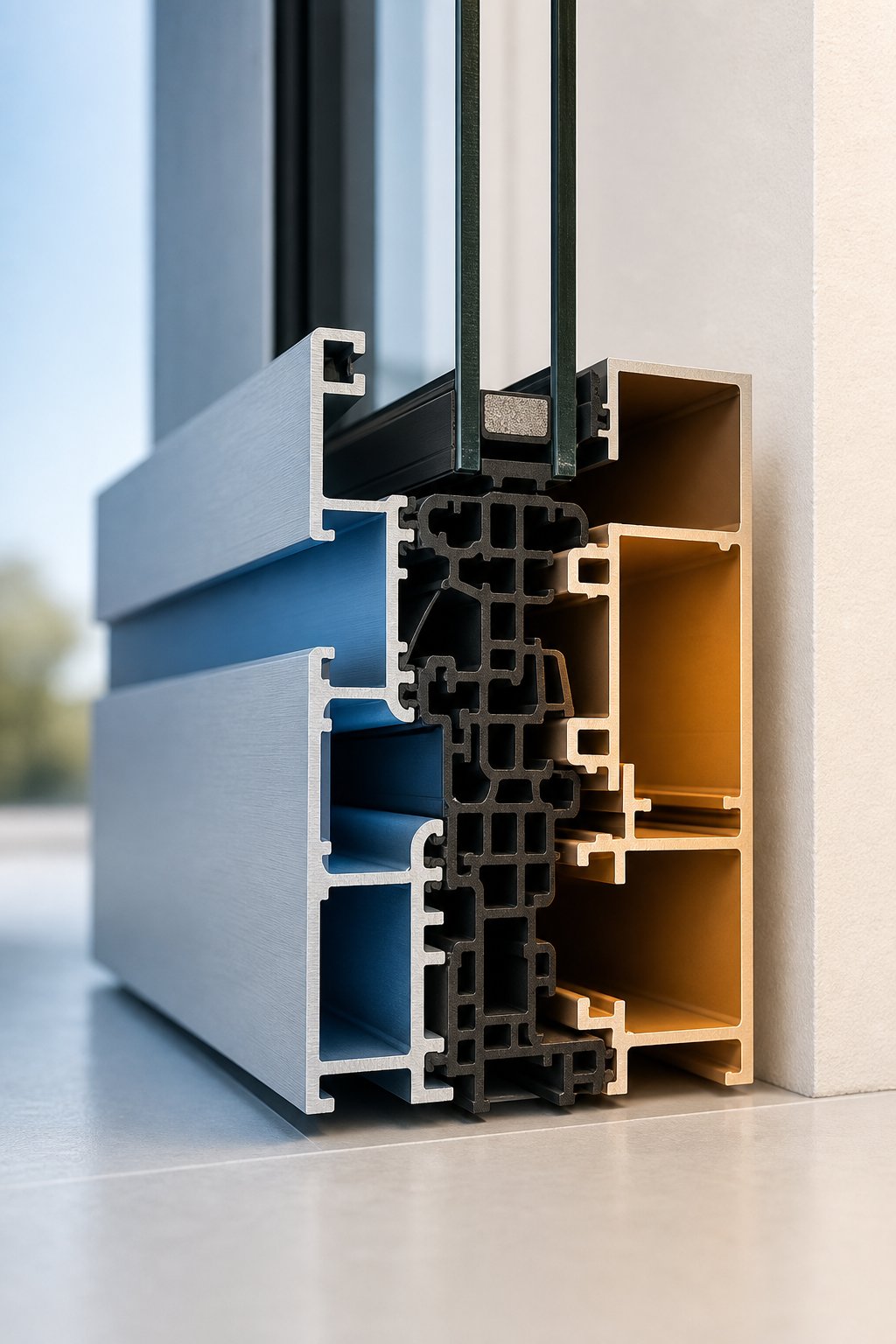
A thermal break is a strip of low-conductivity material — typically reinforced polyamide (PA66 GF25) — inserted between the interior and exterior aluminium profiles. This polyamide barrier has a thermal conductivity of just 0.3 W/mK, effectively severing the heat highway through the frame.
The result is significant. Thermally broken aluminium systems can reduce frame U-values by 30 to 60 percent compared to standard profiles. Premium thermally broken aluminium doors achieve whole-system U-values around 1.2 W/m²K when paired with quality double glazing — a figure that meets or exceeds the National Construction Code’s requirements of 1.6 W/m²K for external doors in most Australian climate zones.
Condensation risk drops substantially too. Because the interior face of the frame stays warmer, the dew point is rarely reached under normal indoor humidity levels. For an aluminium glass door in a bedroom or living area, that means clearer glass, drier frames, and healthier indoor air.
Wood’s Natural Insulation Advantage
Timber doesn’t need engineering to insulate well — it does so by nature. With thermal conductivity between 0.12 and 0.16 W/mK, wood resists heat transfer at a fundamental material level. High-performance timber doors can achieve whole-product U-values of 1.4 W/m²K and under, while timber window systems have been tested as low as 0.8 W/m²K.
This natural advantage means even a basic solid timber door without advanced glazing provides reasonable insulation. An aluminium door with window panels needs thermal breaks and quality glazing to reach similar territory. For projects where energy performance is the top priority and budget allows for ongoing timber maintenance, wood holds a genuine edge — particularly in colder regions like Tasmania or the Victorian highlands.
That said, the gap has narrowed considerably. A modern thermally broken aluminium system with argon-filled double glazing and low-E coatings performs within striking distance of timber. The choice often comes down to which trade-offs matter more to you: timber’s inherent insulation versus aluminium’s dimensional stability and minimal upkeep.
What Determines a Door System’s Overall Thermal Performance
No single component dictates energy efficiency in isolation. The whole assembly matters:
- Frame material and thermal break depth — wider polyamide strips improve insulation in aluminium systems; denser timber species perform marginally better than softwoods
- Glazing type — double or triple glazing, low-E coatings, and argon or krypton gas fills all reduce heat transfer through the glass, which typically represents the largest surface area of the door
- Seals and gaskets — continuous weather seals prevent air infiltration, which can undermine even the best-insulated frame
- Installation quality — gaps between the frame and wall, poorly shimmed openings, or missing insulation around the reveal create thermal bridges regardless of the door’s rated performance
- Door configuration — sliding doors have more frame-to-glass junctions than a single hinged panel; bi-fold systems introduce additional sealing points at each fold
Specific U-value data should always be sourced from the manufacturer’s technical documentation for the exact profile, glazing configuration, and size you’re considering. Published figures represent tested specimens under controlled conditions — your installed performance depends on all five factors above working together.
Thermal performance tells you about comfort and running costs. But a door also needs to survive the environment it’s installed in — and that’s where climate-specific durability becomes the deciding factor between aluminium and wood for many Australian projects.
Total Cost of Ownership Over the Life of Your Home
Running costs don’t stop at energy bills. The real financial picture of any door material unfolds over decades — through maintenance weekends, hardware replacements, refinishing cycles, and eventually the question of whether the door outlasts your mortgage or needs swapping before you’ve paid it off. A total cost of ownership framework captures what a purchase price alone never will.
Upfront Costs for Different Door Types
At the point of sale, timber and aluminium occupy overlapping price bands rather than sitting neatly apart. A basic hollow-core timber interior door is the cheapest option on the market, but that’s not a fair comparison to a solid aluminium exterior system. When you compare like for like — quality exterior doors suited to Australian conditions — the picture is more nuanced.
Solid hardwood entry doors (spotted gum, blackbutt, or jarrah) typically range from $1,200 to $4,000 AUD supply-only for a standard single door, depending on species, panel design, and glazing. Engineered timber doors sit slightly lower. Standard aluminium hinged doors fall in the $800 to $2,500 AUD range supply-only, while premium thermally broken systems push higher. For sliding and bi-fold configurations, aluminium garage doors prices and large-format panel systems vary enormously based on span, track type, and glazing specification.
Installation costs add another layer. Timber doors are heavier and may require more labour time for fitting and adjustment. Aluminium’s lighter weight and factory-precise tolerances often translate to faster installation — fewer billable hours on site. Specific pricing varies significantly by door type, size, configuration, and supplier, so obtaining multiple quotes from reputable aluminium door suppliers and timber specialists for your exact project is essential.
Maintenance Demands Over Two Decades
This is where the two materials diverge sharply. Wood is organic. It breathes, absorbs moisture, expands, contracts, and gradually degrades without intervention. Keeping a timber door functional and attractive requires periodic sanding, repainting or re-staining, and resealing — typically every 3 to 5 years for film-forming finishes in moderate climates, and as often as every 2 to 3 years for doors with high sun or rain exposure. Each cycle involves preparation, materials, and either your time or a tradesperson’s invoice.
A realistic annual DIY maintenance budget for a solid timber entry door sits around $150 AUD in materials — sandpaper, quality exterior finish, brushes, and weatherstrip replacement. Over a decade, that’s roughly $1,500 in direct costs plus your labour. Add one professional repair for early rot or frame swelling (common in humid coastal areas), and the 10-year figure climbs toward $2,500 to $3,000 AUD. Climate and exposure amplify these numbers: a north-facing timber door in Brisbane cops far more UV punishment than a sheltered entry in Hobart, accelerating finish breakdown and increasing maintenance frequency.
Aluminium doors require almost nothing by comparison. A wipe-down with soapy water once or twice a year, occasional lubrication of hinges and locking hardware, and periodic inspection of seals and gaskets. That’s the full extent of it. No repainting, no sanding, no sealing. Powder-coated and anodised finishes don’t peel, blister, or fade under normal conditions. Even small accessories like an md door sweep aluminium threshold seal last years without degradation, unlike rubber or brush alternatives that perish in UV exposure.
Aluminium door repairs, when they do occur, tend to involve hardware replacement (handles, rollers, locks) rather than structural remediation. These are straightforward, relatively inexpensive fixes compared to addressing timber rot, warping, or termite damage.
When Wood Becomes More Expensive Long-Term
The crossover point — where aluminium’s higher upfront cost is offset by lower ongoing expenses — typically arrives within 8 to 12 years for exterior doors in exposed positions. For sheltered interior applications with minimal weather stress, timber can remain cost-competitive much longer. But for any door facing the elements, the maths tilts steadily toward aluminium as the years accumulate.
Warranty structures reflect this reality. Most aluminium door manufacturers offer structural warranties of 10 to 15 years on frames and 5 to 7 years on powder-coat finishes, with some premium systems extending further. Timber door warranties are typically shorter — often 2 to 5 years — and frequently conditional on documented maintenance compliance. Miss a refinishing cycle, and your warranty may be void.
Lifespan compounds the difference. Aluminium doors routinely serve 50 to 60 years without structural decline. Well-maintained solid timber doors can last 30 to 50 years, but neglected ones may need full replacement within 15 to 20 years — a scenario that’s far more common than most homeowners anticipate when they skip that third refinishing cycle.
Lifecycle Cost Comparison Framework
| Cost Category | Aluminium Door (20-Year Period) | Solid Timber Door (20-Year Period) |
|---|---|---|
| Purchase (supply only, standard exterior) | $1,200–$3,000 AUD | $1,500–$4,000 AUD |
| Professional installation | $300–$600 AUD | $400–$800 AUD |
| Maintenance years 1–10 | $100–$200 (cleaning supplies, lubricant) | $1,500–$3,000 (refinishing cycles, materials, possible repair) |
| Maintenance years 10–20 | $200–$400 (hardware service, seal replacement) | $1,500–$3,500 (continued refinishing, weatherstrip replacement, possible structural repair) |
| Potential replacement within 20 years | Unlikely — mid-life at most | Possible if maintenance lapsed or high-exposure location |
| Estimated 20-year total | $1,800–$4,200 AUD | $4,900–$11,300 AUD |
Note: These figures represent planning estimates for a single standard exterior door. Actual costs vary by door type, size, configuration, climate zone, and chosen aluminium door suppliers or timber specialists. Obtain project-specific quotes before budgeting.
The table makes one thing clear: the purchase price is a fraction of what you’ll actually spend over the door’s working life. For budget-conscious projects, the cheapest door to buy is rarely the cheapest door to own — particularly in the harsh, variable climates that define much of Australia. And it’s precisely those climate conditions that determine not just maintenance costs, but whether a material survives at all.
Climate Performance from Coastal Salt to Inland Heat
Australia doesn’t have a climate — it has dozens. A beachfront home in Noosa faces entirely different stresses than a property in Alice Springs or a weatherboard cottage in Hobart. The material you choose for your doors needs to handle your specific environment, not some averaged-out national condition. This is where the aluminium versus wood question stops being theoretical and starts being geographic.
Coastal and High-Humidity Performance
Salt air is relentless. It attacks surfaces at a molecular level, accelerating corrosion in metals and degrading protective finishes on timber. Coastal properties within 1 km of the shoreline — and sometimes further, depending on prevailing winds — face the harshest conditions any door material will encounter in residential use.
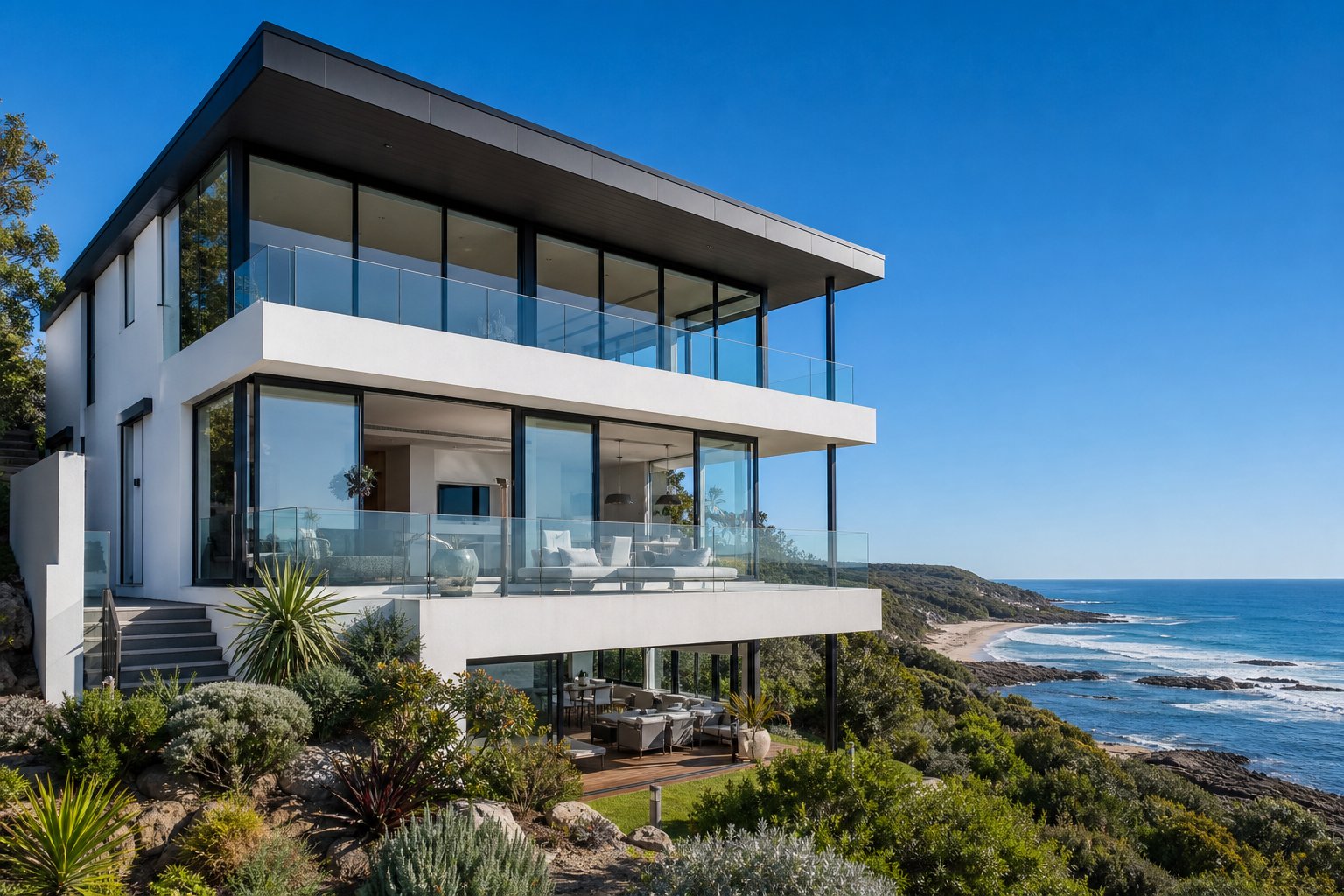
Aluminium handles this environment well. Its natural oxide layer provides baseline corrosion resistance, and powder-coated or anodised finishes add a robust secondary barrier against salt deposits. Marine-grade powder coatings (meeting AS 3715 requirements) are specifically formulated for coastal exposure, and PVDF coatings offer even greater protection for properties directly on the waterfront. Aluminium patio doors and aluminium sliding patio doors in beachside homes typically show minimal degradation after decades of salt exposure — provided the coating remains intact and hardware receives periodic lubrication.
Wood tells a different story near the coast. High humidity means timber absorbs moisture from the air constantly, causing fibres to swell. Doors stick in their frames during wet seasons, then shrink and gap when drier conditions return. Salt accelerates finish breakdown, meaning that 3-to-5-year refinishing cycle compresses to every 1 to 2 years for exposed timber doors in coastal Queensland or the NSW South Coast. Rot risk climbs sharply, particularly in end-grain areas and joints where moisture pools. Even naturally durable species like spotted gum require vigilant maintenance in these conditions.
For aluminium garage doors and aluminium shed doors on coastal properties, the advantage is even more pronounced. These larger openings face full weather exposure with less shelter from eaves, making aluminium’s moisture indifference a practical necessity rather than a luxury.
Extreme Heat and UV Exposure
Inland Australia delivers a different assault: intense UV radiation and extreme temperature swings. Australia has some of the highest UV levels in the world, and surfaces exposed to direct northern or western sun cop extraordinary punishment over time.
Timber in arid and semi-arid zones faces cracking and splitting as moisture content drops below stable levels. The wood dries out faster than it can be replenished, and repeated thermal cycling — hot days followed by cool nights — stresses joints and adhesives. Clear finishes break down rapidly under intense UV, requiring more frequent recoating. Dark-stained timber doors on west-facing elevations in Perth or Adelaide can reach surface temperatures exceeding 80°C on summer afternoons, accelerating finish failure.
Aluminium’s dimensional stability gives it a clear edge here. It doesn’t dry out, crack, or split regardless of ambient humidity. Quality powder coatings are formulated with UV stabilisers that resist fading and chalking for 15 to 25 years, even under harsh sun. An aluminium gate door on a boundary fence or a front entry system facing west will hold its colour and profile long after an equivalent timber installation has required multiple refinishing cycles.
The one caveat: dark-coloured aluminium frames absorb more solar radiation and can become hot to touch. Lighter powder-coat colours or reflective finishes mitigate this in extreme heat zones.
Which Material Suits Australian Climate Zones
Climate zone should be one of your first filters when deciding between aluminium and wood. Here’s how the recommendation shifts across Australia’s major conditions:
- Tropical (Darwin, Cairns, Far North QLD) — Aluminium strongly preferred. Constant high humidity, cyclone risk, and termite pressure make timber a high-maintenance choice. Aluminium resists all three without intervention. Cyclone-rated aluminium systems meet AS 2047 wind-load requirements for Region C and D classifications.
- Coastal temperate (Sydney, Wollongong, Gold Coast, Adelaide coast) — Aluminium preferred for exposed elevations. Timber viable for sheltered positions with committed maintenance. Salt air and humidity favour non-porous materials, particularly for aluminium sliding patio doors and large openings that face prevailing sea breezes.
- Arid and semi-arid (Alice Springs, Broken Hill, inland WA/SA) — Aluminium preferred. Extreme heat, UV intensity, and low humidity cause timber to dry, crack, and require frequent refinishing. Aluminium’s stability under thermal stress makes it the lower-risk option.
- Temperate (Melbourne, Hobart, Canberra, Adelaide Hills) — Both materials perform well. Timber’s natural insulation offers a genuine advantage in cooler climates where heating loads dominate. Aluminium with thermal breaks is equally viable. This is the zone where personal preference, aesthetic goals, and maintenance tolerance legitimately drive the decision.
- Bushfire-prone areas (various, BAL-rated zones) — Aluminium is non-combustible and meets BAL requirements up to BAL-FZ (Flame Zone) when specified correctly. Timber doors in bushfire zones require specific species, thicknesses, and protection measures to comply with AS 3959. For BAL-29 and above, aluminium simplifies compliance significantly.
Timber species selection matters enormously for those who choose wood in challenging climates. Spotted gum and ironbark offer superior hardness and natural durability (Class 1 above-ground). Merbau resists moisture well but can leach tannins. Western red cedar provides natural insect resistance but is softer and less impact-resistant. Choosing the right species for your climate zone can extend timber’s viable lifespan considerably — but it won’t eliminate the maintenance obligation.
Climate dictates durability, but it’s not the only threat a door faces. Forced entry, impact resistance, and the integrity of locking systems present a different kind of stress test — one where material strength and frame rigidity determine how well your home stays secure.
Security Strength and Break-In Resistance
A door’s job isn’t just managing temperature and weather — it’s the primary physical barrier between your family and anyone who shouldn’t be inside your home. Yet most aluminium-versus-wood comparisons barely mention security, or reduce it to a single line about “strength.” The reality is more layered. Break-in resistance depends on the entire door system working together: frame rigidity, leaf construction, locking hardware, glazing specification, and installation quality all contribute. Material choice sets the foundation, but it doesn’t tell the whole story.
Break-In Resistance and Frame Strength
Aluminium’s strength-to-weight ratio gives it a structural advantage that matters during a forced-entry attempt. An aluminium front door frame is approximately three times stronger than an equivalent timber frame at comparable dimensions. That rigidity resists the levering, prying, and impact forces that intruders typically apply to door edges and lock zones.
Because aluminium profiles are extruded to precise specifications, manufacturers can engineer reinforcement exactly where it’s needed — around lock keeps, hinge pockets, and corner joints. The material doesn’t compress or deform under sustained pressure the way softer timbers can. Commercial aluminium doors and aluminium storefront doors rely on this characteristic daily, securing retail and office premises where forced-entry resistance is a baseline requirement rather than an optional upgrade.
Solid timber doors resist break-ins differently. Dense hardwoods like jarrah or spotted gum offer sheer mass — a 50 mm solid hardwood panel absorbs impact energy effectively and resists splitting. But timber’s performance varies enormously by species. Softwood doors (pine, cedar) are significantly easier to breach. And any timber door weakened by moisture damage, rot at the base, or poorly maintained joints loses structural integrity over time. A neglected timber frame that’s begun to soften around the lock mortise offers far less resistance than it did when new.
The critical difference: aluminium’s security performance doesn’t degrade with age or exposure. A 20-year-old aluminium security door retains the same frame rigidity it had on installation day. Timber’s resistance is conditional on ongoing maintenance — a factor that matters more than most homeowners realise until it’s tested.
Locking Systems and Hardware Compatibility
The lock is only as effective as the frame holding it in place. Multi-point locking systems — which secure the door at three, five, or even seven points along the frame edge — are the current standard for high-security residential doors. These systems distribute load across the full height of the frame, making it far harder for an intruder to force the door by attacking a single locking point.
Aluminium frames accommodate multi-point locks particularly well. The extruded profiles provide consistent, precise channels for lock mechanisms, strike plates, and keep hardware. There’s no risk of the frame material compressing around fixings over time, which means the lock engagement stays tight and reliable year after year. Commercial aluminium door frames in high-traffic applications demonstrate this durability — locks that cycle thousands of times annually without the frame degrading around the hardware.
Timber doors also support multi-point locking, but the installation demands more care. Mortising multiple lock points into a timber stile weakens the surrounding material if the timber section isn’t sufficiently thick. Hardwood handles this better than softwood, but any timber frame is susceptible to gradual loosening around fixings as the wood expands and contracts seasonally. Screws in timber can work loose over repeated moisture cycles — a problem that simply doesn’t exist in aluminium.
Additional hardware considerations include tamper-proof hinges with integrated security pins, anti-lift features that prevent the door being removed from its track or frame, and internal glazing beading that stops glass panels being removed from the exterior side. All of these features integrate more reliably into aluminium’s rigid, dimensionally stable profiles.
Glazing and Security as a Complete System
Most modern doors incorporate glass — whether a full-height panel in a sliding system, sidelights flanking an entry door, or decorative inserts. The glazing choice has as much impact on security as the frame material itself.
Two glass types matter for security:
- Toughened (tempered) glass — four to five times stronger than standard annealed glass. When it does break, it shatters into small, relatively harmless granules rather than dangerous shards. It resists casual impact but can still be breached with sustained force or a pointed tool.
- Laminated glass — two or more glass layers bonded with a polyvinyl butyral (PVB) or ionoplast interlayer. Even when cracked, the interlayer holds the glass in place, preventing easy access through the opening. This is the superior choice for security-critical applications.
Aluminium frames support both glass types without modification, and their slim profiles don’t sacrifice structural depth around the glazing rebate. The combination of a rigid aluminium frame, multi-point locking, and laminated glazing creates a system that meets or exceeds PAS 24 security testing standards — the benchmark for residential door security that evaluates the complete assembly under simulated attack conditions including levering, impact, and lock manipulation.
Timber-framed glazed doors can achieve equivalent security ratings, but typically require thicker frame sections to maintain rigidity around the glass, which affects sightlines and overall aesthetics.
Security Considerations Ranked for Homeowners
When evaluating door security for your home, prioritise these factors in order of impact:
- Locking system quality — a multi-point lock with anti-snap, anti-bump, and anti-drill cylinder protection is the single most important security feature regardless of frame material
- Frame rigidity and condition — the frame must resist deformation under force; aluminium maintains this indefinitely while timber requires ongoing structural integrity
- Glazing specification — laminated glass for any accessible glazed panel; toughened as a minimum for upper-storey or less accessible positions
- Internal beading — glass must be secured from the inside so it cannot be removed externally
- Hinge security — dog bolts, security pins, and anti-lift features prevent the door being attacked from the hinge side
- Installation quality — the strongest door system fails if it’s poorly fixed to the surrounding structure; adequate frame fixings into solid substrate are non-negotiable
- Ongoing maintenance — a timber door that’s swollen, warped, or rotting around lock keeps is a security liability regardless of its original specification
For aluminium security doors and aluminium front doors, items 2 and 7 on this list are essentially resolved by the material choice itself. For timber, they require active owner commitment throughout the door’s life.
Insurance providers in Australia don’t typically mandate a specific door material, but they do assess overall home security when setting premiums. Doors meeting AS 2047 performance requirements and fitted with compliant locking hardware may support favourable assessments. Some insurers offer discounts for homes with security-screen doors — a category where aluminium dominates the Australian market.
Security keeps your home protected from external threats. But there’s another external consideration that increasingly influences material decisions — one that looks beyond your property boundary to the broader environmental footprint of what you install.
Environmental Impact and Sustainability Compared
Both aluminium and wood carry environmental baggage — just in different forms. Aluminium demands enormous energy to produce from raw ore. Wood requires forests to be harvested responsibly. Neither material gets a free pass, and the sustainability question comes down to how each is sourced, how long it lasts, and what happens when it reaches the end of its useful life.
Aluminium Recyclability and Embodied Energy
Primary aluminium production is energy-intensive. Smelting bauxite ore into usable metal consumes significant electricity, and the embodied carbon of virgin aluminium is substantially higher than timber on a per-kilogram basis. That’s the headline figure critics point to — and it’s accurate as far as it goes.
But it doesn’t go far enough. Aluminium is infinitely recyclable without any loss in quality. The recycled metal performs identically to virgin material in aluminium doors windows and structural applications. Critically, recycling aluminium requires only about 5 percent of the energy needed for primary production — a 95 percent reduction in embodied energy each time the material cycles through reuse.
An estimated 75 percent of all aluminium ever produced remains in active use today, circulating through manufacturing cycles rather than sitting in landfill. As the proportion of recycled content in aluminium windows doors systems continues to grow — driven by both economics and carbon reduction targets — the embodied energy gap between aluminium and timber narrows with each product generation. Low-carbon aluminium produced using renewable hydroelectric power further reduces the footprint of new production.
Timber Sustainability and Certified Sourcing
Wood’s environmental credentials rest on two pillars: it’s renewable, and it stores carbon. Trees absorb CO2 as they grow, locking that carbon into their cellular structure. PEFC research confirms this carbon remains stored in timber products — including doors — for as long as the product lasts. A solid timber door effectively keeps CO2 out of the atmosphere for decades.
These benefits hold only when the timber comes from responsibly managed forests. Certification schemes like FSC (Forest Stewardship Council) and PEFC (Programme for the Endorsement of Forest Certification) verify that harvested forests are replanted, biodiversity is maintained, and long-term forest health is protected. Uncertified timber from poorly managed or illegally logged sources reverses the environmental equation entirely. When specifying timber doors, insisting on FSC or PEFC certification isn’t optional for a genuinely sustainable choice — it’s the baseline.
End-of-Life and Circular Economy Considerations
What happens when a door reaches the end of its service life matters more than most buyers consider at purchase time. Research into building material circularity highlights that approximately 27 percent of all aluminium products are used in construction — and aluminium retains real scrap value at end of life. Old aluminium windows & doors frames are readily collected by recyclers because the material is worth recovering. The metal re-enters the supply chain at full quality, supporting a genuinely circular material flow.
Timber’s end-of-life path differs. Untreated wood can biodegrade naturally or be repurposed — old doors become furniture, garden features, or biomass fuel. However, painted or chemically treated timber is harder to recycle and often ends up in landfill. Only 10 to 15 percent of construction timber currently undergoes recycling, according to circular economy research — a figure that highlights how much potential remains unrealised.
Sourcing decisions matter enormously for both materials. Recycled-content aluminium from a renewable-energy smelter and FSC-certified hardwood from a well-managed Australian plantation both represent responsible choices. Virgin aluminium from a coal-powered smelter and uncertified tropical hardwood both represent poor ones. The material itself is less important than the supply chain behind it — a nuance worth investigating with your supplier before committing to either option.
Environmental credentials inform the big-picture decision, but the practical question most buyers face next is more immediate: which material suits the specific type of door their project requires?
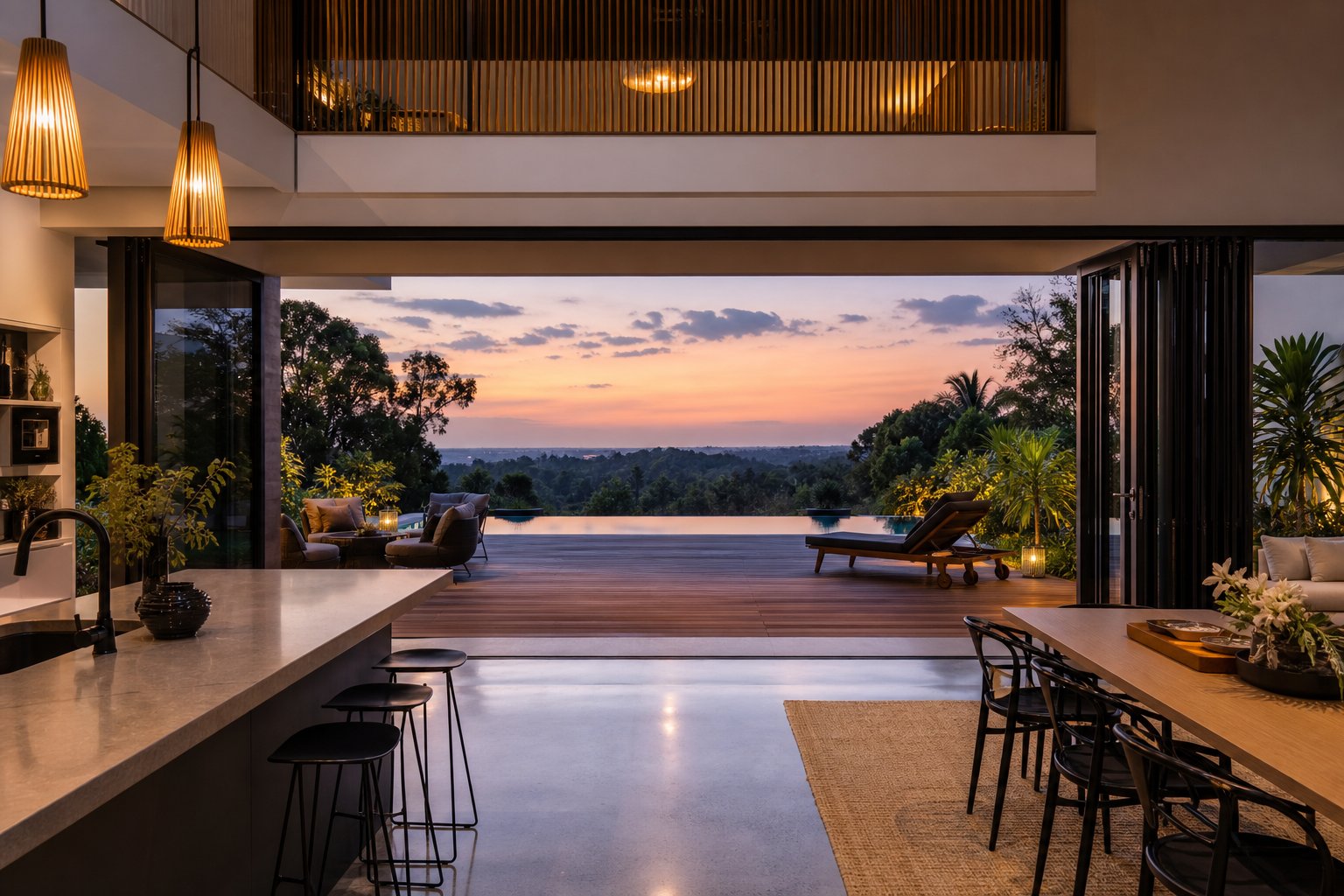
Which Door Types Favour Which Material
The aluminium-versus-wood question doesn’t have a single answer partly because “door” isn’t a single product. A sliding system spanning a 6-metre rear elevation faces completely different structural demands than a 920 mm hinged entry door. The material that excels in one configuration may be merely adequate — or outright unsuitable — in another. Your door type narrows the field before climate, budget, or aesthetics even enter the conversation.
Sliding and Stacker Doors Where Aluminium Excels
Large-format sliding doors represent aluminium’s strongest use case. The material’s rigidity allows frame profiles as narrow as 20 to 30 mm while still supporting heavy double-glazed panels weighing 80 kg or more per leaf. That translates directly into more glass, less frame, and uninterrupted views — exactly what homeowners want when they open up a living area to a garden or pool deck.
Timber simply can’t match these sightlines at scale. Wood frames need substantially more bulk to achieve equivalent structural performance across wide spans, which means thicker mullions eating into your view. For a 4-panel aluminium sliding doors system spanning 4.8 metres, the total frame obstruction might be 120 mm. An equivalent timber system could require 200 mm or more — a visible difference that compounds across every vertical member.
Aluminium stacker doors take this further, with panels sliding and stacking behind one another to create near-complete openings. Aluminium lift and slide doors use a cam-action handle that lifts the panel off its seals for effortless operation even at substantial panel weights, then drops it back down for an airtight seal when closed. These mechanisms rely on aluminium’s dimensional precision — the tight tolerances that keep rollers, tracks, and seals functioning smoothly over decades of daily use. MEICHEN’s sliding and ultra-slim aluminium door systems demonstrate how modern profiles achieve maximum glass area without compromising weather performance or security, offering configurations suited to both residential rear elevations and commercial shopfronts.
Bi-Fold and French Door Considerations
Aluminium bifold doors dominate the Australian market for good reason. Each folding panel must be light enough to operate smoothly yet rigid enough to resist racking under its own weight when cantilevered open. Aluminium delivers both properties simultaneously. Aluminium’s strength allows larger individual panels — meaning fewer folds across a given opening, cleaner aesthetics, and less hardware to maintain.
A typical aluminium bi-fold system supports panels up to 1,000 mm wide and 2,700 mm tall without sagging or binding. Timber bi-folds exist, but panel sizes are more constrained, weight increases significantly, and the folding hardware works harder over time as seasonal timber movement affects alignment. Aluminium concertina doors — the term used interchangeably with bi-folds in some markets — fold neatly to one or both sides, stacking compactly against the wall to maximise the clear opening.
Aluminium french doors occupy a middle ground. The classic double-door format doesn’t demand the same structural gymnastics as a bi-fold, so timber performs respectably here. Wood’s warmth and traditional proportions suit period homes where French doors open onto a verandah or courtyard. But for contemporary projects wanting slimmer frames and larger glass panels in a French door configuration, aluminium still offers a visual edge. MEICHEN’s hinged and bi-fold aluminium systems cover both scenarios — from heritage-sympathetic profiles to minimalist designs with barely-there frames.
Front Entry and Commercial Applications
Front doors are where timber still holds genuine appeal. The entry is your home’s handshake — the first tactile and visual impression visitors receive. Solid hardwood delivers warmth, grain character, and a sense of substance that resonates with traditional and transitional architectural styles. A well-crafted spotted gum or blackbutt entry door makes a statement that powder-coated aluminium struggles to replicate, despite advances in woodgrain finishes.
That said, aluminium pivot doors are reshaping what a front entry can look like. Oversized pivot panels — 1,200 mm wide, 2,700 mm tall, or larger — create dramatic entrances that solid timber can’t achieve without excessive weight and complex engineering. Modern woodgrain finishes applied to aluminium now mimic natural timber so convincingly that the visual gap has narrowed considerably, while the aluminium substrate eliminates warping, swelling, and refinishing obligations entirely.
Commercial applications tilt decisively toward aluminium. Retail shopfronts, office entries, and hospitality venues need doors that handle thousands of open-close cycles annually, resist forced entry, support automated closers and access control systems, and maintain appearance without scheduled maintenance. Commercial aluminium doors meet all these demands as standard. Timber in commercial settings is reserved for high-end hospitality or heritage-listed buildings where aesthetic requirements override practical considerations — and even then, aluminium-clad timber or aluminium with woodgrain coatings often provides a more durable compromise.
MEICHEN’s commercial glazed and thermal break aluminium door systems address this spectrum — from retail entries requiring maximum transparency to office partitions needing acoustic separation, through to non-thermal break options for internal commercial applications where energy performance is less critical.
Material Suitability by Door Type
| Door Type | Aluminium Suitability | Timber Suitability | Key Differentiator |
|---|---|---|---|
| Sliding (standard and stacker) | Excellent — slim profiles, large spans, smooth operation | Limited — heavier frames, restricted panel sizes | Aluminium enables 20–30 mm sightlines impossible in timber |
| Bi-fold / concertina | Excellent — lightweight panels, precise folding alignment | Good for smaller configurations — weight limits panel count | Aluminium supports wider, taller panels without sagging |
| Hinged entry (single/double) | Very good — modern aesthetic, zero maintenance | Very good — warmth, character, traditional appeal | Aesthetic preference drives the decision; both perform well |
| Pivot | Excellent — supports oversized panels with minimal hardware | Possible but weight-limited — requires heavy-duty pivot sets | Aluminium’s low weight enables dramatic large-format entries |
| French | Very good — slimmer frames maximise glass | Very good — suits period architecture and traditional proportions | Style context determines the better fit |
| Commercial (shopfront, office, hospitality) | Excellent — durability, security, automation compatibility | Niche — heritage or high-end hospitality only | Cycle life, maintenance, and hardware integration favour aluminium |
The pattern is clear: as door size increases and operational complexity grows, aluminium’s advantages compound. Timber holds its ground in traditional hinged applications where warmth and character matter most. For everything else — particularly the large-format openings that define contemporary Australian architecture — aluminium’s structural efficiency and design flexibility make it the more capable platform. The remaining question is how to match your specific priorities to the right material, which is where a structured decision framework becomes genuinely useful.
A Decision Framework to Find Your Best Fit
Knowing the technical differences between aluminium and wood is one thing. Translating that knowledge into a confident purchase decision for your specific project is another. The variables stack up quickly — budget constraints, local climate, council regulations, personal taste, how you feel about spending Saturday afternoons with a sanding block. A structured approach cuts through the noise and points you toward the material that actually fits your life, not just your Pinterest board.
Decision Factors Ranked by Priority
Work through these factors in order. Each one either narrows your options or confirms a direction. By the end, most homeowners find the answer has become obvious.
- Climate and exposure. Check your location against the climate guidance covered earlier. Coastal, tropical, and arid zones strongly favour aluminium. Temperate, sheltered positions give both materials a fair run. If your door faces prevailing weather or direct afternoon sun, weight that exposure heavily — it determines maintenance burden more than any other single factor.
- Budget priority — upfront versus long-term. If your renovation budget is tight and you’re choosing a sheltered aluminium hinged doors entry or a simple timber panel, upfront cost may legitimately drive the decision. But for exposed exterior doors you’ll live with for 15+ years, the lifecycle cost framework matters more. An aluminium front door costs less to own over two decades than most timber equivalents in comparable positions.
- Maintenance tolerance. Be honest with yourself. If you know you won’t refinish a timber door every three to five years — and most people don’t — aluminium removes that obligation entirely. A realistic self-assessment here prevents regret later.
- Aesthetic preference and architectural style. Contemporary homes with clean lines and large openings suit aluminium’s slim profiles naturally. Heritage, Federation, or Craftsman-style properties often demand timber’s warmth and traditional proportions. Neither preference is wrong — it’s about coherence with your home’s existing character.
- Security requirements. High-security needs (ground-floor apartments, isolated properties, commercial premises) favour aluminium’s non-degrading frame rigidity and reliable multi-point lock engagement over time.
- Environmental values. If embodied carbon concerns you, investigate recycled-content aluminium or FSC-certified timber. Both can be responsible choices depending on supply chain transparency.
- Door type and size. Large-format openings — aluminium sliding door systems, exterior aluminium bifold doors, or pivot entries — lean heavily toward aluminium for structural and operational reasons. Standard hinged doors give you genuine freedom to choose either material.
Property Type and Planning Considerations
Your decision may not be entirely yours to make. Properties within heritage conservation areas (HCAs) face additional regulatory layers. In NSW alone, the Inner West Council manages 107 conservation areas where external alterations — including door replacements — typically require council approval through a development application or heritage minor works notification.
Within an HCA, contributory buildings are expected to maintain materials and finishes sympathetic to the area’s character. Replacing a timber door with aluminium on a heritage-listed facade may be refused outright, or require a heritage impact statement demonstrating the change won’t diminish the streetscape. Non-contributory buildings have more flexibility, but new work still needs to be sympathetic to the surrounding heritage context.
For modern homes, new builds, and properties outside conservation zones, no such restrictions apply. You’re free to choose based purely on performance, cost, and preference — whether that’s aluminium folding doors across a rear elevation or a solid hardwood entry statement.
Resale value sits at the intersection of aesthetics and practicality. Research into material choices and property value consistently shows that energy-efficient windows and doors, durable exterior materials, and low-maintenance finishes attract buyers and support higher sale prices. Aluminium bifold exterior doors opening to an outdoor living area photograph well, signal modern renovation quality, and promise incoming owners years of trouble-free operation. Quality timber entry doors add character and perceived craftsmanship — particularly in established suburbs where buyers expect traditional detailing. Both materials can enhance value when they match the property’s market positioning.
Choosing a Quality Supplier for Your Project
Whichever material you choose, supplier quality determines whether you get the performance the material is capable of delivering. Look for these indicators:
- Compliance documentation — doors tested and certified to AS 2047 for structural performance, weather resistance, and operating force
- Thermal performance data — published U-values for the specific profile and glazing configuration, not generic claims
- Warranty terms — structural frame warranty of 10+ years for aluminium; clear maintenance conditions for timber warranties
- Finish quality — powder coating to AS 3715 for aluminium; kiln-dried, certified timber with factory-applied primer coats
- Range and configurability — a supplier offering multiple system types (sliding, hinged, bi-fold, pivot, commercial) can match the right product to each opening rather than forcing a single solution across your project
For readers whose decision framework points toward aluminium, MEICHEN’s full range of aluminium door systems covers the spectrum — thermal break options for energy-conscious projects, ultra-slim profiles for maximum glass and modern aesthetics, commercial glazed systems for larger developments, and standard configurations for budget-sensitive builds. It’s a practical starting point for Australian homeowners, builders, and architects searching for aluminium doors near me who want to compare specifications across sliding, hinged, bi-fold, and pivot configurations from a single supplier.
Choose aluminium when climate exposure is harsh, maintenance must be minimal, openings are large, or long-term cost matters most. Choose timber when heritage character is essential, natural insulation is a priority, the position is sheltered, and you’re committed to periodic upkeep. Choose either with confidence in temperate, sheltered applications where both materials perform well — and let personal preference have the final word.
Frequently Asked Questions About Aluminium vs Wood Doors
1. Are aluminium doors more energy efficient than wood doors?
Wood has a natural insulation advantage with thermal conductivity of 0.12-0.16 W/mK compared to aluminium’s 150-200 W/mK. However, modern thermally broken aluminium doors use polyamide barriers that reduce frame U-values by 30 to 60 percent. When paired with quality double glazing, thermally broken aluminium systems achieve whole-system U-values around 1.2 W/m²K — meeting or exceeding NCC requirements for most Australian climate zones. The gap between the two materials has narrowed significantly, making both viable for energy-efficient homes when correctly specified.
2. How long do aluminium doors last compared to wooden doors?
Aluminium doors typically last 50 to 60 years without structural decline, requiring only periodic cleaning and occasional hardware lubrication. Solid timber doors can last 30 to 50 years with diligent maintenance — sanding, repainting, and resealing every 3 to 5 years. However, neglected timber doors in exposed positions may need full replacement within 15 to 20 years. Aluminium’s lifespan is largely independent of maintenance effort, while timber’s longevity is directly tied to how consistently it’s cared for throughout its service life.
3. Are aluminium doors more secure than timber doors?
Aluminium frames are approximately three times stronger than equivalent timber frames at comparable dimensions, providing superior resistance to levering and prying forces. Their dimensional stability means multi-point locking systems maintain tight engagement indefinitely — unlike timber, where seasonal expansion and contraction can loosen fixings over time. However, overall door security depends on the complete system: locking hardware quality, glazing specification (laminated glass is recommended), hinge security, and installation quality all matter as much as frame material.
4. Which is cheaper overall — aluminium or wood doors?
Upfront, both materials occupy overlapping price bands for quality exterior doors. Standard aluminium hinged doors range from $800 to $2,500 AUD supply-only, while solid hardwood entry doors sit between $1,200 and $4,000 AUD. The real cost difference emerges over time. Timber maintenance (refinishing every 3-5 years) adds $3,000 to $6,500 AUD over 20 years for a single exterior door. Aluminium’s maintenance costs over the same period are typically $300 to $600 AUD. The total cost crossover point — where aluminium becomes cheaper to own — usually arrives within 8 to 12 years for exposed exterior doors.
5. Are aluminium doors better for coastal homes in Australia?
Aluminium is strongly preferred for coastal properties. Its non-porous surface and natural oxide layer resist salt-air corrosion, while marine-grade powder coatings (meeting AS 3715) provide additional protection for waterfront installations. Timber doors near the coast face accelerated finish breakdown, swelling from constant humidity, and increased rot risk — compressing the typical refinishing cycle from every 3-5 years down to every 1-2 years. For tropical and cyclone-prone coastal regions like Far North Queensland, aluminium also offers cyclone-rated systems meeting AS 2047 wind-load requirements for Region C and D classifications.
More Window & Door Guides