What Every Brisbane Buyer Should Know About Aluminium Window Suppliers
A quote lands in your inbox. It lists window sizes, a total price, maybe a brand name. But it tells you almost nothing about whether that supplier can actually deliver what your project needs — compliant, durable windows suited to South East Queensland’s demanding conditions.
This guide exists to close that gap. It is not a sales pitch. It is a buyer-education resource built around the questions that matter before you commit to a supplier for your windows Brisbane QLD project — whether that is a single bathroom renovation or a multi-unit development.
Aluminium window suppliers in Brisbane operate across a surprisingly wide spectrum of capability, and understanding where a given supplier sits on that spectrum is the single most consequential decision you will make during procurement.
What Aluminium Window Suppliers Actually Provide
The term “supplier” covers several distinct business models. Some companies are integrated manufacturers — they extrude or source profiles, fabricate frames, assemble glazing, and deliver finished units ready for installation. Others are assemblers who purchase components and build windows to order. A third category operates as supply-only wholesalers serving builders and contractors, while others bundle full supply-and-install packages for homeowners.
Each model carries different implications for pricing, lead times, warranty coverage, and quality control. A window Australia buyer sourcing for a commercial project has fundamentally different needs than a homeowner replacing three openings in a Queenslander. Knowing what kind of supplier you are dealing with — and what they actually control in their production chain — shapes every conversation that follows.
Why Brisbane Projects Have Unique Requirements
Brisbane is not Melbourne or Sydney when it comes to window specification. The subtropical climate drives year-round ventilation demands. Coastal proximity — from Redcliffe through Wynnum to the Redlands — introduces salt-air corrosion that degrades poorly finished aluminium within years rather than decades. South East Queensland sits within Wind Region B under Australian Standards, carrying higher structural requirements than most southern states. And properties in outer growth corridors or near bushland face BAL ratings that restrict frame and glazing choices further.
These factors mean that a supplier’s local expertise — their familiarity with AU windows compliance, regional wind classifications, and corrosion zone mapping — is not a bonus. It is a baseline requirement.
The complexity of your project should never exceed the capability of your supplier. A window that looks identical on paper can fail within years if the profile finish, hardware grade, or structural rating does not match your specific site conditions in South East Queensland.
What separates a reliable supplier from a risky one often comes down to details that never appear on a standard quote — the types of aluminium window systems they offer, how those systems perform under local conditions, and whether the supplier can demonstrate compliance with the standards that govern every opening in your building envelope.
Types of Aluminium Windows Available From Brisbane Suppliers
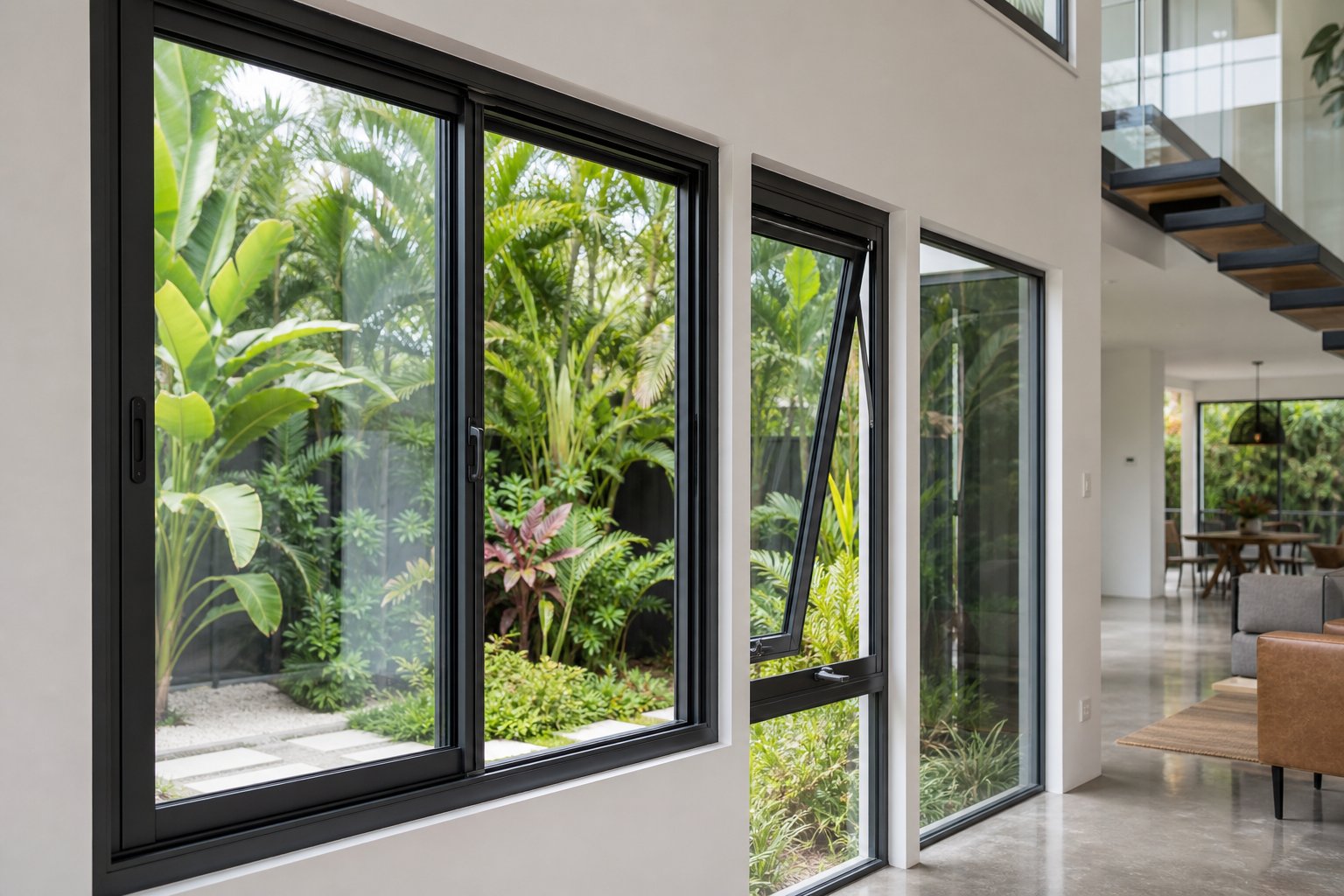
Not all aluminium windows do the same job. The configuration you choose — how the window opens, seals, and ventilates — determines how well it performs in a given room, orientation, and noise environment. Brisbane suppliers typically offer five core configurations: sliding, awning, casement, louvre, and fixed-pane. Each has distinct strengths, and most well-designed homes use a combination rather than relying on a single type throughout.
Understanding these differences puts you in a stronger position when reviewing supplier quotes, because the window type directly affects pricing, hardware requirements, and long-term maintenance demands.
Sliding Windows and Why They Dominate in Queensland
Walk through any Brisbane suburb — from post-war cottages in Camp Hill to new builds in Springfield — and aluminium sliding windows outnumber every other configuration by a wide margin. There are practical reasons for this dominance.
Sliding aluminium windows move horizontally along a track, requiring zero clearance outside the wall plane. That matters in Queensland homes where outdoor entertaining areas, walkways, or garden beds sit immediately adjacent to the building. Unlike casement or awning styles that swing outward, a sliding window stays flush, making it suitable for bedrooms facing narrow side setbacks, kitchens overlooking pathways, and living areas opening onto decks.
Ventilation is the other driver. Brisbane’s subtropical climate means windows stay open for months at a time, and an aluminium sliding window provides a wide opening area — typically up to 50% of the frame — that encourages consistent cross-ventilation without mechanical cooling. For open-plan living zones oriented to catch prevailing north-east breezes, that unobstructed airflow makes a measurable difference to comfort and energy costs.
The trade-off? Sliding systems rely on brush seals and track contact rather than compression seals, so they are generally weaker for acoustic performance than hinged alternatives. On a quiet suburban street this is rarely an issue, but properties facing arterial roads or commercial zones may need a different approach on noise-exposed elevations.
Awning, Casement, and Fixed Windows for Specific Applications
Where sliding windows handle everyday ventilation, awning, casement, and fixed-pane configurations solve more specific problems.
Awning windows are hinged at the top and open outward from the bottom, creating a canopy effect. This lets them remain open during Queensland’s afternoon storms without admitting rain — a genuine advantage in a city that receives over 1,000 mm of rainfall annually. They seal tightly when closed thanks to compression against the frame, making them a strong choice for bathrooms, laundries, and any opening where weather protection and controlled airflow matter more than maximum ventilation volume. Multi-point locking hardware also gives them a security edge in ground-floor applications.
Casement windows hinge at the side and swing outward, allowing nearly the full window area to open. That makes them effective where maximum airflow is needed but a sliding track is impractical — tall, narrow openings in hallways, stairwells, or beside fixed panels in feature walls. They perform well acoustically when closed because the sash compresses evenly into perimeter seals. The limitation is clearance: they project outward, so they are unsuitable where external obstructions or pedestrian paths sit close to the facade.
Fixed-pane windows do not open at all — and that is precisely their advantage. With no moving parts, no seals to degrade, and no hardware to maintain, they deliver the strongest acoustic and weather performance of any configuration. Brisbane suppliers often recommend fixed panels for street-facing feature glazing, high-level clerestory windows, or large format openings where ventilation is handled by adjacent operable windows on quieter elevations.
Louvre windows deserve a mention for their subtropical heritage. Multiple horizontal glass blades pivot simultaneously, allowing up to 95% of the opening area to ventilate — far more than any other type. They suit covered outdoor rooms, breezeways, and enclosed verandahs where maximum airflow is the priority and weather protection is already handled by roof overhangs or screens.
Choosing the Right Configuration for Your Project
Rather than defaulting to one window type everywhere, consider three decision factors for each opening:
Room function. A bedroom needs secure locking, good acoustic sealing, and controllable ventilation — awning or casement configurations often outperform sliding in that role. A kitchen benefits from a sliding window that stays clear of benchtops and splashbacks. A living room with a busy-road frontage may use fixed glazing paired with operable windows on the quieter side.
Orientation and exposure. North and east-facing openings in Brisbane catch prevailing breezes and benefit from generous ventilation areas — sliding aluminium windows or louvres. West-facing walls receive intense afternoon sun and driving rain, making awning windows with low-E glazing a better fit. South elevations receive minimal sun but often face cooler winds, where tighter-sealing configurations reduce draughts.
Noise environment. Properties near highways, flight paths, or commercial precincts benefit from fixed or compression-sealed windows on exposed facades, with operable ventilation directed toward quieter boundaries.
The table below summarises how each configuration stacks up across the factors that matter most in Brisbane projects:
| Window Type | Ventilation Capacity | Weather Sealing | Security Features | Ideal Room Placement |
|---|---|---|---|---|
| Sliding | High (up to 50% open area) | Moderate — brush seals, track contact | Standard latch locking | Living areas, kitchens, bedrooms on quiet streets |
| Awning | Moderate (limited opening angle) | Excellent — compression seal, rain protection | Multi-point locking | Bathrooms, laundries, ground-floor security zones |
| Casement | Very high (near-full opening) | Excellent when closed — compression seal | Multi-point locking | Hallways, stairwells, feature wall combinations |
| Fixed | None | Maximum — no moving parts or joints | Inherently secure | Street-facing facades, clerestory, feature glazing |
| Louvre | Maximum (up to 95% open area) | Low — gaps between blades | Limited without additional screening | Covered verandahs, breezeways, outdoor rooms |
Most Brisbane suppliers can fabricate all five types, but their level of expertise with each may vary. When requesting quotes, specify configuration by room rather than asking for a blanket window type across the whole project. That single step forces the supplier to demonstrate whether they understand how different aluminium window systems interact with your specific site conditions — and it reveals a lot about their technical capability before you commit.
Configuration, however, is only half the performance equation. The aluminium profile that forms the frame — its depth, thermal properties, and finish quality — shapes how well any window type holds up over a Queensland decade.
Understanding Aluminium Window Profiles and Performance
Pick up two aluminium window quotes from different Brisbane suppliers and you will likely see different profile systems listed — sometimes by brand name, sometimes by a depth measurement in millimetres. What rarely gets explained is what those numbers actually mean for your home’s comfort, energy performance, and long-term durability. The profile is the skeleton of the window. Its design dictates how much glass you can fit, how well heat and noise are managed, and how the frame holds up against Queensland’s sun, salt, and storms.
Getting this right matters more than most buyers realise, because two windows that look identical from across the room can behave very differently over a decade depending on what is happening inside that aluminium frame.
Thermal Break vs Non-Thermal Break Profiles Explained
Aluminium conducts heat efficiently — roughly 205 W/m·K, which makes it structurally excellent but thermally problematic. In a non-thermal break profile, the aluminium runs as a single continuous piece from the exterior face to the interior face. Heat travels freely through the metal in both directions. Summer warmth moves inward. Air-conditioned cool moves outward. The frame essentially works against your climate control.
A thermally broken profile solves this by splitting the aluminium into two separate sections — one interior, one exterior — connected by an engineered polymer strip, typically glass-fibre reinforced polyamide. That strip interrupts the metal-to-metal heat path. The result is a frame that resists heat transfer rather than facilitating it.
Here is the Brisbane-specific nuance that most generic guides miss: South East Queensland’s mild winters mean heating loads are minimal compared to Melbourne or Canberra. The primary argument for thermal breaks in southern states — preventing heat loss in winter and eliminating condensation on ice-cold frames — carries less weight here. Brisbane homes rarely experience the interior condensation problems that plague southern dwellings with non-thermally broken aluminium.
That does not make the distinction irrelevant, though. Even in subtropical climates, a thermally broken frame reduces cooling loads during Brisbane’s long, hot summers by limiting how much external heat conducts through the frame into conditioned rooms. It also provides measurably better acoustic insulation — the polymer strip absorbs sound vibration that solid aluminium transmits freely. For properties near busy roads, flight paths, or commercial zones, that acoustic benefit alone can justify the price premium.
The practical takeaway for Brisbane buyers: non-thermal break profiles remain a legitimate choice for budget-conscious projects in quiet, non-coastal locations where energy performance targets are modest. But if your project targets a 7-star NatHERS rating or higher, or if acoustic performance matters, thermally broken aluminium sliding windows material becomes a requirement rather than an upgrade.
How Profile Selection Affects Glazing and Energy Performance
Profile depth is the measurement you will see on spec sheets — typically ranging from 50 to 70 mm for standard residential systems and 70 to 150 mm for architectural-grade profiles. That depth figure is not just about structural rigidity. It determines how much glass the frame can hold.
A deeper profile creates a larger glazing pocket — the channel that houses the glass unit. A shallow 50 mm profile might accommodate single glazing or a narrow double-glazed unit, but it cannot physically fit the thicker insulated glass units needed for serious acoustic or thermal performance. If you want 10.38 mm laminated glass for noise reduction, or a double-glazed unit with a 12 mm argon-filled cavity for thermal insulation, the profile must have sufficient depth to house that assembly securely.
The relationship is straightforward: more profile depth equals more room for wider thermal break cavities, more complex internal air chambers, and thicker glass packages. For a sliding aluminium window on a noise-exposed facade, this might mean stepping up from a standard 52 mm track system to a 90 mm or deeper profile that accepts acoustic-rated glazing. For a fixed panel targeting strong thermal performance, a deeper frame supports double or even triple glazing configurations that shallow profiles simply cannot hold.
Brisbane’s National Construction Code energy requirements increasingly push residential builds toward better-performing glazing, particularly on west-facing elevations where solar heat gain is intense. The profile you specify must be capable of accepting the glass package required to meet those energy targets — something worth confirming with your supplier early in the quoting process rather than discovering as a limitation later.
Material Quality and Finish Options for Queensland Conditions
The aluminium extrusion itself is only part of the durability equation. How that metal is finished determines whether it still looks sharp and resists corrosion five, fifteen, or thirty years after installation. Two primary finish technologies dominate the Brisbane market:
Powder coating is the most common finish. A dry polyester powder is electrostatically applied to pretreated aluminium and cured in an oven, forming a hard, continuous film. Quality varies significantly. Budget coatings may look fine initially but chalk, fade, or lose adhesion within a few years under Queensland’s intense UV exposure. High-quality powder coatings meeting recognised standards like Qualicoat specifications undergo rigorous pretreatment protocols that seal the aluminium substrate before coating — a step that prevents oxidation from forming underneath the finish and causing it to lift over time.
Anodising takes a fundamentally different approach. Rather than applying a coating on top, the process grows an integral oxide layer from the aluminium’s own surface through controlled electrochemical reaction. The result is exceptionally hard — rivalling diamond on the Mohs hardness scale — and scratch-resistant. Colour options are limited to metallic tones (silver, bronze, champagne, black), but the finish will not peel, chip, or delaminate because it is part of the metal rather than bonded to it.
For Brisbane’s coastal and bayside suburbs — Sandgate, Manly, Cleveland, Wynnum, Redcliffe — finish selection becomes critical. Salt-laden air accelerates corrosion on inadequately protected aluminium. Properties within corrosion zones need either a marine-grade powder coat with enhanced pretreatment or a Class I anodised finish to maintain frame integrity over decades. Standard finishes that perform perfectly in inland suburbs like Kenmore or The Gap may deteriorate within years at waterfront locations.
Ask your supplier what pretreatment process they use before powder coating. Without proper substrate preparation — particularly chrome phosphate or equivalent conversion coating — even premium powder coat will eventually fail in Queensland’s UV-intensive, humidity-rich environment.
A few practical considerations for finish selection in Brisbane projects:
- Properties within 1 km of tidal water should specify marine-grade finish systems with cleaning intervals no longer than every three months
- West-facing frames receive the most UV punishment — richer colours (deep reds, blues) fade faster than neutral tones under sustained exposure
- Dual-colour powder coating (different interior and exterior finishes) adds cost but allows a white interior to match trim while the exterior uses a darker shade that better resists visible UV degradation
- Anodised finishes are harder to repair locally if damaged — powder coat can be touched up, anodised surfaces typically cannot
The profile system and its finish work together as a package. A well-chosen sliding windows aluminium frame with adequate depth, appropriate thermal properties for the application, and a finish grade matched to the exposure environment will outperform a more expensive window let down by a mismatch in any one of those areas. When evaluating supplier quotes, look for profile system details and finish specifications — their presence signals a supplier who understands that performance lives in the engineering detail, not just the price line.
Profile characteristics set the performance ceiling. But whether a window legally qualifies for installation in your Brisbane project depends on a separate layer entirely — the building codes and compliance standards that govern every opening in your building envelope.
Brisbane Building Codes and Compliance for Aluminium Windows
A beautifully fabricated aluminium glazed window means nothing if it cannot be legally installed in your building. Compliance is not a background detail — it is the gatekeeping layer that determines whether your windows meet structural, safety, and energy requirements for your specific Brisbane site. And yet, it is the area where most buyers have the least visibility, because quotes rarely explain what standards actually govern the product being offered.
Two Australian Standards sit at the centre of every aluminium window compliance brisbane discussion: AS 2047 and AS 1288. Beyond these, wind region classifications and Bushfire Attack Level ratings add site-specific requirements that vary dramatically between suburbs. A supplier who cannot speak fluently about all three is a supplier who may deliver product that fails certification — leaving you with costly remediation or a build that stalls at inspection.
AS2047 and AS1288 Standards in Plain Language
AS 2047 is the national standard for windows and external glazed doors. Think of it as the performance rulebook. It sets minimum requirements across several measurable criteria: structural strength under wind pressure, resistance to water penetration during storms, limits on air infiltration through closed windows, and operating force so hardware functions safely over the product’s lifespan. Every aluminium window installed in an Australian building must be tested and certified to AS 2047 — this is referenced directly by the National Construction Code, making it a legal obligation rather than an optional quality benchmark.
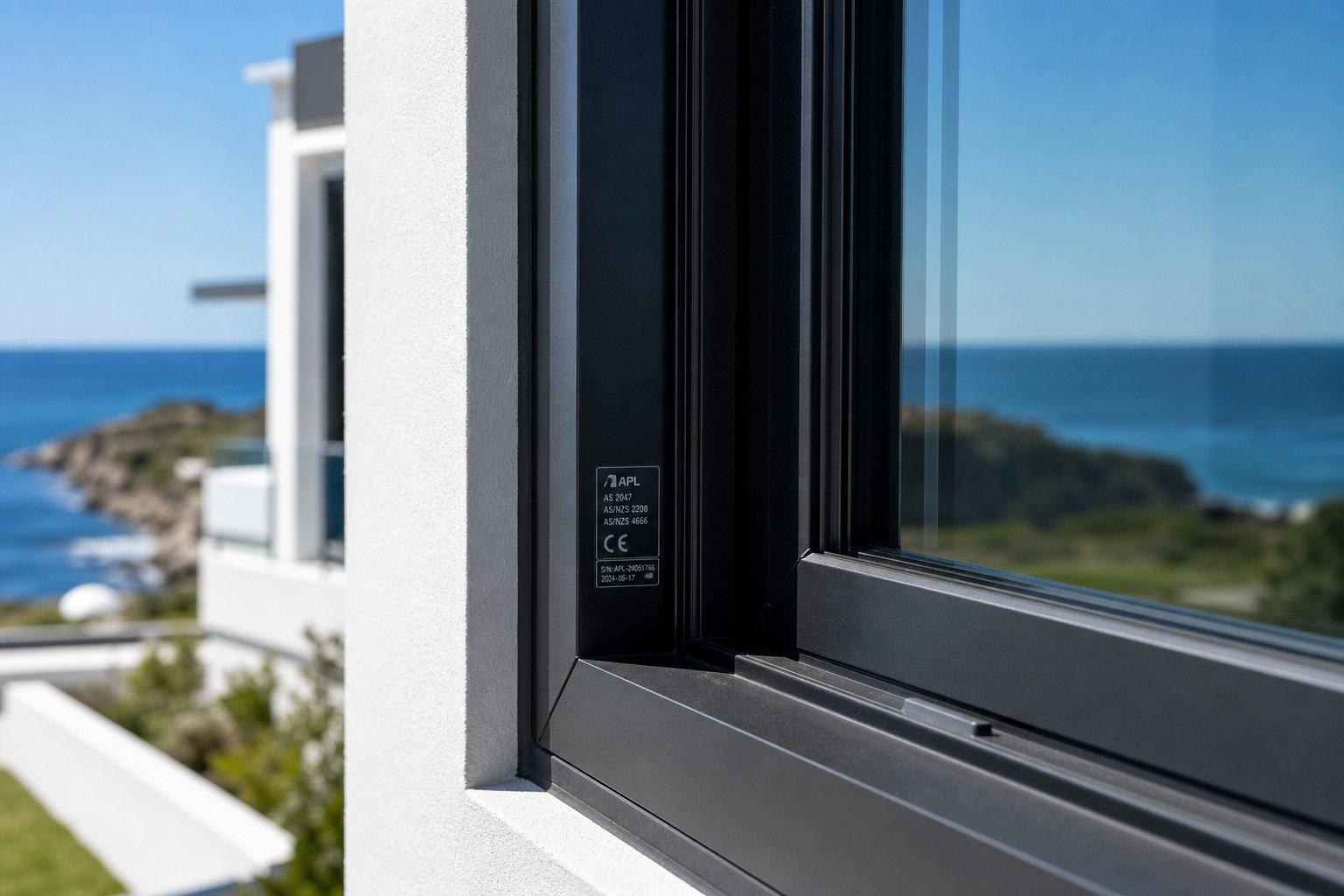
What does this mean in practical terms? A compliant window carries a performance label — typically found on the inside of the frame or head — showing its wind and water ratings in Pascals. It comes backed by a certificate of compliance issued by the manufacturer, ideally through an accredited body like the Australian Glass and Window Association (AGWA). Products tested through AGWA members undergo assessment at NATA-accredited laboratories, providing independent verification that the numbers on the label reflect actual physical performance.
AS 1288 works alongside AS 2047 but focuses specifically on glass selection and installation. It governs which glass type is required based on location within the building, the size of the pane, its height above ground, and proximity to areas where people could fall against it. Safety glazing — toughened or laminated — is mandatory in locations the standard identifies as vulnerable: next to doors, at low levels, in bathrooms, and in overhead applications. For windows Brisbane projects, AS 1288 also determines glazing thickness requirements based on wind loads, which ties directly back to the wind rating for your site.
Together, these two standards ensure that a window performs structurally under load, keeps water out during heavy rain, and uses glass that will not create dangerous shards if broken by impact or pressure.
Wind Ratings and Why They Matter in South East Queensland
Wind ratings determine how much force your windows must withstand without failing. Australia divides the continent into wind regions, and each building site receives a specific wind classification based on its geographic location, terrain category, topography, and available shielding from surrounding structures or vegetation.
Brisbane falls within Wind Region B under AS 4055, which is non-cyclonic but carries higher baseline wind speeds than the sheltered Region A that covers much of inland southern Australia. Within Region B, individual sites receive classifications ranging from N1 to N4 depending on exposure. A house tucked into an established suburb surrounded by other buildings and mature trees might receive an N1 or N2 classification. A property on an exposed coastal ridge at Redcliffe or on elevated terrain at Mount Coot-tha could rate N3 or higher.
These classifications matter because they directly dictate the structural performance requirement for every window in the building. An N3-rated site needs windows tested to significantly higher wind pressures than an N2 site. If your supplier provides windows rated for N2 conditions but your site classifies as N3, those windows will fail certification — regardless of how good they look or how competitive the price was.
Proximity to the coast intensifies requirements further. Terrain categories account for how much open water or flat land sits between your site and the prevailing wind direction. Bayside suburbs — Wynnum, Manly, Sandgate, Brighton — often face higher terrain exposure ratings than homes just a few kilometres inland, even within the same council area. This is not theoretical. It translates directly into which window systems your supplier can offer for those openings, because not every profile system achieves the higher pressure ratings that exposed coastal sites demand.
BAL Ratings and Coastal Corrosion Zone Considerations
Properties in Brisbane’s outer suburbs and semi-rural corridors face an additional compliance layer: Bushfire Attack Level ratings. If your land falls within a bushfire overlay mapped by your local council, construction must comply with AS 3959, which specifies materials and methods based on your assessed BAL rating.
In South East Queensland, councils including Brisbane City Council, Moreton Bay, Logan, Redland, and Ipswich use State Planning Policy mapping to identify medium, high, and very high bushfire intensity zones, along with buffer areas typically extending up to 100 metres from vegetation. If your property sits within these mapped areas, a formal BAL assessment determines your rating — from BAL-12.5 at the lower end through to BAL-FZ (Flame Zone) at the extreme.
For windows Brisbane properties in bushfire-prone zones, the implications are direct. Higher BAL ratings restrict glass types (toughened rather than annealed), require bushfire-rated screening or shutters, and mandate specific frame configurations that resist ember attack. At BAL-29 and above, external window frames must be non-combustible — aluminium qualifies, but the associated hardware, seals, and screening must also meet the standard. Not every supplier stocks or fabricates bushfire-compliant window assemblies, and lead times for these specialised configurations are typically longer than standard product.
Corrosion zones add yet another dimension. The Australian Standard for corrosion protection classifies locations by distance from the coast and prevailing wind exposure. Properties within severe marine environments — generally within 1 km of breaking surf or tidal waters — need enhanced protection systems on all external metalwork. For aluminium windows, this translates into marine-grade pretreatment processes, heavier powder coat film builds, or anodised finishes. A supplier quoting standard coastal finishes for a property 200 metres from Moreton Bay is either underspecifying or unfamiliar with the requirements — both are red flags.
Across all three compliance dimensions — AS 2047/1288, wind classification, and BAL/corrosion ratings — the critical takeaway is the same: your supplier must be able to produce documentation proving their product meets the specific requirements of your site. Not generic claims. Not verbal assurances. Actual certified paperwork that your certifier can verify during inspection.
A reputable aluminium window supplier should be able to provide the following compliance documents without hesitation:
- AS 2047 performance labels affixed to each window, showing tested wind and water ratings in Pascals
- Certificate of compliance from the manufacturer, preferably issued through AGWA or equivalent accredited body
- NATA-accredited test reports confirming structural adequacy, water penetration resistance, and air infiltration performance
- Glazing compliance certificates per AS 1288, confirming correct glass type and thickness for each opening
- Wind load calculations or structural engineering data matching product ratings to your site-specific wind classification
- BAL compliance documentation where applicable, confirming frame, glass, seal, and screen assemblies meet your assessed rating under AS 3959
- Finish and coating specifications confirming suitability for your corrosion zone classification
If a supplier hesitates, deflects, or cannot produce these documents on request, treat that as a clear signal about their operating standard. Compliance paperwork is not a premium add-on — it is a baseline obligation that every legitimate manufacturer and fabricator maintains as standard practice.
Standards and certifications confirm a product is fit for purpose. But they do not tell you how that product gets from fabrication to your site — or who bears responsibility when something goes wrong along the way. That question depends entirely on the service model your supplier operates under.
Supply-Only vs Supply-and-Install Services Explained
Two suppliers quote you the same aluminium sliding window for the same opening. One price is 30% lower than the other. Bargain? Not necessarily. The cheaper quote might be supply-only — meaning you receive windows at your site and nothing else. The higher quote might include measurement, delivery, installation, sealing, flashings, and a single warranty covering the entire job. These are fundamentally different propositions, and confusing them is one of the most common (and expensive) mistakes buyers make.
The distinction matters because it determines who carries responsibility at every stage — from initial measurement through to what happens if a window leaks three years after installation. Understanding which model suits your project prevents warranty disputes, scheduling headaches, and finger-pointing between trades.
Supply-Only Services for Builders and Contractors
Supply-only is exactly what it sounds like: you purchase manufactured windows and take delivery. No installation crew arrives. No one checks your measurements beforehand. The supplier’s obligation ends when the product leaves their factory or warehouse in good condition.
For experienced builders and contractors, this model offers genuine advantages. Cost control sits at the top of that list — eliminating bundled installation fees can reduce the window line item significantly, particularly on larger projects where the builder already has qualified installers on their crew. Scheduling flexibility is the second benefit. Rather than coordinating around a supplier’s installation calendar, the builder integrates window fit-off into their own construction programme, slotting it between frames and lock-up at whatever timing suits the broader build sequence.
Bulk purchasing power also comes into play. Builders managing multiple projects or multi-unit developments often negotiate volume pricing that supply-and-install packages cannot match. And for contractors who have refined their installation methods over years of practice, maintaining control over workmanship quality is a feature, not a compromise.
The trade-off is responsibility. With supply-only, the buyer owns measurement accuracy completely. If windows arrive and do not fit the openings, that is not the supplier’s problem — it is yours. Installation quality, weatherproofing, flashing integration, and compliance with AS 2047 performance requirements all fall on whoever installs the product. And warranty coverage splits: the supplier warrants the manufactured product against defects, but installation-related failures (water ingress due to poor sealing, frame damage during fit-off, hardware issues from incorrect adjustment) sit outside their scope.
This model works well for buyers who understand the division clearly and have the trade skills or project management capability to handle their half of the equation. It works poorly for anyone who assumes a product warranty covers problems caused by how that product was installed.
Supply-and-Install Packages for Homeowners
For homeowners — particularly those undertaking renovations without a builder managing the process — aluminium window supply and install packages offer something supply-only cannot: single-point accountability.
When one company measures, manufactures, delivers, and installs your windows, there is no ambiguity about who is responsible if something goes wrong. A leak at the frame-to-wall junction? Their problem. A window that does not operate smoothly six months after installation? Their problem. Glass that fogs internally within the warranty period? Still their problem. You deal with one company, one warranty, one phone number.
That clarity has real value, especially for homeowners who lack the technical knowledge to diagnose whether a window failure stems from a manufacturing defect or an installation error. In a supply-only arrangement, the manufacturer blames the installer and the installer blames the manufacturer — a scenario that plays out in consumer dispute forums with depressing regularity.
Supply-and-install services also remove the measurement liability that trips up inexperienced buyers. The supplier’s team measures every opening, accounts for structural tolerances, and takes responsibility if their measurements result in windows that do not fit. For renovation projects — where existing openings are rarely perfectly square or consistent — that professional measurement step prevents costly remaking of custom-sized units.
The cost premium over supply-only reflects these additional responsibilities and the labour component. It is not simply a markup for convenience — it covers measurement visits, skilled installation labour, sealant and flashing materials, site cleanup, and the extended warranty coverage that single-source accountability enables.
Hybrid Models and Project-Specific Arrangements
The market is not rigidly binary. Many Brisbane suppliers — and increasingly, aluminium window suppliers Sydney and interstate also offer this — operate hybrid arrangements tailored to project scale and buyer capability.
A common hybrid: the supplier handles measurement, fabrication, and delivery, while the builder or homeowner arranges installation independently. The supplier retains measurement responsibility (eliminating the biggest risk in pure supply-only), but installation labour remains with the buyer’s chosen contractor. This works particularly well for owner-builders who have a trusted installer but lack confidence in measuring complex openings accurately.
Another variation involves supply-and-install for complex or high-risk openings (large-format sliding doors, stacker systems, corner windows) while simpler standard windows on the same project ship as supply-only for the builder to install. This targets the supplier’s installation expertise where it adds the most value while keeping straightforward work within the builder’s scope and budget.
For multi-unit developments, some suppliers offer project-managed supply with installation supervision — they deliver product, provide a site supervisor during fit-off, and sign off on installation quality without employing the installation crew directly. This gives developers warranty protection closer to full supply-and-install while using their own labour force.
The right model depends on your project type, your technical capability, and how much risk you are willing to carry personally. The table below maps the key differences across the factors that matter most:
| Factor | Supply-Only | Supply-and-Install |
|---|---|---|
| Typical cost | Lower — product only | Higher — includes labour, materials, accountability |
| Warranty responsibility | Split — manufacturer covers product defects only | Unified — one party covers product and workmanship |
| Measurement liability | Buyer carries full risk | Supplier carries risk |
| Timeline control | Buyer sets installation schedule | Subject to supplier’s installation calendar |
| Installation quality | Depends on buyer’s chosen installer | Controlled by supplier’s trained team |
| Ideal buyer profile | Licensed builders, experienced contractors, volume purchasers | Homeowners, owner-builders, renovation projects without a builder |
| Dispute resolution | Complex — multiple parties involved | Straightforward — single point of contact |
Whether you go supply-only, full-service, or somewhere in between, the service model shapes your quote in ways that are not always visible on the pricing summary. It determines what is included, what is excluded, and where liability sits when the unexpected happens. Recognising those differences before you compare numbers — rather than after something goes wrong — is what separates an informed buyer from one learning expensive lessons on site.
Service model aside, the numbers themselves deserve scrutiny. Two quotes for seemingly identical windows can land at vastly different totals, and the reasons are rarely obvious without knowing what actually drives aluminium window pricing in the Brisbane market.
What Influences Aluminium Window Pricing in Brisbane
Searching online for aluminium windows prices will return a frustrating mix of vague ranges and outdated figures. The reality is that no honest supplier can give you a meaningful price without knowing at least half a dozen specifics about your project. A 600 x 600 mm fixed panel for a bathroom and a 2400 x 1200 mm sliding window for a living room are both “aluminium windows” — but they might sit $800 or more apart in cost. Understanding what creates those gaps puts you in a position to read quotes critically rather than simply comparing bottom-line totals.
Key Factors That Drive Aluminium Window Pricing
Seven variables interact to determine the aluminium window price for any given opening. Shift one, and the number moves — sometimes dramatically.
Size and dimensions. Larger windows need more raw material, heavier-duty hardware, and often reinforced framing to maintain structural integrity. As A&D Windows notes, oversized or non-standard units may require additional structural support that pushes cost further upward. Doubling a window’s area does not simply double the price — it can introduce engineering requirements that escalate the total disproportionately.
Window type and design. Sliding configurations are generally the most affordable thanks to straightforward construction and fewer moving parts. Awning, casement, and bi-fold styles carry higher price points because of additional hardware, more complex fabrication, and tighter sealing systems. Multi-panel setups or unusual shapes push costs higher again.
Glazing specification. Single glazing remains the lowest-cost option, but double glazing with argon-filled cavities, low-E coatings, laminated interlayers, or tinted glass can add 40–100% to the glazing component alone. For Brisbane projects targeting NCC energy compliance on west-facing elevations, higher-specification glass is often unavoidable — it is a performance requirement, not a luxury upgrade.
Profile system and depth. A standard 52 mm residential profile costs less than an 80 mm architectural-grade thermally broken system. The deeper, more complex profile accommodates better glazing and delivers superior performance, but the raw material and fabrication costs reflect that capability.
Frame finish. Standard powder-coated colours in common shades (white, black, monument) typically form part of the base price. Custom colours, woodgrain effects, dual-colour finishes, or marine-grade anodising all attract premiums. For coastal Brisbane suburbs, specifying the right finish grade is non-negotiable — but it does affect the bottom line.
Hardware grade. Budget locks and rollers versus commercial-grade multi-point locking and heavy-duty stainless steel tracks sit at opposite ends of both the durability and price spectrum. Security-rated hardware certified to Australian Standards costs more than generic fittings.
Order volume. A single replacement window carries proportionally higher per-unit costs than a full-house order of 20 or more. Manufacturers amortise setup, cutting, and assembly time across units — fewer units means each one absorbs more overhead.
Standard Sizes vs Custom Fabrication Costs
Standard window sizes exist because manufacturers can produce them in efficient batches, reducing per-unit tooling and setup costs. If your openings align with commonly produced dimensions — and in new builds they often do, because architects typically design to standard modules — you benefit from those production economics.
Custom fabrication enters the picture when openings deviate from standard modules: renovations with non-standard rough openings, architectural designs featuring unusual proportions, or heritage restorations requiring specific dimensions to match existing reveals. Custom does not necessarily mean expensive — a 50 mm variation from standard might add minimal cost — but highly irregular shapes, curved frames, or oversized single panels require specialised jigs, additional engineering, and sometimes manual assembly steps that standard production lines handle automatically.
The decision is not always between cheap standard and expensive custom. Sometimes a slightly adjusted opening size during construction allows you to use a standard window that performs identically to what a custom unit would have delivered — at a noticeably lower aluminium windows price. A knowledgeable supplier will flag these opportunities during the quoting phase rather than simply manufacturing whatever you specify.
How to Read and Compare Supplier Quotes
Two quotes can show a 20–30% price difference for what appears to be the same product. In almost every case, the gap comes from specification differences hiding in the details — not from one supplier being dramatically more profitable than another. The cheaper quote might use thinner glass, basic hardware, a shallower profile, or exclude items the other quote bundles in.
Comparing quotes effectively means confirming you are looking at like-for-like specifications. Check that each quote covers the same number of units, the same dimensions, the same glazing type, the same hardware standard, and the same scope of supply (product only, or product plus delivery, or product plus delivery plus installation).
A comprehensive quote from a professional supplier should itemise at minimum:
- Profile system name, depth, and whether it is thermally broken or standard
- Glazing specification — single, double, or laminated; glass thickness; gas fill; coatings (low-E, tinted)
- Hardware brand and grade, including locking type and roller specification
- Finish type and colour, noting any marine-grade or premium coatings
- Flyscreen inclusion or exclusion, and screen type (fibreglass, stainless, security mesh)
- Delivery charges and logistics arrangements
- Installation scope (if applicable) — what is included in the install (sealing, flashings, cleanup) and what is not
- Lead time from order confirmation to delivery or installation
- Warranty terms — duration, what is covered, and what voids coverage
- Compliance documentation included with supply (AS 2047 certificates, glazing compliance, wind rating confirmation)
If a quote arrives as a single lump sum without this level of detail, you cannot meaningfully compare it against a properly itemised competitor. Vague quotes are not necessarily dishonest — but they make it impossible to identify where cost is being saved and whether those savings compromise performance or compliance.
Project-capable suppliers typically walk buyers through these cost drivers rather than presenting a take-it-or-leave-it number. MEICHEN, for example, structures their quoting process around material calculation, system recommendations, and manufacturing coordination — giving buyers visibility into why the price sits where it does and where trade-offs exist. That kind of transparency is a hallmark of suppliers who view the quote as a consultation tool rather than just a sales document.
Red flags in quoting? Watch for quotes that omit glazing specifications entirely, list no hardware details, provide no lead time estimate, or refuse to confirm which Australian Standards the product is tested to. A missing detail is not always malicious — but a supplier unwilling to provide specifics on request is telling you something about how they will handle accountability after your money changes hands.
Pricing clarity is one half of the pre-purchase equation. The other half is knowing which questions to ask — and in what order — to expose whether a supplier’s capability matches their claims before you commit.
Essential Questions to Ask Aluminium Window Suppliers
A polished showroom and a competitive price tell you very little about what happens after you sign. The questions most buyers forget to ask — about fabrication control, compliance documentation, and post-sale accountability — are precisely the ones that separate a reliable supplier from one who disappears when problems surface. Treating the quoting phase as an interview rather than a transaction gives you the information you actually need to make a confident decision.
These aluminium window supplier questions work as a structured checklist. Run through them with any supplier you are seriously considering, and pay as much attention to how they respond as to what they say.
Questions About Product Quality and Compliance
Start here because this is where the stakes are highest. A window that fails compliance can stall your build at inspection, void your insurance, or require complete replacement at your cost.
- Is your product tested and certified to AS 2047, and can you provide the test certificate — not just a compliance label? Any legitimate manufacturer holds NATA-accredited test reports. If they offer only verbal assurance or a generic product brochure, that is not certification.
- Which profile system do you use, and what is the frame depth? This reveals whether the supplier understands what their product can and cannot accommodate in terms of glazing thickness and structural performance. A vague answer like “industry standard aluminium” tells you nothing.
- What glass specification is included in this quote — type, thickness, coatings, and whether it meets AS 1288 for each opening location? Glazing drives both performance and cost. If the quote lists no glass detail, you cannot verify it meets safety or energy requirements.
- What powder coating pretreatment process do you use, and does the finish specification suit my corrosion zone? As noted in earlier sections, coating quality varies enormously between budget and premium suppliers. If they cannot name the pretreatment chemistry or the coating standard they work to, the finish may not last a Queensland decade.
- Are your windows fabricated in-house or by a third-party fabricator? Neither answer is automatically wrong, but you need to know who controls quality. A supplier who outsources fabrication should be able to name their fabricator and confirm what quality management systems are in place.
Questions About Process, Timing, and Support
Quality products still cause problems if they arrive late, arrive wrong, or arrive without anyone taking responsibility for the next step. These questions reveal whether the supplier has the operational maturity to deliver reliably.
- What is your current manufacturing lead time from order confirmation to delivery? Aluminium window production typically runs four to eight weeks depending on complexity, colour, and factory load. A supplier who cannot give you a specific timeframe — or who quotes unrealistically short turnarounds — may be over-promising. Ask whether their estimate accounts for current workload, not just theoretical capacity.
- Who is responsible for site measurement, and what happens if measurements are wrong? This question exposes whether liability sits with you or with them. In supply-only arrangements, measurement errors are your problem. If the supplier offers a measurement service, confirm in writing that they carry the cost of remaking if their measurements are incorrect.
- How will you communicate progress during manufacturing? Multi-week lead times feel manageable when you receive proactive updates. They feel chaotic when your calls go unreturned for three weeks. Ask whether they provide order confirmation timelines, production milestone updates, or a nominated contact for status queries.
- What happens if I need to change a specification after ordering? Projects evolve. A flexible supplier will have a clear policy — whether changes are possible before a cut-off point, what additional costs apply, and how modifications affect delivery dates. Rigid refusal to discuss changes can signal an inflexible operation that struggles when real-world complications arise.
- What does your warranty actually cover, for how long, and what voids it? “Ten-year warranty” means nothing without understanding what falls inside and outside its scope. Ask specifically whether the warranty covers hardware failure, seal degradation, powder coat fading, and — if supply-and-install — installation-related water ingress. Request the warranty document in writing before committing, not after.
Red Flags That Suggest an Unreliable Supplier
The answers to those ten questions are revealing, but sometimes the warning signs are not in what a supplier says — they are in what they avoid saying, or how they behave when pressed for specifics.
Inability to produce compliance documentation. If a supplier cannot provide AS 2047 test certificates, glazing compliance data, or wind rating confirmation within a reasonable timeframe, their product may not be independently tested. Verbal claims of compliance without paperwork are worthless at inspection. As quality assurance professionals note, missing or insufficient certifications are among the most serious red flags in any supplier relationship — they indicate systemic gaps rather than simple oversights.
Vague or verbal-only warranty terms. A supplier who discusses warranty in general terms but will not provide the actual warranty document before purchase is hiding limitations. Legitimate manufacturers have written warranty policies readily available because they stand behind them.
Reluctance to provide references or completed project examples. Every established supplier has past clients and finished projects. If they cannot or will not connect you with references — particularly for projects similar to yours in scale — question why. A complete absence of verifiable track record should give any buyer pause.
Pricing that seems dramatically below market. An aluminium windows price list showing figures well below every competitor does not mean you have found a bargain. Discount aluminium windows often achieve their price point through thinner profiles, inferior hardware, reduced glass specifications, or skipped compliance testing. The savings evaporate when you need to replace product that fails within years — or when a certifier rejects non-compliant windows during your build inspection.
Pressure tactics or urgency without justification. “This price is only available until Friday” or “We have a cancellation slot you need to take now” are sales techniques designed to prevent you from doing due diligence. A confident supplier with a quality product does not need to rush your decision — they know their offering stands up to comparison.
Unwillingness to itemise the quote. If a supplier resists breaking their quote into component costs — profile, glazing, hardware, finish, delivery — they may be obscuring where corners have been cut. Transparency in quoting correlates strongly with transparency in every other part of the relationship.
None of these red flags guarantees a bad outcome on their own. But cluster two or three together and you are looking at a supplier whose processes probably will not hold up when your project needs them most. The goal is not to find a perfect supplier — it is to find one whose capabilities, communication, and accountability match the complexity of what you are building.
Asking the right questions narrows the field. The final step is turning those answers into a structured evaluation — a framework for comparing shortlisted suppliers against the specific demands of your project type and scale.
How to Evaluate and Choose the Right Supplier for Your Project
You have asked the hard questions. You know what profiles, compliance standards, and service models look like at a technical level. The challenge now is converting all of that knowledge into a practical shortlisting process — one that narrows a field of potential aluminium window suppliers in Brisbane down to the one or two partners whose capabilities genuinely align with what your project demands.
This is not a one-size-fits-all exercise. A homeowner replacing windows in a post-war cottage needs different things from a supplier than a developer coordinating fenestration across a 60-unit apartment complex. The evaluation criteria stay consistent, but their relative weight shifts dramatically depending on who you are, what you are building, and how much complexity your project carries.
Building Your Supplier Shortlist
Start by filtering, not ranking. Rather than scoring every supplier you can find against a generic checklist, eliminate those who clearly cannot meet your baseline requirements. That baseline includes three non-negotiable criteria:
Compliance capability. Can the supplier produce AS 2047 test certificates, AS 1288 glazing documentation, and wind rating data relevant to your specific site classification? If not, they are out — regardless of price. This single filter removes a surprising number of operators from contention, particularly those selling imported product without local testing or those fabricating from unverified profile systems.
Product range match. Does the supplier actually manufacture or fabricate the window types and configurations your project requires? A supplier specialising in standard sliding windows for residential renovations may not have the engineering depth to handle large-format bi-fold doors or corner glazing assemblies. Match capability to need before comparing numbers.
Geographic and logistical fit. For Brisbane projects, a supplier with local fabrication or warehousing offers shorter lead times, easier site coordination, and more responsive after-sales support than one shipping from interstate. Buyers in other markets — those sourcing aluminium windows Melbourne or aluminium windows Adelaide — face the same logic. Local capability reduces risk because physical proximity compresses response times when something needs attention.
Once your shortlist contains only suppliers who pass these three filters, you can evaluate on the dimensions that differentiate good from great: pricing transparency, communication quality, lead time reliability, finish and hardware options, and the depth of project support they provide beyond simply taking an order.
A practical approach for most residential projects: contact three to five suppliers who pass the baseline filter, provide identical specifications to each, and compare their responses across both price and process. The supplier who asks clarifying questions, flags potential issues with your specifications, and returns a detailed itemised quote is almost always a stronger long-term partner than the one who sends a lump-sum figure within hours of receiving your inquiry.
Matching Supplier Capabilities to Your Project Scale
Project scale determines which supplier capabilities matter most — and where underspending on supplier quality creates disproportionate downstream risk.
Small residential projects — a bathroom renovation, a few window replacements, or a single room addition — carry relatively contained risk. If something goes wrong, the cost of rectification is manageable. For these projects, a competent local fabricator offering supply-and-install with clear warranty terms is usually the right fit. You need quality product, reliable installation, and someone who answers the phone if a seal fails in two years. You do not necessarily need a supplier with BIM integration or multi-site logistics capability.
Full new builds and major renovations sit in the middle ground. Here, you are coordinating 15 to 40 openings across multiple window types, potentially mixing sliding, awning, fixed, and door configurations. Lead time reliability becomes critical because your entire construction programme depends on windows arriving when lock-up is scheduled — not three weeks later. The supplier needs to manage a window schedule, confirm engineering for larger openings, coordinate staged delivery, and provide compliance documentation that your building certifier will accept without queries. This is where the difference between a product seller and a project partner becomes tangible.
Multi-unit developments, commercial projects, and volume builds operate at a scale where supplier failure cascades across the entire programme. A two-week delay on windows for a single house is an inconvenience. A two-week delay across 80 apartments is a contractual liability running into tens of thousands of dollars. At this scale, you need a supplier who can demonstrate production capacity planning, quality control systems documented across the full manufacturing chain, staged delivery coordination matched to your construction sequence, and the engineering depth to handle specification variations between unit types without errors propagating through the batch.
Suppliers like MEICHEN position themselves specifically for this project-capable tier — offering end-to-end support from drawings and window schedules through system recommendations, material calculation, manufacturing coordination, quality control, logistics, and delivery planning. For builders, developers, and procurement teams managing complex scopes across Brisbane and South East Queensland, that breadth of service scope is what separates a supplier who absorbs project complexity from one who adds to it. Their services page provides a concrete reference point for what comprehensive supplier support looks like when all the pieces — from specification to site — are coordinated under one roof.
The principle translates regardless of geography. Whether you are sourcing aluminum windows Sydney for a harbourside apartment block or coordinating aluminium windows Adelaide for a suburban subdivision, the evaluation logic holds: match the supplier’s demonstrated capability to the coordination demands your project actually carries.
To summarise the evaluation priorities by buyer type:
For homeowners and owner-builders:
- Single-source warranty covering both product and installation
- Measurement service with liability for accuracy
- Clear communication and a nominated point of contact
- Compliance documentation provided without chasing
- Finish and hardware options suited to your specific exposure zone
- Realistic lead time commitments with proactive progress updates
For builders and contractors:
- Reliable lead times that align with construction programme milestones
- Itemised quoting with full specification transparency
- Capacity to handle mixed configurations across a full window schedule
- Engineering support for complex or oversized openings
- Staged delivery options matched to your site sequence
- Responsive technical support during installation if issues arise
- Volume pricing structures that reflect genuine economies of scale
For developers and procurement teams:
- Demonstrated production capacity to meet project-scale volumes without quality degradation
- Documented quality control systems with inspection records available per batch
- Project coordination capability — from shop drawings through manufacturing to delivery logistics
- System recommendation expertise across multiple profile tiers and performance levels
- Flexibility to manage specification variations between unit types within a single project
- After-sales support framework covering defects liability periods and warranty claims at scale
- Track record with comparable multi-unit or commercial projects in South East Queensland
The right supplier is not always the cheapest, the closest, or the one with the most polished marketing. It is the one whose proven capabilities — documented, verifiable, and backed by references — sit at or above the complexity level your project demands. Undershoot on supplier capability and you inherit risk that shows up as delays, rework, and compliance failures. Overshoot dramatically and you may pay for engineering depth you never actually use. The goal is alignment between what your project needs and what your supplier has demonstrated they can deliver — consistently, transparently, and with accountability that survives beyond the deposit.
Frequently Asked Questions About Aluminium Window Suppliers in Brisbane
1. What Australian Standards should aluminium windows meet in Brisbane?
Every aluminium window installed in Brisbane must comply with AS 2047 (windows and external glazed doors) and AS 1288 (glass selection and installation). AS 2047 covers structural wind resistance, water penetration, and air infiltration performance, while AS 1288 governs which glass type and thickness is required based on the window’s location, height, and proximity to vulnerable areas. Brisbane sits within Wind Region B under AS 4055, meaning windows must meet higher structural ratings than most inland southern locations. A compliant supplier will provide NATA-accredited test certificates, performance labels showing wind and water ratings in Pascals, and glazing compliance documentation without hesitation.
2. What is the difference between supply-only and supply-and-install aluminium window services?
Supply-only means you receive manufactured windows at your site with no measurement, installation, or sealing included — the supplier’s obligation ends at delivery. This suits experienced builders who want cost control and scheduling flexibility but requires the buyer to carry full responsibility for measurement accuracy and installation quality. Supply-and-install packages bundle measurement, fabrication, delivery, and professional fitting under a single warranty, giving homeowners single-point accountability if anything goes wrong. The cost premium reflects labour, materials, and the extended warranty coverage that comes with unified responsibility. Many Brisbane suppliers also offer hybrid arrangements where they handle measurement and fabrication while the buyer arranges their own installer.
3. How much do aluminium windows cost in Brisbane?
Aluminium window pricing varies significantly based on seven key factors: size and dimensions, window type, glazing specification, profile system depth, frame finish grade, hardware quality, and order volume. A small fixed bathroom panel and a large living room sliding window can differ by $800 or more. Double glazing with low-E coatings can add 40-100% to the glazing component compared to single glazing. Rather than relying on generic price lists, request itemised quotes from multiple suppliers specifying identical configurations. A transparent supplier like MEICHEN will walk you through material calculations, system recommendations, and manufacturing coordination so you understand exactly what drives your quoted price.
4. Why do coastal Brisbane suburbs need special aluminium window specifications?
Properties within 1 km of tidal water or breaking surf fall within severe marine corrosion zones under Australian Standards. Salt-laden air accelerates oxidation on inadequately protected aluminium, causing standard finishes to degrade within years rather than decades. Bayside suburbs like Wynnum, Manly, Sandgate, and Redcliffe require either marine-grade powder coating with enhanced pretreatment protocols or Class I anodised finishes. Additionally, coastal terrain exposure often results in higher wind classifications (N3 or above) that demand windows tested to greater structural pressures. A supplier familiar with Brisbane’s coastal conditions will specify appropriate finish systems and confirm wind ratings matched to your site without needing to be prompted.
5. What questions should I ask an aluminium window supplier before ordering?
Priority questions fall into two categories: product quality and operational process. For quality, ask whether their product holds AS 2047 test certificates from NATA-accredited labs, what profile system and frame depth they use, what glazing specification is included in the quote, and what pretreatment process protects the powder coating. For process, ask about current manufacturing lead times with specific timeframes, who carries measurement liability, how they communicate during production, and request the full warranty document in writing before committing. Red flags include inability to produce compliance paperwork, verbal-only warranty promises, reluctance to provide references, and quotes that arrive as unexplained lump sums without specification detail.
More Window & Door Guides