Understanding Aluminium Window Spare Parts
A stiff handle, a draft creeping through a closed sash, a lock that only engages when you force the frame shut. These are the moments that send property owners, facility managers, and tradespeople searching for aluminium window spare parts. The trouble is, most people land on this topic knowing something is wrong but not knowing what the part is actually called or how to find the right replacement.
This guide bridges that gap. Rather than listing products and hoping you recognise what you need, it starts with symptoms, moves through diagnosis, and lands on the correct component with confidence. Think of it as a problem-first resource, not a product catalogue.
What Are Aluminium Window Spare Parts
In practical terms, these are the individual hardware and sealing components that allow an aluminium window to open, close, lock, and weatherproof correctly. They include handles, hinges, friction stays, rollers, espagnolette locks, gaskets, glazing beads, and a range of smaller window accessories that keep a system functioning day to day. The aluminium frame itself is the structural shell. The spare parts are everything attached to that shell that makes operation, security, and weather resistance possible.
Why a Problem-First Approach Matters
Most people searching for aluminium window supplies are not browsing. They have a window that rattles, leaks, jams, or refuses to lock. Knowing the symptom is the fastest path to identifying the correct component, and getting the right part first time saves both money and frustration.
Most aluminium window failures are single-component issues that do not require full window replacement. A worn friction stay, a cracked gasket, or a seized lock mechanism can often be resolved with one correctly matched part.
The sections ahead break down every major part category, match them to specific window types, and walk through the measurements and identification steps that prevent costly ordering mistakes.
Every Type of Aluminium Window Spare Part Explained
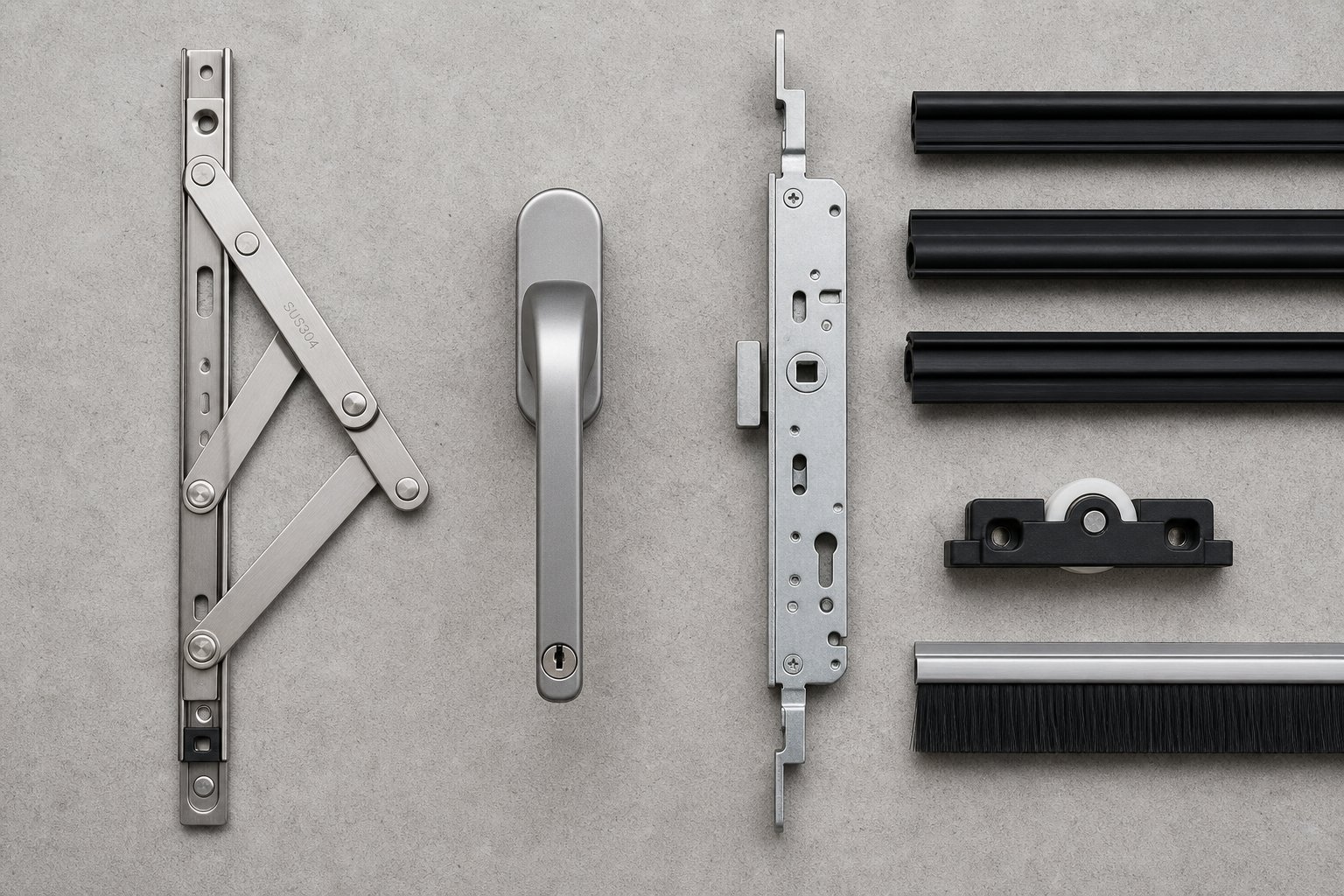
Knowing something is wrong is step one. Knowing which category of component to investigate is step two. Aluminium window components fall into three broad families: security hardware, movement hardware, and weatherproofing elements. Each family serves a distinct function, and each fails in recognisable ways. Here is the full breakdown.
Handles, Locks, and Security Hardware
This group controls how your window locks shut and how much compression force holds the sash against its seals. When security hardware wears out, you typically notice the window rattling despite being “locked,” or the handle spinning without engaging anything.
- Inline handles – Operate flush with the sash face on casement windows. Failure sign: handle feels loose, spins freely, or wobbles at the base.
- Cranked handles – Offset design used where the sash sits behind a projecting frame. Failure sign: same as inline but also watch for cracking where the crank bends.
- Espagnolette locks – A gearbox mechanism driven by the handle that moves vertical rods into keeps at the head and sill. Failure sign: handle operates but rods do not move, or excessive force is needed to engage the lock. A stripped gearbox or worn follower is often the culprit.
- Shootbolts – Vertical bolts that extend from the sash into the frame for added security points. Failure sign: bolt no longer reaches the keep due to misalignment or a bent rod.
- Keyed cylinders – Euro-profile or oval cylinders that add key-locking capability. Failure sign: key won’t turn, or the tailpiece no longer engages the gearbox correctly.
Together, these parts create multiple locking points and pull the sash tight against its seals. When any one fails, both security and weatherproofing suffer.
Hinges, Stays, and Movement Hardware
Movement hardware dictates how your window opens, how far it travels, and how much weight it supports. Problems here show up as stiffness, sagging, or a sash that drifts open or won’t stay in position.
- Friction stays – Spring-loaded arms that hold casement and awning sashes open at any angle. Failure sign: the sash drops under its own weight or won’t hold position when released.
- Top-hung hinges – Allow the sash to pivot outward from the top rail (awning style). Failure sign: excessive play, visible wear on pivot pins, or uneven gap at the sash bottom.
- Side-hung hinges – Support side-opening casements. Failure sign: sash drags on the sill or frame when opening, indicating hinge fatigue or loose fixings.
- Restrictor stays – Limit opening width for safety or ventilation control. Failure sign: stay snaps open past its intended stop, or the release button no longer functions.
- Sliding track rollers – Nylon or stainless steel wheels that carry sashes along horizontal tracks. Failure sign: grinding noise, jerky movement, or the sash lifting off the track at one end.
Hardware for aluminium windows in this category is sized by sash weight and track length. A mismatched friction stay, for instance, may hold the window initially but fatigue within months.
Seals, Gaskets, and Weatherproofing Components
Weatherproofing parts are the silent workers. They block wind, rain, and dust without any moving mechanism, relying purely on material compression and correct geometry. When they degrade, drafts and water ingress appear gradually rather than all at once.
- Rubber gaskets (EPDM) – Provide the primary perimeter seal between sash and frame. EPDM offers high UV and temperature resistance, making it the standard for Australian conditions. Failure sign: rubber hardens, cracks, turns white, or no longer springs back when pressed.
- Brush seals (pile weatherstripping) – Fine bristle strips used in sliding window tracks to block dust and air. Failure sign: bristles flatten permanently, leaving visible gaps between sash and frame.
- Compression weatherstripping – Foam or hollow rubber strips that compress when the sash closes. Failure sign: material develops a compression set and stays flat even when the window is open.
- Glazing beads – Snap-in aluminium or PVC strips that hold the glass pane within the sash. Failure sign: bead loosens, rattles, or pops out of its channel, allowing glass movement.
- Drainage caps and pressure equalisation components – Small covers and channels that manage condensation runoff and equalise air pressure within the frame cavity. Failure sign: water pooling inside the frame, or visible blockage of weep slots.
Seal profiles vary by manufacturer and system, so cross-section dimensions matter when ordering replacements. A seal that looks similar but sits 1 mm too narrow in the channel will leak from day one. That specificity, matching each part not just by type but by precise measurement, is where most sourcing mistakes happen. The sections ahead address exactly how to avoid them.
Window System Types and Their Specific Aluminium Window Frame Parts
Every spare part exists within a specific system. A friction stay designed for a casement window will never appear in a sliding frame. A multi-point lock from a tilt-and-turn sash has no equivalent on a fixed lite. Identifying your window type first eliminates entire categories of components from consideration and puts you on the right track immediately.
Casement and Awning Window Components
Casement windows hinge on the side and swing outward. Awning windows hinge at the top and push out from the bottom. Both rely on the same core group of aluminium window frame parts to function:
- Friction stays – These carry the full weight of the aluminium window sash as it opens. Stay length must match the sash width, and load rating must suit the sash weight. An undersized stay on a heavy double-glazed sash is a common failure point in Australian homes.
- Espagnolette locking systems – A single handle drives locking rods to multiple keeps around the frame perimeter, pulling the sash tight against compression seals.
- EPDM compression gaskets – The perimeter seal that creates airtightness when the locking mechanism draws the sash inward against the frame.
Casement and awning systems generally offer superior airtightness and wind pressure resistance compared to sliding systems because the sash compresses directly against rubber seals. That compression seal design also means their hardware wears differently: friction stays fatigue under sash weight, while espagnolette gears strip from repeated locking cycles.
Sliding Window Components
Sliding windows move horizontally along tracks without any hinge mechanism. Their hardware is entirely different from hinged systems:
- Track rollers – Nylon or stainless steel wheels that carry the sash along the bottom rail. Roller diameter and axle height must match the specific track profile.
- Track channels – The extruded aluminium rail the rollers sit in. Debris accumulation and corrosion here cause most sliding difficulties.
- Interlocks – The vertical members where two sashes overlap when closed. Interlocks provide the primary security engagement point.
- Pile weatherstripping – Fine brush seals fitted into the interlock and frame channels. Unlike compression gaskets on casement windows, pile strips rely on bristle density rather than rubber compression for their seal.
Sliding systems use hook locks or snail cams rather than espagnolettes. Their sealing performance is inherently lower because the sash sits parallel to the frame rather than compressing into it.
Tilt-and-Turn and Fixed Window Components
Tilt-and-turn windows are increasingly common in Australian residential projects, particularly where ventilation flexibility and easy cleaning access matter. A single handle controls multiple operating modes: tilted inward from the top for ventilation, or swung fully inward like a door for cleaning and egress.
The mechanism behind this relies on multi-point locking gear that runs the full perimeter of the sash. Corner drives redirect the locking rods around 90-degree bends, and the handle position determines which hinge set is active. These are precision components, and replacing one element (a corner drive, a tilt mechanism, or a turn hinge) requires exact compatibility with the overall system.
Fixed-lite windows, by contrast, have minimal hardware needs. They do not open. Their spare parts are limited to glazing beads, perimeter gaskets, and drainage components. If a fixed window has a problem, it is almost always a seal issue rather than a hardware failure.
The table below maps each window type to its primary hardware categories, giving you a quick reference for narrowing your search:
| Window Type | Movement Hardware | Locking Hardware | Sealing Components |
|---|---|---|---|
| Casement (side-hung) | Friction stays, side-hung hinges, restrictor stays | Espagnolette lock, shootbolts, keyed cylinder | EPDM compression gaskets, glazing beads, drainage caps |
| Awning (top-hung) | Friction stays, top-hung hinges, restrictor stays | Espagnolette lock, shootbolts | EPDM compression gaskets, glazing beads, drainage caps |
| Sliding | Track rollers, guide channels | Hook locks, snail cams, interlock latches | Pile weatherstripping, interlock seals, track drainage |
| Tilt-and-turn | Multi-point gear, corner drives, tilt and turn hinges | Perimeter multi-point lock (handle-driven) | EPDM compression gaskets, glazing beads, drainage caps |
| Fixed lite | None | None | EPDM perimeter gaskets, glazing beads, drainage caps |
With your window type confirmed, the next logical question shifts from “what kind of parts does my system use” to “which specific symptom tells me which part has failed.” That diagnostic step is where ordering confidence really begins.
Diagnosing Common Problems and Matching Them to Aluminium Window Repair Parts
You know your window type. You know which hardware families apply. The missing piece is connecting what you are experiencing right now, the draft, the jam, the rattle, to the specific component that has failed. Getting this diagnosis right is the difference between a single replacement part and a frustrating cycle of returns and reorders.
Drafts and Air Leaks
Cold air filtering through a closed window rarely points to a frame defect. In most cases, the culprit is a sealing component that has lost its ability to compress. EPDM gaskets harden and crack after years of UV exposure and thermal cycling. Compression weatherstripping develops a permanent set, staying flat even when unloaded. And pile weatherstripping on sliding windows loses bristle density until the seal is more gap than barrier.
There is another scenario that catches people out. A window can have perfectly healthy gaskets and still leak air if the espagnolette mechanism is not pulling the sash firmly against the frame. When locking hardware wears, it no longer generates enough compression to seat the seals properly. The draft feels like a seal problem, but the root cause is actually a mechanical one. Check the locking engagement before replacing gaskets.
Difficulty Opening or Closing
Stiff or jerky operation is one of the most common complaints, and the cause varies entirely by window type. On casement and awning windows, friction stays are the usual suspect. The internal spring mechanism fatigues over time, making the sash feel heavy or causing it to drop when released. Worn or misaligned hinges produce similar resistance, often accompanied by the sash dragging against the frame at one corner.
On sliding windows, the problem almost always lives in the track. Debris accumulation, corroded channels, or worn rollers create grinding resistance that worsens gradually. Misaligned rollers can also cause the sash to sit unevenly, binding against the head or jamb. A quick test: if the sash moves freely for the first 100 mm then catches, a roller is likely sitting at an incorrect height or has developed a flat spot.
Lock Failures and Security Concerns
A lock that no longer engages, or engages only with excessive force, is both a security risk and a weatherproofing issue. The most common aluminium window hardware replacement in this category involves the espagnolette gearbox. Wear typically occurs in the locking arms or gear assemblies, resulting in a handle that spins without driving the rods into their keeps.
Shootbolt misalignment is the second frequent offender. Building settlement or repeated slamming can shift the bolt path relative to the keep, meaning the bolt extends but misses its target. Worn keyed cylinders round out the list. If the key turns but nothing happens, the tailpiece connecting cylinder to gearbox has likely snapped or disengaged.
Rattling and Condensation
A window that rattles when closed usually signals one of two things: glazing beads have loosened in their channels, or perimeter gaskets have shrunk away from the sash edge. Both allow the glass or the sash itself to vibrate under wind pressure. These are straightforward aluminium window frame parts to replace once identified.
Condensation between the panes is a different matter entirely. Fogging inside a sealed double-glazed unit indicates that the insulated glass unit (IGU) seal has failed, allowing moisture to enter the cavity. This is not a hardware spare part issue. It requires IGU replacement, not a gasket or bead swap. Recognising this distinction saves time and money.
A Simple Diagnostic Sequence
Before ordering any parts for aluminium windows, work through this process to confirm your diagnosis:
- Identify your window type – Casement, awning, sliding, or tilt-and-turn. This narrows the possible hardware immediately.
- Describe the symptom precisely – Draft, stiffness, lock failure, rattle, or condensation. Note when it occurs (all the time, only under wind load, only in certain weather).
- Isolate the area – Run your hand around the frame perimeter to locate drafts. Open the window slowly to identify where resistance begins. Test the lock at each engagement point separately.
- Inspect the suspect component visually – Look for cracked gaskets, visible debris in tracks, loose glazing beads, or broken hardware. Photograph anything unusual.
- Test a simple fix first – Clean tracks, lubricate hinges with silicone spray, or tighten handle screws. If the symptom persists, the component needs replacement rather than maintenance.
- Record measurements and system markings – Before sourcing a replacement, note profile stamps, part dimensions, and system codes from the frame. This information determines exact compatibility.
That final step, recording measurements and system markings, is where the real specificity begins. A friction stay is not just a friction stay. It has a stack height, a track length, and a load rating that must match your sash. The next section breaks down exactly what to measure, where to measure it, and what tools you need.
How to Identify the Correct Spare Part for Your Aluminium Window
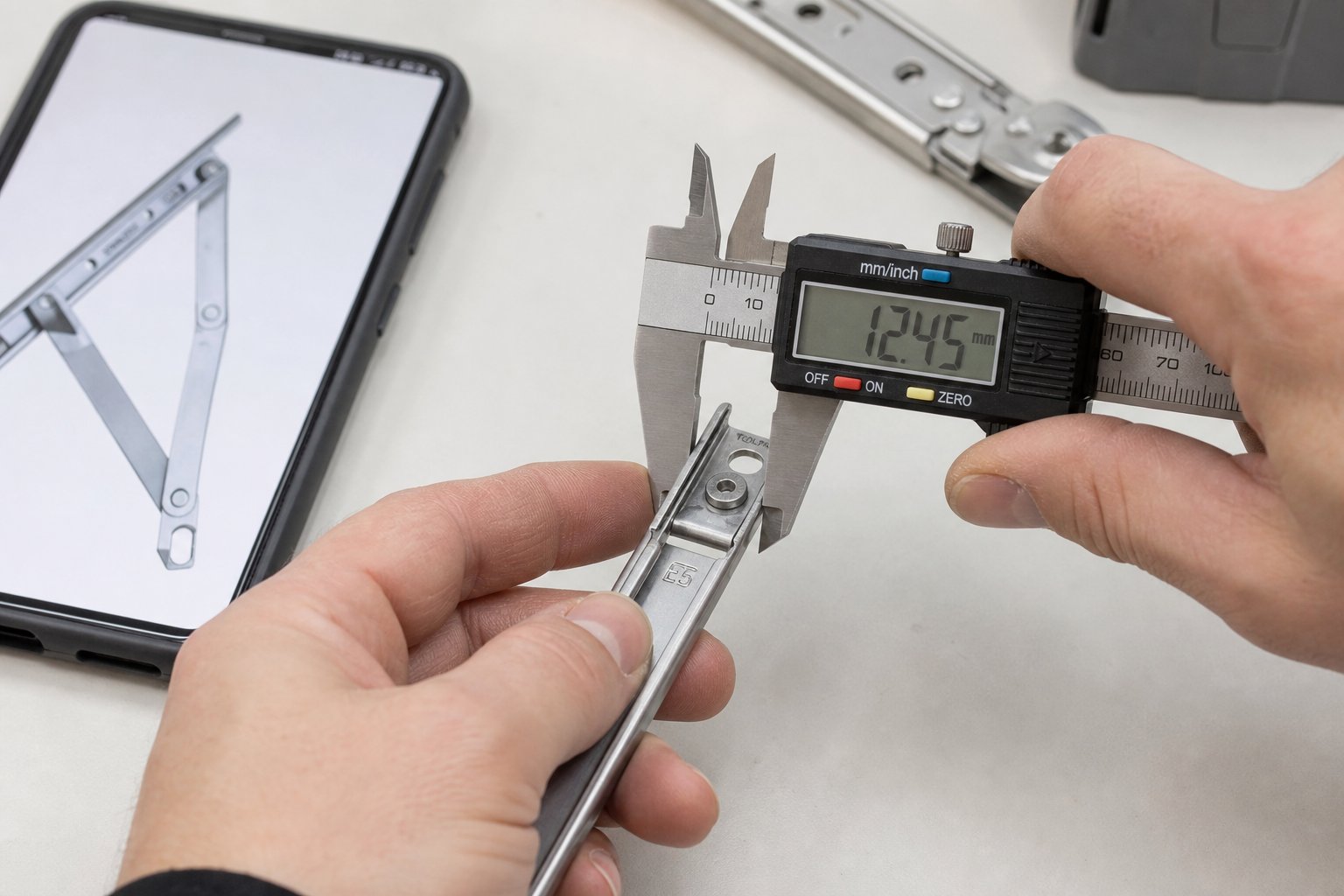
Incorrect identification is the single biggest reason aluminium window spare parts get returned. A friction stay that looks identical to the old one but measures 2 mm shorter in stack height will not seat properly. A handle with the wrong spindle length will spin without engaging the lock. These are not obscure edge cases. They represent the majority of failed orders, because most people source by appearance rather than by specification.
Getting measurements right the first time eliminates guesswork, prevents wasted money on returns, and keeps your repair timeline on track. Here is exactly what to measure, where to find it, and what tools you need for each component type.
Key Measurements to Take Before Ordering
Every aluminium window component has at least one critical dimension that determines compatibility. Measuring the wrong thing, or measuring in the wrong location, sends you straight to the returns counter. Below are the essential specifications for each major part category.
Handles: The spindle length is the measurement that catches people out. It is the square metal shaft that passes through the frame and engages the lock gearbox. Measure from the base of the handle (where it sits against the frame) to the tip of the spindle. Australian casement handles typically use a 7 mm square spindle, but lengths vary from 15 mm to 45 mm depending on the frame profile thickness. If you cut it too short, the gearbox will not engage. Too long, and the handle sits proud of the frame.
Locks (espagnolette gearbox): Two dimensions matter here. The backset distance is measured from the front face of the lock faceplate to the centre of the spindle hole (follower). The PZ dimension is measured from the centre of the spindle hole to the centre of the keyed cylinder hole. Get either wrong and the replacement will not align with the existing handle position or cylinder cutout in the frame.
Friction stays: Two numbers define a stay: track length and stack height. Track length is measured along the channel the stay arm slides within, and it roughly corresponds to the sash width. Stack height is the thickness of the hinge stack where it sits between the sash and frame, typically either 13 mm or 17 mm for most Australian aluminium systems. If you cannot physically measure the stack height (the stay is riveted in place and hard to access), note that some suppliers offer packer caps that convert a 13 mm stay to 17 mm.
Gaskets and seals: Cross-section shape and size are everything. A gasket might be 10 mm wide and 6 mm tall with a wedge-shaped foot, or 8 mm wide and 4 mm tall with a bulb profile. The difference is invisible at a glance but completely determines whether it will lock into the frame channel and compress correctly. Cut a short sample (50-100 mm) from a section that has not been stretched or compressed, and measure the width and height with digital callipers.
Sliding window rollers: Wheel diameter, housing width, and axle height all need to match. Most Australian sliding aluminium windows use rollers with wheel diameters between 18 mm and 32 mm, but the housing must sit within the sash rail without modification. Removing the existing roller and measuring directly is the only reliable method.
Reading Profile Stamps and System Codes
Here is something most homeowners never realise: aluminium window profiles are almost always stamped or etched with identifying information. This code tells you the extrusion system, the manufacturer, and sometimes the production batch. It is the fastest route to sourcing exact-match replacement parts.
Where to look:
- Frame rebate – Open the window and inspect the inner face of the frame where the sash sits against it. Stamps are often along the hinge channel or lock side.
- Top rail of the sash – Particularly on sliding windows. Pull the sash out if possible and check the top rail or side jamb for engraved serial numbers, manufacturer names, or production codes.
- Glass spacer bar – The edge of the double-glazed unit sometimes carries manufacturer identification, though this relates to the glass unit rather than the frame system.
- Hinge channel – After removing a friction stay or hinge, the channel beneath often reveals an embossed system code.
When you find a stamp, photograph it in sharp focus with something for scale (a ruler or coin beside it). Common codes in the Australian market reference systems from brands like AWS, Capral, Alspec, or Bradnams. Providing this code to a parts supplier immediately narrows compatibility to the exact extrusion profile your window uses.
If no visible stamp exists (it may be obscured by paint, corrosion, or dirt), check original building documentation. Construction plans, material supply lists, and warranty booklets from the builder often record the window system brand and model, as past building documents regularly list window specifications.
Cross-Referencing Discontinued and Legacy Parts
Older aluminium windows present a particular sourcing challenge. A window installed in the 1980s or 1990s may use hardware from a manufacturer that has since been acquired, rebranded, or shut down entirely. The original part number no longer appears in any current catalogue. This does not necessarily mean the window is beyond repair.
Two paths exist for sourcing old aluminium window parts:
Universal replacement parts: Many hardware components, particularly handles, friction stays, and rollers, have evolved toward standardised dimensions. If your measurements fall within common ranges and the mounting pattern aligns, a universal aftermarket part will function correctly. Gaskets are the main exception. Seal profiles remain highly system-specific, and a universal gasket rarely achieves the same compression as the original.
OEM-specific components: When the part geometry is unique to a particular system (think tilt-and-turn multi-point gear, proprietary espagnolette mechanisms, or custom-profile glazing beads), you need an exact-match replacement. Specialist suppliers maintain catalogues of obsolete and hard-to-find components across hundreds of brands, including legacy systems like Alenco and other manufacturers whose production lines have long ceased. These suppliers can often cross-reference a discontinued part number to a current-production equivalent if one exists.
For properties built in the 1970s or 1980s with combination aluminium storm window parts or early thermally unbroken frames, the hardware dimensions may differ significantly from modern systems. Measuring the existing component precisely and providing photographs to a specialist supplier is the most reliable approach when a direct catalogue match is unavailable.
Specification Checklist
Use this table as a reference before placing any order. Each row tells you what to measure, where to find it, and what tool gives an accurate result:
| Part Type | Measurement Needed | Where to Measure | Tool Required |
|---|---|---|---|
| Handle | Spindle length, spindle width (7 mm standard) | From handle base to spindle tip | Ruler or digital callipers |
| Espagnolette lock | Backset distance, PZ dimension, faceplate width | From faceplate face to follower centre; from follower to cylinder centre | Steel ruler, digital callipers |
| Friction stay | Track length, stack height (13 mm or 17 mm) | Along slide channel; from frame face to outer hinge face | Tape measure, digital callipers |
| Gasket / seal | Cross-section width, height, and foot profile shape | Cut a 50-100 mm sample from an undistorted section | Digital callipers, profile gauge (optional) |
| Sliding roller | Wheel diameter, housing width, axle-to-base height | Remove roller from sash rail and measure directly | Digital callipers |
| Keyed cylinder | Internal length, external length (from cam centre to each end) | Remove cylinder from lock body; measure each side from cam | Ruler or digital callipers |
| Glazing bead | Cross-section profile and clip foot dimensions | Remove a short section and measure width, height, and clip geometry | Digital callipers, profile gauge |
A set of digital callipers (accurate to 0.01 mm) and a steel ruler handle the vast majority of these measurements. For gaskets with complex profiles, a contour gauge pressed against the cross-section creates a visual template you can photograph and send directly to a supplier for matching.
Armed with precise measurements and a system code, you move from guessing to specifying. The question shifts from whether a part will fit to how long that part will last and what you can do to extend its service life.
Aluminium Window Component Lifespan, Maintenance, and Knowing When to Replace
Precise measurements get the right part on your window. But how long will that part actually last once installed? Knowing the typical aluminium window component lifespan for each hardware category lets you plan maintenance proactively, budget for future replacements, and make smarter decisions about whether continued repair still makes financial sense.
Typical Lifespan of Common Components
The aluminium frame itself is the longest-lived element, commonly lasting 40 to 50 years before structural concerns arise. The aluminium parts attached to that frame wear out considerably sooner. Here are general ranges under normal residential use:
- Friction stays: 7 to 12 years, depending on sash weight and how frequently the window is operated. Heavier double-glazed sashes shorten this range.
- Hinges: 10 to 15 years. Corrosion-prone environments cut this significantly.
- Handles and locks: 10 to 20 years with periodic lubrication. Coastal properties often see the lower end.
- Sliding rollers: 5 to 8 years. Exposure to dirt, moisture, and grit in the track accelerates degradation.
- EPDM gaskets: 10 to 20 years. UV exposure and extreme temperature cycling cause hardening and cracking.
- Pile weatherstripping: 5 to 10 years. Bristles flatten permanently under constant compression.
- Espagnolette gearboxes: 15 to 20 years for quality units, though stripped followers can appear earlier in high-use windows.
Properties in coastal areas, bushfire zones, or regions with high UV exposure (most of Australia, frankly) should expect aluminium parts to trend toward the lower end of each range. Salt air in particular drives filiform corrosion on unprotected metal hardware if residue is not cleared regularly.
Maintenance Practices That Extend Part Life
A few simple aluminium window maintenance tips, applied consistently, can push each component toward the upper end of its lifespan rather than the lower. The key is frequency over intensity: light, regular attention beats an annual overhaul.
- Monthly (coastal properties) or quarterly (inland): Rinse frames and hardware with fresh water to remove salt, dust, and airborne grit. Use a soft cloth with mild pH-neutral soap for stubborn marks. Avoid ammonia, bleach, or abrasive pads that strip protective coatings.
- Seasonally (every 3 to 4 months): Vacuum sliding tracks with a crevice attachment to remove debris. Clear weep holes and drainage slots of spider webs, dirt, and mulch. Inspect gaskets visually for cracking, whitening, or permanent compression set.
- Annually: Apply a dry silicone spray to friction stays, hinge pivots, lock mechanisms, and sliding rollers. Avoid oil-based lubricants like WD-40 for long-term use as they attract dust and eventually gum up moving parts. Check hinge tension and adjust fixings if the sash has developed play. Test espagnolette engagement at each locking point and note any increased resistance.
This rhythm takes minutes per window. Skipping it consistently shortens component life by years rather than months.
When Replacement Beats Repair
Replacing individual aluminium parts makes sense when the frame remains structurally sound and the issue is isolated. But there comes a point where continued component swaps become false economy. Recognising that threshold early saves money long-term.
Consider when to replace aluminium windows entirely rather than fitting new hardware:
- Frame corrosion beyond surface level – Pitting or structural weakening of the aluminium profile itself (not just surface oxidation) means hardware no longer mounts securely.
- Profile deformation – A frame that has warped, bowed, or shifted from square will not seal correctly regardless of how new the gaskets or hardware are.
- Thermal performance obsolescence – Older non-thermally-broken frames with single glazing cannot meet current NCC energy efficiency requirements through hardware upgrades alone. If you are renovating to comply with NatHERS ratings or improving comfort in a poorly insulated home, new thermally broken frames with insulated glass units deliver a step-change that no spare part can replicate.
- Repeated multi-component failure – If you are replacing gaskets, stays, and locks within the same 12-month period on the same window, the frame is likely approaching end-of-life and drawing other components down with it.
For most well-maintained aluminium windows in Australian conditions, individual component replacement remains cost-effective for 25 to 35 years. Beyond that, a holistic assessment of frame condition, energy performance, and cumulative repair costs determines whether your next step is another spare part or a conversation about new windows altogether.

Where to Source Aluminium Window Spare Parts
You have the diagnosis, the measurements, and the system code. The remaining question is where to actually buy the part. Sourcing channels for aluminium window spare parts range from retail shelf stock to fabrication-level partnerships, and the right choice depends on whether you are fixing one window at home or coordinating hardware across a 40-unit development.
Retail and Online Hardware Suppliers
For straightforward replacements like handles, friction stays, or standard-profile gaskets, retail and online specialists are the fastest route. Australian hardware retailers such as Bunnings carry a basic selection of window hardware, but their range tends to favour the most common residential profiles. If your window uses a standard AWS or Capral extrusion, you may find a compatible part on the shelf.
Specialist online stores offer broader catalogues. Dedicated aluminium door parts suppliers and window hardware retailers typically stock components across dozens of systems, including legacy and discontinued lines. They also provide technical filtering by measurement, which retail stores rarely offer in person.
The limitation of both channels is consistency. Big-box retailers stock high-turnover items but rarely carry non-standard profiles, obscure gasket cross-sections, or system-specific espagnolette mechanisms. Online specialists solve the range problem, though you are relying on your own measurements for compatibility.
Pros
- Quick access for standard components
- Suitable for one-off residential repairs
- Online stores allow filtering by specification and system brand
- Lower minimum order quantities (single-piece purchasing)
Cons
- Limited range for non-standard or legacy aluminium profiles
- No compatibility verification — you are responsible for measurement accuracy
- Bulk purchasing and project-level coordination not supported
- Technical support varies significantly between retailers
Working With a Fabrication Partner for Complex Requirements
Single-window repairs are one thing. Builders, developers, and procurement teams managing multi-unit projects face a different challenge entirely. When you need consistent hardware across 20 identical openings, or you are refurbishing a heritage building with profiles that no longer appear in any retail catalogue, the sourcing equation changes.
An aluminium window fabrication partner operates at a different level. Rather than simply stocking parts, they can verify component compatibility against original extrusion profiles, source hardware that matches specific system codes, and supply components as part of a broader project workflow that includes drawings, material schedules, and delivery coordination. This matters when incorrect hardware across multiple units multiplies cost and delays exponentially.
For trade professionals who need this kind of project-level support, MEICHEN’s Services & Solutions page outlines how their team supports builders and contractors from system recommendations through to material coordination and compatible hardware supply. It is one option worth considering when your requirements extend beyond picking a single part off a shelf and into territory where profile knowledge, batch consistency, and delivery scheduling become critical.
Pros
- Compatibility verified against original aluminium window profiles
- Access to system-specific and hard-to-source components
- Project-level coordination: drawings, schedules, and staged delivery
- Technical guidance on hardware selection for new and legacy systems
Cons
- Not cost-effective for single-part residential purchases
- Lead times may be longer than off-the-shelf retail supply
- Typically oriented toward trade and commercial clients rather than DIY homeowners
The sourcing channel you choose should match the scale and complexity of your project. A homeowner replacing one friction stay needs a reliable online store and accurate measurements. A builder fitting out an apartment block needs a partner who understands the full system and can guarantee consistency across every opening. Either way, the measurements and system identification covered earlier remain your foundation — no sourcing channel can compensate for an incorrect specification.
Your Aluminium Window Spare Parts Replacement Guide
Every section of this guide has been building toward the same outcome: getting the right part, first time, without wasted money or wasted weekends. Whether you are a homeowner dealing with one stiff casement or a site manager coordinating hardware across a multi-storey development, the workflow remains the same. Only the scale and sourcing channel change.
Your Spare Part Replacement Workflow
Here is the complete process distilled into a bookmarkable sequence. Each step depends on the one before it, so skipping ahead is where mistakes creep in.
- Confirm your window type – Casement, awning, sliding, tilt-and-turn, or fixed lite. This eliminates entire hardware categories from consideration immediately.
- Describe the symptom precisely – Draft, stiffness, lock failure, rattling, or condensation. Note whether it occurs constantly or only under specific conditions like wind load or rain.
- Isolate and inspect the failed component – Run your hand along the frame perimeter for drafts, operate the window slowly to identify resistance points, and visually check for cracked gaskets, debris in tracks, or broken hardware.
- Rule out maintenance fixes – Clean tracks, lubricate hinges, tighten screws. If the problem persists, a replacement part is needed rather than a tune-up.
- Measure the component accurately – Use digital callipers for spindle length, stack height, gasket cross-section, roller diameter, backset distance, and any other critical dimension specific to that part type.
- Locate and photograph the system code – Check the frame rebate, hinge channel, or top rail for embossed stamps. Reference brands like AWS, Capral, Alspec, or Bradnams narrow supplier searches instantly.
- Source from a compatible supplier – Match your measurements and system code to a specific product listing. For standard parts, an online specialist handles most residential needs. For project-scale or legacy-system requirements, work with a fabrication partner who can verify compatibility against the original profile.
- Install, test, and verify – Fit the replacement, operate the window through its full range, check seal compression, and confirm locking engagement at every point.
That sequence covers how to replace aluminium window hardware whether the job involves a single gasket or fifty matching friction stays. The discipline is the same at every scale: identify, diagnose, measure, verify, source.
Getting Professional Support for Complex Projects
For a homeowner fixing a kitchen casement, this guide and a reliable online parts supplier are usually enough. But aluminium window part sourcing for builders managing multi-unit developments, heritage refurbishments, or commercial fitouts brings complexity that individual part orders cannot address. When you need batch-consistent hardware across dozens of openings, legacy components cross-referenced to current-production equivalents, or delivery staged to match construction programming, the task moves beyond a shopping cart.
Trade professionals in that position benefit from fabrication-level support: a partner who can work from drawings and window schedules, recommend compatible systems, calculate material requirements, and coordinate delivery against project timelines. MEICHEN’s Services & Solutions page details how their team supports builders, architects, and project managers through that full process, from initial system recommendations through manufacturing coordination and delivery planning. It is a resource worth exploring when your scope exceeds straightforward part replacement and enters drawing-to-delivery territory.
Regardless of project scale, the principle holds: accurate identification prevents returns, correct measurements prevent rework, and the right sourcing channel prevents delays. Get those three right, and you have nailed your aluminium window spare parts replacement without wasting a dollar.
Frequently Asked Questions About Aluminium Window Spare Parts
1. What are the most commonly replaced aluminium window spare parts?
Friction stays, EPDM gaskets, sliding track rollers, and espagnolette lock gearboxes are the most frequently replaced components in Australian aluminium windows. Friction stays fatigue under sash weight over 7 to 12 years, gaskets harden and crack from UV exposure after 10 to 20 years, and rollers wear out within 5 to 8 years due to dirt and grit in the track. Coastal properties tend to need replacements sooner because salt air accelerates corrosion on metal hardware. In most cases, replacing a single failed component restores full window function without the expense of a complete window replacement.
2. How do I identify which spare part my aluminium window needs?
Start by confirming your window type (casement, awning, sliding, or tilt-and-turn), then match your symptom to the likely component. Drafts usually point to failed gaskets or weak lock compression. Stiff operation suggests worn friction stays or debris-clogged tracks. Lock failure typically involves a stripped espagnolette gearbox. Once you identify the suspect part, check the frame rebate or hinge channel for an embossed system code from brands like AWS, Capral, or Alspec. This code, combined with precise measurements using digital callipers, allows suppliers to match the exact replacement. For complex multi-unit projects, a fabrication partner like MEICHEN can verify compatibility against original extrusion profiles as part of broader project support.
3. Can I use universal replacement parts on older aluminium windows?
Universal parts work well for many standard components such as handles, friction stays, and rollers, provided your measurements fall within common ranges and the mounting pattern aligns. However, system-specific components like tilt-and-turn multi-point gear, proprietary espagnolette mechanisms, and custom-profile gaskets often require exact-match replacements. Gaskets are particularly problematic because seal profiles remain highly system-specific, and a universal gasket rarely achieves the same compression seal as the original. For legacy systems from the 1970s through 1990s, specialist suppliers maintain catalogues of obsolete hardware and can often cross-reference discontinued part numbers to current-production equivalents.
4. What measurements do I need before ordering aluminium window hardware?
Each component has critical dimensions that determine fit. For handles, measure spindle length from the base to the tip (typically 15 mm to 45 mm) and confirm the 7 mm square width. For espagnolette locks, record both the backset distance and PZ dimension. Friction stays require track length and stack height (usually 13 mm or 17 mm). Gaskets need cross-section width, height, and foot profile shape measured from an undistorted sample using digital callipers. Sliding rollers require wheel diameter, housing width, and axle-to-base height. Taking these measurements accurately before ordering is the single most effective way to avoid costly returns and project delays.
5. When should I replace the entire aluminium window instead of fitting new spare parts?
Individual part replacement remains cost-effective for well-maintained aluminium windows up to about 25 to 35 years old. Beyond that, consider full replacement if you observe frame corrosion that goes deeper than surface oxidation, profile deformation that prevents proper sealing regardless of new gaskets, or repeated multi-component failures on the same window within a 12-month period. Thermal performance is another deciding factor: older non-thermally-broken frames with single glazing cannot meet current NCC energy efficiency requirements through hardware upgrades alone. If your renovation needs to achieve specific NatHERS ratings, new thermally broken frames with insulated glass units deliver performance that no spare part can replicate.
More Window & Door Guides