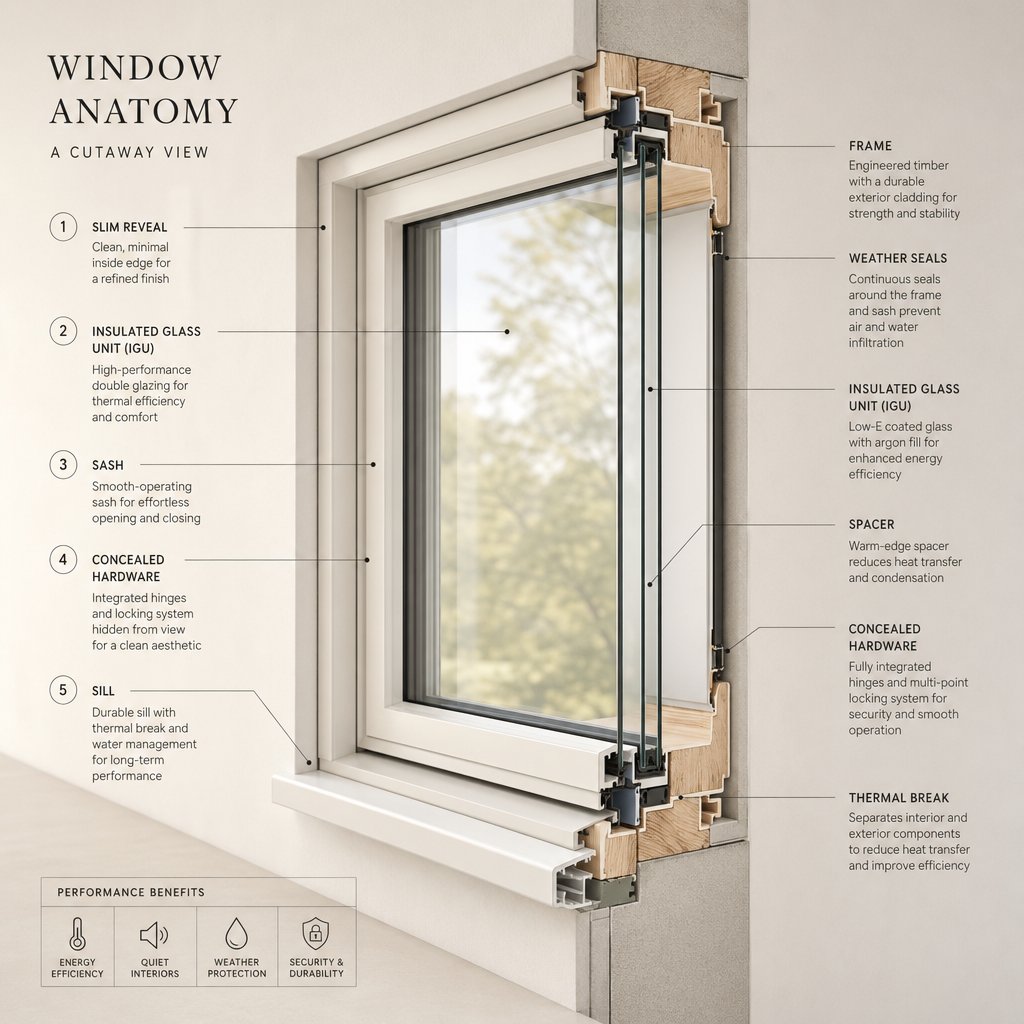
What Makes Aluminium the Dominant Window Frame Material
A metal window frame built from aluminium alloy is not just a border around glass. It is a precision-engineered structural system, and every decision about its composition ripples through decades of performance.
Defining Aluminium as a Window Frame Material
Aluminium window frame material refers to extruded aluminium alloy profiles engineered to form the structural skeleton of a window system, providing strength, weather resistance, and design flexibility.
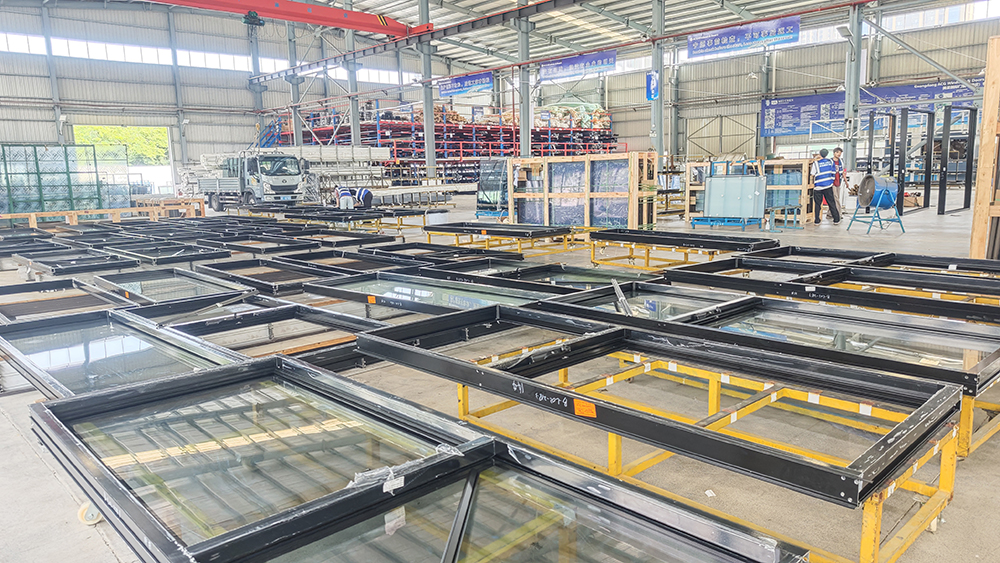
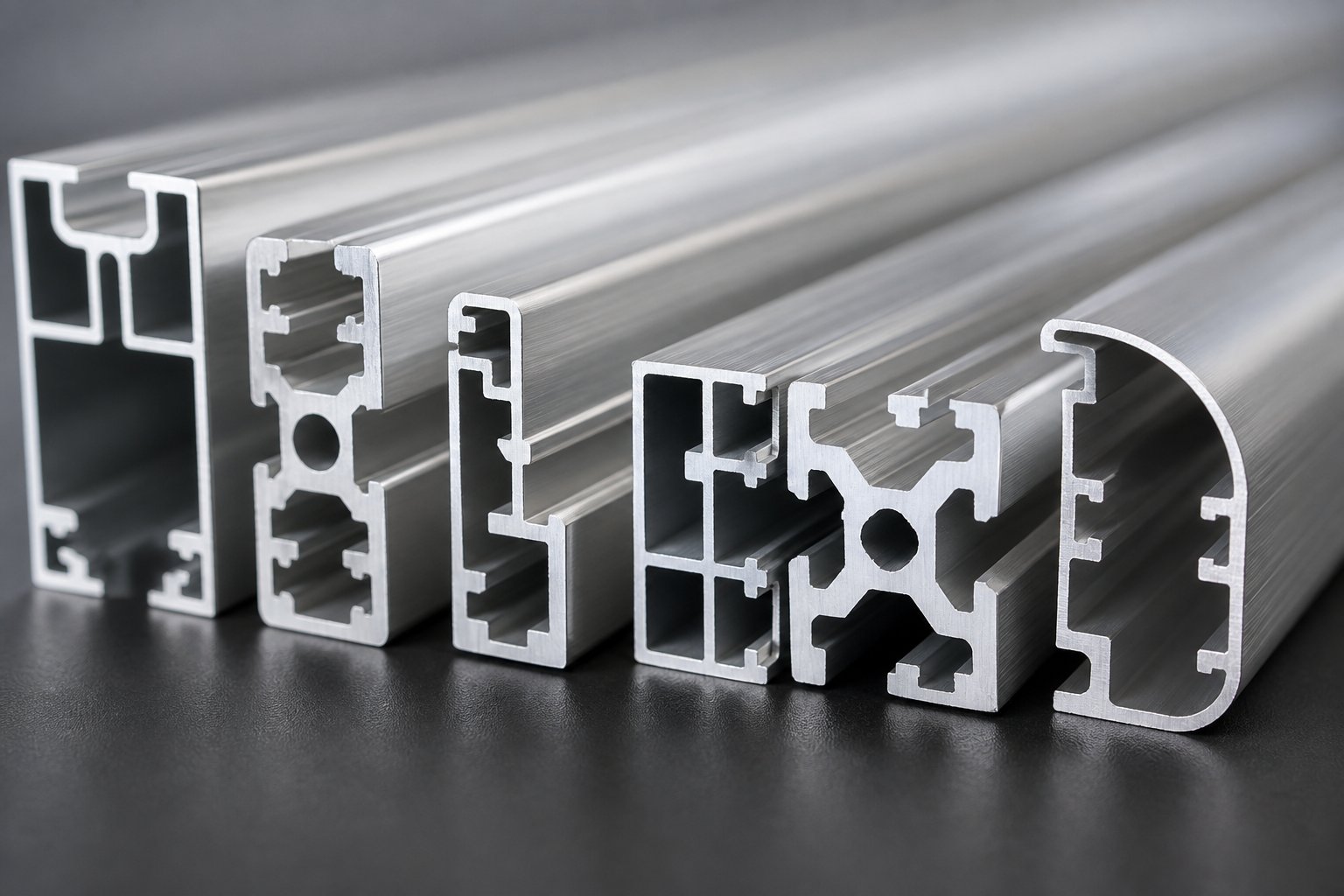
In practical terms, manufacturers heat cylindrical aluminium billets and force them through steel dies under immense hydraulic pressure. The result is a continuous hollow profile, complete with internal chambers, drainage pathways, and cavities designed to accept thermal break inserts. Once cut to length, these extrusions become the framework that holds glazing in place, resists wind loads, sheds water, and anchors hardware across a service life that routinely exceeds 40 years.
Why Frame Material Choice Impacts Every Project Outcome
Choosing the wrong window frame material shows up in ways that compound over time. Structural integrity under wind pressure, thermal performance through summer heat and winter cold, condensation resistance, colour stability, and long-term maintenance burden all trace back to one origin point: what the frame is actually made of, and how well it was made.
This matters whether you are a homeowner weighing aluminium against timber or uPVC, an architect specifying compliant systems for a multi-storey development, or a builder sourcing frames that meet AS 2047 without blowing out the project budget.
The pages ahead go deeper than most guides dare. We will walk through specific alloy grades and what separates them, the extrusion process that determines profile quality, thermal break technology that overcomes aluminium’s natural conductivity, surface treatments that define appearance and longevity, and climate-specific specification guidance for Australian conditions. Each layer of understanding builds toward a single outcome: choosing the right aluminium frame material the first time, so you are not replacing it a decade too early.
Aluminium Alloy Grades and How to Choose Between Them
Not all aluminium frame material performs the same way under load, through the anodising bath, or across a 30-year service life. The difference comes down to alloy grade and temper designation — two variables that most window brochures gloss over entirely. Understanding them puts you in a position to specify with confidence, whether you are choosing metal frame windows for a coastal home or large-span commercial window frames for a multi-storey fitout.
Understanding 6063-T5 and Why It Dominates Architectural Glazing
If you pull a section through virtually any residential aluminium window sold in Australia, the profile is almost certainly 6063 alloy. This magnesium-silicon formulation (roughly 0.6% silicon, 0.9% magnesium) exists specifically because it flows beautifully through complex extrusion dies, producing smooth surfaces with sharp detail. For aluminium alloy windows where appearance and corrosion resistance matter as much as strength, nothing else comes close in terms of value.
The T5 temper designation means the profile was cooled directly from the extrusion press and then artificially aged — no separate solution heat treatment step. This keeps residual stresses low, maintains dimensional stability in thin-walled sections, and delivers an ultimate tensile strength of approximately 145 MPa. For standard residential window spans and typical Australian wind regions, that is more than adequate.
The T6 temper takes the same 6063 alloy through a full solution heat treatment followed by water quench and artificial ageing. The result is roughly 190 MPa ultimate tensile strength — a meaningful jump that allows smaller cross-sections to carry higher loads. The trade-off: quenching can introduce distortion in complex profiles, and production cost increases. Specifiers reach for 6063-T6 when a project demands slimmer sightlines without sacrificing structural capacity.
When to Specify 6061-T6 or 6005 for Structural Demands
Large commercial window frames, curtain wall mullions spanning floor-to-floor heights, and high-wind-zone applications push beyond what 6063 can handle. That is where 6061-T6 enters the conversation. With an ultimate tensile strength around 290 MPa and yield strength near 240 MPa, it provides the structural backbone for projects where deflection limits are tight and safety factors leave no room for compromise.
The catch? 6061 does not extrude as willingly through intricate die geometries. Its higher silicon and copper content increases flow resistance, meaning profiles tend toward simpler cross-sections with thicker walls. Surface finish quality is also a step below 6063 — acceptable for powder-coated commercial frames, less ideal where a pristine anodised finish is the brief.
Sitting between these two is 6005, an alloy gaining traction for thicker-walled window profiles and structural sub-frames. It offers better extrudability than 6061 with improved strength over 6063, making it a practical middle ground for projects that need a little more structural capacity without sacrificing profile complexity. European markets also commonly use 6060, which has slightly lower magnesium content than 6063 and correspondingly lower strength — suited to lighter-duty applications where fabrication ease is prioritised.
How Alloy Grade Affects Finish Quality and Longevity
The relationship between alloy chemistry and surface treatment is direct. 6063’s low iron content and balanced magnesium-silicon ratio produce a consistently bright, uniform oxide layer during anodising. Alloys with higher magnesium or trace impurities can develop mottled or streaky anodised surfaces — a cosmetic issue that no amount of post-processing fully corrects.
For powder coating adhesion, the story shifts slightly. Pretreatment processes (chromate-free conversion coatings, mechanical etching) matter more than base alloy, though 6063 and 6060 still tend to accept paint more uniformly than 6061 due to their finer grain structure. When specifying metal frame windows that must hold colour and resist chalking across decades of Australian UV exposure, starting with the right alloy is the first layer of insurance.
| Grade | Typical Use | Relative Strength | Extrudability | Surface Finish Quality | Best Application |
|---|---|---|---|---|---|
| 6063-T5 | Standard residential and architectural windows | Moderate | Excellent | Superior | Residential windows, sliding doors, louvres |
| 6063-T6 | Slim-profile residential and light commercial | Moderate-High | Excellent | Superior | Slim sightline designs, awning windows |
| 6060 | European-market window systems | Low-Moderate | Excellent | Very Good | Lighter-duty profiles, tilt-and-turn frames |
| 6005 | Thicker-walled structural profiles | Moderate-High | Good | Good | Sub-frames, structural mullions, transoms |
| 6061-T6 | Large-span commercial and high-wind zones | High | Moderate | Fair | Commercial curtain walls, cyclone-rated frames |
Choosing the right grade is really about matching the alloy’s capabilities to the demands your project places on it — span, wind load, finish expectation, and budget. But even the best alloy is only as good as the extrusion process that shapes it into a usable profile.
How the Extrusion Process Determines Frame Performance
An aluminium window profile is only as good as the process that shapes it. Two frames made from identical 6063-T5 billets can perform very differently if one was extruded with tighter die tolerances, better temperature control, and more consistent quenching. The extrusion journey — from raw billet to finished window profile — embeds quality characteristics that no downstream fabrication step can fully correct.
From Billet to Profile — The Extrusion Journey
The process begins with a cylindrical aluminium billet heated to between 400 and 520 degrees Celsius — hot enough to become malleable without melting. A hydraulic press then forces this heated metal through a precision-machined steel die at pressures ranging from 800 to 2,500 tonnes. The die’s aperture defines the exact cross-sectional geometry of the extruded aluminium window frame, including hollow chambers for structural rigidity, integrated drainage channels, and cavities sized to accept thermal break strips.
As the profile emerges, it is rapidly cooled — either by water quench or forced air — to lock in the desired crystalline structure. A mechanical stretching step follows, straightening the length and relieving internal stresses before the profile moves to artificial ageing furnaces for final temper development. The result is a continuous length of aluminium window profile, dimensionally stable and ready for cutting and fabrication.
Die Design and Its Impact on Frame Sightlines
Every extruded aluminium window frame starts life as a die drawing. The die’s geometry dictates minimum wall thickness, internal chamber count, and the thinness of visible frame edges — what the industry calls sightlines. Slimmer sightlines mean more glass and less frame visible to occupants, which is exactly what contemporary architecture demands.
Here is where alloy selection circles back. 6063 flows more readily through complex die geometries than 6061 because its lower alloying content reduces flow resistance. This means manufacturers can push 6063 through dies with thinner wall sections and tighter internal radii, achieving narrower aluminium window profiles without compromising fill. Specifying 6061 for a slim-sightline residential frame often forces thicker walls to ensure complete die fill, partially defeating the purpose.
But thinner walls are not automatically better. A window profile must resist deflection under wind load — particularly relevant in Australian wind regions W1 through W5 under AS 1170.2. Reduce wall thickness too aggressively and the frame bows inward under negative pressure, compromising seal compression and potentially cracking glazing units. Good die design balances visual slimness against structural moment of inertia, placing material strategically where bending stresses concentrate.
Quality Standards and Tolerance Specifications
Dimensional consistency across aluminium window extrusion profiles separates reliable systems from problematic ones. When wall thickness varies along a profile’s length, gaskets compress unevenly, hardware binds, and weatherseals fail prematurely. Industry standards exist to prevent this.
For the Australian market, the key references are EN 12020 (tolerances on precision profiles in 6060 and 6063 alloys), EN 755-9 (general extrusion tolerances), and ASTM B221 (the American standard for aluminium alloy extruded bars, rods, wire, profiles, and tubes, widely referenced in international supply chains). Structural design of aluminium frames in Australia falls under AS 1664, which governs allowable stresses and deflection limits.
Typical dimensional tolerances for architectural window profiles include wall thickness accuracy of plus or minus 0.15 to 0.25 mm, cross-sectional dimensions within plus or minus 0.3 mm for profiles under 200 mm, and straightness deviations no greater than 1 mm per metre of length.
When evaluating aluminium window profiles from any supplier, architects and builders should verify the following quality indicators:
- Consistent wall thickness across the full profile length — measured at multiple points, not just the cut ends
- Sharp, well-defined internal corner radii indicating complete die fill and proper extrusion pressure
- Dimensional tolerance compliance with EN 12020 or equivalent, confirmed by the extruder’s quality certificates
- Absence of surface tearing, drag marks, or die lines that signal worn tooling or incorrect billet temperature
- Straightness within specification — bowed profiles create assembly headaches and compromise seal performance
These indicators matter most at the point of procurement. Once profiles are cut, fabricated, and installed, dimensional deficiencies become embedded problems that drive callbacks and premature seal failures. Requesting test certificates and verifying tolerance class before committing to a supplier is a small step that pays off across the life of the frame.
Of course, even a perfectly extruded profile still faces aluminium’s fundamental weakness: thermal conductivity. The next layer of engineering — thermal break technology — transforms raw aluminium from a heat bridge into a genuine insulating system.
Thermal Break Technology That Transforms Aluminium Performance
Aluminium conducts heat at roughly 200 to 235 W/(m·K). PVC sits around 0.16 W/(m·K). That gap — over a thousand-fold — is the single biggest objection architects and homeowners raise against aluminium window profiles. Left unaddressed, it turns a frame into a heat highway, funnelling energy straight through the building envelope. But modern thermally broken systems close this gap so effectively that aluminium now competes directly with timber and uPVC on thermal metrics, without sacrificing the structural and aesthetic advantages that made it dominant in the first place.
Why Raw Aluminium Conducts Heat and What That Means for Frames
A solid aluminium extrusion is essentially a continuous metal bridge between indoor and outdoor temperatures. In winter, heat migrates outward through the frame at a rate that chills the interior surface well below dew point. In summer, the process reverses — exterior heat conducts inward, loading the air conditioning system with extra work. An untreated aluminium window profile in a standard residential assembly can produce a frame U-value above 5.0 W/(m²·K), which undermines even the best double-glazed unit sitting within it.
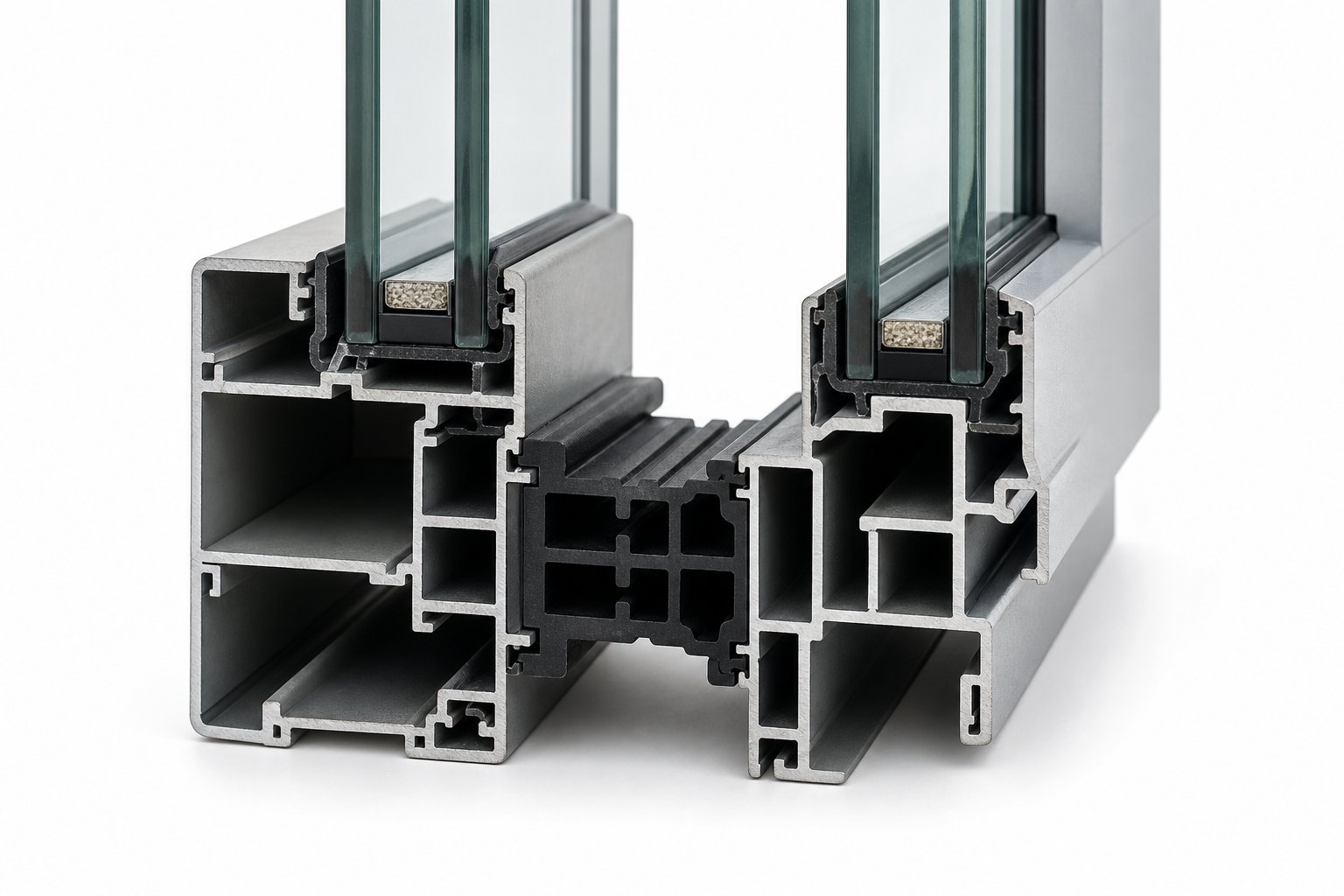
The solution is not to change the metal. It is to interrupt the conductive path. Thermal break technology splits the frame into two separate aluminium profiles — one facing the interior, one facing the exterior — connected by a strip of low-conductivity insulating material. This insulating bridge reduces the complete assembly’s effective thermal conductivity to between 1.8 and 3.5 W/(m·K), and paired with quality glazing, achieves window U-values in the range of 1.8 to 2.5 W/(m²·K). That represents a 50 to 70 per cent improvement over non-thermally-broken aluminium frames.
PA66 Nylon vs Polyurethane Thermal Break Materials
Two materials dominate thermal break construction, and they are not interchangeable. Each suits different profile geometries, structural demands, and manufacturing processes.
Polyamide (PA66 nylon) strips are rigid, pre-formed insulating bars — typically reinforced with 25 per cent glass fibre — that get mechanically crimped between the inner and outer aluminium profiles. The crimping process uses knurled teeth cut into the aluminium pocket walls, with over 580 kilograms of staged pressure locking the strip into a load-bearing composite. PA66 has a thermal conductivity of just 0.3 W/(m·K), excellent dimensional stability across temperature extremes, and a coefficient of thermal expansion close enough to aluminium that differential movement does not compromise the joint over decades of cycling. Glass-fibre reinforcement adds bending stiffness, making PA66 the standard for structural window profiles that must carry glazing weight and resist wind loads without deflection.
Polyurethane takes a fundamentally different path. In the pour-and-debridge method, a liquid two-part polymer is dispensed into a channel extruded directly into the aluminium profile. Once cured into a rigid mass, the aluminium bridge at the base of the channel is mechanically removed, leaving the polyurethane as the sole thermal and structural connection. This method offers design flexibility — the insulating zone can be shaped to fill irregular cavities that pre-formed strips cannot easily reach — but polyurethane is inherently less rigid than glass-fibre-reinforced PA66, and its dimensional behaviour over long thermal cycles is less predictable.
For most window profiles sold in Australia, PA66 with glass-fibre reinforcement has become the default. It satisfies EN 14024 requirements for structural thermal barrier assemblies, including shear strength and transverse tensile strength testing that verifies the composite profile performs as a single structural member rather than two loosely connected halves.
| Property | PA66 Nylon (Glass-Fibre Reinforced) | Polyurethane (Pour and Debridge) |
|---|---|---|
| Structural Strength | High — load-bearing composite with aluminium | Moderate — adequate for lighter-duty profiles |
| Thermal Performance | 0.3 W/(m·K) conductivity | Similar low conductivity, varies with density |
| Dimensional Stability | Excellent across temperature extremes | Good, but more susceptible to long-term creep |
| Profile Geometry Flexibility | Requires pre-formed strip geometry to match pocket | Fills irregular cavities and complex shapes |
| Manufacturing Method | Mechanical crimping of pre-formed strips | Liquid pour, cure, then debridge |
| Typical Applications | Residential and commercial window profiles, doors, curtain walls | Custom or complex profile geometries, some curtain wall systems |
Condensation Resistance Through Smart Frame Design
Thermal breaks do more than save energy. They keep the interior face of the frame warm enough to stay above dew point — the temperature at which moisture in the air condenses onto a surface. In climates like Melbourne, Canberra, or the NSW Southern Tablelands where winter mornings routinely drop below 5 degrees Celsius, untreated aluminium frames weep with condensation that damages paint, rots adjacent timber reveals, and encourages mould growth.
Three design factors determine whether a thermally broken frame resists condensation in practice:
- Thermal break depth — a deeper insulating zone pushes the cold aluminium further from the interior surface, raising the temperature of the indoor-facing profile. Frames targeting colder Australian climate zones typically specify thermal breaks of 24 mm or deeper.
- Profile chamber design — multi-chamber construction within the interior aluminium section creates still-air pockets that add secondary insulation, further warming the frame surface relative to the exterior.
- Frame-to-glass interface — the junction where aluminium meets the insulated glass unit is a common cold spot. Well-designed window profiles use EPDM gaskets and thermally isolated glazing beads to prevent the glass edge from conducting cold back into the visible frame surface.
Together, these elements allow thermally broken aluminium to maintain interior surface temperatures well above condensation thresholds in nearly all Australian climate zones. The frame effectively behaves as an insulated assembly rather than a bare metal conductor — a transformation that shifts aluminium from its weakest talking point into genuine competition with timber on thermal comfort.
Still, thermal performance is only half the durability equation. The surface treatment applied to that aluminium determines how the frame weathers UV exposure, salt air, and decades of Australian climate over its installed life.
Surface Treatments That Protect and Define Aluminium Frames
Raw aluminium develops a thin natural oxide layer within minutes of exposure to air — roughly 2 to 4 nanometres thick. That passive film offers some protection, but it is nowhere near sufficient for an aluminium window profile exposed to decades of UV radiation, salt-laden coastal winds, or the intense solar cycling common across Australian climate zones. Surface treatment is what bridges the gap between bare metal and a finish that holds its colour, sheds grime, and resists corrosion for the warranty period and well beyond.
Three systems dominate architectural aluminium finishing globally, and each suits a different balance of performance, budget, and aesthetic ambition.
Anodising vs Powder Coating vs PVDF Finishes
Each treatment works through a fundamentally different mechanism. Understanding that mechanism helps specifiers match the right finish to their project’s environmental exposure and design intent.
- Anodising — an electrochemical process that converts the aluminium surface itself into a hard, integral aluminium oxide layer. The profile is immersed in a sulphuric acid electrolyte bath and subjected to direct current, growing a porous oxide coating typically 15 to 25 micrometres thick for architectural applications. Sealing in hot deionised water or nickel acetate closes the pores, locking in corrosion resistance and any absorbed dye colour. The result is not a coating sitting on top of the metal; it is the metal transformed into ceramic-hard protection.
- Powder coating — a dry thermoset polymer powder applied electrostatically to the pretreated aluminium surface and cured at approximately 180 to 200 degrees Celsius. The cured film typically measures 60 to 80 micrometres thick and bonds mechanically and chemically to the prepared substrate. Powder coat systems offer the widest colour range of any aluminium finish, from standard RAL solids through to metallic, pearlescent, and textured effects.
- PVDF/fluoropolymer coating — a premium liquid-applied system based on polyvinylidene fluoride resin (minimum 70 per cent PVDF content in quality systems). Applied in multiple coats, PVDF provides exceptional UV resistance and colour stability in extreme environments. Its carbon-fluorine molecular bonds are among the most stable in organic chemistry, translating directly into fade resistance that outlasts standard powder coats by a significant margin.
How Alloy Composition Affects Surface Treatment Results
The alloy grade discussion from earlier chapters feeds directly into finish selection. Alloy 6063 is the preferred substrate for anodising precisely because its low iron and copper content produces a more uniform oxide layer, consistent colouring, and superior surface brightness. When iron exceeds approximately 0.25 per cent — common in 6061 or lower-grade extrusions — the anodised layer develops grey streaking or mottled patches that no amount of dyeing can mask. Copper traces create a yellowish cast. For projects specifying natural silver or light-coloured anodised aluminum window profiles, 6063 is effectively non-negotiable.
Powder coating is more forgiving of alloy variation because the finish is an applied film rather than a conversion of the base metal. Pretreatment quality matters more than alloy grade in this context. However, 6063’s finer grain structure still accepts pretreatment chemicals more uniformly, which contributes to better long-term adhesion and fewer micro-blistering failures in aggressive environments.
PVDF finishes, being liquid-applied over a primer coat, are the least sensitive to base alloy. Their performance depends almost entirely on application technique, film thickness control, and the quality of the chromate-free conversion coating beneath. This makes PVDF a practical choice for mixed-alloy assemblies where structural mullions in 6061 must achieve the same aesthetic as 6063 sash profiles within the same metal frame window system.
Colour Stability and Warranty Considerations
Warranty periods vary dramatically between treatment types, and they serve as a reliable proxy for expected service life in the field.
Anodised finishes on architectural aluminium window profiles typically carry warranties against significant colour change or corrosion failure for 10 to 20 years, depending on oxide thickness and sealing quality. The oxide layer does not flake or peel — it can only be worn away mechanically — but its limited colour palette restricts design freedom to natural silver, bronze, black, and a handful of electrolytic shades.
Powder coating warranties align broadly with the AAMA performance tier system: entry-level formulations offer around one year of guaranteed performance, mid-range coatings extend to five years against chalking and fade, and high-performance systems warranted to the most stringent level deliver up to ten years of proven resistance under harsh UV and weathering exposure. Australian coastal and high-UV environments demand at minimum the mid-range tier, with premium systems strongly recommended for north-facing elevations and unshaded facades.
PVDF coatings sit at the top of the durability hierarchy. Quality systems maintain colour and gloss for 20 to 30 years in even the most demanding exposures — including the intense UV loads and salt environments found along the Australian coastline. The cost premium over standard powder coat is significant, but for high-visibility commercial projects or homes where recoating access is difficult or expensive, the lifecycle economics often justify the upfront investment.
Beneath all three systems, surface preparation determines whether the finish survives to its warranty limit or peels within a few years. The industry has largely transitioned from hexavalent chromate pretreatments to chromate-free alternatives — typically zirconium or titanium-based conversion coatings — driven by environmental regulation. These newer pretreatments perform well when applied correctly, but they are less forgiving of process variation. Alkaline degreasing, acid etching to create mechanical tooth, thorough deionised-water rinsing, and consistent conversion coating weight all contribute to long-term adhesion. Skipping any step, or rushing rinse cycles, creates adhesion failures that surface months or years after installation.
| Treatment | Durability | Colour Range | Relative Cost | Best Environment |
|---|---|---|---|---|
| Anodising (15-25 micrometres) | Excellent — integral oxide cannot peel | Limited (silver, bronze, black, select dyes) | Medium-High | Coastal, high-abrasion, heritage-aesthetic projects |
| Powder Coating (60-80 micrometres) | Very Good — high abrasion and weather resistance | Extensive (full RAL range, metallics, textures) | Medium | Residential, commercial, most Australian climates |
| PVDF/Fluoropolymer (multi-coat system) | Superior — exceptional UV and chemical resistance | Good (solid colours, metallics, limited textures) | High | Extreme UV, coastal, industrial, high-rise facades |
Beyond these core systems, design versatility continues to expand. Woodgrain sublimation transfers — where a printed film is heat-bonded to a powder-coated base — now convincingly replicate timber species from spotted gum to Tasmanian oak, giving aluminium frames the visual warmth of wood without timber’s maintenance demands. Textured powder coats mimic sandblasted stone or raw concrete. Matt finishes reduce glare on sun-drenched elevations while gloss options suit sleek contemporary facades. The aluminium window profile has evolved from a handful of silver and white options into a design palette limited more by imagination than material capability.
Selecting the right surface treatment locks in appearance and corrosion resistance for decades. But protection from the environment extends beyond the frame’s own surface — particularly when other metals in the assembly introduce an invisible electrochemical threat.
Matching Aluminium Frame Specifications to Your Climate
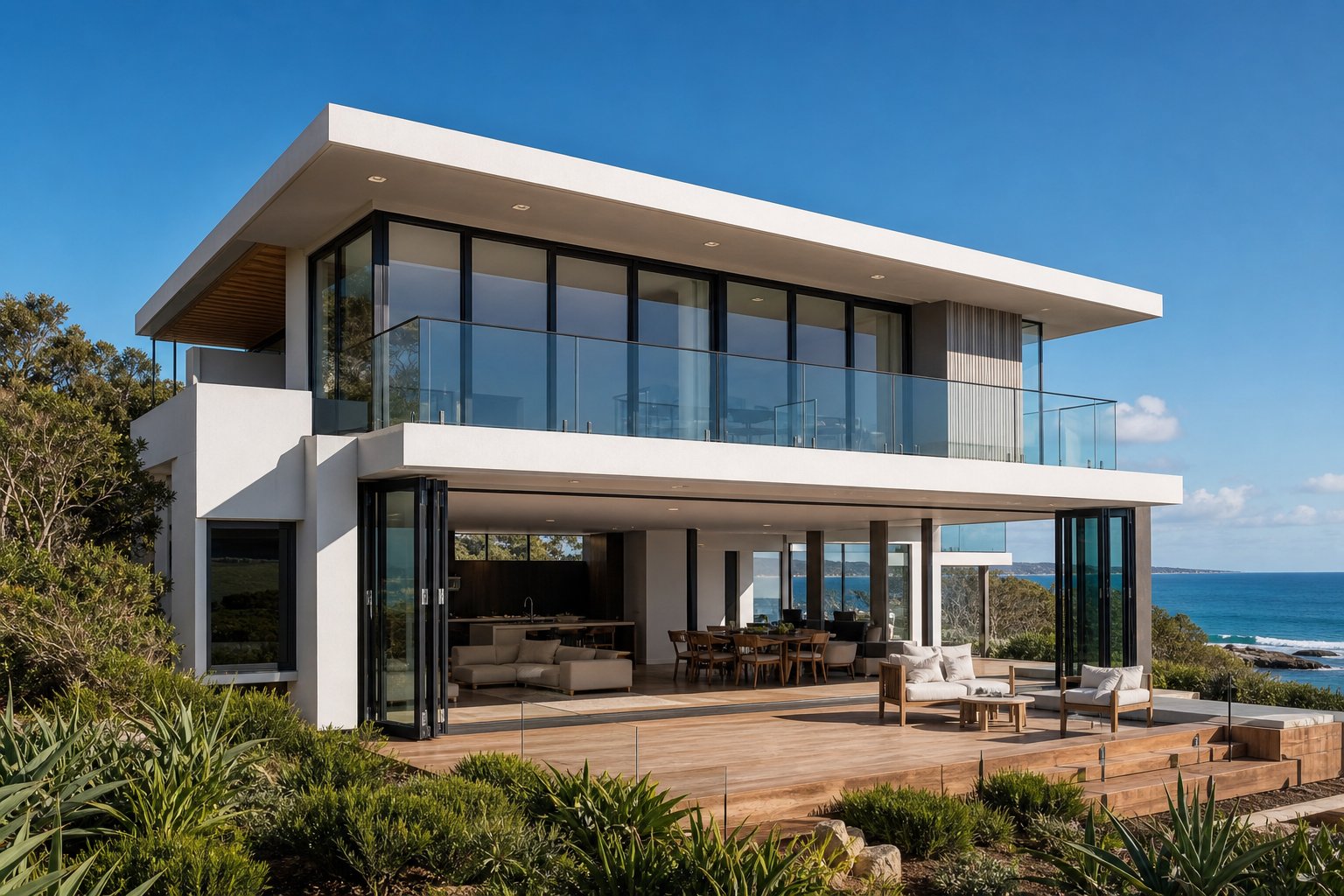
Environment does not just threaten the surface finish of metal window frames — it dictates which alloy, which thermal break depth, and which coating system will actually survive long enough to justify the investment. A specification that performs flawlessly in temperate Melbourne may corrode within a decade on the Sunshine Coast, or fail structurally under cyclonic wind pressures in Karratha. Climate-based material selection is not optional. It is the difference between a 40-year frame and a 15-year replacement cycle.
Coastal Environments and Corrosion-Resistant Specifications
Salt spray is relentless. Properties within 1 kilometre of breaking surf face concentrated airborne chlorides that attack aluminium’s passive oxide layer, particularly at cut ends, drainage slots, and hardware fixings where protection is thinnest. Standard powder coating at 60 micrometres may not be enough. Coastal aluminium frame window systems demand either marine-grade anodising at 20 to 25 micrometres minimum, or powder coat systems built to the highest performance tier with enhanced chromate-free pretreatment for salt resistance.
Alloy selection matters here too. While 6063-T5 remains the base extrusion alloy, some manufacturers specify 6005 for coastal mullions and sub-sills where thicker walls and marginally better corrosion resistance provide extra insurance. Drainage design becomes critical — profile chambers must shed moisture rapidly rather than pooling salt-contaminated water against internal surfaces where it accelerates pitting.
High-Wind Zones and Structural Alloy Requirements
Northern Australia — from Broome and Karratha through to Cairns and Townsville — sits within cyclone-rated wind regions where design pressures can exceed 2.5 kPa on upper storeys. Under AS 1170.2, these pressures translate directly into minimum structural capacity requirements for metal window framing. Standard 6063-T5 profiles in typical residential wall thicknesses simply cannot span large openings without excessive deflection.
The response is threefold: heavier alloy grades (6061-T6 for primary mullions carrying wind load), thicker wall sections (3.0 mm or more versus the 1.6 mm common in sheltered regions), and reinforced mullion-to-transom joints that distribute stress across bolted or welded connections rather than relying on crimps alone. AS 2047 sets the performance criteria these frames must meet, while AS 4055 classifies housing sites into non-cyclonic N-ratings and cyclonic C-ratings based on geographic location, topography, and shielding effects.
Tropical environments layer additional demands on top of structural ones. High humidity and extreme UV exposure call for PVDF fluoropolymer finishes that resist both chalking under solar radiation and microbial growth in persistently damp conditions. Profile drainage design must accommodate monsoon volumes without backing up into interior seals.
Cold Climate Frame Design for Condensation Control
In Canberra, the Victorian highlands, and Tasmania, winter morning temperatures drop low enough that frame U-value becomes the primary specification driver. A shallow 16 mm thermal break that suffices in Brisbane creates condensation problems when indoor-outdoor temperature differentials regularly exceed 20 degrees Celsius.
Cold-climate aluminium frame window systems typically require thermal break depths of 24 mm or greater, multi-chamber interior profiles, and thermally isolated glazing beads to keep the indoor frame surface above dew point. The target frame U-value shifts below 2.5 W/(m²·K) — and ideally closer to 2.0 — to satisfy NatHERS modelling and achieve comfortable condensation resistance factors. Powder coating is generally adequate for these environments since UV intensity and salt exposure are lower, but coating quality still needs to resist freeze-thaw cycling without adhesion loss.
| Climate Zone | Key Risk | Recommended Alloy | Surface Treatment | Thermal Break Depth | Relevant Standard |
|---|---|---|---|---|---|
| Coastal (within 1 km of surf) | Salt spray corrosion | 6063-T5 / 6005 for sub-frames | Marine-grade anodising or high-performance powder coat | 20 mm minimum | AS 2047, AS 3715 (metal finishing) |
| Tropical / Cyclonic | High wind, humidity, UV | 6061-T6 for mullions, 6063-T5 for sashes | PVDF fluoropolymer | 20-24 mm | AS 1170.2, AS 4055, AS 2047 |
| Cold / Alpine | Condensation, heat loss | 6063-T5 or T6 | Powder coat (mid-high performance tier) | 24 mm or greater | NCC Section J, NatHERS, AS 2047 |
| High-Wind Non-Cyclonic | Structural deflection | 6063-T6 / 6061-T6 for large spans | Powder coat or anodising | 20 mm standard | AS 1170.2, AS 2047 Clause 2.3.2 |
| Inland Arid | Extreme thermal cycling, UV | 6063-T5 | High-performance powder coat or PVDF | 20-24 mm | NCC Section J, AS 2047 |
The table above provides a starting framework, but real projects rarely fit one category neatly. A beachfront home in northern Queensland faces coastal corrosion, cyclonic wind loads, and tropical UV simultaneously — meaning it needs the strictest specification from each column. Always cross-reference geographic location against all applicable risks rather than defaulting to whichever single category seems dominant.
Getting alloy, finish, and thermal break right protects the aluminium itself. But a window frame is never aluminium alone — it is an assembly of metals, seals, fasteners, and hardware working together. Where those different metals meet, a quieter form of deterioration begins unless material compatibility is designed in from the start.
Hardware Compatibility and Preventing Galvanic Corrosion
Every aluminium window frame is an assembly of multiple metals working in close contact. Hinges, locks, fasteners, handles, corner brackets, and reinforcement plates introduce steel, brass, zinc, and stainless steel into an aluminium host. In dry conditions, that mix causes no issues. Add moisture — coastal humidity, condensation running down a frame, or rainwater wicking into a screw cavity — and an invisible electrochemical reaction begins eating the window frame metal from the inside out.
Galvanic Corrosion Between Aluminium and Common Fastener Metals
Galvanic corrosion occurs when two dissimilar metals are electrically connected in the presence of a conductive fluid. The metals form a small battery: the more “active” metal (aluminium, in most window pairings) becomes the anode and sacrifices material to protect the more “noble” metal acting as the cathode. You see the damage as white powdery deposits around fastener holes, pitting beneath bracket faces, and eventually loosened fixings that no longer grip sound metal.
The severity depends on how far apart the two metals sit on the galvanic series — a ranking of electrode potentials — and on the surface area ratio between them. A small aluminium rivet driven into a large steel plate suffers far more concentrated attack than a small stainless screw in a large aluminium mullion, because the galvanic current concentrates on whichever anode area is smallest relative to the cathode.
Common metal pairings found in aluminium window components carry different risk levels:
- Plain carbon steel fasteners in aluminium — High risk. The potential difference is large, and uncoated steel also introduces iron oxide staining as it corrodes independently. This is the worst common pairing in window assemblies.
- Galvanised (zinc-coated) steel fasteners — Moderate risk initially, but zinc is more active than aluminium, meaning the zinc coating sacrifices itself first. Once depleted, bare steel contacts aluminium and risk escalates rapidly.
- Brass hardware fittings (copper-zinc alloy) — Moderate risk. Copper is significantly more noble than aluminium, so brass handles, striker plates, and hinges can pit surrounding aluminium in wet environments.
- 304 stainless steel fasteners — Lower risk than plain steel due to a smaller area ratio advantage (small screw in large aluminium profile), but still a genuine concern in marine or constantly damp conditions where chloride ions act as aggressive electrolytes.
- 316 stainless steel fasteners — Similar galvanic potential to 304 against aluminium, but far better resistance to its own pitting and crevice corrosion in salt environments, making it the preferred choice for coastal aluminium frame assemblies.
Isolate dissimilar metals with non-conductive barriers wherever moisture exposure is possible. If you cannot eliminate the galvanic couple, control it through material selection, physical separation, and drainage design.
Specifying Hardware That Protects Frame Integrity
Prevention comes down to breaking the circuit. Without electrical contact or without an electrolyte bridging the metals, the galvanic cell cannot operate. Practical mitigation for metal around window frame assemblies includes:
- Nylon bushings and PTFE sleeves — inserted around fastener shanks so the stainless screw never directly touches the aluminium bore wall. A washer under the head alone is not enough; the shank-to-hole interface is where most current flows.
- Isolating washers — placed beneath both bolt heads and nuts to prevent face-to-face contact between cathodic hardware and the anodic aluminium surface.
- Dielectric compounds and compatible sealants — applied during assembly to fill micro-gaps and block moisture from reaching the metal interface. These greases and pastes also reduce galling during installation.
- Specifying 316 stainless steel for all coastal projects — the molybdenum content in 316 resists chloride attack on the fastener itself, preventing crevice corrosion that would otherwise undermine the joint even if galvanic corrosion of the aluminium is controlled.
The surface area ratio principle also guides good practice. When stainless fasteners are small relative to the aluminium profile they secure — the typical window frame scenario — the galvanic current spreads across a large anode and corrosion proceeds slowly. Reversing that ratio (small aluminium clips securing large stainless components) invites concentrated attack and early failure.
Component-Level Material Requirements Within a Single Frame
A single window frame is not one uniform part. It comprises sash rails that carry glazing weight, a head and sill that resist water entry, mullions spanning between floor and ceiling in multi-panel configurations, transoms dividing upper and lower lights, and sub-sills anchoring the entire assembly to the structure. Each component faces different structural loads, water exposure patterns, and hardware attachment points — and may therefore require different wall thicknesses, alloy choices, or reinforcement strategies within the same system.
Sub-sills, for example, sit in the most corrosion-prone position: they collect drainage water, trap debris, and often contact dissimilar metal fixings driven into steel or concrete substrates. A thicker wall section in a corrosion-resistant alloy (6005 or 6063 with enhanced anodising) makes sense here even if the rest of the frame runs standard 6063-T5 at lighter gauge. Mullions carrying wind load in upper storeys of multi-storey buildings may step up to 6061-T6 while sash profiles remain 6063-T5 — a deliberate mix of alloys within one window assembly to put strength and corrosion resistance exactly where each is needed most.
EPDM and silicone gaskets play a dual role in this system. As weatherseals, they prevent water and air infiltration at glass-to-frame and sash-to-frame interfaces. But they also serve as galvanic isolation barriers — separating aluminium profiles from glass (which contains trace metals in its edge spacers and coatings), from stainless steel hinge pins, and from the zinc or tin oxide layers on low-e glazing surfaces. High-quality EPDM gaskets maintain their elastic memory and insulating properties for decades, provided they are correctly compressed during installation and not deformed by over-tightened hardware or misaligned profiles.
When gaskets degrade — stiffening under UV exposure or losing compression set over time — they cease to provide both their sealing function and their isolation function simultaneously. That is why periodic inspection of gasket condition is not just about draughts and water leaks. It is about protecting the aluminium frame material itself from electrochemical degradation at every point where dissimilar materials meet.
With hardware compatibility and corrosion prevention addressed at the component level, the remaining question becomes practical: how do all these material decisions — alloy, thermal break, surface treatment, fastener specification — come together into a coherent selection process for a real project?
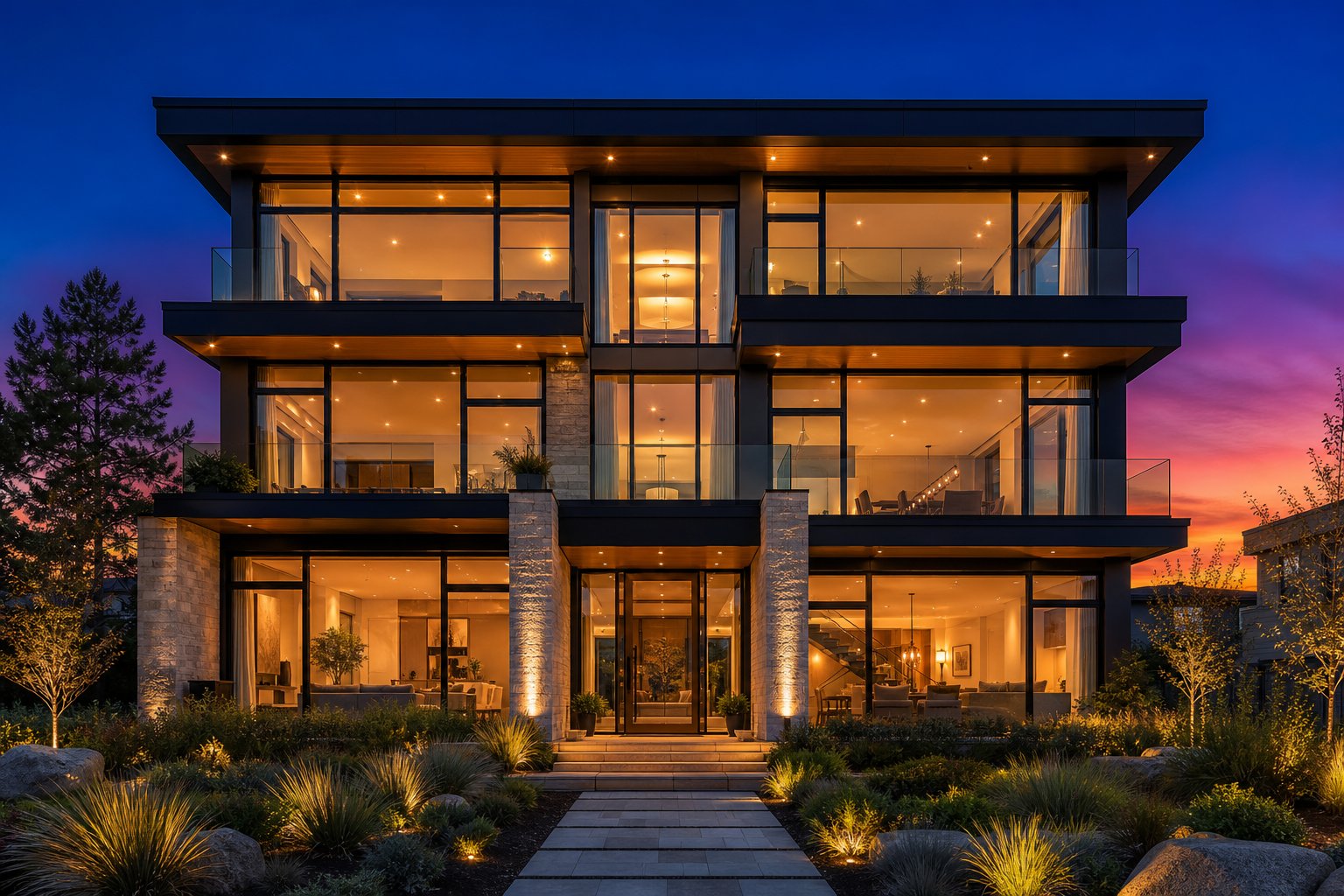
Selecting the Right Aluminium Frame for Your Next Project
Alloy grades, thermal breaks, surface treatments, fastener specifications, climate mapping — every layer of knowledge covered so far feeds into one practical outcome: choosing the right aluminium window frame material for your specific build and living with that choice comfortably for decades. The gap between a great decision and a costly one usually comes down to lifecycle thinking rather than upfront price comparison alone.
Lifecycle Cost and Long-Term Value of Aluminium Frames
Upfront cost is a snapshot. Total cost of ownership is the full picture. Among the common types of window frames available in Australia — aluminium, uPVC, and timber — each carries a different balance of initial outlay, maintenance burden, and replacement frequency that reshapes the economics over a building’s service life.
Aluminium frames typically last 30 to 40 years with minimal maintenance: periodic washing, silicone lubricant on hardware, and gasket replacement at the 10 to 15 year mark. No repainting, no refinishing, no structural degradation from moisture. uPVC starts cheaper but hits a hard ceiling around 20 to 25 years when seals fail and frames warp beyond repair — replacement rather than refurbishment becomes the only path forward. Timber can exceed 30 years, but only with consistent five-to-seven-year refinishing cycles that accumulate significant labour cost over time.
On a whole-of-life basis, aluminium often emerges as the most cost-effective option because it avoids both the replacement cycle of uPVC and the maintenance burden of timber. The “cheap” reputation of uPVC is a function of the upfront figure alone — extend the comparison to 40 or 60 years and the calculation inverts.
Recyclability strengthens that lifecycle position further. Aluminium is infinitely recyclable without quality loss, and at least 95 per cent of aluminium facade material is recovered through recycling at end of life. Unlike uPVC, which has limited recycling infrastructure in Australia and frequently ends up in landfill, aluminium re-enters the manufacturing stream as a valuable commodity. For projects where embodied energy and circular economy credentials matter — increasingly relevant under NatHERS and Green Star frameworks — this end-of-life advantage is a genuine differentiator.
A Project-Type Selection Checklist
The best specification depends on your project category. Each type carries different structural demands, thermal targets, exposure risks, and budget realities. Use the checklist below to identify the specification priorities that match your scenario before approaching aluminium window supplies companies for quotes.
- Residential single-storey (new build or renovation) — 6063-T5 alloy, standard powder coat in your preferred colour, 20 mm thermal break minimum, double glazing with low-E coating, multi-point locking hardware. This covers most suburban Australian homes in non-cyclonic wind regions.
- Multi-storey residential (apartments, townhouses) — 6063-T6 for slimmer sightlines on upper levels, thicker wall sections on wind-exposed elevations, acoustic glazing where traffic noise is a factor, and compliance documentation for NCC Section J energy requirements across multiple climate zones within the same development.
- Commercial (offices, retail, mixed-use) — 6061-T6 mullions for floor-to-ceiling spans, curtain wall integration, PVDF finish for high-visibility facades, and thermal modelling to satisfy commercial Section J DTS or JV3 verification.
- Coastal residential (within 1 km of breaking surf) — 6063-T5 with 6005 sub-sills, marine-grade anodising or high-performance powder coat, 316 stainless steel fasteners throughout, enhanced drainage design, and quarterly exterior washing schedule built into the maintenance plan.
- High-performance passive house or low-energy build — 6063-T6 profiles with thermal breaks of 34 mm or deeper, triple glazing, warm-edge spacers, whole-window U-values below 1.0 W/(m²·K), and WERS certification confirming energy rating alignment with NatHERS modelling targets.
These categories are not mutually exclusive. A coastal passive house needs the corrosion strategy from one column and the thermal depth from another. Cross-reference your location, building type, and performance ambitions rather than defaulting to a single template.
To translate these priorities into a specification you can hand to a supplier, follow this sequence:
- Identify your NCC climate zone and wind region using AS 4055 site classification.
- Define your thermal performance target — minimum NCC compliance or beyond-code aspirations for comfort or certification.
- Determine environmental exposure: coastal salt, cyclonic wind, bushfire BAL rating, or extreme UV.
- Select the alloy, thermal break depth, and surface treatment that address all identified risks simultaneously.
- Specify hardware metals and isolation strategies compatible with your corrosion environment.
- Choose window types and configurations — the types of aluminium windows (casement, awning, sliding, fixed) that serve each room’s ventilation and aesthetic role.
- Request itemised quotes from at least three suppliers against an identical written brief covering all of the above.
Finding Aluminium Window Systems Engineered for Australian Conditions
Knowledge without action stays academic. The framework above works only if it connects to suppliers who manufacture or source systems built for Australian standards, tested to AS 2047, and available with the alloy grades, thermal break configurations, and finish systems your project demands.
For homeowners, builders, and architects ready to move from specification to procurement, the priority is finding a supplier whose product range covers multiple window frames types — casement, sliding, awning, bi-fold, fixed — within a consistent profile system so that every opening on your facade shares the same sightlines, hardware logic, and warranty structure. MEICHEN’s aluminium window range is one example of this approach: custom aluminium window systems with material specifications suited to Australian climate zones, AS 2047 compliance across window types, and the flexibility to match alloy, thermal break, and colour requirements to individual project conditions.
Whatever supplier you choose, the questions remain the same. Confirm the alloy grade in writing. Verify thermal break material and depth. Request powder coat or anodising test certificates. Ensure hardware fasteners suit your corrosion environment. And compare warranty structures component by component — frame, hardware, glazing unit, and finish separately — because the weakest link sets your true replacement timeline.
The aluminium window frame material you select today defines your building’s performance envelope for the next three to four decades. Get the alloy right, protect it with the correct surface treatment, break its thermal conductivity with properly specified insulating strips, and isolate every dissimilar metal in the assembly. Do that, and the frame disappears into the background — exactly where good engineering belongs — while you enjoy the views, the comfort, and the silence on the other side of the glass.
Frequently Asked Questions About Aluminium Window Frame Material
1. What is the best aluminium alloy for window frames?
For most residential and architectural windows in Australia, 6063-T5 is the industry-standard alloy. It offers excellent extrudability, superior surface finish quality for both anodising and powder coating, and sufficient structural strength for standard wind regions. Projects requiring higher load capacity — such as large-span commercial glazing or cyclone-rated frames in northern Queensland — typically step up to 6061-T6, which delivers roughly double the yield strength. Alloy 6005 serves as a practical middle ground for thicker-walled structural sub-frames that need more capacity than 6063 without sacrificing too much profile complexity.
2. Do aluminium window frames cause condensation problems?
Untreated aluminium conducts heat over 1,000 times faster than PVC, which can chill the interior frame surface below dew point and trigger condensation. However, modern thermally broken aluminium frames solve this by splitting the profile into interior and exterior sections joined by an insulating PA66 nylon strip. In colder Australian climate zones like Canberra or Tasmania, specifying thermal break depths of 24 mm or greater, multi-chamber interior profiles, and thermally isolated glazing beads keeps the indoor frame surface warm enough to prevent condensation under typical winter conditions.
3. How long do aluminium window frames last compared to uPVC and timber?
Aluminium window frames typically last 30 to 40 years with minimal maintenance — periodic washing, hardware lubrication, and gasket replacement around the 10- to 15-year mark. uPVC frames generally reach 20 to 25 years before seal failure and warping require full replacement. Timber frames can match aluminium’s lifespan but demand consistent refinishing every five to seven years. On a whole-of-life cost basis, aluminium often proves most cost-effective because it avoids both the replacement cycle of uPVC and the ongoing maintenance burden of timber.
4. What surface finish is best for aluminium windows in coastal areas?
Coastal properties within one kilometre of breaking surf face concentrated airborne chlorides that attack aluminium aggressively. Marine-grade anodising at 20 to 25 micrometres thickness provides integral corrosion protection that cannot peel, while high-performance powder coat systems with enhanced chromate-free pretreatment offer broader colour choice with strong salt resistance. For extreme coastal or industrial exposures, PVDF fluoropolymer coatings deliver the highest durability, maintaining colour and gloss for 20 to 30 years. Whichever finish you choose, pair it with 316 stainless steel fasteners and a quarterly exterior washing schedule.
5. What is a thermal break in an aluminium window frame?
A thermal break is an insulating strip — typically glass-fibre-reinforced PA66 nylon — that physically separates the interior and exterior aluminium sections of a window profile. This interrupts the metal’s conductive heat path, reducing frame U-values by 50 to 70 per cent compared to non-thermally-broken frames. The strip is mechanically crimped into precision-machined pockets within the aluminium extrusion, creating a composite profile that performs as a single structural member while dramatically improving energy efficiency. Thermal break depths range from 16 mm for mild climates up to 34 mm or more for passive house specifications.
More Window & Door Guides