What Aluminium Window Configurations Are and Why They Matter
Most people spend weeks choosing a window colour or frame profile, then give the actual configuration about five minutes of thought. That decision — how panels sit within the frame and which ones move — shapes how your home performs for the next 30 years.
An aluminium window configuration is the specific arrangement of fixed and operable panels within a single frame, including the direction and method by which each panel opens or slides.
It is not the same as window “type” or “style.” A sliding window is a type. Whether that slider has one fixed panel and one moving panel (or two moving panels) is the configuration. The distinction matters because two aluminium windows of the same type can behave very differently depending on their panel layout.
What Does Window Configuration Actually Mean
Configuration defines the operational arrangement of panels. It answers three questions: which panels are fixed, which are operable windows, and in what direction do the operable ones move? A three-panel sliding window might have the centre panel fixed with both outer panels sliding inward, or it might fix both outer panels and slide only the centre. Same frame size, same glass area — completely different airflow, cleaning access, and security profile.
Why Configuration Matters More Than Most Homeowners Realise
The downstream impacts of window configurations reach further than ventilation alone. Your choice directly affects thermal sealing performance, acoustic insulation, emergency egress compliance, and how easily you can maintain windows and window frames over their lifespan. A poorly matched configuration can mean inadequate airflow in bathrooms, non-compliant bedroom openings, or energy losses that compound every single year.
This guide breaks down every configuration option available in aluminium windows, matched to room function, climate, and long-term performance — so you can make a decision that actually holds up.
Every Aluminium Window Configuration Type Defined
Each configuration behaves differently in terms of airflow, weather sealing, and space clearance. The table below maps every major type against its operation, panel layout, and typical opening capacity.
| Configuration Type | How It Operates | Panel Arrangement | Typical Opening Size |
|---|---|---|---|
| Fixed | No moving parts — sealed permanently into the frame | Single panel, no operable section | 0% (non-operable) |
| Casement (side-hung) | Hinged on one vertical side, swings outward or inward | One or two operable panels per frame | Up to 100% of panel area |
| Awning (top-hung) | Hinged at the top, opens outward from the bottom | Single operable panel, often paired with fixed panels | Up to 100% of panel area |
| Hopper (bottom-hung) | Hinged at the bottom, tilts inward from the top | Single operable panel | Limited tilt angle, ~30-40% effective opening |
| Tilt-and-turn | Tilts inward from the top or swings inward from the side | Single panel with dual-mode hardware | Up to 100% in turn mode |
| Sliding (XO, OX, XOX, OXXO) | Panels glide horizontally along tracks | Combination of fixed (O) and operable (X) panels | 50% for XO/OX; up to 66% for XOX |
| Aluminium double-hung | Two sashes slide vertically within the frame | Upper and lower sashes, both operable | Up to 50% of total frame area |
| Aluminium single-hung | Lower sash slides up; upper sash is fixed | One fixed, one operable sash (vertical) | Up to 50% of total frame area |
| Pivot | Rotates on a central horizontal or vertical axis | Single panel rotating within the frame | Up to 100% (both sides exposed) |
| Louvre | Multiple glass blades tilt open simultaneously | Parallel blades within a frame | Up to 95% airflow when fully open |
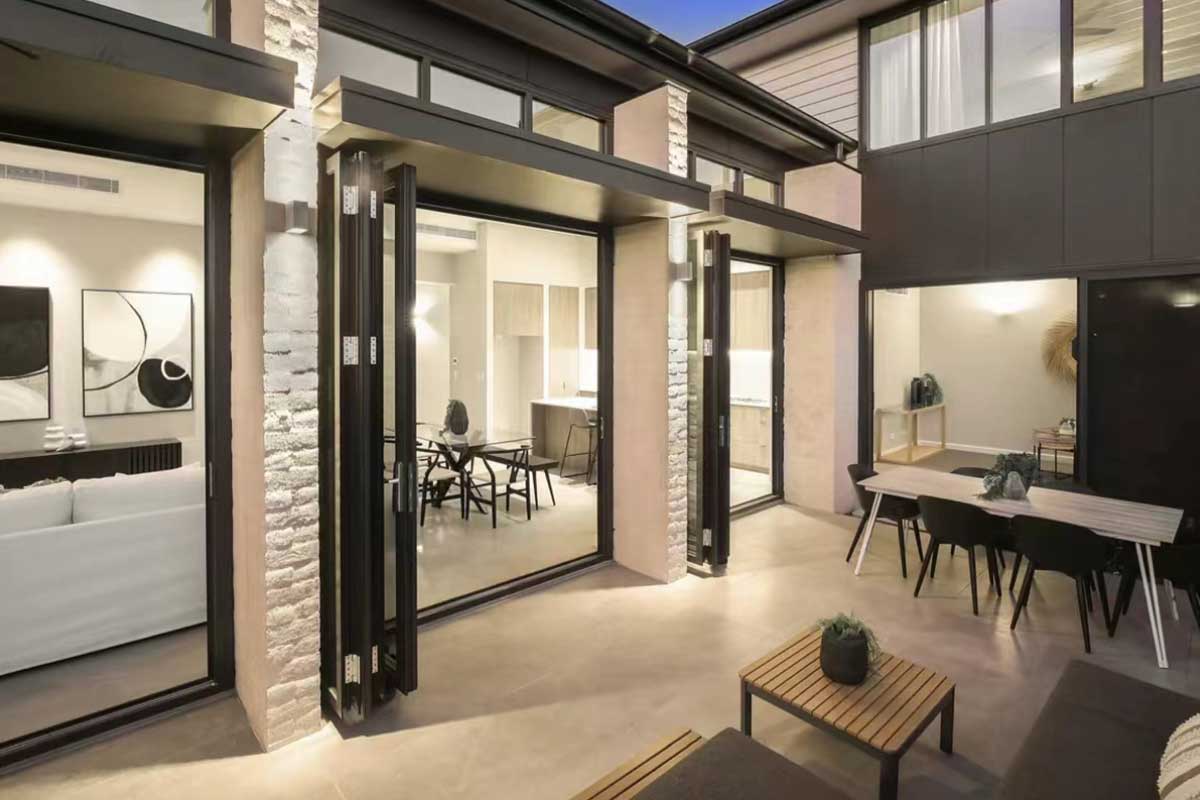
| Bi-fold | Panels fold and stack against one side | Multiple hinged panels (typically 2-7) | Up to 90% of total opening width |
Fixed and Operable Panel Arrangements Explained
A fixed panel does exactly what it sounds like — it sits permanently within the frame with no hardware, no seals to wear, and no moving parts. Fixed configurations deliver the tightest thermal and acoustic seal possible because there is simply no gap for air to pass through. They are the go-to choice for maximising uninterrupted views or filling large openings where ventilation is handled elsewhere.
An aluminium casement window hinges on one vertical side and swings outward (or inward, though outward is standard in Australia). Because the sash presses into compression seals when closed, casement configurations rank among the best for airtightness in operable windows. They also provide full clear opening, making them useful for emergency egress.
Awning windows hinge at the top and push outward from the bottom. This geometry means you can leave them open during light rain — the glass panel acts as a small canopy. They suit bathrooms, laundries, and any elevation exposed to weather.
Hopper windows reverse that arrangement, hinging at the bottom and tilting inward. They are less common in residential builds but appear in basements and below-bench applications where outward projection is not practical.
Tilt-and-turn configurations combine both modes in a single panel. Tilt the handle up and the window tilts inward from the top for secure ventilation. Turn the handle sideways and the entire sash swings inward like a door, giving full access for cleaning. This dual-mode operation makes them popular on upper storeys where exterior access is difficult.
Sliding Configuration Notation Decoded
Aluminium sliding windows use a letter-based naming system that confuses people at first glance. The xo window meaning is straightforward once you know the rule: “X” marks the operable (sliding) panel, “O” marks the fixed panel, and you always read the sequence as viewed from the exterior of the building.
- XO — Left panel slides, right panel is fixed (viewed from outside). The most common two-panel sliding window system in residential builds.
- OX — Right panel slides, left panel is fixed. Functionally identical to XO but mirrored, chosen based on which side suits furniture layout or access.
- XOX — Both outer panels slide toward the centre; the middle panel is fixed. This triple-panel arrangement provides ventilation from both sides while preserving a central view.
- OXXO — Two fixed outer panels with two operable panels meeting in the centre. Common in wider openings where you want a symmetrical look with a generous central opening.
A key constraint worth noting: you cannot place two operable panels (XX) directly adjacent without a fixed panel between them. The sliding window system relies on one panel overlapping behind another on the track, so each operable sash needs a fixed panel to slide past.
Specialty Configurations for Unique Applications
Pivot windows rotate on a central axis — either horizontal or vertical — allowing the entire panel to spin within the frame. They suit large openings on upper floors because both the interior and exterior glass faces become accessible for cleaning. Architecturally, they create a striking visual when open.
Louvre configurations use multiple parallel glass blades that tilt open simultaneously via a single control mechanism. When fully open, louvres allow up to 95% airflow through the frame — far more than any other configuration. They are a staple in Queensland and northern Australian builds where cross-ventilation is critical.
Bi-fold configurations consist of multiple panels hinged together that fold and stack to one or both sides of the opening. They effectively remove the wall between indoor and outdoor spaces, making them popular for living areas that open onto decks or patios. The trade-off is more complex hardware and a higher frame-to-glass ratio when closed, since each panel requires its own frame section and hinges.
Every one of these configurations interacts differently with room function, climate exposure, and long-term maintenance — factors that determine whether a configuration choice pays off or quietly costs you year after year.
Matching Configurations to Room Function and Purpose
A configuration that works brilliantly in a living room can be a genuine liability in a bathroom. Each room in your home has distinct demands — airflow volume, privacy level, emergency escape requirements, and even how much bench space sits beneath the sill. Choosing the right panel arrangement for each space is where most of the long-term value (or regret) lives.
| Room | Primary Need | Recommended Configurations | Why |
|---|---|---|---|
| Bathroom / Wet Areas | Controlled ventilation + privacy | Awning, louvre, hopper | Allow airflow while resisting rain ingress; positioned high for privacy |
| Living Room / Open-Plan | Maximised views + indoor-outdoor flow | Fixed + XOX sliding, bi-fold | Large uninterrupted glass panels with selective operable sections |
| Bedrooms | Egress compliance + comfort | Casement, aluminium sliding windows, tilt-and-turn | Meet NCC clear-opening requirements for emergency escape |
| Kitchen / Utility | Ventilation + safety near benchtops | Awning, sliding panel window | No inward-projecting sashes over work surfaces; easy one-hand operation |
Bathrooms and Wet Areas Need Controlled Ventilation
Bathrooms deal with constant moisture, and the configuration you pick determines whether that moisture escapes efficiently or lingers on surfaces. Awning windows are the standout choice here. Because the panel hinges at the top and pushes outward, you can leave it open during a shower or even during rain without water entering the room. The angled glass acts as a shield.
Louvre configurations take bathroom ventilation a step further. With blades tilted open, they deliver up to 95% airflow — far more than any other operable window — while the angled slats block direct sightlines from outside. For bathrooms in tightly spaced suburban builds where neighbours are close, louvres paired with obscured glass give you both privacy and serious air exchange. Hopper windows also suit below-sill installations in laundries, though their inward tilt can interfere with benchtop clearance if not carefully placed.
Living Rooms and Open-Plan Spaces Prioritise Views
In a living room, the goal flips. You want the largest possible expanse of glass with minimal frame interruption. Fixed panels deliver this perfectly — no hardware, no mullion breaks for operable mechanisms, just clean sightlines. But a fully fixed wall offers zero ventilation, so the practical approach is to combine fixed panels with selective operable sections.
An XOX aluminium sliding window arrangement is ideal for wide living room openings. The fixed centre panel preserves your primary view while both outer panels slide open for cross-ventilation. For homes designed around indoor-outdoor living — especially along Australia’s eastern seaboard — bi-fold configurations remove the boundary entirely, stacking panels to one side and opening up 90% of the wall. The trade-off is a higher frame-to-glass ratio when closed, since each folding panel carries its own frame section and hinges.
Bedrooms Require Egress-Compliant Openings
Bedroom windows are not just about comfort and light. Under the National Construction Code (NCC), every bedroom must have an openable window or door that provides an emergency escape path. The clear opening needs to be large enough for a person to climb through — generally a minimum of 850 mm high and 600 mm wide, or an unobstructed area of at least 0.44 m².
Aluminium casement windows meet this requirement easily because the full sash swings open, providing unobstructed clear space. Sliding aluminium windows also work well, provided the operable panel is wide enough — a standard XO slider with a 600 mm or wider operable sash typically complies. Single hung aluminium windows can be more limiting for egress because only the bottom sash moves, and the clear opening height depends on how far it travels. Aluminium sash windows in a double-hung arrangement offer more flexibility, since both the upper and lower sashes can open to increase effective ventilation area, though egress is still measured by a single opening.
Upper-storey bedrooms add another layer. Fall-prevention requirements under the NCC restrict how wide a window can open if the sill sits below 1.7 metres from the finished floor. In these situations, tilt-and-turn configurations offer a smart compromise — the tilt mode provides secure ventilation through a narrow top gap, while the full turn mode remains available for emergency egress or cleaning when needed.
Kitchens and Utility Rooms Balance Airflow and Safety
Kitchens generate heat, steam, and cooking odours that demand reliable ventilation, but the window sits directly above surfaces where you prepare food and handle hot items. An inward-opening casement above a cooktop or sink is a hazard — you risk bumping your head or knocking the sash into taps and splashbacks.
Awning windows solve this neatly. Mounted above the benchtop, they push outward and away from the workspace. You can crank them open with one hand while the other holds a pan. For wider kitchen openings beside a dining nook or breakfast bar, a sliding panel window keeps the operable section flush within the wall plane — no projection inward or outward — making it safe and unobtrusive in tight layouts.
Utility rooms and laundries follow a similar logic. These spaces benefit from generous airflow to dry out moisture, but they often have shelving, appliances, or drying racks close to the window wall. Aluminium sliding windows on a simple track keep everything compact, and their horizontal operation means nothing swings into the room when you need air moving through.
Selecting configurations room by room is only half the equation. How each of those configurations actually performs thermally — particularly the seal type, frame-to-glass ratio, and glazing weight it can support — determines whether your energy bills reflect a smart choice or an expensive oversight.
Thermal Performance and Energy Efficiency by Configuration
Every operable mechanism introduces a potential path for air to leak through. The configuration you choose dictates what kind of seal sits between the moving panel and the frame — and that seal type is the single biggest variable in how much conditioned air escapes your home. Two identically sized aluminium window frames with different configurations can have dramatically different infiltration rates, even when installed by the same team on the same wall.
How Seal Types Vary Across Configurations
There are three broad categories of sealing across aluminium window configurations, and each performs differently under pressure.
- No operational seal (fixed panels): A fixed window has no moving parts, which means no gaps for air to pass through. When installed correctly, it is essentially airtight. This makes fixed configurations the highest-performing option for minimising infiltration.
- Compression seals (casement, awning, tilt-and-turn): These configurations use crank or lever mechanisms that pull the sash firmly into rubber or silicone gaskets around the frame perimeter. The closing action compresses the seal, creating a tight barrier. Casement and awning windows consistently rank just below fixed panels for airtightness because the hardware forces the sash against the weatherstripping under mechanical pressure.
- Brush or pile seals (sliding, double-hung, single-hung): Sliding configurations rely on brush-type pile strips along the tracks and meeting rails. These seals allow the panel to glide freely, which means they cannot compress as tightly as gasket-based systems. The result is higher air leakage potential — particularly as the pile wears over time.
In practical terms, a well-made casement or awning window can achieve air infiltration rates two to three times lower than a comparable sliding configuration. That gap compounds over decades of heating and cooling cycles, especially in climates with extreme temperature differentials like Melbourne winters or western Sydney summers.
Frame-to-Glass Ratio and Its Energy Impact
Operable configurations demand more aluminium window framing material than fixed ones. Every moving panel needs structural support for hinges, locks, rollers, or pivot hardware — and that support comes in the form of additional frame sections. More frame means less glass area within the same rough opening.
Why does this matter thermally? Glass and frame have different thermal properties. In most modern systems, the glazing (particularly double-glazed units with low-e coatings) outperforms the frame for solar heat gain management. A fixed panel maximises glass area and minimises window frame metal, giving you the best ratio for controlling how much solar energy enters the room. Conversely, a bi-fold configuration with five panels in the same opening introduces five vertical frame sections, each reducing the glazed area and adding conductive pathways — even with thermal breaks in place.
For north-facing windows in Australian homes, where you want controlled solar gain in winter, a predominantly fixed configuration with minimal operable sections delivers the most efficient balance. The less frame interrupting the glass, the more effectively you can harness passive solar design.
Glazing Weight and Configuration Constraints
Double glazing is now standard in most Australian builds targeting NatHERS compliance, and triple glazing is gaining traction in colder climate zones. But heavier glass creates real constraints for operable configurations.
A standard double-glazed insulating unit weighs roughly 20 kg per square metre. Triple glazing pushes that closer to 30 kg/m². Fixed panels handle this weight without issue — the glass sits permanently in the frame with no stress on moving hardware. Casement and awning configurations manage double glazing well, though larger panels require heavy-duty friction stays to support the added mass without sagging over time.
Sliding configurations face a different challenge. Heavier glass means more force required to move the panel along its track, and greater wear on rollers. Bi-fold systems feel this most acutely — each folding panel must be light enough to swing on its hinges while stacking neatly. This is why some bi-fold manufacturers limit glass thickness or panel width when triple glazing is specified. Aluminium window frames offer an advantage here over timber or uPVC: the strength-to-weight ratio of aluminium allows thinner frame profiles that still support heavy glazing, keeping panel weight manageable without sacrificing structural integrity.
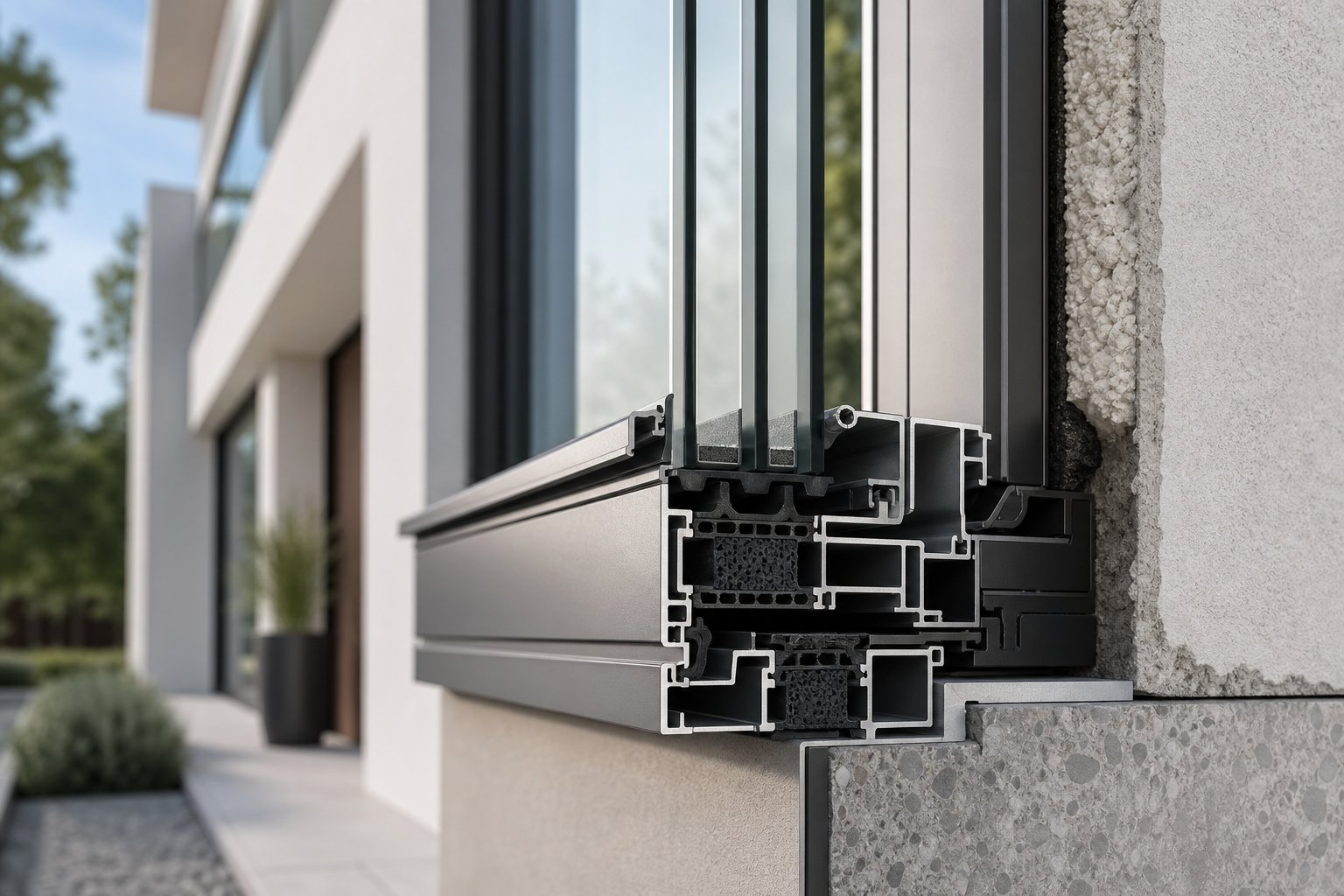
Aluminum clad wood windows attempt to combine timber’s insulating properties with aluminium’s exterior durability, but they add frame bulk that further limits operable panel sizes. Pure aluminium frames with polyamide thermal breaks achieve comparable thermal performance in a slimmer profile — a distinction that becomes critical when you need large operable panels carrying double or triple glazing. The thermal break itself is a strip of insulating polyamide inserted between the interior and exterior faces of the aluminum window frame, reducing conducted heat transfer while preserving the structural continuity that makes aluminium configurations possible at scale.
Thermal performance is measurable and quantifiable. But there is another performance dimension — sound — that follows many of the same physical principles yet rarely gets the attention it deserves when selecting configurations.
Acoustic Insulation Across Different Aluminium Window Configurations
Sound follows the path of least resistance. It does not care how thick your glass is if there is a 2 mm gap where a seal has worn thin or a brush strip has compressed flat. This is why two aluminum frame windows of identical size and glass specification can deliver wildly different noise reduction — the configuration determines where those weak points exist and how effectively they are managed.
Three factors govern how much sound passes through any window system: the mass of the glass (heavier glass resists vibration better), the airtightness of the overall assembly, and the number of seal contact points around the operable perimeter. Configuration choice directly controls two of those three variables.
Why Fixed Panels Outperform Operable Ones for Sound
A fixed panel has no moving parts, no operational seals, and no hardware penetrations. When installed with structural glazing or continuous gaskets compressed permanently into the frame, it achieves the tightest possible barrier against airborne sound. There is simply no gap for sound waves to exploit.
The physics are straightforward. Sound is pressure variation travelling through air. Any opening — even one invisible to the naked eye — allows that pressure wave to pass through the building envelope. A 1% gap in an otherwise solid barrier can reduce sound insulation by up to 10 dB, which the human ear perceives as roughly halving the effectiveness of the window. Fixed configurations eliminate this risk entirely because the glass-to-frame junction is sealed once during manufacture and never disturbed.
For metal framed windows in high-noise environments — homes facing arterial roads, rail corridors, or flight paths — fixed panels with laminated acoustic glass represent the gold standard. The combination of permanent sealing and vibration-dampening interlayers in the glass delivers consistent performance that does not degrade over time the way operable seals inevitably do.
Ranking Operable Configurations by Acoustic Performance
Not every room can rely on fixed glass alone. Ventilation, egress, and cleaning access all demand operable sections. The question becomes: which operable configurations lose the least acoustic performance?
The ranking below moves from highest to lowest sound insulation among operable types, based on seal mechanism and closure pressure:
- Tilt-and-turn — Multi-point locking hardware pulls the sash into compression seals at numerous points around the full perimeter. When locked closed, these windows achieve near-fixed-panel airtightness. The inward-opening design also allows thicker sealing profiles without affecting exterior clearance.
- Casement (side-hung) — Compression seals engage around the entire sash perimeter when the window is cranked shut. Multi-point espagnolette locks on quality casement windows create even pressure distribution, minimising any localised gaps where sound could leak.
- Awning (top-hung) — Similar compression seal principle to casement, with an added advantage: gravity assists closure. The weight of the sash presses downward onto the bottom seal, reinforcing the compression that hardware alone provides. This makes awning configurations particularly reliable for acoustic performance over time, as the seal pressure does not rely solely on mechanical components that may loosen.
- Hopper (bottom-hung) — Compression seals engage, but the inward tilt means gravity works against the top seal rather than assisting it. Slightly less consistent long-term performance than awning types.
- Double-hung and single-hung — Vertical sliding sashes use a combination of brush seals and weatherstripping. Performance sits between compression-sealed and horizontally sliding types, though meeting rail seals between upper and lower sashes can be a weak point.
- Sliding (horizontal) — Brush or pile seals along tracks and interlocking rails allow panels to glide freely but cannot compress as tightly as gasket systems. Single pane aluminum windows in older sliding configurations are particularly poor performers acoustically, though modern thermally broken sliders with upgraded pile seals have narrowed the gap somewhat.
- Louvre — Multiple blade edges mean multiple potential leakage paths. Even with rubber or felt seals on each blade, the sheer number of joints makes louvres the weakest configuration for sound insulation. They excel at ventilation but sacrifice acoustic control to achieve it.
- Bi-fold — When fully closed, bi-folds rely on compression seals similar to casement windows. However, the number of panel-to-panel junctions and the complexity of the folding hardware introduce more potential leakage points than a single casement or awning sash.
The gap between the top and bottom of this list is substantial. A well-specified tilt-and-turn window with multi-point locking can achieve sound reduction within 2-3 dB of a fixed panel, while a louvre configuration in the same opening might sacrifice 10-15 dB of insulation — a difference you would clearly hear as a doubling or tripling of perceived noise.
Strategies for Noise-Sensitive Rooms
Bedrooms facing busy roads or rail lines benefit most from a deliberate acoustic strategy built around configuration choice. The approach is simple in principle: maximise fixed glass area and minimise the operable portion to only what ventilation and egress require.
A practical example: rather than specifying a full-width sliding window for a bedroom on a main road, consider a combination of fixed panels flanking a single casement or tilt-and-turn sash. The fixed sections handle the bulk of the acoustic barrier, while the smaller operable section — sealed with compression gaskets and multi-point locks — provides ventilation without compromising the overall sound rating of the wall.
This configuration-first approach can reduce or even eliminate the need for expensive acoustic glass upgrades. Laminated acoustic glazing adds cost — typically $80 to $150 per square metre above standard double glazing — and while it improves performance, it cannot compensate for air leakage through poorly sealed operable sections. Spending that budget on thin frame windows with fixed panels and high-quality compression-sealed operable sections often delivers better real-world results than fitting acoustic glass into a configuration riddled with brush seals.
For homes in particularly noisy locations, combining both strategies — acoustic laminated glass in fixed panels paired with compression-sealed operable sections — creates a layered defence. The fixed panels do the heavy lifting, the operable sections maintain livability, and the overall wall achieves consistent noise reduction without relying on any single element to carry the full load.
Metal window frames in aluminium offer an additional advantage here. Their slim profiles mean less frame area transmitting structure-borne sound compared to bulkier uPVC or timber sections, and thermally broken aluminium frames add a layer of vibration isolation between the exterior and interior face of the profile. The result is a system where both airborne and structure-borne sound paths are addressed within a single, cohesive frame design.
Acoustic performance is one dimension of environmental control. But sound is not the only external force acting on your windows — wind-driven rain, humidity, and extreme weather events all interact with configuration choice in ways that demand equally careful consideration.
How Climate and Weather Shape Configuration Choice
A configuration that seals beautifully in a temperate Melbourne suburb may fail spectacularly on a cyclone-prone Townsville coastline. Climate is not a secondary consideration — it should be one of the first filters you apply when narrowing down which panel arrangements suit each elevation of your home. Wind exposure, humidity levels, rainfall intensity, and bushfire risk all interact with configuration choice in ways that can either protect your investment or quietly undermine it for decades.
Wind and Rain Resistance by Configuration Type
Wind-driven rain is the most common cause of water ingress through windows that are otherwise structurally sound. Research from Simpson Gumpertz & Heger highlights a critical gap: fenestration products certified to resist high structural wind pressures may still leak at wind speeds far below their rated capacity. The culprit is almost always the seal mechanism — and that mechanism is defined by configuration.
Awning and tilt-and-turn configurations resist rain ingress while open because the panel itself acts as a shield. An awning window hinged at the top deflects water away from the opening, and inward wind pressure actually pushes the sash tighter against its compression seals when closed. This is why awning configurations dominate on weather-exposed elevations across coastal Australian builds.
Casement windows tell a different story. When open, the sash projects outward and catches wind like a sail. In heavy rain with gusting crosswinds, water can drive directly into the opening. Closed casements perform well — their compression seals handle pressure effectively — but the moment you open them during a storm, they offer no rain protection whatsoever.
Sliding aluminum windows and horizontal sliding configurations face a specific vulnerability. They rely on track drainage and back-dam systems rather than compression seals to manage water. A back dam is essentially a raised lip at the rear of the sill track that prevents pooled water from overflowing inward. The problem is that one inch of back-dam height resists only about 5.2 psf of water pressure — meaning even moderate wind-driven rain can overtop the dam and cause uncontrolled leakage. Out-swinging, gasketed products like casement and awning windows consistently outperform sliding configurations under severe weather because their sealing mechanism improves under wind load rather than being overwhelmed by it.
For homes in exposed coastal locations or elevated sites where wind speeds regularly exceed 60-70 km/h during storms, prioritising awning and casement configurations on windward elevations — and reserving a sliding aluminum window for sheltered walls — is a practical strategy that reduces long-term water damage risk.
Ventilation Strategies for Humid and Hot Climates
Northern Australia, from Cairns through to Darwin and across much of coastal Queensland, demands configurations that move serious volumes of air. Mechanical cooling handles peak heat, but for the eight or nine months of the year when conditions are warm but not extreme, natural ventilation through well-chosen configurations can dramatically reduce energy consumption.
Louvre configurations are the standout performer in tropical and subtropical regions. With blades fully open, they allow up to 95% airflow through the frame — no other configuration comes close. Louvre windows are especially popular in coastal and tropical areas where ventilation is the primary concern, and modern designs incorporate robust locking mechanisms without compromising airflow capacity. For Queenslander-style homes with wide verandas and elevated floors, louvres on multiple elevations create stack-effect ventilation that draws cool air in low and exhausts warm air high.
Cross-ventilation — the strategy of placing operable windows on opposing walls to create a breeze path through the home — depends entirely on configuration placement. The principle is simple: air enters through windward openings and exits through leeward ones. But the configuration on each side matters. A large aluminum horizontal sliding window on the windward wall paired with louvres or casement windows on the leeward side creates a pressure differential that pulls air through the space efficiently. If both sides use fixed panels, you get views but zero airflow. If both use small awning windows, you get trickle ventilation but not the volume needed to cool a room passively.
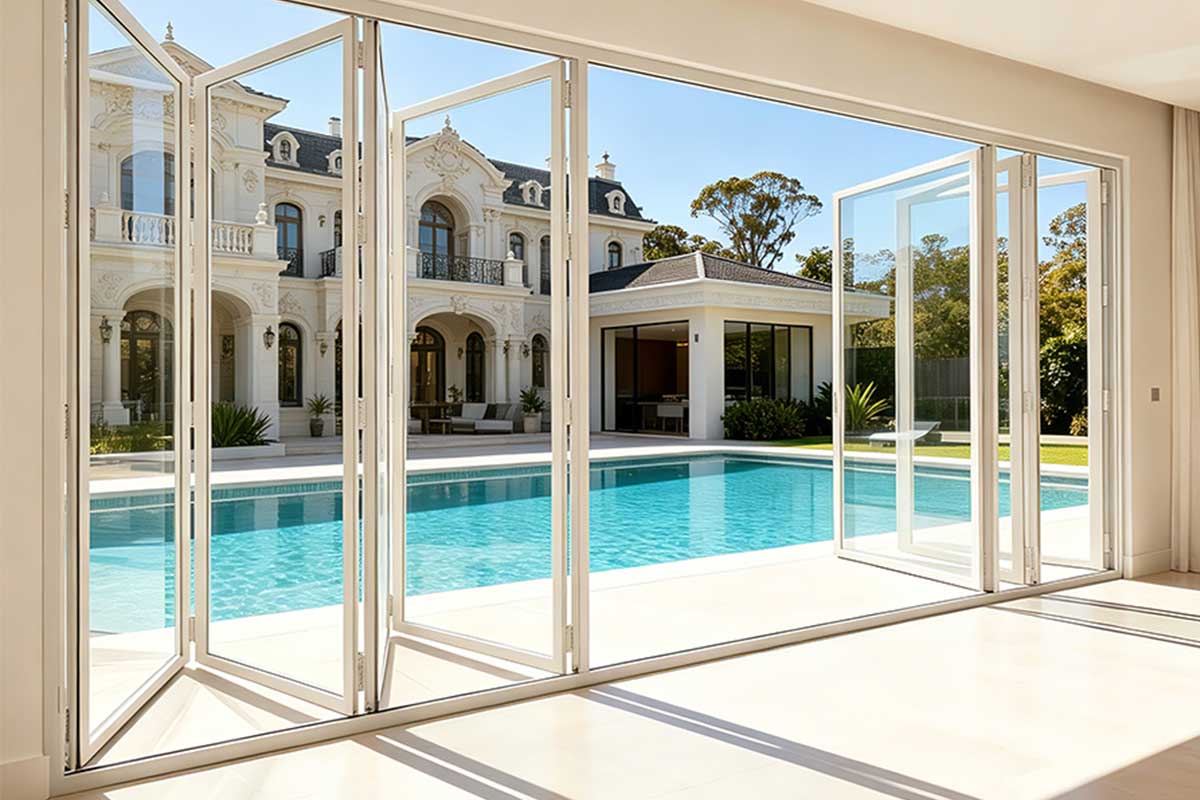
Bi-fold configurations take a different approach entirely. Rather than managing airflow through controlled openings, they remove the wall. In subtropical climates where indoor-outdoor living defines the lifestyle — think Brisbane, the Gold Coast, or the Sunshine Coast — bi-folds on the northern or eastern elevation create full-width openings that blur the boundary between living room and deck. The trade-off is that bi-folds offer no partial-open rain protection the way awning windows do. They are either fully open or fully closed, which limits their usefulness during the sudden afternoon storms common in these regions.
A smarter approach for humid climates combines configurations: bi-folds for the primary indoor-outdoor connection on sheltered elevations, awning windows on exposed walls for rain-safe ventilation, and louvres in wet areas and service rooms where maximum airflow matters more than views. This layered strategy keeps air moving through the home regardless of weather conditions.
Bushfire Zone and Extreme Weather Considerations
For homes assessed under Australia’s Bushfire Attack Level (BAL) rating system, configuration choice is not just a comfort decision — it is a compliance requirement. BAL ratings range from BAL-LOW through to BAL-FZ (Flame Zone), and as the rating increases, so do the performance demands on every opening in the building envelope.
The core threats in a bushfire event are radiant heat, ember attack, and rapid pressure changes as fire fronts pass. Each of these interacts differently with different configurations:
- Fixed panels perform most consistently in bushfire zones. They have no moving parts, no operational gaps, and no hardware penetrations where embers can enter. A fixed metal window with correctly specified toughened or laminated glass and continuous perimeter seals presents the fewest vulnerabilities to ember ingress.
- Awning configurations are the next best option for operable windows in bushfire areas. Their compression seals, combined with robust multi-point locking, create a tight barrier when closed. The relatively simple hardware means fewer potential failure points under thermal stress.
- Casement and tilt-and-turn configurations also use compression seals and can achieve strong ember resistance when closed, though their larger sash sizes mean more perimeter length to seal — and more potential for localised gaps if frames distort under heat.
- Sliding configurations present moderate risk. Their brush seals and track systems create more potential entry points for embers, and the track drainage channels designed to shed water can also admit fine burning material. At BAL-29 and above, sliding metal windows require careful detailing to meet compliance.
- Louvre and bi-fold configurations face the greatest challenges in bushfire zones. Louvres have multiple blade edges — each one a potential ember entry path — and their sealing systems are inherently less tight than compression-sealed alternatives. Bi-folds introduce numerous panel-to-panel junctions and complex folding hardware that creates gaps under thermal expansion. Both configuration types require additional protection measures at higher BAL ratings, and in BAL-40 or BAL-FZ zones, they may be impractical or non-compliant on exposed elevations.
The practical implication for homeowners in bushfire-prone areas is clear: use fixed and awning configurations on the elevations facing the greatest fire risk (typically the side closest to bushland or classified vegetation), and reserve more complex operable configurations like bi-folds for sheltered elevations with lower exposure. Black aluminium windows and bronze aluminum windows — popular for their aesthetic in bush settings — perform identically to other powder-coated finishes in terms of fire resistance; the colour choice is cosmetic, not structural.
Beyond bushfire, homes in cyclone-rated regions (Wind Region C and D under AS 4055) face similar logic. Configurations with compression seals handle extreme wind pressures more reliably than those relying on back dams and brush seals. Fixed panels and awning windows dominate in cyclone-prone builds for the same reason they suit bushfire zones: fewer moving parts mean fewer failure points when conditions turn extreme.
Climate-driven configuration decisions protect the building envelope. But the hardware inside each configuration — the hinges, rollers, locks, and friction stays that make operable panels function — determines whether that protection holds up over five years or twenty-five.
Hardware, Hinges, and Long-Term Maintenance by Configuration
Hardware is the part of a window you interact with daily but rarely think about until something fails. A stiff handle, a roller that drags, a friction stay that no longer holds the sash open — these are not random breakdowns. They are predictable consequences of the mechanical demands each configuration places on its components. Understanding what hardware drives each configuration helps you anticipate maintenance needs and avoid the slow deterioration that turns a well-chosen window into a frustrating one.
Hardware and Hinge Systems That Define Each Configuration
Every operable configuration relies on a specific hardware system to function. The type of mechanism determines how the panel moves, how much force is required, and where wear concentrates over thousands of open-close cycles.
- Friction stays (awning and casement): These are the hinged arms that control how far the sash opens and hold it in position against wind load. A friction stay uses a sliding channel with adjustable resistance — tight enough to hold the panel at any angle, loose enough to move smoothly by hand. Quality stays are rated for sash weights up to 20-25 kg and should maintain consistent friction over 10,000+ cycles. Cheaper stays lose tension within a few years, causing the sash to drop or slam shut in wind.
- Multi-point locking (tilt-and-turn and high-security casement): A single handle rotation engages locking points at multiple positions around the sash perimeter — typically four to eight points depending on window size. This distributes closing pressure evenly across all seals, which is why tilt-and-turn configurations achieve near-fixed-panel airtightness. The mechanism is more complex than a simple latch, but the trade-off is superior compression and security.
- Rollers and tracks (sliding configurations): Sliding panels ride on nylon or stainless steel rollers seated in aluminium tracks. Roller quality determines how smoothly the panel glides and how well it handles the weight of double-glazed units over time. Tandem roller systems (two rollers per side) distribute load more evenly than single rollers and resist the tilting that causes panels to bind in their tracks. Track profile design — particularly the depth and shape of the channel — affects both drainage and long-term roller wear.
- Pivot hardware (pivot windows): Central pivot mechanisms use a pin-and-socket system that allows the entire sash to rotate 180 degrees within the frame. The pivot point must support the full weight of the panel at its centre of gravity, which demands precision engineering — especially for large panels with heavy glazing. Friction brakes within the pivot control rotation speed and hold the sash at any angle.
- Espagnolette locks (casement and awning): A single handle drives a connecting rod that engages locking cams at the top and bottom of the sash simultaneously. This pulls the panel evenly into its compression seals. Espagnolette systems are simpler than full multi-point locks but still provide distributed closing pressure across the sash height.
Hardware quality is not something you can assess by looking at a closed window in a showroom. The difference between a $15 friction stay and a $60 one only becomes apparent after three or four years of daily use — when the cheaper component has lost its holding tension and the premium one still operates as it did on day one. For anyone dealing with old aluminum windows that have become difficult to operate, the hardware is almost always the root cause rather than the frame itself. Old aluminum window frames often remain structurally sound for decades while the hinges, rollers, and locks around them wear out and need replacement.
Maintenance Requirements by Configuration Type
Each configuration carries a different maintenance profile. Some demand regular attention to stay functional; others are essentially set-and-forget. The table below maps each type against its key hardware, realistic maintenance intervals, likely failure points, and cleaning access.
| Configuration | Key Hardware | Maintenance Frequency | Common Failure Points | Cleaning Access |
|---|---|---|---|---|
| Fixed | None (sealed permanently) | Minimal — frame and seal inspection annually | Perimeter seal degradation over 15-20 years | Exterior face requires outside access |
| Casement | Friction stays, espagnolette lock, handle | Every 6-12 months — lubricate hinges and locks | Friction stay tension loss, hinge pin wear, seal compression | Good — sash swings open for exterior cleaning from inside (ground floor) |
| Awning | Friction stays, winder or lever, locking cam | Every 6-12 months — lubricate stays and winder mechanism | Winder gear wear, stay arm fatigue, bottom seal compression | Moderate — bottom of exterior glass accessible when open, top less so |
| Tilt-and-turn | Multi-point lock, dual-mode handle, corner drives | Every 6-12 months — lubricate locking points and hinges | Corner drive mechanism, handle spindle wear | Excellent — turn mode exposes full exterior face for interior cleaning |
| Sliding | Tandem rollers, track, interlock, latch | Every 3-6 months — clean tracks, check roller adjustment | Roller wear, track debris buildup, interlock misalignment | Limited — only the operable panel’s exterior is accessible from inside |
| Double-hung | Spiral balances or block-and-tackle, sash locks | Every 6-12 months — check balance tension, lubricate channels | Balance spring failure, weatherstrip wear at meeting rail | Moderate — tilt-in sashes (if fitted) allow interior cleaning |
| Bi-fold | Hinges, rollers, top/bottom track, flush bolts, multi-point lock | Every 3-6 months — clean tracks, lubricate hinges and rollers | Roller misalignment, hinge sag on heavy panels, track wear | Good when open — panels fold to expose both faces |
| Louvre | Blade clips, operating bar, handle mechanism | Every 6-12 months — check blade clips, lubricate operating bar | Blade clip fatigue, operating bar linkage wear | Good — individual blades removable for cleaning |
| Pivot | Pivot pins, friction brake, restrictor | Every 12 months — lubricate pivot points, check friction brake | Friction brake wear, pivot pin loosening | Excellent — 180-degree rotation exposes both faces from inside |
Sliding configurations demand the most frequent attention because their tracks accumulate dust, sand, and debris that directly impedes operation. In coastal areas where salt air accelerates corrosion, vacuuming lower tracks regularly and checking roller adjustment prevents the gradual binding that makes panels increasingly difficult to move. If a sliding panel starts dragging, the roller height likely needs adjustment on both sides simultaneously to maintain balance and avoid uneven wear.
Casement and awning windows need periodic hinge lubrication — a light silicone-based lubricant applied to friction stays and locking cams every six months keeps operation smooth. Avoid oil-based products that attract dust and create gummy residue over time. The seals themselves benefit from a silicone conditioner applied twice yearly, particularly in regions with strong UV exposure where rubber gaskets can dry and crack prematurely.
Fixed windows have the lowest maintenance burden by far. With no moving parts, the only ongoing requirement is periodic inspection of the perimeter seal and frame finish. However, this simplicity comes with a trade-off that becomes apparent the moment you need to clean the exterior glass — particularly on upper storeys.
Cleaning Access and Practical Ownership Considerations
Maintenance is not just about hardware longevity. It is also about whether you can realistically keep your windows clean and functional without hiring specialists or setting up scaffolding every few months. Configuration choice on upper floors has a direct impact on ongoing ownership costs that many people overlook during the design phase.
Tilt-and-turn configurations are purpose-built for this problem. In turn mode, the entire sash swings inward like a door, bringing the exterior glass face within arm’s reach from inside the room. You can clean both sides of the glass standing safely on your own floor — no ladder, no external access equipment, no window cleaner on a quarterly retainer. For apartments, multi-storey townhouses, and any window above ground level, this is a significant practical advantage that justifies the slightly more complex (and expensive) hardware system.
Pivot windows offer similar benefits. A 180-degree rotation exposes both glass faces to the interior, making them another strong choice for upper-storey applications where external access is impractical. They are less common in residential builds than tilt-and-turn, but for large feature windows on second or third storeys, pivot configurations solve the cleaning problem elegantly.
Fixed panels on upper floors present the opposite scenario. The glass cannot be accessed from inside at all. For a single-storey home, this is a minor inconvenience — a step ladder and a squeegee handle the job. For a two-storey home with fixed panels on the upper level, you are looking at either a long extension pole, a tall ladder against the facade, or a professional window cleaning service. Over twenty years of ownership, those cleaning costs add up. It is worth considering whether a fixed panel on an upper floor could be replaced with a tilt-and-turn or pivot configuration that sacrifices a small amount of thermal and acoustic performance in exchange for practical self-maintenance.
Sliding windows fall somewhere in between. The operable panel can be lifted off its track for cleaning in some systems, but this is not always straightforward — particularly with larger, heavier double-glazed panels. The fixed panel in a sliding configuration remains inaccessible from inside unless the window is designed with a removable sash feature. For ground-floor applications this is manageable, but on upper storeys it creates the same access challenge as a fully fixed window.
For homeowners considering an aluminum frame window replacement project — particularly those upgrading from old aluminum windows with single glazing and worn-out hardware — configuration choice during the replacement phase is a rare opportunity to solve long-standing maintenance frustrations. If your existing sliders on the second floor have been impossible to clean properly for years, specifying tilt-and-turn or awning configurations in the replacement aluminum windows eliminates that problem permanently. An aluminium window frame kit designed for retrofit applications can often fit within the existing structural opening, making the configuration upgrade feasible without major building work. Similarly, aluminum retrofit windows engineered for renovation projects allow you to change configurations without altering the surrounding wall structure — converting a fixed panel to an operable one, or swapping a problematic slider for a casement that seals tighter and cleans easier.
The hardware that drives each configuration is only as good as the frame material supporting it. Hinges anchored into a frame that swells, warps, or degrades will loosen regardless of their own quality — which is precisely where aluminium’s material properties create advantages that other frame materials cannot match.
Why Aluminium Frames Enable Unique Configuration Options
Timber swells. uPVC flexes under load. Both materials demand thicker frame sections to achieve the structural rigidity that operable configurations require — and those thicker sections eat into your glass area, limit maximum panel sizes, and constrain what configurations are physically possible in a given opening. Aluminium sidesteps these limitations entirely. Its strength-to-weight ratio allows frame profiles thin enough to almost disappear visually, yet rigid enough to support heavy glazing across wide spans without deflection. This is not a marginal difference — it fundamentally changes which configurations you can specify and how large you can make them.
Slimmer Profiles Enable Larger Fixed and Sliding Panels
The structural strength of an aluminium window frame means engineers can reduce profile depth to as little as 45-55 mm while still meeting wind load requirements under AS 2047. A comparable uPVC frame needs 70-80 mm or more to achieve the same structural performance, and timber demands even greater depth depending on species and grain orientation.
That 20-30 mm difference per frame section compounds across a full window. In a four-panel OXXO sliding configuration, you have five vertical frame elements (four panel stiles plus the outer frame). Saving 25 mm on each adds up to 125 mm of additional glass width — roughly the difference between a view that feels expansive and one that feels segmented by thick mullions. For floor-to-ceiling fixed panels, slimmer aluminium profiles maximise the uninterrupted glass area that makes these configurations architecturally compelling in the first place.
Metal frame windows in aluminium also enable wider sliding spans than competing materials. A single sliding panel in aluminium can comfortably reach 1.5 to 2 metres wide without the mid-span deflection that would make a uPVC panel of the same width bow under its own glazing weight. This means fewer panels to cover a given opening, fewer frame intersections, and a cleaner aesthetic — particularly in living areas where views matter most.
Thermal Break Technology Unique to Aluminium Configurations
Aluminium conducts heat roughly 1,000 times more readily than timber. Left unaddressed, this conductivity would make aluminium joinery a poor choice for energy-conscious builds. Thermal break technology solves this problem with an elegance that is specific to aluminium construction.
A polyamide thermal break is a strip of reinforced insulating material — typically glass-fibre-filled nylon (PA66) — mechanically locked between the interior and exterior faces of the aluminium profile. This creates two thermally isolated halves connected by a material with extremely low thermal conductivity, effectively preventing the frame from acting as a bridge between indoor and outdoor temperatures. The result is an aluminum window frame that retains aluminium’s structural advantages while achieving thermal performance comparable to timber.
What makes this technology uniquely suited to aluminium is the extrusion process itself. Aluminium profiles are extruded in complex cross-sections that incorporate precise channels for the thermal break insertion. Timber cannot be manufactured this way — its thermal performance comes from the material’s inherent properties rather than engineered insulation. uPVC uses hollow chambers within the profile for insulation, but those chambers reduce structural rigidity, which is why uPVC frames must be thicker. Aluminium with thermal breaks delivers both insulation and strength in a slimmer package, enabling configurations — particularly large operable panels and expansive fixed sections — that would thermally underperform in non-broken aluminium or structurally fail in uPVC at the same profile dimensions.
For alu windows specified in Australian climate zones 6 and 7 (alpine and cold temperate regions), thermally broken profiles are now essentially mandatory to meet NatHERS energy targets. The thermal break allows these windows in aluminium to achieve U-values competitive with timber while maintaining the slim sightlines and configuration flexibility that aluminium is chosen for.
Powder-Coat Finishes and Configuration Longevity
Every operable configuration places mechanical stress on its frame — hinges pull against their anchoring points, rollers press into tracks, locking cams compress against strike plates. Over decades of use, the frame material around these stress points must maintain dimensional stability and surface integrity. This is where aluminium’s powder-coat finish system creates a compounding advantage over timber and uPVC.
Powder coating bonds electrostatically to the aluminium substrate and is then cured at approximately 200°C, creating a finish that resists UV degradation, salt spray corrosion, and mechanical abrasion far beyond what paint on timber or the inherent surface of uPVC can achieve. Aluminium windows require only occasional cleaning to maintain their appearance, while timber demands cyclical sanding, priming, and repainting — particularly around hardware-intensive areas like hinge recesses and lock mortises where moisture can penetrate damaged paint film.
For hardware-intensive configurations like bi-fold and tilt-and-turn — where multiple hinges, locking points, and moving components concentrate stress on the frame — this durability difference is not cosmetic. Timber frames around bi-fold hinges commonly show paint cracking and moisture ingress within 5-8 years in exposed Australian conditions, leading to localised swelling that misaligns the hardware and compromises seal compression. The aluminium window frame around those same hinges remains dimensionally stable and corrosion-free for 30+ years under the same exposure, meaning the hardware continues to operate as designed without the frame degrading around it.
uPVC faces a different problem. While it does not corrode or require painting, it softens and creeps under sustained load — particularly in the high UV and heat conditions common across most of Australia. Over time, uPVC frames around heavy bi-fold panels or large casement sashes can deform slightly, creating gaps between the sash and frame that compromise both thermal and acoustic seals. Aluminium’s rigidity under thermal cycling means custom aluminum windows maintain their factory tolerances year after year, regardless of how many times the hardware cycles or how intense the sun exposure becomes.
Australian aluminium window specialists like MEICHEN leverage these material advantages across their full range of configuration-specific solutions — offering custom options in sliding, casement, awning, and fixed configurations engineered for local climate conditions. Their systems pair thermally broken profiles with powder-coat finishes rated for coastal and high-UV environments, ensuring that the configuration you select today performs consistently across decades of Australian weather without the frame material becoming the weak link.
Material capability sets the boundaries of what is possible. The next step is pulling every performance dimension — ventilation, weather resistance, acoustics, security, and maintenance — into a single decision framework that helps you select the right configuration for each opening in your project.
Selecting the Right Aluminium Window Configuration for Your Project
Ventilation, acoustics, weather resistance, thermal performance, hardware longevity, cleaning access — each dimension points toward a different “best” configuration depending on what you prioritise. No single type wins across every criterion. The practical challenge is weighing these trade-offs against each other for every opening in your home, then arriving at a combination that performs well as a whole rather than excelling in one area while failing in another.
Configuration Selection Criteria at a Glance
The table below synthesises the performance characteristics covered throughout this guide into a single quick-reference tool. Use it to compare configurations side by side against the criteria that matter most for each specific opening in your project.
| Configuration | Ventilation Capacity | Weather Resistance | Security Level | Cleaning Access | Space Requirements | Acoustic Rating | Thermal Performance | Typical Applications |
|---|---|---|---|---|---|---|---|---|
| Fixed | None | Excellent | High | Exterior access needed | None (flush) | Excellent | Excellent | Feature views, noise-sensitive walls, upper storeys |
| Casement | High (full sash opening) | Good when closed; poor when open in rain | High (multi-point lock) | Good from inside (ground floor) | Outward projection clearance | Very Good | Very Good | Bedrooms (egress), living areas, general ventilation |
| Awning | Moderate to High | Very Good (rain protection while open) | High | Moderate | Outward projection (less than casement) | Very Good | Very Good | Bathrooms, kitchens, weather-exposed elevations |
| Tilt-and-Turn | High (turn mode); Low (tilt mode) | Good | Very High (multi-point perimeter lock) | Excellent (interior cleaning of exterior face) | Inward swing clearance | Excellent | Very Good | Upper storeys, apartments, noise-sensitive bedrooms |
| Sliding (XO/OX) | Moderate (50% opening) | Moderate (track drainage dependent) | Moderate | Limited (operable panel only) | None (panels slide within frame) | Moderate | Good | Living rooms, bedrooms, kitchens with limited clearance |
| Sliding (XOX/OXXO) | Moderate to High (up to 66%) | Moderate | Moderate | Limited | None | Moderate | Good | Wide living room openings, panoramic walls |
| Double-Hung | Moderate (top and bottom ventilation) | Good | Moderate to High | Moderate (tilt-in sashes if fitted) | None (vertical sliding) | Moderate to Good | Good | Traditional facades, heritage renovations |
| Bi-fold | Very High (up to 90% opening) | Poor when open; Good when closed | Moderate to High | Good when folded open | Stacking zone for folded panels | Moderate | Moderate | Indoor-outdoor living areas, entertaining spaces |
| Louvre | Excellent (up to 95% airflow) | Good (angled blades deflect rain) | Low to Moderate | Good (blades removable) | None | Poor | Poor to Moderate | Tropical ventilation, bathrooms, service areas |
| Pivot | High | Moderate | Moderate | Excellent (180-degree rotation) | Inward and outward clearance | Good | Good | Upper-storey feature windows, architectural statements |
No single row dominates every column. That is the point. A fixed panel delivers the best aluminium window performance for acoustics and thermal efficiency, but it scores zero for ventilation. A louvre excels at airflow but sacrifices sound insulation and security. The right choice depends on what each specific opening needs to do — and most projects need several different configurations working together.
Combining Multiple Configurations in a Single Project
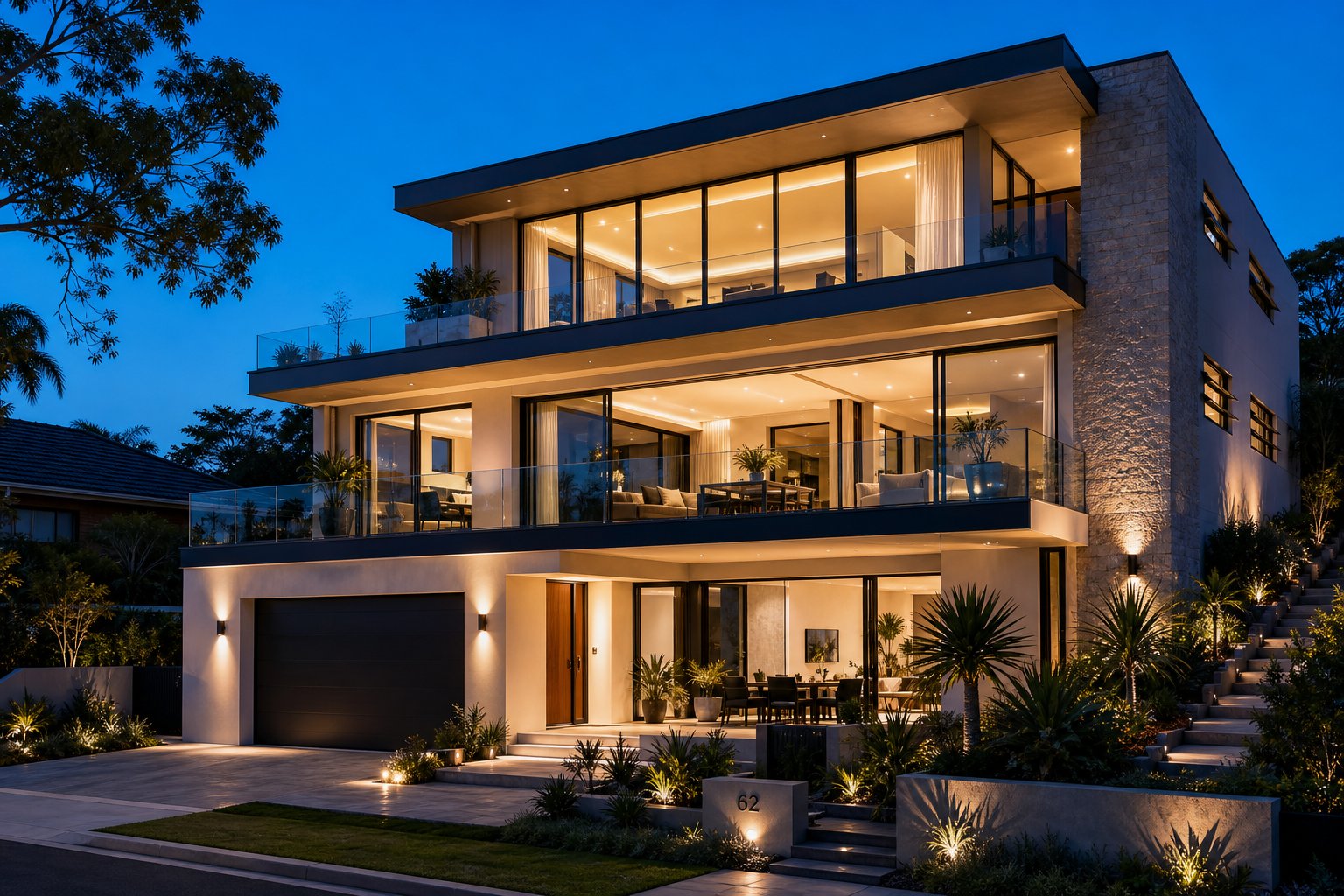
Virtually no residential or commercial build uses a single configuration throughout. A typical Australian home might specify bi-folds on the rear living area opening to the deck, awning windows in bathrooms and above the kitchen bench, casement or tilt-and-turn in bedrooms for egress and cleaning access, fixed panels on noise-exposed street-facing walls, and louvres in a laundry or mudroom. That is five different configurations in one project — and it is entirely normal.
The key to making this work visually is consistency in frame profile, colour, and sightline proportions. A cohesive aluminium window system from a single supplier ensures that your casement frames match your sliding frames match your fixed panels in terms of external appearance, even though the internal hardware and operation differ completely. Matching frame materials and colours across different window types prevents a disjointed appearance and maintains architectural flow from room to room and elevation to elevation.
Aluminium makes this easier than other frame materials. Because profiles are extruded to precise dimensions and powder-coated in identical batches, you get colour and finish consistency across every configuration type — something that is harder to guarantee with painted timber or co-extruded uPVC where different profile shapes may show subtle colour variation. Whether you are specifying replacement windows aluminium for a renovation or selecting configurations for a new build, the ability to mix operational types while maintaining a unified facade is one of aluminium’s strongest practical advantages.
A few practical rules help when combining configurations across a project:
- Align head and sill heights across adjacent windows on the same elevation, even when configurations differ. A casement and a sliding window side by side look cohesive if their top and bottom lines match.
- Use consistent mullion widths where possible. Some configurations require wider stiles for hardware, but a good aluminium system minimises these differences.
- Group operable sections logically. Place ventilation where airflow is needed (windward walls, wet areas) and fixed panels where views or noise control take priority.
- Consider maintenance access holistically. If one elevation is difficult to reach externally, specify tilt-and-turn or pivot configurations there rather than fixed panels that will be impossible to clean without scaffolding.
Working With Specialists to Finalise Your Configuration Plan
A comparison table gives you the framework. Room-by-room analysis narrows the options. But finalising a configuration plan for an actual build requires site-specific assessment that no guide can fully replicate — orientation, local wind patterns, neighbouring structures, council requirements, BAL ratings, NCC compliance for egress, and the structural capacity of existing openings (particularly relevant for aluminium window replacement projects).
Experienced aluminium window suppliers bring this site-level knowledge. They can assess which elevations face prevailing weather, identify where acoustic performance matters most based on noise sources, confirm egress compliance for bedroom configurations, and flag any BAL or cyclone-rating constraints that limit your options on specific walls. A professional window consultation typically covers precise measurements, material and configuration recommendations tailored to your home’s architecture, and a clear quote that accounts for the complexity differences between configuration types.
For homeowners searching for aluminium windows near me or comparing aluminium window supplies across different providers, the differentiator worth looking for is configuration expertise — not just product range. Any supplier can sell you a sliding window. Fewer can advise you on whether that slider should be an XO or XOX based on your room’s cross-ventilation needs, or whether a tilt-and-turn would serve you better on an upper storey given your cleaning access constraints and acoustic requirements.
If you are moving from the research phase into project specification — whether for a new build, a renovation, or aluminum replacement windows upgrading older single-glazed units — MEICHEN’s aluminium windows page provides a clear path from configuration education to product selection. Their range covers sliding, casement, awning, fixed, and specialty configurations with thermally broken profiles engineered for Australian conditions, and their team works with homeowners, builders, architects, and developers to match configurations to site-specific performance requirements. It is the kind of resource that bridges the gap between understanding what each configuration does and specifying exactly what your project needs.
The configuration decisions you make today lock in performance outcomes for 25 to 30 years. A few hours spent matching the right panel arrangement to each opening — informed by the thermal, acoustic, climate, and maintenance considerations covered in this guide — pays dividends every single year in comfort, energy savings, and practical livability. Get it right once, and you will not think about it again. Get it wrong, and you will be reminded every time you open a window that fights you, clean glass you cannot reach, or pay an energy bill inflated by seals that were never designed for your conditions.
Frequently Asked Questions About Aluminium Window Configurations
1. What does XO mean on a sliding window?
XO is a notation system used to describe sliding window panel arrangements as viewed from the exterior of the building. The X represents the operable (sliding) panel and the O represents the fixed panel. So an XO window has the left panel sliding and the right panel fixed when viewed from outside. OX is the mirror image, XOX means both outer panels slide toward a fixed centre panel, and OXXO has two fixed outer panels with two operable panels meeting in the middle. This notation helps builders, architects, and homeowners communicate exactly which panels move and which stay put within a given frame.
2. Which aluminium window configuration is best for energy efficiency?
Fixed panels deliver the highest energy efficiency because they have no moving parts and therefore no operational seals where air can leak. Among operable configurations, casement and awning windows rank next because their closing mechanisms compress rubber gaskets tightly around the full sash perimeter, achieving air infiltration rates two to three times lower than sliding windows. Sliding configurations use brush or pile seals that allow the panel to glide freely but cannot compress as tightly, resulting in higher air leakage over time. For the best thermal outcome, combine predominantly fixed panels with selective casement or awning sections where ventilation is needed, and specify thermally broken aluminium frames with polyamide insulation strips to address aluminium’s natural conductivity.
3. What aluminium window configuration is required for bedroom egress compliance in Australia?
Under the National Construction Code (NCC), bedrooms must have an openable window or door providing a clear emergency escape path — generally a minimum of 850 mm high and 600 mm wide, or an unobstructed area of at least 0.44 square metres. Casement windows meet this easily because the full sash swings open. Sliding windows also comply provided the operable panel is at least 600 mm wide. Single-hung windows can be limiting since only the bottom sash moves. For upper-storey bedrooms where fall-prevention rules restrict opening width below 1.7 m sill height, tilt-and-turn configurations offer secure tilt ventilation with full-turn egress available when needed.
4. How do aluminium window configurations perform in bushfire zones?
Configuration choice directly affects bushfire compliance under Australia’s BAL rating system. Fixed panels perform best because they have no moving parts, no operational gaps, and no hardware penetrations where embers can enter. Awning configurations rank next due to their compression seals and simple hardware with fewer failure points under thermal stress. Sliding windows present moderate risk because brush seals and track drainage channels can admit fine burning material — requiring careful detailing at BAL-29 and above. Louvre and bi-fold configurations face the greatest challenges, with multiple blade edges or panel junctions creating potential ember entry paths. At BAL-40 or BAL-FZ, these may be impractical on exposed elevations. The general strategy is to use fixed and awning windows on bushland-facing walls and reserve complex operable types for sheltered sides.
5. Can you mix different aluminium window configurations in one home?
Mixing configurations is not only possible but standard practice in Australian residential builds. A typical home might use bi-folds opening to a rear deck, awning windows in bathrooms and kitchens, casement or tilt-and-turn in bedrooms for egress and cleaning access, fixed panels on noise-exposed street-facing walls, and louvres in laundries. The key to making this work visually is sourcing all configurations from a single aluminium window system so frame profiles, colours, and sightline proportions remain consistent across every window type. Aligning head and sill heights on the same elevation and using consistent mullion widths ensures a cohesive facade even when operational types differ behind the glass. Specialists like MEICHEN offer full configuration ranges within unified profile systems designed for this purpose.
More Window & Door Guides