What Makes Aluminium Windows Truly High End
The phrase “high end” gets attached to aluminium windows far too loosely. Walk through any new housing estate and you will find builder-grade frames marketed as premium despite offering little beyond a basic aluminium shell and standard glass. Genuine high end aluminium windows are an entirely different category of product, and the distinction matters for anyone investing in a home that needs to perform across decades of Australian weather.
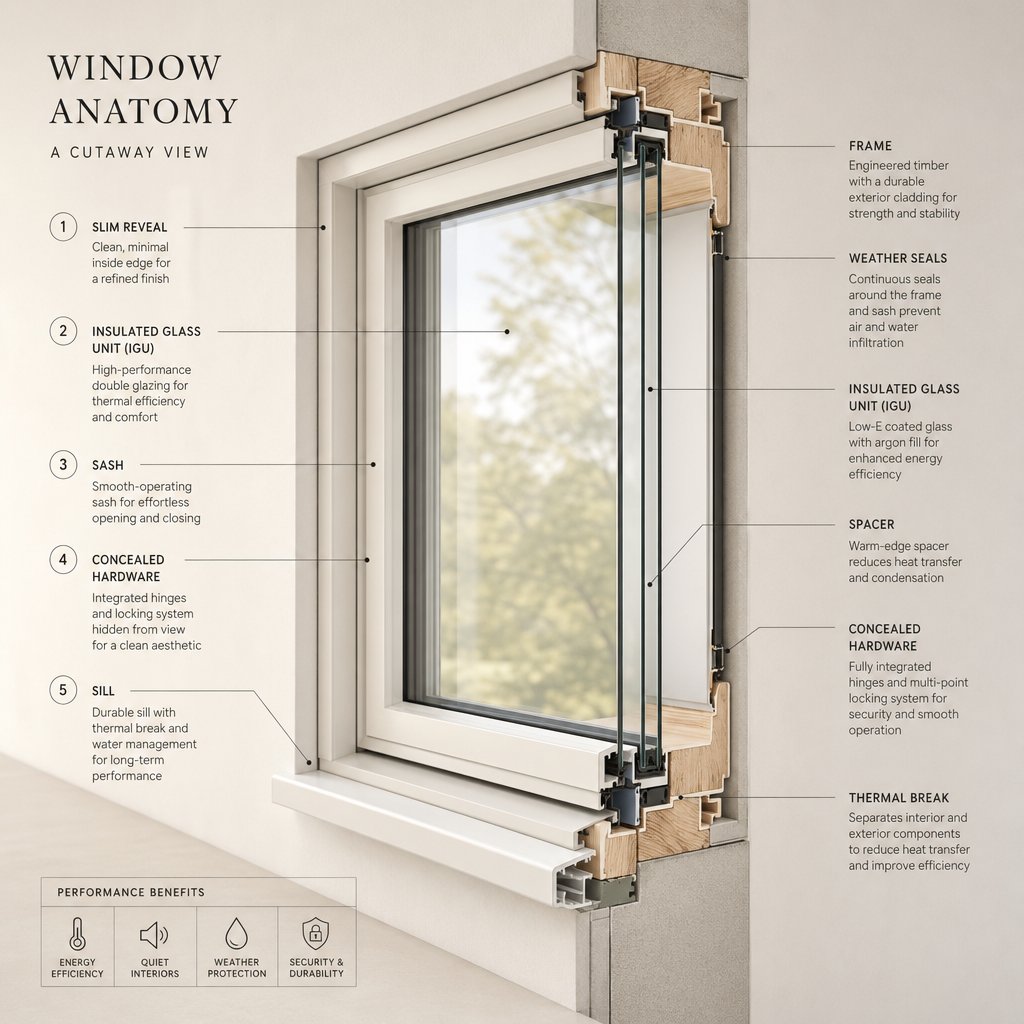
High end aluminium windows are engineered fenestration systems defined by multi-chamber profile construction, advanced polyamide thermal breaks, architectural-grade powder coating, certified performance ratings, and precision hardware — not simply by brand name or visual appearance.
Defining Premium in Aluminium Window Systems
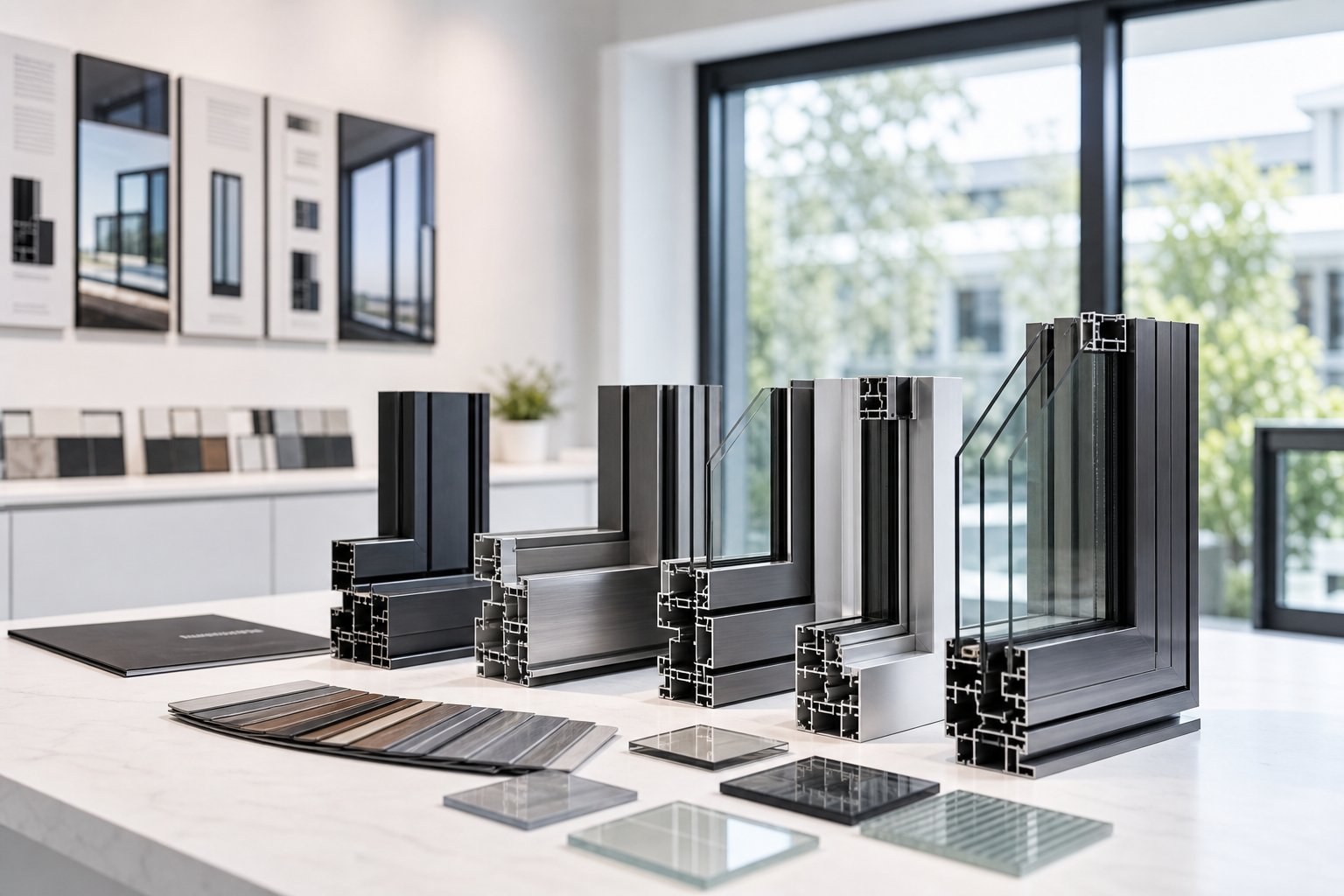
A truly premium aluminium window system earns that label through measurable engineering attributes. The profile itself features multiple internal chambers that improve both structural rigidity and thermal insulation. Within that profile sits a thermal break — an insulating barrier separating the interior and exterior aluminium faces — wide enough to dramatically reduce heat transfer. Modern aluminium windows at this tier typically incorporate breaks of 24 mm or more, compared to the narrow 12-16 mm strips found in commodity products.
Hardware matters just as much. Premium systems rely on multi-point locking mechanisms, concealed hinges rated for heavy sashes, and friction stays engineered for tens of thousands of cycles. The finish is Qualicoat-certified or marine-grade powder coating designed to resist chalking, fading, and salt-air corrosion across coastal Australia. Certified performance ratings — covering air infiltration, water penetration, and wind load resistance under AS 2047 — provide objective proof rather than marketing language.
Why Standard Aluminium Falls Short for Discerning Projects
Standard aluminium windows serve a purpose, but their limitations become obvious on demanding projects. Shallow profiles of 40-50 mm lack the depth needed for effective thermal separation, meaning heat flows freely between the outdoor and indoor faces of the frame. Basic polyester coatings can fade within a few years under intense UV exposure. Generic sealing materials degrade faster, allowing dust and water ingress during storms. Limited colour options and visible hardware further separate these products from anything that deserves the premium label.
For homeowners, architects, and builders choosing windows in aluminium, understanding where that line falls is essential. High quality aluminium windows deliver comfort, longevity, and energy efficiency precisely because their engineering goes far deeper than surface appearance — a reality that becomes clearer when you examine how each specification tier stacks up against measurable criteria.
How to Tell Premium Apart from Standard Aluminium Window Frames
Price tags alone reveal nothing about what sits inside an aluminium window frame. Two products can look identical from the street yet differ wildly in profile engineering, coating durability, and long-term thermal performance. The gap between genuine premium and dressed-up standard is measurable — and once you know what numbers to look for, marketing claims become easy to verify or dismiss.
Profile Depth and Chamber Design
Profile depth is the single fastest indicator of where an aluminium frame window sits on the quality spectrum. Standard builder-grade aluminium window frames typically measure 40-50 mm from front to back. That shallow depth limits what engineers can fit inside: minimal thermal separation, narrower glazing cavities, and fewer internal chambers for structural reinforcement.
Premium aluminium frames for windows start at 60 mm and extend to 75 mm or beyond for heavy-duty configurations. That extra depth creates room for wider thermal breaks, multi-chamber construction, and thicker wall sections. Multi-chamber profiles — where the extrusion contains three, four, or even five separate internal cavities — improve insulation by trapping still air within the frame itself. They also add rigidity without increasing weight, which matters for large openings where structural integrity determines how well hardware and seals perform over decades.
Wall thickness compounds the difference. Quality aluminium window frames use a minimum 1.6 mm wall thickness for residential applications, while coastal and high-wind zones demand 2.0 mm or more. Budget products often drop to 1.0-1.2 mm — adequate for small openings in sheltered locations, but prone to flex and seal failure on anything larger.
Finish Quality and Powder Coating Standards
Every aluminium window gets some form of surface treatment, but the gap between entry-level and premium coating is substantial. Standard polyester powder coating provides a basic colour layer that resists general weathering for roughly 10-15 years before noticeable chalking or fading appears. In the harsh Australian UV environment, that timeline can compress further, particularly on darker colours and north-facing elevations.
Premium aluminium framed windows use Qualicoat-certified or marine-grade coatings — often Qualicoat Seaside-rated for salt-air exposure — engineered to maintain colour stability and surface integrity for 25-30 years. PVDF liquid coatings push that further still, offering three decades of gloss and colour retention. Anodised finishes remain popular for bronze aluminium windows and natural metallic tones, producing a hard oxide layer (25-35 microns thick for aggressive environments) that resists scratching, chalking, and UV degradation far more effectively than standard powder.
The aluminium windows profile itself also influences finish longevity. Deeper profiles with rounded edges hold powder coating more evenly than shallow, sharp-cornered extrusions where coating thickness can thin at corners — creating early failure points.
A Clear Framework for Evaluating Quality Tiers
Rather than relying on brochure language, use these measurable criteria when comparing any manufacturer’s aluminium window frames side by side:
- Profile depth: 60 mm+ indicates mid-to-premium; 70 mm+ signals high-performance systems
- Thermal break width: 24 mm minimum for genuine thermal improvement; 30-40 mm for premium-tier performance
- Wall thickness: 1.6 mm minimum residential; 2.0 mm for coastal or large-span applications
- Glass accommodation: capacity for double glazing (24-28 mm units) at minimum; triple glazing capability (36-44 mm units) at the premium tier
- Hardware grade: multi-point locking, concealed hinges, and friction stays rated for sash weights above 80 kg
- Finish certification: Qualicoat Class 2 or Seaside-rated for coastal zones; documented salt spray testing hours (1,000+ for marine exposure)
- Warranty terms: 10-year minimum on frames and finish; 5-year minimum on hardware and moving components
Any supplier unwilling to provide specific numbers across these categories is likely selling mid-range aluminum frame windows at premium prices. The structural bones of the frame — profile geometry, break width, chamber count, and coating certification — tell you more about real quality than any showroom display ever will. And those structural details connect directly to how well the window manages heat, which brings us to the technology that truly defines performance in aluminium fenestration.
Thermal Break Technology That Defines Performance
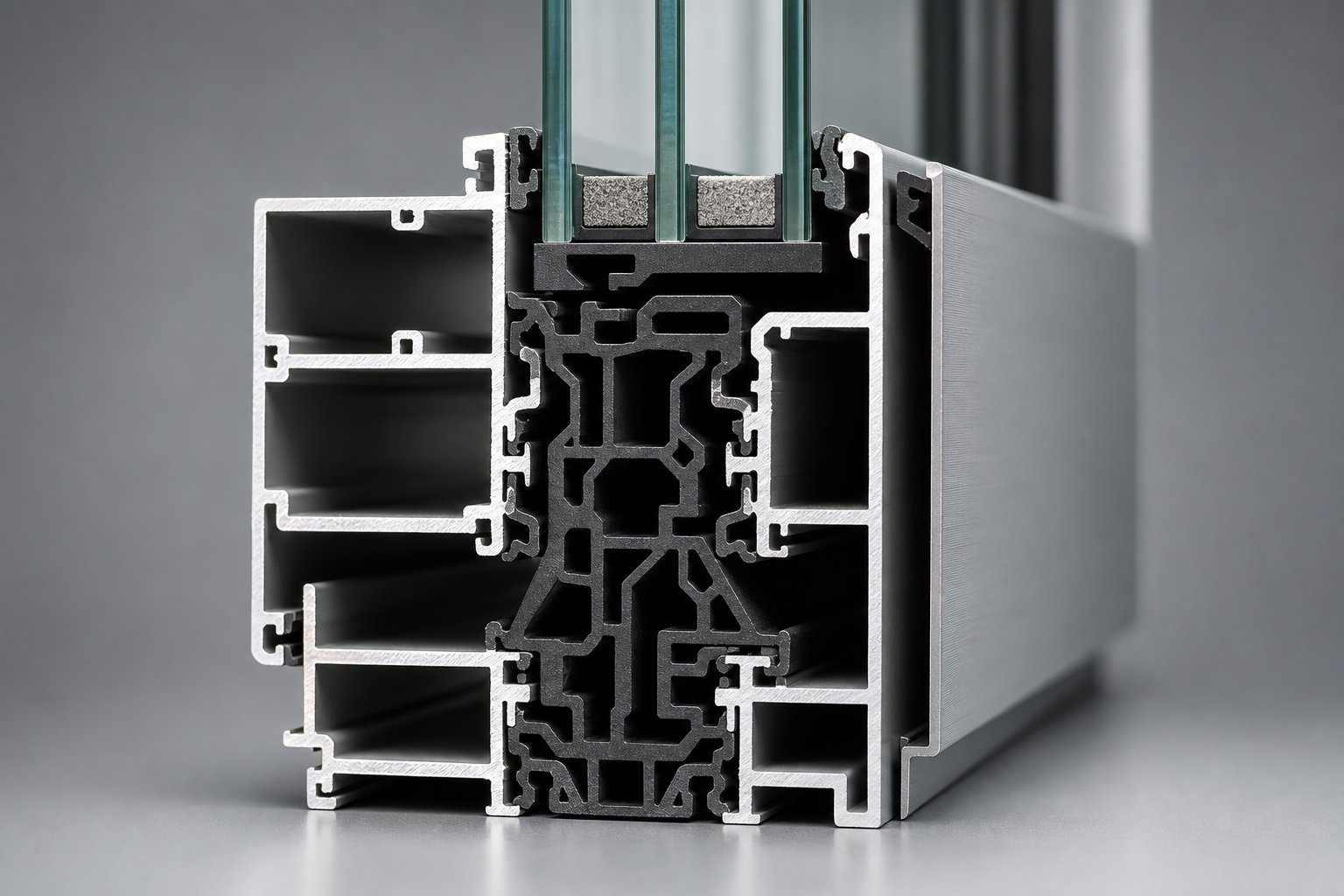
Aluminium conducts heat roughly 1,000 times faster than timber and 200 times faster than PVC. Left uninterrupted, an aluminium window profile acts as a thermal highway — channelling summer heat inward and winter warmth outward with remarkable efficiency. That conductivity is aluminium’s greatest structural asset and its most significant thermal liability. The solution sits inside the frame itself, invisible from the outside yet responsible for the vast majority of performance difference between a premium system and a basic one.
How Thermal Breaks Eliminate Aluminium’s Weakness
A thermal break is an insulating barrier positioned between the interior and exterior faces of an aluminium extrusion. It severs the conductive pathway through the metal, forcing heat to pass through a low-conductivity material instead. Think of it as a dam inserted into a river — the flow doesn’t stop entirely, but the volume drops dramatically.
The width of that barrier matters enormously. In standard aluminium window systems, thermal breaks measure just 12-16 mm. Premium European-derived aluminium window profiles push that to 24-40 mm or more. Each additional millimetre of break width reduces the frame’s U-value — the measure of how readily heat passes through — because the insulating material has a thermal conductivity around 0.3 W/mK compared to aluminium’s 237 W/mK. The difference is not incremental. It’s transformational.
Polyamide vs Polyurethane Thermal Barriers
Two materials dominate the thermal break space, and understanding their differences reveals why not all “thermally broken” frames perform equally.
Polyamide (PA66 with glass fibre reinforcement) is the workhorse of premium European aluminum window profiles. Pre-formed strips are mechanically crimped into channels machined along the extrusion. The glass fibre reinforcement delivers dimensional stability across temperature cycles, UV resistance, and structural rigidity. Most high-performance residential systems use this approach.
Polyurethane takes a different path. Liquid polymer is poured directly into the aluminium cavity, solidifies within minutes, and then a section of aluminium is removed (debridged) to complete the thermal separation. Polyurethane foam achieves a thermal conductivity rating of 0.21 compared to polyamide’s 2.08, positioning it as the superior thermal performer. It also outperforms polyamide by four to five times in shear and tensile strength — critical for large-scale glazing where the thermal break bears structural load.
Neither material is inherently wrong for a project, but understanding which one sits inside your frame — and how wide that break actually is — separates informed specification from blind trust in marketing.
Real-World Energy Performance Implications
The practical impact of superior thermal breaks extends well beyond a number on a data sheet. Traditional aluminium windows without adequate breaks produce frame U-values around 4.0-6.0 W/(m²K). Thermally broken aluminium window systems with wide polyamide or polyurethane barriers routinely achieve 0.8-2.0 W/(m²K) — a 70-85% improvement in thermal efficiency.
For an Australian home, that translates into tangible outcomes: reduced HVAC loads during Melbourne winters and Brisbane summers alike, fewer cold spots beside glazed openings, and virtually eliminated condensation on interior frame surfaces. Interior aluminium temperatures stay closer to room ambient rather than tracking outdoor extremes, which means heating and cooling systems cycle less frequently and the building envelope performs as intended.
These gains compound across every window in a home. A dwelling with fifteen or twenty openings fitted with wide-break aluminium frames will consume measurably less energy than the same home fitted with narrow-break or non-thermally-broken alternatives — savings that accumulate year after year without any ongoing effort from the homeowner. The thermal break is, quite simply, the engineering detail that earns the “high end” label. Everything else is decoration.
Yet even the best frame means little if the glass it holds doesn’t match its performance capability — a mismatch that wastes much of the engineering investment sitting inside those profiles.
Glazing Options That Maximize Premium Aluminium Frames
A high-performance aluminium frame without appropriate glass is like a sports car running on budget tyres. The frame provides the structural platform, but it’s the glazing that delivers most of the thermal, acoustic, and security performance in any aluminium window with glass. Pairing a premium frame with inferior glazing wastes the engineering investment — and it happens more often than you’d expect.
Double vs Triple Glazing in Premium Frames
Premium aluminium frames are engineered to accommodate heavier glazing units that standard profiles simply cannot support. A triple-glazed insulating glass unit (IGU) can weigh 40-60% more than its double-glazed equivalent for the same opening size. That additional mass demands deeper glazing rebates, reinforced hardware, and robust friction stays — all standard features of a genuinely high-end system.
Triple glazing achieves U-values as low as 0.7 W/(m²K), compared to 1.2-1.6 W/(m²K) for typical double-glazed units. For residential aluminium windows in cooler Australian climates — think alpine Victoria, Canberra winters, or elevated areas of the tablelands — triple glazing delivers measurable comfort and energy gains. In temperate and subtropical zones, high-performance double glazing with advanced coatings and gas fills often delivers the right balance between cost and efficiency, particularly when solar heat gain management matters more than preventing heat loss.
The decision isn’t purely about pane count. A well-specified aluminum double pane window with premium low-E coatings and gas fills will outperform a basic triple unit with clear glass and air gaps every time.
Low-E Coatings and Gas Fills
Low-emissivity coatings are microscopically thin metallic oxide layers applied to glass surfaces inside the sealed unit. They reflect radiant heat back toward its source — keeping warmth inside during winter and rejecting solar radiation during summer. Low-E coatings reduce energy loss by 30-50% compared to uncoated glass, at roughly 10-15% additional cost over the glazing unit.
Gas fills work alongside these coatings. Argon, the most common fill, reduces convective heat transfer within the sealed cavity and performs well in standard 12-16 mm gaps. Krypton fills suit narrower cavities (6-10 mm) used in slimmer profile systems, delivering superior insulation in less space — relevant for slim sightline designs where overall unit depth is constrained.
For commercial aluminium windows and large-format residential applications, specifying high-performance glass is non-negotiable. A premium frame with standard uncoated glass will record a whole-window U-value far above what the frame itself could achieve, because the glazing occupies 70-80% of the total window area. The glass dominates performance.
Acoustic and Security Glass Options
The structural capacity of premium aluminium frames unlocks glazing configurations that lighter systems can’t carry. Laminated acoustic glass — typically 6.5 mm or thicker with a PVB interlayer — reduces noise transmission significantly, making it essential for homes near arterial roads, flight paths, or entertainment precincts. Varying pane thicknesses within the IGU (for example, 6 mm outer, 4 mm middle, 8 mm inner) disrupts different sound frequencies more effectively than uniform glass.
Toughened safety glass, required in many applications under AS 1288, shatters into small blunt fragments rather than dangerous shards. Security-rated configurations layer toughened and laminated glass together, resisting forced entry and impact from storm-borne debris — relevant in cyclone-rated zones across northern Australia.
Here’s how common glazing configurations stack up, from good to exceptional thermal performance:
- Good: Double glazed, clear glass, argon fill, aluminium spacer — U-value approximately 2.6-2.8 W/(m²K)
- Better: Double glazed, single low-E coating, argon fill, warm-edge spacer — U-value approximately 1.4-1.6 W/(m²K)
- High performance: Double glazed, dual low-E coatings, krypton fill, warm-edge spacer — U-value approximately 1.0-1.2 W/(m²K)
- Exceptional: Triple glazed, dual low-E coatings, argon or krypton fill, warm-edge spacer — U-value approximately 0.7-0.9 W/(m²K)
Each step up the performance ladder adds weight and unit depth, reinforcing why the frame must be specified first and the glazing matched to it. Premium aluminium handles all of these configurations without flex or seal compromise — a capability that opens the door to every architectural style from minimal fixed panels to large operable sashes.
Window Types for Every Architectural Vision
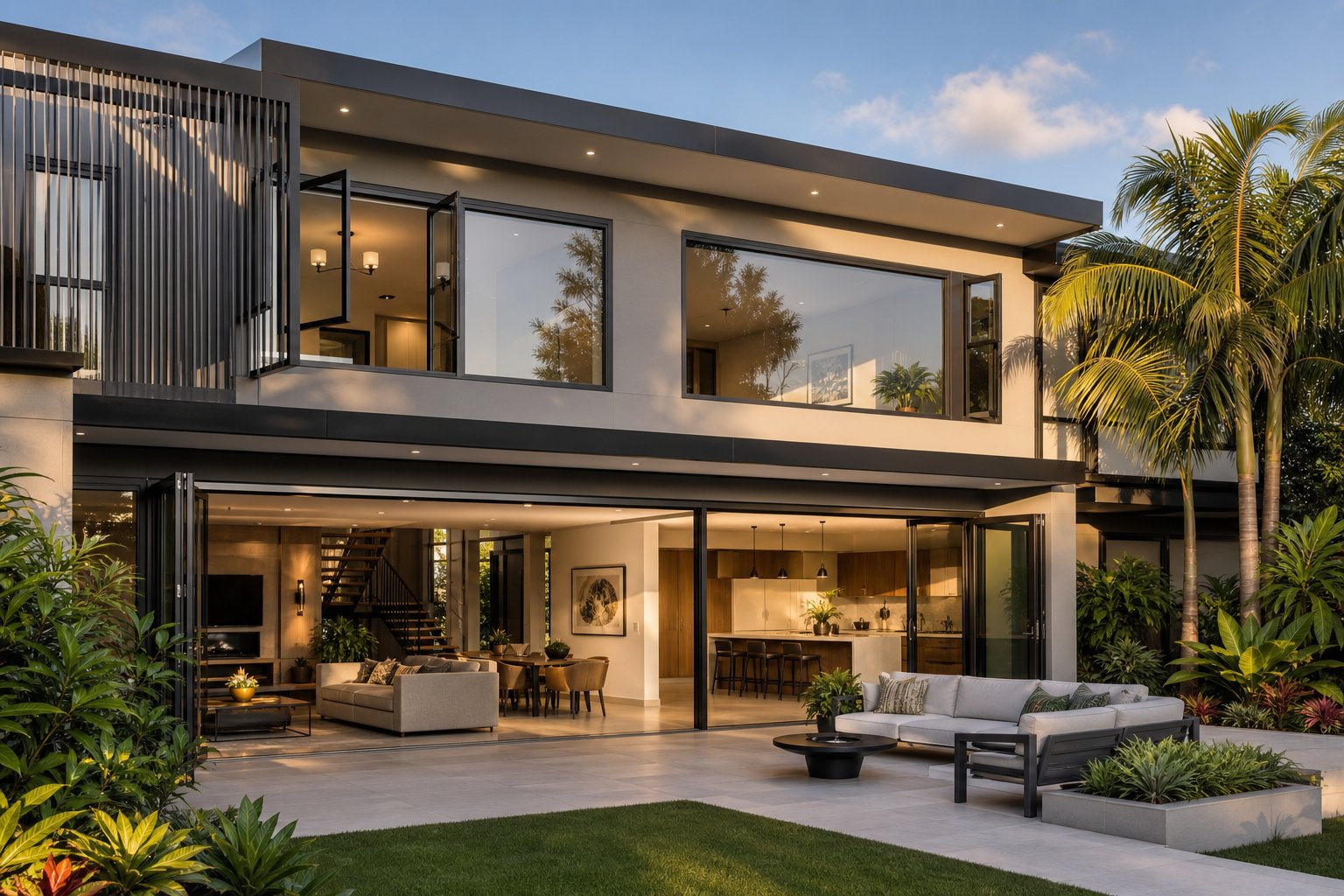
Premium frames and high-performance glazing only deliver their full potential when paired with the right window type for the application. A fixed panel makes no sense where ventilation matters. A casement won’t work where a sliding system would free up floor space. High-end aluminium’s greatest practical advantage is its versatility — the same engineering platform supports nearly every operable configuration architects can imagine, often with slimmer sightlines and larger spans than standard equivalents can manage.
Casement and Tilt-Turn for Maximum Ventilation
Aluminium casement windows remain the most popular choice for residential projects across Australia, and at the premium tier they perform distinctly differently from budget equivalents. A high-end aluminium casement window achieves frame face widths as narrow as 45-55 mm on the opening sash, compared to 65-80 mm on standard systems. That reduction might sound modest in millimetres, but across a wall of casements it translates into noticeably more glass and less frame — more daylight, better views, and a cleaner architectural expression.
The structural rigidity of deep-profile aluminium casement windows also supports larger individual sashes. Where builder-grade frames max out around 600-700 mm panel width before hardware struggles, premium systems handle sashes exceeding 900 mm wide and weighing well over 80 kg on concealed multi-point hinges. Larger sashes mean fewer mullions dividing your view and significantly more airflow when open.
Tilt-turn configurations take versatility further. A single window operates in two modes: tilting inward at the top for secure background ventilation, or swinging fully inward like a door for cleaning access and maximum airflow. This European-derived design suits contemporary Australian homes where parents want ventilation without fully open windows at height, or where upper-storey access makes external cleaning impractical. Premium aluminium sash windows in tilt-turn configuration accommodate heavy triple-glazed units that cheaper systems cannot support in this dual-action mode.
Fixed and Picture Windows for Uninterrupted Views
Where the goal is pure visual connection — a coastal panorama, bushland outlook, or city skyline — fixed glazing in slim profile windows delivers maximum glass area with minimal frame intrusion. High-end fixed aluminium frames achieve face widths as slim as 20-35 mm, meaning the frame nearly disappears from the interior. Standard fixed frames typically sit at 50-60 mm face width, creating a noticeably heavier visual border around the glass.
These narrow profiles demand precise engineering. Maintaining structural integrity and weather sealing with so little visible material requires thicker wall sections, tighter manufacturing tolerances, and superior gasket design. The result is a window that looks effortlessly minimal but relies on considerable hidden engineering to resist wind loads and thermal movement across large spans — sometimes exceeding 3 metres in a single panel.
For projects combining fixed and operable windows in the same elevation, premium systems offer matching sightlines across both types, so the fixed panels don’t look visually disconnected from the opening ones beside them.
Sliding and Louvre Systems for Indoor-Outdoor Living
Australian residential design gravitates toward erasing the boundary between inside and out. Lift-and-slide door systems and multi-panel sliding configurations serve that ambition better than almost any other window type. Premium aluminium sliding systems handle panel weights exceeding 400 kg per leaf, gliding on precision-machined stainless steel tracks with minimal effort despite their mass.
Multi-panel configurations — three, four, or even six panels stacking to one side — create openings spanning 6-12 metres or more. The thermal break technology and weather sealing discussed earlier applies identically here, so these massive openings don’t sacrifice energy performance for spectacle.
Aluminium louvre windows offer a different approach to climate-responsive design. Rather than large operable panels, louvre blades rotate to control airflow precisely — particularly effective in tropical and subtropical Australian climates where managing ventilation and rain protection simultaneously is a daily requirement. Premium aluminium louvre systems use individual blade seals and multi-point locking to achieve weather ratings that older louvre designs never approached, making them suitable for bedrooms and living spaces rather than just utility areas.
Whether the project calls for custom aluminium windows configured as floor-to-ceiling fixed panels, operable aluminium casement designs for cross-ventilation, or expansive sliding systems for entertaining, the common thread is that premium aluminium provides the structural backbone for all of them without compromise. Australian homeowners and architects exploring these configurations can work with specialists like MEICHEN, who offer project-ready custom aluminium window systems across casement, sliding, fixed, and louvre types for both residential and commercial builds.
Each of these window types looks impressive in a showroom. What separates the genuinely premium from the merely attractive is what happens behind the glass — the hardware mechanisms and performance certifications that validate whether a system will still operate flawlessly a decade from installation.
Hardware and Certifications That Signal Genuine Quality
A window can feature deep profiles, wide thermal breaks, and flawless powder coating — yet still disappoint within a few years if the hardware fails. Handles loosen. Hinges sag. Locks disengage halfway through their travel. These are the symptoms of entry-level components dressed up inside an otherwise capable frame, and they’re far more common than most buyers realise. Hardware is where cost-cutting hides most effectively, because no one inspects a hinge mechanism with the same scrutiny they give a colour swatch. Certifications exist to close that gap — offering objective, testable evidence of how a window actually performs rather than how it looks.
Multi-Point Locking and Concealed Hinges
In budget aluminium windows, a single latch or cockspur handle secures the sash at one point along its edge. That single connection leaves the rest of the frame relying on friction and gasket compression alone to resist wind pressure, forced entry, and long-term seal integrity. Premium systems take a fundamentally different approach.
Multi-point espagnolette locking engages the sash at three, five, or even seven contact points around the perimeter when the handle rotates. Each locking point pulls the sash tighter against the frame gaskets, compressing seals uniformly and dramatically improving both weather resistance and security. The mechanism itself uses a central gearbox driving stainless steel rods to mushroom-head cams — components rated for 50,000+ cycles in top window manufacturers’ hardware specifications.
Concealed hinges eliminate visible external hardware, producing the clean aesthetic that defines contemporary design. More importantly, they distribute sash weight across a broader mounting area than surface-fixed butt hinges. For large casement sashes weighing 80-120 kg, high-grade friction stays rated specifically for that mass prevent the gradual sag that eventually causes binding, air leakage, and water ingress in lighter systems.
Hardware is often the first component to fail in cheaper systems because it endures the most repetitive mechanical stress. When evaluating the best aluminium windows for a project, ask specifically about hardware brand, cycle rating, corrosion resistance class, and maximum supported sash weight. These numbers reveal more about long-term reliability than frame depth ever will.
Certifications That Validate Performance Claims
Marketing language is easy to produce. Certification isn’t. Genuine high end window manufacturers submit their products to independent, accredited testing laboratories and publish the results. These certifications give buyers the objective evidence needed to separate substantiated performance from aspirational brochure copy.
In Australia, several standards and rating systems matter most:
AS 2047 is the foundational standard. As referenced in the National Construction Code, it covers structural performance under wind load, water penetration resistance, air infiltration limits, and operating force — all tested under controlled laboratory conditions by NATA-accredited facilities. Every aluminium window installed in a new build or renovation requiring council approval must comply. Yet compliance exists on a spectrum: a window can scrape past minimum thresholds or exceed them by a wide margin. Premium systems target performance well above minimum gateway values.
BAL (Bushfire Attack Level) ratings apply across much of suburban and peri-urban Australia. Windows rated to BAL-29 or BAL-40 use specific glazing types, frame configurations, and sealing systems designed to resist radiant heat and ember attack. For properties in designated bushfire-prone areas, this certification isn’t optional — it’s a condition of approval.
WERS (Window Energy Rating Scheme) provides star ratings for heating and cooling performance, helping homeowners compare products on a standardised scale. Both residential aluminium window manufacturers and commercial aluminium window manufacturers use WERS data to demonstrate energy efficiency without requiring buyers to interpret raw U-values and SHGC figures themselves.
Passivhaus certification represents the international benchmark for ultra-low energy buildings. Aluminium window systems achieving Passivhaus-certified component status must demonstrate frame U-values typically below 0.8 W/(m²K) — a threshold that demands the widest thermal breaks, premium gasket systems, and triple glazing as a minimum. Few aluminium systems achieve this, making it a reliable marker of genuinely elite performance.
Testing Benchmarks Worth Understanding
Behind every certification sits a battery of physical tests. Understanding what gets measured helps you ask better questions of any aluminium window manufacturers you’re evaluating.
| Standard / Rating | What It Measures | Why It Matters to Buyers |
|---|---|---|
| AS 2047 — Structural | Resistance to positive and negative wind pressure (in Pascals) | Confirms the window won’t flex, leak, or fail during storms relevant to your location and building height |
| AS 2047 — Water Penetration | Resistance to wind-driven rain at specified pressure differentials | Prevents internal water damage, mould growth, and premature seal degradation |
| AS 2047 — Air Infiltration | Volume of air passing through a closed window per metre of joint length | Lower infiltration means better energy efficiency, reduced dust ingress, and improved acoustic isolation |
| BAL Rating (AS 3959) | Resistance to radiant heat, direct flame contact, and ember attack | Mandatory compliance for properties in bushfire-prone zones; protects lives and property |
| WERS Energy Rating | Whole-window thermal and solar performance on a star scale | Enables direct product comparison for heating and cooling efficiency without technical expertise |
| AS 1288 — Glazing | Selection and installation requirements for safety glass | Ensures glass type matches its application, protecting occupants from breakage injury |
| Passivhaus Component | Frame and whole-window U-values under strict test protocols | Identifies products capable of meeting ultra-low energy building targets |
Air infiltration rates deserve particular attention. Premium windows tested under AS 2047 achieve infiltration below 1.0 L/s per metre of operable joint at the rated test pressure. Standard products often sit at 2.0-5.0 L/s/m — a difference that compounds across every window in a home, adding up to significant uncontrolled air exchange that heating and cooling systems must compensate for around the clock.
Water penetration resistance follows similar logic. Top window manufacturers test to pressures of 300-600 Pa (simulating severe wind-driven rain), while budget products may only achieve 150-200 Pa before leakage occurs. In exposed coastal or elevated sites across Australia, that margin can be the difference between dry interiors and progressive water damage hidden inside wall cavities.
Wind load ratings tie directly to location. A window installed on the fifteenth storey of a Sydney apartment tower faces substantially higher design pressures than one in a single-storey suburban home in Adelaide. High end window brands engineer and test their systems to cover upper-range design pressures — meaning they carry capacity for demanding installations without requiring special structural modifications.
Collectively, these certifications and benchmarks form a language that legitimate manufacturers speak fluently. Any supplier reluctant to share specific test results, rated pressures, or certificate numbers is asking you to trust appearances over evidence — and appearances, as we’ve established, are the easiest part of a window to fake. What’s far harder to fabricate is how a system stacks up against entirely different frame materials, each with its own strengths and trade-offs.
Aluminium Compared to Timber, Steel, and Fiberglass
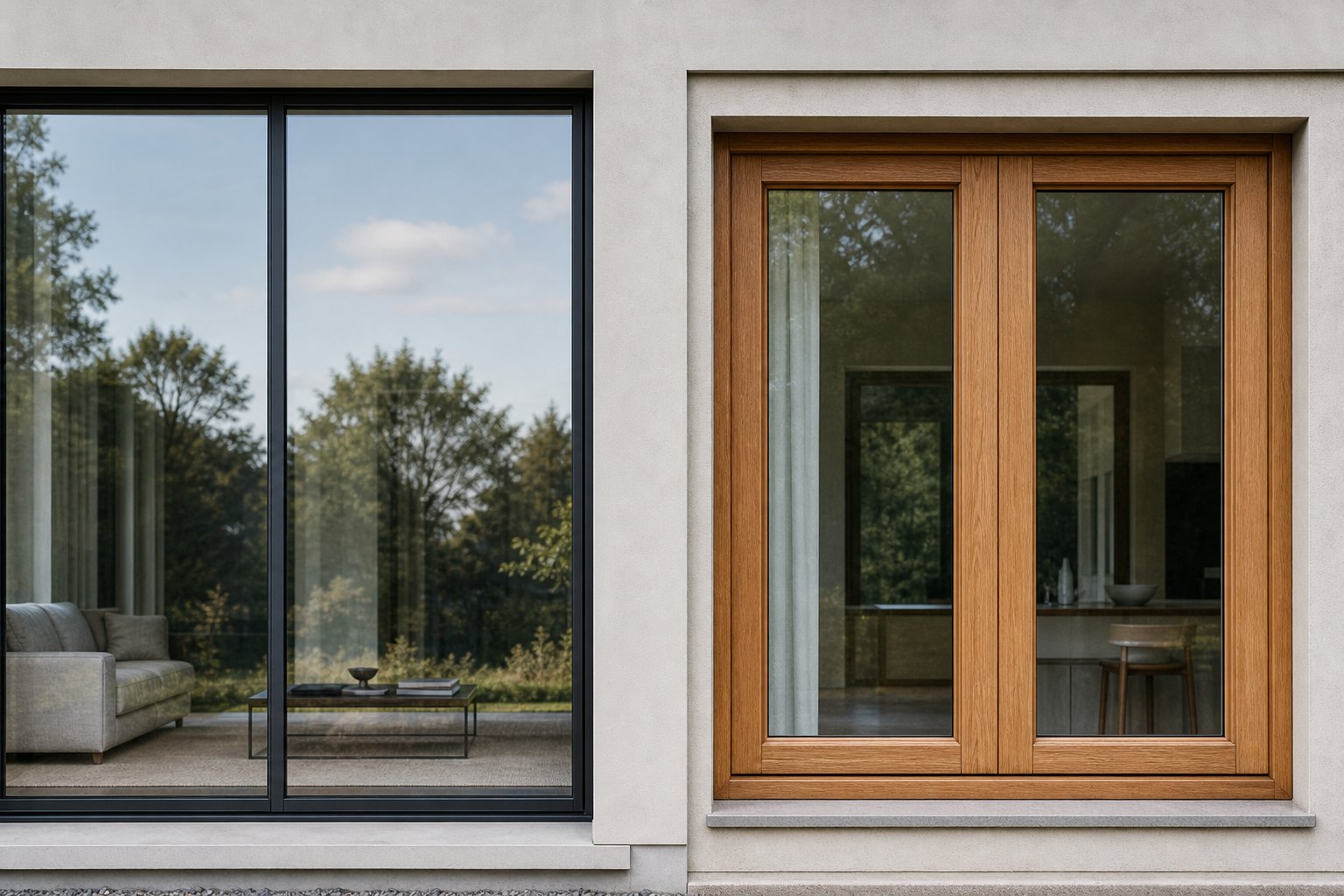
Certifications confirm what a window can do. But they don’t answer a more fundamental question: should the frame be aluminium at all? Every material carries trade-offs, and honest evaluation demands acknowledging where aluminium leads, where it trails, and where alternatives might suit a project better. For anyone investing in metal frame windows at the premium tier, understanding what you gain — and what you sacrifice — against timber, steel, and fiberglass prevents expensive regret down the line.
Aluminium vs Timber Frames
Timber insulates naturally. Its cellular structure achieves frame U-values of 1.2-1.4 W/(m²K) without any thermal break technology at all. That’s a meaningful edge over thermally broken aluminium’s typical 1.4-1.6 W/(m²K) in standard residential systems, though premium aluminium approaching 0.8 W/(m²K) with wide polyamide breaks narrows the gap substantially.
The trade-off sits in longevity and maintenance. Hardwood timber frames can last 50-60 years, but only with repainting or re-staining every 4-7 years — six to ten maintenance cycles over the frame’s service life. Aluminium demands nothing beyond occasional cleaning and hardware lubrication across its 40-60 year lifespan. In the Australian context, where UV intensity accelerates coating breakdown on timber, that maintenance burden compounds quickly.
Timber also warps, swells, and attracts termites. Aluminium does none of these things. For coastal and subtropical locations, or for owners who simply don’t want to commit to cyclical refinishing, aluminium’s stability and corrosion resistance outweigh timber’s raw thermal advantage. That said, timber’s warm aesthetic and heritage character remain unmatched for period homes, Queenslanders, and heritage-overlay zones where council requirements may mandate natural materials regardless of performance arguments.
A middle path exists in wood clad aluminium windows — sometimes marketed as aluminum clad wood windows — which combine a timber interior for warmth and visual character with an aluminium exterior shell for weather protection. These metal clad windows offer the natural beauty of wood inside the living space while eliminating most external maintenance concerns. The compromise is complexity: more joints, higher cost, and reliance on the seal between materials remaining intact over decades.
Aluminium vs Steel and Fiberglass
Steel delivers the slimmest sightlines of any frame material — profiles as narrow as 20-25 mm face width, even thinner than premium aluminium’s 35 mm. For heritage industrial aesthetics, Crittall-style glazing, and custom metal windows requiring maximum glass with minimum visual frame, steel occupies a unique position that aluminium cannot fully replicate.
The penalties are real, though. Steel corrodes without vigilant protection, particularly in coastal and high-humidity environments across Australia. Thermal performance lags behind aluminium unless expensive thermally broken steel systems are specified, typically achieving U-values of 1.5-2.5 W/(m²K). Cost sits well above equivalent aluminium systems due to custom fabrication requirements. And lead times stretch longer because steel windows are rarely off-the-shelf products.
Fiberglass occupies the opposite end of the spectrum — thermally excellent (U-values as low as 0.20 W/(m²K)), dimensionally stable, and low-maintenance. It expands and contracts at nearly the same rate as glass, reducing seal stress over temperature cycles. On paper, fiberglass outperforms aluminium thermally while matching its durability claims.
In practice, fiberglass availability in Australia remains limited compared to aluminium. Fewer fabricators, fewer colour options, bulkier profiles than aluminium for equivalent structural performance, and a higher price point restrict its market share. Aluminium’s colour range — virtually unlimited through powder coating — and its established supply chain across Australian manufacturers give it practical advantages that fiberglass hasn’t yet overcome domestically.
Where Aluminium Excels and Where It Doesn’t
Aluminium’s natural conductivity remains its inherent weakness. Without a thermal break, it performs terribly. With one, it performs competitively but still doesn’t match timber or fiberglass for raw insulation value at equivalent profile depths. That’s an honest limitation worth acknowledging.
What aluminium offers in return is a combination no single competing material can replicate: strength-to-weight ratio enabling the largest spans with the slimmest frames; complete dimensional stability regardless of humidity, temperature, or UV exposure; corrosion resistance suited to salt-laden coastal air; an essentially unlimited palette of colours and finishes; full recyclability at end of life (requiring just 5% of the energy needed for virgin production); and a proven 40-60 year service life with negligible maintenance. For most Australian residential and commercial projects, that combination makes aluminium the strongest all-round choice — provided the thermal break specification matches the climate demands.
| Criteria | Aluminium (Thermally Broken) | Timber (Hardwood) | Steel (Thermally Broken) | Fiberglass |
|---|---|---|---|---|
| Thermal Performance (Frame U-value) | 0.8-1.6 W/(m²K) | 1.2-1.4 W/(m²K) | 1.5-2.5 W/(m²K) | 0.2-1.0 W/(m²K) |
| Maintenance | Minimal (cleaning only) | High (repaint every 4-7 years) | Moderate (corrosion monitoring) | Minimal (cleaning only) |
| Expected Lifespan | 40-60 years | 50-60 years (hardwood) | 50+ years (protected) | 40+ years |
| Maximum Practical Span | Large (3-4 m single panel) | Moderate (limited by weight/stability) | Large (steel’s strength allows wide spans) | Moderate (bulkier profiles needed) |
| Minimum Sightline Width | 35 mm | 55 mm+ | 20-25 mm | 50 mm+ |
| Colour Options | Virtually unlimited (powder coat) | Any paint/stain colour | Limited (painted or galvanised) | Limited (can be painted) |
| Cost Range (Indicative, AUD per m²) | $800-$1,800 | $1,000-$2,200 | $1,500-$3,500+ | $1,200-$2,500 |
| Sustainability | 95% recyclable, low-energy recycling | Renewable resource, carbon storage | Recyclable, moderate impact | Limited recyclability |
This comparison clarifies a pattern: no material wins every category. Aluminum clad options and hybrid solutions attempt to combine strengths, but complexity always introduces additional cost and potential failure points at material junctions. For most projects, choosing one primary material and specifying it well delivers better outcomes than layering compromises.
The real question isn’t which material looks best in a table — it’s which one performs best across an actual lifespan of ownership, maintenance cycles, and inevitable component replacements. That lifecycle perspective shifts the value equation in ways initial pricing never reveals.
Lifecycle Maintenance and Long-Term Value of Durable Aluminium Windows
Comparing materials in a table is useful, but tables freeze performance at a single point in time. Real value unfolds across decades — through heatwaves and coastal storms, through seasons of neglect and years of attentive care. Premium aluminium’s strongest argument isn’t what it costs on day one. It’s what it costs, and how it behaves, on day ten thousand. That lifecycle perspective is where durable aluminium windows separate most clearly from every competing option.
Expected Lifespan and Aging Characteristics
Premium powder-coated aluminium windows are expected to remain fully functional for 40-60+ years with minimal degradation. That figure isn’t aspirational marketing — it reflects the inherent stability of aluminium as a material. The metal doesn’t rot when exposed to moisture. It doesn’t warp when humidity fluctuates between dry inland summers and wet coastal winters. It doesn’t become brittle after decades of UV bombardment the way polymer-based frames eventually do.
Compare that with the alternatives. Softwood timber frames typically last 25-35 years before structural degradation becomes a concern, assuming consistent maintenance throughout. Hardwood extends to 50-60 years, but only with repainting every 4-7 years — miss a cycle and moisture ingress accelerates decay rapidly. uPVC frames last 20-35 years before the plasticisers break down, leading to irreversible discolouration, micro-cracking, and eventual brittleness that no amount of cleaning or treatment can reverse.
Aluminium ages differently. Its natural oxide layer forms within hours of exposure to air and acts as a self-healing protective barrier against further corrosion. Qualicoat-certified powder coatings add a second layer of defence, maintaining colour stability and surface integrity for 25-30 years even under Australia’s extreme UV conditions. When that coating eventually weathers — typically showing mild chalking rather than flaking — the underlying aluminium remains structurally perfect. The frame hasn’t weakened. Only its cosmetic surface has aged.
For homeowners calculating true cost of ownership, that longevity reframes the entire investment. An aluminum replacement window installed today may well outlast the next renovation cycle entirely, delivering value across a timeframe where uPVC would require full replacement and timber would demand thousands of dollars in cumulative maintenance.
Maintenance Requirements Over Time
The maintenance routine for premium aluminium windows is genuinely minimal — not “low maintenance” in the way marketers use the phrase to mean “less than timber,” but close to negligible in practical terms.
Cleaning involves warm water, a mild detergent, and a soft cloth. Twice a year is sufficient for most locations; quarterly for coastal properties where salt residue accumulates on frame surfaces. Avoid abrasive cleaners or scouring pads, which can damage the powder coating’s surface layer. Pay attention to drainage slots along the sill — debris accumulation here can block water escape paths and create pooling during storms.
Hardware requires annual lubrication. A light application of silicone-based spray to hinges, locking mechanisms, and friction stays keeps moving components operating smoothly and prevents corrosion at pivot points. Tighten any loose screws on handles or stays before they allow misalignment to develop.
Gaskets and seals are the one component with a shorter service life than the frame itself. Rubber and EPDM gaskets remain effective for 15-25 years depending on UV exposure and compression cycles. Inspect them every three to five years for cracking, flattening, or loss of elasticity. Seal replacement is straightforward and far less costly than repainting an entire timber frame — typically a job measured in hundreds rather than thousands of dollars per window.
Contrast this with timber’s reality: sanding, priming, and repainting every 4-7 years at $300-$600 per window each cycle. Over 40 years, that’s six to ten rounds of labour-intensive refinishing. uPVC demands almost nothing for the first 15 years, then offers no remedy when discolouration and brittleness set in — the only “maintenance” at that point is wholesale replacement.
Here’s a simple annual maintenance checklist for premium aluminium windows:
- Every 6 months: Clean frames and glass with mild detergent and soft cloth; clear drainage slots of debris
- Annually: Lubricate all hinges, locks, and friction stays with silicone-based spray; check for loose hardware screws
- Every 2-3 years: Inspect gaskets and weatherstripping for cracking or compression set; check caulking around frame perimeters
- Every 5 years: Examine powder coating for chalking (especially on north-facing and dark-coloured frames); inspect glazing seals for moisture between panes
- As needed: Touch up any scratches to the powder coating with manufacturer-matched paint pen; replace gaskets showing visible deterioration
Follow that routine and premium aluminium frames will look and function almost identically at year thirty as they did at year one. No other mainstream frame material offers that combination of longevity and low intervention.
When Replacement Makes Sense
Aluminium’s durability creates an interesting paradox: the frames often outlast the technology they were built with. A structurally sound aluminium window from the 1980s or 1990s may still be physically intact yet thermally obsolete. Knowing when to upgrade rather than maintain is just as important as knowing how to care for what you have.
Several scenarios signal that replacement aluminum windows deliver better value than continued maintenance of existing systems:
Failed glazing seals. Condensation between panes indicates the sealed unit has lost its gas fill and moisture barrier. The glass must be replaced regardless — and if the frame lacks a thermal break or uses outdated single glazing, upgrading the entire window assembly makes more economic sense than fitting new glass into an underperforming frame.
Outdated single glazing. Many older aluminium windows — particularly those installed before the mid-2000s — hold single-pane glass in non-thermally-broken frames. These systems deliver U-values of 5.0-6.0 W/(m²K), dramatically worse than the 1.4 W/(m²K) required under current NCC provisions. Modern thermally broken aluminium systems achieve 0.8-1.6 W/(m²K), representing a 70-85% improvement in thermal performance.
Non-compliant thermal performance. Homes undergoing major renovations or extensions often trigger compliance requirements with current energy standards. Existing windows that fall below NCC Section J or NatHERS modelling thresholds may need upgrading to achieve the required star rating for the dwelling — particularly relevant when selling, as buyers increasingly scrutinise energy performance.
Worn hardware beyond repair. If locking mechanisms, hinges, or rollers have degraded to the point where parts are no longer manufactured or compatible, the cost of custom-fabricating obsolete hardware often exceeds the cost of specifying new windows with modern multi-point systems.
Replacement windows in aluminium using current thermal break and glazing technology deliver immediate, measurable improvements: reduced energy bills, elimination of cold draughts beside glazed openings, condensation-free mornings, and improved acoustic isolation from traffic or neighbourhood noise. These gains compound from day one and continue across another 40-60 year service life — resetting the lifecycle clock entirely.
That long horizon raises a practical question: how do you actually go about specifying and sourcing premium aluminium windows that deliver on these promises, rather than ending up with another system that merely claims to be high end?
How to Specify and Source Premium Aluminium Windows
Knowing what separates a genuinely premium system from a dressed-up standard one is half the battle. The other half is translating that knowledge into a specification that delivers the right product to your site, on time, within budget, and fully compliant with Australian requirements. The specification process isn’t complicated, but skipping steps or leaving decisions vague invites the exact kind of compromise this entire article warns against.
Key Decisions When Specifying Premium Aluminium
Every specification starts with context. Climate zone, building orientation, exposure level, and design intent all shape which performance benchmarks matter most. A north-facing living room wall in coastal Queensland faces different demands than a south-facing bedroom in alpine Victoria — and the aluminium window profiles, glazing configurations, and hardware selections should reflect that difference precisely.
Work through these decisions in sequence rather than jumping to colour swatches and handle styles:
- Define performance requirements: Identify your NCC climate zone, NatHERS energy targets, BAL rating (if applicable), and any acoustic or security needs. These set the minimum thermal, structural, and safety benchmarks your windows must achieve.
- Select the profile system: Choose a frame system with adequate depth, thermal break width, and wall thickness for your spans and exposure conditions. Confirm it accommodates your intended glazing weight.
- Specify glazing configuration: Match double or triple glazing, low-E coatings, gas fills, and spacer types to your thermal and acoustic targets. Confirm the sealed unit depth fits within the chosen profile’s glazing rebate.
- Choose window types per opening: Assign casement, fixed, sliding, tilt-turn, or louvre configurations based on each room’s ventilation, view, and access requirements.
- Confirm colours and finishes: Specify powder coating standard (Qualicoat Class 1 or 2, Seaside rating for coastal), colour code, and finish type (matt, satin, textured). Dark colours in high-UV zones need higher-grade coatings.
- Verify compliance documentation: Request AS 2047 test reports, WERS ratings, BAL certificates, and hardware cycle-test data before committing. Never accept “compliant” without seeing the paperwork.
- Confirm warranty terms: Lock in written warranties covering frame, finish, hardware, and sealed units separately — each component ages differently.
- Coordinate installation details: Confirm reveals, flashing interfaces, structural support for heavy units, and sequencing with your builder’s programme before production begins.
That sequence prevents expensive changes mid-production. Aluminium joinery fabricated to incorrect dimensions or incompatible specifications rarely gets reworked — it gets remade at someone’s cost.
What to Look for in a Specialist Supplier
Not every aluminium windows company operates at the same level. The difference between a capable aluminium window company and a basic reseller shows up in how they handle complexity, customisation, and collaboration with your project team.
Look for these hallmarks when evaluating aluminium window suppliers:
- Custom manufacturing capability: Can they produce non-standard sizes, unusual configurations, and project-specific details — or are they limited to catalogue dimensions?
- Range of window types: A specialist should offer casement, sliding, fixed, tilt-turn, louvre, and bi-fold systems within a cohesive design language, so mixed configurations across your project share consistent sightlines and finishes.
- Transparent performance data: Genuine aluminium windows specialists publish test results, U-values, and certification details openly. Reluctance to share numbers is a red flag.
- Project experience: Ask for examples across residential and commercial builds. An aluminium window manufacturers’ portfolio should demonstrate capacity beyond simple like-for-like replacements.
- Collaborative approach: The best aluminium window suppliers work directly with architects, builders, and developers — reviewing drawings, advising on buildability, and coordinating delivery with construction sequencing.
Australian specialists like MEICHEN illustrate what this looks like in practice: custom aluminium window systems spanning casement, sliding, fixed, and louvre types, configured for both residential and commercial projects, with direct collaboration across project teams from specification through to installation. That integrated approach — where product selection, customisation, performance validation, and site coordination sit under one roof — reduces the gaps where quality compromises typically hide.
Whether you’re searching for aluminium windows near me or evaluating aluminum window suppliers nationally, the checklist above applies equally. Specification rigour up front, paired with a supplier capable of delivering against that specification without shortcuts, is ultimately what separates a window that lives up to its premium claim from one that merely carries a premium price tag.
Frequently Asked Questions About High End Aluminium Windows
1. What makes aluminium windows high end compared to standard options?
High end aluminium windows are defined by measurable engineering attributes rather than brand prestige alone. Key differentiators include multi-chamber profiles with depths of 60 mm or more, wide polyamide or polyurethane thermal breaks (24-40 mm versus 12-16 mm in standard systems), Qualicoat-certified or marine-grade powder coatings rated for 25-30 years of colour stability, multi-point espagnolette locking hardware rated for 50,000+ cycles, and independently certified performance under AS 2047. Standard builder-grade windows use shallow profiles, narrow thermal barriers, and basic finishes that degrade faster under Australian UV and coastal conditions.
2. How long do premium aluminium windows last compared to timber and uPVC?
Premium powder-coated aluminium windows typically last 40-60 years with minimal maintenance — essentially periodic cleaning and annual hardware lubrication. Hardwood timber frames can match that lifespan but require repainting every 4-7 years, adding six to ten costly maintenance cycles over their service life. uPVC frames last 20-35 years before plasticisers break down, causing irreversible discolouration and brittleness. Aluminium’s natural oxide layer self-heals against corrosion, and the metal does not warp, rot, or become brittle with UV exposure, making it the lowest-intervention option over a full ownership lifecycle.
3. Are thermally broken aluminium windows worth the extra cost in Australia?
Thermally broken aluminium windows deliver substantial energy and comfort improvements across Australian climates. Without a thermal break, aluminium frames produce U-values around 4.0-6.0 W/(m²K), acting as thermal highways between indoor and outdoor environments. Premium thermally broken systems achieve 0.8-1.6 W/(m²K) — a 70-85% reduction in heat transfer. This translates into lower HVAC energy consumption, elimination of condensation on interior frame surfaces, and fewer cold or hot spots beside glazed openings. The upfront cost premium is offset by energy savings that compound annually across the window’s 40-60 year lifespan.
4. What certifications should I look for when buying high end aluminium windows in Australia?
Australian buyers should verify several key certifications. AS 2047 compliance is mandatory and covers structural wind load resistance, water penetration, and air infiltration — but premium systems exceed minimum thresholds significantly. BAL ratings (under AS 3959) are essential for bushfire-prone areas. WERS star ratings allow direct energy performance comparison between products. For ultra-high-performance projects, Passivhaus component certification confirms frame U-values below 0.8 W/(m²K). Additionally, look for Qualicoat-certified finishes (Class 2 or Seaside-rated for coastal zones) and hardware with documented cycle-test ratings from NATA-accredited laboratories.
5. How do I choose between aluminium, timber, and steel window frames for a premium build?
Each material excels in different areas. Aluminium offers the best all-round combination: slim sightlines (35 mm), virtually unlimited colour options, 40-60 year lifespan with negligible maintenance, large span capability, full recyclability, and strong thermal performance with wide thermal breaks. Timber insulates naturally but demands repainting every 4-7 years and is vulnerable to warping, termites, and moisture. Steel achieves the slimmest profiles (20-25 mm) for heritage aesthetics but costs significantly more and requires corrosion monitoring. Fiberglass performs thermally well but has limited availability and colour options in Australia. For most Australian residential and commercial projects, thermally broken aluminium provides the strongest balance of performance, durability, and design flexibility. Specialists like MEICHEN offer custom aluminium systems configured across multiple window types for both residential and commercial builds.
More Window & Door Guides