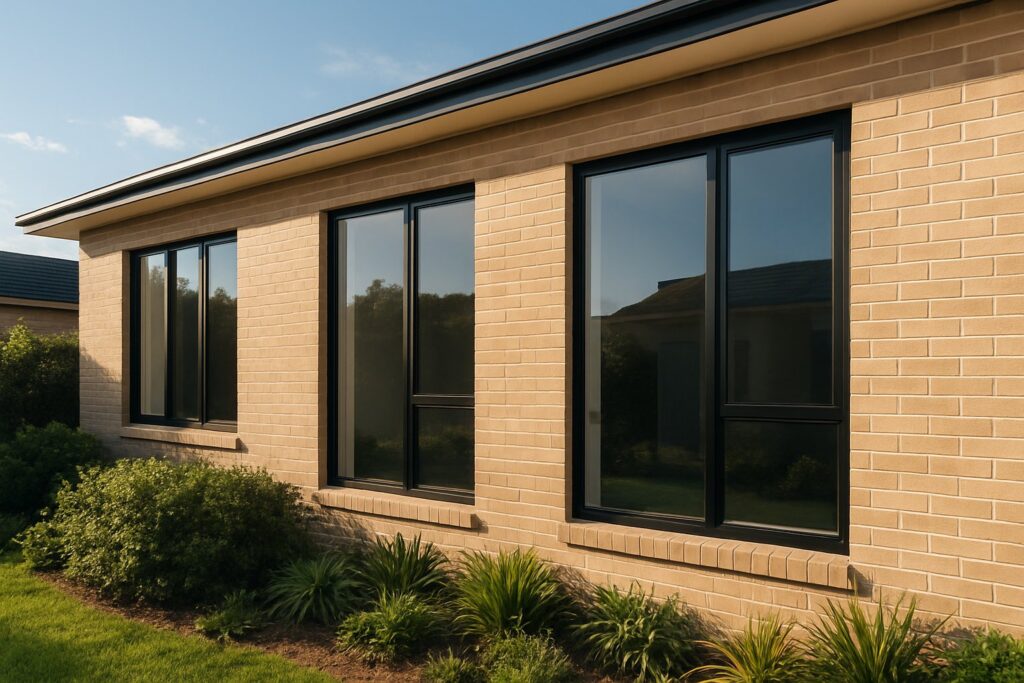
What Are Aluminium Glass Louvre Windows
Not every window needs to swing, slide, or stay shut. Some are built to breathe. Aluminium glass louvre windows fall squarely into that category — designed from the ground up to manage airflow, light, and privacy through a deceptively simple mechanism.
Defining Aluminium Glass Louvre Windows
Aluminium glass louvre windows consist of multiple horizontal glass blades held within an aluminium frame. Each blade pivots on a central axis, opening and closing in unison to regulate ventilation and natural light without requiring the window sash to protrude into or away from the building.
That pivoting action is what separates louvre windows from conventional window types. A fixed window offers no ventilation at all. A sliding window opens only half its area at best. Casement and awning styles swing outward, consuming exterior space. Glass louvre windows, by contrast, allow air to pass between every blade simultaneously, delivering a far greater effective ventilation area relative to the size of the opening.
The aluminium frame serves a dual purpose: it anchors the blade carriers securely to the building structure while resisting corrosion in coastal and humid environments — a trait that matters across much of Australia.
Where Louvre Windows Originated and Why They Persist
Louvered windows trace their roots to tropical architecture, where managing heat and humidity without mechanical cooling was a daily necessity. Homes across Southeast Asia, the Pacific Islands, and northern Queensland relied on adjustable louvers to capture cross-breezes and shed rain at the same time. The concept worked so well that it never disappeared.
What has changed is the context. Aluminium louvre windows now appear in temperate and subtropical climates too — in Melbourne apartments seeking passive cooling, in Perth homes chasing afternoon sea breezes, and in commercial buildings aiming to reduce mechanical ventilation loads. Their persistence comes down to a principle that remains as relevant today as it was a century ago: controlled natural airflow improves comfort and reduces energy consumption.
The sections ahead cover everything you need to make an informed decision — from mechanical operation and blade configurations to energy performance, building code compliance, and long-term maintenance.
How Aluminium Louvre Windows Work
A louvre window looks straightforward from the outside — just parallel strips of glass stacked within a frame. The engineering behind that simplicity, though, is what determines whether a product performs reliably for decades or becomes a source of draughts and frustration within a few years.
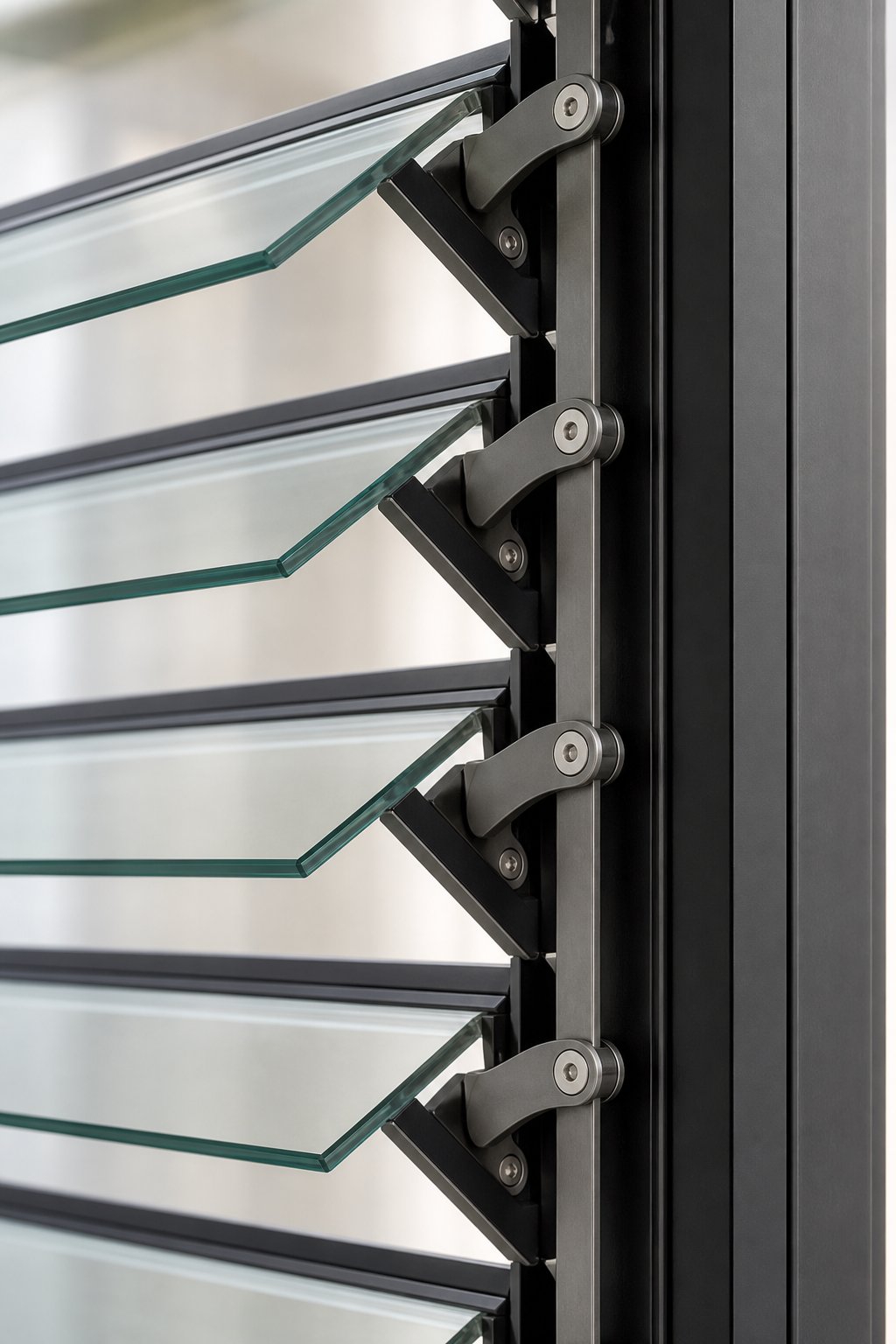
Every glass louver window is built from six core components working together:
- Aluminium frame — the structural perimeter that anchors the entire assembly to the building
- Glass blades — horizontal panes (sometimes called slats or louvres) that pivot to control airflow
- Blade carriers or clips — aluminium fittings that grip each blade and allow it to rotate
- Linking bar — a vertical rod connecting all carriers so blades move in unison
- Operator mechanism — the handle, chain winder, or motor that drives the linking bar
- Seals — weatherstripping fitted along blade edges and frame junctions to block air and water infiltration
The Pivot and Carrier Mechanism
Each glass blade sits inside a pair of aluminium carriers — one at each end. These carriers are mounted on a pivot point within the frame’s vertical stiles, allowing the blade to rotate smoothly between fully closed and fully open. The linking bar runs along one side of the window, connected to every carrier through a pin or slot joint. When you turn the operator, the linking bar moves vertically, and that motion translates into simultaneous rotation across all blades.
This unified movement is what makes a louvre window practical. Rather than adjusting each blade individually, a single action sets the entire array to the same angle — whether you want blades cracked open at 15 degrees for gentle ventilation or swung wide for maximum airflow.
How Blades Seal Against Weather
Ventilation is only half the story. When closed, the blades must form a weather-resistant barrier. In quality systems, each blade overlaps the one below it slightly, and compressible seals — typically EPDM rubber or similar marine-grade gaskets — run along the full length of the blade edges. As the blades close, they compress against these seals to restrict both air and water penetration.
High-performance louvre systems take this further. Safetyline Jalousie, for example, frames each blade on three sides and achieves air leakage rates as low as 0.25 L/s/m² — well below the 5.0 L/s/m² threshold that Australian Standard AS 2047 classifies as high leakage. Brush gaskets fitted to the vertical stiles add another layer of protection against draughts.
The Role of the Aluminium Frame
The frame does more than hold everything in place. It houses the carrier pivot points, conceals the linking bar mechanism, and provides the structural connection between the window louver assembly and the surrounding wall. Aluminium is the preferred frame material because it combines high strength-to-weight ratio with natural corrosion resistance — critical for coastal Australian environments where salt air degrades lesser metals quickly.
Frame depth also matters. A deeper profile creates space for wider blade carriers, thicker seals, and even integrated insect screens or security bars without compromising the blade’s range of motion. When comparing products, the frame’s internal geometry often reveals more about long-term performance than surface finish alone.
Blade Configurations That Affect Performance
The way a louvre window performs — how much air it moves, how well it sheds rain, and how it looks on the facade — comes down to blade configuration. Two windows with identical frame dimensions can behave very differently depending on blade width, blade count, overlap depth, and whether the blades are operable or fixed. These variables interact with each other, so understanding the trade-offs helps you specify the right setup for your climate and building type.
Blade Width Options and Visual Impact
Glass louvers are manufactured in a range of widths, typically falling into three broad categories. Narrow blades run from around 88 mm to 102 mm wide. Medium formats sit between 125 mm and 152 mm. Wide blades — the most visually striking — span from approximately 200 mm up to 600 mm in some specialist systems.
Blade width shapes the window’s character. Narrow blades create a fine, linear rhythm across the opening — a look that suits contemporary facades where texture and repetition are part of the design language. Because more blades fit into a given height, narrow configurations also mean more overlap points, which generally improves weather resistance.
Wide blades, on the other hand, deliver a cleaner, more minimal appearance. When closed, fewer horizontal lines interrupt the view, giving the window a closer resemblance to a standard glazed panel. The trade-off is that each blade-to-blade junction becomes a longer potential path for wind-driven rain, and the structural demands on each individual blade increase with span.
Medium widths strike a middle ground — enough visual openness to feel modern without pushing the limits of weather performance. For most residential applications across temperate and subtropical Australia, medium-format blades offer the most balanced combination of aesthetics, ventilation, and sealing.
Overlap, Span, and Weather Performance
Overlap refers to how much one blade covers the edge of the blade below it when closed. Greater overlap means more contact area for seals to compress against, which improves resistance to air infiltration and water penetration. Narrow blades naturally produce more overlap points per metre of window height, creating a tighter seal pattern overall.
Span — the unsupported horizontal distance a blade covers — introduces structural considerations. A 600 mm wide glass blade spanning 900 mm horizontally behaves differently under wind load than the same blade spanning 1500 mm. Longer spans require thicker glass or toughened profiles to resist deflection, and any flex in the blade under pressure can compromise the seal line. Most manufacturers specify maximum spans for each blade width, and exceeding those limits invites water ingress under storm conditions.
For high-wind regions — think coastal Queensland or exposed sites in Tasmania — narrower blades with shorter spans and deeper overlaps tend to outperform wider configurations. In sheltered urban settings, wider blades can perform perfectly well because the wind pressures they face are substantially lower.
| Criteria | Narrow Blades (88–102 mm) | Medium Blades (125–152 mm) | Wide Blades (200–600 mm) |
|---|---|---|---|
| Ventilation area (% of opening) | High — more blades create more cumulative gap when open | Moderate to high | Moderate — fewer gaps per opening height |
| Weather resistance | Strong — more overlap points, shorter spans | Good — balanced overlap and span | Reduced — fewer overlaps, longer seal lines |
| Aesthetic style | Fine-lined, textural, rhythmic | Clean and contemporary | Minimal, panel-like appearance |
| Typical applications | Bathrooms, laundries, high-wind zones, stairwells | Living areas, bedrooms, commercial facades | Feature windows, sheltered balconies, architectural statements |
Fixed Versus Operable Blade Configurations
Not every louvre blade in a window needs to move. A fixed louvre window uses blades set at a permanent angle — determined during design and locked in place at installation. Fixed configurations suit situations where consistent shading or privacy screening is the priority and ventilation is handled elsewhere. They also simplify the assembly since there is no linking bar, operator, or moving carrier to maintain.
An adjustable louvre window, by contrast, gives occupants direct control. Blades can be rotated from fully closed to fully open — or held at any angle in between — to respond to changing weather, time of day, or privacy needs. The mechanical complexity is greater, but so is the functional flexibility.
Hybrid approaches combine both. A common arrangement places fixed blades at the top or bottom of a window for permanent screening, with operable blades in the centre section where ventilation control matters most. This reduces the number of moving parts while still delivering meaningful airflow adjustment. Some commercial projects use fixed glass louvers across an entire facade for solar shading, then integrate operable panels at specific locations tied to the building’s ventilation strategy.
The choice between fixed and operable also affects long-term maintenance. Fixed blades have no mechanical wear points — their lifespan is essentially the lifespan of the frame and glass. Operable systems require periodic lubrication of carriers and operators, seal replacement over time, and occasional realignment if blades drift out of sync. For most homeowners, that maintenance is minimal, but it is worth factoring into the decision when specifying large installations with dozens of operable blades.
Blade configuration is only one half of the usability equation. How you actually open and close those blades — the operator mechanism — determines whether daily interaction feels effortless or awkward, and whether automation is even possible.
Understanding Operator Types and When to Use Each
The blades might be the visible part of a window louvre, but the operator is what you actually interact with every day. It is the mechanism that translates your intent — more air, less air, fully closed — into blade movement. Choose the wrong operator for the location and you end up with a window that rarely gets adjusted because it is too awkward to reach or too stiff to bother with.
Operators for louvered glass windows range from purely mechanical to fully automated. Ranked from simplest to most advanced:
- Lever handle operators — direct push-pull action, no gearing
- Chain winder operators — geared manual control via a rotating handle and flexible drive cable
- Motorised operators — electric actuators with optional smart controls, sensors, and remote access
Each suits different installation scenarios, budgets, and user expectations. The sections below break down where each type works best.
Lever Handle and Push-Out Options
A lever handle is the most basic operator available. It connects directly to the linking bar through a simple pivot, so pushing or pulling the handle rotates all blades simultaneously. There is no gearing, no cable run, and no motor — just a mechanical linkage between your hand and the glass.
This directness makes lever handles fast to operate and virtually maintenance-free. They suit ground-floor installations where the window is within easy arm’s reach: kitchen splashbacks, bathroom walls, laundry ventilation panels. Because the handle sits on the window frame itself, there is no wall-mounted hardware to plan around.
The limitation is reach. If the window sits above bench height or behind furniture, a lever handle becomes impractical. It also offers no locking detent in most designs — blades stay at whatever angle the handle holds them, relying on friction rather than a positive stop. For windows exposed to strong gusts, that can mean blades drifting open or closed without intervention.
Chain Winder Operators for Manual Control
Chain winders are the workhorse of the adjustable louver window world in Australia. A small geared mechanism mounts to the wall or window reveal, connected to the louvre’s linking bar by a flexible stainless steel cable that runs through conduit. Turning the winder handle rotates the cable, which drives the linking bar up or down to pivot the blades.
The key advantage is remote placement. The winder can sit at a comfortable operating height — typically 1000 mm to 1200 mm above floor level — even when the window itself is positioned high on the wall or above a door. Arens, a well-known Australian manufacturer, produces chain winder systems (such as the MDCR and Maxi operators) specifically designed for louvres and sun blades, with cable runs that can extend several metres between the operator and the window.
Chain winders also provide a mechanical locking action. The gearing holds the blades at whatever angle you set, resisting wind pressure without drifting. That makes them suitable for exposed locations where gusts would push a simple lever handle out of position.
Maintenance is minimal — occasional lubrication of the cable and gearbox keeps operation smooth. The main consideration is cable routing during installation: the conduit path needs to be planned early, especially in masonry or rendered walls where chasing channels after the build is disruptive and costly.
Motorised and Automated Operator Systems
When a window louvre sits beyond comfortable manual reach — above a stairwell, in a double-height living space, or across a long commercial facade — a motorised operator becomes the practical choice. Electric actuators replace the manual winder with a motor that drives the linking bar at the press of a button, a signal from a wall switch, or a command from a building management system.
Motorised systems open up automation possibilities that manual operators simply cannot match. Rain sensors can trigger automatic closure when weather changes, temperature sensors can adjust blade angles to optimise passive cooling, and timers can open louvres each morning and close them at dusk. Integration with smart home platforms means you can control ventilation from a phone app or voice assistant — useful when you are away from home and weather shifts unexpectedly.
Electric window actuators typically operate on 24V DC or 240V AC power. The 24V DC option is more common in residential and light commercial applications because it is safer to run through window frames and allows battery backup for fail-safe closure during power outages. Actuator lifespan generally exceeds 10,000 full-load operations, which translates to well over a decade of daily use in most homes.
The trade-off is cost and installation complexity. Motorised systems require electrical supply to the window location, a controller or transformer, and potentially sensor wiring. For a single bathroom louvre, that investment rarely makes sense. For a bank of high-level louvres ventilating an open-plan living area or a multi-storey commercial atrium, the convenience and performance gains justify the outlay comfortably.
| Criteria | Lever Handle | Chain Winder | Motorised / Automated |
|---|---|---|---|
| Ease of use | Very simple — direct push-pull | Easy — turn handle at wall height | Effortless — button, sensor, or app |
| Installation complexity | Low — mounts on frame, no cable run | Moderate — cable conduit and wall-mount winder | Higher — electrical supply, controller, wiring |
| Indicative cost (AUD, supply only) | $30–$80 | $150–$400 | $500–$1,500+ |
| Automation capability | None | None | Full — rain, temperature, timer, smart home |
| Best applications | Ground-floor windows within arm’s reach | High-level windows, above benches, standard residential | Hard-to-reach locations, commercial, smart homes, multi-window banks |
| Maintenance | Negligible | Periodic cable lubrication | Motor service every 5–10 years, sensor calibration |
Choosing an operator is ultimately about matching the mechanism to the location and the user. A holiday home with high raked ceilings and no one present during storms benefits enormously from rain-sensing automation. A kitchen window beside the sink needs nothing more than a lever you can flick with one hand. Most Australian homes land somewhere in between — chain winders covering the majority of openings, with a motorised unit reserved for that one awkward spot above the staircase.
Whichever operator you select, its value only materialises if the window itself delivers on the core promise: better airflow, better comfort, and fewer compromises than conventional alternatives.
Key Benefits of Aluminium Glass Louvre Windows
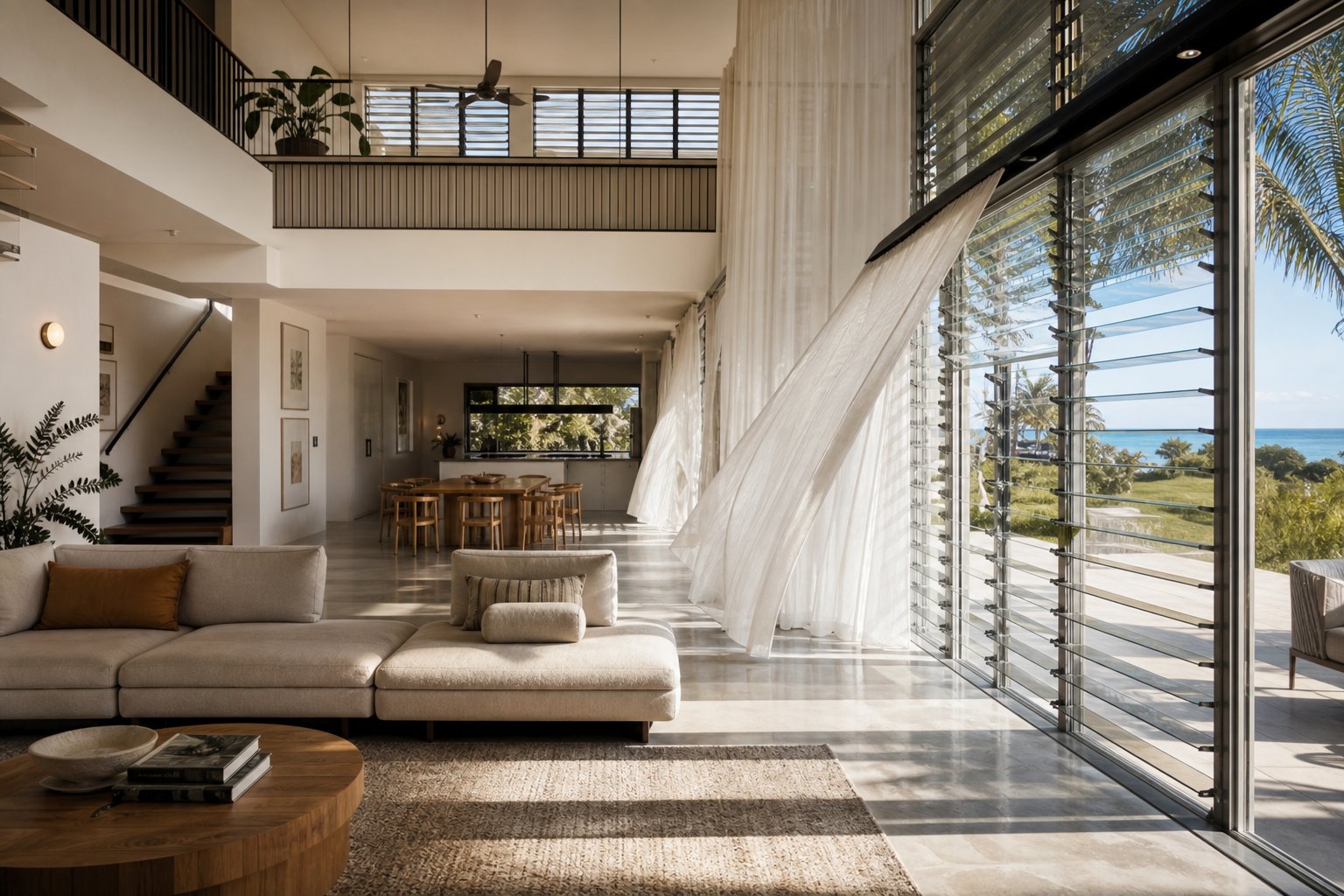
Airflow, comfort, and fewer compromises — that is the promise. But what does it actually look like in practice? The advantages of aluminium glass louvre windows extend well beyond ventilation alone. They touch on security, light control, spatial efficiency, and how a building responds to its climate without leaning on mechanical systems.
Here is what window louvres deliver that most other operable window types cannot match simultaneously:
- Near-total ventilation area — when fully open, almost the entire window opening is available for airflow
- Precise angle control — blades can be set at any pitch between closed and fully open, letting you fine-tune breeze strength and direction
- Ventilation with security — glass blades remain in place even when open, maintaining a physical barrier against intrusion
- Light and privacy management — blade angle determines how much daylight enters and how much visibility outsiders have into the room
- Compact operation — no sash swings inward or outward, so louvres work in tight spaces where casement or awning windows would obstruct paths or furniture
- Design versatility — available in a range of blade widths, frame colours, and glass types to suit everything from a Queenslander renovation to a multi-storey commercial facade
Ventilation Control and Airflow Precision
Louvre windows permit almost 100% of their opening area for natural ventilation — roughly twice the effective airflow of sliding or sash windows, which typically open only 50% of their area.
That figure, documented in tropical architecture research, explains why louvered glass windows remain the default choice in climate-responsive buildings across northern Australia. Every blade becomes an independent air channel when open, and because the blades pivot rather than slide, there is no dead panel blocking half the opening.
Precision matters just as much as volume. Tilting blades to a shallow angle lets a gentle breeze filter through without creating a gust strong enough to scatter papers off a desk. Opening them wider on a still evening maximises convective airflow — warm air rising out through high-level louvres while cooler air enters through lower openings. That kind of graduated control is difficult to achieve with a casement window, which is essentially either open or closed.
The ability to capture breezes from multiple angles adds another layer. Because each blade deflects air slightly as it passes, windows with louvers can redirect airflow into a room even when the breeze does not hit the facade head-on. This makes them effective on walls that are not perfectly oriented to prevailing winds — a practical advantage on Australian sites where lot orientation is often dictated by subdivision layout rather than climate.
Security, Light, and Privacy Advantages
One of the oldest criticisms of louvre windows was poor security. Traditional designs allowed blades to be pried out from the outside with minimal effort. Modern systems have addressed this comprehensively. Security clips or pins lock each blade into its carrier, requiring specialist tools to remove. Some manufacturers integrate stainless steel security bars or mesh screens behind the blades, allowing full ventilation without compromising the building envelope’s resistance to forced entry.
Light control works on the same principle as a venetian blind, but at the building envelope itself. Angling blades downward blocks direct sun while still admitting diffused daylight — reducing glare and solar heat gain without darkening the room entirely. For west-facing windows in Perth or north-facing openings in Brisbane, this adjustability means louvers for windows can manage harsh afternoon sun without relying on internal blinds or curtains that trap heat between the glass and the fabric.
Privacy follows the same logic. Partially closed blades prevent line-of-sight into a room from street level while still allowing air to circulate freely. Bathrooms, ground-floor bedrooms, and street-facing living areas all benefit from this dual function — ventilation and visual screening delivered by the same element, with no additional fittings required.
Connecting Louvre Windows to Passive Design Goals
Australia’s YourHome guide to passive cooling identifies air movement as the key to most sources of passive cooling — carrying heat out of a building and replacing it with cooler external air. Aluminium glass louvre windows are purpose-built for exactly this function. They enable cross-ventilation through opposing walls, stack ventilation through high-level openings, and night purging of accumulated daytime heat — all without consuming a single watt of electricity.
In practical terms, a home designed with strategically placed louvre windows can reduce its reliance on air conditioning substantially. Ceiling fans paired with open louvres create effective cooling at a fraction of the energy cost of a split system. Research from Darwin, Brisbane, and Sydney referenced in the YourHome guide shows that air-conditioning use can drop by up to 75% when fans and natural ventilation work together.
That connection between window design and whole-of-home energy strategy is where aluminium glass louvre windows deliver their greatest long-term value. They are not just an opening in a wall — they are an active component of a passive system, responding to occupant input and environmental conditions throughout the day. The question that naturally follows is how they stack up against the alternatives when evaluated across every performance criterion, not just ventilation alone.
Aluminium Louvre Windows Compared to Other Window Types
Every window type involves trade-offs. Louvred windows prioritise ventilation and airflow control, but that does not automatically make them the right choice for every opening in a home. A fair comparison requires evaluating each option across the full range of criteria that matter in practice — not just the single metric where one type happens to excel.
Louvre Windows vs Casement and Awning Windows
Casement windows hinge at the side and swing outward, while awning windows hinge at the top. Both seal tightly because the sash presses against the frame when closed — a mechanism that produces lower air leakage rates than sliding or hung window types. That compression seal gives casement and awning windows an edge in weather resistance and thermal performance, particularly in cooler climates where minimising air infiltration is the priority.
Where glass louver windows pull ahead is ventilation capacity. A casement window opens its full area but only in one direction, and the protruding sash can obstruct walkways, patios, or adjacent windows. An awning window opens less — typically limited to 20 to 30 degrees — which restricts airflow significantly when wind direction does not align with the opening angle. Breezway’s comparison testing highlights that louvre blades opening horizontally allow ventilation through the entire window area, while awnings are restricted to a minimal degree depending on wind direction.
Cleaning also differs. Casement and awning sashes can be difficult to reach on upper storeys because the outer glass face swings away from the building. Louver windows allow both sides of each blade to be cleaned from inside — a practical safety advantage for multi-storey homes.
Louvre Windows vs Sliding and Fixed Windows
Sliding windows — both horizontal sliders and vertical hung types — are among the most common in Australian homes. They are affordable, mechanically simple, and sit flush within the wall plane. Their weakness is ventilation: only half the window area can ever be open at once, since one panel must overlap the other. Air leakage rates also tend to be higher than hinged types because the sash slides rather than compresses against the frame.
Fixed windows offer the best thermal and acoustic performance of any type. With no operable components, there are no gaps, no seals to degrade, and no moving parts to maintain. The obvious limitation is zero ventilation. Fixed glazing works well for picture windows, highlight panels, and locations where views matter more than airflow — but it cannot contribute to a passive cooling strategy at all.
Louver windows occupy a different position entirely. They sacrifice some thermal tightness in exchange for unmatched ventilation flexibility. A louver glass window can open nearly its full area to airflow, adjust blade angles for partial ventilation, and still close to form a sealed barrier — something neither a slider nor a fixed pane can replicate.
When Louvre Windows Are and Are Not the Best Choice
Objectivity matters here. Aluminium glass louvre windows are not universally superior. In cold climates — alpine regions of Victoria and NSW, or Tasmanian highlands — where heating loads dominate and every gap in the envelope costs energy, casement or awning windows with high-performance seals and double glazing will outperform louvres on thermal efficiency. The multiple blade-to-frame junctions in a louvre system create more potential paths for heat loss than a single-sash window with continuous compression seals.
Security is another consideration. While modern louvre systems have improved dramatically with locking clips and security screens, a solid casement sash with multi-point locking still presents a more formidable physical barrier to forced entry. For ground-floor windows in high-risk areas, that difference can matter.
Louvre windows shine brightest in warm and temperate climates where natural ventilation reduces cooling loads, in rooms that need airflow and privacy simultaneously, and in locations where a protruding sash would be impractical. Bathrooms, kitchens, stairwells, covered outdoor areas, and upper-storey bedrooms catching evening breezes — these are the applications where no other window type delivers the same combination of performance.
| Criteria | Louvre Windows | Casement Windows | Awning Windows | Sliding Windows | Fixed Windows |
|---|---|---|---|---|---|
| Ventilation performance | Excellent — near 100% of opening area | Good — full area but single direction | Limited — restricted opening angle | Moderate — max 50% of area | None |
| Weather sealing (when closed) | Good — seal quality varies by product | Very good — sash compresses against frame | Excellent — tightest seal of operable types | Fair — sliding contact, higher leakage | Excellent — no operable gaps |
| Security | Good with modern locking clips and screens | Very good — multi-point locks standard | Very good — limited opening restricts access | Moderate — sash can be forced from track | High — no operable entry point |
| Energy efficiency | Moderate — multiple junctions increase potential leakage | Good — fewer junctions, tight seal | Good — compression seal, small opening limits heat exchange | Moderate — seal wear over time | Best — no air leakage path |
| Maintenance | Moderate — operator, seals, and blade alignment | Low — hinge lubrication, seal checks | Low — similar to casement | Low to moderate — track cleaning, roller replacement | Minimal — glass cleaning only |
| Indicative cost (AUD, supply and install per opening) | $600–$1,500 | $500–$1,200 | $500–$1,200 | $400–$900 | $300–$700 |
| Aesthetic flexibility | High — blade widths, frame colours, glass types | Good — various frame profiles and glazing | Good — clean lines when closed | Moderate — visible track and overlap | High — uninterrupted glass area |
Cost ranges above are indicative for standard residential sizes and will vary with glazing specification, frame finish, and regional labour rates. Custom sizes, BAL-rated products, or motorised operators push louvre window pricing toward the upper end.
The comparison makes one thing clear: choosing a window type is not about finding the single best product — it is about matching performance characteristics to each opening’s specific demands. Many well-designed Australian homes use louvred windows alongside casement and fixed glazing, placing each type where its strengths matter most. That mixed approach works particularly well when the thermal performance of each window is optimised for its role — which raises the question of how energy efficiency can be maximised within the louvre format itself.
Energy Efficiency and Passive Ventilation Strategies
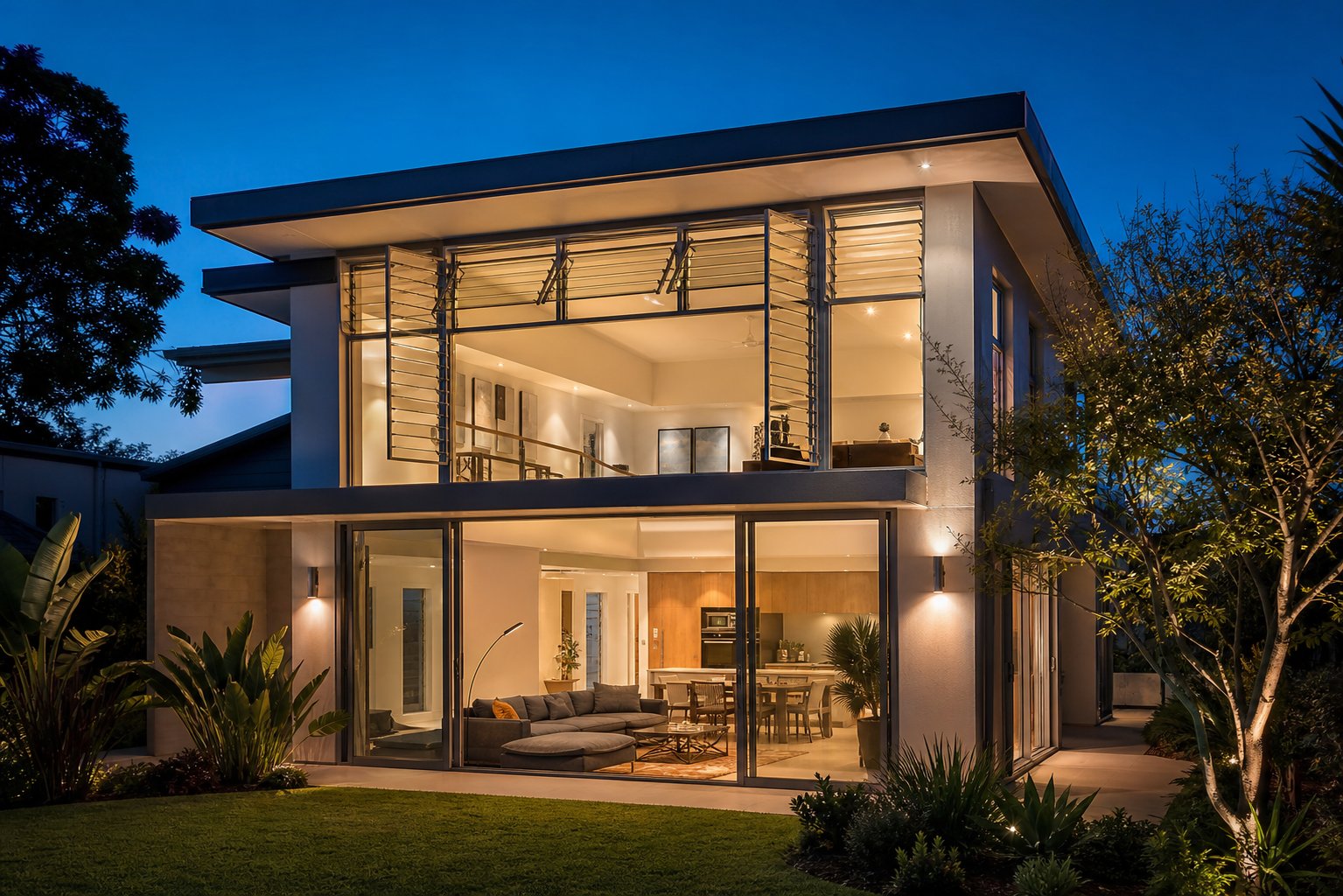
Optimising a louvre window for energy performance is a different challenge than optimising a casement or fixed pane. The geometry is fundamentally different — multiple blades mean multiple junctions, and each junction is a potential weak point in the thermal envelope. That does not make aluminium louver windows inherently inefficient, but it does mean the specification choices around frames, seals, and glazing carry more weight than they would for a single-sash window.
Thermal Performance and Aluminium Frame Technology
Every point where a glass blade meets the aluminium frame creates a thermal junction. A typical louvre window with six or eight blades has far more of these junctions than a casement window with its single sash-to-frame perimeter. More junctions mean more opportunities for conducted heat to travel between inside and outside — a phenomenon known as thermal bridging.
Standard aluminium is a highly conductive material. Without intervention, an aluminium frame acts as a direct pathway for heat transfer, efficiently moving warmth from the cooler side to the warmer side regardless of season. In summer, exterior heat conducts inward. In winter, interior warmth escapes outward. For aluminium window louvers in climate zones where both heating and cooling loads matter — Sydney, Melbourne, Adelaide, Perth — this conductivity works against you year-round.
Thermally broken aluminium profiles address this directly. A thermal break is a reinforced polyamide bar or polyurethane-based insulator inserted between the inner and outer aluminium sections of the frame. It physically separates the two metal profiles, breaking the conductive pathway so heat cannot travel freely through the frame material. The result is a frame that retains aluminium’s strength, slim sightlines, and corrosion resistance while dramatically reducing its thermal conductivity.
The difference in real-world performance is substantial. Data from the Window Energy Rating Scheme (WERS) shows that a standard single-glazed aluminium window has a U value of 6.9 W/m²°C, while a double-glazed aluminium unit drops to 4.2 W/m²°C. Thermally broken frames push that figure lower still — approaching the performance of timber or uPVC frames that sit around 3.0 W/m²°C for equivalent glazing configurations. For an aluminium louver window, where frame-to-blade contact points are numerous, specifying thermally broken profiles makes a proportionally larger difference than it would for a window type with fewer junctions.
Weatherseals play an equally critical role. When blades close, compressible gaskets along each edge must form a continuous air barrier across every overlap point. Degraded or poorly specified seals allow air infiltration that bypasses the glazing entirely — warm air leaking out in winter, hot air pushing in during summer. Quality EPDM or silicone-based seals maintain their compression over thousands of open-close cycles, but they do require periodic inspection, particularly in homes exposed to high UV or coastal salt air that accelerates rubber degradation.
Passive Ventilation Strategies Using Louvre Windows
Energy efficiency is not only about keeping conditioned air inside. In Australian climates, some of the largest energy savings come from reducing the need for mechanical cooling in the first place. This is where aluminium glass louvre windows shift from a potential thermal liability into an active energy asset.
Cross-ventilation — air flowing in through one side of a building and out the other — is the most straightforward passive cooling strategy. It relies on pressure differentials created by wind hitting the building envelope. Australia’s YourHome guide notes that cool breezes work best in narrow or open-plan layouts with well-designed openings. Louvre windows are particularly effective here because their near-complete opening area creates minimal resistance to airflow. A pair of louvre windows on opposing walls moves substantially more air than equivalent sliding windows opening only half their area.
Stack-effect ventilation works even on still days. Warm air rises naturally, and if it can escape through high-level openings, it draws cooler replacement air in through lower openings. Placing louvre windows at both high and low points in a room — or using high-level louvres in combination with lower casement or sliding doors — creates a passive chimney effect that continuously flushes warm air upward and out. Stairwells, double-height living spaces, and clerestory positions are ideal locations for this approach.
Night purging takes the concept further. During summer, building materials absorb heat throughout the day. Opening louvre windows fully after sunset allows cooler night air to flush that stored heat from walls, floors, and furnishings — resetting the building’s thermal mass before the next day’s heat arrives. In inland areas where diurnal temperature swings exceed 6 to 8 degrees Celsius, night purging through aluminium louvres can reduce or eliminate the need for air conditioning entirely during shoulder seasons.
Evidence from Darwin, Brisbane, and Sydney referenced in the YourHome guide demonstrates that combining ceiling fans with natural ventilation through well-placed openings can reduce air-conditioning use by up to 75%. Louvre windows, with their ability to remain partially open during rain (by angling blades downward) and their compatibility with security screens, make this strategy practical even in locations where leaving conventional windows open overnight raises security or weather concerns.
Glazing Options for Enhanced Energy Performance
The glass itself is the final variable. Single-glazed louvre blades are standard in tropical regions where thermal insulation matters less than ventilation capacity. But for temperate and cool-temperate zones — or anywhere air conditioning is used regularly — upgrading to double glazed louvre windows delivers measurable improvements in both U value and solar heat gain control.
Double-glazed louvre blades use two layers of glass separated by an air or argon-filled cavity, applying the same insulating principle found in standard IGU (insulated glass unit) windows. The cavity reduces conductive heat transfer through the glass, while the option of low-emissivity (low-E) coatings on one surface further limits radiant heat flow. Tinted glass reduces solar heat gain coefficient (SHGC) for west-facing installations where afternoon sun drives cooling loads highest.
Matching glazing specification to climate zone is essential. A north-facing louvre in Brisbane benefits from a moderate SHGC that admits useful winter warmth while shading geometry handles summer exclusion. The same window in Hobart needs a lower U value above all else, making argon-filled double glazing with low-E coating the priority. West-facing aluminium louvres in Perth — exposed to intense afternoon radiation — demand low SHGC glass regardless of other factors.
Suppliers like MEICHEN offer aluminium window systems with multiple glazing choices — single, double-glazed, tinted, and low-E options — alongside custom frame configurations and colour selections. That flexibility allows homeowners, builders, and architects to match louvre window specifications precisely to their climate zone requirements and energy performance targets, rather than accepting a one-size-fits-all product that compromises in one direction or another.
Getting the thermal specification right is one part of the equation. The other is ensuring the installation itself meets the regulatory requirements that govern where and how louvre windows can be used — requirements that vary significantly depending on your location, the building’s exposure, and the specific hazards your site faces.
Building Codes and Regional Compliance Requirements
A louvre window can be perfectly specified for thermal performance and still fail at the compliance stage if the regulatory environment has not been factored in from the start. Australia’s National Construction Code (NCC) sets the baseline, but the actual requirements your project must satisfy depend heavily on geography — your site’s bushfire attack level, wind region, climate zone, and even the height of the window above ground all shape what is permissible.
Compliance requirements for aluminium glass louvre windows are jurisdiction-specific. What passes in a sheltered Melbourne suburb may be entirely non-compliant on an exposed coastal site in northern Queensland. Professional verification through your building certifier or accredited supplier is essential before finalising any specification.
The key compliance areas you need to verify with local authorities include:
- Bushfire Attack Level (BAL) rating — determines material, glazing, and screening requirements
- Wind region classification — dictates structural capacity of frames, blades, and fixings
- Minimum ventilation provisions — sets the required openable area for habitable rooms
- Fall protection — governs barrier heights and opening restrictions for windows above ground level
- Accessibility and operator reach — influences operator type and mounting height for compliant use
Bushfire and Cyclone Compliance
In bushfire-prone areas, AS 3959 (Construction of Buildings in Bushfire-Prone Areas) applies directly to louvre windows. Depending on the assessed BAL rating for your site — ranging from BAL-LOW through to BAL-FZ (Flame Zone) — requirements escalate from basic non-combustible framing through to ember-resistant mesh, metal-only construction, and the elimination of any plastic components that could melt or ignite during ember attack. Exterior aluminium louvres and metal louvers inherently satisfy the non-combustible framing requirement, but the seals, clips, and any insect screening must also meet the relevant BAL threshold. At higher ratings, specific glazing types (toughened or wired glass) and mesh aperture sizes become mandatory.
Cyclone compliance is a separate but equally critical consideration for projects in wind Regions C and D — broadly covering northern Queensland, the Northern Territory coastline, and parts of Western Australia. Cyclone-rated louvre systems must resist design wind actions calculated under AS/NZS 1170.2, which derives wind pressures based on region, terrain category, building height, and shielding. Products are proven through cyclic pressure testing to AS 4040.3 — a regime that repeatedly loads the specimen to simulate the push-pull forces of a real cyclone event — and impact testing that demonstrates resistance to wind-borne debris.
Operable systems face particular scrutiny here. Moving parts, slender blades, and linkages can be vulnerable to pressure differentials that try to wrench blades open or rack frames. A louvre that performs well in Melbourne or Adelaide may be entirely unsuitable in Townsville or Darwin without significant engineering adaptation — thicker blade profiles, denser fixing patterns, positive locking mechanisms, and robust blade-to-linkage joints designed to resist fatigue under repeated loading.
Ventilation Standards and Fall Protection
The NCC’s Section F sets minimum requirements for outdoor air supply to habitable rooms. Louvre windows used as natural ventilation openings must provide sufficient openable area — and critically, the relevant measurement is the free area through which air can actually pass, not simply the face area of the window frame. A louvre with blades open at 90 degrees provides near-total free area, but partially opened blades reduce it proportionally. Your certifier will assess whether the installed configuration delivers adequate ventilation for the room’s floor area and intended use.
Fall protection introduces a separate constraint. Where a louvre window is installed above ground level with a fall height of one metre or more, the NCC requires measures to prevent people — particularly children — from falling through or past the opening. For louvre windows, this typically means restricting blade opening angles, incorporating an aluminium fixed louver panel at low level, adding compliant balustrade bars, or ensuring the sill height meets minimum barrier requirements. The specific solution depends on the window’s height above floor level, the fall distance below, and whether the blades themselves constitute an adequate barrier when open.
Accessibility also plays a role. Operator mechanisms must be reachable by the intended occupants. Australian standards and the NCC’s accessibility provisions influence mounting heights for chain winders and lever handles — particularly in aged-care, disability-accessible, or public buildings where reach range is limited. Motorised operators with wall-mounted switches or remote controls often provide the simplest path to compliance in these scenarios.
Questions to Ask Your Building Certifier
Because requirements shift with location, building class, and site-specific hazards, no single product specification works universally. Before committing to a louvre window order, confirm the following with your certifier or building surveyor:
- What is the site’s BAL rating, and does the proposed louvre system hold certification to that level?
- What wind region and terrain category apply, and has the supplier provided engineering documentation confirming the product’s suitability for those design pressures?
- Does the openable area of the proposed louvre windows satisfy the minimum ventilation requirement for each room?
- Are fall protection measures required at the proposed installation height, and does the window configuration comply without additional guarding?
- Do operator mounting heights meet accessibility requirements for the building’s intended use class?
- Are there any state or local variations to the NCC that impose additional constraints — such as Western Australia’s retained wind Region D provisions?
Asking these questions early — at design stage rather than after procurement — avoids costly substitutions and project delays. A reputable supplier will provide independent test reports, engineering calculations, and compliance documentation tied to your specific site conditions rather than generic product brochures.
Compliance gets the window approved and installed. Keeping it performing well over the following decades is a different discipline entirely — one that depends on understanding what maintenance louvre systems actually need and what problems to watch for before they escalate.
Maintenance, Troubleshooting, and Lifespan Expectations
Aluminium louvres are mechanically simple compared to many building components, but they are not maintenance-free. Moving parts wear, seals degrade under UV and salt exposure, and glass collects grime that eventually affects both appearance and operation. The good news is that a modest routine — measured in minutes per quarter, not hours — keeps glass louvered windows functioning smoothly for decades.
Routine Cleaning and Maintenance Schedule
Dust, pollen, and salt residue accumulate on blade surfaces and within carrier tracks. Left unchecked, that buildup traps moisture against seals and metal components, accelerating corrosion and stiffening pivot points. A consistent schedule prevents small issues from compounding into expensive repairs.
Follow this routine to cover the essentials:
- Monthly — light wipe-down. Open blades fully and dust both sides with a dry microfibre cloth. This removes loose particles before they bond to the surface.
- Every three months — wash blades and frame. Use warm water with a mild detergent (no abrasive cleaners) and a soft sponge. Rinse thoroughly and squeegee excess water to prevent streaking. Pay attention to the blade edges where seals sit.
- Every six months — lubricate moving parts. Apply a silicone-based spray to pivot points, carrier clips, and the linking bar connection. Silicone lubricant resists attracting dust, unlike petroleum-based alternatives that become sticky over time. Test the operator by cycling blades fully open and closed several times to distribute the lubricant evenly.
- Annually — full inspection. Check blade alignment (do all blades open and close in unison?), tighten any loose screws or hardware, and examine seals and gaskets for cracking, peeling, or compression set. Inspect the aluminium frame for signs of oxidation or powder coat damage, particularly around drainage weep holes.
- Coastal properties — increase frequency. Homes within a few kilometres of the ocean should move the wash cycle to monthly and lubrication to quarterly. Salt deposits are aggressive and invisible until corrosion is already underway.
Troubleshooting Common Louvre Window Issues
Even well-maintained aluminium louvre windows develop issues over time. Most are straightforward to diagnose and resolve before they require professional intervention:
- Blade alignment drift — blades no longer open or close evenly. Usually caused by a worn or bent linking bar pin. Inspect the connection between the linking bar and each carrier clip. Replace any deformed pins and check that carriers pivot freely.
- Operator stiffness or resistance — the chain winder or lever becomes hard to turn. Clean the mechanism of accumulated dust, then apply silicone lubricant to the gearbox and cable. If stiffness persists, check for debris lodged in the blade tracks or a kinked cable run.
- Seal degradation — draughts or fine water mist entering when blades are closed. EPDM rubber seals harden and crack after prolonged UV exposure. Replace weatherstripping along affected blade edges — most systems use clip-in gaskets that do not require disassembly of the entire window.
- Water ingress during heavy rain — often caused by blocked weep holes rather than failed seals. Clear drainage channels in the sill with a thin brush or compressed air. If water still enters, check that the sill slopes away from the interior and recaulk any gaps between the frame and the wall opening.
- Corrosion on louvered aluminum frames — white powdery oxidation (aluminium oxide) or powder coat bubbling. Sand the affected area lightly, treat with a corrosion inhibitor, and touch up with matching exterior paint. For coastal installations, applying a protective wax coating to the frame annually adds a sacrificial barrier against salt attack.
- Broken or cracked glass blade — replace the individual blade promptly. A missing or damaged blade compromises both weather sealing and security. Most suppliers stock standard blade sizes; custom widths may require a short lead time.
Expected Lifespan and Warranty Indicators
How long should an aluminium louvre window last? The answer depends on which component you are asking about. The aluminium frame — with no moving parts and inherent corrosion resistance — is the longest-lived element. Properly powder-coated frames in non-coastal environments routinely exceed 30 to 40 years without structural degradation. Glass blades, assuming no impact damage, last equally long since glass does not fatigue or degrade under normal conditions.
Moving parts tell a different story. Operators, linking bars, carrier clips, and seals are subject to mechanical wear and environmental degradation. Industry warranty structures reflect this reality: manufacturers commonly offer 10 to 15 years on frames and non-moving components, while hardware and seals carry shorter coverage — typically 5 to 10 years. Glass breakage from external impact is usually excluded entirely.
These warranty periods are conservative indicators of minimum expected life, not expiry dates. With the maintenance routine outlined above, operators and seals often perform well beyond their warranty period. The critical variable is environment. A sheltered inland installation ages far more slowly than an exposed beachfront one, where salt, UV, and wind-driven sand accelerate every degradation mechanism simultaneously.
Treating warranty documentation as a maintenance prompt works well in practice — when the hardware warranty period ends, schedule a thorough inspection and replace any seals or components showing wear. That single intervention can extend the functional life of the entire assembly by another decade or more, making aluminium louvres one of the more cost-effective window investments over a building’s full lifecycle.
Longevity, though, assumes the right product was specified in the first place. Selecting the correct blade count, glazing type, operator, and frame finish for your specific project is where the initial decisions lock in decades of performance — or frustration.
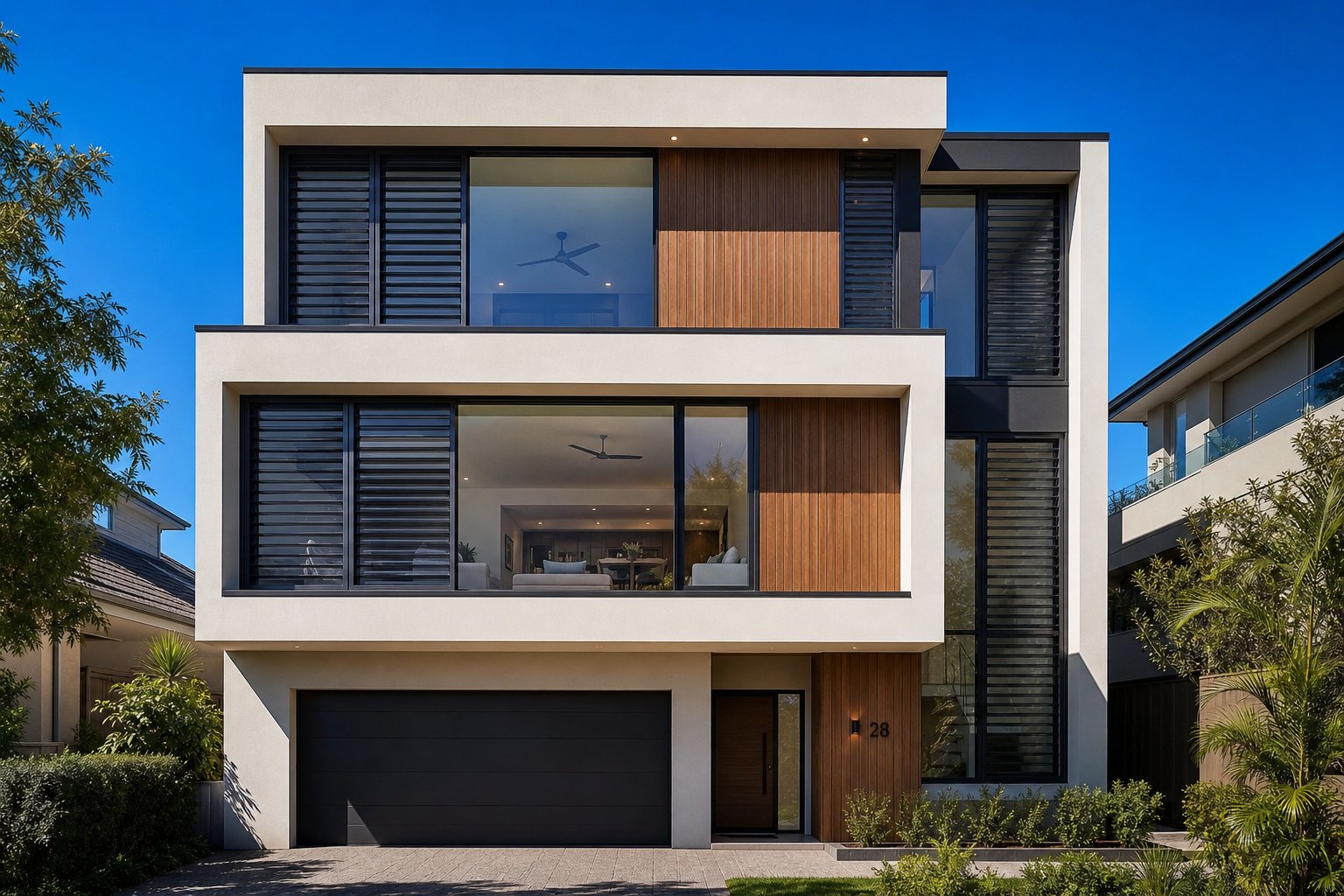
Selecting and Specifying Your Louvre Windows
Getting the specification right at the outset saves time, money, and the particular frustration of discovering mid-build that a product does not fit the opening, suit the climate, or meet the certifier’s requirements. Aluminium glass louvre windows offer more configuration variables than most window types — blade count, blade width, glazing type, operator mechanism, frame finish, and compliance ratings all need to align with the project’s specific demands. Working through these decisions methodically produces a window that performs exactly as intended for decades.
Sizing and Configuration Decisions
Start with the opening itself. Measure the structural opening width and height, then determine how many blades will fill that space based on your chosen blade width. A 1200 mm tall opening fitted with 152 mm medium-format blades accommodates roughly seven to eight blades depending on the frame head and sill dimensions. The same opening with 102 mm narrow blades fits ten to twelve. More blades mean more overlap points and tighter weather sealing — a priority for exposed sites — while fewer, wider blades deliver cleaner sightlines for sheltered locations where aesthetics take precedence.
Frame size follows from the opening dimensions and the wall construction. Aluminium louvre frames are available in various depths to suit timber stud walls, brick veneer, concrete block, and commercial curtain wall systems. The frame must sit flush or recessed within the reveal to allow proper flashing and weatherproofing at the perimeter. Confirm the frame depth accommodates your chosen blade thickness — standard 6 mm glass blades fit most systems, but double glazed louvre windows with 22 mm insulated units require deeper carriers and a wider frame profile.
Operator selection ties directly to installation height and the intended user. A lever handle works for any window within arm’s reach — typically below 1500 mm above floor level. Chain winders suit windows mounted between 1500 mm and 2400 mm, with the winder handle positioned at a comfortable 1000 mm to 1200 mm height on the adjacent wall. Anything higher than 2400 mm, or any window that needs to respond automatically to weather changes, points toward a motorised system. For aged-care or accessible housing, motorised operators with wall switches at 900 mm to 1100 mm height often provide the simplest compliance path.
Glazing choice depends on climate zone and orientation. North-facing modern louvre windows in subtropical Brisbane can perform well with single-glazed clear blades, relying on shading and ventilation to manage heat. South-facing openings in Melbourne or Canberra benefit from double-glazed low-E blades that minimise winter heat loss. West-facing installations anywhere in Australia should prioritise low solar heat gain coefficient (SHGC) glass — tinted or coated — to reduce afternoon cooling loads. If the site carries a BAL rating, confirm that the glazing type satisfies AS 3959 requirements for the assessed bushfire attack level.
What to Look for in a Quality Supplier
Frame finish is where long-term durability either holds or fails. Powder coating is the standard protective finish for aluminium louvers, but quality varies enormously. Look for coatings that meet or exceed the Qualicoat or AAMA 2604 standard — these specify minimum film thickness, adhesion, UV resistance, and salt spray performance. A cheap powder coat might look identical to a premium one on day one, but five years of Australian sun and coastal air will expose the difference as chalking, fading, or delamination.
Colour options matter for architectural cohesion. Most quality suppliers offer a range spanning from standard whites, blacks, and greys through to custom colour matching via RAL or Colorbond codes. If your project requires the louvre frames to match existing window joinery, fascia, or cladding, confirm that the supplier can deliver an exact colour match rather than a closest-available approximation.
MEICHEN is one Australian supplier offering custom louvre windows with the full range of capabilities discussed here — multiple glazing selections (single, double-glazed, tinted, low-E), extensive colour options, and project-based supply for builders, developers, and architects working across residential and commercial sectors. Their aluminium window systems are configured to order, which means specifications can be tailored to individual openings rather than constrained by off-the-shelf sizing. For projects requiring consistent supply across multiple window types — louvres alongside casement, awning, and fixed panels — a single-source approach like this simplifies procurement and ensures colour consistency across the entire facade.
Beyond any single supplier, evaluate candidates against these practical criteria: do they hold independent test reports for the compliance ratings your project requires? Can they supply engineering documentation for your specific wind region? Do they offer a warranty structure that covers both frame and hardware with clearly stated terms? And critically — can they meet your project timeline without compromising on the specification you have carefully developed?
Your Specification Checklist
Before placing an order or requesting a formal quote, confirm you can answer every item on this list. Presenting a complete specification to your supplier eliminates back-and-forth delays and ensures the quote you receive reflects the actual product you need — not a generic placeholder that gets revised three times during procurement.
- Opening dimensions (width x height) for each louvre window location
- Wall construction type and frame depth required
- Blade width preference and resulting blade count per opening
- Glazing specification — single, double-glazed, tinted, low-E, or combination
- Operator type for each window — lever, chain winder, or motorised
- Frame colour — standard range or custom colour match (provide RAL or Colorbond code)
- Compliance certifications required — BAL rating, wind region, AS 2047 performance class
- Security requirements — locking clips, security bars, or mesh screening
- Fall protection measures if installed above ground level with a fall height exceeding one metre
- Screening requirements — insect mesh, security screen, internal or external mounting
- Lead time expectations and project delivery schedule
- Warranty terms — frame, hardware, seals, and glass covered separately or together
- Installation support — supply only, or supply and install with manufacturer-trained fitters
A thorough checklist and specification process ensures the custom louvre windows you receive match the project’s functional, aesthetic, and regulatory requirements without costly rework. It also gives your builder or installer a clear scope document — reducing the risk of site disputes over what was ordered versus what was expected.
Aluminium glass louvre windows reward careful specification. The upfront effort of working through blade configurations, glazing options, operator types, and compliance requirements translates directly into a product that ventilates precisely, seals reliably, looks right on the facade, and lasts the life of the building. Skip that process, and you are gambling that a generic selection will happen to suit your specific conditions. Given the range of climates, exposures, and building types across Australia, that is a gamble rarely worth taking.
Frequently Asked Questions About Aluminium Glass Louvre Windows
1. How much ventilation do aluminium glass louvre windows provide compared to other window types?
Aluminium glass louvre windows deliver close to 100% of their opening area as free ventilation space when blades are fully open. This is roughly double the effective airflow of sliding windows, which can only open 50% of their area at most. Casement windows open fully but in a single direction, while awning windows are restricted to a narrow opening angle. The ability to pivot every blade simultaneously gives louvre windows the highest ventilation-to-frame-size ratio of any operable window type available in Australia.
2. Are aluminium louvre windows energy efficient?
Energy efficiency depends on specification choices. Standard single-glazed aluminium louvre windows have higher heat transfer rates due to multiple blade-to-frame junctions. However, thermally broken aluminium frames combined with double-glazed low-E blades significantly reduce thermal conductivity. In warm Australian climates, louvre windows can actually improve overall energy performance by enabling passive ventilation strategies — cross-ventilation, stack-effect cooling, and night purging — that reduce reliance on air conditioning by up to 75% when paired with ceiling fans. Suppliers like MEICHEN offer multiple glazing options including double-glazed and low-E configurations to match climate zone requirements.
3. How do you maintain aluminium glass louvre windows?
Maintenance involves monthly dusting of blades with a microfibre cloth, quarterly washing with mild detergent and warm water, six-monthly silicone lubrication of pivot points and linking bar connections, and an annual full inspection of blade alignment, seals, and hardware. Coastal properties should increase wash frequency to monthly and lubrication to quarterly due to salt exposure. Common issues like operator stiffness, seal degradation, and blade alignment drift are straightforward to resolve with basic tools and replacement parts. Well-maintained louvre windows typically last 30 to 40 years for frames and glass, with hardware and seals requiring replacement every 10 to 15 years.
4. What operator type should I choose for my louvre windows?
Operator choice depends on installation height and accessibility needs. Lever handles suit ground-floor windows within arm’s reach — simple, direct, and virtually maintenance-free. Chain winders are the most common choice for Australian homes, ideal for windows mounted above bench height or up to 2400 mm, with the winder handle positioned at a comfortable wall height. Motorised operators suit hard-to-reach locations like stairwells or double-height spaces, and enable automation features such as rain sensors and smart home integration. For accessible housing or aged-care projects, motorised systems with low-mounted wall switches often provide the simplest compliance path.
5. Do aluminium louvre windows comply with Australian building codes for bushfire and cyclone zones?
Aluminium louvre windows can comply with both bushfire (AS 3959) and cyclone (AS/NZS 1170.2) requirements, but only when specifically rated and certified for those conditions. Bushfire compliance depends on your site’s BAL rating and may require toughened glass, ember-resistant mesh, and elimination of plastic components at higher ratings. Cyclone-rated systems must pass cyclic pressure testing to AS 4040.3 and debris impact testing. Standard louvre products designed for sheltered urban areas are not automatically suitable for high-wind or bushfire-prone sites. Always confirm compliance certifications with your supplier and building certifier before specifying.
More Window & Door Guides