Why Your Aluminium Door Frames Deserve a Specific Cleaning Approach
That white, chalky film creeping across your door frames is not just dirt. It is aluminium oxidation, and it changes the rules for how you should clean. Grab the wrong product or scrub too aggressively and you can do more harm than years of neglect ever would.
If you have ever wondered how do I clean aluminium without making things worse, you are asking the right question. Aluminium door frames are not like timber or uPVC. They carry a microscopically thin oxide layer that forms naturally when the metal meets oxygen in the air. This layer actually protects the aluminium underneath, acting as a shield against deeper corrosion. The catch? Many common household cleaners, abrasive pads, and acidic solutions strip that shield away, leaving the raw metal exposed and vulnerable.
Why Aluminium Door Frames Need Special Attention
Understanding aluminium how to clean it properly starts with a bit of basic chemistry. When aluminium reacts with oxygen, it forms aluminium oxide on the surface. Unlike rust on steel, which flakes off and keeps eating into the metal, this oxide layer is hard and self-healing under normal conditions. It is your frame’s built-in defence. The goal of any good cleaner for aluminium is to remove grime and surface buildup without destroying that protective barrier.
What Happens When You Skip Proper Cleaning
Left unchecked, environmental contaminants like salt air, pollution particles, and trapped moisture compromise the oxide layer over time. The result is pitting, permanent discolouration, and a rough texture that collects even more grime. Coastal Australian homes cop this especially hard, where salt-laden air accelerates the breakdown.
Improper cleaning accelerates aluminium frame degradation faster than no cleaning at all. Using the wrong tools or chemicals strips the protective oxide layer, exposing bare metal to rapid corrosion.
The good news: with the right technique and a few affordable supplies, restoring and maintaining your aluminium door frames is straightforward. The following steps walk you through identifying your frame’s finish type, choosing safe products, and tackling everything from routine grime to heavy oxidation.
Step 1 – Identify Your Aluminium Frame Finish Type
Before you mix a single drop of soapy water, there is one question that determines everything else: what finish is on your frames? Different aluminium door frame finish types respond very differently to cleaning products and techniques. A method that restores one finish can permanently damage another.
Most Australian homes feature one of three finishes on their aluminium door and window frames. Knowing which one you are dealing with takes about thirty seconds and saves you from costly mistakes when learning how to clean aluminium window frames properly.
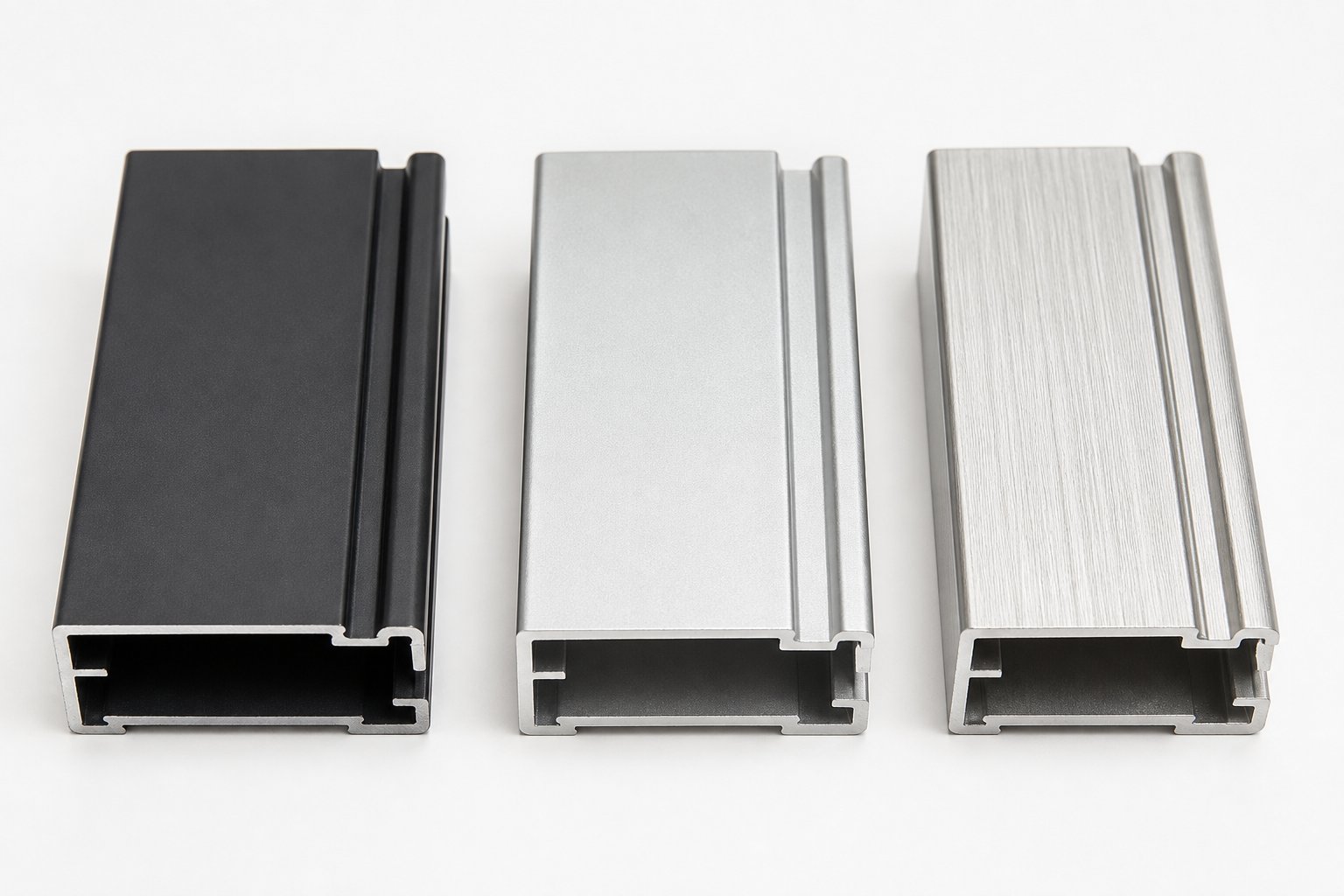
Anodized vs Powder-Coated vs Brushed Finishes
Powder-coated aluminium is by far the most common finish on modern Australian door frames. The process applies a dry powder paint to the aluminium surface, then cures it under heat to form a thick, uniform skin. It comes in virtually any colour and has a smooth, paint-like feel. Quality manufacturers like MEICHEN offer extensive custom colour options with durable multi-layer powder-coat systems, and the finish quality directly affects how much maintenance your frames will need over their lifespan.
Anodized aluminium has a distinctly metallic appearance. The finish is created through an electrochemical process that converts the surface into a hard, corrosion-resistant oxide layer integrated with the metal itself. It does not chip or peel because it is part of the aluminium rather than sitting on top of it. You will often find anodized finishes on older frames or commercial installations where a natural metallic look was preferred.
Brushed or raw aluminium shows visible directional grain lines across the surface, similar to brushed stainless steel. Cleaning brushed aluminium requires extra care because the textured surface traps contaminants in its grooves, and scrubbing against the grain direction can leave permanent marks.
Quick Visual Tests to Identify Your Finish
Run your fingernail lightly across an inconspicuous area. Powder coating feels like smooth plastic and shows a uniform colour when viewed at an angle. Anodized surfaces feel harder and cooler, with a subtle metallic sheen that shifts slightly in different light. Brushed aluminium has a tactile texture you can feel with your fingertip, with fine parallel lines visible up close.
| Finish Type | Appearance | Touch Test | Common Locations | Cleaning Sensitivity |
|---|---|---|---|---|
| Powder-Coated | Smooth, uniform colour (matte to glossy) | Feels like painted plastic, slightly warm | Most modern residential doors and windows | Moderate — avoid abrasives and strong solvents that chip or dull the coating |
| Anodized | Metallic sheen, typically silver, bronze, or charcoal | Hard, cool, glass-like smoothness | Older homes, commercial buildings, high-exposure facades | High — acidic cleaners dissolve the anodic layer permanently |
| Brushed/Raw Aluminium | Visible directional grain lines, matte metallic | Textured ridges felt under fingertip | Feature entries, industrial-style interiors, custom joinery | High — must clean with the grain; cross-grain scrubbing causes visible scratching |
If your frames are a bold colour like charcoal, white, or a custom shade, you almost certainly have a powder-coated finish. Silver or bronze frames with a hard, glassy feel point to anodizing. And if you can see and feel fine lines running in one direction, you are working with brushed aluminium.
Identifying your finish takes moments, but it shapes every product choice and technique from here on. Each finish has a different tolerance for chemicals, pressure, and abrasion, so the cleaning supplies you reach for next need to match what is actually on your frames.
Step 2 – Gather the Right Cleaning Supplies
Your finish type dictates which products are safe. Grabbing whatever sits under the kitchen sink is how frames end up scratched, stained, or stripped of their protective coating. The best cleaner for aluminium door frames depends on two things: the finish you identified in Step 1 and how severe the buildup actually is.
Think of your supply list in three tiers. Start with the gentlest option and only escalate when the lighter approach fails to shift the grime. This principle — use the mildest effective method first — protects the frame’s surface while still getting results.
Essential Supplies for Routine Door Frame Cleaning
For regular maintenance and light dust or fingerprints, these basics handle the job on all three finish types without risk:
- Mild dish soap — a few drops in warm water creates a pH-neutral solution that lifts everyday grime without attacking oxide layers or powder-coat finishes.
- Microfibre cloths (at least two) — one for washing, one for drying. Microfibre traps particles rather than dragging them across the surface, preventing micro-scratches.
- Soft-bristle brush — a nylon-bristled brush (like a clean paintbrush or soft toothbrush) reaches into frame rebates and corners where cloths cannot.
- Bucket of clean water — for rinsing your cloth frequently and for the final rinse that removes soap residue.
This tier suits monthly or bi-monthly cleans and works as a reliable aluminum window frame cleaner for frames that have not been neglected. Most Australian homeowners will find this is all they need between seasonal deep cleans.
Specialist Products for Stubborn Stains and Oxidation
When routine washing leaves behind dull patches, water stains, or light chalky residue, step up to moderate-strength products. These are still safe for aluminium but carry more cleaning power:
- Specialist aluminium cleaner — pH-neutral formulas designed specifically as a cleaner for aluminum window frames dissolve oxidation without stripping protective coatings. Look for products labelled safe for anodized and powder-coated surfaces.
- White vinegar solution (diluted) — one part white vinegar to four parts water tackles mineral deposits and light oxidation on powder-coated and raw aluminium. Avoid using this on anodized finishes, where even diluted acid can compromise the anodic layer.
- Non-abrasive sponge — a standard kitchen sponge (soft side only) or melamine foam for targeted spot cleaning on stubborn marks.
- Spray bottle — for applying vinegar solution or diluted cleaner evenly without over-saturating the frame.
For heavy oxidation, embedded grime, or frames that have gone years without attention, a third tier of supplies brings restoration-level results:
- Fine-grade nylon pad — a white or grey Scotch-Brite style pad (never green, which is too coarse) provides gentle abrasion that lifts oxidation from raw or brushed aluminium without gouging the surface.
- Aluminium polish — products like Autosol or similar metal polishes restore shine on bare and brushed finishes after oxidation removal.
- Oxidation remover — commercial aluminium restorers formulated to dissolve heavy chalky buildup and restore colour to neglected frames.
- Car wax or silicone-based protectant — applied after cleaning, this adds a sacrificial barrier that repels moisture and slows future oxidation.
Regardless of how severe the staining looks, never substitute steel wool, wire brushes, or acidic bathroom cleaners on aluminium door frames. Steel wool embeds iron particles that cause rust spots. Wire brushes gouge through protective coatings. And bathroom cleaners containing hydrochloric or phosphoric acid cause irreversible black staining and pitting on aluminium surfaces.
Gathering the right supplies before you start means you will not be tempted to improvise mid-clean with something harsher. With your products matched to your finish type and stain severity, the actual cleaning technique becomes the deciding factor in how your frames turn out.
Step 3 – Cleaning Aluminium Door Frames Step by Step
Supplies ready, finish identified — time to put cloth to frame. The technique itself is simple, but a few details separate a clean that protects your aluminium from one that leaves streaks, soap film, or hidden grime in the channels. Here is the routine process laid out in order, so you can work through it methodically each time.
The Top-to-Bottom Washing Technique
Gravity is your ally. Dirty water runs downward, so starting at the top prevents you from re-soiling areas you have already cleaned. Work in small sections — roughly arm’s length at a time — rather than trying to wash an entire frame in one pass. This keeps your cloth wet enough to lift grime and stops soap from drying on the surface before you can rinse it off.
- Dry-brush loose debris. Use a soft-bristle brush or a dry microfibre cloth to sweep away dust, cobwebs, and loose grit from the frame surface. Pay attention to the top rail and corners where debris settles undisturbed. Skipping this step means you will drag abrasive particles across the finish during washing.
- Prepare your soapy solution. Add a few drops of mild dish soap to a bucket of warm water — just enough to create light suds. Hot water is unnecessary and can soften adhesive seals on some frames.
- Wash from top to bottom. Dip a microfibre cloth into the solution, wring it so it is damp rather than dripping, and wipe the frame starting at the highest point. Use straight, overlapping strokes that follow the length of the frame. On anodized surfaces, avoid circular scrubbing — it can leave swirl marks visible in certain light. On powder-coated frames, gentle linear passes are equally effective and safer for the coating.
- Clean channels and rebates. Switch to your soft-bristle brush for the narrow grooves where the glass sits and the internal rebates of the frame profile. These recesses trap compacted dirt that a flat cloth simply glides over. Dip the brush in your soapy water and work along the channel length, loosening buildup as you go.
- Rinse thoroughly with clean water. Using a separate bucket of fresh water (or a low-pressure hose for exterior frames), wipe or rinse away all soap residue. This step matters more than most people realise — leftover detergent attracts new dirt within days and can etch into finishes over time if left to dry repeatedly.
- Dry with a clean microfibre cloth. Wipe the frame dry immediately after rinsing. This prevents water spots, especially in areas with hard water where mineral deposits leave white marks as droplets evaporate.
Rinsing and Drying for a Streak-Free Finish
If you are wondering how do I clean aluminium window frames without ending up with hazy streaks, the answer almost always comes down to rinsing. Soap residue is the number one cause of that dull, filmy look people mistake for oxidation. Rinse your cloth in clean water frequently — every few passes — and do a final wipe-down with a freshly wrung cloth to catch anything you missed.
For exterior frames exposed to direct sun, try to clean in the early morning or late afternoon. Warm surfaces cause water and soap to evaporate too quickly, leaving residue behind before you get a chance to rinse. A shaded frame gives you more working time and a noticeably cleaner result.
This routine handles everyday grime, fingerprints, and light dust buildup effectively. But what about those frames where the damage goes deeper — the chalky white patches, the dull grey discolouration that soap and water barely touch? That is oxidation, and it calls for a different level of treatment.
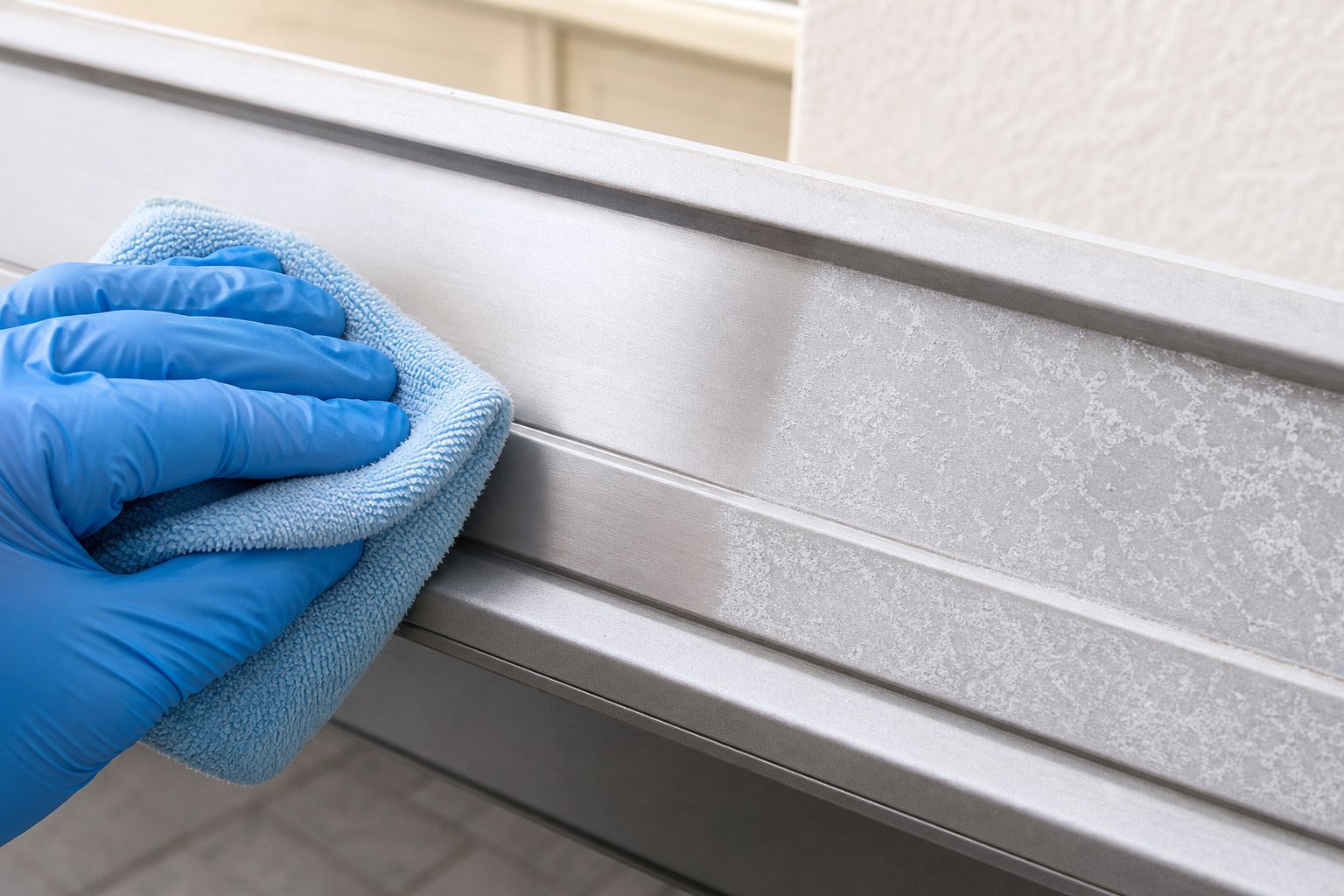
Step 4 – Remove Oxidation and Restore Discoloured Frames
Soap and water handle surface grime. But that persistent white, powdery film that refuses to budge? That is aluminium oxidation — and it is the single most common reason Australian homeowners search for help with oxidised aluminium window frames. The good news: most oxidation on residential door frames is entirely treatable at home, provided you match the severity to the right method.
Understanding White Chalky Residue on Aluminium
Aluminium oxidation is a chemical reaction, not just dirt. When the metal’s surface meets oxygen and moisture in the air, it forms aluminium oxide (Al₂O₃) — a white or grey powdery compound that bonds to the surface. In small amounts, this oxide layer is actually beneficial. It creates a self-healing barrier that slows further corrosion. The problem starts when environmental factors overwhelm that natural defence.
Salt air along the Australian coast, pooling moisture in door tracks, pollution particles in urban areas, and simple long-term neglect all accelerate the process. Over years, the thin protective layer thickens into visible chalky patches, and eventually the surface develops pitting — small crater-like marks where the metal itself has been eaten away.
Here is the critical distinction: surface oxidation is cosmetic. It looks poor but the frame remains structurally sound. Pitting that penetrates deep into the aluminium profile is structural. If you can catch a fingernail in the pits or see material flaking away, the damage has moved beyond a simple clean. For most residential frames showing white residue and mild roughness, restoration is straightforward. Frames with deep, widespread pitting may need professional assessment or replacement.
Three-Level Oxidation Removal Method
Treating oxidation effectively means matching your approach to the severity. Jumping straight to aggressive methods on light oxidation risks unnecessary surface damage. Going too gentle on heavy buildup wastes your time. Use the table below to identify where your frames sit, then follow the corresponding procedure.
| Oxidation Level | Visual Signs | Recommended Treatment | Time Required | Expected Result |
|---|---|---|---|---|
| Light | Slight dulling, thin haze, surface still smooth to touch | White vinegar paste method | 15–20 minutes per frame | Original sheen restored, smooth finish |
| Moderate | Visible white or grey patches, chalky residue transfers to fingers, surface feels rough | Commercial aluminium restorer | 30–45 minutes per frame | Colour and smoothness largely recovered, minor marks may remain |
| Heavy | Deep pitting, thick powdery buildup, sandpaper-like texture | Fine nylon abrasive pad technique | 45–60 minutes per frame | Surface smoothed and improved, some pitting scars may persist |
Light oxidation — white vinegar paste method: Mix two parts baking soda with one part water to form a thick paste. Apply a thin layer over the dulled areas and let it sit for ten minutes. Then dampen a soft cloth with a solution of one part white vinegar to four parts water and wipe the paste away using gentle, straight strokes. The mild acid dissolves the oxide layer without attacking the aluminium beneath. Rinse thoroughly with clean water and dry immediately. This approach works well for anyone wondering how to deoxidise aluminium frames that have only recently started to dull.
Moderate oxidation — commercial aluminium restorer: Apply a dedicated aluminium restoration product according to the label directions. These formulas are pH-balanced to dissolve heavier oxide buildup without damaging powder-coated or anodized finishes (check compatibility on the label). Work in small sections, applying with a non-abrasive sponge and allowing the recommended dwell time — typically two to five minutes. Wipe away with a damp microfibre cloth, rinse, and dry. A second application may be needed on particularly stubborn patches.
Heavy oxidation — fine nylon abrasive pad technique: For frames with visible pitting and thick chalky deposits, a white or grey Scotch-Brite style nylon pad provides the gentle mechanical action needed. Dampen the pad and apply a small amount of aluminium restorer or a baking soda paste directly to the surface. Work in straight strokes following the frame’s length — never in circles, which create visible swirl marks. Apply light, even pressure and let the pad do the work. Rinse frequently to check progress. This method suits raw and brushed aluminium best. On powder-coated frames, restrict pad use to bare aluminium areas only, as abrasion will dull the coating. The same technique applies if you need to restore corroded aluminium shower door frames, where moisture exposure often causes heavier buildup in a shorter timeframe.
After any oxidation treatment, apply a thin coat of car wax or silicone-based protectant to the cleaned surface. This sacrificial layer slows re-oxidation by blocking direct contact between the aluminium and moisture in the air. Reapply every three to six months depending on your climate exposure.
Oxidation tends to concentrate on the visible face of the frame, but the areas that actually degrade fastest are hidden from view — the tracks, thresholds, and bottom channels where water pools and grit accumulates. Those spots demand their own targeted approach.
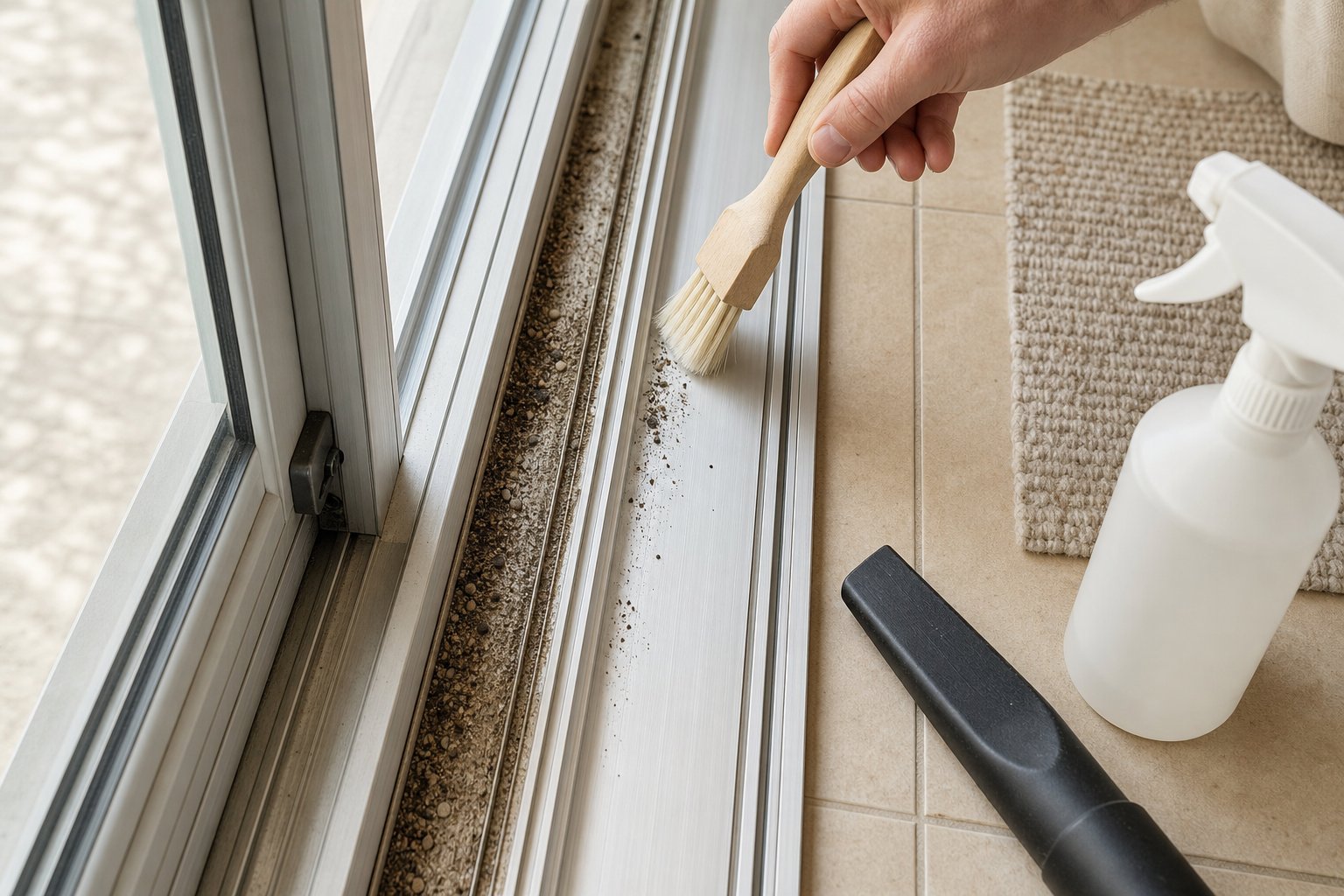
Step 5 – Deep Clean Door Tracks and Threshold Channels
Tracks and thresholds sit at the lowest point of your door system, which makes them a collection zone for everything gravity delivers — sand, leaf litter, hair, insect debris, and moisture that has nowhere to drain. Reduced airflow at floor level means these channels stay damp longer than the visible frame faces above, creating ideal conditions for mould growth and accelerated oxidation. Foot traffic compounds the problem by grinding grit into the track surface with every pass.
Cleaning aluminium sliding door tracks requires a slightly different approach than the frame faces. You are dealing with compacted debris in narrow grooves, potential mould colonies, and mechanical components that need lubrication after cleaning. Here is the sequence that gets results without damaging the track profile.
Clearing Grit and Mould From Door Tracks
- Vacuum loose debris first. Use a crevice attachment to pull out dry grit, sand, dead insects, and dust from the full length of the track. This prevents you from turning dry debris into abrasive mud once water is introduced.
- Loosen compacted buildup with a stiff nylon brush. A firm nylon-bristled brush (an old toothbrush works for narrow channels) dislodges the packed layer that vacuuming misses. Work along the track length, pushing debris toward one end where you can vacuum it out again.
- Treat mould with a diluted bleach-free solution. Mix one part white vinegar to three parts water in a spray bottle, or use a dedicated mould remover safe for aluminium. Spray directly onto discoloured areas, let it sit for five minutes, then scrub with your nylon brush. Avoid chlorine bleach — it can pit aluminium surfaces and damage rubber seals.
- Wipe and rinse the track clean. Use a damp microfibre cloth to collect loosened grime. For deep channels, wrap the cloth around a flat-head screwdriver or butter knife to reach the bottom corners. Rinse with a small amount of clean water and absorb the excess immediately with a dry cloth.
- Dry the track completely. Standing water in tracks is the primary cause of mould return and threshold corrosion. Use a dry cloth or even a hair dryer on a low setting to eliminate residual moisture from corners and weep holes.
- Lubricate sliding mechanisms. Once the track is fully dry, apply a thin line of dry silicone spray along the track surface. Avoid petroleum-based lubricants like WD-40 — they attract dust and create a sticky residue that accelerates grime buildup. Slide the door back and forth several times to distribute the lubricant evenly across the rollers.
Cleaning and Protecting the Threshold Area
The aluminium door threshold takes more direct abuse than any other part of the frame. Foot traffic, dragged furniture, and pooling rainwater all concentrate here. To clean an aluminium door threshold effectively, follow the same vacuum-brush-wash sequence above, but pay extra attention to the raised ridges and drainage slots that characterise most threshold profiles. A cotton bud or pipe cleaner clears blocked weep holes that prevent water from draining outward.
Common track and threshold problems often have straightforward fixes:
- Black mould in track corners — caused by trapped moisture and organic debris. Treat with vinegar solution and improve drainage by clearing weep holes.
- Grinding or resistance when sliding — grit embedded under rollers. Vacuum thoroughly, clean roller wheels with a damp cloth, and re-lubricate with silicone spray.
- Paint overspray on the threshold or track — apply a small amount of Goo Gone or a citrus-based adhesive remover to a soft cloth and gently rub the affected area. Avoid acetone-based products like Goof Off, which can strip powder-coated finishes. Work patiently in small sections, re-applying as needed rather than scrubbing aggressively.
- White mineral deposits from hard water — wipe with a cloth dampened in diluted white vinegar (one part vinegar to four parts water), then rinse and dry.
- Stiff or seized locking mechanisms — spray a small amount of dry silicone lubricant into the lock barrel and work the mechanism several times to distribute it internally.
Tracks and thresholds benefit from a quick vacuum every fortnight, even between full cleans. This two-minute habit prevents grit from compacting into the hard layer that demands serious scrubbing later. With the mechanical components of your door system running smoothly, the next consideration is protecting the frame from the cleaning mistakes that cause more damage than the dirt itself.
Step 6 – What Not to Use on Aluminium Frames
Knowing how to clean metal doors properly is only half the equation. The other half is knowing what will wreck them. Every mistake below triggers a specific chemical or mechanical reaction that compounds over time — and most of the damage is irreversible once it starts.
Why Abrasive Tools Destroy Protective Coatings
Aluminium’s natural oxide layer measures just a few nanometres thick. It is hard, but it is not armour. Physical abrasion cuts straight through it, and the consequences go far beyond a surface scratch.
- Steel wool or wire brushes — These gouge through the oxide layer and embed microscopic iron particles into the aluminium surface. Those iron fragments then rust independently, creating orange-brown spots that bleed outward. Worse, the exposed raw aluminium beneath the scratches corrodes at an accelerated rate because the self-healing oxide layer cannot reform evenly over a deeply scored surface. Research into aluminium surface chemistry confirms that once the protective oxide film is mechanically disrupted, localised pitting corrosion initiates rapidly in the presence of moisture.
- Green scouring pads or coarse abrasive sponges — Less aggressive than steel wool but still too harsh for powder-coated and anodized finishes. They create fine scratches invisible to the naked eye at first, but these micro-grooves trap dirt and moisture, dulling the surface progressively with each clean. Within a few months of repeated use, the finish looks permanently hazy.
If you want to clean aluminium window frames without causing this kind of cumulative damage, stick to microfibre cloths and white or grey nylon pads rated for delicate surfaces.
Chemical Reactions That Permanently Damage Aluminium
The wrong chemical does not just fail to clean — it actively attacks the metal through predictable reactions that no amount of rinsing afterward can undo.
- Full-strength vinegar or acidic cleaners on anodized surfaces — Anodizing creates a thick, engineered oxide layer through electrochemical processing. Undiluted acids (including vinegar at full concentration) dissolve this anodic layer by reacting with the aluminium oxide, converting it into soluble aluminium salts. The result is permanent clouding, uneven colour patches, and loss of the corrosion resistance the anodizing was designed to provide.
- Alkaline oven cleaners or caustic degreasers — Products containing sodium hydroxide react aggressively with aluminium. Surface chemistry research demonstrates that highly alkaline solutions (pH above 13) preferentially dissolve aluminium compounds from the surface, causing irreversible black or dark grey staining. This discolouration is not a surface deposit you can wipe off — it is a chemical alteration of the metal itself.
- Pressure washing at close range — A pressure washer delivering over 2,000 PSI forces water past rubber seals and weatherstripping, flooding internal frame cavities where it cannot drain or dry. Trapped moisture promotes hidden corrosion from the inside out. The high-pressure stream also damages window and door seals, leading to air leaks, drafts, and long-term water intrusion into wall cavities. On powder-coated frames, close-range pressure can chip the coating at edges and joints, creating entry points for oxidation.
- Neglecting to rinse soap residue — This one surprises people because the soap itself seems harmless. But detergent left to dry on aluminium forms a thin alkaline film. Over repeated cleaning cycles, that film etches into the finish, creating a permanently dull haze. The residue also attracts airborne dust and pollution particles, meaning the frame looks dirty again within days — prompting another wash that deposits yet more soap. It becomes a self-reinforcing cycle of surface degradation.
The pattern across all these mistakes is the same: each one compromises the barrier between raw aluminium and its environment. Once that barrier fails in a specific spot, corrosion concentrates there and accelerates. Avoiding these errors costs nothing and preserves the frame’s appearance for years longer than any restoration product can.
Protecting your frames from accidental damage is one thing. Building a proactive schedule that accounts for your local climate conditions is what separates frames that last decades from those that need replacing after ten years.

Step 7 – Build an Aluminium Door Frame Maintenance Schedule for Your Climate
A single cleaning session restores your frames today. Without a schedule tailored to where you live, you will be back at square one within months. Australian climates vary dramatically — a beachside home in Noosa faces entirely different pressures than a suburban house in Ballarat or an apartment in inner-city Sydney. Your aluminium door frame maintenance schedule should reflect those differences rather than following a generic “clean twice a year” recommendation that ignores local conditions.
Climate-Based Cleaning Frequency Guide
Salt, pollution, and humidity are the three environmental forces that determine how quickly aluminium frames deteriorate between cleans. Each one attacks the frame through a different mechanism, and each demands a different response frequency.
Coastal salt air is the most aggressive. Airborne chloride ions land on frame surfaces and penetrate the oxide layer, initiating pitting corrosion that progresses rapidly if deposits are not rinsed away. Properties within five kilometres of the shoreline — common across QLD, NSW, and WA coastal strips — need significantly more frequent attention. Industry maintenance guidance for coastal buildings confirms that salt-laden air settles on metal surfaces, works into joints and corners, and accelerates corrosion on exposed components if not managed with regular fresh-water rinsing.
Urban pollution particles — brake dust, diesel soot, and industrial fallout — bond to powder-coated and anodized surfaces over time. Unlike loose dust that wipes away easily, these micro-particles embed into the finish and create a gritty texture that traps moisture against the frame. Homes near major roads, train lines, or industrial zones in cities like Melbourne, Sydney, and Brisbane accumulate this contamination faster than suburban or rural properties.
High humidity promotes mould growth in tracks and channels, particularly in tropical and subtropical regions from Cairns down through the Gold Coast. Persistent dampness also slows drying after rain, extending the contact time between moisture and the aluminium surface.
| Climate Type | Routine Clean Frequency | Deep Clean Frequency | Key Risk Factor |
|---|---|---|---|
| Coastal / Salt-Air (within 5 km of shoreline) | Monthly rinse and wipe-down | Every 3 months | Chloride-driven pitting corrosion; salt deposits accelerate oxide layer breakdown |
| Urban / High-Pollution (near major roads, industrial areas) | Every 6–8 weeks | Every 6 months | Embedded soot and particulates; surface contamination traps moisture against finish |
| Standard Inland / Suburban | Every 3 months | Annually | Dust accumulation and seasonal pollen; slower degradation but still requires consistent care |
How do you clean aluminium window frames on a coastal property differently from an inland one? The technique stays the same — the frequency changes. A monthly fresh-water rinse on coastal frames takes five minutes per door and prevents salt from sitting long enough to initiate pitting. That same frame cleaned only twice a year would show visible oxidation within eighteen months.
Seasonal Triggers That Signal Immediate Cleaning
Beyond your regular schedule, certain events should prompt an unplanned clean regardless of when you last maintained the frames:
- After coastal storms or high-wind events — Storm-driven salt spray deposits far more chloride than normal sea breeze. A fresh-water rinse within 48 hours removes these concentrated deposits before they begin corroding the surface.
- Post-bushfire smoke exposure — Ash and smoke residue is acidic. Frames exposed to heavy smoke haze (common across south-eastern Australia during summer) should be washed promptly to prevent chemical etching.
- Following heavy pollen season — Spring pollen compacts into tracks and channels, holding moisture against the aluminium. A thorough track vacuum and wipe-down in early November prevents mould establishing over the humid months ahead.
- Before winter — A pre-winter clean and seal check ensures drainage paths are clear and weatherstripping is intact before the wet season. Blocked weep holes during winter rains lead to pooling water and hidden corrosion inside the frame cavity.
- After renovation or construction work nearby — Render dust, concrete splatter, and paint overspray are all easier to remove within days of settling. Left for weeks, they bond chemically to the finish.
Cleaning aluminium window frames on a reactive schedule — responding to these triggers as they occur — fills the gaps between your routine maintenance and prevents the kind of concentrated damage that turns a simple wipe-down into a full restoration project.
A consistent schedule keeps frames looking sharp and functioning well. But even the most diligent maintenance routine cannot overcome poor frame quality. The finish system, fabrication precision, and thermal design of the frame itself determine how much effort you will spend cleaning over its lifetime — and whether that effort delivers lasting results or just delays the inevitable.
When Quality Frames Make Maintenance Easier
Some frames fight you every time you pick up a cloth. Others wipe clean in minutes and look good for months between sessions. The difference rarely comes down to how diligently you maintain them — it comes down to how well they were made in the first place.
How Frame Quality Affects Long-Term Maintenance
A well-manufactured aluminium door frame resists oxidation, sheds grime more readily, and develops fewer of the problem areas that demand intensive cleaning. The reasons are structural, not cosmetic. Multi-layer powder-coat systems — where the aluminium receives chemical pretreatment, a primer layer, and a top coat before curing at 180–200°C — create a thick, uniform protective film that outperforms single-coat finishes in corrosion resistance, UV stability, and scratch tolerance. Frames finished this way resist chalking and colour fade for significantly longer, meaning less frequent restoration work over the frame’s lifespan.
Thermal break construction plays a less obvious but equally important role. Thermally broken aluminium profiles separate the interior and exterior faces of the frame with a polyamide barrier, keeping the internal surface warmer. This dramatically reduces condensation forming on the frame — and condensation is one of the primary drivers of mould growth in tracks and oxidation on frame faces. Less moisture sitting on the aluminium means less cleaning, full stop.
Precision fabrication matters too. Frames with tight mitre joints, flush-fitting gaskets, and properly aligned drainage channels leave fewer gaps where dirt compacts and moisture pools. Cheap or poorly assembled frames develop visible gaps at corners within a few years, creating pockets that trap organic debris and hold water against the metal.
Investing in Aluminium Frames Built to Last
If you are cleaning aluminium window frames that are beyond restoration — deep pitting, flaking powder coat, failed seals — the most practical path forward is replacement with frames engineered to resist those problems from day one. When evaluating new aluminium door and window systems, look for these quality indicators that directly reduce your future cleaning burden:
- Multi-layer powder-coat finish — chemical pretreatment plus primer plus top coat, cured under controlled heat. This system resists chalking, UV fade, and chemical attack far better than single-coat applications.
- Thermally broken profiles — polyamide barriers between inner and outer aluminium faces eliminate condensation-driven corrosion and mould.
- Precision-machined drainage channels — properly sized and positioned weep holes that prevent water pooling in tracks and sills.
- Flush mitre joints and tight gasket seals — minimise dirt-trapping gaps and prevent moisture ingress into the frame cavity.
- Custom colour systems with quality-controlled application — factory-applied finishes under controlled conditions outperform site-applied coatings in adhesion and uniformity.
Manufacturers like MEICHEN build these qualities into their aluminium window, door, and facade systems as standard — from durable multi-layer powder-coated finishes in custom colours through to thermally broken profiles across their full product range. For homeowners planning a new build, renovation, or full-house replacement, their project-based approach covers everything from glass and hardware selection to colour customisation and technical support from drawings through delivery. It is the kind of manufacturing precision that means how do you clean aluminium window frames becomes a five-minute job rather than a weekend project.
Ultimately, learning how to clean a metal door frame properly protects your investment today. Choosing frames built with superior finishes and thermal performance protects it for decades. The best maintenance routine is one you barely notice — and that starts with aluminium systems engineered to stay cleaner, longer.
Frequently Asked Questions About Cleaning Aluminium Door Frames
1. What is the best homemade cleaner for aluminium door frames?
A few drops of mild dish soap in warm water is the safest and most effective homemade cleaner for routine aluminium frame maintenance. For light oxidation or mineral deposits, mix one part white vinegar with four parts water in a spray bottle. Avoid using this vinegar solution on anodized finishes, as even diluted acid can damage the anodic layer. For stubborn chalky buildup, a paste of two parts baking soda to one part water applied for ten minutes before wiping with the diluted vinegar solution lifts oxidation without harming the underlying metal. Always rinse thoroughly with clean water afterward to prevent residue buildup.
2. How do you remove white oxidation from aluminium door frames?
Removing white oxidation depends on severity. Light hazing responds well to a baking soda paste left for ten minutes, then wiped away with a diluted white vinegar solution and rinsed clean. Moderate chalky buildup where residue transfers to your fingers requires a commercial aluminium restorer applied with a non-abrasive sponge and allowed to dwell for two to five minutes before wiping. Heavy pitting with a sandpaper-like texture needs a fine-grade white or grey nylon pad used with gentle straight strokes along the frame length. After any oxidation treatment, apply car wax or a silicone-based protectant to slow re-oxidation by blocking moisture contact with the bare aluminium surface.
3. Can you use vinegar to clean aluminium window and door frames?
Diluted white vinegar (one part vinegar to four parts water) is safe for powder-coated and raw aluminium frames and works well on mineral deposits and light oxidation. However, never use vinegar at full strength or on anodized aluminium surfaces. Anodizing creates an engineered oxide layer through electrochemical processing, and undiluted acids dissolve this layer permanently, causing irreversible clouding and uneven colour patches. If you are unsure whether your frames are anodized or powder-coated, perform a simple touch test first — anodized surfaces feel hard, cool, and glass-like, while powder coating feels like smooth plastic.
4. How often should you clean aluminium door frames in coastal areas?
Coastal properties within five kilometres of the shoreline need a fresh-water rinse and wipe-down monthly, with a full deep clean every three months. Salt-laden air deposits chloride ions on frame surfaces that penetrate the protective oxide layer and initiate pitting corrosion if not removed promptly. After coastal storms or high-wind events, perform an additional rinse within 48 hours regardless of your regular schedule, as storm-driven salt spray deposits far more concentrated chloride than normal sea breeze. Applying a silicone-based protectant or car wax every three to six months adds a sacrificial barrier that slows salt-driven degradation between cleans.
5. What should you never use to clean aluminium frames?
Steel wool and wire brushes are the worst offenders — they gouge through the protective oxide layer and embed iron particles that rust independently, creating orange-brown spots. Alkaline oven cleaners containing sodium hydroxide cause irreversible black staining by chemically altering the metal surface. Acidic bathroom cleaners with hydrochloric or phosphoric acid cause permanent pitting. Pressure washers at close range force water past seals into frame cavities, promoting hidden internal corrosion. Even leaving soap residue without rinsing creates a cycle of surface degradation, as the alkaline film etches into the finish over repeated cleaning cycles and attracts new dirt within days.
More Window & Door Guides