What Actually Makes an Aluminium Window High Performance
Search for aluminium windows and you will find dozens of manufacturers claiming high performance. Rarely does anyone explain what that actually means. The term gets applied so loosely that a budget aluminium window and a thermally broken, acoustically rated system can sit under the same label. That gap between marketing language and measurable reality is where costly specification errors happen.
This guide breaks down the technical criteria that separate genuinely high performance aluminium windows from standard products, giving architects, builders, and homeowners a shared framework for evaluating claims.
Defining High Performance in Aluminium Window Systems
A high performance classification is not a branding exercise. It refers to a window system that exceeds minimum code requirements across multiple measurable criteria: thermal insulation (U-value), air permeability, water penetration resistance, wind load capacity, and acoustic attenuation. An aluminium window only earns that distinction when tested performance data confirms it outperforms standard minimums set by applicable standards such as AS 2047 and the National Construction Code.
What separates premium aluminium windows from entry-level products is not a single feature. It is the engineered interaction of thermally broken profiles, high-grade gaskets, precision hardware, and appropriately specified glazing units working as one integrated system.
Why the Distinction Matters for Project Outcomes
Specifying contemporary aluminium windows with verified high performance credentials directly influences a project’s NatHERS energy rating, occupant thermal comfort, and long-term asset value. Underperforming windows in aluminium frames force mechanical heating and cooling systems to compensate, increasing operational costs for decades. Buildings designed to tighter performance envelopes hold their value better and meet evolving compliance thresholds without retrofitting.
High performance is defined by the combined system performance of frame, glazing, hardware, and seals — not any single component. A thermally broken frame paired with poor seals or inadequate glazing will not deliver its rated potential.
The sections that follow unpack each performance metric individually, then show how they interact to produce measurable outcomes at the whole-window level.
The Performance Metrics That Define Window Quality
Each metric listed on a spec sheet tells part of the story. The challenge is that most product literature presents these numbers in isolation, without explaining how they relate to one another or what thresholds actually matter. Whether you are specifying commercial windows for a multi-storey office or selecting aluminium frames for a coastal home, the same core metrics apply. The difference lies in the required performance levels and the standards used to verify them.
Thermal Performance and U-Value Thresholds
U-value measures how much heat passes through a window assembly, expressed in watts per square metre per degree Kelvin (W/m2K). Lower numbers mean better insulation. A critical distinction exists between centre-of-pane U-value and whole-window U-value. The centre-of-pane figure only measures the glazing itself, ignoring the frame and edge spacer — components where most heat loss occurs in aluminium systems. Whole-window U-values capture total performance and are the figure that matters for NCC compliance and NatHERS modelling.
Standard non-thermally-broken aluminium windows typically deliver whole-window U-values between 5.0 and 7.0 W/m2K. High performance thermally broken systems push that figure below 2.0 W/m2K with appropriate glazing, placing them in the same thermal range as timber and uPVC frames while retaining aluminium’s structural and aesthetic advantages.
Air Permeability and Water Tightness Ratings
Air permeability testing measures the volume of air leaking through a closed window under controlled pressure. Under AS 2047, windows are tested at specific pressure differentials and the leakage rate is reported in litres per second per square metre of openable area. Tighter seals mean less uncontrolled air infiltration, better energy efficiency, and reduced dust and noise penetration.
Water tightness testing applies a uniform water spray while simultaneously pressurising the exterior face of the window. The test determines the maximum pressure at which no water penetrates to the interior. For commercial window frames and industrial windows subjected to high wind-driven rain exposure — think coastal high-rises or windows for commercial buildings near airports — water tightness ratings become a critical differentiator between standard and high performance classifications. AS 2047 assigns water resistance ratings in Pascals, with higher values indicating greater resistance to wind-driven rain penetration.
Wind Load Resistance and Structural Integrity
Wind load resistance is tested by applying positive and negative pressure cycles to the window and measuring deflection and permanent deformation. AS 2047 classifies windows by their ultimate strength rating — the maximum wind pressure the window can withstand without failure — expressed in Pascals (Pa). In cyclone-prone regions of northern Queensland and the Northern Territory, wind load requirements escalate dramatically, demanding commercial-grade structural performance even in residential applications. A window rated to 2000 Pa handles typical suburban conditions; systems rated above 4000 Pa address severe exposure zones and taller buildings where wind pressures increase with height.
Acoustic Ratings Explained
Sound insulation performance is expressed using Rw (weighted sound reduction index) in Australia, following ISO 717-1. The equivalent in North American standards is STC (Sound Transmission Class). Both use a single-number scale where higher values indicate greater noise reduction. A standard double-glazed aluminium window might achieve an Rw of 28 to 32. High performance systems with laminated glass, wider cavities, and optimised seal compression can reach Rw 40 or above — a meaningful difference given that every 10 dB reduction roughly halves perceived loudness.
The table below brings these metrics together, showing how standard and high performance thresholds compare across the key criteria governed by Australian standards.
| Performance Metric | Unit | Standard Threshold | High Performance Threshold | Governing Standard |
|---|---|---|---|---|
| Whole-Window U-Value | W/m2K | 5.0 – 7.0 | Below 2.0 | NCC / AS 2047 / WERS |
| Air Permeability | L/s/m2 at test pressure | Moderate leakage rates | Minimal leakage under elevated pressure | AS 2047 |
| Water Tightness | Pascals (Pa) | 150 – 300 Pa | Above 450 Pa | AS 2047 |
| Wind Load Resistance | Pascals (Pa) | Up to 2000 Pa | Above 3000 Pa (cyclone zones: 4000+ Pa) | AS 2047 / NCC |
| Acoustic Insulation (Rw) | dB | 28 – 32 | 38 – 45+ | AS/NZS 1276 / ISO 717-1 |
These metrics do not operate independently. A window that excels in thermal performance but fails under wind load will not maintain its seal compression over time, degrading both air tightness and acoustic performance. The frame engineering that delivers structural integrity is the same engineering that keeps gaskets under proper compression — which is precisely why thermal break design deserves closer examination.
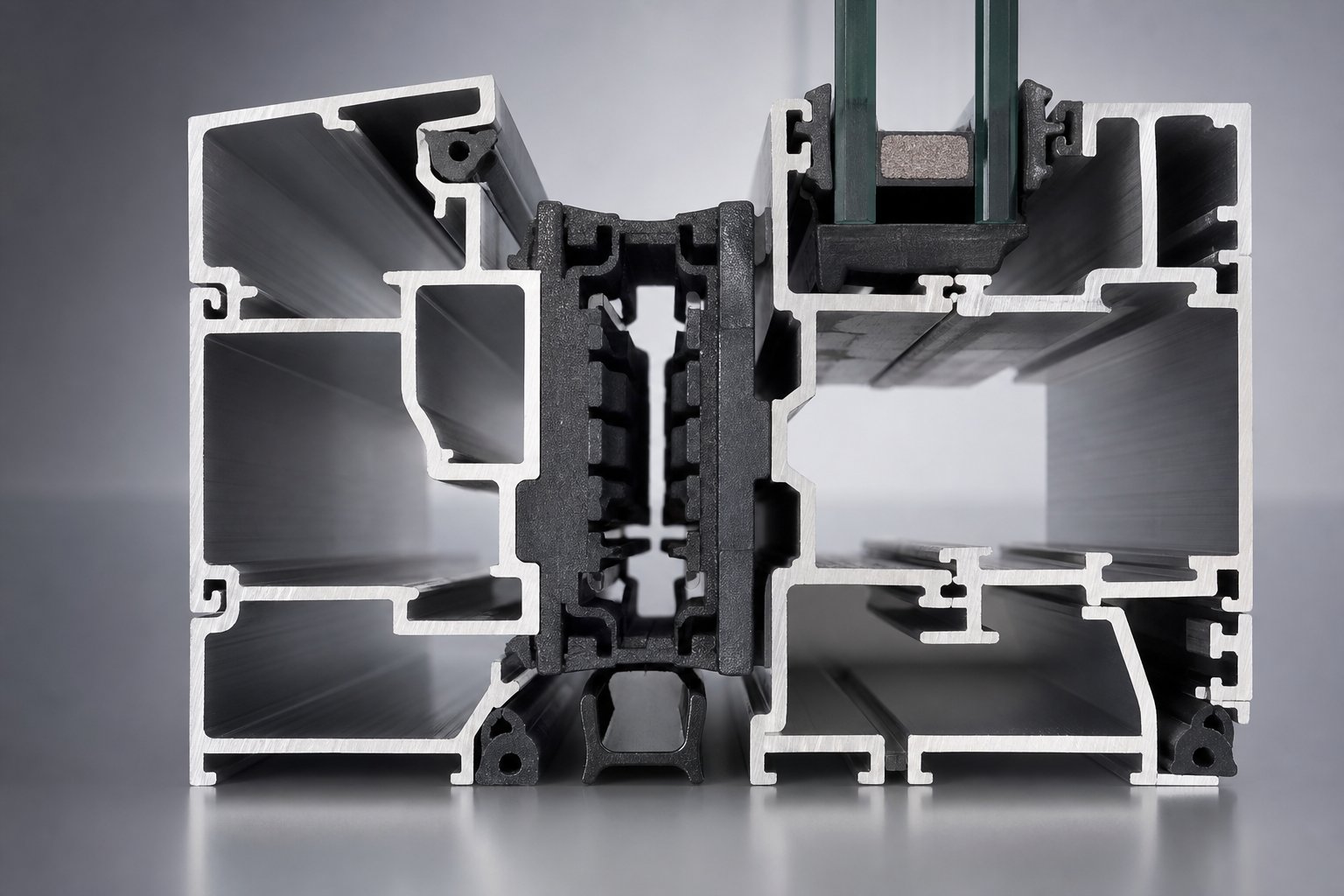
Thermal Break Technology and How It Transforms Aluminium Window Profiles
Aluminium conducts heat at roughly 160 W/m·K — approximately 1,000 times faster than PVC and 5,000 times faster than timber. Left uninterrupted, an aluminium window profile acts as a thermal highway between inside and outside air. Thermal break technology stops that highway cold by splitting the frame into two separate aluminium sections and bridging them with an insulating barrier.
How Polyamide Barrier Strips Work
The barrier material in modern aluminium window profiles is polyamide 6,6 (PA66) reinforced with glass fibre. With a thermal conductivity of just 0.3 W/m·K — over 500 times lower than the surrounding aluminium — this strip creates a dramatic reduction in heat flow through the frame while maintaining full structural capacity.
During manufacture, the aluminium extrusion is produced as two separate pieces with precision-machined channels. Polyamide strips are inserted into those channels and mechanically locked in place through a knurling or crimping process. The result is a composite profile that behaves as a single structural unit but thermally functions as two isolated components separated by an insulating zone. Heat trying to travel from the warm interior face to the cold exterior face must pass through the polyamide — and at 500 times the resistance of aluminium, very little makes it through.
Profile Depth and Thermal Break Width
Not all thermal breaks deliver equal performance. The width of the polyamide strip is the primary variable. Standard aluminium windows profile configurations use strips in the 14.8 mm to 24 mm range, delivering frame U-values (Uf) of around 2.5 to 3.5 W/m²K. Step up to wider strips — 30 mm to 35 mm — with multi-chamber geometries and optional foam insulation inserts, and frame U-values drop to 0.8 to 1.2 W/m²K, rivalling high-performance timber.
Deeper aluminium window profiles accommodate wider thermal breaks and larger glazing units simultaneously. This relationship is not incidental — it is the engineering logic behind why high performance systems use substantially deeper frames than budget alternatives. A deeper profile provides the physical space for a wider insulating zone and the structural depth to resist wind loads without excessive deflection, connecting thermal performance directly to structural performance.
Condensation Resistance Factor
Condensation forms when the interior surface of a window frame drops below the dew point of indoor air. On a non-thermally-broken aluminium frame exposed to cold exterior conditions, the interior face temperature can plummet to just 5°C — well below the dew point in a home maintained at 21°C and 50% relative humidity. Moisture condenses on the frame, runs down to the sill, and over time promotes mould growth and material degradation.
A 24 mm thermal break keeps the interior surface above 15°C under those same conditions, safely above dew point and effectively eliminating condensation risk. The Condensation Resistance Factor (CRF) quantifies this capability — higher values indicate a frame that maintains warmer interior surface temperatures under standardised test conditions. High performance thermally broken systems consistently score well above standard aluminium frames on this metric, which is particularly relevant for Australian coastal properties where humidity levels frequently sit between 60% and 80%.
Several variables determine how effectively a thermal break performs in practice:
- Strip material — PA66 with glass fibre reinforcement is the industry standard for structural and thermal performance
- Strip width — wider breaks (30 mm+) deliver progressively better insulation
- Internal geometry — multi-chamber designs extend the thermal pathway heat must travel
- Number of thermal break zones — some premium systems incorporate multiple breaks within a single profile
- Connection method — knurled or crimped joints must maintain integrity without creating localised thermal bridges
- Foam insulation inserts — filling profile chambers with insulating foam further reduces convection within the frame
These factors combine to determine the frame’s thermal and condensation performance. But a thermally broken frame does not work alone — its real-world U-value depends heavily on how the glazing unit and frame interact as a unified system.
How Glazing Specification Interacts with Frame Performance
A thermally broken aluminium frame and a high-performance glazing unit are not independent products that happen to share a window opening. They form a composite system where the final U-value, condensation behaviour, and structural adequacy are determined by how well the two are matched. Specify a premium frame with budget glazing, or pair advanced triple-glazed units with a frame that cannot support their weight, and the whole-window performance falls short of what either component could achieve individually.
Double Versus Triple Glazing for Different Climates
Australia’s climate zones span tropical heat in Far North Queensland to cold alpine conditions in the Snowy Mountains, with everything from hot-arid inland regions to temperate coastal cities in between. This range means there is no single correct glazing answer for every aluminium glazed window.
Double glazing with a quality Low-E coating and argon gas fill delivers strong performance in NCC climate zones 1 through 5 — covering most of coastal NSW, Queensland, and Western Australia. In these areas, controlling solar heat gain coefficient (SHGC) often matters more than chasing the lowest possible U-value. A well-specified double-glazed unit paired with a thermally broken aluminium frame comfortably achieves the whole-window U-values needed for compliance and occupant comfort.
Triple glazing becomes worthwhile in colder climate zones (6, 7, and 8), high-altitude areas, and south-facing elevations that receive minimal solar gain. The additional glass pane and second gas-filled cavity reduce the centre-of-pane U-value further, but the real benefit compounds when paired with a frame engineered to minimise the thermal bridging around the glass edge — the zone where heat loss concentrates. Upgrading glazing without addressing the frame simply shifts the weak point rather than eliminating it. Where aluminium single-pane glazed windows once dominated older buildings, the performance leap to even a well-specified double-glazed aluminium system is enormous — often halving or more the heat transfer through the opening.
Low-E Coatings and Gas Fills
Low-emissivity coatings are microscopically thin metallic layers applied to glass surfaces inside the sealed unit. They work by reflecting long-wave infrared radiation — the type of heat energy that radiates from warm interior surfaces toward the cold glass in winter, or from sun-heated exterior glass toward cooled interiors in summer. The position of the coating on specific glass surfaces (referred to as surface 2, 3, or 5 in a triple-glazed unit) is selected based on whether the priority is reducing heat loss, limiting solar gain, or both.
Between the glass panes, argon or krypton gas fills replace air to reduce conductive and convective heat transfer within the cavity. Argon performs optimally in cavities of approximately 12 to 16 mm and is the standard choice for energy efficient aluminium windows with double glazing. Krypton — roughly six times denser than argon — insulates effectively in narrower gaps of 6 to 9 mm, making it the preferred fill for triple-glazed units where two cavities must fit within a manageable overall frame depth.
These glazing technologies do not operate in isolation from the frame. The whole-window U-value is a weighted average of the centre-of-pane performance, the edge-of-glass performance (governed by the warm-edge spacer), and the frame U-value. A Low-E coated, gas-filled glazing unit might achieve a centre-of-pane U-value below 1.1 W/m²K, but if the frame and edge losses are significant, the whole-window result could be 1.8 or higher. The thermal break width, spacer bar material, and glazing rebate depth all influence how much of that centre-of-pane potential translates to real installed performance.
Glazing Weight and Frame Engineering
A standard double-glazed unit with two panes of 4 mm glass weighs approximately 20 kg per square metre. Step up to triple glazing with 6 mm panes and that figure climbs to around 45 kg/m². For a large aluminium window with glass spanning 2.4 metres in height, the total glazing weight can exceed 100 kg per panel.
This has direct consequences for frame design. The aluminium profile must resist sustained static load without creep or deflection that could compromise seal compression at the glazing rebate. Hinges and friction stays on operable sashes need to be rated for the increased weight — hardware designed for double-glazed units will fatigue prematurely under triple-glazed loads, leading to seal failure and performance degradation within years rather than decades. Profile depth, wall thickness, and internal reinforcement chambers all scale with intended glazing weight.
The following variables collectively determine how glazing specification influences whole-window performance:
- Number of panes — double or triple, affecting both thermal resistance and total unit weight
- Glass thickness — thicker panes improve acoustic performance and structural resilience but add load
- Low-E coating position and type — controls the balance between heat retention and solar gain management
- Gas fill type — argon for standard cavities, krypton for narrower triple-glazed configurations
- Cavity width — wider gaps improve thermal and acoustic performance up to an optimal point, beyond which convection currents diminish returns
- Warm-edge spacer material — reduces thermal bridging at the glass perimeter where the frame meets the glazing unit
- Laminated versus toughened glass options — affect acoustic rating, safety compliance, and weight
Getting this specification right means the glazing and frame reinforce each other rather than working at cross-purposes. But even perfect thermal and structural specification can underperform if the components that maintain seal compression over time — the gaskets, weatherseals, and locking hardware — are not equally well considered.
Hardware, Seals, and Gaskets as Performance-Critical Components
Spec sheets list thermal break widths and glazing U-values prominently. Gasket materials and locking mechanism specifications, if they appear at all, are buried in appendices. Yet these are the components that determine whether a window actually delivers its rated performance once installed — and whether it continues to do so five, ten, or twenty years later. In aluminium window systems, the frame and glass provide the potential for high performance. The seals and hardware realise it.
Gasket Systems and Weatherseal Design
Every operable window relies on compression between the sash and frame to block air and water. That compression happens at the gasket — a continuous elastomeric seal that deforms under pressure to fill micro-gaps in the contact zone. The material, geometry, and placement of these gaskets directly govern the air permeability and water tightness ratings discussed earlier.
Modern high performance aluminium systems use thermoplastic elastomer (TPE) or ethylene propylene diene monomer (EPDM) gaskets. Both materials maintain their elasticity across Australian temperature extremes, from sub-zero alpine mornings to 45°C summer days in western Sydney or inland Queensland. Cheaper PVC-based seals harden and crack within a few years of UV exposure, losing the very compression that keeps air and water out.
Two fundamental seal configurations exist in aluminium casement windows and other operable types:
Centre-seal design positions the primary gasket in the middle of the frame-to-sash overlap. Air pressure pushes the sash tighter against the seal as wind speed increases, creating a self-reinforcing seal under load. This is the preferred approach for high-exposure applications because performance improves under the same conditions that challenge it most.
Face-seal design places the gasket on the outer face of the contact zone. It relies entirely on hardware compression to maintain contact. While simpler to manufacture, face-seal configurations are more vulnerable to performance degradation as hardware wears or the sash settles over time.
Many premium aluminium systems combine both — a primary centre-seal for weatherproofing backed by an internal air seal to create a drained and ventilated interstitial chamber. Any water that bypasses the outer seal drains harmlessly through weep slots before reaching the interior gasket. This dual-barrier approach is what separates systems rated above 450 Pa water tightness from those that fail at 200 Pa.
Hardware and Its Role in Long-Term Performance
A gasket only works when compressed. The hardware — locking mechanisms, hinges, and friction stays — provides and maintains that compression over the window’s service life. This is where long-term performance quietly lives or dies.
Multi-point locking systems engage the sash against the frame at several points along its perimeter rather than relying on a single central lock. The difference is substantial: a single cam lock creates localised compression that diminishes toward the corners, while a three- or four-point system distributes pressure evenly along the full length of the seal. Even compression means consistent air tightness across the entire sash — no weak spots where drafts develop over time.
For casement aluminium windows and awning configurations, friction stays bear the sash weight while simultaneously maintaining seal alignment. These stays experience significant mechanical stress with every opening cycle. Industry data suggests quality hardware can perform reliably for 15 to 25 years under normal residential use, but that figure depends heavily on material composition. Stainless steel hinges and stays rated for coastal environments resist the corrosion that causes binding, misalignment, and ultimately seal failure. Lower-grade zinc-alloy components in salt-air zones — think anywhere within a few kilometres of the Australian coastline — may begin degrading within five to eight years.
Hardware degradation is gradual and easy to miss. A friction stay that has lost tension allows the sash to sit fractionally lower in the frame. The gasket compression at the top of the sash reduces. Air permeability increases at that point. The window still closes and locks, but its tested performance rating no longer reflects reality. This is the most common cause of performance loss in otherwise high-quality aluminum frame casement windows — not frame failure, not glazing failure, but hardware that no longer holds the system at its designed compression.
Each venting window in a building represents a point where mechanical components must maintain performance over thousands of opening cycles. Even small vent windows in bathrooms and laundries — often overlooked during specification — require the same hardware quality as larger openings if they are to maintain their contribution to the building envelope’s integrity.
The Complete System Approach
Frame material gets the headline. Glazing specification gets the energy modelling attention. But the performance that actually reaches the occupant is delivered by the complete assembly — and the weakest component sets the ceiling.
A high performance aluminium window is a system-level achievement. The finest thermally broken profile and most advanced glazing unit will underperform if paired with seals that have hardened, hardware that has lost compression, or gaskets that were under-specified from the start.
The following components collectively contribute to whether a window achieves and maintains its rated performance:
- Primary weatherseal gaskets — material type (TPE or EPDM), continuous corners without butt joints, and UV stability
- Secondary air seals — inner barrier creating the dual-seal drainage chamber
- Multi-point locking mechanisms — number of engagement points and even compression distribution
- Friction stays and hinges — load rating matched to sash weight, corrosion-resistant materials for coastal zones
- Glazing beads and pressure plates — maintaining glazing unit position and edge-seal compression
- Keep and striker alignment — precise engagement ensuring consistent latch force over time
- Drainage and ventilation slots — preventing hydrostatic pressure build-up between seal lines
Specifiers who focus exclusively on U-values and frame material miss half the performance equation. Requesting hardware specifications, gasket material data, and seal configuration details is just as important as reviewing thermal test reports. A window rated to Rw 42 in a laboratory achieves that figure only when every seal is under proper compression — compression that hardware must deliver reliably year after year, through temperature cycles, coastal corrosion exposure, and tens of thousands of operation cycles.
These mechanical components keep the system performing at its rated level. But performance is not only about what happens at the seal line today — it is also about what happens to the frame itself over decades of environmental exposure, which is where surface finish selection becomes a factor in sustained performance.
Acoustic Performance and Sound Insulation in Aluminium Systems
Seal compression, gasket material, and hardware integrity all influence acoustic outcomes — but the conversation around sound insulation in aluminium windows rarely extends beyond a single Rw number on a data sheet. For projects near busy roads, flight paths, rail corridors, or urban entertainment precincts, that single number can mean the difference between a liveable space and one that drives occupants to distraction. Acoustic performance deserves the same rigorous specification attention as thermal and structural metrics, especially in commercial aluminum windows and residential developments exposed to persistent noise.
Understanding STC and Rw Acoustic Ratings
Two rating systems dominate acoustic specification globally. In Australia, the weighted sound reduction index (Rw) is the standard metric, aligned with ISO 717-1 and used across Europe, New Zealand, and most international markets. In North America, Sound Transmission Class (STC) serves a similar purpose but applies different frequency weightings and calculation methods.
Both express sound reduction as a single decibel figure — higher numbers mean greater attenuation. However, the two scales are not directly interchangeable. STC values typically run three to four decibels higher than the equivalent Rw rating for the same assembly (for example, an STC 49 rating roughly corresponds to Rw 44-45). This discrepancy exists because Rw covers a broader frequency range, capturing low-frequency noise that STC partially overlooks.
For Australian projects, Rw is the relevant metric for compliance with NCC requirements and state-based noise regulations. STC figures may appear on imported product data sheets — particularly from North American manufacturers — but should not be compared directly against Rw-rated local products without applying the appropriate correction.
What neither rating captures perfectly is performance against a specific noise source. Both are laboratory-derived averages weighted across a range of frequencies. A window with Rw 38 might handle mid-frequency traffic noise brilliantly yet allow low-frequency truck rumble to pass with less attenuation than the number suggests. This is why understanding the dominant frequency profile of a site’s noise environment matters as much as the published rating.
How Aluminium Frame Design Affects Sound Insulation
Sound transmission through a window system follows the path of least resistance. The glazing unit typically represents the largest surface area, but the frame, seals, and any air gaps around the perimeter all contribute. In aluminium systems, several design characteristics influence acoustic outcomes.
Frame mass and density. Aluminium is denser than timber and substantially denser than uPVC. That mass resists vibration transfer — a heavier frame re-radiates less sound energy into the interior. This gives aluminium a natural advantage for sound blocking in applications like windows storefront installations and curtain wall window assemblies where large glazed areas meet structural framing.
Thermally broken multi-chamber profiles. The same polyamide thermal breaks that interrupt heat flow also disrupt acoustic bridging between the exterior and interior aluminium shells. Multi-chamber frame geometries create additional air pockets that dampen sound vibration as it attempts to travel through the profile. This decoupling effect — separating the inner and outer frame elements — mirrors the same principle that makes double glazing work acoustically.
Seal compression and continuity. As covered in the previous section, sound will exploit any gap in the seal line. Continuous gaskets without butt joints, combined with multi-point locking that maintains even compression, are essential for achieving published Rw ratings in real installations. A 1 mm gap across just 5% of a seal’s length can reduce effective sound insulation by several decibels — enough to notice immediately.
Glazing cavity width and asymmetry. Wider air gaps between panes improve low-frequency attenuation. Using glass panes of different thicknesses (asymmetric glazing) prevents both panes from resonating at the same frequency, which would otherwise create a transmission peak that allows certain sounds through almost unimpeded. For commercial fixed windows facing major arterial roads or glass wall windows in high-rise developments, specifying asymmetric configurations is standard practice for achieving meaningful noise reduction.
Specifying for Noise Reduction
Effective acoustic specification starts with understanding the noise source and its frequency characteristics. Traffic noise from a busy arterial road peaks in the 100 to 1000 Hz range. Aircraft noise carries significant energy below 200 Hz. Rail noise combines low-frequency rumble with mid-frequency wheel-on-rail screech. Each source demands a slightly different glazing response.
For most urban residential and commercial scenarios in Australian cities, the following strategies deliver meaningful improvement:
- Laminated glass with acoustic-grade PVB or EVA interlayers — dampens vibration across the speech and music frequency bands
- Asymmetric glass thickness — for example, 6 mm outer pane with 4 mm inner pane — disrupts resonance transfer
- Wider cavities (12 mm to 20 mm) — improve low-frequency attenuation compared to narrow gaps
- Multiple seal lines under consistent compression — prevent flanking noise around the frame perimeter
- Acoustic sealant at frame-to-structure junctions — closes the hidden pathway where sound bypasses the window entirely
The table below compares typical acoustic performance achievable with different glazing and frame configurations in aluminium window systems. Values represent indicative Rw ranges based on common Australian-market specifications.
| Configuration | Typical Rw Range (dB) | Best Suited For | Key Acoustic Mechanism |
|---|---|---|---|
| Single glazed, standard aluminium frame | 22 – 26 | Low-noise rural or suburban sites | Mass of single pane only |
| Standard double glazed (4/12/4), thermally broken frame | 28 – 32 | Moderate urban noise exposure | Mass + cavity separation |
| Acoustic double glazed (6/16/4 laminated), thermally broken frame | 35 – 40 | Busy roads, rail corridors, storefront windows near nightlife zones | Mass + damping + asymmetry + wider cavity |
| Triple glazed (4/12/4/12/4 laminated), high performance thermally broken frame | 38 – 44 | Airports, highways, industrial zones, commercial developments | Multiple mass-air-mass barriers + damping |
A few practical points worth noting. Triple glazing does not always outperform a well-specified acoustic double-glazed unit at all frequencies. Where budget allows only one strategy, laminated glass with a quality interlayer often delivers better cost-to-performance value than adding a third pane. The additional mass and damping from the interlayer target the mid-frequency range where human hearing is most sensitive — the frequencies that feel most intrusive in homes and workplaces.
For storefront window applications facing busy streets, fixed-panel configurations naturally achieve higher acoustic ratings than operable windows because they eliminate the seal-line vulnerabilities inherent in openable sashes. Where ventilation is required, specifying a combination of large fixed acoustic panels with smaller, well-sealed operable sections concentrates the acoustic weakness in the smallest possible area.
Acoustic performance is measurable, testable, and specifiable — but only when you know what to ask for. The rating on a test report reflects a laboratory result under ideal conditions. Maintaining that performance over decades depends on everything discussed in previous sections: seal integrity, hardware compression, frame stability, and the quality of the installation itself. It also depends on something less discussed — how well the aluminium frame resists environmental degradation that could compromise its structural and sealing integrity over time.
Surface Finishes That Protect Long-Term Frame Performance
Environmental degradation works slowly. Salt-laden coastal air, intense UV radiation, industrial pollutants, and seasonal temperature swings all attack exposed aluminium surfaces over years and decades. While raw aluminium naturally forms a thin protective oxide layer, that passive film is too thin and inconsistent to reliably protect a window frame through a 40-year service life in harsh Australian conditions. Surface finishes are what bridge the gap between aluminium’s inherent potential and the sustained real-world performance that high performance systems demand.
Two dominant finish technologies serve the architectural aluminium market — powder coating and anodising. Each protects through a fundamentally different mechanism, and the choice between them influences not just appearance but long-term structural integrity, maintenance burden, and even thermal performance at the seal interfaces.
Powder Coating for UV and Corrosion Protection
Powder coating applies a thermoset polyester resin to the aluminium surface using an electrostatic spray process, then cures it in an oven at high temperature. The result is a uniform protective film typically 60 to 80 microns thick that bonds tightly to the substrate and forms a continuous barrier against moisture, UV, and chemical exposure.
For Australian conditions — particularly the intense UV index that causes chalking and colour fade in lesser coatings — powder coating delivers strong resistance when applied to an appropriate standard. The relevant quality benchmarks follow a tiered structure. Entry-level specifications suit sheltered residential applications with moderate exposure. Higher-tier coatings undergo extended salt-spray testing (1,500 to 3,000 hours) and accelerated UV weathering, making them suitable for coastal homes within salt-spray zones or buildings in industrial precincts. The most demanding architectural specifications require performance validated under extreme exposure conditions, providing confidence for projects where aluminium black windows face full northern sun and salt air simultaneously.
Colour flexibility is a major advantage. From matte charcoal to textured bronze to satin white, powder coating offers hundreds of RAL colour options, including the deep black aluminium windows finish popular in contemporary Australian architecture. That design freedom comes without sacrificing protection — the same chemistry that delivers a rich black aluminum window appearance also provides the corrosion and UV barrier the frame needs for decades of service.
Anodising for Architectural Durability
Anodising takes a completely different approach. Rather than applying a coating on top of the aluminium, the process converts the surface aluminium itself into a dense aluminium oxide layer through an electrochemical bath. The result is an integral finish — not a separate film that could peel or delaminate, but a structural transformation of the outer metal surface.
The anodic oxide layer achieves hardness values of 300 to 400 Vickers, making it exceptionally resistant to scratching and abrasion. For architectural aluminium windows, oxide thicknesses between 20 and 25 microns provide the optimal balance of corrosion protection, colour stability, and cost. In marine environments or other aggressive exposure conditions, thicker layers (up to 30 microns) deliver additional resilience.
Clear anodized aluminum windows retain the natural metallic appearance of the base alloy — a silver or warm grey tone that weathers gracefully over decades without the chalking or peeling that poorly applied coatings can develop. Bronze and champagne tones are also achievable through the anodising process, though the colour palette remains narrower than powder coating. Anodised finishes on aluminium black windows are possible through darker dye processes, though achieving a true deep black requires careful quality control.
Because the oxide layer is integral to the metal rather than sitting on top of it, anodised finishes do not chip or flake. They resist UV degradation inherently — the aluminium oxide is chemically stable under sunlight exposure — and require only periodic cleaning with mild detergent and water to maintain their appearance. For anodized aluminum frame windows in lower-contact applications like fixed glazing and upper-storey openings, this translates to decades of performance with virtually no maintenance intervention.
How Finishes Affect Lifecycle Performance
Finish quality connects directly to sustained window performance in a way that is easy to overlook. When a powder coating degrades or an unprotected frame corrodes, the damage does not stay cosmetic for long. Corrosion around gasket channels alters the profile geometry that seals compress against. Swelling or pitting at hardware fixings loosens hinge screws and striker plates. The result is progressive loss of seal compression — and with it, the air tightness, water resistance, and acoustic performance the system was originally rated for.
A well-specified finish prevents that cascade by keeping the aluminium substrate pristine at every interface where seals, hardware, and glazing beads make contact. It is not vanity — it is performance preservation.
- Durability: Anodising provides superior scratch and abrasion resistance (300-400 Vickers hardness); powder coating offers better resistance to impact chipping and chemical exposure from cleaning agents or mortar splashes during construction
- Maintenance: Anodised finishes require only mild detergent washing; powder-coated surfaces benefit from periodic cleaning and inspection for chips that expose the substrate, particularly in coastal zones
- Aesthetic options: Powder coating delivers hundreds of colours, textures, and gloss levels including matte, satin, and high-gloss; anodising is limited to metallic tones (silver, bronze, champagne, dark grey) but offers a refined natural-metal appearance that many architects prefer for black aluminium windows and contemporary facades
- Cost considerations: Powder coating is generally more cost-effective for large production runs; anodising carries a higher per-unit cost due to its more complex electrochemical process and tighter quality control requirements
- Repairability: Powder-coated frames can be touched up with colour-matched liquid coatings for minor damage; anodised finishes cannot be spot-repaired — any damage to the oxide layer requires professional retreatment of the full profile
- Coastal suitability: Both perform well in salt-air environments when correctly specified, though higher-tier powder coating standards and thicker anodic layers (25-30 microns) are recommended for frames within direct salt-spray zones
The finish you specify determines whether your aluminium frames still perform at their rated level in fifteen years or whether degraded seal interfaces have quietly eroded the thermal, acoustic, and weatherproofing performance you originally paid for. It is one of the quieter decisions in a window specification — but one with compounding consequences over decades of service. Those decades are also where the total cost picture starts to diverge dramatically between aluminium and alternative frame materials.
How High Performance Aluminium Compares to Other Frame Materials
Surface finishes protect the frame. But the frame material itself determines what is structurally possible in the first place — how slim the sightlines can be, how wide the spans, how long the service life, and how the system performs thermally over its entire lifespan. Material choice is where every other performance decision either gains leverage or hits a ceiling.
This section provides a direct, honest comparison between high performance aluminium and the alternatives that specifiers routinely evaluate. No material is perfect in every category. The goal here is clarity — not advocacy.
High Performance Aluminium Versus Standard Aluminium
Not all aluminium window frames are created equal. A basic aluminium frame and a high performance system share the same base metal, but the similarities end there. Standard aluminium windows — the type common in Australian homes built from the 1970s through the early 2000s — typically lack thermal breaks, rely on single compression seals, use basic hardware, and accommodate only standard double-glazed units at best.
High performance aluminium systems differ in every measurable dimension:
- Thermally broken profiles with PA66 strips (24 mm to 35 mm wide) versus no thermal break at all
- Multi-point locking hardware maintaining even seal compression versus single-point cam locks
- Dual-barrier gasket systems in TPE or EPDM versus single PVC weatherstrips
- Deeper profiles engineered for triple glazing and higher wind loads versus shallow sections limited to standard double glazing
- Whole-window U-values below 2.0 W/m²K versus 5.0 to 7.0 W/m²K for non-thermally-broken frames
The performance gap between these two categories is larger than the gap between high performance aluminium and most competing materials. Specifiers who dismiss aluminium based on experience with older, non-thermally-broken systems are comparing against a product class that modern aluminum framed windows have long surpassed.
Aluminium Versus Timber, uPVC, and Composite Frames
Each frame material brings inherent strengths. Timber offers natural thermal resistance and warmth. uPVC provides good insulation at a lower price point. Composite systems attempt to blend properties from multiple materials. High performance aluminium competes on structural capability, design flexibility, longevity, and recyclability — while acknowledging that its raw thermal conductivity requires engineered solutions (thermal breaks) to match the others thermally.
Where aluminium genuinely excels is sightline width. The strength-to-weight ratio of aluminium allows slim aluminium windows with frame profiles as narrow as 45 to 55 mm while still meeting high wind load and structural requirements. Timber and uPVC frames need substantially more material to achieve equivalent structural spans — typically 70 to 100 mm or wider — reducing the glass area and the sense of openness that slim frame windows deliver. For architects pursuing maximised daylight and uninterrupted views, slim profile windows in aluminium remain difficult to match in any other material.
Structural span capability is another clear differentiator. Metal frame windows in aluminium can bridge openings exceeding 3 metres in height without requiring steel reinforcement or mullion subdivisions that timber and uPVC demand. This makes aluminium the natural choice for large-format sliding doors, expansive fixed glazing panels, and corner window configurations where structural integrity under wind load is non-negotiable.
Recyclability gives aluminium an environmental edge. At end of life, aluminium is infinitely recyclable without loss of material quality. Timber is biodegradable but rarely recycled into window frames. uPVC recycling infrastructure exists but quality degrades with each cycle. For projects targeting Green Star credits or other sustainability frameworks, the metal window frame lifecycle story is compelling.
Honesty demands acknowledging where aluminium sits behind. Timber has inherently lower thermal conductivity — roughly 0.13 W/m·K versus aluminium’s 160 W/m·K before thermal breaks are applied. This means a simple timber frame achieves reasonable thermal performance without engineered intervention, whereas aluminium requires sophisticated thermal break technology to reach equivalent levels. uPVC similarly insulates naturally due to its low conductivity and hollow multi-chamber design.
Maintenance is another area where trade-offs are minimal for aluminium but significant for timber. A powder-coated or anodised aluminium frame needs only periodic cleaning. Timber demands repainting or re-staining every five to ten years depending on exposure — a recurring cost and effort that compounds substantially over a 30-year horizon.
Fire performance favours aluminium decisively. Aluminium is non-combustible and retains structural integrity at temperatures where uPVC melts and timber chars. In bushfire-prone areas governed by BAL ratings under AS 3959, slimline aluminium windows meet compliance thresholds that uPVC cannot achieve without additional protection measures.
The following table compares these materials across the criteria that matter most for Australian project specification. Performance categories reflect general achievable levels rather than specific product claims, since actual performance varies by manufacturer and configuration.
| Criterion | High Performance Aluminium | Standard Aluminium | Timber | uPVC | Composite |
|---|---|---|---|---|---|
| Achievable Whole-Window U-Value | 1.4 – 2.0 W/m²K | 5.0 – 7.0 W/m²K | 1.4 – 2.2 W/m²K | 1.3 – 1.8 W/m²K | 1.4 – 2.0 W/m²K |
| Structural Span Capability | Excellent (3 m+ without reinforcement) | Good (moderate spans) | Moderate (limited by section size) | Limited (steel reinforcement needed for larger spans) | Good (varies by composition) |
| Sightline Width | Very slim (45 – 55 mm typical) | Slim (50 – 65 mm) | Wide (70 – 100 mm) | Wide (70 – 90 mm) | Moderate (60 – 80 mm) |
| Recyclability | Infinite (no quality loss) | Infinite (no quality loss) | Biodegradable / limited reuse | Limited (quality degrades) | Difficult (mixed materials) |
| Maintenance Frequency | Minimal (periodic cleaning) | Minimal (periodic cleaning) | High (repaint every 5 – 10 years) | Low (cleaning only) | Low to moderate |
| Fire Rating (non-combustibility) | Non-combustible | Non-combustible | Combustible | Melts / self-extinguishing | Varies by composition |
| Typical Service Life | 40 – 60+ years | 30 – 40 years | 30 – 60 years (maintenance dependent) | 20 – 35 years | 25 – 40 years |
A few patterns stand out. High performance aluminium and timber converge on thermal performance when aluminium is properly thermally broken — but diverge dramatically on maintenance, fire performance, and achievable sightline width. uPVC offers competitive thermal figures and low maintenance, but cannot match aluminium’s structural spans, slim profiles, or longevity. Composite frames occupy a middle ground that suits some applications but lacks the proven long-term track record of aluminium or timber in the Australian market.
Evaluating these materials against one another works best when claims are backed by independently verified test data rather than manufacturer self-declarations. Reviewing documented compliance and certification records helps specifiers confirm that the aluminium systems under consideration have been tested against Australian performance standards — providing a factual basis for comparison rather than relying solely on published marketing material.
Material selection sets the boundaries of what is achievable. But boundaries only matter if the chosen system delivers its promised performance across the full lifespan — which brings the conversation to the true cost of ownership over decades, not just the purchase price on day one.
Lifecycle Cost Analysis for Residential Aluminium Windows
Material comparison tables tell you what each frame can do. They do not tell you what each frame will cost you over the 40 to 60 years it remains in your walls. The purchase price of high performance aluminium windows is higher than standard aluminium or uPVC — that much is widely understood. What is rarely quantified is the total cost of ownership once maintenance, energy performance, and replacement cycles are factored across decades of service.
Upfront Cost Versus Total Cost of Ownership
A high performance thermally broken aluminium window typically costs 25 to 40 percent more than an equivalent-sized uPVC unit at the point of purchase, and roughly 30 percent more than standard non-thermally-broken aluminium. For a typical Australian home with 15 to 20 window openings, that premium adds meaningful dollars to the upfront budget — enough to make cost-conscious homeowners pause.
But the upfront figure represents only a fraction of the true financial picture. Lifecycle cost analysis across a 50-year period consistently shows that aluminium residential windows with thermal breaks deliver lower total costs than alternatives requiring earlier replacement. The initial premium is effectively an investment in avoided future costs — fewer replacements, lower maintenance spend, and reduced energy bills compounding year after year.
Custom aluminium windows engineered for a specific project carry higher day-one costs than off-the-shelf alternatives. However, the precision fit of a custom system typically delivers tighter air seals, better thermal performance, and longer service life — all of which reduce operating costs over the building’s lifetime and minimise the likelihood of premature replacement.
Maintenance and Replacement Cycles
Replacement timing is where lifecycle economics diverge most dramatically. Quality uPVC frames in Australian conditions typically require replacement within 20 to 30 years as UV degradation, seal failure, and frame discolouration accumulate. Timber demands repainting every five to ten years, with frame replacement often necessary at the 30-year mark if maintenance has lapsed. Standard aluminium without thermal breaks lasts longer structurally but may warrant replacement for energy performance reasons as building codes tighten.
High performance thermally broken aluminium house windows routinely deliver service lives of 40 to 60 years when properly finished and maintained. In many cases, the frames outlast the building itself. That longevity eliminates an entire replacement cycle that other materials require — and replacement costs are not simply the original purchase price repeated. They include demolition, making good to reveals and internal finishes, repainting, potential structural modifications to accommodate updated profiles, and the disruption cost of living through a window replacement project.
Annual maintenance for powder-coated or anodised aluminium frames amounts to periodic washing with mild detergent — no repainting, no re-staining, no seal replacement under normal conditions. Compare that to timber’s recurring five-to-ten-year repaint cycle, and the maintenance cost differential alone compounds into thousands of dollars over a 40-year period.
Energy Savings Over Decades
Thermal performance improvements deliver financial returns every day the heating or cooling system runs. A high performance aluminium window with a whole-window U-value below 2.0 W/m²K dramatically reduces heat transfer compared to an older non-thermally-broken frame sitting at 5.0 to 7.0 W/m²K. Those savings compound annually. Even a modest reduction in heating and cooling load — difficult to assign a universal dollar figure to because it varies by climate zone, house size, energy tariff, and occupant behaviour — accumulates into a substantial sum over 30 or 40 years.
Payback periods depend heavily on local conditions. A home in Melbourne’s NCC climate zone 6 with high winter heating demand recovers the premium faster than a well-shaded home in subtropical Brisbane where the temperature differential across the window is smaller for most of the year. Homes replacing older aluminium replacement windows — the non-thermally-broken type common in 1980s and 1990s Australian construction — see the largest energy benefit because the baseline they are improving against is so poor.
The following factors should form the basis of any lifecycle cost comparison when evaluating aluminium window options for a project:
- Initial purchase cost — supply price including any premium for thermally broken profiles, high-grade hardware, and specified finishes
- Installation cost — labour for fitting, sealing, and commissioning, which may be marginally higher for heavier high performance units
- Annual energy savings — reduction in heating and cooling costs compared to the existing or alternative window specification
- Maintenance expenditure — periodic cleaning versus recurring repainting, gasket replacement, or hardware servicing
- Repair costs — addressing hardware wear, seal degradation, or finish damage over the service life
- Replacement timing and cost — whether a full replacement cycle is required within the building’s projected life, including associated disruption and making-good costs
- End-of-life value — aluminium’s scrap and recycling value versus disposal costs for materials with limited recyclability
Viewed through this lens, the purchase price premium for high performance aluminium becomes a smaller proportion of the total investment — and the system that costs more on day one frequently costs less over the decades that follow. The real question is not whether you can afford the premium, but whether your project timeline is long enough to benefit from it. For owner-occupiers, long-term investors, and anyone specifying replacement aluminium windows for a building they intend to keep, the arithmetic typically favours the higher-performing system.
Lifecycle cost analysis gives you the financial framework. What it does not give you is certainty that a manufacturer’s performance claims will hold up in practice — which is why the process of specifying, verifying, and documenting performance against recognised testing standards matters just as much as the numbers themselves.
Specifying and Verifying High Performance Aluminium for Projects
Financial confidence comes from lifecycle analysis. Technical confidence comes from verification — knowing the performance numbers behind a product are not just plausible but proven. The gap between a manufacturer’s claimed performance and independently verified performance is where specification risk lives. Closing that gap requires a structured approach to identifying what your project needs, understanding which standards govern those requirements, and knowing what documentation to demand from aluminium window suppliers before committing.
Identifying Performance Requirements for Your Project
Every specification starts with context. A residential project in NCC climate zone 2 on the Gold Coast faces different thermal, wind, and corrosion demands than a commercial development in Hobart’s climate zone 7. Orientation matters — south-facing openings lose heat with little solar gain to offset it, while west-facing glazing in Perth battles intense afternoon solar load. Building type, storey height, terrain category, and proximity to the coast all feed into the performance levels your windows must achieve.
Translate these project conditions into measurable window specifications: target U-values consistent with your NatHERS modelling, wind pressure ratings derived from AS 4055 or site-specific wind assessment, water penetration resistance appropriate for your exposure category, and acoustic ratings that address site noise levels. This performance brief becomes the benchmark against which you evaluate every aluminium windows manufacturer and product system under consideration.
Testing Standards and Certifications to Look For
In Australia, AS 2047 is the primary standard governing windows and external glazed doors. It prescribes testing for deflection under wind load, operating force, air infiltration, water penetration resistance, and ultimate structural strength. The standard is referenced in both volumes of the NCC and applies to all classes of buildings — residential and commercial alike.
Complementing AS 2047, the Window Energy Rating Scheme (WERS) provides third-party certified thermal and solar performance data accredited through the Australian Fenestration Rating Council (AFRC). WERS ratings are compliant with NCC requirements and accepted for regulatory compliance — making them the most reliable thermal performance reference available when comparing products from different window frame suppliers.
Third-party testing through NATA-accredited laboratories carries fundamentally more weight than manufacturer self-declaration. Self-certified performance data is faster and cheaper to produce, but it lacks independent verification. For high-risk products like windows — where failure affects building envelope integrity, energy performance, and occupant safety — independent testing provides greater credibility and lower regulatory risk. When evaluating aluminium windows manufacturers or comparing systems from commercial aluminum window manufacturers, always ask whether test reports come from accredited external facilities or in-house assessments.
Evaluating Manufacturer Documentation
Performance claims without documentation are marketing. Performance claims backed by independently verified test reports are specification data. The distinction matters enormously when your professional reputation — or your building’s compliance — depends on the windows performing as promised.
Request the following documents from any aluminum windows manufacturer before finalising your specification:
- AS 2047 test reports — covering deflection, air infiltration, water penetration, and ultimate strength testing, conducted by a NATA-accredited laboratory
- WERS certificates — third-party certified U-values and SHGC figures for the specific frame and glazing combinations you intend to use
- Window Compliance Certificate — the formal certificate confirming the supplied product meets all applicable Australian Standards, typically provided at project completion
- AS 1288 compliance documentation — verifying glass selection and installation meets the Glass in Buildings standard
- BAL rating evidence — for projects in bushfire-prone areas, test data demonstrating compliance with AS 3959 at the required Bushfire Attack Level
- Cyclone testing documentation — for projects in wind region C or D, evidence of performance under cyclonic pressure cycling
- Powder coating or anodising quality certificates — confirming the surface finish meets the relevant durability tier for your exposure conditions
Reputable alum windows manufacturers present this documentation transparently. Some provide it through dedicated compliance portals — for example, MEICHEN’s compliance and certifications page demonstrates how aluminium window suppliers can make testing data and certification records directly accessible to specifiers evaluating systems against Australian standards. This kind of transparency simplifies the verification process considerably, allowing architects and builders to confirm performance claims without chasing individual test reports through sales representatives.
If a supplier cannot produce current test reports from an accredited facility for the specific product and configuration you are specifying, treat that as a red flag — regardless of how impressive their brochure appears. The difference between a genuine high performance aluminium window and a standard product with aspirational marketing often comes down to what documentation exists behind the claims. Verified performance data is the only bridge between a spec sheet promise and a building that actually performs.
Frequently Asked Questions About High Performance Aluminium Windows
1. What U-value should high performance aluminium windows achieve?
High performance thermally broken aluminium windows should achieve whole-window U-values below 2.0 W/m²K when paired with appropriate glazing. This figure accounts for the complete assembly — frame, glass, edge spacer, and seals — not just the centre-of-pane measurement. Standard non-thermally-broken aluminium frames typically sit between 5.0 and 7.0 W/m²K, so the performance gap is substantial. For Australian NCC compliance and NatHERS modelling, always reference the whole-window U-value rather than component-level figures, as this reflects real installed thermal performance.
2. How do thermal breaks improve aluminium window performance?
Thermal breaks insert polyamide 6,6 (PA66) strips between the inner and outer aluminium sections of a window profile, reducing heat transfer by over 500 times compared to uninterrupted aluminium. Wider thermal breaks — typically 30 mm or above in high performance systems — combined with multi-chamber geometries and optional foam inserts can achieve frame U-values as low as 0.8 to 1.2 W/m²K. Beyond thermal insulation, these breaks also reduce condensation risk by keeping interior frame surfaces above dew point temperature, which is particularly relevant in humid Australian coastal environments.
3. Is triple glazing necessary for aluminium windows in Australia?
Triple glazing is not universally necessary across Australia. Well-specified double glazing with Low-E coatings and argon gas fill delivers strong performance in NCC climate zones 1 through 5, covering most of coastal NSW, Queensland, and Western Australia. Triple glazing becomes worthwhile in colder climate zones 6, 7, and 8, high-altitude areas, and south-facing elevations with minimal solar gain. The key consideration is that triple-glazed units weigh significantly more — up to 45 kg/m² — requiring frames and hardware engineered for that additional load to maintain long-term seal compression and performance.
4. How long do high performance aluminium windows last compared to other materials?
High performance thermally broken aluminium windows routinely deliver 40 to 60-plus years of service when properly finished and maintained — often outlasting the building itself. By comparison, uPVC frames typically require replacement within 20 to 35 years due to UV degradation, while timber frames last 30 to 60 years but demand repainting every 5 to 10 years. The longevity of aluminium eliminates an entire replacement cycle, and when combined with minimal maintenance requirements (periodic cleaning only), the total lifecycle cost frequently falls below materials with lower upfront prices.
5. What certifications should I look for when buying aluminium windows in Australia?
For Australian projects, prioritise AS 2047 test reports from NATA-accredited laboratories covering wind load, air infiltration, and water penetration resistance. WERS (Window Energy Rating Scheme) certificates provide independently verified thermal and solar performance data accepted for NCC regulatory compliance. Additional documentation includes AS 1288 glass compliance, BAL rating evidence for bushfire-prone areas, and powder coating or anodising quality certificates confirming finish durability for your exposure conditions. Always verify that test reports come from independent accredited facilities rather than manufacturer self-declarations, as third-party testing provides substantially greater credibility.
More Window & Door Guides