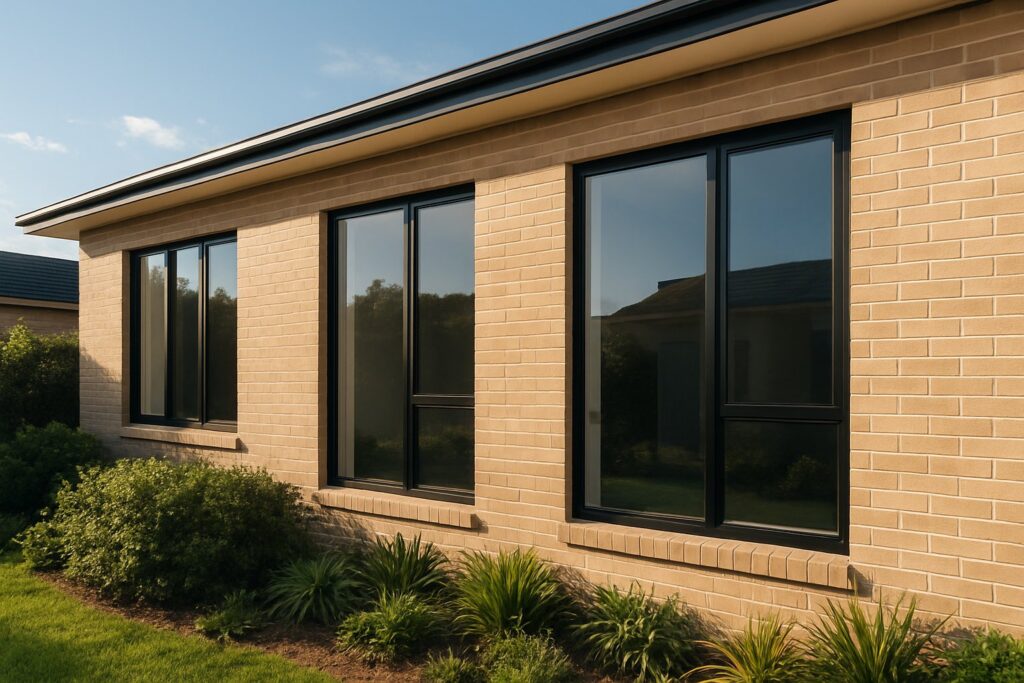
What Are External Aluminium Window Shades
Most people think of blinds and curtains when they hear “window shading.” Those sit inside. External aluminium window shades take a fundamentally different approach — they stop solar radiation at the outer face of the building, before it ever touches glass.
External aluminium window shades are shading devices mounted on the exterior of a building’s windows, constructed from aluminium slats, panels, or louvres, and engineered to block solar radiation before it passes through the glazing into interior spaces.
Defining External Aluminium Window Shades
The critical distinction between these systems and interior treatments comes down to where heat interception happens. Interior blinds and curtains can only reflect or absorb light that has already passed through glass — by that point, a significant portion of solar energy has already converted to heat inside the building envelope. Aluminium window shades installed externally intercept that radiation at the source, keeping heat outside where it belongs.
Aluminium dominates exterior shading for good reason. At roughly 2,680 kg/m³, it is light enough to mount on facade framing without imposing heavy structural loads. It resists corrosion naturally, and when finished with powder coating or anodising, it handles years of direct UV exposure, wind, rain, and thermal cycling without warping, softening, or degrading. Dimensional stability matters here — exterior-mounted components face constant thermal expansion and contraction cycles that would distort lesser materials over time. And at end of life, aluminium is 100% recyclable without loss of material properties, supporting circular construction goals.
These properties explain why the aluminum sunshade has become the default choice for architects and builders specifying external shading — whether as fixed louvres on commercial towers, retractable systems on residential facades, or metal awnings over shopfronts and heritage buildings. An aluminum shade system built from quality alloy and properly finished will outlast fabric, timber, and PVC alternatives by a wide margin in exposed outdoor conditions.
Where External Aluminium Shades Are Used
The scope of application is broad. Residential homes use aluminium window shades to reduce cooling loads on west-facing bedrooms and living areas. Commercial facades integrate aluminum sunshades as architectural features that double as energy performance elements — contributing to NCC Section J compliance and Green Star ratings. Institutional buildings like schools and hospitals specify them for occupant comfort and long-term durability with minimal maintenance overhead.
Whether the project is a single-storey home in coastal Queensland or a multi-storey office in Melbourne’s CBD, external aluminium shading systems offer a solution tailored to the building’s orientation, climate, and design intent. The variety of available types — from fixed metal awnings to motorised louvre systems — means there is rarely a project that cannot benefit from some form of external aluminium shade.
This guide covers every angle: the physics behind why external shading outperforms interior alternatives, a full typology of system types, material comparisons, climate matching, automation options, maintenance, and a structured buyer’s framework. Consider it a comprehensive resource to consult before browsing product catalogues.
Why External Shading Outperforms Interior Blinds
A pair of curtains might block glare, but they do surprisingly little about heat. The reason is simple physics — and understanding it explains why awnings for windows, louvre systems, and other external shading devices deliver dramatically better thermal performance than anything mounted inside.
How Solar Heat Gain Works Through Glass
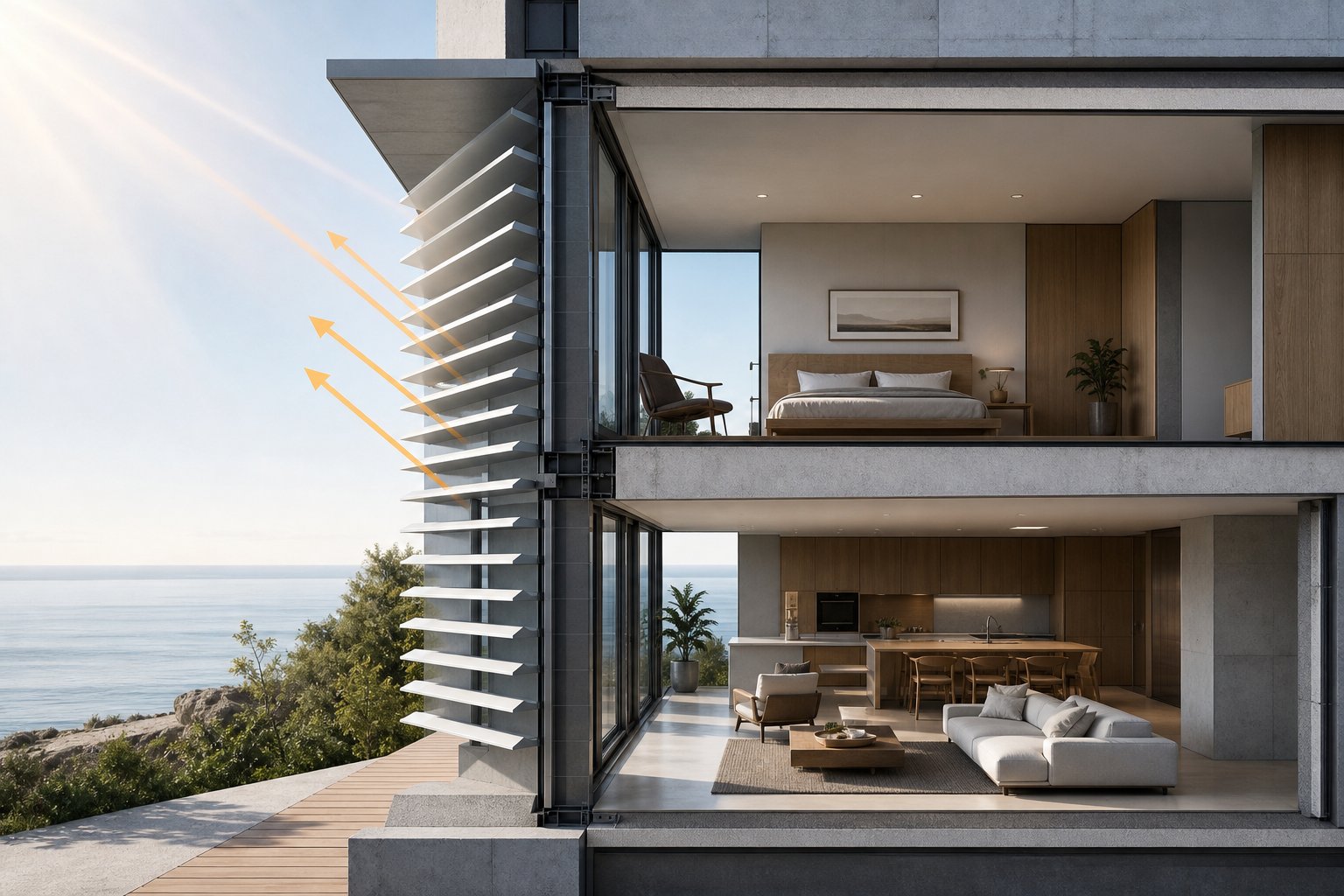
Sunlight arrives at a window as short-wave radiation. Glass is largely transparent to these wavelengths, so the energy passes straight through. Once it strikes interior surfaces — floors, furniture, walls — it converts into long-wave infrared radiation. Here is the problem: glass is not transparent to long-wave radiation. That converted heat energy becomes trapped inside the building, much like a greenhouse traps warmth for growing plants.
Interior blinds and curtains sit behind the glass. They can absorb or reflect some of the incoming light, but the solar radiation has already entered the building envelope. Research from BRANZ confirms that internal shading reduces heat gain by only a small amount because most absorbed heat simply re-radiates into the room. A drawn curtain might cut light, but it barely dents the thermal load.
External aluminium shades flip the equation entirely. By intercepting solar radiation before it contacts the glass, they prevent the greenhouse cycle from starting. The short-wave energy hits the aluminium slats or panels, reflects back into the atmosphere, and the residual absorbed heat dissipates outdoors through convection — never entering the interior. This is why a well-designed sun shade aluminum system positioned outside a window can block the vast majority of solar heat gain, while an interior blind of any quality cannot match that performance.
Impact on Cooling Loads and Energy Bills
Every watt of solar energy blocked outside is a watt your air conditioning system does not need to remove. Data from the U.S. Department of Energy shows that window awnings can reduce solar heat gain by up to 65% on south-facing windows and 77% on west-facing windows (equivalent to north-facing and west-facing in the Southern Hemisphere). For Australian homes, west-facing and north-facing glazing cop the worst punishment — low sun angles drive radiation deep into rooms, and these orientations benefit most from aluminum awnings for windows or adjustable louvre systems.
The window eaves or shading devices you choose have a direct relationship with cooling energy demand. Less heat entering through glass means shorter compressor run times, lower peak electricity loads, and reduced wear on HVAC equipment. In regions like western Sydney, Brisbane, or Perth where summer temperatures regularly push past 35°C, the cumulative savings over a cooling season are substantial.
An aluminum sun shade mounted externally does not just improve comfort — it shifts the entire energy balance of a room. Occupants seated near shaded windows experience fewer hot spots and less radiant heat discomfort, reducing the temptation to overcool the entire space just to make perimeter zones tolerable.
- Heat blocked before glass contact — solar radiation is reflected and dissipated outdoors, preventing the greenhouse effect inside
- Reduced UV damage to interiors — furnishings, flooring, and artwork are shielded from the wavelengths that cause fading and degradation
- Lower cooling energy consumption — air conditioning systems work less to maintain comfortable temperatures, cutting electricity bills
- Improved occupant comfort near windows — radiant heat and glare are eliminated at the source, making perimeter zones as comfortable as the centre of the room
The performance gap between external and internal shading is not marginal — it is fundamental. Interior treatments manage symptoms; exterior aluminium systems eliminate the cause. That distinction matters most when selecting the right type of shading system for a specific building, orientation, and climate zone.
Every Type of External Aluminium Shade Explained
Knowing that external shading outperforms interior treatments is one thing. Choosing the right system type is another challenge entirely — and it depends on whether your priority is precise light control, architectural statement, weather protection, or all three. Here is a full breakdown of the main categories of metal window awnings and shading systems available for Australian projects.
Venetian Blinds and Louvred Systems
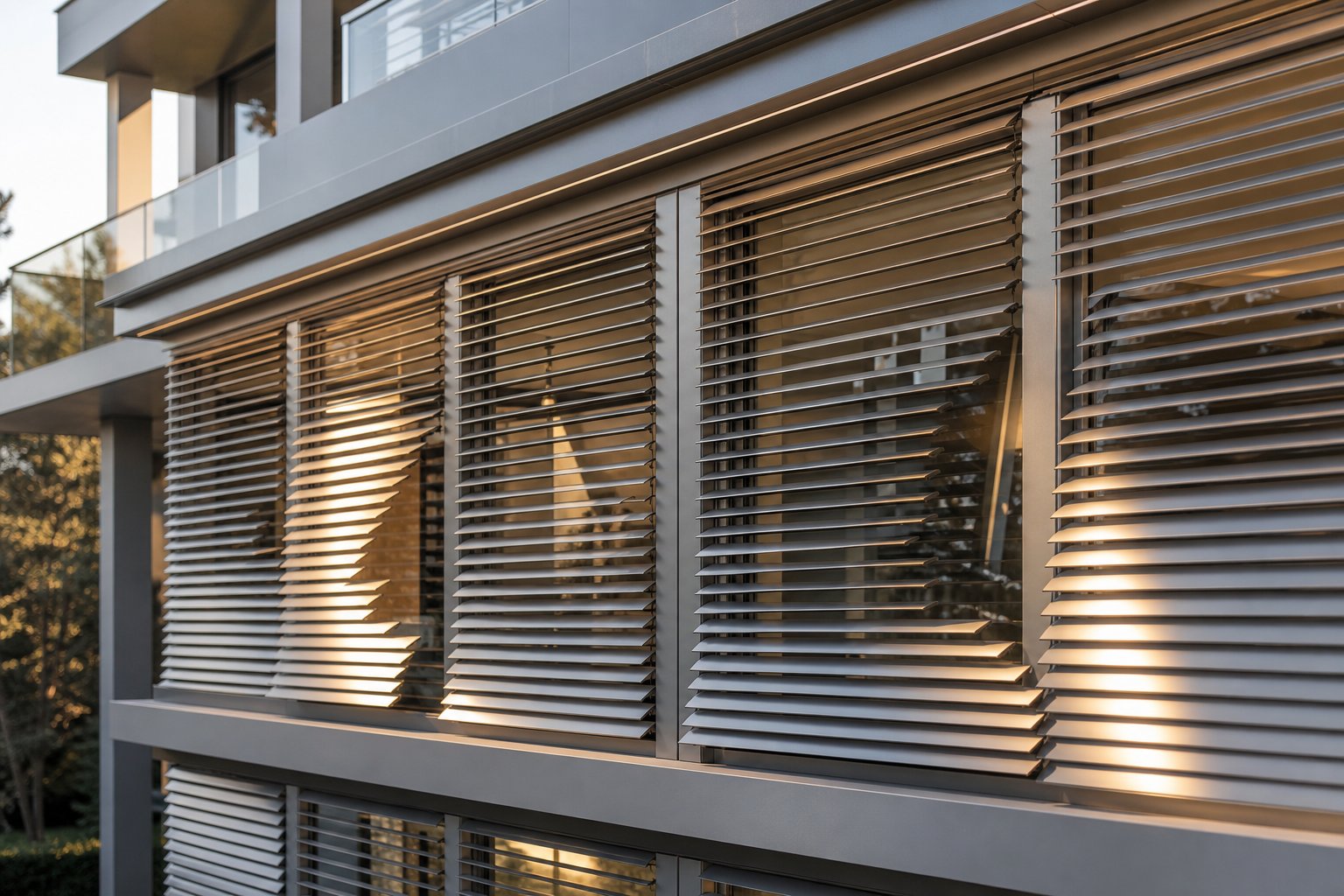
External venetian blinds work on the same principle as their interior cousins, but they are engineered to withstand outdoor conditions. Horizontal aluminium slats tilt to control the angle at which light enters a room — from fully open (maximum daylight and airflow) to fully closed (near-complete blackout). Slat profiles come in rounded (S or C) and angular (Z) shapes, with C-type slats offering up to 180° of tilt and S or Z shapes managing around 90°. Systems can span up to 5 metres wide and 5 metres in drop, making them suitable for large glazed areas on commercial facades.
Fixed louvre systems — both horizontal and vertical — take a different approach. Rather than adjustable slats on a cord mechanism, they use permanently angled aluminium blades set at calculated angles based on sun path data. Vertical louvres are common on east and west elevations where the sun strikes at low angles. These aluminium louvred systems offer the most precise, maintenance-free light control because there are no moving parts to service.
Fixed Awnings and Canopies
The fixed aluminium awning is a staple of Australian streetscapes and residential builds alike. These aluminum window awnings project outward above the window head, casting a shadow zone that blocks high-angle summer sun while still admitting lower winter sun. Profile options include flat-panel designs for a clean contemporary look, concave curves that add depth, and convex shapes that shed water efficiently.
For heritage homes, Queenslanders, or farmhouse-style builds, corrugated iron awnings deliver the right visual character. A corrugated steel awning or sheet metal awning replicates the proportions of traditional verandah roofing and pairs naturally with weatherboard or rendered facades. These fixed systems are the simplest to install — no moving parts, no motors, and virtually no ongoing maintenance beyond occasional cleaning.
Roller Shades and Retractable Systems
External roller shades use interlocking aluminium slats — either perforated for filtered light or solid for full blackout — that coil into a compact head box when retracted. They are ideal where shading is needed only part of the day or seasonally. Width is typically limited to around 3 metres per unit, and pairing with wind sensors is strongly recommended since extended slats can catch gusts if left deployed during storms.
Retractable folding-arm awnings offer another option: they extend outward from the wall to shade a window or outdoor area and fold flat against the facade when not in use. These suit variable climates where occupants want full sun access in winter and deep shade in summer.
| Attribute | External Venetian / Louvres | Fixed Awnings & Canopies | Roller Shades | Retractable Systems |
|---|---|---|---|---|
| Light control precision | Excellent — infinitely adjustable tilt | Moderate — fixed shadow angle | Good — open or closed (perforated options filter light) | Good — deploy or retract as needed |
| Weather protection | Moderate — slats allow wind through but need retraction in storms | High — permanently mounted, no mechanical vulnerability | Moderate — must retract in high winds | Moderate — must retract in high winds |
| Aesthetic style | Modern / commercial | Traditional or modern depending on profile | Clean, minimal, modern | Modern residential / hospitality |
| Ventilation | Excellent — air passes between tilted slats | Good — open sides allow airflow | Limited when fully deployed | Good — open underside allows circulation |
| Installation complexity | Moderate to high (brackets, guides, controls) | Low (fixed brackets only) | Moderate (head box, guides, motor) | Moderate (arm mechanism, wall plate) |
Each system type suits a different combination of priorities. A metal window awning with a fixed profile is the no-fuss choice for straightforward heat rejection on a budget. Louvred aluminium systems reward those who want granular, real-time light management. Retractable and roller options suit homeowners who value flexibility and clean facade lines when shading is not needed. The right choice often depends less on the product itself and more on the material it is made from — and how that material performs against the alternatives over ten, twenty, or thirty years of outdoor exposure.
Aluminium vs Wood vs PVC vs Fabric for External Shading
Longevity separates a good investment from a costly mistake — and material choice is the single biggest factor determining how long any external shade system lasts. Aluminium dominates the market for metal awnings for windows, but it competes against timber, PVC, fabric, and composite alternatives. Each has a place, though not all perform equally when bolted to the outside of a building and left to face Australian weather year after year.
Aluminium Compared to Wood and Timber
Timber shading has visual warmth that appeals to many homeowners, particularly on heritage or Hamptons-style builds. But exterior-mounted timber faces a hostile environment. Moisture infiltration causes rot. Termites target untreated softwoods. UV exposure greys and cracks unfinished surfaces within a single season. Real-world performance data shows that wood structures require repainting, resealing, or staining every two to four years to maintain weather resistance — a cycle that compounds in both cost and effort over the life of the installation.
Weight is another consideration. Hardwood timbers commonly used for awnings weigh roughly three to four times more than equivalent aluminium sections, imposing greater structural loads on facade framing and requiring heavier brackets. Over a 20-year period, cumulative maintenance on timber window awnings metal — sanding, priming, painting, treating for pests — often exceeds the original installation cost. Aluminium, by contrast, arrives powder-coated in any colour and requires nothing beyond occasional washing to maintain its finish for decades.
Aluminium vs PVC, Fabric, and Composite
PVC shading components cost less upfront, but UV radiation degrades them over time. After several years of Australian sun exposure, PVC becomes brittle, discolours, and loses structural integrity. Colour options are limited, and PVC softens at high temperatures — a real concern for west-facing applications in Perth, Darwin, or western Sydney where surface temperatures climb aggressively on summer afternoons.
Fabric awnings — canvas, acrylic, or polyester — offer the lowest entry price and suit cafe-style aesthetics. Their lifespan is the trade-off. Industry data indicates canvas awnings last 8–12 years, while vinyl-coated fabrics push to 15–25 years under ideal conditions. In humid climates like coastal Queensland or northern NSW, mould growth shortens fabric life significantly. Wind vulnerability is the other major drawback: fabric cannot handle sustained gusts without risk of tearing or structural damage to the arm mechanism.
Composite materials (aluminium-timber hybrids, fibre-reinforced polymers) offer improved weather resistance over raw timber, but at a price premium that often exceeds pure aluminium systems. Availability in Australia remains limited compared to standard aluminium or awning steel products, and repair parts can be difficult to source.
Metal awnings — particularly aluminium — consistently deliver the best balance of durability, low weight, and minimal maintenance for exterior applications. Aluminium and steel awnings typically last 20–30 years, often only replaced due to physical impact damage rather than material degradation. That kind of service life, combined with full recyclability at end of use, explains why window metal awnings remain the professional specification of choice across residential, commercial, and institutional projects.
| Attribute | Aluminium | Wood / Timber | PVC | Fabric | Composite |
|---|---|---|---|---|---|
| Durability (years) | 20–30+ | 10–20 (with maintenance) | 10–15 | 8–15 | 15–25 |
| Weight | Low | High | Low–moderate | Very low | Moderate |
| Maintenance needs | Minimal — wash only | High — repaint/reseal every 2–4 years | Low initially, replacement when degraded | Moderate — cleaning, mould treatment, retension | Low–moderate |
| Indicative cost (AUD, supply only) | $$–$$$ | $$–$$$ | $–$$ | $–$$ | $$$–$$$$ |
| UV resistance | Excellent (powder-coated or anodised) | Poor without treatment | Moderate — degrades over time | Moderate — fading and weakening | Good |
| Wind rating suitability | High — rigid structure | High — rigid structure | Moderate | Low — vulnerable to gusts | High |
| Recyclability | 100% recyclable | Biodegradable but not recyclable as building product | Limited recycling pathways | Landfill in most cases | Difficult to separate materials |
The table tells a clear story without needing embellishment. Aluminium’s combination of lightweight rigidity, weather immunity, low ongoing costs, and environmental credentials makes it the natural fit for any shading system expected to perform reliably in exterior exposure. That performance advantage becomes even more pronounced when you factor in specific climate conditions — salt air, cyclone zones, extreme heat — where material weaknesses are exposed fastest.
Matching External Aluminium Shades to Your Climate
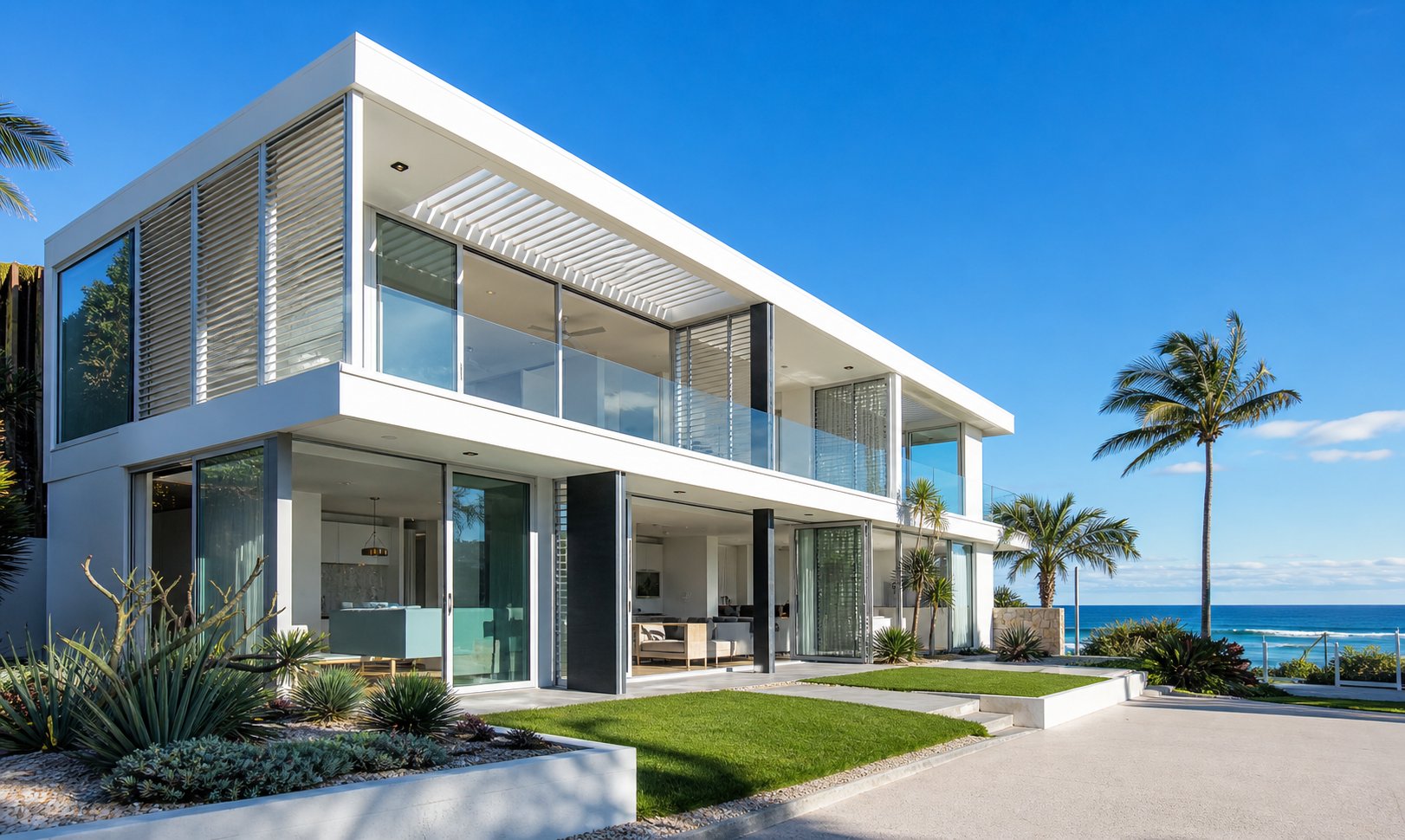
Australia stretches across multiple climate zones — from the tropical north to the temperate south, from salt-sprayed coastlines to arid inland plains. A shading system that thrives in suburban Melbourne may struggle on a beachfront in Cairns if the wrong finish or mounting approach is specified. Material strength alone is not enough; the combination of surface treatment, system type, and installation detail determines whether exterior metal window awnings perform for decades or deteriorate within a few years.
Coastal and Marine Environments
Living near the ocean means living with salt. Airborne chloride particles carried on sea breezes settle on every exterior surface, and when combined with persistent humidity, they become one of the most aggressive corrosive forces metals can face. Salt-laden air breaks down protective oxide layers on metals, traps moisture, and triggers electrochemical corrosion — a process that accelerates dramatically at joints, fastener points, and any spot where the protective finish has been scratched or chipped.
Raw aluminium naturally forms a thin oxide layer that offers some defence, but it is not sufficient for homes within a few hundred metres of the waterline. Two surface treatments raise the bar significantly:
Marine-grade powder coating involves a multi-layer process: chemical pre-treatment of the aluminium surface, application of a primer layer, then a durable polyester or fluoropolymer topcoat cured at high temperature. The result is a finish that resists salt spray, UV degradation, and impact far better than standard single-coat applications. When specifying for coastal projects, look for products that explicitly reference marine-grade pre-treatment — not just “powder coated” without further detail. Sealed edges and coated fastener holes matter as much as the visible surface.
Anodising takes a different approach, converting the aluminium surface itself into a hard aluminium oxide layer through an electrolytic process. Anodisation thickness is measured in microns — typically 15 to 25 microns for architectural applications. A 25-micron anodised finish provides exceptional scratch resistance and salt-air durability because the protective layer is integral to the metal rather than applied on top. For outside window metal awnings in coastal Queensland, the NSW coast, or anywhere within the salt zone defined by AS 2312, anodising at 20 microns or above is a reliable specification benchmark.
Fastener selection deserves equal attention. Galvanic corrosion occurs when dissimilar metals come into contact in the presence of salt-contaminated moisture — one metal sacrifices electrons to the other, corroding rapidly at the junction. This is why stainless steel bracket screws driven into an aluminium shade frame can cause localised pitting if isolating washers or compatible 316-grade stainless fixings are not used. Specifying marine-grade stainless steel fasteners and isolating spacers where metals meet is a small cost that prevents premature failure at the most vulnerable points of any outdoor window awnings metal installation.
Hot-Dry, Humid, and Wind-Prone Climates
Coastal salt is not the only environmental stress Australian buildings face. Each major climate type imposes its own demands on aluminum sun shades — and understanding those demands helps narrow the field to the right system and finish combination.
Intense heat and UV exposure. In hot-dry regions like inland Western Australia, central Queensland, or western NSW, surface temperatures on dark-coloured exteriors can exceed 80°C on a still afternoon. PVC softens and distorts at these temperatures. Fabric awnings fade and weaken under relentless UV bombardment. Aluminium profiles remain dimensionally stable regardless of heat — they do not warp, expand excessively, or soften. Powder-coated finishes in lighter colours (whites, creams, light greys) reflect rather than absorb solar energy, keeping the shade structure itself cooler and further reducing radiant heat transfer to the window beneath.
Humid tropical conditions. From Darwin across the Top End and down through coastal Queensland, humidity levels sit above 70% for months at a time. Fabric shading materials become breeding grounds for mould and mildew in these conditions, requiring regular chemical treatment or replacement. Timber swells, contracts, and eventually rots without constant attention. Aluminium does not absorb moisture at all — its non-porous surface simply sheds water and resists biological growth. For tropical projects, the main consideration is ensuring drainage channels in awning-style systems remain clear, so pooled water does not sit against the building facade.
Wind-prone and cyclone regions. Northern Australia falls within cyclone-prone zones where design wind speeds can exceed 250 km/h in severe events. Wind-load ratings for exterior shading products define the maximum sustained and gust speeds a system can safely withstand without structural failure. Fixed systems — permanent louvres, bolted awnings, and rigid canopies — handle high winds far better than retractable or operable systems, which must be stowed before storms arrive. Motorised blinds paired with anemometer sensors can retract automatically when wind speeds exceed a set threshold (commonly 8 to 10 m/s for standard products, or approximately 30 to 36 km/h), but this only protects against moderate gusts, not cyclone-force events.
For homes in cyclone-rated regions of QLD, WA, or the NT, fixed aluminium louvre systems or heavy-gauge fixed awnings engineered to comply with AS 1170.2 (wind actions) are the appropriate choice. Retractable systems can still be used, but they should be treated as fair-weather shading — not as permanent structural elements.
- High-wind zones — specify fixed louvre systems or permanently mounted aluminium awnings engineered for the site-specific design wind speed
- Variable climates — retractable venetian blinds with motorised wind sensors offer flexibility, providing shade when needed and stowing safely when conditions change
- Extreme sun angles in tropical regions — deep-profile awnings or wide-blade horizontal louvres block the near-vertical midday sun that shallow overhangs cannot reach
- Coastal properties — anodised finishes at 20 microns or above, combined with marine-grade stainless steel fixings and isolating washers, protect against salt-air corrosion
- Hot-dry inland areas — lighter-coloured powder-coated aluminum sun shades reduce heat absorption and maintain finish integrity under intense UV exposure
Climate is not a detail to address after selecting a shade system — it is the starting point that determines which system type, finish grade, and mounting strategy will actually deliver lasting performance. Getting this decision right at the specification stage avoids costly replacements down the track. The next layer of that decision involves how the chosen system will be controlled — manually, by motor, or through fully automated smart-home integration — and how each control tier affects both daily convenience and long-term energy savings.
From Manual Crank to Smart Home Automation
A perfectly specified aluminium louvre system means little if it sits in the wrong position all afternoon. Control technology determines whether your shading responds to changing sun angles in real time or stays put until someone remembers to adjust it. The gap between those two scenarios — in energy savings, convenience, and system longevity — is larger than most people expect.
Manual, Motorised, and Sensor-Driven Controls
Three distinct tiers exist, each suited to different budgets and project priorities.
Manual operation remains the most affordable entry point. Hand cranks, pull cords, or geared winder mechanisms give direct physical control over slat angle or retraction. No wiring, no programming, no battery changes. For a single window with a fixed daily routine — a bedroom that only needs shading in the afternoon, for instance — manual systems deliver reliable performance at the lowest cost. The trade-off is obvious: they depend entirely on the occupant being present and motivated to adjust them.
Motorised systems add electric or battery-powered drive units controlled via remote, wall switch, or both. A tubular motor housed within the headbox or guide channel tilts aluminum sun shade louvers or rolls a shade up and down at the push of a button. Installation requires either mains wiring to the motor location or a rechargeable battery pack. The convenience gain is immediate — no physical effort, no reaching awkward window positions — but the system still relies on someone deciding when to operate it.
Sensor-automated systems remove human decision-making from the equation entirely. Climate sensors — wind, sun intensity, and rain — trigger automatic responses that protect both the shading hardware and the building’s thermal performance. A wind sensor retracts custom aluminum sunshades before gusts cause structural damage. A sun sensor deploys shading when radiation exceeds a set threshold. A rain sensor stows fabric or perforated systems that would trap moisture. These sensors communicate wirelessly with the motor controller, adjusting shading position without any occupant input.
The protective benefit matters as much as the comfort gain. An awning left extended during a strong gust can sustain structural damage — automated retraction at a preset wind speed (typically 30–36 km/h for standard residential systems) eliminates that risk entirely.
Smart Home Integration and Automated Sun Tracking
Beyond standalone sensors, modern aluminum louvered shading systems integrate into broader smart home ecosystems. Compatibility with protocols like Wi-Fi, Matter, and Thread means external shades can participate in coordinated routines alongside lighting, HVAC, and security systems.
Smartphone apps provide granular control from anywhere — adjust aluminum sunshade louvers from the office, check system status while travelling, or set schedules that shift with sunrise and sunset times throughout the year. Voice assistant integration through Alexa, Google Home, or Siri adds hands-free operation for quick adjustments without reaching for a phone or remote.
The highest tier involves automated sun-tracking algorithms. These systems calculate the sun’s azimuth and elevation for the building’s exact GPS coordinates and orientation, then continuously adjust louvre angles to maintain optimal shading throughout the day. Rather than a binary open-or-closed response, sun-tracking delivers precise blade angles that block direct radiation while maximising diffused daylight — reducing artificial lighting loads at the same time as rejecting heat.
Smart shading systems can reduce cooling loads by 15–25% compared to manually operated equivalents, simply because they respond in real time rather than relying on imperfect human timing. An occupant who forgets to close shading before leaving for work on a 38°C day forces the air conditioning to fight unshaded solar gain for hours. An automated system deploys the moment sun intensity warrants it — every day, without fail.
- Manual crank or cord — lowest cost, no power required, fully occupant-dependent
- Motorised with remote control — push-button convenience, requires wiring or battery
- Motorised with wall timer — basic scheduling for daily routines, no sensor input
- Smart-home integrated with app control — remote access, voice commands, scene automation, and seasonal scheduling
- Fully automated with sun, wind, and rain sensors — real-time environmental response, maximum energy savings, and hardware protection without human intervention
Budget naturally scales with capability. A manual crank adds negligible cost to the shade system itself. A quality tubular motor adds $200–$500 AUD per opening depending on size and torque requirements. Full automation with sensor suite and smart-home integration typically adds $500–$1,200 AUD per zone — but the energy savings, hardware protection, and set-and-forget convenience mean this tier often delivers the fastest payback on buildings with significant glazing exposure. The real question is not whether automation pays off, but how long the system needs to last before that investment matters — which brings maintenance and long-term care into sharp focus.
Maintenance and Long-Term Care for Metal House Awnings
Aluminium shading systems earn their reputation for low maintenance — but low is not zero. A metal awning over window glass sits exposed to every weather event the building faces, and small oversights compound into costly repairs if ignored long enough. The good news: a simple routine keeps these systems performing and looking sharp for decades.
Cleaning Methods and Frequency
Dirt, pollen, salt residue, and bird droppings build up on any exterior surface over time. Left to accumulate, these contaminants can trap moisture against the powder-coat finish and eventually degrade it. The cleaning approach for external aluminium shades is deliberately gentle — a standard garden hose with a regular nozzle and a bucket of warm water mixed with mild liquid detergent handles most situations effectively.
Use a soft microfibre cloth or non-abrasive sponge to wipe down slats, panels, or louvre blades. Work in a downward motion so dirty runoff drains away rather than pooling in joints or channels. Rinse thoroughly to remove all soap residue, then dry with a soft cloth to prevent water spotting — particularly on darker powder-coat colours where spots show more visibly.
What to avoid matters just as much as what to use. Pressure washers can damage powder-coat finishes — their concentrated stream strips or dents the protective layer. Steel wool, Scotch-Brite pads, and any abrasive cleaning tool will scratch the surface. Chemical cleaners containing solvents or petroleum-based compounds react with powder coatings and should never be applied. A reliable rule of thumb: if the product requires protective gloves to handle, it is too aggressive for your aluminium shading.
Cleaning frequency depends on location:
- Coastal properties (within 1 km of the waterline) — monthly washing to remove salt deposits before they concentrate and attack the finish
- Suburban and urban settings — quarterly cleaning is sufficient for most environments
- Properties near trees or bushland — clean after heavy pollen seasons and remove sap or organic debris promptly
- Inland rural areas with low pollution — biannual washing typically maintains appearance and finish integrity
Timing matters too — clean when the shading is in shade rather than direct sun. Soapy water evaporating rapidly on hot metal leaves residue and can cause uneven results. Early morning or late afternoon works well in Australian conditions, and never attempt cleaning during freezing conditions if you happen to be in alpine regions.
Corrosion Prevention and Finish Maintenance
Aluminium itself does not rust, but it can corrode — particularly at points where dissimilar metals meet. Galvanic corrosion occurs when aluminium contacts steel or other dissimilar metals in the presence of moisture, creating an electrochemical reaction that pits the aluminium at the junction. Fastener points, bracket connections, and any location where house metal awnings attach to steel structural elements are the spots to watch.
During routine inspections, look for white powdery deposits around screw heads and bracket bases — this aluminium oxide buildup is an early sign of galvanic activity. If spotted early, the fix is straightforward: remove the affected fastener, clean the area, apply an isolating coating or install a nylon washer to separate the metals, and replace with a compatible marine-grade 316 stainless steel fixing. Left unchecked, the pitting deepens and can eventually compromise the structural attachment point.
Powder-coat finishes degrade gradually through a process called chalking — a fine powdery residue forms on the surface as the topcoat breaks down under prolonged UV exposure. Minor chalking after ten or more years is normal and does not mean the finish has failed. It can be managed by gentle cleaning and, if desired, application of a clear protective wax designed for powder-coated surfaces. Deep scratches or chips that expose bare aluminium should be touched up promptly using manufacturer-matched touch-up paint to prevent localised corrosion — particularly critical for old fashioned metal awnings on heritage properties where replacement profiles may be difficult to source.
When does a full recoat become necessary? For quality powder-coated systems installed with proper pre-treatment, expect 15 to 25 years of service before the finish needs professional attention. Anodised surfaces last even longer — often the life of the building — because the protective layer is part of the metal rather than applied on top. A well-maintained metal awning over window openings should comfortably deliver 20 to 30 years of service, far exceeding the 8–15 year lifespan of fabric alternatives or the constant upkeep cycle of timber.
Use this seasonal checklist to keep your system in top condition:
- Inspect fasteners and brackets — check for loosening due to thermal cycling and retighten as needed; look for signs of galvanic corrosion at dissimilar metal junctions
- Check for finish damage or chalking — address scratches and chips with touch-up paint before moisture penetrates to bare aluminium
- Clean slats or panels — wash with mild detergent and water, rinse thoroughly, and dry to prevent water spotting
- Lubricate moving parts on operable systems — apply a light silicone-based lubricant to pivot points, tilt mechanisms, and guide channels on venetian or roller systems
- Test motorised controls and sensors — verify that wind sensors trigger retraction correctly, sun sensors activate deployment, and motor operation is smooth without grinding or hesitation
- Clear drainage channels on awning styles — remove leaves, debris, and organic matter from gutters and channels to prevent water pooling against the building facade
This twice-yearly routine takes less than an hour for most residential installations. It is a fraction of the effort required to sand, prime, and repaint timber awnings — and it protects an asset that, with minimal attention, outlasts nearly every other exterior shading material on the market. That longevity makes the upfront investment easier to justify, though knowing exactly what to specify and budget for before purchasing still requires careful planning.
Essential Buyer’s Guide for External Aluminium Shades
Knowing what works and how to care for it is half the equation. The other half is deciding what to buy — and that decision involves more variables than most product catalogues reveal. Shade type, slat geometry, finish, control mechanism, sizing method, and installation approach all intersect, and getting one wrong can undermine the rest. This framework walks through each decision point so you can approach suppliers with clarity rather than confusion.
Before selecting any shade type, assess the orientation of every window you plan to shade. North-facing glass needs different coverage angles than west-facing glass, east-facing openings face low morning sun, and south-facing windows in tropical Australia receive direct summer sun that temperate-zone homes never encounter. Orientation dictates shade depth, slat angle, and system type — choose the window first, then choose the shade.
Shade Type and Slat Size Selection
Start by identifying your primary goal for each window. Privacy? Adjustable louvres or venetian systems with tight slat spacing block sightlines while still admitting diffused light. Maximum heat rejection? A fixed aluminum window awning with a deep projection catches the widest angle range of direct sun. Architectural statement? Decorative metal window awnings with custom blade profiles or perforated panels transform a functional element into a facade feature. Light control granularity? External venetians with narrow slats offer the finest adjustment.
Slat width directly affects both performance and appearance. Narrower blades (50–60 mm) provide more precise tilt control and a refined, contemporary look — they suit modern residential facades where clean lines matter. Wider blades (80–100 mm) cast deeper shadows per slat, meaning fewer blades are needed per opening. They read as bolder architectural elements and are common on commercial buildings. For a window metal cover that prioritises full blackout when closed, wider slats with interlocking profiles eliminate light gaps more effectively than narrow alternatives.
Colour, Finish, and Sizing Considerations
Colour choice is not purely aesthetic — darker colours absorb significantly more UV radiation and heat, leading to faster chalking and fade over time, while lighter colours reflect solar energy and hold their appearance longer in direct sun exposure. For a metal awning for windows on a west-facing elevation baking in afternoon sun, whites, creams, or light greys are functionally smarter choices. Save charcoal, black, and deep bronze for shaded or south-facing installations where UV intensity is lower.
Powder coating offers hundreds of colour options from standard RAL and Dulux charts, with custom matching available. Anodised finishes provide a harder surface with a metallic sheen that some contemporary metal window awnings use to complement natural-finish aluminium window frames. Always request a physical colour sample and view it against your facade materials in actual daylight conditions — screen colours are unreliable for final selection.
Sizing requires precision. External shading must extend past the window edges by at least 100–150 mm on each side to prevent sun creeping around the margins at oblique angles. Measure the structural opening (not just the glass) and confirm head height clearance above the window for headbox or bracket mounting. Standard sizes suit common opening dimensions and keep costs lower, but Australian homes — particularly renovations and period properties — frequently have non-standard window sizes. Custom fabrication adds 20–40% to the cost but ensures complete coverage and a flush, intentional appearance. For aluminum window covers on irregularly shaped openings or grouped window assemblies, custom is almost always the better path.
Control Mechanisms and Budget Planning
Your choice between manual, motorised, and automated operation is where budgets diverge most dramatically. A manual system adds negligible cost to the shade hardware itself, while motorised options typically add $200–$500 AUD per window and full automation with sensors pushes the addition to $500–$1,200 AUD per zone. But upfront price tells only part of the story.
Total cost of ownership includes installation labour, electrical wiring or battery replacement cycles, periodic sensor calibration, and the energy savings that automated systems generate over their lifespan. A motorised system on a large west-facing window that responds automatically to sun intensity may recover its premium within three to five years through reduced cooling costs — particularly in climate zones where air conditioning runs heavily from October through March. Manual systems cost less to install but deliver no energy savings beyond what the occupant remembers to activate.
| Decision Category | Options Available | Key Trade-off | Budget Impact |
|---|---|---|---|
| Shade type | Fixed awning, venetian louvre, roller shade, retractable arm | Simplicity and weather resistance vs. adjustability and light control | Fixed systems lowest; motorised louvres highest |
| Slat size | 50–60 mm (narrow), 80–100 mm (wide), solid panel | Finer light control vs. bolder aesthetic and fewer components | Narrow slats require more blades per opening — moderate cost increase |
| Material finish | Standard powder coat, premium powder coat, anodised (15–25 micron) | Cost vs. longevity and corrosion resistance in harsh environments | Standard lowest; marine-grade anodising adds 30–50% to finish cost |
| Control mechanism | Manual crank, motorised remote, smart-home automated with sensors | Low upfront cost vs. energy savings and hardware protection over time | Manual near-zero addition; full automation $500–$1,200 AUD per zone |
| Installation method | DIY (fixed awnings), professional (motorised/automated systems) | Cost saving vs. warranty validity, wiring safety, and correct calibration | DIY saves $150–$400 per opening; professional ensures compliance |
One pattern emerges from this framework: the decisions that save the most money long-term — automation, quality finishes, custom sizing — cost more upfront. Treating external shading as a building performance investment rather than an accessory purchase shifts the calculus. A well-specified system pays dividends through lower energy bills, reduced HVAC wear, and a maintenance burden measured in minutes per year rather than weekends per season. The final piece of the puzzle is ensuring the shade system and the window it protects are designed to work together — a coordination step that is easiest during the build or renovation phase and far more limiting as a retrofit afterthought.
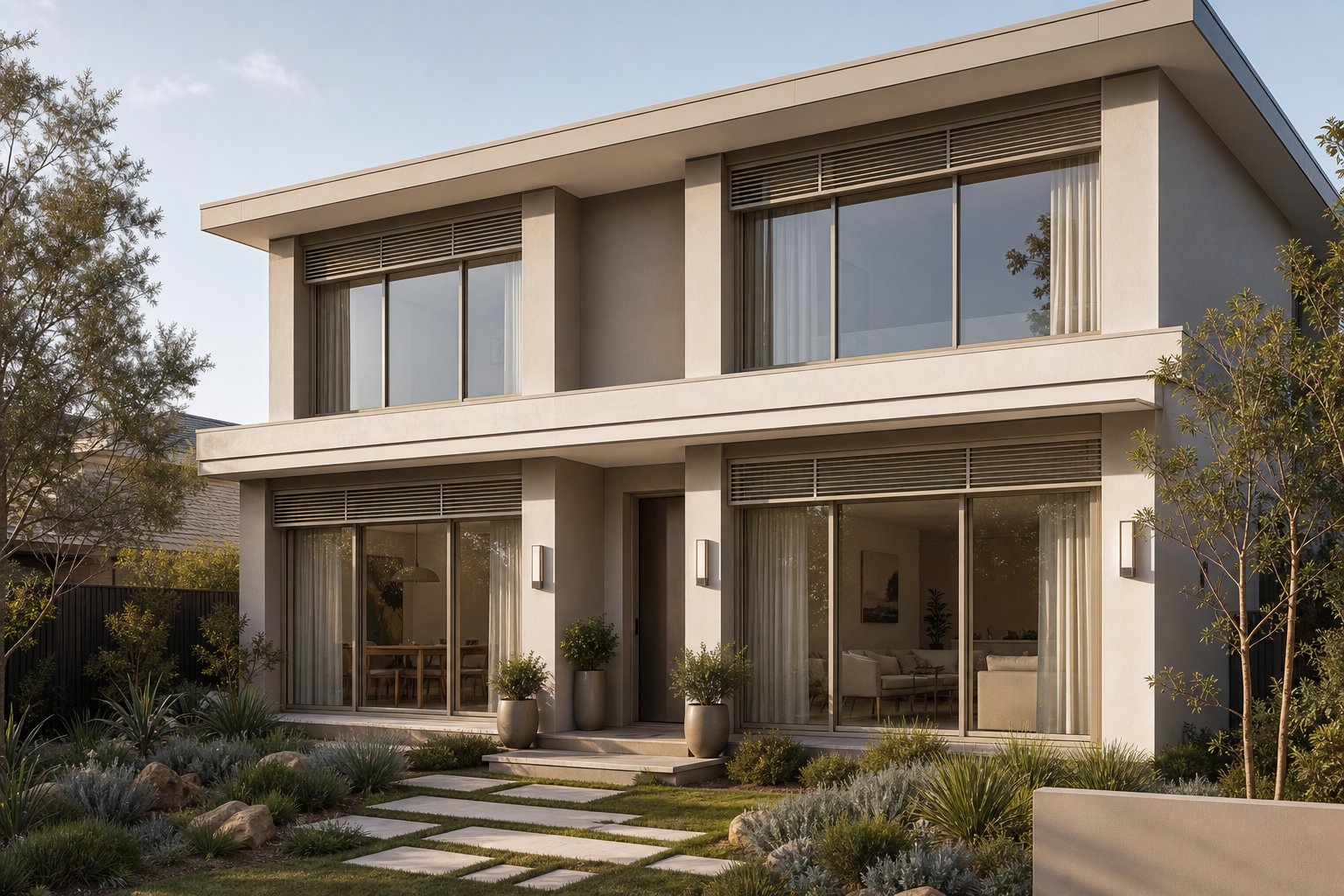
Pairing External Shades With the Right Aluminium Window Systems
An external shading system does not exist in isolation — it bolts to something. The window frame beneath it, the wall construction around it, and the structural fixings between them all determine whether the installation looks intentional and performs reliably, or feels like an afterthought fighting against the building it is attached to.
Why Window Frame Design Matters for External Shade Mounting
Every external shade system transfers load back to the building through brackets, angles, or headbox fixings. That load path depends on what sits at the point of attachment. A window awning frame built from aluminium provides a rigid, dimensionally stable substrate that accepts mechanical fasteners without splitting, swelling, or degrading over time. Timber frames can compress under bracket pressure or rot where moisture infiltrates around fixings. PVC frames lack the screw-holding strength for heavier motorised systems.
Aluminium awning windows offer a natural compatibility advantage here. Because the shade hardware and the window frame share the same base material, their thermal expansion rates match — both grow and shrink at the same rate through seasonal temperature swings. This eliminates the micro-movement and bracket fatigue that occurs when dissimilar materials cycle at different rates over years of service. It also removes galvanic corrosion risk at the connection point, since no dissimilar metal interface exists to trigger electrochemical degradation.
Head clearance is another practical factor. Retractable systems need space above the window for their headbox or roller mechanism. An aluminum clad awning window with a recessed head detail can accommodate this neatly, while frames with bulky external flashings may require spacer brackets that push the shade further from the glass — reducing shading effectiveness at acute sun angles.
Coordinating Shading Systems With Your Window Specification
Builders, architects, and homeowners planning new builds or major renovations gain a significant advantage by specifying windows and external shading together rather than treating them as separate purchases. When both elements are designed in parallel, the window head height, reveal depth, frame profile, and colour can all be coordinated to create a seamless visual result and an efficient structural connection.
Retrofitting shade systems onto existing awning aluminium windows is certainly possible, but it introduces constraints. Existing frame depths may not suit certain bracket types. Colour matching against a weathered finish can be imperfect. And structural assessment of the existing lintel or wall framing may be needed to confirm it can carry the additional dead load of a motorised system plus wind loading.
For Australian residential and commercial projects where integrated design matters most, exploring aluminium window systems that are engineered for compatibility with external shading is a practical starting point. MEICHEN’s aluminium window range offers a resource worth consulting — covering window types, custom sizing, colour coordination across standard and premium powder-coat palettes, and performance specifications relevant to pairing aluminium awning windows with external shade hardware. When the window and shade share a design language from the outset, the result reads as architecture rather than addition.
Treating the window-shade interface as a single coordinated system — rather than two independent product selections — delivers better thermal performance, cleaner aesthetics, and a connection detail that holds up structurally for the full service life of both components.
Frequently Asked Questions About External Aluminium Window Shades
1. How much more effective are external aluminium window shades compared to interior blinds?
External aluminium shades intercept solar radiation before it passes through glass, preventing the greenhouse effect that traps heat indoors. According to U.S. Department of Energy data, exterior window shading can reduce solar heat gain by up to 65-77% depending on orientation. Interior blinds only manage light that has already entered the building envelope, meaning most absorbed heat simply re-radiates into the room. The performance difference is not incremental — it is a fundamentally different approach to thermal management that directly reduces air conditioning demand and energy bills throughout summer.
2. What type of external aluminium shade is best for high-wind or cyclone-prone areas in Australia?
Fixed aluminium louvre systems or permanently mounted heavy-gauge awnings engineered to comply with AS 1170.2 (wind actions) are the safest choice for cyclone-rated regions in QLD, WA, or the NT. These rigid structures have no moving parts vulnerable to storm damage. Retractable or motorised systems can still be used in wind-prone areas, but they should incorporate anemometer sensors that automatically retract the shading when wind speeds exceed approximately 30-36 km/h. Treat retractable systems as fair-weather shading rather than permanent structural elements in high-wind zones.
3. How long do external aluminium window shades last and what maintenance do they need?
Quality powder-coated or anodised aluminium shading systems typically last 20-30 years, often only replaced due to physical impact rather than material degradation. Maintenance is minimal — wash with mild detergent and water quarterly in suburban settings or monthly in coastal locations to remove salt deposits. Inspect fasteners and brackets seasonally for signs of galvanic corrosion, lubricate moving parts on operable systems, and touch up any powder-coat scratches promptly. This routine takes under an hour for most residential installations and keeps systems performing at their best for decades.
4. Are automated external aluminium shades worth the extra cost over manual systems?
Automated systems with sun, wind, and rain sensors typically add $500-$1,200 AUD per zone over manual alternatives. However, they can reduce cooling loads by 15-25% compared to manually operated equivalents because they respond to changing conditions in real time rather than relying on occupants to remember adjustments. They also protect the hardware by automatically retracting before damaging wind gusts arrive. For buildings with significant west or north-facing glazing in hot Australian climates, the energy savings and hardware protection often recover the premium within three to five years.
5. What finish should I choose for external aluminium shades in a coastal location?
For properties within a few hundred metres of the waterline, specify either marine-grade powder coating with multi-layer pre-treatment or anodising at 20 microns or above. Marine-grade powder coating involves chemical pre-treatment, a primer layer, and a durable polyester or fluoropolymer topcoat that resists salt spray and UV degradation. Anodising converts the aluminium surface into a hard protective oxide layer that is integral to the metal. Equally important is using 316-grade marine stainless steel fasteners with isolating washers to prevent galvanic corrosion where dissimilar metals meet in salt-contaminated moisture.
More Window & Door Guides