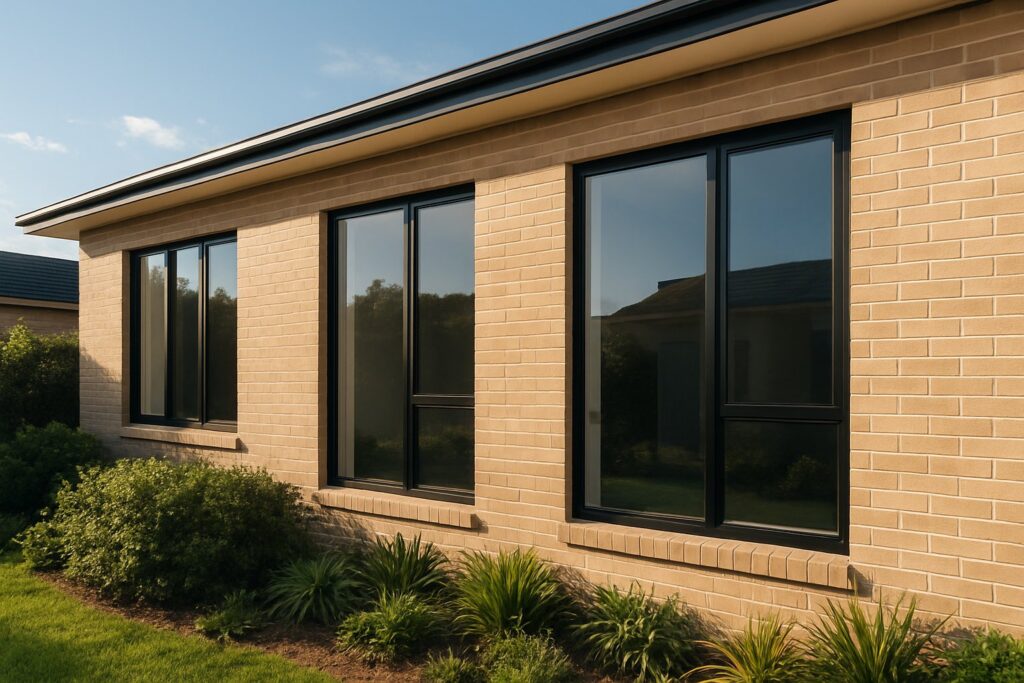
What Are Double Glazed Aluminium Frame Windows
Double glazed aluminium frame windows consist of two panes of glass separated by a sealed air or gas-filled cavity, housed within a structural aluminium frame system. The insulating gap — typically 12 mm to 16 mm wide — reduces heat transfer, noise transmission, and condensation compared to single-pane alternatives.
Definition and Core Components
Strip the system down and you have four essential parts working together: two glass panes, a sealed cavity filled with air or argon gas, a spacer bar that maintains the gap and keeps moisture out, and the aluminium frame that holds everything in place. Each element serves a specific thermal or structural purpose. Remove or downgrade one, and the whole unit underperforms.
Single glazing relies on a lone pane of glass — a poor insulator that lets heat pass through freely and does little to block outside noise. Double glazing interrupts that direct path by trapping a layer of low-conductivity gas between two panes, creating what the industry calls an Insulated Glass Unit (IGU).
Why Aluminium Paired With Double Glazing
Aluminium brings something other frame materials struggle to match: a strength-to-weight ratio that supports large glass panels without bulky profiles. Slimmer frames mean more glass area, more natural light, and cleaner sightlines — qualities that architects and homeowners increasingly demand. The material also resists corrosion, UV degradation, and the warping that affects timber or uPVC over decades of Australian sun exposure.
Paired with modern thermally broken profiles, aluminium frames no longer carry the old reputation of being “cold.” That pairing of structural performance and thermal engineering is why double glazed aluminium windows dominate both residential renovations and commercial projects across Australia.
Who Benefits Most From This Window System
Homeowners chasing energy savings, noise reduction, or bushfire compliance. Builders working to meet NCC Section J requirements without sacrificing design intent. Renovators replacing ageing single-glazed aluminium with a system that fits existing openings while dramatically lifting performance. This article walks through the decision from a buyer’s perspective — how the technology actually works, what the numbers mean, and where common myths quietly cost people thousands.
How the Integrated Window System Works
Focusing on the frame alone when choosing double glazed aluminium windows is like judging a car by its paint job. The frame matters, but it is one part of a tightly engineered system where glass, gas fill, spacer bar, and seals all interact to produce a single performance outcome. That outcome is measured as the Uw value — the whole-window thermal transmittance — and it can only be as strong as the weakest link in the chain.
Here is what each component actually does within the system:
- Glass panes — Control solar heat gain, light transmission, and acoustic insulation. Options range from standard float glass to Low-E coated, laminated, and toughened configurations.
- Gas fill — Occupies the sealed cavity between panes, reducing convection and conduction compared to plain air. Argon and krypton are the two common choices.
- Spacer bar — Maintains the precise gap between glass panes, houses desiccant to absorb residual moisture, and forms part of the perimeter seal. Material choice directly affects edge-of-glass heat loss.
- Primary and secondary seals — Lock the gas inside, block moisture infiltration, and bond the IGU into a single structural unit capable of lasting 20+ years.
- Aluminium frame — Provides structural support, weather protection, and the mounting interface to your wall. Thermal break quality determines how much heat bypasses the IGU through the frame itself.
- Hardware and compression seals — Ensure opening sashes close tightly against the frame, preventing air leakage that would undermine the entire assembly’s insulating performance.
Downgrade any single element and the Uw value climbs, energy bills rise, and comfort drops. That is why evaluating quotes on frame price alone leads to expensive mistakes.
Glass Pane Options and Their Role
The glass accounts for the largest surface area in any window, so its specification has an outsized effect on both thermal and acoustic performance. Standard 4 mm float glass is the baseline — adequate for many applications, but far from the only option.
Low-E (low emissivity) coatings are where the real gains happen. These microscopically thin metallic layers — often silver-based in softcoat variants — reflect radiant heat while still allowing visible light through. A quality Low-E coating on surface 2 or 3 of the IGU can cut radiant heat transfer by more than half, dramatically improving the glass centre-pane Ug value without any visible change to the window’s appearance.
For homes near busy roads or under flight paths, laminated glass with a PVB interlayer adds meaningful sound reduction. Toughened (tempered) glass delivers safety compliance where required — near floor level, in doors, or in bushfire-prone zones rated under AS3959. You can combine these treatments: a toughened outer pane with a laminated inner pane and Low-E coating gives you safety, acoustics, and thermal performance in a single IGU.
The critical point most buyers miss is that low-E glass aluminium frame performance depends on how the coating interacts with the frame’s thermal break. A high-performance coating paired with a poorly broken frame still produces a mediocre Uw result, because heat simply bypasses the glass through the aluminium.
Gas Fills and Spacer Bar Technology
The sealed cavity between panes is not empty space — it is an active insulating layer. Air provides a baseline, but argon gas reduces thermal conductivity by roughly 30% compared to air alone. That translates to a centre-of-glass U-value improvement of around 0.2 to 0.3 W/m²K — a meaningful gain from a component you cannot see or feel.
How argon gas works in double glazed windows is straightforward: its atoms are larger and heavier than nitrogen and oxygen molecules in air, which slows convection currents and reduces conductive heat transfer across the cavity. Krypton performs even better — about 50% lower conductivity than air — but costs significantly more and is typically reserved for narrow-cavity or triple-glazed units where space is limited.
The spacer bar holding those panes apart deserves equal attention. Traditional aluminium spacers conduct heat readily, creating a cold “halo” around the glass perimeter that can account for 20-30% of total window heat loss. Warm edge spacer bar technology in aluminium windows replaces that conductive bridge with composite or stainless steel alternatives that dramatically reduce perimeter heat transfer. The improvement to overall Uw value is typically 0.1 to 0.2 W/m²K — modest on paper, but it also slashes condensation risk at the glass edge, protecting frames and sills from moisture damage over the window’s lifetime.
How Seals and Hardware Complete the System
A dual-seal system keeps the IGU functioning for decades. The primary seal — usually polyisobutylene (PIB) — creates a hermetic barrier against moisture and gas escape. The secondary seal, typically silicone or polyurethane, provides structural bonding and weather resistance. Together, they maintain gas concentration above 80% for 20+ years in a well-manufactured unit.
When seals fail, moisture infiltrates the cavity, overwhelms the desiccant packed inside the spacer bar, and produces permanent fogging between panes. That is not a frame problem or a glass problem — it is a seal and manufacturing quality problem. Asking suppliers about their sealant types, cure processes, and warranty coverage for seal failure is one of the most overlooked steps in the buying process.
Finally, compression seals and weather gaskets around opening sashes complete the envelope. Multi-point locking hardware pulls the sash tight against these seals, eliminating air gaps that would let conditioned air escape regardless of how well the IGU itself performs. Every double glazed window component explained here contributes to a single goal: controlling heat, sound, and moisture as one integrated system rather than a collection of parts.
Thermal Break Technology Explained
Of all the components in that integrated system, one element determines whether your aluminium frame helps or hinders the glass unit it holds: the thermal break. It is the single specification that separates a high-performance window from an expensive energy leak — and it is the detail most buyers never think to ask about.
What a Thermal Break Actually Does
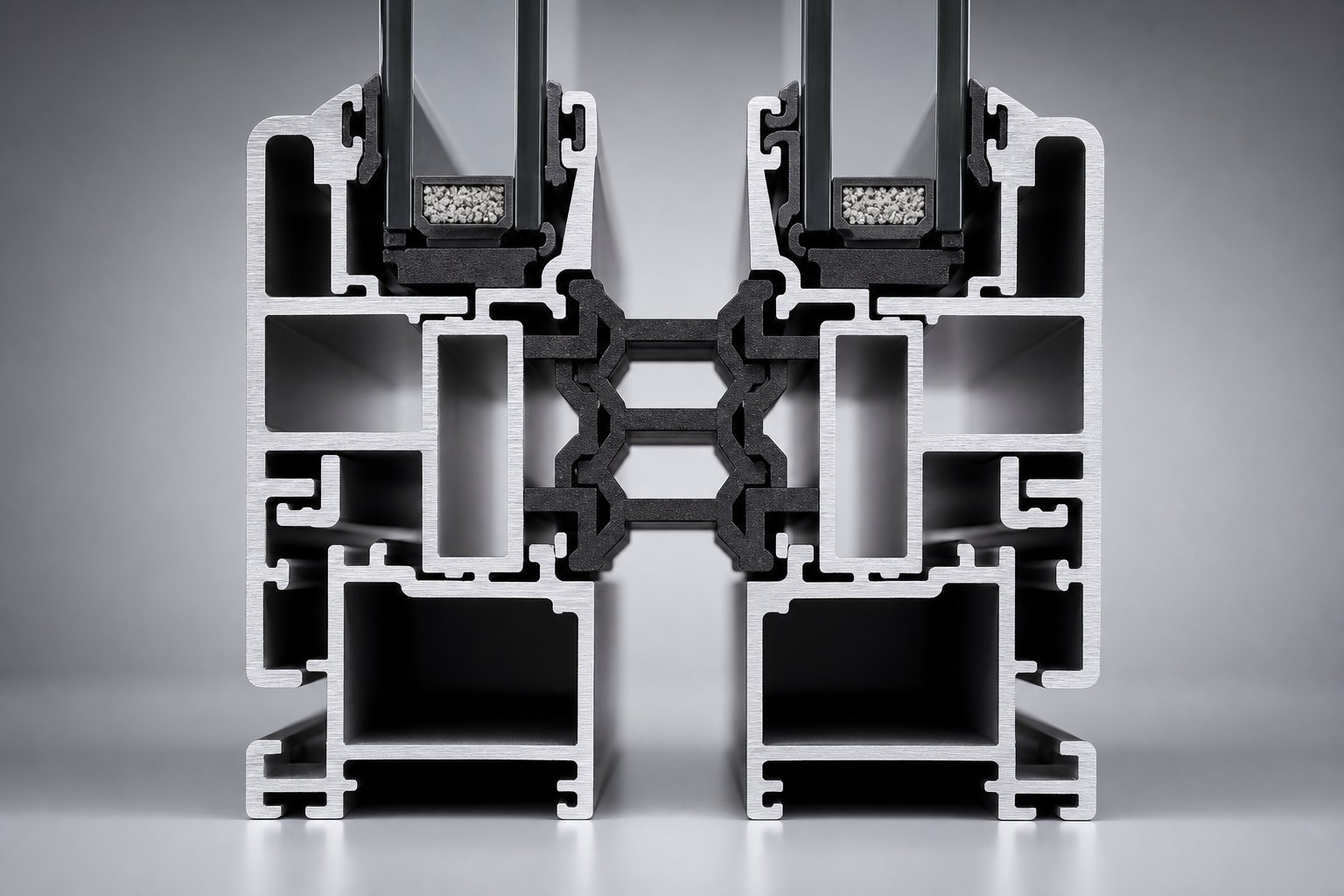
A thermal break is a non-conductive barrier — typically a strip of polyamide (PA66) reinforced with 25% glass fibre — inserted between the interior and exterior sections of an aluminium frame. It physically splits the frame into two halves connected only by this insulating bridge.
The physics are simple. Aluminium conducts heat at roughly 160 W/m·K — around 1,000 times faster than uPVC and 5,000 times faster than timber. Without a thermal break, the frame acts as a direct highway for heat transfer. In winter, warmth races outward through the aluminium. In summer, exterior heat pours inward. Either way, the insulating glass unit is undermined by the very frame holding it in place.
Polyamide thermal break performance changes that equation dramatically. At just 0.3 W/m·K, the polyamide strip is over 500 times less conductive than the aluminium surrounding it. That single barrier transforms the frame from a thermal liability into a genuine insulator.
Thermally Broken vs Standard Aluminium Frames
The performance gap between thermally broken aluminium window frames and standard (non-broken) profiles is not marginal — it is transformative. A standard aluminium frame typically delivers a Uf value of 5.0 to 7.0 W/m²·K. Introduce a quality 24 mm polyamide thermal break and that drops to 1.8–2.5 W/m²·K. Premium profiles with 34 mm+ breaks and foam insulation inserts push below 1.2 W/m²·K — territory that rivals high-performance timber.
This distinction matters more than frame material choice alone. A thermally broken aluminium frame at 1.8 W/m²·K outperforms a poorly designed uPVC profile, while a non-broken aluminium frame at 6.0 W/m²·K will bleed energy regardless of how good the glass is.
| Metric | Thermally Broken Aluminium | Standard Aluminium (No Break) |
|---|---|---|
| Frame Uf value | 0.8–2.5 W/m²·K | 5.0–7.0 W/m²·K |
| Condensation risk | Low — interior surface stays warm | High — cold frame drops below dew point |
| Energy rating impact | Supports NCC Section J compliance | Unlikely to meet current requirements |
| Interior comfort | No cold spots or draughts near frame | Noticeable cold radiation in winter |
| Typical applications | Residential, commercial, passive house | Non-conditioned spaces, sheds, older buildings |
How to Identify Quality Thermal Breaks
Not all thermally broken frames are equal. Three factors separate a premium thermal break from a token one:
- Polyamide strip depth — Wider strips insulate better. Entry-level systems use 14.8 mm strips; mid-range profiles sit around 24 mm; high-performance systems run 34 mm or more. Ask for the exact measurement.
- Number of chambers — Modern profiles incorporate multiple air chambers within the frame section. A 3-chamber system offers baseline thermal performance, while 5- and 7-chamber designs deliver progressively lower Uf values by trapping additional pockets of still air.
- Manufacturing method — Quality systems use precision-machined channels with mechanical crimping or knurling to lock the polyamide permanently to the aluminium. This bond must maintain structural integrity across decades of thermal cycling without loosening or cracking.
When comparing quotes, request the frame Uf value — not just the whole-window Uw. Two suppliers can quote the same glass specification yet deliver vastly different thermal outcomes because one uses a 20 mm break and the other a 34 mm break. That hidden difference shows up in your energy bills every quarter, and it explains how thermal breaks prevent condensation on frames that would otherwise drip moisture onto sills and surrounding finishes throughout the cooler months.
The takeaway is practical: choosing between thermally broken vs standard aluminium frames is not a minor upgrade. It is the single specification that determines whether your double glazed aluminium windows perform as engineered — or quietly cost you thousands in lost energy over their lifetime.
Energy, Acoustic, and Durability Performance
Thermal break quality sets the ceiling for what a double glazed aluminium window can achieve. But what does that achievement actually look like in measurable terms? Three performance dimensions matter most to Australian homeowners: how much energy the window saves, how much noise it blocks, and how long the whole system lasts before needing replacement. Each has its own rating system — and each is routinely misunderstood.
Energy Efficiency Ratings Decoded
The aluminium double glazed window energy rating you will encounter most often is the Uw value. That “w” stands for “window” — it measures thermal transmittance across the entire unit (frame, glass, spacer, and seals combined), expressed in watts per square metre per degree Kelvin (W/m²·K). Lower numbers mean less heat escaping in winter and less heat entering in summer.
To put the scale in perspective, data from Cooee Architecture shows a single-glazed aluminium window sits at a U-value of 6.7 — meaning heat pours through almost unimpeded. Standard double glazing in an aluminium frame drops that to 4.8. Add a thermally broken or composite frame and you reach 3.6. Timber or PVC frames with double glazing achieve around 3.3. For context, a typical insulated brick veneer wall delivers a U-value of 0.45 — so even a well-specified double glazed aluminium window loses heat roughly eight times faster than the wall surrounding it.
That comparison is not meant to discourage. It is meant to calibrate expectations and highlight why glass area, frame specification, and orientation all need careful thought. For most Australian climate zones, a Uw value between 2.5 and 3.5 W/m²·K represents a realistic target for thermally broken aluminium double glazing. Premium systems with wider thermal breaks, argon gas, Low-E coatings, and warm-edge spacers can push below 2.0.
The second number worth understanding is SHGC — Solar Heat Gain Coefficient. The Australian Glass and Window Association defines it as the fraction of incident solar radiation admitted through a window, both directly transmitted and absorbed then released inward. It ranges from 0 to 1. A lower SHGC blocks more solar heat; a higher SHGC lets more warmth in.
Which you want depends entirely on orientation and climate. North-facing windows in Melbourne or Canberra benefit from a higher SHGC to capture free winter warmth, paired with external shading to block summer sun. West-facing glass in Brisbane or Perth needs a lower SHGC to prevent afternoon overheating. There is no single “best” number — only the right balance for your specific situation, which is exactly why energy assessors exist.
Sound Reduction and Acoustic Performance
Sound reduction in double glazed aluminium windows is the benefit homeowners notice immediately — often before they register any change in energy bills. Traffic hum, barking dogs, aircraft noise: all of it drops noticeably when you move from single glazing to a properly specified double glazed system.
The rating to look for in Australia is Rw — the weighted sound reduction index. It expresses, as a single number, how many decibels of airborne sound a window system blocks across a range of frequencies. Higher is better. A standard single-glazed aluminium window might achieve an Rw of 22 to 25. Double glazing with a standard configuration lifts that to around 29 to 32. Specify asymmetric glass thicknesses (say, 6 mm outer and 4 mm inner) and you can reach Rw 34 to 36. Add a laminated pane with a PVB interlayer and Rw values of 38 or higher become achievable.
Because decibels operate on a logarithmic scale, a 10 dB reduction is perceived as roughly halving the loudness. So moving from Rw 25 to Rw 35 does not sound like a modest improvement — it feels transformative.
A few practical points that acoustic ratings alone will not tell you. Frequency matters: low-frequency traffic rumble is harder to block than mid-range voices. Cavity width matters: wider gaps generally improve low-frequency performance. And installation quality matters enormously — sound takes the path of least resistance, so a single poorly sealed gap around the frame can undermine an otherwise excellent glass specification. The system performs as a whole, not as isolated components.
Condensation Prevention and Frame Durability
Condensation on aluminium window frames is one of the most common complaints homeowners raise — and one of the most misattributed. The moisture itself is not a frame defect. It forms when a surface drops below the dew point of the surrounding air. Standard aluminium, with its extreme conductivity, chills rapidly in cold weather and becomes a magnet for moisture. Thermally broken frames solve this by keeping the interior aluminium surface closer to room temperature, well above the dew point in normal conditions.
If condensation appears on the inside face of the glass rather than the frame, it typically signals high indoor humidity combined with inadequate ventilation — a building issue, not a window fault. Condensation between the panes, however, is a different story entirely. That indicates seal failure within the IGU, allowing moist air to infiltrate the cavity. The only fix is replacing the insulated glass unit. This is why warranty terms covering seal integrity matter so much at the purchasing stage.
On durability, the question of how long do aluminium double glazed windows last has a straightforward answer: the frame itself is essentially indefinite. Aluminium does not rot, warp, swell, or degrade under UV exposure. Powder-coated finishes resist fading and chalking for 20 to 30 years in typical conditions. The IGU seals are the limiting factor — quality units maintain gas fill and clarity for 20 to 25 years, with some lasting considerably longer. Hardware (hinges, locks, rollers) may need servicing or replacement at the 15- to 20-year mark depending on usage.
Compare that to timber frames requiring repainting every 3 to 5 years and eventual rot repair, or uPVC profiles that can yellow, become brittle, and lose structural rigidity after 25 to 30 years of Australian sun exposure. Aluminium’s lifecycle cost advantage compounds quietly over decades — a point that raw purchase price comparisons consistently miss.
Aluminium vs uPVC Double Glazed Windows
Lifecycle cost tells part of the story, but it only becomes meaningful when you know what you are comparing against. The most common question Australian homeowners ask when specifying double glazing is simple: is aluminium better than uPVC for windows? The honest answer is that neither material wins across every criterion. Each has genuine strengths, and the right choice depends on your priorities, your budget horizon, and the specific openings you need to fill.
Thermal Performance Head to Head
uPVC is inherently a poor conductor of heat. Multi-chamber profiles trap pockets of still air within the frame itself, delivering decent insulation without any additional engineering. A standard uPVC double glazed window achieves whole-window Uw values of around 1.4 to 1.8 W/m²·K straight off the production line.
Aluminium needs its thermal break to compete. Without one, the frame bleeds heat and the comparison is not even close. With a quality thermally broken profile, however, aluminium double glazing reaches Uw values of 1.2 to 1.6 W/m²·K — effectively matching uPVC. Specify triple glazing on either material and both can push below 1.0 W/m²·K. In practice, the thermal gap between a well-specified aluminium system and a well-specified uPVC system is negligible. The glazing specification and installation quality matter far more than the frame material alone.
Aesthetics, Sightlines, and Design Flexibility
This is where aluminium pulls away decisively. Aluminium profiles can be as slim as 50 mm wide; uPVC frames typically run 70 to 90 mm. That 20 to 40 mm difference sounds minor on paper, but across a wall of windows or a set of bi-fold doors, it translates into noticeably more glass, more light, and a cleaner architectural line.
Structural strength compounds the advantage. Aluminium can span openings up to 3 metres wide without intermediate supports. uPVC generally maxes out around 2 to 2.4 metres before requiring steel reinforcement or additional mullions. For large sliding doors, expansive picture windows, or multi-panel bi-folds, aluminium is often the only practical option.
Colour flexibility adds another layer. Powder coating allows virtually any RAL colour with 25-year finish warranties — including dual-colour options with different shades inside and out. uPVC has improved with foiled finishes in popular tones like anthracite grey and woodgrain, but the range remains limited to 30 to 40 standard options, and foiled finishes may show wear after 15 to 20 years on sun-exposed elevations.
Cost, Lifespan, and Environmental Impact
uPVC holds a clear upfront cost advantage. Expect to pay roughly 20 to 40% less for equivalent uPVC windows compared to double glazed aluminium vs plastic frames cost on a like-for-like basis. For a standard three-bedroom home, that premium can add up to several thousand dollars across all openings.
The calculus shifts over time. Aluminium or uPVC windows which last longer is not a close contest: aluminium frames deliver a functional lifespan of 40 to 50 years, while uPVC typically lasts 25 to 30 years before profiles can yellow, warp, or lose rigidity under prolonged UV exposure. Divide total cost by years of service and the annual ownership cost often favours aluminium — particularly in harsh Australian conditions with intense sun and coastal salt air.
On environmental impact, aluminium is infinitely recyclable with no loss of material quality, and recycled aluminium retains high scrap value. uPVC can be recycled up to seven times, though collection infrastructure in Australia remains less developed. Both materials outperform timber on maintenance-related resource consumption over their full lifecycle.
| Criterion | Aluminium Double Glazing | uPVC Double Glazing |
|---|---|---|
| Thermal performance (Uw) | 1.2–1.6 W/m²·K (thermally broken) | 1.4–1.8 W/m²·K |
| Frame thickness | 50–65 mm | 70–90 mm |
| Colour options | Unlimited RAL colours, dual-colour available | 30–40 standard foiled finishes |
| Structural strength | Spans up to 3 m without reinforcement | Typically limited to 2–2.4 m |
| Lifespan | 40–50 years | 25–30 years |
| Recyclability | Infinitely recyclable, high scrap value | Recyclable up to 7 times |
| Maintenance | Wipe clean; no repainting needed | Wipe clean; may discolour over time |
| Indicative cost (per window, installed) | 20–40% premium over uPVC | Lower upfront cost |
Neither material is universally superior. uPVC makes strong financial sense for standard-sized replacements where budget is the primary driver. Aluminium earns its premium on contemporary builds, large openings, coastal properties, and any project where slim sightlines, design flexibility, and multi-decade durability justify the higher initial outlay. The key is matching the material to the application rather than defaulting to either based on habit or marketing.
Australian Standards and Climate Suitability
Matching the right material to the right application only works if the window actually meets the regulatory bar. In Australia, that bar is set by a web of standards and codes that govern everything from structural wind resistance to energy performance — and non-compliance carries real consequences including failed inspections, voided insurance, and costly rework.
Key Australian Standards for Windows
AS2047 is the primary standard for aluminium window compliance in Australia. It covers windows and external glazed doors, setting mandatory performance benchmarks across structural adequacy (wind load resistance), water penetration resistance, air infiltration limits, and operating force. Every window installed in a new build or major renovation must comply — and that compliance must be documented with a performance label affixed to the frame and a certificate issued by the manufacturer.
AS1288 sits alongside it, governing glass selection and installation. It dictates where safety glass (toughened or laminated) must be used — near floor level, in doors, in overhead glazing, and in locations where human impact is likely. Get this wrong and you face both a safety hazard and a compliance failure that a building certifier will flag immediately.
For properties in designated bushfire-prone areas, AS3959 adds another layer. BAL rated aluminium windows for bushfire zones must meet specific construction requirements depending on the assessed Bushfire Attack Level — from BAL-LOW through to BAL-FZ (Flame Zone). Higher BAL ratings demand specific glass types, frame configurations, and screening that standard residential windows do not provide. If your block carries a BAL rating, this standard is non-negotiable and must be addressed at the specification stage, not after ordering.
Climate Zones and Performance Requirements
NCC Section J window requirements tie energy performance directly to geography. Australia’s eight climate zones — ranging from tropical (Zone 1, think Darwin and Cairns) through to alpine (Zone 8, Snowy Mountains) — each impose different minimum glazing performance thresholds. A window system that comfortably passes in temperate Melbourne may fall short in heating-dominated Canberra or cooling-dominated Brisbane without adjustments to glass specification or SHGC values.
Double glazed windows suit most Australian climate zones well, particularly Zones 4 through 7 where heating loads dominate winter energy use. In tropical Zones 1 and 2, solar control becomes the priority — low SHGC glass and external shading often matter more than the insulating cavity. In alpine Zone 8, triple glazing or enhanced Low-E configurations may be needed to meet the tighter energy budgets NCC 2025 now demands.
The retrofit versus new-build distinction also affects compliance obligations. New construction must meet current NCC requirements in full, verified by a building certifier. Retrofitting existing windows into an established home generally does not trigger full NCC compliance for the entire building — but the replacement windows themselves should still meet AS2047, and many councils require development applications for changes to street-facing facades. Check with your local authority before assuming a straight swap is approval-free.
Compliance Documentation and What to Request
Aluminium window standards in Australia exist to protect buyers, but only if you actually verify compliance rather than taking a supplier’s word for it. Before committing to any purchase, request the following documentation:
- AS2047 Certificate of Compliance — issued by the manufacturer, confirming the product has been tested to the standard’s performance criteria by a NATA-accredited laboratory.
- Performance label details — showing wind and water resistance ratings in Pascals, matched to your site’s specific requirements (wind region, terrain category, building height).
- AS1288 glass compliance certificate — confirming correct safety glass selection for each opening location.
- BAL compliance documentation (if applicable) — specifying the tested BAL rating and confirming the window assembly meets AS3959 for your assessed level.
- WERS or NatHERS energy performance data — providing independently rated Uw and SHGC values that your energy assessor can use in modelling.
- Warranty documentation — detailing coverage periods for frame, IGU seal, hardware, and powder coating, along with any conditions that void coverage.
Suppliers who make this documentation publicly accessible — like MEICHEN’s compliance and certifications page — set a useful benchmark for transparency. If a supplier hesitates to provide test reports or certified performance data, treat that reluctance as a red flag. Architects and specifiers routinely require this level of documentation before approving products for projects, and homeowners deserve the same confidence in what they are buying.
Compliance is not just paperwork. It is the mechanism that ensures your double glazed aluminium windows actually deliver the performance, safety, and longevity you are paying for — and that your investment holds its value if you ever sell.
Frame Profiles for Every Application
Compliance documentation confirms a window meets the standard — but it does not tell you which profile suits your actual opening. Aluminium frames come in a range of depths and geometries, each engineered for different structural demands, thermal targets, and visual outcomes. Choosing the wrong profile for the job is like fitting a sedan engine into a truck: technically possible, structurally questionable, and aesthetically off.
Slim, Standard, and Commercial Profile Options
Slim aluminium window frame profiles have become the defining aesthetic of contemporary Australian residential design. These systems reduce the visible frame width — known as the sightline — to as little as 20 to 30 mm, making the frame nearly disappear and letting glass dominate the facade. The result is a high glass-to-frame ratio that maximises natural light and creates clean, uninterrupted views.
Standard residential profiles sit in the 50 to 65 mm depth range. They accommodate thermally broken chambers comfortably, support double glazed IGUs up to 28 mm thick, and handle most residential wind load requirements without issue. This is the workhorse category — versatile enough for awning windows, casements, and sliding systems across typical single- and double-storey homes.
Commercial and heavy-duty profiles step up to 75 to 100 mm or more. The additional depth allows thicker thermal breaks, larger glazing pockets for oversized IGUs, and the structural capacity to span wide openings in high-rise or high-wind-load environments. A minimum wall thickness of 1.6 mm is recommended for high-rise applications, with reinforced chambers engineered for wind resistance in exposed coastal or elevated positions.
The trade-off is direct: slimmer profiles look sharper but carry less structural capacity and less room for deep thermal breaks. Wider profiles insulate better and span further but occupy more visual real estate. Your choice depends on what the opening demands — not what looks best in a brochure.
| Profile Type | Typical Depth | Maximum Glass Size Supported | Best Applications | Aesthetic Characteristics |
|---|---|---|---|---|
| Slim / Minimal | 35–50 mm | Up to 1.5 m² per pane | Fixed-lite feature windows, slim sliding doors, architectural statements | Near-invisible frame, maximum glass ratio, sightlines 20–30 mm |
| Standard Residential | 50–65 mm | Up to 2.5 m² per pane | Awning, casement, sliding, and bi-fold windows in typical homes | Clean lines, balanced frame-to-glass ratio, sightlines 40–55 mm |
| Commercial / Heavy-Duty | 75–100+ mm | 3.0 m² or more per pane | High-rise, large-span shopfronts, cyclone-rated zones, curtain wall systems | Visible frame presence, robust appearance, sightlines 55–80 mm |
Matching Frame Profile to Window Type
Each window configuration places different structural and mechanical demands on the profile. A fixed-lite window carries no operational hardware — the frame simply holds glass in place — so slim profiles work beautifully. The glass itself contributes to structural rigidity, and without hinges or rollers adding load, the frame can stay minimal.
Casement and awning windows introduce friction stays, hinges, and locking hardware that need adequate frame depth for secure mounting. Standard residential profiles handle these comfortably. Casement profiles typically use 6063 alloy at 1.4 to 1.6 mm wall thickness, providing strong seal performance and bevelled sightlines that shed water effectively.
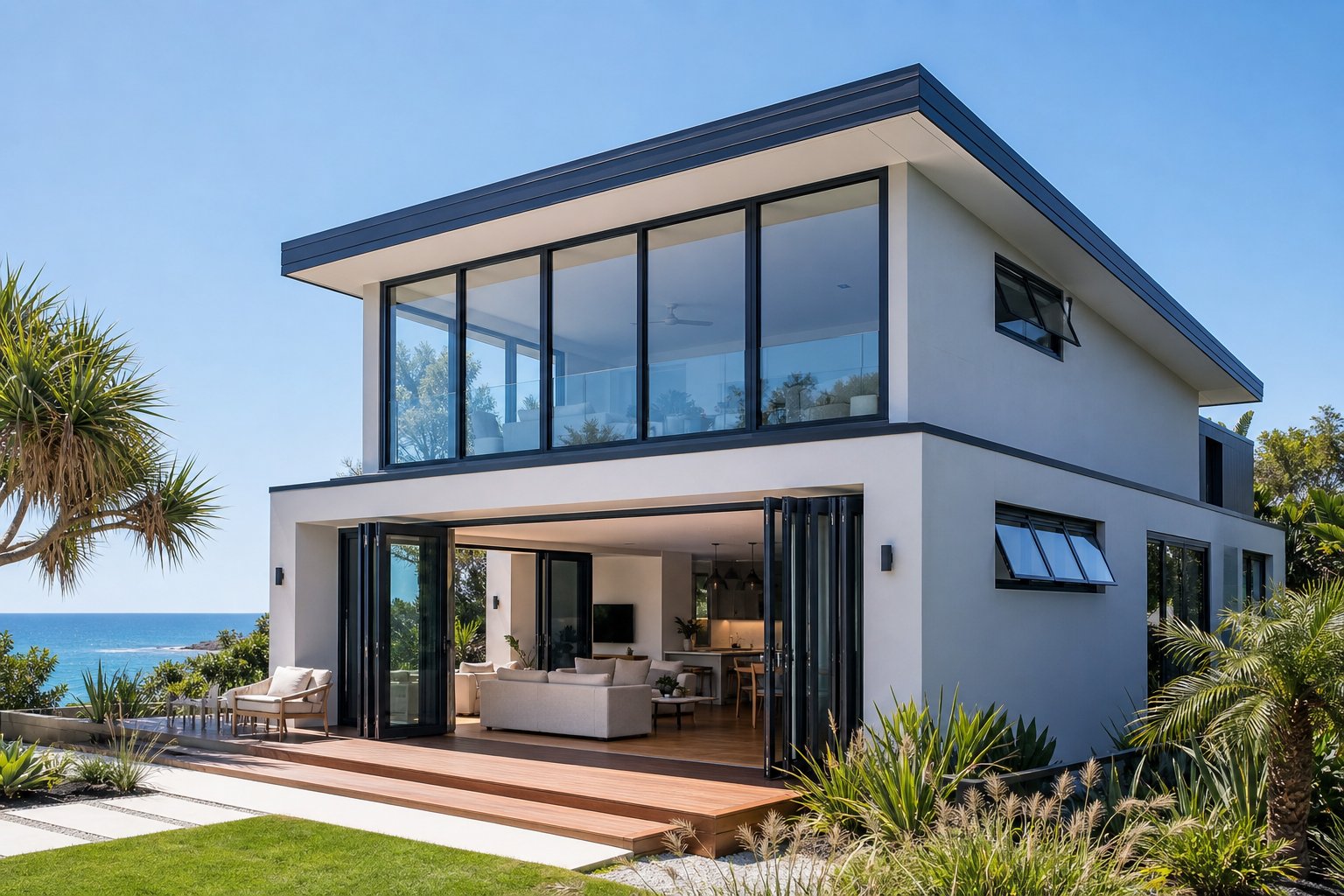
Sliding windows and doors require track systems, rollers, and interlocking stiles built into the profile geometry. Multi-track sliding systems — common in Australian alfresco living designs — need profiles engineered for smooth lateral movement under the weight of large glass panels. The best aluminium frame profile for bifold doors demands even more: reinforced hinges at each fold point, precise alignment tolerances, and enough depth to house multi-point locking across panels that may each weigh 80 kg or more.
Bi-fold systems in particular highlight the difference between commercial vs residential aluminium window frames. A three-panel bi-fold across a 3.6 m opening can use a standard residential profile. Push that to a five-panel system spanning 6 metres and you are into heavy-duty territory — both for the stacking weight on the rollers and the wind load across that expanse of glass.
Sightlines, Light, and Architectural Intent
Aluminium window sightline measurements refer to the visible width of frame material you see when looking at the window from inside. It is the dimension that determines how much of your view is frame and how much is glass. In a standard residential system, sightlines typically run 40 to 55 mm. Slim systems cut that to 20 to 30 mm — a reduction that sounds modest in millimetres but transforms the visual weight of an entire glass wall.
The architectural impact compounds across multiple openings. A bank of four fixed-lite windows with 50 mm sightlines presents 200 mm of visible frame across the mullions alone. Drop to 25 mm sightlines and that halves to 100 mm — a meaningful gain in uninterrupted glass and daylight penetration. For homes designed around indoor-outdoor flow, that difference shapes how the space feels at every hour of the day.
Minimising frame width does carry practical considerations. Slimmer profiles leave less room for deep thermal breaks, which can limit the achievable Uf value. They also reduce the maximum pane size the frame can structurally support. And in bushfire zones or cyclone-rated regions, minimum profile depths and wall thicknesses are dictated by compliance requirements rather than aesthetic preference.
The growing trend toward slim aluminium windows in residential design reflects a broader shift: homeowners want architecture that prioritises light and connection over heavy framing. The engineering now exists to deliver that without sacrificing thermal performance or structural safety — provided the profile is matched correctly to the opening size, wind load, and compliance obligations of the specific project. Getting that match right is where informed specification separates a stunning result from an expensive compromise.
Common Myths About Aluminium Frames Debunked
Matching the right profile to the right opening is a technical exercise — but many homeowners never get that far. They rule out aluminium entirely based on outdated assumptions that no longer reflect how these windows actually perform. Some of these myths date back to the single-glazed, non-thermally-broken systems of the 1980s. Others are simply repeated so often they feel true. Here is what the evidence actually says.
Myth: Aluminium Frames Are Always Cold
- Myth: Aluminium conducts too much heat, making windows cold in winter and hot in summer. This was accurate decades ago. Raw aluminium does conduct heat roughly 1,000 times faster than uPVC. But modern thermally broken profiles insert polyamide barriers that slash frame conductivity to levels matching — and in premium configurations exceeding — multi-chamber uPVC. Are aluminium windows cold in winter? Not when specified with a 24 mm or deeper thermal break. Frame Uf values of 1.5 to 2.0 W/m²·K keep interior surfaces warm and comfortable, even in Melbourne’s coldest weeks.
- Myth: Aluminium frames always cause condensation. Condensation forms when a surface drops below the dew point of surrounding air. Standard aluminium without a thermal break chills rapidly and attracts moisture — that part is real. But do aluminium frames cause condensation when thermally broken? Modern thermally broken systems paired with double glazed, high-performance Low-E glass keep interior frame surfaces well above dew point, making condensation a non-issue in properly ventilated homes. The myth persists because older, non-broken frames are still in service across thousands of Australian houses — but the technology causing the problem has not been standard for years.
Myth: Aluminium Costs More Over Time
- Myth: Aluminium windows are always more expensive than uPVC, making them a poor investment. Upfront? Yes, aluminium typically carries a 20 to 40% premium. Over a full lifecycle? The maths reverses. Aluminium frames last 40 to 50 years without warping, yellowing, or losing structural integrity. uPVC profiles typically reach end-of-life at 25 to 30 years under Australian UV exposure. Factor in one full uPVC replacement cycle — including removal, disposal, and reinstallation — and the aluminium system that cost more on day one often costs less per year of service. Reduced maintenance compounds the advantage: no repainting, no resealing, just an occasional wipe down.
Myth: Limited Colours and Environmental Harm
- Myth: Aluminium windows only come in silver, white, or black. This one is simply wrong. Aluminium window colour options through powder coating now span over 450 RAL colours, including matte, textured, and metallic finishes. Dual-colour options — one shade inside, another outside — are standard offerings from most quality fabricators. Deep greens, warm greys, burnt reds, and woodgrain-look finishes are all achievable with UV-stable powder coating that carries 25-year warranties against fading and chalking. The palette is effectively unlimited.
- Myth: Aluminium is not environmentally friendly. Are aluminium windows environmentally friendly and recyclable? Emphatically yes. Aluminium is infinitely recyclable with no degradation in material quality — unlike uPVC, which can only be recycled a limited number of times. Recycling aluminium requires just 5% of the energy needed to produce primary metal, and the high scrap value means old frames are actively sought by recyclers rather than heading to landfill. When you add the 40 to 50 year lifespan that eliminates premature replacement waste, aluminium’s environmental credentials are difficult to match in the window industry.
These myths cost homeowners thousands — not through the windows themselves, but through the decisions they prevent. Ruling out aluminium based on outdated information often means settling for bulkier frames, shorter lifespans, or limited design options when a better-performing system was available all along. The real question is not whether aluminium has drawbacks, but whether the supplier you choose can document the performance claims that debunk these myths with certified test data.
How to Evaluate Quotes and Choose a Supplier
Certified test data separates credible suppliers from those trading on assumptions. But when three quotes land in your inbox with different formats, different terminology, and wildly different prices, knowing what to actually compare becomes the challenge. Choosing a double glazed window supplier in Australia comes down to reading beyond the bottom line and understanding what each number on the page means for your home’s long-term performance.
Key Specifications to Compare Across Quotes
Price is the first thing most people look at. It should be the last. When learning how to compare aluminium window quotes, start with the technical specifications that determine whether the product will actually perform as promised:
- Whole-window Uw value — Not just the glass centre-pane figure. The Uw accounts for frame, spacer, and edge losses combined. Two quotes with identical glass can deliver very different Uw results depending on thermal break depth and spacer bar type.
- Thermal break depth — Ask for the exact millimetre measurement. A 20 mm break and a 34 mm break produce vastly different frame Uf values, yet both get described as “thermally broken” in marketing copy.
- Glass composition — Confirm pane thicknesses, Low-E coating position, whether the glass is toughened or laminated, and the cavity width.
- Gas fill type — Argon is standard; air is cheaper but less effective. Confirm which is included, not assumed.
- Acoustic rating (Rw) — If noise reduction matters, this number must appear on the quote. If it does not, the supplier likely has not tested for it.
- Hardware brand and grade — Generic hardware fails earlier. Named brands with independent testing offer better longevity and replacement availability.
Also clarify whether the quote is aluminium window supply and install vs supply only. A supply-only quote looks cheaper but excludes labour, flashing, sealing, and the installation warranty. A supply-and-install quote bundles everything under one point of accountability — meaning one phone call if something goes wrong, not a finger-pointing exercise between fabricator and installer.
Warranty Coverage and What Voids It
Aluminium double glazed window warranty terms vary significantly between suppliers, and vague language like “lifetime warranty” means nothing without specifics. A strong warranty should cover each component separately because each has a different failure timeline:
- Frame and powder coating — Typically 10 to 25 years. Covers structural defects, corrosion, and finish degradation (fading, chalking, peeling).
- IGU seal integrity — Usually 10 to 15 years. Covers fogging between panes caused by seal failure. This is the component most likely to fail first.
- Hardware — Often 5 to 10 years. Covers mechanical failure of hinges, locks, and rollers under normal use.
What voids coverage? Common exclusions include damage from non-approved cleaning chemicals (particularly abrasive or solvent-based products on powder coating), failure to maintain drainage slots, installation by non-approved tradespeople, and structural movement in the building causing frame distortion. Read the fine print before signing — not after a claim is rejected.
Questions to Ask Before Committing
Knowing what to ask an aluminium window supplier separates informed buyers from those who discover problems after installation. Bring these questions to every consultation:
- Can you provide the AS2047 test certificate and NATA-accredited laboratory report for this specific window system?
- What is the whole-window Uw value — not just the glass centre-pane figure — for the configuration you are quoting?
- What is the exact thermal break depth and material in the frame profile?
- Which hardware brand and grade is included, and are replacement parts available locally?
- Is the IGU gas-filled, and if so, what gas type and what percentage fill is guaranteed at manufacture?
- What does the warranty cover separately for frame, seal, hardware, and powder coating — and what actions void each?
- Do you manufacture in-house or resell another company’s product? Who is accountable if a warranty claim arises?
- What is your installation methodology — how do you flash, seal, and weatherproof the frame-to-wall junction?
- Can you provide WERS or NatHERS energy performance data that my assessor can use for compliance modelling?
- Will you supply compliance documentation, performance labels, and test reports before I commit — not just after payment?
A supplier confident in their product answers these without hesitation. One that deflects, generalises, or says “trust us” is telling you something important about their accountability standards. Suppliers like MEICHEN publish their compliance certifications, test data, and performance documentation publicly — giving architects, specifiers, and homeowners the ability to verify claims independently before any commitment is made. That level of transparency should be the baseline expectation, not the exception.
The window you buy is only as good as the supplier standing behind it. Specifications on paper mean nothing without verified testing, clear warranty terms, and a company structured to honour both long after the sale is complete.
Frequently Asked Questions About Double Glazed Aluminium Frame Windows
1. Are double glazed aluminium frame windows cold in winter?
Not when specified with modern thermally broken profiles. A polyamide thermal break of 24 mm or deeper reduces frame conductivity to levels comparable with uPVC. Thermally broken aluminium frames achieve Uf values of 1.5 to 2.5 W/m²K, keeping interior surfaces warm and eliminating cold spots. The outdated reputation comes from non-thermally-broken systems installed decades ago, which are no longer standard in quality residential applications across Australia.
2. How much do double glazed aluminium windows cost compared to uPVC in Australia?
Aluminium double glazed windows typically carry a 20 to 40% upfront premium over equivalent uPVC systems. However, aluminium frames last 40 to 50 years versus 25 to 30 years for uPVC under Australian UV conditions. When you factor in one full uPVC replacement cycle including removal, disposal, and reinstallation, the annual cost of ownership often favours aluminium. Lifecycle cost analysis rather than purchase price alone gives a more accurate comparison for Australian homeowners.
3. What Uw value should I look for in double glazed aluminium windows?
For most Australian climate zones, a whole-window Uw value between 2.5 and 3.5 W/m²K represents a realistic and effective target for thermally broken aluminium double glazing. Premium systems combining wider thermal breaks, argon gas fill, Low-E coatings, and warm-edge spacers can achieve below 2.0 W/m²K. Always request the Uw value rather than just the glass centre-pane figure, as it accounts for heat loss through the frame, spacer, and edges combined.
4. Do aluminium double glazed windows meet Australian building standards?
Yes, provided they are tested and certified to AS2047, which covers structural adequacy, water penetration resistance, and air infiltration. Glass selection must comply with AS1288, and properties in bushfire-prone areas require AS3959 compliance at the assessed BAL rating. Reputable suppliers provide NATA-accredited test certificates, performance labels, and energy data for NCC Section J compliance. Always request this documentation before purchasing, as suppliers like MEICHEN publish their certifications publicly for independent verification.
5. How long do double glazed aluminium windows last before needing replacement?
The aluminium frame itself is essentially indefinite — it does not rot, warp, or degrade under UV exposure. Powder-coated finishes resist fading for 20 to 30 years. The IGU seals are the limiting factor, maintaining gas fill and clarity for 20 to 25 years in quality units. Hardware such as hinges, locks, and rollers may need servicing at the 15 to 20 year mark. Overall, the system delivers a functional lifespan of 40 to 50 years, significantly outlasting uPVC alternatives in Australian conditions.
More Window & Door Guides