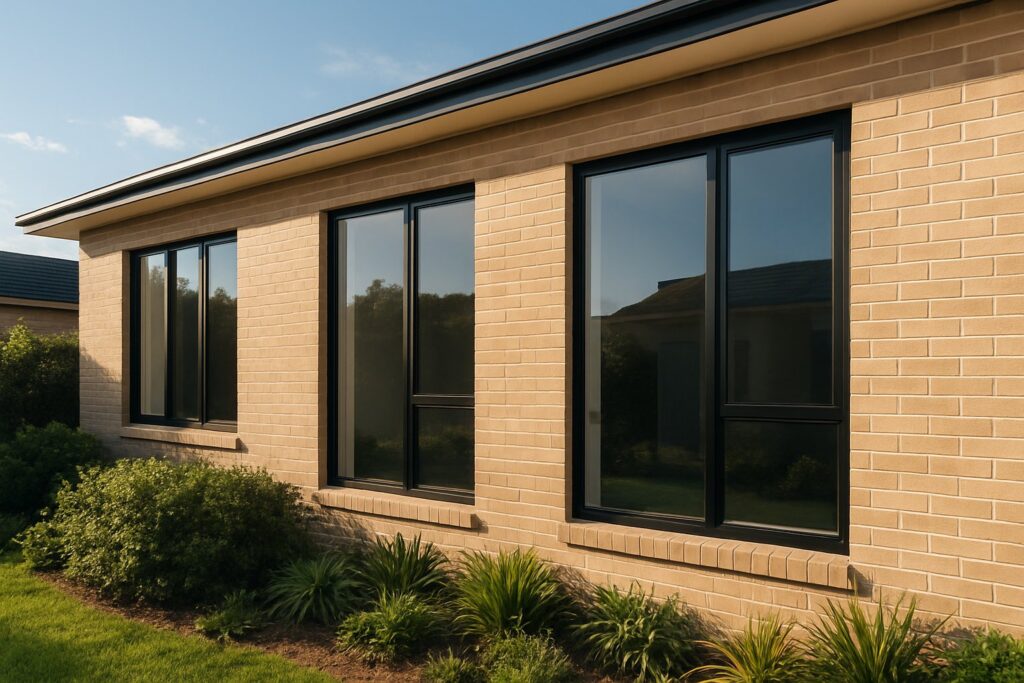
What Are Double Glazed Double Hung Aluminium Windows
Three separate engineering principles sit inside one frame, and most people never realise they are shopping for all three at once. A double glazed double hung aluminium window merges a vertical sliding sash mechanism, an insulated glass unit, and a lightweight metal frame into a single system designed for ventilation control, thermal regulation, and long-term structural performance.
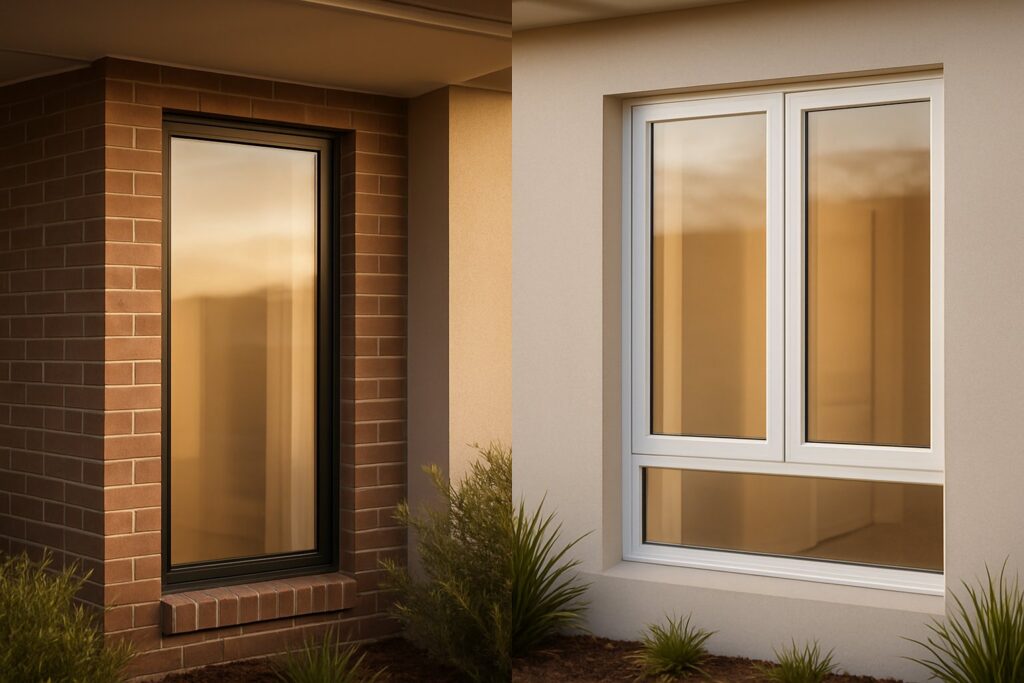
A double glazed double hung aluminium window is a window system featuring two vertically sliding sashes (upper and lower) held within an aluminium frame, with each sash glazed using an insulated glass unit composed of two panes separated by a sealed, gas-filled cavity. The double hung operation provides flexible ventilation, the double glazing delivers thermal and acoustic insulation, and the aluminium frame supplies structural strength with slim sightlines.
How Three Technologies Combine Into One Window
The double hung mechanism allows both the top and bottom sashes to slide up and down independently. Open the bottom sash for direct breeze at seated level, drop the top sash to let warm air escape near the ceiling, or crack both for balanced cross-flow. This flexibility sets aluminium double hung windows apart from fixed, awning, or casement alternatives.
Behind each sash sits an insulated glass unit (IGU). Two panes of glass — typically 4 mm to 6 mm thick — are held apart by a spacer bar and sealed around the perimeter, trapping a layer of air or inert gas such as argon. That sealed cavity slows heat transfer through conduction and convection, turning a simple sheet of glass into a genuine thermal barrier.
The aluminium frame ties everything together. Its high strength-to-weight ratio means profiles can stay narrow, maximising the glass area and the natural light entering your room. Modern aluminium framing also accepts powder-coated or anodised finishes that resist corrosion in coastal and high-UV Australian conditions.
Why This Window Style Remains Popular
Double hung aluminium windows suit a wide range of Australian home styles — from heritage weatherboard cottages to contemporary rendered facades. The sashes sit flush within the frame and never swing outward, so they work above footpaths, decks, and narrow side passages where projecting windows would obstruct clearance. Their vertical sliding action also resists wind buffeting better than hinged designs, a practical advantage in exposed or upper-storey locations.
Key Terminology Explained
Terminology trips people up early. In Australia, the correct spelling is aluminium (six syllables), matching British English convention. North American sources use aluminum (five syllables). Both refer to the same element and the same framing material — only the regional spelling differs. Throughout this guide, we use the Australian standard, though searches for “aluminum double hung windows” lead to identical products. Likewise, “double glazing” and “double pane” describe the same insulated glass concept — two panes, one sealed cavity, one job: reducing energy transfer through the glass.
Understanding these building blocks — sash operation, glass unit construction, and frame material — sets the foundation for evaluating every other decision in the selection process, from component quality down to hardware specification.
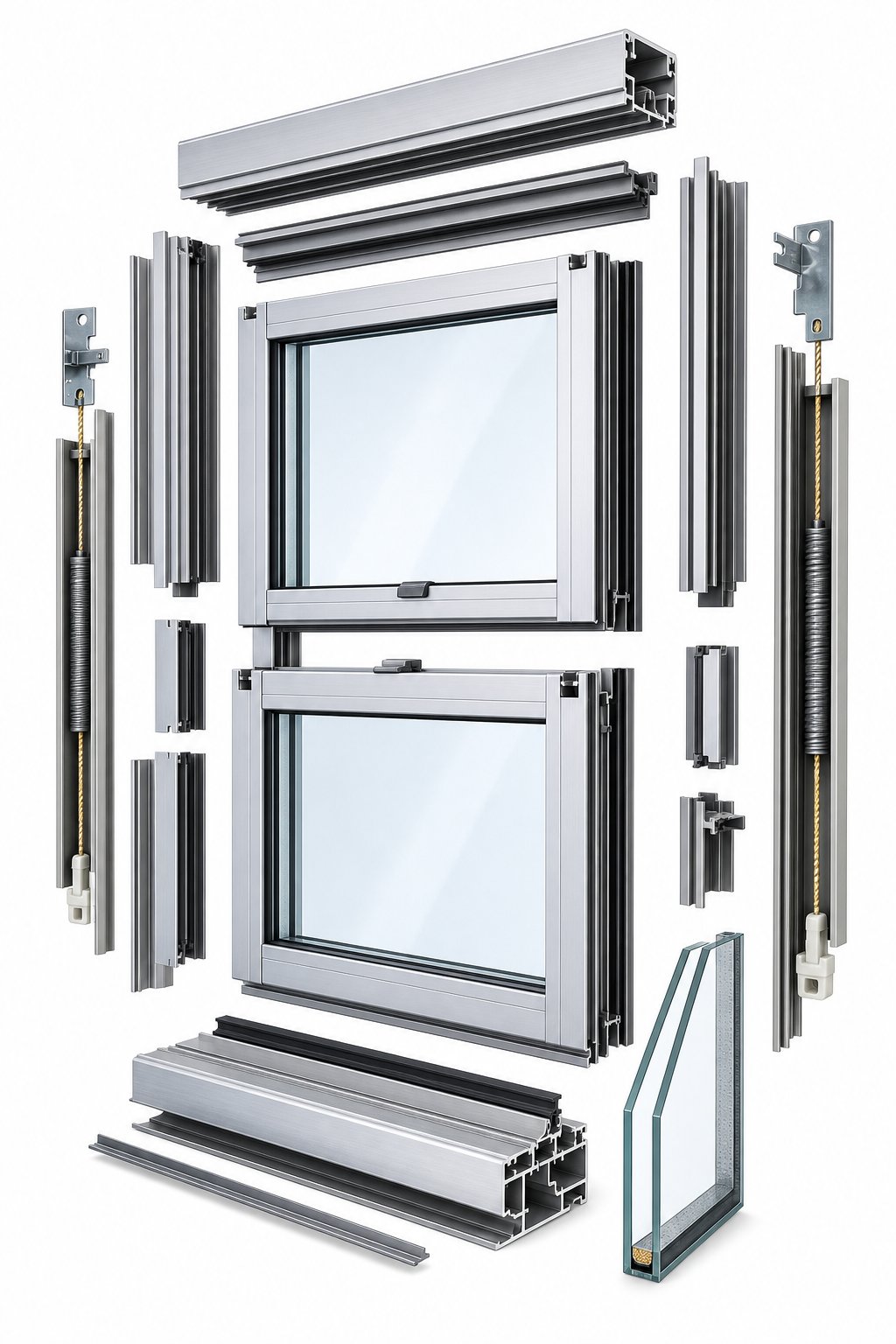
Anatomy of a Double Glazed Double Hung Window System
Every component in this window type exists for a reason. Remove one — or spec a cheap version — and the whole system underperforms. Knowing what sits where helps you spot quality differences between products and understand exactly what you are paying for when you choose an aluminium frame window over a lesser alternative.
Frame and Sash Components
The frame is the structural skeleton anchored to your wall opening. It never moves, but it carries the load of both sashes and the glazing they hold. The sashes are the moving panels that slide vertically within that frame. Together, these parts define how smoothly the window operates and how tightly it seals when closed.
- Head — the top horizontal member of the frame. It spans the full width of the opening and supports the upper sash at its highest travel point.
- Jambs — the two vertical side members running from head to sill. Each jamb contains a track or channel that guides the sashes up and down while housing the balance mechanism.
- Sill — the bottom horizontal member. In aluminium frames, the sill typically incorporates a slight drainage slope and weep holes to direct water away from the interior.
- Meeting rail — the horizontal point where the bottom rail of the upper sash overlaps the top rail of the lower sash when both are closed. A well-designed meeting rail creates an interlocking seal critical for weather resistance and security.
- Top sash and bottom sash — the two independently operable panels. Each sash consists of horizontal rails (top and bottom) and vertical stiles (left and right) that form a rigid rectangle holding the glazing unit.
- Stiles — the vertical members of each sash. They ride within the jamb tracks and carry weatherstripping that contacts the frame to block drafts.
In a quality double pane aluminium window, these frame and sash profiles are extruded with precision tolerances, often to within fractions of a millimetre, so the sashes travel without binding or rattling.
Insulated Glass Unit Breakdown
The insulated glass unit (IGU) is the sealed sandwich sitting inside each sash. It handles the bulk of thermal and acoustic work — the aluminium frame provides structure, but the IGU provides insulation. A standard double glazed unit contains several key elements that each influence long-term performance:
- Two glass panes — typically 4 mm to 6 mm float, toughened, or laminated glass. Pane thickness and type are selected based on structural load, acoustic goals, and safety requirements under AS 1288.
- Spacer bar — a rigid perimeter strip (usually aluminium, stainless steel, or warm-edge composite) that holds the two panes at a consistent distance apart, typically 12 mm to 16 mm for optimal thermal performance.
- Desiccant — a moisture-absorbing material packed inside the spacer bar. It captures any residual humidity sealed within the cavity during manufacture, preventing internal fogging over the unit’s lifespan.
- Primary seal — a polyisobutylene (PIB) bead applied between the spacer and each glass pane. This creates the initial moisture and gas barrier.
- Secondary seal — a structural sealant (typically silicone or polysulphide) applied around the outer edge of the spacer assembly. It bonds the unit together structurally and provides a second line of defence against moisture ingress and gas loss.
- Gas fill — the cavity between panes is filled with an inert gas, most commonly argon (affordable, widely available) or krypton (denser, better insulating, used in narrower cavities). These gases conduct heat less readily than air, improving the unit’s U-value.
When any seal degrades, moisture enters the cavity and the desiccant eventually saturates — that is the point at which you see fogging between the panes, signalling IGU failure.
Hardware and Weatherstripping
Hardware is what transforms a static assembly into a functional, secure window. Weatherstripping is what keeps the elements out once the sashes are closed. Both wear over time, and both are replaceable — a key advantage of double pane aluminium windows over sealed fixed-pane units.
- Balance system — a spring-loaded or cord-driven mechanism concealed within each jamb that counterbalances the sash weight, allowing the panels to stay open at any position without support. Balance type directly affects how effortlessly the sashes glide.
- Sash lock — mounted at the meeting rail, it draws the two sashes together and secures the window against forced entry. Quality cam-action locks compress the meeting rail seal for improved air tightness.
- Tilt latches — spring-loaded clips on each sash that release the panel inward from the frame, allowing you to clean the exterior glass from inside the room. Especially useful on upper-storey installations common in double-storey Australian homes.
- Weatherstripping — flexible seals (typically fin-type or compression bulb) located at four key zones: the head, the sill, both jamb tracks, and the meeting rail interlock. These seals block air infiltration, reduce dust entry, and dampen noise transmission.
Each of these subsystems interacts with the others. A sash that binds in its track accelerates weatherstrip wear. A failed balance lets a sash slam, which stresses the IGU seals. Understanding the relationship between components helps explain why cheap hardware choices often lead to expensive glazing failures down the line — and why the mechanism keeping those sashes suspended deserves a closer look.
How the Balance Mechanism Keeps Sashes Operating Smoothly
That balance system mentioned in the hardware list above? It is arguably the most under-appreciated component in any double hung aluminium window. Without it, a sash weighing 8 kg or more would simply drop under gravity the moment you let go. The balance mechanism counteracts that weight, holding the panel at whatever height you choose and allowing smooth, one-handed operation over tens of thousands of cycles.
Selecting the correct balance type depends primarily on sash weight — and sash weight is determined by the glass specification. A double glazed sash with two 5 mm panes, a 12 mm argon-filled cavity, and an aluminium perimeter frame is substantially heavier than a single-glazed equivalent. Get the balance wrong, and the window either creeps shut on its own or becomes difficult to push open. Either scenario leads to premature wear across the entire system.
Spiral Balance Systems
Spiral balances are the most common type fitted to modern aluminium double hung windows in Australia. The mechanism consists of a steel rod twisted into a tight coil, housed inside a slender tube that fits within the jamb channel. A shoe attached to the bottom of the sash engages the spiral rod. As you raise the sash, the rod twists and stores torsional energy; as you lower it, that stored energy supports the weight.
Their slim profile suits aluminium framing well — the narrow jamb sections of an aluminium double hung window leave limited cavity space, and spiral balances tuck neatly inside without requiring bulky housings. Adjusting tension is straightforward: a few turns of the rod with a tensioning tool increases or decreases the counterbalance force to match a specific sash weight. This adjustability makes them practical during installation and for fine-tuning after glass upgrades.
Block-and-Tackle and Constant-Force Options
Block-and-tackle balances use a combination of pulleys, a cord, and a coiled spring to support the sash. The pulley system provides mechanical advantage, meaning these balances can handle heavier loads than a spiral of equivalent size. They suit larger openings and thicker glass configurations — think oversized double glazed sashes in older-style homes or high-wind-rated builds requiring 6 mm panes on both sides. Their track record spans decades, and replacement parts remain readily available through window hardware suppliers.
Constant-force balances take a different approach. A coiled stainless-steel spring sits inside a compact cassette, delivering uniform tension across the full range of sash travel. Because the force stays consistent whether the sash is open 50 mm or 500 mm, the movement feels particularly smooth. They work well for light to medium sashes and their corrosion-resistant construction suits coastal Australian environments. The trade-off is that they are less easily adjustable than spirals if you later change glass specifications.
Signs Your Balance System Needs Attention
Balance failure rarely happens overnight. It announces itself through a predictable set of symptoms that homeowners often dismiss as “the window getting old.” In reality, the window frame and glazing are fine — it is the balance doing the failing. Common indicators include:
- A sash that slides down on its own after being raised — the balance can no longer counteract the panel weight.
- Uneven movement, where one side travels smoothly but the other drags or sticks — typically one balance has failed while the other still functions.
- Excessive force needed to raise or lower the sash, suggesting a seized or over-tensioned mechanism.
- A sash that slams shut when released, posing a finger-trap hazard — especially concerning in homes with children.
- Visible cord fraying or broken strings (in block-and-tackle or spring-cord systems).
Replacing a failed balance is a targeted repair, not a whole-window replacement. Most balances are matched to sash weight — you weigh the sash (a bathroom scale works), identify the rated balance for that load, and swap the mechanism within the jamb channel. Double hung window sash replacement kits typically include the balance, mounting hardware, and pivot shoes needed for the job. Fitting both sides simultaneously ensures even tension and prevents the lopsided wear that caused the original failure.
| Criteria | Spiral Balance | Block-and-Tackle | Constant-Force |
|---|---|---|---|
| Sash weight suitability | Light to medium (up to ~15 kg) | Medium to heavy (up to ~30 kg+) | Light to medium (up to ~15 kg) |
| Typical lifespan | 15–20 years | 20–25 years | 20+ years |
| Ease of replacement | Straightforward — tensioning tool required | Moderate — cord routing adds complexity | Simple — cassette clips in and out |
| Adjustability | High — rod tension easily modified | Low — spring pre-set at manufacture | Low — force fixed by coil specification |
| Approximate cost per pair (AUD) | $30–$60 | $50–$90 | $45–$80 |
| Best suited to | Standard aluminium double hung windows | Heavier or oversized sashes | Coastal installs, low-maintenance priority |
The balance mechanism is a wear item — it will eventually need servicing or replacement regardless of quality. But the right choice upfront, matched precisely to the glazed sash weight, delays that day considerably. And because the balance determines how effortlessly the window moves every single day, it also shapes the long-term perception of quality that homeowners form about their windows. Smooth travel and reliable holding power come down to this hidden spring doing its job quietly inside the jamb — which raises the next performance question: what happens at the frame itself when heat tries to pass through the aluminium?
Thermal Break Technology and Energy Performance Explained
Aluminium conducts heat roughly 1,000 times faster than timber. That single fact has shaped every criticism levelled at aluminium windows for decades — and it is the reason thermal break technology exists. Without addressing this conductivity, even the best double glazing delivers compromised results because heat simply bypasses the glass cavity and travels straight through the frame. Thermally broken aluminium double glazing solves this problem at the structural level, and understanding how it works separates informed buyers from those who end up paying twice for inadequate performance.
Why Aluminium Conducts Heat and How Thermal Breaks Solve It
Aluminium’s thermal conductivity sits at approximately 160 W/mK. Compare that to timber at around 0.15 W/mK or uPVC at roughly 0.16 W/mK, and the challenge becomes obvious. In a standard aluminium profile without any intervention, the interior face of the frame reaches nearly the same temperature as the exterior face. On a 40°C summer day in western Sydney, the inside of an unbroken aluminium frame gets hot enough to radiate warmth into your room. In a Canberra winter, that same frame chills down enough to attract condensation.
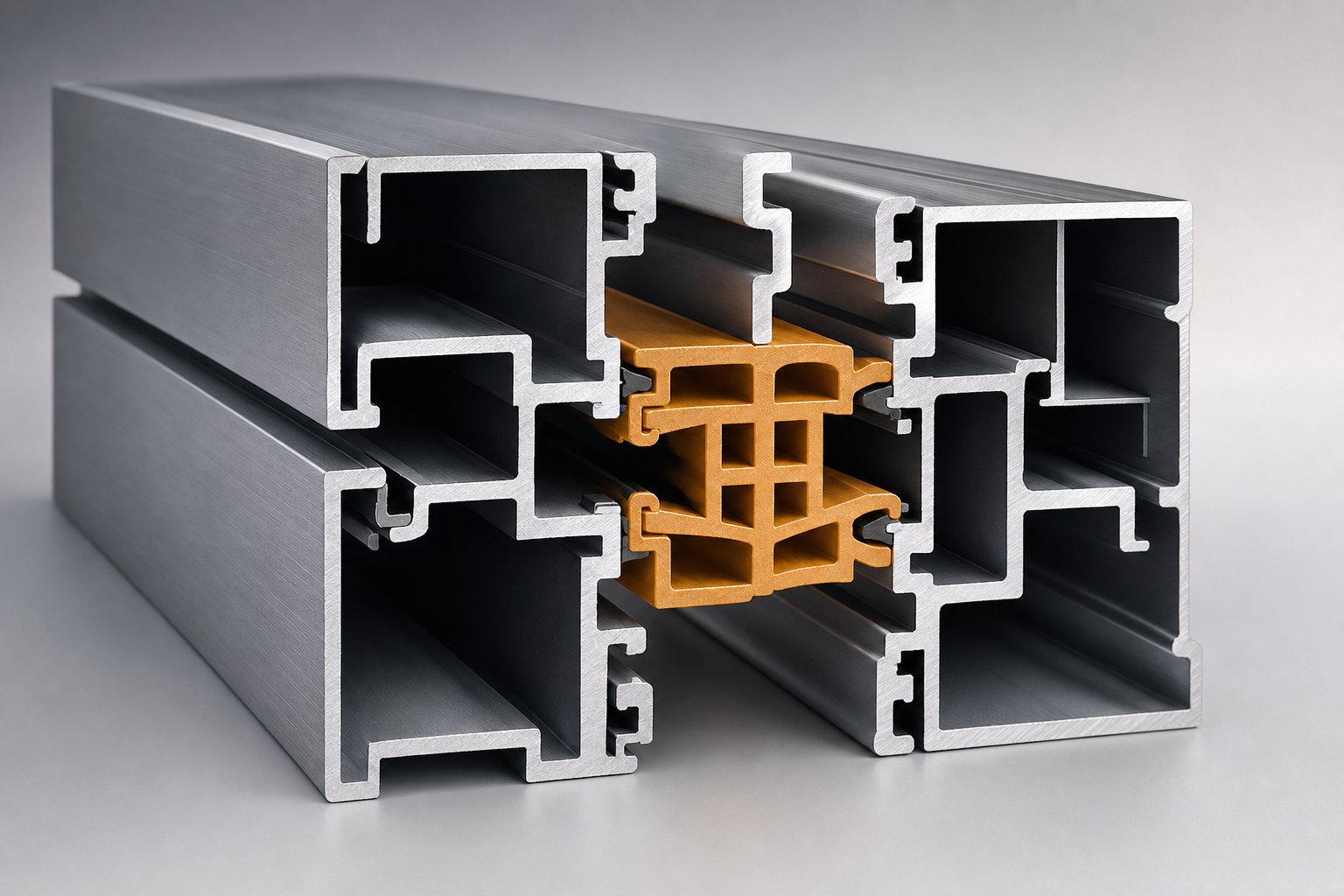
Thermal break technology interrupts this pathway. During the extrusion process, the aluminium profile is manufactured as two separate sections — an interior half and an exterior half. A strip of polyamide (a glass-fibre-reinforced nylon) or a poured polyurethane barrier is then mechanically locked between these two halves. This non-conductive insert creates an insulating bridge, physically disconnecting the cold side from the warm side while maintaining the frame’s structural integrity.
The result is dramatic. Heat can no longer travel in a straight conductive line from outside to inside. It hits the polyamide strip and stalls, because the strip’s thermal conductivity (around 0.25 W/mK) is roughly 640 times lower than the aluminium surrounding it. The interior aluminium surface stays closer to room temperature regardless of what is happening outside.
Thermal break technology transforms aluminium from one of the poorest insulating frame materials into a genuine high-performance option. By splitting the profile and inserting a polyamide or polyurethane barrier, heat transfer through the frame drops so significantly that thermally broken aluminium can rival — and in some configurations exceed — the insulating capacity of timber and uPVC frames, while retaining aluminium’s superior strength, slim sightlines, and indefinite lifespan.
This frame-level insulation works hand-in-hand with the double glazed unit to create a complete thermal envelope. The IGU handles the glass area (which typically accounts for 70–80% of total window surface), while the thermal break handles the frame perimeter. Together, they eliminate the weakest links in the building envelope at that opening.
Understanding U-Values and Energy Ratings
Two numbers dominate energy performance conversations around aluminium double glazed windows: U-value and R-value. They measure the same thing — thermal resistance — but from opposite directions.
- U-value (W/m²K) — measures how much heat passes through one square metre of window for every one-degree temperature difference between inside and outside. Lower is better. A single-glazed aluminium window without a thermal break might have a whole-window U-value around 5.5–6.0. A thermally broken, argon-filled double glazed aluminium window typically achieves 2.0–2.8, and with Low-E glass, can drop below 1.8.
- R-value — the inverse of U-value (R = 1/U). It expresses resistance to heat flow rather than transmission. Higher is better. Australian building codes and NatHERS energy assessments use both metrics depending on the context.
In Australia, the Window Energy Rating Scheme (WERS) provides a star rating system that simplifies these numbers for consumers. A window earns separate ratings for heating season performance (how well it retains warmth) and cooling season performance (how well it rejects solar heat gain). The thermal break contributes primarily to the heating rating by reducing conducted heat loss, while glass coatings and tint choices influence the cooling rating more heavily.
When comparing products, always look at the whole-window U-value rather than centre-of-glass figures alone. The whole-window rating accounts for heat flow through both the glazing and the frame — which is precisely where thermal break quality makes or breaks the overall number.
Low-E Coatings and Gas Fills for Enhanced Performance
Thermal breaks and double glazing form the foundation, but two additional technologies push aluminium double glazed windows into genuinely high-performance territory.
Low-E (low emissivity) coatings are microscopically thin metallic oxide layers applied to one or more glass surfaces within the IGU. They work by reflecting radiant heat back toward its source. In heating-dominated climates like Melbourne or Hobart, the coating is typically placed on surface 3 (the inner face of the outer pane), reflecting escaped room heat back inside. In cooling-dominated climates like Darwin or Townsville, it can be positioned on surface 2 (the outer face of the inner pane) to reflect incoming solar radiation before it enters the room. The coating is invisible to the eye but can reduce radiant heat transfer through the glass by up to 70%.
Gas fills enhance conductive and convective insulation within the sealed cavity. Argon — colourless, odourless, non-toxic — is the standard choice. It is roughly 34% less conductive than air and affordable enough for widespread use. Krypton offers even lower conductivity (about 64% less than air) but costs considerably more and is typically reserved for narrower cavities where the reduced gap demands a higher-performing gas to compensate.
Layer these technologies together — thermally broken aluminium frame, argon-filled cavity, Low-E coated glass — and the window system achieves a whole-window U-value that satisfies even the strictest NCC Section J energy requirements for conditioned spaces. Each layer addresses a different mode of heat transfer: the thermal break stops conduction through the frame, the gas fill slows conduction and convection through the cavity, and the Low-E coating blocks radiant transfer through the glass.
This layered approach means buyers are not locked into a single performance tier. A standard aluminium double glazing configuration works well for moderate climates, while adding Low-E glass and upgrading to a wider thermally broken profile lets the same window system perform in alpine or tropical extremes. The frame material stays the same — what changes is how it is configured, and how each performance layer stacks against the specific climate demands of the installation site.
Aluminium Compared to Timber, uPVC, and Fiberglass Frames
Thermal break technology levels the playing field, but it does not make aluminium the automatic winner for every project. Frame material choice still involves trade-offs across strength, maintenance, aesthetics, longevity, and budget. The honest question is not “which material is best” — it is “which material is best for this specific double hung window application in this climate, on this building, within this budget.”
Here is how aluminium stacks up against the alternatives when all five materials are evaluated specifically for double hung aluminium windows rather than windows in general.
Aluminium Strength and Slim Sightlines
Aluminium’s strength-to-weight ratio is its defining structural advantage. The metal can support large panes of double glazed glass using profiles as narrow as 45–55 mm, where timber needs 60–90 mm and uPVC often requires 70–100 mm reinforced sections to carry the same load. In a double hung configuration — where two full sashes plus their glazing units must travel within the frame — those extra millimetres on each side add up fast. Slimmer profiles mean more visible glass area, more natural light, and cleaner proportions on the facade.
This structural efficiency also means aluminium frames resist racking and deflection better under wind loads. For upper-storey double hung installations exposed to sustained pressure — common on coastal Australian homes — that rigidity translates to tighter seals and smoother sash operation over time. An aluminium clad window approach (aluminium exterior over a timber interior) tries to capture this durability advantage while offering a warm interior aesthetic, though it introduces a more complex joint system.
How Each Material Handles Weather and Time
Longevity depends heavily on where the window lives. Each material responds differently to the conditions Australian homes actually face — UV exposure, salt air, humidity cycling, and temperature extremes.
- Aluminium — powder-coated or anodised finishes resist UV degradation, won’t rot, swell, or attract termites. With proper coastal-grade coatings, aluminium frames handle salt-air environments that destroy other materials. Lifespan typically exceeds 30–40 years with minimal intervention.
- Timber — excellent natural insulator and aesthetically warm, but vulnerable to moisture, termites, and UV breakdown. Requires repainting or re-oiling every 3–5 years. Well-maintained hardwood frames can last 30–60 years; neglected softwood frames may fail within 15.
- uPVC (vinyl) — moisture-proof and low-maintenance, but prone to expansion and contraction in high heat. Dark-coloured uPVC profiles can warp under direct Australian sun. Multi-chambered construction delivers good insulation. Lifespan sits at 20–30 years in moderate climates, potentially less in extreme heat or UV-intense locations.
- Fiberglass — expands and contracts at nearly the same rate as glass, maintaining seal integrity. Strong, stable, and low-maintenance. Limited availability in Australia compared to aluminium and uPVC, with fewer suppliers offering double hung configurations. Lifespan reaches 40–50 years.
- Composite — blends wood fibre with polymer for stability and reduced maintenance. Resists rot and insects better than solid timber. Still relatively niche in the Australian residential market for double hung applications, with fewer proven track records locally.
The honest limitation of aluminium? Without a thermal break, it conducts heat aggressively and attracts condensation in cold weather. This is not a theoretical concern — it is a real performance failure in older or budget aluminium windows. Modern thermally broken systems like MEICHEN’s MA150 Double Hung Window address this directly by incorporating polyamide thermal barriers and double glazing as standard, demonstrating how current aluminium double hung designs overcome the conductivity issue that gave the material its poor reputation decades ago.
Cost and Value Across Frame Materials
Price comparisons only make sense when you account for the full ownership cost — not just the purchase price, but maintenance expenditure, energy performance, and replacement timing over a 30-year horizon. A cheaper window that needs replacing in 15 years costs more than a pricier one that lasts 40.
| Criteria | Aluminium (Thermally Broken) | Timber | uPVC | Fiberglass | Composite |
|---|---|---|---|---|---|
| Relative upfront cost | Medium–High | High | Low–Medium | Medium–High | Medium–High |
| Frame width (typical) | 45–55 mm | 60–90 mm | 70–100 mm | 55–70 mm | 60–80 mm |
| Thermal performance (whole-window U-value, W/m²K) | 1.8–2.8 | 1.6–2.4 | 1.4–2.2 | 1.2–1.9 | 1.4–2.0 |
| Expected lifespan | 30–40+ years | 30–60 years (maintained) | 20–30 years | 40–50 years | 30–40 years |
| Maintenance effort | Low — occasional wash | High — regular sealing, painting | Low — soap and water | Low — minimal | Low–Medium |
| Recyclability | 100% infinitely recyclable | Biodegradable but limited reuse | Difficult to recycle in practice | Limited recyclability | Partial |
| Coastal suitability | Excellent (with marine-grade coating) | Poor without cladding | Good | Good | Good |
| Design flexibility | Extensive colour, profile, and shape options | High — custom milling possible | Moderate — limited colours | Moderate | Moderate |
| Australian availability for double hung | Widely available | Specialist joinery | Growing but fewer DH options | Limited suppliers | Limited suppliers |
Several things stand out. Fiberglass wins on raw thermal numbers and lifespan, but finding a fiberglass double hung system from an Australian supplier with local warranty support remains difficult. Timber delivers warmth and character, yet demands ongoing care that most homeowners underestimate. uPVC offers strong insulation at a lower entry price, but its bulkier profiles reduce glass area — working against the whole reason many people choose double aluminium-framed windows in the first place.
Aluminium occupies a particular sweet spot for Australian conditions: proven longevity in harsh UV and coastal environments, the slimmest sightlines for maximum light, infinite recyclability at end of life, and — when thermally broken and double glazed — energy performance that satisfies NCC Section J requirements across all climate zones. Its weakness is thermal conductivity, but that weakness disappears with a quality thermal break. The real risk is buying a budget aluminium window without one.
Material choice ultimately shapes how that window performs across changing seasons and shifting environmental demands — which raises the question of how these systems should be configured differently depending on whether they face tropical humidity, alpine cold, or relentless coastal salt spray.
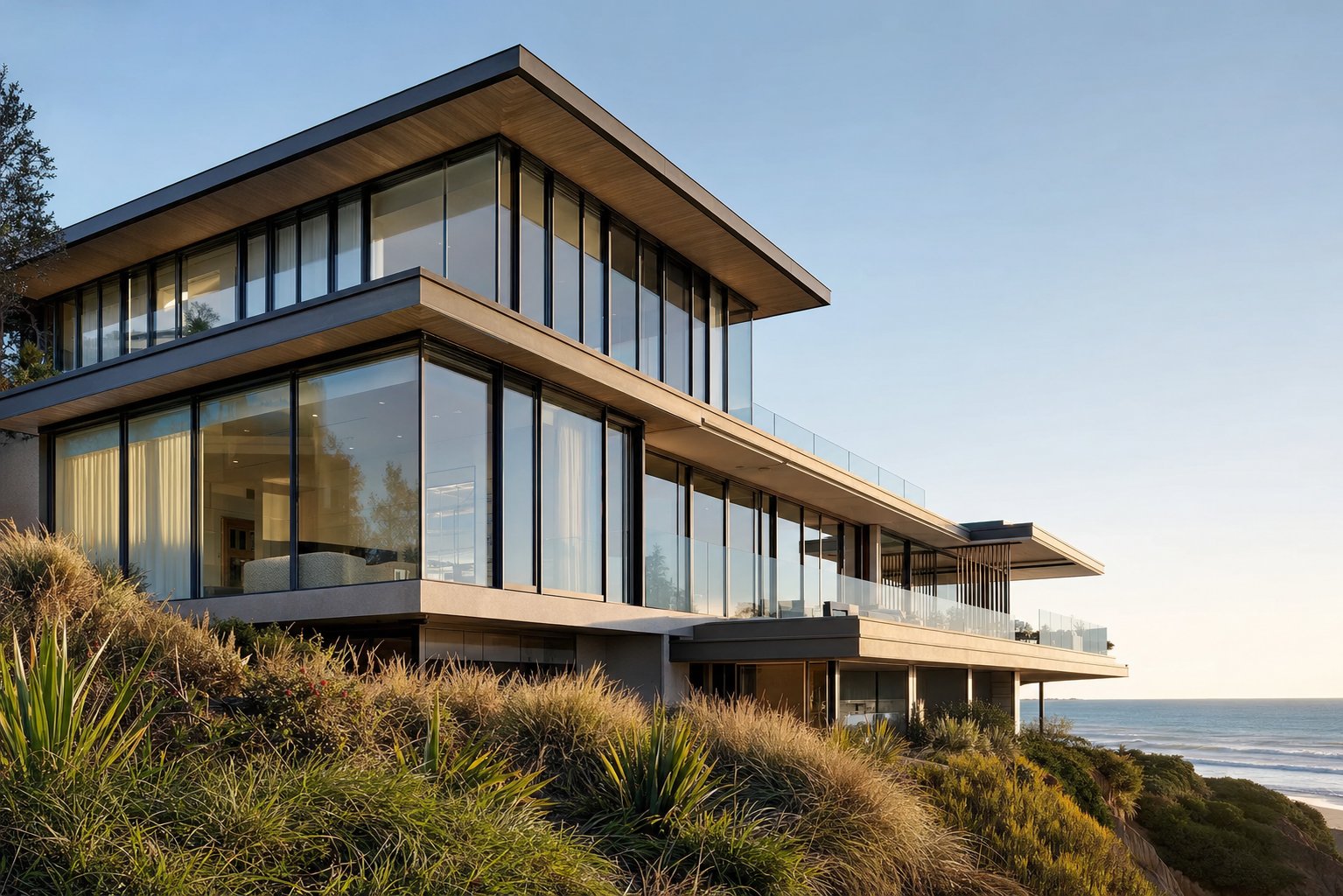
Performance Across Climates and Acoustic Environments
A double glazed double hung aluminium window is not a one-size-fits-all product. The same frame and sash mechanism can deliver dramatically different results depending on how the glass unit is configured — and that configuration should respond directly to local climate conditions, noise exposure, and environmental stresses. Getting this match right is the difference between a window that performs brilliantly for decades and one that underperforms from day one.
Configuration Choices for Hot and Cold Climates
Australia spans climate zones from tropical Darwin to alpine Thredbo, and each zone demands a different glazing strategy within the same aluminium frame system. The glass specification, cavity width, gas fill, and coating placement all shift depending on whether your primary concern is keeping heat out or keeping warmth in.
- Hot arid climates (inland QLD, western NSW, central Australia) — prioritise solar heat rejection. Specify tinted outer pane (grey or green), Low-E coating on surface 2 to reflect solar radiation before it enters the cavity, 12–16 mm argon-filled gap, and consider a wider 20 mm cavity for additional convective resistance. These configurations can reduce cooling energy demands by up to 40% compared to clear uncoated glazing.
- Cold temperate climates (Melbourne, Canberra, Hobart, highlands) — prioritise heat retention and beneficial solar gain. Use clear or lightly tinted glass with Low-E coating on surface 3 to reflect escaped room heat back inside. Argon or krypton gas fill in a 12–16 mm cavity. Pair with a thermally broken frame to prevent condensation on the interior aluminium surface during winter mornings.
- Tropical humid climates (Cairns, Darwin, coastal QLD) — balance heat rejection with humidity resistance. Solar control Low-E on surface 2, tinted outer pane, and ensure all IGU seals use high-quality moisture barriers. Humid conditions accelerate seal degradation, so dual-sealed IGUs with robust desiccant packing are essential for long-term clarity.
- Temperate coastal (Sydney, Perth, Gold Coast, Adelaide) — a balanced approach works best. Moderate Low-E coating, argon fill, and clear or neutral-tint glass. The variable seasonal conditions mean the window needs to perform across both heating and cooling cycles without sacrificing one for the other.
The frame itself remains aluminium throughout — what changes is purely the glass unit specification. This flexibility is one reason double glazed aluminium windows dominate across such varied Australian conditions. One frame system, tuned through glass selection to match any climate zone the NCC defines.
Noise Reduction Through Glass and Gap Design
Thermal performance gets most of the attention, but acoustic insulation matters just as much for homes near busy roads, flight paths, rail corridors, or entertainment precincts. Sound behaves differently to heat, and reducing it requires specific glass strategies that go beyond standard double glazing.
The Sound Transmission Class (STC) rating measures how effectively a window assembly blocks airborne noise — the higher the number, the quieter your interior. A standard double glazed unit with two identical 4 mm panes and a 12 mm air gap achieves roughly STC 28–32. That is adequate for quiet suburban streets, but insufficient near arterial roads or under approach paths.
Three design levers push acoustic performance higher:
- Glass thickness asymmetry — using different thickness panes (for example, 6 mm outer and 4 mm inner) disrupts the resonant frequency that allows sound to pass through. When both panes vibrate at the same frequency, sound transmits easily. Mismatched thicknesses force the sound energy to work against two different resonance points, significantly reducing transmission.
- Wider air gaps — increasing the cavity from 12 mm to 16 mm or 20 mm improves low-frequency sound attenuation. The added distance gives sound waves more space to dissipate energy before reaching the inner pane.
- Laminated glass — a PVB (polyvinyl butyral) interlayer sandwiched within one or both panes absorbs sound vibrations rather than transmitting them. Laminated configurations can add 3–5 STC points over non-laminated equivalents of the same thickness, pushing a well-specified aluminium double glazed window assembly into the STC 38–44 range — enough to reduce heavy traffic noise to a background murmur.
Combining all three — asymmetric panes, wider cavity, and laminated glass on the traffic-facing side — delivers the best results. For homes near major roads or in high-density areas, this configuration transforms double hung aluminium storm windows from basic weather barriers into serious acoustic shields, often negating the need for secondary glazing that older single-glazed double hung windows require.
Coastal and High-Humidity Performance
Salt-laden air is the most aggressive environment any window system faces in Australia. Fine salt crystals carried on sea breezes settle on frames, hardware, and tracks, attracting moisture and initiating corrosion within months if the materials are not specified correctly.
Aluminium handles this challenge better than most alternatives — provided it is properly finished. Two protective approaches dominate:
- Powder coating — electrostatically applied polyester powder baked onto the aluminium surface creates a continuous barrier between the metal and salt air. For coastal installations within 500 metres of breaking surf, coatings should meet or exceed the durability requirements of AS 3715. Higher-grade marine coatings rated to 1,000+ hours of salt-spray testing provide an additional safety margin.
- Anodising — an electrochemical process that converts the aluminium surface into a hard aluminium oxide layer. This layer is not applied on top — it grows from within the metal itself, making it virtually impossible to chip or peel. Anodised finishes resist salt corrosion and UV degradation simultaneously, which is why they remain common on high-end coastal projects throughout Victoria, NSW, and Queensland.
By comparison, untreated timber swells, cracks, and rots in salt-air environments. uPVC handles moisture well but can become brittle under the extreme UV exposure that coincides with coastal conditions. Standard hardware in any frame material fails fast — stainless steel (316 marine-grade) locks, hinges, and rollers are essential regardless of frame choice.
The complete picture for a coastal double glazed aluminium window includes marine-grade powder coating on all external profiles, stainless-steel hardware throughout, IGU seals rated for high-humidity exposure, and drainage channels designed to shed salt-laden water before it pools. Properly configured, these systems remain operational and visually clean for decades along the Australian coastline — while lesser-specified windows begin showing corrosion within 12 to 18 months.
Climate and acoustic performance both depend on getting the glazing configuration right for the specific site. Yet there is another dimension of performance — one that extends well beyond the building’s lifespan — which increasingly influences material selection decisions: what happens to the window at end of life, and what environmental cost was embedded in manufacturing it in the first place.
Sustainability and Recyclability of Aluminium Window Frames
Most window buying decisions focus on what the product does while it is installed — thermal performance, noise reduction, ventilation. Fewer buyers consider what happens to the frame material once the window reaches end of life, or what environmental cost was baked into manufacturing it. For aluminium, the lifecycle story is surprisingly strong. It is one of the few building materials that can be recycled indefinitely without losing structural or aesthetic quality, and that single characteristic reshapes the entire environmental equation when you compare aluminium replacement windows against other frame options over a multi-decade horizon.
Infinite Recyclability Without Quality Loss
Aluminium is a metal — an element bonded in a crystal structure — which means it can be melted and reformed repeatedly without degrading its fundamental properties. Unlike plastics, which break down into shorter polymer chains each time they are mechanically recycled, aluminium retains its original strength, formability, and finish potential through every cycle. A window frame extruded today from recycled content performs identically to one made from virgin ingot. There is no “downcycling” involved.
This is not a theoretical claim. Industry data from the Aluminum Association shows that approximately 75% of all aluminium ever produced remains in active use today — circulating through manufacturing, use, recovery, and remanufacturing in a genuinely closed loop. In building and construction markets specifically, recycling rates exceed 90%, because the high scrap value of aluminium creates a financial incentive to recover it rather than send it to landfill.
For homeowners weighing up aluminum windows replacement options, this matters practically. The aluminium frame you install today will not end up in a tip. When the window eventually reaches the end of its service life — 30 to 40 years from now — that frame has real monetary value as scrap and will almost certainly be collected, remelted, and extruded into new profiles or products.
Recycling aluminium requires only around 5% of the energy needed to produce primary aluminium from raw bauxite ore. That 95% energy saving means every recycled aluminium window frame carries a fraction of the carbon footprint embedded in its original manufacture — and this saving repeats every time the metal cycles through the system, indefinitely.
Lifecycle Environmental Impact
The upfront energy cost of producing primary aluminium is genuinely high — smelting bauxite ore into usable metal is an electricity-intensive process. Critics point to this initial embodied energy as aluminium’s environmental weakness. And they are not wrong, in isolation. But lifecycle assessment tells a different story when you account for longevity, maintenance requirements, and recyclability across the full ownership period.
Consider the comparison against the two most common alternative frame materials in Australia:
- Timber — the only frame material with negative embodied carbon when responsibly sourced, because trees sequester CO2 as they grow. However, timber frames demand regular painting or sealing (every 3–5 years), and those maintenance products — primers, paints, sealants — carry their own chemical and carbon footprint accumulated over decades. Treatment chemicals used to protect against termites and rot (common in Australian conditions) add further environmental load. If a timber frame deteriorates prematurely due to neglected maintenance, the replacement cycle starts over, doubling the lifecycle impact.
- uPVC (vinyl) — derived from petrochemicals and manufactured using chlorine chemistry. While uPVC frames require minimal maintenance during their service life, their end-of-life story is problematic. Most uPVC windows removed during renovation or demolition end up in landfill because recycling infrastructure for PVC building products remains limited in Australia. The material degrades with each recycling attempt, and contamination from reinforcing steel, hardware, and sealants complicates the process. A typical lifespan of 20–30 years means multiple replacement cycles within the timeframe a single aluminium frame would still be operating.
Aluminium sits between these extremes on initial embodied energy — higher than timber, comparable to or lower than uPVC depending on recycled content — but pulls decisively ahead over the full lifecycle. Its 30–40+ year lifespan eliminates replacement cycles. Its near-zero maintenance avoids decades of chemical applications. And its infinite recyclability means the embodied energy is not “spent” — it is stored in a material that retains value and utility through each successive life.
End-of-Life Value Recovery
Here is where aluminium differs most sharply from every competing frame material: it has genuine scrap value at end of life. When a building is demolished or a homeowner upgrades from an older replacement aluminum window to a newer system, the aluminium frames are routinely pulled out and sold to scrap metal dealers. The metal does not need special processing facilities or dedicated collection programmes — it feeds directly into existing secondary aluminium production streams that already account for the majority of aluminium output in developed economies.
Timber frames, by contrast, typically go to skip bins during demolition. If they contain chemical treatments (CCA-treated pine, for example), they cannot be burned or composted safely and end up in controlled landfill. uPVC frames follow a similar path — technically recyclable in a narrow sense, but practically discarded because the economics of collection and reprocessing do not stack up at current volumes in Australia.
For environmentally conscious buyers — and for builders working toward Green Star or similar sustainability ratings — this closed-loop characteristic is increasingly relevant. Specifying aluminium double hung windows means specifying a frame material that retains value at every stage: high performance during use, low maintenance burden throughout its life, and genuine material recovery at end of service. No other common window frame material offers all three simultaneously.
Sustainability credentials matter at the point of purchase. But they also matter across the years that follow — the years spent living with the window daily, maintaining it (or not), and keeping it operating at peak performance. Which raises a practical question: what does ongoing care actually look like for an aluminium double hung system, and how little or how much attention does it genuinely need?
Maintenance and Long-Term Care for Lasting Performance
Aluminium double hung windows earn their reputation for low maintenance — but low does not mean zero. A small amount of seasonal attention keeps sashes gliding smoothly, seals performing effectively, and the powder-coated finish looking sharp for decades. Neglect these basics and minor issues compound into expensive repairs. The good news: most upkeep is simple, requires no specialist tools, and takes less than an hour per window annually.
Cleaning Tracks and Lubricating Hardware
Dirt and grit in the jamb tracks is the single most common cause of stiff or uneven sash travel. Fine dust, pollen, insect debris, and sand carried on the breeze settle into the grooves and gradually pack into a resistant layer that forces the sash to drag rather than slide. Clearing the tracks twice a year prevents this buildup from damaging rollers or scoring the aluminium channel.
Start by vacuuming loose debris from the track with a crevice attachment. Follow with a soft brush — an old toothbrush works well — dipped in warm water with a few drops of mild dish detergent. Scrub the grooves and wipe dry with a clean cloth. Avoid leaving moisture sitting in the channel, as pooled water traps fresh grit faster.
Once tracks are clean, lubricate moving hardware. Apply a silicone-based spray to the balance shoes, sash locks, and tilt latch mechanisms. Silicone lubricants dry without leaving a sticky residue — critical, because oil-based products attract dust and create the exact grime you just removed. A light spray every six months keeps locks engaging crisply and balances travelling freely.
Weatherstrip and Seal Inspection
Weatherstripping degrades so slowly you rarely notice until a draught appears or road noise creeps up. At least once a year — ideally before winter — run a visual check along all four seal zones: head, sill, both jamb tracks, and the meeting rail interlock. Look for compression that has gone flat, cracking along fin seals, sections pulling away from the frame, or gaps visible with the sash fully closed.
Damaged weatherstripping should be replaced promptly. Most aluminium double hung systems use clip-in or press-fit seal profiles that pull out cleanly and accept a fresh length cut to size. Source the correct profile from the window manufacturer or a glazing hardware supplier — generic weatherstripping from general hardware stores rarely matches the specific channel dimensions of aluminium-framed systems.
The insulated glass unit deserves a separate visual check. Persistent fogging or haze between the two panes — cloudiness you cannot wipe from either side — indicates that the perimeter seal has failed and moisture has entered the cavity. Once the internal desiccant saturates, the fog becomes permanent. At that point, the IGU needs replacement, though the aluminium frame and sashes themselves typically remain perfectly sound.
For powder-coated frame surfaces, clean with the same mild detergent and soft cloth used on the tracks. Never use abrasive pads, scouring powders, or solvent-based cleaners — these damage the coating and expose raw aluminium underneath. A gentle wash two to three times per year (more often in coastal or dusty locations) keeps the finish intact and the warranty valid.
Seasonal Maintenance Checklist
Spreading tasks across the year avoids the temptation to skip everything. This schedule covers both autumn preparation for winter weather tightness and spring recovery after the cold months:
- Autumn — Inspect weatherstripping for compression or cracking. Replace any damaged sections before winter rain and cold expose gaps. Check drainage weep holes in the sill are clear of debris so water drains rather than pools.
- Late autumn — Lubricate all hardware (locks, balances, tilt latches) with silicone spray. Test sash operation at full travel to identify any dragging or uneven movement before cold weather makes stiff mechanisms worse.
- Spring — Vacuum and wash jamb tracks to clear grit accumulated over winter. Clean glass inside and out. Inspect powder-coated surfaces for any chips or scratches that could allow corrosion to start — touch up with manufacturer-matched paint if needed.
- Spring — Visually inspect each IGU for internal fogging or condensation. Check that both sashes sit square and that the meeting rail interlocks tightly when closed.
When to Repair vs When to Replace
Aluminium’s durability means the frame itself almost never needs replacing — it is individual components that wear. Knowing which failures justify repair and which signal full replacement saves money and avoids unnecessary waste.
| Problem | Likely Cause | Repair or Replace? | DIY or Professional? |
|---|---|---|---|
| Sash slides down on its own | Failed or worn balance mechanism | Repair — replace balance pair | DIY (moderate skill required) |
| Fogging between glass panes | IGU seal failure, desiccant saturated | Replace IGU only — frame stays | Professional (requires reglazing) |
| Draughts with sash closed | Compressed or cracked weatherstripping | Repair — replace weatherstrip | DIY (clip-in profiles) |
| Lock does not engage securely | Worn cam, misaligned keeper | Repair — adjust or replace lock | DIY (screwdriver and replacement part) |
| Powder coating peeling or flaking | Physical damage, UV degradation, or poor original application | Spot repair if localised; consider recoating if widespread | Professional (requires proper surface prep) |
| Frame corroding at joints | Coating breach in coastal environment, water trapped in channels | Assess extent — may need frame replacement if structural | Professional (structural assessment needed) |
| Sash binds or jams mid-travel | Debris in track, misaligned sash, or swollen weatherstrip | Repair — clean track, realign sash | DIY (clean and lubricate first) |
The general rule: if the aluminium frame profiles are straight, uncorroded, and structurally sound, almost everything else — glass units, balances, locks, weatherstrips, even handles — can be replaced individually. Full window replacement only makes sense when the frame itself is compromised (significant corrosion, structural deflection, or when upgrading to a thermally broken system from an older unbroken profile). This component-level repairability is one of aluminium’s underappreciated advantages — it extends the practical service life far beyond what most homeowners expect, provided those small seasonal maintenance tasks actually get done.
Selecting the Right Double Hung Window for Your Project
Maintenance keeps an existing window performing. But choosing the right window in the first place — specifying the correct glass, frame configuration, and compliance pathway before anything gets ordered — determines whether that performance meets your actual needs for the next three decades. This is where homeowners, builders, and architects diverge in their decision-making, yet all face the same core set of specification choices.
Key Specification Decisions for Your Project
Whether you are replacing a single window in a bedroom renovation or specifying 200 openings across a multi-residential development, the decision tree follows the same logic. Work through these points before requesting quotes for double hung windows for sale in your area:
- Opening size and weight limits — measure the structural opening (height and width in millimetres). Larger openings mean heavier sashes, which influence balance type and may require thicker aluminium profiles or reinforced meeting rails. Most standard double hung systems accommodate openings up to approximately 1,500 mm wide and 1,800 mm tall; anything beyond that typically moves into custom territory.
- Glass specification — match the IGU to your site conditions. Clear glass for shaded or south-facing openings; tinted for west-facing heat exposure; Low-E coated for energy-sensitive builds; laminated for acoustic control or BAL-rated bushfire zones. The choice here directly impacts weight, cost, and compliance outcomes.
- Cavity width and gas fill — 12 mm argon-filled cavities suit most residential applications. Step up to 16 mm or 20 mm cavities for enhanced acoustic or thermal performance. Krypton fills only make sense in narrow-cavity configurations where space is constrained.
- Hardware finish — standard options include white, black, and brushed chrome. Coastal projects should specify 316-grade stainless-steel hardware regardless of colour preference. Ensure locks, tilt latches, and sash lifts are available in finishes that complement both the interior décor and the external powder coat colour.
- Frame colour and coating grade — powder coating to AS 3715 is the minimum standard. Coastal installations within one kilometre of breaking surf require enhanced durability coatings. Confirm the manufacturer’s coating warranty covers your specific exposure classification.
- Thermal break requirement — non-negotiable for NCC Section J compliance in most climate zones. Verify the profile uses a polyamide thermal barrier, not simply a cheaper “poured and debridged” polyurethane that may not carry the same structural certification.
Getting these decisions locked in early prevents the expensive mid-project changes that give this article its title. Each choice cascades into the next — glass type affects sash weight, which affects balance selection, which affects long-term operability.
Compliance and Rating Systems to Understand
Australian projects operate under a layered compliance framework. Understanding which standards apply to your build avoids costly re-specification after council or certifier review.
- AS 2047 — the primary Australian Standard governing window and door performance. It sets minimum requirements for air infiltration, water resistance, wind load resistance, and operating force. Every window installed in a new build or major renovation must comply.
- AS 1288 — the glazing standard. It determines where safety glass (toughened or laminated) is mandatory — typically below 800 mm from finished floor level, within 500 mm of a door, or in wet areas.
- NCC Section J (Energy Efficiency) — specifies maximum whole-window U-values and solar heat gain coefficients based on your climate zone. A thermally broken, double glazed aluminium system meets these requirements across all eight climate zones when configured correctly.
- WERS (Window Energy Rating Scheme) — a voluntary but widely referenced star-rating system. Higher stars indicate better energy performance. Many builders and energy assessors use WERS ratings as a shorthand during NatHERS modelling.
- BAL ratings (Bushfire Attack Level) — for properties in designated bushfire-prone areas, AS 3959 prescribes specific glazing requirements ranging from BAL-LOW through to BAL-FZ (Flame Zone). Higher BAL ratings typically mandate toughened or tempered glass, bushfire-rated seals, and non-combustible framing — aluminium inherently satisfies the framing requirement.
For professionals managing documentation, a structured window schedule listing each opening type, size, performance values, and compliance pathway streamlines both council approval and on-site verification. Include U-value, SHGC, and air infiltration data for every window type specified.
Finding a Quality Aluminium Double Hung Window System
The market splits into two broad categories: standard (project) windows and custom-manufactured systems. Standard systems use fixed size ranges and pre-engineered configurations — ideal for repetitive residential builds where speed and budget consistency matter. Custom systems engineer each window to project-specific dimensions, performance targets, and architectural intent — suited to feature elevations, non-standard openings, or builds chasing premium performance benchmarks.
Most Australian residential projects fall somewhere between. A builder might use standard sizes across a development’s bedroom and bathroom openings, then switch to custom dimensions for living areas with larger or uniquely proportioned windows. This hybrid approach balances cost control with design flexibility.
Regardless of which path suits your project, evaluate suppliers against these criteria: AS 2047 test evidence for the specific configurations you need, clear warranty terms covering both frame and IGU, proven supply into your climate zone, and the ability to provide WERS data or NatHERS modelling support when your energy assessor requests it.
For readers who have followed the principles discussed throughout this guide — spiral balance operation, thermally broken framing, double glazing configured for Australian conditions — and want to see how those elements come together in a dedicated system, MEICHEN’s MA150 Double Hung Window applies exactly this combination for residential and project-based applications. It serves as a practical reference point for comparing how different manufacturers interpret the same core engineering requirements into a finished product you can actually specify and install.
Frequently Asked Questions About Double Glazed Double Hung Aluminium Windows
1. Are double glazed aluminium windows energy efficient?
Yes, when fitted with thermal break technology. Modern thermally broken aluminium double hung windows achieve whole-window U-values between 1.8 and 2.8 W/m²K, which satisfies NCC Section J energy efficiency requirements across all Australian climate zones. The thermal break — a polyamide strip inserted between the interior and exterior aluminium profiles — reduces heat transfer through the frame by roughly 640 times compared to unbroken aluminium. Combined with argon gas fills and Low-E coatings on the insulated glass unit, these windows perform comparably to timber and uPVC alternatives while offering slimmer sightlines and longer lifespans. Systems like MEICHEN’s MA150 Double Hung Window incorporate polyamide thermal barriers and double glazing as standard features for Australian residential applications.
2. How long do double glazed double hung aluminium windows last?
Thermally broken aluminium double hung windows typically last 30 to 40 years or more with minimal maintenance. The aluminium frame itself is virtually indestructible under normal conditions — it won’t rot, warp, swell, or attract termites. Individual components wear at different rates: balance mechanisms last 15 to 25 years depending on type, weatherstripping may need replacing every 10 to 15 years, and insulated glass units maintain seal integrity for 20 to 30 years before potential fogging. Because these components are individually replaceable without removing the frame, the practical service life often extends well beyond 40 years. Powder-coated finishes rated to AS 3715 resist UV degradation and coastal salt exposure throughout this lifespan.
3. What causes a double hung window to not stay open?
A double hung window that slides down on its own has a failed or worn balance mechanism. The balance — typically a spiral, block-and-tackle, or constant-force type — counteracts the sash weight so the panel holds at any position. Over 15 to 20 years of use, the spring tension weakens or the cord frays, and the mechanism can no longer support the glazed sash. Uneven travel where one side drops faster indicates only one balance has failed. The fix is a targeted repair: weigh the sash, source a replacement balance matched to that weight, and swap the mechanism within the jamb channel. Replacing both sides simultaneously ensures even tension and prevents recurring issues.
4. Are aluminium windows suitable for coastal areas in Australia?
Aluminium is one of the best-performing frame materials in coastal salt-air environments — provided it receives the correct protective finish. Powder coating to AS 3715 or marine-grade anodising creates a continuous barrier between the metal and corrosive salt particles. For installations within 500 metres of breaking surf, enhanced durability coatings rated to 1,000+ hours of salt-spray testing are recommended. The complete coastal specification also includes 316 marine-grade stainless-steel hardware, IGU seals rated for high-humidity exposure, and drainage channels designed to shed salt-laden water. Properly configured, aluminium double hung windows remain operational for decades along the Australian coastline where untreated timber and standard hardware would fail within 12 to 18 months.
5. What is the difference between double hung and single hung aluminium windows?
In a double hung window, both the top and bottom sashes slide vertically and operate independently — you can open either or both for flexible ventilation control. A single hung window has a fixed top sash and only the bottom panel moves. Double hung designs offer superior airflow management: drop the top sash to release warm air near the ceiling while raising the bottom for fresh intake at seated level. They also allow tilt-in cleaning from both sashes, which is particularly useful on upper-storey installations. The trade-off is that double hung windows require two balance mechanisms instead of one, adding slightly to cost and long-term maintenance. For most Australian homes, the ventilation flexibility justifies the modest additional investment.
More Window & Door Guides