What Double Glazing Means in Aluminium Windows
Before you start comparing double glazed aluminium window suppliers, it helps to understand exactly what you’re buying. Double glazing refers to a sealed insulating glass unit (IGU) fitted within an aluminium frame. It’s not simply two sheets of glass stacked together — it’s an engineered system where every component plays a role in thermal and acoustic performance.
How Sealed Insulating Glass Units Work
An IGU in aluminium double glazed windows consists of two panes of glass separated by a spacer bar, with the cavity between them hermetically sealed. That sealed airspace is what creates the insulating barrier. Here are the key components that make up a double glazed unit:
- Outer glass pane — faces the exterior environment
- Spacer bar — maintains a consistent gap between panes
- Gas fill — air, argon, or krypton within the sealed cavity
- Inner glass pane — faces the interior living space
- Primary and secondary sealant layers — prevent moisture ingress and gas leakage
Each layer works together. If the sealant fails, moisture enters the cavity and the unit fogs. If the spacer bar conducts too much heat, you lose efficiency at the glass edge. An aluminium window with glass that performs well depends on every one of these elements being right.
Gas Fills and Glass Coatings Explained
The cavity between panes is typically filled with air or a denser inert gas. Argon is the most common upgrade — it’s denser than air and reduces heat transfer through the IGU. Krypton offers even better insulation but costs significantly more and is less commercially available at scale. When 90% argon fill replaces air in a low-E coated IGU, insulating performance can improve by up to 16%.
Low-emissivity (low-E) coatings are microscopically thin metallic layers applied to one or more glass surfaces. They reflect radiant heat back toward its source — keeping warmth inside during winter and solar heat outside during summer. For double-glazed aluminium windows in Australia, low-E coatings are particularly valuable given the country’s intense UV exposure and wide temperature swings.
Why Spacer Bar Choice Matters
The spacer bar separating the two panes is a detail most buyers overlook, yet it directly affects edge-of-glass temperature and condensation risk. Traditional aluminium spacers are strong and inexpensive, but they conduct heat readily — creating a thermal bridge at the perimeter of the IGU. Warm-edge spacers, made from materials like stainless steel, thermoplastic, or composite polymers, reduce heat transfer at the glass edge by up to 30% compared to conventional metal spacers.
For aluminium double glazing to perform at its best, warm-edge spacers are the stronger choice — especially in cooler climates like Melbourne or Hobart where condensation on interior glass is a common complaint. When you’re evaluating suppliers, asking which spacer system they use tells you a lot about how seriously they approach thermal performance.
This foundational knowledge — IGU construction, gas fills, coatings, and spacer types — gives you the vocabulary to ask the right questions. But the glass unit is only half the equation. How it interacts with the aluminium frame determines whether your aluminium double glazed windows actually deliver on their rated performance.
How Double Glazing Enhances Aluminium Window Performance
Aluminium has a reputation problem. Many buyers assume the material is too conductive to work well in energy-efficient windows — and with single pane aluminium windows, that concern has some merit. Bare aluminium transfers heat roughly 1,000 times faster than timber. But that raw conductivity figure ignores what modern engineering has done to the frame, and what double glazing does to the glass area itself. When a thermally broken aluminium frame holds a quality IGU, the combination delivers performance that rivals or exceeds other frame materials across three measurable dimensions.
Thermal Insulation and Energy Savings
The biggest gain from upgrading to double pane aluminium windows is reduced heat transfer through the glazed area — which typically accounts for 70-80% of a window’s total surface. A sealed cavity filled with argon gas dramatically slows conduction and convection between the interior and exterior panes. Add a low-E coating, and radiant heat transfer drops further still. The result is a U-value reduction of 50% or more compared to single glazing, which translates directly into lower heating and cooling costs. In climates like Melbourne’s cold winters or Brisbane’s intense summers, that thermal barrier works year-round.
The thermal break in the aluminium frame — a polyamide strip separating the inner and outer profiles — ensures the frame doesn’t undermine what the double glass windows achieve. Without it, heat bypasses the IGU through the frame itself. With it, the entire window system functions as a cohesive insulating unit.
Condensation Prevention on Interior Glass
Condensation forms when warm, moist indoor air contacts a surface cold enough to reach its dew point. Single glazed aluminium windows are notorious for this — the inner pane sits close to outdoor temperature, and the conductive frame compounds the problem. Double glazing keeps the interior glass surface significantly warmer, reducing condensation risk by 70-90%. That means less mould growth around frames, less damage to window sills, and better indoor air quality. For aluminium double hung windows and casement styles alike, this benefit is especially noticeable in bathrooms, kitchens, and bedrooms where humidity levels spike overnight.
Noise Reduction Through Double Glazed Units
Sound attenuation through double glazing works on the mass-air-mass principle. Two separate panes of glass, decoupled by an air or gas cavity, disrupt sound wave transmission far more effectively than a single pane of equivalent total thickness. Standard double glazing typically achieves 30-35 dB of noise reduction — a noticeable step up from the 25-28 dB range of single glazing. Using unequal pane thicknesses (say, 6 mm outer and 4 mm inner) improves this further by preventing both panes from resonating at the same frequency. For homes on busy roads or under flight paths, this acoustic improvement is often the primary reason buyers choose aluminium double pane windows over single glazed alternatives.
| Performance Metric | Single Glazed Aluminium | Double Glazed Aluminium (with thermal break) |
|---|---|---|
| Approximate U-value range | 5.0 – 6.0 W/m²K | 1.8 – 2.8 W/m²K |
| Noise reduction | 25 – 28 dB | 30 – 40+ dB |
| Condensation risk | High — inner pane near outdoor temperature | Low — inner pane stays close to room temperature |
| Heat loss through glazing | Baseline (100%) | Reduced by 40 – 60% |
These numbers tell a clear story, but they only hold true when the frame and glazing unit are engineered as a system. A high-performance IGU installed in a non-thermally-broken frame still bleeds heat at the perimeter — which raises the question of how frame engineering and glass performance actually interact at a technical level.
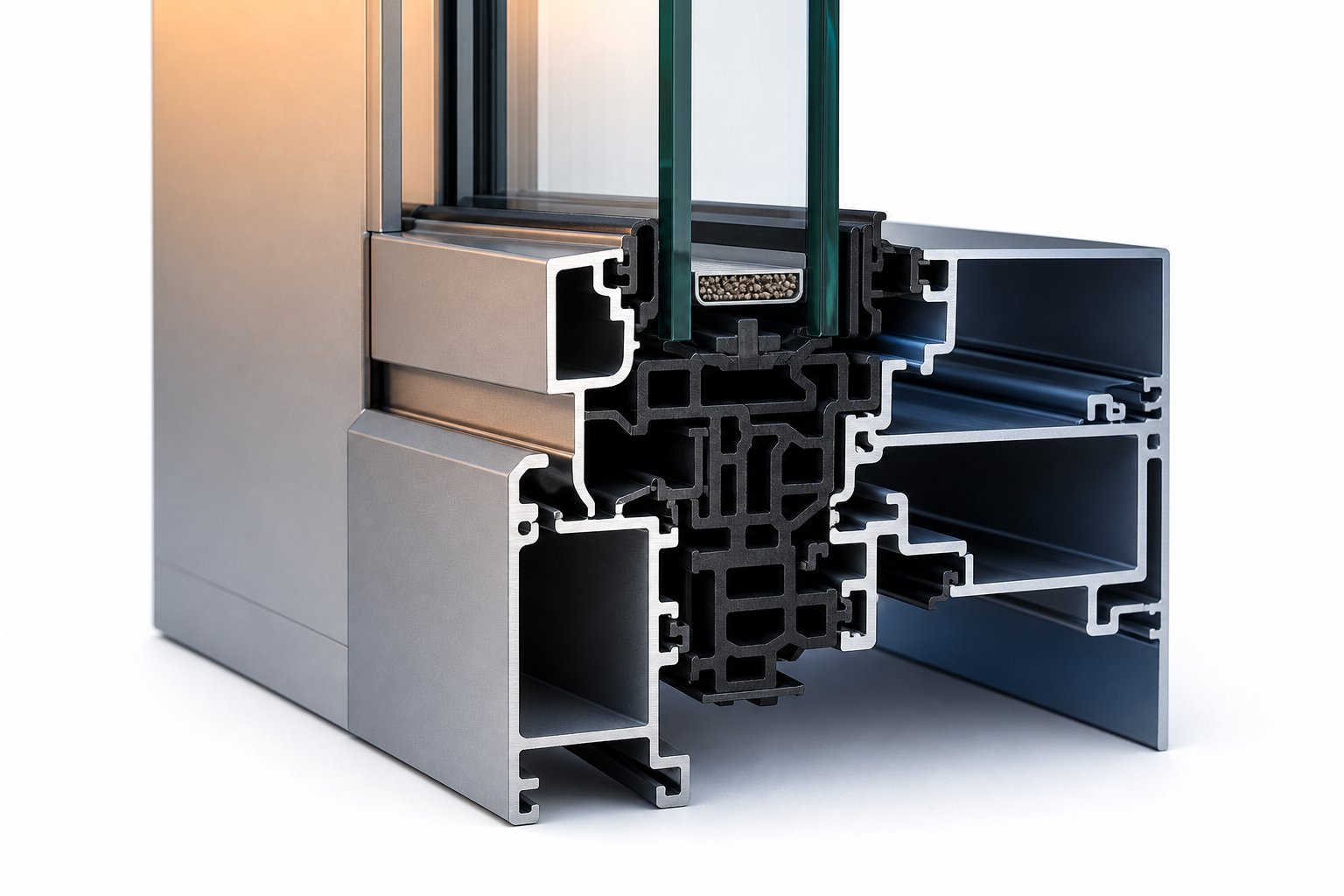
Thermal Break Technology and Frame-Glazing Synergy
The glazing unit and the frame aren’t independent parts — they form a single thermal system. A premium IGU can’t compensate for a frame that conducts heat freely, and a well-engineered frame can’t rescue a poorly sealed glass unit. Understanding how these two components interact is what separates informed buyers from those who end up disappointed with their aluminium window frames.
What Is a Thermal Break in Aluminium Frames
A thermal break is a strip of non-conductive material — typically glass-fibre-reinforced polyamide (nylon) — inserted between the interior and exterior sections of an aluminium window frame. It physically separates the two halves of the profile so heat can’t travel directly through the metal from one side to the other.
Without this barrier, a continuous aluminium profile acts as a thermal bridge. Touch a non-thermally-broken metal window frame on a cold morning and you’ll feel exactly how efficiently it conducts heat out of your home. Polyamide’s thermal conductivity sits around 0.3 W/mK compared to aluminium’s 237 W/mK — a difference of nearly 800 times. That single strip of material can improve frame thermal performance by 70-85%, bringing U-values from the 4.0-6.0 W/m²K range down to 0.8-2.0 W/m²K in well-designed thermal break aluminium windows.
Frame Depth and Glazing Unit Compatibility
Frame depth determines what thickness of IGU a supplier can physically accommodate. Standard aluminium window framing profiles typically accept glass units from 20 mm to 28 mm — enough for a basic double glazed unit with a 12 mm cavity. But if you want a wider gas-filled cavity (16 mm or 20 mm for better insulation), or you’re specifying thicker glass for acoustic or safety reasons, you need a deeper profile.
This is where supplier capability matters. Not every manufacturer offers the frame depth required for high-performance IGU configurations. A deeper profile with properly designed glazing channels ensures secure glass retention, adequate edge clearance for thermal expansion, and room for quality gasket seals. Ask your supplier what maximum IGU thickness their system supports — the answer reveals a lot about the performance ceiling of their product range.
Why Both Components Must Work Together
Window performance is only as strong as its weakest component. A high-performance IGU in a non-thermally-broken frame still bleeds heat at the perimeter. A thermally broken frame holding a low-quality glass unit still underperforms at the glazed area. Both must be engineered as a system.
This principle is critical when evaluating double glazed aluminium window suppliers. Some offer excellent aluminium window frames paired with basic glass units. Others source premium IGUs but fit them into profiles without adequate thermal breaks. The suppliers worth your attention are those who treat aluminium window framing and glazing specification as a coordinated engineering decision — matching frame depth, thermal break width, spacer type, gas fill, and glass coatings to deliver a verified whole-of-window U-value rather than cherry-picking individual component specs.
Knowing how frame and glass interact gives you a technical foundation. The next question is how to read the performance numbers suppliers put in front of you — and which metrics actually matter for your climate zone.
Performance Metrics Every Buyer Should Understand
Supplier specification sheets are full of numbers, but most buyers don’t know which ones actually matter for their project. When you’re comparing products from different double glazed aluminium window suppliers, four key metrics determine whether an aluminium window will perform well in your specific climate — or just look good on paper.
Here’s how to rank these metrics by importance when evaluating energy efficiency:
- U-value (thermal transmittance) — the single most important indicator of insulating performance
- Solar Heat Gain Coefficient (SHGC) — critical for managing cooling loads in warm climates
- Air Infiltration (AL) — measures how airtight the window assembly is under pressure
- Visible Transmittance (VT) — determines how much natural light passes through the aluminum glass unit
Each metric tells you something different about how the window behaves in real conditions. Let’s break them down.
Understanding U-Value and What Numbers to Look For
U-value measures the rate at which heat transfers through the entire window assembly — frame, glass, spacer, and all. It’s expressed in W/m²K, and lower numbers mean better insulation. This is the metric that matters most for reducing heating costs in cooler climates like Melbourne, Hobart, or Canberra.
A key point many buyers miss: the U-value shown on a quality specification sheet should represent the whole window, not just the centre of glass. Because aluminium framed windows have higher conductivity at the frame and glass edge, a centre-of-glass figure alone paints an overly optimistic picture. The Window Energy Rating Scheme (WERS) in Australia rates whole-of-window performance, which gives you a realistic number to compare across suppliers. If a supplier only quotes centre-of-glass U-values, ask for the total system figure — the difference can be significant.
For compliance with the National Construction Code (NCC), the required U-value depends on your climate zone. Colder zones demand lower values. Check your supplier’s documentation against the NCC Section J requirements or your NatHERS assessment to confirm the product actually meets your project’s energy targets.
Solar Heat Gain Coefficient by Climate Zone
SHGC measures how much solar radiation passes through the glazing and enters your home as heat. It’s rated from 0 to 1 — a lower number means less solar heat gets through. Unlike U-value, there’s no universal “better” direction for SHGC. Your climate determines what you need.
In Queensland, the Northern Territory, or coastal NSW where cooling loads dominate, a low SHGC keeps interiors comfortable without overworking your air conditioning. Metal framed windows facing west or north in these regions benefit most from low-SHGC glass with solar control coatings. Conversely, in Victoria or Tasmania where winter heating is the bigger concern, a moderate-to-high SHGC allows beneficial solar warmth to enter during cooler months — reducing reliance on mechanical heating.
The trade-off? Lower SHGC typically means lower visible transmittance too, since the coatings that block solar heat also reduce light. Quality suppliers offer multiple glazing configurations so you can balance heat control against daylighting for each orientation of your home.
Reading Supplier Specification Sheets
Air infiltration — sometimes listed as air leakage — measures how much air passes through the closed window assembly under pressure. It’s expressed in litres per second per square metre (L/s/m²) in Australian testing. Lower numbers indicate a tighter seal. This metric matters for both energy efficiency and comfort; a draughty window undermines even the best framed windows regardless of their glazing performance.
Visible Transmittance (VT) rounds out the picture. Rated from 0 to 1, it tells you how much natural light the aluminium window lets through. Higher VT means brighter interiors. Most residential buyers prefer VT above 0.4 for living areas, though this needs to be balanced against SHGC requirements in sun-exposed orientations.
When reviewing any supplier’s data sheet, look for testing conducted to recognised standards — in Australia, that means AS 2047 for structural and weatherproofing performance, and WERS for energy ratings. If a supplier can’t point you to independently verified test results for their complete window system, treat their published numbers with caution. The metrics only mean something when they’re tested under controlled, repeatable conditions on the actual product you’re purchasing — not a theoretical calculation based on component specs alone.
A Framework for Evaluating Aluminium Window Suppliers
Performance metrics tell you what a window should do. But the supplier behind that window determines whether it actually delivers — consistently, on time, and with proper support when something goes wrong. Most buyers compare products. Fewer compare the organisations making them. That gap is where costly mistakes happen.
Whether you’re a homeowner sourcing aluminium window suppliers for a renovation or a builder placing a multi-unit order, the evaluation criteria below go beyond catalogue specs. They address the operational factors that separate reliable aluminium window manufacturers from those who look good on paper but create headaches on site.
Quality Control and Manufacturing Standards
A single good sample doesn’t guarantee a good batch. The real question is whether a supplier maintains consistent quality across every unit they produce — and whether they can prove it.
Credible alum windows manufacturers operate structured quality control at multiple production stages. As outlined by industry manufacturing guides, this typically includes incoming material inspection (checking profiles, glass, hardware, and gaskets before they enter production), in-process checks during cutting, machining, and assembly, and final inspection covering dimensions, diagonal accuracy, sash operation, seal integrity, and surface finish.
When you’re looking at aluminum windows for sale, ask the supplier to walk you through their QC workflow. A manufacturer confident in their process will explain it clearly. One that deflects or gives vague answers — “we check everything before it ships” — likely doesn’t have a formalised system. For black aluminum windows and other premium finishes, surface treatment consistency is especially important; powder coating thickness, adhesion, colour matching, and edge coverage should all be controlled and documented.
Third-party testing adds another layer of confidence. Products tested to AS 2047 for structural and weather performance, or rated through WERS for energy efficiency, carry independent verification that self-declared claims simply can’t match. Ask whether test reports are available for the specific product configuration you’re ordering — not just a generic system test from years ago.
Warranty Terms That Actually Protect You
Warranties vary enormously between aluminium window manufacturers, and the headline duration often obscures what’s actually covered. A “25-year warranty” sounds reassuring until you discover it only applies to frame corrosion and excludes the IGU seal, hardware, and powder coat finish — the components most likely to fail first.
Effective warranty evaluation means reading the detail. According to warranty analysis from industry sources, the most common coverage gaps include:
- Seal failure — the leading cause of fogged double glazing. Some warranties cover it for 10 years, others exclude it entirely or prorate the claim value over time.
- Hardware — hinges, locks, rollers, and friction stays wear with use. Check whether hardware is covered for the same duration as the frame or carries a shorter sub-warranty.
- Surface finish — powder coating degradation, chalking, or colour fade may be excluded in coastal or high-UV environments unless a marine-grade finish was specified.
- Installation-related defects — many product warranties are voided if installation wasn’t performed by an approved contractor.
- Transferability — if you sell the property, does the warranty transfer to the new owner? Non-transferable warranties reduce your home’s resale value.
Ask for the warranty document in writing before you commit. If a supplier can’t provide it — or if the language is deliberately vague — that tells you something about how they handle claims.
Red Flags When Evaluating Suppliers
Some warning signs are subtle. Others aren’t. Here’s what experienced builders and specifiers watch for when shortlisting double glazed aluminium window suppliers:
| Evaluation Criteria | What to Ask | What Good Looks Like | What to Avoid |
|---|---|---|---|
| Product documentation | Can you provide full technical data sheets and installation guides? | Detailed specs including whole-of-window U-values, SHGC, air infiltration, and AS 2047 test references | Generic brochures with no tested performance data or only centre-of-glass figures |
| Test reports | Are third-party test reports available for this specific product? | Current reports from NATA-accredited labs, referencing the exact configuration quoted | “We can get that later” or reports for a different product line presented as equivalent |
| Lead times | What’s the lead time for standard sizes vs custom orders? | Clear timeframes (e.g. 3-4 weeks standard, 6-8 weeks custom) with production scheduling transparency | Vague promises like “a few weeks” with no written confirmation or milestone visibility |
| Minimum order quantities | Is there a minimum order? Does pricing change with volume? | Transparent MOQ policy with clear pricing tiers for different quantities | Hidden surcharges for small orders discovered only at invoicing stage |
| Warranty specifics | What exactly is covered, for how long, and what’s excluded? | Written warranty document covering frame, IGU seal, hardware, and finish with defined claim process | Verbal assurances, unclear exclusions, or prorated coverage that diminishes rapidly |
| Installation support | Do you provide installation guidance, approved installer networks, or on-site support? | Detailed installation manuals, technical support line, and clear responsibility boundaries | No installation documentation; “your installer should know what to do” |
| After-sales service | How do you handle warranty claims, replacement parts, and defect resolution? | Defined process with response timeframes, local spare parts availability, and documented case handling | No clear process; long delays acknowledged as normal; blame-shifting to installers |
A pattern emerges across these criteria. The suppliers worth working with are those who ask more questions, not fewer — who want to understand your project requirements before quoting, who provide documentation without being chased, and who define their processes clearly enough that you know what to expect at each stage.
Conversely, suppliers who rush to quote without clarifying specifications, who avoid putting commitments in writing, or who can’t explain their own QC process are transferring risk to you. That risk shows up later as site delays, performance shortfalls, or warranty disputes that go nowhere.
The framework above works regardless of project scale. But the weight you place on each criterion shifts depending on whether you’re replacing three windows in a renovation or specifying hundreds of units for a multi-storey development — which raises the question of how project type should shape your supplier shortlist from the start.
Comparing Frame Materials for Double Glazed Windows
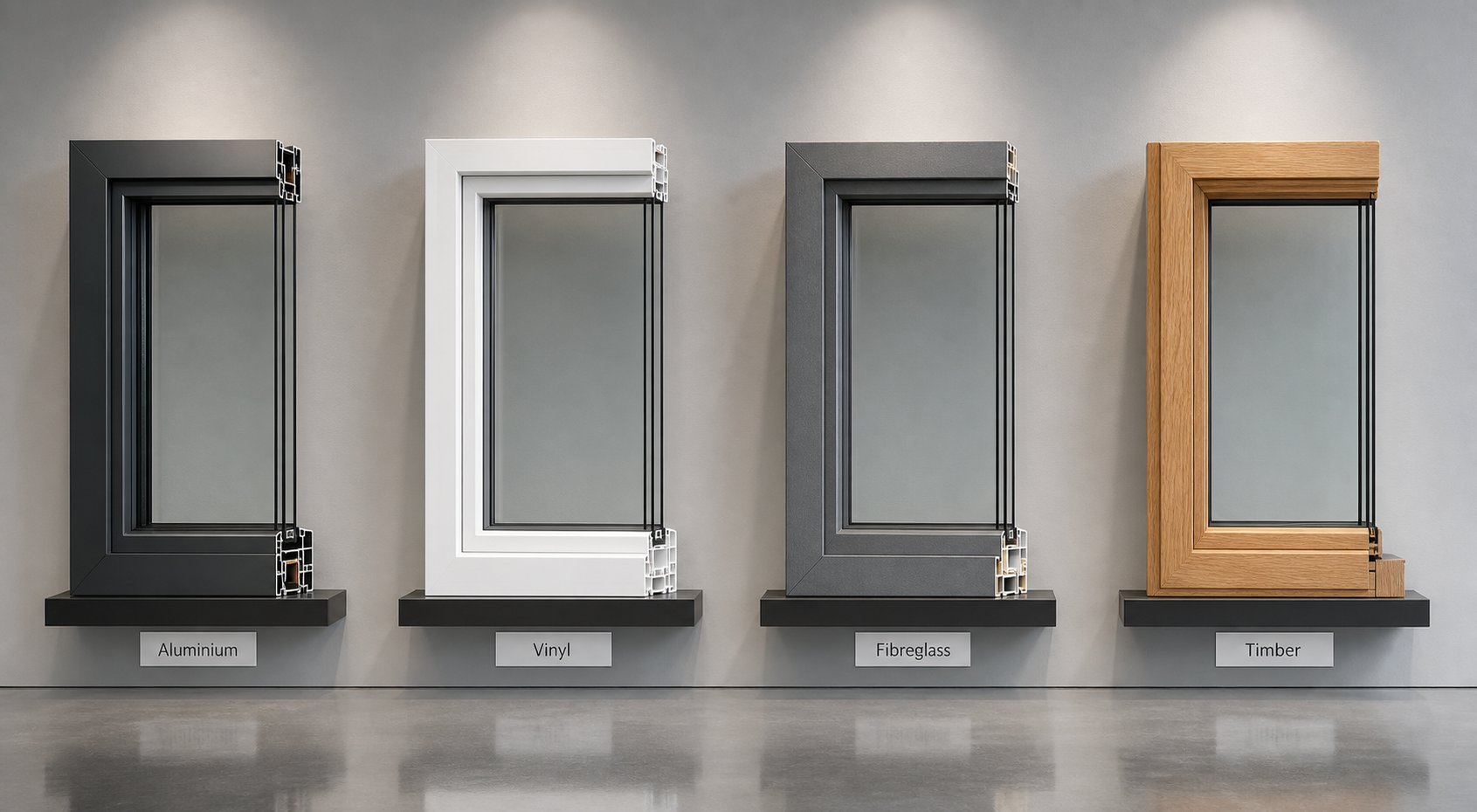
Supplier evaluation criteria apply regardless of frame material — but the material itself shapes what’s possible in terms of span, sightline, longevity, and thermal performance. Aluminium windows aren’t the only option for double glazed units. Vinyl, fibreglass, and timber all accept IGUs. The question is which frame delivers the best combination of performance, durability, and design flexibility for your specific project.
Here’s how the four main frame materials compare when paired with double glazing:
| Criteria | Aluminium (thermally broken) | Vinyl (uPVC) | Fibreglass | Timber |
|---|---|---|---|---|
| Durability | Excellent — resists rot, warping, and pest damage | Good — won’t rot or corrode, but can warp in extreme heat | Excellent — dimensionally stable, resists rot and corrosion | Moderate — susceptible to rot, termites, and moisture without ongoing treatment |
| Thermal performance (with double glazing) | Good to very good — thermal break reduces conductivity by 70-85% | Very good — inherent insulation from multi-chamber profiles | Excellent — low expansion rate matches glass, minimal thermal bridging | Very good — natural insulator, but performance degrades if seals fail |
| Maintenance | Low — periodic cleaning, hardware lubrication | Very low — soap and water only | Low — occasional cleaning, can be repainted | High — repainting or re-staining every 3-7 years, regular inspection for decay |
| Maximum span width | Up to 3,000 mm+ for single panels without reinforcement | Limited to ~1,500-1,800 mm before requiring steel reinforcement | Up to 2,400 mm without reinforcement | Up to 1,800-2,100 mm depending on species and section size |
| Recyclability | Fully recyclable — aluminium retains value indefinitely | Limited — technically recyclable but rarely recovered in practice | Partially recyclable — composite nature complicates processing | Biodegradable — renewable resource but not recyclable as a window product |
| Typical lifespan | 30-50+ years | 20-35 years | 40+ years (limited long-term field data) | 30-60+ years with diligent maintenance |
Aluminium vs Vinyl for Double Glazed Windows
Vinyl dominates the residential market in many countries on price alone. It insulates well without thermal breaks, costs less per unit, and needs almost no upkeep. For standard-sized openings in a budget-conscious project, it’s a sensible choice.
But vinyl hits structural limits quickly. Its lower tensile strength means frames need to be thicker — typically 60-80 mm wide compared to aluminium’s 40-55 mm — which eats into glass area and blocks sightlines. For spans beyond about 1,800 mm, vinyl profiles require internal steel reinforcement to prevent sagging, which adds weight and partially negates the thermal advantage. Aluminium windows handle spans exceeding 3,000 mm without supplementary bracing, making them the default for floor-to-ceiling glazing, stacking sliders, and large-format bi-fold doors common in contemporary Australian homes.
Colour is another differentiator. Vinyl is difficult to paint and typically limited to white, cream, or a handful of factory-applied colours that can fade under Australia’s intense UV. Windows in aluminium accept powder-coated finishes in virtually any colour — including the charcoal, matt black, and bronze tones popular in current architectural design — with coatings that resist fading for 25+ years. For projects where aesthetics and large glass areas drive the design, aluminium frame windows offer a level of versatility vinyl simply can’t match.
Aluminium vs Fibreglass and Wood Frames
Fibreglass is aluminium’s closest competitor on performance. It insulates better without needing a thermal break, expands at nearly the same rate as glass (reducing seal stress), and resists corrosion in coastal environments. The trade-off is cost and availability — fibreglass windows carry a significant price premium and fewer Australian suppliers stock them compared to aluminium. Lead times tend to be longer, and custom sizes are harder to source.
Timber offers natural warmth and excellent insulation, but demands ongoing maintenance that many homeowners underestimate. In humid coastal areas or tropical climates like Far North Queensland, timber frames face rot, swelling, and termite risk unless treated and maintained rigorously. Metal clad windows — timber frames with an external aluminium or metal cladding — attempt to solve this by protecting the exterior while preserving timber’s interior aesthetic. Aluminium clad wood windows perform well in this hybrid role, though they sit at the premium end of the market and add complexity to both manufacturing and installation.
Where aluminium stands apart from both is recyclability. Aluminium is infinitely recyclable without loss of quality, and recycled aluminium requires only 5% of the energy needed to produce primary metal. For projects with sustainability targets or green building certifications, this lifecycle advantage carries real weight.
Which Frame Material Suits Your Project
The right frame depends on what you’re building, where you’re building it, and what you prioritise. A few guiding principles:
- Large openings and slim sightlines — aluminium wins outright. No other material achieves the same strength-to-weight ratio in narrow profiles.
- Maximum thermal performance on a budget — vinyl delivers strong insulation at the lowest cost, provided your openings are standard-sized.
- Extreme durability with minimal maintenance — fibreglass or thermally broken aluminium, depending on availability and budget.
- Heritage or traditional aesthetics — timber or aluminium clad windows with timber interiors.
- Coastal or cyclone-prone locations — aluminium’s corrosion resistance (with appropriate powder coating or anodising) and structural strength make it the preferred choice for metal windows in exposed environments.
For most Australian residential and commercial projects, thermally broken aluminium windows strike the strongest balance between performance, design freedom, longevity, and lifecycle cost. The higher conductivity of raw aluminium — the concern that puts some buyers off — is effectively neutralised by modern thermal break technology and quality double glazing working in concert. What remains is a frame material that enables architectural ambition without compromising on durability or environmental responsibility.
Material choice narrows your supplier options. But within the aluminium category, not all products carry the same certifications — and those certifications determine whether your windows meet code, qualify for energy ratings, and hold up under warranty scrutiny.
Certification Standards and How to Verify Supplier Quality
A supplier can claim any performance figure they like in a brochure. Certification is what proves those claims hold up under independent scrutiny. For Australian projects, the certification landscape centres on a handful of mandatory standards and voluntary rating schemes — and knowing the difference between a legitimately tested product and a self-declared one can save you from compliance headaches, insurance disputes, and windows that underperform from day one.
Key Certification Bodies and What They Test
Several certification frameworks apply to aluminium windows and doors in Australia, each validating a different aspect of performance. Here’s what each one covers:
- AS 2047 (Windows and External Glazed Doors in Buildings) — the mandatory Australian Standard setting minimum requirements for structural adequacy, weather resistance, and durability. Products are tested for deflection under wind load, air infiltration, water penetration resistance, operating force, and ultimate strength. Every external window and glazed door in an Australian building must comply.
- AS 1288 (Glass in Buildings) — governs glass selection, thickness, and safety requirements. It’s referenced within AS 2047 and ensures the glazing itself is appropriate for the application, including human impact safety zones and wind load resistance.
- WERS (Window Energy Rating Scheme) — Australia’s voluntary energy rating system for windows. It provides star ratings (up to 10 stars) for heating and cooling performance, giving buyers a standardised way to compare the energy efficiency of different aluminium doors and windows products.
- NatHERS (Nationwide House Energy Rating Scheme) — while not a window certification per se, NatHERS assessments rely on accurate window performance data. Products with verified WERS ratings integrate directly into NatHERS modelling, ensuring your energy assessment reflects real-world performance.
- BAL (Bushfire Attack Level) compliance — for properties in designated bushfire-prone areas, aluminium windows and doors must meet specific requirements under AS 3959 depending on the BAL rating of the site. This affects glass type, frame material, and sealing details.
- Cyclone compliance — in regions north of the Tropic of Capricorn and other designated wind regions, windows must meet higher structural ratings under AS 2047 to withstand extreme wind pressures and debris impact.
For commercial aluminium windows on larger projects, additional performance requirements often apply — including acoustic ratings tested to AS/NZS 1276.1 and fire resistance where windows sit near boundary walls. The certification burden scales with project complexity, which is precisely why supplier documentation quality matters so much.
How to Verify Supplier Certifications Are Legitimate
Self-declared compliance is not the same as independently verified compliance. Some suppliers state their products “meet AS 2047” without ever having submitted them for testing at a NATA-accredited laboratory. Others hold valid test reports but for a different product configuration than what they’re quoting you.
Here’s how to distinguish genuine certification from marketing language:
Ask for the test report, not just the claim. A legitimate AS 2047 test report will reference a specific product type, size, and configuration. It will name the testing laboratory (which should hold NATA accreditation), include the date of testing, and detail results for each performance criterion — deflection, air infiltration, water penetration, operating force, and ultimate strength.
Check the product matches the report. A test report for a 1200 x 1500 mm awning window doesn’t automatically validate a 2400 x 2100 mm sliding door from the same range. AS 2047 allows manufacturers to extrapolate results within defined limits, but significant size or configuration changes require separate testing. If your order involves non-standard sizes or configurations, confirm that the supplier’s compliance documentation covers what you’re actually purchasing.
Look for compliance labels. As the Australian Glass and Window Association (AGWA) advises: if a window has no compliance labelling to AS 2047 or AS 1288, don’t use it — send it back. Every compliant window should carry identification linking it to its tested performance claims.
Verify WERS ratings independently. WERS ratings are published in a searchable database. If a supplier claims a particular star rating, you can cross-reference it against the official WERS records rather than relying solely on their marketing materials.
Australian Standards for Aluminium Window Systems
AS 2047 isn’t optional — it’s embedded in the National Construction Code and enforced through building certification. Using non-compliant windows creates problems that extend well beyond performance. Building certifiers can refuse to issue occupancy certificates. Insurance claims may be denied if non-compliant windows contribute to water damage or structural failure during storms. And if you ever sell the property, a building inspection that flags non-compliant windows becomes a negotiation liability.
For builders, architects, and specifiers sourcing commercial aluminium windows or residential systems, the simplest way to manage compliance risk is to work with suppliers who make their certification documentation publicly accessible. MEICHEN, for example, publishes its compliance and certification credentials online, allowing builders and specifiers to verify standards alignment before engaging in detailed quoting. This kind of transparency — where test reports, standards references, and product documentation are available upfront rather than drip-fed after repeated requests — signals a supplier that treats compliance as foundational rather than an afterthought.
The broader principle holds regardless of which supplier you choose: certified products protect you legally, financially, and practically. They ensure your aluminium windows and doors meet code, integrate accurately into energy assessments, and carry warranty backing that holds up if something fails. Suppliers who invest in rigorous testing and transparent documentation are telling you something about how they operate across every part of their business — from manufacturing quality to after-sales support.
Certification confirms a product meets standards. But standards requirements shift depending on what you’re building, where you’re building it, and whether you’re starting from scratch or replacing existing windows — factors that also determine which type of supplier is best positioned to serve your project.
Choosing the Right Supplier for Your Project Type
Not every double glazed aluminium window supplier serves every project equally well. A manufacturer geared toward high-volume commercial work may not entertain a three-window bathroom renovation. A supplier specialising in standard residential sizes may struggle with the custom aluminium windows a contemporary architect has drawn up. Your project type — its scale, complexity, and regulatory context — should shape your shortlist from the outset.
New Construction vs Replacement Window Suppliers
New builds and aluminium window replacement projects demand different products and different installation approaches. In new construction, windows are fitted into open stud frames before cladding goes on. The supplier provides full frames with fixing flanges or brackets designed to anchor directly to the structural opening. Frame profiles can be wider, deeper, and optimised purely for performance because there are no existing constraints to work around.
Replacement aluminium windows tell a different story. The existing opening, lining, and sometimes the sub-frame remain in place. The new window must fit within those dimensions — often with tighter tolerances. Some suppliers offer retrofit-specific profiles designed to slot into existing reveals without major structural modification, while others only manufacture new-construction frames and leave the adaptation to your installer. If you’re searching for aluminium windows near me for a renovation, confirm upfront whether the supplier’s product range includes replacement windows aluminium profiles engineered for retrofit scenarios. A mismatch here leads to awkward site modifications, compromised weatherproofing, or both.
Energy efficiency also differs between the two contexts. A new-construction window attaches directly to the wall structure, creating a tight seal that minimises air leakage. A replacement window’s performance depends partly on the condition of the existing frame and surrounding materials. If the original timber reveal is rotted or the masonry opening has shifted, even a premium IGU won’t perform to its rated specification. Good suppliers will flag this and recommend a full-frame replacement rather than a pocket insert where conditions warrant it.
Residential and Commercial Project Considerations
Residential and commercial aluminium windows differ in more than just size. Commercial projects typically require higher structural ratings (to handle greater wind loads on upper storeys), stricter acoustic performance, and compliance documentation that satisfies building certifiers and project managers simultaneously. Order volumes are larger, lead times are more critical, and the consequences of a delayed delivery ripple through an entire construction programme.
For residential projects — a single home or a small multi-dwelling development — the priorities shift toward aesthetic flexibility, colour choice, and responsive communication for smaller order quantities. Not all suppliers handle both ends of this spectrum well. A manufacturer tooled up for commercial aluminium windows may impose minimum order quantities that price out a homeowner. Conversely, a boutique residential supplier may lack the production capacity or certification depth that a commercial project demands.
Performance-focused suppliers like MEICHEN bridge this gap by serving residential, commercial, and architectural project types with documented compliance across Australian Standards. Their publicly accessible certification documentation gives builders and specifiers a reference point for what transparent supplier engagement looks like — regardless of project scale.
Matching Supplier Capabilities to Your Project Scope
Climate zone adds another layer. A supplier serving projects in Darwin or Cairns should offer low-SHGC glazing options as standard — solar control is non-negotiable in tropical Australia. In Melbourne or Hobart, low U-value configurations with argon-filled cavities and low-E coatings take priority for winter heating performance. Coastal projects from the Gold Coast to Perth’s northern suburbs need corrosion-resistant finishes and hardware rated for salt-air exposure. If a supplier can’t specify glazing and finish options appropriate to your location, they’re not equipped to serve your project properly.
Standard sizes versus custom fabrication is the final filter. Many suppliers stock a range of common dimensions that ship quickly and cost less. But if your design calls for non-standard heights, unusual configurations, or oversized panels, you need a manufacturer with custom aluminium windows capability — and the engineering support to confirm structural adequacy at those sizes.
Before you request quotes, work through these steps to ensure you’re approaching the right suppliers for your situation:
- Define your project type — new construction, full-frame aluminium window replacement, or pocket retrofit — and confirm the supplier manufactures profiles suited to that method.
- Confirm the supplier’s typical project scale aligns with yours — residential, commercial, or both — and ask about minimum order quantities.
- Identify your climate zone and check that the supplier offers glazing configurations (SHGC, U-value, VT) appropriate for your region’s dominant heating or cooling loads.
- Determine whether you need standard or custom sizes, and verify the supplier’s fabrication capability and lead times for each.
- Request compliance documentation — AS 2047 test reports, WERS ratings, and warranty terms — before engaging in detailed pricing discussions.
- Ask about installation support: do they provide technical drawings, fixing details, and approved installer networks in your area?
- Check after-sales responsiveness by asking how warranty claims and replacement parts are handled, including typical resolution timeframes.
These steps won’t guarantee a perfect outcome, but they filter out suppliers who can’t meet your project’s actual requirements — saving you from discovering capability gaps after contracts are signed and timelines are locked in. The buyers who get the best results from their double glazed aluminium window suppliers are those who match the supplier’s strengths to the project’s demands before price ever enters the conversation.
Frequently Asked Questions About Double Glazed Aluminium Window Suppliers
1. What should I look for when comparing double glazed aluminium window suppliers?
Beyond product specs, evaluate suppliers on manufacturing quality control processes, warranty coverage specifics (including IGU seal, hardware, and finish), lead times for standard versus custom orders, third-party test reports from NATA-accredited labs, and after-sales service responsiveness. Transparent suppliers provide AS 2047 compliance documentation upfront and can walk you through their QC workflow without hesitation. Red flags include vague specifications, no independently verified test data, and verbal-only warranty assurances.
2. How do I know if a supplier’s aluminium windows comply with Australian Standards?
Legitimate compliance requires independent testing at a NATA-accredited laboratory to AS 2047 for structural and weather performance, and AS 1288 for glass safety. Ask for the actual test report referencing your specific product configuration, size, and date of testing. Verify WERS energy ratings through the official searchable database rather than relying on brochure claims. Suppliers like MEICHEN publish compliance credentials publicly at meichenwindows.com.au/compliance, demonstrating what transparent certification documentation looks like for builders and specifiers.
3. Are thermally broken aluminium windows as energy efficient as vinyl or timber?
Modern thermally broken aluminium windows achieve comparable energy performance to vinyl and timber when paired with quality double glazing. The polyamide thermal break reduces frame conductivity by 70-85%, bringing whole-of-window U-values into competitive range. While vinyl insulates well inherently, it cannot span large openings without steel reinforcement. Aluminium’s advantage lies in enabling floor-to-ceiling glazing, slim sightlines, and spans exceeding 3,000 mm — maximising glass area while maintaining structural integrity and thermal performance.
4. What is the difference between centre-of-glass and whole-of-window U-values?
Centre-of-glass U-value measures thermal performance at the middle of the IGU only, ignoring heat loss through the frame and glass edges. Whole-of-window U-value accounts for the entire assembly — frame, spacer, edge-of-glass, and centre-of-glass combined. Because aluminium frames have higher conductivity at the perimeter, centre-of-glass figures paint an overly optimistic picture. Always request whole-of-window U-values tested through WERS for accurate comparison between suppliers, as the difference between the two figures can be substantial.
5. Do I need different double glazed aluminium windows for different climate zones in Australia?
Yes. Climate zone determines which glazing configuration performs best. In cold climates like Melbourne or Hobart, prioritise low U-values with argon-filled cavities and low-E coatings to retain heat. In tropical Queensland or the NT, low Solar Heat Gain Coefficient (SHGC) glass with solar control coatings reduces cooling loads. Coastal locations require corrosion-resistant powder coating and marine-grade hardware. A capable supplier will recommend glazing specifications matched to your specific climate zone rather than offering a one-size-fits-all product.
More Window & Door Guides