Understanding Aluminium and uPVC as Window Frame Materials
Every window frame does two jobs at once: it holds the glass in place and separates the inside of your home from whatever the Australian climate throws at it. The material doing that work shapes everything from how much light enters a room to how much you spend on energy bills over 30 years. That makes the difference between aluminium and uPVC windows more than a cosmetic preference. It is an engineering decision with long-term financial consequences.
What Is uPVC and How Is It Used in Windows
uPVC stands for unplasticised polyvinyl chloride. Unlike standard PVC windows, which contain chemical plasticisers to make the material flexible, uPVC removes those softening agents entirely. The result is a rigid, weather-resistant plastic reinforced with steel inserts and finished with fusion-welded joints. Manufacturers extrude the raw polymer into hollow multi-chamber profiles that trap pockets of air, giving uPVC doors and windows their characteristic insulation properties. The material does not rot, rust, or require repainting, and modern uPVC windows and doors come in a growing range of colours and finishes applied through foil wrapping.
What Is Aluminium and Why Is It a Popular Window Material
Aluminium window frames start as heated aluminium alloy logs forced through precision dies under immense hydraulic pressure, a process called extrusion. This allows fabricators to create complex profile shapes with very thin walls that remain structurally sound. The strength-to-weight ratio of extruded aluminium is exceptional. Frames can be slimmer, glass areas can be larger, and architects gain freedom to design floor-to-ceiling openings that a bulkier frame material simply cannot support at the same scale. Aluminium is also infinitely recyclable without degradation of properties, non-combustible, and available in virtually any colour through powder coating.
The core distinction is straightforward: uPVC is a plastic polymer valued for its built-in insulation and affordability, while aluminium is a lightweight metal valued for its strength-to-weight ratio, slim sightlines, and design flexibility.
Neither material is universally superior. Choosing between uPVC vs aluminium windows depends on project priorities — thermal targets, budget horizon, aesthetic goals, climate exposure, and compliance requirements. The sections ahead unpack each of those factors with real performance data, so you can weigh the trade-offs that actually matter for your build rather than relying on generic sales claims. Starting with the one factor that affects every other decision: how material strength dictates what your frames can physically do.
Material Properties and Frame Engineering Differences
Saying aluminium is stronger than uPVC is technically correct, but it tells you almost nothing useful until you translate that strength into millimetres of frame, square metres of glass, and decades of colour stability. The practical engineering gap between these two materials shows up every time a designer tries to maximise a view or a fabricator calculates how large a single panel can go.
Frame Thickness and Sightline Comparison
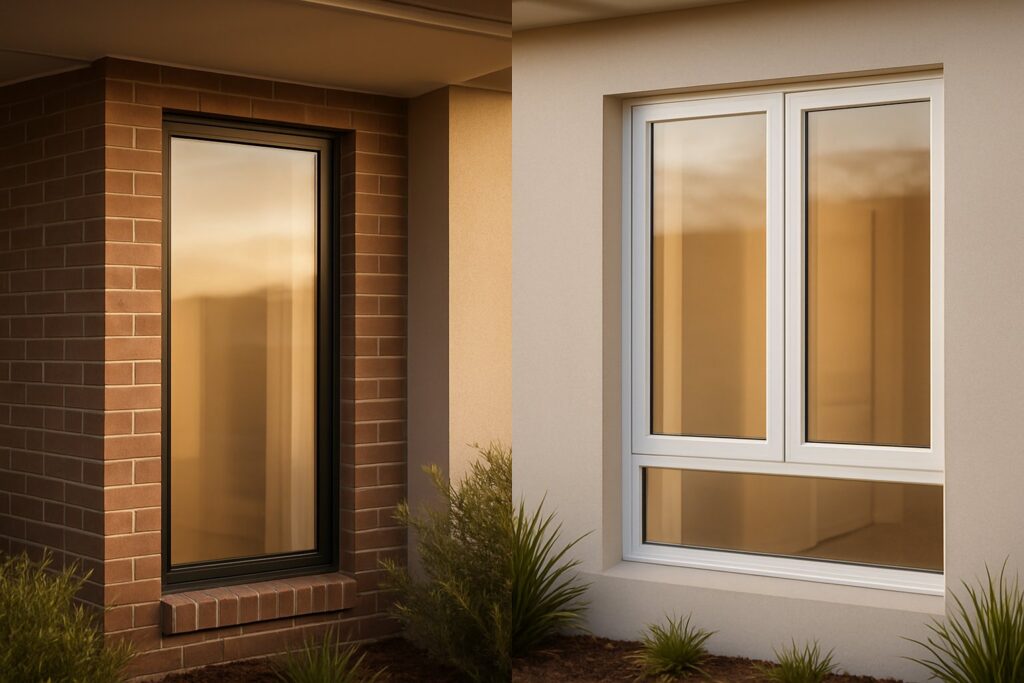
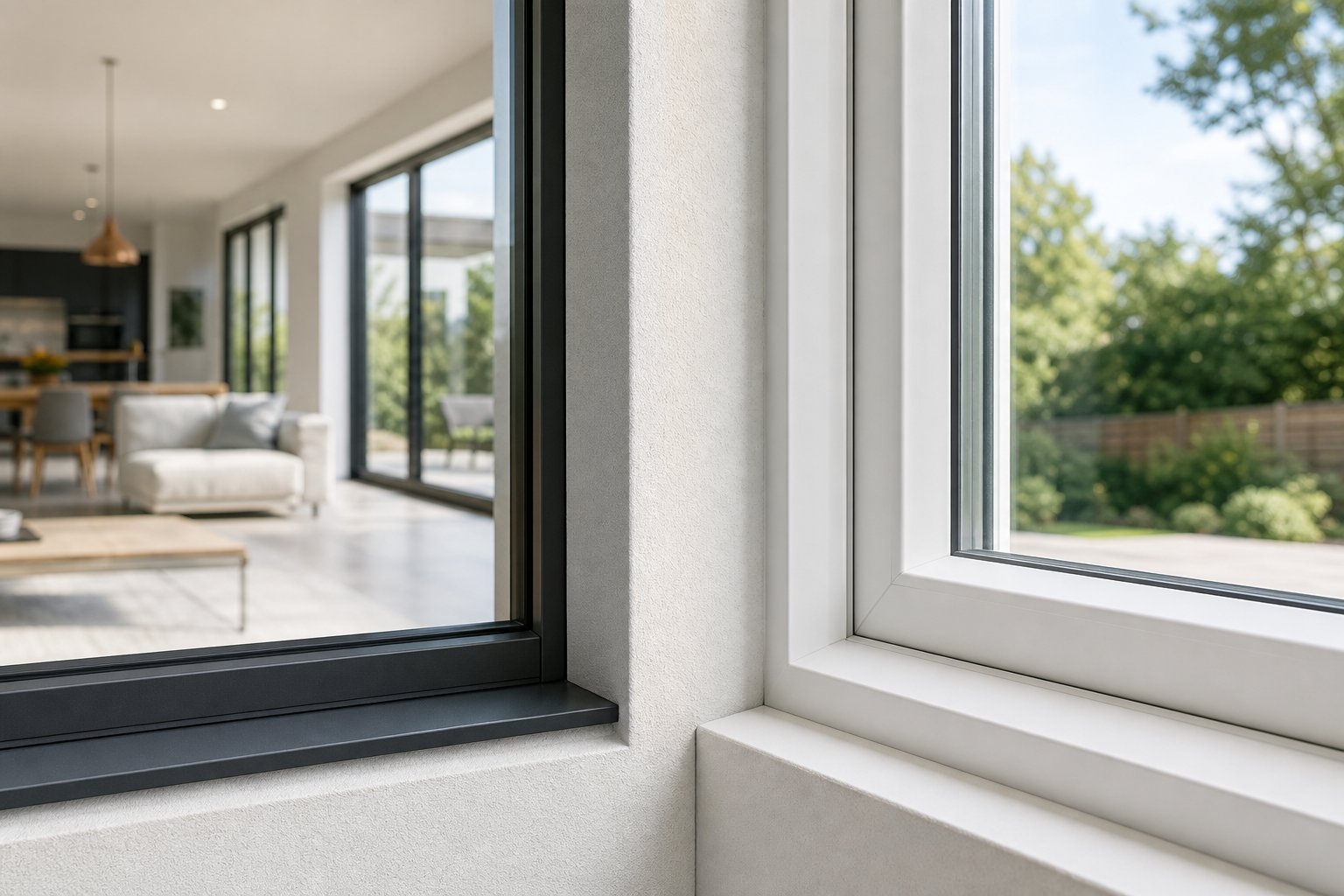
Frame width directly controls sightlines — the visible border of frame material surrounding the glass when you look at a closed window. Extruded aluminium windows achieve slimmer profiles because the metal’s rigidity supports structural loads at thinner cross-sections. A typical aluminium casement frame sits around 45 to 65 mm wide on the face. A comparable uPVC casement needs roughly 70 to 100 mm to deliver equivalent structural performance, because the plastic relies on larger multi-chamber cavities and internal steel reinforcement to resist wind loads and self-weight deflection.
That 25 to 35 mm difference per side might sound minor on paper. In practice, it compounds across every mullion, transom, and opening joint in a window wall. On a bank of three casement windows, you could gain an additional 150 mm or more of uninterrupted glass simply by switching to aluminium profiles. For standard aluminium window sizes in residential projects, this translates to noticeably more daylight penetration and a cleaner facade line — something increasingly requested by architects designing open-plan Australian living spaces.
How Material Strength Affects Design Possibilities
Structural strength determines maximum panel size before a frame begins to bow, twist, or exceed wind-load compliance under AS 2047. Durable aluminium windows can span openings well beyond what uPVC handles comfortably in a single panel. Where uPVC sliding doors typically max out around 2,000 to 2,400 mm in panel width before requiring additional reinforcement or mid-rails, aluminium sliding windows material can stretch to 3,000 mm or wider in a single leaf, supporting the oversized bi-fold and stacking configurations common in contemporary Australian homes.
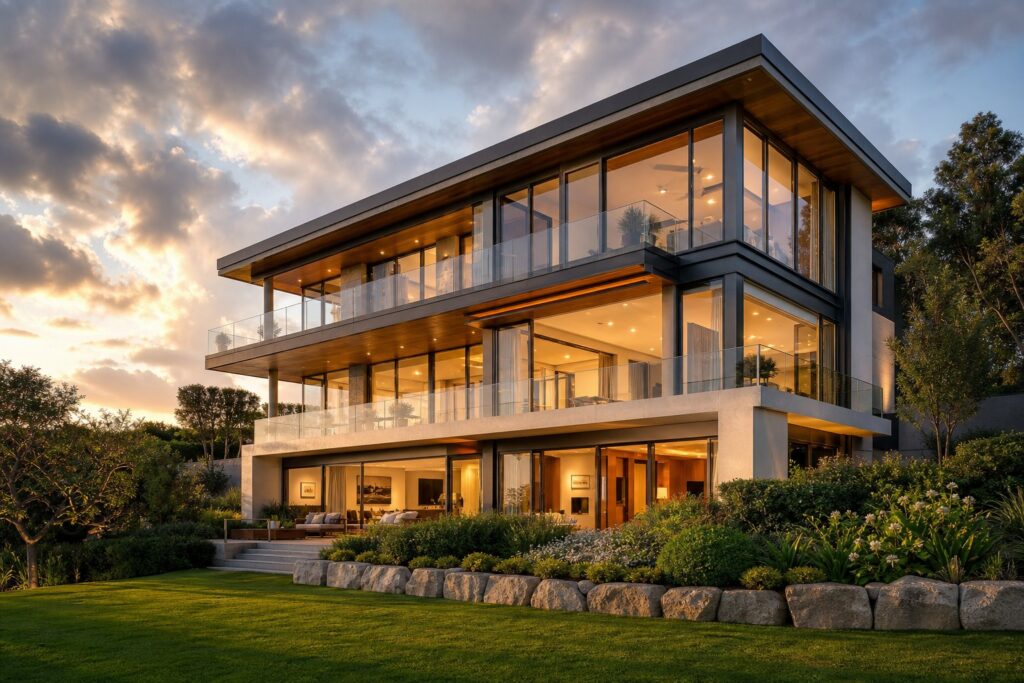
This matters most when the brief calls for floor-to-ceiling glass, large sliding doors opening to an outdoor entertaining area, or commercial shopfronts where uninterrupted glazing drives the design. Aluminium is the dominant framing material in these applications precisely because it delivers structural adequacy at dimensions uPVC cannot match without subdividing the opening.
| Attribute | Aluminium | uPVC |
|---|---|---|
| Typical frame face width | 45–65 mm | 70–100 mm |
| Maximum single panel width (sliding) | Up to 3,000 mm+ | Up to 2,000–2,400 mm |
| Glass-to-frame ratio | Higher (more glass area) | Lower (more frame visible) |
| Colour and finish options | 200+ powder coat colours, including metallic and textured finishes | Approximately 30–40 foil wrap colours |
| Finish longevity | 25+ years without significant fading | 10–15 years before potential fading on darker foils |
Colour retention is an underestimated differentiator, especially in Australia’s high-UV environment. Powder-coated aluminium frames hold their colour for 25 years or more because the electrostatically applied finish bonds at a molecular level and resists ultraviolet breakdown. uPVC frames in white or light grey perform well long-term, but darker foil finishes — charcoal, black, or anthracite — absorb more heat and UV energy on north and west-facing elevations, increasing the risk of fading, chalking, or delamination over time. For projects specifying dark frame colours in sun-exposed positions, aluminium’s finish durability becomes a significant practical advantage rather than a purely cosmetic one.
Of course, stronger frames and better colour stability mean nothing if the window lets heat pour through. And that is exactly where the thermal performance conversation gets interesting — particularly once you understand what a polyamide thermal break actually does inside an aluminium profile.
Thermal Performance and Energy Efficiency Compared
Raw aluminium conducts heat roughly 1,000 times faster than timber and around 200 times faster than uPVC. On paper, that makes aluminium sound like a terrible choice for a window frame. In practice, a single engineering innovation has almost entirely closed the gap — and understanding how it works is essential to making a fair comparison between these two materials.
How Thermal Breaks Transform Aluminium Performance
A thermal break is an insulating strip — typically reinforced polyamide (nylon) — that sits between the inner and outer halves of an aluminium profile, physically severing the metal-to-metal pathway that would otherwise act as a heat highway. The polyamide has a thermal conductivity of approximately 0.3 W/mK compared to aluminium’s 237 W/mK, so it slashes conductive heat transfer through the frame by a dramatic margin. Width matters here: the wider the polyamide barrier, the better the insulation. Premium thermally broken aluminium windows use breaks ranging from 24 mm to 35 mm, and advanced systems even incorporate aerogel inserts for further performance gains.
Without a thermal break, an aluminium frame might record a U-value somewhere between 4.0 and 6.0 W/m²K — well outside compliance with the National Construction Code (NCC) and far below what the Window Energy Rating Scheme (WERS) would consider acceptable. Introduce a quality thermal break, and that same frame drops to between 0.8 and 2.0 W/m²K — a 70 to 85 per cent improvement. In the Australian residential market, standard thermally broken aluminium windows typically achieve frame U-values around 1.5 to 1.6 W/m²K, with premium systems pushing toward 1.4 W/m²K.
uPVC takes a different path to the same destination. Its multi-chamber profiles create a series of trapped air pockets inside the frame, each acting as a small insulating buffer. Because the plastic itself is a poor conductor of heat, uPVC frames achieve U-values of roughly 1.2 to 1.4 W/m²K without needing an additional thermal barrier. That built-in advantage is one reason uPVC became so popular in colder climates. However, the margin between the two materials has narrowed considerably as aluminium thermal break windows have matured in design and manufacturing precision.
Impact of Frame Material on Glazing and Overall U-Values
Here is something that often gets overlooked: the frame accounts for only about 20 to 30 per cent of the total window area. The glass unit handles the rest. That means overall window performance is a combined result of frame U-value, glazing U-value, and how well the two interface at the edge seal.
Standard double glazing with a low-emissivity coating and argon gas fill typically delivers a glass U-value around 1.0 to 1.2 W/m²K. Triple glazing pushes that down to approximately 0.8 W/m²K. Pair either glazing option with a thermally broken aluminium frame, and the overall system U-value lands in a range that comfortably meets NCC Section J energy efficiency requirements for most Australian climate zones. Pair the same glazing with a uPVC frame, and you gain a modest further improvement — but often only a few tenths of a W/m²K in practice. For most residential projects, the real-world energy consumption difference between a well-specified thermally broken aluminium window and a comparable uPVC window is marginal rather than transformative.
Sound insulation follows a somewhat different pattern. Both materials can accommodate acoustic glazing — thicker panes, laminated interlayers, and varied glass thickness combinations that disrupt sound wave transmission. However, uPVC’s bulkier multi-chamber profiles and the inherent damping properties of plastic as a material give it a slight acoustic edge at the frame level. In high-noise environments near arterial roads or flight paths, that difference can be meaningful, especially when combined with laminated double or triple glazing. Aluminium frames compensate through tighter manufacturing tolerances and precision gasket systems, but the denser uPVC profile tends to absorb more vibrational energy.
Thermal performance, then, is no longer the decisive separator it once was. The more telling long-term question is how each material holds up year after year — how it ages, what maintenance it demands, and when it finally needs replacing.
Durability and Lifespan
A window that performs brilliantly on day one but deteriorates within 15 years is not a good investment — no matter how impressive the spec sheet looked at the point of sale. Longevity separates a smart purchase from an expensive lesson, and it is one of the starkest contrasts when comparing uPVC versus aluminium windows.
Expected Lifespan for Each Material
Modern uPVC frames are engineered to deliver 20 to 35 years of reliable service before degradation becomes functionally noticeable. Earlier generations from the 1980s and 1990s often failed sooner — yellowing, cracking, or warping within a decade — but today’s formulations include UV stabilisers and improved chemical compounds that extend that timeline significantly. Still, the plastic does age. Prolonged UV exposure, particularly on north and west-facing elevations in the Australian climate, gradually breaks down the polymer chains. Over two to three decades, white uPVC may begin to chalk or develop surface micro-cracks. Darker foil-wrapped finishes face an even tougher battle: they absorb more solar heat, which accelerates expansion stress and can cause foils to delaminate or bubble.
Aluminium tells a different story. High-quality powder-coated aluminium frames routinely last 40 to 60 years or more. The metal does not rot, warp, or become brittle with age. Its natural oxide layer actively protects the base material against corrosion, and the baked-on powder coat finish resists UV breakdown far more effectively than foil wrapping on plastic. Dimensional stability is another quiet advantage — aluminium maintains its shape and structural integrity across extreme temperature swings, which means opening sashes still operate smoothly decades after installation. The frame’s longevity often outlasts the glazing unit itself, making it a genuine fit-and-forget material for homeowners planning to stay put.
Maintenance Requirements Over the Life of the Window
Both materials carry a reputation for being low maintenance, and both earn it — but the specifics differ. With aluminum vs PVC windows, the maintenance calendar looks like this:
uPVC maintenance tasks:
- Wash frames with warm soapy water and a soft cloth twice a year to remove grime and airborne pollutants
- Avoid abrasive cleaners, bleach, and scouring pads — these strip the UV-resistant surface layer
- Lubricate hinges, handles, and multi-point locking mechanisms with silicone spray every 6 to 12 months
- Inspect rubber gaskets annually and replace when they shrink, crack, or lose compression — typically every 8 to 12 years
- Clear drainage slots at the base of each frame to prevent water pooling inside the profile
- Budget for potential full seal replacement around the 15 to 20 year mark as gaskets harden
Aluminium maintenance tasks:
- Wipe frames down with a mild detergent and water two to three times a year — more frequently in coastal areas where salt deposits can compromise the powder coat over time
- Apply a silicone-based lubricant to rollers, friction stays, and lock mechanisms annually
- Check weatherseals and gaskets every 12 to 18 months — replacement is straightforward and typically needed every 10 to 15 years
- Inspect the powder coat finish periodically for chips or scratches, particularly around coastal properties in Queensland, Western Australia, or the NSW coastline where salt air accelerates localised corrosion if the bare metal becomes exposed
- In bushfire-prone zones, clear debris from drainage channels and check that seals remain intact after each fire season
Hardware longevity follows a similar pattern across both materials. Hinges, rollers, and locking mechanisms are typically the first components to wear regardless of frame type, with most quality fittings lasting 10 to 15 years before needing servicing or replacement. The critical difference is that when hardware wears out on an aluminium frame, the frame itself is usually still in excellent condition — so you are replacing a $50 hinge, not a $1,500 window. On a uPVC frame approaching the 25-year mark, hardware failure often coincides with broader material degradation, making full window replacement the more practical option.
Durability, however, is only half the financial equation. A window that lasts twice as long but costs three times more might not deliver better value — or it might deliver far better value depending on how you calculate it. Working through the real cost of ownership over a 20-plus year horizon reveals which material genuinely saves money and which one merely appears cheaper at the point of purchase.
Aluminium Window Price vs uPVC Windows Price Over Time
Most homeowners compare quotes, pick the cheaper number, and move on. That logic works for purchases you replace every few years. Windows are not one of those purchases. A window installed today will still be in your wall when the mortgage is paid off — or it will have been ripped out and replaced at considerable expense. The real question is not which material costs less to buy, but which one costs less to own.
Upfront Cost Factors for Each Material
Aluminium windows carry a higher price tag at the point of purchase. The cost of aluminium windows reflects several compounding factors: the raw material is more expensive than polymer resin, the extrusion and powder coating process demands tighter manufacturing tolerances, and the hardware systems engineered for slimmer profiles tend to be more specialised. In the Australian market, expect aluminium to sit roughly 30 to 50 per cent above uPVC for an equivalent window configuration — size, glazing specification, and opening type held constant.
For a standard three to four bedroom home requiring a full set of windows, uPVC windows price typically falls in the range of $8,000 to $15,000 AUD supply and install, depending on size, quantity, and glazing spec. The equivalent aluminium package generally lands between $12,000 and $22,000 AUD. These ranges shift significantly based on several variables:
- Window size and configuration — larger panels, bi-fold doors, and corner windows push aluminium further ahead because they leverage the material’s structural advantages
- Glazing specification — upgrading from standard double glazing to triple glazing or acoustic laminated units adds cost equally to both materials
- Colour and finish — standard white or silver aluminium sits at the base price; custom RAL colours, dual-colour finishes, or textured coatings add 10 to 20 per cent
- Hardware grade — commercial-grade hinges, multi-point locks, and soft-close mechanisms increase the aluminium window cost more noticeably due to tighter integration requirements
- Compliance requirements — cyclone-rated systems (relevant in northern Queensland and the NT), bushfire-rated assemblies (BAL 29 and above), or acoustic-rated units all attract premiums regardless of frame material
The uPVC price advantage is most pronounced on standard-sized openings — casement and awning windows in typical residential dimensions where the plastic profiles perform well within their structural limits. As openings get larger or design complexity increases, the gap narrows because uPVC requires additional reinforcement, wider mullions, or subdivided panels to compensate for its lower strength.
Lifecycle Cost Analysis Over 20-Plus Years
Shift the lens from purchase price to total cost of ownership and the arithmetic changes shape. A uPVC window lasting 25 years and an aluminium window lasting 45 years are not the same product priced differently — they are two different propositions entirely. Over a 40-year period, the uPVC option likely requires one full replacement cycle. The aluminium option likely requires only seal and hardware servicing.
| Cost Factor | Aluminium | uPVC |
|---|---|---|
| Initial purchase (relative) | Higher (30–50% premium) | Lower (base cost) |
| Maintenance over 20 years | Minimal — periodic cleaning and hardware lubrication | Minimal — cleaning, gasket replacement around year 12–15 |
| Likely replacement within 40 years | Unlikely — frame outlasts most ownership periods | Probable — full replacement around year 25–30 |
| Cost per year of ownership | Lower when spread across 40–50 year lifespan | Comparable or higher once replacement is factored in |
| Resale value contribution | Perceived as premium upgrade; stronger buyer appeal in modern and contemporary properties | Viewed as standard; less likely to differentiate at sale |
The resale angle deserves attention. Industry data suggests window replacements typically recover around two-thirds of their cost in added property value — though Australian figures will vary by market conditions, property type, and buyer expectations. What matters more than a generic percentage is context. In a contemporary architecturally designed home or a renovated inner-city terrace, aluminium frames read as a premium finish that aligns with buyer expectations. Estate agents in Sydney, Melbourne, and Brisbane consistently note that aluminium windows and doors are perceived as an upgrade, particularly in markets where slim-framed, large-format glazing has become the design benchmark.
Conversely, in a brick veneer family home in a suburban street where every neighbour has uPVC, the premium for aluminium may not translate to a proportional increase in sale price. The material choice adds value most clearly when it matches the property’s positioning and the expectations of its likely buyer pool.
Price, though, is never the only consideration. Where you build — the climate zone, the proximity to salt air, the UV intensity — determines not just how long a window lasts but which material can survive without compromise in the first place.

Climate Suitability and Environmental Considerations
Geography rewrites the spec sheet. A window system that performs flawlessly in Melbourne’s temperate south may degrade prematurely on a Cairns balcony battered by cyclonic rain, salt mist, and relentless UV. The question of whether aluminium windows are better than uPVC cannot be answered in the abstract — it depends heavily on what your local environment will do to the frame over 30 or 40 years.
Which Material Suits Coastal and High-UV Environments
Australia’s coastline stretches more than 35,000 kilometres, and a huge proportion of the population lives within a few kilometres of salt air. That makes corrosion resistance a genuine performance requirement rather than a nice-to-have specification line. uPVC is inherently immune to salt corrosion — the polymer simply does not react with sodium chloride the way metals can. For beachside homes from the Gold Coast to the Mornington Peninsula, uPVC windows vs aluminium comes down to whether you want zero concern about salt attack or whether you are prepared to specify a marine-grade powder coat finish and commit to more frequent cleaning.
Aluminium is not defenceless in coastal zones. A quality marine-grade powder coat (typically tested to over 3,000 hours of salt spray exposure) provides robust protection, and the underlying aluminium oxide layer adds a secondary barrier. The catch is that any chip, scratch, or mechanical damage to the coating creates a vulnerability. In aggressive salt environments — think beachfront properties within 500 metres of the high-tide mark — exposed base metal can develop pitting corrosion if left unaddressed. Regular wash-downs and prompt touch-ups of damaged areas keep this risk manageable but not eliminated.
UV exposure tells a different story. Australia ranks among the highest UV-intensity environments on earth, and north and west-facing elevations cop the worst of it. Here, aluminium versus upvc windows favours the metal. Powder-coated aluminium resists UV degradation extremely well — the baked finish maintains colour stability for decades. uPVC in lighter shades holds up reasonably, but darker foil-wrapped profiles absorb significantly more thermal energy and UV radiation. Over 15 to 20 years in high-UV positions, darker uPVC finishes risk chalking, fading, or delaminating. White uPVC performs better but is still susceptible to surface embrittlement over very long timeframes in harsh sun.
For extreme cold — relevant in alpine areas of Victoria, NSW, and Tasmania — thermally broken aluminium is critical. Without a quality polyamide break, the frame becomes a cold bridge that drives condensation and energy loss. uPVC performs naturally well in cold climates thanks to its built-in insulating chambers. In hot-humid tropical zones like Far North Queensland and the Northern Territory, both materials cope with moisture, though aluminium’s dimensional stability under heat cycling gives it an edge in maintaining seal compression and smooth operation over time.
- Coastal (within 1 km of surf) — uPVC preferred for zero corrosion risk; aluminium viable with marine-grade finish and regular maintenance
- High UV, sun-exposed elevations — Aluminium preferred, particularly for darker colour specifications that would degrade on uPVC
- Alpine and cold climates — Both perform well; aluminium requires quality thermal breaks (24 mm+ polyamide); uPVC insulates naturally
- Tropical and hot-humid — Aluminium preferred for dimensional stability under sustained heat and humidity cycling
- Bushfire-prone zones (BAL 12.5 to BAL-FZ) — Aluminium strongly preferred; non-combustible and compliant without additional protection measures
- Suburban, moderate climate — Either material performs well; choice driven by budget, aesthetics, and longevity preference
Recyclability and Environmental Impact
Environmental credentials have become a genuine decision factor rather than a marketing afterthought. Aluminium is infinitely recyclable — it can be melted down and re-extruded into new window profiles without any loss of structural properties. Recycling aluminium uses roughly five per cent of the energy required for primary production, and scrap aluminium carries real market value, meaning old frames are actively collected and reprocessed rather than sent to landfill. The trade-off is that initial production from bauxite ore is extremely energy-intensive, carrying a significant carbon footprint at the manufacturing stage.
uPVC’s recycling picture is more complex. The material can be recycled up to seven times, with each cycle producing usable material for new profiles and building products. Recycling infrastructure for uPVC has improved considerably in recent years, though collection rates still lag behind aluminium. On the production side, uPVC requires less energy to manufacture initially, giving it a lower embodied energy per unit at the point of installation. The lifecycle equation depends on how many times the material is actually recycled in practice versus theory.
Fire safety adds another layer to the comparison — and one with direct regulatory implications. Aluminium is classified as non-combustible. It does not ignite, does not release toxic fumes when heated, and meets the requirements for non-combustible construction under the National Construction Code without exemption. This makes it the default framing material for multi-storey residential, commercial, and mixed-use buildings where combustibility restrictions apply.
uPVC is classified as combustible, though it is self-extinguishing — meaning it does not sustain a flame once the ignition source is removed. In buildings required to be of non-combustible construction, uPVC window use historically required specific code exemptions around vertical separation between storeys and maximum glazed area ratios. For single-storey and low-rise residential projects, this classification rarely presents a practical barrier. For multi-residential developments, commercial buildings, or projects in bushfire-prone areas rated BAL 29 and above, aluminium’s non-combustible status simplifies compliance and removes a layer of design constraint entirely.
Climate resilience, environmental responsibility, and fire behaviour collectively shape which material belongs in a given project. But no amount of scenario matching replaces the need for verified performance data — documented compliance credentials that prove a window system actually meets the standards a project demands.
Building Standards and Compliance for uPVC Windows vs Aluminium Windows
Choosing between materials based on brochures and showroom samples is one thing. Specifying a window system for a real project — where council sign-off, NCC compliance, and long-term liability sit on the line — requires something far more concrete: documented evidence that the product actually performs as claimed. For architects, builders, and specifiers, compliance documentation is not paperwork to file and forget. It is the foundation of defensible material selection.
Performance Standards That Apply to Window Systems
In Australia, every window and external door installed in a residential or commercial building must comply with AS 2047 — the standard governing design, construction, and testing of windows, doors, and shutters. This single standard covers a broad set of measurable performance criteria:
- Structural adequacy — resistance to wind loads based on site-specific conditions including terrain category, building height, and geographic wind region
- Water penetration resistance — the ability of the window to prevent water ingress under simulated wind-driven rain at specified pressures
- Air infiltration — the rate of uncontrolled air leakage through the closed window, directly affecting energy efficiency and occupant comfort
- Operating force — how much physical effort is needed to open, close, and lock the window under normal conditions
Alongside AS 2047, glazing must meet AS 1288 for glass selection and installation — covering safety glass requirements, thickness calculations, and human impact considerations. Energy performance feeds into the NCC Section J requirements (for commercial buildings) and NatHERS ratings (for residential), where the Window Energy Rating Scheme (WERS) provides a standardised way to compare thermal and solar performance across different window systems.
Both aluminium and uPVC windows and doors can meet these standards. The difference lies in how each material achieves compliance — and how transparently that compliance is documented by the manufacturer. Aluminium window systems from established manufacturers are typically tested as complete assemblies: frame, glazing, hardware, seals, and fixings assessed together under controlled laboratory conditions. The resulting test reports and certificates of conformance provide specifiers with verifiable data rather than general marketing claims.
uPVC windows and doors go through the same testing regime under AS 2047, and quality uPVC systems pass comfortably for standard residential applications. Where things diverge is at the extremes — large panel sizes, high wind regions, cyclone-rated zones, and multi-storey applications — where aluminium’s structural properties make achieving compliance more straightforward without adding secondary reinforcement or subdividing openings.
Why Compliance Documentation Matters for Project Specifications
A test certificate is not a marketing asset. It is a legal record that a specific window configuration met specific performance thresholds under controlled conditions. When a building surveyor reviews a project for occupancy certification, or when a homeowner lodges a warranty claim after a water leak, that documentation becomes the reference point.
Specifiers should be looking for several things before locking in a window system:
- Current AS 2047 test reports covering the exact configurations specified — not just a generic product line certificate
- WERS ratings for the proposed glazing and frame combination, confirming energy compliance for the relevant NatHERS climate zone
- Bushfire compliance documentation (tested to AS 3959) where the project falls within a designated BAL zone
- Cyclone-region compliance for projects in wind region C or D, covering structural adequacy under extreme wind loads
- Non-combustibility classification evidence where the NCC requires non-combustible construction — particularly relevant for multi-storey residential and commercial projects
Fire classification is where the two materials part ways most sharply in a compliance context. Aluminium is inherently non-combustible and satisfies NCC requirements for non-combustible construction without exemptions or workarounds. uPVC, while self-extinguishing, is classified as a combustible material. In buildings required to be of non-combustible construction, uPVC window use relies on code exemptions that impose conditions around vertical separation between storeys and limits on aggregate glazed area as a proportion of the wall face. These conditions are manageable for some project types but add a layer of design constraint — and potential compliance risk — that aluminium avoids entirely.
For professionals specifying aluminium systems, reviewing a manufacturer’s published compliance credentials is the fastest way to confirm suitability against project-specific requirements. MEICHEN’s compliance and certifications page, for instance, details how their aluminium window and door systems are tested against Australian standards for energy efficiency, weather resistance, structural performance, and durability — giving specifiers a concrete reference point when assessing whether a system meets documented expectations for a given project.
The broader principle applies regardless of material or brand: never specify a window based solely on a product brochure or verbal assurance. Request the test reports. Confirm the WERS data matches the glazing configuration you are actually ordering. Verify that the system has been tested in the opening sizes and types relevant to your design. Compliance is not a box to tick at the end of a project — it is a filter that should shape material selection from the very first sketch.
With performance standards clarifying what each material can verifiably deliver, the remaining challenge is more personal: matching the right material to the specific property, the specific budget horizon, and the specific priorities that define your project.
How to Choose the Right Aluminium vs uPVC Window Material for Your Project
Knowing the technical differences is useful. Knowing which material belongs in your specific project is what actually saves money and avoids regret. The right choice depends less on which material is objectively “better” and more on how well it aligns with your property type, location, timeline, and priorities.
Matching Material Choice to Your Property Type
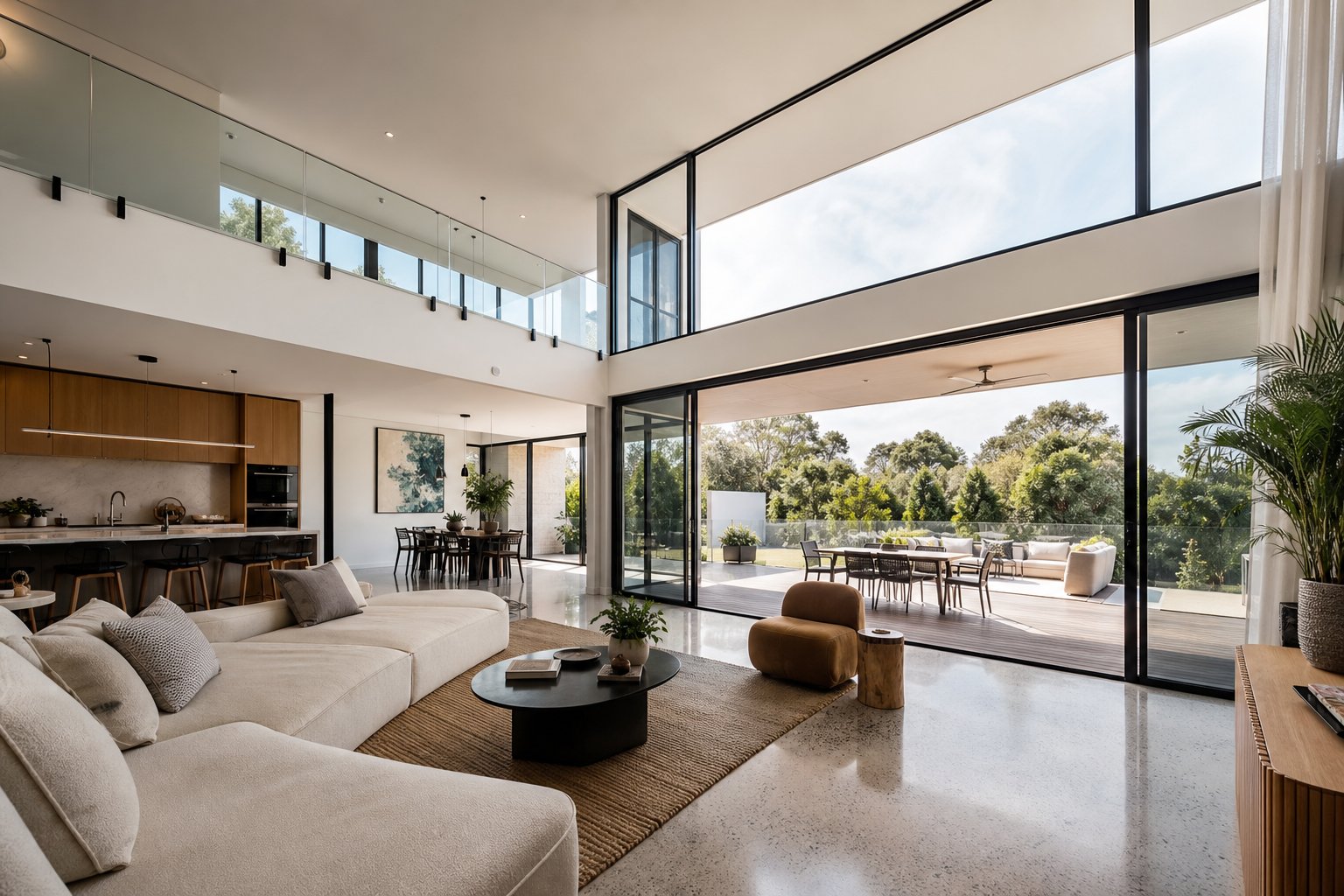
Different buildings demand different things from their windows. A sleek contemporary home with open-plan living and oversized openings needs slim sightlines and large spanning capability — that is aluminium territory. The structural strength allows floor-to-ceiling glass, bi-fold configurations, and corner windows that define modern Australian architecture.
Period homes and heritage-listed properties present a different brief. Conservation areas often mandate frame proportions and profiles that mimic original timber joinery. Here, uPVC with woodgrain foil finishes or purpose-designed heritage aluminium profiles may both work, depending on local council requirements and the heritage overlay. Always check with your council before assuming either material will gain approval.
For commercial properties and multi-residential developments — apartments, townhouse complexes, aged care facilities — aluminium dominates for practical reasons. Non-combustible construction requirements under the NCC typically rule out uPVC above certain heights. Combined with the ability to achieve larger openings without additional reinforcement, aluminium windows vs uPVC becomes less of a choice and more of a compliance outcome in these project types.
Suburban family homes on moderate budgets sit in the middle. Both materials perform well in standard residential applications. If the priority is keeping upfront costs down on a straightforward brick veneer home with standard-sized openings, affordable aluminium windows or quality uPVC can both deliver solid results. The deciding factor often comes down to whether you value longevity and slim aesthetics (aluminium) or maximum insulation at the lowest initial outlay (uPVC).
Installation complexity differs modestly between materials. uPVC frames are slightly heavier due to bulkier profiles and internal steel reinforcement, which can make handling larger units more awkward on site. Aluminium frames, while lighter per lineal metre, demand more precision during installation because their slimmer profiles leave less tolerance for out-of-square openings or uneven substrates. Both require experienced installers — but aluminium’s tighter tolerances mean that workmanship quality has a larger impact on the final seal performance and operating smoothness.
Questions to Ask Before Committing to a Window System
Before signing a contract, work through these decision points with your installer or supplier. They will expose gaps in specification and help you avoid expensive mid-project changes:
- What is the project location and climate exposure? — Coastal salt zones, bushfire-prone areas, cyclone regions, and high-UV elevations all narrow the viable material options.
- What are the priority performance requirements? — Thermal efficiency, acoustic control, structural wind ratings, or fire compliance? Rank them, because trade-offs exist.
- What is the realistic budget horizon? — A 10-year ownership plan changes the cost equation compared to a 30-year stay. Factor in potential replacement costs for uPVC within that window.
- What aesthetic outcome does the design demand? — Slim frames and large glass areas push toward aluminium. Traditional proportions and white finishes suit uPVC. Dark colours in sun-exposed positions strongly favour powder-coated aluminium.
- Can the supplier provide documented compliance evidence? — Request AS 2047 test reports, WERS ratings for the exact configuration you are ordering, and any bushfire or cyclone compliance certificates relevant to your site. For aluminium systems, reviewing a manufacturer’s published certifications — such as the compliance documentation provided by MEICHEN — confirms whether the system meets your project’s specific structural, energy, and weather resistance requirements.
- What warranty terms cover both product and installation? — Separate the frame warranty from the hardware warranty and the installer’s workmanship guarantee. Ask whether warranties are transferable if you sell.
- What is the realistic lead time? — Custom-colour aluminium typically requires longer manufacturing lead times than standard white uPVC. Plan accordingly if your build program is tight.
The difference between aluminium and uPVC windows is not a single answer — it is a matrix of trade-offs that shifts based on your circumstances. Work through the questions above honestly, verify the compliance credentials of whatever system you shortlist, and choose the material that serves the full life of your project rather than just the day the quote arrives.
Frequently Asked Questions About Aluminium and uPVC Windows
1. Are aluminium windows better than uPVC for Australian homes?
Neither material is universally better. Aluminium suits projects requiring slim sightlines, large openings, dark colour finishes, and long-term durability of 40 to 60 years. uPVC works well for budget-conscious builds with standard-sized openings, offering strong thermal insulation without a thermal break. The best choice depends on your climate zone, property type, aesthetic goals, and how long you plan to own the home. Coastal properties may favour uPVC for salt resistance, while bushfire zones and multi-storey buildings typically require aluminium for non-combustibility compliance.
2. How much more do aluminium windows cost compared to uPVC in Australia?
Aluminium windows generally cost 30 to 50 per cent more than uPVC upfront for an equivalent configuration. A full window package for a standard three to four bedroom Australian home typically ranges from $12,000 to $22,000 AUD for aluminium versus $8,000 to $15,000 AUD for uPVC (supply and install). However, aluminium’s longer lifespan of 40 to 60 years means the cost per year of ownership can actually be lower than uPVC, which may need full replacement around the 25 to 30 year mark.
3. Do thermally broken aluminium windows perform as well as uPVC for insulation?
Modern thermally broken aluminium windows achieve frame U-values of approximately 1.5 to 1.6 W/m2K, while uPVC frames typically reach 1.2 to 1.4 W/m2K. The gap has narrowed significantly with advances in polyamide thermal break technology. Since frames account for only 20 to 30 per cent of total window area, the overall system performance difference between the two materials is often just a few tenths of a W/m2K when paired with equivalent double or triple glazing — a marginal rather than transformative difference for most residential projects.
4. How long do uPVC windows last compared to aluminium windows?
Quality uPVC windows deliver 20 to 35 years of reliable service before degradation becomes noticeable, with darker foil finishes degrading faster in high-UV environments. Aluminium frames routinely last 40 to 60 years or more, maintaining dimensional stability and structural integrity throughout. The powder-coated finish on aluminium resists UV breakdown far more effectively than foil wrapping on uPVC. When hardware fails on aluminium frames, the frame itself is usually still in excellent condition, making component replacement cost-effective rather than requiring full window replacement.
5. What compliance standards should aluminium and uPVC windows meet in Australia?
All windows installed in Australian buildings must comply with AS 2047 covering structural adequacy, water penetration resistance, air infiltration, and operating force. Glazing must meet AS 1288, while energy performance aligns with NCC Section J requirements and NatHERS ratings via the WERS scheme. Bushfire-prone areas require AS 3959 compliance. A key compliance difference is that aluminium is non-combustible and satisfies NCC requirements without exemptions, while uPVC requires specific code exemptions for buildings of non-combustible construction. Specifiers should request current test reports for the exact configurations being ordered, such as those documented on manufacturer compliance pages like MEICHEN’s certifications.
More Window & Door Guides