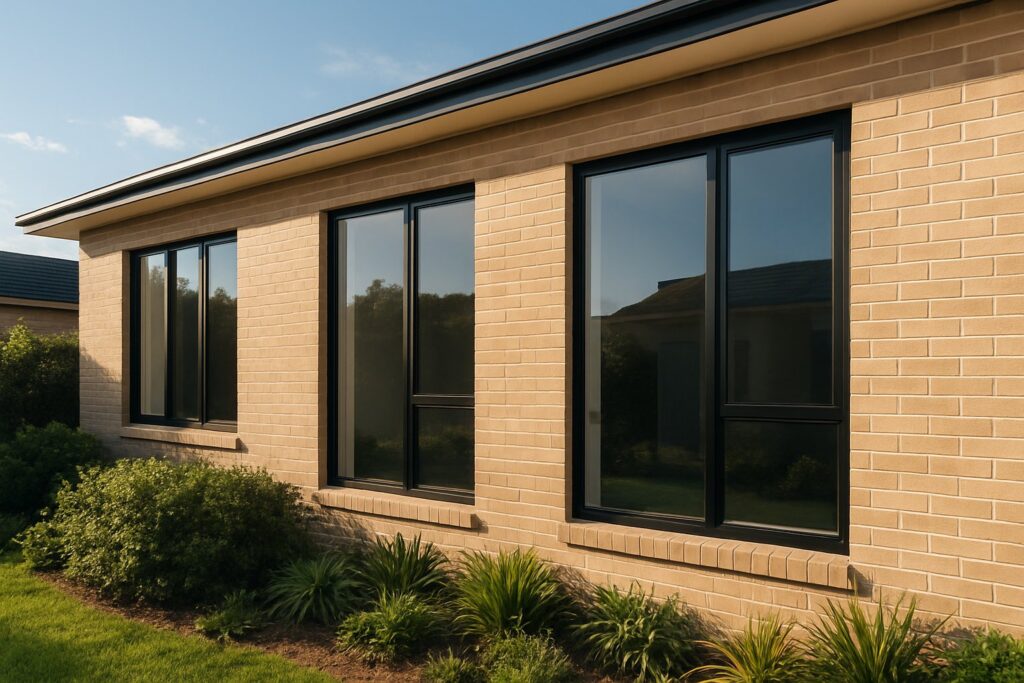
What Are Anodised Aluminium Window Colours
Not every window finish is created equal. Most aluminium frames you see on Australian homes and commercial buildings wear a powder-coated skin — a layer of colour applied on top of the metal. Anodised aluminium windows work differently, and that difference matters.
Anodising is an electrochemical process that thickens the natural oxide layer on aluminium, producing integral metallic colours that become part of the metal itself rather than sitting on top like paint. The resulting finish cannot peel, flake, or chip because it is the aluminium surface, transformed at a molecular level.
The palette of anodised aluminium windows colours is deliberately narrow — silvers, champagnes, golds, bronzes, and blacks — yet each tone carries a depth and warmth that applied coatings simply cannot replicate. These are genuine aluminium colours drawn from the metal’s own character, not pigments sprayed onto a surface. Think of it as the difference between staining timber and painting over it: one reveals the material, the other conceals it.
This guide breaks down every available anodised colour option for architectural windows, the science behind each finish, how anodised frames compare to powder-coated alternatives, and how to match specific tones to your property style — whether you’re building a contemporary home in Melbourne or restoring a heritage facade in Sydney.
What Makes Anodised Colour Different from Paint or Powder Coat
With powder coating, a polyester-based layer sits on top of the aluminium. It can chip on impact and may need recoating after years of harsh UV exposure. Anodised colour, by contrast, is embedded within the aluminium oxide layer through electrolytic processes. The coating is integral to the metal — it grows from the base aluminium during the electrochemical bath. There is nothing to peel away because the colour and the surface are one and the same. For Australian coastal and high-UV environments, that distinction translates directly into longevity.
Why the Metallic Palette Is a Design Advantage
A limited range might sound like a constraint, but architects and designers treat it as a mark of premium authenticity. Anodised finishes are inherently metallic because they are the metal. Light penetrates the translucent oxide layer before reflecting back, giving coloured aluminium frames a living quality that shifts subtly across the day. Powder-coated equivalents can imitate bronze or champagne tones, yet they remain fully opaque — the depth and lustre of genuine anodised aluminium windows stays out of reach. That optical richness is precisely why bronze and gold anodised finishes have become quiet markers of high-end residential and commercial design across Australia.
Understanding what creates those distinctive aluminium anodising colours requires a closer look at the electrochemistry involved — and it turns out the science is as elegant as the finish itself.
The Science Behind Anodised Aluminium’s Metallic Palette
Strip away the technical jargon and the anodising process follows a beautifully simple logic. An aluminium extrusion is submerged in an acid electrolyte bath — typically a sulfuric acid and water solution — and an electric current is passed through the liquid. That current forces the aluminium surface to oxidise in a controlled, accelerated way, building up a hard, porous oxide layer far thicker than the wisp-thin film that forms naturally in open air. At this stage, the finish is clear: a transparent shield that highlights the natural colour of aluminium, which is a clean silvery white.
If silver is the goal, the process stops here and the pores are sealed. But most architectural aluminium anodising colours require a second step — and this is where the real artistry begins.
Electrolytic Colouring and How Bronze Tones Are Created
In the industry, the method is known as two-step electrolytic colouring. After the oxide layer has formed, the aluminium moves to a separate colouring tank containing an inorganic metal solution — most commonly tin, though cobalt and nickel are also used. An electrolytic current drives those metallic salts deep into the microscopic pores of the oxide layer, depositing them from the base of each pore upward.
Here is the elegant part: the depth of colour depends almost entirely on immersion time. A brief dip deposits a thin layer of tin at the bottom of each pore, producing a pale champagne tone. Extend that immersion and more metal fills the pores, shifting the finish through light bronze, medium bronze, and dark bronze. Push it further still and you reach extra-dark bronze and eventually black. This single variable — time — is why the bronze family dominates the spectrum of anodizing colours available for architectural windows. Every shade from warm honey through to near-black is produced by the same metallic salt; only the duration changes.
Copper salts can also be introduced in a specialised third step, yielding richer reddish-bronze and burgundy tones that sit outside the standard palette. These specialty finishes remain niche but are occasionally specified for landmark commercial projects where a distinctive facade colour is paramount.
At a microscopic level, something even more interesting is happening. As light hits the anodised surface, it doesn’t simply bounce off the top layer. Instead, it passes through the translucent aluminium oxide, interacts with the metallic salt deposits nestled inside each pore, and reflects back through the oxide again. This creates an optical interference effect — different wavelengths of light are selectively reinforced or cancelled depending on the pore depth and the amount of metal deposited. It’s the same principle that produces iridescent colours on a soap bubble, except here it’s locked permanently into a surface harder than sapphire. That interference is what gives aluminium anodization colors their characteristic depth, warmth, and subtle luminosity — qualities that flat, opaque coatings cannot physically reproduce.
Why Anodised Colours Look Different from Powder Coat Equivalents
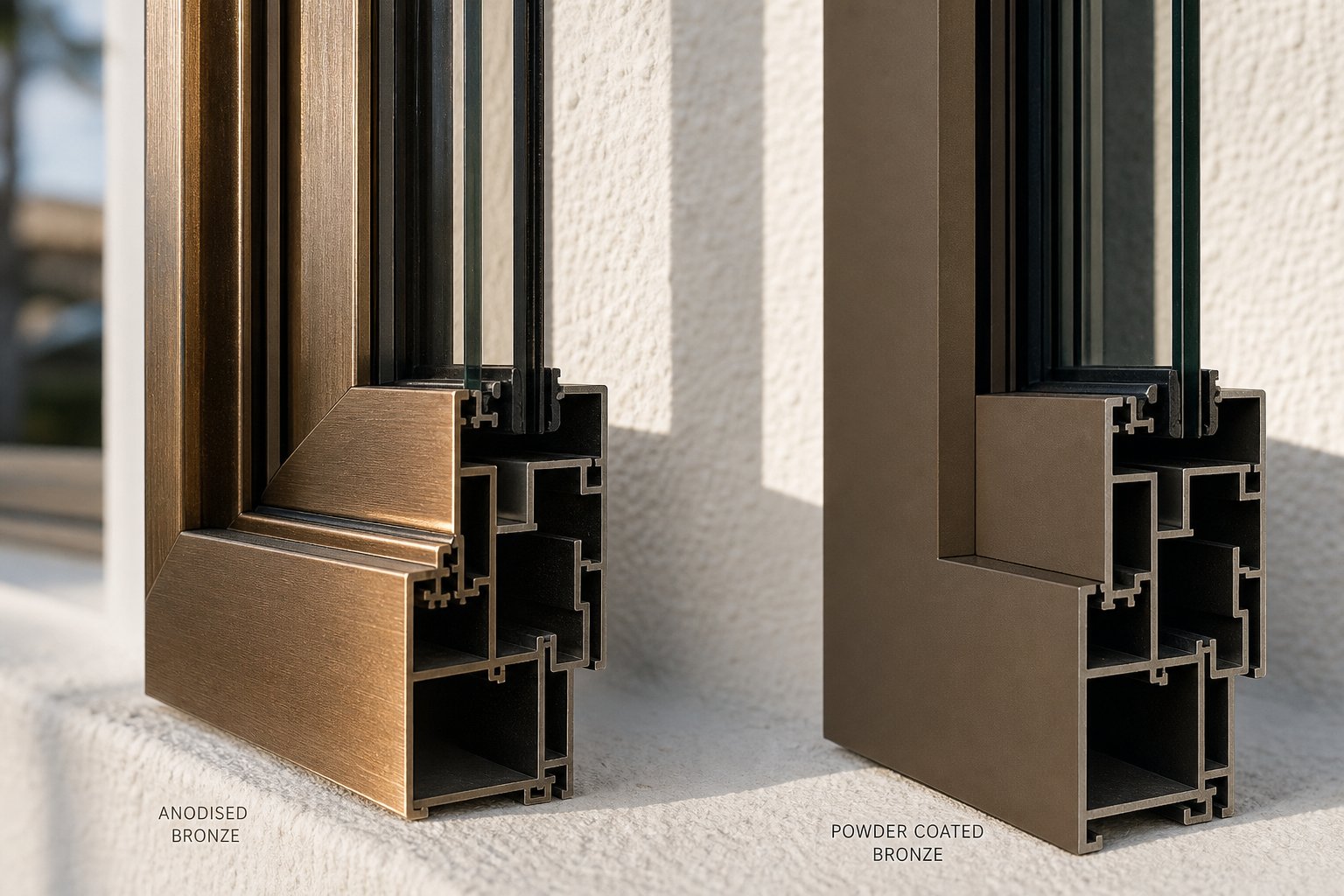
Stand a dark bronze anodised window frame next to a powder-coated frame colour-matched to the same shade and the difference is immediately visible, even to an untrained eye. The powder-coated frame looks solid and consistent — a single, uniform tone. The anodised frame appears to glow from within, its colour shifting slightly as the viewing angle or lighting conditions change.
The reason is translucency. Because light penetrates the oxide layer before reflecting back, anodised finishes behave almost like a stained glass panel layered over polished metal. Morning sunlight draws out warm golden undertones; overcast skies push the same bronze toward a cooler, more graphite-like grey. Architects and designers prize this “living” quality because it gives facades a dynamic character that evolves across the day and across seasons — a property that powder coating, however well formulated, simply cannot deliver.
Powder coat is fully opaque by design. Pigment particles suspended in a polyester resin sit on top of the metal, blocking light from reaching the aluminium beneath. The result is consistent colour — which is an advantage when exact RAL matching is needed — but it sacrifices the metallic authenticity that makes anodised aluminium windows so distinctive. Every tone in the anodised palette, from the palest champagne to the deepest black, carries a translucent metallic signature that traces directly back to the electrochemistry happening inside those microscopic pores.
Knowing how these colours are created raises a practical question: which specific shades are actually available for architectural window applications, and how do they map to recognised industry standards? A comprehensive colour chart makes that picture concrete.
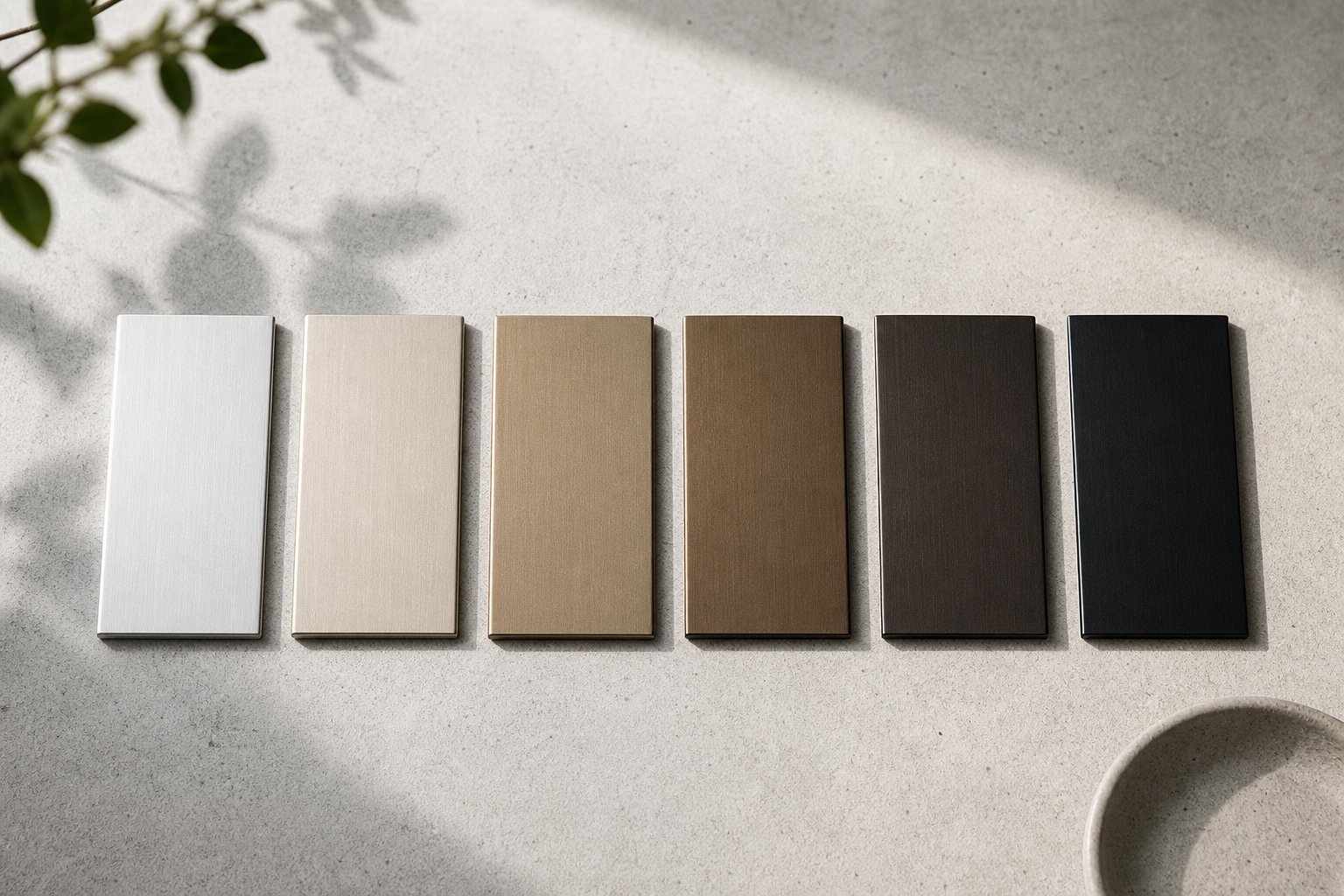
Complete Anodised Aluminium Colour Chart for Windows
Most online resources list anodised colours in passing — a handful of names with no industry references and no practical guidance on where each tone belongs. The table below fills that gap, mapping every standard anodised colour used in architectural window applications to its recognised Qualanod designation, its visual character, and the property types it suits best. Consider this your working anodize color chart for specification decisions.
| Colour Name | Appearance Description | Industry Designation | Best Suited Property Types |
|---|---|---|---|
| Natural Silver (Clear Anodised) | Preserves aluminium’s inherent silvery-white tone with a soft satin or matte sheen. Clean, bright, and coolly modern. | Qualanod C0 / EV1 | Contemporary new builds, minimalist homes, commercial facades |
| Very Light Bronze / Champagne | A delicate warm tint — barely bronze, closer to a soft golden grey. Subtle warmth without visual weight. | Qualanod C31 | Residential renovations, rendered facades, light brick homes |
| Light Bronze | A warm honey-gold tone with visible metallic lustre. Richer than champagne but still understated. | Qualanod C32 | Period-adjacent homes, sandstone facades, heritage-sensitive areas |
| Medium Bronze | A balanced, mid-depth bronze with strong metallic warmth. The most versatile anodised tone. | Qualanod C33 | Residential and commercial — pairs well with brick, timber, stone |
| Dark Bronze | Deep, commanding bronze approaching charcoal. Retains visible metallic warmth under direct light. | Qualanod C34 | High-end residential, luxury developments, heritage-listed buildings |
| Black | Dense, near-opaque black with a subtle metallic undertone visible at oblique angles. | Qualanod C35 / EV6 | Architectural statement projects, commercial buildings, modern homes |
| Gold | Warm, rich golden finish achieved through absorption-based iron salt colouring. Distinctive and eye-catching. | EV3 (German notation) | Period-inspired designs, feature windows, heritage restorations |
This anodized aluminum colors chart covers the standard electrolytic palette available through most architectural fabricators. Specialty tones — reddish bronze, pewter grey, and custom interference colours — do exist but sit outside standard production and typically require project-specific consultation with the anodiser.
Natural Silver and Clear Anodised Finishes
At the lightest end of the spectrum, clear anodised aluminium retains the metal’s natural silvery appearance and adds a refined satin texture. No metallic salts are deposited into the oxide pores; the anodic layer is simply grown, sealed, and left transparent. The result is a cool, crisp finish that emphasises clean lines and lets the aluminium speak for itself.
In specification documents, you’ll often see this referred to as “clear anodised” or coded as Qualanod C0. It is the default finish for ultra-modern architectural projects — think floor-to-ceiling glazing on a double-storey coastal home where the window frames virtually disappear against a rendered white facade. Natural silver also works exceptionally well in commercial fitouts where a neutral, unobtrusive frame colour is needed to let the glass dominate the elevation.
Because no colouring step is involved, clear anodised is the most consistent finish to produce across large orders. Batch variation is minimal compared to the bronze family, making it a practical choice for multi-residential developments where dozens of identical frames need to match.
Champagne, Gold, and Mid-Tone Anodised Finishes
Step up from silver and you enter the warm mid-range — champagne, light bronze, and gold. These tones sit in the sweet spot for Australian residential projects where homeowners want subtle warmth without the heaviness of full bronze.
Champagne (Qualanod C31) barely registers as bronze at all. It reads more as a softly warmed silver, offering just enough tonal shift to take the clinical edge off an otherwise cool-toned facade. Pair it with white render, pale brick, or light-stained timber cladding and the effect is quietly elegant. It’s become one of the most popular anodised choices for new homes across Sydney, Melbourne, and Brisbane — a finish that feels premium without demanding attention.
Gold tones take a different colouring path. Rather than the tin salt electrolytic process used for the bronze family, gold finishes are typically produced through absorption-based iron salt methods, yielding a distinctly warmer, yellower hue. The result suits period-inspired homes, heritage-adjacent designs, and feature window applications where the frames are intended as a design element rather than a background detail. An anolok colour chart — a reference system used by some fabricators to standardise electrolytic and absorption-based tones — can help narrow down the exact gold shade during specification.
Light bronze (Qualanod C32) bridges the gap between champagne and the richer medium-bronze family. It carries a visible honey-gold warmth and enough metallic depth to read clearly as bronze in most lighting conditions. On sandstone-clad homes or warm-toned brick facades common across regional Australia, light bronze feels natural — as if the frames were always meant to be there.
Industry Colour Standards and Specification Codes
Choosing a colour from an anodized color chart is the starting point, not the finish line. For architectural window applications in Australia, two key benchmarks govern the quality and consistency of anodised finishes.
BS 3987 — the British Standard for anodic oxide coatings on wrought aluminium for external architectural applications — sets requirements for coating thickness, sealing quality, and colour fastness. It remains widely referenced in Australian architectural specifications, particularly for projects requiring long-term performance guarantees. Quality anodised finishes meeting BS 3987 standards carry guarantees of up to 40 years, with expected lifespans exceeding 80 years in many environments.
The Qualanod quality label serves as an international certification system for sulphuric acid-based anodising. It defines strict benchmarks across coating thickness, colour tolerance, sealing performance, and corrosion resistance — essentially guaranteeing that the finish has been produced and tested to a verifiable standard. When specifying anodised aluminium windows for any project, requesting Qualanod-certified finishes is one of the simplest ways to protect against inconsistent quality.
Always request physical colour samples from your fabricator before confirming an anodised finish. Anodised colours are produced through electrolytic processes that introduce slight tonal variation between batches — something no screen image or printed swatch can accurately represent. A retained physical sample becomes your contractual colour reference and protects against disputes on delivery.
This emphasis on physical verification is especially important for the bronze family. The difference between light, medium, and dark bronze can appear subtle on screen yet read dramatically differently once installed on a facade — and bronze tones carry the highest batch-to-batch variability of any standard anodised finish. That variability, along with the sheer popularity of bronze across architectural projects, deserves closer examination.
Dark Bronze and Bronze Anodised Window Finishes Explained
Bronze dominates the anodised aluminium window market for good reason. No other colour family offers the same combination of warmth, architectural versatility, and that unmistakable metallic depth. Walk past a row of luxury apartments in Toorak or a heritage-sensitive commercial fitout in Surry Hills and you’ll likely spot bronze anodised frames long before you notice any other finish.
The bronze family spans three recognised grades — light, medium, and dark — each produced through the same two-step electrolytic colouring process described earlier. The only variable separating a soft champagne-bronze from a near-black dark bronze anodised aluminium frame is immersion time. Shorter durations deposit a thin layer of tin salts into the oxide pores, yielding pale warmth. Longer durations pack more metallic material into those same pores, progressively deepening the tone. It’s a deceptively simple mechanism that produces the richest and most sought-after bronze anodized finish available in architectural glazing.
Light Bronze and Medium Bronze Anodised Window Frames
Light bronze sits at the gentler end of the spectrum — a warm, honey-toned finish that reads as quietly premium without commanding attention. On a single-storey brick veneer home with white rendered walls, light bronze frames introduce just enough warmth to soften the facade. Against pale sandstone or cream masonry, the effect is almost effortless; the frames look as though they belong to the building’s natural material palette rather than being imposed upon it. For homeowners seeking understated elegance, light bronze remains one of the most reliable choices in the anodised range.
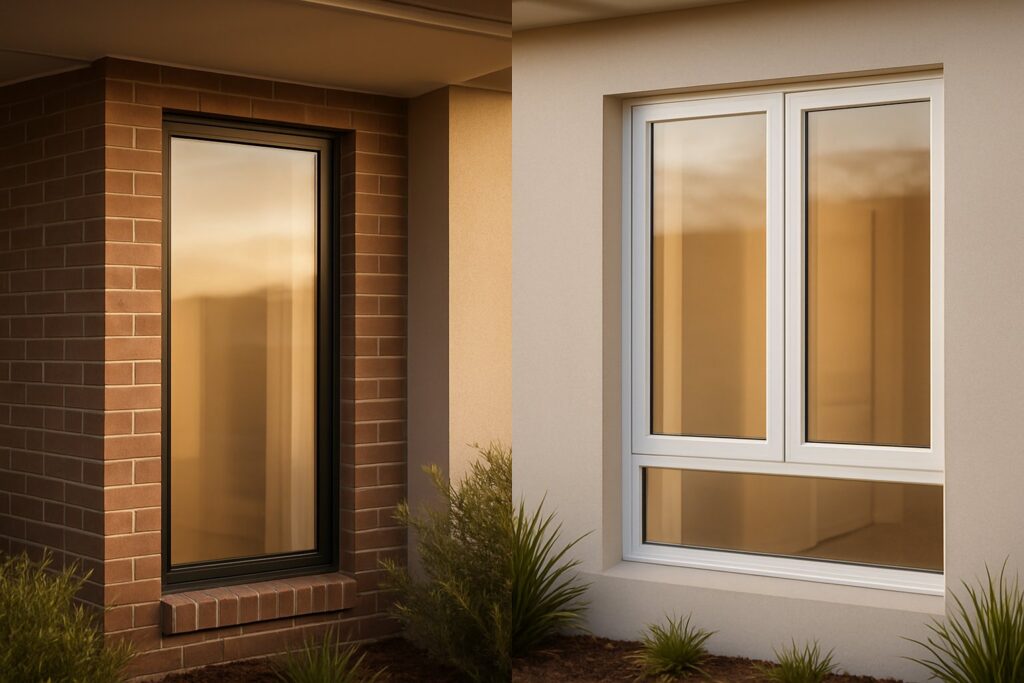
Medium bronze occupies the middle ground and is arguably the most versatile anodised tone available. It carries a richer, deeper warmth than its lighter sibling — enough to hold its own against strong facade materials without overwhelming them. Pair medium bronze window frames with red or warm-toned brickwork and the result feels grounded and cohesive. Set it against timber cladding or natural stone and it pulls out the organic warmth in both materials. This adaptability explains why medium bronze is specified across such a wide range of projects, from suburban family homes in Brisbane to mid-rise commercial buildings in Perth.
A useful rule of thumb for designers and homeowners: light bronze works best where the surrounding palette is already cool or neutral — rendered walls, pale brick, light-coloured cladding. Medium bronze thrives alongside warmer, earthier materials. Both grades deliver the translucent metallic depth that defines an anodized aluminum bronze color, but each responds differently to its architectural context.
Dark Bronze Anodised Aluminium for Architectural Impact
Dark bronze is the heavyweight of the anodised palette. Produced through extended electrolytic deposition, it achieves a commanding depth that approaches black yet retains a visible metallic warmth — a quality that distinguishes it from the flat opacity of powder-coated dark frames. Under direct sunlight, dark bronze anodised aluminium reveals rich chocolate-brown undertones. In overcast conditions, it cools toward graphite. That dynamic, light-responsive character is precisely why architects reach for dark bronze anodized color when a facade needs presence without harshness.
Specifiers frequently choose this grade for high-end residential developments, commercial buildings, and heritage-sensitive projects where pure black would feel too stark against traditional masonry. In conservation areas across Sydney, Melbourne, and Adelaide, dark bronze often satisfies planning requirements more readily than black because its metallic warmth reads as sympathetic to period building materials rather than confrontational.
Brown anodised aluminium is sometimes used as a general umbrella term covering the entire bronze family, though industry professionals distinguish carefully between the specific grades. If a specification document simply says “brown anodised,” always clarify whether it means light, medium, or dark — the visual difference on a finished facade is substantial.
Dark bronze pairs exceptionally well with materials that carry their own weight and texture:
- Slate roofing — the cool grey of natural slate creates a sophisticated contrast against warm dark bronze frames
- Aged brick — weathered reds and browns find a natural companion in the deep metallic warmth of anodised dark bronze
- Dark timber cladding — hardwood species like spotted gum or blackbutt share tonal DNA with dark bronze, creating a seamless material relationship
- Zinc standing seam — the cool, matte grey of zinc cladding sets off dark bronze frames beautifully, a combination increasingly popular on contemporary Australian homes
Avoiding Colour Variation in Bronze Anodised Batches
Every bronze grade carries a practical challenge that specifiers need to manage: batch variation. Because the colour depends on precise electrolytic immersion time, voltage, and solution chemistry, even minor fluctuations between production runs can produce visible tonal differences. Medium and dark bronze tones are the most susceptible — the deeper the deposition, the more sensitive the final shade becomes to process variables.
For small residential orders involving a handful of windows, batch variation rarely poses a problem. For larger projects — a double-storey home with extensive glazing, a multi-residential development, or a commercial facade — inconsistency across frames can be glaringly obvious once installed side by side.
Three practical steps minimise the risk. First, specify to Qualanod standards; the certification enforces strict process controls that narrow the window of acceptable colour deviation. Second, request retained colour samples from the anodiser before production begins — these physical references become your contractual benchmark against which every frame is measured. Third, wherever possible, ensure all window frames for a single project are produced in the same anodising batch. Splitting an order across multiple runs introduces the exact variability you’re trying to avoid.
Bronze gets most of the attention in the anodised world, and deservedly so. But choosing between anodised and powder-coated finishes involves trade-offs that extend well beyond colour — durability, repairability, environmental impact, and cost all factor into the decision.
Anodised vs Powder Coated Aluminium Windows Compared
Durability, repairability, environmental footprint, cost — each factor pulls in a different direction depending on the finish you choose. Most comparisons pit anodised against powder coated aluminium windows and leave it there. A third option, electrophoretic coating, rarely gets a mention in the residential window conversation despite growing commercial adoption. The table below lines up all three finishes across the criteria that matter most for architectural window specification in Australia.
| Criteria | Anodised | Powder Coated | Electrophoretic (E-Coat) |
|---|---|---|---|
| Colour Range | Limited metallic palette — silvers, bronzes, golds, blacks | Virtually unlimited — full RAL range, custom colours, matte/gloss/textured finishes | Wider than anodising, narrower than powder coating — growing range of metallic and solid tones |
| Durability | Exceptional — finish is integral to the metal and cannot peel, flake, or delaminate | Very good — applied layer can chip on heavy impact | Very good — electrochemically bonded, superior adhesion to standard powder coat |
| Scratch Resistance | Superior — anodic oxide layer is extremely hard (comparable to sapphire on the Mohs scale) | Good — resistant to general abrasion but vulnerable to sharp impacts | Good — thinner film than powder coat, moderate scratch resistance |
| UV Stability | Excellent — colour is inorganic and does not fade or chalk under UV exposure | Good to excellent — high-performance PVDF coatings resist fading; standard polyester may chalk over time | Good — water-based organic finish; UV performance varies by formulation |
| Maintenance | Minimal — periodic wash with mild detergent | Low — periodic wash; inspect for chips in high-exposure areas | Low — periodic wash; inspect as per powder coat |
| Expected Lifespan | 40–80+ years in architectural applications meeting BS 3987 | 20–30 years typical; high-performance PVDF coatings can extend this | 20–30 years typical; still emerging in long-term architectural data |
| Environmental Impact | Low — no VOCs, no heavy metals in modern processes; fully recyclable | Low — near-zero VOC emissions; overspray recyclable | Low — water-based paints, minimal VOCs, high material utilisation (95%+) |
| Repairability | Difficult — localised damage cannot be touched up or recoated on site | Moderate — minor chips can be touched up; full recoating possible | Difficult — requires factory reprocessing for significant repairs |
| Relative Cost | Premium — specialist facilities, longer processing for darker tones | Standard to moderate — widely available, efficient for bulk orders | Moderate to premium — lower per-unit cost at high volumes |
This aluminum finishes chart captures the practical trade-offs at a glance, but the nuances behind each column deserve closer attention — particularly around longevity and the emerging role of E-coating in the Australian market.
Durability and Lifespan of Anodised vs Powder Coated Frames
The core distinction is structural. An anodised finish is not a coating in the conventional sense — it is the aluminium surface, electrochemically transformed into a dense oxide layer. There is nothing sitting on top of the metal to chip, blister, or delaminate. That permanence is why anodised finishes offer superior abrasion and scratch resistance compared to most powder coatings, and why quality finishes meeting BS 3987 standards carry performance expectations stretching well beyond 40 years.
Powder coated aluminium windows tell a different story. The polyester or PVDF resin layer bonds firmly to a pre-treated aluminium substrate and performs admirably under normal conditions — resisting fading, chalking, and general wear across decades of service. But it remains an applied layer. A stray ladder, a piece of windblown debris, or a careless installation can chip the surface down to bare aluminium. In coastal or high-UV environments, even well-maintained powder coat may eventually require recoating — something anodised frames simply never need.
That said, powder coating offers one significant durability advantage over anodising: repairability. A chipped powder-coated frame can be spot-repaired or fully recoated on site. Anodised aluminium, because the finish is integral to the metal, cannot be locally touched up. Significant damage typically means replacing the affected section. For ground-floor windows exposed to foot traffic or mechanical risk, this trade-off is worth weighing carefully.
Electrophoretic Coating as a Third Option
Sitting between anodising and powder coating is a finish most Australian homeowners have never heard of: electrophoretic coating, commonly called E-coating or electro-painting. The process submerges aluminium components in a water-based paint bath and applies an electric current, causing organic paint particles to migrate and deposit uniformly across every surface — including recesses and complex geometries that powder spray guns can miss.
E-coating’s chief advantage is adhesion. Because the paint is electrochemically driven onto the substrate rather than sprayed, it bonds more tenaciously than conventional powder coat. The resulting film is thinner and offers a wider colour palette than anodising, though still narrower than the full RAL spectrum available through powder coating. Environmental credentials are strong too — water-based formulations produce minimal VOCs and achieve material utilisation rates above 95 per cent, meaning very little paint goes to waste.
In Australia, electrophoretic finishes remain uncommon in the residential window market. You’re far more likely to encounter them on commercial curtain wall systems, automotive primer applications, and industrial components. However, the technology is gaining traction in commercial glazing projects where architects want better-than-powder-coat adhesion without the colour limitations of anodising. It’s a space worth watching — particularly as fabricators expand their finishing capabilities to meet demand for higher-performance facades in coastal and tropical regions.
When Powder Coating Makes More Sense
Balanced specification means acknowledging where anodising isn’t the answer. Powder coating is the clear winner when a project demands a specific RAL colour, a bold non-metallic tone, or exact colour matching to existing building elements. Renovating a mid-century home with olive-green window frames? Matching a corporate brand colour across a commercial facade? These briefs fall squarely in powder coating’s territory. No amount of electrolytic colouring will produce a fire-engine red or a heritage cream from an anodising bath.
Powder coating also wins on upfront cost. The process is more budget-friendly than anodising for standard orders, and the infrastructure is far more widely available across Australian fabrication networks. For volume residential projects working to tight budgets, powder coated aluminium windows deliver reliable performance and colour consistency at a lower entry price.
The decision framework is ultimately straightforward. Choose anodising when the brief calls for premium metallic finishes, maximum longevity, and minimal lifetime maintenance — particularly in coastal, high-UV, or architecturally sensitive contexts. Choose powder coating when colour flexibility, repairability, or budget constraints take priority. And keep E-coating on your radar for commercial projects where adhesion performance matters as much as aesthetics.
Finish type is only half the equation, though. The real design challenge lies in matching whichever finish — and whichever specific colour within it — to the architectural character of the building itself.
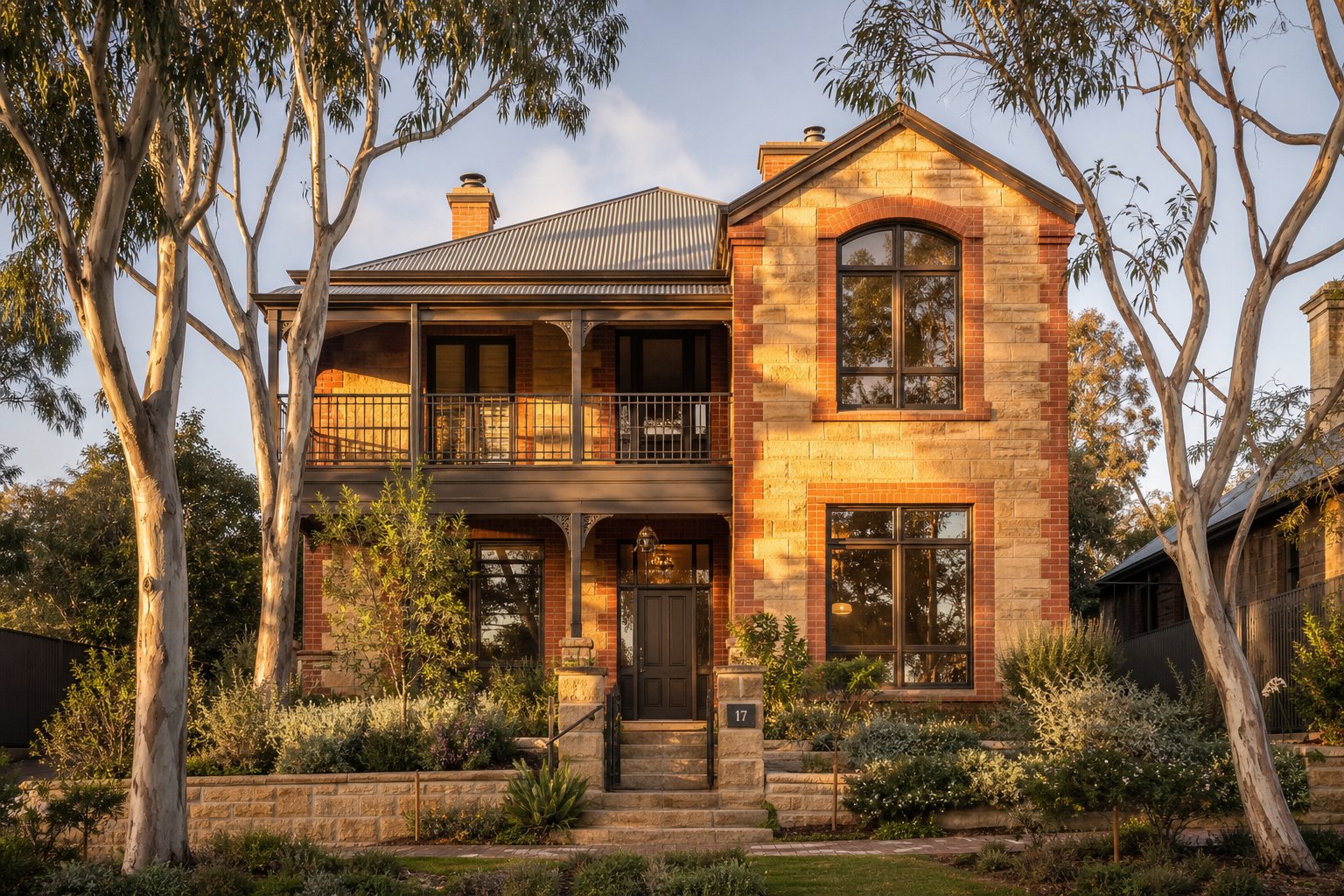
Matching Anodised Window Colours to Your Property Style
A bronze finish that looks stunning on a heritage terrace in Paddington can feel entirely wrong on a flat-roofed contemporary build in Brighton. Colour selection isn’t just about personal taste — it’s about context. The facade materials, roof type, surrounding streetscape, and architectural era of a building all influence which anodised tone will sit most comfortably on the window frames.
The table below maps the most common Australian property types to their best-matched anodised colours, along with the design logic behind each pairing and the complementary materials that make them work.
| Property Type | Recommended Anodised Colours | Design Rationale | Complementary Materials |
|---|---|---|---|
| Contemporary new build / Minimalist home | Natural silver (clear anodised), Dark bronze, Black | Clean metallic tones reinforce modern lines; dark frames create bold contrast against light facades | White render, polished concrete, zinc cladding, spotted gum timber |
| Period home / Heritage property | Medium bronze, Champagne, Light bronze, Gold | Warm mid-tones complement traditional materials without visual heaviness; metallic quality echoes original metal window finishes | Red brick, sandstone, painted weatherboard, terracotta detailing |
| Conservation area dwelling | Medium bronze, Champagne | Subtle metallic warmth satisfies planning requirements more readily than stark black or bright silver | Heritage brick, rendered masonry, slate roofing |
| Coastal home | Natural silver, Light bronze, Dark bronze | Anodised finishes resist salt-air corrosion; lighter tones reduce solar heat absorption on exposed facades | Fibre cement cladding, pale timber, stone veneer |
| Commercial / Multi-residential development | Dark bronze, Black, Medium bronze | Deep tones deliver a consistent, premium facade across large glazed areas; strong street presence | Curtain wall glass, precast concrete, steel detailing, dark brick |
| Mixed-use / Residential streetscape interface | Medium bronze, Brown anodised aluminium tones | Warmer bronze softens commercial scale where buildings meet residential neighbours | Warm-toned brick, timber screening, landscaped setbacks |
Contemporary New Builds and Minimalist Homes
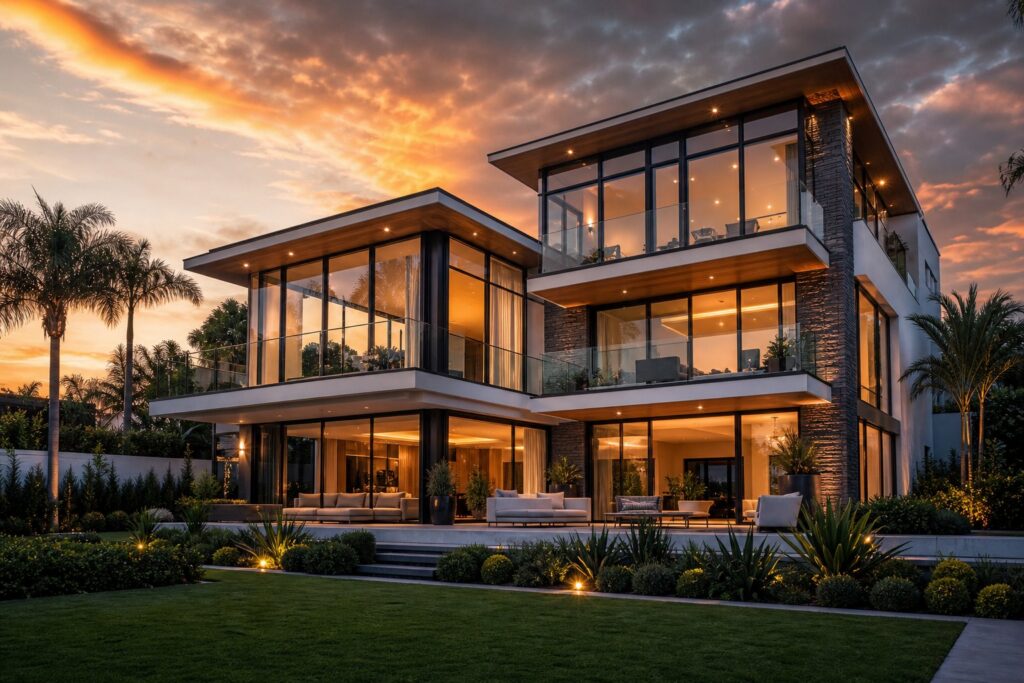
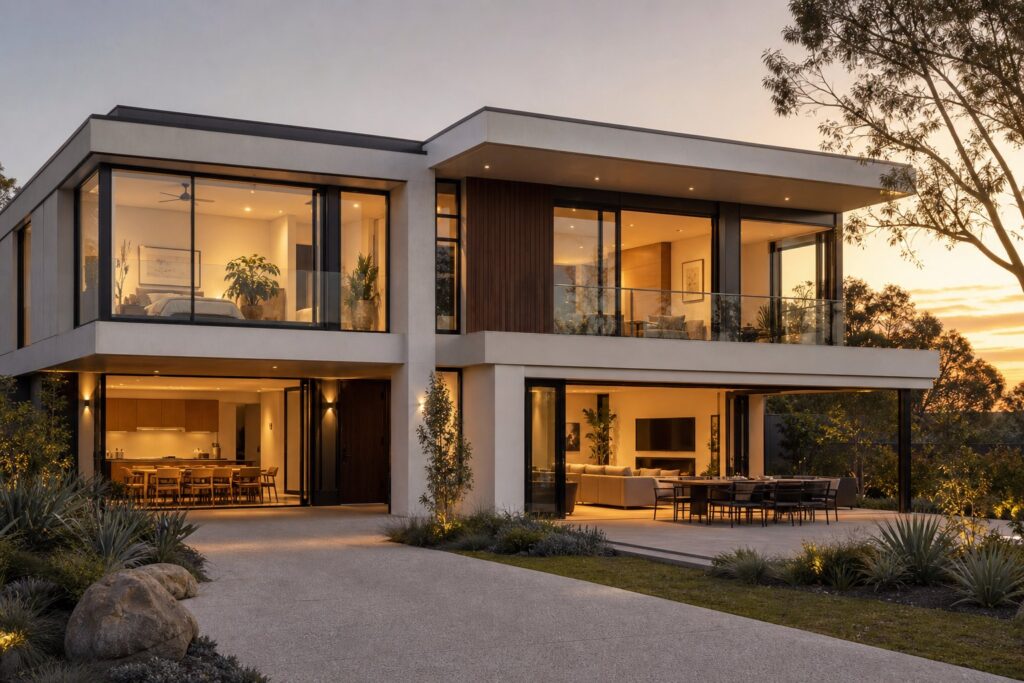
Modern Australian homes thrive on contrast. A three-storey coastal build with floor-to-ceiling glazing and a flat metal roof demands window frames that either disappear entirely or make a deliberate architectural statement — there’s no middle ground. Natural silver achieves the first effect, its cool satin tone blending seamlessly into rendered white walls until the frames virtually vanish, leaving glass as the dominant facade element. Dark bronze and black anodised frames take the opposite approach, drawing sharp lines across light-coloured facades and giving each window a defined, intentional presence.
Grey aluminium windows in anodised finishes occupy an interesting transitional space. They carry enough warmth to avoid the clinical edge of pure silver, yet enough neutrality to work with both contemporary and softly modern designs. For homeowners building in suburbs where the streetscape blends older and newer homes, grey-toned anodised frames bridge the two eras without committing fully to either one.
In all three cases, the translucent metallic quality of anodised finishes gives minimalist facades a visual richness that flat, opaque powder coating cannot replicate. When a building relies on material honesty rather than decorative detail, that depth matters.
Period Homes, Heritage Properties, and Conservation Areas
Heritage contexts call for restraint. On a Federation-era brick home in Haberfield or a Victorian terrace in South Melbourne, window frames need to feel sympathetic — present but not dominant. Medium bronze and champagne anodised tones achieve this balance consistently. Their warm metallic character complements the natural tones of aged brick, sandstone, and painted timber without the visual weight that darker frames impose.
In conservation areas and heritage-listed properties, anodised finishes carry a distinct advantage over powder coating. The subtle, translucent metallic quality of anodised aluminium more closely resembles the patina of traditional metal window finishes — original steel and bronze casements — than any opaque applied coating can. This resemblance can make planning approval smoother, though requirements vary between councils. Always check local heritage overlay provisions and consult your council’s planning team before finalising frame colours for heritage-sensitive projects.
Gold tones suit a narrower set of heritage applications. On a grand Edwardian home with ornate detailing, gold anodised frames can echo period brass hardware and gilded architectural elements. On a simpler cottage, however, gold risks looking ostentatious. Champagne offers a safer route to warmth for most period homes — close enough to gold’s DNA to feel historically appropriate, restrained enough to avoid overstatement.
Commercial Buildings and Multi-Residential Developments
Scale changes everything. A single window frame on a house is a detail; fifty identical frames on a six-storey apartment building become the facade’s defining visual element. Consistency matters enormously at this scale, and anodised finishes — particularly dark bronze and black — deliver the uniform, premium appearance that commercial and multi-residential projects demand.
Dark bronze anodised frames are especially popular on mid-rise developments in inner-city Sydney, Melbourne, and Brisbane. They project substance and warmth across large glazed areas without the starkness of black, and their light-responsive metallic character gives facades a dynamic quality that flat powder-coated tones cannot match. For mixed-use developments where the ground-floor commercial level meets a residential streetscape above, brown anodised aluminium in medium tones softens the transition — warm enough to feel approachable at pedestrian level while still reading as polished and professional from a distance.
Developers and project teams managing large-scale orders benefit from working with window suppliers who stock the full range of aluminum window colors in anodised finishes and can coordinate batch consistency across hundreds of frames. MEICHEN’s aluminium window range, for example, covers multiple anodised and custom colour options suited to both residential and commercial Australian projects — the kind of supplier breadth that simplifies specification when you’re coordinating anodized aluminum frame windows across an entire development rather than a single home.
Matching colour to property type gets you most of the way to a confident specification. But there’s a growing trend that adds another layer of design flexibility — using different anodised colours on the interior and exterior faces of the same window frame.
Dual-Colour and Bi-Colour Anodised Window Frame Options
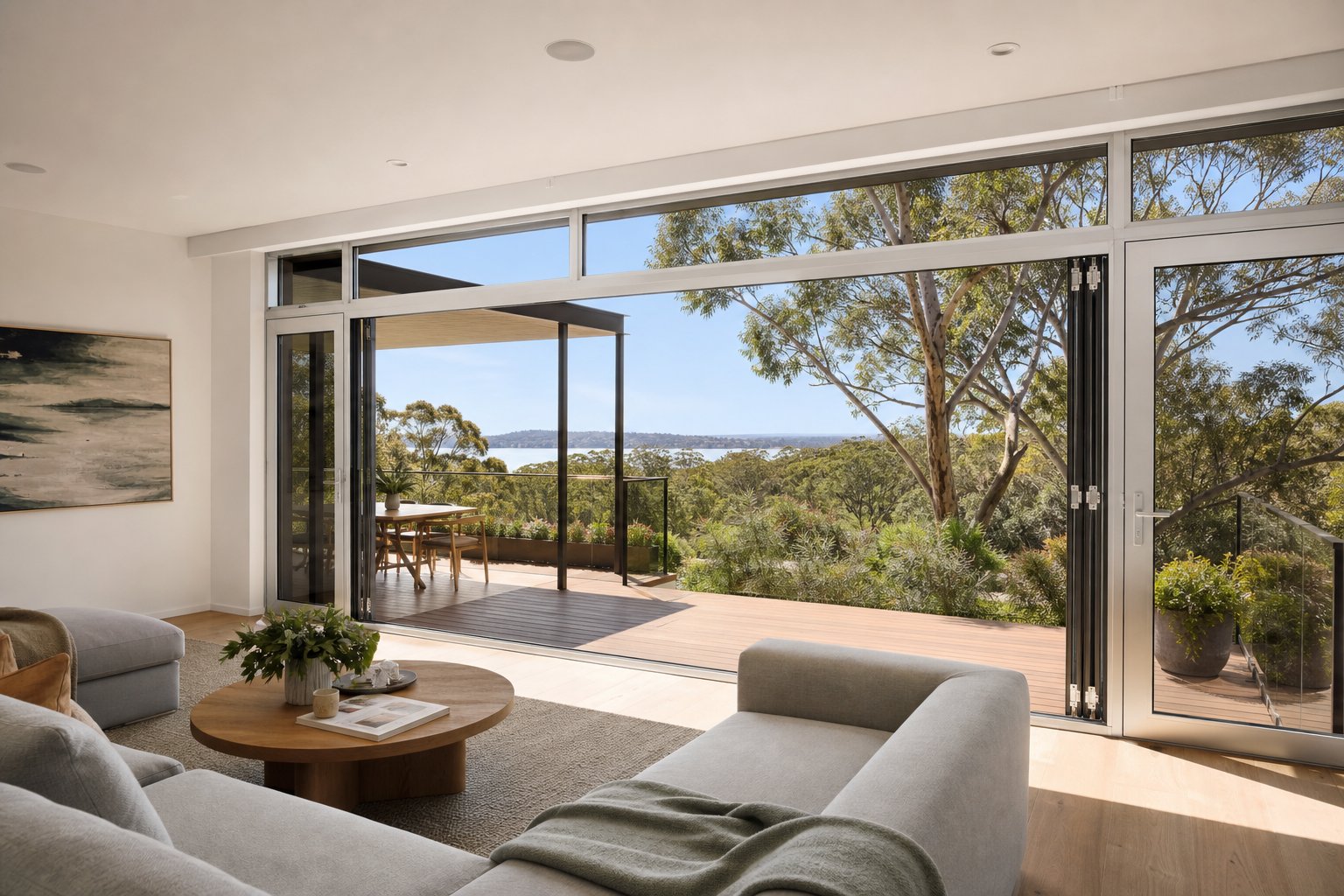
A dark bronze exterior that anchors the facade. A light silver interior that bounces natural light deep into the living room. Until recently, getting both on the same window frame meant powder coating one side and accepting the compromises that come with an applied finish. Dual-colour anodised aluminium window frames change that equation entirely — delivering two distinct anodised finishes on a single profile, each with the full durability and metallic depth of a traditional anodised surface.
How Dual-Colour Anodised Window Frames Work
The technique hinges on how modern thermally broken aluminium profiles are constructed. Rather than a single extrusion, thermally strutted window systems use separate interior and exterior aluminium sections joined by a polyamide thermal break. Because these two sections are physically distinct pieces of aluminium before assembly, each one can be anodised independently — processed through entirely separate colour baths with different electrolytic durations.
The exterior extrusion might receive a full dark bronze treatment, spending extended time in the tin salt colouring bath to achieve that deep, commanding metallic warmth. Meanwhile, the interior extrusion goes through a shorter cycle — or skips electrolytic colouring altogether — emerging as a clean, natural silver. Once both pieces are anodised, sealed, and quality-checked, the polyamide thermal strut locks them together into a single, structurally unified profile. The result is an anodized aluminium window frame with two genuinely different finishes, each grown from the metal itself rather than painted on as an afterthought.
This approach was originally developed for high-end commercial glazing, where architects needed facade-facing colours to differ from interior tones without sacrificing finish performance. It has since filtered into premium residential specification across Australia — particularly in architect-designed homes where interior design continuity matters as much as streetside presentation.
Practical Benefits of Bi-Colour Anodised Windows
Dual-colour specification goes beyond aesthetics. The real value sits in what it eliminates — compromises that single-finish frames force on designers and homeowners alike.
- Exterior colour matches the building facade — dark bronze or black anodised on the street-facing side coordinates with brick, stone, cladding, or render without forcing the interior to follow suit
- Interior colour complements room aesthetics — a lighter anodised tone inside keeps living spaces feeling open and bright, particularly in south-facing rooms or homes with deep floor plans
- Full anodised durability on both surfaces — unlike hybrid approaches where one side is powder coated, both faces retain the scratch resistance, UV stability, and peel-proof permanence of genuine anodised aluminium
- No applied paint required on interior frames — eliminates the risk of interior coatings yellowing, chipping, or requiring maintenance over time
- Premium specification for high-end projects — dual-colour anodised frames signal an elevated level of material consideration that discerning buyers and design-conscious homeowners recognise immediately
Worth noting: bi-colour anodised options need to be discussed with your fabricator during the design phase, not added as a last-minute request. The separate anodising runs, thermal break assembly, and quality matching between interior and exterior sections all add lead time. For residential projects, expect an additional two to four weeks beyond standard anodised frame delivery. For large commercial orders, early engagement with the anodiser is essential to lock in batch consistency across both colour treatments.
Clear Anodised Interior with Dark Exterior Finishes
Among the available combinations, one pairing has emerged as the clear favourite across both residential and commercial projects: clear anodized aluminum windows on the interior face paired with dark bronze or black anodised on the exterior.
The logic is straightforward. Clear anodised aluminium — that clean, silvery satin finish — reflects ambient light rather than absorbing it. Inside a room, it amplifies the sense of brightness and openness, making window reveals feel lighter and less visually intrusive. It also pairs effortlessly with virtually any interior palette, from warm timber floors and white walls through to darker, moodier schemes. The neutrality of silver means it never competes with furnishings or finishes.
On the exterior, dark bronze or black anodised frames do the opposite work. They anchor the facade, define the glazing openings, and give the building a strong architectural identity from the street. The contrast between a bold external presence and a quietly recessive interior creates a layered design experience — the building reads differently depending on whether you’re approaching it or living inside it.
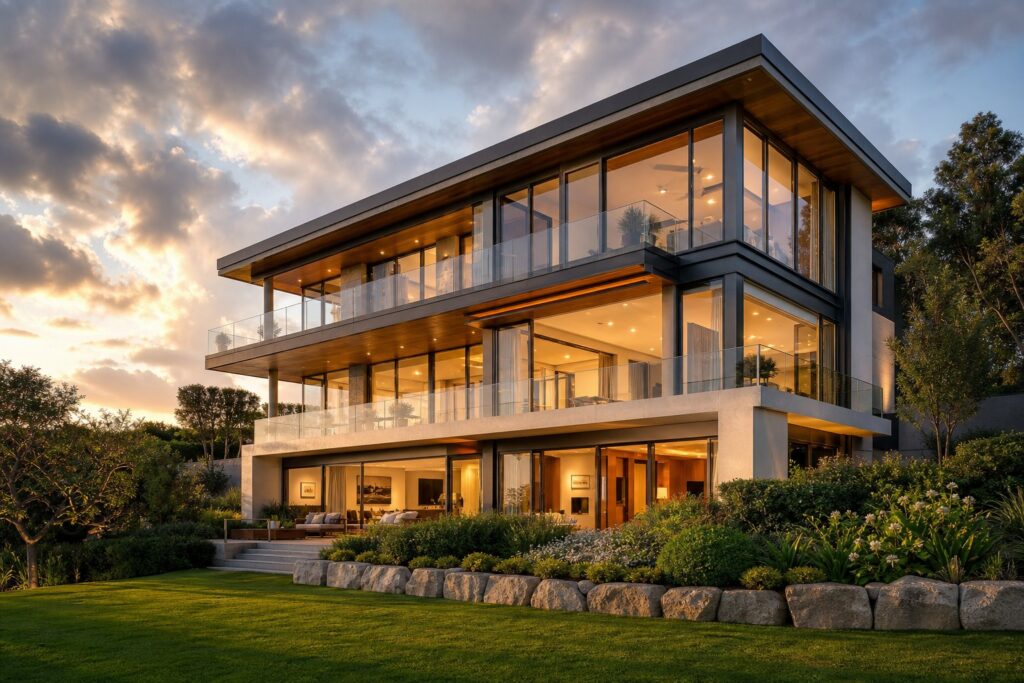
For double-storey and triple-storey homes with expansive glazing — the kind of floor-to-ceiling anodized aluminum window frames that define contemporary coastal and suburban builds across Sydney, Melbourne, and Perth — the dual-colour approach solves a persistent design tension. Homeowners no longer need to choose between a dramatic exterior and a light-filled interior. Both coexist on the same frame, each surface performing its intended role without compromise.
Dual-colour options expand the design possibilities, but the practical foundations beneath those choices — industry standards, sustainability credentials, and realistic cost expectations — ultimately determine whether an anodised specification delivers lasting value.
Standards, Sustainability, and Cost of Anodised Finishes
Choosing the right anodised colour is a design decision. Ensuring that colour performs as expected for decades — and understanding what you’ll pay for that performance — is a specification decision. Three practical pillars underpin every successful anodised aluminium window project: verified quality standards, genuine environmental credentials, and a clear-eyed view of the cost equation. Each one deserves more attention than the surface-level treatment competitors typically offer.
Industry Standards and Quality Marks for Anodised Windows
Two benchmarks matter most when specifying anodised finishes for architectural window applications in Australia.
BS 3987 governs anodic oxide coatings on wrought aluminium for external architectural use. It sets minimum requirements for oxide layer thickness, sealing quality, colour consistency, and resistance to weathering — essentially defining what “architectural grade” anodising means in practice. While it originates as a British Standard, BS 3987 remains widely referenced in Australian architectural specifications, particularly on projects where long-term facade performance is non-negotiable. Finishes meeting this standard are expected to maintain their appearance for decades, even in Australia’s punishing UV and coastal environments.
The Qualanod quality label takes verification a step further. Administered internationally, Qualanod certifies that an anodising facility’s processes, equipment, and output meet strict performance benchmarks across coating thickness, colour fastness, sealing integrity, and corrosion resistance. Qualanod doesn’t just test the finished product — it audits the production process itself, ensuring consistency from batch to batch. Their technical documentation covers everything from surface abrasion resistance testing to the weathering behaviour of anodised aluminium, providing specifiers with confidence that a certified finish has been produced under controlled, repeatable conditions.
For projects involving curtain walling or large-format glazed facades, the Centre for Window and Cladding Technology (CWCT) guidelines offer additional specification frameworks that complement BS 3987 and Qualanod requirements. These are particularly relevant for commercial and multi-residential developments where window and cladding interfaces must perform as integrated systems.
Specifying Qualanod-certified finishes is the single most effective step you can take to ensure long-term colour stability on anodised aluminium windows. The certification guarantees that standard anodized aluminum colors have been produced under audited process controls — removing guesswork from what is otherwise a highly variable electrochemical process.
Sustainability and Environmental Credentials
Sustainability claims are easy to make and harder to substantiate. Anodised aluminium holds up unusually well under scrutiny.
The anodising process itself is inherently non-toxic. Unlike painting or some powder coating processes, modern architectural anodising produces no volatile organic compounds (VOCs). The oxide layer created during anodising is aluminium oxide — the same naturally occurring mineral found in sapphires and corundum. No heavy metals are introduced during the standard electrolytic colouring process; the tin salts used to produce the bronze family are inorganic and contained within a closed-loop system.
Recyclability is where anodised aluminium genuinely excels. When an anodised window reaches the end of its service life — which, as we’ve seen, may be 40 to 80 years away — the aluminium can be melted down and reused without any degradation caused by the oxide layer. The anodic coating simply dissolves back into the melt. Compare this to powder-coated aluminium, where the organic resin layer must be burned off during recycling, and to painted alternatives that can release microplastics during decades of outdoor weathering. From a circular-economy perspective, anodised finishes leave the smallest environmental footprint of any standard aluminium window treatment.
Wastewater management remains the primary environmental consideration in anodising. The acid electrolyte baths generate effluent containing dissolved aluminium and residual acids that require proper filtration and treatment before discharge. Reputable anodisers — particularly those operating under Qualanod certification — maintain closed-loop water treatment systems that neutralise contaminants and, in many cases, recycle treated water back into the production process. For specifiers concerned about supply chain sustainability, asking whether your anodiser holds Qualanod certification effectively confirms that these wastewater controls are in place.
Cost Implications of Anodised vs Powder Coated Frames
Honesty here saves grief later. Anodised aluminium windows cost more than their powder-coated equivalents. The premium varies by project scale, colour choice, and supplier, but as a general guide, expect anodised frames to sit 15 to 30 per cent above comparable powder-coated units on a supply-only basis.
Several factors drive that gap:
- Specialist facilities — architectural-grade anodising requires dedicated plant and equipment that fewer fabricators operate compared to the widespread availability of powder coating lines across Australia
- Batch processing constraints — anodising tanks have fixed capacity, and each batch requires precise chemical management; economies of scale are harder to achieve than with powder coating’s continuous spray-and-cure workflow
- Colour-dependent processing time — darker tones require longer electrolytic deposition, meaning a dark bronze or black anodised frame physically spends more time in the colouring bath than a champagne or silver frame, increasing per-unit cost
- Quality control overhead — maintaining Qualanod-compliant colour consistency across production runs demands rigorous process monitoring that adds operational cost
- Limited supplier competition — fewer anodising facilities in the Australian market means less competitive pricing pressure compared to the highly competitive powder coating sector
Set against that upfront premium is a long-term value proposition that often tilts the equation back in anodising’s favour. An anodised finish never needs recoating. It won’t chalk, fade, or peel under UV exposure. Maintenance amounts to an occasional wash with mild detergent. Over a 30-year window, the total cost of ownership — factoring in the recoating cycles that powder-coated frames may eventually require, particularly in harsh coastal or high-UV locations — frequently favours the anodised option. For homeowners and developers thinking in decades rather than dollars-per-frame at the point of purchase, that lifecycle calculation is worth running before defaulting to the lower upfront number.
An anodization color chart, a verified quality standard, a clear sustainability profile, and realistic cost expectations — these are the reference points that turn a colour preference into a defensible specification. The final step is pulling all of those threads into a practical workflow that gets you from inspiration to installed windows with confidence.
How to Specify the Right Anodised Colour for Your Window Project
Knowing every shade on the palette, understanding the electrochemistry, and appreciating the durability data means very little if the specification process itself goes sideways. A homeowner who falls in love with an anodized champagne color on a screen, only to receive frames two shades darker because no physical sample was confirmed, learns this lesson the expensive way. The gap between colour inspiration and successful installation is bridged by a disciplined specification workflow — one that accounts for the unique characteristics of anodised finishes at every stage.
Step-by-Step Process for Specifying Anodised Window Colours
Whether you’re a homeowner renovating a single-storey cottage in Adelaide or an architect coordinating bronze anodized aluminum windows across a multi-residential tower in Parramatta, the core process follows the same logical sequence. Skipping steps invites colour mismatches, budget surprises, and delivery delays.
- Define the property type and architectural style. Start with context, not colour. A heritage terrace, a coastal contemporary build, and a commercial office facade each point toward a different segment of the anodised palette. The property-matching guidance from earlier in this article gives you a shortlist before you’ve opened a single swatch book.
- Shortlist two or three candidate colours. Use the anodised colour chart and property-type table to narrow the field. For most residential projects, the decision comes down to a choice within a family — medium bronze anodized versus dark bronze, or champagne versus natural silver — rather than a leap between entirely different tones.
- Request physical colour samples from your window supplier. This step is non-negotiable. Anodised colours shift dramatically between digital screens, printed brochures, and real-world metal. Ask for actual anodised aluminium sample pieces, not laminated colour cards. Hold them against your facade materials — brick, render, stone, cladding — in both morning and afternoon light. The translucent, light-responsive nature of anodised finishes means a colour that looks perfect at midday may read very differently under low-angle winter sun.
- Confirm industry standard compliance. Verify that the proposed finish meets BS 3987 for external architectural applications and carries Qualanod certification. These aren’t optional quality extras — they’re your assurance that the anodised colour will hold its integrity through decades of Australian UV, salt air, and thermal cycling. Ask your supplier for documentation, not just verbal confirmation.
- Discuss dual-colour options if interior and exterior requirements differ. If your interior design calls for a lighter tone than your facade demands — clear anodised inside with dark bronze outside, for example — raise this early. Dual-colour anodised frames require separate processing runs and thermal break assembly, adding lead time that needs to be factored into the project schedule from the outset.
- Confirm lead times and order quantities for consistent colour matching. For projects involving more than a handful of windows, insist that all frames are anodised in a single production batch wherever possible. Split batches introduce the tonal variation that the bronze family is particularly prone to. Lock in quantities, confirm delivery timelines, and request that the anodiser retains a reference sample from your specific batch for future verification.
Working with a Window Supplier Who Understands Anodised Finishes
The supplier you choose shapes the outcome as much as the colour you select. Powder coating is available from virtually every aluminium window fabricator in Australia. Anodised finishes are not. The specialist nature of architectural anodising means fewer suppliers offer the full range of tones — and fewer still understand the technical nuances well enough to guide clients through the process confidently.
Look for suppliers who can demonstrate several practical capabilities. They should stock or have direct access to the complete anodised palette, from natural silver through every bronze grade to black. They should provide genuine physical samples — anodised metal, not printed approximations. They should understand Qualanod certification and be able to confirm which anodisers in their supply chain hold it. And critically, they should be able to discuss anodized bronze color options with enough technical fluency to explain the difference between, say, a C33 medium bronze and a C34 dark bronze in terms that relate to your specific project context.
For large or complex orders — a double-storey home with extensive glazing, a multi-unit development, a commercial facade — the supplier also needs robust batch management processes. The ability to coordinate colour consistency across dozens or hundreds of frames, manage retained samples, and communicate realistic lead times separates experienced anodised window specialists from general fabricators who treat anodising as an occasional add-on.
Anodised colour selection should always be confirmed against physical samples viewed in natural light at the project site — never from digital images alone. A retained physical sample, agreed upon by both supplier and client before production begins, becomes the contractual benchmark that protects everyone involved.
Getting Started with Your Anodised Aluminium Window Project
Every successful anodised window project shares the same starting point: a conversation with a supplier who genuinely understands the material. Not a quick quote request. Not a colour picked from a website thumbnail. A proper discussion that covers your building’s architectural character, the facade materials the frames will sit alongside, the performance demands of your location — coastal salt exposure, intense UV, bushfire zones — and the specific bronze anodized color or metallic tone you’re drawn to.
That conversation is where inspiration meets practical reality. It’s where you discover that the medium bronze anodized finish you admired on a neighbour’s renovation might suit your sandstone facade perfectly — or that your north-facing elevation would benefit from a lighter champagne to reduce visual heat on an already warm-toned wall. It’s also where lead times, batch sizing, and budget expectations get anchored in fact rather than assumption.
MEICHEN’s aluminium windows page offers a practical starting point for Australian homeowners, builders, architects, and developers exploring window systems with anodised and custom colour options. The page covers window types, custom specifications, and performance considerations across both residential and commercial applications — giving project teams a clear view of what’s available before the first sample is requested.
The anodised aluminium windows colours covered throughout this guide — from the cool restraint of natural silver through the warm depth of every bronze grade to the commanding presence of black — represent a deliberately curated palette. Each tone exists because the electrochemistry demands it, and each carries a metallic authenticity that no applied finish can replicate. Armed with the right colour chart, the right industry standards, the right supplier relationship, and the practical specification workflow above, you’re positioned to make a finish decision that will look as confident in thirty years as it does the day the frames go in.
Frequently Asked Questions About Anodised Aluminium Window Colours
1. What colours are available for anodised aluminium windows?
Anodised aluminium windows are available in a curated metallic palette that includes natural silver (clear anodised), champagne, light bronze, medium bronze, dark bronze, gold, and black. Each colour is produced through electrolytic colouring, where metallic salts are deposited into the aluminium oxide layer at varying durations. Darker tones like dark bronze and black require longer immersion times. While the range is narrower than powder coating’s virtually unlimited RAL spectrum, every anodised shade carries a translucent metallic depth that applied coatings cannot replicate. Specialty tones such as pewter grey and reddish bronze are also possible through project-specific consultation with anodisers.
2. How long do anodised aluminium window finishes last?
Quality anodised finishes meeting BS 3987 standards are expected to maintain their appearance for 40 to 80 years or more in architectural applications. This significantly exceeds the typical 20 to 30 year lifespan of standard powder-coated finishes. The exceptional longevity stems from the fact that anodised colour is integral to the metal rather than an applied surface layer — it physically cannot peel, flake, or delaminate. Maintenance is minimal, requiring only an occasional wash with mild detergent. For Australian coastal and high-UV environments, anodised finishes are particularly well suited because the inorganic colour does not fade or chalk under prolonged sun exposure.
3. Is anodised aluminium more expensive than powder coated windows?
Yes, anodised aluminium windows typically cost 15 to 30 per cent more than equivalent powder-coated units on a supply-only basis. The premium reflects the specialist facilities required, batch processing constraints, longer treatment times for darker colours, and fewer anodising suppliers in the Australian market. However, the total cost of ownership over decades often favours anodising because the finish never needs recoating, does not chalk or fade under UV exposure, and requires only basic cleaning. For homeowners and developers evaluating value over a 30-year horizon rather than upfront price alone, the lifecycle calculation frequently makes anodised the more economical choice.
4. Can anodised aluminium windows have different colours on the inside and outside?
Yes, dual-colour or bi-colour anodised window frames are available through thermally broken aluminium profiles. Because these systems use separate interior and exterior aluminium sections joined by a polyamide thermal break, each section can be anodised independently in a different colour bath. The most popular combination is clear anodised silver on the interior — maximising light reflection inside the room — paired with dark bronze or black on the exterior for strong architectural presence. Bi-colour options should be discussed with your fabricator during the design phase, as the separate anodising runs and thermal break assembly typically add two to four weeks of lead time beyond standard delivery.
5. What is the difference between anodised and powder coated aluminium window frames?
The fundamental difference is structural. Anodised colour is embedded within the aluminium’s own oxide layer through an electrochemical process, making it part of the metal itself. Powder coating applies a polyester or PVDF resin layer on top of the aluminium surface. This means anodised finishes cannot peel, chip, or flake, while powder coating — though highly durable — can be damaged by sharp impacts. Anodised finishes also exhibit a translucent, light-responsive metallic quality that shifts subtly throughout the day, whereas powder coat is fully opaque. Powder coating wins on colour flexibility with access to the full RAL range, repairability through on-site touch-ups, and lower upfront cost. Suppliers like MEICHEN (meichenwindows.com.au/aluminium-windows/) offer both finish types across their aluminium window range, helping Australian homeowners and specifiers choose the right option for their project.
More Window & Door Guides