
What Condensation on Aluminium Double Glazed Windows Really Tells You
You wake up on a cool morning, walk past your aluminium windows, and notice water droplets clinging to the glass. Maybe the frame feels damp. Maybe there’s a faint haze you can’t wipe away. Before jumping to conclusions about faulty windows or poor manufacturing, it helps to understand what condensation on windows actually means and where it’s forming.
What Condensation on Aluminium Windows Actually Means
Condensation is simply water vapour in the air turning back into liquid when it meets a surface cold enough to trigger that change. On aluminium double glazed windows, this moisture appears as fine droplets, streaming water, or a misty film. Is condensation on windows normal? In many cases, yes. It’s a natural response to temperature and humidity conditions inside and around your home rather than evidence of a defective product.
What matters far more than whether it appears is where it appears. That single detail separates a harmless occurrence from a genuine problem that needs attention.
Interior vs Exterior vs Between-Pane Condensation
Windows with moisture on their interior surface typically point toward high indoor humidity. When your windows have condensation on inside glass, warm moist air from cooking, showering, or even breathing overnight is finding the coldest nearby surface and depositing water there.
Exterior condensation, on the other hand, often signals that your double glazing is actually performing well. It means the outer pane stays cool because very little heat is escaping from inside, so morning dew settles on it the same way it settles on grass.
Condensation trapped between the panes tells a different story entirely. That moisture has breached a sealed unit, meaning the perimeter seal has failed and the insulating gas fill is compromised. This is the one scenario that genuinely requires remedial action.
Condensation is a symptom, not a fault. The location of the moisture determines the cause and the severity. Interior moisture is usually an environmental issue, exterior moisture often confirms good thermal performance, and between-pane moisture indicates seal failure.
This guide walks through the science, the variables specific to aluminium frames, and the practical steps you can take at each stage. The goal is straightforward: help you diagnose what’s happening, understand why, and decide what to do next. No sales pitch, just the information you need to act with confidence.
That diagnosis starts with understanding the physics behind how and why condensation forms in the first place, and why aluminium as a frame material behaves differently from alternatives at a molecular level.
The Science Behind Condensation Formation on Glass and Metal Frames
Condensation on glass isn’t random. It follows predictable physical rules, and those rules apply whether you’re looking at water droplets on a cold drink or a film of moisture on your window pane at 6am in July. The difference with aluminium-framed windows is that the frame material itself introduces a specific thermal behaviour worth understanding.
Dew Point and Surface Temperature Explained
Every room in your home contains water vapour suspended in the air. The warmer the air, the more moisture it can hold. The dew point is the temperature at which that air becomes fully saturated and can no longer hold its moisture in vapour form. Drop a surface below that threshold, and water condenses onto it.
Think of a cold beer on a summer afternoon. The glass sits well below the dew point of the surrounding air, so moisture appears almost instantly on its surface. Your windows work the same way. When the internal glass surface or frame drops below the indoor dew point temperature, condensation in glass and frame areas becomes inevitable.
In a typical Australian home during winter, indoor air at 20°C with 60% relative humidity has a dew point of roughly 12°C. Any surface cooler than 12°C in that room will attract moisture. The glass edge nearest the frame and the frame itself are usually the coldest points on a window, which is exactly where condensation on glass tends to appear first.
Why Aluminium Conducts Heat Differently Than Other Frame Materials
Aluminium has a thermal conductivity roughly 1,000 times greater than uPVC and several hundred times greater than timber. On its own, that raw conductivity means the frame transfers exterior cold to the interior face rapidly. Without intervention, the inside surface of an aluminium frame can sit significantly closer to the outdoor temperature than an equivalent uPVC or timber frame under identical conditions.
This matters because what causes condensation on the windows isn’t the frame material per se. It’s the surface temperature that material creates relative to the indoor dew point. A non-thermally broken aluminium profile can present an interior surface temperature several degrees colder than the surrounding glass, making the frame the first place moisture collects. That’s why many homeowners notice water at the frame edges well before the glass centre fogs.
Modern thermally broken aluminium systems address this through polyamide insulating strips that interrupt the conductive path, but the physics remains relevant for older installations and budget-grade profiles that lack adequate thermal separation.
The Role of Indoor Humidity Levels
Surface temperature is only half the equation. The other half is how much moisture actually sits in your indoor air. Australian homes can generate surprising volumes of water vapour daily: cooking, showering, breathing overnight with closed windows, drying laundry indoors, even indoor plants contribute. The higher the humidity, the higher the dew point climbs, and the warmer a surface needs to be to stay condensation-free.
Inside sealed double glazed units, a silica desiccant packed within the spacer bar quietly absorbs any residual moisture trapped during manufacturing. This keeps the cavity dry and the glass clear for years. But when seals develop micro-failures over time, external moisture slowly infiltrates the cavity, gradually saturating the desiccant. Once it can absorb no more, condensation begins appearing between panes, a visible sign that the unit’s internal defence has been overwhelmed.
Three conditions must align for condensation to form on any window surface:
- Sufficient moisture in the air — indoor humidity levels high enough to produce a dew point near or above the window’s surface temperature.
- Surface temperature below the dew point — the glass or frame is cold enough to trigger the phase change from vapour to liquid water.
- Inadequate air circulation near the glass — still air allows a cold boundary layer to develop at the window surface, preventing warmer room air from keeping the glass above dew point.
Remove any one of these three factors and condensation won’t form. That’s the practical leverage point: you don’t need to solve all three simultaneously. Reducing humidity, raising surface temperature through better-performing frames, or improving airflow across the glass each shifts the balance independently.
Understanding what cause condensation on windows in these precise terms transforms it from a vague frustration into something measurable. And measurable problems lead directly to the next question: how much difference does the frame’s thermal design actually make? That comes down to one specific engineering detail inside the aluminium profile itself.
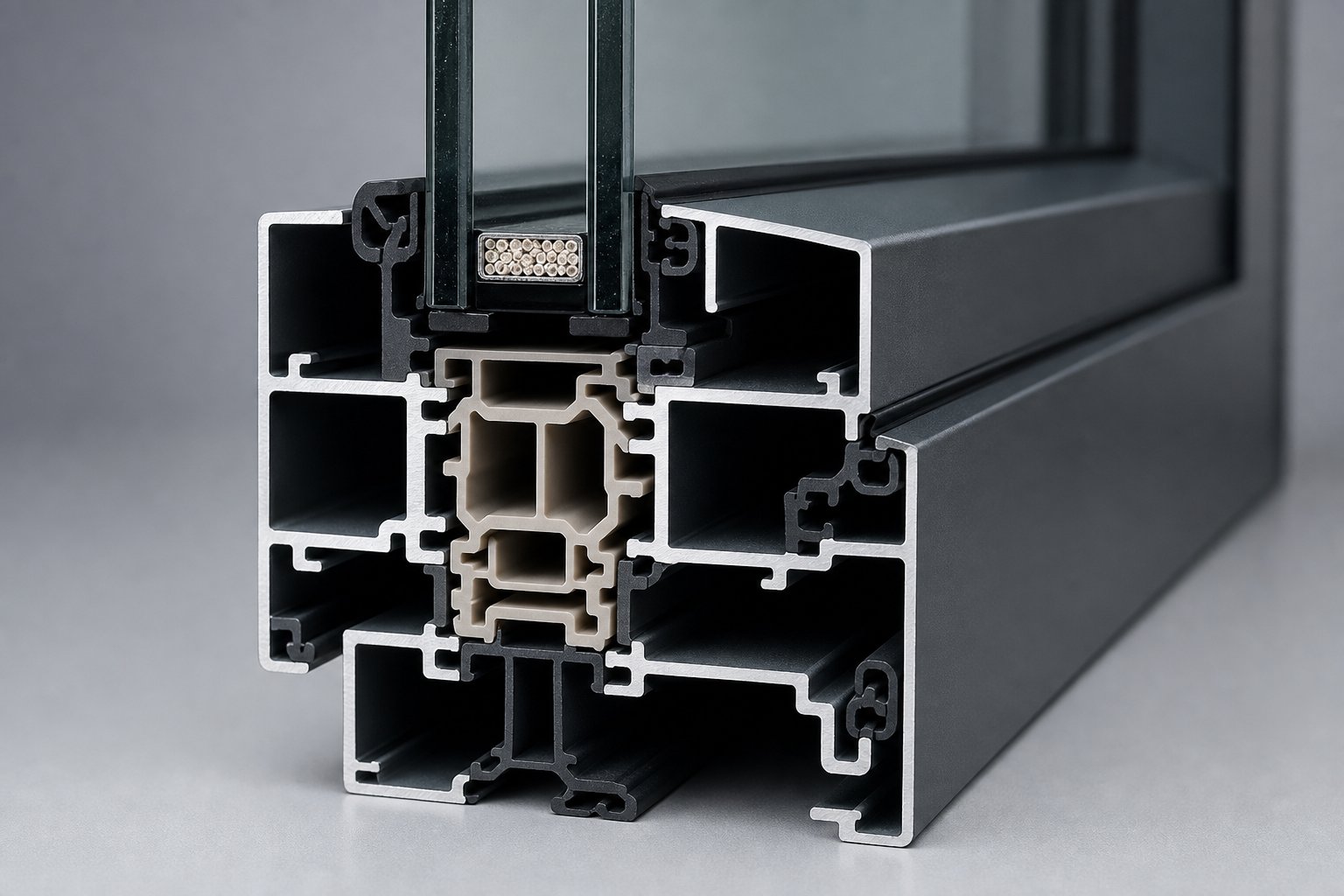
Thermally Broken vs Non-Thermally Broken Aluminium Frames
That engineering detail is the thermal break, a deceptively simple component that completely redefines how an aluminium frame handles temperature. Strip one out and you have a frame that channels cold like a highway. Put one in and the same metal profile behaves more like an insulated composite. The difference in condensation risk between these two configurations is dramatic.
How Thermal Breaks Work Inside Aluminium Profiles
A thermal break is an insulating strip, typically made from polyamide reinforced with glass fibre, mechanically crimped between the interior and exterior sections of the aluminium extrusion. It physically splits the frame into two separate thermal zones. Heat from your living room cannot conduct outward through the metal, and cold from outside cannot travel inward to the interior face.
The polyamide material has a thermal conductivity roughly 500 to 1,000 times lower than aluminium itself. In premium systems, these strips range from around 20mm to 35mm in width, creating a substantial insulation zone within a profile that still looks sleek and minimal. Some advanced configurations use multiple polyamide strips or foam-filled chambers to extend the thermal pathway even further.
The result is an interior frame surface that stays close to room temperature rather than tracking the outdoor conditions. For condensation in double glazing systems, that temperature difference is everything. A frame surface sitting at 16°C in a room with a 12°C dew point stays completely dry. The same frame without a thermal break might sit at 9°C and run with moisture all winter.
Condensation Risk With and Without Thermal Breaks
Non-thermally broken aluminium profiles allow double pane window moisture to form readily because exterior cold transfers almost unimpeded to the interior face. Frame U-values for non-thermally broken aluminium sit around 5.8 to 7.0 W/m²K, meaning heat escapes rapidly and the inside surface chills well below dew point in cooler weather. These are the profiles that earned aluminium its reputation for running with condensation in decades past.
Thermally broken profiles tell a completely different story. Premium systems achieve frame U-values between 1.1 and 2.5 W/m²K, placing them on par with or better than many uPVC configurations under controlled conditions. Double glass window condensation on these frames becomes unlikely during normal use because the interior surface simply doesn’t get cold enough to trigger it.
This is where the common misconception falls apart. People assume aluminium inherently causes more double pane windows condensation than uPVC or timber. The reality is that a modern thermally broken aluminium profile, correctly specified with warm-edge spacers and quality glazing, maintains interior surface temperatures comparable to any other well-performing frame material. The old narrative belongs to an era of uninsulated metal extrusions that no longer represents current technology.
It is surface temperature relative to indoor dew point that determines condensation, not the frame material alone. A thermally broken aluminium frame maintaining its interior face above dew point will stay dry regardless of how conductive the metal is on the other side of the break.
The frame material matters far less than the thermal engineering applied to it. But aluminium doesn’t exist in isolation. It competes directly with uPVC and timber in the Australian market, and homeowners deserve a clear, data-driven comparison of how each material actually performs when the variables are controlled and the conditions are equal.
Aluminium vs uPVC vs Timber for Condensation Resistance
So how do aluminium, uPVC, and timber actually stack up when you put them side by side under identical glazing and climate conditions? Most comparisons focus on aesthetics or cost. Few address the specific question homeowners really want answered: which frame is least likely to develop condensation between panes or across the glass surface during a cold night?
The answer depends less on the raw material and more on the thermal system each frame creates. A basic, single-paned window tells you nothing useful here. What is a double paned window doing differently? It introduces two layers of glass with an insulating cavity, but the frame surrounding that cavity dictates how cold the glass edges and internal surfaces actually get.
Aluminium Frame Condensation Performance
Thermally broken aluminium frames achieve whole-window U-values (Uw) in the range of 2.0 to 2.7 W/m²K in typical Australian double glazed configurations. That puts their interior surface temperatures close enough to room temperature to resist condensation under normal humidity conditions. Non-thermally broken aluminium, by contrast, commonly sits around Uw 3.0 W/m²K or above, leaving the frame edges cold enough to attract moisture in cooler climates like southern Victoria or Tasmania.
The raw thermal conductivity of aluminium sits between 160 and 200 W/mK. Without a thermal break, that conductivity overwhelms the insulating benefit of the double glazed unit at the perimeter. With a quality polyamide break, the frame’s practical performance narrows the gap to uPVC considerably.
How uPVC and Timber Compare Under the Same Conditions
uPVC’s inherent thermal conductivity is roughly 0.15 to 0.25 W/mK, making it a natural insulator without requiring additional intervention. Multi-chambered uPVC profiles typically deliver Uw values around 1.8 to 2.4 W/m²K for standard double glazing. Timber behaves similarly, with softwood conductivity around 0.10 to 0.15 W/mK and whole-window values commonly between 1.8 and 2.5 W/m²K.
Both materials maintain warmer interior surfaces by default, which explains why paned windows in uPVC or timber frames may show slightly less frame-edge condensation than equivalent aluminium without thermal breaks. The operative phrase is “without thermal breaks.” Once you compare thermally broken aluminium against uPVC or timber, the condensation susceptibility differences become marginal rather than dramatic.
| Factor | Aluminium (Thermally Broken) | Aluminium (Non-Thermally Broken) | uPVC | Timber |
|---|---|---|---|---|
| Thermal Conductivity (W/mK) | 160–200 (bridged by polyamide break) | 160–200 (uninterrupted) | 0.15–0.25 | 0.10–0.15 |
| Typical Uw Double Glazed (W/m²K) | 2.0–2.7 | 3.0+ | 1.8–2.4 | 1.8–2.5 |
| Condensation Susceptibility | Low to moderate | High | Low | Low |
| Maintenance Requirements | Minimal (powder coat wash) | Minimal | Minimal (occasional clean) | High (repaint every 4–7 years) |
| Expected Lifespan | 40–50+ years | 40–50+ years | 20–35 years | 30–60 years (species dependent) |
| Sightline Width | 35mm+ | 35mm+ | 70mm+ | 55mm+ |
Note: Uw values are indicative ranges for standard residential double glazed configurations. Actual performance depends on glass specification, gas fill, spacer type, and installation quality.
Which Frame Material Suits Which Climate
In cooler southern regions, where overnight temperatures regularly drop and indoor heating creates large temperature differentials, frame thermal performance becomes critical. Here, thermally broken aluminium, uPVC, and timber all perform adequately for condensation resistance, provided humidity is managed. Non-thermally broken aluminium struggles in these conditions and tends to show condensation between panes at the glass edge, particularly near the spacer bar.
In warmer subtropical and tropical areas, the condensation equation shifts. Higher outdoor humidity combined with air conditioning can create reverse condensation on exterior surfaces. Frame material matters less in these climates, and the focus moves to ventilation strategy and how to tell if windows are double paned with appropriate low-E coatings that influence surface temperatures on both sides.
The critical takeaway from this comparison: frame material is one variable among several. Glazing specification, spacer type, installation quality, and indoor ventilation all interact. Choosing thermally broken aluminium with a low-quality spacer bar can undermine the frame’s performance at the most vulnerable point, the glass edge.
This is where warm-edge spacer technology enters the picture. Traditional aluminium spacer bars inside the sealed unit create a thermal bridge at the perimeter of the glass, right where condensation between panes and at the glass edge is most likely to appear. Warm-edge spacers, made from materials with thermal conductivity up to 950 times lower than aluminium, maintain more consistent temperatures across the entire glass surface. They reduce the cold-edge effect that triggers moisture formation at the perimeter, which is particularly important in aluminium-framed windows where the frame itself already manages significant thermal differentials.
Pairing a thermally broken aluminium frame with warm-edge spacers closes the performance gap almost entirely. The frame prevents cold transfer through the metal profile; the spacer prevents cold transfer at the glass edge. Together, they eliminate the two primary condensation trigger points that older aluminium window systems were notorious for.
Specification matters more than material. That principle holds whether your windows are newly installed or decades old, but the timeline of condensation risk changes significantly as sealed units age and the components that keep moisture out gradually degrade.

The Condensation Lifecycle From New Installation to Aging Seals
Every double glazed window follows a predictable trajectory from the day it’s installed to the day its sealed unit eventually fails. Where your windows sit along that timeline determines whether condensation between window panes is a temporary nuisance, an early warning, or confirmation that the unit needs replacing. Understanding this progression saves you from panicking over normal behaviour or ignoring genuine degradation until it’s too late.
Condensation Patterns After New Window Installation
New builds and major renovations release enormous volumes of construction moisture. Wet plaster, freshly poured concrete, paint, and timber framing can take months to fully dry out. During this period, indoor humidity levels spike well above what the home will experience once it settles. The result? Condensation appearing on brand-new windows that are performing exactly as designed.
This catches many homeowners off guard. You’ve just invested in quality thermally broken aluminium frames, and moisture is streaming down the glass within the first few weeks. In most cases, this resolves within the first heating season as the building dries out and ventilation patterns normalise. It’s temporary, environmental, and not a window defect.
If condensation persists beyond six to twelve months, or if you notice moisture between window panes rather than on the interior surface, the cause shifts from building moisture to either sustained humidity problems or a manufacturing issue worth raising under warranty.
How Seals and Desiccant Degrade Over Time
Inside every sealed double glazed unit, a perimeter seal bonds the two panes together while a silica desiccant embedded in the spacer bar absorbs residual moisture trapped during manufacturing. This system keeps the internal cavity dry and the glass clear for decades in well-made units.
Degradation happens gradually. UV exposure, thermal cycling through hot Australian summers and cold winter mornings, and minor building movement all stress the perimeter seal over years. Micro-cracks form. External moisture vapour begins infiltrating the cavity in tiny amounts. The desiccant absorbs this incoming moisture silently, buying time before any visible change occurs.
Once the desiccant reaches saturation, it can no longer buffer incoming moisture. Condensation between window panes appears, initially faint and intermittent, then persistent. In rare cases of advanced degradation, you might notice desiccant leaking from window spacer bars as granular residue, typically visible as small white or beige particles at the glass edge.
Signs Your Sealed Unit Has Failed
Sealed unit failure doesn’t happen overnight. It follows a progression from invisible micro-failures to obvious visual deterioration. The timeline below helps you identify where your windows currently sit in this lifecycle:
- Years 1–5 (Healthy unit): Glass remains clear. Desiccant absorbs any residual manufacturing moisture. No visible condensation inside the cavity. The unit performs to specification.
- Years 5–15 (Early seal stress): Thermal cycling and UV exposure begin weakening the perimeter sealant. No visible symptoms. The insulating gas may begin leaking at imperceptible rates. Performance remains adequate.
- Years 15–20 (Desiccant saturation approaching): Micro-failures in the seal allow small volumes of humid air into the cavity. The desiccant absorbs this moisture, masking the problem. You might notice occasional, faint misting on cold mornings that clears by midday.
- Years 20–25 (Visible fogging): Desiccant fully saturated. Condensation between panes becomes persistent and no longer clears. You’re now looking at cloudy double pane windows that cannot be cleaned from either side. The insulating gas has largely escaped, reducing thermal performance.
- Years 25–30+ (Advanced degradation): Mineral deposits from repeated moisture cycles leave permanent marks. White stuff between double pane windows, streaking, and spots inside double pane windows become visible. Discoloration between window panes progresses from faint staining to a milky or brownish haze. Mold between window panes can develop in severe cases where organic material has entered the cavity.
These timeframes are approximate. High-quality units with superior edge seals and warm-edge spacers often exceed 25 years before showing symptoms. Poorly manufactured or incorrectly installed units can fail within 5 to 10 years. The critical distinction remains consistent: condensation on the interior room-side surface is an environmental issue, while condensation trapped inside the sealed cavity confirms unit failure requiring glass replacement.
Aluminium frames themselves typically outlast the sealed units by a significant margin, with lifespans exceeding 40 years. This means most aluminium-framed windows need only a sealed unit replacement rather than a complete window change, a far less disruptive and more cost-effective solution when degradation eventually occurs.
Recognising where your windows sit in this lifecycle is the diagnostic half of the equation. The other half, and the factor most within your daily control, is managing the indoor humidity that drives condensation on surfaces you can actually influence.
Room-by-Room Humidity Control to Prevent Window Condensation
Indoor humidity is the single biggest variable you can control without touching the windows themselves. Most people asking why do my windows have condensation inside are actually dealing with a moisture management problem rather than a window performance failure. The tricky part is that different rooms generate moisture in different quantities, at different times of day, and through different activities. Generic advice to “open a window” misses the point entirely.
An average family of four can produce up to 18 litres of moisture daily through cooking, bathing, breathing, and drying laundry. That moisture doesn’t distribute evenly. It concentrates in specific rooms at specific times, which is exactly why condensation appears on some windows and not others.
Managing Kitchen and Bathroom Moisture at the Source
Kitchens are the heaviest moisture producers in most homes. Boiling water, steaming vegetables, running the dishwasher, and even washing up without an extractor running can push several litres of water vapour into a relatively small space within hours. Bathrooms follow closely behind. A ten-minute hot shower releases roughly 1.5 litres of moisture into the air, and without extraction, that vapour migrates through open doors to settle on the coldest surfaces it finds, usually your windows.
The principle is containment at the source. If moisture never escapes the room where it’s created, it never reaches your living room or bedroom glass.
- Install a minimum 60 L/s extractor fan in kitchens — ducted to the outside, not into a ceiling cavity. Run it during cooking and for at least 20 minutes after you finish.
- Fit a 25 L/s extractor in bathrooms — ideally with a humidistat that activates automatically when moisture levels rise, ensuring it runs through your entire shower and well beyond.
- Keep lids on pots while cooking — a simple habit that reduces steam output by up to 70%.
- Close internal doors — prevent moisture migrating from kitchens and bathrooms into adjoining rooms where it condenses on cooler window surfaces.
- Avoid drying laundry indoors without ventilation — a single load of washing releases approximately 2 litres of moisture into the air. If indoor drying is unavoidable, use a dedicated space with an open window or dehumidifier.
Bedroom Condensation and Overnight Humidity Spikes
Bedrooms present a different challenge. Two adults sleeping in a closed room release roughly 1 to 1.5 litres of moisture overnight through breathing and perspiration alone. With windows shut and doors closed for privacy or noise reduction, that moisture has nowhere to go. By morning, relative humidity in an unventilated bedroom can climb above 70%, and you wake to streaming windows. This is what causes condensation on inside windows in bedrooms specifically, and it’s almost always environmental rather than a sign of window failure.
- Open trickle vents on aluminium frames overnight — these provide background ventilation without compromising security or creating noticeable draughts. Most thermally broken aluminium profiles accommodate slot vents in the frame head.
- Cross-ventilate each morning for 10 to 15 minutes — open windows on opposite sides of the room briefly. Cold air holds less moisture, so a short burst of fresh air replaces humid indoor air without significantly cooling the room’s thermal mass.
- Keep bedroom doors slightly ajar where possible — allows moisture to disperse through the home rather than concentrating against one or two window surfaces.
- Position beds away from exterior walls and windows — reduces the warm-breath, cold-surface interaction that accelerates localised condensation.
Ventilation Strategies That Work With Double Glazed Aluminium Windows
Why do windows have condensation on the inside even in well-insulated homes? Because insulation and airtightness work against natural moisture dispersal. Modern double glazed aluminium windows seal tightly, which is excellent for energy efficiency but means the old background draughts that once carried moisture out no longer exist. You need deliberate ventilation to replace what airtight construction removed.
Trickle vents integrated into aluminium frames provide continuous low-level airflow without opening the window. They’re particularly effective on upper floors where the stack effect draws warm air upward and out through vents in the frame head. For rooms with persistent issues, a dehumidifier set to maintain 40 to 55% relative humidity addresses the problem directly. Position it centrally rather than beside a window so it treats the room’s air mass rather than just the boundary layer near the glass.
Whole-house mechanical ventilation with heat recovery (MVHR) offers the most controlled solution for well-sealed homes. These systems extract moist air from wet rooms and supply pre-warmed fresh air to living spaces, maintaining consistent humidity throughout the building without relying on occupant behaviour.
Before committing to any remedial action, run a simple diagnostic to distinguish between a building ventilation issue and a window performance issue:
- Check all windows in the home. If condensation appears on every window, the problem is almost certainly whole-house humidity rather than an individual window defect.
- Note the timing. Moisture that appears overnight and clears by mid-morning points to humidity spikes during closed-up periods. Persistent fogging that never clears suggests seal failure.
- Wipe the glass. If moisture is on the room-side surface and wipes away cleanly, it’s environmental condensation. If it appears trapped between panes and won’t wipe off, the sealed unit has failed.
- Measure relative humidity. A simple hygrometer placed in affected rooms will confirm whether indoor humidity regularly exceeds 55 to 60%. If it does, ventilation and moisture management are your starting points.
- Assess one room at a time. If only one room shows condensation, investigate that room’s specific moisture sources and airflow before questioning the window system.
If you’ve been wondering why do I get condensation inside my windows, this diagnostic usually reveals the answer within a few days of monitoring. Most homeowners discover that targeted ventilation improvements resolve the issue entirely without any work on the windows themselves.
But what happens when diagnostics confirm a genuine window problem rather than an environmental one? That’s where the decision between repair and replacement becomes relevant, and the right path depends entirely on where the moisture is appearing and what’s causing it.
Repair or Replace Your Condensation-Affected Windows
Knowing where the moisture sits is your starting point. The next question is practical: do you adjust your environment, repair the affected unit, or replace it entirely? Each condensation location maps to a different cause and a different action, and getting this right saves you from spending money on solutions that don’t match the problem.
Diagnosing Whether the Problem Is Environmental or Structural
A double pane window foggy on its interior room-side surface is telling you something about the room, not the window. High humidity, poor ventilation, or overnight moisture spikes are the usual culprits. The glass and seals are intact; the air around them is simply too laden with moisture for the surface temperature to handle.
Condensation on the exterior pane requires no action at all. It forms when the outer glass drops below the outdoor dew point on cool, still mornings and actually confirms that your glazing is preventing heat transfer effectively. It clears as the day warms.
Moisture trapped between panes is the one scenario that points to structural failure. The perimeter seal has been compromised, the insulating gas has escaped, and the desiccant is saturated. No amount of ventilation improvement will resolve this. If you’re searching for how to remove moisture from between double pane windows, the honest answer is that the sealed unit itself needs replacing. The cavity can’t be reliably resealed once breached.
The decision matrix below maps each scenario to its likely cause, recommended action, and expected cost level:
| Condensation Location | Likely Cause | Recommended Action | Expected Cost Level |
|---|---|---|---|
| Interior (room-side surface) | High indoor humidity, poor ventilation, overnight moisture buildup | Improve ventilation, use extractor fans, open trickle vents, consider a dehumidifier | Low ($0–$500 AUD) |
| Exterior (outside surface) | Good thermal performance — outer pane stays cool | No action required; clears naturally as temperature rises | Nil |
| Between panes (inside sealed unit) | Seal failure, desiccant saturation, gas fill lost | Replace the sealed glazing unit (IGU); frame can usually be retained | Moderate ($250–$600+ AUD per unit, supply and install) |
When Repair Makes Sense vs When Replacement Is Necessary
Some services offer “defogging” as a way to fix double pane window fogging. This involves drilling into the unit, venting moisture, and inserting a one-way valve. Industry debate persists around whether this restores any insulating value or merely removes the visible symptom. The insulating gas isn’t replaced, and the seal remains compromised. In Australian conditions with significant thermal cycling, a defogged unit is likely to re-fog within a few years.
Genuine window condensation repair makes sense when the issue is environmental. Fitting trickle vents, upgrading extractor fans, or sealing moisture sources costs relatively little and addresses the root cause. These interventions repair condensation in windows by changing the conditions that create it, rather than treating the glass itself.
Replacement becomes necessary when:
- Condensation between panes persists and won’t clear, confirming desiccant saturation and seal failure.
- Visible mineral deposits, streaking, or cloudiness has etched into the glass surface, meaning even a new seal wouldn’t restore clarity.
- The unit shows how to clean cloudy double pane windows isn’t the right question because the haze sits inside a sealed cavity, beyond physical reach.
- Multiple sealed units across the home have failed simultaneously, suggesting age-related batch degradation.
The good news for aluminium-framed windows: the frames themselves typically outlast the glazing by decades. Replacing a sealed unit within an existing aluminium frame is far less disruptive and less expensive than replacing the entire window assembly. How to fix foggy double pane windows in aluminium frames usually means swapping the IGU while retaining the frame, a job most glaziers can complete in under an hour per opening.
For readers trying to work out how to remove moisture from between window panes without replacement, the practical reality is that no permanent solution exists once the seal has failed. Temporary improvements are possible, but restored thermal performance is not. The sealed cavity is a system: glass, gas fill, desiccant, and seal all function together, and a breach in one component undermines the rest.
Getting the diagnosis right before spending money is the entire point of this framework. Environmental condensation needs environmental solutions. Structural failure needs unit replacement. Mixing up the two wastes time, money, and frustration. The remaining consideration is ensuring that whatever action you take, whether specifying new windows or maintaining existing ones, aligns with documented performance standards that give you confidence in long-term condensation resistance.

Building Standards and U-Value Compliance for Condensation Control
Performance standards exist precisely to prevent the kind of guesswork that leads to condensation inside double pane windows years after installation. When aluminium window systems comply with documented thermal requirements, they maintain interior surface temperatures high enough to resist moisture formation under normal conditions. The connection between compliance and condensation resistance is direct and measurable.
How U-Value Requirements Influence Condensation Risk
Australia’s National Construction Code (NCC) sets minimum thermal performance levels for windows through U-value thresholds. The U-value measures the rate of heat transfer through the entire window assembly, frame, glass, spacer, and all. Lower values mean less heat escapes, which keeps the interior glass and frame surfaces warmer relative to room air.
That warmer surface is the key. A window achieving a Uw of 2.2 W/m²K maintains its interior face several degrees above dew point in a room at normal humidity, while a poorly performing window at Uw 4.0+ drops well below it. The NCC doesn’t explicitly state “condensation resistance” as a standalone metric, but by mandating thermal performance that keeps surfaces warm, it effectively sets a condensation resistance floor.
Under the current minimum seven-star energy rating for new residential builds, windows must contribute meaningfully to the overall building envelope performance assessed through NatHERS modelling or the elemental provisions pathway. Systems that merely scrape past minimum thresholds may still allow moisture in double pane windows at the glass edge in colder climates, particularly if the spacer bar or installation detailing introduces localised thermal bridges the U-value figure alone doesn’t capture.
Standards and Compliance for Aluminium Window Performance
Beyond the NCC’s energy provisions, aluminium windows in Australia must satisfy AS 2047 for structural performance, water resistance, and air infiltration, plus AS 1288 for glazing selection and installation. These standards work together. A window that resists water penetration under pressure and limits air leakage also reduces the pathways through which external moisture can compromise the sealed unit over time, delaying the point at which double pane windows fogging inside becomes a risk.
The Window Energy Rating Scheme (WERS) provides an additional verification layer. WERS ratings give specifiers a standardised way to compare products across manufacturers, accounting for frame type, glazing configuration, and gas fill in a single comparable metric. For architects, builders, and consultants evaluating aluminium systems, verified WERS data paired with AS 2047 test reports provides the confidence that specified performance will translate to real-world condensation resistance.
This is where manufacturer documentation becomes critical during specification. Compliance claims need substantiation through certified test results, not just marketing language. Specifiers looking to verify that an aluminium window system meets documented performance standards across energy efficiency, weather resistance, and condensation performance can review examples such as MEICHEN’s compliance and certifications page, which demonstrates how manufacturers present AS 2047 testing, WERS ratings, and NCC compliance evidence in a format useful for project documentation and council submissions.
The practical implication for homeowners is straightforward: windows installed to meet current NCC requirements, with verified U-values and proper installation detailing, inherently resist condensation better than older or non-compliant systems. If your windows were installed under earlier, less stringent standards, the thermal performance gap explains why condensation persists even after improving ventilation. Upgrading to compliant systems addresses the surface temperature side of the equation that environmental measures alone cannot fix.
Making the Right Decision on Aluminium Double Glazed Windows
Condensation on aluminium double glazed windows comes down to physics, not luck. Surface temperature, indoor humidity, and airflow interact in predictable ways, and once you understand those variables, the path forward becomes clear regardless of whether you’re troubleshooting an existing problem or specifying a new installation.
Key Takeaways for Homeowners and Specifiers
If you’re dealing with condensation inside double glazed windows on the room-side surface, start with your indoor environment. Ventilation improvements, moisture management, and targeted extraction resolve the majority of cases without any work on the windows themselves. Asking how do you remove moisture from double pane windows often leads to the wrong answer because when moisture sits on the interior surface, it’s a humidity issue rather than a glazing defect.
When condensation appears between panes, the sealed unit has failed. How do I remove moisture from double pane windows where the seal is breached? The practical reality is that you can’t, not permanently. The IGU needs replacing, but the aluminium frame itself almost always survives for a straightforward reglazing rather than full window replacement.
For those specifying new aluminium windows or evaluating systems for a renovation, the following checklist covers the decisions that directly influence long-term condensation resistance:
- Confirm thermally broken profiles — verify the polyamide thermal break width and frame Uf value in manufacturer documentation.
- Verify warm-edge spacer inclusion — low-conductivity spacers reduce glass-edge temperature differentials where condensation typically starts.
- Check whole-window U-value (Uw) documentation — ensure the system meets or exceeds NCC requirements for your climate zone.
- Plan your ventilation strategy before installation — specify trickle vents, extractor capacities, and airflow paths during design rather than retrofitting after problems appear.
- Establish a maintenance schedule — inspect seals annually, keep drainage slots clear, and monitor for early signs of seal degradation at the glass perimeter.
Choosing Aluminium Double Glazed Windows With Confidence
Knowing how to remove condensation from double pane windows starts with correctly diagnosing the cause. Knowing how to remove condensation between double pane windows means accepting that seal failure requires unit replacement. And knowing how to remove condensation between window panes permanently means specifying quality systems that delay that failure for decades.
Aluminium frames offer longevity, slim sightlines, and structural performance that other materials struggle to match. Paired with proper thermal breaks, warm-edge spacers, and compliant glazing, they resist condensation as effectively as any frame material on the market. The key is informed specification backed by verified data.
Performance-led decision-making starts with documented compliance evidence. Reviewing certified test results, WERS ratings, and AS 2047 reports gives you confidence that a system will perform as claimed over its full service life. For a practical example of how manufacturers present this information, MEICHEN’s compliance and certifications page demonstrates the documentation specifiers, builders, and homeowners should expect when evaluating aluminium window systems for condensation resistance and overall durability.
Condensation isn’t the enemy. Misunderstanding it is. Armed with the science, the diagnostic framework, and a clear specification checklist, you’re equipped to make decisions that keep your windows dry, your home healthy, and your investment protected for the long term.
FAQs About Condensation on Aluminium Double Glazed Windows
1. Is condensation on the inside of aluminium double glazed windows a sign of a faulty product?
Not usually. Interior condensation indicates high indoor humidity rather than a window defect. Warm moist air from cooking, showering, or breathing overnight deposits water on the coldest nearby surface, which is often the glass. Improving ventilation through extractor fans, trickle vents, or morning cross-ventilation typically resolves the issue without any work on the windows themselves. If moisture appears between the panes rather than on the room-side surface, that does indicate seal failure requiring a unit replacement.
2. Why does condensation appear on the outside of my double glazed windows?
Exterior condensation actually confirms your double glazing is working well. It occurs because the outer pane stays cool overnight since very little heat escapes through the insulated unit. Morning dew settles on the cold outer glass the same way it forms on grass or car windscreens. This is more common with high-performance thermally broken aluminium frames and low-E glass, and it clears naturally as the day warms. No remedial action is needed.
3. How long do sealed double glazed units last before condensation appears between panes?
High-quality sealed units with warm-edge spacers and robust perimeter seals typically last 20 to 25 years or more before desiccant saturation leads to visible fogging between panes. Poorly manufactured or incorrectly installed units can fail within 5 to 10 years. The aluminium frame itself generally outlasts the sealed unit by a significant margin, often exceeding 40 years, meaning you usually only need to replace the glass unit rather than the entire window assembly.
4. Do thermally broken aluminium windows get less condensation than standard aluminium frames?
Yes, significantly less. Thermally broken profiles use polyamide insulating strips to interrupt the heat transfer path through the metal, keeping the interior frame surface much warmer. A thermally broken frame achieves U-values between 1.1 and 2.5 W/m2K compared to 5.8 to 7.0 W/m2K for non-thermally broken profiles. That warmer interior surface stays above the indoor dew point under normal humidity conditions, preventing condensation from forming on the frame and glass edges where older aluminium systems were notorious for moisture buildup.
5. Can condensation between double glazed panes be repaired without replacing the glass?
Some companies offer defogging services that drill into the unit, vent moisture, and insert a valve. However, this approach does not restore the insulating gas fill or fix the compromised seal, so the unit typically re-fogs within a few years in Australian conditions with significant thermal cycling. For a lasting solution, the sealed insulating glass unit (IGU) needs replacing. With aluminium frames, this is a relatively straightforward process since the durable frame can be retained while only the glass unit is swapped out, usually completed within an hour per opening.
More Window & Door Guides