What Eco Aluminium Windows Are and Why They Matter
Get the specification wrong on your window frames and you lock in decades of underperformance, inflated energy bills, and premature replacements. That reality makes understanding what actually qualifies as an eco-friendly aluminium window frame essential before any money changes hands.
What Are Eco Aluminium Windows
Eco aluminium windows are thermally broken aluminium window systems that combine polyamide-insulated frame profiles, low-emissivity (low-E) glazing, and sustainably sourced or recycled aluminium to deliver high energy efficiency, long service life, and full recyclability at end of life.
That definition carries weight because each element solves a specific problem. The thermal break eliminates the conductive heat transfer that once made aluminium a liability. Low-E coatings manage solar radiation so interiors stay comfortable without overworking your HVAC. And the material itself can be recycled infinitely without losing structural integrity, closing the loop on embodied energy concerns.
Why Aluminium Is Now an Eco-Friendly Choice
For years, aluminium had a reputation problem. Pure aluminium conducts heat roughly 1,000 times faster than timber, which meant older aluminium frames acted like thermal highways between your living room and the outside air. Specifiers avoided it for energy-conscious projects, and fairly so.
Modern engineering changed the equation entirely. Polyamide thermal breaks inserted between the inner and outer aluminium profiles slash frame U-values by 70 to 85 percent compared to traditional unbroken sections. Pair that with the material’s natural corrosion resistance, powder-coat durability in harsh Australian UV and coastal conditions, and the fact that recycling aluminium uses around 95 percent less energy than primary production, and the sustainability case becomes hard to argue against.
Are aluminium windows environmentally friendly? When specified correctly, they outperform many alternatives across their full lifecycle. The catch is that “specified correctly” involves more than picking a colour swatch. It starts with understanding exactly how that thermal break works and what separates a basic profile from a high-insulation one.
Thermal Break Technology That Makes Aluminium Energy Efficient
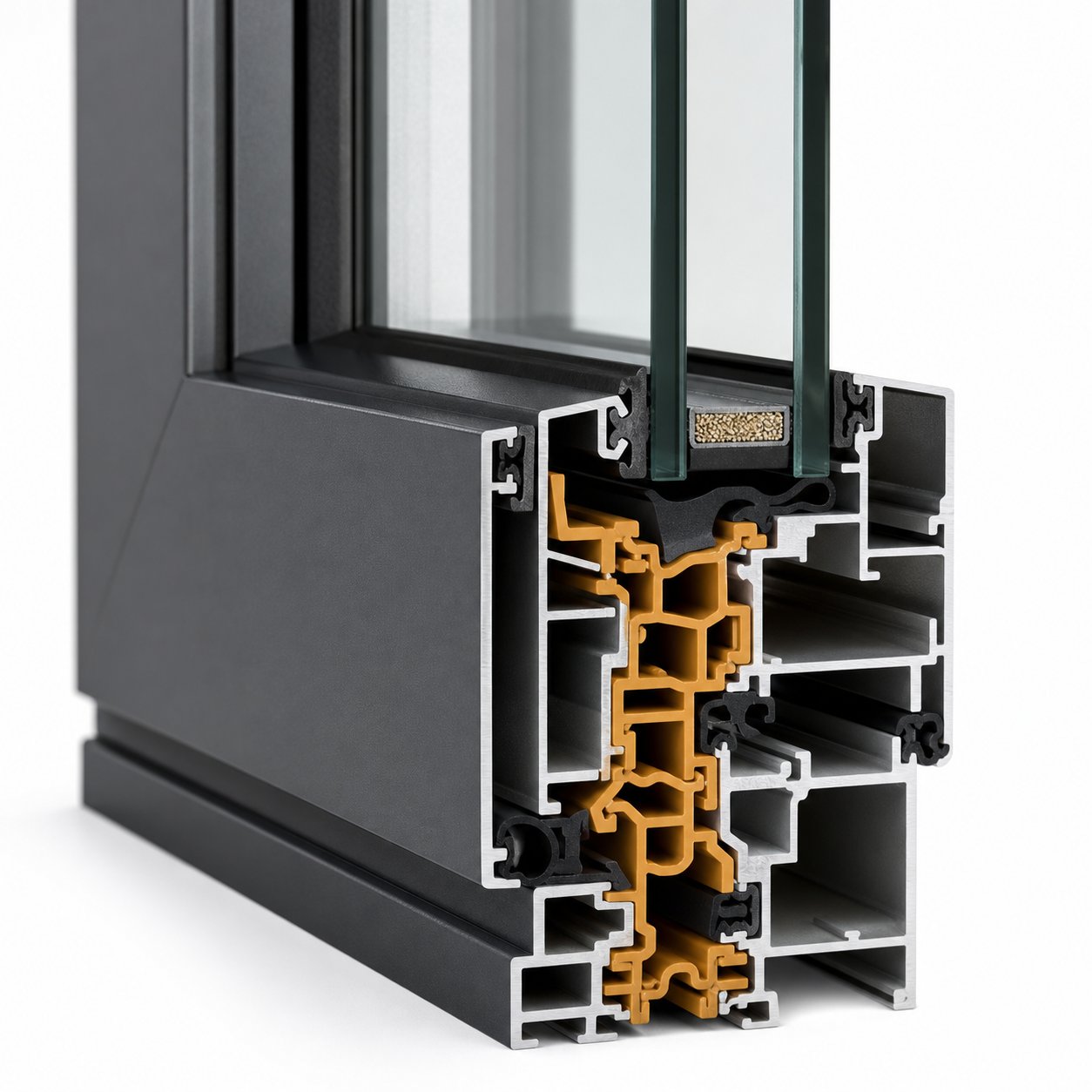
Aluminium conducts heat at roughly 205 W/m·K. Without intervention, a solid aluminium frame is essentially a radiator fin connecting your conditioned interior to whatever temperature sits outside. The polyamide thermal break strip aluminium manufacturers now insert between inner and outer profiles is the single innovation that turned this weakness into a non-issue.
How Thermal Break Profiles Work
A thermal break is a continuous barrier of reinforced polyamide (typically PA66 GF25) mechanically crimped between two separate aluminium extrusions. Because polyamide’s thermal conductivity sits around 0.3 W/m·K, it is roughly 500 to 1,000 times less conductive than the aluminium it separates. Heat trying to travel through the frame hits this insulating zone and stalls.
Every thermally broken aluminium frame consists of four key components working together:
- Outer aluminium shell — faces the weather, carries powder-coat finish, handles structural wind loads
- Polyamide thermal break strip — the insulating bridge (typically 14.8 mm to 35 mm wide) that blocks conductive heat transfer
- Inner aluminium shell — faces the interior, stays closer to room temperature, supports hardware and hinges
- Glazing seal and gasket system — secures the insulated glass unit while maintaining airtightness around the perimeter
This is how thermal break technology works in windows at its core: physical separation. Two aluminium halves that never touch each other, joined only by a material engineered to resist heat flow.
Standard vs High-Insulation Aluminium Profiles
Not all thermal break aluminium window profiles deliver the same result. The width and geometry of the polyamide strip determine how much insulation the frame provides, and the gap between entry-level and premium systems is substantial.
Standard thermally broken profiles use strips in the 14.8 mm to 24 mm range and typically achieve frame U-values between 2.5 and 3.5 W/m²K. They suit mild climates or projects where budget is the primary constraint.
High-insulation profiles push strip widths to 30 mm or beyond, often incorporating multiple chambers and foam inserts within the thermal break zone. These systems achieve frame U-values as low as 0.8 to 1.5 W/m²K — performance that meets or exceeds Passive House certification thresholds. European energy standards, particularly the Passive House Institute’s requirement for whole-window Uw values at or below 0.8 W/m²K, drove manufacturers to develop these advanced multi-chamber designs.
For Australian projects assessed under NatHERS or targeting high WERS star ratings, selecting the right insulation depth matters. A basic thermally broken frame will outperform any unbroken aluminium section, but thermally broken aluminium frames energy efficiency scales directly with profile sophistication. Choosing a 16 mm strip where a 30 mm strip was warranted locks in compromised performance for the life of the building.
The frame, however, is only half the thermal story. What sits inside it — the glass — determines whether the complete window system delivers or disappoints.
Double Glazing and Low-E Glass in Aluminium Frames
A thermally broken frame with mediocre glass is like insulating your walls but leaving the roof open. The glazing unit accounts for roughly 80 percent of a window’s total area, which means it dominates overall thermal and acoustic performance. In eco aluminium window systems, the glass package and the frame work as an engineered partnership — and aluminium’s inherent rigidity gives that partnership an advantage other frame materials struggle to match.
How Double Glazing Boosts Aluminium Window Performance
Double glazed aluminium windows energy efficiency comes down to one principle: trapping a layer of still gas between two panes of glass so heat cannot conduct or convect freely from one side to the other. A standard double-glazed insulated glass unit (IGU) consists of two panes separated by a cavity — typically 14 to 20 mm wide — sealed at the perimeter with a spacer bar and dual-seal system that locks the gas inside.
Aluminium’s structural strength matters here more than most people realise. Because the frame resists deflection under wind loads and thermal expansion, it can support larger sealed units without the warping or bowing that can compromise seals in softer frame materials over time. Larger glass areas mean more natural light entering the space and less reliance on artificial lighting — a genuine energy benefit that compounds across decades of use. Slim aluminium sightlines push this advantage further, maximising the glass-to-frame ratio in ways bulkier profiles simply cannot.
Low-E Coatings and Gas Fills Explained
Low-E glass aluminium window frames pair the structural frame with a microscopically thin metallic coating applied to one of the internal pane surfaces. This low-emissivity coating reflects radiant heat back toward its source: in winter, it bounces interior warmth back into the room; in summer, it can deflect solar radiation before it enters. The coating is invisible to the naked eye yet reduces radiative heat transfer across the cavity by up to 75 percent compared to uncoated glass.
Argon gas filled aluminium windows take this further by replacing standard air inside the cavity with argon — a naturally occurring, non-toxic, colourless gas that is roughly 34 percent less thermally conductive than air. Argon slows both conduction and convection between the panes, pulling U-values down to the 1.1 to 1.5 W/m²K range for a well-specified double-glazed unit. Krypton gas offers even lower conductivity and suits narrower cavities, though at a higher cost point that typically reserves it for specialised applications or triple-glazed configurations.
Modern sealed units retain argon effectively. Industry testing under EN 1279 standards shows loss rates of no more than 1 percent per year, meaning a unit filled to 90 percent argon still holds 70 to 80 percent concentration after two decades — well above the threshold for meaningful thermal benefit.
When evaluating triple glazing vs double glazing aluminium frames, the decision hinges on climate severity, budget, and weight. Triple-glazed units add a third pane and a second gas-filled cavity, pushing U-values lower and sound insulation higher, but at the cost of increased weight and reduced visible light transmission. For most Australian climate zones, a high-quality double-glazed IGU with low-E coating and argon fill delivers the performance sweet spot. Triple glazing finds its strongest case in extreme cold climates or projects targeting Passive House certification.
| Configuration | Insulation Level | Sound Reduction | Weight | Cost Tier |
|---|---|---|---|---|
| Single pane | Minimal | Low | Light | Low |
| Double pane (air fill) | Good | Moderate | Moderate | Moderate |
| Double pane (argon fill + low-E) | Very good | Moderate to good | Moderate | Moderate |
| Triple pane (argon/krypton fill + low-E) | Excellent | High | Heavy | High |
Glazing selection is where specification errors carry the steepest long-term cost. Under-spec the glass and you inherit decades of thermal loss no amount of curtaining will fix. Over-spec it and you pay a weight and cost premium for gains the local climate may never justify. The real question is how your specific climate zone and window orientation should steer these choices — and that answer varies dramatically across Australia’s diverse conditions.
The Environmental Lifecycle of Aluminium Windows
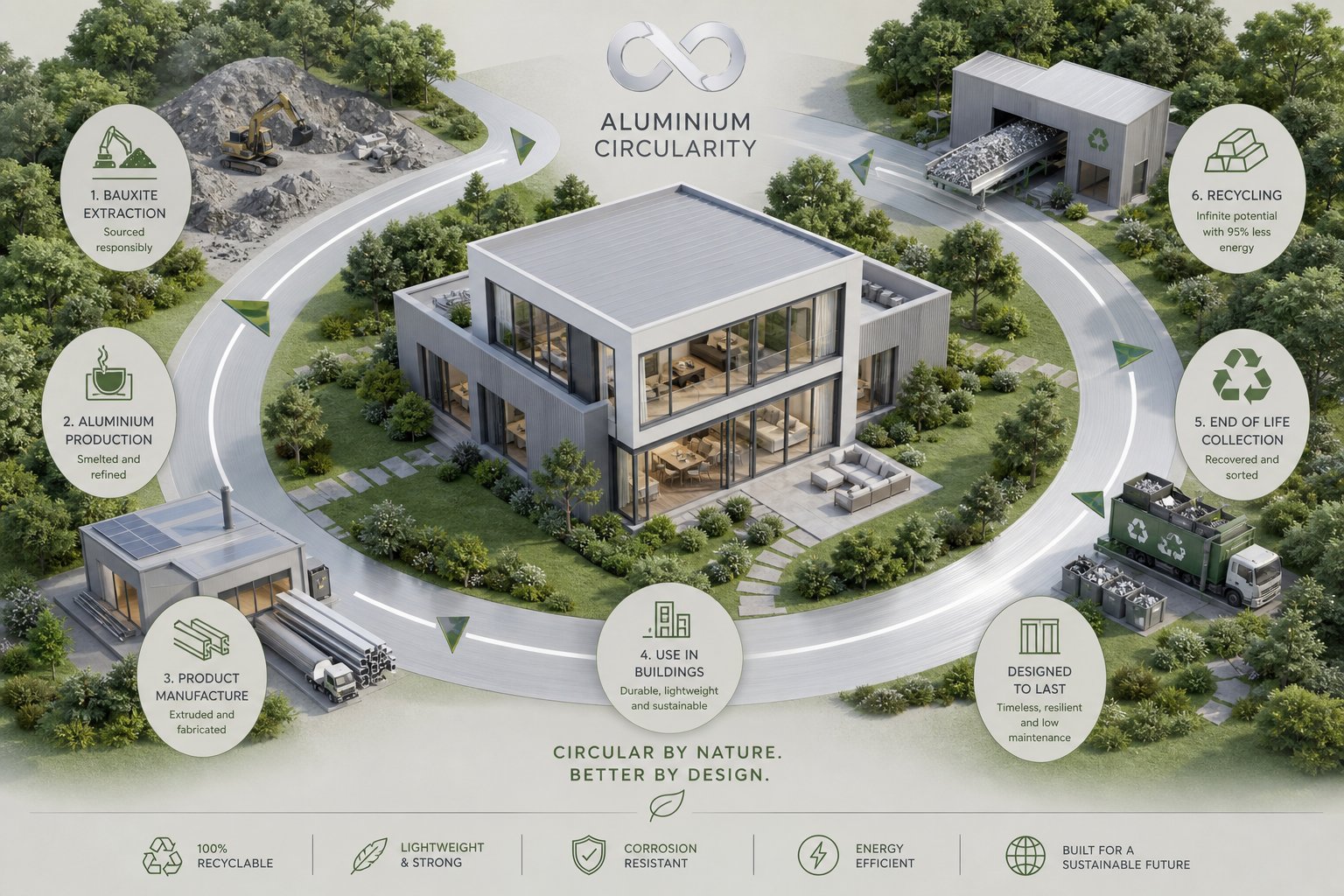
Thermal performance and glazing configurations tell you how a window performs day to day. But sustainability claims only hold up when you zoom out and assess the full lifecycle — from the mine to the building, through decades of service, and eventually back into the material stream. A lifecycle assessment of aluminium window frames reveals a story with a difficult beginning, a long and productive middle, and an ending that loops back to the start.
Aluminium’s Lifecycle From Mining to Recycling
Every aluminium frame begins as bauxite ore, typically strip-mined in tropical regions like northern Australia, West Africa, or South America. That ore undergoes refining into alumina, then smelting via electrolysis into primary aluminium — a process that demands enormous electrical energy. This energy-intensive birth is the single biggest environmental mark against aluminium as a building material, and there is no point pretending otherwise.
The full lifecycle unfolds across these stages:
- Bauxite mining and alumina refining — extraction of raw ore and chemical processing into aluminium oxide
- Primary smelting — electrolytic reduction of alumina into molten aluminium, the most energy-intensive phase
- Extrusion and fabrication — shaping billets into window profiles, adding thermal breaks, powder-coating, and hardware
- Transportation and installation — delivery to site and fitting into the building envelope
- Operational service life — decades of thermal performance, daylight transmission, and weather protection with minimal maintenance
- End-of-life collection and recycling — removal from the structure and reprocessing into new aluminium products
The environmental cost concentrates heavily in stages one and two. Everything that follows works to offset and eventually outweigh that initial investment. And the offset is substantial: well-specified eco aluminium windows reduce heating and cooling loads across their entire service life, compounding energy savings year after year that conventional frames with shorter lifespans never accumulate.
How long do aluminium windows last? In most residential and commercial applications, properly installed thermally broken aluminium frames deliver 40 to 60 years of reliable service. Coastal properties in Queensland or Western Australia may see slightly accelerated wear from salt air, but quality powder-coat finishes and marine-grade alloys push lifespans well beyond what uPVC or timber frames typically achieve. Fewer replacements means fewer manufacturing cycles, less transport, less construction waste entering landfill, and less disruption to a functioning building.
Circular Economy Benefits of Aluminium Frames
Here is where aluminium’s environmental narrative flips. Recycling aluminium requires only around 5 percent of the energy needed to produce primary metal. That 95 percent energy saving transforms the material’s carbon profile entirely when frames reach end of life and re-enter the supply chain.
Unlike plastics and many composites, aluminium does not degrade through recycling. Its atomic structure remains intact through melting and reformation, meaning recycled aluminium windows circular economy benefits are not theoretical — they are physically guaranteed by the nature of the metal itself. The International Aluminium Institute’s material flow analysis confirms that roughly 75 percent of all aluminium ever produced remains in active use today, cycling through successive product lives without loss of quality.
For Australian specifiers evaluating sustainability credentials, several practical points stand out. Building-sector aluminium recovery rates exceed 90 percent globally because the material holds genuine scrap value — demolition contractors have a financial incentive to separate and sell aluminium frames rather than send them to landfill. High recycled content in new profiles is already common, and as secondary production grows (now comprising over 80 percent of total aluminium output in mature markets), the embodied energy gap between aluminium and competing materials narrows further.
This circularity creates a compounding benefit. Each generation of recycled aluminium windows carries a fraction of the embodied carbon that primary production demanded. Over a 100-year building lifecycle involving one or two replacement cycles, aluminium’s total environmental footprint can sit below materials that appear “greener” at first installation but degrade, cannot be meaningfully recycled, and end up in landfill within 20 to 30 years.
Understanding this lifecycle context matters when comparing frame materials side by side. Raw embodied energy at point of manufacture tells only part of the story — what happens across five, six, or seven decades of service, and what value the material retains at the end, shapes the true environmental cost of any window specification.
How Eco Aluminium Compares to Other Frame Materials
Lifecycle credentials set the context, but most specification decisions come down to a direct comparison: how does thermally broken aluminium stack up against the other frame materials competing for your project? The answer is more nuanced than any single “best” pick. Each material brings genuine strengths and honest trade-offs depending on climate, building type, budget horizon, and aesthetic intent.
Aluminium vs uPVC and Timber Frames
The aluminium vs uPVC windows environmental impact debate often starts in the wrong place — at the point of manufacture rather than across the full ownership period. uPVC (unplasticised polyvinyl chloride) is cheaper to produce and offers naturally low thermal conductivity without a thermal break. Those are real advantages. Yet uPVC is produced using chlorine chemistry, is difficult to recycle into equivalent-quality products, and carries a typical service life of 20 to 30 years before UV degradation, discolouration, and seal failures demand replacement. In Australian conditions — particularly the intense UV exposure common across most of the continent — degradation timelines can accelerate considerably.
uPVC also lacks structural rigidity compared to aluminium. Frames need to be bulkier to achieve equivalent spans, which reduces the glass-to-frame ratio and limits natural light penetration. For larger openings, internal steel reinforcement is required, adding weight and complexity without improving recyclability.
The aluminium vs timber window frames comparison tells a different story. Timber is a natural insulator, aesthetically warm, and renewable when responsibly sourced. It also demands consistent maintenance — sealing, painting, or staining every three to five years — and is vulnerable to rot, warping, and insect attack if neglected. In humid coastal areas or tropical regions across northern Australia, timber’s susceptibility to moisture is a genuine durability risk. A well-maintained timber frame can last decades, but “well-maintained” carries a labour and cost commitment many building owners underestimate.
Thermally broken aluminium sidesteps both problems. It resists UV, salt air, and moisture without protective coatings degrading over time. It holds tight tolerances across temperature swings that would cause softer materials to expand, contract, or bow. And at end of life, it retains scrap value rather than heading to landfill — a point the circular economy discussion makes difficult to ignore.
Fiberglass and composite frames deserve separate mention. Fiberglass (pultruded glass-reinforced polymer) offers excellent thermal performance, minimal expansion, and long service life — often 40 to 50 years. It competes closely with aluminium on durability and surpasses it on raw insulation value. The trade-offs sit elsewhere: limited availability in the Australian market, fewer operable configurations, and restricted colour or finish options compared to powder-coated aluminium. Composite frames (blends of wood fibre and polymer) occupy a middle ground — lower maintenance than solid timber, reasonable longevity — but lack aluminium’s recyclability and design precision for slim sightlines.
Which Frame Material Suits Your Project
No single material wins every category. Choosing the most sustainable window frame material depends on weighing your project’s priorities honestly. The table below maps each option across the factors that matter most for long-term performance and environmental responsibility.
| Frame Material | Recyclability | Thermal Performance (with thermal break) | Lifespan | Maintenance Needs | Design Flexibility | Relative Cost |
|---|---|---|---|---|---|---|
| Aluminium (thermally broken) | Excellent — infinitely recyclable, retains full material quality | Good to excellent (depends on profile depth) | 40–60 years | Very low — occasional wash | Excellent — slim profiles, custom shapes, wide colour range | Moderate to high |
| uPVC | Limited — downcycled, rarely into equivalent products | Good (inherently low conductivity) | 20–30 years | Very low — occasional wash | Moderate — bulkier profiles, limited colours, prone to discolouration | Low to moderate |
| Timber | Moderate — biodegradable but not reprocessed into frames | Good (natural insulator) | 30–60 years (if maintained) | High — regular sealing, painting, inspection | Good — paintable, millable, but limited span capability | High |
| Fiberglass | Poor — difficult to recycle | Excellent (very low conductivity) | 40–50 years | Low — minimal upkeep | Moderate — limited market availability, fewer custom options | High |
| Composite | Moderate — some recycled content, limited end-of-life recycling | Good to very good | 30–40 years | Low to moderate | Moderate — mimics timber aesthetics, restricted span sizes | Moderate to high |
A few patterns emerge. If upfront cost drives the decision and long-term ownership is uncertain (rental properties, short-hold developments), uPVC often makes financial sense despite its environmental shortcomings. If heritage aesthetics are non-negotiable and the owner commits to ongoing care, timber remains the authentic choice for restoration work — particularly on Queenslanders or period weatherboard homes where council heritage overlays apply.
For projects that prioritise the intersection of durability, design freedom, low ongoing maintenance, and genuine end-of-life recyclability, eco aluminium windows compared to fiberglass or composite alternatives hold a distinct edge. Aluminium’s strength-to-weight ratio enables the slimmest possible sightlines and the largest operable panels — features that translate directly into more daylight, better views, and reduced reliance on artificial lighting. Pair that with documented 40-plus-year lifespans and near-total material recovery at demolition, and the aluminium window frames pros and cons balance tips heavily toward long-term value for quality-focused residential and commercial projects alike.
Where aluminium concedes ground is raw thermal conductivity before the thermal break does its work. A poorly specified aluminium frame — one with a narrow thermal break, no insulated glazing, or inadequate gaskets — will underperform a well-built uPVC or fiberglass window every time. The material’s potential only converts into performance when the specification matches the climate demands of the site. That climate-specific detail is exactly where many projects get it wrong.
Climate-Specific Specifications for Eco Aluminium Windows
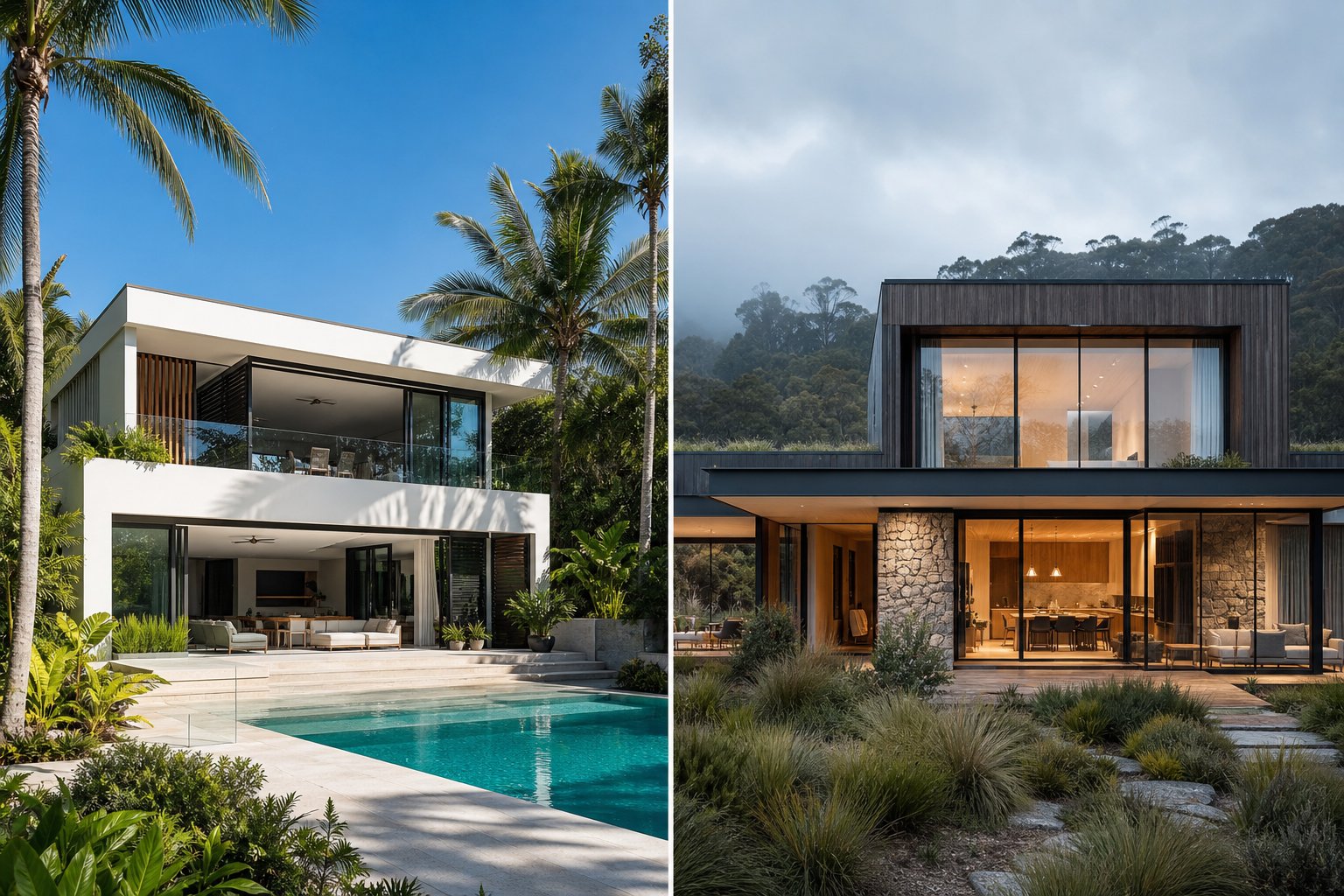
Australia spans eight distinct NCC climate zones — from the hot-humid tropics of Darwin and Cairns to the alpine conditions of the Snowy Mountains. A thermally broken aluminium window that performs brilliantly in Melbourne can be completely wrong for Townsville, and vice versa. The difference comes down to which performance metric takes priority: keeping heat out or keeping heat in.
Specifying for Hot and Cold Climates
In hot climates, solar heat gain is the enemy. Eco aluminium windows for hot climates need low SHGC glazing — typically 0.25 or below — paired with solar control low-E coatings that reject infrared radiation before it enters the building. The frame’s U-value matters less in these zones because the temperature difference between indoors and outdoors is relatively small. What matters is stopping direct solar radiation from turning your interiors into a greenhouse.
The SHGC rating aluminium windows explained simply: it measures the fraction of solar energy that passes through the window as heat, on a scale of 0 to 1. An SHGC of 0.25 means only 25 percent of incident solar energy makes it inside. For Darwin, Cairns, or inland Western Australia, that ceiling is non-negotiable if you want cooling bills under control.
Cold climates flip the priority entirely. The best aluminium windows for cold climates — think Canberra, Tasmania, or the Blue Mountains — demand the lowest achievable U-values (1.4 W/m²K or below for whole-window performance) combined with higher SHGC glazing on north-facing openings. In these zones, you actually want solar heat gain working for you as free passive heating through winter. Specifying low-SHGC glass across all orientations in a cold climate is a costly mistake: you block the very solar energy that would reduce your heating load.
Temperate and mild zones like Sydney, Adelaide, and Perth sit in the middle. Balanced performance is critical here — moderate U-values paired with orientation-specific SHGC selections that manage summer overheating without sacrificing winter warmth.
The following table maps aluminium window specifications by climate zone against priority metrics, drawing on NCC climate zone classifications and WERS performance targets:
| Climate Type (NCC Zone) | Example Locations | U-Value Priority | SHGC Priority | Ventilation Needs |
|---|---|---|---|---|
| Hot-humid (Zone 1) | Darwin, Cairns | Moderate (≤ 4.0 W/m²K) | Critical — low (≤ 0.25) | High — cross-ventilation essential |
| Warm-humid (Zone 2) | Brisbane, Coffs Harbour | Moderate (≤ 3.5 W/m²K) | Important — low (≤ 0.30) | High — breeze capture important |
| Hot-dry (Zone 3) | Alice Springs, inland WA | Important (≤ 2.5 W/m²K) | Critical — low (≤ 0.25) | Moderate — night purging effective |
| Mild temperate (Zone 5–6) | Sydney, Melbourne, Perth | Important (≤ 2.0 W/m²K) | Balanced (0.30–0.55) | Moderate — seasonal variation |
| Cool temperate (Zone 7) | Canberra, Hobart, Blue Mountains | Critical (≤ 1.4 W/m²K) | Higher preferred (0.50–0.65) on north glass | Low — airtightness prioritised |
| Alpine (Zone 8) | Snowy Mountains, Mt Hotham | Critical (≤ 1.2 W/m²K) | Highest feasible (0.55–0.65) on north glass | Minimal — sealed envelope essential |
For commercial projects — offices, retail, schools — the same principles apply at larger scale, but with added complexity. Larger glass areas amplify any SHGC mismatch, and commercial buildings in hot zones often require solar control coatings across all facades regardless of orientation to manage peak cooling loads and comply with NCC Section J energy efficiency provisions.
How Orientation Affects Window Performance
Climate zone tells you the broad strategy. Orientation determines the tactical execution. Research into solar heat gain by window direction consistently shows that north-facing glazing (in the southern hemisphere) receives the most beneficial winter sun while remaining easier to shade in summer with simple horizontal overhangs. East and west-facing glass is the hardest to control — it catches low-angle morning and afternoon sun that eaves cannot block, delivering unwanted heat gain in summer.
This means a single home might need different glazing specifications on different facades. In a Zone 6 Melbourne project, north-facing windows benefit from higher-SHGC glass to harvest passive solar warmth, while west-facing openings on the same building should carry low-SHGC solar control coatings to prevent afternoon overheating. South-facing glass receives minimal direct sun year round, making low U-value the only real priority on that elevation.
Orientation-specific specification is not just for custom residential builds. Apartment towers, aged care facilities, and multi-storey commercial buildings all benefit from facade-by-facade glazing strategies. The additional design effort pays back through lower mechanical plant sizing, reduced energy consumption, and improved occupant comfort — outcomes that compound across the 40-plus-year lifespan of quality thermally broken aluminium systems.
Getting climate and orientation right is the foundation. The next challenge is knowing how to verify that a specified product actually delivers the performance numbers it claims — and that means understanding the rating systems and compliance documentation behind those numbers.
Reading Performance Ratings and Compliance Standards
A product data sheet full of numbers means nothing if you cannot decode what each figure actually tells you about daily comfort, long-term energy cost, and weather resilience. Aluminium window energy performance ratings exist precisely to remove guesswork from specification — but only when specifiers know how to read them and, critically, how to verify that those numbers come from legitimate testing rather than marketing estimates.
Understanding U-Values, SHGC, and STC Ratings
Five core metrics determine whether an eco aluminium window system will perform as expected over its service life. Each measures a different physical behaviour, and each interacts with your climate zone and orientation decisions in distinct ways.
U-value (thermal transmittance) — This is the rate at which heat transfers through the complete window assembly, expressed in W/m²K. Lower numbers mean better insulation. The aluminium window U-value rating explained simply: it tells you how many watts of heat energy pass through one square metre of window for every degree of temperature difference between inside and outside. A whole-window U-value of 1.5 W/m²K loses dramatically less heat than a value of 4.0 W/m²K. In Australia, AS 2047 and WERS both use U-value as a primary performance indicator, and NCC Section J sets maximum allowable values by climate zone.
One trap to watch for: some manufacturers quote centre-of-glass U-values rather than whole-window figures. The frame, spacer bar, and edge effects typically worsen the number, so always confirm you are comparing whole-of-window Uw values — the metric that reflects reality once the product is installed in your wall.
SHGC (Solar Heat Gain Coefficient) — Measured on a scale of 0 to 1, SHGC quantifies the fraction of solar radiation that enters through the window as heat. A value of 0.30 means 30 percent of incident solar energy passes through. How to read window energy performance ratings for SHGC depends entirely on context: in cooling-dominated climates, lower is better; in heating-dominated zones, higher SHGC on north-facing glass harvests free warmth. WERS reports SHGC alongside U-value, making it straightforward to compare products for a given orientation strategy.
STC (Sound Transmission Class) — The STC rating aluminium windows sound insulation delivers is measured in decibels of noise reduction across a standardised frequency range. An STC of 28 to 30 is typical for standard double glazing; an STC of 35 to 40 represents a meaningful step up for homes near busy roads, flight paths, or rail corridors. Higher STC values generally require thicker glass, laminated interlayers, or asymmetric pane thicknesses within the IGU. Aluminium frames contribute positively here because their rigidity maintains tight seals without the micro-gaps that develop in frames prone to warping.
Air infiltration — This measures how much air leaks through a closed window under pressure, expressed in litres per second per metre of operable joint (L/s/m). AS 2047 sets maximum permissible air infiltration rates that every compliant window must achieve. Excessive air leakage undermines both thermal performance and acoustic isolation — the conditioned air you paid to heat or cool simply escapes through poor seals. For eco aluminium windows, tight air infiltration figures confirm that gasket systems and hardware compression are working as engineered.
Water resistance — Rated in Pascals (Pa), this metric indicates the wind-driven rain pressure a window can withstand without leaking. AS 2047 specifies minimum water penetration resistance based on building height, terrain category, and geographic wind region. A window rated at 300 Pa handles moderate exposure; coastal or high-rise applications may demand 450 Pa or above. Aluminium’s dimensional stability under pressure loading means well-designed frames maintain seal integrity at pressures that would distort less rigid materials.
Why Certified Compliance Documentation Matters
Numbers on a brochure are only as reliable as the testing behind them. In Australia, aluminium window compliance certification standards centre on AS 2047, which requires products to be tested by NATA-accredited laboratories and documented with performance labels, certificates of compliance, and traceable test reports. The Australian Glass and Window Association (AGWA) administers a certification program that verifies member products meet these requirements — giving architects, builders, and developers a reliable shortcut to confirm legitimacy.
What does compliance documentation actually look like in practice? Three elements matter:
- Performance label — affixed to the frame, showing wind load and water resistance ratings in Pascals, confirming the product was tested as a complete assembly
- Certificate of compliance — issued by the manufacturer, referencing the specific AS 2047 test results and confirming the window meets NCC requirements for the intended application
- Test reports — the underlying lab data from NATA-accredited testing, available on request for specifiers who need to verify performance claims against project-specific structural and energy criteria
Why does this matter beyond ticking a regulatory box? Non-compliant windows expose building owners to cascading problems: insurance complications, failed council inspections, energy performance that falls short of NatHERS modelling assumptions, and potential legal liability if structural failures occur during storm events. For specifiers managing risk across multiple projects, working with manufacturers who publish transparent compliance documentation eliminates ambiguity at the tender stage.
Manufacturers like MEICHEN, for example, centralise their compliance and certification information in a single accessible resource — allowing architects and builders to verify that aluminium systems meet documented energy efficiency, weather resistance, and acoustic standards without chasing paperwork through multiple channels. That kind of transparency signals a performance-led approach where test data, not sales rhetoric, drives the conversation.
For residential renovators, compliance verification can feel like overkill. It is not. A window that lacks proper AS 2047 certification may void your home insurance, fail a building inspection at sale time, or simply underperform the energy modelling your designer relied on when sizing your heating and cooling systems. The cost of checking is minimal; the cost of assuming is open-ended.
Interpreting these ratings and demanding proper documentation are foundational skills for anyone evaluating aluminium window systems. The practical question that follows is more personal: which window style and configuration actually suits your specific project type — whether that is a heritage renovation, a new-build family home, or a multi-storey commercial development?
Selecting Eco Aluminium Windows for Different Project Types
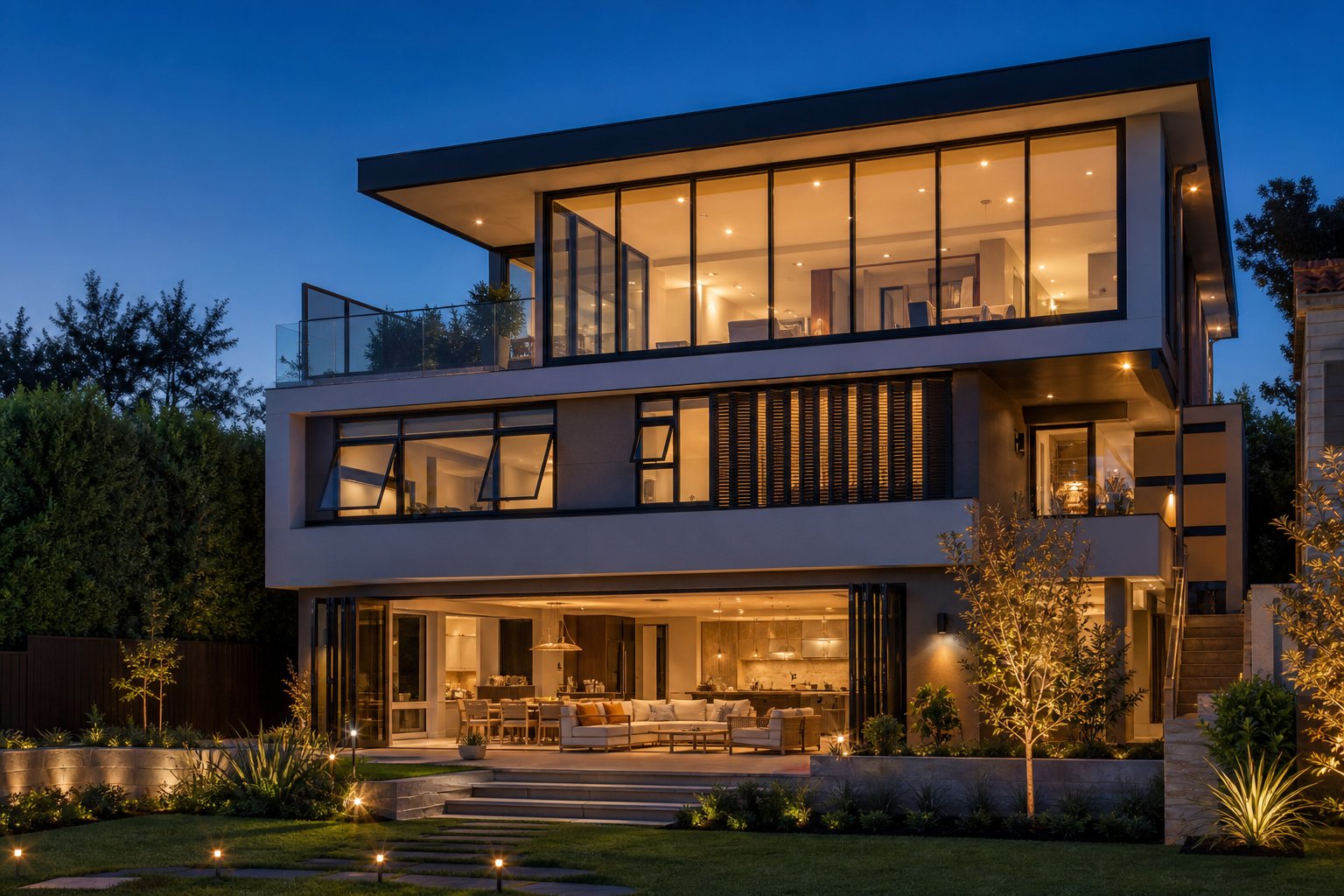
Performance ratings confirm what a window can do. The next question is what it should do in your specific build — and that depends entirely on whether you are threading new frames into an existing brick veneer renovation, specifying a full suite for a new-build estate home, or coordinating hundreds of openings across a commercial fitout. Each scenario carries different structural constraints, aesthetic priorities, and operational demands that steer both style selection and long-term ownership experience.
Choosing Window Styles for Residential and Commercial Projects
Aluminium window styles for new builds offer the broadest freedom. Without the dimensional limits of existing openings, architects can specify larger spans, non-standard aspect ratios, and mixed configurations across different facades — north-facing walls might carry expansive fixed panels for passive solar gain while west-facing elevations use compact awning windows that ventilate without admitting low-angle afternoon sun.
Renovations present tighter constraints. Eco aluminium windows for residential renovations must often fit existing masonry or timber reveals without major structural alteration. The advantage aluminium holds here is that its strength-to-weight ratio allows slim sightline aluminium windows that maximise glass area within a fixed rough opening — replacing a chunky old timber or uPVC frame with a slimmer aluminium profile can increase glazed area by 10 to 15 percent without touching the wall, flooding rooms with natural light and reducing daytime dependence on artificial lighting.
Commercial developments — offices, retail, schools, aged care — scale those same benefits across dozens or hundreds of openings. Aluminium’s dimensional consistency and tight manufacturing tolerances make it the default choice for projects where repeatability, certification documentation, and long-term warranty coverage all need to work at volume.
The operable style you select determines daily usability. Here are the most common configurations and where each one earns its place:
- Awning — hinged at the top and opens outward; ideal for ventilation during rain, commonly used in kitchens, bathrooms, and clerestory applications
- Sliding — panels glide horizontally on tracks; suits wide openings where swing clearance is limited, popular in living areas and bedrooms
- Double hung — two sashes slide vertically within the frame; excellent for heritage-style facades and controlled ventilation from top or bottom
- Casement — hinged at the side, swings outward; provides maximum unobstructed airflow and a clean sightline when closed
- Fixed — non-operable; delivers the slimmest possible frame profile and largest glass area, used for feature glazing, highlight panels, and picture windows
- Bi-fold — multiple panels fold and stack to one side; creates wide unobstructed openings between indoor and outdoor zones, common in living and entertaining areas
In practice, most projects combine several styles. A typical single-storey new build might pair fixed highlight panels above operable awning sashes — capturing both maximum daylight and controllable ventilation from a single wall section.
Maintenance and Long-Term Durability
Low maintenance aluminium window frames are not just a sales talking point — they are a measurable sustainability factor. Every repaint, reseal, or premature replacement carries embodied energy, material waste, and cost. Aluminium sidesteps most of that burden.
The powder-coat finish that protects modern aluminium frames from UV, salt air, and moisture typically lasts 15 to 25 years in outdoor exposure before any visible degradation, and high-performance fluorocarbon coatings push that figure toward 30 years. In coastal locations — think Sunshine Coast, northern NSW, or Fremantle — more frequent washing (every three to four months) removes salt buildup before it can attack the coating, but no repainting or sealing is needed. Inland and suburban installations may only need a soapy wash once or twice a year.
Routine care is genuinely minimal:
- Wipe frames with mild soap and water to remove grime and salt
- Inspect hardware — hinges, rollers, locks — annually and lubricate moving parts
- Check weatherseals for compression loss and replace if gaps develop
Because aluminium does not rot, swell, crack, or warp, the frame itself remains dimensionally stable for 40 to 60 years. That longevity directly supports the eco narrative: fewer replacement cycles, less construction waste, less embodied carbon accumulating over the building’s life. A timber window that lasts 25 years before needing replacement has consumed two full manufacturing and installation cycles in the same period a single aluminium frame continues to perform.
This combination of style versatility, structural precision, and set-and-forget durability is what makes thermally broken aluminium the default specification across so much of Australia’s residential and commercial building stock. The final question is how to pull all these threads together — climate, rating, style, and sustainability — into a clear decision framework that moves a project from research toward confident specification.
Making a Performance-Led Decision on Eco Aluminium Windows
Every specification choice covered so far — thermal break depth, glazing configuration, climate-matched SHGC, orientation strategy, compliance verification — feeds into a single high-stakes moment: the point where research becomes a purchase order. Get the decision sequence wrong and you lock in compromised performance for 40-plus years. Get it right and the building rewards you with lower energy costs, reduced maintenance burden, and genuine sustainability credentials across its entire service life.
Key Decision Factors for Specifiers
Choosing sustainable aluminium windows for builders, architects, and developers is not a single decision — it is a chain of interdependent choices where each link strengthens or weakens the whole. Five factors carry the most weight:
Thermal performance verification. Confirm whole-window Uw values (not centre-of-glass figures) match NCC Section J requirements for your climate zone. A thermally broken profile is only as good as its tested U-value proves it to be. Ask for the number, then ask where it came from.
Glazing configuration. Match pane count, low-E coating position, gas fill, and SHGC to the building’s orientation and climate demands. The same glass package cannot serve a north-facing living room wall and a west-facing bedroom — different facades need different specifications.
Climate suitability. Aluminium window specifications by climate zone differ dramatically. A window perfect for Hobart’s heating-dominated conditions will overcook an interior in Townsville. Verify that both frame and glass selections align with local NatHERS modelling assumptions.
Lifecycle sustainability. Look beyond upfront cost. Factor in expected service life, maintenance frequency, end-of-life recyclability, and the embodied energy implications of replacement cycles. A product that costs less today but demands replacement in 20 years carries hidden environmental and financial debt.
Compliance documentation. Insist on AS 2047 test reports from NATA-accredited laboratories, WERS performance data, and certificates of compliance traceable to the specific product series being quoted — not generic brand-level claims. Transparent documentation separates engineered systems from marketing exercises.
Next Steps Toward Performance-Led Specification
Turning these principles into a procurement workflow requires a clear sequence. The following steps move a project from informed research toward confident specification:
- Define project-specific performance requirements — establish target U-values, SHGC ranges, STC ratings, air infiltration limits, and water resistance pressures based on NCC climate zone, building height, terrain category, and occupancy type
- Map glazing strategy to orientation — specify different glass packages for each facade based on solar exposure analysis, shading provisions, and seasonal heating or cooling balance
- Select frame profile depth and thermal break width — match to the thermal performance targets identified in step one, confirming that the system achieves whole-window Uw values rather than relying on frame-only or glass-only data
- Confirm operable style suitability — ensure selected window types (awning, sliding, casement, fixed) deliver the ventilation, weather sealing, and operational performance the project demands
- Request and verify compliance documentation — obtain AS 2047 test reports, WERS certificates, and NCC compliance statements for the specific product series; confirm testing covers the sizes and configurations being specified, not just minimum gateway specimens
- Evaluate supplier capability and accountability — assess manufacturing consistency, warranty terms, technical support during construction, and willingness to provide traceable documentation at every stage
That final step matters more than many specifiers realise. A system is only as reliable as the manufacturer standing behind it. Suppliers who centralise their compliance and certification documentation in accessible, transparent formats signal confidence in their own testing — and make it straightforward for architects and builders to verify alignment with project requirements without weeks of back-and-forth paperwork.
This performance-led aluminium window selection guide distils what could be an overwhelming decision into a repeatable, auditable process. The aluminium window specification checklist for architects is not complicated — it simply demands that every claim is verified, every metric is matched to context, and every product earns its place through documented evidence rather than assumption. Do that, and the window system you select will perform reliably for decades. Skip it, and the title of this article becomes your reality.
Frequently Asked Questions About Eco Aluminium Windows
1. What makes aluminium windows eco-friendly?
Eco aluminium windows earn their sustainability credentials through three core features: thermally broken frames that slash heat transfer by up to 85 percent compared to unbroken aluminium, low-E glazing that manages solar radiation without heavy reliance on mechanical cooling, and the material’s infinite recyclability. Recycling aluminium consumes roughly 5 percent of the energy required for primary production, and the metal retains full structural quality through unlimited recycling cycles. Combined with a typical service life of 40 to 60 years and near-zero maintenance requirements, these windows reduce replacement waste and embodied carbon accumulation far beyond what shorter-lived frame materials can achieve.
2. How does thermal break technology work in aluminium window frames?
A thermal break is a continuous strip of reinforced polyamide (PA66 GF25) mechanically crimped between two separate aluminium extrusions — one facing the exterior and one facing the interior. Polyamide conducts heat at approximately 0.3 W/m·K, making it 500 to 1,000 times less conductive than aluminium. This insulating bridge prevents heat from travelling through the frame, effectively turning aluminium’s biggest weakness into a non-issue. Strip widths range from 14.8 mm in standard profiles to 35 mm or more in high-insulation systems designed for Passive House certification. The wider the strip and the more complex its internal chamber geometry, the lower the frame’s U-value and the better its energy performance.
3. Are eco aluminium windows better than uPVC for Australian conditions?
For most Australian applications, thermally broken aluminium outperforms uPVC across durability, recyclability, and design flexibility. uPVC degrades under intense UV exposure common across the continent, typically lasting 20 to 30 years before discolouration and seal failures require replacement. Aluminium frames resist UV, salt air, and moisture for 40 to 60 years without repainting or resealing. Aluminium also supports slimmer sightlines and larger glass areas, maximising natural light. Where uPVC holds an advantage is upfront cost and inherent thermal insulation without needing a thermal break. For budget-constrained projects with shorter ownership horizons, uPVC may still make financial sense — but for long-term value and environmental responsibility, aluminium is the stronger choice.
4. What U-value should I look for in eco aluminium windows in Australia?
The target U-value depends on your NCC climate zone. Cool temperate zones like Canberra and Hobart demand whole-window Uw values at or below 1.4 W/m²K, while mild temperate areas such as Sydney and Melbourne should aim for 2.0 W/m²K or lower. Hot-humid regions like Darwin can accept higher U-values (up to 4.0 W/m²K) because the temperature differential between indoors and outdoors is smaller — in those zones, low SHGC matters far more. Always confirm you are comparing whole-of-window Uw figures rather than centre-of-glass values, as frame and spacer effects worsen the number. Manufacturers who provide transparent compliance documentation, such as those publishing AS 2047 test reports, make verification straightforward.
5. How long do eco aluminium windows last compared to other frame materials?
Properly installed thermally broken aluminium frames deliver 40 to 60 years of reliable service with minimal maintenance — typically just periodic washing with mild soap and water. By comparison, uPVC frames last 20 to 30 years before UV degradation and seal failure demand replacement, while timber frames can match aluminium’s lifespan only with consistent maintenance including repainting every three to five years. Fiberglass offers comparable durability at 40 to 50 years but with limited availability and fewer configuration options in the Australian market. Aluminium’s longevity directly reduces lifecycle environmental impact: fewer manufacturing cycles, less transport, less construction waste, and retained scrap value at end of life rather than landfill disposal.
More Window & Door Guides