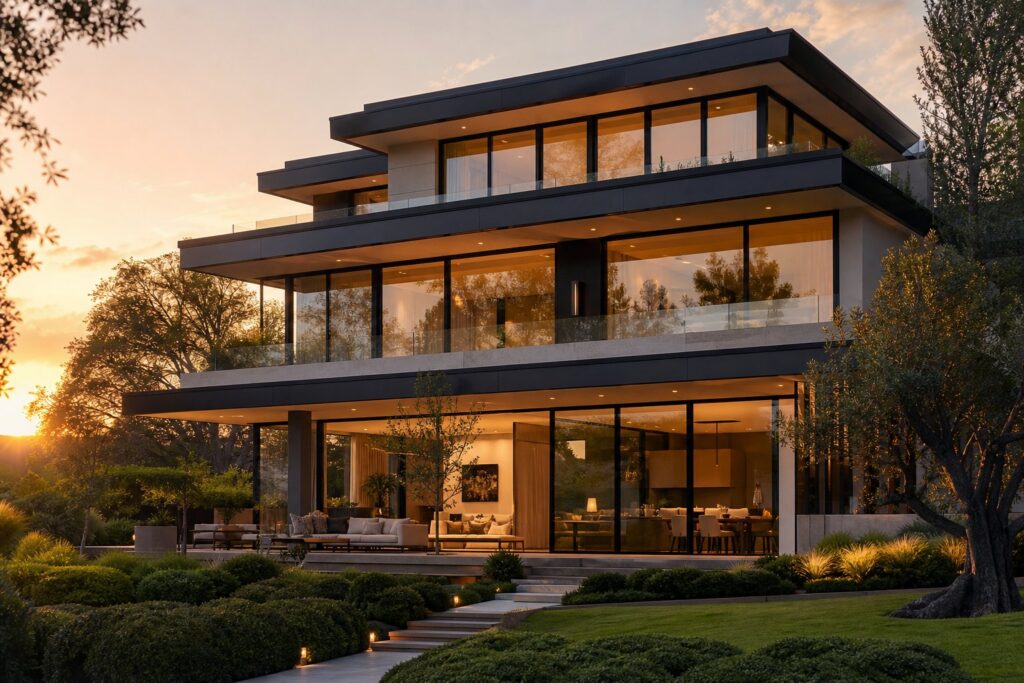
What Aluminium Window Tinting Actually Means
Search for aluminium window tinting and you will land on two very different conversations. One is about window films that contain aluminium — thin metallic layers engineered to reflect solar heat. The other is about applying tint film to windows built with aluminium frames. Same phrase, different problems to solve, and mixing them up can send a project sideways before it starts.
Two Meanings Behind Aluminium Window Tinting
The first interpretation refers to a specific film technology. Metalized window tint films use microscopic aluminium particles deposited onto a polyester substrate to create a reflective barrier against solar radiation. These films bounce heat and UV energy away from the glass, delivering strong thermal performance and glare control. They sit alongside ceramic, carbon, and dyed films as one of several material categories available to homeowners, builders, and vehicle owners alike.
The second interpretation is purely about the frame material. Aluminium-framed windows are everywhere in Australian homes — from coastal apartments to new residential builds — and applying aftermarket tint film to them introduces considerations that timber or uPVC frames simply do not. Aluminium conducts heat rapidly, which changes how the glass and adhesive respond under solar load.
Aluminium window tinting can mean either a metallic aluminium-based tint film applied to any window, or the process of tinting windows that have aluminium frames. Each interpretation carries distinct performance factors, compatibility requirements, and trade-offs that affect purchasing and installation decisions.
Why the Distinction Matters for Your Project
Getting the terminology straight early saves real money and frustration. A homeowner researching aluminium tint film for heat rejection needs to understand signal interference risks — metallic films can disrupt GPS, cellular, and Wi-Fi signals passing through the glass. Someone looking to tint their existing aluminium-framed double-glazed windows faces a different challenge: thermal stress on sealed glass units caused by the frame’s high conductivity.
These are not minor footnotes. Choosing the wrong film type for an aluminium-framed window can void glass warranties or accelerate seal failure. Choosing a metallic aluminium film without considering your home’s wireless environment can degrade connectivity throughout an entire floor. Yet most guides online treat aluminium window tinting as a single, simple topic — if they address it at all.
This resource covers both meanings in depth: how aluminium-based metallic films work and where they excel, how aluminium frames interact with tint film thermally, and the practical trade-offs that sit between the two. Whether you are specifying film for a renovation, weighing up options for a new build, or just trying to figure out what aluminium window tint types are actually available in Australia, everything that follows is built to help you make a confident, informed call.
The science behind that reflective metallic layer — and what makes it behave differently from ceramic or carbon alternatives — is where the real decision-making starts.
How Aluminium-Based Tint Films Work
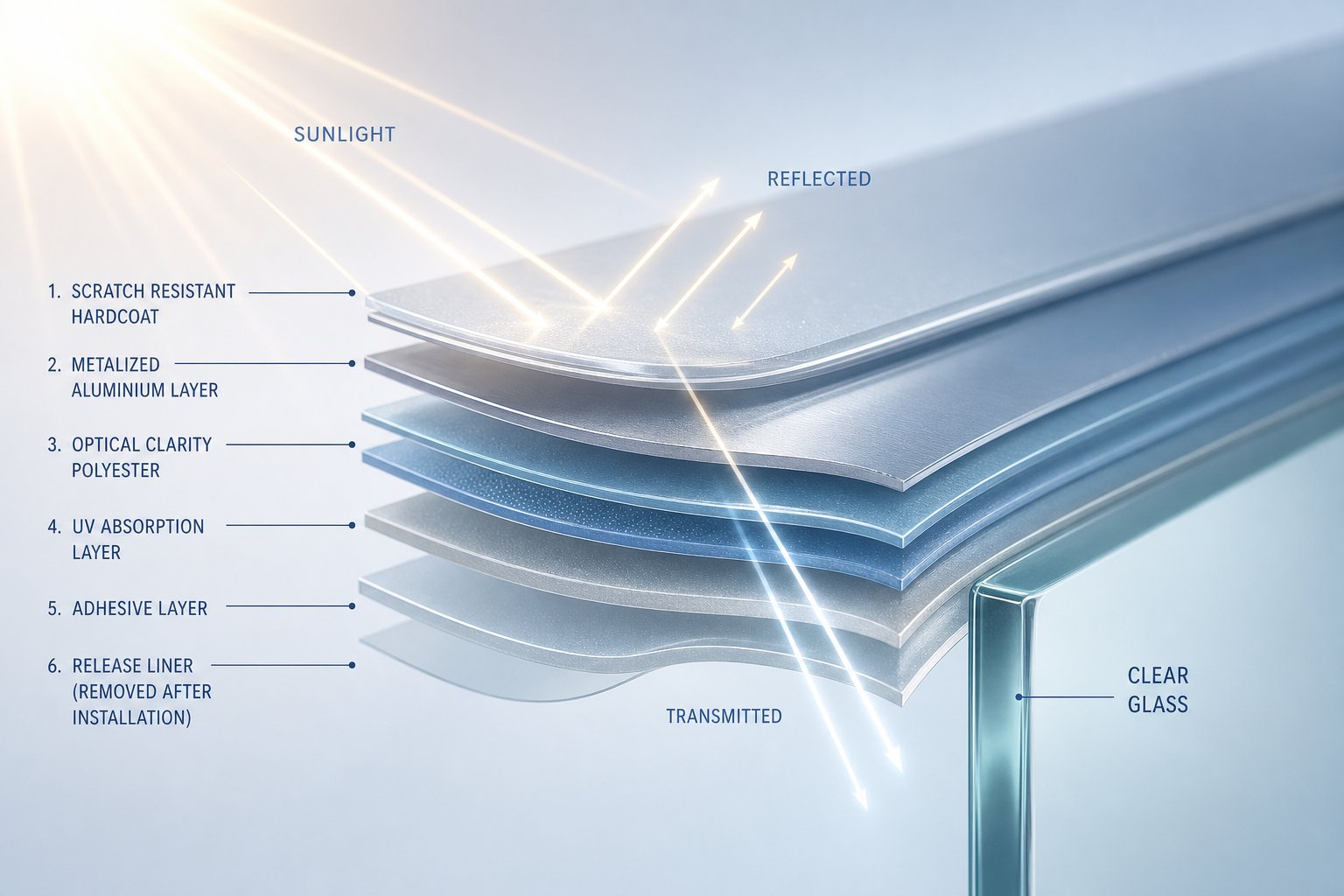
Every window film starts as a thin, optically clear polyester sheet — PET (polyethylene terephthalate) — typically between 25 and 100 microns thick. On its own, this base does nothing to stop heat or UV radiation. The performance comes from what gets deposited on top of it, and in the case of aluminium metallic film, that means an ultra-thin layer of metal atoms bonded directly to the substrate.
How Metallic Aluminium Layers Reflect Solar Energy
The process that creates aluminium tint film is called magnetron sputtering — a physical vapour deposition technique carried out inside a vacuum chamber. Metal atoms (in this case aluminium) are ejected from a target source and deposited in extremely thin, uniform layers onto the PET surface. The result is a film with a faint metallic sheen that reflects a significant portion of incoming solar radiation rather than absorbing it.
Reflection is the key distinction here. When sunlight hits an aluminium-coated film, much of the infrared energy bounces back outward before it can pass through the glass and warm the interior. This mechanism delivers strong heat rejection and effective glare control simultaneously. Aluminium is favoured for this role because it offers high reflectivity relative to its weight, remains stable under prolonged UV exposure, and can be deposited in layers thin enough to maintain reasonable visible light transmission.
The practical effect for Australian homes — particularly those with large, sun-facing glazing — is a noticeable reduction in solar heat gain. Rooms stay cooler, air conditioning systems work less, and harsh glare across screens and furnishings is softened without completely darkening the space.
Aluminium Films Compared to Ceramic and Dyed Alternatives
Aluminium metallic film is one of four main technology tiers available. Each uses a different mechanism to manage heat, light, and UV, and each carries trade-offs that matter depending on the application.
Dyed films rely on coloured pigments absorbed into the polyester to darken the glass and reduce glare. They are the most affordable option but offer limited heat rejection because they absorb solar energy rather than reflecting it — and that absorbed heat can re-radiate inward. Over time, dye molecules break down under sustained UV exposure, leading to colour shift (often toward purple) and declining performance.
Carbon films incorporate carbon particles into a multi-layer structure. Carbon provides solid infrared absorption without the electrical conductivity of metals, which means no interference with wireless signals. Colour stability is also superior to dyed films — carbon does not fade the way organic dyes do.
Ceramic films sit at the premium end. They use nano-scale ceramic particles (commonly titanium nitride or similar compounds) to absorb and reject infrared energy while maintaining exceptional optical clarity. Ceramic offers the highest heat rejection without signal disruption, but at a significantly higher price point and with more complex installation requirements.
| Film Type | Heat Rejection | Glare Reduction | UV Blocking | Signal Interference | Durability | Relative Cost |
|---|---|---|---|---|---|---|
| Aluminium Metallic | High (reflective) | High | High | Yes — attenuates Wi-Fi, cellular, GPS | Very good | Moderate |
| Ceramic | Very high (absorptive/selective) | Moderate to high | Very high (up to 99% UV) | None | Excellent | High |
| Carbon | Moderate to high (absorptive) | Moderate | High | None | Good | Moderate |
| Dyed | Low to moderate (absorptive) | Moderate | Moderate | None | Fair — prone to fading | Low |
Aluminium metallic film lands in a practical middle ground: strong reflective heat rejection, proven durability, and a moderate price — but with one caveat that the table above hints at. Those same conductive metal layers that bounce solar energy away from your glass also attenuate radio frequencies passing through it. For many installations, that trade-off is perfectly acceptable. For others — particularly rooms packed with wireless devices or buildings already fitted with low-emissivity coatings — it becomes the deciding factor in film selection.
The frame holding that glass introduces its own variable, especially when it is aluminium.
Tinting Windows with Aluminium Frames
Aluminium frames dominate Australian residential and commercial glazing for good reason — they are strong, lightweight, corrosion-resistant, and can be extruded into slim profiles that maximise glass area. But that popularity means millions of homes now face a specific compatibility question when aftermarket tint film enters the conversation: can you tint aluminium framed windows without creating problems that other frame materials simply do not produce?
The short answer is yes — but the longer answer involves understanding a physical property that separates aluminium from every other common frame material on the market.
Why Aluminium Frames Create Unique Tinting Challenges
Timber, uPVC, and composite frames are thermal insulators. They absorb heat slowly and release it slowly. Aluminium does the opposite. It conducts heat roughly 1,000 times more efficiently than uPVC and around 1,500 times more efficiently than timber. In practical terms, that means any heat concentrated in the glass pane transfers rapidly through the aluminium frame to the glass edges — and vice versa.
When tint film is applied to a window, the film absorbs a portion of incoming solar energy that would otherwise pass through. That absorbed energy converts to heat within the glass itself. On a timber or uPVC framed window, the insulating frame keeps the glass edges relatively cool because heat does not travel easily through those materials. The temperature difference between the centre of the pane and its edges stays manageable.
Aluminium frames change that equation. Because the metal conducts so efficiently, heat from the sun-exposed glass races outward through the frame, while the shaded glass tucked behind the frame remains cooler. This creates a steeper temperature gradient across the pane — the centre gets hot, the edges stay relatively cool — and that uneven expansion is exactly what triggers thermal stress fractures. Thermal stress refers to the opposing forces created when one area of a glass pane expands from heat while adjacent cooler areas resist that expansion, pulling the glass apart at its weakest points.
The issue is amplified by aluminium’s typical profile design. Slim aluminium frames bite into the glass with narrow rebates, meaning less glass is shaded by the frame compared to chunkier timber or uPVC sections. Paradoxically, even that small shaded strip creates enough of a temperature difference to matter — because the aluminium conducts heat away from that strip so efficiently.
Thermal Stress and Sealed Unit Risks
For single-glazed aluminium windows, thermal stress is a concern primarily for edge-damaged or imperfect glass. But for double-glazed sealed units — increasingly standard in Australian construction — the stakes rise considerably.
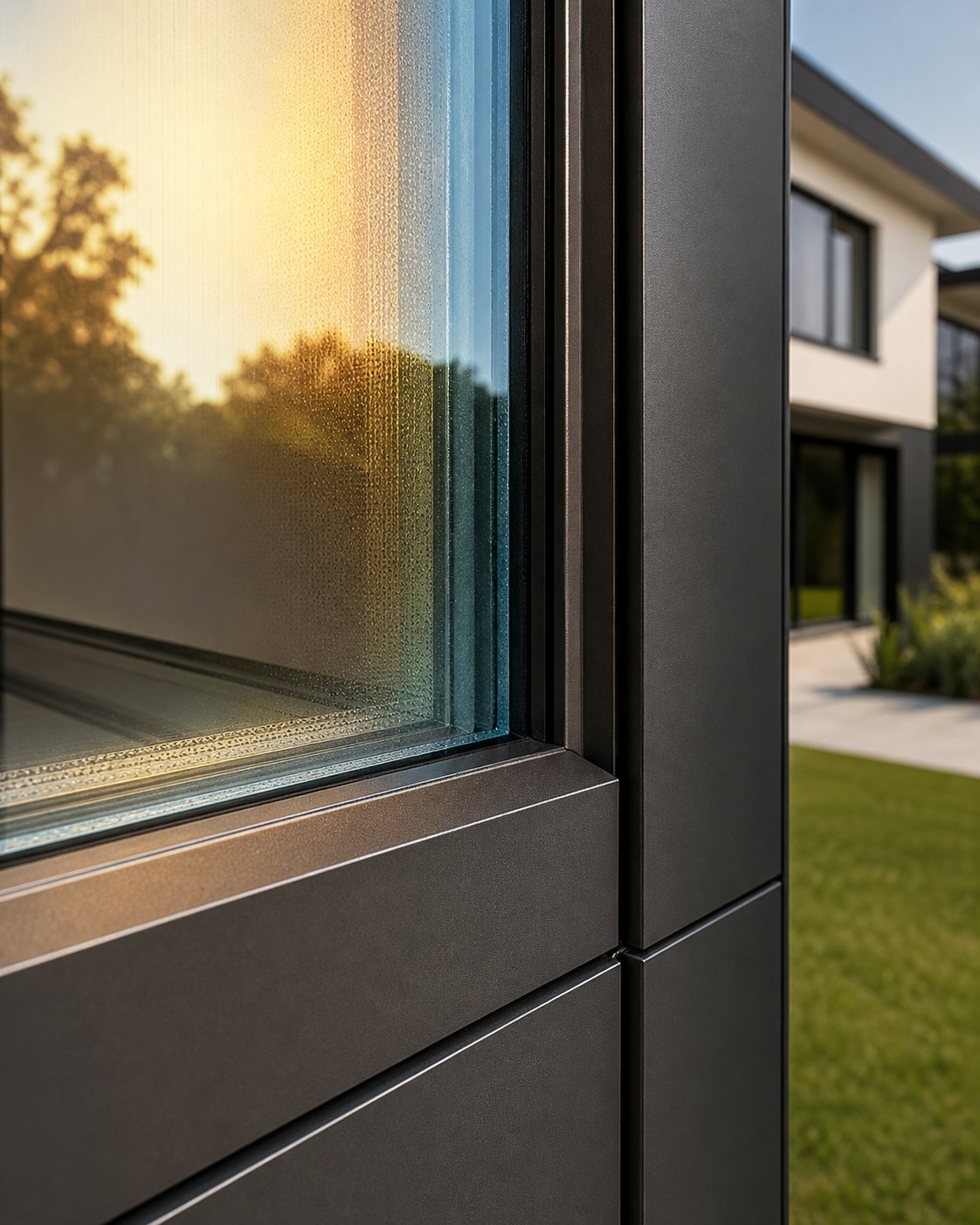
In a sealed double-glazed unit, two panes of glass are bonded to a spacer with primary and secondary seals, enclosing an insulating gas layer (usually argon). When tint film on the inner pane absorbs solar energy, that heat radiates inward toward the sealed air gap. The trapped heat can cause different rates of expansion in the two panes, placing uneven pressure on the perimeter seal. Over repeated daily heating and cooling cycles, this mechanical stress degrades the seal, eventually allowing moisture ingress — visible as fogging or condensation between panes.
With aluminium frames conducting heat rapidly to and from the glass edges, the seal area experiences more aggressive thermal cycling than it would in an insulating frame. The combination of high-absorptance film and highly conductive framing creates the worst-case scenario for sealed unit longevity.
Several variables determine how serious the risk actually is for a given window:
- Frame colour: Dark-coloured aluminium frames (black, charcoal, dark bronze) absorb significantly more solar radiation than lighter finishes, adding heat at the glass edge from the frame itself — not just from the filmed glass surface.
- Glass type: Single-glazed windows tolerate higher film absorptance than double-glazed sealed units. Laminated or toughened glass in double-glazed configurations has different stress tolerances again, and Low-E coatings alter heat flow paths within the unit.
- Film absorption level: Films with solar absorptance above roughly 50 per cent are generally considered high-risk on double-glazed units. The darker and more absorptive the film, the more heat it forces into the glass — and the greater the thermal gradient between centre and edge.
- Climate zone: Windows facing north or west in Australian climates cop intense, sustained solar load. Properties in tropical Queensland or inland NSW experience higher peak glass temperatures than those in temperate southern regions, compounding the thermal stress effect on aluminium-framed units.
- Shading patterns: Partial shading from nearby structures, trees, or architectural features creates hard shade lines across the glass. The abrupt temperature difference between shaded and unshaded portions — already problematic — becomes more pronounced when the aluminium frame rapidly conducts heat away from the cooler shaded zone.
None of these factors operate in isolation. A west-facing, double-glazed window in a dark-framed aluminium system with a high-absorptance film and partial afternoon shade from an adjacent building is carrying four risk factors simultaneously. That same film on a south-facing, single-glazed, light-coloured aluminium frame in Melbourne might present almost no concern at all.
Professional tint installers familiar with aluminium-framed glazing will assess these variables before recommending a product. The critical takeaway is that tint film compatibility with aluminium frames is not a blanket yes-or-no question — it depends on the specific thermal profile of each window, and getting it wrong can mean cracked glass, failed seals, or voided manufacturer warranties.
Understanding exactly how much heat aluminium transfers — and how that shapes your film selection — requires a closer look at the numbers behind thermal conductivity.
Thermal Conductivity and Film Performance
The numbers tell the story more clearly than any general statement. Aluminium has a thermal conductivity of approximately 205 W/m·K, compared to just 0.17 W/m·K for uPVC. That is a ratio of roughly 1,200 to 1. Timber sits even lower, around 0.12 to 0.16 W/m·K depending on the species. These are not subtle differences — they represent entirely different thermal behaviours that directly affect how aluminium frames interact with tint film performance under solar load.
Aluminium Conductivity and Heat Transfer Basics
Heat always moves from warmer areas to cooler ones, and the rate it moves depends on the material in its path. In a tinted window system, solar energy absorbed by the film heats the glass. From there, heat has two primary escape routes: it radiates inward toward the room, or it conducts outward through the frame at the glass edge.
With uPVC or timber frames, that second path is essentially blocked. The frame acts as a thermal dam, keeping heat confined within the glass pane where it distributes relatively evenly. The temperature gradient between centre and edge stays small, and the whole system reaches a stable equilibrium without extreme localised stress.
Aluminium frames behave like a thermal highway. Heat reaches the glass edge and drains rapidly through the metal, creating a persistent cool zone at the perimeter while the centre of the pane remains hot. This uneven temperature profile is what drives thermal stress — but it also affects energy efficiency calculations in ways many homeowners overlook.
Consider the energy balance. A high-absorptance film traps solar energy within the glass, intending to reduce the amount that reaches the interior. But with aluminium framing, a portion of that trapped heat conducts straight through the frame and into the building envelope anyway — bypassing the insulating air gap in double-glazed units entirely. The film reduces radiant heat gain through the glass centre, yet the frame becomes a secondary conduction pathway that partially undermines the overall thermal benefit. Energy modelling that ignores frame conductivity can overestimate the cooling load savings from tint film by a meaningful margin.
Selecting Film Absorptance to Match Frame Properties
Every window film interacts with sunlight through three mechanisms: it transmits some energy, absorbs some, and reflects the rest. Solar absorptance is the fraction the film converts directly into heat within itself and the glass. Solar reflectance is the fraction it bounces away before it enters the glazing system at all.
For aluminium-framed windows, this distinction is critical. A film with high absorptance — say a dark, dyed product — loads the glass with thermal energy that then conducts aggressively through the frame. Research comparing heat-absorbing and reflective window films found that absorptive films raised glass surface temperatures significantly, while reflective films actually kept glass temperatures lower than unfilmed clear glass. The reflective film also delivered superior air conditioning energy savings — up to 10 per cent in high-solar-load orientations — precisely because it rejected heat before it could enter the glazing system.
The lesson for aluminium frames is straightforward. When the frame conducts heat efficiently, you want the film to prevent heat from entering the glass in the first place rather than trapping it there. That means prioritising reflectance over absorptance.
On aluminium-framed windows, choose a film with higher solar reflectance rather than higher absorptance. Reflective films reject heat before it enters the glass, reducing the thermal load that aluminium’s high conductivity would otherwise channel straight through the frame and into the building envelope.
In practical terms, this steers the selection toward metallic aluminium films or premium ceramic films with selective reflective coatings — and away from heavily dyed or purely absorptive products. The best tint film for thermally conductive frames is one that minimises how much energy the glass has to hold in the first place.
That preference for reflective film technology, though, introduces a trade-off that rarely appears in product brochures: what happens to the wireless signals trying to pass through the same glass.
Signal Interference and Practical Trade-Offs
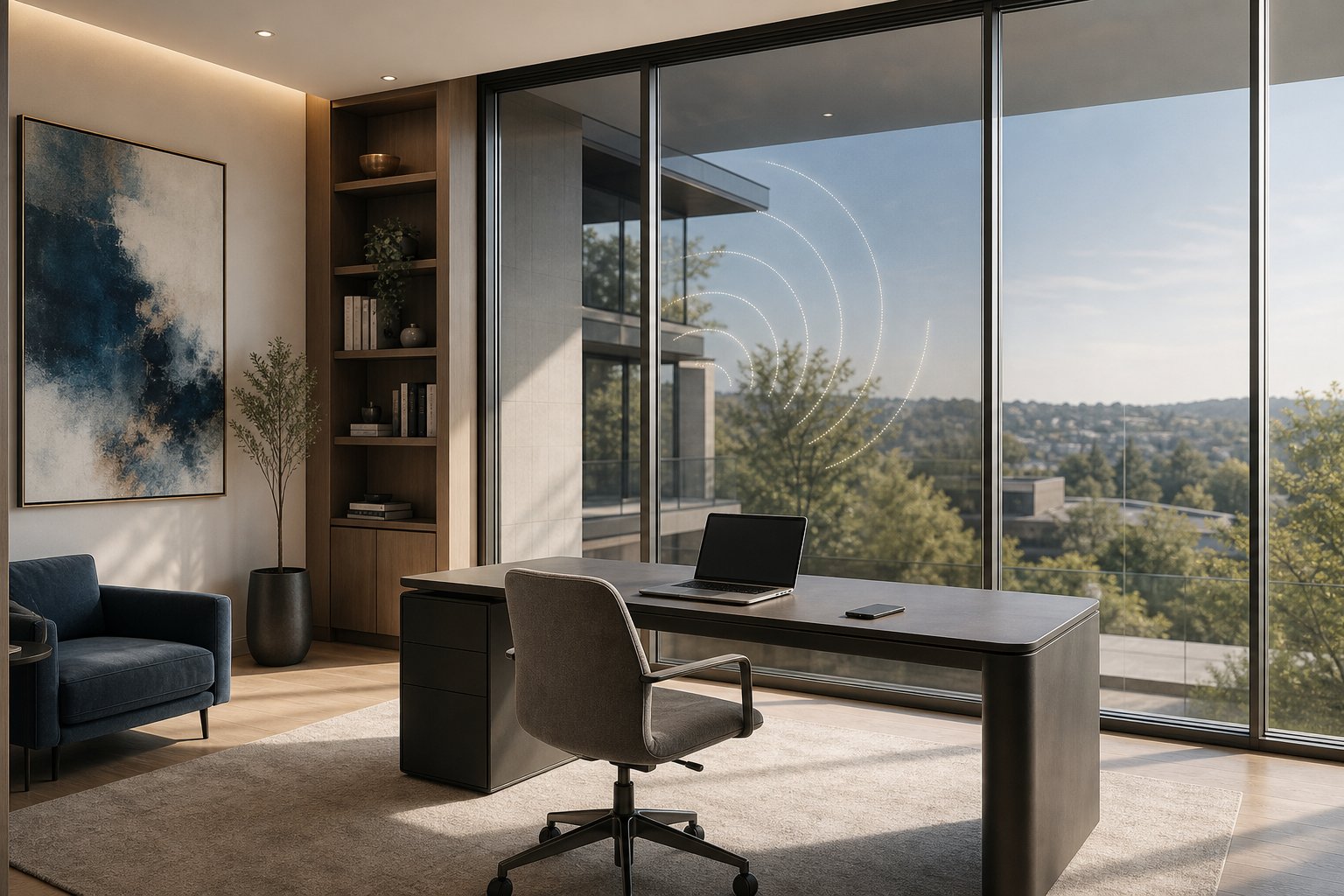
Metallic aluminium films reflect solar radiation effectively — that much is established. But reflection is not selective. The same conductive layer that bounces infrared energy away from your glass also attenuates radio frequency waves trying to pass through it. Your Wi-Fi router, your mobile phone, your GPS device, and your smart home sensors all rely on RF signals that must travel through glazing to reach external access points, cell towers, or satellites. Coat that glass with a conductive aluminium layer, and you have built a partial Faraday cage around the room.
Why Metallic Films Disrupt Wireless Signals
The mechanism is straightforward physics. Radio frequency waves are electromagnetic radiation — the same fundamental phenomenon as visible light and infrared heat, just at a different wavelength. Conductive materials reflect and absorb electromagnetic energy across a broad spectrum. When microscopic aluminium particles form a continuous or near-continuous conductive layer across the glass surface, RF signals arriving from outside get partially reflected back before they reach indoor devices. Industry reports indicate that metallic film can reduce cellular signal strength by 10 to 30 per cent, with GPS — already a weak satellite-based signal — suffering even more severely.
The interference compounds when multiple windows in a room are all filmed. A single tinted pane might produce barely noticeable degradation. Cover every window facing external cell towers or Wi-Fi access points, and the cumulative attenuation starts mimicking the shielding effect that secure government buildings deliberately engineer using specialised RF-blocking glass.
Modern aluminium window systems often arrive with factory-applied low-emissivity (Low-E) coatings — thin metallic or metal-oxide layers designed to reflect infrared heat for energy efficiency. These coatings already attenuate RF signals to some degree. Adding aftermarket aluminium metallic tint on top of factory Low-E glass effectively doubles the conductive barrier, and the combined signal loss can tip a marginal cellular connection into dropped calls and dead zones. Homes in areas with weaker tower coverage — rural properties or buildings partially shielded by terrain — feel this most acutely.
Evaluating Signal Impact Before Installation
Not every room warrants concern. A north-facing bedroom with no router nearby and strong external cell coverage might tolerate metallic film without any noticeable connectivity change. A home office relying on Wi-Fi from a router positioned deeper in the house, with cellular already sitting at two bars near the window, is a different situation entirely.
Before committing to aluminium metallic film, assess which wireless signals pass through the windows you plan to tint:
- Wi-Fi (2.4 GHz and 5 GHz): Affected if your router or mesh nodes sit on the opposite side of tinted glass from connected devices, or if outdoor access points serve indoor areas.
- Cellular 4G/5G: Higher-frequency 5G bands are more susceptible to attenuation than lower-frequency 4G signals. Homes already in fringe coverage areas face the greatest risk of dropped calls and slow data.
- GPS: Satellite signals arrive extremely weak after travelling from orbit. Even modest metallic film can delay satellite lock or degrade positioning accuracy for indoor navigation devices.
- Smart home devices: Sensors, security cameras, and IoT hubs communicating via Wi-Fi or proprietary RF protocols may lose connection reliability if their signal path crosses tinted glazing.
- Bluetooth (2.4 GHz): Short-range connections between devices on opposite sides of a tinted window — like an outdoor speaker paired to an indoor phone — can stutter or drop entirely.
A simple before-and-after test — checking signal bars, Wi-Fi speed, and GPS lock time with windows open versus closed — gives a baseline for how much attenuation your current glass already produces. If connectivity is already marginal, metallic film will likely push it past a usable threshold, and ceramic or carbon alternatives become the smarter path forward.
Signal interference is a performance consideration you can evaluate and plan around. Regulatory compliance, on the other hand, is non-negotiable — and the rules governing how much light your tinted windows must transmit vary depending on where you live and what type of building you occupy.
Regulations and VLT Compliance for Tinted Windows
Visible light transmission — VLT — is the percentage of visible light that passes through a glazed surface. It is measured using a spectrophotometer across the visible spectrum (380 to 780 nanometres), and the resulting number tells you how bright or dark a window appears. A VLT of 70 per cent means the glass allows 70 per cent of visible light through. Apply a tint film, and that number drops — sometimes dramatically — depending on the film’s density and construction.
In Australia, window tint VLT regulations vary between vehicle and building applications, and confusing the two is a common mistake. Vehicle tinting laws set minimum VLT percentages for windscreens and side windows (typically 35 per cent VLT for front side windows in most states), enforced by state road authorities. Building glazing operates under an entirely different framework — one governed by the National Construction Code and, in many cases, layered with additional body corporate restrictions.
Understanding Visible Light Transmission Requirements
The NCC Part 10.5 sets the baseline for natural light in habitable rooms. It requires windows to provide an aggregate light transmitting area of not less than 10 per cent of the room’s floor area. The key phrase is “light transmitting area” — this is measured exclusive of framing members and glazing bars, and it relates to the transparent portion of the window that actually admits daylight.
Applying tint film does not reduce the physical area of your glazing, but it reduces how much light passes through each square metre of that area. A heavily tinted window still counts as light transmitting area under the NCC, yet a room that barely meets the 10 per cent threshold with clear glass could fall short of practical daylight adequacy once a low-VLT film is applied. While the NCC natural light requirements for tinted windows do not explicitly prescribe a minimum VLT percentage for film, building certifiers and energy assessors evaluating NatHERS compliance will factor the reduced light transmission into their modelling.
Residential window tinting laws by state do not mirror vehicle regulations. No Australian state currently mandates a specific legal VLT percentage for home windows in the same prescriptive way road authorities regulate car glass. Instead, compliance sits within the broader performance requirements of the NCC — adequate natural light, energy efficiency under NatHERS, and glazing performance validated through schemes like WERS. The practical effect: you can install a relatively dark film on a residential window without breaching a hard VLT number, provided the room still meets natural light provisions and your energy rating is not compromised.
For commercial buildings, the picture tightens. Class 5 through 9 buildings under the NCC have more prescriptive daylighting and energy performance requirements, and heavily tinted glazing can conflict with both. Specifiers working on commercial fitouts should verify film VLT against the project’s Section J energy provisions and any green building rating targets (such as Green Star or NABERS) that reward daylight penetration.
Body Corporate and Appearance Restrictions
Even where no building code prevents you from applying film, body corporate rules for reflective window film can stop a project cold. In strata and community title schemes across Australia, the external appearance of a building is treated as common property. A tint film bonded to the inside face of a window pane still changes the building’s exterior aesthetic — and that change triggers the consent question.
Reflective and metallic aluminium films attract the most scrutiny. A mirror-finish film on one apartment in a building of clear-glass units creates a visible disparity from the street. Strata managers and committees routinely refuse high-reflectivity applications on aesthetic uniformity grounds. Even neutral, low-reflectivity solar films can require approval where by-laws capture any alteration to external appearance — and most do.
The consent framework varies by state legislation (in South Australia, for example, schemes fall under either the Strata Titles Act 1988 or the Community Titles Act 1996), but the practical threshold is consistent: if the film is visible from common property — the street, a courtyard, a lobby, an adjoining lot — consent is almost certainly required. Proceeding without approval risks a removal order at the owner’s expense.
Before purchasing any film, a straightforward compliance check protects your investment:
- Check local council regulations. Confirm whether your property has any heritage overlays, development controls, or neighbourhood character provisions that restrict external glazing treatments.
- Review NCC natural light requirements. Verify that your habitable rooms will still meet the 10 per cent light transmitting area threshold in practical daylight terms after the film is applied, particularly for rooms with limited window area.
- Consult body corporate or strata rules. Contact your strata manager or owners corporation to confirm whether window film requires consent. Ask specifically about reflectivity restrictions and approved film specifications.
- Confirm manufacturer VLT specifications. Request the product datasheet showing the installed VLT percentage, total solar energy rejection, and external reflectance — these are the figures your certifier, energy assessor, or body corporate committee will evaluate.
Navigating these layers before you commit to a product avoids the costly scenario of installing film that performs well thermally but fails a compliance check you did not know existed. With regulations addressed, the next practical question becomes how long that film will actually last — and what the Australian climate does to it over time.
Maintenance and Longevity Across Climates
Compliance and product selection only matter if the film holds up over time. How long does window tint last on aluminium frames? The answer depends less on the frame itself and more on the climate punishing both the film and the adhesive holding it in place. Professionally installed, high-quality metallic or ceramic films typically deliver 10 to 15 years of solid performance in moderate Australian climates. Drop that same film onto a west-facing aluminium window in coastal Queensland, and the timeline can compress to seven or eight years — sometimes less with budget products.
Climate Factors That Affect Film Lifespan
Australia’s climate zones push window film harder than most other developed markets. Intense UV radiation — among the highest globally — accelerates dye breakdown in lower-grade films and gradually degrades the adhesive bond at the glass-film interface. Temperature cycling adds mechanical fatigue: a dark film on a north-facing aluminium frame might swing between 25°C overnight and well above 70°C at the glass surface during a summer afternoon. Each cycle flexes the adhesive layer microscopically, weakening it over months and years.
Coastal climate window tint lifespan takes an additional hit from airborne salt. Salt deposits on frames and glass edges create micro-corrosion pathways that wick moisture behind the film perimeter. Aluminium frames resist corrosion better than steel, but powder-coated or anodised finishes are not immune — pitting at hardware junctions or drainage slots can trap salt-laden moisture right where the film edge meets the glass. Properties within a few kilometres of the coast in areas like Sydney’s Northern Beaches, the Gold Coast, or Perth’s western suburbs should budget for shorter replacement intervals and more frequent inspections of film edges.
Humidity compounds all of this. In tropical zones — Darwin, Cairns, Townsville — sustained high humidity softens adhesive bonds over time, particularly if the original installation trapped any moisture during application. Window film bubbling and peeling causes almost always trace back to adhesive failure, and moisture is the most common catalyst.
Cleaning and Care for Tinted Aluminium Windows
Proper maintenance extends film life meaningfully, and the good news is that cleaning tinted aluminium windows safely requires nothing exotic. Use a soft microfibre cloth with warm, soapy water — both for the film surface and the aluminium frame. Avoid ammonia-based glass cleaners on tinted surfaces; ammonia breaks down the film’s scratch-resistant coating over time. A dedicated window film cleaner or a mild dishwashing liquid diluted in water works well.
For the frames themselves, never use abrasive pads, steel wool, or harsh chemical cleaners on anodised or powder-coated aluminium. These finishes protect the underlying metal from oxidation, and damaging them invites corrosion — especially in coastal environments where the protective layer is the only barrier between salt air and raw aluminium. A soft cloth, low water pressure, and patience with stubborn marks is the safest approach.
Inspect film edges quarterly, particularly on windows with high solar exposure. Early edge lifting is easy to address with professional re-sealing, but once adhesive failure spreads inward from the perimeter, the film typically needs full replacement.
Watch for these warning signs that your tint has reached the end of its service life:
- Bubbling: Air pockets forming beneath the film surface, usually starting near edges and spreading inward as the adhesive separates from the glass.
- Purpling or colour shift: A clear sign of dye degradation in non-metallic films — the original neutral tone turns purple or brownish, indicating UV damage at the molecular level.
- Edge peeling: Film lifting away from the glass at corners or along the bottom edge, often accelerated by moisture ingress or cleaning product run-off pooling at the base.
- Haze or cloudiness: A milky appearance when light passes through at certain angles, reducing clarity and indicating adhesive breakdown across the film surface.
- Increased heat or glare: If rooms feel noticeably warmer or screen glare returns to pre-tint levels, the film’s solar rejection properties have degraded beyond useful performance.
- Visible scratches or cracking: Physical damage that compromises both appearance and the film’s structural integrity as a continuous barrier.
One or two of these symptoms appearing together is enough to start planning a replacement rather than waiting for complete failure. Catching degradation early also protects the glass beneath — old adhesive residue left too long can become significantly harder to remove cleanly, adding cost and labour to the replacement job.
Knowing when to replace is half the equation. Knowing what to replace it with — and whether aftermarket film is even the right answer for your specific window system — is where the real decision framework comes together.

Choosing the Right Film for Your Aluminium Windows
Replacement cycles, climate exposure, and regulatory compliance all feed into the same underlying question: which film actually belongs on your aluminium-framed glass? There is no universal answer, but there is a reliable framework for narrowing the field — one that weighs the variables unique to aluminium systems against your practical priorities.
Key Variables in Film Selection
Five factors shape the decision more than anything else. Getting clear on each one before browsing product catalogues saves you from buying a film that performs brilliantly on paper but creates problems on your specific windows.
Glass type: Single-glazed aluminium windows tolerate a wider range of film absorptance levels. Double-glazed sealed units demand low-absorption or reflective films to avoid thermal stress on the perimeter seal. If your aluminium windows carry factory Low-E coatings, adding a metallic film stacks conductive layers and amplifies both signal interference and potential heat buildup within the unit.
Frame colour: Dark powder-coated frames (black, monument, charcoal) absorb solar energy independently of the glass. That extra heat at the glass edge compounds the thermal gradient issue discussed earlier. Light-coloured frames are more forgiving and open the door to slightly more absorptive film choices.
Climate zone: Properties in high-solar-load areas — northern and western Australia, inland NSW, most of Queensland — benefit most from reflective films that reject heat outright. In cooler southern climates like Melbourne or Hobart, the solar load is lower and the risk of extreme glass temperatures drops, making moderately absorptive carbon films a viable middle ground.
Desired VLT: Darker films deliver more privacy and glare control but push more heat into the glass. If your habitable rooms sit near the 10 per cent natural light threshold under the NCC, a higher-VLT film keeps you compliant without sacrificing all solar control performance.
Signal sensitivity: Rooms housing Wi-Fi routers, home offices relying on cellular data, or buildings with existing Low-E glass should avoid metallic aluminium film entirely. Ceramic alternatives deliver comparable heat rejection without attenuating wireless frequencies.
The table below maps these variables to the film type best suited to each scenario:
| Decision Factor | Scenario | Recommended Film Type |
|---|---|---|
| Glass type | Double-glazed sealed unit with Low-E coating | Ceramic (low absorptance, no signal loss) |
| Glass type | Single-glazed clear glass | Aluminium metallic or ceramic |
| Frame colour | Dark frame (black, charcoal) | High-reflectance metallic or ceramic |
| Frame colour | Light frame (silver, white, surfmist) | Carbon, ceramic, or metallic |
| Climate zone | High solar load (QLD, WA, northern NSW) | Aluminium metallic (budget) or ceramic (premium) |
| Climate zone | Moderate solar load (VIC, TAS, ACT) | Carbon or ceramic |
| Signal sensitivity | Home office, weak cellular, smart home devices | Ceramic or carbon only |
| Signal sensitivity | No wireless reliance through glazing | Aluminium metallic (strong value) |
| Budget | Cost-conscious, single-pane, low signal risk | Aluminium metallic |
| Budget | Premium performance, dual-pane, long lifespan | Ceramic |
In short: ceramic vs metallic tint for aluminium windows comes down to whether you need signal transparency and dual-pane compatibility (ceramic wins) or maximum reflective performance at a moderate price on single-pane glass (metallic wins). Neither is categorically better — each fits a different set of constraints.
When to Choose Professional Installation
DIY window tinting on aluminium frames is technically possible. Film kits with pre-cut sizing and application tools are readily available. But the margin for error narrows considerably on aluminium-framed systems — especially double-glazed ones — because poor installation amplifies the thermal risks already inherent in the frame material.
A DIY window tinting aluminium frames guide will show you the squeegee technique, how to trim edges, and how to avoid trapped air bubbles. What it typically will not cover is the thermal stress assessment: confirming that your chosen film’s absorptance level is safe for your specific glass type, frame colour, and orientation. Professional installers carry manufacturer compatibility data and will flag risky combinations before film goes on glass. They also provide warranty coverage — most quality film warranties require professional installation to remain valid.
Consider professional installation when:
- Your windows are double-glazed sealed units
- The frame finish is dark and windows face north or west
- You want the film manufacturer’s warranty to apply
- Multiple windows need consistent coverage without visible seams
- The property is in a body corporate scheme requiring compliance documentation
DIY makes more sense for single-glazed aluminium windows in low-risk orientations, where the consequences of imperfect installation are cosmetic rather than structural.
Of course, aftermarket film is itself a retrofit solution — one that addresses thermal performance gaps in an existing window system. For new builds, major renovations, or full window replacements, a different approach eliminates the need for tint film altogether: specifying the glazing performance you need at the window system level from the start. MEICHEN’s aluminium window systems offer custom glazing options, thermally broken frames, and solar control glass configurations designed to deliver heat rejection, UV protection, and energy efficiency as built-in properties rather than aftermarket additions. For homeowners, builders, and architects working on Australian residential or commercial projects, this approach means the glazing arrives project-ready — no film selection dilemmas, no signal interference concerns, and no future replacement cycles to plan for.
Whether you are retrofitting existing aluminium windows with carefully chosen film or specifying new systems with integrated performance, the final step is knowing exactly what to ask the people doing the work — and what documentation protects your investment long-term.
What to Ask Before You Commit to Installation
Selecting the right film on paper is only half the job. The other half is making sure the person applying it to your aluminium-framed glass understands the thermal, compatibility, and warranty landscape that comes with the territory. A good installer does more than stick film to windows — they assess risk, confirm product suitability for your specific glazing system, and provide documentation that protects you if something goes wrong down the track.
Equally important: recognising when aftermarket film is not the right answer at all. For new builds and full window replacements, specifying solar control glazing at the system level often delivers better long-term outcomes than retrofitting film onto glass that was never designed for it.
Questions to Ask Your Tint Installer
Walking into a consultation armed with the right questions separates an informed client from one who gets whatever product the installer has in stock. These are the essentials, listed in priority order based on what protects your investment most directly:
- Has this film been assessed for compatibility with my glass type and frame material? The installer should confirm whether your double-glazed sealed units, Low-E coatings, or laminated glass carry any manufacturer restrictions on aftermarket film. Ask them to show you the film manufacturer’s glazing compatibility guidelines — not just a verbal assurance.
- What is the film’s solar absorptance, and have you assessed thermal stress risk for my specific windows? On aluminium-framed double-glazed units, this is non-negotiable. A professional window tinting installer checklist in Australia should include orientation assessment, frame colour evaluation, and confirmation that the film’s absorption level sits within safe parameters for the sealed unit.
- What warranty applies, and what conditions void it? Window tint warranty for aluminium frames should cover adhesive failure, delamination, bubbling, and colour stability. Ask explicitly whether the warranty covers seal failure on double-glazed units if thermal stress is a contributing factor. Many warranties exclude consequential damage to sealed units — you need to know that upfront.
- What is the installed VLT percentage, and can you provide the manufacturer’s test certificate? If you are in a body corporate scheme or need to demonstrate NCC natural light compliance, you will need documented VLT figures — not estimates. Ask for the product datasheet showing VLT, total solar energy rejection (TSER), and external reflectance.
- Are you insured and licensed for this work? In most Australian states, window film installation on residential or commercial buildings does not require a specific trade licence. However, public liability insurance is essential — it protects you if the installation damages glass, frames, or sealed units. Ask for a certificate of currency.
- What is the curing period, and what care instructions apply during that time? Freshly applied film needs time for the adhesive to fully bond — typically 14 to 30 days depending on climate and film thickness. Cleaning, opening windows, or disturbing the film edge during this period can cause premature failure.
- Will you provide a written quote itemising product, labour, and warranty terms? Verbal agreements offer no protection. A detailed written quote that specifies the exact film product (brand, model, VLT), the number of windows covered, total cost, and warranty duration gives you a clear paper trail.
Any installer who cannot answer these questions confidently — or who resists putting warranty terms in writing — is telling you something about their process. Move on. The questions to ask a window tint installer are not about being difficult; they are about ensuring the person working on your aluminium windows understands the specific risks that come with thermally conductive framing.
Specifying Solar Performance at the Window System Level
Aftermarket tint film exists because the original glazing did not deliver the thermal performance the building needed. For existing homes, it remains a practical and cost-effective retrofit. But for anyone planning a new build, a renovation that includes window replacement, or a commercial project still in the specification phase, a fundamentally different option is available: specifying solar control glazing for new builds as an integrated component of the window system itself.
This approach eliminates the compromises inherent in aftermarket film. Factory-applied solar control coatings are engineered into the glass during manufacturing — bonded permanently, covered by the glazing manufacturer’s warranty, and tested as a complete system with the frame, hardware, and seals. There is no adhesive to degrade, no film edge to lift, no signal interference from metallic layers (unless specifically chosen), and no risk of voiding a sealed unit warranty because the thermal performance was designed into the unit from the start.
For aluminium window systems specifically, thermally broken frames paired with solar control glass address both halves of the aluminium window tinting equation simultaneously. The thermal break interrupts the conductive pathway through the frame — reducing the heat transfer that makes aftermarket film risky on standard aluminium — while the factory glazing rejects solar energy without relying on an aftermarket adhesive bond.
MEICHEN’s aluminium window range is designed around this principle. Their systems integrate custom glazing options, thermally broken profiles, and multiple window styles with performance specifications built for Australian residential and commercial projects. For homeowners, builders, architects, and developers moving from research to procurement, this means selecting a window system where solar control, UV protection, and energy efficiency are standard features — not problems to solve after installation with a roll of film and a squeegee.
The practical distinction matters most for projects where long-term performance, minimal maintenance, and warranty security are priorities. Specifying solar control at the system level upfront costs more than retrofitting film onto existing glass — but over a 20-year window lifecycle, the total cost of ownership often favours the integrated approach once you factor in film replacement cycles, potential seal failures, and the ongoing signal interference workaround that metallic films demand.
Whether your project calls for aftermarket film on existing aluminium windows or a purpose-specified glazing system for new construction, the underlying principle stays the same: understand what your aluminium frames conduct, what your glass absorbs, what your signals need to pass through, and what your compliance environment requires. Arm yourself with those four pieces of knowledge, ask the right questions of whoever is doing the work, and the decision — retrofit or specify — becomes clear.
Frequently Asked Questions About Aluminium Window Tinting
1. Does aluminium window tint block Wi-Fi and mobile signals?
Yes. Aluminium metallic tint films contain conductive metal layers that attenuate radio frequency signals passing through the glass, acting as a partial Faraday cage. Wi-Fi (2.4 GHz and 5 GHz), cellular 4G/5G, GPS, Bluetooth, and smart home device signals can all be affected. The interference compounds when multiple windows are filmed or when the glass already has factory-applied Low-E coatings. If wireless connectivity is critical in a room, ceramic or carbon films provide comparable heat rejection without any signal disruption.
2. Can you safely tint double-glazed aluminium windows?
You can, but film selection requires careful consideration. Aluminium frames conduct heat roughly 1,200 times more efficiently than uPVC, which accelerates thermal cycling at the sealed unit’s perimeter. High-absorptance films force heat into the glass that then channels through the frame, stressing perimeter seals and potentially causing fogging or seal failure over time. Professional installers should assess your specific glass type, frame colour, orientation, and climate zone before recommending a product. Reflective films with lower solar absorptance are generally safer for double-glazed aluminium systems than dark, absorptive alternatives.
3. How long does window tint last on aluminium-framed windows in Australia?
Professionally installed metallic or ceramic films typically last 10 to 15 years in moderate Australian climates. However, harsh conditions reduce that lifespan. West-facing windows in coastal Queensland or high-UV inland regions may see performance decline within seven to eight years. Factors that shorten film life include sustained UV exposure, daily temperature cycling, coastal salt air corroding film edges, and high humidity softening adhesive bonds. Regular inspection of film edges and early attention to bubbling or peeling helps maximise service life before full replacement becomes necessary.
4. What is the difference between aluminium metallic tint and ceramic tint film?
Aluminium metallic films use sputtered metal particles to reflect solar energy away from the glass, delivering strong heat rejection at a moderate price point. Ceramic films use nano-scale ceramic particles to absorb and selectively reject infrared energy while maintaining optical clarity. The key practical differences: ceramic films do not interfere with wireless signals, are safer on double-glazed sealed units due to lower absorptance, and last longer — but cost significantly more. Aluminium metallic film excels on single-glazed windows in high-solar-load areas where signal interference is not a concern and budget matters.
5. Do I need body corporate approval to tint my apartment windows in Australia?
In most strata and community title schemes across Australia, yes. Window tint film — particularly reflective or metallic varieties — changes the external appearance of the building, which is typically classified as common property. Even film applied to the inside face of a window can trigger consent requirements if it is visible from common areas, the street, or adjoining lots. Proceeding without approval risks a removal order at the owner’s expense. Contact your strata manager before purchasing film to confirm whether consent is required and whether any reflectivity or colour restrictions apply to approved products.
More Window & Door Guides