Finding the Right Cleaning Method for Your Aluminium Frames
A coastal home in Queensland collects salt crust on its window frames within weeks. A sheltered brick veneer in suburban Melbourne might go months with nothing worse than dust and pollen. Yet search for how to clean aluminium window frames online, and you will find the same generic advice repeated everywhere: grab some soapy water and wipe them down.
That approach works fine for light surface dirt. But it does very little against mineral scale, black mould embedded in frame channels, or the chalky white oxidation that appears on older uncoated aluminium. Worse, applying the wrong cleaning method to the wrong finish can cause permanent damage. Steel wool will gouge powder coating. Acidic cleaners will strip anodised surfaces. Bleach will discolour most finishes on contact.
Why One Cleaning Method Does Not Fit All Frames
The grime your frames attract depends on three variables: your location, your frame’s finish type, and how exposed each window is to the elements. A powder-coated frame facing a busy road picks up a sticky film of exhaust pollutants. An anodised frame near the coast develops salt deposits that etch the surface if left unchecked. Interior frames in kitchens build up a greasy residue that soap alone struggles to cut through. Each scenario calls for a different level of cleaning intensity and a different set of materials.
Understanding these differences is what separates effective cleaning from wasted effort or accidental damage. The best way to clean aluminium window frames is always the gentlest method that actually solves the specific problem you are dealing with.
What This Ranked Guide Covers
This guide ranks five proven methods from simplest to most intensive, matched to the stain type each one resolves. Rather than a single generic routine, you can jump straight to the approach that fits your situation.
- Method 1 — Warm Soapy Water: Safe everyday maintenance for dust, fingerprints, and light grime on any finish type.
- Method 2 — White Vinegar Solution: Targets hard water stains, mineral deposits, and light discolouration.
- Method 3 — Baking Soda Paste: Removes mould, mildew, and stubborn organic buildup from frame channels.
- Method 4 — Commercial Aluminium Cleaner: Dissolves oxidation and restores chalky, faded frames without damaging the metal.
- Method 5 — Professional Restoration: Addresses severe corrosion, structural pitting, and finishes beyond DIY repair.
Each method section includes finish-specific guidance so you know exactly what is safe for powder-coated, anodised, brushed, or polished aluminium. The goal is straightforward: match the problem to the right solution, protect your frames from unnecessary harm, and keep them performing well for decades.
How We Evaluated and Ranked Each Cleaning Method
Ranking aluminium window frame cleaning methods is not as simple as picking a favourite product and calling it the winner. A technique that works beautifully on light dust can fail completely against oxidation, and a powerful commercial cleaner that restores chalky frames may be overkill — or even harmful — on a routine maintenance day. The ranking in this guide is situation-dependent, built around a set of criteria that helps you identify the best cleaning method for window frames based on what you are actually dealing with.
Five Evaluation Criteria We Used
Every method in this guide was assessed against five practical factors. These are not abstract scores; they reflect what matters most when you are standing in front of a dirty window with limited time and a frame you do not want to damage.
- Effectiveness on target stain type: Does this method actually resolve the specific problem it claims to address? A general-purpose cleaner that leaves mineral deposits untouched scores low against hard water, regardless of how well it handles dust.
- Safety across finish types: Aluminium frames come in powder-coated, anodised, brushed, and polished finishes. Each reacts differently to chemicals, abrasives, and pH levels. A method that is safe on every finish earns a higher rank than one requiring you to identify your coating first.
- Cost and accessibility of materials: Most homeowners do not want to order specialty chemicals online and wait for delivery. Methods using common household items rank higher for accessibility, though professional-grade products earn their place when simpler options fall short.
- Ease of DIY execution: Can you complete this method confidently without professional training? Complex multi-step processes with tight dwell times or buffing equipment score lower for the average homeowner.
- Risk of frame damage: This is the deciding factor when two methods are otherwise equal. A technique with zero damage risk on any surface always outranks one that could go wrong if applied too aggressively or left on too long.
Method 1 — warm soapy water — tops the ranking because it scores well across all five criteria for the widest range of everyday situations. But that does not make it universally superior. A homeowner asking “how do I clean aluminium window frames that have turned white and chalky?” needs Method 4 or 5, not soap. The ranking reflects what works best for most people most of the time, with clear guidance on when to escalate.
Interior vs Exterior Surface Considerations
Your frames face two completely different environments depending on which side you are looking at. Interior-facing surfaces collect dust, fingerprints, cooking grease, and condensation residue. These contaminants are generally softer and less chemically aggressive, making them easier to remove with gentle methods.
Exterior-facing surfaces tell a different story. They absorb the full force of your local climate: salt spray along the coast, traffic pollution in urban corridors, UV degradation that breaks down coatings over time, bird droppings with acidic compounds that etch finishes if left sitting, and airborne dust that bonds to damp frames during rain events. The exterior side of your frames almost always needs more frequent attention and occasionally a more intensive cleaning approach than the interior.
This distinction matters when choosing your method. Interior frames rarely need anything beyond Method 1. Exterior frames in exposed positions may cycle through Methods 1 to 3 depending on the season and what has accumulated since the last clean. Treating both sides identically either means over-cleaning interior surfaces or neglecting exterior ones.
How Your Environment Affects Cleaning Frequency
How often to clean aluminium window frames depends largely on where your home sits. A beachside property in a salt-air zone faces far more corrosive exposure than a sheltered home surrounded by established gardens in an inland suburb. Manufacturer maintenance guidelines recommend monthly cleaning in coastal or urban areas where corrosive and pollutant buildup is more aggressive, with less frequent schedules for sheltered locations.
The table below provides a starting point. Adjust based on your specific exposure — a home shielded by neighbouring buildings in a coastal suburb may not need cleaning as often as a fully exposed waterfront property.
| Environment Type | Recommended Frequency | Primary Contaminants |
|---|---|---|
| Coastal (within 1 km of saltwater) | Every 3–4 weeks | Salt deposits, sand, moisture, UV degradation |
| Urban / high-traffic areas | Every 6–8 weeks | Exhaust film, industrial fallout, pollution residue |
| Suburban (moderate exposure) | Every 8–10 weeks | Dust, pollen, bird droppings, light pollution |
| Sheltered inland / rural | Every 3 months | Dust, cobwebs, occasional organic debris |
| Tropical / high-humidity zones | Every 4–6 weeks | Mould, mildew, moisture staining, insect residue |
These intervals assume you are using the appropriate method for your stain type each time. Regular cleaning with warm soapy water prevents the majority of buildup from ever reaching the stage where vinegar, baking soda, or commercial products become necessary. The frames that end up needing aggressive restoration are almost always the ones that went years without routine care — salt and acidic deposits slowly etch surfaces that a simple monthly wipe would have protected.
With the evaluation framework and frequency guidance established, the next question is practical: what does each method actually involve, and how do you execute it without putting your frames at risk?
Warm Soapy Water for Safe Everyday Maintenance
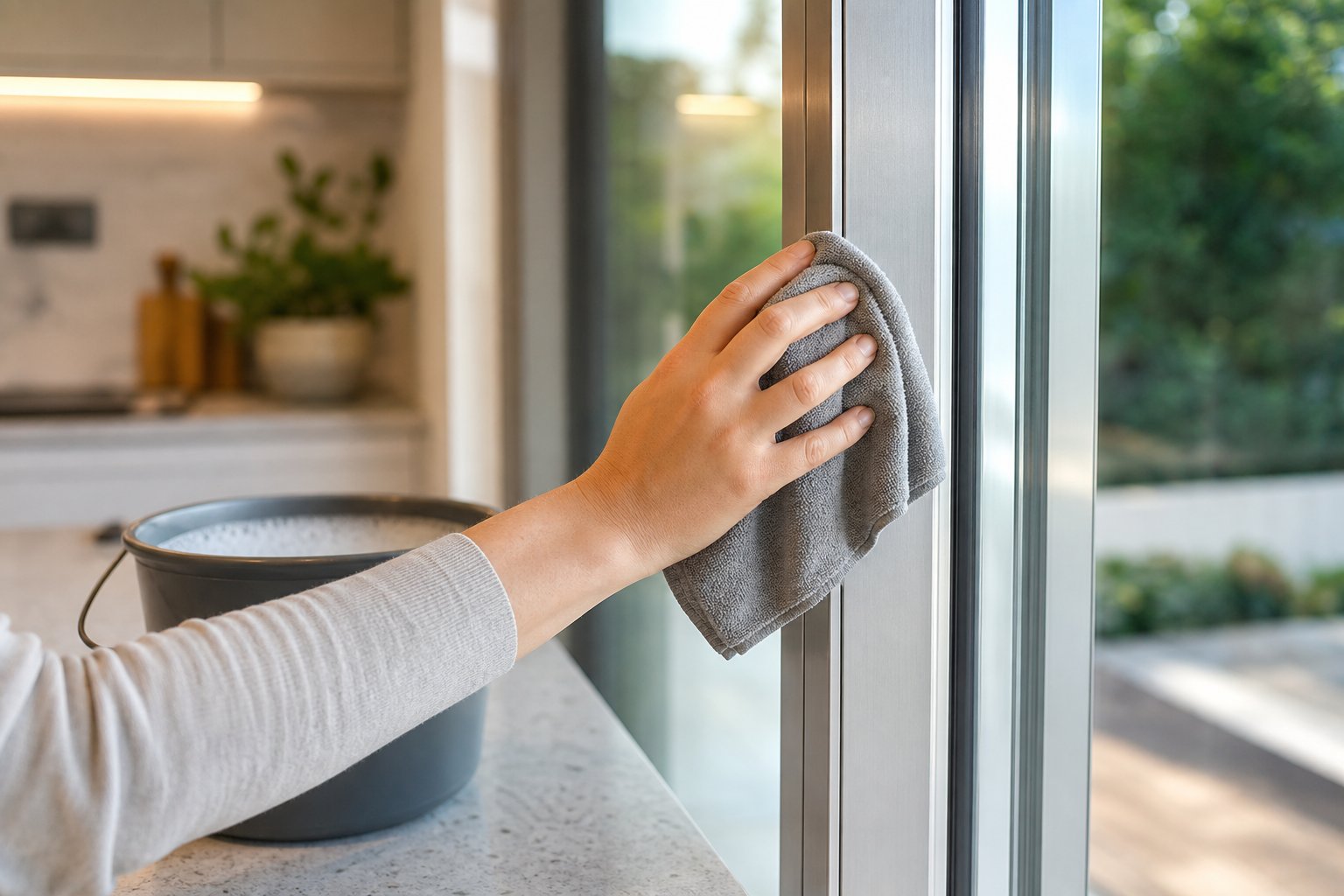
There is a reason professionals reach for soapy water before anything else when cleaning aluminium window frames. It carries zero risk of chemical damage across every finish type — powder-coated, anodised, brushed, or polished — and handles roughly 80% of the everyday grime that accumulates on residential frames. Dust, fingerprints, light salt residue, cooking film, pollen: a pH-neutral soap solution dissolves all of it without touching the protective coating underneath.
This is the safe way to clean window frames regardless of age, brand, or location. It is also the method that prevents bigger problems down the track. Salt deposits and acidic compounds from bird droppings or pollution begin etching aluminium surfaces within weeks if left undisturbed. A regular soapy wash removes these contaminants before they break through the finish and trigger oxidation or pitting. Research into salt spray exposure on finished aluminium confirms that even high-performance coatings require routine cleaning to maintain their protective barrier in corrosive environments.
The Step-by-Step Soapy Water Technique
Getting a streak-free result comes down to technique as much as product choice. Here is how to wash aluminium window frames properly, from setup through to final dry.
- Prepare two buckets. Fill one with lukewarm water and a few drops of pH-neutral dish soap — not laundry detergent, which often contains brightening agents and alkaline compounds that can dull finishes over time. Fill the second bucket with plain rinse water.
- Remove loose debris first. Use a soft-bristle brush or vacuum with a crevice tool to clear dust, cobwebs, and grit from tracks and corners. Skipping this step turns dry dirt into abrasive mud the moment water hits it.
- Work top to bottom. Dip a soft microfibre cloth into the soapy bucket, wring it until damp rather than dripping, and wipe from the top rail downward along each side, finishing with the bottom rail. Gravity pulls dirty runoff over surfaces you have not yet reached, loosening grime as it goes.
- Use straight, overlapping strokes. Avoid circular scrubbing motions on flat frame faces. Straight horizontal or vertical passes — slightly overlapping each stroke — produce an even finish without swirl marks or streaking.
- Rinse thoroughly. Use your second bucket and a clean cloth, or a gentle garden hose spray, to remove all soap residue. Leftover detergent attracts fresh dirt and can leave a hazy film once dry.
- Dry immediately with a clean microfibre cloth. This single step eliminates water spots, especially in hard water areas. Wipe in the same direction as your wash strokes for a uniform finish.
Timing matters too. Avoid cleaning in direct sun or on hot days — the solution evaporates before you can rinse it off, leaving sticky residue that is harder to remove than the original dirt. An overcast morning is ideal.
Protecting Seals and Weatherstrips While You Clean
Rubber gaskets and weatherstrips sit in grooves around the glass and along the frame edges. They are essential for thermal insulation, noise reduction, and keeping water out of your wall cavity. Dislodging or damaging them during cleaning creates problems far more expensive than a dirty frame.
When wiping near seals, reduce pressure and let the cloth glide over the rubber rather than pushing into crevices. A dedicated seal maintenance guide recommends cleaning gaskets with the same neutral soapy water you use on frames — simply wipe along the seal with a damp cloth, never pulling or twisting the rubber away from its channel. If you notice grit trapped where the seal meets the frame, a soft toothbrush dipped in soapy water loosens it without forcing the gasket out of position.
Avoid directing hose water at high angles into seal joints. Water pressure can push past the gasket lip, especially on older seals that have lost some elasticity. A gentle trickle from above during the rinse step is sufficient to flush soap away from these areas.
Finish-Specific Pressure and Pad Guidance
Not all aluminium finishes tolerate cleaning the same way. Understanding your frame’s coating lets you clean confidently without holding back too much or accidentally going too hard.
Powder-coated frames are the most common on Australian homes built in the last two decades. The baked-on polymer layer is relatively tough and tolerates moderate pressure with a microfibre cloth. You can work slightly more firmly on stubborn spots like insect residue or dried salt without concern — the coating will not scratch under soft fabric.
Anodised frames require a lighter touch. The anodised layer is harder than powder coat but also thinner, and it can show fine scratches more readily if hit with anything abrasive. Stick to soft microfibre only, with light even pressure. Never use scouring pads, magic erasers, or stiff-bristled brushes on anodised surfaces.
Brushed or polished aluminium shows every mark. Use your softest cloth, minimal pressure, and always wipe in the direction of the grain or polish lines — never across them.
Key warning: Abrasive materials — steel wool, scouring pads, cream cleansers, and even rough paper towels — cause permanent scratches on aluminium frame finishes. Once the protective layer is scored, moisture penetrates to the bare metal and corrosion begins. There is no way to undo this damage without professional recoating. Always default to the softest cloth available.
When you clean aluminium frames with soapy water on a consistent schedule, you eliminate the conditions that lead to tougher stains in the first place. Salt never gets the chance to sit long enough to etch. Organic matter never dries hard enough to require scrubbing. The method is simple precisely because regular use keeps problems from escalating — but when mineral deposits or discolouration do appear despite routine maintenance, a slightly different solution is needed.
White Vinegar Solution for Hard Water and Mineral Deposits
Hard water leaves its signature everywhere it touches — white crusty deposits, grey mineral film, and dull patches that soapy water alone will not budge. If your home draws bore water or sits in an area with heavy rainfall runoff, you have likely noticed these stains building along the bottom rails and drip edges of your aluminium frames. This is where vinegar earns its place as the second-ranked method: it dissolves calcium and magnesium deposits that soap cannot break apart, without requiring any specialty products.
So how do you clean aluminium window frames with mineral buildup? The answer is a simple acidic solution that targets the chemistry of the stain itself. Vinegar’s acetic acid reacts with alkaline mineral deposits, breaking them down into water-soluble compounds that wipe away cleanly. It is inexpensive, widely available, and effective on both powder-coated and well-maintained anodised surfaces when used correctly.
Mixing and Applying the Vinegar Solution Correctly
The correct dilution ratio is equal parts white vinegar and water — a 1:1 mix in a standard spray bottle. Use distilled water if possible, since tap water containing the same minerals you are trying to remove can redeposit them as the solution dries. Standard white vinegar at 5% acetic acid concentration is ideal. Cleaning vinegar (6–10% acidity) works faster but increases the risk of finish damage if left too long.
Follow this process for cleaning aluminium frames with vinegar:
- Pre-clean the frame. Wipe down with a damp cloth to remove loose dust and surface dirt. You want the vinegar working on mineral deposits, not wasting its acidity on organic grime sitting on top.
- Spray the solution evenly across the stained area, ensuring full coverage of mineral deposits. Focus on bottom rails, corners, and any spot where water pools or drips.
- Let it sit for 3 to 5 minutes. The dwell time is essential — vinegar needs contact time to dissolve mineral bonds. Do not let it dry on the surface; if conditions are hot or windy, work in smaller sections.
- Wipe with a soft microfibre cloth using gentle, straight strokes. The deposits should lift easily. For textured frame profiles, use a soft toothbrush to reach into grooves.
- Rinse thoroughly with clean water. This step is non-negotiable. Vinegar residue left on the frame continues reacting, and on anodised surfaces it can etch the finish over time.
- Dry with a clean cloth to prevent fresh water spots from forming immediately after your effort.
A useful side benefit: regular vinegar application on exterior frames in humid climates discourages mould growth. The mild acidity creates an inhospitable surface for mould spores to colonise, reducing the frequency of deeper cleaning sessions later.
When Vinegar Can Damage Your Frames
Vinegar is not universally safe on aluminium. Its acidity — the very property that dissolves mineral deposits — becomes a liability on certain surfaces. Industry guidance on anodised aluminium care confirms that acid-based materials cause chemical attack on aluminium finishes, and once damage is visible, it is irreversible.
Do not use vinegar in these situations:
- Bare or uncoated aluminium: Frames with no powder coat or anodised layer have no protective barrier. Acetic acid accelerates oxidation on exposed metal, turning a cosmetic issue into structural deterioration.
- Frames with visible corrosion pitting: If you can see small pockmarks or rough patches where the finish has already failed, vinegar will worsen the damage by attacking the exposed aluminium beneath.
- Damaged or flaking anodised surfaces: Where the anodised layer has worn through, vinegar penetrates to bare metal at those weak points.
- Extended dwell times in direct sun: Heat accelerates chemical reactions. Vinegar drying on a sun-heated frame concentrates its acidity and dramatically increases the risk of etching.
When in doubt, test in an inconspicuous spot — the inside edge of a bottom rail or behind a flyscreen — and check for any discolouration or dulling after rinsing.
Troubleshooting Stubborn Water Spots
Some mineral deposits resist the first application, particularly if they have been building for months. Before reaching for stronger chemicals, try these adjustments:
Increase the dwell time to 8–10 minutes, keeping the surface damp by respraying halfway through. For heavily scaled areas, soak a microfibre cloth in undiluted vinegar, lay it flat against the stain, and leave it in place for 5 minutes — this maintains full contact on vertical surfaces where spray would otherwise run off.
If the deposit still will not shift, the buildup may have bonded with the finish at a level vinegar cannot reach without risking damage. This is the point where you should move to a dedicated commercial aluminium cleaner rather than increasing vinegar concentration or scrubbing harder. Forcing the issue with abrasive pressure or stronger acids crosses from effective cleaning into finish damage territory.
Pros
- Inexpensive and available at any supermarket
- Effective at dissolving calcium, lime, and mineral scale
- Safe on powder-coated and intact anodised finishes when rinsed promptly
- Doubles as a mould deterrent on exterior frames in humid climates
- No harsh fumes — safe to use in enclosed spaces with basic ventilation
Cons
- Unsafe on bare, uncoated, or already-corroded aluminium
- Requires thorough rinsing — residue left behind can etch anodised surfaces
- Ineffective against oxidation, heavy mould, or organic staining
- Cannot be used in direct sun without risk of accelerated chemical reaction
- May need multiple applications for old, heavily mineralised deposits
Using vinegar to clean aluminium window frames handles the mineral staining that routine soap cannot touch — but it has a clear ceiling. When the problem shifts from inorganic mineral deposits to organic growth like black mould embedding itself in frame channels, a different chemistry is needed to break down the biological material without damaging the surface beneath it.
Baking Soda Paste for Mould and Stubborn Organic Stains
Mould is a different beast to mineral scale. Where hard water deposits are inorganic and respond to acid, mould is a living organism that feeds on moisture and organic matter — dust, dead skin cells, pollen — trapped in frame channels and gasket grooves. It roots into porous surfaces and crevices, which means you need a method that physically lifts the growth while creating a chemical environment hostile to regrowth. Baking soda paste does both.
Sodium bicarbonate is mildly alkaline (pH ~8.3), giving it enough chemical activity to disrupt mould cell structures without posing any risk to powder-coated or anodised aluminium finishes. Its fine crystalline texture provides gentle mechanical abrasion — enough to dislodge embedded mould from textured frame profiles, but far too soft to scratch protective coatings. This makes it the ideal method to remove mould from aluminium window frames safely, regardless of finish type.
Preparing the Baking Soda Paste
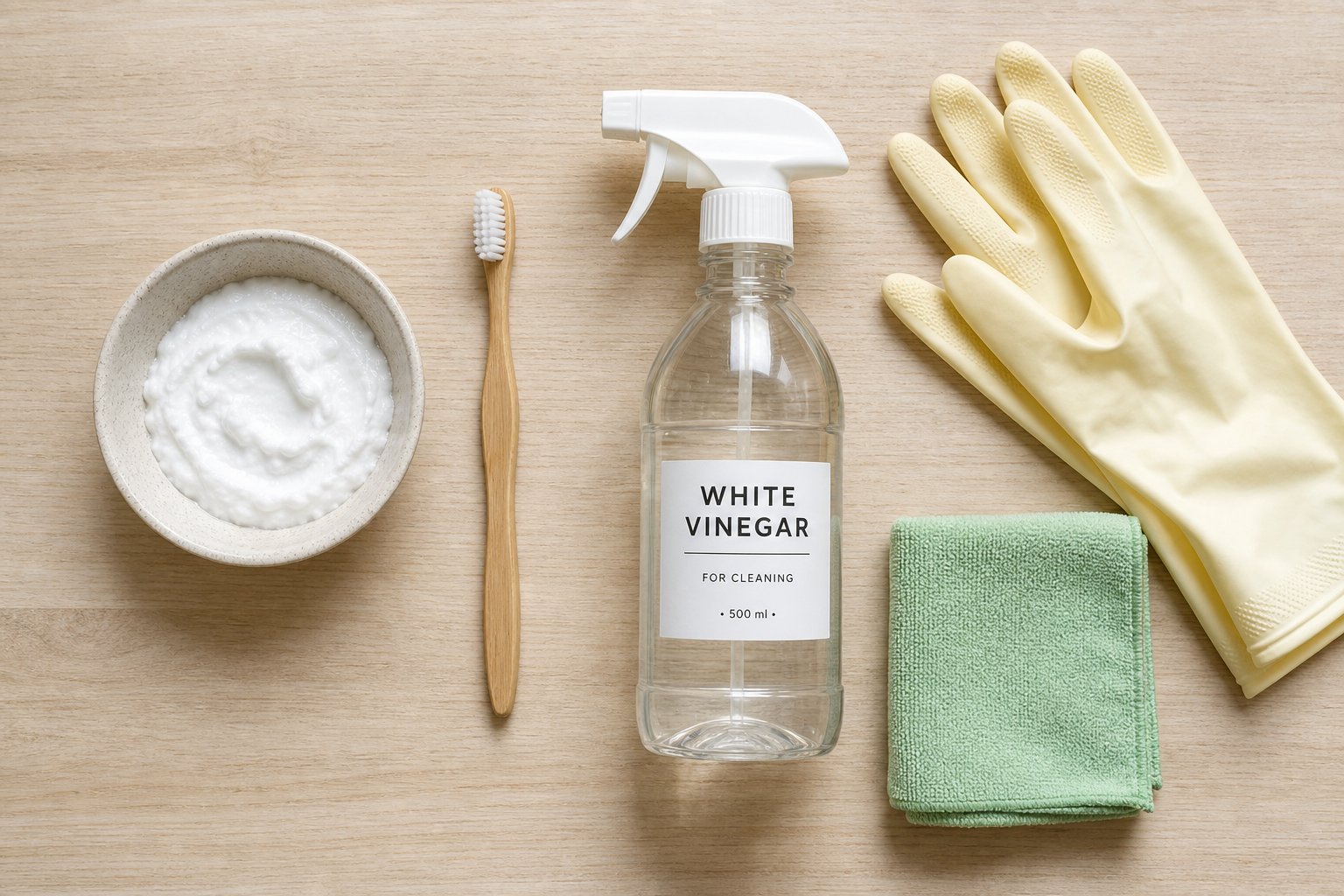
Mix three parts baking soda to one part water in a small bowl. Stir until you achieve a thick, spreadable consistency similar to toothpaste. If the paste feels too runny to cling to vertical frame surfaces, add more baking soda a teaspoon at a time until it holds shape. Prepare only what you need for the current session — the paste dries out and loses effectiveness within an hour.
For application, use a soft-bristle brush (an old toothbrush works perfectly for narrow channels, while a larger soft-bristle cleaning brush covers flat frame faces). Avoid stiff nylon or wire bristles. Spread the paste evenly across the mouldy area, working it into grooves and corners where mould tends to concentrate. The approach from here depends on how severe the growth is.
Three-Level Mould Severity Treatment Guide
Not all mould problems are equal. A faint grey film on a bathroom window frame calls for a different level of effort than entrenched black mould filling every drainage slot. Match your treatment intensity to what you are actually facing.
- Light surface mould (grey or green film, wipes partially with a damp cloth): Apply the baking soda paste directly, let it sit for 10 to 15 minutes, then scrub gently with your soft-bristle brush and wipe away with a damp microfibre cloth. Rinse the area with clean water and dry thoroughly. One application is usually sufficient. This level is common on interior bathroom and kitchen frames where condensation collects but ventilation is reasonable.
- Moderate black mould in frame channels and track grooves: Apply the baking soda paste as above, then lightly spray white vinegar over the paste. The two react to produce a foaming action that helps lift deeper mould from crevices. Let the fizzing subside — roughly 5 minutes — then scrub with your brush, paying attention to drainage channels and corners where spores concentrate. Rinse and dry. A second application may be needed if dark staining remains after the first pass.
- Heavy mould with root staining (dark patches that persist after scrubbing, typically on neglected exterior frames in humid climates): Apply a thick layer of paste, cover with plastic wrap to prevent it drying out, and allow 30 minutes of dwell time. Remove the wrap, spray vinegar to reactivate the cleaning action, scrub thoroughly, rinse, and dry. Repeat the full process a second time for any remaining discolouration. If staining persists after two full treatments, the mould may have penetrated beneath a damaged coating — a sign that professional assessment is warranted.
Protective gear matters during any mould cleaning session. Mould removal specialists recommend wearing rubber gloves and a face mask to avoid inhaling spores disturbed during scrubbing, and keeping the room well ventilated by opening adjacent windows. This is especially important for how to remove black mould from window frames where the growth has been established for some time and spore counts will be higher when disturbed.
Never use bleach on aluminium window frames. While bleach kills mould effectively on non-porous surfaces like tiles, it causes permanent discolouration on powder-coated finishes and can corrode bare aluminium. The chemical reaction between sodium hypochlorite and aluminium produces dark staining that cannot be reversed without professional recoating. Stick to baking soda and vinegar — they achieve mould removal without any risk to your frames.
Hardware Maintenance While You Clean
A mould-cleaning session gives you access to parts of the frame that are normally out of sight and out of mind. Take advantage of it. While you have the brushes and cloths out, address two adjacent maintenance tasks that directly affect frame longevity and window performance.
Clear the drainage channels. Aluminium window frames have small weep holes and drainage slots along the bottom rail that allow condensation and rainwater to escape outward. Mould, dirt, and debris frequently block these channels, trapping moisture inside the frame and accelerating corrosion. Use a thin bottle brush or a straightened paperclip wrapped in cloth to clear each drain slot. Flush with clean water to confirm flow.
Lubricate hinges and hardware. Spray a silicone-based lubricant onto hinge pins, locking mechanisms, and sliding hardware. Silicone spray repels moisture without attracting dust — petroleum-based lubricants do the opposite, creating a sticky film that collects grime and accelerates wear. A single application during each deep-clean session keeps hardware operating smoothly and reduces the chance of metal-on-metal corrosion at pivot points.
These two tasks take less than five minutes per window but prevent problems that cost significantly more to fix later: blocked drains lead to pooled water and seal failure, while seized hardware means forced operation that warps frame profiles over time.
Preventing Mould From Returning
Cleaning mould without addressing the moisture source guarantees it will grow back. The primary driver in Australian homes is inadequate ventilation combined with high humidity — particularly in bathrooms, laundries, and kitchens where steam production is regular.
Practical prevention steps that reduce mould recurrence on aluminium frames:
- Run exhaust fans during and after showers or cooking — leave them on for at least 15 minutes after you finish to clear residual moisture from the air.
- Open windows daily for cross-ventilation where security and weather allow. Even 20 to 30 minutes of airflow significantly reduces condensation buildup on frame surfaces.
- Keep indoor humidity below 60%. A hygrometer costs under $20 AUD and lets you monitor conditions. If readings consistently exceed 60%, a portable dehumidifier in problem rooms makes a measurable difference.
- Wipe condensation from frames as it appears during winter mornings rather than letting it pool in bottom rails and gasket channels.
- Maintain a regular dusting schedule on frame surfaces — mould spores need organic matter to colonise, and household dust provides exactly that.
Homes in tropical Queensland, coastal NSW, or anywhere with sustained high humidity may need to clean aluminium window frames with baking soda every 4 to 6 weeks during the wet season, even with good ventilation habits. The goal is to interrupt mould colonies before they establish deep enough to cause staining.
Baking soda handles the organic side of frame contamination effectively, but it has a clear limit. When you are no longer dealing with biological growth and instead facing the white, chalky degradation of the aluminium surface itself — oxidation — a fundamentally different product is required. That chalky residue is not sitting on top of the finish; it is the finish breaking down.
Commercial Aluminium Cleaner for Oxidation and Chalky Residue
Oxidation is not a surface stain. It is the aluminium itself reacting with oxygen and moisture, producing a white or grey powdery layer that no amount of soapy water, vinegar, or baking soda will dissolve. If your frames feel rough and chalky to the touch — or you can rub your finger across the surface and pick up a fine white powder — you are dealing with aluminium oxide, and you need a product specifically formulated to reverse it.
Commercial aluminium frame cleaners contain mild acids or micro-polishing compounds that break down accumulated oxide layers without attacking the sound metal beneath. They sit in a different category to household cleaners: engineered for a precise chemical interaction between the cleaning agent and aluminium oxide, rather than general-purpose degreasing or disinfecting. This is the method that answers the question of how to clean oxidised aluminium window frames that have gone beyond cosmetic dullness into genuine surface degradation.
Recognising Oxidation vs Normal Weathering
Before spending money on a commercial aluminium window frame cleaner, confirm that oxidation is actually your problem. Normal weathering looks like general dullness, faded colour, and accumulated grime — all of which respond to the gentler methods covered earlier. Oxidation presents differently.
Signs you are dealing with oxidation rather than dirt or mineral deposits:
- A white, grey, or chalky powdery residue that transfers to your finger when rubbed
- Rough or gritty texture on surfaces that were once smooth
- Small pockmarks or pitting visible under close inspection
- Dull, matte patches on frames that should have a sheen or satin finish
- The problem persists or worsens after thorough cleaning with soap and water
Oxidation progresses in stages. In its initial phase, it appears as a faint whitish film that many homeowners mistake for dried water spots. Left untreated, it develops into a more noticeable powdery or flaky texture and eventually leads to pitting that compromises the frame’s surface integrity. The earlier you intervene with the right product, the less aggressive the treatment needs to be.
Choosing a Product Safe for Your Finish Type
Not every commercial cleaner suits every frame. Products designed for bare mill-finish aluminium (common on boats and trailers) can be far too aggressive for the powder-coated or anodised frames on your home. Choosing the wrong formulation risks stripping colour, dulling the sheen, or etching the protective layer you are trying to restore.
When selecting a cleaner for aluminium window frames, evaluate these criteria:
- Non-abrasive formulation: The product should rely on chemical action rather than gritty particles to remove oxidation. Abrasive compounds scratch coatings and create fresh sites for corrosion to take hold.
- pH appropriate for your finish: Powder-coated frames tolerate mildly acidic cleaners (pH 3–5) in short contact applications. Anodised frames need a near-neutral product (pH 5–7) to avoid dissolving the oxide layer that forms the anodising itself. Check the label for finish compatibility statements.
- Safe near glass and rubber seals: Some industrial-grade aluminium brighteners contain hydrofluoric acid or strong alkalines that damage glass, rubber gaskets, and weatherstrips on contact. Residential-grade products should explicitly state they are safe for use around glazing and seals.
- Clear application and dwell-time instructions: Reputable products specify exactly how long to leave the cleaner on the surface. Vague instructions suggest the manufacturer has not tested the product properly across different conditions.
- Australian supplier availability: Look for products stocked at local hardware chains or specialist suppliers. Imported cleaners can be excellent, but availability for repeat purchases matters when maintenance is ongoing.
If your frames are powder-coated and less than 15 to 20 years old, mild oxidation often responds well to a dedicated powder-coat restoration product rather than a bare-aluminium brightener. These products contain fine polishing compounds that smooth the surface and restore gloss without cutting through the coating layer.
Application Technique for Oxidation Removal
Removing oxidation from aluminium frames is a methodical process. Rushing it — or applying product to the entire frame at once — leads to uneven results and risks over-exposure in areas that dry before you can buff them.
- Test in an inconspicuous area first. Choose the inside edge of a bottom rail or behind a flyscreen. Apply a small amount of product, follow the label’s dwell time, and check for any discolouration, dulling, or adverse reaction before proceeding with the full frame.
- Pre-clean the frame. Wash with warm soapy water and dry completely. You want the commercial cleaner reacting with oxidation — not wasting its chemistry on surface dirt and dust sitting on top.
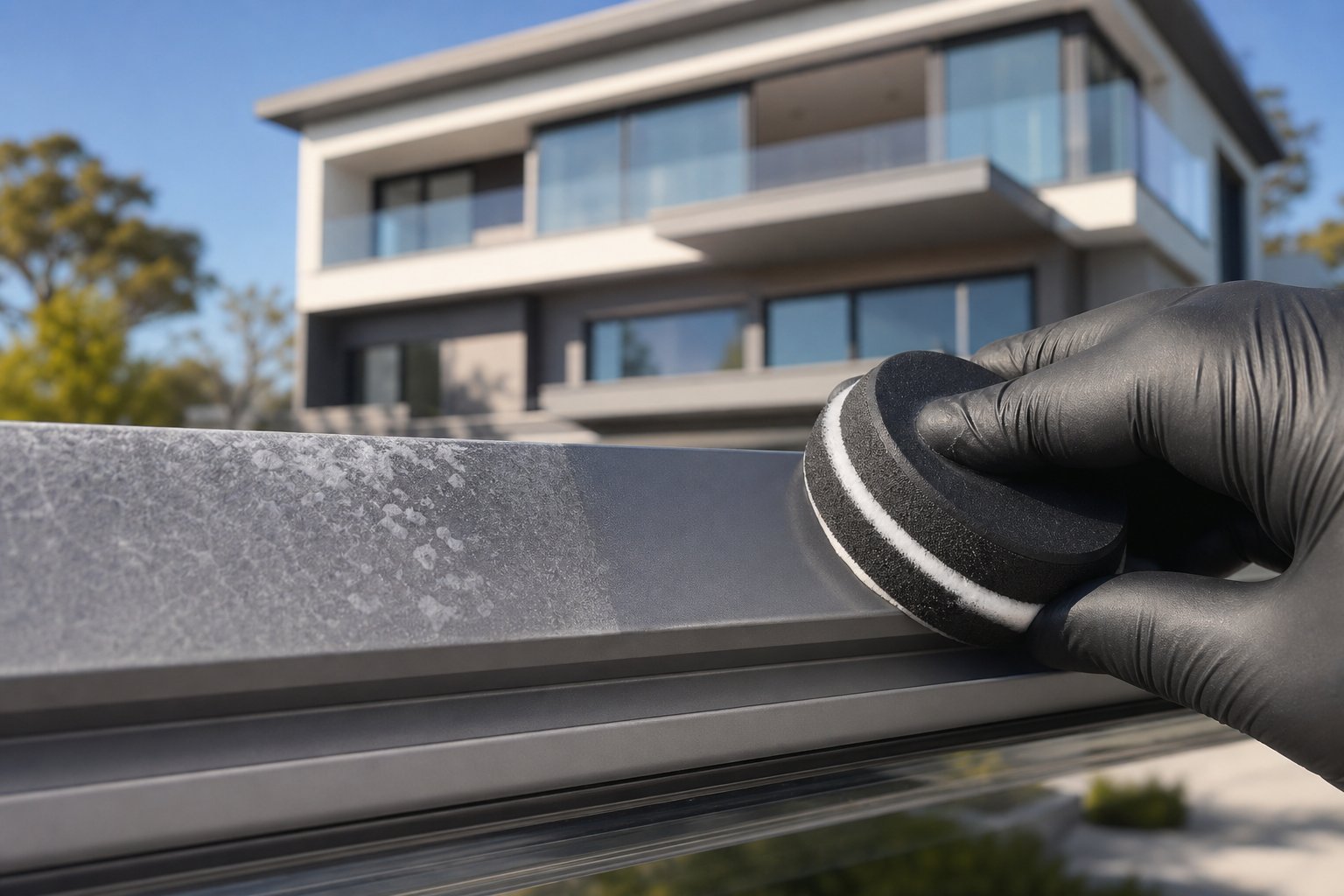
- Apply with a foam applicator or soft cloth. Work in sections no larger than 30 cm at a time. Spread the product evenly across the oxidised area using gentle, overlapping strokes. Foam applicator pads give the most even coverage and prevent the pooling that occurs with rags.
- Respect the dwell time. Most residential-grade products need 2 to 5 minutes of contact. Do not let the product dry on the surface — if conditions are warm, shorten your section size so you can buff before evaporation occurs.
- Buff with a clean, dry microfibre cloth. Use light circular motions to remove the dissolved oxidation and product residue. The cloth should pick up dark grey or black residue — that is the oxide layer lifting away. Flip to a fresh section of cloth frequently.
- Rinse the section with clean water and dry immediately. Inspect the result. A second application may be needed for heavily oxidised areas, but allow the surface to rest for 24 hours between treatments to avoid cumulative chemical stress on the finish.
For frames with pitting that persists after oxidation removal, the damage is structural rather than cosmetic. The product has done its job — it has removed the oxide — but it cannot fill material that has already been lost. At this point you are looking at either a professional refinishing service or frame replacement, depending on severity.
Worth noting: modern powder-coated aluminium frames from quality manufacturers resist oxidation far longer than the older uncoated or thin-film frames common on Australian homes built before the early 2000s. High-quality powder coating creates a substantial polymer barrier between the atmosphere and the aluminium substrate, dramatically reducing oxygen contact and moisture ingress. Homeowners considering frame replacement or upgrades can explore MEICHEN’s aluminium window range, which features durable powder-coated finishes engineered to resist oxidation and minimise long-term maintenance demands — particularly relevant for coastal and harsh-climate Australian homes where uncoated frames deteriorate within a decade.
The difference in maintenance burden between well-coated modern frames and older unprotected ones is substantial. Where an uncoated frame might need commercial oxidation treatment every 12 to 18 months in a coastal environment, a quality powder-coated system may go 10 to 15 years before showing any signs of surface breakdown — assuming routine soap-and-water cleaning keeps corrosive deposits from accumulating.
Commercial cleaners handle the oxidation problem effectively when the frame’s underlying structure is still sound. But there is a threshold where chalky residue and pitting cross from a maintenance issue into a structural one — where no product can restore what corrosion has already consumed, and the frame itself is compromised.
Professional Restoration for Severe Aluminium Window Corrosion and Damage
Every cleaning method covered so far assumes the frame beneath the grime is fundamentally intact. The coating may be dull, the surface may be oxidised, and the channels may be packed with mould — but the aluminium itself still holds its shape, maintains its seal integrity, and does its structural job. When that assumption no longer holds, you have crossed from a cleaning problem into a repair or replacement decision. Knowing exactly where that line sits saves you from wasting time and money on products that cannot fix what is actually broken.
Signs Your Frames Need Professional Help
Aluminium window corrosion progresses through stages that are easy to miss if you are not looking for them. Early oxidation — the chalky white residue covered in Method 4 — is cosmetic and reversible. But once corrosion penetrates the protective finish and begins consuming the base metal, the damage becomes structural and no household product can undo it.
Call a specialist if you notice any of the following:
- Deep pitting across frame surfaces: Small craters or rough patches where aluminium has been eaten away. Unlike surface oxidation, pitting means material is permanently lost. Running your fingernail across the frame catches on these depressions rather than gliding smoothly.
- Structural corrosion compromising seal integrity: If the frame profile has corroded at the points where rubber gaskets or weatherstrips seat, those seals can no longer form a reliable barrier. You may notice draughts, condensation between glass panes, or visible moisture ingress around the frame edges — all indicators that the frame is no longer performing its weatherproofing function.
- Flaking or peeling powder coat exposing bare metal: Powder coating fails in patches when the bond between polymer and aluminium breaks down, usually from prolonged moisture exposure beneath the coating. Once bare metal is exposed, corrosion accelerates dramatically. Scrubbing or applying cleaners to these areas strips more coating and worsens the problem.
- Warping or distortion of the frame profile: Aluminium frames that have become difficult to open or close smoothly may have warped due to sustained corrosion weakening the cross-section. A frame that no longer sits square in its opening cannot seal properly, regardless of how clean you keep it.
- Persistent water leaks around the frame perimeter: Water finding its way past seals — particularly after you have confirmed the drainage channels are clear — often points to frame degradation rather than a seal or installation issue.
Any single item on that list warrants professional assessment. Two or more appearing together almost always means the frame has reached the end of its serviceable life through cleaning alone.
Restoration vs Replacement Decision Guide
Professional aluminium window frame restoration typically involves chemical stripping of the old finish, treating any surface corrosion, and re-coating with fresh powder coat or re-anodising. The process restores both appearance and protection, but it only makes sense when the underlying aluminium is structurally sound. If pitting has compromised more than surface depth, or if the frame profile has lost material to the point where hardware mounting points or seal channels are weakened, no amount of recoating will bring back the original performance.
In Australia, professional aluminium frame repair and recoating typically costs between $350 and $800 AUD per window, depending on the frame size, extent of corrosion, and whether the window needs to be removed for workshop treatment. Full aluminium window replacement — including supply, installation, and disposal of the old frame — generally ranges from $900 to $2,500 AUD per opening for standard residential sizes, though custom or oversized configurations push costs higher.
Replacement starts making more financial sense than restoration in several scenarios:
- Restoration cost exceeds 50–60% of replacement cost. At that threshold, you are paying nearly as much for a restored old frame as you would for a brand-new system with modern thermal performance and a fresh warranty.
- The frames are single-glazed or lack thermal breaks. Older aluminium frames without thermally broken profiles conduct heat and cold directly through the metal. Replacing them with modern thermally broken, double-glazed units delivers measurable energy efficiency gains — reduced heating and cooling costs, improved NatHERS ratings, and better indoor comfort — that restoration of the old frame cannot provide.
- Multiple frames across the home need work. Restoring one or two frames is cost-effective. When the majority of your windows show corrosion damage, a whole-home replacement project achieves consistency in appearance, performance, and warranty coverage that piecemeal restoration cannot match.
- The home is in a cyclone, bushfire, or high-corrosion zone. Compliance with current NCC requirements and relevant Australian Standards (AS 2047 for windows, AS 1288 for glazing) may necessitate upgraded frames that meet ratings the old ones were never designed for. Restoration preserves the original specification; replacement upgrades it.
The decision is ultimately a cost-benefit calculation specific to your home. A heritage property with character aluminium joinery may justify restoration costs that would be hard to rationalise on a standard suburban build. Get at least two professional quotes — one for restoration and one for replacement — so you can compare with real numbers rather than assumptions.
Edge Cases That Require Specialist Tools
Beyond corrosion, a handful of common staining problems sit in a grey area: not caused by dirt, minerals, or oxidation, and risky to tackle with standard household methods.
Paint splatter from renovation work is one of the most frequent culprits. Dried acrylic or enamel paint on aluminium frames tempts homeowners to reach for razor blades or paint thinners — both of which damage finishes. Razor blades gouge powder coating instantly. Solvent-based thinners dissolve the binder in powder coat, causing it to soften, discolour, or peel. A professional window cleaner uses plastic scraping tools and finish-safe solvents applied in controlled amounts to lift paint without touching the coating beneath.
Mortar and render residue from construction presents a similar challenge. Cement-based mortar bonds aggressively to aluminium surfaces, and the alkaline chemistry of fresh mortar can etch anodised finishes if left for even a few days. Specialist mortar removal products exist, but their application requires careful masking of glass and seals, precise dwell-time control, and immediate neutralisation — tasks better suited to a tradesperson experienced with post-construction cleaning than a weekend DIY session.
Graffiti and adhesive residue round out the edge cases. Commercial graffiti removers vary wildly in formulation, and many contain solvents that attack powder coat. A professional applicator tests compatibility before committing to a full treatment, protecting your warranty and your finish in the process.
For any of these situations, the guiding principle remains the same one that runs through every method in this guide: if the treatment risks causing more damage than the stain itself, hand it off to someone with the right tools and experience. The cost of professional intervention is almost always less than the cost of refinishing or replacing a frame damaged by an aggressive DIY attempt.
Knowing when to escalate — and what each method can realistically achieve — puts you in a strong position to choose the right approach for any situation. What remains is seeing all five methods side by side, matched to specific scenarios, so you can make that choice at a glance.
Side-by-Side Comparison of All Five Methods
Five methods, five different problems they solve, and five different risk profiles. Scanning a detailed breakdown at a glance is faster than re-reading each section when you just need to know which approach matches your situation. The table below compares every method across the factors that matter most when deciding how do you clean aluminium window frames in a way that is both effective and safe.
Method Comparison by Stain Type and Finish
| Method | Target Problem | Finish Safety | Cost | Time per Window | Difficulty | Risk Level |
|---|---|---|---|---|---|---|
| Warm Soapy Water | Dust, fingerprints, light grime, salt film | Safe on all finishes | Under $5 AUD | 5–10 minutes | Beginner | None |
| Commercial Aluminium Cleaner | Oxidation, chalky residue, heavy weathering | Check label — varies by formulation | $15–$45 AUD | 15–25 minutes | Intermediate | Low–Medium (finish damage if misused) |
| White Vinegar Solution | Hard water stains, mineral deposits, light discolouration | Safe on powder coat and intact anodised; unsafe on bare aluminium | Under $5 AUD | 10–15 minutes | Beginner | Low (if rinsed promptly) |
| Baking Soda Paste | Mould, mildew, embedded organic grime | Safe on all finishes | Under $5 AUD | 15–30 minutes | Beginner–Intermediate | None–Low |
| Professional Restoration | Deep corrosion, pitting, structural damage, failed coatings | Handled by specialist — tailored to finish | $350–$800+ AUD per window | Professional timeframe | Not DIY | None (when done by qualified tradesperson) |
Soapy water and commercial cleaners sit at the top because they cover the widest range of situations between them. One is your weekly-to-monthly routine; the other is your annual or biannual rescue when surface degradation sets in. The three remaining methods fill the gaps between those two poles — mineral buildup, biological growth, and damage beyond any product’s reach.
Scenario-Based Quick-Pick Guide
Rather than working through the table every time, match your specific situation to the right method directly.
- Coastal home routine clean (every 3–4 weeks): Warm soapy water. Salt deposits are corrosive but dissolve easily when caught early. This frequency prevents buildup from reaching the stage where stronger methods become necessary.
- Removing construction dust from a new build: Warm soapy water with a thorough pre-rinse. Construction dust contains calcium silicate and cement particles that scratch if rubbed dry. Flood the surface first, then wash gently. For mortar splashes or paint overspray, engage a professional post-construction cleaner rather than scraping the finish yourself.
- Restoring neglected rental property frames: Start with soapy water to clear surface grime, then assess what remains. Mineral scale responds to vinegar. Mould in tracks and channels responds to baking soda paste. Chalky oxidation needs a commercial cleaner. Neglected frames typically need a combination — work through the methods in order from gentlest to most intensive rather than jumping straight to chemicals.
- Maintaining high-end architectural installations: Soapy water exclusively for routine care, keeping frequency high (monthly in exposed areas). These frames often feature premium anodised or specialty finishes where even mild acids carry unnecessary risk. If oxidation appears on an architectural finish, consult the manufacturer’s maintenance guide or the installer before applying any commercial product — some high-end coatings have specific product requirements that differ from standard powder coat.
The best product to clean aluminium window frames is always the least aggressive one that actually solves the problem in front of you. Escalate only when the gentler method has failed, not as a precaution.
Common Mistakes That Damage Aluminium Frames
Knowing what not to use on aluminium window frames is as important as knowing what works. These mistakes show up repeatedly, each one capable of causing damage that costs far more to repair than the cleaning session was worth.
- Steel wool or abrasive scouring pads: They remove grime, yes — along with your protective coating. Every scratch becomes a site where moisture contacts bare metal and corrosion begins. Industry guidance consistently lists abrasive materials as the single most common cause of preventable frame damage.
- Pressure washers aimed at seals and joints: High-pressure water forces past rubber gaskets and into the frame cavity, where it sits unseen and promotes internal corrosion. It can also dislodge weatherstrips entirely or force water into your wall cavity. If you use a pressure washer on surrounding surfaces, keep the nozzle well away from frame edges and seal lines.
- Ammonia-based glass cleaners dripping onto frames: Many popular glass sprays contain ammonia, which discolours and weakens protective coatings on aluminium. Spray your glass cleaner onto the cloth rather than directly onto the window, and wipe any drips off the frame immediately. Better still, use separate cloths for glass and frame cleaning.
- Mixing cleaning chemicals: Combining vinegar with bleach produces toxic chlorine gas. Mixing baking soda with commercial aluminium cleaners neutralises the active ingredients in both, wasting product and creating unpredictable residues. Use one method at a time, rinse thoroughly between sessions, and never combine products in the same application.
- Scrubbing anodised frames with cream cleansers: Cream-based household cleaners contain calcium carbonate or silica particles that act as fine abrasives — gentle enough for ceramic but too harsh for anodised aluminium. They dull the finish progressively with each use until the frame looks permanently hazy.
Each of these aluminium window cleaning mistakes to avoid shares a common thread: they trade short-term convenience for long-term damage. A few extra seconds choosing the right cloth or spraying onto fabric instead of glass eliminates risks that would otherwise require professional recoating to reverse.
With the full method comparison and common pitfalls mapped out, the final piece is putting it all together into a maintenance routine you can follow year-round — one that keeps your frames in the “soapy water is all I need” category for as long as possible.

Final Recommendation and Long-Term Maintenance Strategy
The Recommended Cleaning Routine for Most Homes
If you take one thing from this guide, let it be this: warm soapy water on a consistent schedule prevents roughly 90% of aluminium frame problems from ever developing. Salt never sits long enough to etch. Organic matter never dries hard enough to harbour mould. Mineral deposits never accumulate to the point where vinegar becomes necessary. The best way to keep aluminium window frames clean is not a single heroic deep-clean — it is a simple routine repeated often enough that grime never gains a foothold.
When targeted issues do appear, escalate one level at a time. Vinegar handles mineral scale. Baking soda paste handles mould. Commercial cleaners handle oxidation. Professional help handles structural damage. Match the method to the stain, match your pressure to the finish type, and protect your seals and weatherstrips at every stage. That sequence covers every realistic scenario an Australian homeowner will encounter.
The simplest aluminium window maintenance schedule is the most effective one: clean regularly with the gentlest method that works, escalate only when necessary, and never skip the rinse.
Building a Seasonal Maintenance Calendar
Long term care for aluminium window frames works best when tied to the seasons. Each quarter brings different challenges, and addressing them on schedule keeps your frames in the low-effort maintenance category year-round. Based on seasonal maintenance best practices for Australian conditions, here is a practical calendar to follow:
- Spring (September–November): Full wash of all frames with warm soapy water after winter condensation season. Inspect seals for moisture damage. Clear drainage weep holes of debris. Check hardware operation and lubricate hinges with silicone spray.
- Summer (December–February): Clean exterior frames to remove dust and pollen buildup. Check for UV-related finish degradation on north- and west-facing windows. Inspect rubber seals for heat brittleness — sun exposure dries out rubber, reducing its effectiveness over time.
- Autumn (March–May): Wash frames and remove organic debris (leaves, cobwebs, insect residue) from tracks and channels before the wet season. Apply baking soda paste to any emerging mould spots. This is your best window for preventive mould treatment before humidity rises.
- Winter (June–August): Wipe condensation from interior frames regularly, especially in bathrooms and kitchens. Inspect for early mould growth in frame channels. Check that weep holes remain clear so trapped moisture can drain. Test locks and latches — cold weather stiffens metal components.
Coastal homes should add a mid-season soapy water wash between each quarterly session to manage salt accumulation. Homes in tropical or high-humidity zones benefit from monthly mould inspections during the wet season.
Investing in Frames That Stay Cleaner Longer
The most effective long-term cleaning strategy starts before you ever pick up a cloth. Quality aluminium frames with robust powder-coated finishes resist oxidation, UV degradation, and corrosion at a level that older uncoated or thin-film frames simply cannot match. A well-engineered frame reduces how often you need to clean, how aggressively you need to clean, and how quickly surface problems escalate into structural ones.
Readers planning new builds or frame upgrades can explore MEICHEN’s aluminium window range for systems engineered with low-maintenance finishes and durable hardware — a practical way to reduce long-term cleaning effort while ensuring performance across Australian conditions, from coastal salt air to inland UV exposure.
Whether you are maintaining existing frames or choosing new ones, the principle stays the same: protect the finish, respect the material, and clean before problems compound. Your frames will repay that small investment of time with decades of reliable service.
Frequently Asked Questions About Cleaning Aluminium Window Frames
1. What is the safest cleaner for aluminium window frames?
Warm water with a few drops of pH-neutral dish soap is the safest option for every aluminium finish type, including powder-coated, anodised, brushed, and polished surfaces. It carries zero risk of chemical damage and effectively removes dust, fingerprints, light salt residue, and everyday grime. Avoid laundry detergents, as their alkaline compounds and brightening agents can dull protective coatings over time. Always use a soft microfibre cloth rather than abrasive pads, and dry the frame immediately after rinsing to prevent water spots.
2. Can you use vinegar on aluminium window frames?
White vinegar diluted 1:1 with water is effective for dissolving hard water stains and mineral deposits on powder-coated and intact anodised aluminium frames. However, vinegar should never be used on bare or uncoated aluminium, frames with visible corrosion pitting, or damaged anodised surfaces, as the acidity accelerates oxidation on exposed metal. Always rinse thoroughly within 3 to 5 minutes of application to prevent the acid from etching the finish, and avoid applying in direct sunlight where rapid evaporation concentrates the solution.
3. How do you remove oxidation from aluminium window frames?
Oxidation — the white, chalky powdery residue on older frames — requires a commercial aluminium cleaner containing mild acids or micro-polishing compounds. Household products like soap, vinegar, or baking soda cannot dissolve aluminium oxide. Apply the product with a foam applicator in small sections, respect the recommended dwell time, and buff with a clean microfibre cloth. Always test in an inconspicuous area first, and choose a formulation rated safe for your specific finish type. Modern powder-coated frames from quality manufacturers like MEICHEN resist oxidation significantly longer than older uncoated systems.
4. How often should you clean aluminium window frames?
Cleaning frequency depends on your environment. Coastal homes within 1 km of saltwater need cleaning every 3 to 4 weeks to prevent salt from etching the finish. Urban homes near busy roads benefit from cleaning every 6 to 8 weeks. Suburban properties with moderate exposure can stretch to every 8 to 10 weeks, while sheltered inland or rural homes typically manage with quarterly cleaning. Tropical or high-humidity zones require attention every 4 to 6 weeks to prevent mould establishment. Consistent routine cleaning with soapy water prevents the majority of problems from escalating.
5. What should you never use to clean aluminium window frames?
Avoid steel wool and abrasive scouring pads, which permanently scratch protective coatings and create corrosion entry points. Never use bleach on aluminium — it causes irreversible discolouration on powder-coated finishes and corrodes bare metal. Keep ammonia-based glass cleaners away from frames, as ammonia weakens protective coatings. Avoid pressure washers aimed at seals and joints, which force water past gaskets and into frame cavities. Do not use cream cleansers containing silica particles on anodised surfaces, and never mix different cleaning chemicals together in the same application.
More Window & Door Guides