What Actually Determines the Average Cost of Aluminium Windows
If you have searched for the average cost of aluminium windows in Australia, you have probably found vague ranges that raise more questions than they answer. A single casement window might be quoted at $600 by one supplier and $1,400 by another, and both quotes could be legitimate. The difference comes down to what is actually included and how many variables sit behind that final number.
This guide is not a static price list. It is a complete breakdown of every cost component in an aluminium window project, designed to help you budget with confidence and spot what your quote might be hiding.
Why Aluminium Window Pricing Varies So Much
Several forces push aluminium window prices up or down at any given time. Global aluminium commodity pricing plays a direct role, with raw aluminium sitting around $2,850 USD per tonne in 2025, a figure that flows through to local fabrication costs. Supply chain disruptions, shipping logistics into Australia, and fluctuating demand from the construction sector all layer on top. Then there is project complexity: a straightforward like-for-like replacement in a single-storey brick veneer home is a different proposition entirely from custom-sized openings in a multi-level coastal build requiring cyclone-rated frames and scaffolding access.
Understanding what affects the price of aluminium windows means looking beyond the window unit itself and considering the full scope of your project.
Key Cost Drivers at a Glance
Here are the main factors that shape your final bill, each of which this article explores in detail:
- Frame material and profile system — thermally broken vs standard, slim vs heavy-duty
- Glazing type — double glazed, Low-E coatings, argon gas fills
- Window size and configuration — standard openings vs custom dimensions
- Colour finish — standard powder coat vs custom RAL colours or dual-colour options
- Installation labour — fitting, sealing, trimming, and waste removal
- Ancillary costs — scaffolding, skip hire, internal and external making good, council approvals
Each of these elements can shift your per-window cost by hundreds of dollars. A homeowner asking how much do aluminium windows cost on average needs to understand all six categories to compare quotes fairly. The sections ahead unpack each one, starting with a detailed pricing table that maps window type against size — something no single resource currently offers in the Australian market.
Aluminium Window Prices by Type and Size
Pricing guides tend to give you one dimension at a time — either a list by window type or a range by size. That leaves you cross-referencing multiple sources to figure out what a medium sliding window actually costs compared to a small casement. The table below brings both variables together in one place, giving you a clearer picture of where your project sits on the cost spectrum.
Pricing by Window Type
Not all aluminium windows carry the same price tag, even at identical dimensions. A fixed aluminium window supply-only price starts lower because there is no operating hardware, no hinges, and no locking mechanism — just frame and glass. Operable styles cost more as complexity increases. Sliding windows add track systems and rollers. Casement and awning windows require friction stays and multi-point locks. Tilt and turn aluminium window prices sit higher again because the dual-action hardware is more sophisticated, typically European-engineered. Bi-fold configurations carry the steepest premium due to multiple panels, heavy-duty hinges, and precision-aligned tracking.
How Size Affects Your Per-Unit Cost
Larger windows demand more aluminium extrusion, bigger glazing units, and stronger hardware to handle the increased weight. The sliding aluminium window cost by size, for example, can more than triple when moving from a small bathroom unit to a wide living room opening. That said, the cost per square metre often decreases slightly with larger units because fabrication setup costs are spread across more material. A small casement might work out to a higher aluminium casement window price per square metre than a large one, even though the total dollar figure is lower.
Combined Type and Size Reference
The following table presents indicative supply-only pricing in AUD for standard aluminium windows across common residential sizes. These figures are based on Australian market data and represent double-glazed units with standard powder-coated frames.
| Window Type | Small (600 x 900mm) | Medium (1200 x 1500mm) | Large (2400 x 1200mm) |
|---|---|---|---|
| Fixed | $150 – $280 | $400 – $620 | $570 – $800 |
| Sliding | $200 – $320 | $430 – $580 | $650 – $880 |
| Casement / Awning | $220 – $380 | $450 – $680 | $680 – $950 |
| Tilt and Turn | $450 – $620 | $820 – $1,250 | $1,200 – $1,800 |
| Bi-fold (per panel) | $600 – $900 | $950 – $1,400 | $1,400 – $2,000+ |
Note: All figures are indicative market estimates representing supply-only pricing and exclude installation, scaffolding, and ancillary costs. Bi-fold aluminium window cost per panel varies significantly based on the number of panels in the configuration — a four-panel set typically offers better per-panel value than a two-panel unit. Actual quotes will differ based on glazing specification, profile system, colour finish, and whether units are standard or custom-manufactured to your opening dimensions.
These ranges give you a realistic starting point for budgeting, but they only tell half the story. The gap between supply cost and your final installed price is where most of the surprises hide — and that separation between materials and labour deserves its own breakdown.
Material Supply Costs vs Installation Labour Explained
A single dollar figure on a quote tells you almost nothing about where your money is going. The supply-only aluminium window prices in the table above represent just the product leaving the factory — frame, glass, and hardware. Your installed cost layers on labour, access requirements, finishing work, and a handful of line items that rarely appear in headline pricing. Separating these components is the only way to compare quotes on equal terms.
What Supply-Only Pricing Includes
When a supplier quotes you a supply-only price, that figure typically covers four things:
- Aluminium frame — the extruded profile, cut and assembled to your specified dimensions
- Glazing unit — double-glazed sealed unit (glass, spacer bar, gas fill if specified)
- Hardware — handles, locks, hinges, friction stays, or rollers depending on window type
- Seals and gaskets — weather seals, drainage slots, and compression gaskets
What it does not include: delivery to site, any structural modifications to your opening, removal of existing windows, or the labour to actually fit the unit into your wall. This distinction matters because the aluminium window installation cost per window can rival or exceed the product cost itself, particularly for complex access situations or older homes requiring structural remediation.
Installation Labour as a Separate Line Item
Aluminium window fitting labour rates in Australia generally range from $150 to $450 per window for straightforward replacements in accessible ground-floor locations. That base rate covers removal of the existing window, fitting the new unit, shimming and levelling, applying internal and external seals, and basic waste removal. Rates climb quickly when the installer encounters rotted timber reveals, damaged lintels, or non-standard openings that need building up or cutting back.
A licensed glazier or window installer should provide labour as a clearly separated line item. If your quote bundles everything into a single per-window figure, you have no way of knowing whether you are paying a premium on the product, the labour, or both.
Ancillary Costs Most People Forget
The hidden costs of aluminium window installation sit in the finishing and logistics — items that feel minor individually but compound across a full-house project. Here is the typical cost stack for a standard window replacement:
| Cost Component | Indicative Range (per window) | Notes |
|---|---|---|
| Window supply (product) | $200 – $2,000+ | Varies by type, size, and specification |
| Installation labour | $150 – $450 | Ground floor, standard opening |
| Scaffolding | $80 – $250 per window | Required for upper-storey access |
| Skip hire / waste removal | $30 – $80 per window | Old frames, glass, packaging |
| Internal making good | $60 – $150 per window | Plastering, patching reveals |
| External making good | $50 – $120 per window | Render repair, flashing, caulking |
| Decoration / painting | $40 – $100 per window | Internal reveals and external trim |
On a ten-window project, those ancillary items alone can add $3,000 to $7,000 beyond the product and labour costs. Scaffolding is the biggest variable — a single-storey brick veneer home may need none at all, while a double-storey weatherboard with rear-only access could require scaffolding on multiple elevations.
Always request an itemised quote that separates supply costs from installation labour and lists every ancillary charge individually. A single lump-sum figure makes it impossible to compare suppliers fairly or identify where you might reduce costs without compromising quality.
One final consideration that catches homeowners off guard: GST. In Australia, most quotes from registered businesses will include GST in the stated price, but always confirm. Unlike some overseas markets where reduced tax rates apply to energy-saving home improvements, Australian GST applies at the standard 10% rate regardless of whether your new windows improve thermal performance. The only common exception is if your project forms part of new construction where margin scheme or other GST treatments may apply — your builder or accountant can clarify this for your specific situation.
With supply, labour, and ancillary costs mapped out as separate budget lines, the next question is what drives the product cost itself higher — and that often comes down to a single engineering detail hidden inside the aluminium frame.
How Thermal Break Technology Impacts Your Price
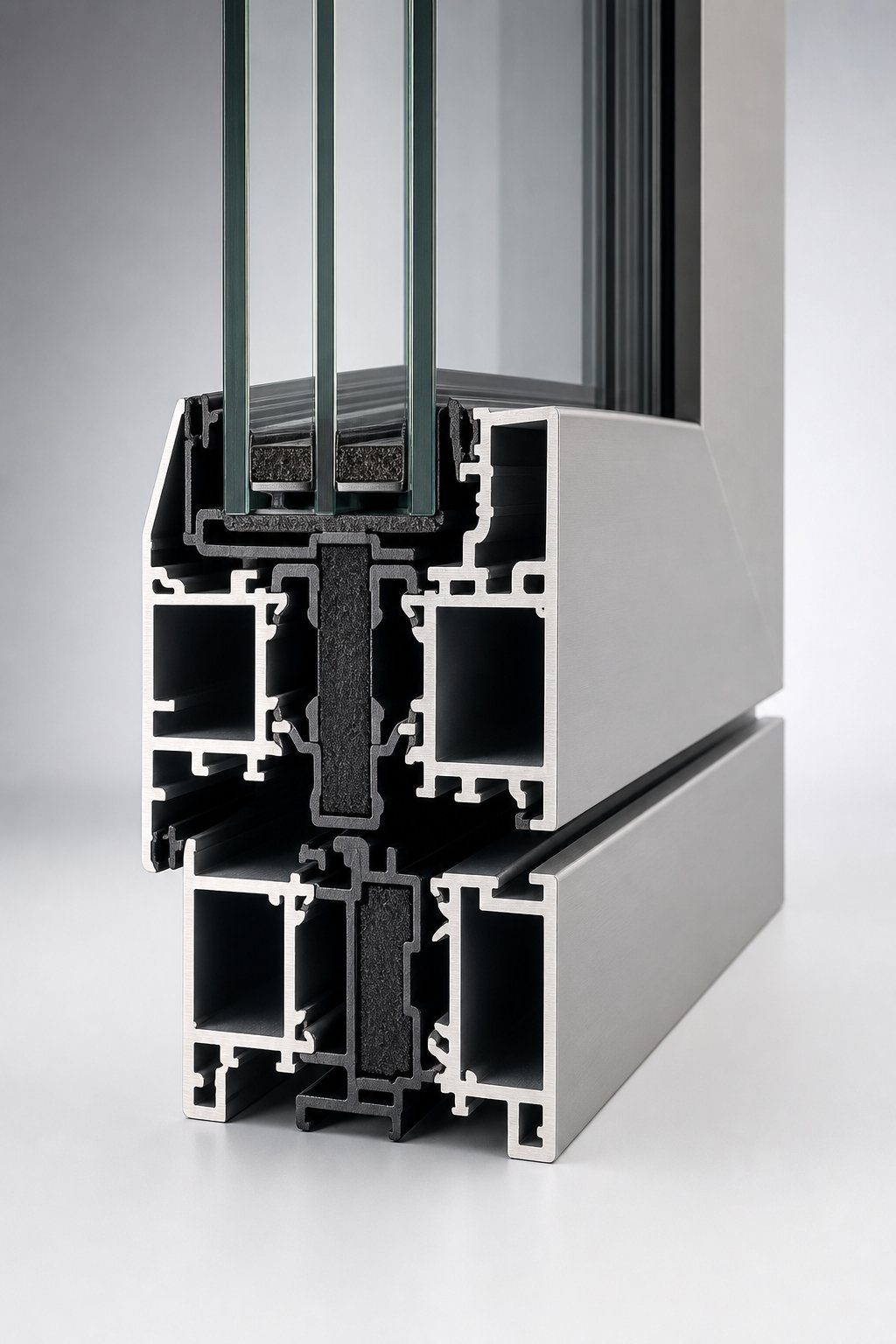
That engineering detail is a strip of polyamide — a rigid, low-conductivity polymer mechanically locked between the inner and outer sections of the aluminium frame. Without it, your frame acts as a thermal highway. Aluminium conducts heat at 160 to 200 W/m·K, meaning warmth escapes in winter and radiates inward in summer almost as fast as the metal can carry it. The polyamide barrier drops that figure to around 2–3 W/m·K, effectively severing the thermal connection between inside and outside.
What Thermal Break Technology Actually Does
Think of it as splitting one aluminium frame into two separate pieces joined by an insulator. The outer section faces the weather. The inner section stays close to room temperature. Because the polyamide bridge conducts so little energy, the internal surface of the frame no longer gets cold enough to trigger condensation on winter mornings — a persistent problem with non-thermally-broken profiles that leads to mould, timber rot in surrounding reveals, and ongoing maintenance costs.
The practical result is a frame that reduces heat transfer by 40 to 60 percent compared to a standard aluminium profile. Your heating and cooling systems work less, rooms feel more consistent in temperature, and cold spots near windows disappear.
Cost Premium for Thermally Broken Frames
So what is the thermally broken aluminium windows cost difference in real terms? Expect to pay roughly 15 to 25 percent more than an equivalent non-thermally-broken unit, with some complex profiles pushing the thermal break aluminium window price premium closer to 40 percent. On a medium casement window quoted at $500 supply-only, that translates to an additional $75 to $200 per unit — a meaningful line item across a full-house project, but one that typically pays for itself within 8 to 15 years through reduced energy bills.
Are thermally broken aluminium windows worth it? For most Australian installations, the question is increasingly academic. The National Construction Code sets minimum thermal performance requirements for external glazing assemblies, and achieving compliant Uw values without a thermal break is extremely difficult. In practice, thermally broken frames are no longer an optional upgrade — they are a regulatory baseline for new work and most replacement projects requiring council approval.
Double Glazing and Energy Performance Ratings
A thermally broken frame on its own does not guarantee strong energy performance. The glazing unit needs to pull its weight too. According to data from the Window Energy Rating Scheme (WERS), a standard aluminium frame with single glazing delivers a Uw value of 6.9 W/m²K — poor by any modern standard. Swap to double glazing with a basic air gap and that drops to 4.2. Pair a thermally broken frame with a double-glazed unit featuring Low-E coating and argon gas fill, and you can achieve Uw values of 1.5 or better, comfortably meeting NCC requirements across all Australian climate zones.
The double glazed aluminium window energy rating cost is essentially baked into the thermal break decision. Once you are specifying a thermally broken profile, the incremental cost of upgrading from a standard IGU to a high-performance Low-E argon unit is relatively modest — often $40 to $80 per window — yet the thermal improvement is substantial. Skipping this step creates what installers call the “glass mismatch trap”: you pay the frame premium but undermine it with underperforming glazing.
The thermal break and glazing specification together form the performance core of your window. But they are not the only specification choices that shift your price — the colour you choose for the frame exterior, and the profile thickness you need for your opening size, introduce their own cost layers.
Colour Finishes and Frame Profiles That Change the Price
Your frame’s thermal performance is locked in once you choose a thermally broken profile and glazing spec. The next set of decisions — colour and profile thickness — are where aesthetics meet engineering, and where powder coated aluminium window finish costs can quietly inflate your budget if you are not paying attention to the tier structure.
Standard vs Custom RAL Colours
Most Australian aluminium window manufacturers include a small selection of colours in their base pricing. These are high-volume finishes that run through the powder coating line regularly, keeping batch costs low. Step outside that palette and you enter custom territory, where the coating line needs to be purged, re-loaded with your specific powder, and run for a smaller batch — all of which adds cost per unit.
Here is how colour tiers typically break down and their relative impact on your per-window price:
- Standard colours (no surcharge) — Matt Black, Surfmist (off-white), Monument (dark grey), Woodland Grey. These align with popular Colorbond tones and are stocked by most fabricators.
- Extended range (+5–10%) — Additional Colorbond-matched shades like Basalt, Ironstone, or Pale Eucalypt. Available without a full custom run but produced less frequently.
- Custom RAL colours (+15–30%) — Any specific RAL code outside the standard range. The custom RAL colour aluminium window cost premium reflects minimum order quantities, dedicated coating runs, and longer lead times.
- Textured or specialty finishes (+20–40%) — Matt, satin, or timber-look finishes that require multi-stage application or specialist powders.
On a medium casement window priced at $550 supply-only in a standard colour, a custom RAL finish could add $80 to $165 per unit. Across a ten-window project, that is an extra $800 to $1,650 — a meaningful budget item that often surprises homeowners who assumed colour was a free choice.
Dual-Colour Options and Their Premium
A dual-colour configuration gives you one finish on the exterior (to match your facade) and a different colour on the interior (to complement your interior design). It looks seamless from both sides, but the manufacturing process is anything but simple. Each frame section must be masked and coated separately, effectively doubling the powder coating labour.
The dual colour aluminium window price premium typically sits between 20 and 35 percent above a single-colour equivalent. For a window that would cost $600 in a single standard finish, expect $720 to $810 in a dual-colour specification. The premium is worth considering if your home has a dark exterior cladding but light interior walls — a common scenario in contemporary Australian builds where charcoal or black exteriors pair with white or light grey interiors.
Slim vs Standard vs Heavy-Duty Frame Profiles
Frame profile selection is not purely cosmetic. It determines sightlines (how much frame you see versus glass), structural capacity, and ultimately what openings the window can span without additional support.
Slim profile aluminium window prices carry a premium because achieving structural integrity with less material requires more sophisticated engineering — tighter tolerances, higher-grade alloys, and precision thermal break integration. The payoff is minimal frame visibility and a more contemporary aesthetic, which is why architects frequently specify slim profiles for living areas and feature windows.
Standard profiles suit most residential openings up to around 1500mm wide and offer the best balance of cost, performance, and availability. Heavy-duty profiles become necessary for larger spans — wide sliding doors, stacker systems, or corner windows where the frame must resist significant wind loads without deflection. In cyclone-rated regions of northern Queensland and the NT, heavy-duty profiles may be mandatory regardless of opening size to meet AS 2047 wind pressure requirements.
How your window integrates with the surrounding wall also influences profile choice. A flush-mount installation into a rendered wall demands a different frame depth than a window sitting within a brick reveal. If your architect specifies a recessed or shadow-line detail, the profile may need custom adaptors or deeper frame sections, adding both material cost and fabrication complexity.
Colour and profile decisions feel like finishing touches, but they compound across a project in ways that shift the average cost of aluminium windows well beyond base-level estimates. The real question is whether that upfront premium delivers value over the life of the window — and that requires stepping back to look at total cost of ownership against the alternatives.
Total Cost of Ownership vs Cheaper Alternatives
Aluminium windows cost more upfront than uPVC. That much is obvious from any supplier’s price list. But the total cost of ownership aluminium windows deliver over their full service life tells a different story — one where the cheapest option at purchase often becomes the most expensive option over 25 years.
Expected Lifespan and Replacement Cycles
The aluminium window lifespan vs timber windows comparison, and the same comparison against uPVC, comes down to material durability under Australian conditions. UV exposure, coastal salt air, temperature cycling between summer and winter, and the occasional hailstorm all test frame materials differently.
Quality aluminium frames routinely last 40 to 50 years with minimal intervention. uPVC performs well for the first 15 to 20 years, but seals degrade, frames can yellow or become brittle under intense UV, and once a uPVC frame warps or cracks, repair is rarely viable — the entire unit needs replacing. Timber sits somewhere in between: well-maintained hardwood can last 30 to 60 years, but “well-maintained” is doing heavy lifting in that sentence. In the Australian climate, timber demands repainting or resealing every 5 to 7 years without exception.
Over a 50-year period — a reasonable planning horizon for a family home — you would likely need one set of aluminium windows, at least two sets of uPVC, and one set of timber with significant ongoing maintenance investment.
Maintenance Costs Over Time
Aluminium window maintenance costs over time are close to zero. An occasional wash with soapy water and a check of hardware and seals is all that is required. There is no painting, no staining, no sanding back peeling finishes. Powder-coated aluminium does not rot, warp, or degrade under UV in the way organic materials do.
Timber, by contrast, carries an ongoing maintenance obligation. Budget roughly $30 to $60 per window per year for periodic sanding, priming, and repainting — or accept that neglected timber will rot, particularly on weather-exposed elevations. Over 25 years, that maintenance spend alone can exceed the original cost of the window.
uPVC requires little active maintenance, which is part of its appeal. But its low maintenance profile masks a hard ceiling: once the material degrades (typically around the 20 to 25 year mark in Australian conditions), there is no maintenance action that can restore it. The frame is finished.
When Cheaper Alternatives Become a False Economy
The aluminium vs uPVC windows cost comparison long term flips the upfront narrative on its head. Here is how the numbers stack up across a 25-year ownership period for a standard 1200 x 1500mm casement window:
| Factor | Aluminium | uPVC | Timber |
|---|---|---|---|
| Initial cost (supply and install) | $800 – $1,400 | $450 – $800 | $1,200 – $2,500 |
| Expected lifespan | 40 – 50+ years | 20 – 25 years | 30 – 60 years (maintained) |
| Maintenance frequency | Minimal (wash only) | Minimal until failure | Every 5 – 7 years (repaint/seal) |
| Maintenance cost over 25 years | ~$50 | ~$50 | $750 – $1,500 |
| Replacement within 25 years? | No | Likely (1 replacement) | No (if maintained) |
| Estimated 25-year total cost | $850 – $1,450 | $900 – $1,600+ | $1,950 – $4,000 |
The pattern is clear. uPVC’s lower entry price evaporates once you factor in a likely replacement cycle within 25 years. Timber’s longevity is real, but the cumulative maintenance spend pushes its total cost well above aluminium. On a whole-life basis, aluminium is often the cheapest option of the three — a conclusion that surprises homeowners who fixate on the initial quote.
So are aluminium windows worth the extra cost? In most scenarios involving a permanent home where you plan to stay 10 years or more, yes. The combination of slim sightlines, superior strength-to-weight ratio, near-zero maintenance, and infinite recyclability makes the premium self-justifying over time. Aluminium frames do not yellow, do not warp, and do not need replacing within a typical mortgage period.
That said, aluminium is not always the right call. For a small laundry window in a rental property, a utility room in a temporary structure, or a budget-constrained project where every dollar matters today and the property will be sold within five years, uPVC delivers adequate performance at a lower immediate outlay. The false economy only kicks in when short-term savings are applied to long-term situations.
Lifecycle cost gives you the macro view of value. But your actual spend still depends heavily on where you are building and what your specific project demands — factors that vary dramatically across Australian states and even between suburbs.
Regional Variations and Project-Specific Price Factors
A homeowner in inner Sydney and a homeowner in regional Tasmania can specify the exact same aluminium window — same profile, same glazing, same colour — and receive quotes that differ by 20 to 40 percent. The product itself has not changed. Everything around it has: labour markets, access logistics, local demand, regulatory requirements, and the sheer cost of doing business in different parts of the country.
Regional Price Differences Across Markets
Aluminium window prices by region in Australia follow a predictable pattern tied to construction activity and trade availability. Capital cities — particularly Sydney and Melbourne — carry higher installation labour rates because demand for qualified glaziers and window installers outstrips supply. A straightforward ground-floor replacement that might cost $250 per window in labour in Adelaide could run $350 to $450 in Sydney’s inner west, where tradies factor in travel time, parking constraints, and the general cost of operating a business in a high-overhead market.
Regional and rural areas present a different cost dynamic. Product pricing may be comparable (or even slightly higher due to freight), but labour availability is the real variable. Fewer installers means less competition, longer wait times, and sometimes travel charges for crews coming from the nearest major centre. A project in a coastal town two hours from Brisbane might attract a $500 to $1,000 mobilisation fee on top of standard labour rates simply because the installer is travelling with a loaded vehicle and losing a day to logistics.
Northern Australia adds another layer. In cyclone-prone regions of Queensland, the Northern Territory, and parts of Western Australia, windows must meet higher wind pressure ratings under AS 2047. That means heavier-duty profiles, upgraded hardware, and sometimes thicker glazing — all of which push the base product cost up by 10 to 20 percent before installation even begins. Coastal locations compound this with the need for marine-grade powder coating or anodising to resist salt-air corrosion, adding further to the per-unit price.
Planning Permission and Conservation Area Costs
Most standard window replacements in Australia fall under exempt development — you can swap like-for-like without council approval, provided you are not changing the size of the opening or altering the external appearance of a heritage-listed property. Step outside those boundaries and the planning permission cost for new aluminium windows starts adding up fast.
A development application (DA) for window modifications typically costs between $300 and $1,500 in council fees alone, depending on your local government area. Processing times range from four to twelve weeks, which can delay your project and push installation into a less favourable season.
Heritage overlays and conservation areas introduce the most significant cost escalation. If your property sits within a heritage conservation area or is individually listed on a local or state heritage register, replacement windows may need to replicate the original design in profile, proportion, and sometimes material appearance. The heritage aluminium window cost in a conservation area reflects several compounding factors:
- Heritage-profile extrusions — custom aluminium profiles designed to mimic traditional timber proportions (deeper rails, narrower stiles, period-appropriate moulding details) cost significantly more than standard modern profiles
- Colour restrictions — councils may mandate specific heritage colours that fall outside standard ranges, triggering custom RAL surcharges
- Like-for-like configuration — if the original windows were double-hung, your replacements may need to be double-hung regardless of whether casement or awning would be cheaper or more practical
- Heritage consultant fees — some councils require a heritage impact statement prepared by a qualified consultant, adding $1,500 to $5,000 to your pre-construction costs
- Extended approval timelines — heritage applications often require referral to heritage advisory committees that meet monthly, stretching approval to three or four months
In practical terms, a heritage-compliant aluminium window can cost 40 to 80 percent more than a standard equivalent in the same size. A project that might budget $15,000 for ten standard windows could blow out to $22,000 to $27,000 once heritage requirements are factored in — before any additional council or consultant fees.
Project Complexity Factors
Beyond geography and regulation, the physical characteristics of your property and project scope introduce their own cost multipliers. Scaffolding costs for window replacement are the most common surprise. A single-storey home with clear access on all sides may need no scaffolding at all. A double-storey home with windows on the upper level will almost certainly require it, and the cost scales with height, duration, and the number of elevations involved.
Scaffolding hire for a standard two-storey residential elevation runs $1,200 to $3,500 depending on length and access difficulty. If your property has limited side access (common in inner-city terraces and narrow-lot subdivisions), scaffolding may need to be erected from the rear via crane, pushing costs higher still. Multi-storey apartments or townhouses with body corporate restrictions on access timing add coordination complexity that translates directly into labour hours.
Here are the project-specific factors that most commonly increase costs beyond the base window price:
- Upper-storey access — scaffolding, elevated work platforms, or rope access for high-rise installations
- Narrow or rear-only access — manual handling of materials through the property rather than direct delivery to the installation point
- Structural modifications — enlarging or reducing openings requires lintel installation, brickwork, or framing changes
- Asbestos-containing materials — older fibro or weatherboard homes may have asbestos in window reveals or cladding adjacent to openings, requiring licensed removal before installation can proceed
- Bushfire Attack Level (BAL) compliance — properties in BAL-rated zones need windows meeting AS 3959, which mandates specific glazing types, frame materials, and screening that add $150 to $500+ per opening
- Non-standard wall construction — double-brick, rammed earth, or solid masonry walls require different fixing methods and longer installation times than standard timber or steel framing
- Strata or body corporate approvals — units and townhouses may require committee approval, matching existing building aesthetics, and coordinating with other owners for shared scaffolding
- Wet area or high-exposure locations — bathrooms, pools, and ground-floor openings near paths may require safety glass upgrades under AS 1288 beyond what the base specification includes
Each of these factors can add anywhere from a few hundred to several thousand dollars per window. The cumulative effect on a complex project — say, a heritage-listed double-storey terrace in an inner-city conservation area with rear-only access and asbestos in the reveals — can push the total project cost to two or three times what a straightforward suburban replacement would run.
Understanding these variables is essential, but knowing what to look for in a quote is what actually protects your budget. The difference between a comprehensive quote and a vague one often determines whether these project-specific costs surface before you commit or after the work has started.
How to Evaluate and Compare Aluminium Window Quotes
You have three quotes sitting in your inbox. One is $12,000, another is $16,500, and the third is $21,000 — all for what appears to be the same ten-window project. The price gap feels enormous, but without knowing what each quote actually includes, you cannot tell which represents genuine value and which is hiding costs that will surface mid-project. Learning how to compare aluminium window quotes starts with understanding what belongs on the page in the first place.
What a Complete Quote Should Include
A reliable quote is not a single number on a page. It is a detailed specification document that lets you see exactly what you are buying, who is responsible for each element, and what the total commitment looks like. As industry guidance from Fenbro emphasises, quotes that seem similar at first glance often differ significantly once you examine the technical details and scope of works.
Here is what should an aluminium window quote include at minimum:
- Window specifications per unit — profile system name, frame depth, thermal break confirmation, and whether the frame is standard or heavy-duty
- Glazing specification — double or triple glazed, Low-E coating, gas fill type, Uw value for the complete window assembly
- Hardware details — handle type, locking mechanism, hinge or roller specification, and any security upgrades
- Colour and finish — exact colour name or RAL code, single or dual-colour, powder coat standard or premium
- Supply cost per unit — individual pricing for each window rather than a single bundled total
- Installation labour — clearly separated from supply, with scope of fitting works defined
- Ancillary works — scaffolding, waste removal, internal and external making good, listed as individual line items
- Guarantees and warranties — product warranty duration, installation warranty (separate from product), and what each covers
- Payment terms and timeline — deposit amount, progress payments, final payment trigger, and estimated project duration from order to completion
If a quote is missing three or more of these elements, you are not yet in a position to compare it against other offers. The bottom-line figure is meaningless without the detail behind it. Getting itemised quotes for aluminium windows is not about being difficult — it is about ensuring you can make a fair like-for-like comparison and avoid budget surprises once work begins.
Red Flags When Comparing Quotes
Some warning signs are subtle. Others are glaring once you know what to look for. Based on common patterns flagged by industry professionals and consistent with what Australian homeowners report, here are the aluminium window quote red flags to avoid:
- Vague product specifications — a quote that says “aluminium windows, double glazed” without naming the profile system, Uw value, or hardware standard is not a quote you can compare. It could describe a $400 window or a $1,200 window.
- No itemisation — a single lump-sum figure with no breakdown between supply, labour, and ancillary costs. This makes it impossible to identify where savings are being made or where corners are being cut.
- Pressure to sign immediately — “this price is only valid today” or “we cannot hold this quote past Friday” are high-pressure tactics. A reputable supplier will give you reasonable time to review and compare.
- No site survey conducted — any company quoting without physically measuring your openings and assessing access, wall construction, and existing conditions is guessing. Those guesses become variations and extras once the project starts.
- Unusually low pricing — if one quote comes in 30 percent or more below the others, something is missing. It could be inferior product specification, excluded ancillary works, or a price that will inflate through variations once you have committed.
- No mention of compliance — quotes for Australian installations should reference relevant standards (AS 2047 for performance, AS 1288 for safety glazing) and confirm NCC compliance. Silence on compliance is a concern.
- Unclear responsibility for installation — who is fitting the windows? Is it the supplier’s own team or a subcontracted installer? If subcontracted, who handles warranty claims for workmanship issues?
A quote that ticks multiple red flags is not necessarily a scam — it may simply be a supplier who produces incomplete documentation. But incomplete documentation leads to misunderstandings, and misunderstandings lead to cost blowouts. Treat missing detail as a risk factor, not just an inconvenience.
Understanding Quote Drivers and Specifications
The real power in comparing quotes comes from understanding what drives the numbers. When you know that custom sizing adds fabrication cost, that non-standard colours trigger batch surcharges, and that thermally broken profiles carry a structural premium, you can read a quote the way a builder reads it — identifying where specifications differ and what those differences mean in dollar terms.
Three quote drivers catch most homeowners off guard:
Custom sizing vs standard modules. If your openings do not align with a manufacturer’s standard size increments, every window becomes a custom fabrication. This is not unusual in Australian homes — particularly older properties where openings were built to imperial dimensions — but it adds 10 to 20 percent to supply costs compared to standard-module pricing.
System recommendations. Different profile systems suit different applications. A supplier recommending a commercial-grade system for a residential project may be over-specifying (and over-charging), while one quoting a lightweight residential system for large openings may be under-specifying (creating performance or compliance issues down the track). The system recommendation should match your opening sizes, wind zone, and performance requirements.
Material calculations and waste. Aluminium extrusion is sold in standard lengths. How efficiently your window dimensions nest within those lengths affects material waste, which flows through to your per-unit cost. A supplier with sophisticated material calculation processes can often reduce waste and pass that efficiency on as lower pricing.
Working with a supplier that offers full project support — from initial drawings and schedules through to system recommendations, material calculation, manufacturing coordination, and delivery planning — helps ensure your quote reflects accurate specifications rather than rough estimates. This end-to-end approach means the quote you receive is based on real engineering data, not ballpark assumptions that get corrected (at your expense) once production begins. MEICHEN’s services model is one example of this integrated approach, supporting builders, architects, and homeowners through every stage from project documentation to quality-controlled delivery.
The goal is not necessarily to choose the cheapest quote. It is to choose the most complete and accurate one — the quote where what you see on paper matches what you will actually pay at project completion. A detailed, well-specified quote from a capable supplier will almost always save you money compared to a vague, low-ball figure that grows through variations and extras once the work is underway.
Making the Right Choice for Your Budget and Project
A well-specified quote is your best protection against cost surprises. But before you request one, you need clarity on whether aluminium is the right material for your situation — and a structured approach to planning the project from first measurement to final installation.
When Aluminium Windows Are Worth the Investment
Choosing aluminium windows for your home budget makes sense when several conditions align. You are staying in the property long enough to benefit from the lifecycle savings — typically ten years or more. Your design calls for slim sightlines, large openings, or contemporary aesthetics that uPVC cannot deliver structurally. Your location demands durability: coastal salt air, intense UV, cyclone zones, or bushfire-rated areas where aluminium’s resilience is not a luxury but a necessity. And your project involves openings large enough that only aluminium’s strength-to-weight ratio can span them without bulky framing.
Where aluminium may not justify the premium: small utility windows in budget renovations, investment properties where resale is planned within five years, or temporary structures where longevity is irrelevant. In those cases, uPVC delivers adequate performance at a lower immediate outlay.
Planning Your Budget From Drawings to Delivery
Knowing how to budget for an aluminium window project means working through a sequence that captures every cost layer covered in this guide. Here are the aluminium window project planning steps that keep your budget realistic from day one:
- Assess your requirements — count every opening, note which are standard replacements and which involve structural changes, and identify access constraints, heritage overlays, or BAL ratings that will affect scope.
- Determine specifications — decide on window types, thermal break requirements, glazing performance targets, colour finish, and profile weight class based on your opening sizes and climate zone.
- Get multiple itemised quotes — request at least three quotes that separate supply, labour, and ancillary costs with full specifications per unit. Reject any quote that bundles everything into a single figure.
- Verify supplier capabilities — confirm the supplier can handle your project scope, from custom sizing and material calculations through to manufacturing coordination and quality control. A full service aluminium window supplier brings benefits that extend well beyond product delivery — they reduce the risk of specification errors, production delays, and costly mid-project variations.
- Confirm installation timeline — lock in lead times for fabrication, delivery scheduling, and installation sequencing. Factor in council approval timelines if a DA is required, and coordinate scaffolding hire with your installer’s availability.
The average cost of aluminium windows is never a single number. It is the sum of product specification, colour choices, thermal performance, installation complexity, regional labour rates, and project-specific factors that no generic price list can capture. Accurate budgeting requires understanding all of these layers — and working with partners who can quantify them precisely for your situation.
For builders, developers, architects, and homeowners planning larger or more complex projects, working with a supplier that supports the full journey — from drawings and schedules through system recommendations, manufacturing coordination, and delivery planning — streamlines budgeting and eliminates the gap between quoted price and final cost. If you are ready to move from research to project planning, MEICHEN’s end-to-end services offer that level of support from first contact through to quality-controlled delivery on site.
Frequently Asked Questions About Aluminium Window Costs
1. How much do aluminium windows cost on average in Australia?
Supply-only pricing for standard double-glazed aluminium windows in Australia ranges from $150 to $2,000+ per unit depending on type and size. A medium casement window (1200 x 1500mm) typically costs $450 to $680 supply-only, while installation adds $150 to $450 per window for ground-floor access. Total installed cost for a standard medium window generally falls between $800 and $1,400 including labour and basic ancillary works. Factors like thermally broken frames, custom RAL colours, upper-storey scaffolding, and heritage compliance can push costs significantly higher.
2. Are aluminium windows worth the extra cost compared to uPVC?
Over a 25-year ownership period, aluminium often proves cheaper than uPVC despite higher upfront pricing. Aluminium frames last 40 to 50 years with virtually no maintenance, while uPVC typically needs full replacement after 20 to 25 years due to UV degradation and seal failure in Australian conditions. When you factor in one likely uPVC replacement cycle, the estimated 25-year total cost for uPVC ($900 to $1,600+) can exceed aluminium ($850 to $1,450). Aluminium also delivers slimmer sightlines, superior structural strength for large openings, and full recyclability at end of life.
3. What is the difference between supply-only and installed aluminium window prices?
Supply-only pricing covers the aluminium frame, sealed glazing unit, hardware, and gaskets as delivered from the manufacturer. Installed pricing adds fitting labour ($150 to $450 per window), plus ancillary costs that most quotes understate: scaffolding ($80 to $250 per window for upper storeys), waste removal ($30 to $80), internal making good ($60 to $150), external making good ($50 to $120), and decoration ($40 to $100). On a ten-window project, these ancillary items alone can add $3,000 to $7,000 beyond product and labour costs. Always request itemised quotes separating each component so you can compare suppliers on equal terms.
4. Do thermally broken aluminium windows cost more and are they mandatory?
Thermally broken frames carry a 15 to 25 percent premium over non-thermally-broken equivalents, translating to roughly $75 to $200 extra per medium-sized window. However, the National Construction Code sets minimum thermal performance requirements for external glazing that are extremely difficult to meet without a thermal break. For new installations and most replacement projects requiring council approval in Australia, thermally broken frames are effectively a regulatory baseline rather than an optional upgrade. The energy savings typically recoup the premium within 8 to 15 years through reduced heating and cooling costs.
5. What should I look for when comparing aluminium window quotes?
A complete quote should itemise window specifications (profile system, thermal break, Uw value), glazing details, hardware, colour finish, supply cost per unit, installation labour, ancillary works, warranties, and payment terms. Red flags include vague specifications like ‘aluminium, double glazed’ without technical detail, no itemisation between supply and labour, pressure to sign immediately, no site survey, and pricing more than 30 percent below competing quotes. Working with a full-service supplier that supports the process from drawings through to manufacturing coordination and delivery planning helps ensure quotes reflect accurate engineering data rather than rough estimates that inflate through variations once work begins.
More Window & Door Guides