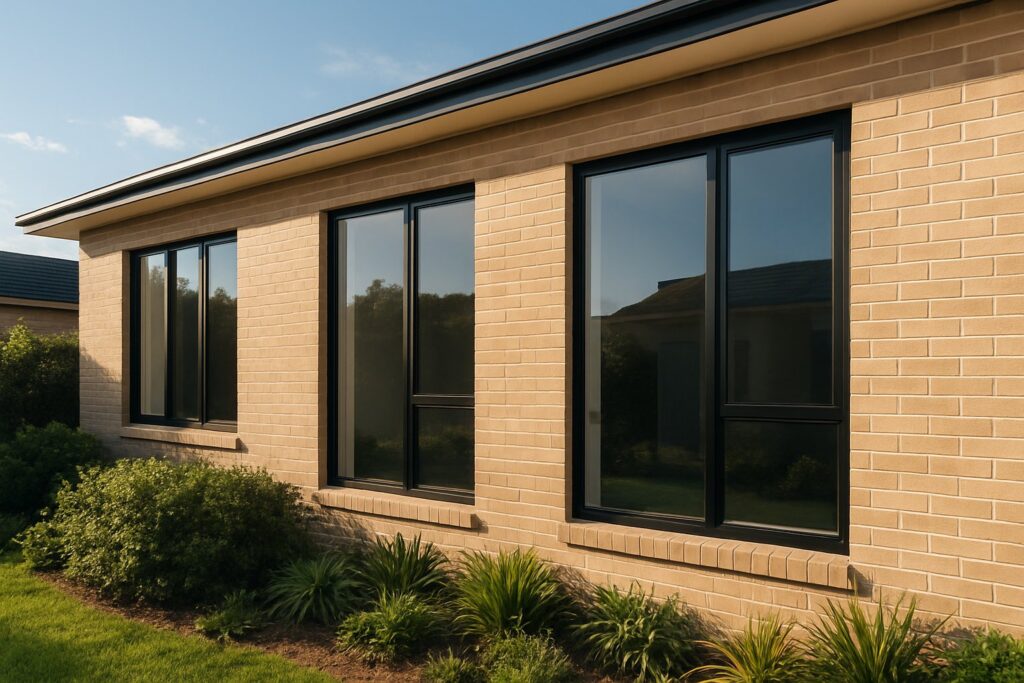
Why Victoria Homeowners Are Choosing Aluminium Windows
Aluminium windows use extruded aluminium alloy profiles — typically from the 6000 series — as the structural frame that holds glazing in place. They dominate both residential renovations and commercial builds across Victoria, yet no single resource exists to help local homeowners evaluate them through a climate-first lens. This guide fills that gap. It is not a product catalogue. It is a practical, independent look at why windows in aluminium suit Victorian conditions and how to make a confident material decision.
What Makes Aluminium a Leading Window Frame Material
Aluminium earns its place at the top of specification lists through a handful of standout properties. Its strength-to-weight ratio allows fabricators to produce slim yet structurally sound profiles capable of spanning large openings without bulky reinforcement. The metal forms a natural oxide layer that resists corrosion — a critical advantage in a state where coastal suburbs, wet winters, and variable humidity are part of daily life.
Beyond durability, aluminium is fully recyclable without loss of quality. Many Australian manufacturers now incorporate recycled content into their extrusions, making it a responsible long-term choice. Design flexibility rounds out the picture: the material can be extruded into virtually any profile shape, powder-coated in hundreds of colours, and engineered to accept modern thermal break and double-glazing systems. For builders and architects working across Victoria’s diverse housing stock, that versatility simplifies specification across windows AU-wide.
Who This Guide Is For
Whether you are a homeowner planning a renovation, a builder comparing frame options for a new estate, or an architect balancing aesthetics with performance, this guide speaks directly to your decision.
Aluminium is the most specified commercial framing material in Australia, and its share of the residential market continues to grow as thermal break technology closes the insulation gap with other frame types.
Over the sections ahead, we cover Victoria’s climate interactions, honest material comparisons, thermal performance advances, style options, maintenance realities, and supplier evaluation — everything you need to move from research to a well-informed choice. The conversation starts where every good building decision should: with climate.
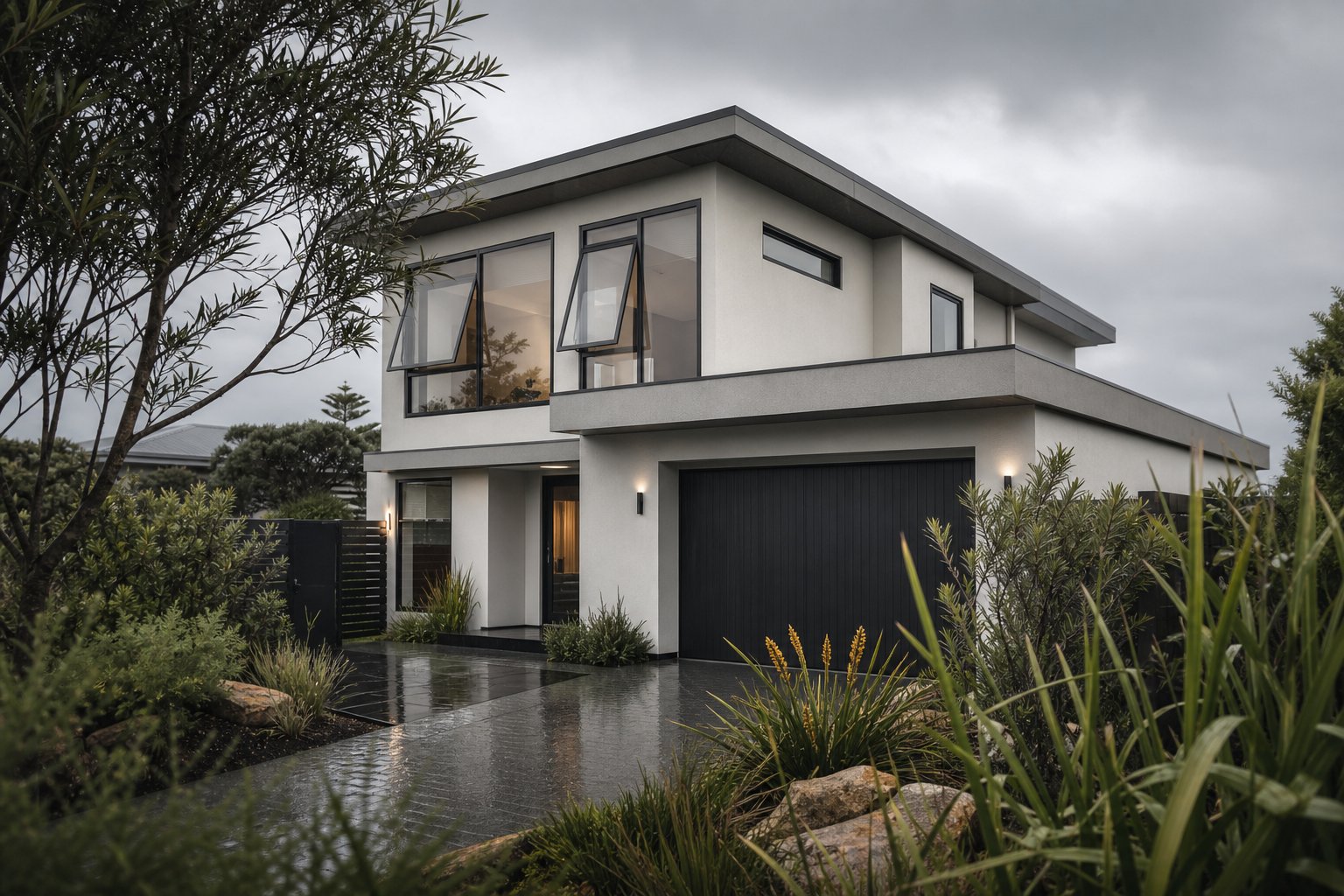
How Victoria’s Climate Shapes Your Window Frame Decision
Victoria’s weather rarely sits still. A single week in Melbourne can deliver morning frost, afternoon sun, and an evening downpour — sometimes all on the same day. Move south-east to the Mornington Peninsula or down to the Bellarine Coast, and salt-laden winds become a constant companion. Head inland toward Ballarat or the Macedon Ranges, and winter bites harder while summer stays dry. This variability is exactly why choosing an Australian window frame based on climate matters more than choosing one based on looks alone.
Victoria falls primarily within NCC Climate Zone 6, classified as temperate. Cool winters, mild-to-warm summers, moderate annual rainfall, and relatively high humidity in coastal pockets define the conditions your window frames must handle year after year. Understanding how those conditions interact with frame materials separates a window that lasts decades from one that quietly deteriorates behind the curtain.
How Victoria’s Coastal and Wet Conditions Affect Window Frames
Salt spray is one of the most aggressive forces acting on building materials in bayside suburbs like Brighton, Frankston, and the surf coast stretching from Torquay to Lorne. Airborne salt particles settle on frames, and if the material is porous or inadequately protected, corrosion follows. Timber frames in these areas absorb moisture from humid air and driving rain, leading to swelling, paint failure, and eventually rot — a cycle that demands repainting every one to two years and sometimes full replacement within 20 years.
Aluminium behaves differently. The metal does not absorb moisture at all. It will not swell after weeks of wet weather, and it will not shrink when dry inland winds blow through in summer. When properly powder-coated — a baked-on finish that bonds to the aluminium surface — the frame gains an additional barrier against salt and pollution deposits. This combination of inherent corrosion resistance and protective coating is why aluminium remains a preferred choice in coastal areas across window Australia markets, from Port Phillip Bay through to regional seaside towns.
Victoria’s wet winters compound the advantage. Rainfall in Melbourne averages around 650 mm annually, and much of it arrives during the cooler months when drying times are longer. Frames that trap or absorb water become breeding grounds for mould and decay. Aluminium drains cleanly, dries fast, and remains dimensionally stable regardless of how long the rain persists.
Thermal Performance in Victoria’s Temperate Climate
There is one honest caveat. Aluminium is a conductor — it transfers heat and cold more readily than timber or uPVC. In alpine regions or tropical extremes, this characteristic demands serious engineering attention. Victoria’s temperate range, however, works in aluminium’s favour. Winter overnight lows around Melbourne typically sit between 5°C and 9°C, while summer peaks hover near 25°C to 30°C on most days. The temperature differential across the frame is moderate compared to what au windows face in Canberra’s sub-zero mornings or Darwin’s relentless tropical heat.
This does not mean thermal performance can be ignored — modern solutions like thermally broken profiles and double glazing address it comprehensively, and a later section explores those technologies in detail. The point here is that Victoria’s climate does not punish aluminium the way harsher zones can, making it a practical baseline choice that engineering can then elevate into a genuinely high-performance system.
Taken together, Victoria’s climate profile produces a set of conditions that align well with aluminium’s material strengths:
- Humidity resistance — no moisture absorption, no swelling, no rot even in prolonged wet periods
- UV stability — powder-coated finishes resist fading and chalking under Victoria’s moderate-to-high UV levels
- Dimensional stability — frames hold their shape across seasonal temperature swings without warping or cracking
- Low maintenance in wet conditions — no repainting, no sealing, and minimal intervention beyond periodic cleaning
These factors do not make aluminium the only viable option — but they do explain why it consistently outperforms timber on lifecycle cost and effort in Victoria’s conditions. The real question is how it stacks up against every alternative, which requires a closer material-by-material comparison.
Aluminium vs Other Frame Materials for Victoria Builds
Every frame material brings trade-offs. The challenge for Victoria homeowners is weighing those trade-offs against local conditions — not generic marketing claims. Timber, uPVC, and composite frames each have legitimate strengths, but their weaknesses become sharper when tested against Victoria’s wet winters, coastal salt exposure, and the practical realities of long-term ownership. Here is how they compare when you put climate and lifecycle front and centre.
Aluminium vs Timber Frames in Victorian Homes
Timber has undeniable warmth. It insulates naturally, looks beautiful in heritage contexts, and carries the kind of tactile character that aluminium simply cannot replicate at a molecular level. For period homes in suburbs like Hawthorn, Carlton, or Ballarat, timber frames feel architecturally appropriate.
The cost of that character, though, is ongoing maintenance. In Victoria’s climate, timber frames need repainting or staining every three to seven years to prevent moisture penetration. Skip a cycle, and you risk swelling, cracking, or rot — particularly on south-facing elevations that stay damp longer through winter. Termite monitoring adds another layer of vigilance. Over a 30-year lifecycle, the cumulative cost of timber maintenance often exceeds the frame’s original purchase price, making it the more expensive option despite aluminium’s lower upfront cost.
One development worth noting: modern woodgrain powder coating now allows al windows to closely replicate the visual warmth of timber without inheriting any of its maintenance demands. For renovators who want a heritage-sympathetic look with contemporary durability, this finish bridges the aesthetic gap convincingly.
Aluminium vs uPVC and Composite Alternatives
uPVC earns attention for its thermal insulation properties. The multi-chambered plastic profiles naturally resist heat transfer, giving uPVC an edge in raw U-value comparisons against standard aluminium. For budget-conscious projects where insulation is the primary concern, it has a role.
Its limitations, however, become apparent in other areas. uPVC profiles are structurally weaker than aluminium, requiring wider frames to achieve the same rigidity — which means bulkier sightlines and less glass area. Large openings that demand structural spans beyond 1.5 to 2 metres typically need internal steel reinforcement, adding cost and complexity. Colour options remain more restricted than powder-coated aluminium, and lighter shades can yellow or discolour under prolonged UV exposure — a genuine concern given Victoria’s moderate-to-high UV index through spring and summer.
Composite frames attempt to solve these trade-offs by blending materials — often combining a timber or foam core with an aluminium exterior shell. The result can deliver strong thermal performance alongside weather resistance. The catch is cost: composite systems sit at the premium end of the market and are less widely available from Australian fabricators, which can limit supply options and extend lead times for Victoria projects.
When choosing an aluminium glazed window system, aluminum double glazed windows, or any alternative, the decision becomes clearer when you compare specific performance criteria side by side:
| Criteria | Aluminium | Timber | uPVC | Composite |
|---|---|---|---|---|
| Durability | 30-50+ years, minimal degradation | 20-40 years with consistent maintenance | 20-30 years, may weaken over time | 30-40+ years |
| Maintenance | Very low — periodic cleaning only | High — repainting, sealing, termite checks | Low — occasional cleaning | Low to moderate |
| Design flexibility | Excellent — any profile shape, slim or bold | Good — traditional shapes and detailing | Moderate — limited by material stiffness | Good — depends on system |
| Sightline width | Slim (as narrow as 45 mm) | Moderate (typically 55-70 mm) | Wide (65-80 mm+) | Moderate (55-65 mm) |
| Maximum span size | Large — high strength enables expansive openings | Moderate — limited by material weight | Small to moderate — needs reinforcement for large spans | Moderate to large |
| Colour options | Virtually unlimited via powder coating | Any paint or stain colour (requires recoating) | Limited palette, may discolour | Good range, system-dependent |
| Recyclability | 100% recyclable without quality loss | Renewable but not easily recycled | Recyclable but less commonly processed | Difficult — mixed materials |
| Victoria climate suitability | Excellent — resists moisture, salt, UV | Moderate — vulnerable to wet conditions without maintenance | Good for insulation, weaker structurally | Very good — but limited local supply |
Aluminium clearly leads on durability, design freedom, and low lifecycle effort. Its one notable trade-off — thermal conductivity — is the reason thermally broken profiles and double-glazed units exist. That engineering solution has matured to the point where it fundamentally changes the equation, turning aluminium’s single weakness into a solved problem rather than a lasting compromise.
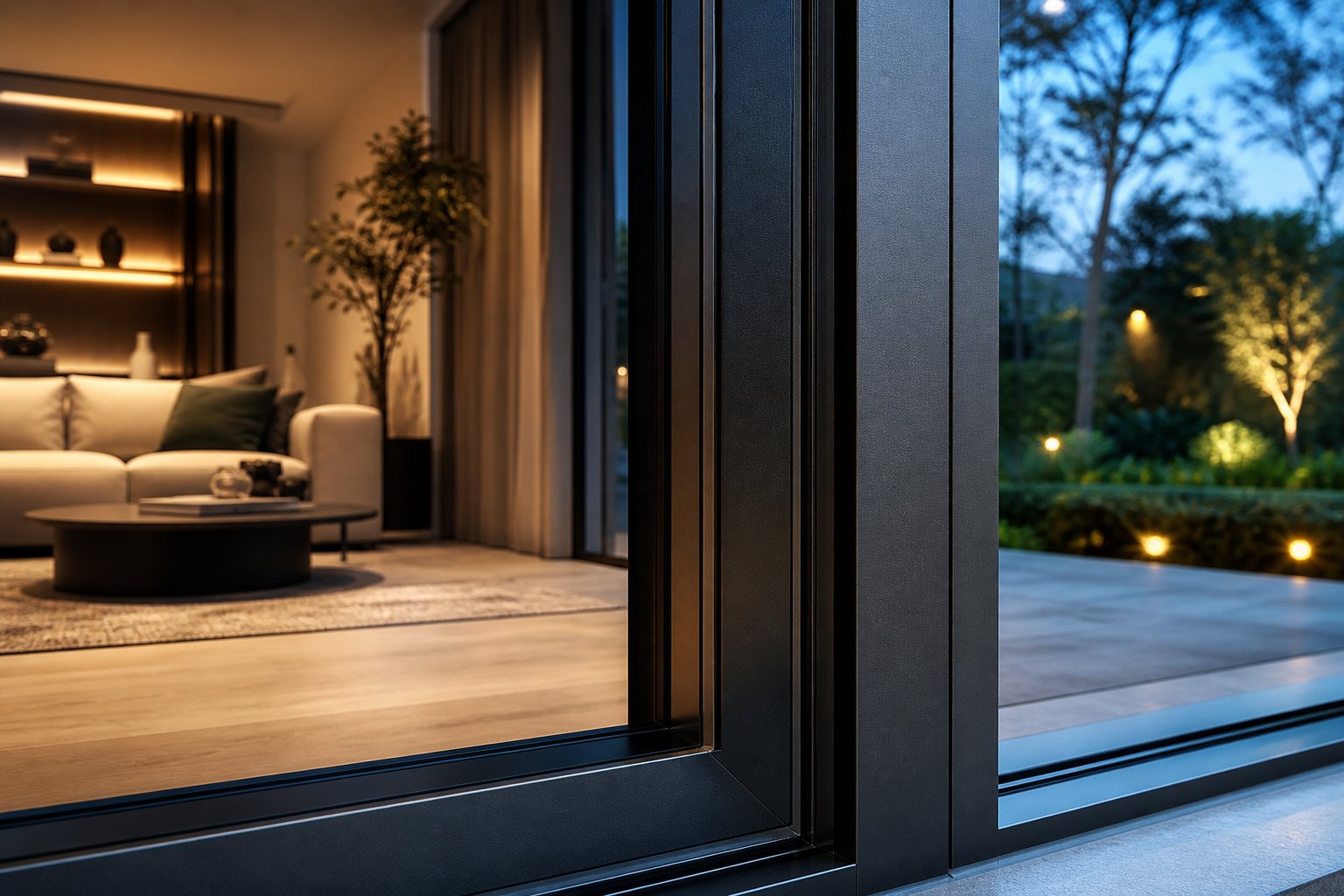
Thermal Break Technology That Changes the Equation
Walk into any dinner party conversation about windows and someone will say it: “Aluminium is cold.” Ten or fifteen years ago, that was fair criticism. Standard aluminium frames conducted heat straight through from one side to the other, leaving the indoor surface cold to the touch on winter mornings and contributing to condensation. That era is over. Modern engineering has addressed aluminium’s thermal weakness so comprehensively that the old reputation no longer reflects the product available to Victoria homeowners today.
The technology responsible is called a thermal break — and understanding how it works puts you in a stronger position when evaluating quotes and asking suppliers the right questions.
What Is a Thermal Break and How Does It Work
Picture an aluminium window profile split into two separate halves. One half faces the outdoors; the other faces your living space. Bridging the gap between them is a strip of polyamide — a glass-fibre-reinforced plastic (PA66) with extremely low thermal conductivity. That strip is mechanically locked into machined channels on each aluminium section, creating a single structural unit that behaves as two thermally independent zones.
The physics are straightforward. Aluminium conducts heat at approximately 160 W/m·K — over 1,000 times faster than uPVC. Without intervention, your frame becomes a thermal highway, bleeding warmth outward in winter and channelling heat inward during summer. The polyamide barrier — with conductivity of just 0.3 W/m·K — breaks that highway. Heat hits the strip and essentially stops, reducing frame-level heat loss by a factor of more than 500 compared to a solid aluminium profile.
This technology has been standard practice in European aluminium window systems for decades. It is now widely available in Australian-manufactured windows, with thermal break depths ranging from 14.8 mm in entry-level products up to 34 mm in high-performance systems. For Victoria’s Climate Zone 6 conditions, a break depth of 20 mm or more delivers meaningful insulation improvement, while premium profiles with 24-34 mm breaks push performance into territory that rivals timber and uPVC frames on U-value alone.
From the outside, a thermally broken frame looks identical to a standard one. The polyamide sits hidden inside the profile. The only way to confirm its presence — and its depth — is to ask your supplier directly. Request the frame U-value (Uf), and you will have a number you can compare across every quote you receive.
Double Glazing and Aluminium Frame Synergy
A thermal break addresses the frame. Double glazing addresses the glass. Together, they form a complete thermal envelope — and for aluminium double glazed windows, this combination is where real-world performance reaches its stride.
A double-glazed insulated glass unit (IGU) consists of two panes separated by a sealed cavity, typically 12-20 mm wide. That cavity slows convective heat transfer between the panes. Fill it with argon gas — denser and less conductive than air — and insulation improves by a further 16%. Add a low-emissivity (low-E) coating to one of the interior glass surfaces, and you gain a microscopically thin metallic layer that reflects radiant heat back into the room during winter while still admitting daylight.
Layer these technologies together in a well-specified aluminium frame and the whole-window U-value (Uw) drops dramatically. Entry-level aluminium double glazed systems achieve Uw values between 2.0 and 2.4 W/m²K. Mid-range products — thermally broken frames with argon-filled, low-E glass — sit between 1.4 and 1.9 W/m²K. High-performance configurations push below 1.3 W/m²K, comfortably exceeding National Construction Code energy requirements for Victoria’s climate zone.
Modern thermally broken aluminium windows can achieve whole-window U-values of 1.4 W/m²K or below — comparable to high-quality uPVC frames and sufficient to exceed NCC Section J requirements for residential builds in Victoria’s Climate Zone 6.
That figure matters because it dismantles the outdated belief that double glazed aluminium windows cannot compete on energy efficiency. When the frame carries a quality thermal break and the IGU pairs argon fill with low-E coatings and warm-edge spacer bars, the complete system performs at a level that would have required triple glazing a decade ago.
Warm-edge spacers deserve a brief mention. Traditional aluminium spacer bars at the perimeter of the sealed unit create their own small thermal bridge right where the glass meets the frame — the coldest point on any window. Replacing them with composite or stainless steel warm-edge spacers reduces this edge loss, improving both condensation resistance and the overall Uw figure. For anyone specifying aluminium double glazed windows in Victoria, warm-edge spacers are increasingly standard rather than an optional upgrade.
The practical takeaway is this: thermal break technology and double glazing are not separate improvements bolted together as an afterthought. They are engineered as an integrated system, where each component lifts the performance of the others. A thermally broken frame keeps the glass edge warmer, which helps the sealed unit last longer. A well-specified IGU reduces reliance on frame insulation alone. The synergy produces a window that handles Victoria’s cool winters and warm summers with genuine efficiency — not just compliance-level adequacy.
With the thermal question resolved at a materials level, the next consideration becomes practical: which window styles and configurations make the most of this performance across different home types and living situations?
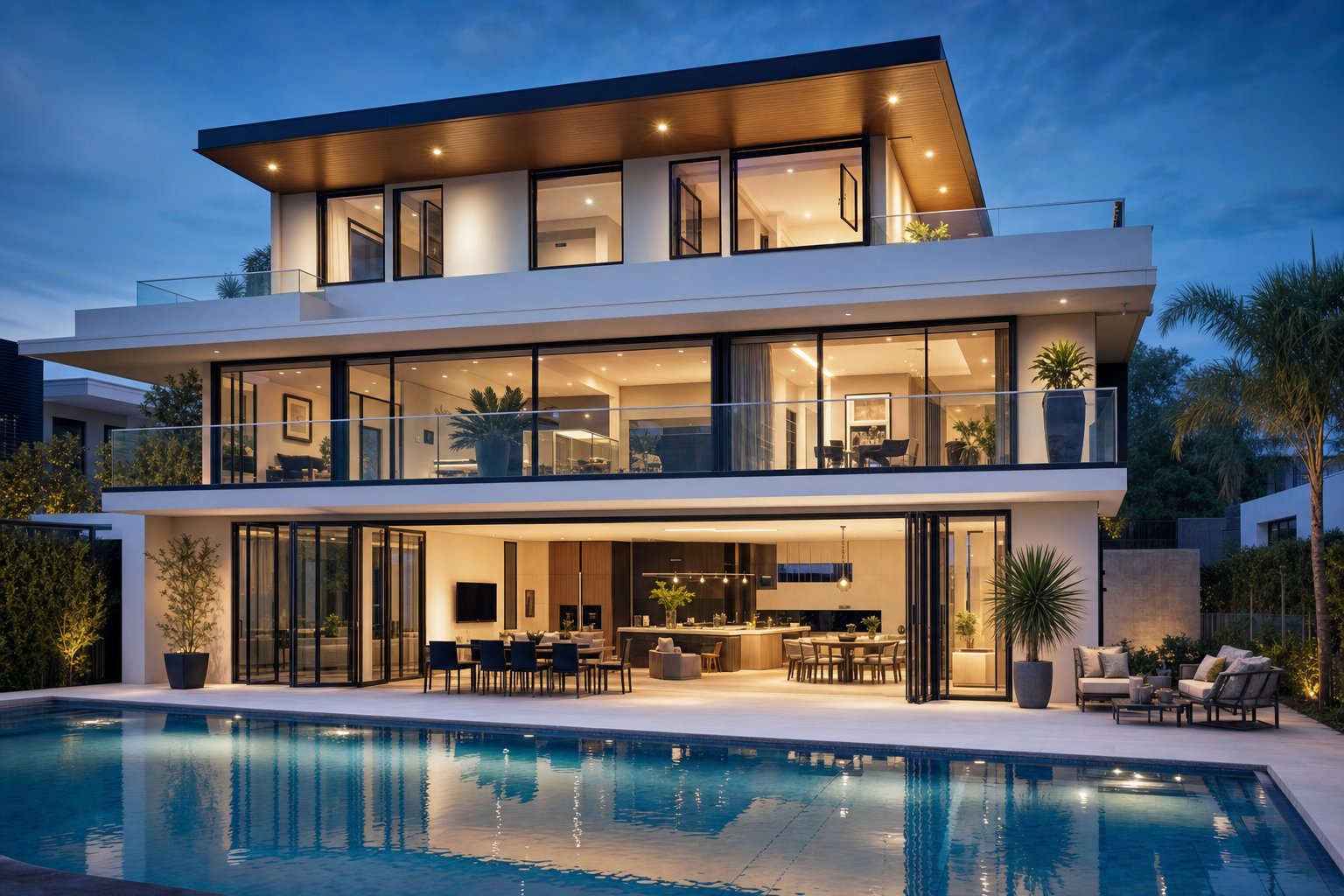
Aluminium Window Styles and Configurations for Every Home
Performance specifications tell you how well a window insulates. Style and configuration determine how it actually lives — how it ventilates your kitchen during a rainstorm, how it frames a garden view from your living room, or how it connects an indoor dining space to a deck on a mild autumn evening. Aluminium’s structural versatility means the range of operable styles available is broader than any other frame material, and understanding which configurations suit which situations saves both money and regret.
Casement, Awning, and Fixed Window Configurations
Casement windows hinge at the side and swing outward, opening the full aperture to airflow. They provide excellent weather sealing when closed — the sash presses firmly against compression seals under latch pressure — and deliver maximum ventilation when open. For bedrooms and living areas where cross-breezes matter, casements remain a staple across Victorian homes from weatherboard cottages in Northcote to brick veneer builds in Berwick.
Awning windows hinge at the top. The sash tilts outward from the bottom, creating a canopy effect that allows fresh air in while deflecting rain away from the opening. This makes them particularly well-suited to Victoria’s climate, where you often want ventilation during drizzle without inviting water onto your sill. Bathrooms, kitchens, and laundries benefit most — spaces that generate moisture and need consistent airflow regardless of weather. The popularity of aluminium awning windows extends well beyond Victoria; they are among the most specified residential window types across Australian cities from Sydney to Adelaide, precisely because they solve the rain-and-ventilation problem so cleanly.
Fixed windows do not open at all. That limitation is also their strength: no operable hardware means no air leakage paths, making them the best-performing configuration for thermal and acoustic insulation. Pair a fixed pane with a thermally broken aluminium frame and argon-filled double glazing, and you have the tightest thermal envelope possible in a window unit. Fixed panels work beautifully as feature windows, highlight windows above doors, or as the central pane in a combination where flanking casements or awnings handle ventilation duties.
Sliding and Stacking Systems for Open-Plan Living
Victoria’s mild climate encourages indoor-outdoor connection, and aluminium is the frame material that delivers it at scale. Sliding windows and doors run on tracks, requiring no swing space — making them practical for tight outdoor areas like balconies or narrow side passages. Standard two-panel sliders suit most openings, while three- or four-panel configurations span wider walls.
Bi-fold systems take things further. Multiple panels fold and stack against one side, opening up to 90% of the aperture and effectively removing the wall between inside and out. Aluminium’s strength-to-weight ratio is critical here: slimmer stiles and rails mean more glass per panel, and the frame can support large individual panes (commonly 900-1000 mm wide per leaf) without excessive weight or structural compromise. The result is expansive glazing with minimal visual interruption — a look that timber or uPVC bi-folds struggle to match without becoming noticeably heavier or bulkier.
Stacking slider systems offer another approach for wide openings. Panels slide behind one another and park at one or both ends, opening up substantial widths while keeping each panel fully supported on its own track. For entertainment areas facing north-facing gardens — a common layout in Victorian residential design — stacking sliders deliver seamless flow between kitchen, alfresco, and lawn.
Colour and Finish Options
Powder coating is the standard finish for aluminium windows in Australia. The process applies a dry polymer powder electrostatically, then cures it under heat to form a tough, uniform skin that bonds permanently to the aluminium surface. Quality powder coating resists chipping, fading, and chalking for 15 to 25 years, even under Victoria’s UV exposure.
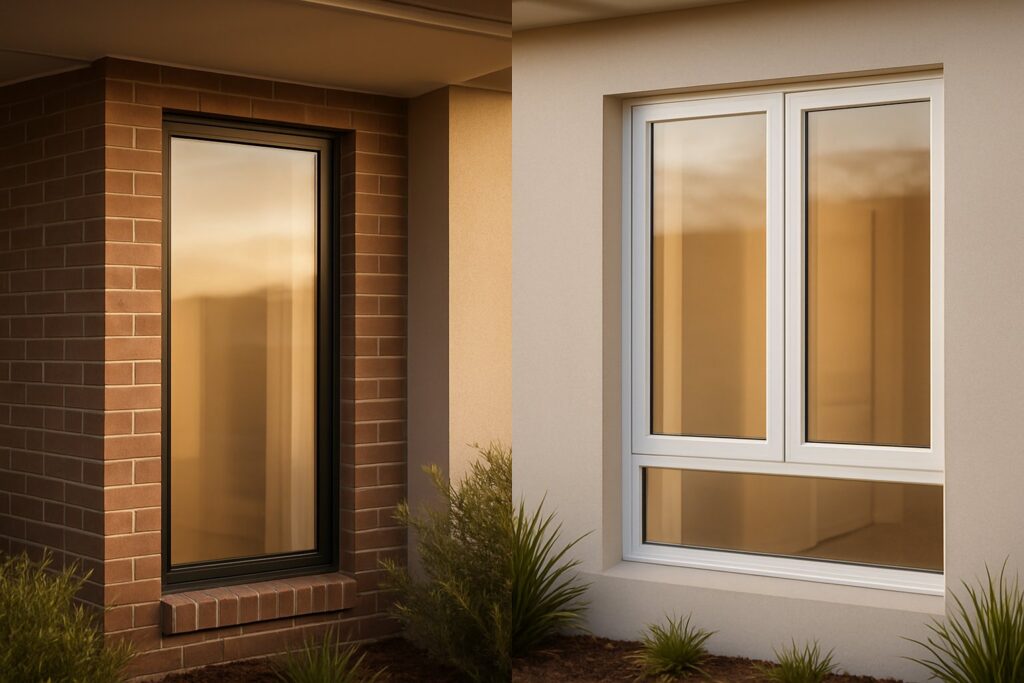
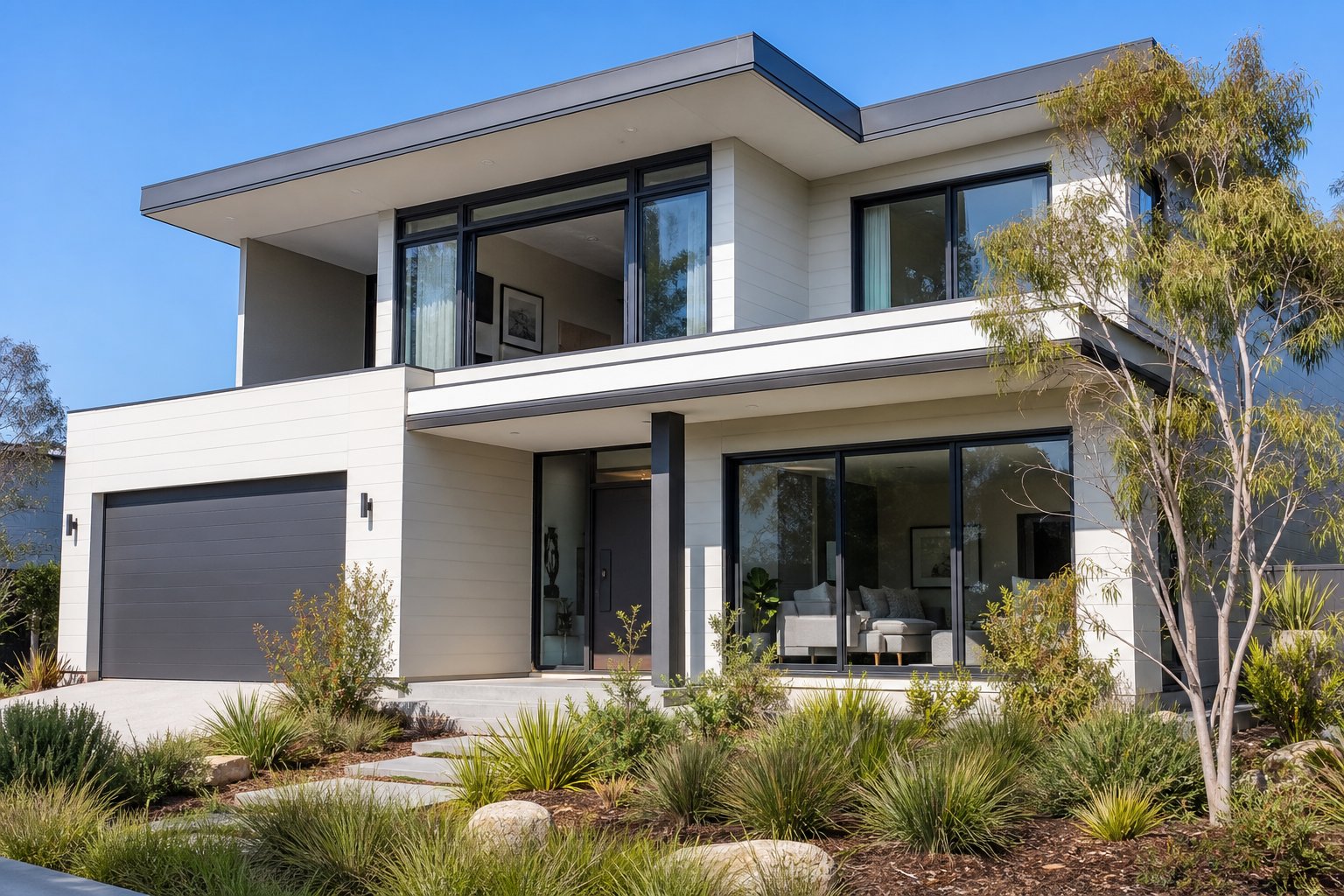
Colour trends in contemporary Victorian homes lean toward darker tones. Black aluminium windows have become the defining aesthetic choice for modern builds and renovations alike — their crisp, dark frames create strong visual contrast against light renders and pale brickwork while almost disappearing at night when interior lights are on. Charcoal, monument, and dark grey finishes offer slightly softer alternatives that achieve a similar effect with marginally less contrast. For heritage renovations, aluminium black windows might feel too stark, so woodgrain powder coatings provide a convincing timber-look finish visible from street level, without any of the associated maintenance burden.
Custom colour matching extends the palette further. Most quality fabricators can match any colour from the Dulux or Colorbond range, and some offer dual-colour options — a different shade on interior and exterior faces — allowing the window to coordinate with both your facade and your internal joinery.
For readers wanting to explore specific product lines, custom sizing, and the full range of style and colour combinations available for Victorian projects, MEICHEN’s aluminium window range provides a practical starting point. Their systems cover casement, awning, sliding, and fixed configurations with project-ready customisation for residential and commercial builds across Victoria.
Choosing the right configuration often depends on your home type and the functional demands of each room. Here are popular pairings that work well across Victoria’s housing stock:
- Period homes (Victorian, Edwardian, Federation) — double-hung and casement windows maintain heritage proportions; woodgrain finishes complement traditional facades
- Modern builds (contemporary, architectural) — fixed panels, sliding doors, and bi-fold systems maximise glass area; black aluminium windows or charcoal tones reinforce clean lines
- Apartments and townhouses — awning and casement windows suit smaller openings; security and acoustic performance take priority alongside ventilation
- Renovations and extensions — match existing window styles in the original structure while upgrading frame material; aluminium replicates most profiles with improved longevity
The style you choose shapes daily comfort. But how that style performs across a 30- or 40-year ownership period depends equally on whether the application is residential or commercial — and the engineering behind each differs more than most homeowners realise.
Residential and Commercial Aluminium Window Applications
Aluminium dominates commercial glazing across every major Australian city. Walk through any CBD — Melbourne, Sydney, Adelaide — and the glass-fronted office towers, retail shopfronts, and multi-storey apartment facades you see are overwhelmingly framed in aluminium. That commercial dominance is not accidental. It reflects engineering advantages that no other frame material can match at scale. What many homeowners do not realise is how directly those advantages translate into residential benefits, particularly for Victoria’s growing renovation and new-build markets.
Commercial Aluminium Window Specifications
Commercial buildings place demands on window frames that go well beyond anything a single-storey house encounters. Multi-storey towers face significantly higher wind loads at elevation — a window on the fifteenth floor deals with forces that would never reach a ground-level bedroom. Aluminium’s structural rigidity allows engineers to design frames using heavier profile sections (commonly 100-150 mm deep) that resist bending under these conditions without flex or seal failure over time.
Fire resistance and bushfire compliance add further weight to the specification. Aluminium is non-combustible and maintains structural integrity at temperatures that would ignite timber or deform uPVC. For projects requiring BAL (Bushfire Attack Level) rated windows — relevant across many parts of regional Victoria — aluminium is often the only frame material that achieves compliance without supplementary shielding. In commercial contexts, the same fire resistance integrates seamlessly with curtain wall systems, spandrel panels, and fire-rated glazing assemblies that form a building’s protective envelope.
Thermal performance at commercial scale relies on more complex thermal break configurations. Multi-cavity polyamide strips, sometimes combined with insulating foam fills, address the massive glass areas found in office buildings where solar heat gain must be carefully managed to keep cooling loads under control. These systems meet stringent NCC Section J energy requirements for Class 5 to 9 buildings — requirements that grow more demanding with each code update.
Residential Applications and Scaled Solutions
Residential aluminium systems share the same core material advantages but are engineered for a different context. Profiles run lighter — typically 45-70 mm deep — because single- and double-storey homes face lower structural loads. Hardware shifts from heavy-duty commercial mechanisms designed for hundreds of daily operations to residential-grade fittings optimised for smooth feel, quiet operation, and family-friendly ergonomics.
Aesthetics also diverge. Where commercial glazing prioritises uniformity and integration with facade systems, residential windows balance performance against visual proportion, frame colour, and how profiles interact with surrounding materials like brick, render, or cladding. Slimmer residential sightlines — achievable because of lower span demands — put more glass on display, which is exactly what most Victorian homeowners want from a living room or bedroom window.
For builders and developers working across larger projects — housing estates, townhouse rows, or apartment complexes — aluminium offers manufacturing consistency that other materials struggle to match. Every frame comes off the extrusion line to identical tolerances. Powder coating is applied in controlled batches, ensuring colour consistency across fifty or a hundred windows ordered months apart. That precision simplifies logistics and eliminates the colour-matching headaches common with painted timber across big multi-stage developments, whether the project sits in Melbourne’s growth corridors or in regional centres.
The renovation context is equally compelling. Victoria holds an enormous stock of older homes — weatherboards, brick veneer, and rendered dwellings from the 1950s through 1980s — many fitted with original timber or early aluminium windows that have reached end of life. Modern aluminium frames can be retrofitted into existing openings with minimal structural modification. The dimensional precision of extruded profiles means new frames slot cleanly into prepared reveals, and because aluminium is lighter than timber for equivalent structural performance, load-bearing lintels rarely need upgrading. For a homeowner replacing ageing windows in a 1970s brick veneer in Doncaster or a weatherboard in Yarraville, that means faster installation, less disruption, and lower builder costs compared to a frame material that requires opening modifications.
Whether the project is a shopfront in Richmond, a high-rise in Docklands, or a family home in Geelong, the underlying principle holds: aluminium’s engineering pedigree was built in commercial applications, and residential systems inherit that structural confidence at a scale and price point suited to everyday homes. The real differentiator over time is not the frame itself — it is how you maintain it and what you can realistically expect across decades of ownership.
Maintenance and Lifespan of Aluminium Windows in Victoria
One of the strongest selling points of aluminium frames is also one of the least discussed in practical terms. “Low maintenance” appears on every manufacturer’s brochure, but what does that actually look like across a 30- or 40-year ownership period in Victorian conditions? And how long do aluminium windows last before you genuinely need to think about replacement? Realistic answers to these questions help you plan both your maintenance effort and your long-term budget with clarity rather than guesswork.
Routine Maintenance for Aluminium Windows in Victoria
Low maintenance does not mean zero maintenance. Aluminium frames are forgiving — far more so than timber — but neglecting them entirely, particularly in coastal or high-pollution areas, shortens both their appearance and functional lifespan. The good news is that the routine is simple, infrequent, and requires no specialist skills or tools.
The primary task is washing. Dust, airborne pollutants, and organic deposits accumulate on any external surface over time. In bayside suburbs from Williamstown to Frankston, salt particles settle on frames after onshore winds. Left undisturbed for months, salt residue can etch through the protective powder coating layer and create dull patches. A periodic wash with warm water and mild household detergent — applied with a soft cloth or sponge — removes these deposits before they cause harm. Avoid abrasive pads or alkaline-based cleaners, as these can damage the coating surface.
Beyond cleaning the frames themselves, tracks and drainage slots need attention. Sliding and awning windows rely on small weep holes to drain water that enters the track during rain. Dirt, leaves, or insect debris can block these channels, leading to water pooling inside the frame. A soft brush or vacuum clears tracks quickly, and a damp cloth finishes the job.
Hardware lubrication keeps things operating smoothly. Hinges, locking mechanisms, and rollers on sliding panels benefit from an annual application of silicone-based lubricant. Avoid oil-based or grease-based products — they attract grime and can gum up over time, creating more problems than they solve. A light spray of silicone, worked through the mechanism by opening and closing the window several times, is all that is needed.
Weather seals and gaskets deserve a check every few years. These rubber or EPDM strips around the sash perimeter create the airtight and watertight seal that keeps drafts and rain out. Over time — typically 10 to 15 years — seals can become brittle or compressed, reducing their effectiveness. The frame itself will still be in excellent condition at this point; replacing seals is a relatively inexpensive maintenance item that restores the window’s original performance without requiring frame replacement.
Coastal properties — anywhere within a few kilometres of Port Phillip Bay, Western Port, or the open coast — benefit from more frequent cleaning. Quarterly washing rather than biannual keeps salt from gaining a foothold. Properties further inland, in suburbs like Ringwood, Eltham, or Melton, face less aggressive conditions and can comfortably follow a less intensive schedule.
Here is a practical maintenance frequency guide that covers most Victorian homes:
- Monthly — quick visual check for obvious damage, ensure drainage slots are clear after heavy rain
- Quarterly — clean tracks and drainage channels, wipe down frames in coastal locations
- Annually — lubricate all hardware and moving parts, wash frames and glass thoroughly, inspect powder coating for chips or scratches
- Every 5 years — inspect weather seals and gaskets for compression or cracking, assess overall powder coat condition, check for any hardware wear requiring replacement
Compare that schedule to timber windows — which demand repainting every three to seven years, termite inspections, putty maintenance, and constant vigilance against rot — and the contrast in ownership effort becomes stark. These aluminium window maintenance tips represent the full extent of what is required for decades of reliable performance.
Lifespan Expectations and Warranty Considerations
So how long do aluminium windows last in practice? Quality aluminium frames installed in Australian homes typically deliver 25 to 40 years of service, with many lasting beyond that range when properly maintained. The frame itself — the extruded aluminium profile — is essentially the last component to fail. It does not rot, warp, or structurally weaken over time the way timber does. It does not become brittle under UV exposure like uPVC can after extended periods. The aluminium alloy remains dimensionally stable decade after decade.
What does wear out are the consumable components: hardware mechanisms, weather seals, and in some cases, the sealed glazing unit itself. Hinges may fatigue after 15 to 20 years of regular use. Locks can stiffen or fail. Seals lose elasticity. Double-glazed units can eventually lose their gas fill or develop internal condensation as edge seals degrade — typically after 20 or more years. Every one of these components is replaceable without discarding the frame. That repairability extends the practical lifespan of the window system well beyond what any single component achieves on its own.
Warranty terms vary between manufacturers and fabricators. Frames typically carry warranties between 7 and 15 years, while powder coating warranties often sit around 10 years for standard finishes and longer for premium or marine-grade coatings. Hardware may carry a separate warranty of 5 to 10 years. These warranty periods represent minimums — they do not indicate expected failure points. A well-manufactured aluminium window from a reputable supplier will comfortably outlast its warranty period by a significant margin under normal conditions.
Victoria’s climate, for all its variability, is relatively gentle on aluminium compared to harsher Australian environments. Tropical humidity in Far North Queensland accelerates hardware corrosion. Heavy industrial pollution in certain urban corridors concentrates aggressive particulates on frame surfaces. Extreme alpine temperature cycling stresses seals more aggressively. Victoria’s temperate conditions — moderate humidity, modest temperature differentials, and relatively clean air outside immediate coastal zones — create an environment where double-glazed aluminium windows age gracefully with minimal intervention.
The practical implication for homeowners is straightforward. Invest in quality aluminium windows from a manufacturer who complies with AS2047 standards, commit to the modest maintenance routine outlined above, and your frames will reward you with decades of reliable, attractive service. The frame will likely outlast your interest in the house. When the time does come to upgrade — usually driven by aesthetic preference or advances in glazing technology rather than structural necessity — the old aluminium is fully recyclable, closing the loop on a material that served you well and returns to the supply chain without waste.
That long ownership horizon makes the choice of supplier particularly important. A window that lasts 40 years ties you to the quality decisions made at purchase — the profile system, the hardware grade, the coating specification, and the installation precision. Choosing the right partner upfront is the single most consequential maintenance decision you will ever make for your windows.
Choosing the Right Aluminium Window Supplier in Victoria
A 40-year product deserves more than a 40-minute purchasing decision. The supplier you choose determines the profile system behind your walls, the hardware you will operate thousands of times, and the coating standing between your frames and Victoria’s weather. Not all window suppliers Melbourne homeowners encounter are equal — and the differences are not always obvious from a showroom visit or a quote sheet. Knowing what separates quality from adequacy puts you in control of the conversation.
What to Look for in an Aluminium Window Supplier
Start with compliance. Every external window and door installed in an Australian building must meet Australian Standard AS2047, which covers structural performance, water penetration resistance, air infiltration, and operating force. A credible supplier will provide a performance label on every product and a certificate of compliance — ideally backed by testing through NATA-accredited laboratories. If a supplier cannot produce this documentation on request, that tells you everything you need to know about their quality floor.
Beyond compliance, evaluate breadth. Can the supplier provide casement, awning, sliding, fixed, bi-fold, and stacking configurations from a single system? A broader range means fewer compromises when different rooms in the same home need different window types but consistent aesthetics. Custom sizing matters equally — Victoria’s housing stock includes everything from Federation-era openings with non-standard dimensions to contemporary designs with floor-to-ceiling glazing. A supplier locked into fixed sizing limits your design freedom.
The supplier landscape itself is worth understanding. A fabricator assembles windows from profile systems designed and extruded by a separate system supplier — they cut, join, and glaze but do not control the raw material. A dealer resells products manufactured elsewhere, acting primarily as a sales channel. A direct manufacturer controls the process from extrusion or system design through to finished product, offering tighter quality control and greater flexibility for custom work. For complex residential or commercial projects across aluminium windows Melbourne markets, working with a manufacturer or authorised fabricator typically delivers better outcomes than purchasing through a multi-layered retail chain.
Getting Project-Ready with the Right Partner
The best suppliers function as technical partners rather than transactional sellers. They assist during specification — helping architects select appropriate wind ratings, glazing builds, and thermal break depths for a project’s specific location and orientation. They provide shop drawings for builder review before manufacturing begins. And they offer installation guidance or direct installation services that protect warranty validity.
This kind of lifecycle support matters most for larger or more complex builds — multi-unit developments, architecturally designed homes, or renovations involving non-standard openings. A supplier who disappears after invoicing leaves gaps that builders or homeowners are forced to fill themselves, often at additional cost.
Whether you are sourcing aluminium windows Melbourne suppliers for a single-home renovation or comparing aluminium window suppliers Sydney and Victorian fabricators for a commercial development, a structured evaluation process removes guesswork:
- Verify AS2047 compliance — request performance labels, certificates, and test reports matching the exact product configuration you are purchasing
- Review available window types — confirm the supplier covers all configurations your project requires from a single cohesive system
- Confirm custom sizing capability — ensure non-standard dimensions, shapes, or combinations can be manufactured without excessive lead times
- Check thermal break options — ask about break depth, polyamide grade, and resulting frame U-values for your chosen profiles
- Ask about glazing specifications — determine whether the supplier partners with quality glass processors and offers argon fill, low-E coatings, and warm-edge spacers
- Compare warranty coverage — look at frame, coating, hardware, and sealed-unit warranties separately, and understand what voids each
- Assess project support services — specification assistance, shop drawings, engineering input, and installation guidance distinguish a partner from a vendor
For homeowners and project teams ready to move from research into specification, MEICHEN’s aluminium window systems offer a practical starting point. Their range spans the full suite of residential and commercial configurations, with custom sizing, thermal break options, and performance data accessible directly — giving builders, architects, and developers a clear path from product exploration to project-ready documentation without the back-and-forth that slows so many procurement timelines.
Investing time in supplier evaluation feels less urgent than choosing colours or layouts. But the frame behind your wall will still be there long after you have forgotten the name of your painter. Choose the supplier who earns a 40-year relationship — not just a purchase order.
Frequently Asked Questions About Aluminium Windows in Victoria
1. Are aluminium windows good for Victoria’s coastal climate?
Aluminium is one of the best-suited frame materials for Victoria’s coastal conditions. The metal does not absorb moisture, so it will not swell, rot, or warp during prolonged wet winters or exposure to salt-laden air in bayside suburbs. When finished with quality powder coating, aluminium frames gain an additional protective barrier against salt deposits and UV degradation. Coastal properties benefit from quarterly washing to prevent salt buildup, but unlike timber frames that need repainting every few years, aluminium requires no recoating to maintain structural and aesthetic integrity over decades.
2. How long do aluminium windows last in Victoria?
Quality aluminium window frames installed in Victorian homes typically deliver 30 to 50 years of service with proper care. The extruded aluminium profile itself is the last component to deteriorate — it does not rot, warp, or become brittle under UV exposure. Components that wear first include hardware mechanisms (15-20 years), weather seals (10-15 years), and sealed glazing units (20+ years), all of which are replaceable without discarding the frame. Victoria’s temperate climate is relatively gentle on aluminium compared to tropical or heavily polluted environments, which supports longer lifespans with minimal intervention.
3. Do thermally broken aluminium windows meet energy requirements in Victoria?
Yes. Modern thermally broken aluminium windows paired with double glazing comfortably meet and exceed National Construction Code energy requirements for Victoria’s Climate Zone 6. A polyamide thermal break inserted between the interior and exterior aluminium profiles reduces frame-level heat transfer dramatically. When combined with argon-filled, low-E coated double glazing and warm-edge spacers, these systems achieve whole-window U-values of 1.4 W/m²K or below — performance comparable to high-quality uPVC frames and sufficient for NCC Section J compliance in residential builds.
4. What maintenance do aluminium windows need in Victoria?
Aluminium windows require periodic washing with mild detergent to remove dust, pollution, and salt deposits — quarterly for coastal properties, biannually for inland homes. Tracks and drainage slots should be cleared of debris each quarter to prevent water pooling. Hardware benefits from annual silicone-based lubrication, and weather seals should be inspected every five years for compression or cracking. This modest routine keeps frames performing well for decades. Compared to timber windows that demand repainting every three to seven years plus termite monitoring, aluminium ownership effort is significantly lower.
5. How do I choose a quality aluminium window supplier in Victoria?
Start by verifying AS2047 compliance — every supplier should provide performance labels and test certificates for their products. Evaluate their range of window types, custom sizing capability, thermal break options, and glazing specifications including argon fill and low-E coatings. Compare warranty coverage across frames, powder coating, hardware, and sealed units separately. Prioritise suppliers who offer project lifecycle support such as specification assistance, shop drawings, and installation guidance. Working directly with a manufacturer or authorised fabricator typically provides greater flexibility for custom projects than purchasing through retail channels. MEICHEN’s aluminium window systems at meichenwindows.com.au offer a practical resource for exploring configurations, custom options, and project-ready documentation.
More Window & Door Guides