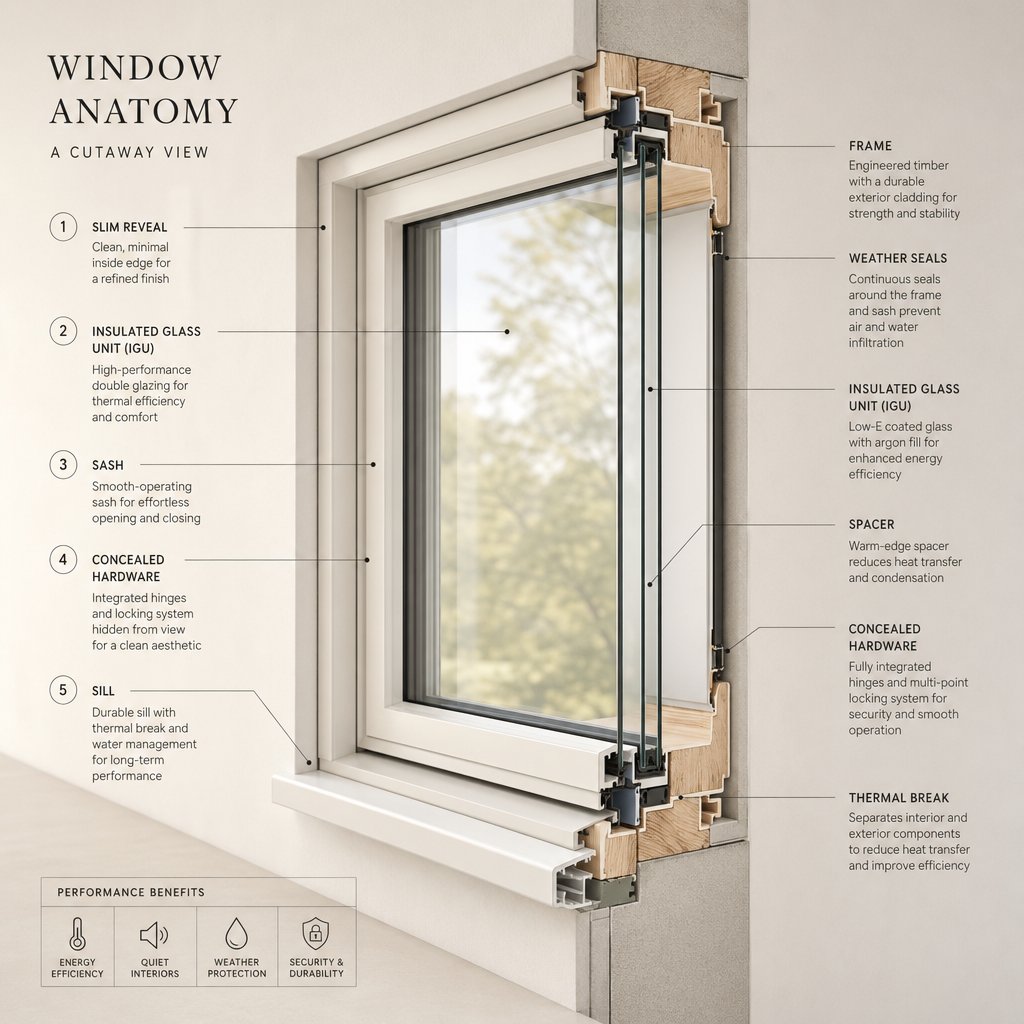
What Defines Aluminium Windows Quality Beyond Marketing Claims
Every manufacturer claims their aluminium windows are “high quality.” It is one of the most overused phrases in the fenestration industry, and it tells you almost nothing. Genuine aluminium windows quality is not a single attribute you can point to on a spec sheet. It is an ecosystem of interdependent factors, each influencing the others, and a weakness in any one area can undermine the entire system.
Think of it this way: a premium-grade alloy means little if the profile engineering cannot support the glazing weight over a wide span. A beautiful powder-coated finish will not save a window that lacks proper thermal break technology or uses cheap single-channel weatherseals. Each aluminium window is a sum of its parts, and assessing quality requires looking at all of them together rather than latching onto a single selling point.
This article is not a promotional overview telling you that alu windows are a smart choice. You probably already know that. Instead, it is a quality-assessment resource designed to help buyers, architects, and specifiers distinguish genuinely engineered products from those coasting on generic marketing language.
Why Not All Aluminium Windows Perform Equally
The Australian market spans everything from budget residential units assembled with thin, low-grade profiles to high-performance architectural systems engineered for cyclone zones and coastal salt exposure. Both carry the label “aluminium window,” yet they perform in vastly different ways over time. Are aluminum windows good? That depends entirely on where they sit within this spectrum. Understanding the specific quality markers that separate tiers helps you make decisions based on evidence, documented performance data, and third-party certifications rather than brochure photography.
The Quality Ecosystem Approach
Rather than treating quality as a vague descriptor, this guide breaks it down into six measurable pillars. Each one interacts with the others, and together they determine whether a window aluminium windows system will perform reliably for decades or begin failing within a few years of installation.
- Frame (Alloy and Profile) — The structural backbone, encompassing alloy grade, wall thickness, and multi-chamber geometry that dictates strength, rigidity, and maximum span capability.
- Thermal System — The thermal break design that separates inner and outer aluminium faces, directly controlling heat transfer, condensation resistance, and energy efficiency.
- Surface Finish — Powder coating or anodising quality that protects the frame against UV degradation, corrosion, and colour shift across harsh Australian conditions.
- Seals and Drainage — Multi-point compression weatherseals and engineered drainage channels that prevent water ingress and air leakage under pressure.
- Glass Integration — How the insulated glass unit is secured within the frame, affecting both thermal performance and long-term seal integrity.
- Hardware — Handles, hinges, locking systems, and friction stays that determine operational lifespan, security ratings, and day-to-day usability.
A failure in any one pillar cascades into others. Poor drainage leads to internal corrosion that weakens the frame. Substandard hardware stresses seals during operation, accelerating their deterioration. Quality lives in the connections between these elements as much as in each element itself. The sections ahead examine each pillar in detail, giving you the technical knowledge to spot red flags before they become expensive problems.
Alloy Grades and Profile Engineering That Determine Longevity
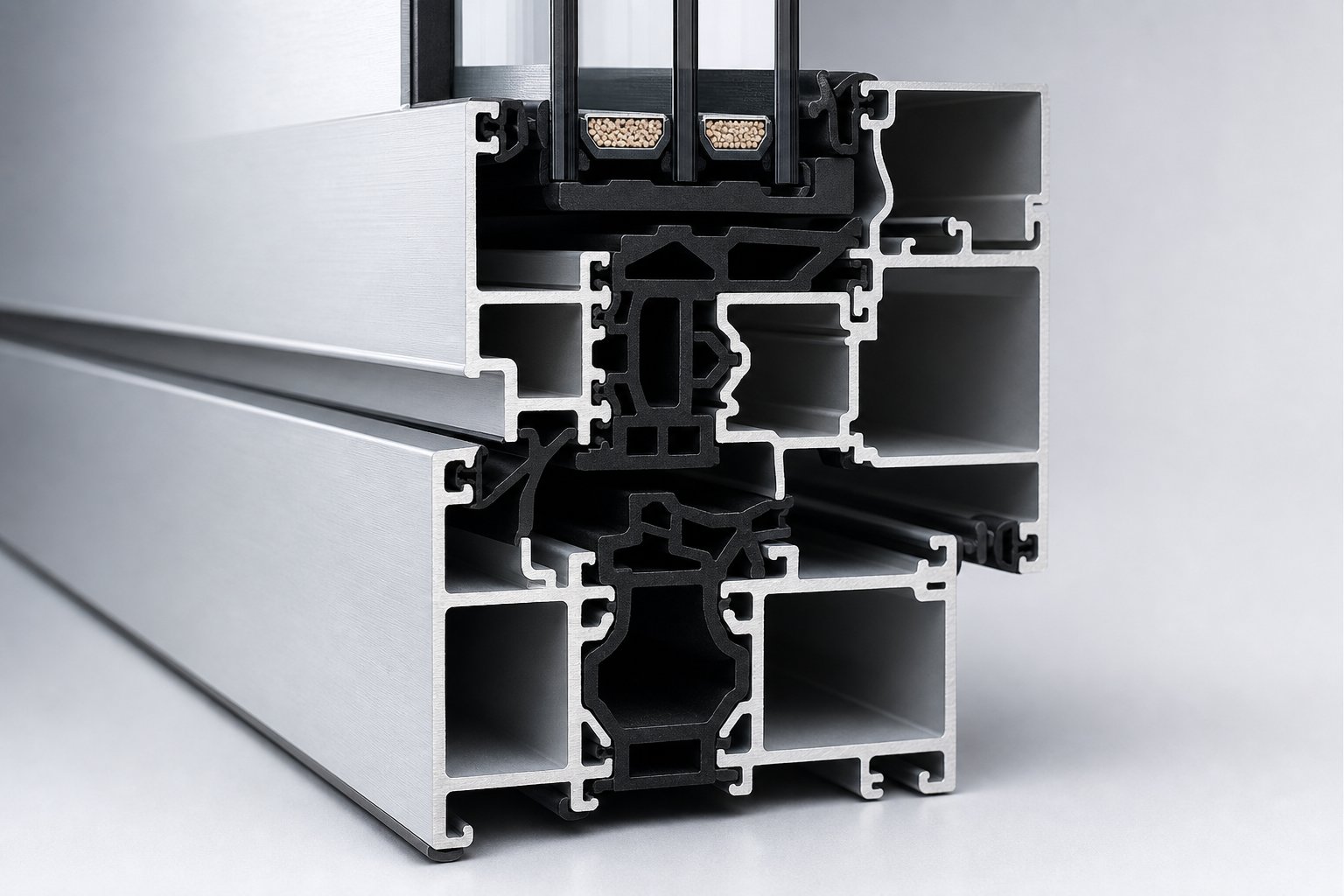
The six quality pillars outlined above all depend on a single starting point: what the frame itself is made of and how it is shaped. An aluminium window frame is not simply “aluminium” in a generic sense. The specific alloy grade dictates strength, corrosion behaviour, and how well the surface accepts protective finishes. The profile geometry — wall thickness, chamber count, internal webbing — determines how much load that frame can carry, how much noise it blocks, and whether it will flex or hold firm across a three-metre span on a windy afternoon.
Most suppliers never mention these details. You will see phrases like “commercial-grade aluminium” or “heavy-duty frame” without any technical substance behind them. Knowing what to look for at the alloy and profile level gives you a far more reliable basis for comparison than marketing adjectives ever will.
Understanding Aluminium Alloy Grades for Windows
Two alloys dominate the architectural aluminium window framing industry: 6063 and 6061. Both belong to the 6xxx series (magnesium-silicon alloys), but they serve different purposes.
6063 — the architectural standard. Containing approximately 0.45–0.9% magnesium and 0.2–0.6% silicon, 6063 aluminium is purpose-built for extrusion. It flows smoothly through complex die geometries, which means manufacturers can produce intricate multi-chamber profiles with thin walls and tight tolerances. Critically for windows, it delivers an exceptionally smooth surface finish — ideal for powder coating or anodising — and offers excellent corrosion resistance, even in coastal environments. This is why the vast majority of quality aluminium window frames in the Australian residential and commercial market use 6063.
6061 — the structural workhorse. When a project calls for unusually large spans or extreme wind loads (think floor-to-ceiling fixed panels in a cyclone-rated building), 6061 steps in. With higher magnesium and silicon content, it achieves roughly 50% greater tensile strength than 6063 in the same temper condition — around 290 MPa versus 190 MPa at T6. The trade-off is reduced extrudability and a less refined surface finish, which is why it is reserved for specific structural demands rather than used as a general-purpose aluminium frame window material.
The letter-number suffix after the alloy grade — T5 or T6 — refers to the heat treatment (temper) applied after extrusion:
- T5 — The profile is air-cooled directly from the extrusion press, then artificially aged in a furnace. This develops moderate strength (approximately 145 MPa tensile for 6063) at lower processing cost. It is the standard temper for most architectural aluminium window frames where surface finish quality and cost efficiency are priorities.
- T6 — The profile undergoes a separate solution heat treatment followed by water quenching and controlled ageing, pushing tensile strength to around 190 MPa for 6063. T6 is specified when maximum rigidity is needed for larger or thinner-profile designs.
In practical terms, a 6063-T5 aluminium window frame material offers the optimal balance for the majority of residential and light commercial applications across Australia. For projects with exceptional structural requirements — very wide openings, high wind zones, or minimal-sightline designs — specifiers may call for 6063-T6 or even 6061-T6 profiles.
Profile Thickness and Chamber Design
Alloy grade sets the material properties. Profile design determines how effectively those properties translate into real-world performance. Two characteristics matter most here: wall thickness and internal chamber geometry.
Wall thickness is the single fastest indicator of frame quality you can check. Quality aluminium window frames typically range from 1.4 mm to 2.0 mm wall thickness. Budget systems often drop below 1.4 mm to cut material costs, and the consequences show up as reduced security ratings, increased frame flex under wind pressure, diminished screw-holding strength for hardware, and poorer acoustic insulation. If a supplier cannot confirm their profile wall thickness in writing, treat it as a red flag.
Multi-chamber design refers to the internal geometry of the extruded profile — the hollow chambers and connecting webs visible in a cross-section cut. Quality aluminium window frames use multiple chambers to distribute structural loads more efficiently, house drainage pathways and concealed hardware, provide additional thermal isolation (still air trapped in chambers acts as insulation), and increase the moment of inertia so the frame resists bending without adding excessive weight.
A budget single-chamber profile and an engineered multi-chamber profile may look similar from the outside. The difference becomes apparent over time — and under load.
| Metric | Budget Thin-Profile System | Engineered Multi-Chamber System |
|---|---|---|
| Wall thickness | 1.0–1.2 mm | 1.4–2.0 mm |
| Chamber count | 1–2 chambers | 3–5+ chambers |
| Typical maximum span | ~1.5 m unsupported | 3.0 m+ unsupported |
| Indicative security rating | Basic latch only | Multi-point locking capable |
| Acoustic performance | Minimal noise reduction | Meaningful sound attenuation |
| Thermal break compatibility | Often absent or narrow | Wide polyamide break integrated |
The relationship between profile engineering and thermal performance is direct. A deeper, multi-chamber frame can accommodate a wider thermal break — and thermal break width is one of the most consequential quality differentiators in modern aluminium windows. That connection between frame depth and energy performance is worth understanding in detail.
Thermal Break Technology and What Energy Performance Really Means
Frame depth and chamber count set the stage, but the thermal break itself is where energy performance is won or lost. Strip away the marketing language, and thermally improved aluminium windows are defined by one critical component: a continuous insulating barrier that physically separates the indoor and outdoor aluminium faces of the profile. Without it, the frame acts as a thermal highway — aluminium conducts heat roughly 1,000 times faster than timber and 200 times faster than uPVC. With it, you have a genuinely energy efficient aluminium window system capable of matching or outperforming alternative frame materials.
How Thermal Breaks Transform Aluminium Performance
The industry-standard thermal break material is PA66 GF25 — polyamide 66 reinforced with 25% glass fibre. This engineered polymer has a thermal conductivity of approximately 0.3 W/mK compared to aluminium’s 237 W/mK, creating a barrier that is nearly 800 times less conductive than the metal surrounding it. The glass fibre reinforcement is not incidental. It ensures the strip’s coefficient of thermal expansion closely matches that of aluminium, so both materials expand and contract in sync through decades of Australian thermal cycling without shearing apart.
Break width is where differentiation gets measurable. Standard aluminium thermal break windows use strips around 20 mm wide, while high-performance architectural systems push to 34 mm, 40 mm, or beyond. Wider breaks force heat to travel a greater distance through low-conductivity material, directly improving the frame’s thermal resistance.
The practical outcome shows up in U-values — the metric measuring how much heat passes through a building element, expressed in W/m²K. Lower numbers mean less heat transfer. A non-thermally broken aluminium frame typically registers a U-value around 5.0 W/m²K. Integrate a quality polyamide thermal break, and that same frame can drop to 1.5 W/m²K or lower. High-end systems with wider breaks and multi-chamber profiles achieve whole-window U-values between 0.8 and 2.0 W/m²K — a 70 to 85% reduction in heat transfer. For Australian projects targeting NatHERS compliance or high WERS ratings, that gap is the difference between passing and failing. Brands like Milgard thermal break aluminium windows have demonstrated in the North American market how properly engineered polyamide barriers deliver performance competitive with timber and fibreglass alternatives — a principle that applies equally to quality Australian systems.
Energy Ratings and Real-World Performance
Those U-value numbers translate into tangible outcomes beyond a compliance certificate. In a Melbourne winter, a thermally broken frame keeps its interior surface close to room temperature. Your heating system runs less because warmth stays inside rather than conducting out through the frame. In a Brisbane summer, the same barrier blocks external heat from radiating inward, reducing air conditioning load. The aluminium vs fibreglass windows debate often centres on thermal conductivity, but a well-specified thermally broken aluminium system closes that gap almost entirely while offering superior strength and slimmer sightlines.
Condensation control is the quieter benefit. When a frame’s interior surface drops below the dew point of indoor air, moisture forms — leading to mould growth, paint damage, and degraded seals. Thermal breaks eliminate cold-bridging by ensuring the inner aluminium face never approaches outdoor temperatures. In humid coastal climates along Australia’s eastern seaboard, this alone justifies the premium over non-broken systems.
A quality aluminium window with proper thermal break technology can match or exceed the insulation performance of timber and uPVC frame materials — while maintaining aluminium’s structural advantages for larger spans, slimmer profiles, and longer maintenance-free service life.
Thermal performance sets the baseline for comfort and efficiency, but it means little if the protective finish fails within a few years of installation. The surface coating is what stands between engineered aluminium and the relentless Australian sun, salt air, and temperature extremes — and its quality varies just as widely as the thermal systems underneath.
Surface Finishes That Protect Performance for Decades
A thermally broken, multi-chamber aluminium frame is only as durable as the finish protecting it. In Australia’s climate — relentless UV, salt-laden coastal air, and daily temperature swings — the surface coating is not cosmetic. It is the front line of defence against corrosion, chalking, and colour degradation. Two systems dominate architectural fenestration: powder coating and anodising. Both can deliver decades of service, but only when specified and applied correctly. The gap between a quality finish and a budget one is invisible on installation day. It shows up three to five years later.
Powder Coating Quality and Certification Standards
Powder coating involves electrostatically applying a dry resin-pigment blend to pretreated aluminium, then curing it in an oven to form a continuous, hard film. Three variables separate durable aluminium windows from those destined for early cosmetic failure: pre-treatment, film thickness, and resin grade.
Pre-treatment is the step most often cut from budget systems. Before any powder touches the aluminium, the substrate needs a chemical conversion coating — either chromate-based or a newer chrome-free alternative — that seals the metal surface and provides adhesion. As Qualicoat notes, powder coatings are air-permeable. If pre-treatment is poorly applied or absent, oxidisation creeps beneath the coating over time, causing the finish to lift and blister. This failure looks dramatic but starts invisibly at the molecular level years before it becomes obvious.
Film thickness for architectural applications should meet a minimum of 60 microns. Budget window fabricators sometimes apply coatings as thin as 40 microns to save material. The result is reduced UV protection and faster chalking, particularly on north-facing elevations exposed to intense Australian sun.
Resin grade determines long-term weathering performance. Qualicoat classifies architectural powders into three performance tiers. Class 1 suits most residential installations and offers solid durability for standard environments. Class 2 uses premium resin formulations tested to maintain colour and gloss stability well beyond 30 years — increasingly specified on commercial and prestige residential projects. Whether you are specifying a classic white aluminium window for a coastal home or a bold charcoal for an urban facade, the underlying resin class dictates how that colour holds up over decades, not months.
Qualicoat-licensed applicators undergo independent auditing to verify consistent pre-treatment and curing protocols. Requesting Qualicoat certification from your supplier is one of the simplest quality checks available — and one of the most commonly skipped.
Anodising Versus Powder Coating for Different Environments
Anodising takes an entirely different approach. Rather than applying a coating on top of the aluminium, it grows an integral aluminium oxide layer from the metal itself through an electrochemical process. This oxide layer cannot peel or flake because it is physically part of the substrate. The finish is translucent, giving anodised frames a distinctive metallic depth that powder coating cannot replicate.
For bespoke aluminium windows on high-end architectural projects, anodising delivers unmatched scratch and abrasion resistance — rivalling the hardness of corundum on the Mohs scale. It is unaffected by UV degradation in the way organic coatings eventually are, and it can be mechanically cleaned and renewed rather than repainted when surface staining occurs after many years.
Powder coating, however, dominates when colour flexibility matters. Custom colour matching, RAL or NCS system specification, and woodgrain sublimation finishes are all exclusively powder-coat territory. For projects requiring a specific design palette or timber-look aesthetics on aluminium frames, powder coating remains the only viable option.
| Performance Factor | Anodising (Class I Architectural) | Powder Coating (Qualicoat Class 1/2) |
|---|---|---|
| Durability / lifespan | 30–50+ years; renewable by cleaning | 25–35+ years (Class 2 resins); requires recoating if damaged |
| Colour range | Limited — natural silver, bronze, black, grey tones | Virtually unlimited; custom RAL matching and woodgrain effects |
| Scratch resistance | Excellent — integral oxide layer is extremely hard | Good — but susceptible to chipping on impact |
| UV performance | Unaffected by UV; no organic binder to degrade | Very good (Class 2); may chalk over time without maintenance |
| Coastal / salt spray suitability | Good with Class I thickness (min. 18 microns); vulnerable to prolonged chemical attack | Excellent with chromate pre-treatment and marine-grade specification; better chemical resistance than anodise |
For coastal Australian installations — from the Gold Coast to the Mornington Peninsula — the choice often comes down to environment and aesthetics together. Powder coating with a proper chromate pre-treatment and marine-grade resin offers superior chemical resistance against salt deposits, while anodising delivers a harder, self-renewing surface suited to high-traffic openings. Either can produce durable aluminium windows when correctly specified; the failure point is always in the shortcuts, not the technology itself.
A flawless finish protects the frame, but it cannot compensate for what sits behind and within it. The hardware, weatherseals, and glazing integration hidden inside the profile determine whether the window actually performs as a sealed, secure, operable unit — or simply looks like one.
Hardware, Seals, and Glazing as Quality Multipliers
A beautifully finished aluminium frame with a wide thermal break can still fail as a window. The frame is structural housing — it only becomes a functioning fenestration system when hardware, weatherseals, and glazing work together within it. These components are rarely discussed in detail because they are hidden once the window is closed. Yet they are responsible for the qualities people actually experience: smooth operation, silence during storms, dry sills after heavy rain, and security against forced entry. In aluminium framed windows, these internal systems determine whether the product lives up to its engineered potential or falls short within a few years of daily use.
Hardware Quality and Operational Lifespan
Handles, hinges, friction stays, locking mechanisms — these are the moving parts that wear with every open-close cycle. Quality hardware is cycle-tested to 20,000 or more operations, simulating roughly 20 years of regular daily use before any degradation is acceptable. Budget hardware often lacks this validation entirely, and the difference shows up as sagging sashes, stiff handles, and locks that no longer engage properly.
Material matters just as much as mechanism design. Zinc alloy handles corrode quickly in salt-laden air. Stainless steel — specifically 316 marine grade for properties within five kilometres of the coast — resists pitting and maintains smooth operation year after year. For windows with an aluminum frame supporting heavy double-glazed sashes, the hinge system carries substantial gravitational load. High shear-strength stainless steel pins prevent the sash from dropping over time, which would otherwise cause abnormal friction on weatherseals and premature tearing of lower gaskets.
Multi-point locking systems distribute closing force evenly across the frame perimeter rather than concentrating it at a single latch point. This achieves two things: better compression of weatherseals along the entire frame, and significantly higher resistance to forced entry. A single-point lock on a large awning window is a security and performance compromise, regardless of how strong the frame itself might be.
Weatherseals and Drainage Design
Seals are the invisible barrier between indoor comfort and outdoor weather. Quality aluminium windows use dual or triple compression seal systems — typically coextruded EPDM (ethylene propylene diene monomer) gaskets with high shape memory that maintain their elastic compression over decades of thermal cycling. The layered approach creates separate pressure-equalisation chambers: an outer weather seal deflects wind-driven rain, while an inner air seal maintains the thermal and acoustic envelope. If one layer is breached under extreme pressure, the next holds.
Drainage engineering is the detail most commonly botched in budget systems. Every window frame accumulates some moisture — condensation, minor capillary action, or water that passes the outer seal during severe storms. Quality systems incorporate engineered drainage channels and pressure-equalised cavities that direct water back outside through concealed slots before it reaches the inner seal. Poor drainage — missing slots, blocked channels, or upward-facing cavities that trap water — leads to standing moisture inside the profile. Over months and years, this causes internal corrosion that eats the frame from within, invisible until the damage is structural.
Glazing Integration and Structural Bonding
An aluminium window with glass is not simply glass placed inside a frame. How the insulated glass unit (IGU) is retained determines both thermal performance and long-term seal integrity. Quality systems use one of two approaches: structural glazing tape that bonds the glass to the frame under controlled pressure, or mechanically fixed glazing beads secured with stainless steel clips and lined with EPDM gaskets. Both methods hold the IGU firmly while allowing controlled thermal movement — critical when aluminium and glass expand at different rates across Australian summer-to-winter temperature ranges.
Budget systems often rely on silicone sealant alone. Silicone is a valid secondary seal and filler, but it lacks the structural resilience and consistent compression of engineered gaskets. Over time, UV exposure degrades exposed silicone, and the glazing begins to shift microscopically within the rebate. That movement breaks the IGU edge seal, leading to gas loss (in argon-filled units), internal fogging, and reduced thermal performance — a slow failure mode that takes years to become visible but is irreversible once it occurs.
Evaluating these sub-systems requires knowing what to look for. The following indicators separate quality-grade components from budget shortcuts:
Hardware quality indicators:
- Cycle testing certified to a minimum of 20,000 operations
- 316 stainless steel specification for coastal installations
- Multi-point locking with mushroom-cam bolts for security resistance
- Friction stays rated to support the actual sash weight without sagging
- Consistent brand-matched hardware system rather than mixed unverified parts
Weatherseal quality indicators:
- Dual or triple EPDM compression seal system with high shape memory
- Pressure-equalised drainage chambers between seal lines
- Visible, unblocked drainage slots on the exterior face of the frame
- Continuous gasket runs without gaps or poorly fitted corner joints
- Seal material rated for the project’s temperature range (critical in tropical and alpine zones)
Glazing integration quality indicators:
- Mechanically fixed beads or structural glazing tape — not silicone alone
- EPDM gaskets lining the glazing rebate for consistent compression
- Correct setting blocks positioned to support the IGU without stress points
- Edge seal integrity verified before installation (no visible moisture or delamination)
- Spacer bar system matched to energy requirements (warm-edge spacers for thermally broken frames)
These three sub-systems — hardware, seals, and glazing — interact constantly during normal operation. A stiff hinge forces the user to push harder, stressing seals at the closing edge. A poorly drained frame corrodes the hardware mounting points. A shifted IGU changes pressure distribution on the gaskets. Quality is not additive here; it is multiplicative. One weak link degrades everything connected to it.
That interdependence becomes even more consequential when environmental conditions amplify stress. A window that performs perfectly in sheltered suburban Melbourne faces entirely different demands installed 200 metres from the surf at Noosa Heads or exposed to cyclonic gusts in Townsville. The climate where a window lives changes which quality markers matter most — and which shortcuts fail fastest.
How Climate and Location Change Which Quality Markers Matter Most
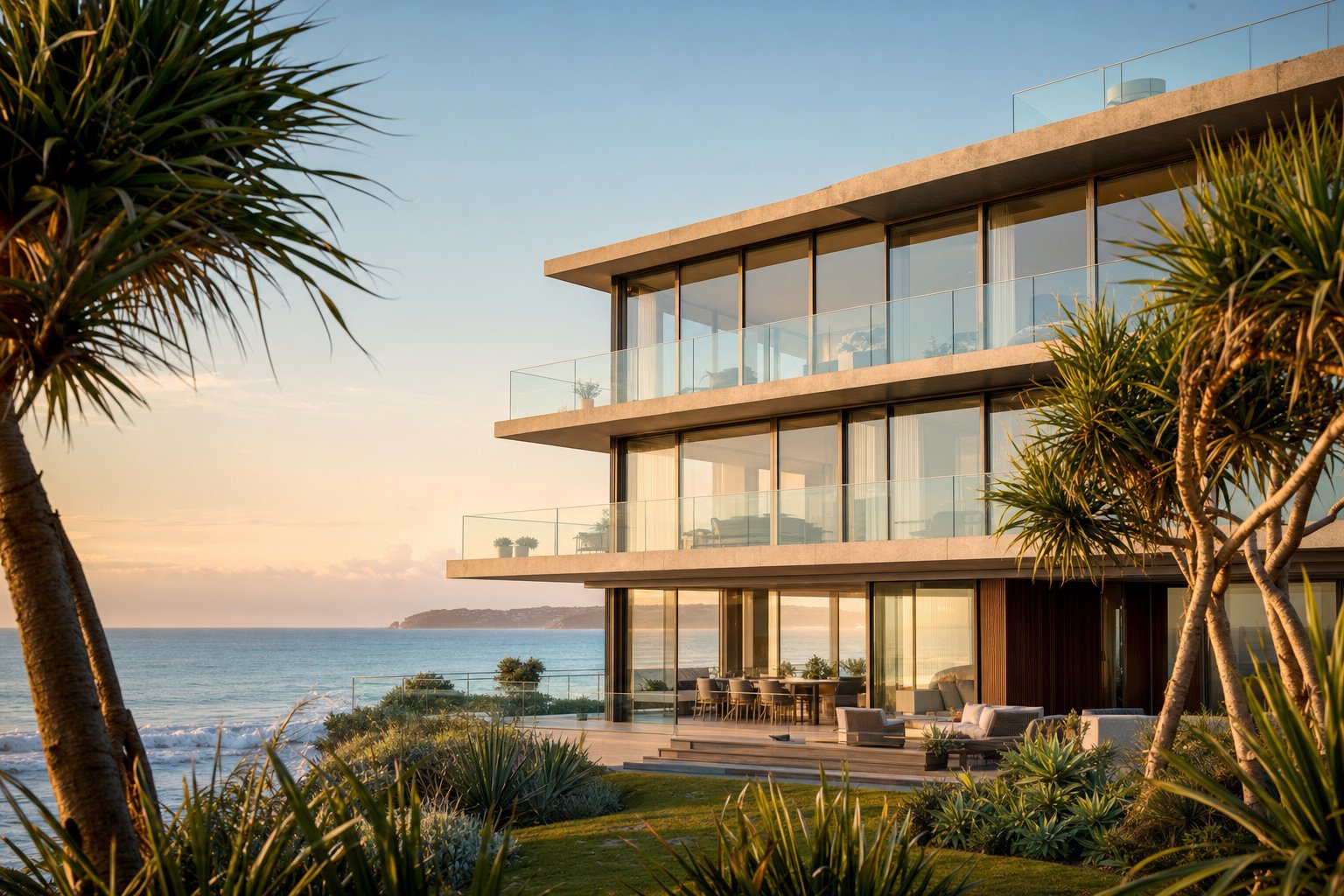
A window specified for a quiet street in suburban Adelaide faces a fundamentally different life than one installed 300 metres from breaking surf on the Sunshine Coast or bolted into a Townsville high-rise within a cyclone-rated zone. Every quality factor discussed so far — alloy, finish, seals, hardware, glazing — remains important regardless of location. But environment amplifies specific stresses and exposes specific weaknesses faster. What counts as adequate inland may be dangerously under-specified at the coast or in the tropical north.
This is where many purchasing decisions go wrong. Buyers compare quotes based on price and appearance alone, without asking whether the product is rated for the conditions it will actually face. A set of aluminum residential windows perfect for a temperate inland suburb can corrode, seal-fail, or structurally weaken within a few years if installed in the wrong environment without appropriate upgrades.
Coastal Environments and Salt Spray Resistance
Salt does not simply sit on surfaces — it actively attacks them. Airborne saline aerosols deposit on aluminium frames, hardware, and seals, breaking down protective coatings and accelerating oxidation in ways that inland environments never replicate. The severity depends on proximity: properties within one kilometre of breaking surf experience the most aggressive exposure, while prevailing onshore winds can push significant salt loading up to five kilometres inland along exposed coastlines.
For residential aluminum windows in these zones, standard specifications are not enough. Coastal-grade systems require enhanced anodising of 25 microns or greater, or powder coating to Qualicoat Seaside certification, which validates performance under sustained salt exposure. Hardware must be 316 marine-grade stainless steel — no exceptions. Standard zinc alloy or 304-grade components develop pitting corrosion within 12 to 24 months in high-salt environments, eventually seizing completely.
Accelerated salt spray testing (conducted to ISO 9227) simulates years of coastal exposure in controlled laboratory chambers. Quality coastal systems achieve 1,000 hours or more of salt spray resistance, which correlates with approximately 15 to 25 years of real-world coastal lifespan depending on maintenance practices. Budget aluminium house windows rarely undergo this testing at all — a significant red flag for any coastal project. Gaskets also require specific formulation: standard EPDM can degrade faster under combined salt, humidity, and UV attack, so marine-rated compounds with enhanced UV and ozone stabilisers are essential for corner joints and compression points where failure initiates first.
Extreme Heat, UV Exposure, and Thermal Cycling
Australia’s inland and northern regions deliver some of the harshest UV radiation on the planet. North-facing elevations in Perth, Darwin, and outback Queensland absorb cumulative UV doses that degrade organic powder coat binders faster than in temperate southern states. Without Class 2 resin formulations or PVDF-based coatings, colour fading and chalking can become visible within five to seven years rather than the expected twenty-plus.
Thermal cycling creates a subtler but equally damaging stress pattern. A dark-coloured aluminium frame in western Sydney can swing from 10 degrees Celsius overnight to over 80 degrees on its sun-facing surface by mid-afternoon in summer. That repeated expansion and contraction — day after day, season after season — stresses every connection between dissimilar materials. Aluminium and glass expand at different rates. Quality systems address this with engineered setting blocks, flexible structural glazing tape, and EPDM gaskets formulated for heat-aging resistance and stable compression set under prolonged high-temperature exposure. Budget systems use generic gaskets that harden, shrink, and crack — losing their sealing force and creating air gaps that worsen with every thermal cycle.
Sealants at the frame-to-substrate junction face the same challenge. UV-stable exterior silicone with high movement capability is non-negotiable for hot climate installations. Sealant embrittlement from sustained heat exposure is one of the most common water ingress causes in northern Australian buildings — and one of the least discussed during the purchasing process.
High-Wind and Cyclonic Regions
Northern Queensland, the Northern Territory, and parts of coastal Western Australia fall within designated cyclone regions where wind loads on building envelopes can reach extreme levels. Windows in these areas are tested to Australian Standard AS 2047 under both positive pressure (wind pushing against the glass) and negative pressure (suction pulling the glass outward). The negative pressure case is often more critical — it tries to pull the glazing out of the frame and tear the window from its fixings.
Water penetration resistance under pressure is tested simultaneously, because cyclonic conditions drive rain horizontally at velocities that overwhelm standard drainage systems. Quality systems for these regions use deeper frames, thicker profiles, reinforced mullion connections, and impact-resistant glazing — often laminated safety glass capable of withstanding windborne debris. The profile wall thickness, chamber geometry, and hardware anchoring discussed in earlier sections all become load-critical rather than merely desirable.
Each of these climate zones shifts the hierarchy of quality priorities:
- Coastal (within 1–5 km of surf):
- Marine-grade hardware (316 stainless steel)
- Enhanced corrosion protection (Qualicoat Seaside or 25+ micron anodising)
- Salt-rated EPDM gaskets with UV/ozone stabilisers
- Extreme heat and high UV (inland, northern, and western exposures):
- Class 2 powder coat resins or PVDF finish systems
- Heat-rated EPDM compounds with verified compression set performance
- Engineered thermal expansion management between frame and glazing
- High-wind and cyclonic regions (tropical north, exposed coastal sites):
- Positive and negative wind pressure ratings compliant with AS 2047 for the site’s wind classification
- Impact-resistant laminated glazing
- Reinforced frame profiles with enhanced fixing and anchoring details
Many Australian projects fall into more than one category simultaneously. A beachfront home in Cairns faces salt exposure, extreme UV, high humidity, and cyclonic wind loads — demanding the highest specification across every quality pillar. Specifying for just one of those stresses while ignoring the others guarantees premature failure somewhere in the system.
Climate-specific performance is verifiable through testing and documentation, not through assurances. The question for any buyer is not just whether a window meets general quality benchmarks, but whether the manufacturer can demonstrate — through test data and certification — that the specific product configuration handles the conditions at the actual installation site. That documentation trail is where genuine quality separates itself from claims, and where red flags become easiest to spot.
Quality Red Flags That Reveal Substandard Aluminium Windows
Documentation and testing prove quality. Their absence reveals the opposite. Knowing what to look for — both on the physical product and within the quoting process — saves you from discovering the pros and cons of aluminium windows the hard way: through premature failure, costly repairs, and regret. These warning signs are the ones suppliers rarely volunteer, because acknowledging them means admitting that not everything on the market deserves your trust.
Visual and Structural Red Flags During Inspection
You do not need laboratory equipment to spot a substandard aluminium window. A careful hands-on inspection reveals more than most buyers realise. Run your fingers along the mitre joints at each corner — visible weld marks, grinding scratches, or uneven gaps indicate rushed fabrication with poor tolerances. Push firmly on the centre rail of a closed sash. Excessive flex suggests the profile wall thickness sits below the 1.4 mm minimum that quality systems maintain. Lightweight, hollow-feeling handles that wobble on their spindles are another giveaway; compare them to the solid, precisely machined hardware found on properly engineered systems.
Check for weatherseal configuration. A single rubber channel running around the frame perimeter is a budget shortcut — quality windows use dual or triple compression seal systems. Look at the exterior face of the frame: are there drainage slots at the base of the sash rebate? Missing or minimal drainage means water will pool inside the profile rather than escaping, accelerating internal corrosion that remains invisible until structural damage is done. Finally, ask whether a thermal break is present. If the supplier cannot show you the polyamide barrier in a cross-section sample, assume it does not exist.
Quote and Specification Red Flags
The purchasing process itself often exposes quality problems before a product is ever delivered. When reviewing quotes, vagueness is your clearest warning sign. A reliable specification names the profile system, alloy grade, thermal break width, and U-value. A quote describing simply “aluminium windows” without technical detail is hiding something — often that the product lacks the engineering to back up specific claims.
Understanding the disadvantages of aluminium at the budget end helps here: without proper thermal breaks, quality finishes, and engineered seals, cheap aluminium frames amplify heat transfer and condensation rather than preventing them. These are not inherent flaws of the material — they are consequences of poor specification. The aluminium pros and cons debate only makes sense when you compare like with like, and red flags in the quoting process tell you the comparison is not equal.
- No thermal break specified — the single largest performance compromise, eliminating energy efficiency and condensation control entirely.
- Profile wall thickness under 1.4 mm or unspecified — indicates a structural shortcut affecting security, rigidity, and hardware anchoring.
- Inability to provide test certification documentation — no AS 2047 compliance report means performance claims are unverified.
- Warranty shorter than 10 years on frame or 5 years on hardware — signals low manufacturer confidence in longevity.
- Vague specifications omitting alloy grade or profile system name — prevents you from independently verifying the product.
- No mention of U-value or thermal performance data — suggests the product has not been tested or would perform poorly.
- Single-channel weatherseals with no drainage design — a water ingress and corrosion failure waiting to happen.
- Lightweight, unbranded hardware with no cycle-test rating — early operational failure and compromised security.
Any supplier unwilling to provide specific technical documentation and independent test results should be treated with caution regardless of price point. Transparency is not optional — it is the minimum standard of a quality-focused manufacturer.
These red flags matter whether you are weighing the windows pros and cons for a single renovation or specifying hundreds of openings on a commercial project. The next logical question is: what documentation actually constitutes proof of quality, and which industry standards give that proof objective weight?
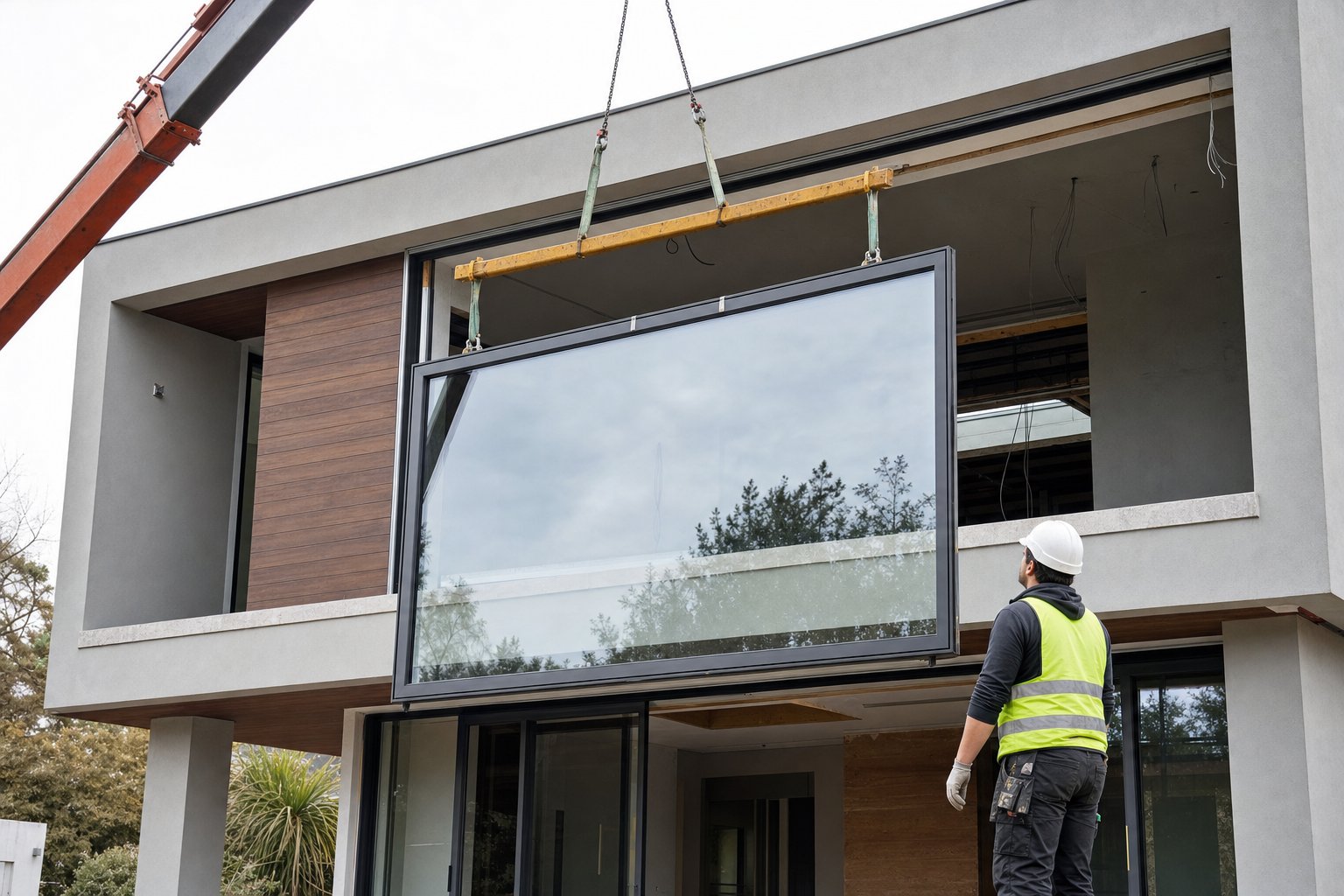
Industry Standards and Certifications That Prove Genuine Quality
Red flags tell you what to avoid. Standards and certifications tell you what to trust. The difference between marketing claims and verified performance comes down to one thing: whether an independent third party has tested the product and documented the results. In Australia, that verification framework is well established — but surprisingly few buyers, and even some specifiers, understand what each standard actually validates or how to confirm a product genuinely holds the certifications a supplier claims.
National and International Standards for Aluminium Windows
The backbone of window performance verification in Australia is Australian Standard AS 2047 — the national standard governing windows and external glazed doors. It is not optional. The National Construction Code (NCC) references AS 2047 directly, meaning every window installed in a new build or major renovation must comply. What makes it meaningful is the breadth of what it tests: structural adequacy under wind pressure, water penetration resistance during driven rain, air infiltration limits that affect energy performance, and operating force to ensure accessibility. A window certified to AS 2047 has been physically tested under controlled laboratory conditions by a NATA-accredited facility — not merely declared compliant by its manufacturer.
Wind loads are covered separately under AS 1170.2, which defines the design wind speeds for every location and building height classification across Australia. This standard feeds directly into AS 2047 testing: a window rated for suburban Brisbane at ground level faces a different pressure requirement than the same window installed at level eight of a Darwin apartment tower. The combination of both standards ensures the product is validated for the specific conditions it will face, not just a generic benchmark.
Beyond performance testing, AS 1288 governs glazing selection and installation — ensuring the correct glass type (annealed, toughened, or laminated) is specified based on location, panel size, and human impact risk. For any aluminium windows company operating legitimately in the Australian market, compliance across AS 2047, AS 1170, and AS 1288 forms the non-negotiable baseline. European EN standards (such as EN 14351-1 for performance characteristics of windows and doors) serve a similar function for imported systems, though Australian projects always require local compliance verification regardless of international certifications held.
The key standards and what each validates:
- AS 2047 (Windows and External Glazed Doors) — Structural integrity under wind pressure, water penetration resistance, air infiltration limits, and operating force compliance.
- AS 1170.2 (Wind Actions) — Site-specific design wind speeds that determine the pressure ratings a window must achieve for its installation location and height.
- AS 1288 (Glass in Buildings) — Correct glass type selection, thickness, and installation method based on human impact risk, panel dimensions, and location within the building.
- NCC (National Construction Code) — The overarching regulatory framework referencing AS 2047 for compliance, plus energy efficiency requirements validated through NatHERS or WERS ratings.
- WERS (Window Energy Rating Scheme) — Independent energy performance rating covering U-value, solar heat gain coefficient, and air infiltration, allowing direct product comparison.
Quality Marks and Manufacturer Certifications
Standards define what must be achieved. Quality marks verify that a manufacturer achieves it consistently — not just on a single sample sent to a laboratory, but across every unit leaving the production line. This distinction matters. A one-off test report proves a product can meet a standard under ideal conditions. A quality management certification proves the manufacturer maintains that level reliably over time.
Membership in organisations like the Australian Glass and Window Association (AGWA) requires documented quality management systems, regular third-party auditing, full material traceability, and warranties backed by independently verified test data. AGWA members have their products tested by NATA-accredited laboratories and commit to ongoing compliance monitoring — meaning the window you receive should perform identically to the one that passed certification testing. Aluminum windows news from the industry consistently highlights that AGWA-accredited manufacturers demonstrate lower warranty claim rates and higher long-term customer satisfaction, precisely because ongoing auditing catches production drift before it reaches the customer.
For specifiers and architects, the practical question is straightforward: can the manufacturer provide the test report for the specific configuration you are specifying — not just a generic system certificate, but performance data for the exact size, glazing type, and opening style your project requires? Reputable manufacturers make this documentation readily accessible rather than treating it as proprietary information. Those committed to transparency publish their compliance certifications and test data openly — MEICHEN’s compliance page, for example, documents their adherence to Australian standards for performance, energy efficiency, weather resistance, and durability, allowing architects and specifiers to verify claims against published data rather than relying on verbal assurances.
This level of documentation access is not unusual among quality-focused manufacturers — but its absence is a red flag. An aluminium windows company that cannot or will not provide configuration-specific test reports, compliance certificates, or a clearly documented quality management process is asking you to accept unverified claims. In a market where aluprof windows and other international systems increasingly enter the Australian supply chain, verifying local compliance independently becomes even more critical. An EN certification earned in Europe does not automatically satisfy AS 2047 requirements. Always confirm that Australian-standard testing has been completed by a NATA-accredited laboratory, regardless of what other international marks the product may carry.
Certifications validate performance. But translating that knowledge into a practical purchasing decision requires a structured approach — a way to systematically compare products, suppliers, and documentation side by side before committing. That comparison tool is what separates informed specifiers from hopeful buyers.
Your Aluminium Window Quality Assessment Checklist
Knowing what separates quality from marketing is only useful if you can apply that knowledge in real time — when sitting across from a sales rep, reviewing a specification document, or comparing three quotes side by side. The checklist below consolidates everything discussed in this article into a structured evaluation tool. Print it, save it, or pull it up on your phone during showroom visits. Each row represents a specific question you should ask, paired with what a quality-focused response actually looks like.
Pre-Purchase Quality Evaluation Checklist
The advantages of aluminum windows — strength, slim sightlines, recyclability, and design flexibility — only materialise when the product is genuinely well-engineered. Use this table to verify that a supplier’s offering delivers on those benefits rather than trading on the material’s reputation alone.
| Quality Factor | What to Ask the Supplier | Acceptable Quality Response |
|---|---|---|
| Alloy grade | What alloy and temper designation is used in your profiles? | 6063-T5 or 6063-T6 for standard applications; 6061-T6 for large structural spans. Named and documented. |
| Wall thickness | What is the minimum profile wall thickness? | 1.4 mm minimum; 1.6–2.0 mm for premium and high-wind systems. Stated in writing on the quote. |
| Thermal break width | What thermal break material is used and how wide is it? | PA66 GF25 polyamide; minimum 20 mm for residential, 34 mm+ for high-performance. U-value data provided. |
| Coating type and thickness | Is the powder coat Qualicoat-certified? What thickness and pre-treatment? | Minimum 60 microns; chromate or chrome-free conversion coating confirmed; Qualicoat Class 1 or 2 documented. |
| Finish warranty | What is the warranty period on the coating or anodised finish? | Minimum 10 years against peeling, blistering, and excessive colour shift. Written warranty document available. |
| Hardware material | What grade of stainless steel is used for hinges, stays, and locks? | 304 stainless for inland; 316 marine grade for coastal. Branded, traceable hardware system named. |
| Cycle testing | How many open-close cycles has the hardware been tested to? | Minimum 20,000 cycles certified by the hardware manufacturer. Test documentation available on request. |
| IGU specification | What glazing unit construction is standard — spacer type, gas fill, glass thickness? | Warm-edge spacer (e.g. Super Spacer or TGI), argon gas fill, minimum 20 mm cavity. Full IGU spec sheet provided. |
| Seal system | How many compression seal lines are used, and what material? | Dual or triple EPDM compression seals. Pressure-equalised drainage between seal lines confirmed. |
| Standards compliance | Can you provide AS 2047 test reports for this specific configuration? | Configuration-specific NATA-accredited test report provided — not just a generic system certificate. |
| Frame warranty | What warranty covers the frame against structural and corrosion failure? | Minimum 10 years; quality manufacturers offer 15–25 years on frame integrity. |
How long do aluminum windows last? With the right specification, 40 to 60 years is realistic — far exceeding timber and uPVC alternatives. But that lifespan is only achievable when every row in the table above receives a satisfactory answer. Skip the verification, and you may discover the benefits of aluminum windows were never delivered to your particular project.
Using Documentation to Verify Quality Claims
The single most reliable differentiator between quality manufacturers and the rest is documentation transparency. Reputable suppliers do not treat compliance data as proprietary. They publish it, share it proactively, and welcome scrutiny. If requesting a test report or certification document creates hesitation or delay, that tells you more than any brochure ever could.
One of the pros of aluminum as a window material is its long track record in commercial and architectural applications — decades of testing, refinement, and standards development that generate extensive performance data. Quality manufacturers leverage this by providing detailed technical specifications for every system they offer: U-values, air permeability classes, water penetration ratings, wind load classifications, and acoustic performance. Readers evaluating suppliers can reference MEICHEN’s compliance page as an example of the documentation depth and transparency that characterises quality-focused manufacturers — covering performance standards, energy efficiency, weather resistance, and durability certifications relevant to Australian project requirements.
When comparing affordable aluminum windows against premium options, the documentation gap is often more revealing than the price gap. A lower quote might simply reflect a product that has never been independently tested — meaning you are paying less but receiving no verified assurance of performance. The smart comparison is not price alone; it is price relative to documented, certified capability. Request the paperwork. Compare it side by side. Let the evidence decide.
Aluminium Windows Quality: Frequently Asked Questions
1. How can I tell if aluminium windows are high quality?
Genuine quality is verified through measurable factors rather than marketing language. Check the profile wall thickness (minimum 1.4 mm for quality systems), confirm the alloy grade is 6063-T5 or T6, look for a polyamide thermal break of at least 20 mm width, and verify dual or triple EPDM compression seals with engineered drainage. Request AS 2047 test reports for the specific configuration you are purchasing. Manufacturers committed to quality, such as MEICHEN, publish their compliance certifications openly at their compliance page (meichenwindows.com.au/compliance), allowing you to verify performance claims against documented Australian standards.
2. How long do quality aluminium windows last in Australian conditions?
Well-specified aluminium windows can last 40 to 60 years, significantly outlasting timber and uPVC alternatives. However, this lifespan depends on correct specification for the installation environment. Coastal properties require marine-grade 316 stainless steel hardware and Qualicoat Seaside certified finishes, while high-UV inland locations need Class 2 resin powder coatings. The frame warranty should be a minimum of 10 years, with quality manufacturers offering 15 to 25 years. Regular maintenance and correct climate-specific specification are what bridge the gap between theoretical lifespan and real-world durability.
3. What is a thermal break in aluminium windows and why does it matter?
A thermal break is a continuous PA66 polyamide strip (reinforced with 25% glass fibre) that physically separates the inner and outer aluminium faces of the window frame. Since aluminium conducts heat roughly 1,000 times faster than timber, this barrier is essential for energy efficiency. Break widths range from 20 mm in standard systems to 40 mm or more in high-performance units. A non-thermally broken aluminium frame has a U-value around 5.0 W/m2K, while a quality thermally broken system can achieve 1.5 W/m2K or lower — representing up to 85% reduction in heat transfer. This directly affects NatHERS compliance, energy bills, and condensation resistance.
4. What certifications should I look for when buying aluminium windows in Australia?
The essential certification is AS 2047 compliance, tested by a NATA-accredited laboratory for your specific window configuration — not just a generic system certificate. Beyond this, look for AS 1170.2 wind load compliance matched to your site location, AS 1288 glazing compliance, WERS energy ratings for thermal performance comparison, and Qualicoat certification on the powder coat finish. Quality manufacturers also hold AGWA membership, which requires documented quality management systems and regular third-party auditing. Always request the actual test reports rather than accepting verbal assurances of compliance.
5. Are aluminium windows suitable for coastal homes in Australia?
Aluminium windows perform excellently in coastal environments when correctly specified, but standard inland specifications will fail prematurely near the coast. Properties within 1 to 5 kilometres of breaking surf require enhanced corrosion protection: 316 marine-grade stainless steel hardware (not 304 grade), powder coating to Qualicoat Seaside certification or anodising at 25 microns minimum, and marine-rated EPDM gaskets with UV and ozone stabilisers. Quality coastal systems achieve over 1,000 hours of accelerated salt spray testing (ISO 9227), correlating with 15 to 25 years of real-world coastal performance. Ask suppliers specifically about their salt spray test results and coastal warranty terms.
More Window & Door Guides