
What Causes Condensation on Aluminium Window Frames
You wake up on a cold morning, and there it is: water droplets clinging to your aluminium window frames. Your first thought might be that something is wrong with the windows themselves. It’s a reasonable assumption, but it’s almost always the wrong one.
What Condensation on Aluminium Windows Actually Is
Condensation on aluminium window frames occurs when warm, moisture-laden indoor air contacts a surface cold enough to drop below the dew point temperature. At that threshold, water vapour in the air transitions from gas to liquid, depositing as visible droplets on the frame or glass.
This is pure physics. The same process fogs up a cold glass of water on a humid day. Your aluminium frames aren’t leaking, broken, or defective. They’re simply providing a surface where the temperature difference between inside and outside becomes visible.
Daily activities drive indoor moisture levels higher than most people realise. Cooking, showering, breathing, and drying laundry indoors all release water vapour into the air. When that humid air meets a cold surface, condensation is the inevitable result.
Why Aluminium Frames Are More Susceptible Than You Think
Here’s where material science enters the picture. Aluminium has a thermal conductivity of approximately 237 W/mK, compared to timber at around 0.12 W/mK. That’s nearly 2,000 times more conductive. In practical terms, aluminium transfers heat (and cold) through its structure far more rapidly than timber or uPVC, which means the interior face of an aluminium frame can cool down quickly when outdoor temperatures drop.
This conductivity is precisely what makes aluminium such a strong, slim, and structurally versatile framing material. But it also means that without proper engineering intervention, the inside surface of the frame can become cold enough to trigger condensation on aluminium window frames, particularly during winter.
The critical point: this isn’t a flaw in the material. It’s a known characteristic that modern thermally broken aluminium systems are specifically designed to counteract. Understanding the difference between a material property and a product failure is the first step toward solving the problem rather than blaming the frame.
The real question isn’t whether aluminium conducts heat. It does. The question is how that conductivity interacts with your home’s humidity levels, ventilation, and the thermal design of the window system itself.
The Science Behind Thermal Bridging and Dew Point
That interaction between conductivity, humidity, and temperature has a name in building science: it revolves around the dew point. Getting a handle on this concept explains not just why aluminium window condensation occurs, but exactly when it will and won’t happen in your home.
Dew Point and Surface Temperature Relationship
The dew point is the temperature at which air becomes fully saturated and can no longer hold its moisture as vapour. Drop any surface below that threshold, and water appears. It’s the same reason a cold beer glass “sweats” on a summer afternoon in Brisbane — the glass isn’t leaking; the surrounding air is depositing moisture onto it.
Inside your home, the dew point shifts depending on how much moisture the air carries. At 21°C with 60% relative humidity, the dew point sits around 12.6°C. If the interior surface of your window frame falls below that temperature, condensation forms. The warmer and more humid your indoor air, the higher the dew point climbs — and the easier it becomes for condensation on aluminium windows to appear.
Several factors determine where your home’s dew point lands at any given moment:
- Indoor humidity level — higher moisture content raises the dew point closer to room temperature
- Outdoor temperature — colder external conditions pull frame surface temperatures down
- Ventilation rate — stale, moisture-rich air accumulates when airflow is restricted
- Room usage — kitchens, bathrooms, and bedrooms with closed doors generate localised humidity spikes
How Thermal Bridging Creates Cold Spots on Frames
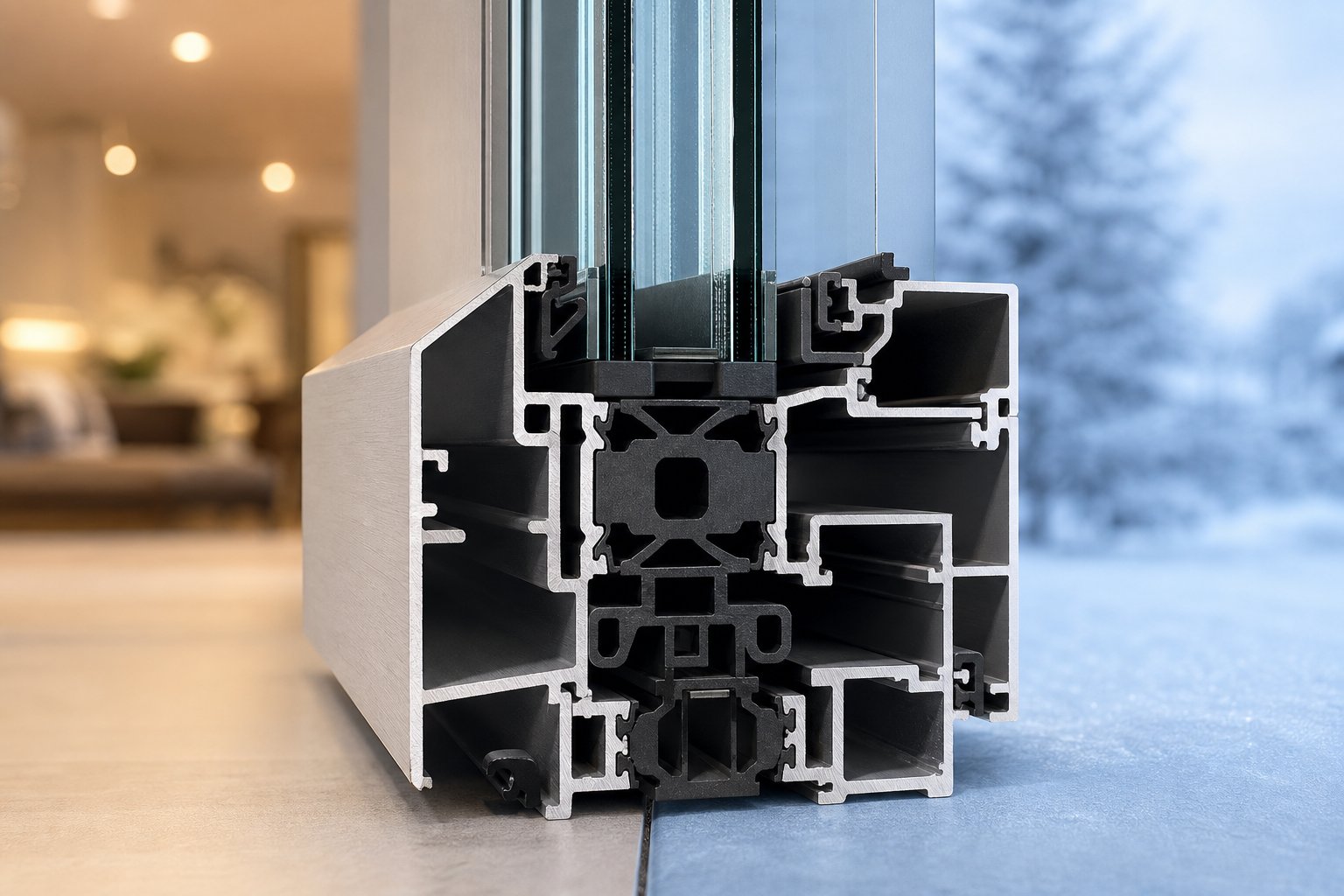
Thermal bridging occurs when a highly conductive material creates an uninterrupted path for heat to escape through the building envelope. In an aluminium window frame without a thermal break, the metal section runs continuously from inside to outside. Because aluminium conducts heat at approximately 237 W/mK, the interior face of that frame rapidly approaches outdoor temperatures on cold nights.
Picture a Melbourne winter evening at 5°C outside. An unbroken aluminium frame essentially acts as a heat highway, pulling warmth out of your room and allowing cold to travel inward. The result is a localised cold spot — a patch of frame surface sitting well below the dew point of your indoor air. That’s where aluminium window frame condensation concentrates: not across the entire window, but specifically on the coldest sections of the frame profile.
Research into thermal bridging in aluminium framing systems indicates these bridges can account for up to 30% of heat loss in well-insulated buildings. The condensation you see is actually a visible symptom of energy escaping through the frame.
Why Thermal Breaks Change the Equation
Modern thermally broken aluminium windows tackle this problem at its source. A thermal break is a strip of low-conductivity material — typically polyamide (nylon) — inserted between the interior and exterior aluminium sections of the frame. This strip interrupts the conductive path, preventing heat from flowing freely through the metal.
The effect is significant. By severing that thermal highway, the interior face of the frame stays much warmer. Instead of approaching outdoor temperatures, it remains closer to room temperature — ideally above the dew point. Studies show thermal breaks can reduce heat loss through the frame by up to 50%, which directly translates to a warmer interior surface and far less condensation risk.
Polyamide is the preferred material for these breaks because it combines low thermal conductivity with structural strength, allowing slim frame profiles without sacrificing performance. The depth and design of the thermal break matter too — a deeper break provides greater separation between the cold outer shell and the warm inner face.
This is why condensation aluminium windows experienced a decade ago is far less common with current systems. The frame material hasn’t changed, but the engineering has. A well-specified thermally broken aluminium window keeps its interior surfaces above dew point under normal indoor conditions, making condensation the exception rather than the rule.
Of course, even the best-performing frame can’t overcome extreme indoor humidity or inadequate ventilation. The thermal break raises the bar, but the environment inside your home still plays a decisive role — and that environment varies dramatically from one room to the next.
Three Types of Condensation and What Each Means
Not all condensation on aluminium windows tells the same story. Where the moisture appears — inside, outside, or trapped between the panes — changes the diagnosis entirely. Some forms are harmless, one is actually a good sign, and another signals a genuine problem that needs attention. Knowing which is which saves you from unnecessary worry or, worse, ignoring something that requires action.
Internal Condensation on the Room Side
This is the type most homeowners notice first. Water droplets or a film of moisture forms on the interior surface of the glass or frame, typically overnight or during cold mornings. Aluminium windows condensation inside the home is driven by the same dew point mechanics covered earlier: warm, humid indoor air meets a surface cold enough to trigger the phase change from vapour to liquid.
Internal condensation is the most common complaint, but it’s also the most manageable. It doesn’t indicate a faulty window or a broken seal. It indicates that indoor humidity is too high relative to the surface temperature of the glass or frame. Cooking without an extractor fan, drying clothes indoors, or sleeping in a closed bedroom all push humidity levels up. When outdoor temperatures drop, the inner pane cools just enough to cross that dew point threshold.
Left unchecked over time, persistent internal condensation can encourage mould growth on surrounding walls and window sills. But the fix lies in controlling the indoor environment — ventilation, humidity management, and adequate heating — rather than replacing the window itself.
External Condensation as a Sign of Efficiency
Finding moisture on the outside of your windows can be alarming if you don’t know what it means. Counterintuitively, external condensation is a strong indication that the window system has high insulating properties. It means the glazing unit is doing exactly what it should: keeping indoor heat inside and preventing it from warming the outer pane.
Here’s the mechanism. On still, clear nights — particularly common in autumn and early winter across southern Australia — the outer glass surface radiates heat and cools below the dew point of the outside air. Because the double or triple glazing is effectively blocking heat transfer from inside, the outer pane stays cold. Humid morning air then deposits moisture on that cold exterior surface, just as dew forms on a car windscreen.
This phenomenon tends to appear most often with high-performance condensation aluminium double glazed windows. Older, poorly insulating windows actually let enough heat escape to keep the outer pane warm, which prevents external condensation. So if you see it on your new aluminium windows, it’s confirmation that the thermal performance is working as designed. It typically evaporates within an hour or two as the sun warms the glass.
Interstitial Condensation and Seal Failure
This is the one that warrants concern. Interstitial condensation appears as a foggy haze or visible moisture trapped between the glass panes of a sealed double or triple glazed unit. You can’t wipe it away from either side because it’s inside the sealed cavity.
Double and triple glazed units rely on an airtight perimeter seal to keep the insulating gas (argon or krypton) locked between the panes. When that seal degrades — through age, poor manufacturing, or physical damage — moisture-laden air enters the cavity, and the insulating gas escapes. The result is permanent misting that worsens over time, reduced thermal performance, and compromised energy efficiency.
Unlike internal or external condensation, interstitial condensation cannot be resolved through ventilation or humidity control. The sealed unit has failed and needs replacement. The aluminium frame itself is typically unaffected — it’s the glazing unit that requires attention, not the entire window assembly.
| Type | Location | Primary Cause | Severity | Recommended Action |
|---|---|---|---|---|
| Internal | Room-facing surface of glass or frame | High indoor humidity meeting cold surface | Low to moderate — manageable | Improve ventilation, reduce humidity, maintain heating |
| External | Outside surface of outer pane | Cold outer glass below outdoor dew point | None — sign of good insulation | No action needed; clears naturally |
| Interstitial | Between sealed glass panes | Perimeter seal failure allowing moisture ingress | High — indicates unit failure | Replace the sealed glazing unit |
The practical takeaway is straightforward. If you’re seeing condensation on aluminium windows on the room side, the solution sits within your control through environmental adjustments. If it’s on the outside, you can relax — your windows are performing well. And if it’s trapped between the panes, contact your installer or glazier about replacing the sealed unit rather than the entire frame.
Identifying the type correctly matters because each points to a completely different cause — and a completely different response. But it also raises a fair question: does the frame material itself make one type more likely than another? That depends on how aluminium stacks up against the alternatives in managing heat transfer.
Aluminium vs uPVC vs Timber for Condensation Risk
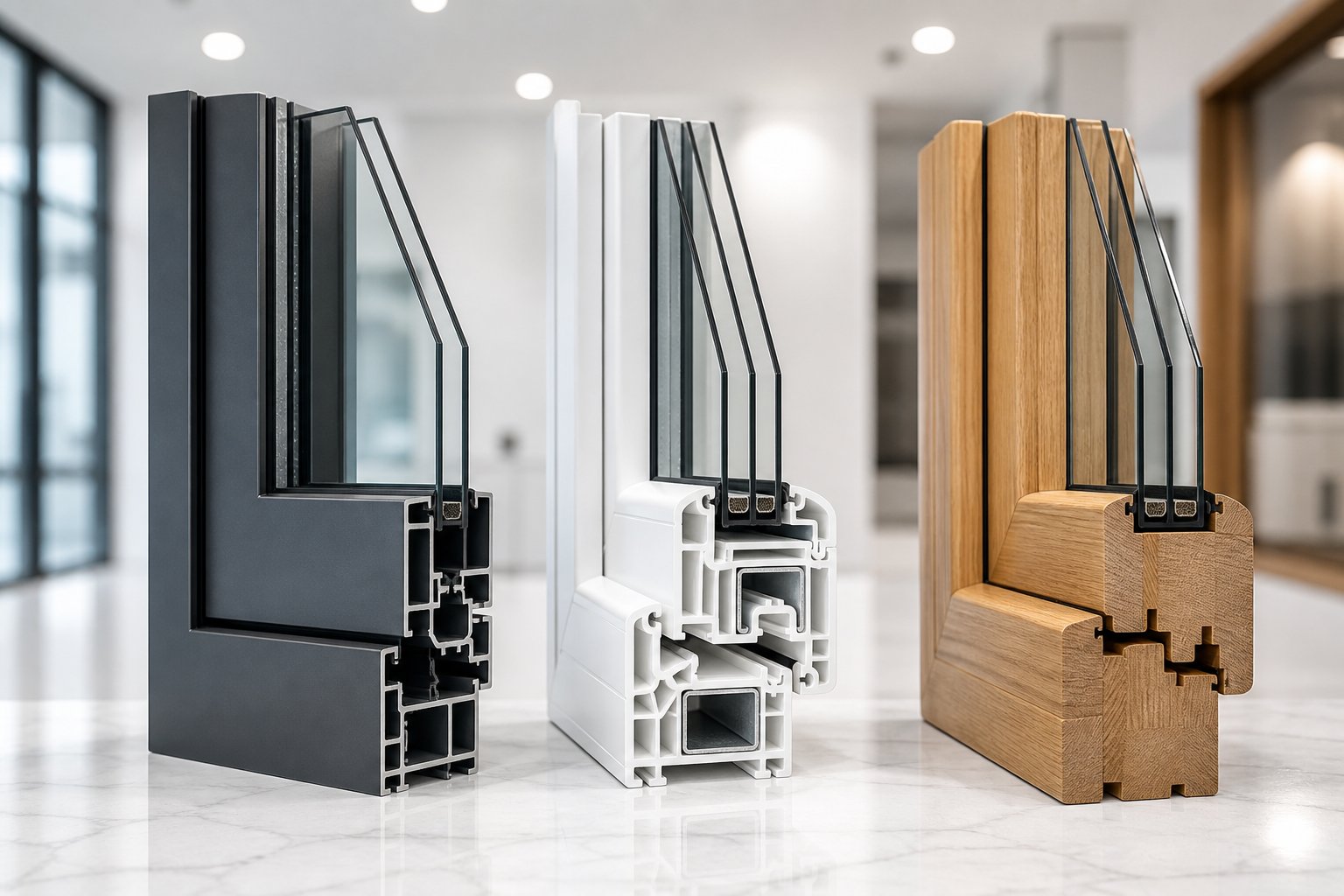
The raw thermal conductivity numbers paint a stark picture. Aluminium sits at roughly 160–200 W/mK, while uPVC lands around 0.15–0.25 W/mK and softwood timber around 0.10–0.15 W/mK. On paper, aluminium conducts heat hundreds of times faster than either alternative. So do aluminium windows cause condensation more readily? In their unmodified state, yes. But “unmodified” is the key qualifier — and it’s where most comparisons stop too early.
Aluminium Frames With and Without Thermal Breaks
A non-thermally broken aluminium frame behaves like a direct thermal conduit between indoors and outdoors. Indicative frame U-values (Uf) for these older systems typically fall in the 5.5–7.0 W/m²K range, producing whole-window values (Uw) above 3.0 W/m²K even with decent double glazing. The interior surface stays cold, and condensation follows predictably.
Introduce a polyamide thermal break, and the picture shifts dramatically. Modern aluminium windows condensation performance improves because thermally broken systems achieve Uf values of roughly 2.5–4.0 W/m²K and whole-window Uw values around 2.0–2.7 W/m²K with appropriate glass. That puts them within striking distance of uPVC — close enough that the frame material alone no longer determines whether you’ll see moisture on a winter morning.
uPVC Multi-Chamber Insulation Approach
uPVC tackles heat transfer through profile design rather than material intervention. Multi-chamber construction — typically five to seven hollow chambers within the frame — traps pockets of still air that resist conductive and convective heat flow. The result is consistent thermal performance without needing an additional break element.
Typical double glazed uPVC windows deliver Uf values around 1.5–2.5 W/m²K and whole-window Uw values in the 1.8–2.4 W/m²K range. That inherent insulating ability means the interior frame surface stays warmer relative to room temperature, reducing condensation risk without relying on engineering add-ons. For standard residential applications, uPVC delivers predictable thermal results across most product lines.
Timber Natural Insulation Properties
Timber’s cellular structure provides natural thermal resistance. Softwood frames typically achieve Uf values of 1.4–2.2 W/m²K, placing them alongside uPVC for condensation resistance. The frame surface stays relatively warm, and double glazed aluminium windows condensation complaints rarely have an equivalent in well-maintained timber installations.
The trade-off is maintenance. Timber demands regular painting or staining every three to seven years to prevent moisture ingress and decay — particularly in exposed coastal or high-humidity locations common across Australia. Left unprotected, the very moisture resistance that makes timber thermally appealing can be undermined by the material absorbing water and deteriorating.
| Factor | Aluminium (Non-Thermally Broken) | Aluminium (Thermally Broken) | uPVC | Timber |
|---|---|---|---|---|
| Thermal Conductivity | 160–200 W/mK | Interrupted by polyamide break | 0.15–0.25 W/mK | 0.10–0.15 W/mK |
| Condensation Risk (Unmodified) | High | Low to moderate | Low | Low |
| Available Thermal Solutions | Thermal break strips, aerogel inserts | Already integrated | Multi-chamber profiles, foam filling | Natural cellular structure; composite cladding options |
| Durability | 40–60 years | 40–60 years | 25–40 years | 30–50 years (with maintenance) |
| Maintenance | Minimal — periodic cleaning | Minimal — periodic cleaning | Low — cleaning and hardware checks | High — regular painting, sealing, inspection |
The comparison reveals something important: frame material is only one variable in the condensation equation. Two homes with identical aluminium frames can have completely different condensation outcomes depending on glazing specification, installation quality, indoor humidity levels, and ventilation habits. A thermally broken aluminium window paired with high-performance double glazing and warm-edge spacers can outperform a poorly installed uPVC window with basic glass.
Framing the question as “which material causes condensation” misses the point. The real question is how the complete window system — frame, glass, spacers, seals, and installation — performs as a unit. And within that system, the glazing itself often has more influence on condensation than the frame material surrounding it.
Glazing Options That Reduce Condensation in Aluminium Frames
The glass does more heavy lifting than most people give it credit for. While frame material gets the blame when moisture appears, it’s the glazing unit — its construction, gas fill, and coatings — that largely determines how warm the inner pane stays on a cold night. Pair the right glass specification with a thermally broken aluminium frame, and condensation shifts from a recurring frustration to an occasional edge case.
Single Glazed Aluminium and Condensation Challenges
Single glazing in an aluminium frame is essentially a condensation guarantee during cooler months. With nothing but a single pane of glass separating indoor warmth from outdoor cold, the interior surface temperature drops rapidly. There’s no insulating cavity, no gas fill, and no low-E coating to slow heat loss. The inner glass surface can fall to within a few degrees of the outdoor temperature on a still winter night.
In a typical southern Australian winter — say 5°C overnight in Melbourne or Adelaide — a single glazed aluminium window’s inner surface might sit around 7–9°C. With indoor air at 20°C and 50% relative humidity, the dew point lands near 9.3°C. That’s right at or below the glass temperature, meaning condensation forms readily and often heavily. Add the unbroken aluminium frame conducting cold inward, and you get moisture on both the glass and the frame simultaneously.
Single glazed aluminium windows remain common in older Australian homes, particularly pre-1990s construction. They were standard before energy efficiency requirements tightened. If you’re dealing with persistent condensation on aluminium window frames of this era, the glazing is almost certainly the primary culprit — not the aluminium itself.
Double Glazed Performance in Aluminium Frames
Double glazing transforms the equation by introducing an insulating cavity between two panes of glass. That cavity — typically 12–16 mm wide — traps a layer of gas that dramatically slows heat transfer. The inner pane stays warmer because it’s shielded from the cold outer pane by this insulating barrier.
The gas fill within that cavity matters more than most homeowners realise. Standard air provides some insulation, but argon gas is roughly six times denser than air, which reduces convection currents within the cavity and slows heat transfer further. Argon performs optimally in a gap width of approximately 12–13 mm, making it the standard choice for residential double glazing. The result is a measurably warmer inner pane — often 5–8°C warmer than a single glazed equivalent under the same conditions.
For condensation on aluminium windows, this temperature lift is critical. Raising the inner glass surface from 8°C to 14–16°C pushes it comfortably above the dew point under normal indoor humidity levels. Double glazed aluminium windows with argon fill and a thermally broken frame can keep interior surfaces warm enough to prevent condensation in all but the most humid indoor environments.
The spacer bar separating the two panes also plays a role. Traditional aluminium spacers create a thermal bridge at the glass edge — a cold ring around the perimeter where condensation tends to appear first. Warm edge spacers demonstrate thermal conductivity rates up to 950 times lower than aluminium spacers, maintaining more consistent temperatures across the entire glass surface and reducing that characteristic edge condensation.
When Triple Glazing Makes Sense
Triple glazing adds a third pane and a second insulating cavity, pushing the inner glass surface temperature even closer to room temperature. In extremely cold climates or homes with naturally high humidity — think large families, indoor pools, or properties in alpine regions — triple glazing provides an additional margin of safety against condensation.
Krypton gas is approximately six times denser than argon and performs optimally in narrower cavities of 6–9 mm. This makes it the preferred fill for triple glazed units, where fitting three panes into a standard frame depth requires thinner gaps. The combination of two krypton-filled cavities and three panes delivers exceptional thermal resistance, keeping the inner surface within 1–2°C of room temperature even during severe cold snaps.
For most Australian climates, well-specified double glazing in a thermally broken aluminium frame handles condensation effectively. Triple glazing becomes worth considering in alpine areas, consistently cold southern regions, or where indoor humidity is difficult to control due to building use.
The glazing specifications that influence condensation performance include:
- Gas fill type — argon suits standard double glazing cavities (12–13 mm); krypton suits narrower triple glazing cavities (6–9 mm) and delivers higher insulating performance
- Spacer bar material — warm edge spacers (polymer or foam-based) prevent the cold perimeter ring that aluminium spacers create at the glass edge
- Cavity width — optimal insulation occurs at specific widths matched to the gas type; too narrow or too wide reduces effectiveness
- Low-E coating position — a low-emissivity coating on the inner face of the outer pane (surface 2) reflects radiant heat back into the cavity, raising the inner pane temperature and reducing condensation risk
Combining a thermally broken aluminium frame with argon-filled double glazing, warm edge spacers, and correctly positioned low-E coatings addresses condensation from every angle. The thermal break keeps the frame warm. The gas fill and coating keep the glass warm. The warm edge spacer eliminates the cold perimeter. Together, they raise the entire interior surface above dew point under normal living conditions.
Condensation on New Aluminium Windows: A Temporary Problem
A specific frustration that catches many homeowners off guard: condensation on new aluminium windows in recently completed builds. You’ve invested in thermally broken frames, quality double glazing, and proper installation — yet moisture still appears during the first winter. It feels like something is wrong, but it’s almost always temporary.
New homes carry higher humidity levels during the first year or two as construction materials release trapped moisture. Concrete slabs, plaster, render, paint, and timber framing all contain significant water content that gradually evaporates into the indoor air as the building dries out. This elevated humidity raises the dew point, making condensation on new aluminium window frames more likely even when the windows themselves are performing to specification.
The solution during this drying-out period is straightforward: increase ventilation, use trickle vents if fitted, run bathroom and kitchen extractors more frequently, and consider a portable dehumidifier during the first winter. As the building stabilises — typically within 12 to 24 months — indoor humidity drops to normal levels and the condensation resolves without any modification to the windows.
If condensation persists well beyond that initial period, the issue shifts from construction moisture to ongoing environmental factors: ventilation habits, occupancy levels, and how each room in the home generates and manages humidity differently.

Room-by-Room Guide to Managing Window Condensation
Every room in your home produces moisture differently. A bathroom during a hot shower and a living room on a quiet evening are worlds apart in terms of humidity output — yet both contain aluminium window frames that respond to the same physics. Treating the whole house as one uniform environment is where most condensation advice falls short. The reality is that each space demands its own strategy.
Ranked by condensation risk, rooms typically follow this order:
- Bathrooms — steam from showers and baths produces rapid, intense humidity spikes that can push relative humidity above 90% within minutes
- Kitchens — boiling, steaming, and dishwasher cycles generate sustained moisture output, often without adequate extraction
- Bedrooms — closed doors overnight trap moisture from breathing (each person exhales roughly 200 ml of water vapour over eight hours), while heating is typically reduced or off
- Laundry rooms — drying clothes indoors releases the full water content of the load directly into the air
- Living areas — generally lower humidity unless used for drying laundry or housing large numbers of indoor plants
Kitchens and Bathrooms With High Moisture Output
Wet rooms are the obvious culprits, but the solutions need to be specific rather than generic. In bathrooms, condensation aluminium window frames experience is most intense because humidity spikes are sudden and extreme. A ten-minute shower in a closed bathroom can raise relative humidity from 50% to over 80% in that time.
The fix isn’t just “use the extractor fan.” It’s about running the fan for at least 15–20 minutes after you finish showering — not just during. Most people switch it off when they leave the room, but the moisture lingers. A humidistat-controlled extractor that runs automatically until humidity drops below a set threshold (ideally 60%) removes the guesswork entirely. For bathrooms without a window or with poor natural ventilation, a continuously running low-speed extract fan with a boost function is worth the modest installation cost.
Kitchens follow similar logic but with a different pattern. Cooking produces sustained moisture over longer periods. Using lids on pots, running the rangehood on a higher setting during steam-heavy cooking, and keeping the kitchen door closed (to prevent moisture migrating to other rooms) all reduce how to reduce condensation on aluminium windows in adjacent spaces. A rangehood that vents externally rather than recirculating is significantly more effective at removing moisture from the room entirely.
Bedrooms and Overnight Condensation Buildup
Here’s where the problem catches people off guard. Bedrooms often show the worst aluminium windows condensation on frames despite producing far less moisture than a kitchen or bathroom. The reason is accumulation in a sealed space.
Two adults sleeping in a closed bedroom release approximately 400 ml of water vapour overnight through breathing alone. Add the moisture from perspiration, and the total can exceed a litre. With the door shut, heating turned down or off, and trickle vents often closed against draughts, that moisture has nowhere to go. Indoor humidity climbs steadily through the night while the window frame temperature drops as outdoor conditions reach their coldest point around dawn. The result: condensation concentrated on the coldest surface in the room — the aluminium window frame and lower glass edge.
Specific strategies that work for bedrooms:
- Keep trickle vents open — the slight draught they create is minimal compared to the moisture they allow to escape; the air exchange prevents humidity from building to problematic levels
- Leave the bedroom door slightly ajar — even a small gap allows moisture to disperse into the wider home rather than concentrating in one room
- Maintain low background heating overnight — keeping the room above 16–18°C prevents the window frame surface from dropping below dew point; the energy cost is modest compared to dealing with mould remediation later
- Avoid drying laundry in bedrooms — a single load of washing releases 2–5 litres of water as it dries, overwhelming any ventilation strategy in a closed room
Living Areas and Balanced Ventilation
Living rooms and open-plan spaces generally fare better because they’re larger, better heated, and doors tend to stay open during the day. Condensation on aluminium window frames in these rooms usually points to a specific source: indoor laundry drying, a large fish tank, numerous houseplants, or poor cross-ventilation.
The approach here is about maintaining balance rather than aggressive extraction. Cross-ventilation — opening windows on opposite sides of the home for even ten minutes daily — flushes accumulated moisture and replaces it with drier outdoor air. During winter, this feels counterintuitive, but a brief burst of ventilation is far more effective than leaving a window cracked all day, which cools the room without properly exchanging the air volume.
For homes with open-plan kitchen-living layouts (increasingly common in Australian renovations and new builds), the kitchen’s moisture output directly affects the living area windows. Ensuring the rangehood captures steam at the source prevents it from drifting across the open space and condensing on cooler window surfaces at the far end of the room.
The common thread across every room is the same: moisture needs a path out, and surfaces need to stay warm enough to remain above dew point. But the specific combination of ventilation method, heating level, and behavioural adjustment differs depending on how each space is used. Knowing your highest-risk rooms lets you target your efforts where they’ll have the greatest impact — which raises the practical question of exactly which solutions deliver the best results for the least cost and effort.
How to Stop Condensation on Aluminium Windows
The answer depends on how much you’re willing to spend and how quickly you need results. Some fixes cost nothing and work within days. Others require investment but solve the problem at a structural level for decades. The most effective approach usually combines several strategies across different effort tiers — addressing both the moisture source and the cold surface simultaneously.
The single most impactful environmental control is maintaining indoor relative humidity between 40–60%. Below 40%, air feels uncomfortably dry and can irritate respiratory systems. Above 60%, you’re entering the zone where condensation on aluminium window frames becomes likely on any cold morning. Every solution below ultimately serves this target, either by removing moisture from the air or by raising surface temperatures above the dew point that corresponds to that humidity range.
Low-Cost Immediate Actions for Existing Windows
These require no professional help and no significant outlay. They won’t transform a poorly specified window into a high-performance unit, but they address the environmental side of the equation — which is where most condensation problems actually live.
Start with ventilation habits. Open trickle vents on every window that has them, including overnight in bedrooms. Run extractor fans for 15–20 minutes after cooking or showering, not just during. Cross-ventilate the home for 5–10 minutes each morning by opening windows on opposite sides — a short, sharp air exchange replaces humid indoor air with drier outdoor air without significantly cooling the building mass.
Behavioural changes compound quickly. Cook with lids on pots to contain steam. Vent tumble dryers externally rather than into the room (a condensing dryer that exhausts indoors releases its full moisture load into your home). Move drying racks out of bedrooms and into well-ventilated spaces or outdoors. Close kitchen and bathroom doors during high-moisture activities to prevent humidity migrating to cooler rooms where it condenses on aluminium frames.
A basic hygrometer — available for under $20 AUD — lets you monitor relative humidity in problem rooms. You can’t manage what you can’t measure, and many homeowners are surprised to discover their bedroom sits at 70%+ overnight. That visibility alone changes behaviour.
Medium-Investment Upgrades That Make a Difference
When behavioural changes aren’t enough — or when the home’s design makes adequate natural ventilation difficult — targeted upgrades bridge the gap. These typically range from $100 to $2,000 AUD depending on scope.
A quality dehumidifier is often the fastest path to results for homes with persistent humidity issues. Refrigerant-type units work well in heated rooms (above 15°C), while desiccant models perform better in cooler, unheated spaces like garages or laundries. Running a dehumidifier in the most affected room overnight can drop relative humidity by 15–20 percentage points, pulling it well below the condensation threshold.
Upgrading to humidistat-controlled extractor fans removes the reliance on occupants remembering to run them. These units sense humidity levels and activate automatically, running until the room returns to a safe range. For bathrooms and kitchens without external-venting rangehoods, retrofitting ducted extraction is a worthwhile investment that addresses the moisture at its source.
Secondary glazing — an additional pane fitted to the room side of existing windows — raises the interior surface temperature without replacing the window. For older single glazed aluminium frames where full replacement isn’t in the budget, secondary glazing can reduce condensation significantly by creating an insulating air gap. Magnetic or track-mounted systems allow seasonal removal if ventilation is preferred during warmer months.
Maintaining consistent low-level heating overnight also falls into this category. Letting rooms drop to 12–14°C overnight saves on energy bills but allows frame surfaces to cool below dew point. Keeping bedrooms at 16–18°C with a timer-controlled heater costs modestly more but prevents the conditions that cause condensation to form in the first place.
Long-Term Solutions When Replacing Windows
If you’re planning a renovation or your existing windows have reached end of life, specifying correctly from the outset eliminates condensation as an ongoing concern. This is how to stop condensation on aluminium window frames permanently rather than managing symptoms year after year.
Thermally broken aluminium frames with a minimum 20 mm polyamide break depth keep interior surfaces well above dew point under normal conditions. Paired with argon-filled double glazing, warm edge spacers, and correctly positioned low-E coatings, these systems achieve whole-window U-values low enough to resist condensation even in high-humidity rooms.
For homes in consistently cold regions — alpine areas, elevated inland zones, or exposed southern coastal locations — triple glazing in thermally broken frames provides an additional performance margin. The investment is higher, but the inner pane temperature stays within 1–2°C of room temperature regardless of external conditions.
Whole-home ventilation systems, such as mechanical ventilation with heat recovery (MVHR), represent the most comprehensive long-term solution for how to stop condensation on aluminium windows across every room simultaneously. These systems continuously extract stale, humid air and replace it with filtered fresh air, recovering up to 90% of the heat in the process. They’re most cost-effective when integrated during a build or major renovation rather than retrofitted.
| Solution | Cost Level | Effectiveness | Effort |
|---|---|---|---|
| Open trickle vents and cross-ventilate daily | Free | Moderate | Low — behavioural change only |
| Cook with lids, vent dryers externally | Free to minimal | Moderate | Low — habit adjustment |
| Hygrometer for monitoring humidity | Under $20 AUD | Supportive — enables informed action | Minimal |
| Portable dehumidifier | $200–$600 AUD | High in targeted rooms | Low — plug in and run |
| Humidistat-controlled extractor fans | $150–$500 AUD installed | High for wet rooms | Medium — requires electrician |
| Secondary glazing on existing windows | $300–$800 AUD per window | High for single glazed frames | Medium — professional fitting recommended |
| Consistent overnight background heating | Ongoing energy cost | Moderate to high | Low — timer setup |
| Thermally broken aluminium frames with quality glazing | $800–$1,500+ AUD per window | Very high — addresses root cause | High — full window replacement |
| MVHR whole-home ventilation system | $5,000–$15,000 AUD installed | Very high — whole-home solution | High — best during build or renovation |
Most households find the sweet spot somewhere in the middle: a combination of improved ventilation habits, a dehumidifier in the worst-affected room, and consistent heating overnight. These three actions together stop condensation on aluminium window frames for the majority of homes without requiring window replacement. For those building new or renovating, specifying the right frame and glazing combination from the start means the environmental controls become a safety net rather than a necessity — which brings the focus to exactly what specifications to look for when choosing new aluminium windows.

Specifications to Demand When Choosing New Aluminium Windows
Choosing the right aluminium window system is where you shift from managing condensation to preventing it altogether. The difference between a frame that fogs up every winter morning and one that stays dry comes down to measurable specifications — numbers you can compare, verify, and hold a supplier accountable to. Knowing what to ask for puts you in control of the outcome before a single frame is installed.
Thermal Break Specifications That Matter
Not all thermal breaks are equal. The depth of the polyamide strip, its material composition, and how it integrates with the frame profile all influence how effectively it interrupts heat flow. A shallow thermal break of 10–12 mm provides some improvement over an unbroken frame, but it won’t keep interior surfaces above dew point during sustained cold conditions. For reliable condensation resistance in southern Australian climates, look for a minimum thermal break depth of 20 mm — and preferably 24–34 mm in high-performance systems designed for alpine or exposed coastal locations.
The material matters too. Polyamide 6.6 reinforced with glass fibre is the industry standard for structural thermal breaks. It combines low thermal conductivity with the mechanical strength needed to hold the interior and exterior aluminium sections together under wind load and operational stress. Some budget systems use PVC or foam inserts that degrade faster and offer less consistent thermal separation over time. Ask specifically what material the thermal break is made from and whether it meets relevant durability standards.
U-Values and What They Tell You About Condensation Risk
U-values measure how readily heat passes through a building element — lower numbers mean better insulation and warmer interior surfaces. For how to prevent condensation on aluminium window frames, the whole-window U-value (Uw) is the figure that matters most. It accounts for the combined performance of the frame, glazing, and spacer bar as a complete system rather than isolating any single component.
As a practical benchmark, a whole-window Uw of 2.0 W/m²K or below keeps interior surfaces warm enough to resist condensation under typical indoor conditions (20–21°C, 50–55% relative humidity). Many thermally broken aluminium systems achieve Uw values between 1.6 and 2.2 W/m²K when paired with argon-filled double glazing and warm edge spacers. Triple glazed configurations push below 1.4 W/m²K for projects where maximum condensation resistance is critical.
Be cautious about how U-values are quoted. A frame U-value (Uf) in isolation looks impressive but doesn’t reflect real-world performance. Always request the whole-window value calculated to AS 2047 or the relevant testing methodology, and confirm whether it’s based on a standard window size or a specific configuration for your project.
Compliance Standards as a Quality Benchmark
Australian standards exist precisely to ensure window systems perform as claimed. When evaluating suppliers, the documentation behind their products tells you as much as the products themselves. Key specifications to request from any aluminium window supplier include:
- Minimum thermal break depth — 20 mm polyamide as a baseline for condensation-prone climates; deeper for extreme conditions
- Whole-window U-value (Uw) — tested and calculated per AS 2047, not just the frame or glass in isolation
- Glazing unit specification — gas fill type, cavity width, low-E coating position, and spacer bar material (warm edge preferred)
- Compliance with AS 2047 and AS 1288 — covering structural performance, weather resistance, and safety glazing requirements
- WERS rating — the Window Energy Rating Scheme provides an independent, standardised comparison of thermal performance across products
- Weathersealing performance — tested water penetration resistance and air infiltration rates, particularly important for exposed or coastal installations
These aren’t optional extras or premium add-ons. They’re the baseline for any aluminium window system that claims to manage condensation effectively. A supplier who can’t provide clear documentation against these criteria is asking you to take their word for it — and in a market with significant variation in product quality, that’s a risk worth avoiding.
Weathersealing quality deserves specific attention because it affects condensation indirectly. Poor seals allow cold air infiltration around the frame perimeter, creating localised cold spots where moisture deposits. Multi-point locking systems that compress seals evenly, dual weather strips, and drainage channels that prevent water pooling all contribute to a frame that performs consistently over its lifespan rather than degrading within a few years.
For architects, builders, and specifiers working on projects where condensation resistance is a documented requirement, manufacturers who publish their compliance and testing data transparently make the selection process far more straightforward. MEICHEN’s Compliance & Certifications page is one example of how this documentation can be presented — covering Australian standards adherence, performance testing results, and energy efficiency benchmarks in a format that supports specification decisions without ambiguity.
The broader principle applies regardless of which supplier you evaluate: if how to stop aluminium windows condensation is a priority for your project, demand verified performance data rather than marketing claims. Tested U-values, certified compliance, and documented weathersealing results give you confidence that the system will perform as specified once installed — and that the condensation-free performance you’re paying for will actually materialise in practice.
Putting It All Together for Condensation-Free Performance
Verified specs on paper only matter if the broader picture holds together. Condensation-free aluminium windows aren’t the result of any single fix — they emerge from the overlap between frame engineering, glazing quality, and the environment inside your home. Get one right and neglect the others, and moisture still finds a way onto the glass.
Key Principles for Condensation-Free Aluminium Windows
Condensation is a humidity and temperature problem, not inherently an aluminium problem. Modern thermally broken aluminium systems with appropriate glazing perform comparably to uPVC and timber for condensation resistance. The frame material conducts heat — that’s physics — but the thermal break, glazing specification, and indoor environment determine whether that conductivity ever becomes visible as moisture on your windows.
Three principles run through every aluminium window condensation solution covered in this article:
- Keep interior surfaces warm — thermally broken frames, quality double or triple glazing, warm edge spacers, and consistent heating all raise surface temperatures above dew point
- Keep indoor humidity in check — ventilation, extraction at source, and behavioural habits maintain relative humidity between 40–60% where condensation rarely forms
- Specify correctly from the start — whole-window U-values, thermal break depth, and tested compliance data give you confidence before installation rather than regret after
When these three elements align, preventing condensation on aluminium window frames becomes the default state rather than an ongoing battle.
When to Act and When to Monitor
Not every instance of condensation demands immediate intervention. A light mist on glass that clears within an hour of the heating coming on is normal in most Australian homes during winter — particularly in the first year or two of a new build. The question is whether it’s occasional and minor, or persistent and heavy.
A simple decision framework:
- Occasional, light condensation (clears quickly, no pooling, no mould) — environmental controls are sufficient. Improve ventilation habits, monitor humidity with a hygrometer, and maintain background heating overnight. No structural changes needed.
- Regular condensation in specific rooms (bedrooms overnight, bathrooms after use) — targeted solutions for those rooms. Humidistat extractors, open trickle vents, dehumidifiers in the worst-affected spaces. Still manageable without window replacement.
- Persistent, heavy condensation across multiple windows (pooling on sills, mould forming, present even with ventilation efforts) — the window system likely lacks adequate thermal performance. Frame and glazing upgrades are warranted, particularly if the existing windows are single glazed or non-thermally broken aluminium.
The severity guides the response. Light condensation is a nudge to adjust habits. Heavy, persistent moisture is a signal that the building envelope needs attention at a specification level.
For homeowners weighing their options, the path forward is clear: start with the free behavioural changes, layer in targeted upgrades where needed, and specify properly when the time comes to replace. For architects, builders, and specifiers selecting systems for new projects, the priority is documented performance — tested U-values, certified compliance with AS 2047, and transparent data that confirms condensation resistance under real conditions. Resources like MEICHEN’s Compliance & Certifications page demonstrate how manufacturers can present this evidence clearly, supporting informed decisions where energy efficiency, weather performance, and condensation resistance are critical selection criteria.
Aluminium isn’t the enemy. Unmanaged humidity and under-specified systems are. Address those two factors, and the frame does exactly what it’s designed to do — perform for decades without a drop of moisture where it shouldn’t be.
Frequently Asked Questions About Aluminium Windows Condensation
1. Is condensation on aluminium windows a sign of a faulty product?
No. Condensation on aluminium window frames is a physics response, not a product defect. It occurs when warm, moisture-laden indoor air contacts a surface that has cooled below the dew point temperature. Aluminium’s high thermal conductivity means the frame surface can cool quickly, but modern thermally broken systems with polyamide strips interrupt this heat path and keep interior surfaces warm enough to resist condensation under normal indoor humidity levels (40-60% relative humidity).
2. Why do my new aluminium windows have condensation when my old ones didn’t?
New builds carry elevated moisture levels during the first 12 to 24 months as construction materials like concrete slabs, plaster, render, and timber framing release trapped water into the indoor air. This temporarily raises the dew point, making condensation more likely even on high-performance windows. Additionally, new windows with better insulation may show external condensation (moisture on the outside pane), which actually confirms the glazing is performing well thermally. Increasing ventilation and using a dehumidifier during this drying-out period typically resolves the issue.
3. How do I stop condensation on aluminium window frames in bedrooms?
Bedrooms are high-risk because doors stay closed overnight, trapping moisture from breathing (two adults release approximately 400 ml of water vapour over eight hours) while heating drops and frame surfaces cool. Effective strategies include keeping trickle vents open overnight, leaving the bedroom door slightly ajar, maintaining low background heating at 16-18°C, and avoiding drying laundry in the room. A hygrometer helps monitor humidity levels so you can adjust ventilation before condensation becomes persistent.
4. What specifications should I look for to prevent condensation on new aluminium windows?
Request a minimum 20 mm polyamide thermal break depth, a whole-window U-value (Uw) of 2.0 W/m²K or below tested to AS 2047, argon-filled double glazing with warm edge spacers, and correctly positioned low-E coatings. Compliance with AS 2047 and AS 1288 confirms structural and weather performance. Manufacturers like MEICHEN publish their compliance and certification data at meichenwindows.com.au/compliance, which helps architects and specifiers verify performance claims against documented Australian standards before committing to a system.
5. Does external condensation on aluminium windows mean something is wrong?
External condensation is actually a positive indicator. It means your glazing unit is insulating effectively, preventing indoor heat from warming the outer pane. On still, clear nights the outer glass radiates heat and cools below the outdoor dew point, causing moisture to form on the exterior surface. This is most common with high-performance double or triple glazed units and typically clears within an hour or two as morning sun warms the glass. No action is required.
More Window & Door Guides