What Are Aluminium Window Weep Holes
Every aluminium window frame in your home contains a quiet defence against water damage — one you may have never noticed. Those tiny slots or openings along the bottom rail of the frame are window weep holes, and they serve a single critical purpose: draining trapped moisture before it causes harm.
A weep hole is a small engineered opening in the bottom rail of an aluminium window frame that allows accumulated water — from rain, wind-driven moisture, or condensation — to drain safely to the exterior, preventing pooling, corrosion, and structural damage to surrounding materials.
Defining Weep Holes in Aluminium Window Frames
So what is a weep hole, exactly? It is not a vent, and it is not a gap left by poor manufacturing. A weep is a purpose-built drainage point, typically a few millimetres wide, positioned at the lowest point of the frame’s sill track. Its job is purely hydraulic: give water a path out. Unlike ventilation openings that manage airflow, weep holes deal exclusively with liquid moisture that has already entered the frame cavity. They are found on sliding windows, double-hung windows, and other operable sash types where water can collect inside the track.
Why Aluminium Frames Specifically Need Weep Holes
Timber can absorb small amounts of moisture and release it slowly. Aluminium cannot. Its non-porous surface means any water that enters the frame profile has nowhere to go — it simply sits there. Without an exit path, that pooled water accelerates seal degradation, encourages mould growth in adjacent wall cavities, and can eventually overflow into your interior. Aluminium’s thermal conductivity also makes it prone to condensation forming inside the frame itself, adding another moisture source that needs active management.
For homeowners, understanding these drainage points means catching problems early. For builders and specifiers, it means selecting systems where drainage is engineered into the profile rather than treated as an afterthought. The real question is how all these components — slopes, chambers, gaskets, and weep openings — work together as a complete system.
How the Aluminium Window Drainage System Works
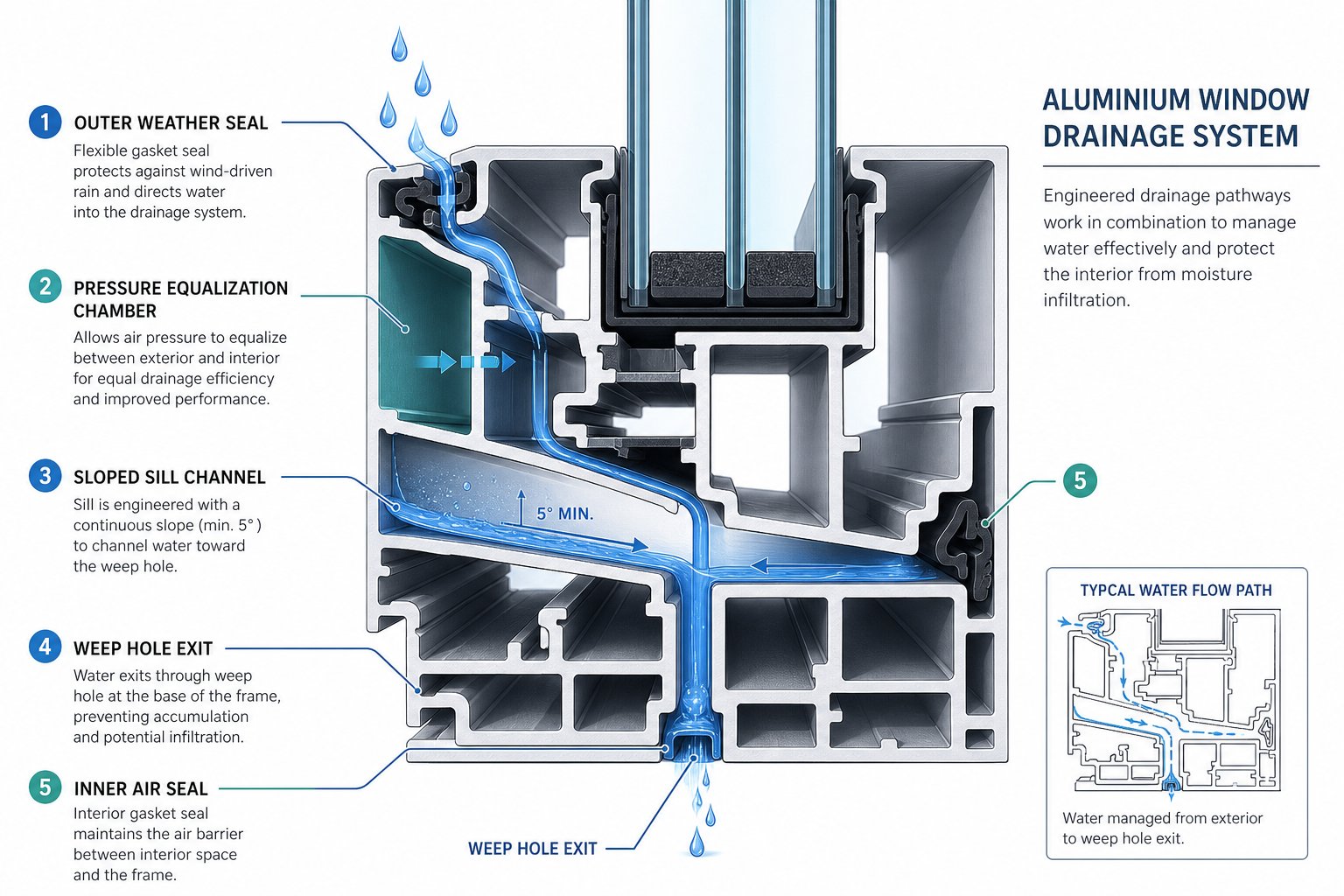
A weep hole on its own is just a slot in metal. What makes it effective is the engineered system behind it — a sequence of slopes, chambers, seals, and pressure logic that guides water from entry to exit without letting it reach your interior walls. Think of it less as a single drain and more as a staged water management pathway built directly into the aluminium extrusion.
The key components of this drainage system work in sequence:
- Outer weather seal (rain screen): a flexible gasket or brush seal that deflects the bulk of wind-driven rain and reduces the volume of water reaching inner cavities
- Pressure equalization chamber: an engineered void between the outer and inner seals that neutralises wind pressure differentials
- Sloped sill channel: an internal gutter with a built-in fall (minimum 2% pitch) directing collected water toward the lowest point
- Window drain holes (weep openings): controlled exit points positioned at the base of the sill where gravity completes the evacuation
- Inner air seal: the final EPDM gasket barrier that maintains thermal and acoustic performance, ideally staying dry under normal conditions
How Water Enters and Moves Through Aluminium Frames
During a storm, water does not simply hit the glass and run off. Wind-driven rain strikes at angles, and pressure differences between the exterior and interior create a suction effect that pulls moisture into frame joints and sash tracks. Even well-sealed aluminium windows are designed to accept that some water will penetrate past the first line of defence — the outer weather seal is a rain screen, not a dam.
Once past that outer gasket, water enters the drainage cavity within the frame profile. Gravity takes over here. The sill extrusion is shaped with a subtle internal slope, channelling water weep toward the lowest available point. In a well-engineered system, there is no flat surface where water can pond. Every millimetre of the internal channel angles downward, funnelling moisture to the exit slots at the base of the frame.
This is where weep holes in windows complete their job. Positioned at the terminal low point of the sloped channel, they allow collected water to pass through the frame wall and drip harmlessly to the exterior sill or flashing below. A typical height differential of 50 to 75 mm between the internal collection point and the weep opening creates enough positive drainage pressure to pull water through the passage reliably.
Pressure Equalization and Drainage Mechanics
Here is where most explanations of window drainage fall short. A weep hole alone cannot protect your home if wind pressure is actively forcing water deeper into the frame. During heavy rain with strong gusts, the air pressure on the exterior face of your window can be significantly higher than the pressure inside the frame cavity. That differential pushes water through any gap it can find — inward, not outward.
Pressure equalization solves this problem. Small vents connect the drainage chamber to the exterior atmosphere, allowing outside air pressure to communicate into the cavity. When the pressure inside the chamber matches the pressure outside, the driving force that pushes water inward drops dramatically. Water is no longer being forced backward through micro-gaps. Instead, it simply sits in the chamber until gravity routes it down and out through the weep openings.
Without this pressure logic, even large window drain holes would struggle during storms. Water would be held in the cavity or driven past the inner seal. With a properly designed pressure equalization chamber, the system remains passive and reliable — no moving parts, no pumps, just physics doing the heavy lifting.
Condensation Drainage Within Aluminium Profiles
Rain is not the only moisture source your drainage system handles. Aluminium conducts heat roughly 1,000 times more efficiently than timber, which means the frame temperature can drop below the dew point on cool mornings or during air-conditioned summers. When that happens, condensation forms on the interior surfaces of the frame profile itself — moisture that never came from outside but still needs somewhere to go.
In thermally broken aluminium systems common across Australian homes, the polyamide break reduces this effect but does not eliminate it entirely. Condensation still forms in the cavity between the thermal break sections, particularly in coastal and tropical climates where humidity is persistently high. The same sloped sill channels that handle rain infiltration also collect and route this internal condensation to the weep openings.
This dual-purpose design is why the drainage system matters even in dry weather. A frame that handles storm water perfectly can still develop mould or seal degradation if condensation has no exit path. The complete system — slopes, chambers, seals, and weep points — manages both external and internal moisture sources through a single integrated logic.
Of course, not every aluminium window uses the same weep hole configuration. The shape, size, and visibility of these drainage points vary considerably depending on the frame design and manufacturer priorities.
Types of Weep Hole Designs in Aluminium Frames
Look closely at the bottom rail of any aluminium window and you will find some form of drainage opening — but it will not always look the same. Manufacturers use several distinct weephole configurations, each balancing drainage performance against aesthetics, pest resistance, and security. Knowing which type sits in your frames helps you maintain them properly and understand what to expect during inspections.
Open Slot and Covered Flap Weep Designs
The most common configuration in Australian aluminium windows is the open slot weep — a simple rectangular opening, typically around 5 mm by 16 mm, machined directly into the outer face of the bottom rail. From the exterior, these appear as small horizontal gaps spaced evenly along the sill. They are effective and easy to inspect, but their exposed nature makes them vulnerable to dirt, insects, and debris entering the frame cavity.
Covered flap weeps address that vulnerability. These use a small hinged plastic or rubber cover — sometimes called a weep hole cover — that sits over the slot opening. Under normal conditions, the flap stays closed, blocking insects and wind-driven dust. When water pressure builds inside the frame, the flap lifts outward, releasing moisture. Once drainage is complete, the cover falls back into place. Weep hole covers for windows are readily available as replacement parts if the original covers crack or go missing over time.
Concealed and Internal Channel Drainage Systems
Premium aluminium window systems increasingly favour hidden drainage that maintains clean, uninterrupted sightlines. Instead of visible exterior slots, these frames incorporate internal gutters that collect water and route it through concealed vertical cavities within the profile. The water exits at discreet points hidden beneath panel joints or behind external flashings — invisible to anyone looking at the window face.
These concealed systems require a minimum 2% internal pitch toward their outlets and rely on proper gasket compression to function correctly. They deliver a sleek, minimalist appearance popular in contemporary Australian architecture, but they are harder to inspect visually and require professional assessment if drainage problems develop.
How to Identify Your Weep Hole Type
Identifying your configuration takes less than a minute. Crouch down to eye level with the bottom rail of your aluminium window and examine the exterior face. If you see small rectangular slots — open or fitted with tiny plastic flaps — you have a standard external weep system. If the bottom rail appears completely smooth with no visible openings, your frame likely uses concealed internal channels. A window weep hole diagram from your manufacturer’s installation documentation can confirm the exact drainage path if you are unsure.
| Type | Visual Appearance | Advantages | Common Applications |
|---|---|---|---|
| Open Slot Weep | Small rectangular gaps visible on exterior bottom rail | Easy to inspect and clean; reliable gravity drainage; low cost | Standard sliding and double-hung windows; residential projects |
| Covered Flap Weep | Slots with small plastic or rubber hinged covers | Blocks insects and debris when closed; self-draining under pressure | Homes in bushland or coastal areas; insect-prone regions |
| Internal Channel (Concealed) | No visible openings on exterior face; smooth bottom rail | Clean minimalist aesthetic; reduced pest entry; weather-tight appearance | Premium architectural projects; contemporary facades; commercial glazing |
Why do manufacturers choose one over another? It comes down to priorities. Open slots suit budget-conscious residential builds where easy maintenance matters most. Covered flaps are preferred in environments where mud wasps, spiders, or coastal grit would quickly block unprotected openings. Concealed systems appeal to architects and homeowners who refuse to compromise sightlines — though they trade visual simplicity for slightly more complex maintenance access.
Regardless of which design your aluminium frames use, the drainage principle remains identical. Water collects, gravity pulls it down, and the weephole provides the exit. The real variable is where those exit points sit on the frame — and that depends entirely on which style of window you are looking at.
Where Are Window Weep Holes Located on Different Styles
Placement varies more than most homeowners expect. A sliding window drains differently from a casement, and an awning frame positions its exit points in a completely different spot again. If you have ever crouched down looking for weep holes on windows and found nothing, chances are you were searching in the wrong place for your particular window type. This guide breaks it down style by style so you know exactly where to look.
Finding Weep Holes on Sliding Aluminium Windows
Sliding windows are the most common aluminium window type in Australian homes, and their drainage logic is straightforward. The sashes ride along horizontal tracks, and the outer track — the one closest to the exterior — is where water collects during rain. Weep holes sit on the outer face of this bottom track sill, allowing pooled water to escape before it rises high enough to overflow inward.
On most sliding aluminium frames, you will find two or more drainage slots spaced along the length of the outer track. They are typically positioned at the lowest point of the sill profile, directly below where the outer sash panel sits when closed. Some systems also include secondary drainage points on the inner track for condensation management, though these are less common in standard residential installations.
- Open the sliding sash fully to expose the bottom track.
- Look at the outer face of the frame sill (the side facing your garden or street).
- Identify small rectangular slots or covered openings near each end of the track and sometimes at the centre.
- Check the track floor for internal drainage channels that slope toward these exit points.
If water sits in your sliding window track after rain and does not drain within a few minutes, the weep openings are likely blocked or the sill has lost its drainage slope due to frame settling.
Locating Drainage Points on Awning and Casement Frames
Awning windows hinge at the top and push outward from the bottom. Because the sash swings away from the frame, water that hits the glass runs down and drips off the bottom rail while the window is open. When closed, however, rain can still penetrate the seal junction between the sash bottom rail and the fixed sill frame. Drainage points on awning windows are found in one of two locations: machined into the bottom rail of the sash itself, or positioned along the sill section of the fixed outer frame.
Casement windows hinge at the side and swing outward like a door. Their drainage challenge is slightly different — water collects along the full width of the bottom frame member rather than in a defined track. Weep holes on casement frames sit along the exterior face of the bottom sill, typically at each corner where the internal drainage channel terminates. Some casement systems route water through the hinge jamb and out at the sill junction, making the exit point less obvious.
- For awning windows: close the sash and examine the exterior face of the bottom sill frame. Look for slots or flap covers along the lowest edge.
- If no external slots are visible on the sill, open the sash and inspect the underside of the bottom rail for concealed drainage channels.
- For casement windows: inspect the exterior bottom rail of the fixed frame, focusing on the corners where internal gutters terminate.
- Check both the hinge side and the latch side — some casement profiles drain toward one end only.
Awning and casement frames in modern Australian homes often use concealed internal drainage rather than visible exterior slots, particularly on architectural-grade systems where clean sightlines are a priority.
Double-Hung Aluminium Window Drainage Locations
Double-hung windows add complexity because they have two independently operable sashes — an upper and a lower — each capable of collecting moisture. Where are window weep holes located on these frames? In two distinct zones.
The lower sash sits in a track similar to a sliding window, and the bottom of this track drains through weep holes on the exterior face of the sill, just as you would find on a slider. The upper sash, however, has its own drainage requirement. When the upper panel is in its closed (raised) position, water can collect along the meeting rail — the horizontal bar where the two sashes overlap. Drainage from this zone typically routes downward through vertical channels within the frame jambs, exiting at the sill level.
- Start at the exterior bottom sill — look for standard weep slots or covered openings along the lowest rail.
- Examine the meeting rail (where upper and lower sashes overlap) for small drainage slots on its exterior face.
- Check the lower corners of the frame jambs for secondary exit points that handle upper-sash condensation.
- If your double-hung has tilt-in sashes for cleaning, inspect the pivot hardware area for integrated drainage channels.
Do All Windows Have Weep Holes?
A question that comes up regularly: do all windows have weep holes? For aluminium frames, the answer is effectively yes — virtually every aluminium window system manufactured to Australian standards includes engineered drainage. However, not all drainage is visible. Fixed (non-operable) aluminium panels may rely on the glazing rebate drainage system rather than traditional sill weeps, routing any moisture that breaches the glazing seal downward through concealed internal paths.
Older aluminium windows from the 1970s and 1980s sometimes have fewer or smaller drainage openings than modern systems, and decades of paint, oxidation, or renovation work may have obscured them entirely. If you genuinely cannot locate any drainage points on your aluminium frames, it does not necessarily mean they are absent — they may simply be concealed, blocked, or integrated into the profile in a way that is not immediately obvious from a visual inspection.
Knowing where your drainage points sit is only half the equation. The more pressing concern for most homeowners is recognising when those openings stop working — and what the early warning signs look like before water damage takes hold.
Common Problems and Signs of Weep Hole Failure
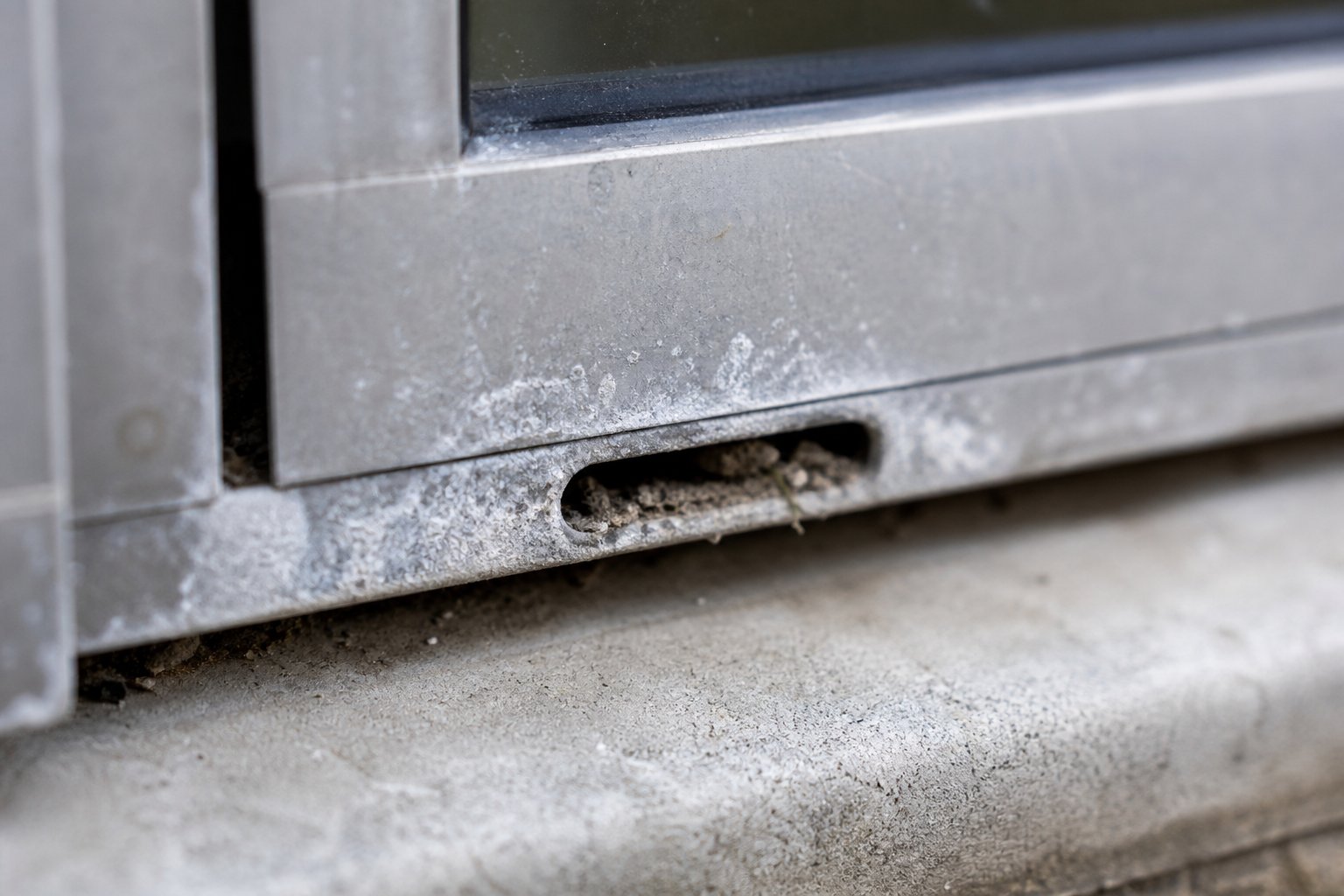
A drainage opening the size of a fingernail does not need much to become completely useless. A smear of paint, a clump of dirt, a single mud wasp nest — any of these can turn a functioning weeper hole into a sealed dead end. And because these openings are small, low to the ground, and easy to overlook, most homeowners only discover a blockage after water has already found its way somewhere it should not be.
Understanding what goes wrong — and what to watch for — is the difference between a five-minute clean and a costly repair bill.
Oxidation and Environmental Blockage in Aluminium Weep Holes
Aluminium does not rust the way steel does, but it does oxidise. Over years of exposure, a thin layer of aluminium oxide builds along the interior walls of the drainage channel. In mild climates this layer is actually protective, but in coastal areas where salt air accelerates the process, that oxide film thickens and narrows the channel bore. A weeping hole that started at 5 mm wide may effectively shrink to 2 or 3 mm — still technically open, but far less capable of handling heavy rainfall.
Paint overspray is a more abrupt culprit. During exterior renovations, painters frequently mask windows but miss the bottom rail entirely. A single coat of paint across the sill face can seal weep openings shut in seconds. Even partial overspray creates a lip that catches debris and accelerates future blockage. Worse still, some homeowners deliberately seal weep holes with caulk, mistakenly believing the openings are gaps that let water in rather than channels that let water out.
Mineral deposits pose a quieter threat. In regions with hard bore water — common across parts of South Australia, inland Queensland, and Western Australia — calcium and lime scale gradually crystallise inside the drainage path. Each evaporation cycle leaves a thin mineral residue behind, and over a decade or more, these deposits can restrict flow almost as effectively as a physical plug.
Insect Nesting and Debris Accumulation Problems
If you live anywhere in eastern Australia, mud wasps are likely the single biggest threat to your wheep holes. These insects seek out small, sheltered cavities for nest building, and an unprotected weep slot is an ideal candidate. A mud wasp can pack a drainage channel solid with clay in a matter of hours, creating a blockage that is almost impossible to dislodge without tools. Spiders favour the same openings for web anchoring, and their silk catches airborne dust and pollen that gradually forms a dense mat across the slot entrance.
Debris accumulation varies sharply by environment. Coastal homes collect salt crystite and wind-blown sand. Properties near busy roads gather fine particulate soot. Homes surrounded by eucalyptus trees deal with bark fibre, leaf litter, and sticky resin deposits that bond to the aluminium surface. In high-pollution urban areas — think main arterials in Sydney’s western suburbs or Melbourne’s industrial corridors — a greasy film of airborne grime coats every exterior surface, including weep openings, reducing their effective size season by season.
Homes that have not had their window drainage points inspected in five or more years almost always have some degree of blockage, even in benign climates. The question is whether the restriction has reached a point where drainage capacity is compromised during heavy rain.
Warning Signs Your Weep Holes Are Failing
Blocked drainage rarely announces itself with a dramatic flood. The damage is incremental. Water that cannot escape through the weep opening pools in the sill track, rises slowly during sustained rain, and eventually overtops the internal seal or overflows into the interior frame cavity. From there, it migrates into the wall — wetting plasterboard, softening timber framing, and creating the damp conditions mould needs to establish.
Forensic engineering assessments of window-related water damage consistently reveal the same progression. As fenestration failure analysis demonstrates, standing water on the sealant of insulated glass units can cause premature fogging — a visible sign that the sealed unit itself is failing. Prolonged pooling also degrades the EPDM gaskets that form the inner air seal, accelerating the transition from minor seepage to active water infiltration. Long-term exposure leads to what investigators describe as a “halo” pattern of discolouration or fungal growth around the window sill — damage to walls, flooring delamination, and even substrate deterioration at the wall-floor junction.
Catching problems early means knowing what to look for. Here are the warning signs that your drainage system is struggling:
- Water pooling in window tracks: If water is still sitting in the sill channel more than 15 to 20 minutes after rain stops, drainage is restricted or blocked entirely.
- Exterior staining below the window: Dark streaks or mineral trails running down the wall beneath the sill suggest water is overflowing the frame rather than exiting through the weep openings.
- Musty or damp odours near window frames: Persistent moisture trapped inside the wall cavity produces a distinctive smell, particularly noticeable when you stand close to the frame on warm days.
- Visible corrosion around drainage points: White powdery oxide buildup or pitting around the weep slot indicates chronic moisture contact and poor drainage flow.
- Foggy or cloudy insulated glass: Standing water on the glazing seal can compromise double-glazed units, causing internal condensation that signals seal failure.
- Soft spots or discolouration in adjacent plasterboard: A “halo” of staining, bubbling paint, or spongy drywall around the window sill points to moisture that has already penetrated the wall.
- Insects or visible nesting material in weep slots: Mud deposits, cobwebs, or wasp activity around the bottom rail are a clear sign that drainage openings are compromised or fully sealed.
Any single sign on this list warrants a closer inspection. Two or more appearing together suggest the drainage system has been failing for some time — and the longer moisture sits inside the frame or wall cavity, the more expensive the remediation becomes.
The good news is that most weep hole problems are preventable with straightforward maintenance. Clearing a blocked drainage channel takes minutes, costs virtually nothing, and eliminates the conditions that lead to serious structural damage. The key is knowing how to do it safely — without damaging the aluminium profile or pushing debris further into the frame.

How to Clean and Maintain Aluminium Window Weep Holes
Clearing a blocked drainage channel is one of those rare home maintenance tasks that costs nothing, takes minutes, and prevents hundreds — sometimes thousands — of dollars in water damage. You do not need specialist tools or trade qualifications. A pipe cleaner, a glass of water, and ten minutes per window is all it takes to keep your window weeps functioning through the heaviest storms.
Step-by-Step Weep Hole Cleaning Process
Before you start, gather a few basic items: a flathead screwdriver or small pliers, a pipe cleaner or straw brush, a wire hook or crochet hook, a water source (a jug or garden hose on gentle spray), and optionally a can of compressed air. These are the same tools recommended by the Pacific Northwest National Laboratory’s building science guide for safe weep hole maintenance — and none of them risk damaging your aluminium profiles.
- Locate the weep openings. Examine the exterior bottom rail of the frame for small slots or flap-covered openings. Then open the window and check the interior track for secondary drainage holes — these may sit beneath the track or be visible within the frame channel.
- Test for blockage. Pour a small glass of water into the interior window track. Watch the exterior weep slots. Water should begin dripping out within seconds. If nothing exits, or flow is noticeably slow, cleaning is needed.
- Clear the opening. Using a flathead screwdriver, wire hook, or crochet hook, gently dislodge any visible debris from the weep slot entrance. Work carefully — pull material outward rather than pushing it deeper into the channel.
- Clean the internal channel. Push a pipe cleaner or thin straw brush into the weep hole, pulling it back and forth to extract accumulated grime. If you can access the interior drainage hole, repeat from that side. For stubborn blockages, insert the nozzle of a compressed air can into the interior opening and blow debris outward through the exterior slot.
- Remove caulk if present. If someone has sealed the weep openings with caulk or silicone, use a utility knife or flathead screwdriver to carefully remove it. Mineral spirits or isopropyl alcohol can soften silicone residue without damaging the aluminium surface.
- Flush and retest. Pour water into the track again and confirm it drains freely through the exterior openings. If flow remains restricted, try a different tool angle or consider whether the internal channel requires professional inspection.
- Clean the surrounding track. While you are there, wipe down the sill track with a damp cloth to remove loose dirt that would otherwise wash into the drainage channel during the next rain.
One important note on cleaning products: stick to pH-neutral solutions or plain water when cleaning aluminium frames. Harsh alkaline cleaners — including some common household degreasers — accelerate oxidation of the aluminium surface and can actually worsen channel narrowing over time. Mild dish soap diluted in warm water is safe. Avoid anything labelled for oven cleaning or heavy-duty degreasing.
Recommended Inspection Frequency and Seasonal Routine
How often you need to inspect weep holes windows depends largely on your environment. As a baseline, checking drainage function twice a year — at the start of autumn and again in early spring — catches most problems before the wet season arrives. But certain conditions demand more frequent attention.
Homes within 500 metres of the coastline should inspect quarterly due to accelerated salt and sand buildup. Properties surrounded by mature eucalyptus or other debris-shedding trees benefit from checks every three months as well. If you live in an area with active mud wasp populations — most of eastern Australia from September through March — a quick visual scan of weep openings every month during wasp season takes thirty seconds and prevents the most common blockage type entirely.
A practical seasonal routine looks like this:
- Early autumn (March-April): Full inspection and cleaning before winter rains. Clear any summer insect nesting. Test drainage with water.
- Late winter/early spring (August-September): Check for debris washed into channels during wet months. Clear any mineral buildup from condensation cycles. Confirm flap covers (if fitted) are still flexible and seating properly.
- Mid-summer (January): Quick visual check for wasp activity and cobwebs. Particularly important in subtropical and tropical regions where insect pressure peaks.
This routine adds perhaps 30 minutes to your total annual home maintenance — a negligible investment against the cost of repairing water-damaged wall cavities or replacing failed insulated glass units.
When Drilling Additional Weep Holes Is Considered
Some older aluminium frames — particularly those manufactured before the mid-1990s — have fewer or smaller drainage openings than modern systems require. If you have cleaned existing weep slots thoroughly and water still pools in the track during moderate rain, the frame may simply lack adequate drainage capacity for its exposure conditions.
Drilling weep holes in windows is sometimes proposed as a solution, and in specific circumstances it can be appropriate. An additional slot or two in the outer sill face can dramatically improve drainage on an under-performing frame. However, this is not a casual DIY task for several reasons:
- Frame integrity: Aluminium window profiles are engineered with specific wall thicknesses and structural spans. Drilling in the wrong location can weaken the sill or puncture an internal chamber that was not designed to be open to the exterior.
- Warranty implications: Any modification to the frame profile — including drilling — typically voids the manufacturer’s warranty on weather performance. If the window later leaks, you carry the liability.
- Drainage path logic: A new hole only works if it connects to the internal drainage channel at the correct point. Drilling blindly into the bottom rail may miss the collection cavity entirely, creating an opening that serves no drainage purpose while introducing a potential water entry point.
- Burr and finish damage: Aluminium drilling produces sharp burrs inside the channel that can snag debris and accelerate future blockages. Professional fabricators deburr and finish these openings during manufacture — a step that is difficult to replicate on an installed frame.
If your frames genuinely need additional drainage capacity, engage a window specialist or experienced aluminium fabricator who can assess the profile geometry, identify the correct drilling location relative to internal chambers, and finish the opening properly. The cost is modest — far less than remediation work if water damage develops — and it preserves the system’s engineered performance logic.
For most homeowners, though, regular cleaning of existing openings is all that is needed. Weep holes rarely fail because there are too few of them. They fail because the ones that exist are blocked. Maintain what you have, and the system will do its job reliably for decades.
That said, maintenance needs are not uniform across Australia. A home in beachside Noosa faces very different drainage challenges than one in suburban Canberra — and the inspection schedule that works for one may be entirely inadequate for the other.
Climate-Specific Weep Hole Maintenance Guidance
Australia’s climate diversity means a single maintenance schedule cannot serve every home equally. Salt-laden winds along the Gold Coast, fine particulate grime in Melbourne’s inner west, ember risk in the Blue Mountains, and relentless humidity in Cairns each place distinct pressures on your weep holes for windows. Tailoring your approach to local conditions is what separates homeowners who never experience drainage failure from those who discover water damage too late.
Coastal and Salt-Air Environment Maintenance
Properties within a kilometre of the shoreline face the most aggressive conditions for aluminium window drainage. Salt particles carried by ocean breezes settle on every exterior surface, including the narrow openings of your window drain covers and weep slots. As moisture evaporates, those salt crystals remain — each cycle adding another micro-layer of corrosive residue inside the drainage channel.
Over a single summer, this salt accumulation can reduce effective channel width by a measurable margin. Combined with wind-blown sand that lodges in the slot entrance, coastal weep holes can go from fully functional to critically restricted within a season. Rinsing the bottom rail with fresh water every two to three weeks — a quick pass with the garden hose — dissolves salt deposits before they harden. Quarterly hands-on cleaning with a pipe cleaner keeps the internal channel clear, and inspecting window drain covers for salt crust ensures flap mechanisms still move freely.
Urban, Bushfire, and Tropical Climate Considerations
Urban homes near major roads or industrial zones accumulate a greasy film of airborne particulates — diesel soot, brake dust, and fine pollution — that bonds to aluminium surfaces and gradually seals drainage openings. Unlike dry sand or salt, this grime requires a mild detergent solution to dissolve rather than a simple water rinse. Inspecting every four to six months keeps urban buildup manageable.
Bushfire-prone areas introduce a different concern entirely. Homes rated BAL-12.5 and above often have metal mesh screens with apertures smaller than 2 mm fitted over openable windows to block ember attack. If these screens cover or sit adjacent to weep openings, debris can accumulate behind the mesh where it is harder to spot and clear. Inspect drainage points whenever you service your bushfire screens — typically before each fire season — and confirm that ember guards have not inadvertently restricted the wheep hole exit path.
Tropical regions from Townsville north face a double load. Persistent high humidity drives heavy condensation inside aluminium profiles, meaning the drainage system works year-round rather than only during rain events. Combine that with intense insect activity — mud wasps are active nearly twelve months in the tropics — and monthly visual checks become essential rather than optional. Mould can establish inside a blocked drainage channel within weeks in these conditions, so prompt clearing is critical.
| Climate Zone | Recommended Inspection Frequency | Common Blockage Types | Priority Maintenance Actions |
|---|---|---|---|
| Coastal (within 1 km of shoreline) | Every 3 months | Salt crystal buildup; wind-blown sand; oxidation acceleration | Freshwater rinse every 2–3 weeks; quarterly channel cleaning; check flap covers for salt crust |
| Urban / High-Pollution | Every 4–6 months | Greasy particulate film; diesel soot; fine grime bonding | Clean with mild detergent solution; wipe sill tracks; inspect for grime-sealed openings |
| Bushfire-Prone (BAL-12.5+) | Every 6 months + pre-fire season | Leaf litter and bark fibre behind ember mesh; ash residue post-event | Clear debris behind screens; confirm ember guards do not block drainage; post-fire flush |
| Tropical / Subtropical | Monthly visual check; full clean every 3 months | Mud wasp nests; mould growth; heavy condensation residue | Monthly scan for insect activity; clear nests immediately; flush channels to prevent mould |
| Temperate Inland | Every 6 months (autumn and spring) | Dust accumulation; spider webs; occasional insect nesting | Standard biannual clean; test drainage with water pour; clear cobwebs from slot entrances |
Temperate inland areas — think Canberra, Ballarat, or the Adelaide Hills — enjoy the gentlest conditions. Standard twice-yearly maintenance is typically sufficient, with spider webs and general dust being the primary concerns rather than aggressive environmental corrosion.
Regardless of your climate zone, the underlying principle holds: match your inspection frequency to your exposure level, and act on blockages the moment you find them. A five-minute seasonal check is always cheaper than the remediation that follows months of undetected drainage failure. Of course, maintenance alone cannot compensate for a system that was never properly engineered — which is where building standards and compliance documentation become relevant.

Building Standards and Compliance for Window Drainage
Maintenance keeps drainage working. But the reason your aluminium windows have functional weep holes in the first place — properly sized, correctly spaced, and positioned to handle your site’s specific wind and rain exposure — comes down to engineering governed by Australian Standards. These are not optional guidelines. They are mandatory performance benchmarks that every window weep hole, drainage channel, and pressure equalization chamber must satisfy before a frame leaves the factory.
For homeowners, this means confidence that a compliant window has been tested to drain under real storm conditions. For builders, architects, and specifiers, it means knowing exactly what documentation to demand — and what its absence tells you about a product’s actual performance.
Standards Governing Aluminium Window Drainage Design
The cornerstone standard is AS 2047 — Windows and external glazed doors in buildings. This document sets the mandatory minimum specification for every window installed in an Australian external wall, covering structural strength, air infiltration, operating force, and critically for drainage — water penetration resistance.
What are weep holes in the context of compliance? They are one component of the engineered drainage system that allows a window to pass the AS 4420.5 Water Penetration Resistance Test. During this test, water is sprayed onto the window assembly while simultaneously applying air pressure that simulates wind-driven rain. The window must demonstrate zero water leakage into the building at the rated pressure. A weephole that is undersized, poorly positioned, or inadequately connected to the internal drainage channel will cause the assembly to fail this test — water backs up, overtops the internal seal, and penetrates inward.
The water penetration test pressure is not arbitrary. It corresponds directly to the wind classification of the installation site, which is determined by geographic location, terrain category, building height, and whether the window sits in a corner position (where wind pressures intensify). A window rated for a sheltered suburban site in Melbourne faces a lower test pressure than one specified for an exposed coastal position in Far North Queensland. The drainage system — including weep hole capacity — must be engineered to handle the water volume associated with that specific pressure rating.
Beyond AS 2047, the National Construction Code (NCC) references this standard directly, making compliance a legal requirement rather than a voluntary quality mark. Non-compliant windows risk council rejection during inspection, insurance complications if water damage occurs, and potential liability for the builder or installer who specified them.
What Compliance Documentation Tells You About Drainage Performance
A compliant aluminium window system carries specific documentation that confirms its drainage has been tested — not just designed on paper. Specifiers and builders should verify the following indicators before selecting a system:
- Performance label: Located on the inside of the frame or head, displaying wind and water ratings in Pascals. The water resistance rating directly reflects the pressure at which the drainage system was proven to function without leakage.
- Certificate of compliance: Issued by the manufacturer, ideally through an accredited body such as the Australian Glass and Window Association (AGWA). Members have their products tested by NATA-accredited laboratories — the same labs that verify the window weep hole system performs under simulated storm conditions.
- Test reports from NATA-accredited labs: These detail the actual AS 4420.5 water penetration test results, confirming the drainage system handled the rated pressure without failure. Request these if the performance label or certificate raises questions.
- Drainage system engineering documentation: Quality manufacturers provide technical drawings showing internal drainage paths, weep hole sizing and spacing, pressure equalization chamber geometry, and minimum sill slopes. This documentation confirms drainage was designed as an integrated system rather than added as an afterthought.
- Weather resistance and condensation management data: Beyond rain penetration, look for evidence that the system manages internal condensation — particularly relevant for thermally broken profiles where moisture forms within the thermal break cavity.
The absence of any of these documents is a red flag. A window without a performance label should not be installed — full stop. As the AGWA advises, if a window has no compliance labelling to AS 2047 or AS 1288, send it back.
Manufacturers who take drainage engineering seriously make this documentation readily accessible. MEICHEN, for example, publishes their compliance and certification details — including weather resistance and condensation management credentials — on a dedicated page that specifiers can evaluate before shortlisting. This kind of transparency lets architects and builders confirm that the drainage system behind every weephole has been independently verified, not just claimed in a brochure.
For specifiers working on projects with elevated exposure — coastal sites, high-rise applications, or cyclone-rated regions — the water penetration rating on the performance label is the single most important number to check. It tells you the maximum wind-driven rain pressure the drainage system can handle before failure. Match that rating to your site’s design wind pressure (nominated by the building designer per NCC requirements), and you have confidence the weep holes, channels, and seals will perform when conditions are at their worst.
Compliance documentation also protects you after installation. If a window develops drainage problems within its warranty period, test reports and certificates establish that the product met its rated performance at the time of manufacture — shifting the investigation toward installation quality, site conditions, or maintenance rather than product deficiency.
Standards and paperwork confirm a system was engineered correctly. But what happens when drainage problems persist despite proper maintenance and compliant products? That is where the line between DIY care and professional assessment becomes important to recognise.
When to Seek Professional Help With Window Drainage
Regular cleaning solves the vast majority of weep hole window problems. But some drainage issues run deeper than a blocked slot — and no amount of pipe cleaners or compressed air will fix a frame that has structurally failed, a seal that has perished, or a drainage design that was never adequate for the site’s exposure in the first place.
Recognising that boundary between a quick DIY fix and a job that genuinely requires professional assessment saves you time, money, and — most critically — prevents you from living with a problem that is quietly worsening behind your walls.
Signs You Need Professional Window Assessment
If you have cleaned every drainage opening, confirmed water flows freely through the channel, and still find water pooling in your tracks or seeping into the room during rain, the issue is not the weep hole. Something else in the system has failed. A professional window assessor will pressure-test the frame, inspect internal gaskets, evaluate flashing integration with the surrounding wall, and identify whether the leak originates from the window itself or from above — a roof or cladding fault that merely appears at the window.
Use these criteria to decide whether your situation warrants a professional call:
- Persistent water ingress despite clear drainage openings: Water entering the room even after thorough cleaning points to failed seals, compromised flashing, or a pressure equalization fault within the frame.
- Visible frame distortion or racking: If the bottom rail is bowed, twisted, or no longer sits level, the internal drainage slope has been compromised. Water ponds rather than flows, and no cleaning will restore the original geometry.
- Perished or hardened gaskets: EPDM seals that have cracked, shrunk, or lost elasticity allow water to bypass the drainage system entirely. Gasket replacement on aluminium frames requires trade-level disassembly.
- Foggy double-glazed units adjacent to drainage points: If your insulated glass has developed internal condensation near the sill, prolonged water contact has likely degraded the glazing seal — a problem that requires unit replacement rather than drainage maintenance.
- Suspected design inadequacy in older frames: Windows manufactured before the mid-1990s may lack sufficient drainage capacity or pressure equalization logic for their installed position. A professional can assess whether the existing system can be improved or whether replacement is the practical path forward.
- Water damage visible in surrounding wall materials: Soft plasterboard, mould growth behind skirting boards, or swelling in timber reveals indicate moisture has already migrated beyond the window frame — requiring both remediation and a root-cause investigation.
A professional assessment typically involves a controlled water spray test (simulating rain at increasing pressures), thermal imaging to detect hidden moisture in the wall cavity, and a detailed report identifying the failure point. Expect the assessor to distinguish clearly between a maintenance issue you can manage yourself and a systemic problem that demands repair or replacement.
How Modern Aluminium Systems Solve Chronic Drainage Issues
For homes with aging aluminium frames — particularly those installed in the 1970s through early 1990s — chronic drainage problems often trace back to a fundamental limitation: what is a weep hole in a window of that era was typically a simple drilled opening with no pressure equalization chamber, no internal slope engineering, and minimal consideration for condensation management. These frames were manufactured to standards far less rigorous than today’s requirements.
Modern aluminium window systems treat drainage as integrated engineering rather than a last-minute addition. Pressure equalization chambers are extruded directly into the profile geometry. Internal sill slopes are built into the die design, not machined after the fact. Concealed drainage channels route water through controlled paths that resist debris accumulation and insect nesting. And thermally broken profiles reduce condensation load on the drainage system in the first place — meaning less moisture for the weep openings to handle.
Upgrading to a current-generation aluminium system does not just fix a blocked drain. It replaces a fundamentally limited drainage logic with one that has been pressure-tested, independently certified, and engineered for the specific wind and rain exposure your site demands. For professionals evaluating replacement options, manufacturers like MEICHEN publish their weather resistance and condensation management certifications, giving specifiers verifiable evidence that the drainage system behind every opening has been validated to Australian Standards — not just claimed in a product brochure.
Whether your situation calls for a simple seasonal clean or a complete system upgrade, the principle remains the same. What are weep holes in windows? They are the final exit point for moisture that has no business sitting inside your walls. Keep them clear, choose systems that are engineered to drain reliably, and act early when the warning signs appear. A few minutes of attention each season protects the structure, comfort, and value of your home for decades to come.
Frequently Asked Questions About Aluminium Window Weep Holes
1. What happens if you block or seal aluminium window weep holes?
Sealing weep holes with caulk or paint traps water inside the frame cavity with no exit path. Because aluminium is non-porous, pooled moisture cannot evaporate through the frame material. Over time, this standing water degrades EPDM gaskets, causes insulated glass unit fogging, promotes mould growth in adjacent wall cavities, and can lead to plasterboard damage and timber framing rot. If weep holes have been accidentally sealed during renovations, carefully remove the caulk or paint with a utility knife and test drainage by pouring water into the track.
2. How often should you clean weep holes on aluminium windows?
Inspection frequency depends on your environment. Coastal homes within one kilometre of the shoreline should clean weep holes every three months due to salt and sand buildup. Tropical and subtropical properties benefit from monthly visual checks and quarterly full cleaning because of persistent insect activity and high humidity. Urban homes near busy roads need attention every four to six months. Temperate inland locations can typically manage with biannual cleaning in autumn and spring. A quick drainage test — pouring water into the track and watching for exterior flow — takes seconds and confirms whether cleaning is needed.
3. Can you drill additional weep holes into aluminium window frames?
Drilling extra weep holes is sometimes appropriate for older frames with inadequate drainage capacity, but it should be handled by a professional aluminium fabricator rather than attempted as a DIY task. Incorrect placement can puncture internal chambers not designed for exterior exposure, weaken the frame’s structural integrity, or miss the internal drainage channel entirely. Drilling also typically voids the manufacturer’s weather performance warranty. A specialist can assess the profile geometry, identify the correct location relative to internal cavities, and properly deburr the opening to prevent future debris accumulation.
4. Do all aluminium windows have weep holes?
Virtually every aluminium window system manufactured to Australian Standards (AS 2047) includes engineered drainage, but not all drainage is visible from the exterior. Fixed non-operable panels may use glazing rebate drainage rather than traditional sill weeps. Premium architectural systems often incorporate concealed internal channels that exit at discreet points hidden beneath panel joints or behind flashings. Older frames from the 1970s and 1980s may have fewer or smaller openings that have been obscured by paint or oxidation over decades. If you cannot locate drainage points visually, consult your manufacturer’s installation documentation or engage a window professional for assessment.
5. What is the difference between weep holes and ventilation openings in window frames?
Weep holes serve a purely hydraulic function — they provide an exit path for liquid water that has entered the frame cavity through rain infiltration or internal condensation. They sit at the lowest point of the sill and rely on gravity to drain moisture outward. Ventilation openings, by contrast, manage airflow and pressure within the frame profile. In pressure-equalised aluminium systems, small vents connect the drainage chamber to the exterior atmosphere to neutralise wind pressure differentials during storms. Both are essential to the complete drainage system, but they perform distinct roles: vents prevent water from being pushed inward by wind pressure, while weep holes allow collected water to exit once pressure is equalised.
More Window & Door Guides