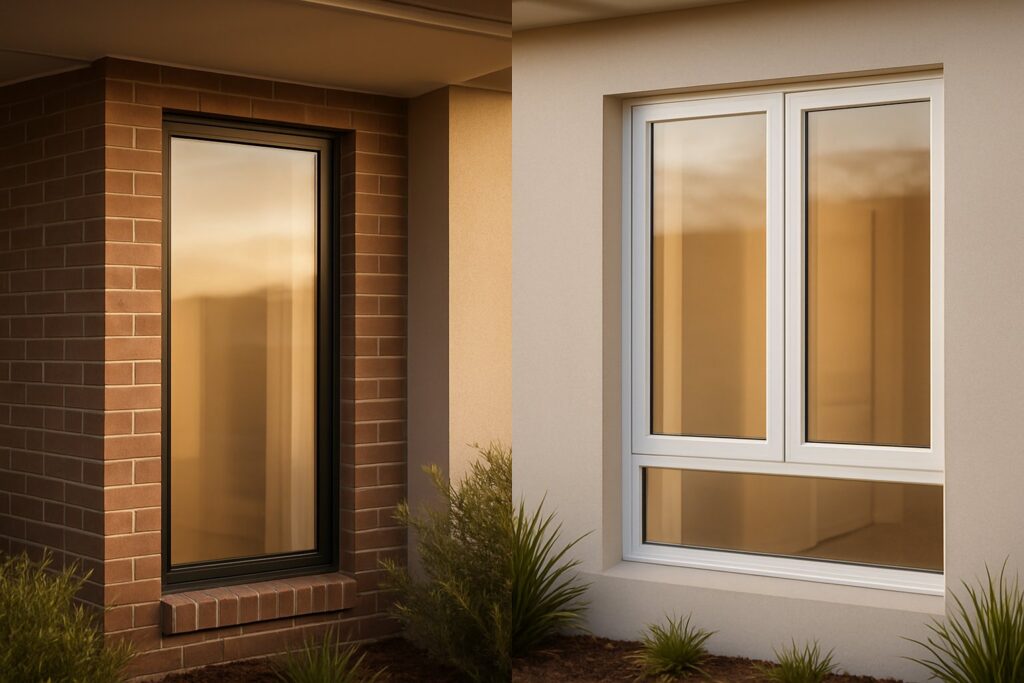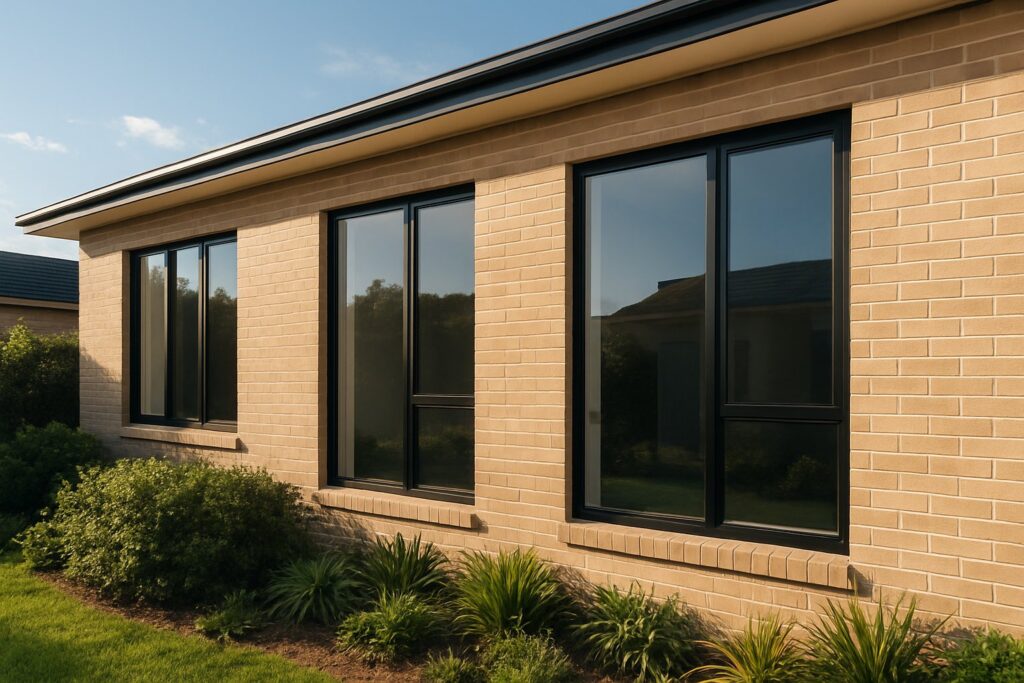
What Aluminium Window Latches Are and Why They Matter
Most online searches for aluminium window latches return product listings and spec sheets. Helpful if you already know what you need, less so if you are trying to figure out which latch suits your frame, your climate, or your security goals. This guide takes a different approach: it starts with the window type you have and works outward to the hardware that fits it.
What Is an Aluminium Window Latch
An aluminium window latch is a mechanical fastening device mounted on the sash and frame of an aluminium window. Its core function is to hold the sash firmly against the frame when the window is closed, creating a tight seal for security, weather resistance, and energy efficiency.
In simple terms, a latch keeps your window shut. It pulls the moving sash into the fixed frame so air, water, and uninvited guests stay outside. The aluminium window latch function explained in one sentence: it secures the closed position without requiring a key.
That last point matters. The difference between a window latch and a lock is straightforward. A latch holds the window closed through mechanical engagement — a cam, wedge, or tongue slotting into a keeper. A lock adds keyed or coded security on top of that hold, preventing the latch from being released without authorisation. Many modern fittings combine both functions, but the distinction is worth understanding when you are shopping for replacements or upgrades.
Why Latch Selection Matters
Choosing the wrong latch creates problems that compound over time. A poorly matched mechanism may not compress the weatherseal fully, letting draughts and moisture creep in. It can leave a security gap that a simple pry tool could exploit — window security research shows that a significant proportion of break-ins occur through ground-floor windows with inadequate latching. And a latch that does not align with the frame profile wears unevenly, stripping screw holes or cracking under repeated use.
Why aluminium window latches matter comes down to three things: they seal your home against weather, they form the first line of defence against forced entry, and they control ventilation by letting you open and close windows smoothly for years. Getting the selection right from the start saves money, frustration, and potential safety issues down the track.
The sections ahead break this down by latch anatomy, mechanism type, and window style — so you can match the right hardware to your specific frame with confidence.
Latch Anatomy and Terminology Explained
Knowing what a latch does is one thing. Identifying its individual parts — especially when you are standing in a hardware aisle or scrolling through replacement listings — is another challenge entirely. Window hardware can look remarkably similar across different systems, so understanding the correct terminology helps you match the right component to your frame without guesswork.
Key Components of a Window Latch
Every aluminium window latch, regardless of style, is built from a handful of core elements. Think of it as a simple mechanical puzzle where each piece has a specific job:
- Keeper (strike plate) — the fixed metal plate or bracket mounted on the window frame. It receives and holds the moving part of the latch when the window is closed.
- Tongue or cam — the moving component that rotates or slides into the keeper to create a secure hold. A tongue is typically a tapered wedge shape, while a cam is a rotating lobe that draws the sash tight against the frame.
- Handle or lever — the user-operated element you grip to engage or release the latch. Handles vary from flush-mount pulls on sliding windows to projecting levers on casement styles.
- Spindle — the connecting rod or shaft that transfers motion from the handle to the tongue or cam mechanism inside the latch body. A worn or incorrectly sized spindle is a common reason handles spin freely without engaging.
When shopping for replacements, these four window latch spindle and handle components are what you need to measure and match. Get the keeper spacing or spindle length wrong by even a few millimetres, and the latch either will not engage or will not compress the seal properly.
How Latches Interact with Stays and Hinges
A latch does not work in isolation. It is part of a broader hardware system that includes stays, hinges, and sometimes slide bolts — each controlling a different aspect of window operation.
Here is the simplest way to understand how window latches and stays work together: the latch secures the closed position, while the stay controls the open position. A casement stay, for example, holds the sash at a fixed opening angle so it does not swing freely in the wind. The latch then takes over when you pull the window shut, drawing the sash firmly into the frame and compressing the weatherseal.
Hinges define the pivot point and swing direction. Stays govern how far and how stably the sash opens. And the latch locks everything down when closed. All three must be compatible with the same aluminium window profile — mismatched hardware from different systems can result in poor alignment, excessive wear, or gaps that compromise both security and weather resistance.
With these parts clearly labelled, identifying the exact mechanism type your window uses becomes far more straightforward — which is precisely what the next section covers.
Types of Aluminium Window Latches and How They Work
Latch types are often lumped together under vague labels like “window hardware” or sorted by brand rather than mechanism. That makes comparison shopping frustrating. A more useful approach is to group latches by how they physically engage — because the mechanism determines which window styles they suit, how much compression they deliver, and how secure they are against forced entry.
Wedge and Cam Latches
These two mechanisms dominate hinged aluminium windows, yet the wedge vs cam window latch difference trips up many buyers. Both pull the sash toward the frame, but they achieve that compression in distinct ways.
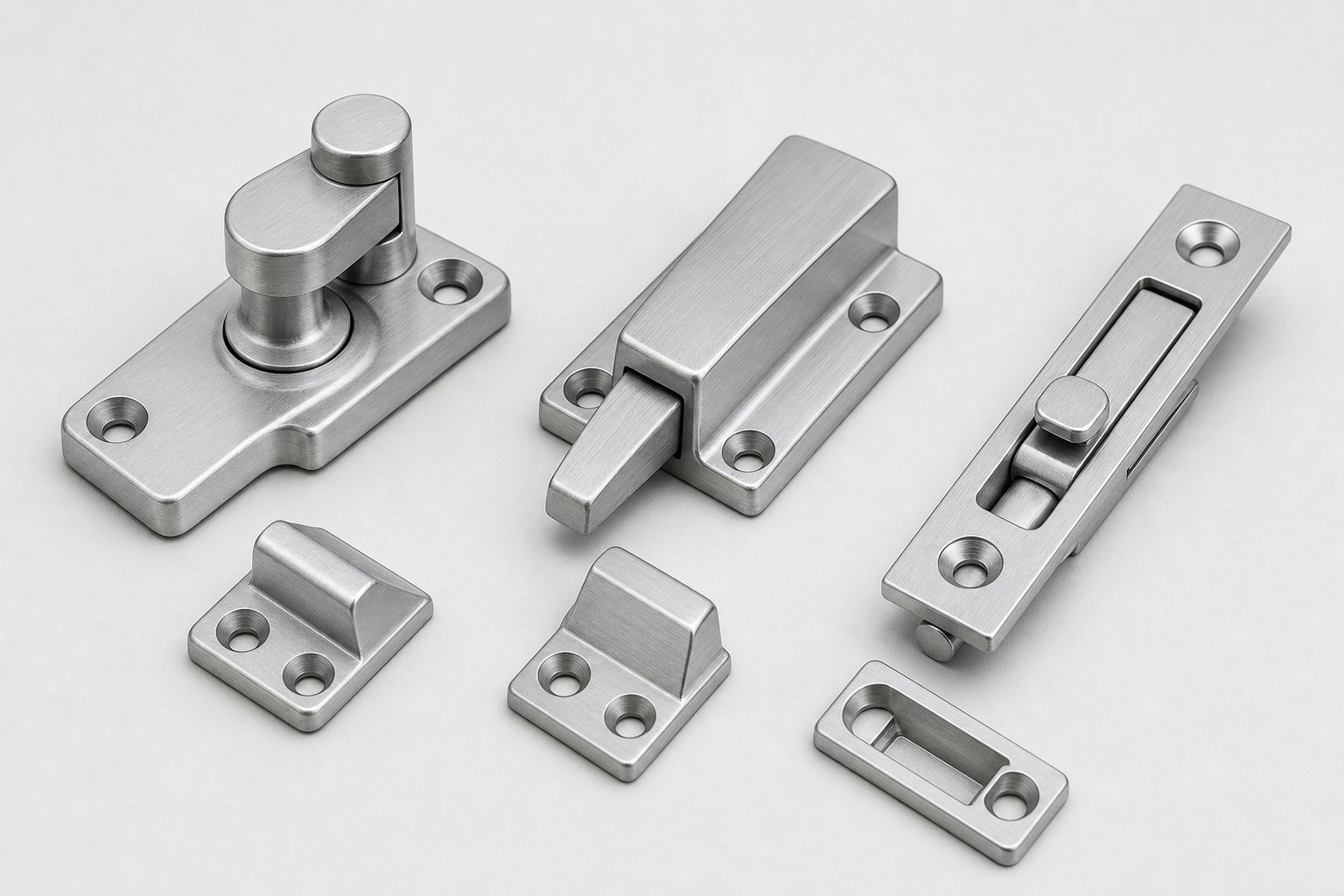
A wedge latch uses a tapered tongue that slides into a keeper slot. As the tongue pushes deeper, its angled profile forces the sash progressively tighter against the frame — much like a doorstop works in reverse. This gradual draw makes wedge latches forgiving of minor misalignment, which is why they are a popular choice on casement and awning windows where the sash swings outward and needs a firm pull-in on closing.
A cam latch rotates a shaped lobe (the cam) behind a keeper hook. As the handle turns, the cam’s eccentric profile generates strong compression in a single motion. Cam-style latches are valued for their positive lock feel and the tight seal they create — particularly useful in areas with high wind exposure or driving rain. Because the cam action is rotational rather than linear, these latches tend to be compact and sit flush against the frame.
Sliding Window Latches and Locks
Horizontal and vertical sliders operate on a completely different plane of motion, so their latching hardware looks and works nothing like hinged-window fittings. Understanding sliding window latch mechanism types helps you avoid buying hardware that simply will not fit.
The most common design is a spring-loaded bolt latch. A small spring pushes a bolt outward into a hole or slot in the adjacent sash or frame. You press the bolt inward to release, slide the window open, and the bolt snaps back automatically when the window returns to the closed position. It is simple, reliable, and sits flush so it does not obstruct the sash travel path.
Lever-operated sash latches add a manual step: you rotate a small lever to engage a bolt or hook into a strike plate on the opposing sash. This type is common on double-hung windows where two sashes overlap at the meeting rail. Some variants include a secondary pin or key cylinder, converting the latch into a latch lock for added security.
Casement and Awning Latch Variations
Outward-opening windows face unique forces — wind pressure can push the sash away from the frame, and the seal relies entirely on the latch pulling inward. Single-point latches (one cam or wedge per sash) work well on smaller openings, but larger casement and awning sashes benefit from a multi-point latch for casement windows.
A multi-point system uses a corner drive mechanism to engage two or more locking points simultaneously from a single handle turn. The force is distributed evenly around the frame perimeter, which prevents sash warping, maintains consistent seal compression, and significantly improves security because no single point can be pried open in isolation.
The aluminium window latch types comparison table below summarises how each mechanism stacks up across the factors that matter most:
| Latch Type | Mechanism | Compatible Window Types | Security Level | Ease of Installation | Typical Limitations |
|---|---|---|---|---|---|
| Wedge latch | Tapered tongue slides into keeper slot | Casement, awning | Moderate | Easy — two-point screw mount | Lower compression than cam on large sashes |
| Cam latch | Rotating cam lobe hooks behind keeper | Casement, awning, top-hung | Moderate to high | Easy — compact footprint | Requires precise keeper alignment |
| Spring-bolt (slider) | Spring pushes bolt into frame slot | Horizontal sliders | Low to moderate | Easy — recessed mount | No keyed security without add-on lock |
| Lever sash latch | Manual lever engages bolt into strike plate | Double-hung, vertical sliders | Moderate | Moderate — meeting rail alignment needed | Exposed hardware on meeting rail |
| Multi-point latch | Corner drive engages multiple hooks simultaneously | Large casement, awning | High | Complex — professional install recommended | Higher cost; harder to retrofit |
Each mechanism suits a specific window behaviour. Sliders need flush, unobtrusive hardware. Hinged windows need compression. Large openings need distributed force. The real question, then, is not which latch type is “best” in the abstract — it is which type matches the window you are actually working with.
How to Choose the Right Latch for Your Window Type
Mechanism knowledge is useful, but most people do not start their search thinking about cams and spring bolts. They start with a window that is not closing properly, or a renovation that needs new hardware. Choosing latch by window type is the fastest path to the right answer because the window’s operation dictates which mechanisms are physically compatible.
Latches for Sliding Windows
Sliders move horizontally (or vertically, in the case of single-hung variants), so any hardware mounted on the sash must sit completely flush with the frame profile. A protruding lever or cam would jam against the adjacent sash or track the moment you try to slide the window open.
The best latch for aluminium sliding windows is typically a flush mount latch for sliding aluminium window frames — either a recessed spring-bolt that snaps into a frame slot automatically, or a low-profile lever latch that sits within the meeting stile. Locking variants add a secondary pin or small key cylinder behind the lever, preventing the bolt from being pushed back from outside. If your slider is wider than 1200 mm, look for a latch with an anti-lift pin that stops the sash from being levered upward out of the track — a common forced-entry technique on older aluminium sliders.
Latches for Casement and Awning Windows
Outward-opening sashes rely on the latch to pull them inward against the weatherseal. Without adequate compression, wind pressure can flex the sash away from the frame, breaking the seal and creating draughts or water ingress.
Understanding how to choose a casement window latch comes down to sash size and exposure. For standard openings up to about 600 mm wide, a single cam or wedge latch at the lock stile provides sufficient compression. Larger sashes — particularly awning windows spanning a full wall width — benefit from multi-point locking systems that engage two or three hooks simultaneously from one handle turn. The distributed force keeps the seal consistent across the entire frame perimeter and dramatically improves resistance to prying.
Latches for Double-Hung Windows
Double-hung windows present a unique challenge: two sashes overlap at a horizontal meeting rail, and the latch must secure both in place. The classic solution is a pivoting sash lock — a rotating cam mounted on the inner sash that hooks over a strike on the outer sash, drawing the two rails together.
If you are following a double hung window latch replacement guide, pay close attention to the meeting rail height and the distance between screw holes. Older aluminium double-hung frames often use non-standard spacing, so measuring the existing footprint before ordering saves a return trip to the hardware store. Upgraded versions include a keyed cylinder or thumb-turn restrictor for child safety and added security.
Quick Decision Checklist
Regardless of window style, the selection process follows the same logical steps:
- Identify your window type — slider, casement, awning, or double-hung — because this eliminates incompatible mechanisms immediately.
- Measure the frame profile depth — the channel width and depth determine whether a latch body will sit flush or protrude.
- Check existing hole spacing — replacement latches should match the current screw pattern to avoid drilling new holes into the aluminium extrusion.
- Confirm security requirements — decide whether a basic latch is sufficient or whether you need a keyed lock, restrictor pin, or multi-point system based on the window’s location and accessibility from outside.
For homeowners and builders planning new aluminium window installations rather than retrofitting existing frames, the process is simpler from the outset. MEICHEN’s aluminium window systems are engineered with compatible hardware specifications built in, so latch selection aligns with the frame profile, seal design, and security rating from day one — no measuring, no guesswork.
Matching the latch to the window type gets you mechanically compatible hardware. But material choice determines how long that hardware lasts, especially in harsh Australian coastal and UV-heavy environments.
Aluminium vs Other Latch Materials Compared
A latch can be the right type for your window and still fail prematurely if it is made from the wrong material. In coastal Queensland or a salt-sprayed Sydney harbourside property, material choice is not a cosmetic decision — it is a durability one. And the single biggest factor most buyers overlook is what happens when two different metals sit against each other in the presence of moisture.
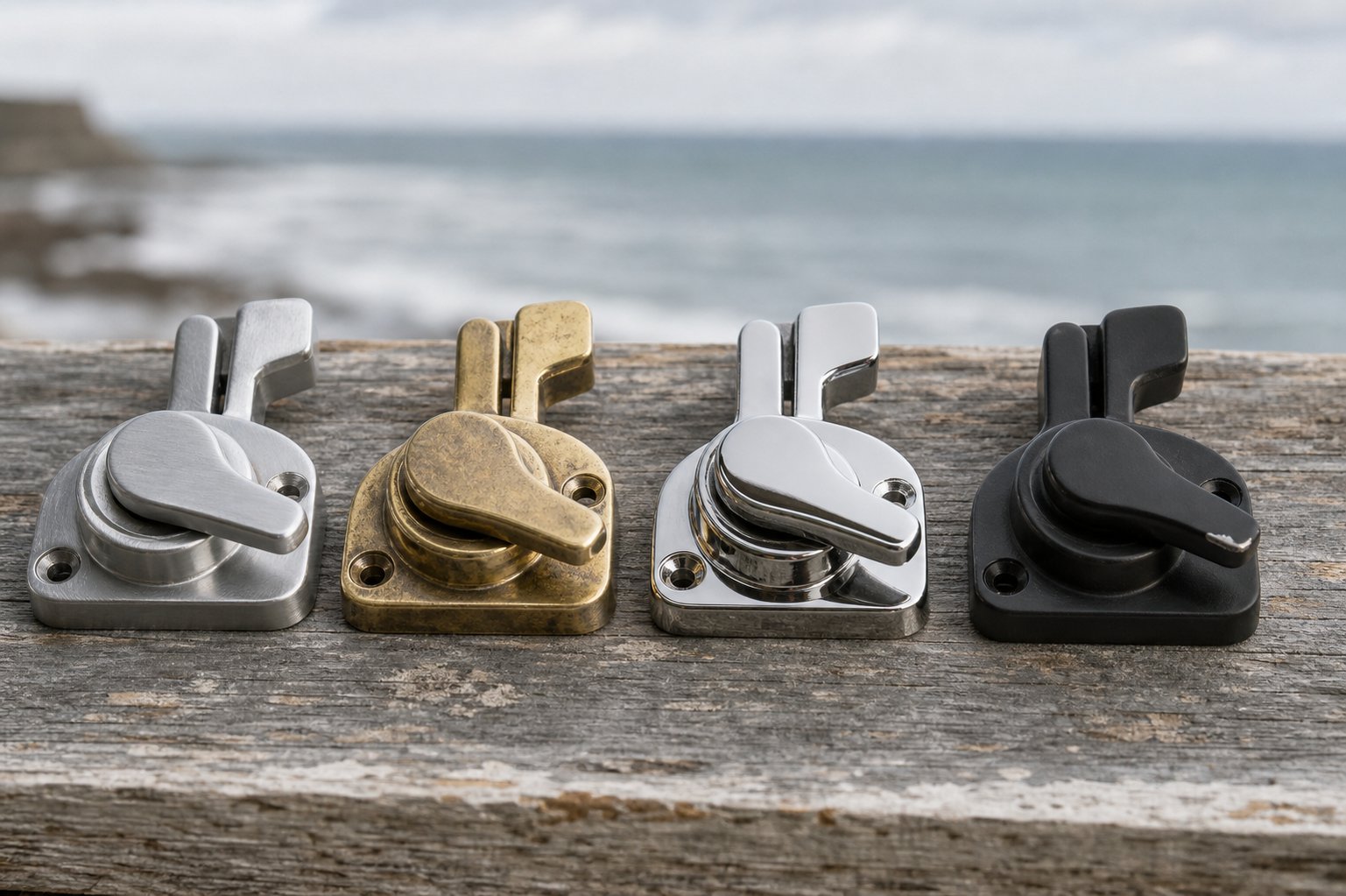
Aluminium Latches vs Brass and Stainless Steel
The principle behind galvanic corrosion in aluminium window hardware is straightforward. When two dissimilar metals touch and an electrolyte — water, salt spray, even condensation — bridges the gap, the less noble metal corrodes preferentially. Aluminium sits relatively low on the galvanic series, which means it loses in most pairings unless the metals are isolated from each other.
This is precisely why aluminium latches on aluminium frames make so much sense. Same metal, no galvanic potential, no corrosion risk from the pairing itself. The latch and frame expand at the same rate in heat, weigh roughly the same per unit volume, and can be powder-coated to match seamlessly. It is the simplest, most reliable combination.
Brass offers a warm, decorative finish that appeals to heritage renovations and period-style homes. The trade-off? Brass is cathodic relative to aluminium, meaning the frame corrodes at the contact point when moisture is present. In dry inland climates, this may take years to become visible. In a coastal environment with persistent salt spray, pitting can appear within months. If you choose brass hardware on aluminium frames, nylon or EPDM isolating washers between the latch body and the frame are essential.
Comparing an aluminium vs stainless steel window latch reveals a different balance. Stainless steel — particularly marine-grade 316 — delivers superior tensile strength and excellent corrosion resistance in its own right. The potential difference between stainless and aluminium is smaller than with brass or mild steel, and the contact area of a latch is relatively small. In practice, stainless steel fixings on aluminium are generally acceptable, but in aggressive coastal or tropical environments, adding an isolation barrier remains a worthwhile precaution. The downsides are cost (typically two to three times the price of an equivalent aluminium latch) and a slight aesthetic mismatch against powder-coated aluminium frames.
Zinc Alloy and Powder-Coated Options
Zinc die-cast latches dominate the budget end of the hardware market. They are inexpensive to manufacture, reasonably strong, and take powder-coat finishes well — which is why they appear in many off-the-shelf window fittings. For inland properties with moderate weather exposure, zinc alloy vs aluminium window latch durability may seem comparable in the short term.
The gap widens over time, especially near the coast. Zinc corrodes faster than aluminium in salt-laden air, and the die-cast structure can become brittle with age. Powder coating helps by sealing the surface, but any chip or scratch exposes the base metal to accelerated attack. Marine-grade aluminium latches, by contrast, form a stable oxide layer that self-heals minor surface damage — making them the best latch material for coastal aluminium windows where long-term reliability matters more than upfront savings.
| Material | Corrosion Resistance | Strength | Weight | Galvanic Compatibility with Aluminium Frames | Relative Cost |
|---|---|---|---|---|---|
| Aluminium (marine-grade) | High — self-healing oxide layer | Moderate | Light | Excellent — no galvanic risk | Moderate |
| Stainless steel (316) | Very high | High | Heavy | Acceptable — isolator recommended in coastal zones | High |
| Brass | Moderate — tarnishes over time | Moderate | Heavy | Poor — high galvanic potential difference | High |
| Zinc die-cast | Low to moderate — degrades in salt air | Moderate (brittle with age) | Medium | Fair — closer to aluminium on galvanic series | Low |
| Zinc die-cast (powder-coated) | Moderate — dependent on coating integrity | Moderate | Medium | Fair — coating acts as partial isolator | Low to moderate |
The pattern is clear: aluminium-on-aluminium eliminates the most common cause of hardware deterioration on aluminium window frames. Where strength demands push you toward stainless steel, isolation is cheap insurance. And where budget pushes you toward zinc, factor in the replacement cycle — a latch that lasts five years in coastal conditions costs more over a decade than one that lasts fifteen.
Material durability is only part of the equation, though. A latch that resists corrosion but offers no resistance to forced entry still leaves a vulnerability — which is where security ratings and building compliance enter the picture.
Security Features and Building Standard Compliance
A latch that holds a window closed is not the same as a latch that keeps an intruder out. The distinction matters more than most homeowners realise, and it becomes critical once Australian building regulations enter the conversation. Security and compliance are two separate requirements that often overlap in the same piece of hardware — but only if you choose the right one.
Locking Mechanisms and Security Ratings
A basic aluminium window latch engages mechanically when you turn the handle. It holds the sash against the frame, compresses the seal, and prevents the window from rattling open in the wind. What it does not do is stop someone from releasing it. A thin blade or lever slipped between the sash and frame can push a standard tongue or cam out of its keeper from outside — a vulnerability that ground-floor and accessible windows cannot afford.
A keyed window latch lock for aluminium frames addresses this gap by adding a secondary locking action. The most common design incorporates a small key cylinder or thumb-turn that pins the latch mechanism in the engaged position. Even if an intruder can reach the latch, they cannot disengage it without the key. Some models use a restrictor pin instead — a spring-loaded bolt that drops into a secondary hole, locking the handle in place until manually retracted from inside.
On sliding windows, the security challenge is slightly different. The sash travels horizontally, so the latch lock must prevent both the release of the bolt and the physical lifting of the sash out of its track. Sliding window locks typically combine a bolt mechanism with an anti-lift pin that blocks upward movement — a dual action that addresses the two most common forced-entry methods for aluminium sliders.
There is no single universal aluminium window latch security rating in Australia equivalent to a door lock grading system. However, hardware that meets the force-resistance requirements outlined in the National Construction Code and relevant Australian Standards provides a measurable baseline. Look for products tested to resist a minimum lateral force without disengaging — this indicates the latch can withstand prying attempts rather than simply holding against wind load.
Building Standards and Compliance
Australian building standards address window latch compliance primarily through safety rather than security — specifically, preventing falls. The National Construction Code (NCC) provision D3D29 requires that openable windows 2 metres or more above the surface beneath must restrict their opening so that a 125 mm sphere cannot pass through. The restricting device must withstand a 250 N outward force — a requirement that directly affects latch and restrictor hardware selection.
A child safety restrictor aluminium window latch integrates this compliance into the latching mechanism itself. Rather than adding a separate chain winder or barrier screen, some latch systems include a built-in restrictor mode that limits the sash opening to less than 125 mm during normal operation. A secondary release — requiring a key, a tool, or a deliberate two-handed action that a young child cannot perform — allows the window to open fully for cleaning, ventilation, or emergency egress.
The NCC specifies that this child-resistant release mechanism must be difficult for a young child to operate while still allowing adults to override it in an emergency such as a fire. Hardware that locks permanently without an override does not comply.
Regional considerations add another layer. Australian aluminium window systems commonly use specific profile dimensions — often based on AS 2047 testing requirements — that dictate which latch hardware physically fits. Latches designed for European profile systems (typically deeper channels and different screw spacing) may not mount correctly on Australian-spec extrusions without modification. Similarly, AU/NZ hardware sizing conventions differ from those used in North American systems, so importing replacement latches from overseas suppliers can create compatibility headaches.
Key Security Features to Look For
When evaluating aluminium window latches for both security and compliance, prioritise hardware that offers:
- Keyed lock option — a key cylinder or thumb-turn that pins the latch in the closed position, preventing external release.
- Anti-lift mechanism — particularly for sliding windows, a secondary pin or block that stops the sash from being levered upward out of the track.
- Restrictor compatibility — either a built-in restrictor mode or mounting provisions for an add-on restrictor that meets the NCC 125 mm sphere test and 250 N force requirement.
- Tamper-resistant fixings — security screws or concealed fasteners that cannot be removed from the exterior side of the window.
Hardware that ticks these boxes satisfies both the practical security concern — keeping intruders out — and the regulatory safety concern of protecting children from falls. The two goals are not identical, but the right latch addresses both without requiring separate devices bolted on as afterthoughts.
Security hardware only performs as intended when it is installed correctly and maintained over time. A keyed latch with a misaligned keeper or corroded pin offers little more protection than a basic unkeyed fitting — which brings the focus to proper installation technique and ongoing care.
How to Install and Maintain Aluminium Window Latches
A well-chosen latch installed poorly performs no better than the wrong latch altogether. Stripped screw holes, misaligned keepers, and gaps in the seal are almost always installation or maintenance failures — not product defects. Getting the fitting right from the start, and keeping it adjusted over the years, is what separates hardware that lasts a decade from hardware that frustrates you within a season.
Installation and Compatibility Checking
Before you pick up a drill, the most important step is confirming that your replacement latch actually fits the existing frame. A replacement latch hole pattern compatibility check saves time, money, and the structural integrity of your aluminium extrusion.
Three measurements matter most:
- Screw hole spacing — measure centre-to-centre between the existing mounting holes. Australian aluminium window profiles vary between manufacturers, and even a 2 mm discrepancy means drilling new holes into the extrusion wall.
- Spindle length — the connecting rod between the handle and the internal mechanism must match the frame profile depth exactly. Too short and the handle will not engage the cam or tongue fully. Too long and it bottoms out, preventing the handle from rotating to the locked position.
- Frame profile depth — the channel into which the latch body sits has a fixed width and depth. A latch designed for a deeper European profile will protrude from a shallower Australian-spec extrusion, preventing the sash from closing flush.
Mismatched hardware does not just perform poorly — it causes damage. Forcing an oversized latch body into a shallow channel can crack the extrusion wall. Drilling new screw holes too close to existing ones weakens the aluminium, and over time the fixings pull through entirely. Always measure first, order second.
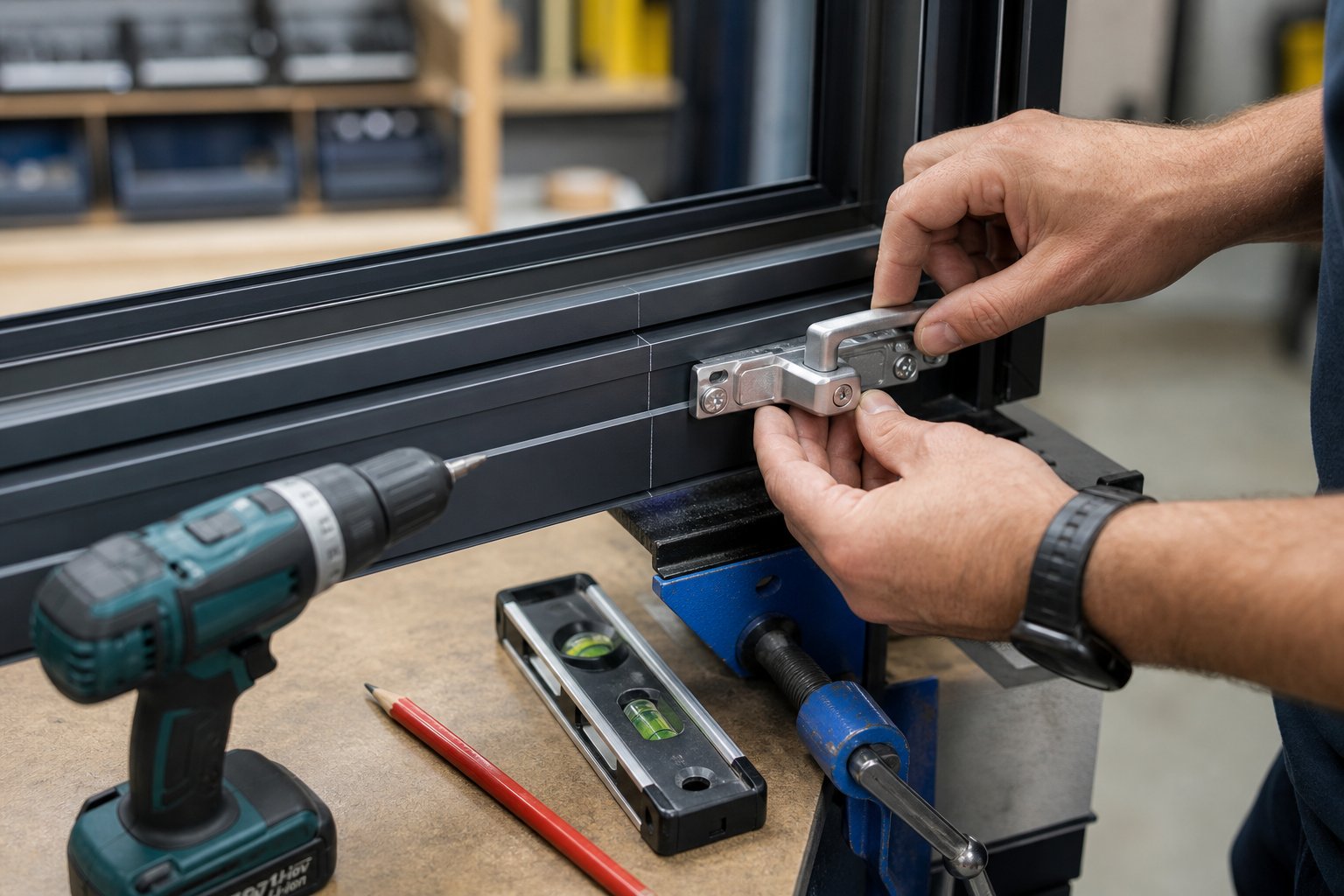
Once you have confirmed compatibility, the installation sequence for a standard cam or wedge latch follows a logical order:
- Mark the keeper position first — close the sash and mark where the keeper (strike plate) needs to sit on the frame so it aligns with the latch tongue or cam. Use a pencil or masking tape rather than scoring the powder coat.
- Drill pilot holes — aluminium is soft enough to tap screws directly, but pilot holes prevent the extrusion from splitting and ensure the screws sit straight. Use a drill bit slightly smaller than the screw shank — typically 2.5 mm for standard M4 window hardware screws.
- Secure the keeper to the frame — mount the keeper first because its position is fixed relative to the sash travel. Tighten screws firmly but not aggressively; overtightening strips aluminium threads quickly.
- Mount the latch body on the sash — align the tongue or cam with the keeper slot, insert the spindle through the handle, and secure the latch body with its mounting screws.
- Test operation before final tightening — close the window and engage the latch several times. The cam or tongue should slide into the keeper smoothly and draw the sash tight against the weatherseal without excessive force. If it binds or misses, loosen the keeper screws and adjust its position by fractions of a millimetre until engagement is clean.
That final test step is critical. Lock keepers that are even slightly misaligned create ongoing problems — the latch either will not engage fully or requires excessive force that wears the mechanism prematurely. A few minutes of patient adjustment during installation prevents years of frustration.
Adjustment and Maintenance Tips
Even a perfectly installed latch needs periodic attention. Aluminium frames expand and contract with temperature changes, seals compress over time, and screws gradually loosen through repeated use. Knowing how to adjust an aluminium window latch keeps the hardware performing as intended without calling in a tradesperson for every minor issue.
The most common adjustments are straightforward:
- Tightening loose screws — if the handle feels wobbly or the latch body shifts when engaged, the mounting screws have likely backed out. Retighten with a hand screwdriver (not a power driver, which risks stripping the aluminium). If the screw hole feels soft, remove the screw, pack the hole with a small amount of two-part epoxy, let it cure, then re-drill a pilot hole and refit.
- Realigning the keeper — seasonal frame movement can shift the keeper out of alignment with the tongue or cam. Loosen the keeper screws, close the sash, and let the latch engagement guide the keeper to its correct position. Retighten once aligned. Some keepers include a slotted mounting hole that allows lateral adjustment without removing the screws entirely.
- Lubricating the cam or pivot point — a dry cam or pivot creates friction, making the handle stiff and accelerating wear on the mechanism. Apply a small amount of silicone-based lubricant (not petroleum-based grease, which attracts dust and can degrade nylon bushings) to the pivot point and cam surface annually.
Window latch maintenance in a coastal environment demands more attention than inland properties. Salt deposits accelerate corrosion, clog moving parts, and degrade powder-coat finishes faster than UV alone. A structured maintenance schedule keeps latches functional and extends their service life considerably:
- Every 3 months (coastal) or 6 months (inland) — wipe down all latch hardware with a damp cloth to remove salt residue, dust, and grime. Pay attention to the keeper slot where salt crystals accumulate and prevent full tongue engagement.
- Every 6 months — inspect the powder-coat finish on the latch body and keeper for chips, scratches, or bubbling. Touch up any exposed metal with a matching paint pen or clear lacquer to prevent corrosion from taking hold beneath the coating.
- Annually — apply silicone spray or dry lubricant to all moving parts: the cam lobe, pivot pins, spindle, and spring mechanisms. Work the handle through its full range of motion several times to distribute the lubricant evenly.
- Annually — check nylon bushings and plastic inserts for wear or cracking. These components isolate metal-on-metal contact and reduce friction, but they degrade under UV exposure and repeated cycling. Replacements are inexpensive and typically press-fit without tools.
- Every 2 years — retighten all mounting screws and test the latch engagement force. If the handle requires noticeably more or less effort than when first installed, the keeper likely needs realignment or the cam surface has worn and may need replacement.
This schedule sounds involved, but each check takes only a few minutes per window. The payoff is hardware that operates smoothly for ten to fifteen years rather than seizing up or failing after three or four — a meaningful difference when you consider the cost and inconvenience of full latch replacement across an entire home.
Maintenance catches most problems early. But some symptoms signal that adjustment alone will not restore proper function — and that is when the repair-versus-replacement decision becomes unavoidable.
When to Repair or Replace Your Aluminium Window Latch
A latch that needed a gentle nudge last winter now requires a firm shove. The sash rattles on windy nights even though it is supposedly closed. These are not quirks to live with — they are early warnings that the hardware is failing. Recognising the signs of worn aluminium window latch hardware early gives you the choice between a quick fix and a planned replacement, rather than discovering the problem when a storm drives rain through the gap or a security vulnerability becomes obvious.
Signs Your Latch Needs Attention
Not every stiff handle or minor rattle means the latch is finished. But certain symptoms point clearly to hardware that is no longer doing its job. If your aluminium window latch is not closing properly, look for these indicators:
- Sash rattling when closed — the tongue or cam is no longer pulling the sash firmly against the frame. You might hear it on breezy days or feel vibration when you press the glass. This usually means the cam has worn flat, the keeper slot has widened, or the compression spring has lost tension.
- Visible gap between sash and frame — close the window, engage the latch, and look along the seal line. Any daylight or uneven contact indicates the latch is not generating enough draw to compress the weatherseal fully. Draughts, dust ingress, and water penetration follow.
- Latch not engaging without force — if you need to lift, push, or jiggle the sash to get the tongue into the keeper, the components have shifted out of alignment or the mechanism has developed internal wear. Forcing engagement accelerates damage to both the latch and the frame.
- Handle spinning freely — this is the clearest sign of internal failure. A handle that rotates without resistance means the spindle has stripped, the cam has broken from its shaft, or the internal gear teeth have worn smooth. No amount of lubrication fixes a mechanical disconnect.
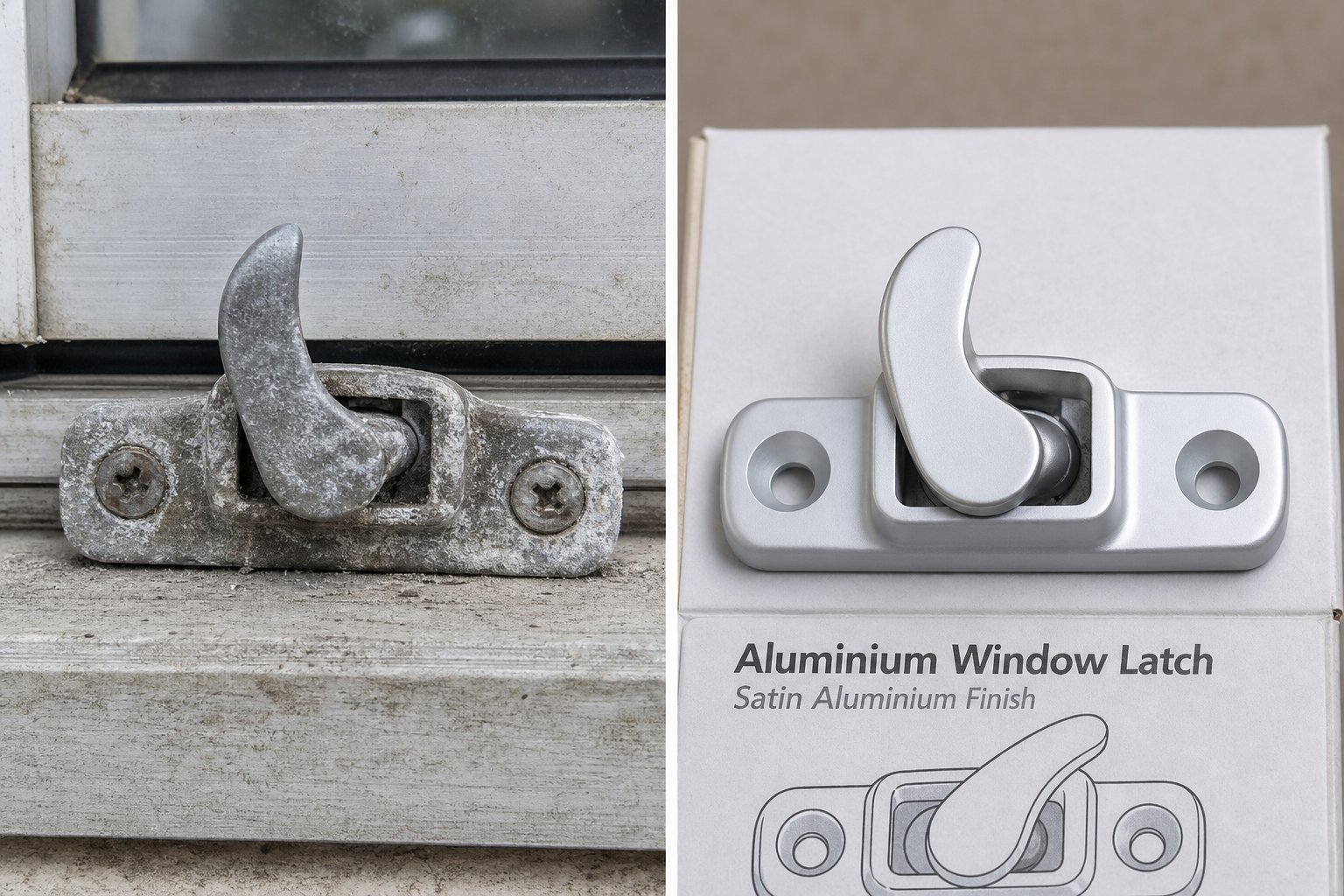
- Corrosion or pitting on the tongue or keeper — surface oxidation on aluminium hardware is normal and usually harmless. But deep pitting, white powdery deposits building up inside the keeper slot, or visible material loss on the cam lobe means the metal is degrading structurally. Corroded components lose dimensional accuracy, which means they can no longer form a tight engagement.
Any single symptom warrants investigation. Two or more appearing together on the same window strongly suggest the latch has reached the end of its useful life — particularly in coastal areas where salt exposure accelerates every form of wear simultaneously.
Repair vs Replacement Decision Guide
The window latch repair vs replacement cost equation is not always straightforward, but a few clear principles simplify the decision. Minor issues that affect alignment or fastening are almost always repairable. Structural failures in the latch body or internal mechanism are not.
Repairable problems include loose mounting screws (retighten or pack with epoxy and re-drill), minor keeper misalignment (loosen and reposition), a dry or stiff pivot point (clean and lubricate), and surface-level corrosion that has not penetrated the base metal (clean with a nylon brush and apply a protective coating). These fixes cost virtually nothing and take minutes per window.
Replacement triggers are different in kind, not just degree. A cracked latch body cannot be welded back to its original tolerance. A stripped spindle will not re-engage no matter how tightly you pack the hole. A cam lobe worn below its designed profile cannot generate the compression the seal requires. And corroded hardware on older aluminium windows often signals that the surrounding seals and frame components are degrading at a similar rate — meaning the latch failure is a symptom of a broader problem rather than an isolated fault.
Use this checklist to guide your decision when assessing each window:
- Repair — screws loose but holes intact, keeper slightly out of position, handle stiff but still engaging, surface grime or light oxidation only, powder coat chipped but base metal sound.
- Replace the latch — handle spins freely (stripped spindle or broken cam), latch body cracked or deformed, deep pitting or material loss on tongue or keeper, mechanism no longer draws sash tight even after realignment, replacement parts for the specific model are no longer available.
- Consider replacing the entire window — multiple latches failing across the same frame, weatherseals permanently compressed or crumbling, frame profile showing signs of corrosion or distortion, screw holes enlarged beyond repair, visible daylight around the frame perimeter even with new hardware fitted.
That last category deserves honest consideration. When you find yourself replacing latches on a window where the seals have hardened, the rollers have seized, and the frame extrusion shows pitting along its length, you are spending money to maintain a system that is failing as a whole. The latch is simply the most obvious component to give out first because it has the most moving parts.
In these situations — where latch replacement reveals broader frame or seal deterioration — upgrading to a modern aluminium window system often delivers better long-term value than piecemeal hardware repairs. MEICHEN’s custom aluminium windows, designed specifically for Australian conditions, come with matched hardware from the factory. The latch, seal, hinge, and frame profile are engineered as a single system, eliminating the compatibility guesswork that makes retrofitting older frames so frustrating.
Whether you repair, replace the latch, or upgrade the window entirely depends on where the failure sits in the system. A single worn cam on an otherwise sound frame is a ten-minute fix. A pattern of failures across multiple components is the frame telling you it has reached the end of its service life — and listening to that signal early saves more than ignoring it ever will.
Frequently Asked Questions About Aluminium Window Latches
1. What is the difference between a window latch and a window lock?
A window latch is a mechanical device that holds the sash against the frame through physical engagement — a cam, wedge, or tongue slotting into a keeper. It secures the closed position without requiring a key. A window lock adds keyed or coded security on top of the latching action, preventing the mechanism from being released without authorisation. Many modern aluminium window fittings combine both functions into a single unit called a latch lock, which uses a key cylinder or thumb-turn to pin the latch in the engaged position. For ground-floor or easily accessible windows in Australian homes, a combined latch lock with anti-lift features provides both holding force and intrusion resistance.
2. How do I choose the right latch for my aluminium sliding window?
Sliding aluminium windows require flush-mount or recessed latches that sit entirely within the frame profile, since any protruding hardware would jam against the adjacent sash or track during operation. The most suitable options are spring-bolt latches that snap automatically into a frame slot, or low-profile lever latches recessed into the meeting stile. For windows wider than 1200 mm, choose a latch with an anti-lift pin to prevent the sash from being levered upward out of the track. Always measure the existing screw hole spacing, frame profile depth, and spindle length before ordering a replacement to ensure compatibility with your specific aluminium extrusion.
3. Why do aluminium latches work best on aluminium window frames?
Aluminium latches on aluminium frames eliminate galvanic corrosion risk entirely. When two dissimilar metals contact each other in the presence of moisture or salt spray, the less noble metal corrodes preferentially — and aluminium loses in most pairings. Using the same metal for both latch and frame means no galvanic potential difference, matched thermal expansion rates, similar weight characteristics, and seamless powder-coat colour matching. This combination is particularly important in Australian coastal environments where persistent salt air accelerates bimetallic corrosion. Brass or steel latches on aluminium frames require nylon isolating washers to prevent accelerated frame deterioration at contact points.
4. How often should I maintain aluminium window latches in coastal areas?
In coastal Australian environments, clean all latch hardware every three months using a damp cloth to remove salt residue from the keeper slot and moving parts. Every six months, inspect the powder-coat finish for chips or bubbling and touch up exposed metal to prevent corrosion. Annually, apply silicone-based lubricant to all pivot points, cam lobes, and spring mechanisms — avoid petroleum-based grease as it attracts dust and degrades nylon bushings. Check nylon inserts for UV damage or cracking at the same time. Every two years, retighten all mounting screws and test engagement force. This schedule keeps latches functional for ten to fifteen years rather than the three to four years typical of neglected coastal hardware.
5. When should I replace an aluminium window latch instead of repairing it?
Replace the latch when you encounter structural failures that adjustment cannot fix: a handle spinning freely indicates a stripped spindle or broken cam shaft, a cracked latch body cannot be restored to tolerance, deep pitting or material loss on the tongue or keeper means the metal has degraded beyond functional dimensions, and if the mechanism no longer draws the sash tight even after keeper realignment, internal wear has exceeded serviceable limits. If multiple latches are failing across the same window frame alongside hardened seals and corroded extrusions, the entire window system may have reached end of life — at which point upgrading to a modern aluminium window system with factory-matched hardware delivers better long-term value than piecemeal repairs.
More Window & Door Guides