What Aluminium Window Weather Seals Do and Why They Matter
A draught curling past a closed window is rarely a glass problem. More often, the culprit is a thin strip of rubber or polymer you barely notice until it stops doing its job. That strip — the weather seal — is the only thing standing between your indoor comfort and whatever the Australian climate throws at your facade.
Whether you are a homeowner tackling a weekend replacement or a property manager mapping out a maintenance schedule across dozens of openings, this guide covers every angle: seal types and profiles, material science, climate-driven selection, failure diagnosis, and step-by-step replacement best practices. It is a single-topic deep dive built to save you time, money, and guesswork.
What Are Aluminium Window Weather Seals
Aluminium window weather seals are flexible gaskets or strips installed at the junctions where aluminium window frames meet their sashes. Their purpose is to block air, water, dust, and noise from infiltrating the building envelope when the window is closed.
Every window system relies on seals, but weather seals for aluminium framed windows carry extra responsibility. Aluminium is rigid and thermally conductive — two traits that make it a brilliant structural material yet a demanding partner for any flexible gasket pressed against it. Unlike timber, which absorbs minor dimensional shifts, or uPVC, which flexes under load, aluminium transfers stress directly to its seals. Choose the wrong profile or material and performance drops fast.
Why Aluminium Frames Demand Specialised Sealing
Aluminium expands and contracts with temperature change at roughly twice the rate of steel and significantly more than timber or uPVC. On a dark-framed window baking in direct Western Australian sun, surface temperatures can climb well above ambient, stretching the frame by fractions of a millimetre along every edge. Come nightfall, it contracts. Multiply that cycle across years and the cumulative fatigue on seals becomes the single biggest maintenance variable in the entire window assembly.
This thermal movement is precisely why understanding the aluminium window seal purpose and function matters before you order a replacement. A seal that performs beautifully on a uPVC casement may harden, crack, or lose compression on an aluminium frame within a few seasons. The sections ahead unpack exactly how to avoid that outcome — from identifying your current seal profile and choosing the right material, to matching your selection to local climate conditions and sidestepping the installation mistakes that shorten seal life.
Where Seals Sit Inside an Aluminium Window Frame
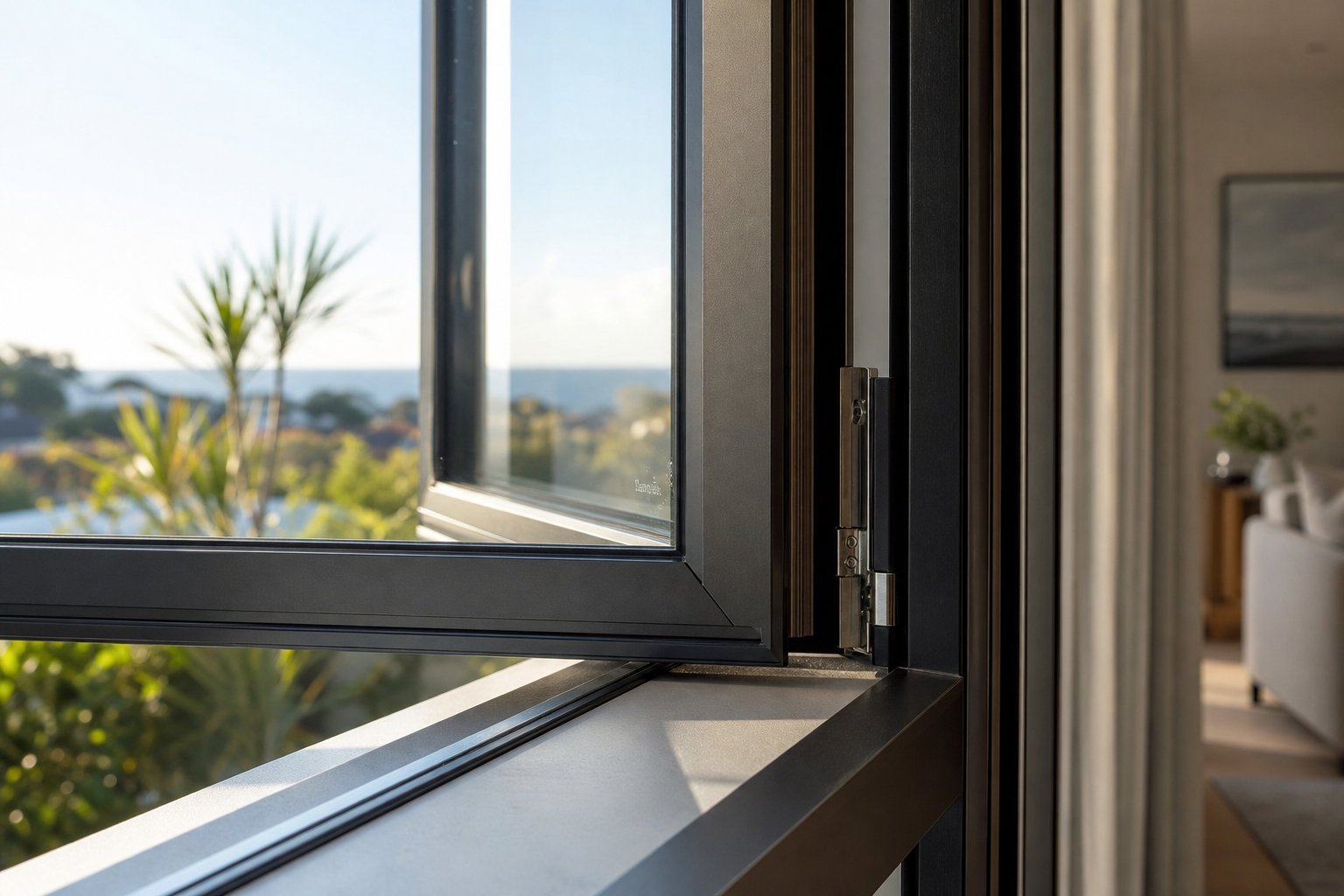
Knowing that your seals need attention is one thing. Knowing exactly where they live inside the frame is another entirely. Aluminium window assemblies can hide two or three distinct sealing zones, and each one does a different job. If you peel back the sash or crouch down to track level, here is what you will find — and what each seal feels and looks like in place.
Compression Seals and Their Position in the Frame
Compression seals handle the heaviest sealing duty on casement, awning, and tilt-and-turn aluminium windows. They sit along the closing edges — the surfaces where the movable sash meets the fixed outer frame the moment you latch the window shut. When the sash presses home, the seal squeezes between those two aluminium faces, deforming just enough to fill any micro-gap and form a continuous airtight barrier around the full perimeter.
On most aluminium systems, the aluminium window compression seal placement relies on a purpose-milled groove extruded directly into the frame profile. Picture a narrow channel, typically 3 mm to 5 mm wide, running the entire length of the frame rebate. The seal slots or presses into this channel, with the bulb or lobe section protruding a few millimetres proud of the aluminium surface. Run your finger along a properly seated compression seal and you will feel a soft, slightly springy ridge rising above the hard metal. Visually, it appears as a continuous rubber bead — usually black or grey — tracing the inner rectangle of the frame. When the window closes, this ridge flattens under pressure and springs back when the sash opens again. That elastic recovery is the entire operating principle.
In thermally broken aluminium frames — now standard in most new Australian builds — compression seals often sit on both the interior and exterior faces of the sash-to-frame junction, creating a double seal line. This dual arrangement adds redundancy: if one line is breached by wind-driven rain, the second catches what gets through.
Sweep and Fin Seals Along Sliding and Hung Sashes
Sliding aluminium windows present a different challenge. The sash cannot press firmly against the frame the way a casement does — it needs to glide sideways along a track. A rigid compression seal would create far too much friction. This is where the sweep seal for sliding aluminium windows earns its place.
Also called pile seals or fin seals, these components look and feel nothing like the bulky rubber gaskets on a casement. A pile seal consists of dense rows of fine synthetic fibres — typically polypropylene or nylon — woven into a narrow plastic or aluminium carrier strip. Imagine a tiny, tightly packed brush running the full height or width of the sliding track. The fibres bend gently as the sash passes over them, allowing smooth movement while still blocking dust, wind-driven rain, and low-level air infiltration. Some versions include a thin flexible plastic fin rising from the centre of the pile to boost draught resistance without adding noticeable friction.
You will typically find pile seals in two locations on a sliding aluminium window: along the vertical stiles of the sash (the side edges that overlap or interlock with the adjacent panel) and along the head and sill tracks where the sash rides. On double-hung aluminium windows, similar pile or fin strips line the jamb channels that guide each sash up and down. Correctly specified pile height — commonly between 6 mm and 8 mm for standard residential aluminium sliders — ensures the fibres make consistent contact without causing the sash to drag or bind.
Perimeter Glazing Seals Between Glass and Frame
There is one more seal zone worth mentioning, even though it falls outside the main focus of this article. The glazing seal sits between the glass pane and the aluminium frame rebate — the recessed ledge that cradles the edge of the glass unit. Its job is to cushion the glass against the hard aluminium, prevent water from reaching the sealed edge of a double-glazed unit, and stop rattling caused by wind pressure.
Understanding the distinction between a glazing seal vs weather seal on an aluminium window matters because the two can fail independently. You might have perfectly intact glazing seals holding the glass firmly in place while the sash-to-frame weather seals have perished and are letting draughts whistle through. The reverse is also possible. Both contribute to overall window performance, but the weather seals at the sash junction are the ones most exposed to mechanical wear, UV degradation, and thermal cycling — and the ones you are most likely to replace yourself.
With a clear mental map of where do seals go on aluminium windows, the next practical step is figuring out exactly which profile shape your window uses — because a seal that looks almost right can still perform poorly if the cross-section does not match the channel it needs to fill.
Identifying Your Aluminium Window Seal Profile Type
Ordering a replacement seal based on a vague description — “it’s the black rubber bit around the frame” — is a reliable way to waste money. Aluminium window seal profiles come in half a dozen distinct cross-sectional shapes, and each one is engineered to fill a specific channel geometry and deliver a particular compression response. Get the profile wrong by even a millimetre and the seal either jams the sash, falls out of the groove, or leaves a gap that defeats the purpose entirely.
The guide below describes each common profile in enough detail that you can identify yours by sight and touch alone — no diagram required.
Common Seal Profiles for Aluminium Windows
P-type (bulb seal with mounting strip). Hold a P-type seal in cross-section and you will see a rounded, hollow bulb — roughly the size of a small pea — attached to a flat mounting strip. The bulb is the compressible part; it squashes when the sash closes and springs back when it opens. The flat strip either slides into an extruded channel or sticks to the frame via adhesive backing. Between your fingers, the bulb feels soft and slightly bouncy, while the strip is firmer and thinner. P-type profiles are among the most common on Australian casement and awning aluminium windows.
E-type (multi-ridged flipper seal). An E-type profile looks like the letter E turned on its back — a flat base with three flexible ridges (sometimes two) projecting outward. Those ridges compress independently, which lets a single seal accommodate slight variations in the gap between sash and frame. When you run a fingertip across the face, you can feel each ridge flex and return. E-type seals tend to be thinner than P-types and are a solid choice where the closing gap is narrow or slightly uneven. In a P-type vs E-type window seal comparison, the key difference is that P-types provide a single, deeper compression zone while E-types spread their sealing force across multiple contact lines.
D-type (half-round tube). Picture a tube sliced lengthwise — that flat side is the mounting face, and the rounded side is the contact surface. D-type seals can be solid rubber or hollow. Hollow versions compress more easily, making them suitable for windows where the latch hardware does not pull the sash in with a lot of force. Solid D-types are firmer and better suited to high-wind exposures. To the touch, the rounded surface feels smooth and dome-like, and pressing it with your thumb gives immediate feedback about whether it is hollow (collapses easily) or solid (resists then slowly yields).
Wedge profiles. A wedge seal has a triangular cross-section that tapers toward one end. It is designed to be pressed into a channel where the taper creates a friction fit — the wider base grips the channel walls while the narrow tip makes contact with the opposing surface. Wedge profiles are frequently used as glazing seals in aluminium systems, sitting between the glass edge and the frame rebate, but they also appear in some sash-to-frame junctions on older extrusion designs. They feel firm and slightly stiff compared to bulb-style seals.
Bubble seals. A bubble seal features a fully enclosed air chamber — a hollow, rounded pocket that compresses flat when two surfaces meet. The “bubble” is typically attached to a carrier base that slots into a frame channel or adheres to a flat surface. Squeeze one between your fingers and it collapses with a soft, cushioned feel before springing back. Bubble seals excel where consistent, even compression is needed across the full perimeter, and they are common in both residential and commercial aluminium window systems.
Fin or pile strips. These differ from every other profile because they are not solid rubber at all. A pile strip is a dense brush of fine synthetic fibres — usually polypropylene — mounted on a narrow carrier. A fin strip substitutes the bristles for one or more thin, flexible plastic blades. Both types are used almost exclusively on sliding and double-hung aluminium windows, where the sash must move freely past the seal. They feel soft and bristly (pile) or smooth and flexible (fin) to the touch, and they deflect sideways rather than compressing downward.
How to Measure and Match the Right Profile
Identifying the shape is half the job. The other half is getting the dimensions right — because a P-type seal that is 1 mm too wide for the channel will buckle on installation, and one that is too narrow will pull free within weeks. Here is how to measure an aluminium window seal for replacement accurately.
- Remove a short sample. Open the window fully. Using a flat-blade screwdriver or a blunt knife, carefully lever out a 50 mm to 100 mm length of the existing seal from a straight section of the frame — avoid corners, where the profile may be distorted. If the seal crumbles on removal, collect as many fragments as possible and try to reconstruct the cross-sectional shape.
- Examine the mounting method. Check whether the seal was pressed into an extruded channel (you will see a groove in the aluminium with a narrow slot opening) or attached with adhesive backing (you will see residue on a flat aluminium surface). This distinction determines whether you need a push-in or self-adhesive replacement.
- Measure the channel or mounting surface. For push-in seals, use a vernier calliper or a small ruler to measure the width of the channel opening (the slot the seal base passes through) and the depth of the channel behind it. Common channel widths on aluminium extrusions fall between 2.5 mm and 5 mm. For adhesive-backed seals, measure the width of the flat surface where the seal was bonded.
- Measure the seal cross-section. Lay the sample on a flat surface and measure its overall height (from base to the highest point of the bulb, fin, or ridge) and overall width. If the seal is a bulb or bubble type, also measure the diameter of the hollow section. Record every dimension in millimetres — even half-millimetre differences matter.
- Note the material and colour. Identify whether the seal is rubber (flexible, matte surface), silicone (slightly tacky, very pliable), foam (spongy, lightweight), or a harder thermoplastic. Note the colour — most aluminium window seals are black or grey, but some systems use white or brown to match the frame powder coat.
- Compare against replacement specifications. Cross-reference your recorded dimensions with the product datasheets of replacement seals. Pay particular attention to the base or foot dimensions — these must match the channel precisely. The compressible section can tolerate slightly more variation, but the mounting interface cannot.
If the original seal is too degraded to measure, your next best option is to take the window brand, model, or series number directly to the manufacturer or a specialist supplier. Many aluminium window extrusion systems use proprietary seal profiles, and ordering by model number eliminates guesswork entirely — a distinction that becomes even more important when you weigh OEM seals against universal aftermarket alternatives.

Comparing Seal Materials for Aluminium Window Systems
Profile shape gets the seal into the channel. Material chemistry determines how long it stays effective once it is there. Two seals with identical cross-sections can deliver wildly different lifespans depending on the polymer they are made from — and aluminium frames, with their thermal conductivity and surface oxidation behaviour, narrow the field of genuinely suitable options more than most homeowners realise.
Five materials dominate the aluminium window seal material comparison table below. Each brings a distinct balance of flexibility, durability, and cost that matters in Australian conditions.
EPDM Rubber, Silicone, TPE, Neoprene, and PVC Compared
EPDM (Ethylene Propylene Diene Monomer) is a synthetic rubber formed by polymerising ethylene, propylene, and a small fraction of diene monomer. In plain terms, it is a purpose-built outdoor rubber — black, matte-textured, and resilient across a vast temperature window. EPDM is the default gasket material in most quality aluminium window systems because it resists UV radiation, ozone, and moisture without becoming brittle. Its operating range spans roughly -51 °C to 177 °C, and it holds its shape under sustained compression better than most alternatives.
Silicone is a semi-organic polymer prized for extreme temperature tolerance — typically -60 °C up to around 230 °C — and a naturally hydrophobic surface that sheds water. It remains supple across seasons, rarely hardens in cold snaps, and resists UV degradation exceptionally well. The trade-off is cost: silicone seals sit at the premium end of the price range and offer lower tear strength, meaning they can be easier to nick or damage during installation. When weighing EPDM vs silicone seal for aluminium windows, silicone earns its premium mainly in marine or extreme-UV environments where its hydrophobic properties and thermal ceiling provide a measurable advantage.
TPE (Thermoplastic Elastomer) blends hard and soft plastics to create a rubber-like material that can be recycled and reprocessed — a growing consideration in sustainability-focused projects. A TPE weather seal for aluminium windows typically handles temperatures from about -34 °C to 121 °C and offers good weathering and ozone resistance. Where TPE falls short relative to EPDM is compression set: under long-term squeeze pressure, TPE is more likely to creep and lose its spring over time, which can reduce sealing force on older windows that are not re-latched daily.
Neoprene (Polychloroprene) is a synthetic rubber originally developed for chemical resistance. It handles a moderate temperature range — roughly -40 °C to 120 °C — and offers decent UV tolerance, though not quite at EPDM or silicone level. Neoprene performs well in industrial applications but is increasingly less common in residential aluminium window seals, partly because its compression set resistance trails EPDM and partly because its cost sits in the mid-to-high bracket without a compelling performance advantage for window duty.
PVC (Polyvinyl Chloride) seals are the budget option. Rigid in their base state, PVC seal compounds are softened with plasticisers to achieve flexibility. This works adequately in mild, stable climates, but the plasticisers migrate out of the material over time — especially under heat and UV — causing the seal to stiffen, shrink, and eventually crack. PVC seals rarely last as long as EPDM or silicone equivalents, and their temperature tolerance is the narrowest of the group, roughly -20 °C to 60 °C.
| Material | UV Resistance | Temperature Tolerance | Compression Set Resistance | Expected Lifespan | Cost Level |
|---|---|---|---|---|---|
| EPDM Rubber | Excellent | -51 °C to 177 °C | Good to very good | 15–25 years | Moderate |
| Silicone | Excellent | -60 °C to 230 °C | Good | 20–30 years | High |
| TPE | Good | -34 °C to 121 °C | Fair — prone to creep under sustained load | 10–20 years | Low to moderate |
| Neoprene | Moderate to good | -40 °C to 120 °C | Moderate | 10–20 years | Moderate to high |
| PVC | Poor to moderate | -20 °C to 60 °C | Poor — plasticiser loss accelerates hardening | 5–10 years | Low |
Which Material Suits Aluminium Frames Best
For the majority of Australian residential and commercial aluminium windows, EPDM remains the best seal material for aluminium window frames. Its broad temperature range handles everything from frosty Canberra mornings to scorching Darwin afternoons, and its UV stability means north- and west-facing seals do not degrade as rapidly as PVC or basic neoprene compounds. Critically, EPDM is chemically inert against aluminium’s natural oxide layer — it will not promote galvanic interaction or accelerate localised corrosion at the contact interface, an issue that some lower-grade polymers can trigger over years of direct metal contact.
TPE is a strong second choice, particularly where recyclability is a project requirement or where the seal sits in a low-compression zone like a sliding track. Its main limitation — a tendency toward compression creep under sustained stress — matters less in applications where the seal is not permanently loaded.
PVC seals, while easy on the budget, deserve caution on aluminium frames. The combination of aluminium’s heat absorption and Australia’s intense UV environment accelerates plasticiser migration, shortening the seal’s useful life well below what the same PVC strip might achieve on a shaded timber frame. For high-exposure elevations or long-term maintenance programs, PVC rarely justifies the upfront savings.
Material selection is ultimately a performance decision — and in the Australian construction landscape, performance decisions are increasingly tied to documented compliance. Architects, builders, and specifiers evaluating aluminium window systems can explore how manufacturers test their assemblies against standards covering weather resistance, durability, and energy efficiency. MEICHEN’s Compliance and Certifications page offers one such resource, outlining how system-level testing validates seal performance as part of the complete window assembly rather than treating it as an isolated component.
Material chemistry tells you what a seal can withstand in theory. Whether you are sourcing that seal through the original window manufacturer or hunting for a compatible aftermarket profile shapes the practical side of the equation — and the performance trade-offs between those two paths deserve their own close look.
How to Find Replacement Seals for Aluminium Windows
You have identified the profile shape. You know which material suits your climate and frame type. The next fork in the road catches plenty of people off guard: do you source a seal directly from the company that manufactured your aluminium windows, or do you buy a universal aftermarket strip that claims to fit a broad range of frames? The answer is not always obvious, and choosing the wrong path can mean a seal that looks right on the shelf yet performs poorly once pressed into the channel.
OEM Seals From the Original Window Manufacturer
Most reputable aluminium window manufacturers design their extrusion systems as integrated packages — frame profiles, hardware, drainage paths, and seals all engineered to work together. The seal profiles in these systems are proprietary, meaning they are purpose-moulded to match the exact channel geometry and compression gap of that specific extrusion series. An OEM seal from the original manufacturer is, by definition, the same component that was tested and certified as part of the complete window assembly.
The advantages are hard to argue with. Fit is guaranteed — no trial-and-error sizing, no trimming a seal that is half a millimetre too tall. Compression behaviour matches the intended latching force, so the seal performs at its designed airtightness and water resistance levels. Perhaps most importantly for newer installations still under warranty, using the manufacturer’s own seal preserves the product warranty. Swap in a third-party strip and you may void the coverage, leaving yourself exposed if a broader frame or hardware issue develops later.
The disadvantages tend to surface as windows age. Manufacturers periodically discontinue extrusion series, and once a profile line is retired, its matching seal stock can dry up or face extended lead times. Pricing also skews higher than generic equivalents — partly because smaller production runs cost more per metre, and partly because you are paying for the assurance of a tested, system-specific component. For property managers maintaining older buildings with dozens of aluminium windows across multiple discontinued series, sourcing OEM seals for every opening can become a logistics headache.
Universal and Aftermarket Replacement Seals
The aftermarket seal market exists precisely because not every replacement needs to be OEM. A universal weather seal for aluminium window frames is manufactured in standardised cross-sectional dimensions — common channel widths of 3 mm, 4 mm, or 5 mm, with bulb or flipper profiles designed to fit the broadest possible range of extrusions. Some aftermarket suppliers, such as those offering universal flipper, bubble, and wedge gaskets, produce a small number of base sizes engineered to cover dozens of proprietary profiles in a single product line.
A universal seal makes solid practical sense in several scenarios. If the window is well out of its manufacturer warranty period, the OEM warranty argument disappears. If the channel dimensions fall within standard ranges — and many Australian residential aluminium windows use fairly common extrusion geometries — a quality aftermarket EPDM or TPE seal can deliver performance that is functionally identical to the original. Budget-conscious maintenance programs covering large numbers of openings often default to aftermarket seals for exactly this reason: lower per-metre cost, faster availability, and no manufacturer minimum order hurdles.
There are situations, however, where a generic profile is a risky bet. Non-standard extrusion systems — particularly commercial curtain wall assemblies, corner windows, or high-performance thermally broken frames — often use seal geometries that no aftermarket product replicates accurately. High-exposure installations facing persistent wind-driven rain or extreme temperature swings also warrant the tighter tolerances that an OEM seal provides. A universal seal that seats 90 percent correctly in a sheltered suburban casement may leak noticeably on a coastal high-rise facade where every fraction of a millimetre counts.
How to Source the Right Replacement
A systematic approach saves time and avoids the frustration of ordering, waiting, testing, and reordering. Start with the original manufacturer — even if the window is decades old, many Australian aluminium window companies maintain archives of their extrusion series and can identify the correct seal from a model number or series code. That code is usually stamped or etched on the frame itself, printed on original purchase documentation, or recorded in the builder’s specification schedule for the property.
If the OEM route hits a dead end — discontinued series, unresponsive manufacturer, or prohibitive cost — shift to aftermarket suppliers. Look for suppliers that list compatible window brands or series alongside their seal products, and always request a sample or order a short test length before committing to a bulk purchase. Pressing a 200 mm sample into the actual channel on your window tells you more in ten seconds than any datasheet dimension can.
Before you contact any supplier — OEM or aftermarket — gather the following details so the conversation is productive from the first call:
- Window brand — the manufacturer name, usually visible on hardware or frame markings
- Model or series number — stamped on the frame, noted on installation paperwork, or available from the original builder
- Seal location — specify whether you need the sash-to-frame perimeter seal, a sliding track pile seal, or a glazing bead gasket
- Channel width — the slot opening in millimetres, measured with a calliper as described in the profiling section above
- Seal height — how far the seal protrudes from the channel surface when seated
- Profile shape — P-type, E-type, D-type, bubble, wedge, or pile, identified from your sample or the profile guide earlier in this article
Armed with that checklist, most suppliers can narrow the options to one or two candidates within minutes. And whichever sourcing path you take — OEM precision or aftermarket practicality — the seal still has to survive whatever your local climate dishes out. That relationship between environment and seal longevity turns out to be one of the most overlooked factors in the entire replacement decision.

How Climate Shapes Aluminium Window Seal Selection
An EPDM gasket that lasts twenty years on a shaded, south-facing window in Melbourne may crack and crumble within a decade on a sun-hammered west elevation in Broome. Same material, same profile — completely different outcome. The variable is climate, and it influences seal longevity more aggressively than most people expect. Choosing the best seal material for your aluminium frames without factoring in your local environment is like specifying sunscreen strength without knowing which beach you are headed to.
UV Exposure and Extreme Heat Considerations
Ultraviolet radiation attacks seal polymers at the molecular level. It breaks the chemical bonds that give rubber and thermoplastic compounds their flexibility, triggering a chain reaction of surface cracking, hardening, and eventual loss of elasticity. In much of Australia — particularly across Queensland, the Northern Territory, and Western Australia — UV index readings sit at “extreme” for months on end. Seals on north- and west-facing aluminium windows cop the worst of it, absorbing hours of direct afternoon sun every day of summer.
Frame colour amplifies the problem. Dark-coloured aluminium — charcoal, black, or deep bronze powder coat — absorbs significantly more solar radiation than lighter finishes. That absorbed heat does not stay in the metal; it conducts directly into the seal sitting in the extrusion channel. On a 38 °C day in Perth, a dark aluminium frame in full sun can easily reach surface temperatures above 70 °C. A UV resistant seal for aluminium window frames — EPDM or silicone, ideally — handles these spikes without breaking down. A PVC seal at those temperatures accelerates plasticiser loss and stiffens noticeably within just a few seasons. If you are selecting an aluminium window seal for extreme heat climates, material grade matters far more than price per metre.
Coastal Salt Air and Humidity Effects
Australia has over 35,000 kilometres of coastline, and a huge share of its population lives within a few kilometres of the ocean. Salt-laden air is a daily reality for homes from the Gold Coast to Fremantle, and it creates a two-pronged attack on window seals.
First, airborne salt particles settle on aluminium surfaces and accelerate oxidation at the seal-to-frame interface. That growing oxide layer roughens the contact zone and can weaken the bond of adhesive-backed seals, gradually peeling them away from the metal. Powder-coated frames resist this better than raw or anodised finishes, but no coating eliminates the risk entirely in aggressive salt-air environments.
Second, high coastal humidity increases the chance of moisture becoming trapped behind or beneath seals. Persistent moisture in a confined aluminium channel is a recipe for localised corrosion, mould growth, and premature adhesion failure. When choosing the best window seal for coastal aluminium windows, look for materials with hydrophobic characteristics. Silicone-based seals naturally repel water from their surface, reducing moisture retention at the contact zone. EPDM performs well in humid conditions too, provided the channel is clean and drainage paths are not blocked by debris or old sealant residue.
Cold Climate and Thermal Cycling Stress
While Australia is not known for arctic winters, regions like the Snowy Mountains, the Tasmanian highlands, and elevated parts of the Great Dividing Range regularly experience freezing overnight temperatures followed by mild or sunny daytime conditions. That daily swing — freeze, thaw, freeze again — is what engineers call thermal cycling, and it punishes aluminium window seals in a way that steady cold alone does not.
Each cycle forces the aluminium frame to expand and contract. Because aluminium has a higher coefficient of thermal expansion than timber or uPVC, those dimensional shifts are proportionally larger, and the seal trapped between two moving aluminium surfaces endures repeated compression and release — hundreds of cycles across a single winter. Over years, this mechanical fatigue causes even quality seals to lose their elastic memory, a degradation pattern that mirrors compression set but is driven by movement rather than static pressure.
A reliable cold climate weather seal for aluminium windows must retain flexibility at low temperatures rather than stiffening into a rigid strip that can no longer conform to the shifting gap. EPDM handles this well, maintaining pliability down to roughly -50 °C. Silicone performs even better in extreme cold. PVC and lower-grade TPE compounds, by contrast, can become brittle below -10 °C, losing the elasticity needed to track frame movement and opening micro-gaps that let cold air stream through. For properties in frost-prone zones, spending a little more on a premium seal compound pays for itself in airtightness and reduced heating costs over the seal’s service life.
Climate dictates which materials survive and which deteriorate prematurely — but even the right material in the right environment will eventually wear out. Recognising exactly how and why seals fail gives you the diagnostic clarity to act before a minor gap becomes a major energy or water problem.
Common Failure Modes in Aluminium Window Seals
Seals do not simply stop working one day. They degrade through specific, identifiable mechanisms — each leaving its own fingerprint on the material. Understanding why aluminium window seals fail transforms maintenance from reactive guesswork into targeted diagnosis. You stop chasing draughts and start addressing root causes.
Four failure modes account for the vast majority of seal deterioration on aluminium-framed windows. Some act slowly over years. Others accelerate each other. All of them are detectable with nothing more than your hands, your eyes, and a few minutes of inspection.
Compression Set and Permanent Deformation
Every time you close a casement or awning window, the seal compresses between the sash and frame. Open the window and it should spring back to its original shape, ready to form a tight barrier again next time. That elastic recovery is the entire operating principle — and compression set is what happens when it breaks down.
Compression set in elastomers occurs when a seal is held under sustained squeeze for extended periods and permanently deforms. The polymer chains within the material rearrange under load, losing their ability to rebound. Measured as a percentage, a seal with 0% compression set has fully recovered its original shape, while one at 100% has completely flattened and exerts zero sealing force — even though the material may look physically intact.
On aluminium windows, compression set in aluminium window seals tends to develop gradually. A window that stays closed for months — a spare bedroom, a rarely used office — keeps the seal under constant load with no opportunity to recover. High temperatures accelerate the process because heat speeds up the chemical changes that break and reform crosslinks within the rubber. Dark-coloured aluminium frames compound this by raising localised temperatures at the seal contact surface.
The practical result is a seal that no longer fills the gap. Close the window firmly, latch it tight, and you still feel cold air trickling past. Hold a lighter flame near the frame on a breezy day and the flame flickers. Look closely at the seal and you may notice it sits noticeably flatter than it once did — the bulb or lobe that used to stand proud of the channel now barely rises above the aluminium surface. That flattened profile is the visual signature of compression set, and no amount of cleaning or adjusting the latch will fix it. The seal needs replacing.
UV Degradation and Surface Cracking
Sunlight is relentless, and in Australia it is especially punishing. UV damage to aluminium window rubber seals begins at the surface and works inward. Ultraviolet radiation fractures the long polymer chains that give rubber and thermoplastic seals their flexibility. What starts as microscopic surface cracks gradually deepens into visible fissures that widen with each temperature cycle.
You can spot UV degradation well before the seal actually fails. Run your thumb along the exposed face of the gasket. A healthy seal feels smooth, pliable, and slightly tacky. A UV-damaged seal feels dry, chalky, and rough — almost powdery in advanced cases. The colour shifts too: black EPDM may take on a dull grey or brownish hue, while lighter-coloured seals yellow or bleach unevenly.
Try flexing a suspect section gently between your fingers. A good seal bends smoothly and returns. A degraded one resists bending, then cracks along the fold line — sometimes snapping outright. Those cracks are not just cosmetic. Each one is a pathway for air and water to bypass the seal entirely, regardless of how well it still sits in the channel. North- and west-facing windows in Queensland, Western Australia, and the Northern Territory are the most vulnerable, but even temperate-climate seals on sun-exposed elevations will eventually succumb if the material lacks adequate UV stabilisation.
Aluminium Oxidation Affecting Seal Adhesion
Aluminium does not rust the way steel does, but it does oxidise. Within minutes of being exposed to air, bare aluminium forms a thin, hard oxide layer on its surface. This layer is actually protective — it slows further corrosion. But for adhesive-backed seals bonded directly to the frame, that same oxide layer creates a problem that worsens with time.
As the oxide film continues to develop — thickening in humid or coastal conditions — it gradually undermines the adhesive bond holding the seal in place. The seal begins to lift at its edges, peeling away from the aluminium surface millimetre by millimetre. Water creeps behind the lifted section, accelerating oxide growth in a self-reinforcing loop. Eventually, entire lengths of seal detach from the frame, leaving obvious gaps.
A separate but related issue involves galvanic interaction between certain seal materials and aluminium. When a polymer contains metallic fillers or conductive additives, and moisture is present, a low-level electrochemical reaction can develop at the contact interface. This accelerates localised corrosion of the aluminium directly beneath the seal — the very surface the seal depends on for adhesion or channel retention. The visual clue is a white, powdery residue forming along the seal contact line, sometimes accompanied by pitting in the aluminium. Quality EPDM and silicone seals are chemically inert against aluminium and do not trigger this reaction, which is another reason material selection matters so much on metal-framed windows.
Thermal Cycling Fatigue
The previous chapter described how freeze-thaw cycles stress seals in cold climates, but thermal cycling fatigue is not limited to frost-prone regions. Any environment with significant daily temperature swings — inland Australia experiences exactly this, with hot days and cool nights across much of the year — subjects aluminium frames to repeated expansion and contraction.
Each cycle shifts the channel walls fractionally. The seal, seated in that channel, is alternately squeezed tighter as the aluminium expands in heat and released as it contracts in cooler temperatures. Over thousands of repetitions, this mechanical push-and-pull gradually works the seal out of its seated position. Push-in seals creep upward in their channels. Adhesive-backed seals experience micro-delamination at the bond line. The result is uneven contact pressure around the window perimeter — tight in some sections, loose in others — creating localised draught paths that are maddeningly inconsistent.
Thermal cycling fatigue also accelerates compression set, because the seal never gets a stable rest period. It is constantly being loaded and unloaded, which fatigues the polymer faster than steady-state compression alone. Corners are particularly susceptible: the seal must bend through a 90-degree turn, and any creeping or shifting concentrates at these junction points first.
Signs Your Aluminium Window Seals Need Replacing
Not every failure mode announces itself dramatically. Some develop so gradually that you adapt to the declining performance without realising it — the room just feels a bit draftier, the street noise a touch louder, the energy bill slightly higher each quarter. Use this aluminium window seal diagnostic checklist as a structured walk-through for any aluminium window you suspect is underperforming:
- Draughts with the window fully closed and latched — hold a thin strip of tissue or a lighter flame near the seal line and watch for movement. Steady deflection signals air passing through failed or compressed seals.
- Water ingress during rain — moisture appearing on the interior sill or tracking down the wall beside the frame, particularly during wind-driven rain, points to seal gaps or adhesion loss along the weather face.
- Increased external noise — a noticeable rise in traffic, neighbourhood, or wind noise when the window is closed suggests the seal is no longer forming a continuous acoustic barrier around the perimeter.
- Visible seal damage — cracking, flattening, discolouration, chalky texture, brittleness, or sections that have pulled free from the channel or peeled away from the frame surface.
- Difficulty closing or latching the window — a seal that has swollen, shifted, or bunched up can interfere with smooth sash operation, requiring extra force to latch. Conversely, a window that closes with zero resistance may indicate the seal has compressed flat and is no longer providing any sealing pressure.
- White powdery residue along the seal contact line — this suggests aluminium oxidation or galvanic corrosion at the seal-to-frame interface, a sign that both the seal and the underlying surface need attention before a new gasket is installed.
If two or more items on that list apply to the same window, replacement is almost certainly overdue. And how you carry out that replacement — the preparation, the technique, the small details that separate a seal job that lasts from one that fails within a year — makes all the difference.
Mistakes to Avoid When Replacing Aluminium Window Seals
A fresh seal in your hand and a clear channel in front of you — it should be straightforward. And most of the time it is, provided you sidestep a handful of errors that turn a 20-minute job into a repeat visit six months later. The common mistakes replacing aluminium window seals are rarely dramatic. They are quiet compromises — a skipped cleaning step, a seal stretched just a touch too far, an adhesive grabbed off the shelf without checking the label. Each one chips away at longevity, and together they explain why some DIY seal replacements last a decade while others barely survive a single winter.
Whether you are a homeowner tackling your first gasket swap or a maintenance professional working through a schedule of dozens of openings, these are the pitfalls worth memorising before you press anything into a channel.
Using Incompatible Adhesives on Aluminium Surfaces
Not every adhesive plays nicely with aluminium. And not every adhesive plays nicely with every seal polymer. Use the wrong combination and you get one of two outcomes — neither of them good.
Acetic-cure silicone sealants, the type that smell like vinegar as they set, release acetic acid during curing. On aluminium, that acid can etch the oxide layer and leave dark staining on anodised or raw surfaces. On powder-coated frames the cosmetic risk is lower, but the chemical interaction can still weaken the bond at the aluminium-adhesive interface over time. Some general-purpose contact adhesives contain solvents that soften or swell certain rubber and TPE compounds, distorting the seal cross-section right at the bonding zone — the one place you need dimensional stability most.
The best adhesive for aluminium window seal replacement depends on both surfaces involved. Neutral-cure silicone adhesives are a safer default for aluminium because they do not produce corrosive by-products. Cyanoacrylate (super glue) works for spot-bonding seal ends at corner joints but is too rigid for continuous runs — it cannot flex with the frame’s thermal movement. MS polymer adhesives offer a good middle ground: strong adhesion to aluminium, flexibility after curing, and compatibility with EPDM, silicone, and TPE seal materials.
Before committing to any adhesive, check the product datasheet for two things: confirmed compatibility with the specific seal material you are installing, and confirmed suitability for use on aluminium alloys. If the datasheet does not mention aluminium explicitly, test a small area in a hidden spot and inspect after 48 hours for discolouration, softening, or poor adhesion. A two-minute compatibility check saves you from re-doing the entire job.
Incorrect Profile Sizing and Stretching During Installation
A seal that is fractionally too narrow for the channel will not grip. It may sit in place during installation, look perfectly fine, and then quietly slide out of the groove within weeks — especially on vertical sections where gravity pulls it downward. A seal that is fractionally too wide demands excessive force to push into the channel, deforming the base or foot section in the process. That deformation reduces the seal’s ability to sit squarely, sometimes cocking the bulb or flipper at an angle that misses the contact surface entirely when the sash closes.
Profile sizing errors are frustrating because they often stem from rounding measurements. A channel opening of 3.8 mm is not the same as 4 mm, and a seal designed for a 4 mm slot will behave differently in each. This is why the measurement steps outlined in the profiling section earlier — using a calliper, not a tape measure — matter so much. Half-millimetre precision is not overkill; it is the minimum for a reliable fit.
Stretching is the other silent killer. Flexible rubber and TPE seals stretch easily during handling, and it is tempting to pull the seal taut as you work it around the frame perimeter. Resist that urge. Stretching thins the material, reducing its cross-sectional area and lowering the compression force it can exert when the window closes. Worse, stretched seals have elastic memory — they want to return to their original length. Over the following days or weeks, the seal slowly contracts back, pulling away from corners and leaving gaps at the very points where water is most likely to enter. If the seal feels like it needs to be stretched to reach the end of a run, it is too short. Cut a new piece with a slight surplus — a few extra millimetres at the joining point are always easier to trim than gaps are to fill.
Skipping Frame Preparation and Corner Detailing
This is the mistake that underpins the most common aluminium window seal installation failures, yet it is also the one people are most tempted to skip because it adds no visible improvement to the finished result. A clean channel looks the same as a dirty one once the new seal is pressed in. But adhesion and retention performance differ enormously.
Old seal residue — fragments of degraded rubber, dried adhesive, accumulated grime, and aluminium oxide buildup — reduces the effective contact area between the new seal and the channel walls. Adhesive-backed seals bond to the residue layer rather than to the metal, which means they are only as secure as that residue is stable. Spoiler: it is not. Push-in seals fare slightly better because they rely on friction fit rather than chemical adhesion, but debris in the channel still prevents them from seating fully, leaving the base proud and vulnerable to displacement.
Corner detailing is the other half of this equation. Corners are where two straight runs of seal meet at a 90-degree angle, and they are the weakest points in the entire perimeter. A butt joint — two square-cut seal ends pushed together — leaves a microscopic gap right at the vertex. Wind-driven rain exploits that gap relentlessly. The better approach is to mitre the seal ends at 45 degrees so they overlap tightly at the corner, or to run a continuous length around the bend without cutting, provided the seal material is flexible enough to negotiate the turn without buckling. On stiffer profiles, a small dab of compatible adhesive at the corner joint adds insurance against separation over time.
A disciplined preparation and installation sequence makes the difference between a seal that lasts its full material lifespan and one that fails prematurely. Here is the correct order for how to replace a weather seal on an aluminium window:
- Remove the old seal completely. Use a flat-blade screwdriver or a plastic trim tool to lever the seal out of the channel. Pull slowly and steadily to extract it in the longest possible lengths — this makes it easier to confirm the full profile shape and check for hidden damage beneath.
- Clean the channel with an appropriate solvent. Wipe the channel with isopropyl alcohol or a mild solvent recommended for aluminium surfaces. This dissolves old adhesive residue, removes grime, and cuts through any oily film. Avoid abrasive cleaners or steel wool, which scratch the aluminium and create an uneven bonding surface.
- Dry the channel thoroughly. Allow the solvent to evaporate completely before introducing the new seal. Residual moisture trapped beneath an adhesive-backed seal will compromise the bond within weeks, and even push-in seals benefit from a dry channel for consistent friction grip.
- Test-fit the new seal. Press a short section — around 100 mm — into the channel without adhesive. Close the window gently against it. The seal should compress visibly without excessive resistance, and the sash should latch normally. If the sash will not close, the seal is too tall or the profile is wrong. If the seal barely touches the sash, it is too short or the wrong shape.
- Cut to length with slight excess. Measure the full run for each side of the frame and add 2 mm to 3 mm of surplus. It is far easier to trim a tiny overlap at the joining point than to bridge a gap where the seal falls short. For mitred corners, mark and cut the 45-degree angle with sharp scissors or a utility knife before pressing the seal into place.
- Press or adhere into position. Starting from one corner, work the seal steadily along the channel. Use a small roller tool or a smooth wooden dowel to push it firmly and evenly into the groove. Keep the seal relaxed — do not pull or stretch. At each corner, ensure the mitred or overlapping ends meet tightly with no visible gap. Apply a spot of compatible adhesive at corner joints if the profile is stiff enough to spring apart.
Rushing any of these steps — particularly the cleaning and the test-fit — is the single most reliable predictor of early failure. The materials may be excellent and the profile a perfect match, but a seal installed into a contaminated channel or stretched around corners will underperform from day one.
Getting the installation right protects your immediate comfort. The larger question — how that seal contributes to the window’s measurable energy performance and its compliance with building standards — connects DIY craftsmanship to something considerably bigger than a draught-free room.
Weather Seals, Energy Performance, and Compliance Standards
A perfectly installed seal does more than stop draughts. It preserves the thermal performance that the entire window system was engineered to deliver. Strip that seal away — or let it degrade unnoticed — and the energy penalty often dwarfs what most people assume. Understanding the aluminium window seal energy efficiency impact shifts the conversation from comfort to cost, and from maintenance to measurable building performance.
How Compromised Seals Affect Air Infiltration and Thermal Performance
Modern thermally broken aluminium frames interrupt heat conduction by inserting a polyamide barrier between the interior and exterior aluminium sections. That barrier can reduce frame U-values by 70 to 85 percent compared to non-thermally broken profiles. Impressive numbers — but they assume the seal around the sash-to-frame junction is intact. The moment gaps appear in degraded gaskets, unconditioned air bypasses the thermal break entirely, streaming through the path of least resistance rather than conducting slowly through the engineered frame profile.
This is why air infiltration through failed aluminium window seals can represent a larger energy penalty than the thermal conductivity of the glass or the frame itself. A high-performance double-glazed unit with a low U-value loses much of its advantage if warm interior air escapes freely around its edges. Research into commercial window and door performance confirms that even small gaps in window assemblies significantly increase infiltration rates, elevating heating and cooling loads while undermining the designed tightness of the building envelope.
The practical consequences show up in ways homeowners feel before they see the energy bill. Condensation forms on interior glass surfaces because the cold air leaking past the seal chills the glass edge below dew point. Rooms nearest windows feel noticeably cooler in winter or warmer in summer, despite the thermostat holding steady. HVAC systems cycle more frequently to compensate, burning energy that a functional seal would have saved. Understanding how weather seals affect window U-value matters because the seal is not an accessory — it is a load-bearing component of the thermal envelope.
Building Standards and the Role of Weather Seals in Compliance
Australian building compliance does not treat seals as optional extras either. The National Construction Code (NCC) sets energy efficiency requirements for the building envelope, and window performance sits at the heart of those provisions. Standards such as AS 2047 specify performance criteria for windows including air infiltration resistance, water penetration resistance, and structural adequacy under wind load. The Window Energy Rating Scheme (WERS) and NatHERS assessments both factor window airtightness into their modelling — a window rated at a given U-value and Solar Heat Gain Coefficient delivers those numbers only when its seals maintain the tested level of tightness.
Laboratory testing under controlled conditions — staged pressure differentials simulating wind-driven rain and air leakage — validates that a complete window assembly meets its declared performance class. Studies analysing hundreds of window and door products over multiple years show that sealing efficiency is one of the primary variables separating products that achieve the highest air permeability and watertightness classes from those that fall short. The research also highlights that performance is sensitive not only to material quality but to installation factors — echoing the preparation and technique principles covered in the previous section.
For architects, builders, and specifiers, the building compliance requirements for aluminium window seals extend beyond initial installation. The NCC’s performance provisions implicitly require that the thermal and weather resistance demonstrated at certification remain functional across the product lifecycle. A window that passed AS 2047 testing with fresh EPDM gaskets but is now running degraded seals no longer delivers its rated performance — even if the glass, frame, and hardware are in perfect condition. This lifecycle perspective is driving a shift in how professionals evaluate aluminium window systems: documented compliance across weather resistance, energy efficiency, and durability is becoming as important as the sticker price. MEICHEN’s Compliance and Certifications page illustrates this approach, providing specifiers and project teams with a transparent resource for verifying that aluminium window systems are tested against Australian standards as complete assemblies — seals included — rather than as collections of individual parts.
Seal quality is only as reliable as the system it belongs to. A compliance-documented aluminium window system — one tested, rated, and certified as a complete assembly — provides the strongest assurance that weather seal performance will hold across the full service life of the installation.
That principle ties together every topic this guide has covered. Profile identification, material selection, climate matching, failure diagnosis, and installation technique all serve a single objective: maintaining the airtight, watertight barrier that your aluminium windows were designed to deliver. Get the seal right and the entire system performs as promised. Let it slip and no amount of expensive glass, thermally broken framing, or premium hardware can compensate for the air bleeding quietly past a perished gasket.
Frequently Asked Questions About Aluminium Window Weather Seals
1. How often should aluminium window weather seals be replaced?
Replacement frequency depends on the seal material, climate exposure, and window orientation. EPDM rubber seals typically last 15 to 25 years, while PVC seals may need replacing every 5 to 10 years — especially on sun-exposed north- and west-facing windows in Australia. Rather than following a fixed schedule, inspect seals annually for signs of compression set, cracking, or peeling. If you notice draughts with the window closed, water ingress during rain, or increased street noise, the seals are likely due for replacement regardless of age.
2. Can I replace aluminium window seals myself or do I need a professional?
Most residential aluminium window seal replacements are manageable as a DIY project, provided you correctly identify the seal profile, measure channel dimensions accurately, and follow proper preparation steps — including cleaning the aluminium channel of old residue before fitting the new gasket. The key tools are a flat-blade screwdriver, a vernier calliper, isopropyl alcohol for cleaning, and sharp scissors or a utility knife. Professional help is recommended for commercial-grade systems, multi-storey windows that are difficult to access, or high-performance thermally broken frames where incorrect seal installation could compromise documented compliance with Australian standards such as AS 2047.
3. What is the best seal material for aluminium windows in coastal areas?
Silicone-based seals are the top choice for coastal aluminium windows due to their naturally hydrophobic surface, which repels salt-laden moisture and reduces corrosion risk at the seal-to-frame interface. EPDM rubber is a strong second option, offering excellent UV and ozone resistance at a lower cost than silicone. Avoid PVC seals in marine environments, as high humidity and salt air accelerate plasticiser loss, causing premature hardening and cracking. Whichever material you choose, ensure the aluminium channel is clean and free of oxidation before installation, as salt air accelerates oxide buildup that weakens adhesive bonds over time.
4. What is the difference between a glazing seal and a weather seal on aluminium windows?
A glazing seal sits between the glass pane and the aluminium frame rebate, cushioning the glass against the metal and preventing water from reaching the sealed edge of a double-glazed unit. A weather seal, by contrast, sits at the junction where the movable sash meets the fixed frame, forming an airtight and watertight barrier when the window is closed. Both contribute to overall window performance, but they can fail independently. You might have intact glazing seals while the sash-to-frame weather seals have perished and are allowing draughts, or vice versa. Weather seals experience more mechanical wear and UV exposure, making them the component most likely to need replacement first.
5. Do degraded window seals affect energy efficiency and building compliance in Australia?
Yes, significantly. Failed seals allow unconditioned air to bypass the thermal break in aluminium frames, undermining the window’s designed U-value and increasing heating and cooling loads. Under Australian building standards, window systems are tested and rated as complete assemblies — including their seals — against criteria such as air infiltration resistance and water penetration resistance per AS 2047. A window that passed certification with fresh gaskets no longer delivers its rated performance once those seals degrade. For specifiers and builders, choosing aluminium window systems with documented compliance across weather resistance, energy efficiency, and durability helps ensure performance is maintained over the full product lifecycle.
More Window & Door Guides