What Aluminium Window Runners Actually Are
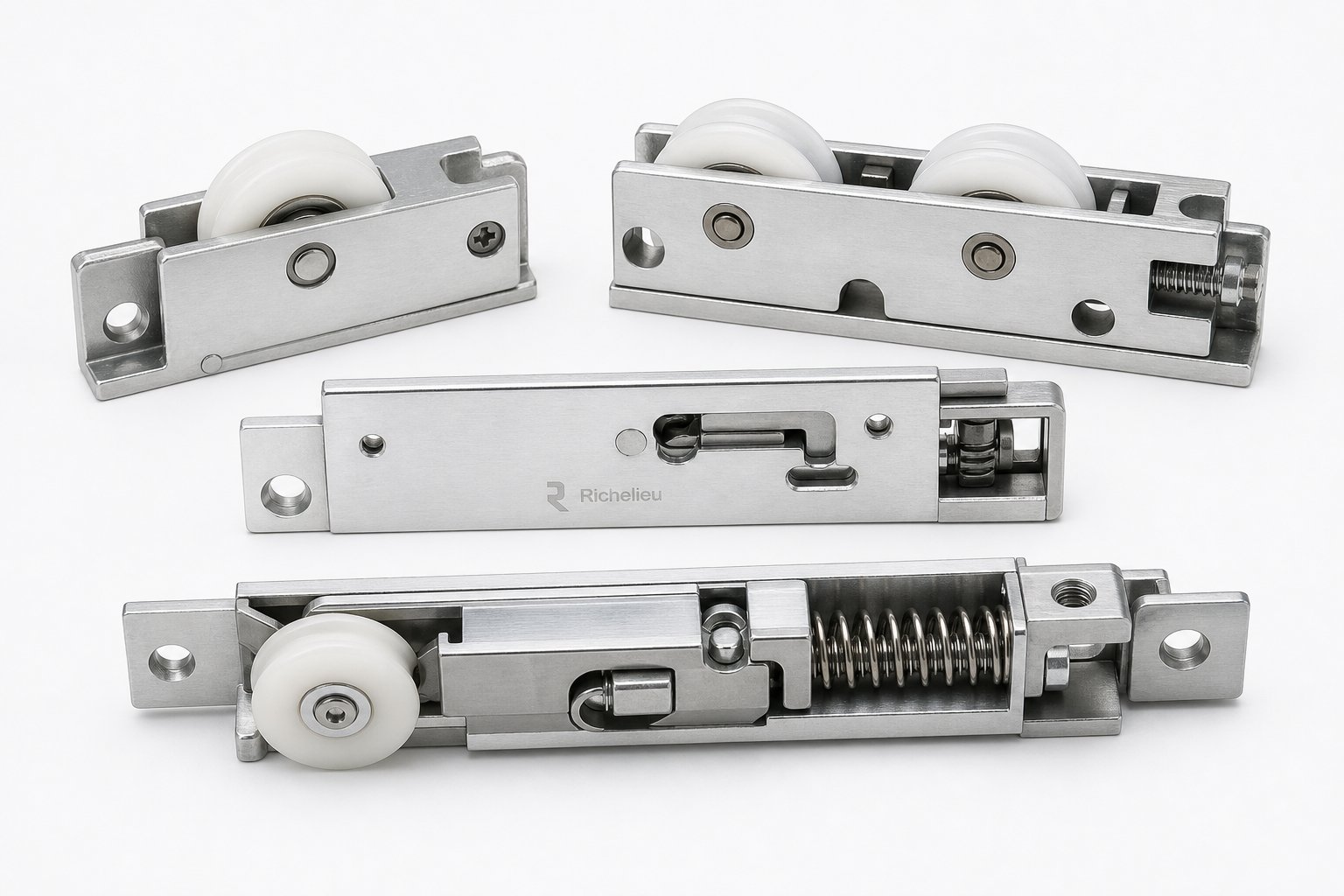
Every sliding window relies on a small set of components hidden inside the frame to move the sash panel smoothly along its track. Aluminium window runners are the assembled hardware units — typically mounted at the base of the sash — that allow the panel to glide horizontally with minimal friction. They combine a housing, an axle, and one or more wheels to carry the full weight of the glass panel while keeping movement effortless.
Aluminium window runners are the wheeled carriage assemblies fitted to a sliding window sash that ride along a track within the aluminium frame, enabling smooth horizontal movement while supporting the panel’s weight and maintaining seal compression.
Runners vs Rollers vs Guides — Clearing Up the Confusion
Search for replacement parts online and you will hit a wall of overlapping terms. A window roller typically refers to the wheel itself — the round component that makes contact with the track. Window rollers as a category can also mean the full assembly, depending on the supplier. A runner or carriage usually describes the complete unit: housing, axle, wheel, and any spring mechanism. Sliding window guides are the vertical or horizontal channels that keep the sash aligned without providing rolling motion, while window glides often refer to low-friction pads or strips rather than wheeled components.
In Australia, “aluminium window runners” is the term most homeowners and tradespeople reach for when something goes wrong with a sliding window. Suppliers like Rolltrak categorise them under “carriages and rollers,” which adds another layer of confusion if you are not sure what you are looking at.
Why the Terminology Matters When Ordering Parts
Getting the name wrong means getting the part wrong. Order a “guide” when you need a roller assembly and you will receive a static channel, not the wheeled unit your sash depends on. Understanding the distinction helps you communicate clearly with hardware stores, online suppliers, and glaziers — and it saves a frustrating return trip. Runners enable your window to operate; guides merely keep it on course. Both matter, but they are not interchangeable.
The real performance differences, though, go well beyond naming conventions. Runner assemblies vary widely in wheel count, bearing type, and load capacity — factors that determine whether your window feels featherlight or fights you every time you reach for ventilation.
Runner System Types and When Each One Fits
Not all sliding window rollers are built the same way. The internal mechanics of a runner assembly — how many wheels it uses, what bearing system it rides on, and how it stays engaged with the track — shape every aspect of window performance. Choosing the right configuration depends on sash weight, usage frequency, and how much noise you are willing to tolerate.
Single vs Tandem Roller Configurations
A single-wheel runner uses one wheel per housing to carry the sash. It is compact, fits narrow sash profiles, and works reliably on lighter panels where weight stays moderate. Most standard residential sliding windows across Australia ship with single-wheel assemblies because the sash is light enough that one wheel handles the load without excessive wear.
Tandem (dual-wheel) runners place two wheels side by side within a single sliding window roller assembly. This distributes weight across two contact points instead of concentrating it on one. The practical result: less pressure per wheel, smoother travel over minor track imperfections, and reduced rocking on heavier sashes. If your window panel carries thick or insulated glass — common with double-glazed units — tandem configurations keep things stable and reduce chatter that single-wheel setups can develop over time.
The trade-off is size. Tandem housings are longer and deeper, so they will not fit every sash corner pocket. Before upgrading from single to tandem, you need to confirm the sash cavity can physically accommodate the larger unit.
Ball-Bearing Assemblies and When They Matter
Inside the wheel, the bearing type determines how freely it spins. Plain sleeve bearings — a simple bushing around the axle — are cheap and adequate for light-duty use. Ball-bearing assemblies introduce small steel balls between the axle and wheel, dramatically reducing internal friction. The difference is most noticeable on heavy panels or windows that get opened several times a day. A ball-bearing sliding window roller spins with less resistance, requires less force to start moving, and maintains its smooth feel for years longer than a plain bushing under the same load.
For high-traffic areas — living rooms opening onto a deck, or rental properties where tenants use the window constantly — ball-bearing sliding window roller assemblies justify their higher cost through longer service life and consistently effortless operation.
Spring-Loaded vs Fixed-Mount Runners
Fixed-mount runners bolt directly into the sash at a set height. They are simple, with fewer moving parts, and rely entirely on accurate factory sizing to maintain proper contact with the track. When everything is new and aligned, they perform well. But as components settle or wear slightly, a fixed-mount runner can lose consistent track engagement, leading to drag or uneven seal compression.
Spring-loaded runners solve this by incorporating a small spring mechanism that pushes the wheel assembly against the track with constant pressure. Even as the sash frame flexes, the track surface wears, or the building settles minutely over years, the spring maintains reliable wheel-to-track contact. This self-adjusting quality makes spring-loaded units the better long-term choice for larger openings and exposed locations where thermal movement and wind load test frame rigidity.
| Type | Mechanism | Best For | Load Capacity Range | Noise Level | Expected Lifespan |
|---|---|---|---|---|---|
| Single-Wheel (Plain Bearing) | One wheel on a sleeve bushing | Light residential sashes | Up to 30 kg | Low–Moderate | 5–8 years |
| Single-Wheel (Ball Bearing) | One wheel with internal ball bearings | Medium-weight panels, frequent use | Up to 45 kg | Low | 8–12 years |
| Tandem (Dual-Wheel) | Two wheels sharing load in one housing | Heavy or double-glazed sashes | Up to 80 kg | Low | 10–15 years |
| Nylon Wheel System | Nylon or acetal wheels for quiet rolling | Bedrooms, quiet environments | Up to 40 kg | Very Low | 7–10 years |
| Spring-Loaded | Spring maintains constant track pressure | Large openings, exposed sites | Up to 60 kg | Low | 10–15 years |
| Fixed-Mount | Bolted at set height, no self-adjustment | New installs with precise alignment | Up to 50 kg | Low–Moderate | 5–10 years |
Each configuration suits a specific scenario. A lightweight bathroom slider does not need tandem ball-bearing assemblies — a well-made single-wheel unit handles it cleanly. A 1200 mm-wide living room panel with 6.38 mm laminated glass, on the other hand, benefits enormously from tandem or spring-loaded sliding window rollers that spread the load and maintain consistent track contact over years of daily use.
What the table cannot capture, though, is how wheel material interacts with these mechanical designs. A tandem runner fitted with the wrong wheel compound for your climate will still fail prematurely — which brings material science into the equation.
How Wheel Material Affects Runner Longevity
The wheel is where rubber meets road — or more precisely, where polymer or metal meets aluminium track. Selecting the wrong window wheel material for your environment is one of the most common reasons runners fail well short of their expected lifespan. Two identical runner assemblies, one fitted with nylon wheels and the other with plain steel, will deliver vastly different service lives depending on whether they sit in a Melbourne suburb or a beachfront home in Noosa.
Five materials dominate the market for window wheels: nylon, steel, brass, stainless steel, and Delrin (acetal). Each brings a distinct balance of strength, noise, corrosion resistance, and cost.
Nylon and Acetal Wheels for Quiet Operation
Nylon wheels are the default choice across most residential aluminium window runners in Australia. They roll quietly against aluminium tracks, resist corrosion entirely, and produce a smooth feel that homeowners notice immediately compared to metal alternatives. Well-made nylon wheels suit sashes up to around 40 kg and handle moderate daily use without issue for years.
Their limitation is load. Under sustained heavy weight or prolonged high heat, nylon can develop flat spots where the wheel rests against the track overnight. Those flat spots create a rhythmic thumping sensation during operation — an early warning sign that the wheel compound has deformed permanently.
Delrin (polyoxymethylene) is a step above standard nylon. This engineering-grade acetal homopolymer offers higher tensile strength, superior fatigue resistance, and a very low coefficient of friction — between 0.1 and 0.3 against steel. It absorbs almost no moisture, meaning it will not swell or soften in humid conditions. Delrin wheels maintain their dimensional stability across an operating range of -40 °C to 90 °C, making them reliable in everything from Tasmanian winters to a north Queensland summer. For rollers for sliding windows that need quiet operation combined with better load tolerance than basic nylon, acetal is the premium polymer option.
Stainless Steel vs Brass in Coastal Environments
Steel wheels handle heavier loads than any polymer, but standard zinc-plated steel has a fatal weakness in Australian coastal areas: salt air penetrates the plating, corrosion sets in, and the wheel eventually seizes on its axle. Within a few years, a steel window wheel exposed to salt-laden air can go from smooth-spinning to completely locked.
Stainless steel solves the corrosion problem outright. It tolerates salt spray, poolside humidity, aggressive cleaning chemicals, and coastal condensation without degrading. Stainless components are the go-to choice for properties within a few kilometres of the coastline, near pools, or in tropical regions where humidity rarely drops below 70%. The trade-off is noise — stainless wheels transmit more rolling sound through the track than nylon, and they cost more.
Brass sits between the two. It resists corrosion better than plated steel and delivers a smooth, quiet roll that suits higher-end residential installations. Brass wheels are gentler on aluminium tracks than steel, generating less track wear over time. They are popular in heritage renovations and premium builds where feel and longevity matter more than keeping costs minimal. However, brass has lower load capacity than steel or stainless, so it suits lighter to mid-weight sashes rather than heavy double-glazed panels.
How Climate Affects Runner Material Choice
Australia’s climate zones create distinct demands on runner hardware. A home in Perth’s coastal suburbs faces different stresses than a property in Canberra’s dry, temperature-variable inland climate.
| Material | Corrosion Resistance | Noise Level | Load Capacity | Cost | Best Environment |
|---|---|---|---|---|---|
| Nylon | Excellent (non-metallic) | Very Low | Low–Moderate | Low | Inland residential, bedrooms |
| Delrin (Acetal) | Excellent (non-metallic) | Very Low | Moderate | Moderate | High-humidity areas, frequent-use windows |
| Steel (Zinc-Plated) | Poor–Moderate | Moderate | High | Low | Dry inland, heavy commercial panels |
| Stainless Steel | Excellent | Moderate–High | High | High | Coastal, poolside, tropical |
| Brass | Good | Low | Moderate | Moderate–High | Premium residential, light coastal |
Temperature extremes compound material weaknesses. In far north Queensland, prolonged heat above 35 °C can accelerate flat-spotting in cheap nylon compounds, while cold snaps in alpine regions make low-grade polymers brittle. Delrin’s proven stability down to -40 °C and up to 90 °C makes it the most temperature-tolerant polymer option. Metal wheels are largely unaffected by temperature alone, but condensation cycles — hot days followed by cool nights — accelerate corrosion on unprotected steel.
Matching material to both sash weight and local conditions is the key. A light bathroom window in Adelaide works perfectly with nylon. A 60 kg double-glazed living room panel in a Sunshine Coast beachfront home demands stainless steel or, at minimum, Delrin with stainless axle hardware. Get this pairing wrong, and even the best runner configuration will underperform — because no mechanical design can compensate for a wheel that is corroding, flat-spotting, or seizing inside its housing.
Material choice, though, only tells half the story. A perfectly selected window wheel still operates within a larger system — one where track geometry, weatherseals, and frame alignment all influence how much work the runner actually has to do.

How Runners Work Within the Complete Sliding Window System
A runner never operates alone. It sits inside a system of interdependent parts, and every one of those parts either helps or hinders the runner’s ability to do its job. Isolating the runner from its context — the sliding window track it rides on, the weatherseals it pushes past, the frame that holds everything square — leads to the most common misdiagnosis in window maintenance: blaming the roller when the real problem lives elsewhere in the mechanism.
Understanding the parts of a sliding window as a connected system changes how you troubleshoot, maintain, and specify replacement hardware. Here is what actually happens inside the frame when you push a sash open.
The complete sliding mechanism consists of these core components working together:
- Runner/roller assembly — carries the sash weight and enables horizontal movement
- Track/window rail — provides the precision surface the roller wheels travel along
- Guide — keeps the sash aligned vertically and prevents lateral play
- Weatherseal/pile strip — creates an air and water barrier between sash and frame
- Sash panel — the glazed unit that moves, applying its weight directly through the runners
- Frame — the fixed aluminium perimeter that holds tracks, accepts the sash, and transfers loads to the building structure
Remove or degrade any single element and the runner’s performance suffers — even if the runner itself is brand new.
Track Profiles and How They Dictate Runner Compatibility
The sliding window track is not a generic channel. Its cross-sectional profile — the shape cut into the aluminium sill extrusion — determines which runners will physically fit, how the wheel makes contact, and how much lateral stability the sash has during operation. Track geometry varies between manufacturers, between product ranges, and even between older and newer versions of the same window series.
Single-track systems carry one sliding panel alongside one fixed panel. The window slider track in this configuration is relatively straightforward: one raised rail for the moving sash, with the fixed panel sitting in a separate rebate. Runner selection here is simple because only one panel moves and the load is predictable.
Dual-track (2-track) systems accommodate two independently sliding panels, each riding its own window rail. This doubles the complexity. Both tracks must maintain identical height and surface condition, because any mismatch creates uneven operation between panels. The runners on each sash need to match the specific rail profile of their designated track — and those profiles can differ slightly between the inner and outer channels to accommodate drainage and seal placement.
Professional-grade aluminium sliding windows engineer the runner, track, seal, and locking hardware as a unified system rather than leaving component matching to chance. The MEICHEN MA100 Sliding Window, for instance, is a 2-track aluminium sliding system where runners, precision-milled tracks, seals, and locks are designed as an integrated unit from the outset. This approach eliminates the compatibility guesswork that plagues aftermarket repairs — every component is dimensioned to work with its counterpart.
Triple-track systems add a third rail, typically for a three-panel configuration where two panels slide past a central fixed lite. Here, the outer tracks may have different profiles to the centre track, meaning you could need two different runner types across the same window. Specifying runners for triple-track systems without checking the exact rail profile of each channel is a guaranteed path to mismatched parts.
The Role of Weatherseals and Frame Alignment
Pile strips — those fuzzy brush-like weatherseals pressed into channels along the sash perimeter — are designed to block air and water infiltration. They do that job well. But they also create drag. Every millimetre of pile strip that contacts the sash edge adds friction the runner must overcome to initiate and sustain movement. Fresh, dense pile strips create more resistance than worn ones, which is why a newly re-sealed window can temporarily feel stiffer than it did before the maintenance.
This is by design. Sealing strips create an airtight barrier against air infiltration, water ingress, and noise transmission — but that tight seal means the runner assembly must generate enough rolling force to push the sash past the seal resistance without the user feeling like they are wrestling the window. In a well-designed system, the runner’s spring tension or bearing quality is calibrated to overcome seal drag smoothly. In a poorly matched system, the user compensates with extra force, accelerating wear on both the seals and the runner wheels.
Frame alignment is the invisible variable that amplifies or masks every other issue. An aluminium window frame that sits perfectly square and level distributes sash weight evenly across both runners, keeps the window rail true, and maintains consistent seal compression. When a frame racks — whether from building settlement, footing movement, or inadequate structural support above a wide opening — the track geometry distorts. One runner carries more load than the other. The sash binds against guides on one side. Seal compression becomes uneven, creating air gaps on one edge and excess drag on the opposite.
Wind load compounds this further. Under sustained pressure, even a correctly installed frame deflects slightly. The aluminium mullions flex inward, narrowing the track spacing by fractions of a millimetre. On a calm day this is invisible, but during high winds — common in exposed coastal and elevated sites across Australia — the deflection can cause the sash to bind momentarily or the runner to lose clean track engagement. Spring-loaded runner assemblies handle this better than fixed-mount types because they self-adjust to maintain contact as the track surface shifts under load.
All of these interactions explain why a runner replacement sometimes fails to fix a sticky window. If the track is corroded, the frame has racked, or the seals are creating excessive resistance, even a premium ball-bearing tandem unit will underperform. Diagnosing what is actually causing the problem — and where in the system the fault lives — is the critical step before reaching for replacement parts.
Diagnosing Whether Your Runners Need Replacement
A sliding window that resists movement triggers the same assumption almost every time: the rollers must be shot. It is a reasonable guess — but it is wrong more often than most people expect. A sticky sash can trace its cause to the track, the frame, accumulated grime, a warped panel, or degraded weatherseals just as easily as to worn-out old sliding window rollers. Spending money on new runner assemblies without identifying the actual fault often leaves you with fresh parts and the same frustrating drag.
A structured diagnostic process saves time, money, and the irritation of repeat disassembly. Work through these steps in order before committing to a replacement:
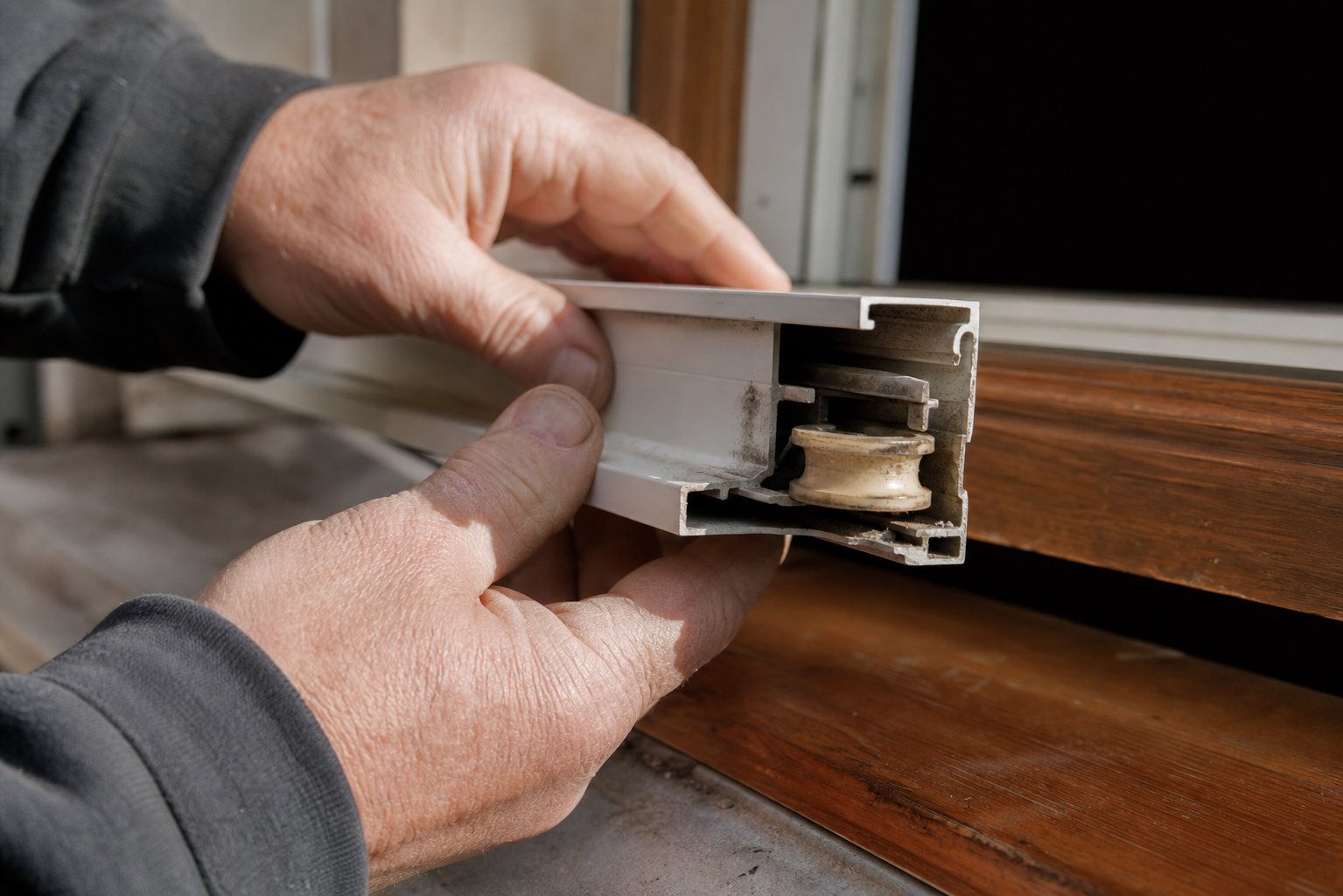
- Visual inspection of runner wheels — Remove the sash and examine each wheel closely. Look for flat spots worn into nylon surfaces, cracks in the wheel material, visible wobble when you spin the wheel by hand, or bearings that refuse to rotate freely. A seized bearing or a wheel with a ground-down flat is definitive: that runner is done.
- Track inspection for damage or debris — Run your finger along the full length of the window guide rail. You are feeling for gouges, corrosion pitting, bent track lips, or gritty buildup. Even minor dents in the rail surface can catch a wheel and create the sensation of a failing runner.
- Frame alignment check — Place a spirit level across the sill track and against each jamb. If the frame has racked — even a couple of millimetres out of square — the sash will bind regardless of runner condition. Look for daylight gaps that are uneven around the sash perimeter.
- Panel squareness test — Measure the sash diagonals. If they differ by more than 2–3 mm, the panel itself has warped or the corner joints have loosened, causing the sash to sit crooked in the frame and load the runners unevenly.
- Weatherseal condition assessment — Check the pile strips for compression, matting, or sections that have pulled free from their channels. Damaged or misaligned seals create localised drag that mimics runner failure.
Checking Whether Runners or Tracks Are the Problem
The distinction between runner failure and track damage comes down to specific visual cues. Worn runners show their age on the wheel itself: nylon develops a flat spot where it rests against the rail overnight, cracked material flakes away at the edges, and seized bearings lock the wheel solid so it skids rather than rolls. Spin each wheel between your fingers. Smooth, free rotation with no lateral play means the runner is still serviceable.
Track problems look different. Misaligned or damaged tracks prevent rollers from moving freely even when those rollers are in perfect condition. Corrosion pitting creates a rough, sandpaper-like texture that grinds against wheels. Bent lips — usually from someone levering the sash out incorrectly — narrow the rail channel and pinch the wheel. Deep gouges from dragged debris score a path that catches the wheel at the same spot every time you slide the window. If the track is the culprit, window tracks replacement or professional re-profiling is the fix, not new rollers.
Frame Alignment and Panel Warping Symptoms
Frame racking is subtle. It develops gradually as a building settles, as lintels deflect, or as timber subframes shrink. The symptoms mimic runner failure closely: the window sticks at certain points, feels heavier to move in one direction, or refuses to close the last few millimetres. The giveaway is asymmetry. If the sash binds on one side but glides freely on the other, or if the gap between sash and frame is visibly wider at one corner, the frame — not the runner — is the primary issue.
Panel warping follows a similar diagnostic pattern. A sash that has lost squareness loads one runner more than the other, accelerating wear on that side. Checking diagonal measurements with a tape measure takes thirty seconds and can save you from replacing runners that are only symptomatic casualties of a deeper structural problem.
When a Simple Clean Fixes Everything
Dirt is the most underestimated cause of sticky windows. Dust, sand, leaf matter, insect debris, and even fine building dust from nearby renovations accumulate in the track channel and pack against the wheels. This buildup obstructs roller movement, creating friction that feels identical to a worn-out assembly. In many cases, a thorough vacuum of the track, a wipe-down with mild detergent, and a light application of silicone spray restores operation completely — no parts needed.
Coastal properties, homes near busy roads, and buildings adjacent to construction sites accumulate track debris faster. If you have not cleaned your window tracks in over six months and the window has gradually become harder to move, start with a clean before ordering replacement parts. You might find the old sliding window rollers still have years of service left once the track is clear and properly lubricated.
A proper diagnosis takes ten minutes and potentially saves hundreds of dollars. But when the runners genuinely are the problem — flat-spotted, seized, or cracked beyond recovery — the next decision matters just as much: choosing the right replacement and avoiding the common mistakes that turn a straightforward swap into a repeat failure.
Mistakes That Ruin a Runner Replacement Job
Confirming that your runners are genuinely worn is only half the battle. The replacement itself is where many DIYers and even some tradespeople introduce new problems. A sliding window roller replacement done poorly can leave you worse off than the worn-out parts you just removed — windows that rattle, leak air, or chew through brand-new wheels within months.
These are the mistakes that crop up most often during a window roller replacement:
- Installing incorrect roller sizing (wrong wheel diameter or housing dimensions)
- Skipping track cleaning before fitting new runners
- Failing to check track alignment and frame squareness first
- Over-tightening adjustment screws, which binds the wheel against the housing
- Using petroleum-based lubricants that degrade nylon wheels and attract grit
- Replacing only one runner instead of doing both on the same sash
Each of these errors seems minor in isolation. Together, they explain why so many replacement window rollers fail far sooner than the originals did.
OEM vs Universal Runners and Compatibility Risks
OEM (Original Equipment Manufacturer) runners are made specifically for a particular window series. They match the sash cavity dimensions, the track profile, and the design load of that system exactly. Universal or generic sliding window replacement rollers, by contrast, are built to approximate fit across multiple brands and series. They are easier to find, typically cheaper, and sometimes the only option for discontinued window lines.
The risk is in the word “approximate.” A generic runner might slide into the sash pocket physically, but its wheel diameter, width, and housing style can differ enough from the original to cause real problems. A wheel that sits 2 mm too high lifts the sash off its weatherseals. One that sits too low leaves the panel dragging against the track lip. Spring tension calibrated for a different sash weight either holds the wheel too loosely against the rail or presses too hard, creating premature flat-spotting.
If OEM parts are available for your window, use them. When they are not — often the case with windows more than 15 to 20 years old — measure meticulously: wheel diameter, axle height from the housing base, overall housing length, and mounting hole spacing. A millimetre or two of tolerance is acceptable. Beyond that, you are forcing a compromise that the window was never designed to accommodate.
Sizing Errors That Cause Premature Failure
The most common sizing mistake is matching wheel diameter alone while ignoring axle height. Axle height determines where the sash sits relative to the track and frame. Get it wrong and the sash either rides too high — losing seal compression along the bottom rail and allowing air and water ingress — or too low, where the bottom rail contacts the track directly and the wheel bears excessive side-load pressure it was never built to handle.
Housing length matters too. A runner housing that is even slightly too long for the sash corner pocket will not seat fully, leaving it cocked at an angle. That angle concentrates load on one edge of the wheel, causing misalignment and accelerated wear. Before purchasing replacement window rollers, remove the existing unit and measure every dimension — not just the wheel. Take photos of the housing profile, note any asymmetric features, and confirm mounting screw positions.
Why You Should Always Replace Runners in Pairs
It is tempting to replace only the runner that is visibly damaged. The logic seems sound: if one wheel is flat-spotted but the other still spins, why replace both? The problem is rolling height. A new runner sits at its factory-spec height. The surviving original has worn down over years of service — its wheel slightly smaller in diameter, its spring slightly softer. Pairing a new unit with a worn one creates uneven sash height: one end rides higher than the other.
That unevenness cascades through the system. The sash tilts fractionally, loading the lower runner with more weight than it should carry. Seal compression becomes inconsistent — tight on one side, gapping on the other. The track wears unevenly as the higher wheel presses harder into the rail surface at its end. Within months, the new runner begins wearing faster than it should, and the old one deteriorates further under its disproportionate share of the load.
Sliding window rollers replacement done properly means swapping both runners on the same sash simultaneously. The cost difference is negligible — often just a few dollars for the second unit — but the performance and longevity gains are significant. Balanced rolling height keeps the sash level, distributes weight evenly, maintains uniform seal contact, and lets both runners wear at the same rate over their full service life.
Getting the replacement right also means giving those new runners the best possible operating conditions from day one. Clean tracks, correct lubrication, and periodic attention make the difference between runners that last a decade and ones that grind to a halt in two years.
Maintaining Runners So They Last Years Longer
Most aluminium window runners are capable of lasting well beyond the point where homeowners assume they need replacing. The difference between a runner that gives out after five years and one that performs smoothly for twelve often comes down to two things: keeping the track clear and using the right lubricant. Neither task takes more than a few minutes, yet both get neglected until the window starts fighting back.
A basic maintenance routine — cleaning debris from the track, lubricating the wheels and rail surface, and inspecting the pile strips — can delay or eliminate the need for a full sliding window guide replacement entirely. The key is doing it at the right intervals for your specific environment.
The Right Lubricant for Aluminium Window Runners
Lubricant choice matters more than most people realise. Petroleum-based products — including general-purpose spray oils — attract dirt and dust, creating a sticky film that gums up the track and accelerates wear. Worse, petroleum compounds can soften and degrade nylon or acetal wheels over time, breaking down the very material the runner depends on for smooth rolling.
WD-40 deserves special mention because it is the product most people reach for instinctively. It is not a lubricant. WD-40 is a penetrating solvent designed to displace moisture and free seized parts. It works well for that narrow purpose — spraying a frozen runner to break corrosion so you can remove it. But it provides no lasting lubrication and leaves a residue that collects grit within days. Use it to penetrate and free, then wipe clean and follow with a proper lubricant.
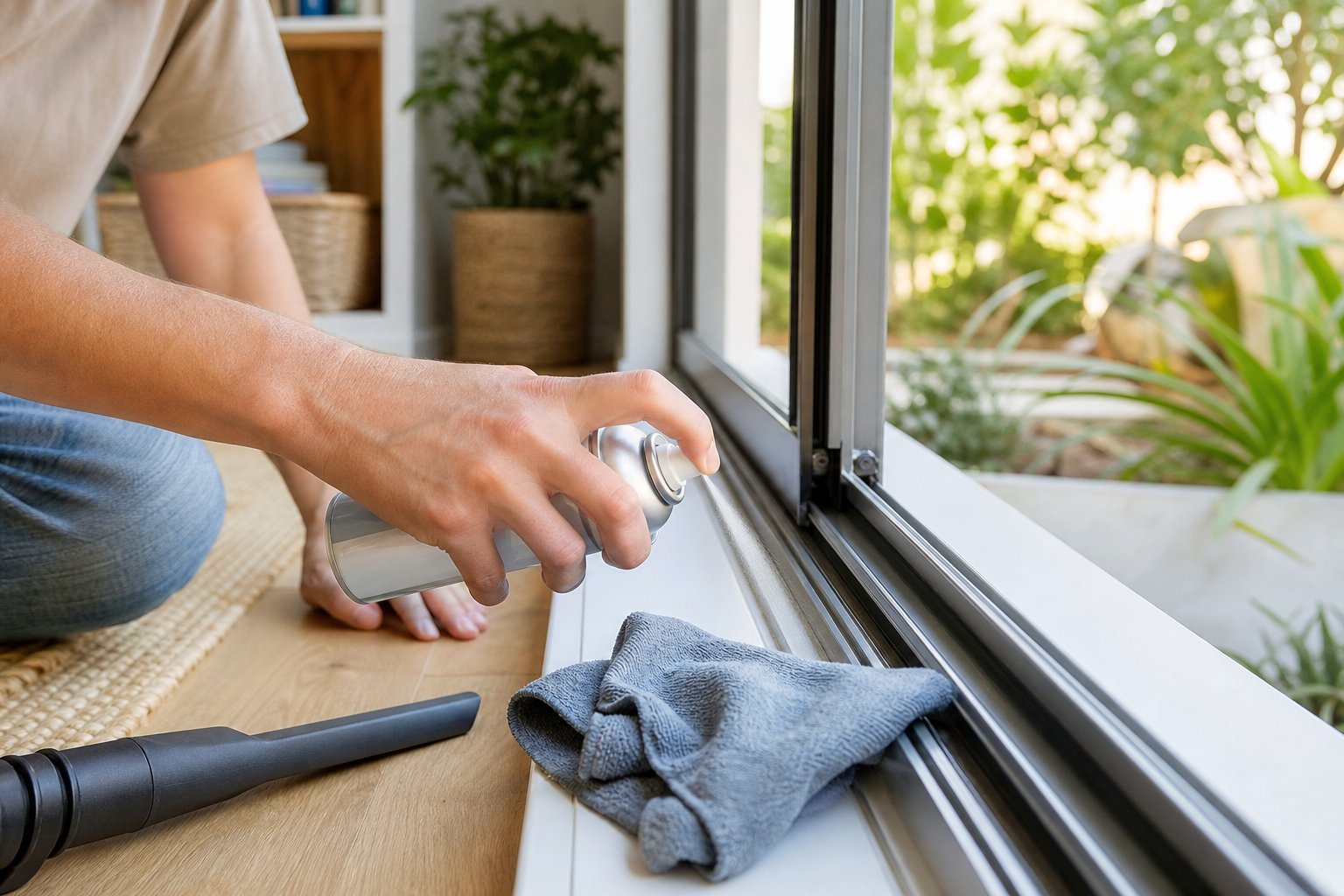
The correct product is a 100% silicone-based spray or dry silicone lubricant. Silicone does not attract dust, will not degrade polymer wheels, and leaves a slick, long-lasting film on both the track surface and the wheel. Industry recommendations specify 100% silicone for all sliding window and door tracks and rollers. Apply a light coat along the full length of the rail, spin each wheel to distribute lubricant across the bearing surface, and wipe away any excess pooling in the track channel.
Cleaning Schedules Based on Your Environment
Where you live dictates how often your tracks need attention. Coastal homes cop salt spray, fine sand, and higher humidity — all of which accelerate debris buildup and corrosion on metal components. Inland suburban properties accumulate less aggressive dirt but still collect dust, pollen, and insect matter that packs against the wheels over time. Homes near construction zones or unsealed roads face particulate loads that rival coastal exposure.
| Environment | Clean Tracks | Lubricate Runners | Full Inspection |
|---|---|---|---|
| Inland suburban | Every 3–4 months | Every 6 months | Annually |
| Coastal (within 5 km of shore) | Every 6–8 weeks | Every 3 months | Every 6 months |
| Near construction or unsealed roads | Monthly | Every 3 months | Every 6 months |
| Rural or bushland | Every 2–3 months | Every 6 months | Annually |
Cleaning is straightforward: vacuum the track channel with a crevice attachment, wipe the rail with a damp cloth to remove residual grime, dry thoroughly, then apply silicone lubricant. This routine takes five minutes per window and can push a window glides replacement years into the future.
Do not overlook pile strip condition during your inspection. Those brush-like weatherseals compress and mat over time, losing their ability to block air while simultaneously creating uneven drag that forces runners to work harder. Sections that have pulled free from their channel or flattened beyond recovery should be replaced — fresh pile strips reduce the rolling resistance your runners must overcome on every single operation, directly extending their working life.
Consistent maintenance keeps each component within its design limits. But for homeowners facing a replacement anyway — whether from years of neglected upkeep or simply ageing hardware — there is an opportunity to do more than swap like for like. The right upgrade can transform how a window feels entirely.
Upgrading Runners for Smoother and Quieter Windows
Replacing worn aluminium window runners with identical parts restores the window to its original performance — nothing more. But original performance was set years ago, often with budget-tier components chosen to hit a price point rather than maximise longevity. If you are already pulling the sash out and swapping hardware, you have an opportunity to go beyond restoration and genuinely improve how the window operates.
Think of it this way: the sliding window parts you remove were designed for the window’s initial cost bracket, not necessarily its best possible performance. Upgrading to a higher-specification runner assembly during a replacement job is one of the most cost-effective improvements you can make to an existing aluminium window — often for just $10 to $30 more per pair than the basic equivalent.
The most impactful upgrade paths include:
- Nylon bushing to sealed ball-bearing wheels — Dramatically reduces rolling resistance and maintains smooth operation far longer under daily use
- Single-wheel to tandem (dual-wheel) configuration — Distributes sash weight across two contact points, essential for heavy double-glazed panels
- Fixed-mount to spring-loaded assemblies — Maintains consistent track engagement as frames flex and components wear over time
- Standard zinc-plated to stainless steel or Delrin wheels — Eliminates corrosion risk in coastal, poolside, or high-humidity environments
Upgrade Paths That Transform Window Performance
The single biggest jump in feel comes from moving to ball-bearing assemblies. A basic nylon runner on a plain bushing requires noticeable force to start the sash moving — especially first thing in the morning after the wheel has rested against the track overnight. A sealed ball-bearing unit spins freely from a standstill, so the sash responds to a light touch rather than needing a deliberate push. For living room or bedroom sliders that get opened and closed multiple times a day, this difference is immediately obvious and surprisingly satisfying.
Tandem upgrades solve a different problem. If your existing windows carry heavy glazing — 6.38 mm laminated glass or insulated glass units common in double-glazed retrofits — single-wheel runners are operating at or near their load limit. They wear faster, develop flat spots sooner, and transfer more vibration into the track. Swapping to a tandem sliding window roller assembly halves the load on each wheel, producing smoother travel and significantly extending service intervals. The only prerequisite is confirming that the sash corner pocket is deep enough to accept the longer tandem housing.
For properties in aggressive environments, material upgrades trump mechanical ones. A beautifully engineered ball-bearing runner with zinc-plated steel wheels will still seize within a few years if salt air is eating the metal from the inside out. Switching to stainless steel wheels — or Delrin wheels paired with stainless axle hardware — addresses the root cause rather than treating the symptom. Coastal homeowners who have been through multiple sets of sliding window replacement rollers often find that upgrading wheel material finally breaks the cycle of premature failure.
Spring-loaded assemblies represent an upgrade in adaptability rather than raw performance. They are the smart choice for older homes where slight frame movement is expected, for wide openings exposed to wind deflection, or for any situation where maintaining consistent rolling contact matters more than minimising initial cost. The spring compensates for wear and flex that would leave a fixed-mount runner intermittently losing track engagement — and that compensation becomes more valuable with each passing year.
Choosing the Right System for New Builds and Renovations
Aftermarket upgrades work well for existing windows, but they always involve compromise. You are fitting better components into a system that was not designed around them. Housing dimensions constrain your options. Track profiles limit wheel diameter choices. Spring tensions calibrated for one sash weight may not perfectly suit yours.
For new builds, extensions, or major renovation projects, there is a fundamentally better approach: specifying a complete aluminium sliding window system where the runners, tracks, seals, locks, and frame are engineered together from the start. When every component is designed as part of the same unit, compatibility is guaranteed. The runner wheel diameter matches the track rail profile precisely. Spring tension corresponds to the actual sash weight. Seal placement accounts for the rolling height of the specific roller assembly fitted at the factory.
The MEICHEN MA100 Sliding Window is a good example of this integrated approach for the Australian market. It is a 2-track aluminium sliding system where the runner assemblies, precision-milled track profiles, weatherseals, and locking hardware are all matched components — eliminating the sliding window hardware compatibility issues discussed throughout this article. For builders, architects, and developers specifying windows at the design stage, this kind of purpose-built system sidesteps the entire aftermarket runner selection problem because the manufacturer has already resolved it at the engineering level.
This distinction matters most for project-scale work. A homeowner fixing one sticky window can afford to trial-and-error their way through aftermarket parts. A builder fitting forty openings across a new development cannot. Specifying an integrated system where the sliding window parts are factory-matched means consistent performance across every opening, no site-level troubleshooting of runner compatibility, and a single warranty covering the complete mechanism rather than fragmented responsibility across multiple component suppliers.
Whether you are upgrading the runners on a twenty-year-old bathroom slider or specifying sliding window hardware for an entire new home, the principle is the same: match the component quality to the demand placed on it. A light, infrequently used window needs nothing extravagant. A heavy, daily-use panel in a harsh environment deserves the best rolling assembly you can fit — or better yet, a system where that decision has already been made for you by the engineers who designed the window as a whole.
Frequently Asked Questions About Aluminium Window Runners
1. What is the difference between a window runner and a window roller?
A window roller refers specifically to the wheel component that contacts the track, while a runner (also called a carriage) is the complete assembly including the housing, axle, wheel, and any spring mechanism. In Australia, the terms are often used interchangeably by homeowners, but when ordering replacement parts, specifying whether you need the full runner assembly or just the roller wheel prevents costly ordering mistakes. Suppliers like Rolltrak categorise these under ‘carriages and rollers,’ which reflects this distinction.
2. How do I know if my aluminium window runners need replacing?
Remove the sash and inspect each wheel closely. Signs of failed runners include flat spots worn into the nylon surface, cracks in the wheel material, visible wobble when spinning by hand, or bearings that refuse to rotate freely. However, a sticky window does not always mean bad runners. Dirty tracks, frame misalignment, warped panels, or degraded weatherseals can all mimic runner failure. Always vacuum and clean the track first, then check frame squareness with a spirit level before committing to a replacement.
3. What type of lubricant should I use on aluminium window runners?
Use a 100% silicone-based spray lubricant. Petroleum-based products attract dust and grit, creating a sticky film that accelerates wear, and they can degrade nylon or acetal wheels over time. WD-40 is not a lubricant — it is a penetrating solvent useful only for freeing seized parts before proper lubrication. Apply silicone spray along the full track length, spin each wheel to distribute it across the bearing surface, and wipe away pooling. For coastal properties, lubricate every three months; inland homes can stretch to every six months.
4. Should I choose nylon or stainless steel window runners for a coastal home?
For homes within five kilometres of the Australian coastline, stainless steel wheels or Delrin (acetal) wheels with stainless axle hardware are the best choices. Salt air corrodes standard zinc-plated steel runners within a few years, causing the wheel to seize on its axle. Nylon resists corrosion entirely but has lower load capacity and can flat-spot under heavy panels in sustained heat. Stainless steel handles salt spray, poolside humidity, and aggressive cleaning chemicals without degrading, though it transmits slightly more rolling noise than polymer alternatives.
5. Can I upgrade my existing sliding window runners to a better system?
Yes. When replacing worn runners, you can upgrade to higher-quality assemblies rather than fitting like-for-like parts. Common upgrade paths include moving from nylon bushing wheels to sealed ball-bearing units for smoother operation, switching from single to tandem configurations for heavy panels, or changing to stainless steel wheels in corrosive environments. The only constraint is the sash corner pocket size — tandem housings are longer and deeper than single-wheel units, so confirm your sash cavity can accommodate the upgrade before purchasing. For new builds or major renovations, specifying an integrated system like the MEICHEN MA100 eliminates compatibility concerns entirely.
More Window & Door Guides