What Aluminium Window Door Frames Are and Why They Matter
Most product pages will tell you aluminium is great and leave it at that. This guide does something different. It walks through the engineering, the trade-offs, and the real-world failures that catch homeowners, builders, and specifiers off guard — so you can make sharper decisions before a single frame gets installed.
What Is an Aluminium Window Door Frame
Before diving into where things go wrong, it helps to nail down exactly what we’re talking about.
An aluminium window door frame is a structural and aesthetic assembly made from extruded aluminium alloy profiles, designed to secure glazing panels within wall openings for both windows and doors. It serves as the load-bearing skeleton that holds glass in place, transfers wind and operational forces into the surrounding structure, and provides the mounting points for hardware, seals, and weatherproofing components.
In practical terms, the frame is everything that isn’t glass. It includes the outer frame fixed to the wall opening, any operable sashes or door leaves, mullions, transoms, glazing beads, and drainage channels. Aluminium window frames achieve all of this with remarkably slim profiles — a direct result of the metal’s exceptional strength-to-weight ratio, which far exceeds steel on a weight-for-weight basis. The material forms a natural oxide layer the moment it contacts air, giving it inherent corrosion resistance without any coating at all. And unlike timber or vinyl, aluminium is 100% recyclable with no loss in quality — nearly 75% of all aluminium ever produced remains in use today.
Why Aluminium Dominates Modern Window and Door Construction
Timber ruled Australian construction for generations. Steel had its moment in commercial builds during the early-to-mid twentieth century. But by the 1950s and 1960s, aluminium had begun replacing both — first in commercial projects, then steadily across residential builds. The reasons were straightforward: aluminium was lighter, easier to extrude into complex shapes, and demanded far less ongoing maintenance than painted timber or rust-prone steel.
That shift accelerated as building regulations tightened. Modern aluminium windows and doors now incorporate thermal break technology, advanced glazing options, and sophisticated sealing systems that address the material’s one historical weakness — thermal conductivity. Today, windows in aluminium account for the dominant share of both commercial and residential glazing across Australia, used in everything from single-storey renovations to high-rise towers.
Yet popularity doesn’t equal immunity from problems. The same properties that make an aluminium window or aluminium door so appealing — slim sightlines, rigid profiles, long lifespan — can mask issues that only surface years after installation. Condensation on interior surfaces, galvanic corrosion triggered by contact with incompatible metals, seal degradation in harsh coastal air, and finish failures from incorrect coating selection are all genuine risks that product brochures rarely mention.
This article covers the full picture: how these frames are engineered and extruded, every window and door type available, the thermal break technology that transformed performance, finish options that protect against Australian conditions, honest comparisons with competing materials, climate-specific guidance, and the maintenance steps that prevent premature failure. Consider it the resource you’d want before signing off on a specification or a renovation quote.
How Aluminium Frames Are Built and What Makes Them Strong
Knowing what an aluminium window door frame does is one thing. Understanding how it gets made — and why that manufacturing process gives aluminium a structural edge over timber, vinyl, and even steel — is where the real insight lives. The story starts with a heated cylinder of metal and a precision-cut steel die.
How Aluminium Frames Are Engineered and Extruded
Every aluminium window frame begins as a solid cylindrical billet of aluminium alloy, typically 6063 alloy for architectural applications. This alloy blends aluminium with small amounts of magnesium and silicon, striking a balance between extrudability, surface finish quality, and structural strength. The billet is heated to around 400–520°C until it becomes malleable — soft enough to shape, but nowhere near molten.
A hydraulic press then forces that heated billet through a hardened steel die under enormous pressure, anywhere from 800 to 2,500 tonnes. The die’s opening is machined to the exact cross-sectional shape of the finished profile, and as the aluminium pushes through, it emerges in a continuous length that mirrors every detail of that opening — hollow chambers, screw channels, gasket grooves, glazing rebates, and all.
This is the critical difference between an aluminium frame and, say, a timber or vinyl one. Timber must be machined from solid stock, limiting geometric complexity. Vinyl profiles are moulded, but the material lacks the tensile strength to achieve slim wall thicknesses. The extrusion process lets engineers design intricate cross-sections — profiles with multiple hollow chambers, reinforcement webs, and integrated thermal break cavities — all produced as a single, continuous piece with consistent material properties along its entire length.
Once the profile exits the die, it is rapidly cooled (quenched) using water or forced air to lock the aluminium into its desired crystalline structure. A stretching process follows to relieve internal stresses and ensure straightness. Finally, heat treatment — typically a T5 or T6 ageing cycle — develops the profile’s full mechanical strength, boosting tensile capacity by 40–60% compared to untreated aluminium.
Strength-to-Weight Ratio and Structural Advantages
Here’s the practical payoff of all that engineering: an aluminium window frame can support significantly larger glass panels using far less material than competing window frame metal options. A 6063-T6 aluminium profile delivers a tensile strength of roughly 190 MPa — and where higher loads demand it, 6061-T6 alloy pushes that figure to around 290 MPa. Meanwhile, the material weighs approximately one-third of steel.
That combination of strength and lightness is why architects reach for aluminium when they want floor-to-ceiling glazing, expansive sliding doors, or slim-profile fixed windows that maximise daylight and views. An aluminum frame window can achieve sightlines well under 25 mm — meaning the visible frame between panes is barely noticeable — whereas timber and vinyl frames typically need 60–100 mm or more to achieve equivalent structural performance.
The internal geometry of a modern aluminum window frame matters just as much as the alloy itself. Multi-chamber construction — where the profile’s cross-section is divided into several hollow compartments separated by internal webs — dramatically increases rigidity without adding proportional weight. These chambers serve multiple purposes simultaneously:
- Lightweight — aluminium weighs roughly one-third of steel at equivalent volume, reducing dead loads on wall structures
- Non-combustible — aluminium does not ignite and carries a melting point above 600°C, a critical advantage in bushfire-prone areas complying with BAL ratings under the NCC
- Dimensionally stable — unlike timber, it does not warp, swell, or shrink with moisture changes; unlike some vinyl formulations, it maintains form across temperature extremes
- 100% recyclable — aluminium can be remelted and re-extruded repeatedly with no degradation in quality, using just 5% of the energy required for primary production
- Corrosion-resistant — a natural oxide layer forms instantly upon exposure to air, providing a self-healing protective barrier against moisture and atmospheric attack
Multi-chamber profiles also create natural pathways for concealed drainage systems (weep holes that channel water away from the glazing), hardware reinforcement points, and — crucially — thermal break cavities. The internal geometry of each chamber can be tuned during the die design phase to optimise structural rigidity in one direction, accommodate specific gasket profiles, or increase the distance between inner and outer aluminium surfaces to reduce heat transfer.
This is where aluminum frame glass assemblies gain their real advantage. Because the frame profiles are so precisely engineered, they can hold heavy double-glazed or triple-glazed insulating glass units (IGUs) without excessive deflection, even across large spans. High-performance aluminium systems on the market today can support individual glass panels exceeding 7.5 square metres in area and sash weights above 500 kilograms — figures that would demand far bulkier frames in timber or vinyl.
Yet none of these structural strengths mean much if the frame bleeds heat straight through the building envelope. And aluminium, for all its advantages, conducts heat roughly 1,000 times faster than timber. That single property drove the most important innovation in aluminium framing over the past three decades — one that fundamentally changed how these frames perform in every climate zone across Australia.
Every Type of Aluminium Frame for Windows and Doors
Structural strength and slim profiles only matter if the frame is configured for the right application. A fixed-lite window and a three-panel bifold door face completely different load conditions, hardware requirements, and weathersealing challenges — yet both can be built from the same family of extruded aluminium profiles. That versatility is precisely what makes aluminium the dominant framing material across so many building types, but it also means the range of available configurations is broader than most buyers realise.
Most product pages lump everything under “windows” and call it a day. Door frames — which carry heavier leaves, wider spans, and far greater traffic loads — rarely get the same attention. Here’s the full picture.
Aluminium Window Frame Types by Operation
Each window operation type demands a distinct profile geometry, hardware set, and sealing arrangement. The core aluminium extrusion platform stays consistent, but the way sashes move, pivot, or lock varies significantly.
- Sliding windows — Two or more sashes glide horizontally along tracks within the frame. Aluminium sliding windows are the most common configuration in Australian residential builds, offering simple operation, easy maintenance, and no projection into indoor or outdoor space.
- Casement windows — A single sash hinges on one side and swings outward (or inward in some designs). The aluminium casement window delivers excellent ventilation control and superior air-tightness when closed, making it a strong performer for energy efficiency.
- Double hung windows — Both the upper and lower sashes slide vertically within the frame, allowing ventilation from top, bottom, or both simultaneously. Aluminium double hung windows are popular in heritage-style builds and older home renovations where maintaining a traditional appearance matters.
- Single hung windows — Only the bottom sash moves; the top sash remains fixed. An aluminium single hung window offers a simpler mechanism and lower cost point than its double hung counterpart while still providing adequate airflow.
- Awning windows — The sash hinges at the top and opens outward from the bottom, creating a canopy effect that allows ventilation even during light rain. Commonly stacked in rows for commercial facades or placed above fixed panels in residential bathrooms and kitchens.
- Fixed-lite windows — No operable sash at all. The glass is glazed directly into the aluminium frame, maximising daylight and views with the slimmest possible sightlines. Used extensively in feature walls, highlight windows, and shopfronts.
Aluminium Door Frame Types for Every Application
An aluminium door frame endures forces that window frames never encounter — repeated open-close cycles, foot traffic impact loads, and the weight of large glass leaves that can exceed 150 kilograms each. The extrusion profiles used for doors are typically deeper and incorporate heavier internal webs, reinforced screw bosses, and wider hardware channels than their window equivalents.
- Sliding doors — One or more panels glide along bottom or top tracks. The go-to choice for connecting living areas to outdoor decks and patios across Australian homes, with spans reaching well beyond 6 metres in premium systems.
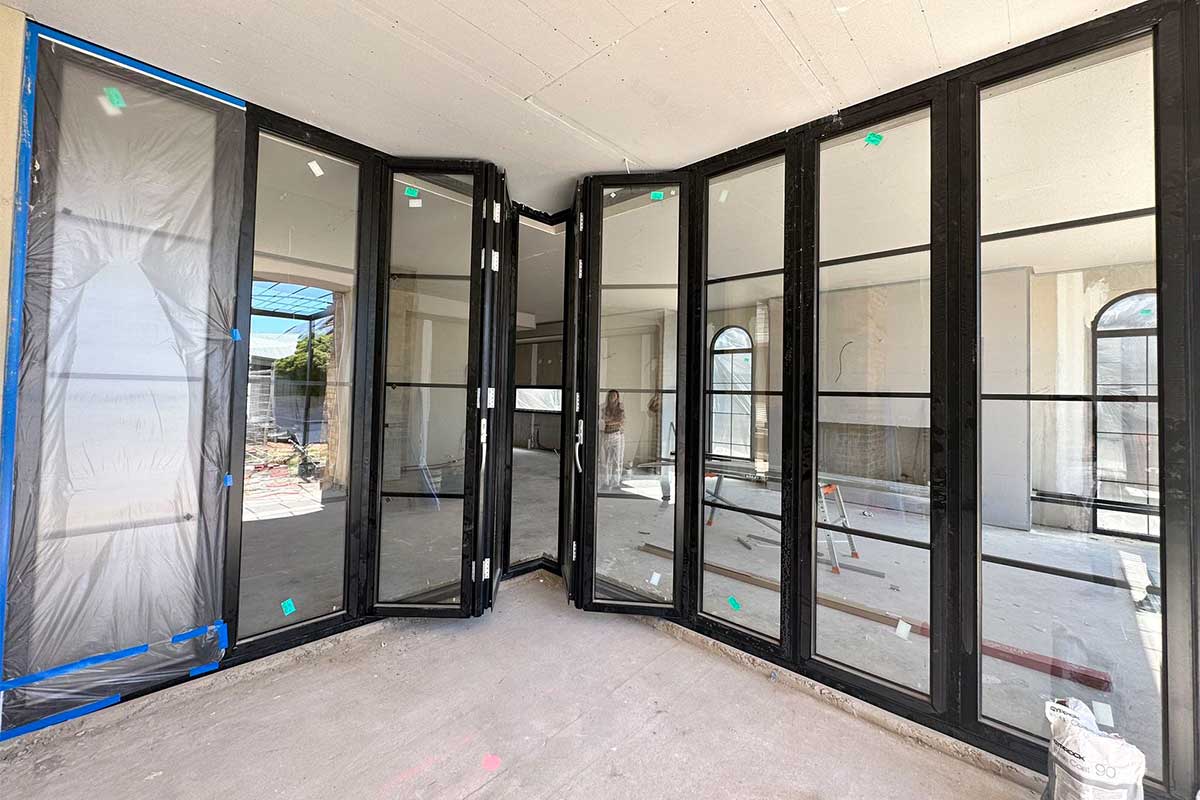
- Bifold doors — Multiple hinged panels fold and stack against one or both sides of the opening, creating a near-complete wall-to-wall opening. Ideal for indoor-outdoor entertaining areas and increasingly popular in contemporary double-storey designs.
- French/hinged doors — One or two leaves swing open on side hinges, offering a classic aesthetic with generous clear openings. Commonly used for courtyard access, balconies, and entries where a traditional look is preferred.
- Pivot doors — The leaf rotates on a central or offset pivot point rather than side hinges, enabling dramatically oversized entries with a single, statement-making panel. A favourite in architecturally designed homes and commercial lobbies.
- Stacking doors — Similar to sliders, but multiple panels slide and stack behind one another or behind a fixed panel, clearing a larger proportion of the opening than a standard sliding configuration allows.
- Entry doors — Heavy-duty aluminium front door systems designed for security, weather resistance, and visual impact. These combine reinforced aluminium frames with insulated panels or glazed inserts and typically carry higher hardware ratings for locking and access control.
Matching Frame Type to Your Project Requirements
Choosing the right configuration isn’t just about aesthetics — building codes, climate exposure, and spatial constraints all play a role. A few practical considerations help narrow the field quickly.
Ventilation requirements drive the choice between operable and fixed configurations. Rooms that need cross-ventilation — kitchens, bathrooms, laundries — benefit from casement or awning windows, which direct airflow more effectively than sliders. Living areas that prioritise uninterrupted views may pair large fixed-lite panels with smaller operable windows positioned for stack-effect airflow.
Space constraints matter more than people expect. Casement and awning windows project outward when open, which can conflict with walkways, balconies, or neighbouring boundaries. Sliding windows and sliding doors sit flat within their tracks, making them the safer default for tight sites. Bifold doors demand clear stacking space alongside the opening — a detail that catches out more than a few renovation projects mid-build.
Compliance demands vary by state and exposure. Homes in bushfire-prone areas must meet specific BAL requirements under the NCC, which influence frame material, glazing type, and sealing details. Cyclone-rated zones across northern Queensland and the Northern Territory impose additional structural testing on both window and door assemblies. Any aluminium door or window specified for these regions needs to carry the relevant AS 2047 compliance documentation.
For builders and architects working across multiple project types, sourcing from a supplier with a complete range — rather than piecing together windows from one manufacturer and doors from another — avoids compatibility headaches and simplifies procurement. MEICHEN’s aluminium window, door, and facade systems page is a practical starting point for Australian projects, offering everything from aluminium sliding windows and casement configurations through to bifold doors, stacking doors, facade systems, louvres, and balustrades within a single product ecosystem.
Selecting the right frame type is only half the equation, though. How that frame handles heat transfer — and whether it includes a thermal break or not — determines whether your carefully chosen configuration actually performs to its energy rating once it’s installed in the wall.
Thermal Break Technology and Why It Changes Everything
Aluminium conducts heat roughly 1,000 times faster than timber. Left unaddressed, that single property turns an otherwise exceptional framing material into an energy liability — bleeding conditioned air straight through the building envelope and inviting condensation onto interior surfaces. For decades, this was the trade-off builders simply accepted. Then thermal break technology arrived and rewrote the rules entirely.
What Thermal Break Technology Is and How It Works
A thermal break is a continuous strip of non-conductive insulating material — typically reinforced polyamide (nylon) — mechanically bonded between the interior and exterior aluminium sections of a window or door frame. By physically separating the inner warm profile from the outer cold profile, the thermal break interrupts the direct path that heat would otherwise follow through the metal, dramatically reducing thermal transfer across the frame.
Picture the aluminium frame as two independent profiles rather than one solid piece. The exterior profile faces the weather. The interior profile faces your living space. Between them sits a rigid polyamide strip — often reinforced with glass fibres for structural integrity — that mechanically locks the two halves together while acting as an insulation barrier. The polyamide itself has extremely low thermal conductivity, so heat that would normally race through a continuous aluminium section is forced to slow down at this bottleneck.
The width of that polyamide strip matters enormously. Wider thermal breaks create a greater separation between interior and exterior aluminium surfaces, which translates to better insulating performance. Premium systems use broad, multi-cavity polyamide strips — sometimes filled with expanding polyurethane foam — to push performance even further. This is the engineering detail that separates a frame meeting minimum compliance from one that genuinely contributes to a high-performance building envelope under the NCC and NatHERS modelling.
Standard vs Thermally Improved vs Thermally Broken Frames
Not every aluminium frame addresses thermal conductivity in the same way. The industry broadly recognises three tiers of thermal performance, each suited to different applications and budgets.
| Criteria | Standard Aluminium | Thermally Improved | Fully Thermally Broken |
|---|---|---|---|
| Thermal Conductivity | High — continuous aluminium profile acts as a direct thermal bridge | Moderate — uses pour-and-debridge resin or narrow isolating strips to reduce transfer | Low — wide polyamide strips with optional foam fill create substantial insulation barrier |
| Energy Rating Suitability | Unlikely to meet current NCC Section J or WERS requirements for conditioned spaces | May satisfy minimum compliance in temperate climate zones | Capable of meeting or exceeding stringent energy targets across all Australian climate zones |
| Typical Application | Non-conditioned commercial and industrial spaces, carports, sheds | Budget-conscious residential projects in mild climates | Residential, high-performance commercial, multi-storey, and projects targeting high NatHERS star ratings |
| Condensation Risk | High — interior frame surfaces become cold, promoting moisture buildup | Reduced but not eliminated, particularly in humid or cold conditions | Significantly reduced — interior profile stays closer to room temperature |
| Relative Cost | Lowest upfront cost | Moderate — small premium over standard | Highest upfront cost, but often offset by lower lifetime energy expenses |
Standard aluminium frames remain common in older Australian homes and unconditioned commercial spaces. Owners of single pane aluminum windows from the 1970s and 1980s are often living with these non-broken profiles — and the condensation, heat loss, and cold-to-the-touch frames that come with them. Upgrading to aluminum double pane windows paired with thermally broken frames is one of the most impactful energy improvements available for these properties.
Debunking the Myth That Aluminium Is Always Cold
The perception that aluminium frames are inherently energy-inefficient is stubbornly persistent — and outdated. It was true of early, non-broken aluminium systems. It is not true of modern thermally broken profiles.
A fully thermally broken aluminium frame paired with quality double glazing can achieve thermal performance that rivals or exceeds many vinyl and timber alternatives in comparable configurations. The thermal break eliminates the conductivity advantage those materials traditionally held, while aluminium retains its superior structural strength, slimmer sightlines, and longer lifespan. In climates with harsh UV exposure and wide temperature swings — conditions common across much of Australia — thermally broken aluminium actually outperforms vinyl systems that can soften, warp, or become brittle over time.
Hybrid approaches also exist. Aluminum clad wood windows — sometimes called wood clad aluminum windows — combine a timber interior frame with an aluminum clad exterior shell, aiming to capture timber’s natural insulation on the inside and aluminium’s weather resistance on the outside. Metal clad windows of this type were once considered the premium solution for thermal performance. Increasingly, though, purpose-built thermally broken aluminium systems deliver comparable insulation values with fewer long-term maintenance concerns, since there is no concealed timber component vulnerable to moisture infiltration or rot.
The takeaway is straightforward: if someone dismisses an aluminium window door frame as “too cold,” they’re judging modern engineering by standards that expired decades ago. The real question isn’t whether aluminium can be thermally efficient — it demonstrably can — but whether the specific frame system specified for a project includes an adequate thermal break for its climate zone and energy targets.
Thermal performance, however, is only one layer of protection. The finish applied to the exterior surface of that frame determines how well it resists the UV radiation, salt air, humidity, and pollution that Australian conditions throw at building envelopes year after year.
Finishes and Coatings That Protect and Transform Aluminium Frames
A thermally broken aluminium frame solves the heat transfer problem. But the frame’s outer surface still sits exposed to everything the Australian environment delivers — coastal salt spray on the Gold Coast, relentless UV across western Queensland, industrial pollutants in urban corridors, and the acidic runoff from adjacent building materials. The finish applied to that surface is what stands between decades of reliable performance and premature chalking, pitting, or outright coating failure that no amount of maintenance can reverse.
Most aluminium window door frame specifications treat the finish as a colour choice. It’s far more than that. The coating system determines corrosion resistance, UV stability, maintenance frequency, and even warranty coverage. Three primary technologies dominate the architectural aluminium market, each engineered for different performance demands and budget realities.
Anodising, Powder Coating, and PVDF Finishes Compared
Anodising is an electrochemical process, not a coating in the traditional sense. The aluminium itself is immersed in a sulphuric acid electrolyte bath, and a controlled electrical current converts the surface metal into a dense, integral aluminium oxide layer. This oxide is extraordinarily hard — rivalling diamond on the Mohs scale at a hardness rating of 9 — and becomes part of the metal rather than sitting on top of it. Architectural-grade (Class I) anodising produces an oxide layer of at least 18 microns, offering outstanding abrasion and corrosion resistance. The trade-off? Colour options are limited to metallic tones — natural silver, bronze, champagne, and dark grey — because the colour comes from the aluminium itself interacting with dyes absorbed into the porous oxide before it is sealed.
Powder coating works entirely differently. A dry powder — typically a polyester-based resin — is electrostatically sprayed onto pretreated aluminium profiles, then cured in an oven at high temperatures. The result is a tough, even film typically 60–80 microns thick that bonds firmly to the metal surface. Powder coating opens up a vast spectrum of colours, textures, and effects, making it the default choice for residential and commercial projects where design flexibility matters. Black aluminum windows, white aluminum windows, bronze aluminum windows — virtually any shade from the RAL colour chart and many custom colours can be matched.
PVDF (polyvinylidene fluoride) coatings, often known by the trade name Kynar, represent the premium tier. These fluoropolymer finishes contain at least 70% PVDF resin and are applied as a liquid spray system, typically over a chrome phosphate pretreatment and primer. The carbon-fluorine bond in PVDF coatings is one of the strongest chemical bonds known, which is why these finishes deliver unmatched resistance to UV degradation, chemical attack, and colour fade — even after decades of direct sun and salt exposure.
| Criteria | Anodising | Powder Coating | PVDF / Kynar |
|---|---|---|---|
| Durability | Excellent — integral oxide layer is extremely hard and abrasion-resistant | High — tough thermoset film resists chipping and wear in most conditions | Excellent — fluoropolymer chemistry resists degradation in the harshest environments |
| Colour Range | Limited — metallic tones only (silver, bronze, champagne, dark grey) | Extensive — virtually unlimited RAL colours, textures, and custom matches | Broad — wide range of solid and metallic colours, though fewer textured options than powder coating |
| UV Resistance | Very good — oxide layer is inherently UV-stable | Good to high — depends on resin formulation and pigment quality | Outstanding — minimal fade, chalking, or gloss loss even after prolonged exposure |
| Maintenance Needs | Low — periodic wash with mild detergent; avoid alkaline cleaners | Low — soap-and-water cleaning; occasional inspection for chips | Very low — highly resistant to dirt adhesion and atmospheric staining |
| Coastal Suitability | Strong — Class I anodising is tested to over 3,000 hours of salt spray resistance | Moderate to good — higher-tier formulations perform well, but premium marine-grade applications may require PVDF | Excellent — purpose-built for seacoast and highly corrosive environments; tested beyond 4,000 hours of salt spray |
| Relative Cost Tier | Mid-range to premium | Budget to mid-range | Premium |
Colour Options and Woodgrain Effects
Colour used to be a straightforward decision — pick from a handful of stock options or pay extra for a custom match. Modern powder coating technology has blown that limitation wide open. Standard colours like matt black, surfmist white, and monument dark grey remain the most popular choices across Australian residential projects, while bronze aluminum windows continue to hold steady appeal for mid-century modern and heritage-sympathetic renovations.
Beyond the standard palette, custom aluminum windows in virtually any colour are achievable through bespoke powder coating. Architects regularly specify Dulux or Interpon colour systems matched to specific RAL or AS 2700 codes, ensuring the aluminium frames integrate with roofing, cladding, and fascia materials without compromise. Custom aluminium windows in unusual tones — deep greens, warm terracottas, even soft pastels — are increasingly common in high-end residential projects where differentiation matters.
The biggest aesthetic shift in recent years, though, is woodgrain sublimation. This process transfers a photographic timber pattern onto a powder-coated aluminium surface using heat and vacuum pressure, producing a remarkably convincing wood-look finish. The result gives homeowners and designers the warm, natural appearance of timber joinery without any of the sanding, oiling, or rot-risk that real wood demands. Woodgrain finishes are especially popular on aluminium front doors, bifold doors, and feature windows where a softer visual statement is desired — yet the frame behind that finish remains dimensionally stable, non-combustible, and virtually maintenance-free.
How to Choose the Right Finish for Your Environment
The best finish for a given project isn’t the most expensive one — it’s the one matched to the conditions the frame will actually face. Getting this wrong is one of the quieter aluminium window door frame failures: a coating that looks perfect at handover but chalks, pits, or discolours within a few years because it was never designed for the exposure it received.
- Coastal salt air (within a few kilometres of the ocean) — Specify PVDF fluoropolymer coatings or Class I architectural anodising. Both are tested to withstand prolonged salt spray exposure. Ensure the pretreatment includes a chrome phosphate conversion coating for maximum adhesion and corrosion defence. Standard powder coatings can underperform in these zones without a marine-grade upgrade.
- Harsh UV and high solar exposure (northern and western Australia) — UV degradation causes chalking and fade. PVDF coatings lead the field here, but high-quality architectural-grade powder coatings with UV-stable pigments also perform well in most residential applications. Darker colours absorb more heat, so frame expansion and contraction should be factored into installation detailing.
- High humidity and tropical climates (Far North Queensland, Top End NT) — Moisture accelerates coating breakdown when pretreatment is inadequate. Both anodising and properly pretreated powder coating handle humidity well, but the critical factor is surface preparation — skipping or skimping on the pretreatment step before coating is the single most common cause of finish failure in humid environments.
- Urban and industrial pollution — Acidic deposits from traffic exhaust and industrial emissions can attack coatings over time. Powder coating and PVDF both resist chemical attack effectively. Regular cleaning — even just an annual wash with mild soapy water — prevents pollutant buildup from reaching the underlying metal.
One detail worth highlighting: the pretreatment process applied before any coating is often more important than the coating itself. A flawless PVDF finish over poorly prepared aluminium will fail faster than a standard powder coat over properly cleaned, etched, and conversion-coated metal. Always ask your supplier about their pretreatment protocol — it’s the invisible step that determines whether a finish lasts five years or thirty.
Finish selection protects the frame against its environment. But whether aluminium is even the right framing material for a particular project — versus vinyl, timber, or fibreglass — depends on a broader set of trade-offs that extend well beyond surface coatings.
Aluminium vs Other Frame Materials and How to Decide
Coatings and thermal breaks have closed many of aluminium’s historical gaps. But no single framing material wins on every criterion, and pretending otherwise does readers a disservice. The honest path to a good specification starts with understanding what each material actually delivers — and where it falls short — across the factors that matter most to Australian builders, architects, and homeowners.
Four materials account for the vast majority of windows and window frames installed across the country: aluminium, vinyl (uPVC), timber, and fibreglass. Composite systems — which bond two or more of these materials together — also exist, but they typically inherit the traits of their parent materials. The comparison below treats each option on its own merits.
Aluminium vs Vinyl vs Wood vs Fibreglass Frames
The following table compares all four framing materials across the criteria that most frequently drive specification and purchasing decisions. Rather than fabricated numbers, it uses relative performance descriptors drawn from real-world behaviour in Australian conditions.
| Criteria | Aluminium (Thermally Broken) | Vinyl (uPVC) | Timber | Fibreglass |
|---|---|---|---|---|
| Structural Strength | Excellent — supports large spans with minimal frame width | Moderate — requires internal steel reinforcement for larger openings | Good — strong but demands thicker profiles for equivalent spans | Very good — high strength-to-weight ratio, though profiles are typically thicker than aluminium |
| Maximum Span Width | Excellent — capable of spanning very large openings (well beyond 6 m in premium systems) | Limited — practical span constraints due to material flexibility; large openings may sag or deflect | Good — achievable for moderate spans; very large openings require heavy, costly sections | Good to very good — handles wider spans than vinyl but typically less than aluminium |
| Thermal Performance | Good to excellent (with thermal break); poor without | Good — inherently low conductivity from the PVC material itself | Very good — timber is a natural insulator | Excellent — very low thermal conductivity; among the best-performing frame materials |
| Maintenance Requirements | Low — periodic cleaning and hardware lubrication; no painting needed | Very low — no painting; simple soap-and-water cleaning | High — requires regular sanding, painting, or oiling to prevent rot, swelling, and pest damage | Low — similar to aluminium; occasional cleaning and hardware care |
| Design Flexibility and Colour Options | Excellent — virtually unlimited colours via powder coating; woodgrain effects; ultra-slim sightlines | Moderate — available in common colours; limited custom matching; thicker profiles restrict sightlines | Good — paintable and stainable in any colour, but natural grain limits finish uniformity | Good — paintable; some factory colour options, though fewer than aluminium powder coating |
| Environmental Impact and Recyclability | Excellent — 100% recyclable with no quality loss; high recycled content common in production | Limited — recyclable in theory but rarely recycled in practice; PVC production raises environmental concerns | Good — renewable resource when sustainably sourced; biodegradable at end of life | Moderate — difficult to recycle; uses resin-based composites that do not break down easily |
| Expected Lifespan | Excellent — several decades with proper maintenance; frames often outlast the building | Good — typically performing well for 20–30 years, though UV exposure can degrade PVC over time | Good to excellent — can last generations if meticulously maintained; deteriorates quickly if neglected | Excellent — highly stable over time with minimal degradation |
| Fire Resistance | Excellent — non-combustible; melting point above 600°C; suitable for BAL-rated construction | Poor — PVC softens, deforms, and can release toxic fumes when exposed to flame | Poor — combustible; requires additional treatment for bushfire zones | Moderate — does not ignite easily but can char and degrade under sustained heat |
| Suitability for Large Openings | Excellent — the benchmark material for expansive glazing, bifold doors, and curtain wall systems | Limited — not typically used for very large openings due to structural constraints | Moderate — achievable but frames become bulky and expensive at large sizes | Good — capable but less commonly available in Australia for very wide configurations |
A few patterns emerge immediately. Metal frame windows — aluminium in particular — dominate wherever structural demands are high, spans are wide, or fire resistance is non-negotiable. Vinyl wins on upfront affordability and inherent thermal performance, but its structural limitations and end-of-life recyclability leave gaps. Timber offers unmatched warmth and character, yet asks for ongoing commitment from the owner. Fibreglass delivers strong all-round performance, though its availability and supplier network in Australia remain narrower than the other three.
When Aluminium Is the Clear Winner
Certain project conditions tilt the decision firmly toward aluminium — not because it’s perfect, but because no alternative handles the same combination of demands as effectively.
Large-format glazing is the most obvious case. When a design calls for floor-to-ceiling framed windows or multi-panel sliding doors spanning 5, 6, or 8 metres, aluminium is often the only material that can deliver the structural rigidity at a slim enough profile to keep sightlines minimal. Try the same opening in vinyl, and the frames either balloon in thickness or require mid-span mullions that chop up the view.
Commercial and multi-storey construction leans heavily on aluminium for good reason. The material’s non-combustibility, dimensional stability, and ability to integrate with curtain wall and facade systems make it the standard for high-rise towers, office buildings, retail fit-outs, and mixed-use developments. Metal framed windows in these contexts need to carry wind loads, acoustic ratings, and fire separation requirements that other materials cannot meet without significant compromise.
Coastal environments reward aluminium’s corrosion resistance, especially when paired with marine-grade anodising or PVDF coatings. Salt air accelerates degradation in timber and attacks unprotected hardware in vinyl systems. A properly finished aluminium frame stands up to these conditions with far less intervention.
Bushfire-prone areas across Australia introduce regulatory requirements — BAL ratings under the NCC — that eliminate combustible framing materials from consideration entirely. In BAL-29 and BAL-40 zones, aluminium is frequently the default because it meets non-combustibility standards without needing additional treatment.
Slim sightline requirements are another aluminium stronghold. Architects designing contemporary homes want the thinnest possible frame between glass panels. Aluminium extrusions achieve sightlines that vinyl and timber simply cannot match at equivalent structural performance.
When an Alternative Material May Be a Better Fit
Honest advice means acknowledging that aluminium isn’t always the right answer. Several scenarios favour a different material entirely.
Heritage restorations often demand timber. Council heritage overlays in suburbs across Sydney, Melbourne, and Brisbane frequently require windows and frames that replicate the original joinery profiles and materiality. Aluminium can sometimes be approved if it’s not visible from the street, but for many heritage projects, timber remains the only compliant option.
Tight budgets in temperate climates often point toward vinyl (uPVC). When the project is a straightforward residential build in a mild climate zone — no extreme heat, no cyclone rating, no oversized openings — uPVC delivers solid thermal performance and very low maintenance at a lower price point than thermally broken aluminium. For aluminum vinyl windows comparisons on standard residential jobs, vinyl frequently wins on simple cost-per-opening arithmetic.
Extreme cold regions can favour fibreglass, particularly in climates where sustained sub-zero temperatures are common. Fibreglass expands and contracts at a rate almost identical to glass itself, which reduces stress on seals and glazing units over repeated freeze-thaw cycles. For homes in alpine areas like the Snowy Mountains or elevated parts of Tasmania, this dimensional compatibility can edge out even thermally broken aluminium in long-term seal integrity.
Sustainability-driven projects that prioritise embodied energy may lean toward sustainably sourced timber, which stores carbon rather than consuming energy-intensive smelting processes. That said, aluminium’s full recyclability and the growing use of recycled content in extrusion billets are narrowing this gap steadily.
A quick decision checklist helps cut through the noise:
- Do you need to span openings wider than 3 metres with minimal frame visibility? — Aluminium is likely the strongest candidate.
- Is the project in a BAL-rated bushfire zone or cyclone region? — Aluminium’s non-combustibility and structural ratings give it a decisive edge.
- Are you working within a heritage overlay that mandates traditional materials? — Timber is almost certainly required.
- Is the primary goal lowest upfront cost on a standard residential build in a mild climate? — uPVC deserves serious consideration.
- Does the project face sustained extreme cold with frequent freeze-thaw cycles? — Fibreglass may deliver better long-term seal performance.
- Is the building coastal, high-rise, or commercial? — Aluminium with appropriate coatings and thermal breaks is the industry default for good reason.
- Do you want maximum colour choice, woodgrain effects, or ultra-modern aesthetics? — Aluminium’s finishing options are unmatched.
No material comparison exists in a vacuum, though. The environment where those frame windows ultimately sit — coastal salt air, tropical humidity, alpine frost, or outback UV — stresses each material differently. How aluminium specifically handles those climate extremes, and which configurations hold up versus which ones fail, is where the next layer of decision-making gets real.
Which Climates Aluminium Frames Handle Best
Material comparisons tell you what each framing option can do in theory. Climate tells you what it actually has to survive. A thermally broken aluminium window door frame specified for a Melbourne townhouse faces fundamentally different stresses than one installed in a beachfront home on the Sunshine Coast or a station building in outback Queensland. The frame material may be identical — the exposure conditions are not, and getting the configuration wrong for the environment is one of the most expensive mistakes in the entire specification process.
Coastal and Marine Environments
Salt-laden air is relentless. It attacks coatings, corrodes hardware, and infiltrates every gap in a frame assembly. Yet aluminium remains the preferred material for coastal construction across Australia — not because it’s immune, but because it handles salt exposure better than any practical alternative when properly specified.
The key lies in alloy selection, finish grade, and one easily overlooked installation detail. Aluminium alloy 6063, the standard for architectural extrusions, forms a natural oxide layer that resists atmospheric corrosion well in most conditions. For buildings within a few kilometres of the ocean, that passive protection needs reinforcement. Marine-grade anodising — Class I architectural anodising with a minimum 18-micron oxide layer — or PVDF fluoropolymer coatings rated to withstand prolonged salt spray exposure are the two coating systems that genuinely hold up in these zones. Standard powder coating at typical 60-micron thickness can begin to break down within a handful of years when battered by direct ocean spray.
Hardware matters just as much as the frame itself. Exterior aluminum doors and frames in coastal zones demand Grade 316 stainless steel for every metal component — hinges, rollers, locks, screws, and track systems. Grade 304 stainless, commonly used inland, lacks the molybdenum content that gives 316 its chloride resistance. Zinc-plated steel hardware, still found in budget installations, can corrode within two to three years near the ocean.
The detail that catches the most people off guard, though, is galvanic corrosion. When aluminium contacts a dissimilar metal — steel lintels, copper flashings, or even stainless steel fasteners without proper isolation — an electrochemical reaction accelerates the aluminium’s deterioration at the contact point. Prevention is straightforward: isolating barriers such as nylon washers, EPDM gaskets, or purpose-made separation tape between the aluminium frame and any adjacent metal eliminate the electrical pathway that drives the reaction. Skip this step during installation, and a perfectly specified aluminum exterior door or window frame can develop localised corrosion that no coating will stop.
Hot, Cold, and Humid Climates
Temperature extremes test framing materials in ways that salt air does not. Timber swells in humid tropical summers and shrinks in dry winters, eventually warping enough to compromise seals and hardware alignment. Some vinyl formulations soften and distort above 60–70°C — a surface temperature easily reached on dark-coloured frames in direct sun across northern and western Australia — while others grow brittle in sustained cold, cracking at joints and weld lines.
Aluminium sidesteps both failure modes. Its coefficient of thermal expansion is low enough that dimensional changes across a 50°C temperature swing remain well within the tolerance absorbed by gaskets and weatherseals. Frames installed in Darwin’s wet season heat perform identically to those enduring frost in the Snowy Mountains, without the warping, swelling, or embrittlement risks that plague organic materials.
Humidity introduces a separate concern: condensation on interior frame surfaces. In tropical climates — Far North Queensland, the Top End — warm, moisture-laden air meets any cold surface and deposits water. Standard aluminium frames without a thermal break become that cold surface, channelling heat (or in air-conditioned buildings, coolness) straight through the profile. The result is persistent moisture on the indoor side of the frame, which promotes mould growth, damages adjacent plaster and paint, and degrades seals over time. Thermally broken profiles are not optional in these conditions — they are essential. The polyamide barrier keeps the interior aluminium surface close to room temperature, dramatically reducing the condensation trigger point.
Cold-climate performance follows the same logic. In alpine regions or Canberra’s winter lows, a non-broken aluminium frame will ice up on the inside, dripping water onto sills and wall linings. A properly specified thermal break eliminates this issue entirely, keeping interior surfaces dry and comfortable even when exterior temperatures drop below zero.
Bushfire and Extreme Weather Zones
Aluminium’s non-combustibility is not a marketing claim — it is a tested, verifiable physical property. The material does not ignite, does not spread flame, and does not contribute fuel to a fire. Tested to AS 1530.1, aluminium passes as non-combustible without qualification. Its melting range sits above 600°C, well beyond the radiant heat intensities specified at BAL-12.5 through BAL-40 under AS 3959.
For buildings in designated bushfire-prone areas across New South Wales, Victoria, South Australia, Western Australia, and Queensland, this makes aluminium the most straightforward compliance path for window and door framing. At BAL-29 and BAL-40, non-combustible external materials are mandated — effectively ruling out timber and most vinyl systems. Solid aluminum exterior doors and commercial aluminum exterior doors designed for bushfire zones incorporate ember-protected seals, toughened or tempered safety glazing, and frame-to-structure connections that resist radiant heat without deformation.
Cyclone-prone regions across northern Queensland, the Northern Territory, and parts of Western Australia impose equally demanding structural requirements. An aluminum outside door or window assembly in a cyclone-rated zone must withstand extreme wind pressures and wind-borne debris impact. Aluminium’s strength-to-weight ratio — high rigidity with relatively light mass — allows frames to meet demanding design pressure (DP) ratings without the bulk that timber would require. Aluminum impact doors and windows rated for these zones use reinforced profiles, heavy-duty hardware, and laminated or toughened glazing to resist both positive and negative wind loads during severe weather events.
Choosing the right combination of thermal break, finish, and hardware for each climate category avoids the kind of slow-motion failure that only becomes visible years after installation:
- Coastal (within 5 km of the ocean) — PVDF or marine-grade anodised finish; Grade 316 stainless steel hardware throughout; galvanic isolation at all dissimilar metal contacts; thermally broken profiles to manage humidity-driven condensation.
- Hot and high-UV inland — High-quality architectural powder coating or PVDF with UV-stable pigments; thermally broken profiles to reduce solar heat gain through the frame; lighter frame colours where possible to minimise surface temperature buildup.
- Cold and alpine — Fully thermally broken profiles with wide polyamide strips are essential; any coating type performs adequately in these conditions since salt and UV are not the primary threats; condensation management is the critical design priority.
- Tropical and humid — Thermally broken profiles are non-negotiable for condensation control; powder coating with robust pretreatment to resist moisture-driven coating adhesion failure; stainless steel hardware to prevent corrosion in high-humidity air.
- Bushfire zones (BAL-12.5 to BAL-FZ) — Non-combustible aluminium framing with ember-protected seals; glazing type and thickness as specified under AS 3959 for the assessed BAL rating; bushfire-rated hardware and frame-to-structure detailing.
- Cyclone and severe wind zones — Reinforced aluminium profiles tested to the required design pressure rating; impact-rated glazing; heavy-duty locking hardware capable of resisting sustained wind loads and pressure cycling.
Climate-matched specification prevents premature failure. But even perfectly specified frames aren’t truly maintenance-free — a claim that persists despite being misleading. What aluminium actually demands from its owners over the long term, and the common problems that surface when that maintenance gets neglected, is where practical ownership begins.
Common Problems and Maintenance for Aluminium Window Door Frames
“Low maintenance” is not the same as “no maintenance.” That distinction trips up more homeowners than almost any other misconception about aluminium framing. The material genuinely demands far less attention than timber — no sanding, no repainting, no rot treatments — but it still needs periodic care. Neglect it long enough and even the best-specified frame will develop issues that could have been prevented with a sponge, a tube of silicone lubricant, and thirty minutes twice a year.
The problems that affect aluminium frames tend to be slow-burn rather than sudden. They develop over seasons and years, often going unnoticed until a draught becomes obvious, a lock jams, or water pools on the sill. Catching them early is cheap. Catching them late usually means component replacement or full frame replacement — neither of which is a minor expense.
Common Issues and How to Prevent Them
The table below covers the most frequent problems encountered with aluminium window and door frames, their root causes, and the practical steps that prevent each one from escalating. Owners of old aluminum windows will recognise many of these — particularly condensation and seal degradation, which are endemic in older, non-thermally-broken frames from the 1970s through 1990s.
| Problem | Common Cause | Prevention Strategy |
|---|---|---|
| Condensation on interior frame surfaces | Absence of a thermal break allows the interior aluminium to drop near exterior temperature, triggering moisture from humid indoor air | Specify thermally broken profiles for new installations; improve indoor ventilation and use exhaust fans in kitchens and bathrooms; for existing non-broken frames, reduce indoor humidity levels and consider aluminium window replacement with modern thermally broken systems |
| Galvanic corrosion at metal contact points | Direct contact between aluminium and dissimilar metals (steel lintels, copper flashings, zinc fasteners) creates an electrochemical reaction in the presence of moisture | Isolate all dissimilar metal junctions with nylon washers, EPDM gaskets, or purpose-made separation tape; use Grade 316 stainless steel fasteners in coastal zones; inspect connection points annually |
| Seal and gasket degradation | UV exposure, temperature cycling, and natural ageing cause rubber and silicone weatherseals to harden, crack, and lose compression | Inspect seals annually for visible cracking or flattening; replace worn gaskets with manufacturer-matched profiles before air and water leaks develop; avoid petroleum-based cleaners near seals |
| Thermal expansion and contraction | Aluminium expands and contracts with temperature changes; while minor, repeated cycling can stress fixings and sealant joints over time | Ensure installation allows for movement — frames should not be over-fixed or wedged tight; check perimeter sealant joints annually for gaps or fatigue cracking |
| Chalking or fading of finishes | Prolonged UV exposure degrades powder coating pigments, particularly on darker colours; coastal salt accelerates surface breakdown on lower-grade coatings | Select UV-stable, architectural-grade powder coatings or PVDF finishes for high-exposure locations; clean frames regularly to remove pollutant buildup that accelerates degradation |
| Stiff or jammed operation | Dirt, debris, and atmospheric grime accumulate in tracks and around hardware; inadequate lubrication increases friction on hinges, rollers, and locking mechanisms | Clean tracks and moving parts seasonally; apply silicone-based lubricant to hinges, locks, and rollers at least once a year; address misalignment promptly before hardware wears unevenly |
Most of these problems share a pattern: they start small, stay invisible for months, and then compound. A gasket that has lost 30% of its compression doesn’t produce an obvious draught — but it no longer stops wind-driven rain. A chalking finish looks merely dull until the underlying aluminium begins to pit. Old aluminum window frames are especially prone to stacking multiple issues simultaneously, since they were installed before thermal breaks, high-performance coatings, and modern drainage design became standard.
Cleaning and Routine Maintenance
The practical maintenance routine for aluminium frames is genuinely simple — nothing like the seasonal sanding-priming-repainting cycle that timber demands. The key is consistency rather than effort. A basic maintenance schedule performed two to four times a year prevents the vast majority of issues listed above.
- Clean frame surfaces with mild soap and water. Use warm water mixed with a gentle dishwashing liquid and a soft cloth or non-abrasive sponge. Wipe down all visible aluminium surfaces, paying extra attention to the bottom rails and sill areas where dirt and moisture accumulate. Rinse thoroughly with clean water to remove detergent residue. In coastal or urban areas, increase cleaning frequency to monthly.
- Clear tracks and drainage channels. Vacuum out dust, leaves, and debris from sliding tracks using a brush attachment. Check weep holes — the small drainage openings machined into the bottom of the frame — and clear any blockages with a thin piece of wire or compressed air. Blocked weep holes are one of the most common causes of water pooling inside the frame and eventually leaking into the wall cavity.
- Lubricate hardware and moving parts. Apply a silicone-based spray lubricant to hinges, locking points, rollers, and any pivot mechanisms. Avoid oil-based or petroleum-based lubricants, which attract dust and can gum up precision hardware over time. Work the window or door through several open-close cycles after lubricating to distribute the product evenly.
- Inspect and replace weatherseals. Run your hand around the perimeter of each sash or door leaf while it’s closed, feeling for draughts. Visually inspect rubber gaskets and brush seals for cracking, compression set, or sections pulling away from the frame. Replacement seals should match the original manufacturer’s profile to maintain proper compression and weatherproofing.
- Touch up minor finish damage. Small chips or scratches in powder-coated surfaces can be addressed with a manufacturer-matched touch-up paint pen before corrosion starts at the exposed aluminium. For anodised finishes, a clear lacquer pen provides temporary protection until professional refinishing can be arranged.
One caution that bears repeating: never use abrasive pads, steel wool, or harsh chemical cleaners on aluminium frames. Scouring powders, alkaline-based oven cleaners, and solvents designed for other metals will strip protective coatings, scratch the surface, and accelerate corrosion. Mild soap and water is all that’s needed for routine cleaning — it’s one of the genuine luxuries of owning aluminium over timber.
Expected Lifespan and When to Consider Replacement
Well-maintained aluminium frames routinely last several decades — many industry sources cite lifespans of 40 to 50 years and beyond, with the aluminium frame itself often outlasting the building’s other components. The material does not rot, is not susceptible to termite damage, and does not degrade structurally under normal use. What does age out over time are the peripheral components: seals, gaskets, glazing units, hardware mechanisms, and surface finishes.
Knowing when maintenance is no longer enough — and when aluminum replacement windows become the smarter investment — comes down to recognising a handful of clear signals.
- Persistent condensation between glass panes indicates failed insulated glass unit (IGU) seals. The glass can sometimes be replaced within the existing frame, but if the frame is old, non-thermally-broken, and showing other symptoms, a complete aluminium window replacement with modern thermally broken units often makes better financial and performance sense.
- Visible frame distortion or warping that prevents proper closing, locking, or sealing. Minor misalignment can be adjusted, but permanent frame deformation — typically caused by building movement or poor original installation — usually means the frame has reached end of life.
- Widespread corrosion beyond surface-level pitting. If aluminium profiles show deep, spreading corrosion — particularly at joints, corners, or screw points — the structural integrity of the frame may be compromised. Localised surface corrosion can be treated, but systemic degradation warrants replacement.
- Chronic draughts and water leaks that persist despite repeated seal replacement. At a certain point, the frame profiles themselves — particularly in old aluminum window frames with worn-out tracks and grooves — can no longer hold new gaskets in proper compression.
- Significant energy inefficiency from non-thermally-broken frames with single glazing. Older homes fitted with first-generation aluminium frames often find that an aluminum replacement window program — swapping to modern thermally broken, double-glazed systems — pays for itself through reduced heating and cooling costs within a reasonable timeframe.
- Fading, UV damage to interiors caused by outdated glazing that lacks Low-E coatings or UV filtering. Faded carpets, discoloured furniture, and deteriorating flooring near windows are visible evidence that the glazing is no longer performing adequately.
For homeowners weighing repair against replacement, the deciding factor is usually cumulative condition. A single worn gasket on an otherwise sound frame is a maintenance job. But when three or four of the symptoms above appear together — common in replacement aluminum windows situations involving frames from the 1980s or earlier — the economics shift decisively toward installing new thermally broken aluminium systems rather than continuing to patch aging components.
Aluminum retrofit windows offer another pathway for some projects, replacing the sash and glass within the existing frame opening to minimise disruption and cost. This approach works when the original frame is structurally sound and correctly sized, but the operable components, glazing, and seals have deteriorated beyond practical repair. It avoids the plastering, painting, and trim work associated with full frame-out replacements, making it an attractive option for occupied homes and strata buildings where minimal disturbance is a priority.
Understanding when to maintain, when to retrofit, and when to replace entirely is the final piece of practical ownership knowledge. The question that follows is broader: given everything covered so far — materials, thermal breaks, coatings, climate demands, and maintenance realities — how do you pull all of those variables together into a confident specification for your next project?
How to Choose the Right Aluminium Frames for Your Project
Every section of this guide has built toward a single practical question: given what you now know about extrusion engineering, thermal breaks, coatings, climate exposure, material trade-offs, and long-term maintenance, how do you turn that knowledge into a specification you can actually hand to a supplier or builder? The answer starts with asking the right questions — about your project, not about the product.
Key Selection Criteria for Your Next Project
Before requesting quotes or browsing product catalogues, work through these foundational questions. Each one maps directly to the technical and performance variables covered throughout this article, and skipping any of them risks a mismatch between what gets specified and what the project genuinely needs.
- Project type — Is this a residential build, a commercial fitout, or a mixed-use development? Residential aluminium doors and windows face different structural, acoustic, and compliance demands than commercial systems. Multi-storey projects introduce additional considerations around wind loading, fire separation, and facade integration.
- Climate zone and exposure conditions — Coastal salt air, tropical humidity, alpine frost, harsh UV, or urban pollution? Each environment dictates specific thermal break widths, finish types, hardware grades, and drainage detailing. A frame specified for suburban Melbourne will not survive unmodified on a Cairns beachfront.
- Required thermal performance level — What NatHERS star rating or NCC Section J compliance target does the project need to hit? This determines whether standard, thermally improved, or fully thermally broken profiles are required — and which glazing configuration pairs with them.
- Preferred finish type and colour — Powder coating, anodising, or PVDF? Standard colour or custom match? Woodgrain sublimation? The answer depends on exposure conditions and design intent, not just aesthetics.
- Window and door operation types needed — Sliding, casement, awning, bifold, hinged, pivot, stacking, fixed? Each aluminium door and frame configuration carries different hardware, sealing, and space-clearance requirements. Map operation types room by room before approaching suppliers.
- Compliance requirements — Does the site carry a BAL rating for bushfire, a cyclone or severe wind classification, or specific acoustic requirements? These non-negotiable constraints filter out certain frame configurations and mandate others. Verify AS 2047 compliance documentation for every product specified.
Working With an Experienced Aluminium Window and Door Supplier
Answering those questions gives you a clear brief. The next step is finding aluminium window suppliers who can deliver against it — not just on one product line, but across the full scope of aluminium joinery your project demands.
There is a practical reason to favour suppliers offering a complete ecosystem of products rather than sourcing windows from one manufacturer, aluminum doors from another, and facade elements from a third. System compatibility becomes your problem when components come from different sources. Gasket profiles may not cross-match. Colour consistency between batches from separate powder coaters is never guaranteed. And when something goes wrong post-installation, accountability fragments across multiple suppliers, each pointing at the other.
A single-source provider that covers aluminium window supplies, door systems, facade solutions, louvres, and balustrades eliminates those risks. Every component is engineered within the same profile platform, finished in the same coating facility, and backed by one point of contact for warranty and technical support. For Australian building projects, MEICHEN is one example of a full-service aluminium window, door, and facade systems provider whose product range spans the complete spectrum — from sliding and casement windows through to bifold doors, stacking doors, louvres, and balustrades — all designed and tested for local conditions. Their product page gives builders, developers, architects, and procurement teams a single starting point for exploring aluminum windows and doors across every configuration covered in this guide.
Moving From Research to Specification
Knowledge without action is just trivia. If you have worked through the selection criteria above, you are ready to take three concrete steps.
First, request technical data sheets for the specific aluminium door and frame systems you are considering. These documents contain the tested performance values — air permeability, water resistance, wind load rating, thermal transmittance — that let you verify claims rather than rely on sales language. Any reputable supplier will provide these without hesitation.
Second, consult directly with suppliers on project-specific requirements. Share your climate zone, BAL or cyclone rating, energy targets, and opening sizes. A good aluminium window supplies partner will recommend the right profile depth, thermal break width, glass configuration, hardware grade, and finish system for your conditions — not simply quote their most expensive option.
Third, evaluate lifecycle cost rather than upfront price alone. A thermally broken aluminium frame with PVDF coating and quality hardware costs more at purchase than a standard non-broken frame with budget powder coating. But when you factor in energy savings, reduced maintenance, longer replacement cycles, and fewer warranty claims, the higher-specification system frequently proves cheaper over the life of the building. The cheapest aluminium window door frame is rarely the one with the lowest price tag — it is the one that costs the least to own across twenty, thirty, or forty years of service.
Frequently Asked Questions About Aluminium Window Door Frames
1. How long do aluminium window and door frames last?
Aluminium window and door frames routinely last 40 to 50 years and often longer when properly maintained. The aluminium itself does not rot, warp, or suffer termite damage, so the frame typically outlasts surrounding building components. What ages out over time are peripheral elements — weatherseals, gaskets, hardware mechanisms, glazing units, and surface finishes. Regular cleaning with mild soap and water, seasonal hardware lubrication, and timely seal replacement keep frames performing well across their full lifespan. Frames from reputable suppliers like MEICHEN, designed specifically for Australian conditions, incorporate durable hardware and coating systems that extend service life even in harsh coastal or high-UV environments.
2. Are aluminium frames energy efficient or do they make homes cold?
Modern thermally broken aluminium frames are genuinely energy efficient — the outdated belief that aluminium is always cold applies only to older, non-broken profiles from the 1970s and 1980s. A thermal break is a continuous polyamide strip inserted between the interior and exterior aluminium sections, interrupting the direct heat-transfer path through the metal. Fully thermally broken aluminium paired with double glazing can rival or exceed the thermal performance of many vinyl and timber alternatives. These systems meet stringent NCC Section J and NatHERS energy rating targets across all Australian climate zones, making them a legitimate high-performance option for both residential and commercial builds.
3. What is the best finish for aluminium frames in coastal areas?
For buildings within a few kilometres of the ocean, PVDF (polyvinylidene fluoride) fluoropolymer coatings or Class I architectural anodising offer the strongest protection against salt-air corrosion. PVDF coatings use carbon-fluorine bonds — among the strongest in chemistry — to resist UV degradation, chemical attack, and colour fade even after decades of direct salt exposure. Marine-grade anodising creates an integral oxide layer tested to withstand over 3,000 hours of salt spray. Standard powder coating, while suitable for most inland locations, may begin breaking down within a few years under direct ocean spray. Equally important is specifying Grade 316 stainless steel hardware throughout and using galvanic isolation barriers wherever the aluminium contacts dissimilar metals.
4. What types of windows and doors are available in aluminium frames?
Aluminium framing supports a broader range of window and door configurations than any other material. Window types include sliding, casement, double hung, single hung, awning, and fixed-lite options. Door types include sliding, bifold, French or hinged, pivot, stacking, and heavy-duty entry systems. All of these can be built from the same extruded aluminium profile platform, which simplifies procurement when sourced from a full-range supplier. MEICHEN’s product ecosystem at meichenwindows.com.au/products covers this complete spectrum for Australian projects — from standard residential sliding windows through to commercial-grade bifold and stacking doors, plus facade systems, louvres, and balustrades.
5. How do I know when to replace old aluminium windows instead of repairing them?
Replacement becomes the smarter investment when multiple issues appear simultaneously: persistent condensation between glass panes indicating failed IGU seals, visible frame distortion preventing proper locking and sealing, widespread corrosion beyond surface pitting, chronic draughts or water leaks despite repeated seal replacement, and significant energy inefficiency from non-thermally-broken single-glazed frames. A single worn gasket on an otherwise sound frame is a simple maintenance job, but stacking three or four of these symptoms together — common in pre-1990s aluminium frames — shifts the economics decisively toward installing modern thermally broken, double-glazed systems. Retrofit options also exist, replacing sashes and glass within the existing frame opening to minimise disruption in occupied homes.
More Window & Door Guides