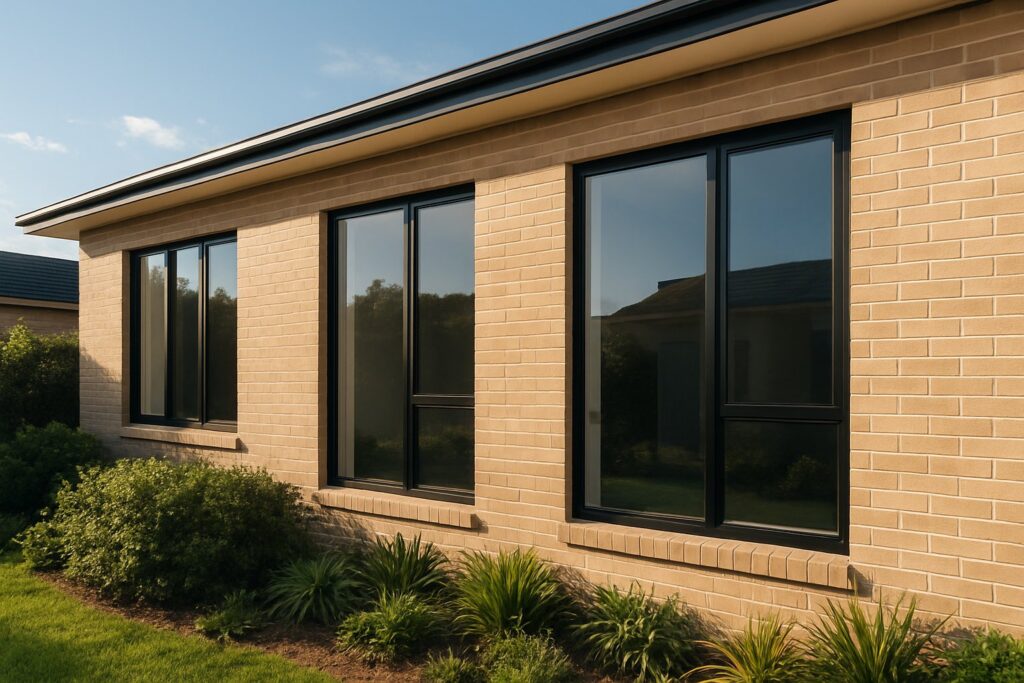
Understanding the Different Types of Window Glass
Window glass is not just a transparent sheet that lets light in. It is a performance component that directly shapes how your home handles heat, sound, safety, and even privacy. Most homeowners spend weeks choosing paint colors or countertop materials, yet barely glance at the glass going into their windows. That is a costly oversight.
Why Window Glass Selection Matters
The glass for windows — types of glass included — determines far more than the view. It influences your heating and cooling bills, how much street noise reaches your living room, whether your furnishings fade from UV exposure, and how secure your home feels at night. Different types of window glass deliver wildly different results across all of these factors.
The glass in your windows accounts for roughly 80% of the window’s total surface area, making it the single biggest factor in thermal performance, noise control, and security.
That single stat explains why upgrading or specifying the right glass can have a bigger impact on comfort and energy costs than almost any other building decision. Whether you are renovating an older home, planning a new build, or simply trying to solve a specific problem like condensation or road noise, the type of glass you choose matters more than the frame around it.
What This Guide Covers
This guide walks through every major category you will encounter, from basic float glass all the way to smart electrochromic glass that tints on demand. Along the way, you will find practical comparisons of insulated glass units, low-E coatings, laminated options for security and sound control, and types of window glass for privacy, including types of obscure glass for bathroom windows. Each section breaks down how the glass works, where it fits, and what it costs relative to alternatives.
No product pitches. Just the information you need to match the right glass to your project, your climate, and your budget. The place to start is the most fundamental glass type of all — and the one every other option builds on.
Float Glass and Annealed Glass Explained
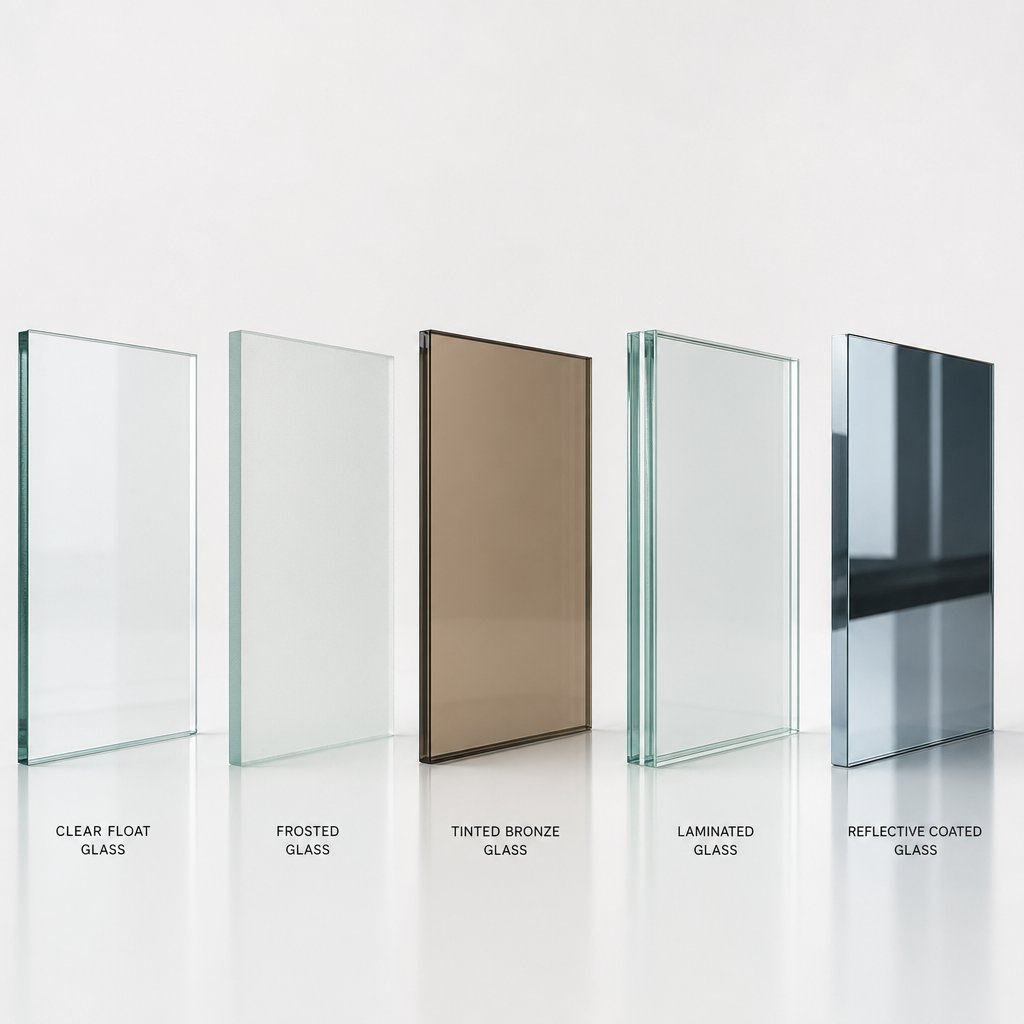
Every other type of glass for windows starts here. Float glass, also called annealed glass, is the base product that gets tempered, laminated, coated, or assembled into insulated units. If you want to understand the full range of types of glass for windows, you need to understand this one first.
How Float Glass Is Made
Imagine molten glass at roughly 1000 degrees Celsius being poured continuously from a furnace onto a shallow bath of liquid tin. The glass literally floats on the tin, spreading out into a perfectly flat, uniform ribbon. Thickness is controlled by the speed at which the solidifying ribbon is drawn off the bath. The result is a “fire-polished” product with virtually parallel surfaces and excellent optical clarity. This process, originally developed in 1952, remains the foundation of the global glass industry, with around 260 float plants worldwide producing approximately 800,000 tons of glass per week.
After forming, the glass ribbon passes through an annealing lehr, a long oven that cools it gradually and evenly. This controlled cooling relieves internal stresses, making the glass easier to cut and fabricate. The finished product is standard annealed float glass, available in thicknesses from 0.4mm to 25mm and widths up to 3 meters.
Where Annealed Glass Is Still Used
Plain annealed glass is the most affordable option on the market, and it still has a place in certain applications. You will typically find it in fixed picture windows positioned well above floor level, interior partitions, and non-impact-prone locations where building codes do not mandate safety glass. Many older homes, especially those built before modern glazing codes took effect, still have single-pane annealed glass throughout, including in areas that would require tempered or laminated glass by current standards.
If you are renovating a historic property, this is worth paying attention to. Replacing old single-pane annealed glass gives you the opportunity to upgrade to safer, more energy-efficient options, particularly in bathrooms where types of privacy glass for bathroom windows can solve both safety and visibility concerns at once.
Here are the key characteristics of float glass at a glance:
- Excellent optical clarity with minimal distortion, making it ideal as a base for further processing
- Most cost-effective glass type available, keeping it common in budget-conscious projects
- Breaks into large, sharp shards on impact, posing a significant injury risk
- Common applications include fixed windows in low-risk positions, picture frames, shelving, and as the raw material for tempered, laminated, and insulated glass products
Limitations and Safety Concerns
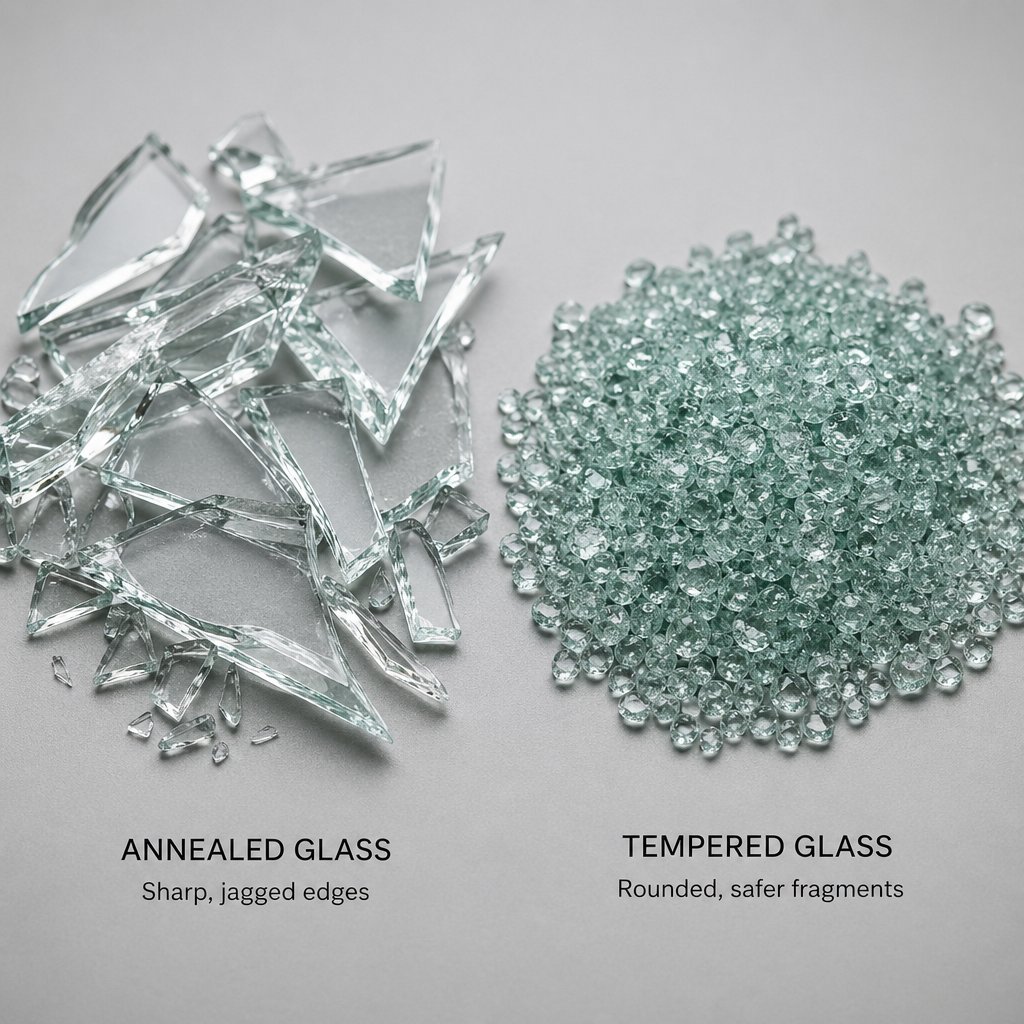
The biggest drawback of annealed glass is how it fails. When it breaks, it fractures into large, jagged pieces with razor-sharp edges. This breakage pattern is the primary reason building codes in most jurisdictions restrict its use in hazard-prone locations such as bathrooms, near doors, beside stairways, and at low heights where someone could fall into the glass.
Annealed glass also offers no meaningful thermal insulation on its own. A single pane does very little to slow heat transfer, which is why it has largely been replaced by insulated glass units in modern construction. On its own, it provides no UV filtering, no sound dampening, and no security resistance.
That said, float glass is not obsolete. It is the starting point. Nearly every advanced glazing product begins as a sheet of float glass before being heat-treated for strength or bonded with interlayers for impact resistance. Those two upgrades, tempering and laminating, transform this basic material into something far more capable.
Tempered Glass and Safety Glass for High-Risk Areas
Strength and safety are where tempered glass earns its reputation. As the most widely specified type of glass for windows in hazard-prone locations, it is the product building codes point to when human safety is on the line.
How Tempered Glass Gets Its Strength
The process starts with a standard sheet of annealed float glass, cut and finished to its final size. That sheet is then heated in a tempering furnace to over 600 degrees Celsius (roughly 1100 degrees Fahrenheit) and rapidly cooled by high-pressure air jets in a process called quenching. This rapid cooling locks the outer surfaces into compression while the interior remains in tension, creating an internal stress profile that gives the glass its remarkable durability.
The result? Fully tempered glass is approximately three to four times stronger than annealed glass of the same thickness. It also handles thermal stress far better, which matters for windows exposed to direct sunlight on one side and air conditioning on the other.
When tempered glass does break, it shatters into small, blunt, granular pieces rather than the large jagged shards you get from annealed glass. This breakage pattern dramatically reduces the risk of serious laceration injuries, which is exactly why codes classify it as safety glass.
There is a middle ground worth knowing about: heat-strengthened glass. It goes through a similar heating process but is cooled more slowly, producing about 1.5 to 2 times the strength of annealed glass. Heat-strengthened glass breaks into larger pieces that tend to stay in the frame, making it useful for elevated facades and spandrel panels. However, it does not qualify as safety glass under most building codes because its fragments are still large enough to cause injury.
Where Building Codes Require Tempered Glass
You do not always get to choose whether to use tempered glass. In many situations, the code decides for you. Most residential and commercial building codes mandate safety glazing in locations where the risk of human impact is elevated. These typically include:
- Glass within 24 inches of a door, including sidelights and panels adjacent to entryways
- Bathroom windows and shower enclosures where wet, slippery conditions increase fall risk
- Glass installed with a bottom edge less than 18 inches above the floor
- Windows and glazed panels adjacent to stairways, landings, and ramps
- Overhead glazing such as skylights, where falling fragments pose a direct hazard
- Glass in and near swimming pool enclosures and hot tub surrounds
- Sliding glass doors and all glass doors in both residential and commercial settings
If you are renovating an older home, it is worth checking whether existing types of glass windows in these locations actually meet current safety requirements. Many do not, especially in homes built before modern glazing codes were adopted.
Pros and Cons of Tempered Glass
Pros
- Breaks into small, relatively harmless granular pieces, significantly reducing injury risk
- Three to four times stronger than standard annealed glass, handling greater impact and wind loads
- Superior heat resistance, making it less susceptible to thermal stress cracking from sun exposure
- Meets safety glazing standards required by building codes in high-risk locations
Cons
- Cannot be cut, drilled, or edge-finished after tempering — all fabrication must happen before the glass enters the furnace
- Higher cost than annealed glass, typically adding 30 to 50 percent to the price per square foot
- Small risk of spontaneous breakage caused by nickel sulfide inclusions, microscopic impurities that can expand over time and trigger fracture without warning
- May exhibit slight optical distortion or roller wave effects from the tempering process
Tempered glass solves the strength and safety equation, but it does not address every performance gap. When you need a window that holds together on impact, blocks noise from a busy street, or filters UV radiation to protect interiors, a different construction method steps in — one that bonds multiple layers of glass into a single resilient unit.
Laminated Glass for Security and Noise Control
Tempered glass is strong, but when it breaks, it still leaves an open hole. Laminated glass takes a fundamentally different approach. Instead of resisting breakage through internal stress, it holds together after impact, keeping the opening sealed and the fragments contained. That distinction makes it one of the most versatile different types of glass for windows where security, acoustics, or storm protection are priorities.
How Laminated Glass Is Constructed
Picture a sandwich. Two or more sheets of glass are bonded together with a tough, flexible plastic interlayer under high temperature and pressure. The most common interlayer is polyvinyl butyral (PVB), a thermoplastic resin film valued for its transparency, adhesion, and sound-dampening properties. Ethylene-vinyl acetate (EVA) is another option, offering better moisture resistance than PVB, though it is more commonly used in decorative applications. For extreme structural demands like blast-resistant or bullet-resistant glazing, a third interlayer type called SentryGlas Plus (SGP) provides twice the load-bearing capacity and five times the tear strength of PVB at the same thickness.
The interlayer is what gives laminated glass its defining characteristic. When the glass cracks, the fragments stick to the plastic film rather than falling out of the frame. You get a spider-web fracture pattern instead of an open breach, and that single property drives all three of its core benefits.
Noise Reduction and STC Ratings
If you live near a busy road, a rail line, or a flight path, you already know how much exterior noise a standard window lets through. This is where laminated glass quietly outperforms other types of window glasses.
Sound reduction in glass is measured using Sound Transmission Class (STC) ratings. The higher the number, the better the glass blocks noise. A single 1/4-inch pane of monolithic glass typically scores around 31 STC. Laminated glass of comparable overall thickness can reach STC ratings of 35 to 40 or higher, because the flexible PVB interlayer acts as a dampening membrane that absorbs sound energy rather than transmitting it straight through.
For context, standard walls in most homes sit around 33 STC, and studio-level soundproofing starts at roughly 45. Combining laminated glass with a double-glazed insulated unit pushes ratings into the 45 to 50 range, which is enough to make a noticeable difference even on a street-facing bedroom window. The key takeaway: if noise is your primary concern, laminated glass delivers more acoustic improvement per dollar than simply adding thicker monolithic panes.
Security and Impact Resistance Benefits
Security is the other major reason homeowners choose laminated glass. Because the interlayer holds the panel intact after impact, a would-be intruder cannot simply smash through and reach inside. Breaking through laminated glass requires sustained, repeated effort, which buys time and acts as a strong deterrent.
This same impact resistance is why laminated glass is mandated in hurricane and cyclone zones. In regions like South Florida’s High Velocity Hurricane Zones, windows must pass rigorous testing where pieces of lumber are fired at the glass at speeds of 30 to 50 feet per second. Even if the glass cracks under impact, it must remain in the frame and prevent wind pressure from entering the building. That sealed barrier is critical because once wind breaches the building envelope, internal pressure can lift the roof and cause catastrophic structural failure.
Beyond security and storms, laminated glass blocks up to 99% of UV radiation thanks to the interlayer’s filtering properties. That means less fading on furniture, flooring, and artwork, a benefit that adds up over years of sun exposure.
Pros
- Holds together on impact, maintaining a sealed barrier against intrusion, wind, and debris
- Superior noise reduction compared to monolithic glass, with STC ratings reaching 40 or higher
- Blocks up to 99% of harmful UV radiation, protecting interior furnishings from fading
- Meets impact-rated glazing requirements for hurricane and cyclone zones
Cons
- Heavier than single-pane glass of the same dimensions, requiring frames and hardware rated for the added weight
- Higher cost than both annealed and tempered glass, particularly with SGP or thicker interlayer configurations
- Slightly reduced optical clarity compared to plain float glass, though the difference is minimal in quality products
- PVB interlayers can be vulnerable to edge delamination in prolonged high-humidity environments
Laminated glass addresses what happens at the glass surface — holding it together, quieting sound, and filtering UV. But thermal performance, the factor that most directly affects your energy bills, depends on what happens in the space between panes. That is the domain of insulated glass units, where sealed air gaps and specialized gas fills take efficiency to an entirely different level.
Insulated Glass Units and Gas Fills
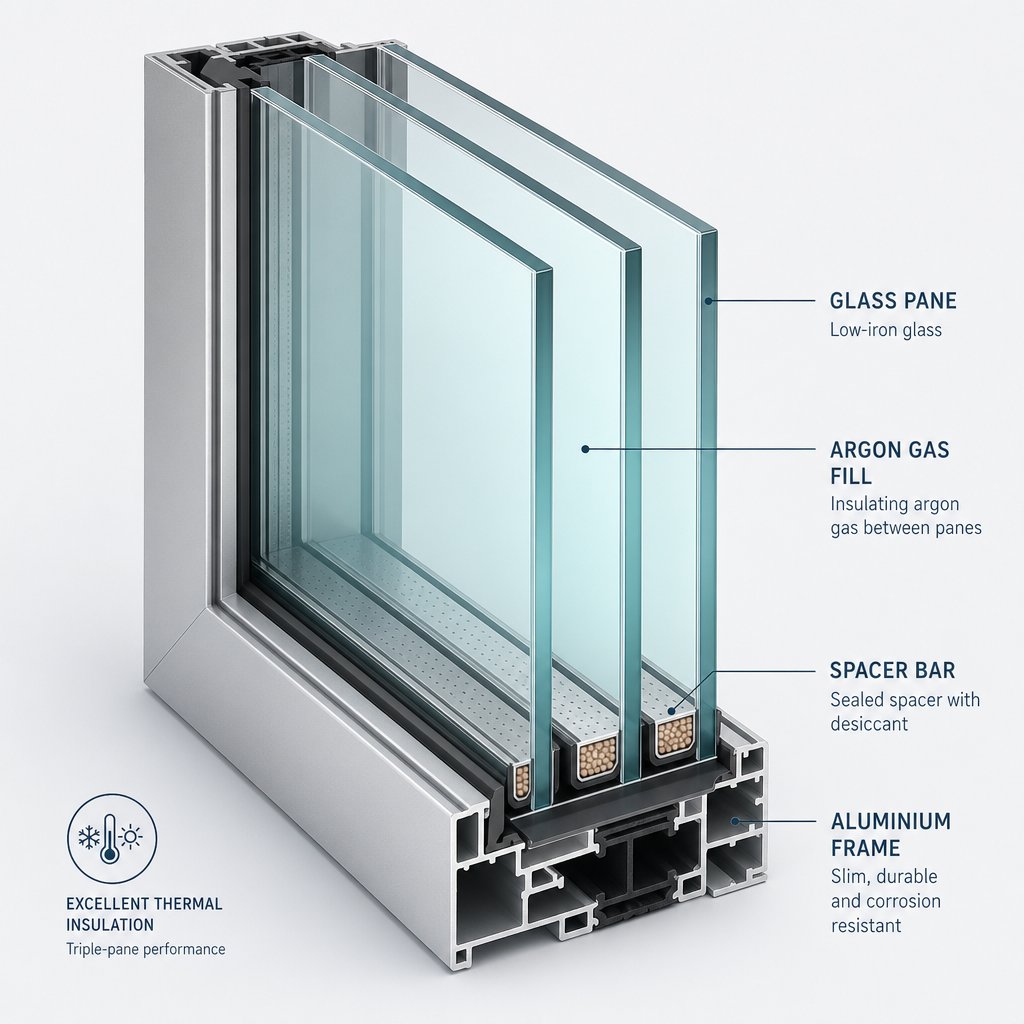
Laminated glass keeps a window intact after impact and dampens noise at the surface. But the biggest energy drain in any home happens through heat transfer across the glass itself. Heat gain and loss through windows account for up to 30% of residential heating and cooling costs, and single-pane glass does almost nothing to slow that exchange. Insulated glass units, commonly called IGUs, tackle this problem by trapping a sealed pocket of gas between two or three panes of glass, creating a thermal barrier that dramatically reduces energy loss.
Double-Pane vs Triple-Pane Performance
A double-pane IGU consists of two sheets of glass separated by a spacer bar, with the sealed gap between them typically ranging from 6mm to 20mm. This simple construction cuts heat transfer roughly in half compared to a single pane. For most climates and budgets, double-pane units represent the sweet spot between performance and cost.
Triple-pane IGUs add a third sheet of glass and a second sealed air gap. That extra barrier further reduces conductive and convective heat loss, and homeowners who upgrade to triple-pane units can save an estimated 3% more on heating costs compared to double-pane. Three percent may sound modest on its own, but it compounds across every window in the house and every year of ownership. Triple-pane windows also deliver noticeably better noise reduction and increased security due to the added glass layer.
The trade-off? Triple-pane units are heavier, thicker, and more expensive. They require frames and hardware engineered for the additional weight, which can limit retrofit options in older homes. Here is how the two configurations compare across the attributes that matter most:
| Attribute | Double-Pane IGU | Triple-Pane IGU |
|---|---|---|
| Typical U-Factor Range | 0.25 – 0.40 | 0.15 – 0.25 |
| Approximate Weight | Moderate (roughly 2x single pane) | Heavy (roughly 3x single pane) |
| Relative Cost Tier | $$ – $$$ | $$$ – $$$$ |
| Best Climate Fit | Mild to moderate climates | Cold climates and extreme heat zones |
| Common Gas Fill Options | Argon (standard), Krypton (premium) | Argon, Krypton, or Argon-Krypton blend |
| Noise Reduction | Good | Very good |
Gas Fills and How They Improve Insulation
The sealed space between panes is not just dead air. In most modern IGUs, that gap is filled with an inert gas that conducts heat more slowly than regular air, boosting the unit’s insulating performance without adding weight or thickness.
Three gases dominate the market, each with a distinct performance and cost profile:
- Argon is the most popular and cost-effective option. It provides reasonable energy performance at a fraction of the cost of denser alternatives, and it works best in standard gap widths of 12mm to 16mm. The vast majority of residential IGUs use argon.
- Krypton is denser than argon and conducts heat even less efficiently, making it the better choice for triple-pane windows with narrower gap widths where argon loses effectiveness. It costs significantly more, but it allows manufacturers to build slimmer, lighter triple-pane units without sacrificing thermal performance.
- Xenon delivers the highest insulating performance of the three, lowering a window’s thermal U-value below what argon or krypton can achieve. However, its cost is prohibitive for most residential projects. You will typically encounter xenon only in high-performance commercial buildings or LEED-certified projects where every fraction of a U-factor point matters.
Some manufacturers offer argon-krypton blends as a middle ground, balancing performance and price for homeowners who want better-than-argon results without the full krypton premium.
Reading NFRC Labels and ENERGY STAR Requirements
When you shop for any type of window glass in an IGU configuration, you will encounter an NFRC (National Fenestration Rating Council) label on the product. This label is your cheat sheet for comparing energy performance across brands and configurations. Three numbers matter most:
- U-Factor measures how fast heat transfers through the window assembly. The scale runs from roughly 0.15 to 1.20, and lower is better. A U-factor of 0.25 means the window resists heat flow far more effectively than one rated at 0.40.
- Solar Heat Gain Coefficient (SHGC) tells you how much solar radiation passes through the glass as heat. It ranges from 0 to 1. In hot climates, you want a low SHGC (around 0.25 or less) to keep cooling costs down. In cold climates, a higher SHGC (around 0.30 to 0.40) lets beneficial solar warmth in during winter.
- Visible Transmittance (VT) indicates how much natural light the glass allows through, also on a 0 to 1 scale. Higher VT means brighter rooms. Most homeowners prefer a VT above 0.40 to avoid a noticeably dim interior.
ENERGY STAR certification uses these metrics as thresholds, and the requirements vary by climate zone. A window that qualifies in Miami may not qualify in Minneapolis. When comparing products, check that the ENERGY STAR rating matches your specific region rather than assuming a generic label applies everywhere. This is especially relevant when choosing types of window glass for bathrooms or other rooms where you might combine an IGU with privacy treatments that further affect light transmission.
Climate zone also shapes which IGU configuration makes the most sense. Warmer regions benefit from double-pane units with low-SHGC coatings that reject solar heat. Colder regions get more value from triple-pane units with very low U-factors and moderately higher SHGC to capture passive solar warmth. Mixed climates often land on double-pane with argon fill and a balanced Low-E coating as the most cost-effective type of glass windows for year-round comfort.
IGU Lifespan and Seal Failure
Every IGU has a finite lifespan, and the weak point is always the edge seal. The perimeter seal keeps the gas fill contained and moisture out. Over time, temperature cycling, UV exposure, and material degradation can compromise that seal, allowing the inert gas to slowly escape and humid air to infiltrate the gap between panes.
The telltale sign? A hazy, foggy appearance between the glass layers that no amount of cleaning will fix. That condensation means the seal has failed, the insulating gas is gone, and the unit’s thermal performance has dropped significantly. Quality IGUs from reputable manufacturers typically last 15 to 25 years before seal degradation becomes an issue, though cheaper units may fail in as few as 10 years. Factors that accelerate seal failure include sustained direct sun exposure, poor installation allowing water to pool at the sill, and excessive frame flex from structural movement.
When seal failure occurs, the entire IGU generally needs replacement rather than repair. Some manufacturers offer 10- to 20-year warranties on seal integrity, so it pays to check warranty terms before purchasing. A failed seal does not just look bad — it means your window is performing closer to a single-pane unit, quietly inflating your energy bills season after season.
IGUs define the thermal backbone of modern windows, but the glass panes within them rarely stand alone. The coatings applied to those panes — Low-E films, tints, and reflective layers — fine-tune how the unit handles solar energy, visible light, and radiant heat. Those coatings are where the real customization begins.
Low-E Coatings and Tinted Glass Demystified
Coatings are what turn a basic insulated glass unit into a high-performance system tuned to your climate. Two windows can look identical from the curb yet perform completely differently depending on the microscopic layers applied to their glass surfaces. Understanding these coatings is essential to choosing the best type of glass for windows in any project, because the coating often matters more than the glass thickness itself.
Hard-Coat vs Soft-Coat Low-E Glass
Low-E stands for low emissivity. In plain terms, a Low-E coating is an ultra-thin metallic layer that reflects infrared heat radiation while still letting visible light pass through. Windows with Low-E coatings typically cost about 10% to 15% more than regular windows, but they can reduce energy loss by 30% to 50%. The real question is which type of Low-E coating fits your situation.
Hard-coat Low-E, also called pyrolytic Low-E, is applied while the glass is still hot on the manufacturing line. The coating fuses directly into the glass surface, creating a layer that is extremely durable and scratch-resistant. You can handle it, store it, and even use it as a standalone monolithic pane without worrying about damage. The trade-off is performance. Hard-coat Low-E has higher emissivity than its counterpart, meaning it reflects less radiant heat. It also allows more solar heat gain, which makes it a reasonable fit for cold climates where you want passive solar warmth during long winters but less ideal where cooling loads dominate.
Soft-coat Low-E takes a different approach. It is applied to cooled glass inside a vacuum chamber using a process called Magnetron Sputter Vacuum Deposition (MSVD). This method deposits multiple ultra-thin metallic layers with far greater precision, resulting in significantly lower emissivity and better solar control. The catch? Soft-coat Low-E is delicate. It must be sealed within an IGU or laminated assembly to protect it from oxidation and physical damage. That requirement is not a drawback so much as a design consideration — virtually all modern residential windows use sealed IGUs anyway.
You may also encounter terms like Low-E2 and Low-E3. These refer to the number of silver-based coating layers within the soft-coat system. A Low-E2 coating uses two layers and delivers strong all-around performance for most climates. Low-E3 adds a third layer, pushing solar control and insulating performance even further. Each additional layer improves the U-factor and fine-tunes the Solar Heat Gain Coefficient, giving specifiers more control over how the glass manages energy. For mixed climates across much of the United States, soft-coat Low-E is the most widely used coating in modern window systems.
How Tinted Glass Colors Affect Performance
Tinted glass works on a completely different principle than Low-E. Instead of a surface coating, metallic oxides are added directly to the glass during manufacturing, giving the entire pane a uniform color. Each tint color absorbs a different portion of the solar spectrum, which means the color you choose has real performance consequences beyond aesthetics.
- Bronze tint absorbs a significant amount of solar heat and reduces glare effectively, making it popular for west-facing windows that catch harsh afternoon sun. It gives interiors a warm tone.
- Grey tint provides the most balanced reduction of both visible light and solar heat without shifting interior color perception noticeably. It is the most neutral-looking option.
- Green tint absorbs more infrared heat than visible light, so rooms stay brighter while still rejecting a meaningful share of solar energy. It is common in commercial buildings and works well in moderate climates.
- Blue tint offers a cooler aesthetic and moderate solar control, though it transmits slightly more heat than grey or bronze. It is chosen primarily for architectural appearance.
Reflective coatings take solar control a step further by applying a thin metallic film to the glass surface that mirrors a portion of incoming sunlight. These coatings are most common in commercial facades where reducing cooling loads on large glass expanses is critical. In residential settings, reflective glass is less popular because it can create a mirror-like appearance from the outside and significantly reduce visible light transmission indoors.
Tinted glass and reflective coatings can both be combined with Low-E coatings within an IGU. They are not mutually exclusive — they address different parts of the energy equation.
Layering Coatings with Other Glass Technologies
Here is where the concept of a “glass system” really clicks. Every different type of window glass discussed so far — tempered, laminated, insulated — can serve as a platform for coatings. A single window might combine a triple-pane IGU with soft-coat Low-E3 on two interior surfaces, argon gas fill in both cavities, and a laminated inner pane for noise control. That is not an exotic specification. It is a realistic configuration for a home on a busy street in a climate with hot summers and cold winters.
The table below compares the main coating and treatment categories across the factors that matter most when specifying glass:
| Coating / Treatment | Energy Efficiency Impact | Durability | Cost Tier | Best Application |
|---|---|---|---|---|
| Hard-Coat Low-E (Pyrolytic) | Moderate — reduces heat loss, allows higher solar gain | High — fused to glass surface, scratch-resistant | $$ | Cold climates prioritizing passive solar heating |
| Soft-Coat Low-E (MSVD) | High — significantly lowers U-factor and controls SHGC | Moderate — must be sealed within IGU or laminate | $$ – $$$ | Mixed and warm climates; most residential projects |
| Soft-Coat Low-E3 (Triple Silver) | Very High — maximum solar control with excellent light transmission | Moderate — requires sealed unit protection | $$$ – $$$$ | High-performance homes; large glazed openings in sun-heavy regions |
| Tinted Glass | Moderate — absorbs solar heat, reduces glare | Very High — color is integral to the glass | $ – $$ | West- and east-facing windows; glare-prone rooms |
| Reflective Coating | High — mirrors solar radiation away from the building | Moderate to High — depends on application method | $$ – $$$ | Commercial facades; large curtain wall systems |
The key insight is that coatings and treatments are not standalone products. They are performance layers stacked onto the glass types and IGU configurations covered earlier. Choosing the best type of window treatments for sliding glass doors or floor-to-ceiling windows, for example, often comes down to selecting the right combination of Low-E coating, tint, and gas fill rather than picking a single “best” glass type.
Energy performance and solar control address what happens with heat and light. But some rooms need glass that manages visibility itself — controlling who can see in without sacrificing the daylight you want to keep. That is a different challenge entirely, and it calls for a different set of glass solutions.
Types of Bathroom Glass Windows for Privacy
Bathrooms, powder rooms, entryway sidelights, and street-facing bedrooms all share the same tension: you want natural light, but you do not want the neighbors watching you brush your teeth. Curtains and blinds solve the problem temporarily, yet they block airflow, trap moisture, and tend to stay permanently closed, which defeats the purpose of having a window in the first place. The smarter approach is building privacy into the glass itself.
Among the different types of glass windows for homes, privacy options have expanded well beyond the single frosted pane your grandparents had in the bathroom. Today you can choose from textured patterns, acid-etched finishes, sandblasted surfaces, gradient frosts, and fully opaque panels, each offering a different balance of obscurity and light transmission. The trick is matching the right option to the right room.
Obscure and Textured Glass Patterns
Textured glass gets its privacy from surface patterns embossed or rolled into the glass during manufacturing. These patterns scatter incoming light so it passes through diffused rather than focused, blurring shapes and details on the other side while still keeping the room bright.
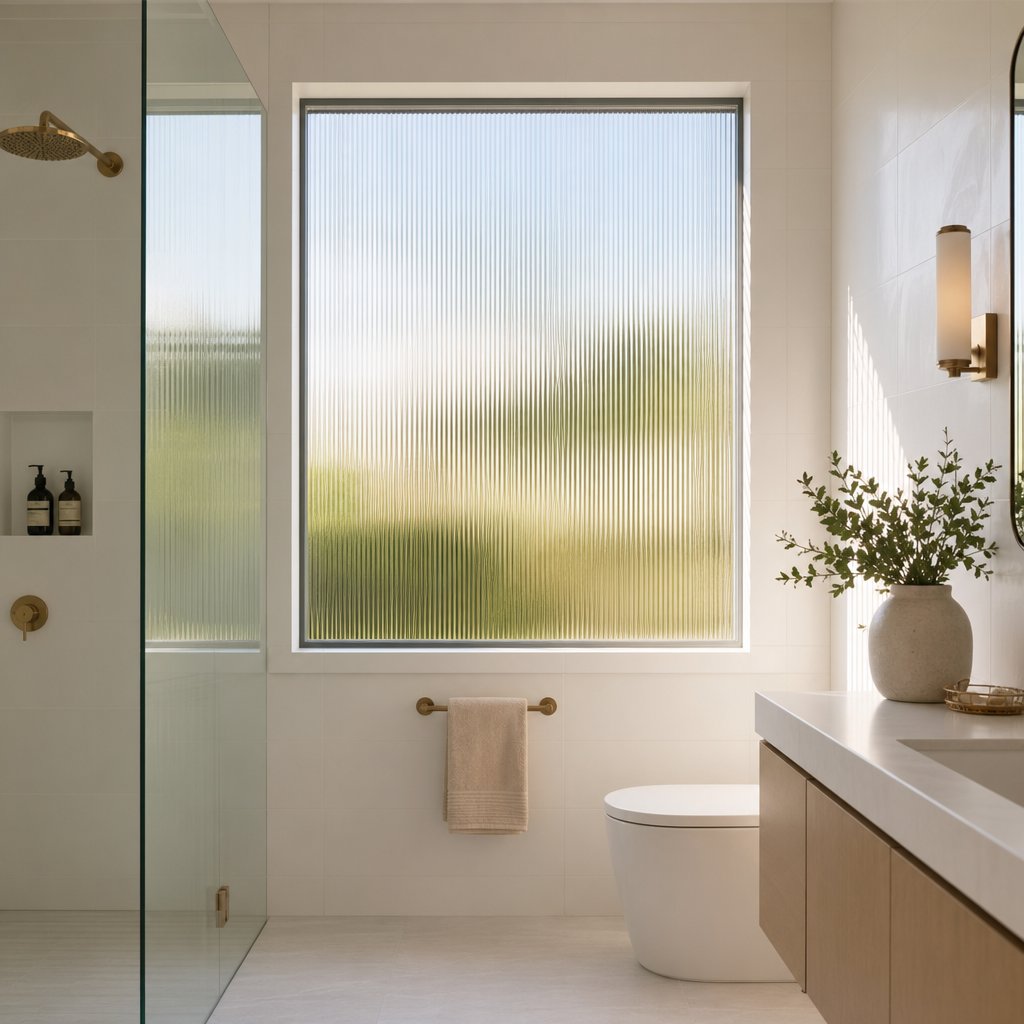
The range of available patterns is surprisingly wide. Reeded (or fluted) glass features vertical grooves that create a clean, modern rhythm, breaking views into soft bands without making the space feel closed off. Rain glass mimics water droplets running down the surface, producing a gentle, organic diffusion that works naturally in wet areas like showers and bathrooms. Flemish glass reproduces the wavy distortion of hand-blown antique panes, offering strong obscurity with a historic character that suits period homes. Glacier and aquatex patterns use free-flowing, rippled surfaces for a more artistic effect.
Each pattern delivers a different level of privacy. Reeded and rain glass provide moderate obscurity — you can sense movement and light levels through them, but faces and details are unreadable. Flemish and glue chip patterns push obscurity much higher, making them better suited for ground-floor windows where passersby are close. Even niche textures like seedy or bubble glass, which trap tiny air pockets to mimic vintage panes, are finding their way into cottage and coastal homes where character matters as much as coverage.
Frosted Glass Options and Light Transmission
Frosted glass takes a different path to privacy. Instead of embossing a pattern, the glass surface is uniformly roughened to scatter light evenly across the entire pane. Two factory methods dominate: acid etching and sandblasting.
Acid-etched glass is treated with an acidic solution that creates a smooth, satin-like finish. It feels soft to the touch, resists fingerprints better than sandblasted alternatives, and produces a consistent, elegant translucency. Sandblasted glass uses high-pressure abrasive particles to roughen the surface, resulting in a slightly grainier texture. Both methods deliver strong privacy, but acid-etched glass is generally easier to clean because its smoother surface traps less dust and oil.
Full-frost treatments obscure the entire pane uniformly, making them ideal for types of bathroom glass windows where complete privacy is non-negotiable. Gradient frosts fade from fully opaque at the bottom to clear at the top, letting you block sightlines at eye level while preserving a view of the sky or treetops above. This partial approach works well in upper-floor ensuites where the risk of being seen is lower and you want to keep as much daylight as possible.
Then there are aftermarket privacy films. These thin polyester layers apply directly to existing glass and can closely replicate the look of etched or sandblasted finishes. Quality films from established manufacturers are hard to distinguish from factory-applied treatments once installed, and they offer a key advantage: they are removable. If your privacy needs change or you move to a new home, the film peels off without damaging the glass underneath. The trade-off is durability. Factory-applied frosting is permanent and integral to the glass, while films can eventually peel, bubble, or discolor, especially in high-moisture environments like showers.
Matching Privacy Level to Room and Location
Choosing the right privacy glass comes down to two questions: how close are people on the other side, and how much light can you afford to lose?
A ground-floor bathroom facing a sidewalk or neighboring property needs full obscurity. Heavy textures like Flemish or glue chip, or a full acid-etched frost, block visibility completely while still flooding the room with diffused daylight. For a shower window, pairing frosted glass with strategic placement — a sill height of five to six feet — adds a second layer of protection without darkening the space.
Upper-floor ensuites and master bathrooms carry less risk. A gradient frost or moderate texture like rain glass often provides enough privacy while keeping the room noticeably brighter than a fully obscured pane would. You still get separation from the outside, but you do not sacrifice the open, airy feeling that makes a bathroom comfortable.
Entryway sidelights and front door lites sit in a different category entirely. Here, privacy is important, but so is curb appeal. Decorative textures like reeded glass or different types of stained glass windows add architectural interest while softening views into the foyer. The goal is not total obscurity but a controlled reveal — enough to let warm interior light glow outward at night without exposing the hallway to every passerby.
Here are the most common privacy glass options ranked from lowest to highest obscurity:
- Seedy or bubble glass — light distortion, mostly decorative, low privacy
- Reeded (fluted) glass — moderate privacy, clean linear pattern, high light transmission
- Rain glass — moderate privacy, organic texture, even light diffusion
- Gradient frost — moderate to high privacy at the base, fading to clear at the top
- Aquatex or wave pattern — moderate to high privacy, strong artistic diffusion
- Full acid-etched or sandblasted frost — high privacy, uniform translucency across the entire pane
- Flemish glass — high privacy, wavy historic distortion
- Glue chip glass — very high privacy, dense fern-like crystalline pattern
- Opaque glass — complete privacy, blocks all visibility and most light
Privacy glass solves the visibility problem, but it is a fixed solution. Once installed, the obscurity level does not change. For homeowners who want the flexibility to switch between clear and private on demand, a newer category of glass is starting to deliver exactly that — using electricity instead of texture.
Smart Glass and Emerging Technologies
Textured and frosted panes give you a fixed level of obscurity, and that works perfectly when the room always needs privacy. But what about a living room window that faces west, where you want a clear view in the morning and tinted protection from afternoon glare? Or a skylight that should flood the room with light on overcast days but reject solar heat when the sun is blazing? Static glass cannot adapt. Smart glass can.
Smart glass, also called switchable glass, uses embedded technologies to change its optical properties on demand. Instead of choosing between clear and private at the time of installation, you make that choice in real time with a switch, an app, or an automated sensor. The concept has been around for decades in commercial and automotive applications — you may have already encountered it in types of car window glass like auto-dimming sunroofs — but residential adoption is accelerating as costs come down and smart home integration improves.
How Electrochromic Glass Works
Electrochromic glass is the most established smart glass technology for windows. The principle is straightforward: a stack of ultra-thin layers is sandwiched between two panes of glass, including an electrochromic material (typically tungsten oxide or nickel oxide), an ion-conducting electrolyte, and transparent conductive coatings on each side.
When a small electrical voltage is applied, ions migrate from one layer through the electrolyte into the electrochromic layer. This movement triggers a chemical reaction that changes the oxidation state of the material, and the glass gradually shifts from clear to a deep blue tint. Remove the voltage, and the ions migrate back, returning the glass to full transparency. The process is fully reversible and can cycle thousands of times without degradation.
The tinting is gradual rather than instant, typically taking 5 to 20 minutes to complete a full transition depending on the pane size and ambient temperature. That slow fade is actually a feature in architectural applications — it avoids the jarring snap from bright to dark that faster technologies produce. Electrochromic glass excels at controlling solar heat gain and glare, which makes it a strong fit for large south- and west-facing windows, skylights, and commercial facades where reducing demand on HVAC and artificial lighting translates directly into energy savings.
SPD and PDLC Alternatives
Electrochromic glass is not the only player. Two other switchable technologies address different priorities, and understanding the distinctions helps you pick the right one for your situation.
SPD (Suspended Particle Device) glass uses a film containing billions of suspended nanoparticles. In its unpowered state, the particles are randomly oriented, absorbing light and giving the glass a dark blue appearance. Apply voltage, and the particles align instantly, allowing light to pass through and the glass to become clear. The transition is fast — nearly instantaneous — and the tint level is continuously adjustable, so you can dial in exactly the amount of light you want. SPD glass filters up to 99.9% of UV rays even in its lightest state, making it popular in automotive sunroofs and marine glazing. For residential use, it suits rooms with intense, variable sun exposure where you want precise, real-time light control.
PDLC (Polymer Dispersed Liquid Crystal) glass works on a completely different principle. A thin film of liquid crystals dispersed in a polymer matrix sits between two glass layers. Without power, the crystals scatter randomly, creating a frosted, opaque appearance similar to types of frosted glass for bathroom windows. Apply an electrical current, and the crystals align, turning the glass transparent. The switch is nearly instant — under one second — and the effect is binary: frosted or clear, with limited intermediate states.
PDLC is the go-to choice when on-demand privacy is the primary goal rather than solar control. Think bathroom partitions, conference room walls, or a street-facing window where you want the option to go from clear to fully obscured without pulling a shade. Unlike types of frosted glass for windows that are permanently etched or textured, PDLC gives you that same frosted look only when you want it.
Here is how the three technologies compare at a glance:
- Electrochromic — switches via ion migration (slow, 5-20 minutes); provides variable tinting for solar and glare control but does not achieve full opacity; privacy capability is moderate; relative cost is high ($$$-$$$$)
- SPD — switches via particle alignment (near-instant); offers continuously adjustable tint from dark to clear with strong UV filtering; privacy capability is moderate to high in darkened state; relative cost is high ($$$-$$$$)
- PDLC — switches via liquid crystal alignment (near-instant); toggles between frosted opaque and fully clear; privacy capability is high in the off state; relative cost is moderate to high ($$-$$$)
Practical Considerations for Residential Use
Smart glass is compelling, but it comes with real-world trade-offs that are worth weighing before you commit.
Cost is the biggest barrier. Smart glass panels typically run $70 to $150 or more per square foot installed, compared to standard IGU glass that costs a fraction of that. Retrofit smart films, which apply to existing glass, bring the entry point down to roughly $25 to $80 per square foot installed, but they still represent a significant premium over conventional window treatments.
Power requirements are modest — most smart glass technologies draw very little electricity during operation, and electrochromic glass only needs power during the transition itself, not to maintain its tinted state. However, every smart glass panel needs a wired electrical connection, which means running low-voltage wiring to each window location. In new construction, that is a minor addition to the electrical plan. In a retrofit, it can mean opening walls and adding circuits, which drives up installation cost and complexity.
Integration with home automation platforms is improving rapidly. Most major smart glass manufacturers now offer compatibility with systems like Google Home, Amazon Alexa, and Apple HomeKit, allowing you to automate tinting schedules based on time of day, sun position, or indoor temperature readings. That automation is where the energy savings really materialize — the glass responds to conditions without you needing to think about it.
Where does smart glass make the most practical sense right now? Skylights are a strong candidate because they are hard to shade with conventional treatments and receive intense overhead sun. Large west-facing picture windows that overheat rooms every afternoon are another natural fit. Bathrooms where you want switchable privacy without the maintenance of blinds in a humid environment also benefit, especially when PDLC technology can replace a permanently frosted pane with something far more flexible.
The technology is still maturing for whole-home residential use. Costs are trending downward, product options are expanding, and installer networks are growing. For most homeowners, smart glass makes the strongest case as a targeted upgrade in specific high-impact locations rather than a whole-house replacement — at least for now. As the market scales, that calculus will shift.
With every glass type and technology now on the table — from basic float glass through smart electrochromic panels — the real challenge becomes comparing them all against each other and figuring out which combination actually fits your project, your climate, and your budget.
Every Glass Type Compared Side by Side
Sorting through individual glass descriptions is one thing. Seeing them all lined up against the same criteria is where the real clarity happens. This section puts every glass type covered so far into a single reference table, then connects the dots between glass selection, frame material, and climate — because a window is a system, not just a pane.
Side-by-Side Glass Type Comparison Table
The table below compares each glass type across the performance attributes that matter most when specifying windows. Cost tiers are relative, ranging from $ (most affordable) to $$$$ (premium). Ratings reflect typical performance when the glass is used in its most common residential configuration.
| Glass Type | Typical Use Cases | Cost Tier | Energy Efficiency | Safety | Noise Reduction | UV Protection | Privacy |
|---|---|---|---|---|---|---|---|
| Aluminium-Framed IGU System (Double/Triple-Pane + Low-E + Gas Fill) | Whole-home new builds, renovations, energy-rated projects | $$ – $$$ | High to Very High | High (when paired with tempered or laminated panes) | Good to Very Good | High (with Low-E coating) | None (clear) — customizable with frosted or textured panes |
| Float / Annealed Glass | Fixed windows in low-risk positions, picture frames, base material for processing | $ | Low | Low — breaks into large sharp shards | Poor | Low | None |
| Tempered (Safety) Glass | Bathrooms, near doors, stairways, overhead glazing, sliding doors | $$ | Low (on its own) | High — granular breakage pattern | Poor to Fair | Low | None |
| Laminated Glass | Security glazing, hurricane zones, noise-sensitive rooms, UV protection | $$ – $$$ | Low to Moderate (on its own) | Very High — holds together on impact | Very Good (STC 35-40+) | Very High (blocks up to 99% UV) | None |
| Double-Pane IGU (Argon Fill) | Standard residential windows in mild to moderate climates | $$ | High | Moderate (depends on pane type) | Good | Moderate (improves with Low-E) | None |
| Triple-Pane IGU (Argon/Krypton Fill) | Cold climates, extreme heat zones, high-performance builds | $$$ – $$$$ | Very High | Moderate to High | Very Good | Moderate to High | None |
| Low-E Coated Glass (Soft-Coat) | Most residential IGUs, energy-rated windows | $$ – $$$ | High to Very High | Depends on base glass | Depends on base glass | High | None |
| Tinted Glass | West/east-facing windows, glare reduction, commercial facades | $ – $$ | Moderate | Depends on base glass | Fair | Moderate | Low |
| Frosted / Obscure Glass | Bathrooms, entryway sidelights, types of frosted glass windows for bedrooms | $ – $$ | Low (on its own) | Depends on base glass | Fair | Low to Moderate | High to Very High |
| Glass Block | Basement windows, shower walls, types of glass block windows for decorative light | $$ – $$$ | Moderate | Moderate | Good | Moderate | High |
| Smart Glass (Electrochromic / SPD / PDLC) | Skylights, large west-facing windows, switchable privacy applications | $$$$ | High (dynamic solar control) | Depends on base glass | Fair to Good | High | Variable — on-demand (PDLC highest) |
Notice how many rows say “depends on base glass” for safety and noise. That is the point. Most of these technologies layer onto each other. A single window might combine tempered glass, a Low-E coating, argon gas fill, and a laminated inner pane — pulling performance from four rows simultaneously. Think in combinations, not single categories.
How Glass Type and Frame Material Work Together
Glass gets most of the attention, but the frame holding it accounts for 20% or more of the window’s total thermal performance. Choosing high-end triple-pane Low-E glass and dropping it into a poorly insulating frame is like putting premium tires on bent rims — you will not get the performance you paid for.
Four frame materials dominate the residential market, and each interacts with glass selection differently:
- Aluminium frames offer slim sightlines and exceptional structural strength, which makes them ideal for supporting heavier glass configurations like triple-pane IGUs or thick laminated units. Modern aluminium profiles include thermal breaks — insulating barriers within the frame — that address the material’s natural conductivity. For a practical example of how this works in real projects, MEICHEN’s aluminium windows collection pairs thermally broken aluminium frames with various glass options to meet Australian standards for energy efficiency and safety, serving homeowners, renovators, builders, and developers across multiple window configurations.
- Timber frames provide natural insulation and a classic aesthetic, but they require ongoing maintenance and can limit glass weight in some profiles.
- uPVC frames deliver strong thermal performance at a lower price point, though their thicker profiles reduce the visible glass area compared to aluminium.
- Composite frames blend materials — often a timber or foam core with an aluminium or fiberglass exterior — aiming for the best of both worlds, though at a higher cost tier.
The renovation versus new construction context matters here too. If you are replacing glass in existing frames, your options are constrained by the frame’s weight capacity, glazing rebate depth, and structural condition. A timber frame from the 1980s may not accept a triple-pane IGU without modification. New construction gives you a clean slate to specify the ideal glass-and-frame combination from the start, which is why it is worth selecting both at the same time rather than treating them as separate decisions.
Climate Zone Recommendations
Your climate determines which glass attributes deserve the most budget. Getting this wrong means overspending on features that do not help or underspending where it counts.
- Hot climates (cooling-dominated regions like northern Australia, the southern US Sun Belt, or tropical zones) benefit most from low-SHGC glass — tinted panes, reflective coatings, or soft-coat Low-E tuned to reject solar heat. Double-pane IGUs with argon fill typically provide sufficient insulation. Types of frosted window glass or tinted options on west-facing walls pull double duty by reducing glare and heat gain simultaneously.
- Cold climates (heating-dominated regions like Canada, northern Europe, or alpine zones) prioritize very low U-factors to retain interior warmth. Triple-pane IGUs with krypton fill and Low-E coatings deliver the best results. A moderately higher SHGC is actually desirable here because it lets passive solar energy supplement your heating system during short winter days.
- Mixed climates (temperate zones with both hot summers and cold winters) need balance. Double-pane IGUs with argon fill and a versatile soft-coat Low-E2 coating handle both seasons effectively. This is the configuration where consulting climate-specific window performance guides pays off, because the ideal SHGC and U-factor targets shift depending on your exact location and building orientation.
Glass type, frame material, and climate zone are three legs of the same stool. Get all three right, and your windows become one of the most cost-effective upgrades in the entire building envelope. Get one wrong, and you are leaving comfort and money on the table — which brings us to the practical question of how to pull all of these variables into a single, confident decision.
How to Choose the Right Types of Glass for Home Windows
You have seen the full lineup — float, tempered, laminated, insulated, coated, privacy, and smart glass. That is a lot of options. But choosing the right types of glass for windows and doors does not require mastering every technical detail. It requires knowing your priorities and working backward from there.
Choosing Glass by Project Priority
Every window project has a lead priority. Identify yours, and the glass specification practically writes itself.
- If energy savings come first, focus on a double- or triple-pane IGU with soft-coat Low-E and argon or krypton gas fill. Match the SHGC to your climate — low for hot regions, moderate for cold ones. This combination delivers the biggest return on every dollar spent.
- If security is the driver, laminated glass is your foundation. The PVB interlayer keeps the pane intact after impact, deterring forced entry and meeting impact-rated requirements in storm-prone zones. Pair it with tempered glass for locations where building codes demand safety glazing.
- If noise reduction matters most, laminated glass again leads the way, ideally within an IGU configuration. A laminated inner pane inside a double-pane unit with an asymmetric gap width can push STC ratings into the mid-40s — enough to make a street-facing bedroom genuinely quiet.
- If privacy is the goal, match the obscurity level to the room. Full acid-etched frost or Flemish texture for ground-floor bathrooms, gradient frost or rain glass for upper floors, and PDLC smart glass where you want switchable control without permanent compromise.
Most real-world projects blend two or more of these priorities. A bathroom renovation might need safety glass (code requirement), privacy (ground-floor location), and decent thermal performance (energy bills). That points to a tempered, frosted pane within an argon-filled IGU with Low-E coating — four technologies in a single window. The takeaway: think in systems, not single types of glass for window specifications.
Your Glass Selection Checklist
When you are ready to move from research to decisions, walk through these steps in order:
- Identify your climate zone and energy priorities — cooling-dominated, heating-dominated, or mixed — to set your target U-factor and SHGC range.
- Check local building code requirements for safety glass in bathrooms, near doors, at low heights, and beside stairways.
- Assess noise and security needs based on your street exposure, neighborhood, and personal comfort threshold.
- Set a realistic budget tier that accounts for both the glass and the frame, since both affect total performance.
- Choose a frame material that complements your glass selection — aluminium for strength and slim profiles, timber for natural insulation, uPVC for value, or composite for a blend.
- Verify ENERGY STAR or equivalent certification for your specific climate zone rather than relying on a generic label.
The best window glass is never a single product. It is the combination of glass type, coating, gas fill, and frame that matches your specific climate, budget, and performance priorities.
Taking the Next Step
Research only gets you so far. At some point, you need to see real products that bring these types of glass for doors and windows together into complete, certified systems. If you are in Australia and considering aluminium-framed windows for a renovation or new build, MEICHEN’s aluminium windows collection is a practical starting point — their range pairs thermally broken aluminium frames with various glass configurations to meet Australian standards for energy efficiency and safety, with options suited to homeowners, renovators, builders, and developers.
Wherever you are in the process, the framework stays the same: lead with your climate, layer in your code requirements and comfort priorities, and choose a glass-and-frame system that delivers on all of them without overspending on features you do not need. That is how you turn a confusing product category into a confident, cost-effective decision.
Frequently Asked Questions About Types of Window Glass
1. What is the most energy-efficient type of window glass?
A triple-pane insulated glass unit (IGU) with soft-coat Low-E3 coating and krypton gas fill delivers the highest residential energy efficiency, achieving U-factors as low as 0.15. For most homeowners, a double-pane IGU with argon fill and soft-coat Low-E coating offers the best balance of performance and affordability, reducing energy loss by 30% to 50% compared to uncoated glass. The ideal configuration depends on your climate zone — hot regions benefit from low Solar Heat Gain Coefficient (SHGC) glass, while cold regions need very low U-factors paired with moderate SHGC to capture passive solar warmth.
2. What type of glass is best for bathroom windows?
Bathroom windows typically require both safety glazing and privacy. Tempered frosted glass within an insulated glass unit is the most practical choice for most bathrooms, meeting building code safety requirements while blocking visibility. For ground-floor bathrooms near walkways, high-obscurity options like Flemish texture or full acid-etched frost provide complete privacy while still allowing diffused natural light. Upper-floor bathrooms can use lighter options like rain glass or gradient frost that maintain more brightness. Homeowners wanting flexibility can consider PDLC smart glass, which switches between clear and frosted on demand — ideal for humid environments where blinds tend to trap moisture.
3. What is the difference between tempered glass and laminated glass?
Tempered glass and laminated glass are both classified as safety glass, but they protect in fundamentally different ways. Tempered glass is heat-treated to be roughly four times stronger than standard annealed glass, and when it does break, it shatters into small, blunt granular pieces that reduce laceration risk. However, it still leaves an open hole in the frame. Laminated glass bonds two or more glass sheets with a tough plastic interlayer (usually PVB), so when it cracks, the fragments adhere to the film and the pane stays intact in the frame. This makes laminated glass superior for security, hurricane protection, noise reduction (STC ratings of 35-40+), and UV filtering (blocks up to 99%), while tempered glass is the standard code-compliant choice for locations like bathrooms, near doors, and beside stairways.
4. How long do double-pane insulated glass windows last?
Quality double-pane insulated glass units from reputable manufacturers typically last 15 to 25 years before the perimeter seal begins to degrade. The first sign of seal failure is a persistent hazy or foggy appearance between the panes that cleaning cannot resolve — this means moisture has infiltrated the sealed gap and the insulating gas has escaped. At that point, the window’s thermal performance drops significantly, essentially functioning closer to a single-pane unit. Factors that shorten IGU lifespan include prolonged direct sun exposure, poor installation that allows water to pool at the sill, and excessive frame flex from structural movement. Checking manufacturer warranty terms before purchase is worthwhile, as many offer 10- to 20-year seal integrity guarantees.
5. Is smart glass worth it for residential windows?
Smart glass is a compelling but premium option that currently makes the most financial sense as a targeted upgrade rather than a whole-home solution. At $70 to $150 or more per square foot installed, it costs significantly more than conventional IGU glass. The strongest residential use cases are skylights (difficult to shade conventionally and exposed to intense overhead sun), large west-facing windows that overheat rooms every afternoon, and bathrooms where PDLC switchable privacy replaces maintenance-prone blinds. Electrochromic glass offers the best solar and glare control with gradual tinting, while PDLC provides instant frosted-to-clear privacy switching. Integration with home automation platforms like Google Home and Apple HomeKit allows automated tinting schedules that maximize energy savings without manual intervention. Costs are trending downward as the market scales, so the value proposition improves each year.
More Window & Door Guides