What Is a Tilt and Turn Window
Imagine a single window that ventilates your home like an awning, opens wide like a door, and locks down tight with one handle. That’s exactly what a tilt and turn window delivers — and it does it without any visible extra hardware on the frame.
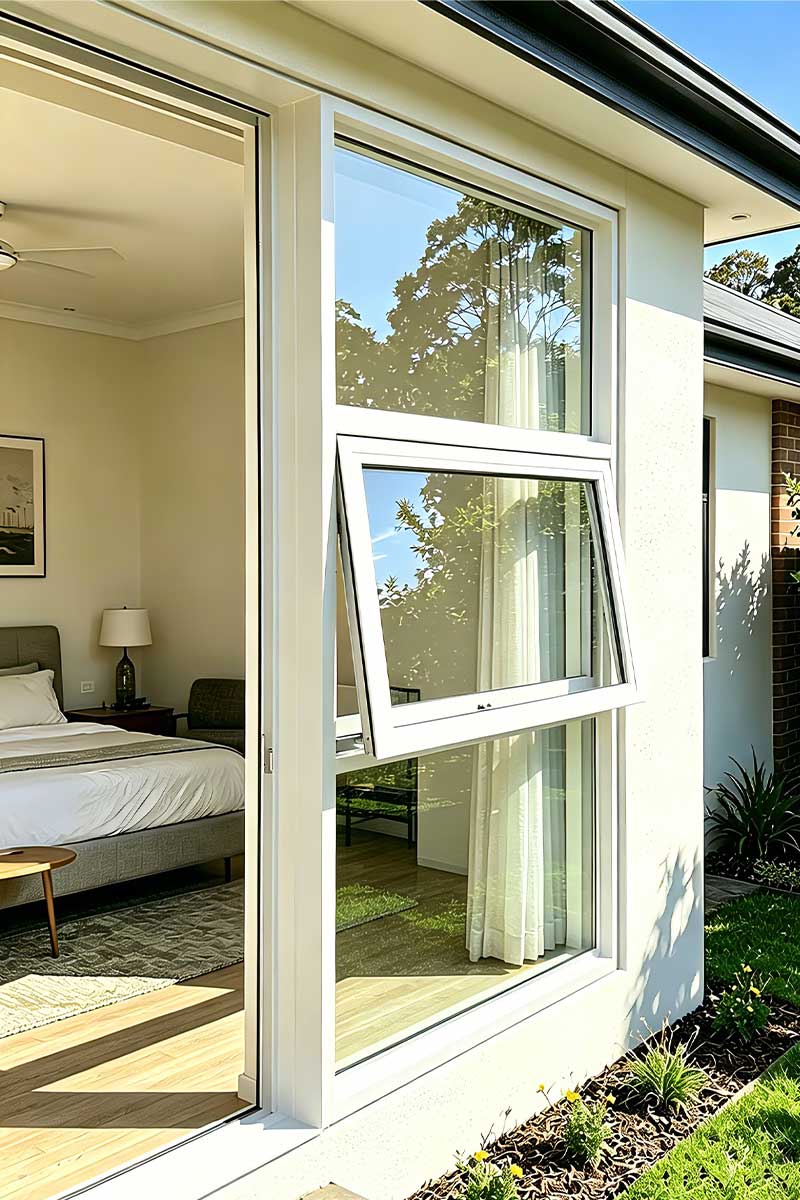
A tilt and turn window is a dual-action window operated by a single handle that either tilts inward from the top for controlled ventilation or swings fully inward on side hinges for cleaning and maximum airflow.
If you’ve only ever used sliding or double-hung windows, the concept might sound unusual. But across much of Europe, this window tilt turn design has been the residential default for decades. The difference comes down to versatility: where a sliding window gives you one motion and a casement gives you another, tilt and turn windows combine both into a single sash.
The Dual-Action Window Defined
Here’s how it works in plain terms. One handle controls two distinct opening modes, and the entire operation happens inward — nothing protrudes outside your home.
- Tilt mode: The top of the sash tilts inward while the bottom edge stays fixed in the frame. This creates a narrow gap at the top for fresh air without fully opening the window.
- Turn mode: The entire sash swings inward on side-mounted hinges, much like opening a door. This gives you full access to the glass for cleaning and unrestricted airflow.
Unlike a casement window that swings outward, or a double-hung that slides vertically, a tilt and turn window keeps everything contained within the room. That single-handle mechanism — rotating between locked, tilt, and turn positions — is what makes the design so elegant.
From European Standard to Global Adoption
These windows originated in post-war Germany during the 1950s, when rebuilding efforts demanded fenestration that was secure, thermally efficient, and easy to maintain. The design quickly became the continental European standard across Germany, Austria, and Scandinavia. As Green Building Advisor notes, tilt and turn remains common in Germany, Austria, and Italy, though it has not yet gained widespread adoption in North American housing markets.
That’s changing. Homeowners in Australia, the UK, and North America are discovering these windows as energy efficiency requirements tighten and modern architectural trends favour slimmer frames with larger glass areas. In markets where sliding and awning windows have traditionally dominated, aluminium tilt and turn windows are gaining ground — driven by their superior sealing performance and the growing demand for passive-house-level airtightness.
So why haven’t they been everywhere all along? Simply put, English-speaking markets developed around different window traditions. But once you understand how the mechanism actually operates, the appeal becomes obvious.
How the Tilt and Turn Mechanism Actually Works
Most window types give you one motion — slide, crank, or push. A tilt turn window gives you two, controlled entirely by the position of a single handle. Sounds complex? It’s surprisingly intuitive once you see what’s happening inside the frame.
The system relies on three handle positions, each engaging a different configuration of internal hardware:
- Handle pointing down: The window is fully locked. All locking points around the frame perimeter are engaged, compressing the sash tightly against the gaskets.
- Handle turned 90 degrees to horizontal: The turn function activates. The sash swings fully inward on side-mounted hinges, like opening a door.
- Handle rotated 180 degrees to point up: The tilt function activates. The top of the sash tilts inward while the bottom and sides remain securely locked.
Every position triggers a precise mechanical response inside the frame — no guesswork, no secondary latches, no extra hardware visible on the surface.
Tilt Mode for Controlled Ventilation
When you rotate the handle to the upward position, you release only the top edge of the sash. It tilts inward at a controlled angle — typically around 10 to 15 degrees — creating a gap at the top for passive airflow. The bottom edge and both sides stay firmly locked into the frame.
This is what makes tilt mode ideal for overnight ventilation, rainy days, or rooms where you want continuous fresh air without leaving the window wide open. Rain runs harmlessly down the exterior glass rather than entering through the gap, and the narrow opening is far too restricted for anyone to reach through from outside. You get airflow directed upward into the room, producing a gentle circulation rather than a direct draft blowing across furniture or bedding.
Turn Mode for Full Inward Opening
Move the handle to the horizontal position and the mechanism disengages all locking points on the hinge side, freeing the sash to swing fully inward. This is where windows that open inward really prove their worth — you get complete, unobstructed access to both sides of the glass from inside the room.
Turn mode is designed for two primary scenarios: maximum ventilation when you want to flush a room with fresh air quickly, and cleaning the exterior glass surface without ladders or professional help. On upper floors especially, this eliminates a genuine safety hazard. The sash opens wide like a casement door, giving you full reach across the outer pane while standing safely inside.
The Handle Position System and Espagnolette Hardware
The magic behind this dual-action operation lives in a piece of hardware called the espagnolette mechanism — a metal bar (or series of connected rods) installed into a dedicated groove along the sash edge. When you turn the handle, this bar moves vertically, simultaneously engaging or disengaging multiple locking points distributed around the entire frame perimeter.
Think of it as a single command that controls many locks at once. In the locked position, the espagnolette pushes steel cams or pins outward into strike plates on all four sides of the frame. Rotate to tilt, and it selectively releases the top while keeping the bottom and sides anchored. Rotate to turn, and it releases the opposite set of points to free the hinge side.
This is what makes tilt and turn window installation worthwhile from an engineering perspective — one handle, one internal mechanism, zero visible hardware on the frame exterior, and a level of sealing performance that single-point or dual-point locking systems simply can’t match. The even compression around the full perimeter is also why these windows outperform most alternatives on airtightness and acoustic insulation.
That mechanical precision doesn’t just deliver clever operation — it directly translates into everyday benefits you’ll feel the moment you start living with these windows.
Practical Benefits That Matter Day to Day
Engineering is impressive on paper, but what actually matters is how a window performs when you’re cooking dinner, sleeping with the window cracked, or trying to clean glass three storeys up without a ladder. The dual-action design translates into a handful of real advantages that affect daily life — not just spec sheets.
Here’s a quick snapshot of what the turn window and tilt modes deliver in practice:
- Continuous ventilation during rain, overnight, or while you’re away from home
- Full exterior glass cleaning from inside — no ladders, no risk
- Child-safe restricted opening in tilt position
- Stronger security than traditional tilt out windows or sliding types
- Reduced condensation in moisture-prone rooms
Each of these deserves a closer look, because the details are where the real value lives.
Ventilation Without Compromising Security or Weather Protection
With most traditional windows, you face a binary choice: open or closed. Leave a sliding window cracked and you’re inviting rain, dust, or a security risk. Close it entirely and the room gets stuffy.
Tilt mode solves this trade-off. Because only the top edge opens inward at a narrow angle, rainwater continues running down the exterior glass and drains away through the frame — it doesn’t enter the room. The Glass and Glazing Federation highlights this secure ventilation capability as one of the defining features of the design.
The restricted gap also means you can ventilate while the home is unoccupied. The opening is too narrow for intrusion, and the bottom and sides of the sash remain fully locked. Imagine leaving for work on a warm morning knowing fresh air is circulating through the house without compromising security — that’s the everyday reality with tilt mode.
Safe and Easy Cleaning From Inside the Home
Cleaning upper-floor windows is one of those tasks that ranges from awkward to genuinely dangerous. Traditional styles force you to lean out, hire a professional, or drag a ladder around the property.
Turn mode eliminates the problem entirely. When the sash swings fully inward, you can reach both sides of the glass while standing safely inside the room. For multi-storey homes, apartments, or any window positioned above an extension or sloped ground, this is a significant safety and convenience upgrade. Many homeowners find they appreciate this feature even more after installation than they expected — routine maintenance becomes a five-minute job rather than a weekend project.
Addressing the Inward-Opening Concern
Here’s the objection that comes up most often: “Won’t an inward-opening sash hit my curtains or block furniture near the window?”
It’s a fair question, and the answer depends on which mode you’re using day to day. In tilt mode — which is how most people ventilate 90% of the time — the sash barely protrudes into the room. Most curtains, roller blinds, and roman shades remain completely unaffected during everyday ventilation.
For full turn mode, a few practical solutions keep things working smoothly:
- Ceiling-mounted curtain tracks set slightly forward of the window reveal, giving the sash clearance to swing past
- Frame-fit blinds (like Perfect Fit or Clic Fit systems) that attach directly to the sash and move with the window — a popular choice for uPVC tilt turn windows
- Integrated blinds sealed between the glass panes, completely eliminating any interference
- Roller blinds within the reveal that roll up flush when the window needs to open fully
The key insight is that inward opening is only a problem if you treat it like a traditional outward-opening window. Once you plan the window treatment around the design — which takes minimal adjustment — the concern disappears. European homeowners have been pairing these windows with blinds and curtains for decades without issue, and the range of purpose-built solutions available today makes it easier than ever.
These daily advantages hold true regardless of frame material or price point. But the performance differences between aluminium, uPVC, timber, and composite frames raise a different question entirely — which material delivers the best combination of strength, thermal efficiency, and longevity for your specific project?
Tilt and Turn vs Casement, Sliding, and Double-Hung Windows
Knowing what is a tilt and turn window and how it benefits daily life is one thing. But how does it actually compare against the window types you’re probably already familiar with? When you’re choosing between a casement, a slider, a double-hung, or an awning window, the decision comes down to how each type performs across the criteria that matter most — ventilation, security, cleaning access, energy efficiency, and suitability for different locations in your home.
Rather than vague claims, here’s a direct feature-by-feature breakdown.
Feature-by-Feature Comparison Table
This table compares the five most common residential window types across key performance criteria. Ratings reflect real-world functional differences based on how each mechanism operates.
| Criteria | Tilt and Turn | Casement | Sliding | Double-Hung | Awning |
|---|---|---|---|---|---|
| Ventilation Control | Excellent — two modes (tilt for partial, turn for full) | Good — full opening outward, but no partial-lock mode | Moderate — max 50% opening area | Good — top and bottom sashes adjust independently | Good — opens outward from bottom for rain-safe airflow |
| Security (Locking) | Excellent — multi-point locking (6-8+ points around perimeter) | Good — multi-point locking on quality models | Limited — typically single-point latch at panel junction | Moderate — dual sash locks, but fewer engagement points | Good — compression lock when closed |
| Ease of Cleaning | Excellent — full inward swing gives access to both glass surfaces from inside | Moderate — exterior glass accessible only from outside | Difficult — exterior glass requires ladders or professionals | Good — many models feature tilt-in sashes for interior cleaning | Difficult — exterior access needed |
| Energy Efficiency (Seal Tightness) | Excellent — compression seals around full perimeter | Excellent — sash presses tightly against frame when closed | Moderate — brush or fin seals with minimal compression | Moderate — seals at sash meeting rails can allow infiltration | Good — compression seal at top and sides |
| Child Safety | Excellent — tilt mode restricts opening to narrow top gap | Moderate — requires restrictors to limit opening | Moderate — opening can be wide enough for a child to pass through | Good — top sash can ventilate while bottom stays closed | Good — outward opening limits access from inside |
| Noise Reduction | Excellent — multi-point compression creates airtight seal | Very good — tight seal when closed | Moderate — brush seals allow some sound transmission | Moderate — meeting rail junction can transmit sound | Good — sealed well when closed |
| Suitability for Upper Floors | Excellent — interior cleaning, no external protrusion | Moderate — outward swing can be hazardous at height | Limited — no cleaning access from inside | Good — tilt-in models allow interior cleaning | Good — outward opening stays low-profile |
| Space Efficiency (No Interior Protrusion) | Moderate — sash swings inward in turn mode | Excellent — opens outward, no interior space needed | Excellent — slides horizontally within frame | Excellent — slides vertically within frame | Excellent — opens outward at bottom |
You’ll notice one honest trade-off immediately: turn tilt windows require interior clearance when fully opened. Sliding and double-hung types win on space efficiency because nothing enters the room. That’s a genuine consideration for tight spaces or windows directly above countertops and furniture.
When Each Window Type Makes More Sense
No single window type is perfect for every situation. Here are scenarios where alternatives genuinely outperform windows opening inwards:
- Sliding windows are the better choice for tight spaces where interior swing clearance doesn’t exist — think windows above kitchen benches, behind furniture, or along balcony access points where an inward-opening sash would block the walkway.
- Awning windows work well in climates or markets where tilt and turn hardware isn’t readily available but you still need rain-safe ventilation. They open outward from the bottom, shedding water while allowing airflow.
- Casement windows suit situations where outward opening is preferred — for example, where you want maximum ventilation without any sash protruding into the room, or where building regulations require outward-opening windows for fire egress.
- Double-hung windows remain a solid choice for heritage properties, conservation areas, or anywhere a traditional sash aesthetic is required. Modern tilt-in versions also offer reasonable interior cleaning access.
The point isn’t that tilted windows are always superior — it’s that they cover more bases simultaneously than any single alternative.
Why Tilt and Turn Wins on Versatility
Look back at the comparison table and count the “Excellent” ratings across each row. Tilt and turn windows consistently score at the top across the widest range of criteria. That’s not marketing — it’s a direct consequence of the dual-action mechanism.
They combine the controlled, rain-proof ventilation of an awning window with the full-opening access of a casement, the multi-point security of the best locking systems available, and interior cleaning convenience that only tilt-in double-hung models come close to matching. As Vinyltek’s engineering comparison notes, quality tilt and turn windows achieve 0.5-1.0 air changes per hour at 50 pascals pressure — roughly half the air leakage of quality sliders at 1.5-2.5 ACH@50Pa.
No other single window type delivers that combination. You’d need to install different window styles in different rooms to approximate what one tilt and turn unit handles on its own. That versatility is precisely why the design became the European residential standard — and why it’s gaining traction in markets that have relied on sliders and double-hung windows for generations.
Of course, versatility in operation is only half the equation. The frame material surrounding that mechanism determines how well it performs thermally, how long it lasts, and how it looks on your facade — which brings us to a decision that affects every other performance metric.
Frame Materials Compared
The dual-action mechanism handles the operation. But the frame material? That determines how your tilt and turn windows perform thermally, how they age, how much maintenance they demand, and how they look on your facade for the next 30 to 50 years. It’s the decision that quietly shapes everything else.
Most guides give you a quick list — aluminium, uPVC, timber — and move on. That’s not enough context to make a confident choice. Here’s how the main frame materials actually compare across the criteria that matter long-term.
| Criteria | Aluminium | uPVC / Vinyl | Timber | Composite | Aluminium-Clad Timber |
|---|---|---|---|---|---|
| Strength-to-Weight Ratio | Excellent — slimmest profiles possible | Moderate — requires bulkier profiles for rigidity | Good — strong but heavier | Good — engineered for stability | Very good — timber core with aluminium shell |
| Thermal Performance | Very good with thermal breaks (1.2–1.8 W/m²K typical) | Very good inherently (1.2–1.6 W/m²K typical) | Good (1.0–1.4 W/m²K typical) | Very good | Excellent (0.7–1.1 W/m²K with triple glazing) |
| Maintenance Requirements | Minimal — periodic cleaning only | Minimal — wipe-clean surface | High — repainting every 5–10 years | Low | Minimal exterior, low interior |
| Expected Lifespan | 40–50 years | 20–35 years | 30+ years (with maintenance) | 30–40 years | 40+ years |
| Aesthetic Profile | Sleek, modern, slim sightlines | Functional, limited colour range | Warm, natural, heritage appeal | Varied — depends on finish | Timber warmth inside, clean lines outside |
| Relative Cost | Mid-to-high | Low-to-mid | Mid-to-high | Mid-to-high | High upfront, low lifecycle cost |
The numbers tell part of the story. The real differences show up when you consider how each material behaves in your specific climate, on your specific building, over decades of use.
Aluminium Frames for Strength and Slim Sightlines
There’s a reason aluminium is gaining ground fast in the tilt and turn market. Its superior strength-to-weight ratio allows frame profiles that are significantly slimmer than uPVC — meaning more glass area, more natural light, and a cleaner architectural look. When you’re investing in tilt open windows with large panes, that structural advantage matters.
Powder-coated finishes give you access to virtually any colour from the RAL palette, including dual-colour configurations where the interior and exterior differ. Those finishes also resist corrosion, UV degradation, and salt spray — making aluminium particularly well-suited to Australian coastal conditions where other materials degrade faster.
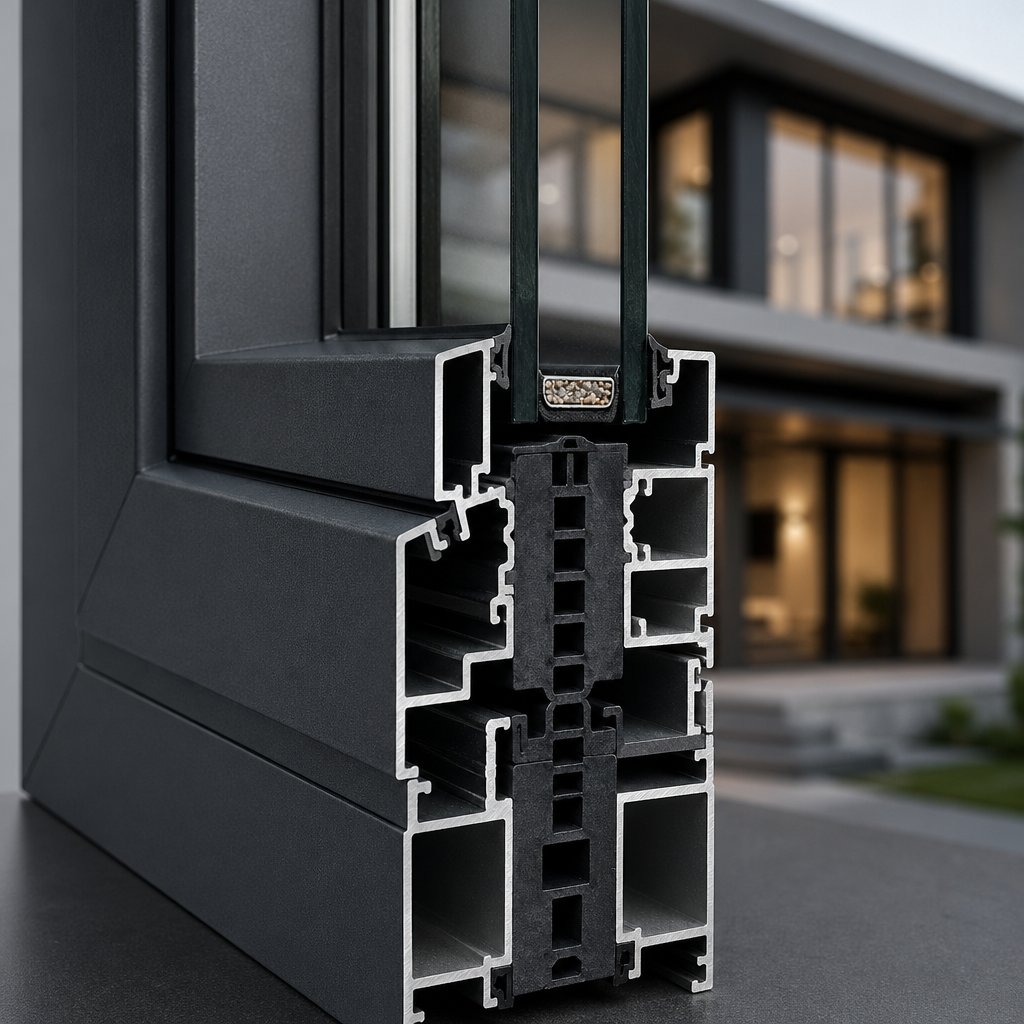
The historical knock on aluminium was thermal conductivity. Modern thermal break technology has largely resolved that concern. By inserting non-conductive polyamide barriers within the frame, manufacturers separate the interior and exterior aluminium components, interrupting the path of heat transfer while preserving structural integrity. Premium thermally broken systems now achieve U-factors competitive with uPVC and timber, especially when paired with double or triple glazing.
Lifespan is another strong point. Aluminium frames typically last 40 to 50 years with nothing more than periodic cleaning — roughly double the service life of uPVC. That longevity, combined with aluminium’s infinite recyclability, makes the higher upfront cost easier to justify over the full ownership period.
For homeowners, renovators, and builders exploring aluminium tilt-and-turn windows in Australia, MEICHEN’s aluminium windows collection offers a practical starting point — featuring energy-efficient, Australian-standard-compliant designs across multiple configurations suited to different project types.
uPVC and Vinyl Frames for Budget-Friendly Performance
Globally, uPVC remains the most common frame material for tilt and turn windows — and for good reason. It’s cost-effective, thermally efficient without requiring thermal breaks, and essentially maintenance-free. You won’t be repainting, re-staining, or treating the surface. A wipe-down with soapy water is the extent of the upkeep.
Thermal insulation is a genuine strength. The multi-chambered profile design traps air within the frame, providing solid resistance to heat transfer without additional engineering. For budget-conscious projects where thermal performance matters but slim aesthetics aren’t the priority, uPVC delivers strong value.
The trade-offs are worth acknowledging, though. uPVC frames are noticeably bulkier than aluminium — the material simply isn’t strong enough to achieve the same slim sightlines. Over time, particularly in climates with intense UV exposure, white uPVC can yellow or become chalky. Colour options are more limited compared to powder-coated aluminium, and while foil-wrapped finishes exist, they don’t match the durability or depth of a factory-applied powder coat. Expected lifespan sits around 20 to 35 years — respectable, but roughly half what aluminium delivers.
Timber, Composite, and Aluminium-Clad Options
Timber frames bring something no synthetic material can replicate: natural warmth and tactile richness. In heritage renovations, conservation zones, or homes where organic materiality is central to the design language, timber remains a valid and sometimes required choice. The thermal performance is naturally good, and the aesthetic ages beautifully — when maintained.
That maintenance is the catch. As Cherwell Windows notes, paint finishes degrade over time, especially on south-facing or weather-exposed elevations. Without regular repainting every five to ten years, timber frames risk water ingress, swelling, and seal failures that compromise both airtightness and structural integrity. Beautiful on day one — but conditional on ongoing care.
Composite frames offer an engineered middle ground: dimensionally stable, resistant to warping and rot, and available in finishes that mimic timber without the maintenance burden. They’re gaining traction in markets where durability and low upkeep outweigh the desire for natural materials.
Aluminium-clad timber sits at the premium end — real timber on the interior for warmth and design cohesion, with a powder-coated aluminium shell on the exterior for weather protection. These systems can achieve U-values as low as 0.7 to 1.1 W/m²K with triple glazing, often exceeding passive house thresholds. The upfront cost is the highest of any option, but lifecycle costs stay low thanks to the virtually maintenance-free exterior cladding.
Your material choice also affects compliance with local building standards and architectural guidelines — something worth confirming early in any project. But regardless of which frame you choose, the glass inside it and the sealing technology around it play an equally critical role in how your tilt and turn windows actually perform on energy efficiency.
Glazing Options and Energy Efficiency Explained
Every window manufacturer claims “energy efficient.” Few explain why. The thermal performance of a tilt-and-turn window isn’t magic — it’s the result of specific glazing technologies and a sealing mechanism that most other window types physically can’t replicate. Understanding what’s actually happening between those panes of glass helps you make smarter decisions about what you’re paying for.
Double vs Triple Glazing in Tilt and Turn Configurations
When you’re specifying dual opening windows, the first major glazing decision is whether to go with two panes or three. Both work well — but they serve different priorities.
Double glazing suits most temperate climates and strikes the right balance between cost and performance. You get a sealed unit with two glass panes separated by a gas-filled cavity, delivering solid thermal insulation and noise reduction for everyday residential use.
Triple glazing adds a third pane and a second gas-filled cavity. According to the Federation of Master Builders, this configuration can be up to 50 per cent more energy efficient than double glazing — achieving U-values as low as 0.6 W/m²K compared to around 1.2-2.8 W/m²K for standard double-glazed units. The trade-off? Roughly 10-20 per cent higher cost and noticeably more weight per sash.
Here’s where tilt or turn windows have a structural advantage. The multi-point locking mechanism distributes the sash weight across several support points around the frame perimeter, rather than relying on one or two hinges. That means tilt and turn hardware handles the added mass of triple glazing more comfortably than single-point hinge systems — making triple-pane configurations practical even in larger window sizes.
Climate is the deciding factor. If you’re in a moderate region, double glazing delivers excellent performance without over-engineering the solution. For passive house projects, extreme cold climates, or high-noise urban environments, triple glazing justifies the premium.
How Multi-Point Locking Creates a Tighter Thermal Seal
This is the energy efficiency advantage that’s unique to the tilt-and-turn window design — and it has nothing to do with the glass itself.
When you lock the window (handle down), the espagnolette mechanism compresses the sash evenly against continuous gasket seals at multiple points around the entire frame perimeter. Depending on window size, that’s typically six to eight or more locking points engaging simultaneously.
Compare that to a sliding window with brush or fin seals and a single-point latch, or a double-hung with seals only at the meeting rails. The difference in air infiltration is measurable. As noted in the earlier comparison, quality tilt and turn systems achieve roughly 0.5-1.0 air changes per hour at 50 pascals — about half the leakage rate of quality sliders. Less air infiltration means less conditioned air escaping, lower heating and cooling loads, and a more consistent indoor temperature without your HVAC system working overtime.
The even compression also prevents localised seal degradation. When pressure is distributed across many points rather than concentrated at one or two, gaskets wear more uniformly and maintain their effectiveness longer.
Low-E Coatings, Gas Fills, and Warm-Edge Spacers
Inside the sealed glazing unit, three technologies work together to minimise heat transfer:
- Low-E (low-emissivity) coatings: A microscopically thin metallic layer applied to the glass surface that reflects radiant heat back toward its source — keeping warmth inside during winter and deflecting solar heat during summer — without reducing visible light transmission.
- Gas fills: The cavity between panes is filled with argon or, in premium units, krypton gas. Both are denser than air and significantly slower at conducting heat. Krypton offers superior insulation in thinner cavities, though at higher cost.
- Warm-edge spacer bars: The structural component separating the glass panes at their edges. Traditional aluminium spacers create a thermal bridge — a cold spot where heat escapes and condensation forms. Warm-edge spacers use composite or foam-based materials that dramatically reduce this thermal bridging, keeping the glass edge warmer and reducing condensation risk.
When these three technologies combine within a frame that seals tightly via multi-point compression, the result is a window system where every component contributes to thermal performance — from the centre of the glass right out to the frame edge. That’s how modern tilt and turn configurations achieve the low U-values that passive house and high-performance building standards demand.
Strong thermal performance keeps energy costs down and comfort levels up. But there’s another dimension to that tight multi-point seal that matters just as much to many homeowners — and it has everything to do with what happens when someone tries to force the window open from outside.

Security Features and Multi-Point Locking Explained
Most window security discussions stop at “it has good locks.” That’s not helpful when you’re trying to understand why windows tilt and turn designs are genuinely harder to break into than a standard slider or single-latch casement. The answer lies in the hardware — specifically, how force is distributed across the frame and what physically prevents the sash from being pried away.
Multi-Point Locking Mechanisms Explained
When you lock a tilt n turn window by rotating the handle to the down position, the espagnolette bar engages locking points distributed around the entire frame perimeter — typically five to eight or more, depending on the window size. Each point pulls the sash firmly against the frame gaskets simultaneously.
Why does that matter for security? Imagine trying to force open a door held by a single deadbolt versus one secured at six separate points along its edge. A single lock concentrates all resistance at one spot — apply enough leverage there and the frame gives. Multi-point locking distributes that force across the full perimeter, meaning an intruder would need to overcome every engagement point at once. The practical result is a window that resists crowbar attacks and prying far more effectively than single-point or dual-point alternatives.
Mushroom Cam Locks and Security Ratings
Not all locking points are created equal. Standard roller cams simply press the sash against the frame — useful for compression, but they can be forced apart with enough leverage. Mushroom cam locks take it further. These are T-shaped or mushroom-shaped metal cams that hook behind steel strike plates recessed into the frame, creating a mechanical interlock that physically prevents the sash from being pulled away from the frame.
Think of it as the difference between pressing two surfaces together versus hooking them together. Even if an intruder manages to flex the frame slightly, the mushroom cams remain engaged behind their strike plates — the geometry simply won’t allow separation without destroying the hardware itself.
This level of hardware is what enables tilt and turn windows to meet stringent security certifications. In Europe, the RC2 resistance class (EN 1627) certifies that a window resists a casual burglar using screwdrivers, pliers, and wedges for at least three minutes. In the UK, PAS 24 sets enhanced security performance requirements for windows in dwellings. Quality tilt and turn systems with mushroom cams routinely achieve both standards — and many also qualify for Secured by Design accreditation.
Why Tilt Position Is Inherently Secure
Here’s a scenario many homeowners face: you want fresh air circulating while you’re out, but leaving a window “open” feels like an invitation. With tilt mode, the sash remains locked at the bottom and both sides — only the top edge tilts inward at a narrow angle. That gap is physically too small for a person to reach through meaningfully or climb through.
This makes tilt mode suitable for ground-floor ventilation even when the home is unoccupied — something you simply can’t achieve safely with a sliding window left cracked or a casement propped open. The security layers working together in a locked or tilted position include:
- Multi-point espagnolette locking engaging 5-8+ points around the frame perimeter
- Mushroom cam locks creating mechanical interlocks that resist prying and separation
- Restricted tilt opening too narrow for intrusion while allowing continuous airflow
- Optional keyed handles that prevent the window being operated without a key — useful for ground-floor rooms or homes with young children
And if your concern is the opposite problem — a house window won’t stay up or hold its position — that’s typically a hardware adjustment issue rather than a security flaw. Tilt and turn mechanisms use friction stays and support arms that can be tightened or realigned to maintain correct sash positioning over time.
Security performance is universal across these windows, but how you use that security varies room by room. A ground-floor bathroom has different ventilation and privacy needs than a third-storey bedroom — and the way you deploy tilt and turn mode shifts accordingly.
Room-by-Room Suitability Guide for Your Home
Every room in your home has different demands — moisture levels, privacy needs, accessibility for cleaning, and how often you want fresh air flowing through. The window tilt and turn mechanism adapts to all of them, but some rooms benefit more dramatically than others.
Here’s a practical ranking, starting with the spaces where tilt-and-turn-windows deliver the most noticeable everyday value:
- Bathrooms and kitchens (moisture control and privacy)
- Bedrooms and living areas (comfort and child safety)
- Upper floors and hard-to-reach locations (cleaning access and safety)
Bathrooms and Kitchens — Moisture Control and Privacy
Steam from a hot shower. Cooking vapour rising off the stove. These rooms generate more moisture than anywhere else in the house, and that humidity needs somewhere to go — otherwise you’re looking at condensation, mould growth, and peeling paint.
Tilt mode is purpose-built for this scenario. It provides continuous ventilation to manage humidity without exposing the room to full view from outside. The narrow top gap lets moist air escape upward while the lower portion of the sash stays locked — maintaining privacy at eye level. As Ecotec Windows notes, tilt and turn windows are often used in bathrooms and kitchens specifically because they ventilate without letting in rain or snow, keeping indoor spaces dry and comfortable.
In kitchens, there’s a bonus: the sash tilts inward at the top rather than swinging outward into your path. It stays clear of countertops, splashbacks, and anyone working at the bench. And when grease and cooking residue inevitably coat the glass? Turn mode lets you swing the sash fully inward and wipe down both surfaces without dismounting anything or reaching awkwardly.
Bedrooms and Living Areas — Comfort and Child Safety
Imagine leaving a bedroom window cracked overnight for fresh air — without worrying about security or a child climbing through. That’s exactly what tilt mode delivers. The restricted top opening allows gentle airflow across the room while the bottom and sides remain fully locked.
For families with young children, this matters enormously. Oknoplast highlights that the tilt function provides controlled ventilation without the risk of accidental falls — the gap is simply too narrow for a child to pass through. Add an optional keyed handle and the window can’t be operated unsupervised at all.
In living areas, the full turn mode comes into play on warm days when you want maximum airflow quickly. The rest of the time, tilt handles everyday background ventilation without disturbing curtains or furniture placement. Vinyl tilt and turn windows are a popular choice here for budget-conscious projects where thermal performance and low maintenance matter more than ultra-slim sightlines.
Upper Floors and Hard-to-Reach Locations
This is where the turn function arguably delivers its greatest practical value. On upper storeys, cleaning exterior glass with traditional windows means ladders, professional crews, or simply living with dirty glass. Turn mode eliminates all of that — the sash swings fully inward, giving you complete access to the outer surface while standing safely on your own floor.
For high-rise apartments, this advantage is even more pronounced. As Liki Systems documents, tilt and turn hardware in luxury high-rise applications can support sash weights up to 130kg, with heavy-duty concealed hinges transferring the load safely into the bottom frame. One Chicago homeowner described the shift as “completely curing her high-rise anxiety” — routine glass cleaning became a five-minute indoor task rather than a scheduled, weather-dependent professional service.
The same logic applies to any window positioned above an extension, conservatory, garage roof, or sloped ground where setting up a ladder safely isn’t practical. If exterior access is awkward or dangerous, turn mode solves the problem permanently.
Knowing where these windows fit best in your home is the first step. The next consideration — how they get installed, what maintenance they need over time, and how to choose the right supplier — determines whether that potential translates into lasting performance.
Installation, Maintenance, and Choosing the Right Supplier
Picking the right window style, frame material, and glazing package gets you most of the way there. But the final stretch — how those tilt and swing windows are installed, how you care for them over the years, and who you buy from — determines whether the performance you paid for actually holds up decade after decade.
Retrofit vs New-Construction Installation
If you’re building new, installation is straightforward. The rough opening is framed to the exact dimensions of the window unit, weatherproofing membranes and flashing tape are integrated before the cladding goes on, and the turning window sits directly against the structural framing. Everything is purpose-built from the start.
Retrofit is more nuanced. You’re fitting a new window into an existing opening — which means adapting the reveal, potentially replacing flashing, and confirming that the surrounding structure is sound. As The Window Source of Middle Georgia emphasises, installing new windows over damaged or rotted frames is a recipe for failure regardless of how good the window itself is. The original frame must be structurally solid, plumb, and free of water damage before a retrofit makes sense.
A few critical considerations apply specifically to tiltable windows:
- Tilt and turn sashes are heavier than comparable sliding or awning units due to the multi-point hardware and thicker glazing they support. The rough opening and surrounding framing need adequate structural capacity — especially with triple-glazed configurations.
- The dual-action mechanism is precision-engineered. If the frame isn’t perfectly level and plumb, the handle won’t rotate smoothly between positions, locking points won’t engage correctly, and seals won’t compress evenly. Accurate installation isn’t optional — it’s what makes the hardware function.
- Proper flashing integration is essential. In retrofit scenarios, new flashing tape should seal the junction between the window frame and the existing wall assembly to prevent water infiltration behind the unit.
Long-Term Maintenance and Hardware Care
One of the best things about swivel windows with tilt and turn hardware is how little routine maintenance they need. But “low maintenance” doesn’t mean “no maintenance.” A simple annual schedule keeps everything operating smoothly for decades:
- Lubricate all hinges, locking points, and the espagnolette mechanism with a silicone-based lubricant once a year. This keeps the handle action smooth and prevents corrosion on metal components.
- Inspect rubber gaskets and compression seals every two to three years. Look for cracking, flattening, or loss of elasticity — degraded seals reduce both thermal performance and weather resistance.
- Check handle and hinge alignment for signs of sagging or stiffness. Warren Windows’ maintenance guide notes that sash dropping is one of the most common issues, especially with large triple-glazed units — but it’s typically correctable via hex-key adjustments on the upper and lower hinge plates to raise the sash back into alignment.
- Clean the drainage slots in the bottom of the frame at least annually. These small channels allow condensation and rainwater to escape. If they’re blocked by dirt or debris, water pools inside the frame and can eventually damage seals or cause mould.
If your house window won’t stay up or the handle feels stiff, resist the urge to force it. These are almost always alignment issues — lateral or vertical adjustments on the hinge hardware will restore smooth operation without replacing any parts.
Choosing the Right Supplier for Your Project
The window itself is only as reliable as the company behind it. When evaluating suppliers, focus on a few non-negotiable factors:
- Standards compliance: In Australia, windows must meet AS 2047, covering structural performance, water penetration resistance, and air infiltration limits. Verify that the supplier provides a certificate of compliance and that products carry the required performance label.
- Warranty coverage: Look for separate warranties on frames and hardware — they wear at different rates. Quality suppliers stand behind both components independently.
- Custom sizing: Not every opening is standard. Confirm the supplier offers made-to-measure options rather than forcing you into fixed sizes that require adaptation.
- Installation support: Whether the supplier installs directly or partners with certified installers, there should be a clear chain of accountability for installation quality.
For those exploring aluminium options specifically, MEICHEN’s aluminium windows collection is worth a look — their range is designed for Australian conditions and compliance requirements, with energy-efficient configurations suited to homeowners, renovators, builders, and developers across different project scales.
The right supplier doesn’t just sell you a product. They help you match the window specification to your climate, your building type, and your long-term expectations — so the performance you read about in guides like this one is the performance you actually live with.
Frequently Asked Questions About Tilt and Turn Windows
1. How do tilt and turn windows open and close?
A single handle controls three positions. Pointing down locks the window with multi-point engagement around the full frame. Rotated horizontally, the sash swings fully inward on side hinges like a door for cleaning or maximum airflow. Rotated upward, only the top edge tilts inward at roughly 10 to 15 degrees while the bottom and sides stay locked, allowing rain-safe ventilation without compromising security. The internal espagnolette mechanism coordinates all locking points simultaneously, so no additional latches or hardware are needed.
2. Are tilt and turn windows more secure than sliding or casement windows?
Yes, in most configurations. Tilt and turn windows use multi-point locking with five to eight or more engagement points distributed around the frame perimeter, compared to the single-point or dual-point latches found on most sliding windows. Upgraded models feature mushroom cam locks that mechanically interlock with steel strike plates, resisting prying and crowbar attacks. In tilt mode, the sash remains locked on three sides with only a narrow top gap, making it suitable for ground-floor ventilation even when the home is unoccupied. Many systems meet RC2 or PAS 24 security certifications.
3. Do tilt and turn windows work with curtains and blinds?
They do, with minor planning. In tilt mode, the sash barely protrudes into the room, so most curtains, roller blinds, and roman shades remain unaffected during everyday ventilation. For full turn mode, practical solutions include ceiling-mounted curtain tracks set slightly forward of the reveal, frame-fit blinds that attach directly to the sash and move with it, integrated blinds sealed between the glass panes, or roller blinds that sit flush within the reveal. European homeowners have paired these windows with standard treatments for decades without issue.
4. What is the best frame material for tilt and turn windows?
It depends on your priorities. Aluminium offers the slimmest sightlines, longest lifespan of 40 to 50 years, and minimal maintenance, making it ideal for modern designs and harsh climates like coastal Australia. uPVC is the most budget-friendly option with strong thermal insulation but bulkier profiles and a shorter 20 to 35 year lifespan. Timber delivers natural warmth and heritage appeal but requires repainting every 5 to 10 years. Aluminium-clad timber combines interior warmth with a weather-resistant exterior shell for premium performance. For Australian projects, suppliers like MEICHEN offer aluminium window systems compliant with AS 2047 standards across multiple configurations.
5. How often do tilt and turn windows need maintenance?
Routine care is minimal but important for long-term performance. Lubricate hinges, locking points, and the espagnolette mechanism annually with silicone-based lubricant. Inspect rubber gaskets and compression seals every two to three years for cracking or flattening. Check handle and hinge alignment for sagging, which is correctable via hex-key adjustments on the hinge plates. Clean the drainage slots in the bottom frame at least once a year to prevent water pooling. With this simple schedule, quality tilt and turn hardware operates smoothly for decades without part replacement.
More Window & Door Guides