Aluminium vs uPVC Doors and What Actually Matters
Are aluminium doors better than uPVC? The honest answer is: it depends entirely on what you’re installing, where it’s going, and what you need it to do. Neither material wins across the board. Aluminium excels in certain door types and situations, while uPVC makes more sense in others.
This guide focuses exclusively on doors — not windows. Most comparisons online blur the two together, but doors face different structural demands, security requirements, and aesthetic expectations than windows do. They deserve their own analysis.
What Are Aluminium and uPVC Doors
uPVC stands for unplasticised polyvinyl chloride. It’s a rigid plastic compound engineered to resist weathering, corrosion, and rot without the plasticisers that make standard PVC flexible. As a door frame material, it’s lightweight, thermally efficient, and cost-effective.
Aluminium is a naturally occurring lightweight metal with a high strength-to-density ratio. In door applications, it delivers slim frame profiles and exceptional structural rigidity, allowing it to support large glass panels without compromising ease of operation.
Each material is engineered differently for door use, and those engineering differences drive real performance gaps depending on the door type and configuration.
Why This Comparison Matters for Homeowners
Whether you’re replacing ageing doors on an existing home, specifying for a new build, or renovating to improve energy performance, the difference between aluminium and uPVC doors has long-term consequences. Your choice affects security ratings, annual energy costs, maintenance commitments, and even property resale value decades down the track.
Choosing between aluminium or uPVC doors for your home is not about which material is “better” overall — it’s about which is better for your specific project requirements, door type, and budget.
The sections ahead break this decision down by durability, thermal performance, security, aesthetics, cost, and — most importantly — which material suits which door type best.
Durability and Lifespan Compared
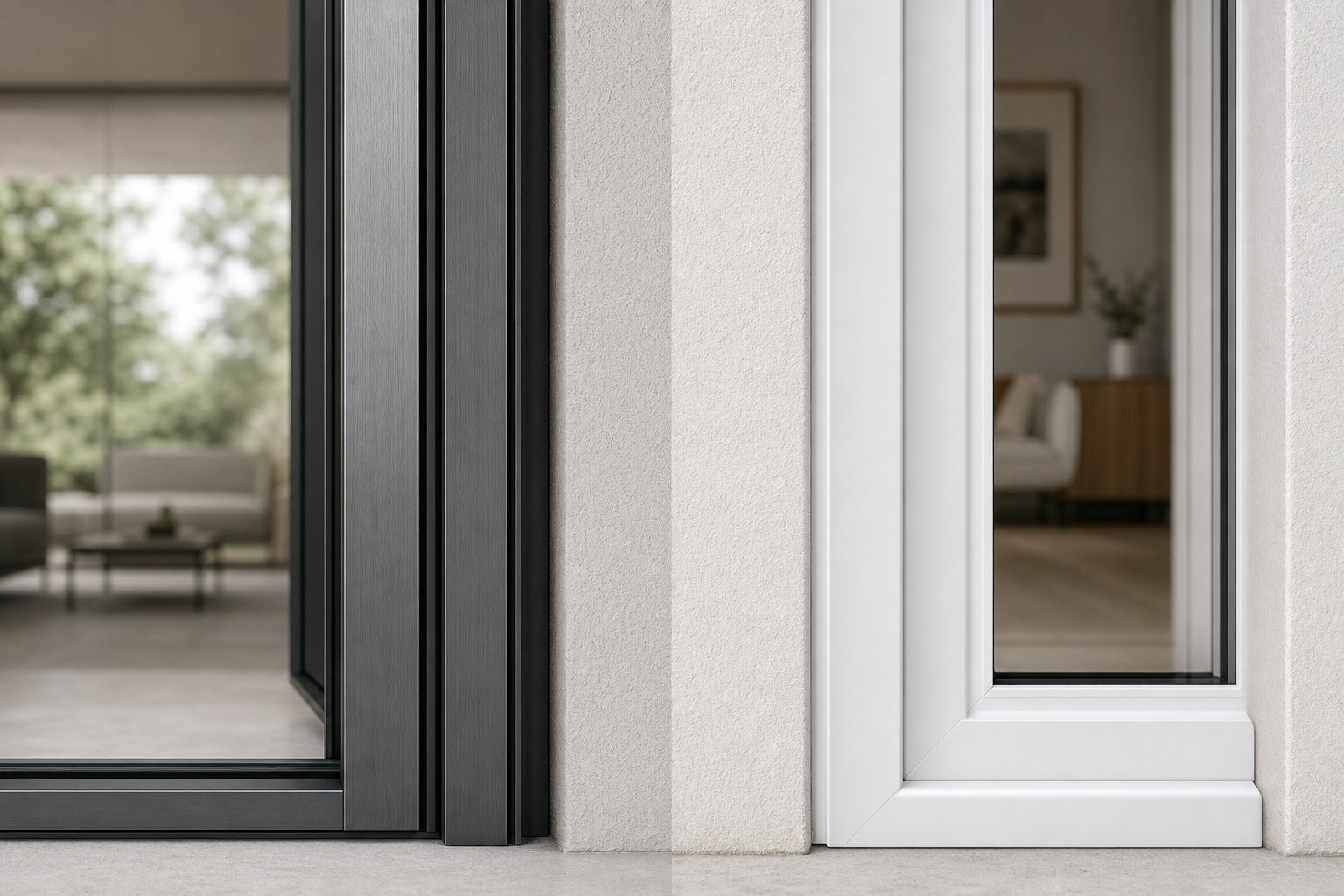
A door gets opened, closed, slammed, and weathered thousands of times a year. It faces UV radiation, driving rain, temperature swings, and the occasional shoulder barge when your hands are full. The material holding it all together needs to handle that punishment for decades — not just look good on installation day.
So how long do aluminium doors last compared to uPVC? And what actually causes one to outlive the other? The answers come down to material science: how each substance responds to stress, sunlight, and time.
Structural Strength and Frame Profiles
Aluminium is inherently rigid. Its natural strength-to-weight ratio means manufacturers can engineer slimmer frame profiles — often as narrow as 45 to 55 mm — while maintaining full structural integrity. That rigidity holds up without internal reinforcement, even across wide door spans of 3 metres or more. The practical result? More glass area, thinner sightlines, and a frame that won’t flex or sag under the weight of heavy double-glazed panels.
uPVC tells a different structural story. The plastic compound itself lacks the rigidity to span large openings unsupported. To compensate, manufacturers insert steel or aluminium reinforcement bars inside the hollow uPVC chambers. This works well for standard-sized doors, but it forces frame profiles to be bulkier — typically 70 mm or wider — to accommodate that internal skeleton. For a standard back door or French door, the difference is barely noticeable. For a 2.4-metre-wide sliding panel or a full-height bifold system, those extra millimetres of frame add up, reducing your glass area and interrupting sightlines.
The structural gap becomes most apparent in larger configurations. Aluminium door frame durability over time remains consistent regardless of span, while uPVC frames under sustained load can gradually deflect, particularly in warmer climates where the plastic softens slightly under heat.
Lifespan and Long-Term Degradation
Industry figures consistently place aluminium door lifespan at 40 to 45+ years with minimal intervention. Some well-maintained aluminium installations have remained fully operational for over 50 years. The metal doesn’t rot, doesn’t absorb moisture, and maintains its dimensional stability across extreme temperature ranges.
The uPVC door lifespan vs aluminium gap exists because plastic degrades differently to metal. Quality uPVC doors — those using premium profiles with proper UV stabilisation — typically deliver 25 to 35 years of reliable service. Lower-grade products may show issues sooner, particularly in Australia’s harsh UV environment.
What drives uPVC degradation over time:
- UV exposure — prolonged sunlight breaks down the polymer chains, causing yellowing, surface chalking, and eventual brittleness. Australia’s UV intensity is among the highest globally, accelerating this process compared to European conditions where uPVC was originally developed.
- Thermal cycling — repeated heating and cooling causes uPVC to expand and contract more than aluminium. Over many years, this cycling can stress joints and seals, leading to warping or operational stiffness.
- Colour instability — darker uPVC finishes absorb more solar heat, increasing the risk of uPVC doors warping and discolouration. White and lighter shades hold up significantly better in direct sun.
Aluminium resists all three mechanisms. Powder-coated finishes protect against UV without degrading the underlying metal. Aluminium’s thermal expansion rate is lower and more predictable than uPVC, and the material doesn’t become brittle regardless of age or sun exposure. Corrosion is the only real threat, and modern powder coating effectively eliminates that risk — even in coastal environments with salt-laden air.
Maintenance Requirements Over Time
Both materials are genuinely low-maintenance compared to timber, but “low” doesn’t mean “zero.” Do aluminium doors need maintenance? Yes — just less of it, less often, and with more predictable outcomes. The table below maps out what each material realistically requires at key intervals.
| Timeframe | Aluminium Doors | uPVC Doors |
|---|---|---|
| Annually | Wipe frames with mild soapy water. Lubricate hinges, locks, and rollers with silicone spray. Clear drainage channels of debris. | Wipe frames with mild soapy water. Lubricate hinges, locks, and rollers with silicone spray. Clear drainage channels of debris. |
| 5 Years | Inspect powder coating for chips or scratches (touch up if needed). Check weather seals for compression and replace any that have hardened. Tighten hardware fixings. | Inspect seals and gaskets for cracking or shrinkage. Check frame corners for separation. Assess hardware operation and replace worn rollers or handles if stiff. |
| 10 Years | Replace weather seals if showing wear. Service multi-point locking mechanisms. Frames and finish typically still in original condition. | Replace perimeter seals and gaskets. Service or replace locking mechanisms and hinges showing wear. Check for early signs of discolouration on sun-facing surfaces. Sealed glazing units may need inspection. |
| 20 Years | Second seal replacement. Hardware service or upgrade. Powder coating still intact on quality systems — no refinishing required. Frame remains dimensionally stable. | Third seal replacement likely. Hardware replacement probable. Possible frame discolouration or surface degradation on sun-exposed doors. Consider whether sealed glazing units need replacing. Some installations may be approaching end of practical life. |
The pattern is clear: both materials share similar annual upkeep, but they diverge at the decade mark. Aluminium’s maintenance stays flat and predictable — seals and hardware are the only consumables. uPVC introduces cumulative material degradation as a variable, particularly in Australia’s climate where UV intensity and summer heat stress the polymer more aggressively than in milder European conditions.
That divergence in long-term durability naturally raises a follow-up question. If aluminium is the stronger, longer-lasting material, does it still carry the old reputation for poor thermal performance — or has modern engineering closed that gap?
Thermal Performance and Energy Efficiency
For decades, the knock on aluminium was simple: metal conducts heat, plastic doesn’t. That criticism was valid — older aluminium door frames acted like thermal highways, bleeding warmth out of your home in winter and letting heat pour in during summer. But that was before thermal break technology rewrote the rules entirely.
Are aluminium doors energy efficient by modern standards? The short answer is yes — and the technology behind that shift is worth understanding, because it directly affects your energy bills and comfort levels year-round.
How Thermal Breaks Work in Aluminium Doors
Picture an aluminium door frame as two separate profiles — one facing inside your home, one facing outside. On their own, those two aluminium sections would transfer heat between them almost instantly. A thermal break solves this by inserting a continuous strip of polyamide (a glass-fibre-reinforced nylon) between the inner and outer profiles, physically separating them with a material that conducts heat 500 to 1,000 times less efficiently than aluminium itself.
That polyamide barrier breaks the thermal bridge. Heat can no longer travel directly through the frame from warm side to cold side. The result is a door frame that behaves thermally more like an insulator than a metal — while retaining all of aluminium’s structural advantages.
The effectiveness of a thermal break depends on its depth. Basic systems use strips around 15 to 20 mm wide, suitable for standard residential applications. Premium multi-chamber systems push that to 30 mm or beyond, creating substantial insulation zones within the frame itself. Manufacturers like MEICHEN offer both thermal break and non-thermal break aluminium door systems, giving specifiers the flexibility to match insulation levels to project requirements — whether that’s a climate-controlled residential living space or a commercial entrance where thermal performance priorities differ.
The engineering is clever, but the concept is straightforward: stop heat moving through the frame, and the frame stops being a weak point in your building envelope.
U-Values and Real Energy Performance
U-values measure how much heat passes through a building element, expressed in watts per square metre per degree Kelvin (W/m²K). Lower numbers mean better insulation. It’s the single most useful metric for comparing the thermal performance of different door systems on a like-for-like basis.
Here’s where the old assumptions fall apart. Non-thermally broken aluminium frames sit around 5.8 to 7.0 W/m²K — genuinely poor. But modern thermally broken aluminium door systems achieve frame U-values between 1.4 and 1.6 W/m²K in standard configurations, with premium systems dropping below 1.0 W/m²K. Compare that to uPVC doors, which typically achieve U-values around 1.3 W/m²K on average.
The practical gap between materials? Minimal. Research suggests the difference between a U-value of 1.3 and 1.6 translates to roughly $7 to $20 AUD extra per year on heating and cooling bills — a figure that’s effectively negligible over the door’s lifetime. Both materials comfortably meet current National Construction Code (NCC) energy requirements and can achieve strong ratings under the WERS (Window Energy Rating Scheme) and NatHERS frameworks used across Australia.
What matters more than frame material in most installations is the glazing specification. A thermally broken aluminium door with high-performance low-E double glazing will outperform a uPVC door with basic glass every time. The frame contributes to overall thermal performance, but the glass — which makes up the majority of the door’s surface area — does the heavy lifting.
Condensation and Weather Resistance
Condensation forms when warm, moist indoor air meets a cold surface. On old aluminium frames without thermal breaks, this was a persistent problem — the metal frame stayed cold enough to hit dew point, and moisture would bead along the inside of the profile. Over time, that moisture encouraged mould growth and damaged surrounding finishes.
Thermal breaks eliminate this issue by keeping the interior aluminium profile close to room temperature. The polyamide barrier prevents the cold from the exterior profile reaching the inside face, so the surface temperature stays above the dew point in normal conditions. Good ventilation still matters — no frame material can compensate for a sealed-up home with high humidity — but thermally broken aluminium doors perform comparably to uPVC in condensation resistance.
Weather sealing is another area where both materials now perform on equal footing. Modern door systems from either material use multi-layer gaskets, brush seals, and compression weatherstrips to prevent water ingress and air infiltration. Aluminium’s dimensional stability gives it a slight edge here: because the frame doesn’t expand and contract as much as uPVC with temperature changes, the seals maintain consistent compression over time. That translates to more reliable weather performance as the door ages, particularly in large sliding or bifold configurations where precise alignment is critical.
MEICHEN’s range of thermally broken aluminium doors — spanning sliding, hinged, and bi-fold systems — demonstrates how this technology translates into real residential and commercial installations across Australian climate zones. Their thermal break systems are engineered to handle Australia’s combination of intense summer heat and cooler winter nights, closing the historical insulation gap that once made aluminium a compromise choice.
Thermally broken aluminium now meets or exceeds the same energy ratings as uPVC in most door configurations. The old assumption that aluminium means poor insulation no longer holds — it’s a legacy criticism that modern engineering has resolved.
Thermal performance is settled, then — both materials can keep your home comfortable and your energy bills in check. But a door isn’t just an insulation panel. It’s also a security barrier, and that’s where the next layer of comparison gets interesting.
Security Standards and Break-In Resistance
A door that keeps the weather out but lets intruders in isn’t much of a door. Security is often the first concern homeowners raise when comparing materials — and the question of whether aluminium doors are more secure than uPVC deserves a more nuanced answer than most comparisons provide.
Here’s the reality: frame material contributes to security, but it doesn’t determine it. A door is a system — frame, locking hardware, hinges, glazing, and installation quality all working together. Get one element wrong and the strongest frame in the world won’t save you.
Locking Mechanisms and Hardware Standards
The locking system is the single most critical security component in any door, regardless of whether the frame is aluminium or uPVC. Both materials accommodate the same high-security hardware, including:
- Multi-point locking systems — these engage bolts, hooks, or rollers at multiple positions along the door edge (typically three to five points), distributing force across the full height of the frame rather than relying on a single latch point.
- Anti-snap, anti-pick, anti-drill cylinders — modern euro cylinders are engineered with sacrificial break points that prevent intruders from snapping the cylinder to access the locking mechanism. Both aluminium and uPVC doors use identical cylinder formats.
- Reinforced keeps and strike plates — the metal plates that receive the locking bolts are secured into the frame with long screws. In aluminium frames, these fix directly into the metal profile. In uPVC, they anchor into the internal steel reinforcement.
A poorly specified aluminium door can be less secure than a properly specified uPVC door fitted with quality hardware. The material sets the foundation, but the hardware does the actual work of resisting attack.
PAS 24 and Secured by Design Certifications
When evaluating the upvc vs aluminium door security rating, certifications matter more than marketing claims. PAS 24 is the most widely recognised enhanced security standard for doors, and it’s increasingly referenced by Australian manufacturers and specifiers as a benchmark for residential entry door performance.
What does PAS 24 actually involve? It’s not a test of individual components in isolation. The entire door assembly — frame, locking mechanism, hinges, and glazing — is tested as a complete system against simulated break-in attempts. Testers use crowbars, screwdrivers, heavy impacts, and lock manipulation techniques to attempt forced entry. If any single component fails, the whole product fails certification.
Both aluminium and uPVC doors can achieve PAS 24 certification. The standard doesn’t favour one material over the other — it evaluates the finished product’s resistance to real-world attack methods. Secured by Design, a related police-backed initiative, builds on PAS 24 by adding requirements around the broader security context of the installation.
The key takeaway? Don’t assume a door is secure based on frame material alone. Ask for certification documentation. If a manufacturer can’t provide evidence of independent security testing, the most secure door material for your home is whichever one comes with verified credentials.
Front Door vs Rear Door Security Considerations
Security priorities shift depending on where a door sits on your property. Front doors face the street — they’re visible, exposed to passing foot traffic, and targeted by opportunistic intruders who rely on speed. A front door needs to resist quick, forceful attacks: shoulder barges, lock snapping, and levering at the frame edge. Aluminium’s inherent rigidity gives it a structural advantage here. The metal frame flexes less under sudden impact, maintaining lock engagement even when force is applied.
Rear doors face a different threat profile. They’re often concealed from neighbours and the street, giving intruders more time and privacy to work. Sustained, methodical attacks — prying at frame corners, working on hinges, or targeting glazing — become more likely. In this scenario, the glazing specification and hinge security matter as much as the frame material. Laminated glass, internally beaded glazing (where the glass is secured from inside, preventing removal from outside), and concealed hinges with anti-lift pins all contribute to rear door security regardless of whether the frame is aluminium or uPVC.
Aluminium does hold one long-term security advantage that’s easy to overlook. Because it expands and contracts less than uPVC with temperature changes, aluminium frames maintain alignment more consistently over time, keeping locking points properly engaged year after year. uPVC frames can shift slightly with seasonal thermal cycling, potentially creating small gaps that reduce lock effectiveness — particularly in larger door configurations where cumulative movement is greater.
Regardless of which material you choose, verify these security features before purchasing:
- Multi-point locking with a minimum of three engagement points
- Anti-snap, anti-pick euro cylinder (or equivalent high-security lock format)
- PAS 24 certification for the complete door system as tested
- Laminated glass on at least the outer pane for impact resistance
- Internally beaded glazing so glass cannot be removed from outside
- Reinforced hinges with anti-lift devices
- Proper installation by qualified fitters — even a certified door loses its rating if installed incorrectly
Security, then, is less about aluminium versus uPVC and more about specification, certification, and installation quality. Both materials can protect your home effectively when engineered and fitted to the right standard. The more interesting question is which material suits which door type — and that’s where the two materials start to diverge more decisively.

Best Material for Each Door Type
Durability, thermal performance, and security all matter — but they play out differently depending on the door configuration you’re installing. A front entry door faces different demands than a 4-metre bifold opening onto a deck. The material that excels in one application might be overkill or underperforming in another.
This is where the aluminium-versus-uPVC debate stops being abstract and starts getting practical. Each door type has structural requirements, aesthetic expectations, and budget realities that favour one material over the other.
Front Doors and First Impressions
Your front door is the first thing visitors see and the last thing they notice when leaving. It sets the tone for the entire property. When deciding on an aluminium or uPVC front door, consider what each material brings to that high-visibility position.
Aluminium dominates the premium front door market for good reason. Its slim profiles create clean, contemporary lines that photograph well and age gracefully. Powder coating opens up virtually unlimited colour options — any RAL shade, including dual-colour configurations with a different finish inside and out. That flexibility lets you match heritage colour schemes, bold statement tones, or understated neutrals with equal precision.
The structural rigidity also matters at the front of a home. Front doors tend to be solid-panel or feature smaller glazed sections rather than full glass, meaning the frame needs to support heavier door leaves without sagging over years of daily use. Aluminium handles that weight without the internal reinforcement uPVC requires.
That said, uPVC front doors serve a legitimate purpose. For rental properties, investment builds on tighter margins, or homes where the front door is sheltered and less visually prominent, a quality uPVC composite door delivers solid security and thermal performance at a lower price point. Modern uPVC front doors have improved dramatically — they’re no longer the flimsy, yellowing panels of the 1990s. But they still can’t match aluminium’s slimline aesthetics or colour versatility in this position.
Bifold and Sliding Doors for Open-Plan Living
Open-plan living relies on large glazed openings that blur the boundary between indoors and out. This is where the question of aluminium vs uPVC bifold doors has the clearest answer — and where aluminium’s material properties translate most directly into a better end result.
The physics are straightforward. Bifold and sliding doors need frames that are strong enough to support heavy double-glazed panels across wide spans, light enough to operate smoothly on tracks, and slim enough to maximise the glass area that makes these doors worth installing in the first place. Aluminium’s high strength-to-weight ratio delivers on all three counts simultaneously.
Consider the numbers. Aluminium bifold frames can measure as little as 45 mm in profile width while spanning openings of 5 to 6 metres across multiple panels. uPVC bifolds exist, but they require frame profiles of 70 mm or more to achieve adequate structural stability — and even then, maximum spans are typically more limited. That extra 25 mm per frame section might sound minor, but multiply it across four or five panels and you’ve lost a significant percentage of your glass area to plastic framing.
The best material for sliding doors follows the same logic. Large sliding panels — particularly those exceeding 3 metres in width — place sustained load on tracks and rollers. Aluminium’s dimensional stability means the frame won’t flex or distort over time, keeping the door gliding smoothly for decades. uPVC sliding doors work well at standard patio sizes (around 1.8 to 2.4 metres wide), but they struggle to match aluminium’s performance and longevity in larger configurations.
For Australian homes designed around the best door material for open plan living — think alfresco entertaining areas, pool surrounds, and indoor-outdoor kitchen flows — aluminium is the natural choice. Suppliers like MEICHEN offer sliding, bi-fold, and ultra-slim aluminium door systems specifically engineered for these applications, with configurations that maximise aperture while meeting Australian standards for wind load, water resistance, and thermal performance.
French Doors and Patio Doors
Not every opening needs floor-to-ceiling glass or a 5-metre span. Standard French doors and traditional patio doors operate at smaller scales where uPVC’s limitations matter less — and its cost advantage matters more.
When comparing upvc vs aluminium French doors, the performance gap narrows considerably. French doors typically feature two leaves of modest width (600 to 900 mm each), meaning frame slimness is less critical to the overall visual impact. uPVC handles these dimensions comfortably without excessive bulk, and the thermal performance is strong without needing premium thermal break systems.
Standard hinged patio doors tell a similar story. At conventional sizes, uPVC delivers reliable weather sealing, decent security with multi-point locks, and a perfectly acceptable appearance — all at a price point that makes aluminium harder to justify unless aesthetics or colour matching are priorities.
Aluminium still wins on longevity and finish quality in these configurations, but the margin of advantage shrinks. If budget is a primary constraint and the door opening is a standard residential size, uPVC French and patio doors represent genuine value without meaningful compromise.
| Door Type | Material | Aesthetics | Security | Thermal Performance | Value for Money |
|---|---|---|---|---|---|
| Front Door | Aluminium | Excellent | Excellent | Very Good | Good |
| Front Door | uPVC | Good | Very Good | Very Good | Excellent |
| Bifold Door | Aluminium | Excellent | Excellent | Very Good | Very Good |
| Bifold Door | uPVC | Fair | Good | Good | Good |
| Sliding Door | Aluminium | Excellent | Excellent | Very Good | Very Good |
| Sliding Door | uPVC | Good | Good | Very Good | Excellent |
| French Door | Aluminium | Very Good | Excellent | Very Good | Good |
| French Door | uPVC | Good | Very Good | Very Good | Excellent |
| Patio Door | Aluminium | Excellent | Excellent | Very Good | Good |
| Patio Door | uPVC | Good | Good | Very Good | Excellent |
| Back/Utility Door | Aluminium | Very Good | Excellent | Very Good | Fair |
| Back/Utility Door | uPVC | Good | Very Good | Very Good | Excellent |
The pattern in this table reveals something useful: aluminium consistently leads on aesthetics and security across every door type, while uPVC consistently leads on value. The gap between them widens as door size increases and narrows as doors get smaller and more standard. That’s the core insight — aluminium’s advantages compound with scale and visibility, while uPVC’s strengths hold steady at conventional dimensions.
Of course, how a door looks on day one is only part of the story. How it looks in five, ten, or twenty years depends on how each material ages — and that’s where colour, finish technology, and visual longevity come into sharper focus.
Aesthetics and How Each Material Ages
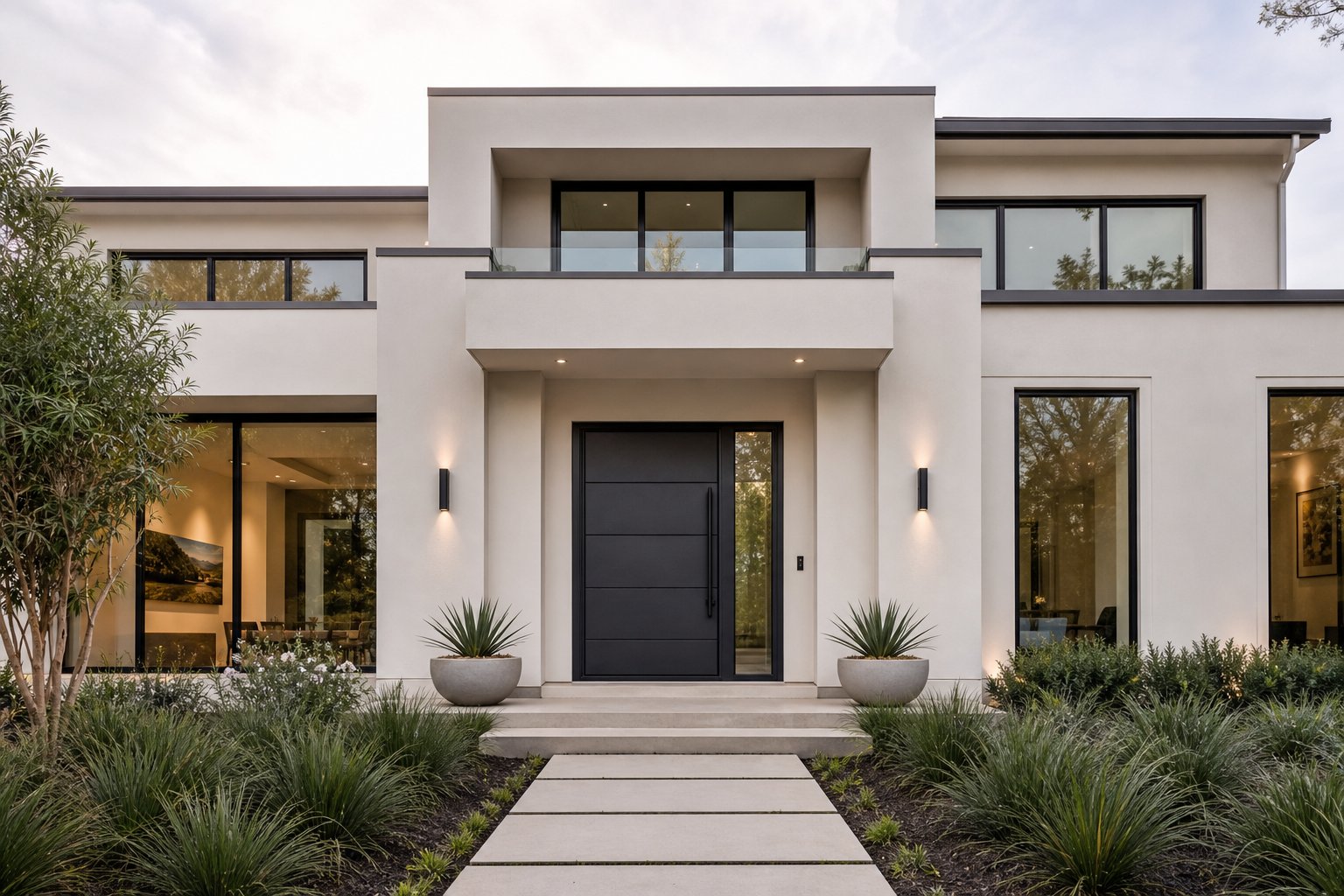
A door’s appearance isn’t static. It changes over years of sun exposure, rain, temperature swings, and daily contact. The aluminium vs uPVC doors appearance gap on installation day is one thing — the gap after fifteen Australian summers is something else entirely. Understanding how each material’s finish is applied, and how it degrades, helps you predict what your door will look like a decade from now.
Colour Range and Customisation Options
Aluminium door colour options start with powder coating — an electrostatically applied dry paint that’s cured under heat to form a hard, uniform shell bonded directly to the metal surface. The result is a finish available in virtually any RAL colour (over 200 standard shades), plus custom-matched tones, metallic effects, and textured surfaces. Dual-colour configurations are standard practice: you can specify anthracite grey on the exterior to match your facade and warm white on the interior to complement your living space. That flexibility makes aluminium the best looking door material for modern homes where colour coordination across doors, windows, and cladding matters.
uPVC takes a fundamentally different approach. Most coloured uPVC doors start as white profiles wrapped in a decorative foil — a thin laminate film heat-bonded to the plastic surface. Through-coloured uPVC (where pigment runs through the entire profile) exists but is limited to a handful of shades: white, cream, grey, black, and a few woodgrain effects. Foil wrapping extends the palette somewhat, offering woodgrain textures and solid colours, but the range remains narrower than aluminium’s powder-coated options and the finish behaves differently over time.
How Each Material Ages Visually
Powder coating on aluminium is remarkably stable. The cured finish resists UV fading, won’t peel or blister, and maintains its colour depth for decades — even in Australia’s intense sunlight. Minor scratches can be touched up without refinishing the entire frame. After twenty years, a quality powder-coated aluminium door typically looks close to how it did on installation day, with perhaps a slight softening of gloss that most people wouldn’t notice without a side-by-side comparison.
uPVC foil wrapping tells a different story over time. Do uPVC doors discolour over time? Yes — and the mechanism is worth understanding. Foil wraps are adhesive-bonded laminates exposed to the same UV radiation and thermal cycling as the underlying plastic. Over years, several things can happen:
- The adhesive weakens with heat exposure, causing the foil to lift, bubble, or peel — particularly on sun-facing elevations where surface temperatures climb highest.
- Darker foil colours absorb more solar heat, accelerating adhesive breakdown and increasing the risk of warping in the underlying uPVC profile.
- White and light-coloured uPVC can yellow or chalk over time as UV breaks down surface stabilisers, though modern formulations resist this better than older products.
- Woodgrain foils fade unevenly, losing their realistic appearance and developing a washed-out, patchy look after prolonged sun exposure.
In Australia’s climate — where UV intensity is significantly higher than in the UK or northern Europe where uPVC was originally developed — these ageing effects tend to appear sooner. A foil-wrapped uPVC door on a north-facing elevation in Brisbane or Perth will age faster than the same product installed in a shaded position in Melbourne.
Architectural Style and Property Suitability
There’s a persistent myth that uPVC always looks cheap. That’s no longer fair. Modern uPVC profiles have improved significantly — sharper edges, better woodgrain textures, and more convincing colour finishes mean a quality uPVC door can look perfectly respectable on a traditional brick veneer home or a weatherboard cottage. For properties where the door isn’t a visual centrepiece, uPVC does the job without drawing negative attention.
But aluminium occupies a different aesthetic tier. Its slim sightlines and crisp, angular profiles suit contemporary architecture — think flat-roofed extensions, minimalist facades, and open-plan living areas where the door frame should disappear into the design rather than dominate it. Aluminium is also the go-to material for heritage renovations where slim steel-look frames need to replicate period proportions while meeting modern performance standards. In conservation areas or heritage-listed properties, council requirements may specifically call for metal-framed doors that match original architectural detailing — a brief that uPVC simply cannot fulfil.
Where does each material’s appearance work best? Here’s a practical breakdown:
- Aluminium shines for: contemporary new builds, minimalist renovations, large glazed openings where slim frames maximise views, heritage restorations requiring steel-look profiles, properties where colour matching across multiple elements is critical, and any elevation where the door is a visual focal point.
- uPVC works well for: traditional suburban homes, cottage-style properties where woodgrain finishes complement the architecture, rear or side doors that aren’t prominently visible, budget-conscious projects where appearance is acceptable rather than aspirational, and homes with existing uPVC windows where material consistency matters.
The aesthetic choice often comes down to visibility and ambition. If the door is a design statement — the thing people photograph, the element that defines your home’s street presence — aluminium’s finish quality and longevity justify the investment. If the door is functional and needs to blend quietly with an existing aesthetic, uPVC delivers that without the premium price tag.
Appearance and ageing are one dimension of value. But the full picture requires looking at what each material costs — not just upfront, but across its entire working life.
Total Cost of Ownership Breakdown
Price is the question that drives most material decisions — and it’s the one that gets oversimplified most often. Yes, uPVC doors are cheaper than aluminium at the point of purchase. But a door isn’t a consumable you replace every few years. It’s a fixed building element that should perform for decades. The real aluminium doors vs uPVC cost comparison only makes sense when you look at what each option costs across its entire working life.
Upfront Purchase and Installation Costs
Aluminium doors carry a higher initial price tag than equivalent uPVC products. The premium varies depending on door type, size, glazing specification, hardware, and finish — but as a general rule, expect aluminium to cost 30 to 50 percent more than a comparable uPVC door in the same configuration.
Several factors drive that gap:
- Raw material cost — aluminium as a metal is more expensive to source and process than uPVC compound.
- Manufacturing complexity — thermal break systems, precision-machined corners, and powder coating add production steps that uPVC’s simpler welded-corner fabrication doesn’t require.
- Finish options — custom RAL colours, dual-colour configurations, and premium hardware selections push aluminium pricing higher. A standard white uPVC door avoids all of those costs.
- Size and configuration — the price gap widens with larger doors. A standard single hinged door might show a modest difference, while a 5-panel bifold system can see aluminium costing nearly double the uPVC equivalent.
Installation costs are broadly similar for both materials. Labour rates depend on your location, the complexity of the opening, and whether structural modifications are needed — none of which change based on frame material. The cost difference sits almost entirely in the product itself.
Total Cost of Ownership Over the Door’s Lifetime
Are aluminium doors worth the extra cost when you stretch the calculation across decades rather than looking at a single invoice? The maths shifts considerably once you factor in replacement cycles, maintenance, and property value.
Consider a straightforward scenario. An aluminium door installed today, lasting 45+ years with periodic seal replacements and hardware servicing, represents one purchase across that entire timeframe. A uPVC door lasting 25 years means you’ll likely need a full replacement within that same period — including removal, disposal, new product supply, and reinstallation labour. That second purchase erases much of the original savings.
The long term cost of aluminium vs uPVC doors also factors in less obvious elements. Aluminium’s dimensional stability means hardware lasts longer because alignment stays true — locks, hinges, and rollers aren’t fighting against a frame that’s gradually shifting. Energy performance remains consistent because seals maintain compression. And from a property value perspective, premium aluminium doors are recognised by buyers and valuers as a quality indicator that lifts perceived home value — particularly on street-facing elevations where kerb appeal directly influences sale price.
None of this means aluminium always wins on total cost of ownership. For doors in low-visibility positions with standard dimensions and modest performance requirements, the lifetime cost difference may not justify the upfront premium. Context matters.
When uPVC Offers Better Value
Honest assessment: there are scenarios where uPVC is the smarter financial decision, full stop. Spending more on aluminium doesn’t make sense if the circumstances don’t reward that investment.
uPVC delivers better value when:
- Budget is the binding constraint — if the choice is between a quality uPVC door installed now or waiting another year to afford aluminium, the immediate upgrade wins. A functioning, well-sealed door today beats a theoretical premium door in the future.
- The property is a rental or investment — tenants rarely notice or care about frame material. uPVC delivers the security, thermal performance, and weather resistance needed without the premium that only benefits owner-occupiers emotionally.
- Standard-sized openings with no aesthetic ambition — a laundry door, a side entry, or a rear utility door that nobody photographs doesn’t need slim sightlines or custom colour matching.
- Short ownership horizon — if you plan to sell within five to ten years, you may not recoup the aluminium premium in added property value, particularly in price-sensitive market segments.
- Matching existing uPVC throughout the home — replacing one door in aluminium when everything else is uPVC can look inconsistent. Material continuity has its own visual value.
| Cost Factor | Aluminium Doors | uPVC Doors |
|---|---|---|
| Upfront Price | 30–50% higher than equivalent uPVC | Lower initial outlay; most budget-friendly option |
| Maintenance Costs | Minimal — seal and hardware servicing only | Low initially; increases as material degrades |
| Replacement Frequency | Once in 45+ years | Likely once or twice in the same period (every 25–30 years) |
| Energy Impact | Comparable to uPVC with thermal break systems | Naturally efficient; no thermal break premium needed |
| Property Value | Recognised premium; positive impact on valuation | Neutral — expected standard in most market segments |
| Cost Per Year of Service | Lower when spread across full lifespan | Lower upfront but higher per year if replacement is needed |
The total cost of ownership for doors isn’t a simple calculation with one right answer. It depends on how long you’ll own the property, which door position you’re filling, and whether the premium features of aluminium — longevity, aesthetics, dimensional stability — actually deliver value in your specific situation. For high-visibility, long-term installations, aluminium’s higher upfront cost amortises into genuine savings. For functional, budget-driven applications, uPVC remains the rational choice.
Cost and performance are personal calculations. But there’s a broader dimension to this decision that extends beyond your property line — how each material performs environmentally, and how location-specific factors like coastal exposure or bushfire zones might tip the balance one way or the other.

Sustainability and Location-Specific Performance
The environmental impact of aluminium vs uPVC doors rarely gets the attention it deserves in material comparisons. Most buyers focus on price, appearance, and performance — understandably so. But if your door lasts 30 to 45 years, its environmental footprint extends far beyond the purchase date. And if your home sits in a coastal suburb, a bushfire-prone area, or a region with extreme heat, the location itself may narrow your material options before budget or aesthetics even enter the conversation.
Recyclability and Environmental Impact
Are aluminium doors recyclable? Completely — and infinitely. Aluminium can be melted down and reformed without any loss of structural quality or material properties. The recycled product is chemically identical to virgin aluminium. This isn’t theoretical either: roughly 75 percent of all aluminium ever produced is still in active use today, cycling through applications as products reach end of life and get reprocessed into new ones.
The economics reinforce the environmental story. Aluminium has genuine scrap value — enough that recyclers actively seek it out. When an aluminium door eventually reaches the end of its service life (decades from now), it won’t sit in landfill. It has monetary value as a raw material, which means the recycling infrastructure exists because it’s commercially viable, not because it’s mandated.
Recycling aluminium also requires only about 5 percent of the energy needed to produce primary aluminium from bauxite ore. That’s a dramatic reduction in embodied energy for each subsequent use cycle.
uPVC recycling infrastructure is improving, but it’s less mature. The material can be mechanically recycled — ground down and reprocessed into new profiles — but the process is more complex than melting metal. Additives, stabilisers, and foil wraps need to be separated. Contamination from hardware, seals, and glazing compounds complicates the stream. In Australia, dedicated uPVC recycling programs exist but aren’t yet as widespread or commercially driven as aluminium scrap recovery. Much end-of-life uPVC still ends up in landfill, where it persists indefinitely as a non-biodegradable plastic.
Honesty demands acknowledging the other side of the ledger, though. Primary aluminium production — smelting bauxite into raw metal — is energy-intensive. The manufacturing carbon footprint of a new aluminium door is higher than a uPVC equivalent at the point of production. That initial carbon debt only gets repaid through aluminium’s longer lifespan (fewer replacements over time) and its high recycling rate at end of life. If you’re comparing a single production cycle in isolation, uPVC has a lower embodied energy. Stretch the comparison across 50 or 60 years — accounting for replacement cycles and end-of-life outcomes — and aluminium’s environmental case strengthens considerably.
Coastal, Exposed, and Climate-Specific Performance
Australia’s geography throws conditions at building materials that European-developed products weren’t originally designed to handle. Salt-laden coastal air, cyclonic wind loads in the north, extreme UV across most of the continent, and summer temperatures that push well past 40°C in many regions — these aren’t edge cases. They’re normal operating conditions for a significant portion of Australian homes.
When choosing the best doors for coastal areas — anywhere within 5 kilometres of the ocean, from Fremantle to the Gold Coast to the Mornington Peninsula — corrosion resistance becomes a primary selection criterion. Aluminium performs well in these environments when specified with marine-grade powder coating. The coating creates a sealed barrier between the salt air and the metal substrate, preventing the oxidation that would otherwise attack bare aluminium over time. Properly specified and maintained, powder-coated aluminium delivers excellent coastal durability while retaining its structural and aesthetic advantages.
uPVC has a natural advantage here: plastic doesn’t corrode. Salt air has zero chemical effect on the polymer, regardless of proximity to the ocean. No special coating or treatment is needed. For coastal homes where maintenance access is difficult or where owners prefer a completely hands-off approach to corrosion management, uPVC’s inherent resistance is a genuine benefit.
Exposed positions with high wind loads shift the balance back toward aluminium. Homes in cyclone-prone regions of northern Queensland, the Northern Territory, and parts of Western Australia face design wind speeds that demand rigid, dimensionally stable frames. Aluminium’s inherent stiffness resists deflection under sustained wind pressure better than uPVC, which can flex in extreme gusts — particularly across larger door spans. For doors that need to meet stringent wind load ratings under AS 2047, aluminium systems typically achieve higher performance grades without requiring the bulkier profiles that uPVC needs to reach the same ratings.
The question of upvc vs aluminium doors in hot climates centres on thermal expansion. All materials expand when heated and contract when cooled, but the rates differ. uPVC expands roughly three times more than aluminium per degree of temperature change. In regions where summer surface temperatures on a sun-facing door can exceed 70°C — common across much of inland and northern Australia — that expansion stresses joints, distorts seals, and can cause operational stiffness in sliding and bifold mechanisms. Darker uPVC colours absorb more heat, amplifying the problem. Aluminium’s lower expansion rate and greater rigidity make it more dimensionally stable through extreme thermal cycling, keeping doors operating smoothly regardless of season.
Fire Resistance and Building Regulations
In bushfire-prone areas — classified under Australia’s BAL (Bushfire Attack Level) rating system — door material choice may not be optional. The National Construction Code and AS 3959 (Construction of buildings in bushfire-prone areas) set specific requirements for external building elements based on the assessed BAL rating of a property.
The fire performance difference between materials is stark. Aluminium is non-combustible. It has a melting point above 600°C and won’t ignite, sustain flame, or produce toxic smoke. Under ember attack or radiant heat exposure, aluminium frames maintain their integrity far longer than plastic alternatives.
uPVC is technically self-extinguishing — it won’t sustain combustion once the ignition source is removed. But it does soften, deform, and produce hydrogen chloride gas (a toxic, corrosive fume) when exposed to high temperatures. At BAL-29 and above, the NCC imposes restrictions on combustible materials in external door and window assemblies. In BAL-40 and BAL-FZ (Flame Zone) classifications, non-combustible framing is effectively mandatory for any opening exposed to the fire front.
For homes in designated bushfire-prone areas across NSW, Victoria, South Australia, Western Australia, and parts of Queensland and Tasmania, this regulatory requirement can make the material decision for you. If your property carries a BAL rating of 29 or higher, aluminium doors aren’t just preferable — they may be the only compliant option for external openings.
Beyond bushfire zones, some commercial and multi-residential projects also require non-combustible framing under NCC fire safety provisions, particularly for doors in fire-rated walls, escape routes, or boundary conditions. Aluminium meets these requirements inherently; uPVC does not.
Climate and location factors that favour each material break down as follows:
- Aluminium is the stronger choice for: bushfire-prone areas (BAL-29 and above), cyclone-rated regions requiring high wind load performance, exposed coastal sites where structural rigidity and corrosion-resistant coatings combine effectively, hot inland climates where thermal expansion stresses uPVC joints, large door openings in any high-wind or high-heat location, and commercial or multi-residential projects with NCC fire compliance requirements.
- uPVC holds its own or leads for: coastal properties where zero-maintenance corrosion resistance is the priority, temperate southern climates (Melbourne, Hobart, Adelaide) where extreme heat and UV are less aggressive, sheltered positions not exposed to high wind loads, standard-sized doors in low-BAL areas where fire compliance isn’t a factor, and budget-driven projects in mild climate zones where uPVC’s limitations are less likely to manifest over its service life.
Geography, climate, and regulation don’t care about your aesthetic preferences or budget constraints. In some locations, the environment makes the decision for you. In others, both materials perform adequately and the choice reverts to the personal factors — appearance, cost, and longevity — covered in earlier sections. Knowing which category your property falls into is the first step toward a material decision that actually holds up over time.
How to Choose Between Aluminium and uPVC Doors for Your Project
Every section of this guide has pointed toward the same conclusion: neither material is universally superior. Aluminium wins in specific scenarios. uPVC wins in others. The question isn’t which is better — it’s which is better for you, given your door type, property, location, and priorities.
So how do you actually make the call? Rather than leaving you with a pile of technical comparisons and no clear direction, here’s a decision framework that pulls everything together into actionable guidance.
Scenario-Based Recommendations
Should I get aluminium or upvc doors? The answer depends on which scenario matches your project most closely.
Choose aluminium when:
- You’re installing bifold, sliding, or large-format doors where slim frames and maximum glass area matter.
- Longevity is a priority — you want one door purchase to last 40 to 45+ years without replacement.
- Colour customisation matters — you need a specific RAL shade, dual-colour finish, or colour coordination across multiple openings.
- The door is in a high-visibility position (front entry, street-facing living areas) where aesthetics directly affect property value.
- Your property sits in a bushfire-prone area rated BAL-29 or above, where non-combustible framing is required.
- You’re in a cyclone-rated region or exposed coastal position where structural rigidity and wind load performance are critical.
- Contemporary or architectural design is the goal — minimalist profiles, clean lines, and modern proportions.
Choose uPVC when:
- Budget is the binding constraint and you need a quality door installed now rather than waiting to afford a premium option.
- The door is standard-sized (single hinged, standard French doors, conventional patio sliders under 2.4 metres).
- You’re fitting out a rental or investment property where tenants won’t notice or value the aluminium premium.
- The door sits in a low-visibility position — rear entry, laundry, side access — where slim sightlines and colour choice aren’t priorities.
- You’re in a temperate southern climate (Melbourne, Hobart, Adelaide) where extreme heat, UV, and wind loads are less aggressive.
- Maximum thermal performance is needed without paying the thermal break premium — uPVC insulates naturally without additional engineering.
- You plan to sell within five to ten years and want functional performance without overcapitalising.
Knowing when to choose uPVC over aluminium doors isn’t a compromise — it’s smart allocation of budget to where it delivers the most return. Equally, investing in aluminium where it genuinely outperforms isn’t overspending — it’s buying decades of trouble-free service and visual quality that cheaper alternatives can’t match.
The Hybrid Approach
Here’s something most comparisons miss: you don’t have to pick one material for every door in your home. A hybrid approach — using both materials strategically across different positions — often delivers the best balance of performance, appearance, and budget.
The logic is straightforward. Aluminium goes where it earns its premium: the front door that defines your street presence, the bifold system opening your living area to the deck, the large sliding door framing your garden view. uPVC goes where it delivers equivalent function at lower cost: the back door to the garage, the side entry nobody photographs, the laundry door that just needs to seal properly and lock securely.
This isn’t a compromise — it’s strategic. You get premium aesthetics and performance where they’re visible and valued, and sensible economy where they’re not. For aluminium vs uPVC doors for renovation projects especially, the hybrid approach lets you allocate budget to the openings that transform the home’s character while keeping costs rational on functional doors that don’t contribute to kerb appeal.
The same logic applies to the best door material for new build homes. Architects and builders routinely specify aluminium for front-facing and living-area doors while using uPVC or even basic aluminium systems for service entries and utility access. The result is a home that presents beautifully from the street and performs efficiently throughout — without blowing the entire door budget on a single material.
Making Your Final Decision
Strip away the technical detail and the decision comes down to five questions. Work through them in order, and the right material for your specific project will become clear:
- Define your budget range. Know what you can spend per opening — supply and installation combined. If the budget only stretches to uPVC, that’s your answer for now. If there’s flexibility, continue down the list.
- Identify door type and size requirements. Large-format bifolds, wide sliders, and oversized panels favour aluminium structurally. Standard hinged doors and conventional French doors work well in either material.
- Consider property style and any planning restrictions. Contemporary homes, heritage renovations, and architecturally designed builds lean toward aluminium’s slim profiles. Traditional suburban homes and cottages suit uPVC’s softer aesthetic. Check council requirements — heritage overlays or bushfire zones may mandate your choice.
- Prioritise between aesthetics, thermal performance, and security. All three are achievable in both materials, but aluminium leads on aesthetics and long-term dimensional stability, while uPVC offers natural thermal efficiency without thermal break costs. Security is comparable when both are properly specified.
- Factor in expected ownership duration. Staying for 20+ years? Aluminium’s longevity and lower cost-per-year-of-service make the upfront premium worthwhile. Selling within a decade? uPVC’s lower initial cost may be the rational choice unless the door position directly influences sale price.
For Australian homeowners, renovators, and builders exploring aluminium options, MEICHEN’s full range of aluminium door systems — spanning sliding, hinged, bi-fold, ultra-slim, and commercial configurations in both thermal break and non-thermal break specifications — provides a practical starting point for understanding what’s available. Reviewing their range helps clarify which configurations, sizes, and thermal specifications align with your specific project requirements before committing to quotes.
The material decision doesn’t need to be agonising. Match the door type to the material’s strengths, be honest about your budget and timeline, and let the specific conditions of your property guide you. That’s how you end up with doors that perform, look right, and deliver value — not for the first year, but for every year after.
Frequently Asked Questions About Aluminium vs uPVC Doors
1. Are aluminium doors better than uPVC for bifold and sliding configurations?
Yes, aluminium is the stronger choice for bifold and sliding doors. Its high strength-to-weight ratio allows frame profiles as slim as 45 mm while spanning openings of 5 to 6 metres. uPVC bifolds require profiles of 70 mm or wider and typically have more limited maximum spans. The slimmer aluminium frames maximise glass area and maintain smooth operation over decades due to superior dimensional stability, making them ideal for open-plan living areas in Australian homes.
2. How long do aluminium doors last compared to uPVC?
Aluminium doors typically last 40 to 45+ years with minimal maintenance, while quality uPVC doors deliver 25 to 35 years of reliable service. The lifespan gap exists because uPVC degrades under UV exposure, causing yellowing, surface chalking, and eventual brittleness. Australia’s intense UV environment accelerates this process compared to European conditions. Aluminium resists UV degradation entirely, and its powder-coated finish maintains colour and structural integrity for decades without refinishing.
3. Do aluminium doors have good thermal performance or do they lose heat?
Modern thermally broken aluminium doors achieve U-values between 1.4 and 1.6 W/m2K, comparable to uPVC doors at around 1.3 W/m2K. Thermal break technology uses a polyamide barrier between inner and outer aluminium profiles, preventing heat transfer through the frame. The practical energy cost difference between materials is roughly $7 to $20 AUD per year. Both materials comfortably meet National Construction Code energy requirements and perform well under WERS and NatHERS frameworks used across Australia.
4. Are aluminium doors more secure than uPVC doors?
Security depends more on the complete door system than the frame material alone. Both aluminium and uPVC doors accommodate multi-point locking, anti-snap cylinders, and reinforced keeps, and both can achieve PAS 24 certification. However, aluminium offers a long-term advantage: its lower thermal expansion means frames maintain alignment more consistently over time, keeping locking points properly engaged year after year. A well-specified uPVC door with quality hardware can be just as secure as aluminium on installation day.
5. Is it worth paying more for aluminium doors over uPVC?
Aluminium doors cost 30 to 50 percent more upfront, but the total cost of ownership often favours aluminium for long-term installations. A single aluminium door lasting 45+ years avoids the replacement cost of a uPVC door that may need replacing after 25 to 30 years. However, uPVC offers better value for rental properties, standard-sized utility doors, short ownership horizons, and budget-constrained projects where the premium features of aluminium won’t deliver a meaningful return.
More Window & Door Guides