What Are Arch Aluminium Windows and Doors
Standard rectangular frames dominate most building facades, but they are far from the only option. Arch aluminium windows and doors break away from straight lines by introducing curved or rounded geometry to the upper portion of the frame, creating openings that feel both structurally purposeful and visually striking. These products sit at the intersection of precision engineering and architectural expression, demanding specialist fabrication techniques that standard fenestration simply does not require.
Arch aluminium windows and doors are fenestration products featuring aluminium frames shaped into curved, semicircular, or pointed profiles. They combine the structural strength and slim sightlines of aluminium with custom-formed geometry, available in both fixed and operable configurations for residential, commercial, and heritage applications.
Defining Arch Aluminium Windows and Doors
The terminology around this product category can be confusing. You will encounter terms like arch top windows, curved windows, round top, half moon, and lunette — all describing variations of the same core idea: a window or door whose upper section departs from a flat horizontal line into some form of curve or point. The differences lie in the specific geometry. A semicircular arch forms a perfect half-circle, while a segmental arch uses a shallower curve. Gothic profiles come to a point, and elliptical shapes offer a flattened oval profile.
What unites them is the frame material. Aluminium’s strength-to-weight ratio and formability make it uniquely suited to these shapes. High-strength 6000-series alloys can be roller-bent or CNC-formed into tight radii without losing structural integrity, allowing each aluminium window to achieve slimmer sightlines on curves than timber or uPVC alternatives typically manage. Both fixed-light and operable configurations exist, though operable arched units are considerably more complex to engineer.
Where Arched Aluminium Fenestration Is Used
The applications span a wide range. Residential projects use rounded windows to add character to facades, brighten stairwells, or replicate period features during renovation. Commercial buildings deploy arched aluminium doors and windows in lobbies and entrance statements where visual impact matters. Ecclesiastical settings — churches, chapels, and heritage halls — rely on pointed and lancet arches to maintain architectural authenticity while upgrading thermal and acoustic performance. In conservation areas and heritage overlay zones across Australia, aluminium’s ability to replicate traditional proportions with modern performance often makes it the only viable aluminium door and window solution that satisfies both council planners and building owners.
This guide covers the full decision journey: from understanding arch types and comparing frame materials, through manufacturing processes, thermal performance, and cost factors, to supplier selection and certification requirements. Whether you are an architect specifying for a heritage restoration, a builder pricing a contemporary statement facade, or a homeowner exploring options for aluminium windows and doors, the sections ahead address each stage in detail.
Popular Arch Shapes and Window Configurations
Shape dictates everything — visual character, manufacturing difficulty, lead time, and cost. Yet most buyers begin the specification process without a clear picture of what arch configurations actually exist in aluminium. The range extends well beyond the simple semicircle, and each profile creates a distinctly different architectural mood.
Full Arch and Semicircular Profiles
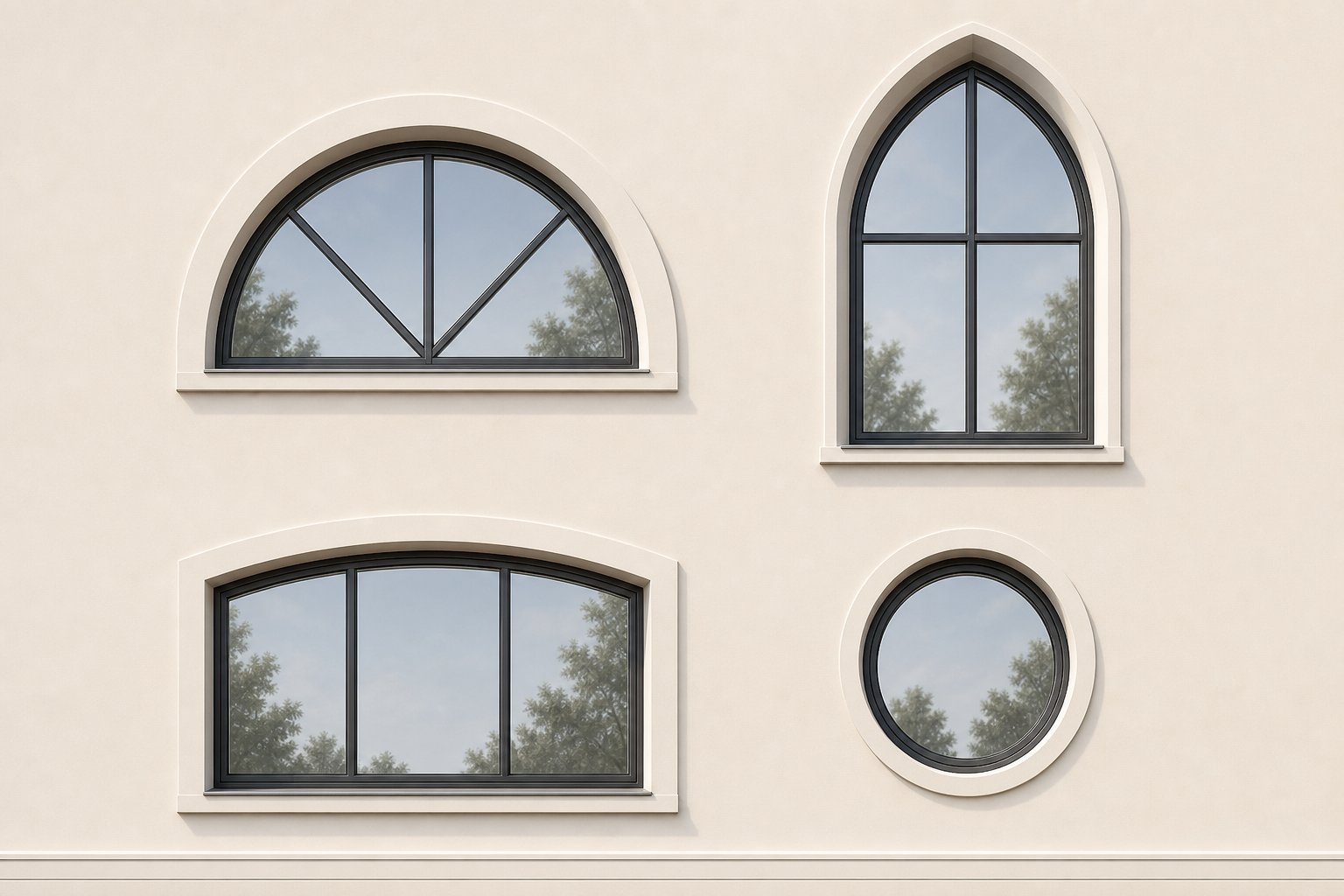
The full arch, sometimes called a Romanesque or round top window, forms a perfect semicircle above the spring line (the point where the curve begins). Its proportions follow a simple rule: the radius of the curve equals exactly half the frame width. This geometric simplicity makes it one of the more straightforward curved window shapes to fabricate in aluminium, since the uniform radius allows consistent roller bending without compound adjustments.
Architecturally, semicircular profiles appear in Georgian fanlights, classical revival facades, and Norman-influenced buildings. They carry a sense of balanced elegance — formal without being dramatic. In modern Australian homes, round top windows work particularly well as fixed-light feature panels above entry doors or at staircase landings where natural light and visual interest converge.
Segmental, Gothic, and Elliptical Variations
A segmental arch uses a shallow curve — less than a semicircle — creating a gentle, understated arc. It is the most common arch window design found on Victorian and Edwardian properties across Australia, adding subtle character without dominating the facade. Because the curve is gentle, segmental profiles are the easiest to manufacture and the most forgiving during installation.
Gothic arches come to a pointed apex where two opposing arcs meet. The vertical emphasis creates drama and height, making them the defining feature of ecclesiastical architecture and Victorian Gothic revival buildings. They are also the most complex to fabricate cleanly in aluminium, as the compound curves meeting at the point demand precise welding or segmented construction.
Elliptical arches sit between these extremes — a flattened oval profile that feels wider and more relaxed than a true semicircle. They suit broader openings where a full semicircular curve would appear too tall or imposing, and they appear frequently in commercial entrance canopies and feature transoms.
Half Moon, Quarter Round, and Eyebrow Shapes
Specialty shapes expand the palette further. Half moon windows are fixed-light semicircles used as standalone accent pieces or lunette transoms above doors. A circle top window — a full round fixed light — creates a porthole effect popular in Art Deco and coastal-inspired designs. Quarter round profiles fill triangular corner spaces where a roofline meets a wall, while eyebrow arches use a very shallow, elongated curve that barely rises above the horizontal, adding just a whisper of movement to an otherwise flat facade.
These curved top windows are almost always fixed (non-opening) due to the complexity of engineering operable hardware around irregular geometries.
| Shape Name | Visual Description | Typical Application | Manufacturing Complexity |
|---|---|---|---|
| Semicircular (Round Top) | Perfect half-circle above spring line | Georgian fanlights, classical facades, feature panels | Moderate |
| Segmental | Shallow curve, less than a semicircle | Victorian terraces, Edwardian homes, cottages | Simple |
| Gothic (Pointed) | Two arcs meeting at a pointed apex | Church conversions, Gothic revival, lancet windows | Complex |
| Elliptical | Flattened oval, wider than semicircular | Broad openings, commercial entrances, transoms | Moderate |
| Half Moon / Lunette | Semicircular fixed light, often above doors | Entry transoms, decorative accent panels | Moderate |
| Circle Top (Porthole) | Full circular fixed light | Art Deco, coastal homes, feature walls | Moderate |
| Eyebrow | Very shallow, elongated curve | Subtle facade detailing, dormer windows | Simple |
| Quarter Round | Quarter-circle filling a corner space | Gable ends, roofline junctions | Simple |
Arched configurations are not limited to windows alone — a gap often overlooked. Aluminium French doors with curved tops replicate the elegance of period entrances while delivering modern thermal and security performance. Arched entrance doors make a strong first impression on heritage and contemporary homes alike. Even arched bi-fold doors are achievable, though the engineering required to fold multiple panels beneath a curved head frame places them firmly in the complex (and premium-priced) category.
The key takeaway: shape selection directly affects both cost and lead time. A segmental arch might add a modest premium over a standard rectangular frame, while a tight Gothic point or a full rounded window with operable sashes can double the fabrication timeline. Understanding where each profile sits on the complexity spectrum helps you budget realistically and brief your supplier with confidence — which leads naturally to the question of why aluminium handles these curves better than competing frame materials.
Why Aluminium Outperforms Other Frame Materials for Curves
Every frame material handles straight lines reasonably well. Curves expose the differences. Bending a profile into an arch amplifies each material’s strengths and weaknesses, making the choice of aluminium windows, timber, uPVC, or steel far more consequential for arched openings than it is for standard rectangular ones.
Aluminium Advantages for Curved Frame Engineering
Aluminium’s strength-to-weight ratio is the headline advantage for curved applications. Because the material delivers high structural rigidity relative to its mass, fabricators can maintain slim sightlines around a curve without needing bulky reinforcement. That means more glass, less frame, and cleaner visual proportions on every arch.
The extrusion process also works in aluminium’s favour. Standard 6000-series alloys respond well to roller bending, allowing fabricators to form gentle segmental curves from continuous lengths of extruded profile rather than joining short straight segments. The result is smoother transitions and fewer potential weak points along the arch. Powder coating completes the picture: a factory-applied finish available in virtually any RAL colour, resistant to UV degradation and salt-air corrosion across Australian coastal conditions, with none of the cyclical repainting that timber demands.
How Other Materials Compare for Arched Frames
uPVC struggles with curves. The material’s lower rigidity means wider profiles are needed to achieve adequate structural performance on bends, and the bending process itself can distort multi-chamber geometries, compromising both thermal performance and aesthetics. Colour options remain limited compared to aluminium, and achieving a clean, facet-free curve in uPVC is difficult at tighter radii.
Timber offers a traditional aesthetic that suits heritage projects, and aluminium clad wood windows attempt to combine timber’s interior warmth with aluminium’s exterior durability. However, curved timber joints are vulnerable to moisture ingress over time, and the ongoing maintenance cycle — sanding, priming, repainting every few years — is amplified on complex curved profiles where access is awkward. For arched applications, timber’s beauty comes at a real upkeep cost.
Steel is the strongest option and achieves the slimmest sightlines of any material, making it attractive for heritage restorations requiring authentic proportions. The trade-offs are significant: steel is the heaviest framing material, prone to corrosion without meticulous protective coatings, and the most expensive to fabricate into custom arch shapes. Metal windows in steel also carry higher thermal conductivity than thermally broken aluminium systems.
Honest Limitations of Aluminium in Arch Applications
Balance demands honesty. Older aluminium frames without a thermal break can act as cold bridges, drawing heat out of a room and encouraging condensation on the inner frame surface. Budget aluminium window frames that skip thermally broken construction still exist in the market, and they perform poorly in cooler climates. The upfront cost of quality thermally broken aluminium also sits above uPVC, though the 40 to 60-year lifespan and near-zero maintenance typically offset that premium over the ownership period.
| Material | Sightline Width | Bendability | Maintenance | Lifespan | Relative Cost |
|---|---|---|---|---|---|
| Aluminium (thermally broken) | Slim (50-65 mm typical) | Excellent — roller bending suits most arch radii | Very low — periodic wipe-down only | 40-60 years | Medium-High |
| uPVC | Wide (70-90 mm typical) | Poor — distorts multi-chamber profiles | Low — occasional cleaning | 25-40 years | Low-Medium |
| Timber | Medium (55-75 mm typical) | Moderate — steam bending or lamination required | High — repaint every 3-7 years | 30-50 years | Medium-High |
| Steel | Ultra-slim (35-50 mm typical) | Good — but heavy and expensive to form | Moderate — corrosion protection essential | 50+ years | High |
The comparison makes the practical case clear: for most arched projects in Australia, windows in aluminium deliver the best balance of slim aesthetics, formability, longevity, and low maintenance. Steel wins on sightline slimness alone, and timber wins on interior warmth, but neither matches aluminium’s all-round suitability for curved fenestration. That suitability, however, depends heavily on how the curved profiles are actually made — a manufacturing process that varies significantly between suppliers and directly affects the quality of the finished aluminium window you receive.
Inside the Manufacturing of Curved Aluminium Profiles
Not all curved frames are made the same way. The method a fabricator uses to shape an aluminum arch directly affects structural integrity, finish quality, and how long the frame performs without issue. Understanding these differences helps you distinguish a premium aluminium frame window from one that merely looks the part on delivery day.
Bending, Welding, and CNC Machining Methods
Three primary techniques dominate the production of aluminium frames for windows with curved geometry:
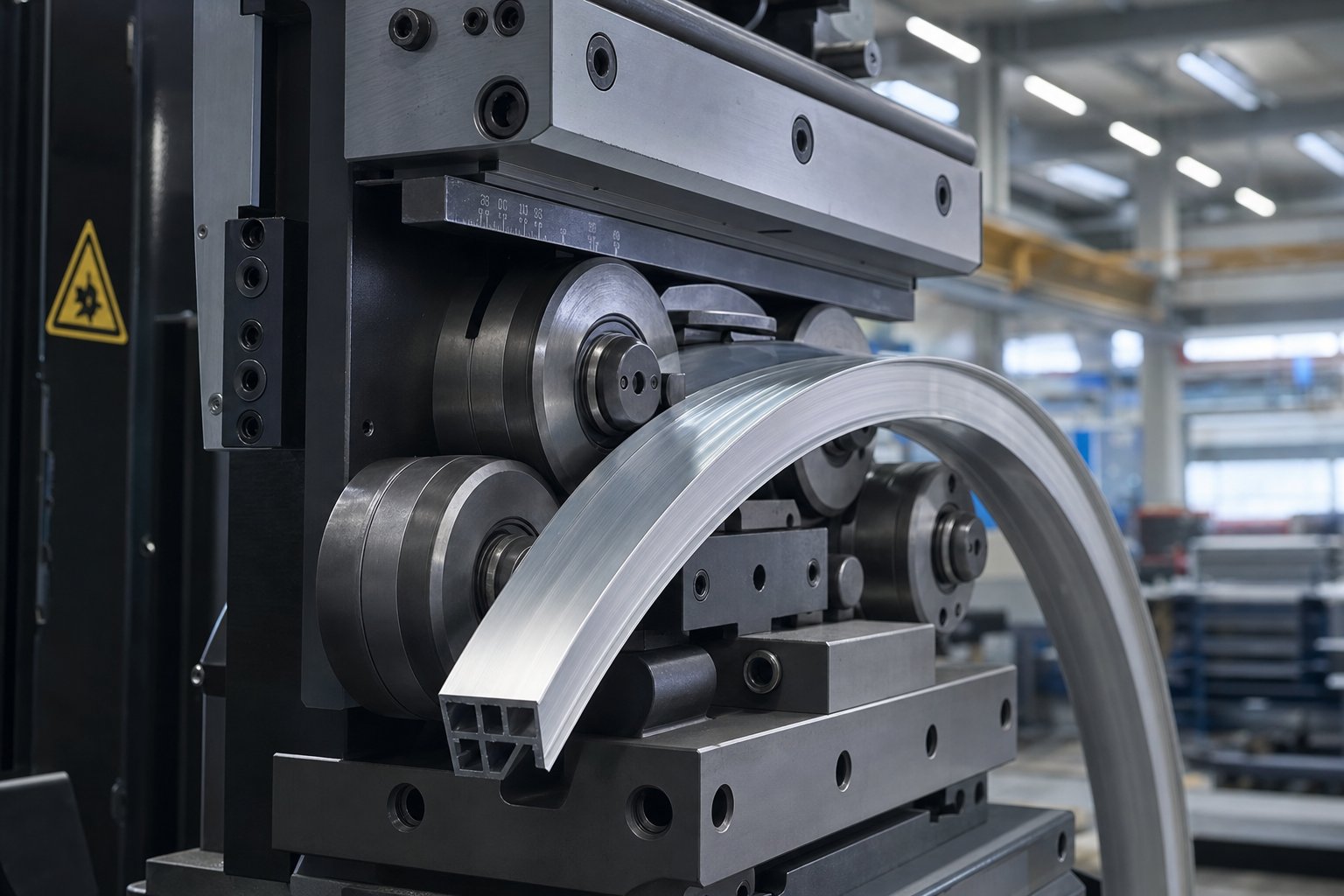
Roller bending of extruded profiles is the most common approach for gentle to moderate curves like segmental and semicircular arches. The process works at room temperature — a cold-forming method where continuous extruded lengths pass through precision rollers that gradually introduce curvature. Because the profile remains a single unbroken piece, structural continuity is maintained throughout the arc. 6000-series alloys (particularly 6063) respond well to this process, offering good formability without sacrificing the strength needed for architectural applications. The key constraint is radius: tighter curves demand lower temper states or risk surface distortion.
Welding segmented straight sections handles complex shapes that roller bending cannot achieve cleanly — tight Gothic points, compound curves, or irregular geometries. Short straight sections are mitred at precise angles and welded together to approximate the curve. The result can look excellent when executed well, but each weld joint represents a potential weak point where moisture could eventually penetrate or where differential thermal movement may stress the seal. This method suits aluminum frame windows with intricate profiles, though it demands skilled fabricators and rigorous post-weld finishing.
CNC machining from solid billets delivers the highest precision. A computer-controlled mill carves the exact profile from a solid block of aluminium, producing curves with tolerances measured in fractions of a millimetre. The trade-off is cost and material waste — this approach suits bespoke one-off pieces or extremely tight radii where bending would compromise the profile’s geometry. It is rarely used for full production runs of metal frame windows.
Quality Indicators in Curved Aluminium Fabrication
Knowing the methods matters less than knowing what good output looks like. When evaluating curved aluminium profiles — whether inspecting samples or assessing a supplier’s portfolio — look for these markers:
- Smooth transitions without visible faceting. A well-bent profile flows in a continuous arc. If you can see flat segments stepping around the curve, the fabrication was either rushed or done with inadequate equipment.
- Consistent profile depth around the curve. Bending forces can compress or stretch different faces of an extrusion. Quality fabrication maintains uniform wall thickness and cross-sectional geometry from the straight sections through the apex of the curve.
- Properly mitred joints where curved meets straight. The transition point between the arched head and the vertical jambs is a telltale area. Clean, tight mitres with no visible gaps indicate precision cutting and assembly.
- Uniform powder coat coverage on bent surfaces. Stretching during bending can thin pre-applied coatings. Reputable aluminium window manufacturers apply powder coating after bending to ensure consistent film thickness and colour density across the entire frame.
Tighter radii amplify every imperfection. A shallow segmental curve is forgiving; a tight Gothic point exposes any shortcut in tooling or technique. The manufacturing method also determines how well thermal breaks — the polyamide insulating barriers within the profile — maintain continuity around the curve. If a thermal break is stressed or compressed during bending, it can create cold spots that undermine the frame’s energy performance.
Reputable manufacturers address this through multi-stage quality control: profile scanning to verify dimensional accuracy post-bend, visual inspection for surface defects, and pressure testing of sealed glazing units before dispatch. These steps add time and cost, but they separate a durable, high-performing aluminium arch from one that develops issues within a few seasons of Australian weather exposure.
Thermal Performance and Glazing for Arched Frames
Manufacturing precision determines how a curved frame looks. Thermal engineering determines how it performs once installed. Arched aluminium profiles face energy efficiency challenges that flat, rectangular frames simply do not encounter — and understanding these challenges helps you specify a system that keeps your home comfortable year-round rather than one that develops cold spots and condensation within a few winters.
How Curved Profiles Affect Thermal Break Continuity
Modern thermally broken aluminium relies on polyamide strips — insulating barriers embedded within the profile that prevent the outer aluminium face from conducting heat directly to the inner face. In a straight section, these strips sit uniformly and perform predictably. Bend that same profile into a curve, and the physics change. The outer face of the extrusion stretches while the inner face compresses, placing uneven stress on the polyamide strip caught between them.
If the thermal break cracks, deforms, or separates from the aluminium during bending, the result is localised cold bridging — small zones where heat escapes freely and where condensation is likely to form on cold mornings. This is particularly relevant for aluminium casement windows with operable arched heads, where the thermal break must maintain continuity not only around the curve but also across the junction with opening hardware.
Quality manufacturers address this in two ways. The first approach uses pre-formed thermal breaks shaped to match the intended curve before being inserted into the bent profile. The second applies the thermal break after the aluminium has been bent, ensuring the insulating strip conforms naturally to the final geometry without stress. Both methods cost more than standard production, but they preserve the thermal integrity that makes thermally broken aluminium worth specifying in the first place. When evaluating suppliers, ask directly which method they use — it is a reliable indicator of whether their aluminum casement and arched products will perform as rated or underdeliver once exposed to real temperature differentials.
Glazing Challenges Unique to Arched Frames
The frame is only half the thermal equation. Curved sealed glass units present their own set of complications that affect cost, availability, and performance.
Flat glass cannot simply be dropped into an arched frame. Curved units require specialist bending — either hot bending at 550–700°C where the glass softens over a mould, or cold bending where pre-tempered panels are mechanically flexed into shape at room temperature. Hot bending achieves tighter radii (as small as 50 mm) and suits complex curves like Gothic points, but it produces annealed glass that needs lamination to meet safety requirements. Cold bending works well for gentle segmental arches and avoids mould costs entirely, though it is limited to single-axis curves and larger radii.
Each method carries trade-offs for the finished unit. Hot-bent glass can show subtle mould marks or roller wave on one surface, while cold-bent panels may exhibit minor optical distortion near the edges where elastic stress concentrates. For most residential arched openings — where viewing distances are moderate and curves are gentle — these effects are negligible. For large feature installations or aluminum clad windows in prominent positions, requesting a sample panel before committing to a full order is worthwhile.
Gas-fill retention also behaves differently in curved sealed units. The cavity geometry in an arched insulated glass unit (IGU) is not uniform — it narrows or widens depending on how the spacer bar follows the curve. This can affect how well argon gas remains sealed over time, with some industry data suggesting marginally higher gas-loss rates in curved units compared to flat equivalents. The practical impact on thermal performance is modest but worth noting when specifying for metal clad windows or wood clad aluminum windows where long-term energy ratings matter.
In terms of real-world thermal performance, well-specified arched aluminium systems with thermally broken frames and argon-filled double glazing achieve U-values around 1.2 W/m²K. To put that in practical terms: a U-value of 1.2 comfortably exceeds the National Construction Code’s minimum requirements for most Australian climate zones, meaning less heat escaping in winter and less solar heat penetrating in summer. For an aluminum casement window or fixed arched light, that translates to noticeably fewer cold draughts near the glass and reduced reliance on heating and cooling systems throughout the year.
The takeaway is straightforward: curved geometry adds complexity to both frame insulation and glazing, but modern manufacturing has solutions for each challenge. The key is specifying products where thermal break continuity and glazing quality have been engineered for the curve — not adapted as an afterthought. That performance foundation then frees you to focus on the more enjoyable question of which arch style best suits your property’s character.
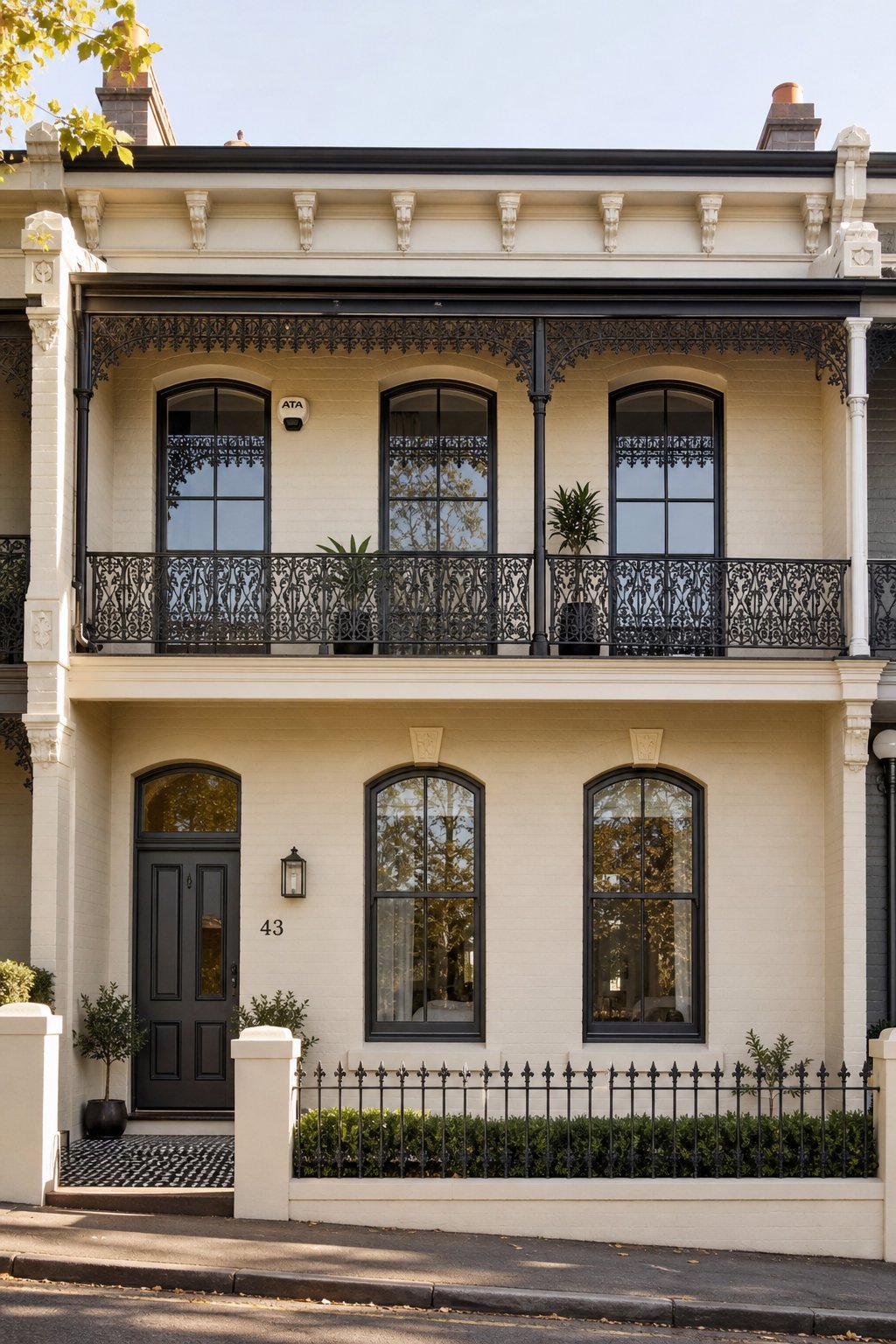
Matching Arch Styles to Your Property Type
A semicircular arch on a Victorian Gothic terrace looks as out of place as a pointed lancet on a mid-century flat-roof home. Getting the geometry right matters — not just aesthetically, but practically. In heritage overlay zones and conservation areas across Australia, councils can reject window replacements that use the wrong arch proportions for the building’s period. Choosing the correct arched window designs for your property type avoids costly redesigns and ensures the finished result feels intentional rather than imposed.
Heritage and Period Properties
Each architectural era favoured distinct arch geometries, and those proportions are often prescribed in heritage guidelines.
Georgian buildings (roughly 1714–1830) relied on classical symmetry. Their signature fenestration feature is the semicircular fanlight above entry doors — a perfect half-circle divided by delicate glazing bars radiating from a central point. Aluminium replicates these proportions with slimmer frames than the original timber, allowing more glass area while maintaining the period silhouette that conservation officers expect.
Victorian architecture (1837–1901) embraced variety. Gothic-inspired pointed arches, segmental curves, and lancet windows all appeared across the era, often on the same building. Italianate terraces favoured gentle segmental arches, while Gothic revival churches and public buildings used steep pointed profiles with decorative tracery. For a Victorian terrace in inner Sydney or Melbourne, a segmental arch with period-appropriate glazing bar patterns is typically the safest choice for council approval.
Edwardian properties (1901–1910) softened the Victorian drama. Segmental arches remained popular but with shallower curves and simpler detailing. These are among the easiest arched profiles to fabricate in aluminium, making them a cost-effective upgrade path for Edwardian homes needing improved thermal performance without sacrificing street-facing character.
Ecclesiastical buildings — churches, chapels, and converted halls — demand lancet arches (tall, narrow, pointed) or full Gothic profiles. The vertical emphasis of these windows with rounded tops transitioning to a point creates the soaring interior light that defines sacred architecture. A metal window arch in aluminium can achieve the slim sightlines needed to honour original iron or stone mullion proportions while delivering modern weather sealing and insulation.
Contemporary and Commercial Applications
Modern architecture uses arched aluminium differently — not to reference history, but to create visual drama through contrast. A single oversized semicircular window on an otherwise minimal facade becomes a statement piece, flooding interiors with light and framing views like a lens. Curved curtain walling wraps entire building corners in continuous glass, blurring the boundary between wall and window.
Art Deco properties (1920s–1940s) suit porthole circles and eyebrow arches — low, elongated curves that echo the era’s streamlined aesthetic. These domed windows and circular fixed lights work beautifully as accent pieces on rendered facades, particularly in suburbs with strong Deco heritage like Sydney’s Bondi or Melbourne’s St Kilda.
For contemporary homes, a curved window plan often centres on one or two feature openings rather than repeating arches across the entire facade. A single large window with curved top above a pivot door, or a pair of arched fixed lights flanking a flat-roofed entrance, creates impact without overwhelming the design. The round window frame design works best when it contrasts with the building’s dominant geometry — curves against straight lines, softness against sharp edges.
Arched Doors for Every Architectural Style
Doors deserve the same period-matching attention as windows. An arched entrance door sets the tone for the entire property — it is the first element visitors encounter and the last they see when leaving.
Arched French doors with curved tops suit Georgian and Edwardian properties where symmetry and elegance define the rear garden elevation. Arched bi-fold configurations work for contemporary homes wanting a dramatic indoor-outdoor connection beneath a curved header, though the engineering complexity places them at the premium end of the spectrum. For Victorian terraces, a single arched entry door with a segmental curve and sidelights replicates the original proportions while upgrading security and insulation.
The following guide pairs recommended arch styles with property types to help you brief your supplier with confidence:
- Victorian (Italianate/terrace): Segmental arches with period glazing bars — subtle curves that match the era’s most common residential profile without triggering heritage objections.
- Victorian (Gothic revival): Pointed Gothic arches and lancet shapes — steep, dramatic profiles that honour the building’s ecclesiastical influences.
- Georgian: True semicircular arches and radial fanlights — classical proportions with symmetrical glazing bar patterns.
- Edwardian: Shallow segmental arches with minimal glazing bars — understated elegance that reflects the era’s move toward simplicity.
- Art Deco: Porthole circles and eyebrow curves — streamlined shapes that echo the period’s love of aerodynamic forms.
- Mid-Century: Eyebrow arches or subtle segmental curves — low-profile shapes that complement horizontal rooflines without competing for attention.
- Contemporary: Full semicircular or elliptical feature arches — bold, oversized curves used sparingly as focal points against minimal facades.
- Ecclesiastical: Lancet arches and tall pointed Gothic profiles — vertical emphasis that maintains the building’s spiritual proportions and interior light quality.
One critical note for properties in conservation areas or heritage overlay zones: local councils may prescribe specific arch proportions, frame depths, glazing bar configurations, and even colours. Aluminium’s slim sightlines and unlimited powder coat palette often make it acceptable where uPVC would be refused outright, but early consultation with your local planning authority remains essential. Request written confirmation of acceptable designs before committing to fabrication — a rejected application after manufacturing has begun is an expensive lesson in the value of checking first.
Style alignment is one piece of the puzzle. The other is budget — and arched configurations carry cost variables that differ significantly from standard rectangular fenestration.
Cost Factors That Drive Arch Aluminium Pricing
Arched aluminium fenestration is not a catalogue product you pick off a shelf. Every unit involves custom fabrication, specialist glazing, and individual templating — and each of those steps adds cost that standard rectangular frames never incur. Rather than quoting dollar figures that shift with market conditions and project specifics, the more useful approach is understanding what drives the price and how much each variable moves the total.
What Makes Arched Frames More Expensive Than Rectangular
Three core cost multipliers separate arched units from their flat-topped equivalents:
Curved profile fabrication. Bending aluminium extrusions into arched shapes requires specialist roller-bending or stretch-bending equipment that most standard fabrication shops do not own. The process is slower, demands skilled operators, and produces higher scrap rates than cutting straight lengths. Industry data suggests this step alone adds a 30 to 60 per cent premium over equivalent rectangular framing.
Curved sealed glass units. Flat double-glazed panels are mass-produced and competitively priced. Curved equivalents require individual moulds, specialist bending kilns, and careful quality control to avoid optical distortion. The glass component of an arched window typically costs 30 to 50 per cent more than flat glass of the same specification — and that premium climbs steeply for tighter radii or double-glazed curved units where both panes must be bent separately.
Individual templating. Each arched opening is unique. Unlike standard sizes that can be batch-produced, custom aluminium windows require site-specific measurements, individual engineering drawings, and one-off fabrication setups. This per-unit overhead is unavoidable and scales with project complexity.
Arch geometry compounds these factors. A gentle segmental curve is the most affordable arched option — the shallow radius bends cleanly, uses less specialist tooling, and accepts standard hardware with minimal modification. A tight Gothic point or full circular profile demands compound curves, precision welding at the apex, and custom-formed thermal breaks, pushing fabrication time and cost significantly higher.
Factors That Influence Your Final Quote
Beyond the arch itself, several specification choices move the price up or down. Listed from highest to lowest impact on your total investment:
- Opening mechanism: Fixed arched lights are the most economical. Operable arched windows — casement or awning sashes that open within a curved frame — require bespoke hinges, custom-profiled seals, and complex geometry that can add 50 to 100 per cent over a fixed equivalent.
- Glazing specification: Single glazing is cheapest but rarely appropriate for habitable rooms. Double glazing with argon fill and low-E coating is the standard for Australian projects. Triple glazing adds further cost and weight, and curved triple-glazed units remain a niche product with limited local availability.
- Size and radius: Larger arched units require more material and stronger profiles. Tighter curves demand more specialist fabrication. Both push the price upward.
- Finish: Standard powder coat colours (white, black, monument) are included in base pricing. Custom RAL colours or textured finishes typically add 10 to 20 per cent for the coating process.
- Hardware and security: Multi-point locking, keyed handles, and restrictor stays all add incremental cost — more so on operable arched units where hardware must follow the curve.
- Quantity: A single bespoke arched unit carries the full setup cost. Multiple units of the same profile spread that overhead, reducing the per-unit premium.
It is worth noting that searching for cheap aluminium windows in arched configurations is largely a contradiction in terms. The fabrication complexity sets a floor beneath which quality cannot be maintained. Budget-priced curved frames almost always cut corners on thermal break continuity, powder coat thickness, or glazing seal integrity — compromises that surface as performance failures within a few years of Australian weather exposure.
The more productive way to think about value is lifecycle cost. Quality aluminium replacement windows in arched profiles carry a realistic service life exceeding 40 years with minimal maintenance — no repainting, no seal degradation, no hardware corrosion in properly specified systems. Spread the upfront premium across four decades of trouble-free performance, and the annual cost of ownership often undercuts cheaper alternatives that need replacing or refurbishing at the 15 to 20-year mark. For homeowners weighing aluminium replacement window options against lower-cost materials, that long-term arithmetic consistently favours aluminium for arched applications where durability and dimensional stability matter most.
Cost clarity helps you budget realistically, but it does not tell you whether your project meets the regulatory requirements that apply in your state or local council area. Certifications and building standards add another layer to the specification process — one that can determine whether your arched aluminium investment is approved or sent back to the drawing board.
Certifications, Standards, and Building Regulations for Architectural Aluminium
A beautifully fabricated arched frame means nothing if it fails to meet the regulatory requirements governing your project. Whether you are specifying residential aluminium windows for a suburban renovation or commercial aluminium windows for a multi-storey development, compliance is non-negotiable — and for arched profiles, the testing and approval process carries nuances that standard rectangular units avoid.
Key Certifications and What They Mean
In Australia, every exterior aluminium door and frame, window, and skylight installed in a building must comply with Australian Standard AS 2047. This is the benchmark referenced by the National Construction Code (NCC), and it covers structural performance under wind load, water penetration resistance, air infiltration limits, and operating force for operable sashes. Certified products carry a performance label — typically found on the inside of the frame — displaying wind and water ratings in Pascals. A Certificate of Compliance from the manufacturer, ideally backed by testing through a NATA-accredited laboratory, confirms the product meets these thresholds.
For arched units specifically, AS 2047 compliance is harder to achieve because curved sealed units and non-standard frame geometries must still pass the same pressure and water-resistance tests as rectangular equivalents. This is why choosing a manufacturer with demonstrated experience in testing curved profiles matters — not every fabricator submits arched configurations for independent verification.
Beyond structural performance, energy ratings fall under the Window Energy Rating Scheme (WERS), which rates windows on heating and cooling performance using a star system. NatHERS assessments for new builds and major renovations reference WERS data, so specifying WERS-rated arched units simplifies your energy compliance pathway. Additional standards relevant to arched projects include:
- AS 2047: Structural adequacy, weather resistance, and operability for windows and aluminium exterior doors.
- AS 1288: Glass selection and installation — critical for curved sealed units where safety glass requirements apply.
- WERS: Energy performance star ratings for heating and cooling, used in NatHERS assessments.
- BAL ratings (AS 3959): Bushfire Attack Level compliance for properties in designated bushfire-prone areas — relevant for metal windows residential projects in peri-urban zones.
- NCC Section J: Energy efficiency provisions that set minimum glazing performance for commercial aluminium windows and doors in Class 2–9 buildings.
Non-compliant installations risk more than a failed inspection. They can void insurance coverage, attract penalties during council audits, and reduce property value if discovered during a sale.
Planning Permission for Arched Windows in Regulated Areas
Structural compliance gets your product approved under the building code. Planning permission determines whether you can install it at all — particularly in conservation areas, heritage overlay zones, or on properties with heritage listings.
Local councils across Australia can prescribe specific requirements for arch proportions, frame materials, glazing bar patterns, and even colour finishes within these zones. A development application (DA) for window replacement in a heritage overlay typically requires drawings showing the proposed arch geometry, frame depth, and sightline width alongside photographs of the existing or original fenestration. The goal is demonstrating that the replacement respects the building’s architectural character.
This is where architectural aluminium holds a distinct advantage. Its slim sightlines can replicate the proportions of original timber or iron frames more faithfully than uPVC, which heritage authorities widely consider unsuitable for listed buildings and conservation areas due to its bulkier profiles and limited detailing. Powder-coated aluminium can also match heritage colour palettes precisely, satisfying council requirements that specify particular finishes for street-facing elevations.
Before committing to fabrication, consult your local planning authority’s conservation officer. Request written guidance on acceptable frame depths, arch proportions, and materials. For listed properties, formal consent is required before any window modification — proceeding without it risks enforcement action and mandatory reinstatement of original features at the owner’s expense.
Compliance and approvals protect your investment. The next step is finding a supplier capable of delivering certified, heritage-appropriate arched aluminium products — a decision that hinges on evaluating manufacturing capability, certification credentials, and project experience.
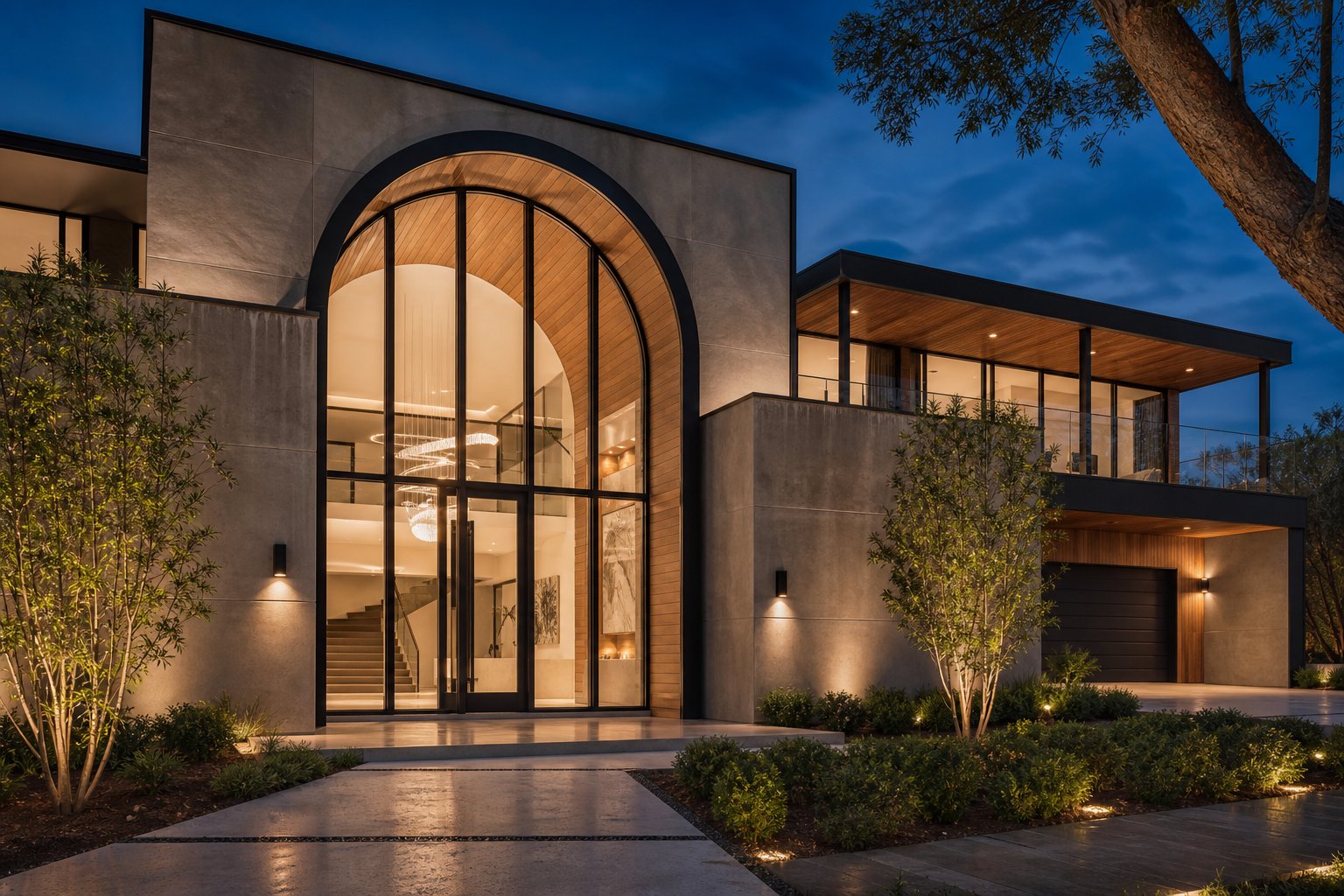
Choosing the Right Supplier for Your Arch Aluminium Project
Certifications confirm a product meets minimum standards. The supplier behind that product determines whether your arched aluminium project runs smoothly or becomes a drawn-out exercise in miscommunication, delays, and compromised quality. Curved fenestration is specialist work — not every aluminium joinery fabricator has the equipment, experience, or quality systems to deliver it reliably. Knowing what to evaluate separates a confident specification from an expensive gamble.
What to Look for in an Arch Aluminium Supplier
The evaluation criteria for an aluminium window supplier handling arched profiles differ from those for standard rectangular work. Curved fabrication demands specific capabilities that you should verify before shortlisting:
- Curved profile manufacturing capability: Do they own roller-bending or stretch-bending equipment in-house, or do they outsource? In-house capability means tighter quality control and shorter lead times.
- Range of arch types offered: A supplier comfortable with segmental curves may struggle with tight Gothic points or full circular profiles. Ask which geometries they have successfully fabricated and installed.
- AS 2047 certification for arched units: Confirm they can provide Certificates of Compliance specifically for curved configurations — not just their standard rectangular product range.
- Project portfolio with completed arched installations: Request photographs and references from previous arched projects. A strong portfolio demonstrates proven capability rather than theoretical claims.
- Complete product ecosystem: Suppliers offering aluminium windows, aluminium doors, facade systems, louvres, and balustrades under one roof simplify specification and ensure visual consistency across your project. When frames, doors, and facade elements come from the same system, profiles align, colours match perfectly, and accountability sits with a single point of contact.
- Technical support and site measurement services: Arched openings require precise templating. Suppliers who offer on-site measurement reduce the risk of fabrication errors caused by inaccurate dimensions.
- Lead time transparency: Custom curved work takes longer than standard production. A reliable aluminium door supplier will provide realistic timelines upfront rather than overpromising and underdelivering.
A supplier ticking all these boxes is not just a vendor — they become a project partner capable of solving problems before they reach site.
Moving from Research to Specification
The procurement journey for aluminium doors and windows in arched configurations typically follows a predictable sequence, whether you are a builder, architect, developer, or contractor:
It begins with research — identifying which arch profiles suit the property, understanding material options, and establishing a realistic budget range. From there, you shortlist suppliers based on the criteria above, request technical drawings or shop drawings showing proposed frame sections and sightlines, arrange site measurement for precise templating of each opening, and finalise the specification including glazing type, colour, hardware, and compliance documentation.
Suppliers with project-based solutions streamline this process considerably. Rather than coordinating separate companies for windows, entry doors, facade panels, and louvres, a single integrated supplier handles the entire scope — reducing coordination overhead and eliminating the finger-pointing that occurs when multiple trades interface poorly.
For Australian building projects, MEICHEN’s aluminium window, door, and facade systems offer an example of this end-to-end approach. Their product ecosystem covers aluminium windows, doors, facade systems, louvres, and balustrades — the full range of architectural aluminium elements that a residential or commercial project might require, including arched and custom-curved configurations. For builders, developers, and procurement teams ready to move from research into specification, exploring a complete product range in one place saves considerable time compared to piecing together components from multiple sources.
Whichever supplier you choose, engage them early. Arched aluminium is not a last-minute specification — lead times for custom curved profiles, specialist glazing, and heritage-compliant finishes mean that early collaboration between your design team and your aluminium doors and windows supplier prevents programme delays that ripple through the rest of your build schedule. The best outcomes consistently come from projects where the supplier is involved from design development onward, contributing technical input on achievable radii, thermal performance, and certification pathways before drawings are locked in.
Frequently Asked Questions About Arch Aluminium Windows and Doors
1. What types of arch shapes are available for aluminium windows and doors?
Aluminium windows and doors come in a wide range of arch shapes including semicircular (round top), segmental (shallow curve), Gothic (pointed apex), elliptical (flattened oval), half moon, circle top (porthole), eyebrow (very shallow elongated curve), and quarter round profiles. Each shape creates a different architectural effect and carries varying manufacturing complexity. Segmental arches are the simplest and most affordable to fabricate, while Gothic pointed arches and full circular profiles sit at the complex end of the spectrum, requiring precision welding or segmented construction techniques.
2. Why is aluminium better than uPVC or timber for arched window frames?
Aluminium outperforms other materials for curved frames due to its superior strength-to-weight ratio, which allows slimmer sightlines around curves without bulky reinforcement. Its extrusion properties suit roller bending, producing smooth continuous arcs rather than joined segments. Unlike uPVC, which distorts multi-chamber profiles when bent and requires wider frames, aluminium maintains structural integrity at tight radii. Compared to timber, aluminium demands virtually no maintenance — no cyclical repainting every few years — and its powder-coated finish resists UV degradation and coastal corrosion across Australian conditions, with a service life of 40 to 60 years.
3. How much more do arched aluminium windows cost compared to standard rectangular ones?
Arched aluminium windows typically cost 30 to 60 per cent more than equivalent rectangular frames for the curved profile fabrication alone. Curved sealed glass units add a further 30 to 50 per cent premium over flat glass of the same specification. Additional cost drivers include whether the window is fixed or operable (operable arched sashes can double the price), glazing type, custom RAL colour finishes, size, and the tightness of the curve radius. Each unit also requires individual site templating, adding per-unit overhead that batch-produced standard sizes avoid.
4. Do arched aluminium windows meet Australian building standards?
Yes, arched aluminium windows can comply with Australian Standard AS 2047, which covers structural performance under wind load, water penetration resistance, and air infiltration. However, achieving certification for curved configurations is more demanding than for rectangular units because non-standard geometries must still pass identical pressure and water-resistance tests. Buyers should confirm their supplier provides Certificates of Compliance specifically for arched profiles, ideally backed by NATA-accredited laboratory testing. Additional relevant standards include AS 1288 for glass selection, WERS for energy ratings, and BAL ratings for bushfire-prone areas.
5. What should I look for when choosing a supplier for arched aluminium windows in Australia?
Key evaluation criteria include in-house curved profile manufacturing capability (roller-bending or stretch-bending equipment), a demonstrated range of arch types successfully fabricated, AS 2047 certification specifically for arched units, a project portfolio showing completed curved installations, and on-site measurement services for precise templating. Suppliers offering a complete product ecosystem — windows, doors, facade systems, louvres, and balustrades — simplify specification and ensure visual consistency. For Australian projects, companies like MEICHEN provide end-to-end aluminium window, door, and facade solutions including arched and custom-curved configurations through their full product range at meichenwindows.com.au.
More Window & Door Guides