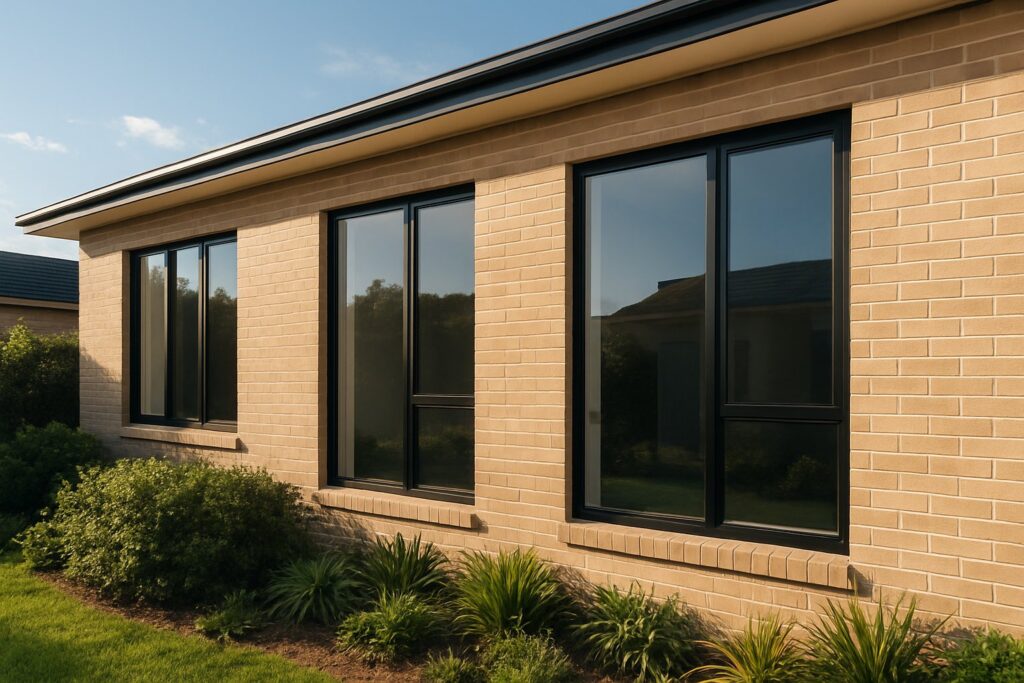
Why Aluminium Windows Suit the Sunshine Coast
Aluminium windows use extruded aluminium alloy profiles as their structural frame, holding glass panes in place while resisting the forces that coastal Queensland throws at building materials daily. Salt-laden air, relentless UV, cyclone-season wind loads, and year-round humidity create a environment where lesser materials deteriorate fast. Timber rots, uPVC can warp or discolour, and untreated steel corrodes. Aluminium, powder-coated and purpose-built for exposure, holds its ground.
In coastal Queensland, aluminium accounts for the vast majority of residential window installations. Its corrosion resistance, slim sightlines, and structural strength make it the default rather than the alternative.
What Makes Aluminium the Preferred Frame Material Here
The combination is hard to beat: lightweight yet rigid profiles that won’t swell in humidity, a naturally forming oxide layer that resists salt corrosion, and powder-coat finishes that shrug off UV degradation. Aluminium windows and doors on the Sunshine Coast handle wide spans for bifold and sliding configurations without sagging, letting architects design the open-plan, breeze-catching layouts this climate rewards. They meet cyclone-rated compliance standards, accept single or double glazing, and require minimal upkeep over decades of service.
Who This Guide Helps
This resource is built for homeowners planning renovations, builders specifying aluminium doors and windows on the Sunshine Coast for new builds, and architects balancing performance with aesthetics. The sections ahead cover every window type available, how local climate factors shape material and design choices, energy performance and thermal break technology, honest material comparisons, salt-air maintenance strategies, powder coating options, and building compliance requirements. Each topic is framed through a subtropical coastal lens, because a window decision made here carries different weight than one made in Melbourne or inland Queensland.
Aluminium Window Types Explained for Sunshine Coast Homes
Knowing aluminium is the right frame material is only half the decision. The next question is which opening style actually works for your rooms, your orientation, and the way subtropical air moves through a building. Each window type handles ventilation, weather sealing, and spatial flow differently, and the Sunshine Coast climate rewards specific choices in specific locations.
Sliding and Bifold Windows for Open-Plan Living
Sliding windows glide horizontally along a track, with one or more panels moving behind a fixed pane. They sit flush within the wall line, meaning nothing protrudes into walkways or outdoor paths. That makes aluminium sliding windows on the Sunshine Coast a practical default for living areas, bedrooms facing verandas, and any opening beside a high-traffic zone. Wide glass panels maximise natural light and frame coastal views without visual clutter.
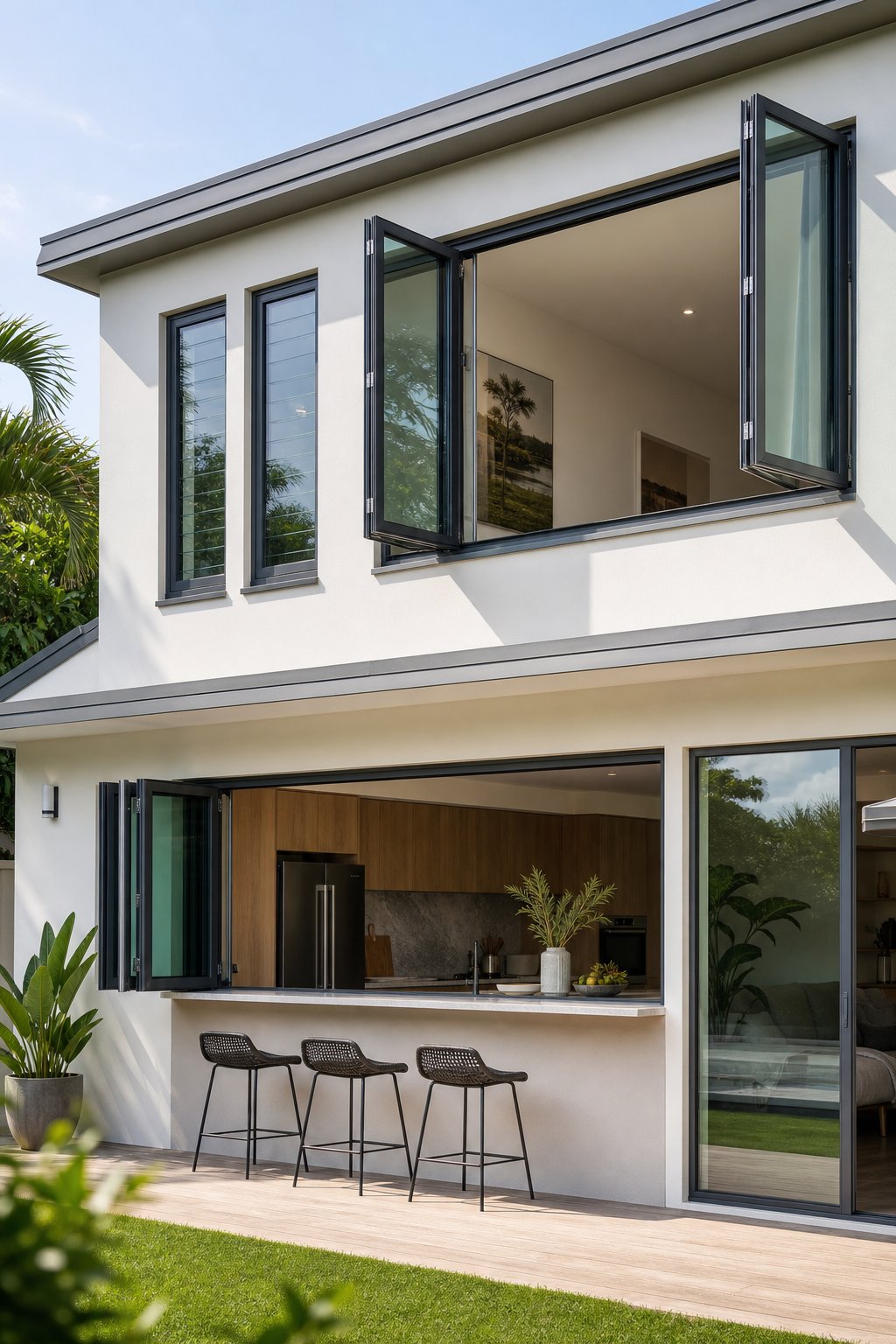
Bifold windows take the open-plan concept further. Two or more hinged panels fold back against each other, creating an almost entirely unobstructed opening. Aluminium bifold windows on the Sunshine Coast appear most often above kitchen benchtops facing outdoor entertaining areas, functioning as servery windows that blur the line between inside and out. Their aluminium frames handle the wide spans these configurations demand without sagging or binding in humid conditions.
Awning and Casement Windows for Ventilation Control
Awning windows hinge at the top and push outward from the bottom. This simple geometry delivers a specific subtropical advantage: you can leave them open during a rain shower without water entering the room. For a region where afternoon storms roll in fast, aluminium window awnings on the Sunshine Coast let homeowners ventilate continuously without watching the sky. They suit bathrooms, laundries, bedrooms, and any space where controlled airflow matters more than a panoramic opening.
Casement windows hinge on the side and swing outward like a narrow door. They catch lateral breezes effectively, directing airflow into the room rather than just allowing it to pass. Casement styles work well on elevations facing prevailing breezes, and their tight seal when closed makes them strong performers for weather resistance and acoustic control.
Louvre and Fixed Windows for Specialty Applications
Louvre windows use horizontal glass blades that tilt open on a pivot, giving precise control over how much air enters a space. They excel in bathrooms, ensuites, and enclosed verandas where maximum ventilation and privacy need to coexist. In subtropical coastal homes, louvres keep air circulating even during light rain when angled correctly. Modern aluminium-framed louvres include robust locking mechanisms that address older security concerns.
Fixed windows do not open at all. Their purpose is light and views, nothing else. Use them for feature walls, stairwells, highlight panels above doors, or anywhere a sealed, energy-efficient pane serves better than an operable one. Paired alongside awning or casement windows, fixed panes let you build large glass expanses while concentrating ventilation where it counts.
| Type | Best Room Fit | Ventilation Level | Weather Sealing | Typical Use Case |
|---|---|---|---|---|
| Sliding | Living areas, bedrooms, walkway-adjacent rooms | Moderate (up to 50% opening) | Good with quality seals | Everyday ventilation without protrusion |
| Bifold | Kitchen serveries, entertainment zones | High (near-full opening) | Moderate when closed | Indoor-outdoor connection |
| Awning | Bathrooms, laundries, bedrooms | Moderate | Excellent (rain protection while open) | Ventilation during wet weather |
| Casement | Bedrooms, studies, breeze-facing walls | High (full sash opening) | Excellent when closed | Catching lateral breezes |
| Louvre | Bathrooms, ensuites, enclosed verandas | Very high (adjustable blade angle) | Moderate (partial rain protection) | Maximum airflow with privacy |
| Fixed | Feature walls, stairwells, highlight panels | None | Excellent (fully sealed) | Light and views without ventilation |
Most Sunshine Coast homes combine several of these types across different rooms and orientations. A north-facing living room might pair fixed panes with flanking awning windows, while a west-facing bathroom uses louvres for constant airflow without direct sun exposure. The real performance gains come from matching each type to the specific climate pressures acting on that wall, which is exactly where local environmental factors start shaping the decision.
How Sunshine Coast Climate Shapes Your Window Decision
The Sunshine Coast sits in a climate envelope that tests building materials harder than most Australian regions. It is not just one factor at play. Salt, UV, humidity, and wind act simultaneously and year-round, compounding each other’s effects. A window frame that performs well in Toowoomba or Ballarat faces a completely different stress profile here, and understanding those stressors is what separates a window that lasts decades from one that deteriorates within years.
- Salt spray corrosion — airborne chlorides attack metal surfaces, accelerating oxidation and pitting on unprotected frames.
- UV radiation — intense subtropical sun degrades seals, fades finishes, and breaks down polymer-based materials over time.
- Humidity — persistent moisture levels above 60% encourage mould growth on seals and can cause timber frames to swell or warp.
- Wind loads — storm events and cyclone-season gusts impose structural demands that frames and glazing must withstand without failure.
These pressures explain why coastal aluminium windows on the Sunshine Coast dominate over alternatives that might work perfectly well 100 kilometres inland.
Salt Air Corrosion Zones and What They Mean for Your Windows
Salt exposure is not uniform across the region. The Galvanizers Association of Australia defines corrosivity categories under AS/NZS 2312.2 that directly affect material specification. Properties within 200 metres of rough surf beaches fall into category C5, where salt deposition is aggressive enough to corrode unprotected metals rapidly. Move between 200 metres and 1 kilometre inland, and you are in C4 territory. Much of the broader Sunshine Coast urban footprint sits within C3, which extends from 1 kilometre to as far as 10 kilometres inland along ocean-facing areas, and can push further depending on prevailing winds.
What does this mean practically? Salt air resistant windows on the Sunshine Coast need powder coating systems rated for the specific corrosivity zone of the property. A beachfront home in Mooloolaba demands marine-grade coatings and stainless steel hardware, while a property in Buderim may only require standard coastal-rated finishes. Reputable aluminium window suppliers on the Sunshine Coast will ask about your distance from the waterline before recommending a coating specification.
UV Exposure and Humidity Effects on Frame Materials
Queensland’s subtropical latitude delivers UV radiation levels that southern states simply do not match. This intensity degrades rubber seals, causes colour shift in lower-quality powder coatings, and breaks down plastic components in hardware and aluminium window screens over time. Sunshine Coast properties cop this exposure across long summer days with high sun angles, meaning even south-facing elevations receive significant reflected UV.
Humidity compounds the problem. Average relative humidity on the coast regularly sits above 60%, creating conditions where moisture lingers on frame surfaces and within seal cavities. Timber frames absorb that moisture and swell. uPVC can soften slightly at surface level. Aluminium remains dimensionally stable regardless of humidity, which is one reason it holds weatherseals in consistent compression year-round without the gaps that develop in frames prone to seasonal movement.
Storm Events and Wind Load Considerations
Every building site in Australia must be assessed for wind load requirements under AS/NZS 1170.2 or AS 4055 for housing. The Sunshine Coast falls within wind regions that can require N2 to N3 ratings for standard housing, with higher ratings for exposed or elevated sites. Properties in cyclone-affected zones further north require C-rated windows, and some Sunshine Coast locations near headlands or at elevation may also attract higher classifications.
Windows must satisfy both Serviceability Limit State (remaining functional under routine loading) and Ultimate Limit State (not collapsing under peak design loads). Aluminium frames handle these structural demands through their inherent rigidity and the ability to engineer thicker profiles or reinforced sections where wind loads dictate. Combined with appropriate glazing thickness and correct installation, they provide the structural performance that storm-prone coastal sites require without the bulk of heavier framing materials.
These climate factors do not operate in isolation. Salt weakens seals that UV has already degraded. Humidity accelerates corrosion that salt initiated. Wind loads stress frames whose hardware has been compromised by years of coastal exposure. The compounding effect is why material choice and coating specification carry more weight here than anywhere south of the Tropic of Capricorn, and why energy performance decisions need to account for this specific subtropical context.
Energy Efficiency and Thermal Break Technology
Aluminium is strong, corrosion-resistant, and dimensionally stable in humidity. It also conducts heat roughly 1,000 times more readily than timber. In a climate where outdoor temperatures regularly push above 30°C and air conditioning accounts for a large share of household energy use, that conductivity matters. Heat travels through a standard aluminium frame from the hot exterior face to the cooler interior, raising indoor surface temperatures and forcing cooling systems to work harder. This is where thermal break technology changes the equation for energy efficient windows on the Sunshine Coast.
Sunshine Coast homes prioritise cooling loads over heating. Unlike southern states where winter heat retention drives window specification, the thermal calculus here centres on keeping solar heat out and reducing air conditioning demand during long, hot summers.
How Thermal Break Aluminium Frames Work
A thermally broken frame splits the aluminium profile into two separate sections, an interior piece and an exterior piece, joined by a strip of reinforced polyamide. This polyamide barrier has very low thermal conductivity, so it dramatically slows heat transfer between the outside and inside faces of the frame. The result is a frame that retains aluminium’s structural strength and slim sightlines while behaving more like an insulator at the point where heat would otherwise flow freely.
Standard aluminium frames without a thermal break act as a continuous conductor. On a 35°C day, the interior frame surface can feel noticeably warm to the touch, and that warmth radiates into the room. Thermal break aluminium windows on the Sunshine Coast reduce this conducted heat gain, lower interior surface temperatures, and minimise the condensation risk that can occur when cooled indoor air meets a warm frame surface. For homes running air conditioning through summer, the difference translates directly into reduced energy consumption.
Glazing Options for Subtropical Energy Performance
The frame is only part of the thermal story. Glass accounts for the majority of a window’s surface area, and its performance is measured by two key metrics:
- U-value — how easily heat flows through the glass assembly. Lower numbers mean better insulation.
- Solar Heat Gain Coefficient (SHGC) — the fraction of solar radiation that passes through as heat. In a cooling-dominated climate, a lower SHGC reduces unwanted heat gain.
Single glazing remains common in older Sunshine Coast homes and still appears in new builds where budget or orientation makes it acceptable. It offers no insulating air gap and limited control over solar heat gain.
Double glazed aluminium windows on the Sunshine Coast use two panes separated by an insulating air or gas-filled cavity. This cavity reduces the U-value significantly, cutting conducted heat transfer and improving acoustic performance as a bonus. Double glazing is most cost-effective on west-facing openings, large sliding doors, and bedrooms exposed to afternoon sun.
Low-E (low-emissivity) glass adds a microscopically thin metallic coating that reflects infrared heat energy while still transmitting visible light. In subtropical applications, a solar control low-E coating on surface two of a double-glazed unit blocks a substantial portion of incoming solar heat without darkening the view. It is a targeted upgrade that delivers measurable cooling load reduction on north and west elevations without the expense of triple glazing.
NatHERS Ratings and Window Selection in Queensland
Every new home in Queensland must achieve a minimum 7-star NatHERS rating under the National Construction Code 2022. The NatHERS assessment models how well the building envelope, including windows, manages thermal loads across the year. Window size, placement, glazing U-value, and SHGC all feed directly into the software that determines whether a design passes or fails.
In practice, this means window selection is no longer purely aesthetic. A large west-facing sliding door with single glazing and a standard aluminium frame can drag an entire home’s rating below compliance. Upgrading that same opening to double glazing with a thermally broken frame and low-E coating can recover the lost performance without reducing window size or changing the floor plan.
The decision about where to invest in thermal breaks and upgraded glazing depends on orientation, window area, and how much thermal performance the rest of the building envelope already provides. Selective upgrades on the most exposed openings often deliver better value than blanket double glazing across every window. A NatHERS assessor can model these trade-offs early in the design process, showing exactly which windows benefit most from higher-specification frames and glass. That specificity matters, because the next decision, choosing between aluminium, timber, and uPVC as your frame material, carries its own set of long-term performance and maintenance implications in coastal conditions.
Aluminium vs Timber vs uPVC in Coastal Queensland
Thermal performance and glazing choices shape how a window handles energy. But the frame material itself determines how long that window survives the Sunshine Coast environment before needing repair, recoating, or outright replacement. Aluminium, timber, and uPVC each bring genuine strengths to the table. The question is which strengths actually matter when salt air, humidity, and UV are constant companions rather than occasional visitors.
Corrosion and Humidity Resistance Compared
Aluminium forms a natural oxide layer that shields the underlying metal from further corrosion. Add a quality powder coat rated for the relevant AS/NZS 2312.2 corrosivity zone, and the frame resists salt attack for decades without structural degradation. Humidity has no dimensional effect on aluminium. It does not swell, shrink, or change shape regardless of moisture levels, which means weatherseals maintain consistent compression year-round.
Timber tells a different story in coastal Queensland. High humidity causes wood fibres to absorb moisture, leading to swelling that can jam sashes and distort frames. When conditions dry out, the timber contracts, opening gaps around seals. This cyclical movement accelerates in subtropical climates where humidity swings are frequent. Salt air compounds the issue by degrading protective coatings faster, exposing raw timber to moisture penetration. Without diligent maintenance, rot can establish itself within a few years on exposed elevations near the coast.
uPVC is inherently immune to corrosion and unaffected by moisture absorption. It will not rot, and salt spray does not attack its surface chemistry. In terms of raw resistance to coastal conditions, uPVC performs well. However, intense UV exposure at subtropical latitudes can cause surface chalking and slight brittleness over extended periods, particularly on north and west-facing elevations. Modern UV-stabilised formulations have improved this, but the long-term track record in high-UV Australian coastal environments is shorter than aluminium’s proven history in the same conditions.
Maintenance Demands Over a 30-Year Lifespan
The real cost of a window extends well beyond the purchase price. Maintenance hours and material costs accumulate over decades, and coastal conditions accelerate every maintenance cycle.
Aluminium frames need periodic washing to remove salt deposits, occasional hardware lubrication, and inspection of powder coating integrity. In most cases, that amounts to a quarterly hose-down and an annual check of seals and tracks. Recoating or respraying may become necessary after 15 to 20 years on beachfront properties, but the frame itself remains structurally sound throughout.
Timber demands significantly more attention. Repainting or re-staining every three to five years is standard in coastal Queensland, and that timeline shortens for salt-exposed faces. Sealant renewal, hardware replacement due to corrosion of non-stainless fittings, and inspection for early rot are ongoing tasks. Neglect any of these for a season or two, and repair costs escalate quickly. For double-storey homes where scaffold access is needed, the labour cost of timber window maintenance becomes a serious long-term consideration.
uPVC sits between the two. It requires very little active maintenance beyond cleaning. No painting, no sealing, no corrosion treatment. The trade-off is that when uPVC does eventually degrade through UV exposure or mechanical wear, repair options are limited. Damaged sections typically require full sash or frame replacement rather than localised restoration. You cannot sand back and respray a uPVC profile the way you can with aluminium.
Sustainability and Long-Term Value
Aluminium is 100% recyclable without loss of quality, and the recycling process uses only around 5% of the energy required to produce primary aluminium. Life cycle analyses show aluminium facade elements lasting at least 75 years, with a minimum 95% recovery rate through recycling. On the Sunshine Coast, a well-maintained powder-coated aluminium window realistically delivers 40 to 50 years of service before replacement becomes necessary. At end of life, the frames retain scrap value and re-enter the material stream rather than heading to landfill.
Timber is biodegradable and renewable when sourced from certified plantations, but its effective lifespan in coastal Queensland rarely matches inland performance. Expect 20 to 30 years with consistent maintenance, less on heavily exposed elevations. The embodied energy in preservative treatments, paints, and replacement cycles also factors into the sustainability equation.
uPVC can be recycled, though the process is more complex than aluminium recycling and the material degrades slightly with each cycle. Industry data suggests uPVC can be recycled up to seven times. Expected lifespan in Australian coastal conditions sits around 20 to 35 years depending on UV exposure and product quality. For homeowners weighing aluminium vs timber windows on the Sunshine Coast, the combination of longevity, recyclability, and low maintenance gives aluminium a clear edge in whole-of-life environmental impact.
Those searching for second hand aluminium windows on the Sunshine Coast will find that used aluminium windows retain structural integrity far better than aged timber or uPVC equivalents, precisely because the material does not degrade in the same cumulative way. A 20-year-old aluminium frame with a fresh powder coat can perform like new. A 20-year-old timber frame in a coastal setting rarely offers the same proposition.
| Criteria | Aluminium | Timber | uPVC |
|---|---|---|---|
| Salt Air Resistance | Excellent (with appropriate powder coat) | Poor (requires constant protective coatings) | Excellent (inherently inert) |
| Maintenance Frequency | Low (quarterly wash, annual inspection) | High (repaint every 3-5 years, ongoing seal checks) | Very low (periodic cleaning only) |
| Expected Lifespan (Coastal QLD) | 40-50 years | 20-30 years (with diligent maintenance) | 20-35 years |
| Recyclability | 100% recyclable, infinite cycles, no quality loss | Biodegradable, renewable if plantation-sourced | Recyclable up to 7 times with some degradation |
| Colour Flexibility | Extensive (any powder coat colour, matte to gloss) | Unlimited (paint or stain any shade) | Limited (factory-applied colours, laminate wraps available) |
None of this makes timber or uPVC inherently bad choices. Timber suits heritage restorations where character and council requirements demand it. uPVC works well for budget-conscious projects on sheltered elevations away from direct salt exposure. But for the majority of Sunshine Coast builds, where longevity, low maintenance, structural performance, and design flexibility all need to coexist in a demanding coastal climate, aluminium earns its dominance through measurable performance rather than marketing.
Material choice sets the baseline. What you do with that material over the following decades, how you clean it, inspect it, and protect it from the specific salt-air conditions of your property, determines whether the window reaches its full potential lifespan or falls short.
Choosing the Best Aluminium Window Styles by Room and Orientation
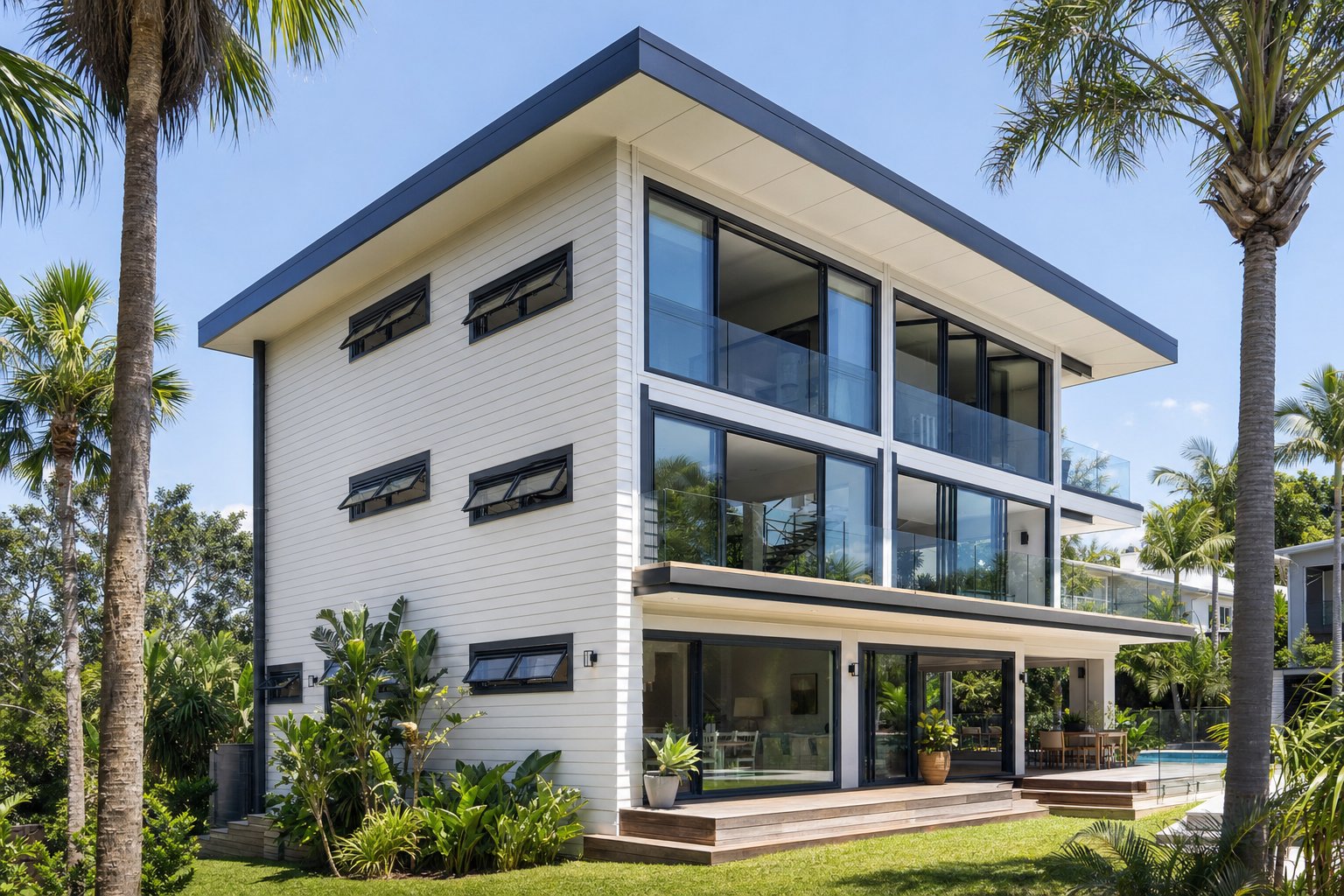
Selecting the right frame material and understanding thermal performance gets you to the starting line. The next step is matching a specific aluminium window design to each opening in your home based on two practical factors: what the room is used for, and which direction the wall faces. Orientation dictates how much sun, heat, breeze, and weather a window receives throughout the day, and the Sunshine Coast’s subtropical latitude amplifies those differences.
North and East-Facing Rooms for Light and Airflow
North-facing walls are the prize orientation in the Southern Hemisphere. They receive consistent, indirect light without the punishing direct heat that west-facing glass cops in the afternoon. On the Sunshine Coast, north-facing windows allow low-angle winter sun to warm interiors while remaining easy to shade in summer with correctly sized eaves. Living rooms, kitchens, and open-plan zones benefit most from this orientation.
East-facing windows capture gentle morning sun and progressively cool as the day moves on. They suit breakfast nooks, home offices, and bedrooms where early light is welcome but afternoon heat is not.
- North-facing living areas — large sliding or bifold windows to maximise light and cross-ventilation; pair with fixed highlight panes for additional daylight without sacrificing wall space.
- North-facing kitchens — awning windows above benchtops for ventilation during cooking, even when rain arrives.
- East-facing bedrooms — casement windows to catch morning breezes and seal tightly against afternoon weather.
- East-facing home offices — awning or louvre windows for adjustable airflow that reduces glare on screens as the sun rises.
West-Facing Windows and Heat Management Strategies
West-facing glass is the most thermally challenging orientation on the Sunshine Coast. Afternoon sun strikes at a low angle that eaves cannot easily shade, driving significant heat gain through summer. The Australian Government’s Your Home guide recommends deep overhanging shading or vertical shading for east and west-facing glazing, and specifying glass with a solar heat gain coefficient no higher than 0.20 where adequate shading is not possible.
From a window style perspective, the best aluminium window styles for west-facing walls minimise glass area while still providing ventilation and light:
- West-facing bathrooms and laundries — louvre windows for maximum airflow with minimal glass exposure to direct sun.
- West-facing living spaces — smaller awning windows positioned high on the wall, allowing hot air to escape via convection while limiting direct solar radiation entry.
- West-facing dining rooms — fixed panes with low-E glazing for evening light, flanked by narrow casement windows for controlled ventilation.
Where large west-facing openings are unavoidable, double glazing with solar control low-E coating and external shading devices become essential rather than optional.
Renovation vs New Build Window Considerations
New builds offer complete freedom. You can size openings, position them precisely for orientation, and specify any window type without structural compromise. The aluminium window design integrates with the wall system from the ground up, with nailing flanges fixed directly to framing before cladding goes on.
Aluminium windows for renovations on the Sunshine Coast face different constraints. Existing wall systems, cladding, and structural framing limit what is possible without major reconstruction. Replacement windows slide into existing openings without disturbing surrounding materials, but they must work within the dimensions already established. Changing a window type during renovation, say swapping a fixed pane for an operable awning, is straightforward as long as the rough opening dimensions remain the same. Altering the opening size, however, involves structural work including new lintels and potentially re-cladding.
For renovators, the practical approach is to assess each opening individually. Ask whether the current window type serves the room’s function and orientation well. A west-facing bedroom with a large single-glazed sliding window might benefit more from a smaller awning window with upgraded glazing than a like-for-like replacement. Renovation is the opportunity to correct orientation mistakes the original builder made decades ago, not just refresh what already exists.
Getting the style right for each wall and room is the design decision. Keeping those windows performing over the following decades in salt air is the maintenance decision, and it carries its own set of practical requirements that coastal homeowners cannot afford to overlook.
Maintaining Aluminium Windows in Salt-Air Environments
Salt never takes a day off. It arrives on every onshore breeze, settles into tracks and crevices, and quietly works against protective coatings if left unchecked. The good news is that aluminium window maintenance in coastal conditions is straightforward, inexpensive, and takes very little time when done consistently. Neglect, on the other hand, compresses a 40-year lifespan into something far shorter.
Routine Cleaning and Inspection for Coastal Properties
Cleaning frequency depends on how close your property sits to the waterline. Homes within a kilometre of the beach accumulate visible salt deposits within weeks. Properties further inland get more breathing room, but still face higher salt loads than anything south of the Tweed or west of the range.
The method is simple: fresh water removes salt before it bonds to the powder coat surface. A garden hose does the job for routine rinses. For deeper cleans, warm water with a mild pH-neutral detergent and a soft cloth or microfibre mitt lifts grime without scratching the finish. Avoid abrasive cleaners, ammonia-based products, or anything designed for heavy industrial degreasing. These strip protective coatings rather than preserving them.
- Monthly — Rinse all frames and tracks with fresh water. Wipe accessible frames with a damp cloth and mild detergent. Vacuum or brush debris from sliding tracks. Check drainage holes are clear so water does not pool inside the frame.
- Quarterly — Deep clean frames using a diluted vinegar solution (one part white vinegar to three parts water) to neutralise salt residue that detergent alone misses. Lubricate hinges, rollers, locks, and handles with a silicone-based spray. Avoid oil-based lubricants, which attract dust and grit that accelerate wear. Inspect rubber seals and gaskets for cracking, hardening, or loss of flexibility.
- Annually — Conduct a full inspection of powder coating integrity. Look for chalking, bubbling, or any white powdery residue on the aluminium surface, which signals the oxide layer is being compromised. Tighten loose screws on hardware. Check window alignment and operation. For properties within 500 metres of the ocean, consider a professional inspection to catch early-stage pitting before it becomes structural.
After any major storm event with strong onshore winds, an immediate freshwater rinse is worth the ten minutes it takes. Storm-driven salt spray is highly concentrated and far more aggressive than everyday coastal air.
When to Repair, Respray, or Replace
Not every sign of wear means a window has reached end of life. Understanding the difference between cosmetic ageing and structural failure saves money and avoids unnecessary replacement.
Aluminium window repairs on the Sunshine Coast typically involve hardware replacement, seal renewal, or localised touch-up of damaged powder coating. Stiff handles, seized locks, or rollers that no longer glide smoothly are hardware issues, not frame failures. Replacing these components restores full function without touching the frame itself. Similarly, aluminium sash window repairs often come down to worn balances or degraded weatherstripping rather than any problem with the aluminium profile.
Respraying becomes relevant when the powder coat has faded, chalked, or been scratched through to bare metal across significant areas. A professional respray applies a new powder coat or two-pack paint system over the existing frame, restoring both appearance and corrosion protection. This is a legitimate aluminium window restoration option on the Sunshine Coast that extends service life by another 15 to 20 years at a fraction of full replacement cost.
Replacement is the right call when you see deep pitting into the aluminium itself, holes through the frame wall, frames that flex or feel soft under hand pressure, or corrosion so widespread that repair costs approach the price of new windows. If hardware mounting points have corroded away or the frame can no longer hold glazing securely, restoration is no longer viable.
Powder coating quality plays a direct role in how soon any of these interventions become necessary. A standard 40 to 60 micron coating suits sheltered inland locations. Coastal properties, particularly those within a kilometre of the beach, benefit from 80 micron or thicker coatings rated to higher durability standards. Marine-grade specifications push beyond 100 microns for beachfront sites. The thicker and better-bonded the initial coating, the longer the frame resists salt attack without maintenance escalation.
Extending Window Lifespan in Salt Spray Zones
Beyond routine cleaning, a few targeted strategies push aluminium windows well past their expected service life in aggressive coastal conditions:
- Upgrade hardware to Grade 316 stainless steel — standard hardware often fails before the frame does. Stainless steel hinges, locks, and rollers resist salt corrosion far longer than zinc-plated alternatives.
- Apply marine-grade wax to frames every six months — a thin hydrophobic barrier that repels salt water and slows deposit accumulation between cleans.
- Replace perished seals promptly — cracked or hardened rubber gaskets allow moisture behind the frame, accelerating hidden corrosion in areas you cannot easily inspect.
- Avoid dissimilar metals in contact with the frame — steel screws or brackets touching aluminium create galvanic corrosion cells that eat into the frame at the contact point. Specify stainless or aluminium fixings throughout.
- Keep vegetation clear of frames — plants trap moisture against surfaces and restrict airflow that would otherwise help frames dry between salt exposure events.
These are not expensive interventions. A tube of silicone lubricant, a tin of marine wax, and a quarterly hour with a hose represent the total investment needed to keep aluminium windows performing at their best in salt air. The payoff is measured in decades of additional service, deferred replacement costs, and windows that still operate smoothly long after the mortgage is paid off.
Maintenance protects the frame’s structural integrity. But the visible finish, the colour and texture that define your home’s street presence, faces its own set of coastal challenges that deserve separate attention.
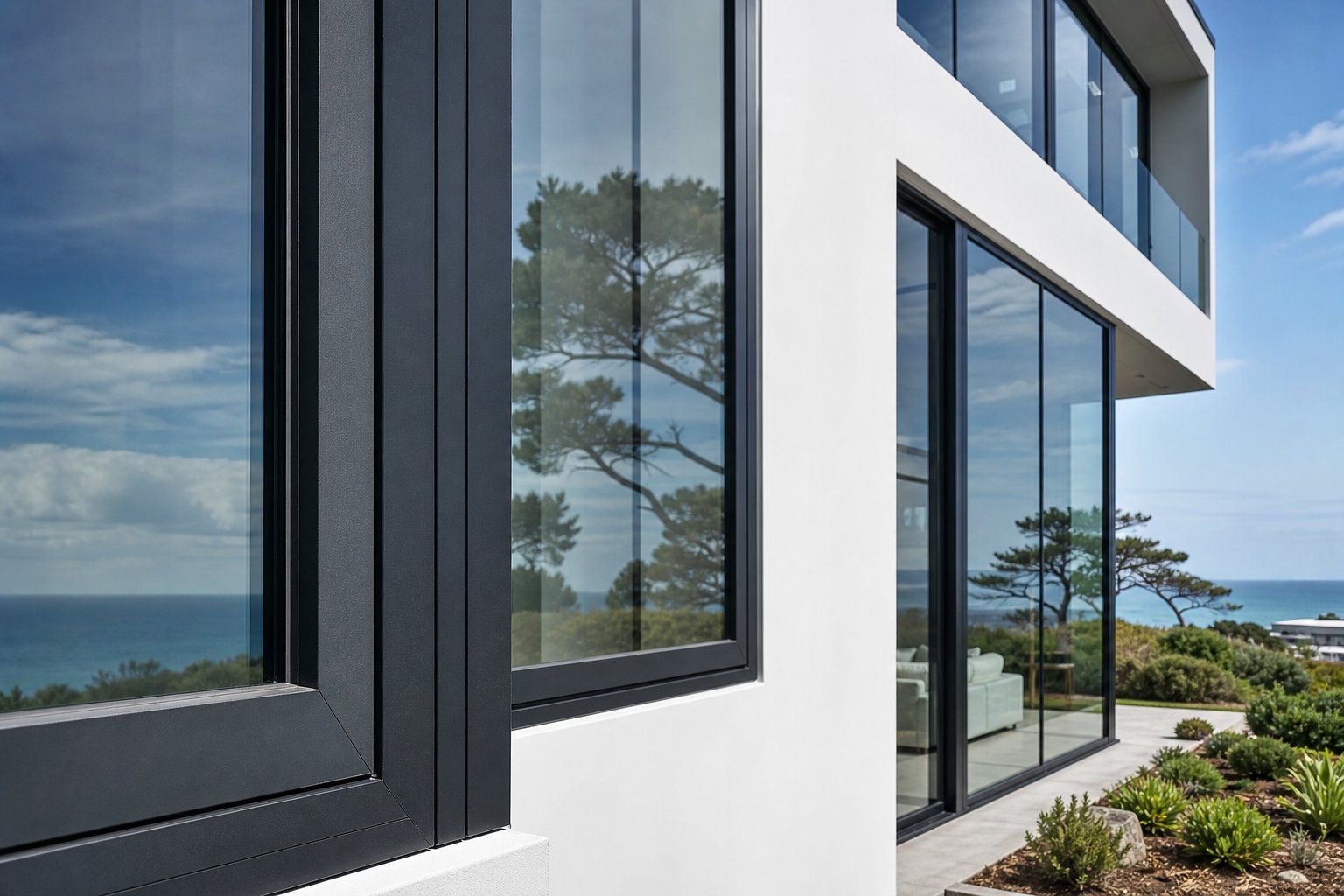
Powder Coating Colours and Coastal-Grade Finishes
Powder coating does double duty on aluminium windows. It provides the corrosion barrier that keeps salt air from attacking the underlying metal, and it delivers the colour and texture that shape your home’s visual identity. Choosing a finish on the Sunshine Coast involves more than picking a shade from a swatch card. Coastal conditions interact differently with different finishes, and the wrong specification shortens the interval before painting aluminium windows becomes necessary.
How Coastal Conditions Affect Different Finishes
Finish type determines how a surface weathers over time. Gloss finishes show scratches and chalking more readily than matte or satin alternatives, because any surface degradation disrupts the reflective quality that defines the sheen. Matte finishes mask minor surface wear better, making them a practical choice for salt-exposed elevations where micro-abrasion from wind-carried particles is constant. Satin sits between the two, offering a subtle lustre that ages gracefully without highlighting every imperfection.
UV intensity on the Sunshine Coast accelerates colour fade in lower-grade coatings. Darker colours absorb more UV energy, which stresses the resin binders in the powder coat and can cause chalking within 10 to 12 years on north and west-facing frames if the coating quality is not matched to the exposure level.
Colour Selection and Thermal Performance
Colour is not purely aesthetic in a cooling-dominated climate. Darker frames absorb significantly more solar radiation than lighter ones, raising the frame’s surface temperature and contributing to conducted heat gain through the profile. On west-facing openings that already cop intense afternoon sun, a black frame runs noticeably hotter than a white or light grey equivalent.
- Whites and off-whites — maximum solar reflectance, lowest heat absorption, suit any orientation. Timeless on coastal Queenslanders and contemporary builds alike.
- Light greys and silvers — strong reflectance with a modern edge. Hide salt residue between cleans better than pure white.
- Charcoals and monument grey — popular for contrast against light render or cladding. Moderate heat absorption; best on south and east elevations or shaded openings.
- Matt black — bold and architectural, but absorbs the most heat. Reserve for well-shaded frames or thermally broken profiles where conducted gain is managed.
- Woodgrain finishes — sublimated timber-look coatings that deliver warmth without timber’s maintenance burden. Suit heritage-style renovations and Queenslander restorations.
Suppliers like MEICHEN offer extensive colour ranges and custom configuration options, allowing homeowners to match specific coastal design requirements across residential and commercial projects without compromising on coating quality.
Marine-Grade Coatings for High-Exposure Properties
Standard powder coating applies at 40 to 60 microns and suits sheltered or inland sites. Coastal-rated coatings step up to 60 to 80 microns with higher-durability polyester formulations. For beachfront properties or homes within 500 metres of the waterline, marine-grade specifications push coating thickness beyond 80 microns, often using PVDF (polyvinylidene fluoride) technology that delivers superior UV stability and salt spray resistance over 20-plus years.
The practical difference is longevity before an aluminium windows respray on the Sunshine Coast becomes necessary. A standard coating on a beachfront home may chalk and fade within 8 to 10 years. A marine-grade PVDF finish on the same property can hold its colour and integrity for 20 years or more with routine washing. The upfront cost difference is modest compared to the expense of aluminium window painting down the track, particularly on double-storey homes requiring scaffold access.
Specifying the right coating grade at the point of purchase is always cheaper than correcting an under-specified finish later. When evaluating options, confirm the coating thickness, resin type, and whether the supplier warranties the finish for coastal installation in your specific corrosivity zone. That warranty conversation leads naturally into the broader question of compliance and what separates a reliable supplier from one that leaves you exposed.
Building Compliance and Choosing a Trusted Supplier
A beautiful window that fails a building inspection is not a bargain. On the Sunshine Coast, compliance is not a single checkbox. It is a layered set of requirements that vary by site, and getting any layer wrong can mean failed certifications, insurance complications, or safety risks that only reveal themselves during a storm or bushfire event. Whether you are planning an aluminium window replacement on the Sunshine Coast or specifying for a new build, understanding what compliance actually involves protects your investment from day one.
BAL Ratings and Cyclone Compliance on the Sunshine Coast
The Sunshine Coast Planning Scheme 2014 includes a Bushfire Hazard Overlay that identifies properties subject to medium or high bushfire risk. If your site falls within this overlay, a BAL assessment determines the construction requirements for every building element, including windows.
BAL classifications range from BAL-LOW (no specific bushfire construction required) through BAL-12.5, BAL-19, BAL-29, and BAL-40, up to BAL-FZ (Flame Zone). Each step up demands more resilient materials and construction detailing under AS 3959:2018. At BAL-12.5 and BAL-19, the focus is sealing against ember entry. From BAL-29 upward, windows need thicker glazing, non-combustible frames, and specific glass types that resist radiant heat. Aluminium frames are inherently non-combustible, which gives them a compliance advantage over timber in bushfire-prone zones. However, the glazing configuration, glass type, and maximum pane size must all fall within tested parameters for the applicable BAL level.
Hinterland suburbs like Maleny, Montville, and parts of Nambour frequently trigger the bushfire overlay. Even properties that feel suburban can carry BAL-19 or BAL-29 ratings depending on vegetation proximity and slope. Your certifier confirms the designation, but verifying that your chosen windows carry specific bushfire certification for the relevant BAL level is your responsibility as the homeowner or builder.
AS2047 Standards and What They Mean for Your Project
Every aluminium window installed in an Australian building must comply with AS 2047, the national standard governing windows and external glazed doors. This standard is referenced directly in the National Construction Code and covers structural performance, water penetration resistance, air infiltration, and operating force.
Structural performance is where AS 2047 intersects most directly with Sunshine Coast conditions. Windows are tested and rated for specific wind classifications. A product rated for a sheltered suburban site in Brisbane may not satisfy the wind load requirements of an exposed coastal or elevated Sunshine Coast property. The wind classification for your site is determined by geographic region, terrain category, shielding, and building height under AS/NZS 1170.2 or AS 4055. Your window selection must match or exceed that classification.
Compliance verification comes down to documentation. Every compliant window should carry a performance label showing its tested wind and water ratings, and the manufacturer should provide a certificate of compliance on request. Products tested through NATA-accredited laboratories and supplied by members of the Australian Glass and Window Association (AGWA) offer an additional layer of assurance. If a supplier cannot produce these documents before you commit to an order, treat that as a serious red flag.
What to Look for in a Sunshine Coast Window Supplier
Compliance documentation is the baseline. Beyond that, the right supplier for your project should demonstrate capability across several practical dimensions. Whether you are comparing established names like Bradnams aluminium windows on the Sunshine Coast or evaluating newer entrants, the same criteria apply:
- Product range and configuration flexibility — can they supply the specific window types, sizes, and opening configurations your design requires, or are you limited to standard catalogue items?
- Compliance documentation on demand — performance labels, AS 2047 certificates, BAL certifications, and WERS data should be available before purchase, not chased after installation.
- Glazing options — single, double, low-E, laminated, and tinted glass should all be available within the same framing system, allowing you to specify different glazing for different orientations without changing suppliers.
- Powder coating rated for your corrosivity zone — confirm the coating thickness and warranty covers your specific distance from the coastline.
- Project support for builders and architects — technical drawings, wind load calculations, and NatHERS-compatible specifications streamline the approval process.
- Supply capability for both residential and commercial scale — a supplier comfortable with single-home renovations and multi-unit developments offers consistency across project types.
Browsing aluminium windows on Gumtree or other secondhand marketplaces can work for sheds or non-habitable structures, but compliance documentation rarely transfers with used products. For any habitable building, you need windows with traceable certification matched to your site’s specific requirements.
For Sunshine Coast projects, MEICHEN’s aluminium window range offers custom configurations, premium brand partnerships, and project-based supply with the glazing choices and compliance documentation that coastal builds demand. Their systems cover residential and commercial applications, making them a practical option to explore when comparing suppliers against the criteria above.
Ultimately, the supplier you choose should make compliance feel simple rather than burdensome. They should know which questions to ask about your site, which specifications to recommend for your exposure zone, and which documentation to provide without being prompted. That combination of product quality, technical knowledge, and proactive support is what separates a supplier worth trusting from one that leaves gaps you will only discover at inspection time.
Frequently Asked Questions About Aluminium Windows on the Sunshine Coast
1. How long do aluminium windows last in Sunshine Coast coastal conditions?
Well-maintained powder-coated aluminium windows typically deliver 40 to 50 years of service on the Sunshine Coast. Lifespan depends heavily on proximity to the ocean and maintenance consistency. Properties within 500 metres of the waterline need marine-grade coatings (80+ microns) and quarterly salt removal to reach the upper end of that range. Homes further inland with standard coastal-rated finishes often exceed 40 years with minimal intervention. By comparison, timber frames in the same conditions last 20 to 30 years with intensive upkeep, and uPVC manages 20 to 35 years before UV degradation becomes problematic.
2. Are thermally broken aluminium windows worth it on the Sunshine Coast?
Thermally broken frames make the most financial sense on west-facing and large north-facing openings where solar heat gain is highest. Because Sunshine Coast homes prioritise cooling loads over heating, the benefit centres on reducing air conditioning demand during summer rather than retaining warmth in winter. A thermal break combined with low-E double glazing on exposed orientations can meaningfully improve your NatHERS rating and lower energy bills. For south-facing or well-shaded windows, standard aluminium frames often provide adequate performance without the added cost of thermal break technology.
3. How do I maintain aluminium windows near the beach?
Monthly freshwater rinsing removes salt deposits before they bond to the powder coat surface. Every quarter, deep clean with diluted white vinegar (one part vinegar to three parts water) to neutralise stubborn salt residue, then lubricate all hardware with silicone-based spray. Annually, inspect the powder coating for chalking or bubbling and check seal flexibility. After major storm events with onshore winds, rinse frames immediately. Upgrading hardware to Grade 316 stainless steel and applying marine-grade wax every six months further extends lifespan for beachfront properties.
4. What building compliance do aluminium windows need on the Sunshine Coast?
All aluminium windows must comply with AS 2047, which covers structural wind load performance, water penetration resistance, and air infiltration. The wind classification for your specific site determines the minimum rating your windows need. Properties within the Sunshine Coast Planning Scheme’s Bushfire Hazard Overlay also require BAL-rated windows under AS 3959:2018, with requirements escalating from ember sealing at BAL-12.5 to radiant heat-resistant glazing at BAL-29 and above. Suppliers should provide performance labels and compliance certificates matched to your site’s wind region and BAL classification before purchase.
5. What is the best aluminium window type for subtropical Queensland homes?
No single type suits every room. The subtropical climate rewards a combination approach: awning windows for bathrooms and laundries where ventilation during rain is essential, sliding or bifold windows for living areas that benefit from open-plan airflow, casement windows on breeze-facing bedrooms, and louvres for spaces needing maximum ventilation with privacy. Orientation matters as much as room function. West-facing walls benefit from smaller openings like high-set awnings or louvres to limit heat gain, while north-facing living zones can accommodate large sliding or bifold configurations paired with correctly sized eaves for summer shading.
More Window & Door Guides