What Goes Into an Aluminium Window Installation Price
When you receive a quote for new aluminium windows, the total figure bundles two very different expenses into one number: the cost of the window unit itself and the labour required to fit it. Most homeowners never see where one ends and the other begins. That lack of clarity is exactly how unexpected charges slip through.
The aluminium window installation price you pay covers far more than someone placing a frame into a hole. It includes removal of existing windows, preparation of the opening, shimming and levelling, sealing against weather, flashing for waterproofing, and interior and exterior trim work. Each of these tasks carries its own time and material cost, and each varies depending on your specific project conditions.
What Aluminium Window Installation Price Actually Covers
Think of it this way: the window unit is a product you buy off a schedule. The installation is a service shaped by your home’s structure, access, storey height, and condition of existing openings. A window installation price reflects site-specific labour, not just a flat rate per unit. That distinction matters when comparing quotes, because two identical windows can carry wildly different fitting costs depending on where and how they need to go in.
Why Installation Costs Are Separate From Window Costs
Industry data consistently shows that installation labour accounts for a significant share of total project spend. Suppliers price their products based on materials, size, and specifications. Installers price their work based on complexity, time, and risk.
Installation labour typically represents 30 to 50 per cent of a total window project cost — meaning on a $10,000 job, you could be paying $3,000 to $5,000 purely for fitting work.
This article focuses on that fitting cost. Rather than rehashing general window buying advice, it unpacks what drives window installation prices in Australia — the specific line items, variables, and hidden charges that determine what you actually pay your installer. If you have ever searched for a window installation labor cost calculator hoping to make sense of a quote, the sections ahead break down exactly what those numbers represent and why they fluctuate so widely from one project to the next.
Key Factors That Drive Installation Pricing Up or Down
No two aluminium window projects cost the same to install. The price swings depend on a handful of measurable variables — some obvious, others less so. Understanding these factors before you request quotes puts you in a stronger position to evaluate what is reasonable and what is inflated.
Window Size and Custom Dimensions
Size is one of the biggest levers on cost. Standard aluminum window sizes — typically ranging from around 600mm x 900mm up to 1200mm x 1500mm — are manufactured in bulk, held in stock, and designed to fit common rough openings in Australian homes. Fitting a standard-sized window is faster and more predictable for installers, which keeps labour charges lower.
Custom or oversized windows change the equation entirely. A floor-to-ceiling fixed panel or an unusually wide sliding unit requires purpose-built frames, specialist glazing, and more hands on site to manoeuvre heavier components into position. The aluminium window cost per unit climbs, but so does the installation price — custom dimensions often demand shimming, reframing of the structural opening, and longer sealing times. As a general rule, expect custom sizing to add 20 to 40 per cent to the fitting cost compared with a standard unit of similar type.
Project volume also plays a role. A single window replacement carries a higher per-unit labour charge than a batch of ten because the installer absorbs mobilisation, setup, and cleanup costs regardless of quantity. Bundling multiple windows into one project creates economies of scale that bring the window price per sq ft (or per square metre) of installed glazing down noticeably.
Site Accessibility and Structural Work
A ground-floor window in a single-storey brick veneer home is about as straightforward as aluminium windows installation gets. Move that same window to the second storey of a double-storey home, and you introduce scaffolding hire, safety compliance, and slower workflow — all of which inflate the quote.
Structural modifications push costs further. Enlarging an opening to accommodate a bigger window means cutting into framing, adding a new lintel, and potentially involving an engineer’s certification to satisfy the National Construction Code. Reducing an opening requires infill framing and patching of internal and external finishes. Either scenario adds a full day or more of labour before the actual window goes in.
Tight access — narrow side passages, heritage streetscapes with restricted parking, or upper-level apartments with no crane access — adds logistical cost that rarely appears in generic price guides but shows up clearly on detailed quotes.
Thermal Break Technology and Its Price Impact
The type of aluminium system specified has a direct bearing on installation time. Thermally broken aluminium frames use a polyamide strip between the inner and outer frame sections to reduce heat transfer. These profiles are heavier than standard non-thermally broken aluminium and require more precise handling during fitting. The sealing requirements are also more involved — incorrect installation can compromise the thermal break’s performance, so installers spend additional time ensuring correct alignment and continuous weathersealing around the entire perimeter.
Compared to lightweight vinyl frames, aluminium profiles demand more physical effort and sometimes a second pair of hands for larger units. That translates to higher labour hours per window. For thermally broken systems specifically, the combination of greater frame weight, tighter tolerances, and specialised sealing adds roughly 15 to 25 per cent more installation time versus a non-thermally broken aluminium window of the same size.
None of these variables exist in isolation. A project involving custom-sized, thermally broken aluminium windows on the upper storey of a weatherboard home with restricted site access will sit at the top end of installation pricing. Conversely, a batch of standard-sized, non-thermally broken units on an accessible ground floor represents the lower end. The gap between those two scenarios can easily double the per-window fitting cost — which is precisely why understanding each factor matters before you sign off on a quote.
New Construction vs Retrofit Installation Costs
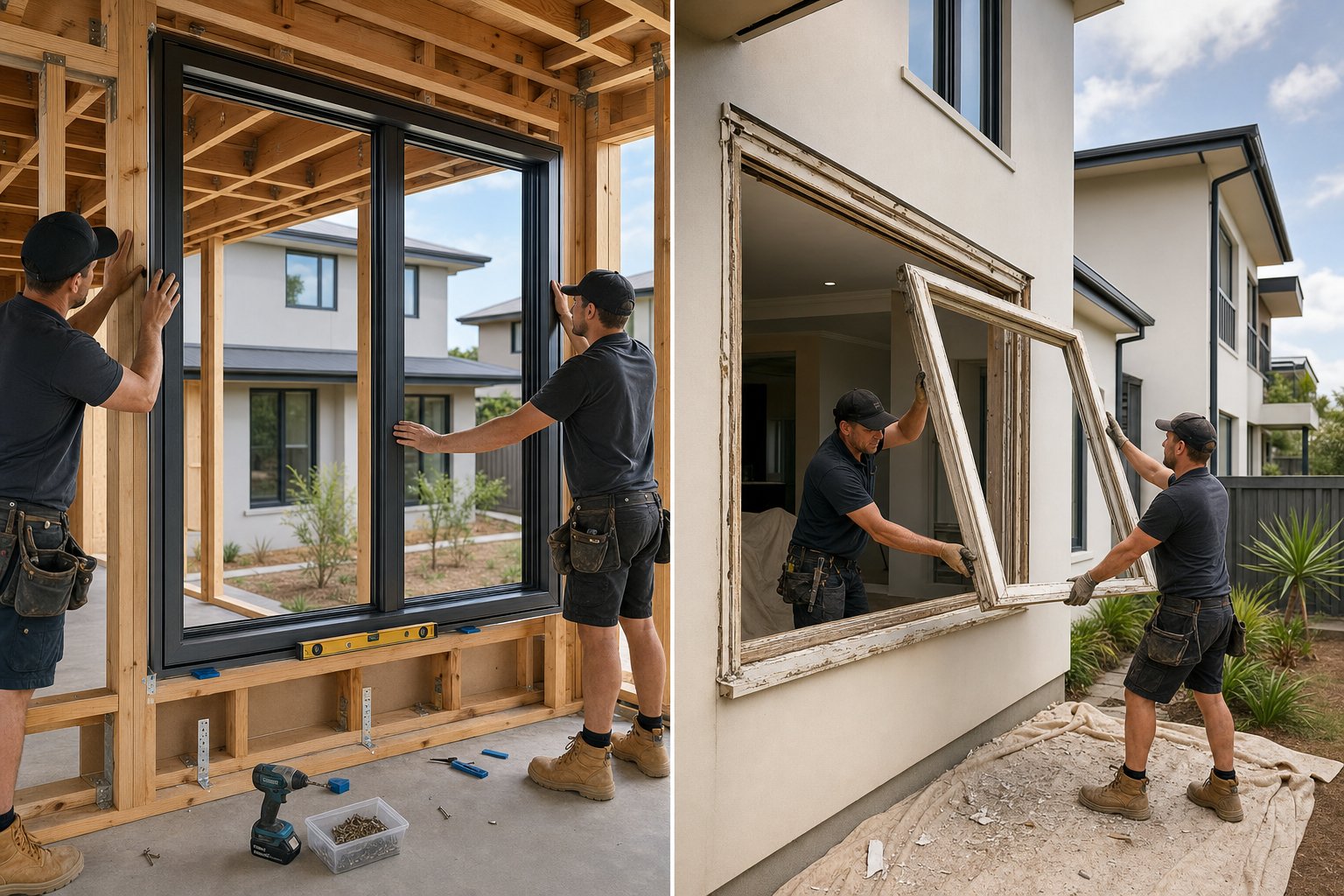
The scenario your installer walks into — a bare stud frame on a new build versus an existing opening with old frames still in place — shapes the construction window cost more than almost any other single variable. These two installation methods follow different processes, carry different risks, and land at different price points.
New Construction Installation Process and Costs
In a new build or major renovation where wall framing is exposed, aluminium windows are fitted directly into rough openings using nailing fins (or fixing lugs, as they are more commonly called in Australia). The installer secures the frame to the timber or steel studs, applies flashing tape to the perimeter, and seals the unit before external cladding goes on. Because the opening is purpose-built to the window’s dimensions and there is nothing to remove first, the process is relatively quick and predictable.
Labour time per window on a new construction project typically runs between 45 minutes and 1.5 hours for standard-sized units. There is no demolition, no surprises hidden behind old frames, and no patching of internal linings. The cost of new windows and installation in this context is lower per opening because the installer works in a controlled, sequential environment — often fitting multiple windows across an entire floor in a single day.
Retrofit and Replacement Installation Differences
Retrofit work is a different story. The installer must first remove existing window frames — timber, steel, or older aluminium — then assess the condition of the surrounding structure before the new unit can go in. This is where unpredictability drives cost upward. Timber reveals may be rotted. Brick openings may not be square. Waterproofing membranes may be damaged or absent entirely. Each issue adds time and materials that cannot be quoted with certainty until the old frame comes out.
Replacement windows are designed to fit within existing openings, which means shimming for level and plumb, reframing where the old opening does not match the new unit’s dimensions, and reapplying waterproofing around the entire perimeter. Interior and exterior trim must also be reinstated or replaced.
| Factor | New Construction | Retrofit / Replacement |
|---|---|---|
| Installation method | Fixed directly to exposed studs via fixing lugs | Fitted into existing opening after old frame removal |
| Typical labour time per window | 45 minutes – 1.5 hours | 1.5 – 3 hours |
| Common additional work | Flashing tape, temporary bracing | Demolition, shimming, reframing, waterproofing repair, trim reinstatement |
| Relative cost level | Lower (predictable scope) | Higher (variable scope, hidden conditions) |
Several factors push retrofit pricing higher still. Multi-storey homes require scaffolding or elevated work platforms for upper-level openings, adding both hire costs and safety compliance time. Heritage-listed properties — common across inner-city suburbs of Sydney, Melbourne, and Brisbane — may carry council restrictions on frame profiles, colours, or sightlines that limit product choices and demand bespoke fitting solutions. And in older fibro or weatherboard homes, discovering damaged framing or asbestos-containing materials behind existing windows can halt work entirely until remediation is completed.
For homeowners researching homewyse window replacement estimates or similar online calculators, keep in mind that most generic tools assume straightforward conditions. The real-world cost of replacing aluminium windows in an existing Australian home almost always sits above those baseline figures once site-specific complications are factored in. Requesting a detailed scoping visit — where the installer physically inspects each opening — is the only reliable way to get an accurate retrofit quote.
Knowing which installation category your project falls into gives you a clearer lens for reading quotes. But regardless of whether you are building new or replacing old, every quote should itemise exactly what you are paying for — and that line-item transparency is where most homeowners lose visibility.
Complete Line-Item Cost Breakdown for Installation
A professional window installation quote should read like a receipt, not a mystery. Every charge should be traceable to a specific task or material. Yet many homeowners receive a single lump sum with little explanation of what sits behind it. Here is what a transparent window installation estimate actually looks like when broken into its component parts.
Labour and Material Line Items Explained
The window install labor cost on a detailed quote typically splits into distinct phases. Each phase carries its own time allocation and, in some cases, separate material charges:
- Window unit supply — the product itself, listed by size, type, profile system, and glazing specification
- Removal of existing windows — demolition labour, including cutting out old frames, pulling fixings, and clearing the opening
- Opening preparation — squaring, shimming, reframing where needed, and cleaning the reveal for the new unit
- Installation labour — fitting, levelling, fixing the new frame into the structural opening, and temporary bracing
- Flashing and waterproofing — flashing tape, sill pans, and membrane application around the perimeter to prevent water ingress
- Sealing — expanding foam infill, interior and exterior sealant application, and backer rod where required
- Exterior trim and aluminium capping — covering exposed timber reveals with aluminium cappings for weather protection and a clean finish
- Interior trim reinstatement — replacing or repainting architraves, sills, and reveals disturbed during removal
- Disposal of old windows — skip bin hire or tip fees for removing old frames, glass, and packaging from site
- Post-installation cleanup — removing protective coverings, sweeping debris, and leaving the site in liveable condition
When comparing quotes side by side, check whether each of these items appears as a separate line or gets bundled into a vague “installation” figure. Bundling is not inherently dishonest, but it makes meaningful comparison impossible. A window installation quote that itemises material, labour, and ancillary costs gives you leverage to identify exactly where one contractor is more expensive than another — and whether that difference reflects better workmanship or just higher margins.
The capping windows cost alone, for example, can range from $40 to $120 per opening depending on the profile depth and whether it wraps three sides or the full perimeter. The labor cost to install window trim on the interior adds another $50 to $150 per window if timber architraves need replacing or custom scribing to uneven walls. These finishing items are routinely excluded from headline quotes and presented as extras once work is underway.
Permit Fees and Disposal Costs
Council approval requirements for window replacements vary across Australian jurisdictions and depend on the scope of work. As a general rule:
- Like-for-like replacements in the same opening size rarely need council approval in most states
- Structural modifications — enlarging or reducing openings, adding new openings, or altering lintels — typically require a development application (DA) or complying development certificate (CDC)
- Multi-unit and strata buildings often need body corporate consent and may trigger additional council requirements
- Heritage-listed properties require approval from the relevant heritage authority, regardless of whether the opening size changes
Permit costs differ between councils but commonly range from $150 to $500 for residential window work involving structural changes. Some installers include permit fees in their quotes; others treat them as a pass-through cost billed separately. Ask upfront who is responsible for lodging the application and whether the quoted price includes any associated inspection fees.
Disposal of old windows is another line item that deserves scrutiny. Older timber or steel frames are straightforward — general waste skips handle them without issue. But homes built before the mid-1980s may contain asbestos in window putty, fibro surrounds, or eaves linings disturbed during removal. Licensed asbestos removal adds a significant surcharge, sometimes $500 or more per opening affected, and must be quoted separately under Australian workplace health and safety regulations.
Trim, Capping, and Finishing Work
The gap between a “window installed” and a “window finished” is where budget blowouts hide. Many installation contracts cover only the fitting of the window unit itself — everything beyond the frame perimeter falls into finishing scope that may sit with a different trade entirely.
Exterior aluminium capping protects exposed timber reveals from weather and eliminates ongoing painting maintenance. Interior trim reinstates the visual finish around the window — architraves, sills, and sometimes plasterboard patching where old frames were wider than the replacements. If your existing home has decorative mouldings or non-standard reveal depths, custom trim adds both material and labour costs.
A genuinely transparent quote separates these finishing items so you can see the full picture before work begins. If a quote looks surprisingly cheap, check whether capping, trim, and interior finishing are included or excluded. That missing scope is often the difference between a competitive price and an incomplete one — and it directly shapes how much your project will actually cost once every trade has left the site.
Aluminium vs Vinyl Installation Cost Comparison
Those line items look different depending on what material your windows are made from. Aluminium and vinyl are the two most common choices for Australian homes, and while the product price gap gets plenty of attention, the installation cost difference is less widely understood. It comes down to physical properties that directly affect how long your installer spends on each opening.
Why Aluminium Costs More to Install Than Vinyl
The cost of aluminium windows versus vinyl is not just a materials story — it is a labour story. Aluminium frames made from 6063-T5 alloy are roughly twice the density of PVC, which means heavier units that demand two-person handling for anything beyond a small awning window. Larger openings — sliding doors, fixed panels, stacker units — can require temporary mechanical lifting aids that vinyl equivalents simply do not need.
Beyond weight, aluminium demands tighter installation tolerances. The material does not flex the way vinyl does, so the opening must be precisely square and the frame must be anchored firmly to structural members rather than relying on friction and foam expansion. Any misalignment shows immediately as a gap or a bind in the sash operation. Installers spend more time on measurement verification, shimming, and progressive tightening of fixings.
Thermally broken aluminium profiles add another layer of complexity. The polyamide strip separating the internal and external frame sections must remain intact and correctly aligned during fitting. Overtightening fixings or forcing a frame into an out-of-square opening can compromise the thermal break’s continuity — defeating the purpose of specifying it. That care takes time, and time is what you pay for on a labour invoice.
Sealing requirements differ too. Aluminium’s rigidity means it does not compress against irregular substrates the way vinyl can, so installers rely more heavily on backer rod, sealant beads, and correctly positioned flashing to achieve a weathertight result. The net effect is an additional $80 to $150 AUD in labour per window compared with a vinyl unit of equivalent size — a figure consistent with manufacturer project data showing experienced crews charging roughly 25 to 40 per cent more for aluminium fitting work.
Thermal Performance and Long-Term Value Comparison
The higher installation cost raises a fair question: is the cost of aluminium windows justified over the long run? The answer depends on your climate zone, coastal exposure, and how long you plan to stay in the property.
Modern thermally broken aluminium achieves U-values between 0.30 and 0.35 W/m²K — within striking distance of multi-chamber vinyl at 0.28 to 0.32 W/m²K. The old reputation of metal windows as energy sieves belongs to the 1980s, before polyamide thermal breaks became standard on quality residential systems. In practical terms, the annual energy cost difference between thermally broken aluminium and vinyl in a temperate Australian climate is negligible — often less than $30 to $50 per year.
Where aluminium pulls ahead is durability. In coastal suburbs from the Sunshine Coast down to the Mornington Peninsula, salt-laden air accelerates vinyl degradation significantly. Surface chalking, seal failure, and frame brittleness can appear within 10 to 15 years on vinyl, while powder-coated aluminium tested to salt fog standards remains structurally sound for 30 to 40 years or more. That lifespan gap eliminates an entire replacement cycle — and the full cost of metal windows paid upfront often works out cheaper than paying for vinyl twice.
| Metric | Thermally Broken Aluminium | Quality Vinyl (Multi-Chamber) |
|---|---|---|
| Average installation labour per window (AUD) | $350 – $550 | $250 – $400 |
| Frame weight consideration | Heavier — often requires two-person handling | Lighter — single installer for standard sizes |
| Expected lifespan | 30 – 50 years | 20 – 30 years |
| Maintenance requirements | Minimal — occasional touch-up if coating damaged | Low — but no repair path for warping or chalking |
| Thermal performance (U-value) | 0.30 – 0.35 W/m²K | 0.28 – 0.32 W/m²K |
| Coastal suitability | Excellent — powder coat resists salt corrosion | Poor — accelerated degradation within 10–15 years |
For inland properties in mild climates where budget is the primary constraint, vinyl remains a reasonable choice. But for anyone building or renovating within a few kilometres of the coast, planning to hold the property long-term, or specifying large openings that demand structural strength, the higher aluminium windows cost — both in product and installation — pays back through avoided replacements, lower lifetime maintenance, and superior performance under Australian conditions.
That long-term calculus only holds, though, if the upfront spend is genuinely accounted for. And as many homeowners discover mid-project, not every cost makes it onto the original quote.
Hidden Costs That Catch Homeowners Off Guard
Quotes can look thorough on paper yet still leave expensive gaps. Industry data shows that unforeseen expenses routinely inflate initial window project budgets by 15 to 30 per cent — a figure that turns a manageable spend into a genuine financial headache. The charges below are not rare edge cases. They surface on Australian aluminium window projects with uncomfortable regularity, and the only reliable defence is knowing they exist before you sign a contract.
Structural Surprises Behind Old Frames
Old frames hide secrets. A timber reveal that looks solid from the room side can be riddled with dry rot, termite damage, or moisture decay once the existing window comes out. You cannot install a new aluminium frame into compromised structure — the opening must be rebuilt first, and that means unplanned carpentry, new timber, and sometimes an engineer’s sign-off.
In homes built before the mid-1980s, there is another risk entirely. Asbestos-containing materials were commonly used in window putty, fibro surrounds, and eaves linings. Disturbing these materials during removal triggers mandatory testing and, if positive, licensed asbestos remediation under Australian workplace health and safety legislation. The cost is not trivial — remediation can add $500 or more per affected opening, and no reputable installer will proceed without it.
These structural surprises represent the single most common hidden cost on retrofit projects. Contractor reports indicate that structural damage repair adds $150 to $500 per window depending on severity, and nearly 20 per cent of window replacements require some form of reframing or opening modification.
Access Equipment and Compliance Upgrades
Ground-floor window install prices rarely include scaffolding because none is needed. Move up to a double-storey home, and the picture changes fast. Scaffold hire or elevated work platform rental for upper-level openings typically runs $300 to $800 per day depending on the configuration and site constraints. For multi-day projects — common when replacing all windows across an entire upper storey — that equipment cost accumulates quickly and may not appear on a base-level quote.
Code-compliance upgrades are another quiet budget inflator. Lodging a development application or complying development certificate for structural window modifications can trigger requirements to upgrade other elements: bushfire-rated glazing in BAL-rated zones, upgraded fall protection for openings above ground level, or improved energy performance to satisfy NCC 2022 provisions. None of these are optional once triggered, and none were part of the original plan.
Weather delays compound the issue on multi-day projects. If rain prevents exterior sealing or waterproofing work, the crew either stands idle or demobilises and returns later — both scenarios add cost that is difficult to predict at quoting stage.
Scope Gaps Between Trades
Perhaps the most frustrating hidden cost is work that falls into a grey zone between your window installer and other trades. Aluminium window wrap cost — the capping of exposed timber reveals — is sometimes included in the window contract and sometimes classified as a separate job for a cladding or carpentry contractor. Gas strut window mechanisms on awning or top-hung units may be installed by the window supplier but adjusted or serviced by a different trade. Interior plastering, painting of new reveals, and repair of skirting boards disturbed during removal almost always sit outside the window installer’s scope entirely.
These scope gaps only become visible once the installer leaves and you realise the job is not actually finished. Chasing separate tradespeople for piecemeal finishing work costs more per hour than having it bundled upfront.
Here are the most common hidden costs ranked from most to least frequent based on contractor experience and industry reporting:
- Structural damage or rot discovered behind existing frames
- Interior and exterior finishing work excluded from the installation contract
- Scaffolding or access equipment hire for upper-storey openings
- Disposal surcharges for asbestos-containing materials
- Code-compliance upgrades triggered by permit applications
- Weather delays on multi-day projects requiring crew return visits
- Non-standard flashing or waterproofing requirements for irregular substrates
Protecting yourself against these surprises comes down to three actions. First, request a detailed scoping visit before accepting any quote — a genuine inspection where the installer physically examines every opening, checks for rot and asbestos indicators, and notes access requirements. Second, ask explicitly what is excluded from the quoted price and get the answer in writing. Third, build a contingency budget of 10 to 15 per cent above the quoted total. If the contingency goes unspent, you keep the savings. If it is needed, you avoid the stress of scrambling for funds mid-project.
Seasonal timing offers one more lever. Window installers near me prices — or anywhere in Australia — tend to peak during the warmer months when renovation activity surges. Scheduling your project for autumn or early winter, when installer demand drops, can yield more competitive pricing and shorter lead times. Off-peak scheduling will not eliminate hidden costs, but it improves your negotiating position and may reduce equipment hire rates when scaffolding suppliers are less booked out.
These surprise charges explain why two seemingly identical quotes can end up costing vastly different amounts once the project wraps up. The difference is not always the installer’s honesty — it is often their thoroughness at scoping stage. And that same thoroughness is what separates a cost-effective project from an expensive one when you start looking for ways to bring the total down.
Smart Ways to Reduce Aluminium Window Installation Costs
Knowing where hidden costs lurk is half the equation. The other half is actively structuring your project to avoid them — or at least minimise their impact on your final bill. The strategies below do not require sacrificing quality or accepting inferior products. They work because they target inefficiencies in how window projects are typically scoped, quoted, and scheduled.
Standard Sizes and Project Bundling Savings
Custom dimensions are the fastest route to an inflated aluminium windows installation price. Every non-standard frame requires purpose fabrication, individual quality checks, and more careful fitting on site. Choosing from an aluminium windows price list of standard sizes — those already tooled and stocked by manufacturers — removes that fabrication premium and cuts labour time because installers work with predictable openings they have fitted hundreds of times before.
Where an opening does not quite match a standard size, consider the mullion approach: splitting one wide opening into two smaller ones using a joining bar. Two standard casement windows fitted side by side can cost less to supply and install than a single oversized custom slider — and they give you more control over ventilation without sacrificing glazed area.
Project bundling delivers the next significant saving. Replacing one or two windows at a time means paying full mobilisation, setup, and cleanup costs each visit. Grouping all your windows and doors into a single project spreads those fixed costs across more openings. Industry practice confirms that bulk purchase and installation consistently lowers the per-unit price through economies of scale — material discounts from suppliers plus more efficient use of installer time on site.
A practical example: replacing eight standard aluminium awning windows in one visit might cost $4,000 to $5,500 in total installation labour. Doing those same eight windows across four separate appointments could push the combined labour to $6,000 to $7,500 once you account for repeated site setup and waste removal trips.
Timing Your Project for Better Pricing
Demand fluctuates across the year, and installers price accordingly. Peak renovation season in most Australian states runs from late spring through summer — October to February — when homeowners chase completions before Christmas or want work done in warmer weather. During these months, lead times blow out, quotes come back higher, and tradespeople have less incentive to sharpen their pricing because their books are full.
Scheduling your project for autumn or early winter shifts the dynamic in your favour. Installer availability improves, scaffolding hire companies offer better rates, and you gain negotiating leverage on both labour and material supply. The windows and doors prices themselves do not necessarily drop, but the total project cost falls because every ancillary expense — equipment, scheduling, crew availability — becomes more competitive.
Beyond seasonal timing, getting multiple detailed quotes remains one of the most effective cost controls available. Three quotes is a minimum; five gives you a clearer picture of market rate. The key word is detailed — a single lump-sum figure tells you nothing. Request line-item breakdowns and compare each component: removal, preparation, fitting, sealing, capping, trim, disposal. You will quickly spot which contractors include finishing work and which quote only the bare installation, leaving you to chase and pay for trims separately.
Choosing a Full-Service Supplier Partner
One of the less obvious cost drivers on window projects is the coordination gap between product supplier, fabricator, and installer. In a fragmented supply chain, each party adds their margin, and miscommunication between them creates costly errors — wrong sizes fabricated, incorrect profiles delivered, frames that do not match the structural openings because nobody verified drawings against site conditions.
Working with a supplier who manages the full project lifecycle eliminates these middleman markups and coordination failures. When one organisation handles everything from initial drawings and material schedules through to system recommendations, manufacturing coordination, and delivery planning, there are fewer handoff points where mistakes and margin-stacking occur. Builders and procurement teams, in particular, benefit from this approach because it gives them a single accountable contact for the entire window package rather than juggling three or four separate contracts.
MEICHEN’s services model illustrates this full-service approach — covering system recommendations, material calculation, manufacturing coordination, quality control, and logistics under one roof. For projects where affordable aluminium windows matter without compromising performance, that consolidated workflow translates directly into lower total cost because you avoid duplicated effort, freight inefficiencies, and the rework that fragmented supply chains inevitably produce.
Here are the specific actions you can take to bring your installation costs down without cutting corners:
- Specify standard window sizes wherever possible — reserve custom dimensions for feature openings that genuinely require them
- Bundle all window replacements into a single project phase to capture volume discounts and reduce mobilisation charges
- Schedule installation during autumn or early winter when demand and pricing are lower
- Collect at least three to five line-item quotes and compare each cost component individually
- Match thermal performance to your climate zone — specifying high-end thermally broken profiles for a mild inland climate adds cost without proportional energy benefit
- Use mullions to split oversized openings into standard-sized units where visually acceptable
- Choose a supplier who controls fabrication and logistics to remove coordination markups from the chain
- Confirm in writing what is included and excluded in every quote before signing
Each of these strategies targets a different cost layer. Applied together, they can realistically reduce your total project spend by 15 to 25 per cent compared with an unplanned approach — without downgrading the product, the installer, or the end result.
Savings at the point of purchase are one dimension of value. But the real measure of whether a window project was money well spent only becomes clear over the following decades — when you factor in maintenance, energy performance, and how long those frames last before they need replacing again.
Long-Term Value and Total Cost of Ownership
Upfront spend is the number everyone fixates on. But a window project is not a one-time purchase — it is a 30-to-50-year commitment that plays out in maintenance bills, energy costs, replacement cycles, and property value. Evaluating the aluminium window price through a total-cost-of-ownership lens changes the calculation entirely.
Lifespan and Maintenance Cost Savings Over Decades
Powder-coated aluminium frames in Australian conditions routinely last 30 to 50 years with minimal intervention. A wipe-down with soapy water once or twice a year, occasional hardware lubrication, and a touch-up of any coating damage every decade or so is the full extent of maintenance. There is no repainting cycle, no warping from UV exposure, and no structural brittleness creeping in after year fifteen.
Vinyl, by contrast, delivers a functional lifespan of roughly 20 to 30 years in temperate inland areas — and as little as 10 to 15 years in coastal zones where salt and ultraviolet light accelerate polymer degradation. That shorter lifespan means a full replacement cycle mid-way through the building’s life: new product, new installation labour, new disposal costs, and new disruption. At current aluminium windows prices, paying once for a frame that outlasts the mortgage is materially cheaper than paying twice for a frame that does not.
Over a 50-year horizon, manufacturer lifecycle data suggests total ownership costs for aluminium sit around 50 per cent lower than vinyl once that replacement cycle is factored in. The break-even point arrives somewhere around year 16 — every year beyond that is pure savings relative to the cheaper initial option.
Energy Efficiency Gains With Thermally Broken Profiles
Thermally broken aluminium profiles achieve U-values of 0.30 to 0.35 W/m²K — performance that reduces heat transfer by up to 60 per cent compared with non-thermally broken aluminium. In practical terms, that translates to measurable reductions in heating and cooling loads, lower electricity bills, and improved NatHERS ratings that benefit both comfort and resale positioning.
For Australian climates — where summer solar heat gain is the dominant energy challenge in most capital cities — the combination of thermally broken frames, low-E glazing, and appropriate Solar Heat Gain Coefficient (SHGC) selection delivers year-round performance that vinyl only marginally betters on paper and cannot match in durability.
Making an Informed Decision on Your Project
Property value uplift adds another return layer. Industry research consistently shows window replacements recouping roughly 67 to 69 per cent of project cost at resale — and premium materials in the right market (coastal, modern, or high-end properties) can track higher. Aluminium’s association with contemporary architecture, slim sightlines, and low maintenance resonates with buyers who recognise quality when they inspect a home.
The right metric for evaluating your aluminium windows price is not the day-one invoice — it is the total cost of ownership across the frame’s full lifespan, including maintenance, energy savings, avoided replacements, and resale value contribution.
Generic price lists and online calculators give you a starting point, but they cannot account for your specific project variables: profile system, opening sizes, glazing performance, site logistics, and delivery coordination. A windows installation cost estimate that reflects your actual scope — not a national average — is the only figure worth making decisions against.
Understanding real quote drivers matters more than chasing ballpark numbers. If you are ready to move from research to project-specific pricing, MEICHEN’s services page outlines how their team supports projects from system recommendation and material calculation through to manufacturing and delivery planning — giving builders, renovators, and procurement teams transparent cost breakdowns grounded in actual project detail rather than generic assumptions.
Frequently Asked Questions About Aluminium Window Installation Pricing
1. How much does it cost to install aluminium windows in Australia?
Installation labour for thermally broken aluminium windows in Australia typically ranges from $350 to $550 AUD per window, depending on window size, storey height, site accessibility, and whether the project is new construction or retrofit. New build installations cost less per opening due to predictable conditions, while retrofit work runs higher because of demolition, reframing, and waterproofing repairs. Total project costs also include removal of old frames, flashing, sealing, exterior capping, interior trim, disposal, and potentially permit fees — all of which should appear as separate line items on a professional quote.
2. Why is aluminium window installation more expensive than vinyl?
Aluminium frames are roughly twice the density of PVC, requiring two-person handling for most standard openings and mechanical aids for larger units. The material’s rigidity demands tighter tolerances during fitting — openings must be precisely square, and fixings need careful progressive tightening. Thermally broken profiles add further complexity because the polyamide thermal strip must remain intact during installation. These factors combine to add approximately $80 to $150 AUD more in labour per window compared with vinyl. However, aluminium’s 30-to-50-year lifespan and superior coastal durability often make it the more cost-effective choice over the building’s lifetime.
3. What hidden costs should I expect during aluminium window replacement?
The most common hidden costs include structural damage or rot discovered behind existing frames ($150 to $500 per affected opening), scaffolding hire for upper-storey access ($300 to $800 per day), asbestos remediation in pre-1985 homes ($500 or more per opening), code-compliance upgrades triggered by permit applications, and finishing work excluded from the installation contract such as interior trim and exterior capping. Industry data shows these unforeseen expenses inflate initial budgets by 15 to 30 per cent. A detailed scoping visit before accepting quotes and a 10 to 15 per cent contingency budget are the best protections against budget blowouts.
4. Is retrofit installation more expensive than new construction window fitting?
Yes, retrofit installation consistently costs more than new construction fitting. New build windows take 45 minutes to 1.5 hours per unit because installers work with purpose-built openings and exposed framing. Retrofit work takes 1.5 to 3 hours per window due to demolition of old frames, assessment of hidden structural conditions, shimming, reframing, and waterproofing repair. Multi-storey retrofits add scaffolding costs, and heritage-listed properties may require bespoke solutions that further increase labour time. Requesting an on-site inspection of every opening is the only reliable way to get an accurate retrofit quote.
5. How can I reduce aluminium window installation costs without compromising quality?
The most effective strategies include specifying standard window sizes instead of custom dimensions (custom adds 20 to 40 per cent to fitting costs), bundling all replacements into a single project for volume discounts, and scheduling during autumn or early winter when installer demand is lower. Collecting at least three to five line-item quotes lets you compare each cost component individually. Working with a full-service supplier who manages drawings, fabrication, and logistics under one roof eliminates middleman markups and coordination errors. Together, these approaches can realistically reduce total project spend by 15 to 25 per cent.
More Window & Door Guides