What Circular Aluminium Windows Are and Why They Matter
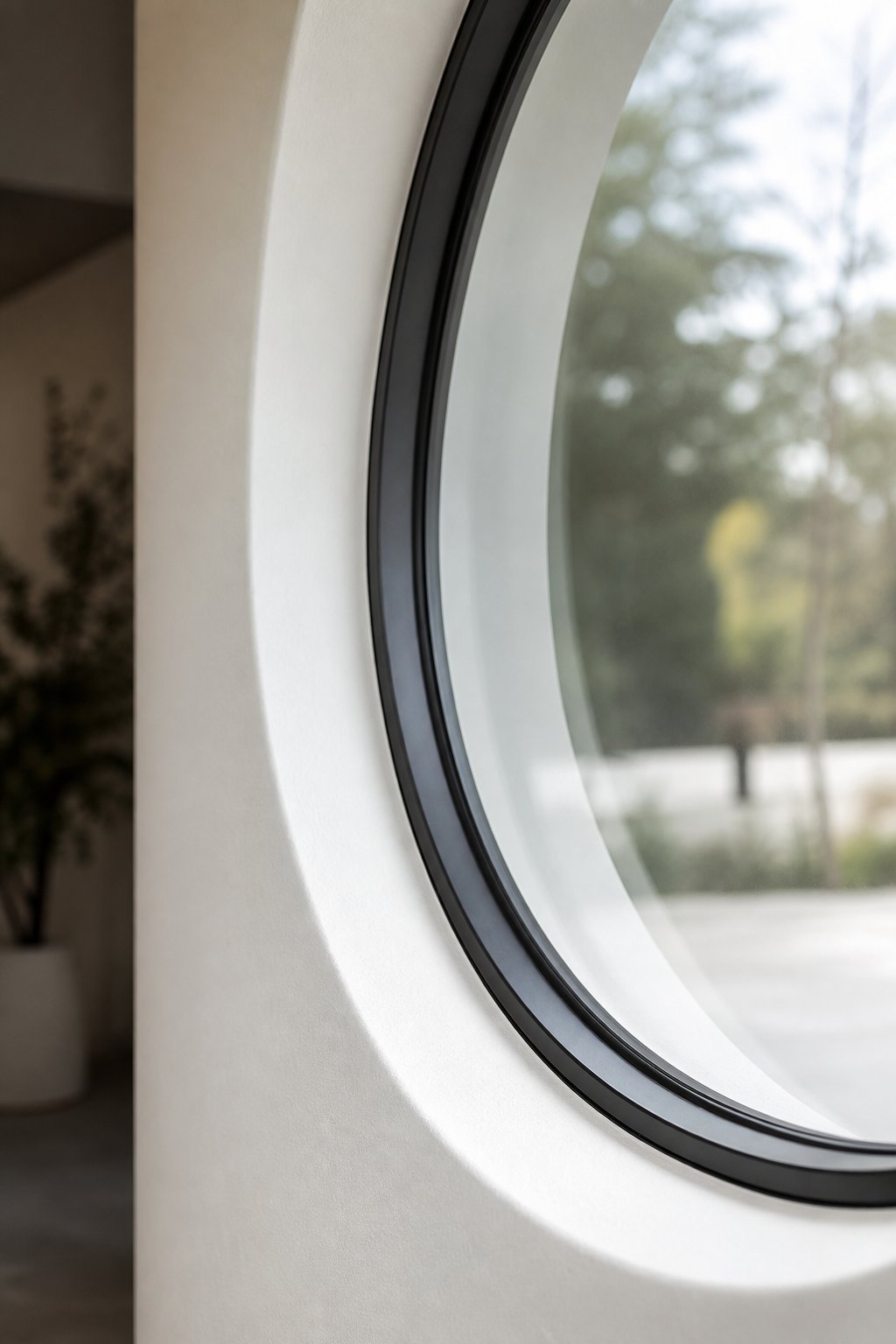
Most windows are rectangles. Straight lines, sharp corners, predictable proportions. A circular aluminium window breaks that pattern entirely. It uses a continuous curved aluminium frame to hold glazing in a round or near-round shape, creating an immediate visual focal point on any facade. These windows serve as both accent features and functional glazing, available in fixed configurations for maximum thermal performance or operable designs (pivot, tilt-and-turn) that allow ventilation.
What separates them from standard rectangular units goes beyond appearance. The engineering is fundamentally different. A rectangular frame relies on mitre-cut corners joined at 90 degrees. A circular window demands a seamless curved profile, bent from extruded aluminium and welded or mechanically joined into a continuous ring. That distinction drives everything from manufacturing lead times to pricing.
Defining Circular Aluminium Windows
A circular aluminium window is a glazed opening framed by a continuously curved aluminium profile, formed into a full circle, half circle, or elliptical shape. Unlike rectangular windows that use straight-cut frame sections joined at corners, circular variants require precision-bent extrusions to create their characteristic round form.
The aluminium frame construction gives these windows a distinct advantage in achieving slim sightlines on a curved profile. Because aluminium offers high rigidity at narrow cross-sections, the frame can remain visually delicate while maintaining structural integrity across the entire radius. This matters more than it would on a straight span, where load distribution is simpler.
Round Window Terminology Explained
If you have ever searched for a round window and felt confused by the results, you are not alone. The round window name changes depending on the era, style, and context. So what is a round window called? The answer depends on its specific shape, size, and architectural heritage. Here are the most common terms you will encounter:
- Circular window — the general term for any fully round window, regardless of frame material or opening mechanism.
- Round window — an informal, widely used synonym for circular window, common in residential contexts across Australia.
- Porthole window — typically refers to smaller circle windows, drawing on the nautical tradition. Popular in coastal homes and bathroom installations.
- Oculus — from the Latin for “eye,” this term traditionally describes a circular opening in a dome or wall and carries classical architectural connotations.
- Oeil-de-boeuf (bull’s-eye window) — a French term for relatively small elliptical or circular windows, often found in upper storeys or set into rooflines as dormers.
- Radius window — a broader term covering any window with curved elements, including full circles, half circles, and arched tops.
- Circle window — a straightforward descriptor used interchangeably with round or circular window in everyday conversation.
All these terms describe variations of the same core concept: a window defined by curves rather than straight edges. Knowing the correct round window name for your project helps when requesting quotes, searching supplier catalogues, or discussing options with your architect. The terminology also signals design intent — specifying an oculus suggests classical elegance, while porthole leans coastal and contemporary.
Understanding what these windows are and what they are called is just the starting point. The real question for most homeowners and builders is why aluminium handles the demands of a curved frame better than any other material on the market.
Why Aluminium Outperforms Other Frame Materials for Round Windows
Bending a straight profile into a precise radius places enormous stress on a frame material. It has to hold its shape under uneven load distribution, resist long-term deformation, and still look refined once glazed. Not every material handles those demands equally. Aluminium does it better than timber, uPVC, or composite alternatives — and the reasons are structural, practical, and financial.
Structural Advantages of Aluminium for Curved Frames
The strength-to-weight ratio of aluminium is the single biggest factor in its dominance for curved windows. Because the metal is inherently rigid at narrow cross-sections, manufacturers can produce a round window frame with sightlines as slim as 35mm. That means more glass, less frame, and cleaner proportions on the finished product.
Compare that to uPVC. Achieving the same structural integrity in a curve requires multi-chambered profiles 70mm wide or more. On a rectangular window, that bulk is manageable. On radius windows, it overwhelms the design. The frame becomes the dominant visual element rather than the glazing — exactly the opposite of what you want from a feature window.
Timber presents a different problem. Wood can split, check, or delaminate when bent to tight radii, particularly with the species commonly used in window manufacturing. Laminated timber can achieve curves, but the resulting profiles are thicker and heavier. A round wooden window in hardwood may look beautiful at installation, but the grain structure under curved stress is inherently less stable than a homogeneous metal extrusion.
Aluminium’s consistency matters here. As MetaBend’s technical overview notes, CNC bending technology can form aluminium profiles to tight radii without compromising structural integrity — something that simply is not possible with uPVC or solid timber sections. The material bends smoothly, holds its shape, and accepts glazing beads and gaskets with precision that curved alternatives struggle to match.
For arch aluminium applications where the curve radius is especially tight — think porthole windows under 500mm diameter — the advantage becomes even more pronounced. Only aluminium can achieve those compact curves while keeping frame profiles narrow enough to maintain visual elegance.
Durability and Low Maintenance Benefits
A circular frame experiences stress differently from a rectangular one. Rather than concentrated loads at four corner joints, forces distribute continuously around the curve. Over decades, materials that swell, shrink, or creep under sustained stress will eventually distort. Aluminium does not.
Modern aluminium windows achieve lifespans of 30 to 45 years as a conservative estimate, with many installations lasting well beyond that. The material resists warping, bowing, swelling, and temperature-induced expansion. For coastal properties across Australia — where salt air accelerates degradation — marine-grade powder coating provides an additional layer of corrosion resistance that timber and uPVC cannot replicate.
Speaking of powder coating: aluminium frames offer virtually unlimited colour options through powder-coating and anodising processes. Want matte black for a contemporary build? Brushed bronze to complement heritage brickwork? A custom colour matched to your cladding? All achievable without the maintenance penalty of painted timber, which demands recoating every four to seven years. Over a 40-year lifespan, that is six to ten maintenance cycles you simply never face with aluminium.
A round wooden window in a coastal location tells a cautionary tale. Salt, UV, and moisture attack the finish relentlessly. Miss one maintenance cycle, and moisture penetrates the grain. On curved sections, where end-grain exposure is more complex than on straight-cut frames, the risk of rot escalates. Aluminium sidesteps all of this. An occasional wash with soapy water is genuinely all it needs.
The lifecycle cost argument is where aluminium pulls decisively ahead for curved windows specifically. Custom-manufactured circular frames are expensive regardless of material. Protecting that investment with a frame that will not deteriorate, discolour, or require replacement within two decades makes financial sense — particularly when the alternative is a uPVC frame that may need complete replacement after 20 to 35 years.
| Criteria | Aluminium | Timber | uPVC | Composite |
|---|---|---|---|---|
| Minimum sightline width | 35mm | 55mm+ | 70mm+ | 50–60mm |
| Maintenance frequency | Minimal (wash only) | Every 4–7 years (repaint) | Minimal (wash only) | Low (periodic checks) |
| Expected lifespan | 40–50+ years | 30–60 years (species dependent) | 20–35 years | 30–40 years |
| Suitability for tight curves | Excellent — CNC bent to precise radii | Limited — risk of splitting or delamination | Poor — profiles too bulky for elegant curves | Moderate — limited radius options |
| Colour options | Virtually unlimited (powder coat/anodise) | Any paint colour (requires recoating) | Limited range, foil wraps available | Moderate range |
| Coastal performance | Excellent with marine-grade coating | Poor without rigorous maintenance | Good | Good |
The comparison is especially stark for curved windows. A material might perform adequately in a straight rectangular frame but reveal its weaknesses once formed into a continuous curve. Aluminium is the one frame material where the engineering advantages actually increase as the geometry becomes more complex — slimmer profiles on tighter radii, with no sacrifice in durability or dimensional stability over time.
Material choice settled, the next logical question is what actually happens during manufacturing. Turning a straight aluminium extrusion into a precision-curved circular frame is a process that explains both the cost and the lead times buyers should expect.
How Circular Aluminium Windows Are Manufactured
A rectangular aluminium window rolls off a production line with relative ease. Straight extrusions are cut to length, mitre-joined at four corners, and glazed — a process that lends itself to automation and volume. A curved window cannot follow that playbook. Every circular frame is fundamentally a custom-manufactured unit, even when ordered in what suppliers call “standard” diameters. The geometry itself demands a different production logic, and that reality drives both cost and lead time.
Understanding the manufacturing journey helps explain why a rounded window that looks deceptively simple in a catalogue takes weeks longer to arrive than its rectangular equivalent — and why the price reflects genuine engineering rather than arbitrary markup.
From Extrusion to Curved Profile
Every aluminium window starts as a billet of raw aluminium alloy — typically 6063-T5, chosen for its excellent formability and suitability for architectural applications. That billet is heated and forced through a shaped die to create a linear extrusion: the flat profile with all the chambers, thermal break channels, and gasket grooves built in. So far, identical to rectangular window production.
The divergence happens next. Instead of being straight-cut to length, the extrusion is fed through CNC roller bending machines that gradually curve it to a precise radius. Three or four rollers apply controlled pressure, nudging the profile into an arc incrementally. The process is slow and deliberate. Push too aggressively, and the profile distorts, wrinkles on the inner radius, or cracks along stress points.
Minimum radius limitations exist because of this physics. A deeper, bulkier profile section resists bending more than a shallow one. For most architectural aluminium sections used in radius windows, the practical minimum diameter sits around 400mm — below that, the risk of visible deformation becomes unacceptable. Stretch bending is sometimes used for tighter curves, where the profile is simultaneously stretched and bent over a die to reduce wrinkling and maintain dimensional accuracy across the cross-section.
Each bent section must then be checked against a template or measured digitally to confirm the radius is consistent along its entire length. Even minor variations of 1–2mm compound across a full circle, resulting in a frame that will not close cleanly or accept its glazing unit.
Why Custom Sizing Affects Lead Times
Rectangular frames benefit from batch efficiency. A fabricator can cut dozens of frames from stock-length extrusions in a single shift using automated saws. A curved window plan requires a dedicated bending setup for each specific diameter — the roller positions must be recalibrated, test bends run, and the arc verified before production pieces are formed. Change the diameter by 50mm and the setup starts again.
The glazing compounds this. A round sealed unit cannot be cut from standard rectangular glass stock on an automated line. Each piece requires custom cutting — typically CNC waterjet or specialist circular cutting equipment — followed by edge polishing, spacer bar bending to match the curve, gas filling, and sealing. For double-glazed units, that means two curved panes plus a precision-bent spacer bar, all assembled to maintain the hermetic seal that prevents condensation between panes.
Then there is the joining. A circular frame formed from a single bent length must have its two ends welded or mechanically joined to close the circle. That junction needs grinding, finishing, and inspection to ensure it is structurally sound and visually invisible. Some manufacturers form the circle from two or more arcs joined at multiple points, which adds more welding and quality control steps. Either approach demands hand-finishing that simply does not exist in rectangular frame production.
Hardware routing adds further complexity for operable units. Hinge pockets, locking points, and handle recesses must be machined into a curved surface rather than a flat one — a task requiring CNC programming specific to that radius rather than a standard template.
When you factor in the curved window plan from start to finish, each unit passes through more hands, more machines, and more inspection stages than its straight-edged counterpart. The full production sequence looks like this:
- Aluminium billet extrusion — raw alloy is heated and pressed through a profiled die to create the linear frame section with integrated thermal break channels.
- CNC roller bending or stretch forming — the straight extrusion is curved to the specified radius using progressive roller pressure or stretch-over-die techniques.
- Radius verification — each curved section is measured against the target radius to confirm dimensional accuracy before proceeding.
- Welding or mechanical joining — arc ends are brought together and joined to form a complete circle (or half-circle), then ground and finished smooth.
- Machining and hardware routing — hinge pockets, drainage slots, locking points, and handle recesses are CNC-machined into the curved frame.
- Surface finishing — the frame is powder-coated or anodised to its specified colour, then baked to cure the finish.
- Curved glazing bead fabrication — internal beads that hold the glass in place are bent to match the frame’s inner radius.
- Glazing unit assembly — custom-cut curved glass panes, bent spacer bars, and gas filling are sealed into a round insulated unit.
- Final assembly and glazing — the sealed glass unit is fitted into the frame with curved gaskets, and hardware is installed.
- Quality control and testing — each completed window is inspected for finish quality, dimensional accuracy, seal integrity, and (for operable units) smooth operation.
That is ten distinct production stages, most of which require individual attention rather than batch processing. A standard rectangular window might pass through six stages with heavy automation at each one. The difference in production time is typically four to eight weeks for a round window frame design versus one to two weeks for a rectangular unit of similar size.
None of this makes circular aluminium windows impractical — it simply means they reward proper planning. Knowing the manufacturing reality helps you set realistic expectations with your builder, coordinate other trades around delivery dates, and understand that the price reflects a genuine production process rather than a mark-up for aesthetics alone.
With manufacturing constraints in mind, the practical question shifts to where these windows actually belong. Not every wall, room, or architectural style benefits equally from a circular opening — and choosing the right context makes the difference between a striking design feature and an awkward mismatch.
Architectural Styles and Placements That Benefit Most
A circular window can look inspired or out of place — context determines which. The shape carries strong visual weight, so it works best when the architectural style already embraces geometric play, organic forms, or deliberate contrast against dominant straight lines. Certain property types and room positions consistently deliver the strongest results.
Property Styles That Suit Circular Windows
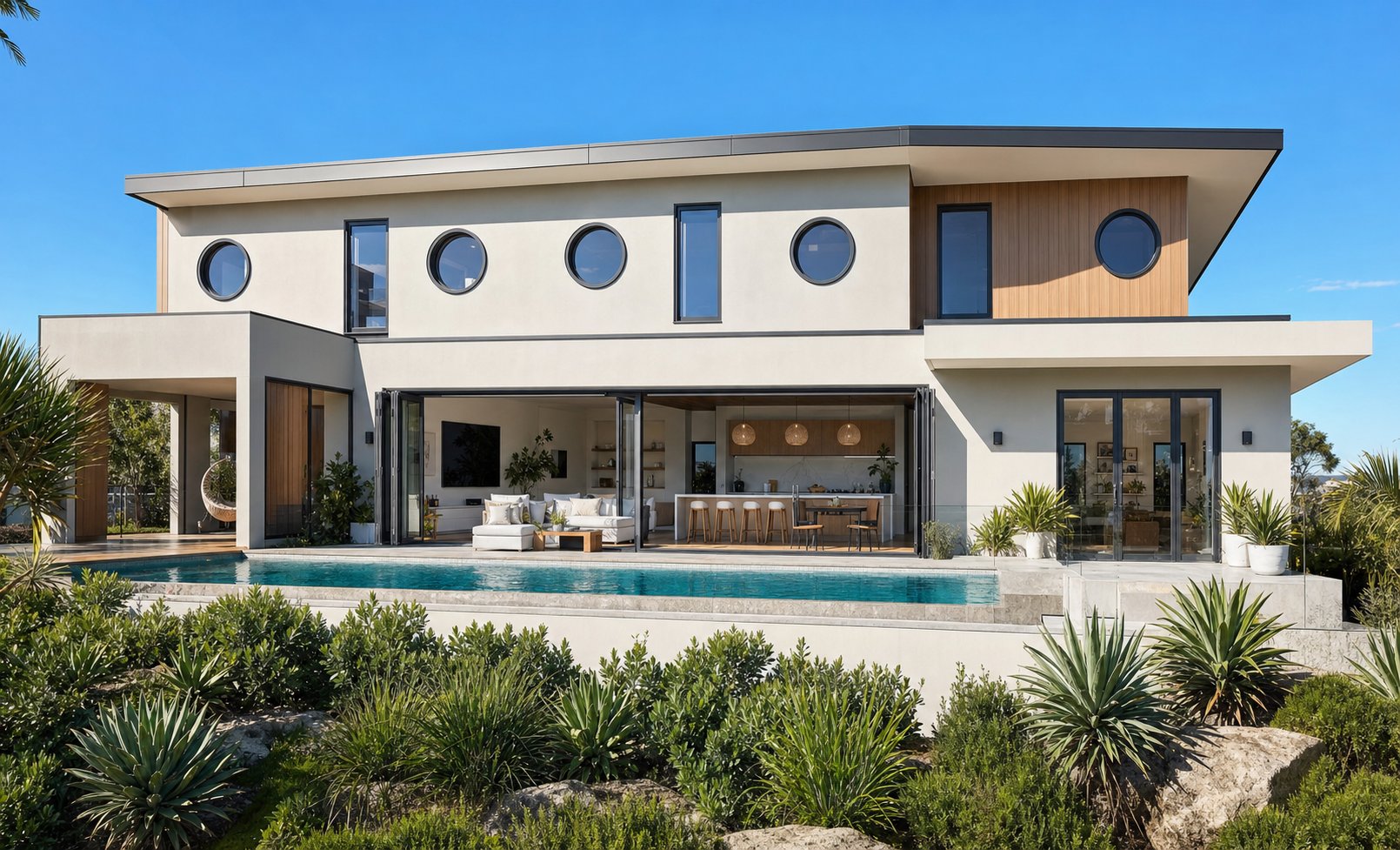
Contemporary minimalist homes are perhaps the most natural fit. A single large round window on an otherwise unbroken facade creates a bold focal point without competing ornamentation. Projects like London’s Runda house by Nikjoo and Flawk demonstrate how curved walls and porthole windows can define an entire architectural identity. In Australia, the same principle translates well to rendered two-storey builds with flat rooflines, where a round exterior window in the upper gable becomes the facade’s signature element.
Coastal properties lean into the nautical heritage of porthole windows. Aluminium handles salt air far better than timber or steel, making it the practical choice for beachside homes along the NSW coast, Victoria’s surf coast, or Queensland’s Sunshine Coast. Smaller porthole-style units in bathrooms and laundries echo marine aesthetics while resisting the corrosion that would destroy lesser materials within a decade.
Heritage renovations benefit in a different way. Many older Australian homes — Federation-era weatherboards, Edwardian brick villas, and Art Deco apartments — originally featured round or semicircular openings that have deteriorated over time. Replacing degraded timber frames with slim-profile aluminium preserves the period proportions while eliminating the ongoing maintenance burden. The colour flexibility of powder-coated aluminium means you can match heritage greens, creams, or deep reds without periodic repainting.
Warehouse conversions and industrial-style builds use round windows for homes to reference porthole and ship-hatch aesthetics. Paired with exposed brick, steel beams, and polished concrete, a circular opening in a partition wall or a circle window door combination in an interior setting adds visual rhythm without softening the industrial edge.
Commercial buildings — cafes, boutique hotels, wellness centres, and creative offices — increasingly use circular windows as design motifs that reinforce brand identity. A repeated pattern of round house windows across a hotel facade, for example, creates a memorable streetscape presence while improving natural light in guest rooms and common areas.
- Contemporary minimalist — large round windows (1000–1500mm diameter), fixed glazing, positioned as a single dramatic feature on a clean facade.
- Coastal residential — small to medium porthole windows (400–800mm diameter), operable pivot or tilt for ventilation, aluminium with marine-grade powder coating.
- Heritage renovation — medium circular or semicircular (600–1000mm diameter), fixed or casement, heritage colour finishes to match period detailing.
- Industrial conversion — medium to large (800–1200mm diameter), fixed units, dark frame finishes (matte black, charcoal, or raw anodised) to complement exposed materials.
- Commercial and hospitality — varied sizes in repeating patterns, often fixed, with custom colours aligned to branding.
Best Room Placements and Design Contexts
Gable walls are the classic position for round windows in Australian homes. A triangular gable end often lacks space for a full rectangular window, but a circular unit fits neatly within the available geometry. It floods the roof void or upper storey with natural light, and an operable version provides cross-ventilation to spaces that would otherwise trap heat — critical in Australian summers.
Stairwells gain a sense of drama from circular glazing. As you ascend, a large round window draws the eye and frames a curated slice of the landscape. The shape works because stairwells are transitional spaces where a conventional window might feel ordinary, but a circle becomes an event. Karawitz Architecture’s circular staircase cutouts illustrate how even abstract interpretations of the round form can transform vertical circulation into something sculptural.
Bathrooms suit smaller porthole-style units perfectly. A 400–600mm fixed circular window positioned high on a wall delivers natural light and a sense of openness without compromising privacy. The compact size also simplifies waterproofing around the opening — fewer linear metres of flashing compared to a larger rectangular alternative.
Entryways and front doors benefit from circular accents above or beside the main opening. A circle window door pairing — where a round fixed light sits above a pivot or hinged entry — adds kerb appeal and bathes the hallway in light. It signals a considered design approach visible from the street, setting the tone before anyone steps inside.
Hallways, home offices, and above kitchen sinks are secondary placements worth considering. In each case, the round form serves a dual purpose: practical daylighting in a space that might otherwise rely on artificial light, and a distinctive design feature that elevates an otherwise utilitarian area.
Choosing the right style and position is half the equation. The other half is sizing — determining exactly what diameter, shape variation, and configuration fits the opening and achieves the proportions your design demands.
Standard Sizes and Custom Dimensions for Every Shape
Sizing is where circular aluminium windows get genuinely complicated — and where most supplier websites leave buyers guessing. Rectangular windows follow predictable increment logic: standard heights and widths in 50mm or 100mm steps, easy to compare across brands. Circular variants do not work that way. Diameters, arc heights, chord widths, and radius measurements all come into play depending on whether you are specifying a full circle, a half moon window, or a quarter round. Getting clarity on available sizes before you lock in structural openings saves weeks of frustration during the build.
Standard Diameter Ranges and Common Configurations
Most Australian aluminium window fabricators offer full circle units in diameter increments starting around 400mm and extending to approximately 1500mm. Smaller than 400mm becomes impractical — the bending radius is too tight for most standard aluminium profiles to achieve without visible deformation, and the glazed area shrinks to the point where the frame dominates. Larger than 1500mm introduces glazing constraints that push both cost and lead time significantly higher.
Within that 400–1500mm range, the most commonly ordered sizes cluster around three tiers. Small porthole-style units between 400mm and 600mm diameter suit bathrooms, laundries, and above-door accent positions. Mid-range units from 700mm to 1000mm work well in gable ends, stairwells, and as feature windows in living areas. Large statement pieces from 1100mm to 1500mm create dramatic focal points on otherwise clean facades — the kind of window that defines a room from both inside and out.
Fixed configurations dominate at every size. As Dimensions.com’s architectural reference data notes, fixed circle windows are available in diameters ranging from approximately 450mm up to 1830mm. Fixed units can push larger because they carry no mechanical hardware weight — there are no hinges, stays, or locking mechanisms limiting the frame’s structural capacity. Operable circular windows (pivot or casement opening) typically cap out around 800–1000mm diameter due to the combined weight of the curved sash and glazing unit.
For homeowners and builders looking to source non-standard circular sizes, specialist suppliers like MEICHEN offer custom aluminium window manufacturing that covers the full diameter spectrum — from compact 400mm portholes through to oversized feature units. Their custom options extend to shape variations and non-standard dimensions that fall between typical increment steps, which is particularly useful when you are matching an existing structural opening or replacing a deteriorated window in a heritage build.
Shape Variations Beyond the Full Circle
A full circle is only the starting point. Half circle windows, quarter round windows, elliptical shapes, and gothic arches each solve different architectural problems — and each has its own sizing logic.
A half circle window (also called a half moon window or semi circle window) consists of the upper arc of a full circle with a flat base along the bottom. The key dimensions are the width (chord length along the base) and the height (the rise from base to the apex of the arc). Typical widths range from 450mm to nearly 3000mm, with heights proportional to half the width for a true semicircle. These sit naturally above doors, rectangular windows, or as standalone transom features — anywhere a flat bottom edge can rest on a lintel or head trim while the curved top creates visual interest.
Quarter round windows occupy corner positions. They combine a flat bottom, a flat vertical side, and a single curved edge connecting the two. Heights and widths typically range from around 230mm to over 2200mm. These work in pairs flanking a rectangular window, tucked into the corners of gable ends, or stacked to create a geometric pattern on a facade. Half moon windows and quarter round windows used together can transform a plain wall into something with real architectural character without requiring a full circular opening.
An elliptical window stretches the circle into an oval — wider than it is tall, or occasionally taller than it is wide. Heights typically range from around 280mm to 1520mm, with widths from about 1040mm to 3660mm. The proportions make elliptical shapes ideal above wide openings like garage doors or bi-fold window walls, where a full circle would require an impractically tall structural opening. Half circle windows follow similar placement logic but with a more pronounced arc.
Gothic arch windows introduce a pointed apex where two arcs meet, creating the distinctive lancet shape associated with ecclesiastical architecture. Heights range from approximately 230mm to over 3650mm, with widths constrained by the arc geometry. These suit heritage restorations, chapel conversions, and contemporary homes that play with historical references in a modern context.
| Shape Type | Typical Diameter/Width Range | Typical Height Range | Common Applications |
|---|---|---|---|
| Full circle | 400–1500mm (diameter) | Equal to diameter | Gable feature windows, stairwells, facade focal points, bathrooms |
| Half circle | 450–2950mm (base width) | 230–1470mm (arc height) | Above doors and rectangular windows, transoms, entryway accents |
| Quarter round | 230–2230mm (width) | 230–2230mm (height) | Corner features, paired flanking elements, gable infill |
| Elliptical | 1040–3660mm (width) | 280–1520mm (height) | Above wide openings, garage door transoms, horizontal accent bands |
| Gothic arch | 230–2900mm (width) | 230–3660mm (height) | Heritage restorations, chapel conversions, dramatic vertical features |
One constraint that applies across all shapes: the maximum size of curved sealed glazing units. Manufacturing curved double-glazed panels requires tempering furnaces large enough to accommodate the bent glass, and curved glazing specialists report maximum panel dimensions around 2500mm girth (curved length) by 3000mm height. Beyond those limits, the glass weight becomes impractical — a single panel at that maximum size in 6mm toughened glass weighs approximately 225kg. For circular aluminium windows, this means full-circle units above roughly 1500–1600mm diameter may require divided glazing bars or multiple sealed units rather than a single uninterrupted pane, which affects both aesthetics and thermal performance.
For any project with non-standard requirements — unusual diameters, uncommon shape combinations, or sizes that push near manufacturing limits — working with a specialist supplier early in the design process prevents costly revisions later. MEICHEN’s custom aluminium window range supports Australian residential and commercial builds with project-ready integration, offering the design consultation needed to confirm that your specified size and shape can actually be manufactured, glazed, and installed without compromise.
Size and shape sorted, the next consideration is less visible but equally important: how well these windows perform thermally, and whether fixed or operable configurations better suit your energy efficiency and ventilation requirements.
Thermal Performance and Energy Efficiency Considerations
Energy efficiency rarely features in conversations about circular aluminium windows — which is odd, because it should be one of the first things you evaluate. A beautiful round window that haemorrhages heat in winter or conducts scorching temperatures inward during an Australian summer is an expensive mistake. The good news: modern thermally broken aluminium systems perform remarkably well in curved applications, often matching or exceeding the thermal credentials of uPVC alternatives. The key is understanding how the technology works within a curved frame and making informed choices between fixed and operable configurations.
Thermal Break Technology in Curved Aluminium Profiles
Aluminium conducts heat efficiently — roughly 200 watts per metre-kelvin. That property makes it ideal for cookware and terrible for window frames, unless you interrupt the thermal pathway. This is exactly what a thermal break does. A continuous strip of polyamide (glass-fibre-reinforced nylon) is mechanically crimped between the interior and exterior aluminium profiles, creating a physical separation that reduces thermal conductivity by 500 to 1000 times compared to the aluminium itself.
In a rectangular window, this thermal break runs along straight frame sections joined at mitre-cut corners. In a circular frame, the polyamide strip must follow the same continuous curve as the aluminium extrusion. The strip is inserted before or during the bending process, depending on the manufacturer’s approach, and must maintain its bond with both the inner and outer aluminium profiles throughout the radius without cracking, delaminating, or creating gaps.
Modern manufacturing handles this reliably. The polyamide strips used in thermally broken systems — typically 18mm to 35mm wide in premium residential profiles — have sufficient flexibility to follow the curve radii common in architectural circular windows (400mm diameter and above). The crimping that locks polyamide to aluminium remains mechanically sound through the bend because the curvature is gradual relative to the strip’s thickness. Tight radii below 400mm can stress the thermal break connection, which is one reason most manufacturers set that as their minimum diameter.
The practical result? A thermally broken circular aluminium frame achieves U-values (thermal transmittance for the frame component alone) in the range of 2.5 to 3.5 W/m²K for standard systems, dropping to 0.8–1.5 W/m²K in premium multi-chamber configurations. Compare that to non-thermally broken aluminium at 5.8–7.0 W/m²K, and the improvement is dramatic. As the Window and Glass Association of New Zealand explains, a traditional aluminium frame with double glazing achieves an R-value of just 0.26, while a thermally broken frame with double glazing reaches up to R0.8 — triple that performance. Add triple glazing, and R1.0 becomes achievable.
For Australian conditions, where the National Construction Code (NCC) sets minimum energy efficiency requirements and WERS (Window Energy Rating Scheme) provides star ratings, thermally broken circular aluminium windows meet compliance thresholds that standard aluminium cannot. This is especially relevant in climate zones 6, 7, and 8 (the cooler southern regions of Victoria, Tasmania, and the ACT highlands), where heat retention through winter drives stringent glazing requirements.
Beyond the frame itself, curved geometry introduces one subtle thermal advantage. A circle encloses the maximum glazing area for a given perimeter length. Put differently, a circular window has less frame per square metre of glass than a rectangular window of the same area. Since glass with argon-filled cavities and low-E coatings typically outperforms even thermally broken frames on U-value, having proportionally more glass and less frame can marginally improve the whole-window thermal rating.
Gas-filled sealed units play their part regardless of window shape. Argon gas between panes reduces convective heat transfer within the cavity by roughly 30% compared to air alone. Krypton offers even better performance at a higher cost. For circular glazing, the sealed unit must maintain its gas fill over decades — and this depends on the quality of the curved spacer bar seal. Well-manufactured circular sealed units with warm-edge spacers (typically stainless steel or composite rather than aluminium) minimise heat loss at the glass edge and maintain gas retention rates above 95% over 20 years.
Condensation resistance ties these elements together. Traditional aluminium frames are typically the coldest visible surface inside a home — which is why moisture condenses there first on cold mornings. Thermally broken profiles keep the interior frame surface much closer to room temperature, staying above the dew point and dramatically reducing condensation risk. For bathrooms and laundries where circular windows are popular and humidity levels run high, this protection matters. It prevents the mould growth, paint peeling, and timber damage that plague cold-framed windows in damp environments.
Fixed Versus Operable Circular Windows
Here is where most buyers face a genuine dilemma. A fixed circular window delivers the best thermal seal, the slimmest sightlines, and the lowest maintenance profile. But it provides zero ventilation. If your round window sits in a habitable room — a bedroom, living area, or study — building regulations under the NCC typically require openable windows to provide adequate fresh air. A stunning fixed circle in a bedroom might look perfect while failing compliance.
Round windows that open solve this problem, though the solution involves trade-offs. Circular windows that open typically use one of three mechanisms: a centre-pivot hinge that rotates the sash 180 degrees, a side-hung casement arrangement where the round sash swings outward like a door, or a tilt-and-turn mechanism offering both inward tilt ventilation and full opening. Each option introduces moving parts — hinges, friction stays, locking hardware, and weatherseals that must accommodate a curved sash edge rather than a straight one.
The thermal penalty is real but manageable. Every operable window has more gasket junctions and hardware penetrations than a fixed equivalent. On a fixed window, the glass sits permanently sealed within its frame, creating a continuous thermal and air barrier. A round window that opens introduces a sash-to-frame junction around the entire circumference — and any imperfection in gasket compression at that curved interface allows air infiltration. In practice, modern arched casement windows with multi-point locking systems compress their weatherseals effectively enough to keep air infiltration within acceptable limits, but they will never match the hermetic seal of a fixed unit.
The cost difference reflects the engineering involved. A fixed circular window requires only the frame and a glazed panel — no hinges, no locking mechanisms, no friction stays. An operable version needs all of those components, each custom-curved or specifically designed for the radius. Hardware for arched windows that open is specialty equipment, not off-the-shelf componentry pulled from a standard casement production line. Expect a 30–50% price premium for an operable circular unit over a fixed one of the same diameter.
Maintenance diverges too. A fixed unit has no moving parts to wear, adjust, or replace. Operable versions require periodic hinge lubrication, weatherseal inspection, and occasional hardware adjustment as gaskets compress over time — the same maintenance any opening window demands, just slightly more involved because replacement parts are curved rather than straight.
| Factor | Fixed Circular Window | Operable Circular Window |
|---|---|---|
| Thermal performance (U-value) | Superior — continuous sealed frame, no air infiltration paths | Slightly reduced — gasket junctions and hardware penetrations introduce minor thermal bridging |
| Ventilation | None — no airflow possible | Full ventilation via pivot, casement, or tilt-and-turn opening |
| NCC compliance for habitable rooms | Does not satisfy ventilation requirements alone | Satisfies ventilation requirements when sized appropriately |
| Cost (relative) | Base price | 30–50% premium over equivalent fixed unit |
| Maximum practical diameter | Up to 1500mm+ (glazing weight is only constraint) | Typically limited to 800–1000mm (hardware must support sash weight) |
| Maintenance | Minimal — occasional external clean | Periodic hinge lubrication, seal inspection, hardware adjustment |
| Weatherproofing | Excellent — permanently sealed, no water ingress risk from open position | Good with multi-point locking; slight risk if seals degrade over time |
| Frame sightline width | Slimmest possible — no sash overlap needed | Wider — requires sash-to-frame overlap for weathersealing |
The practical recommendation for most Australian homes? Use both. Specify a large fixed circular window as your primary design feature — the one that captures the view and makes the architectural statement — and pair it with a smaller operable unit nearby for ventilation compliance. Alternatively, if the circular window must serve both purposes in a single opening, specify an operable unit at a size the hardware can reliably support (typically up to 800mm diameter for a centre-pivot mechanism) and accept the slightly wider sightline as the price of functionality.
Thermal performance and ventilation strategy are decisions you can control. What catches many buyers off guard are the mistakes that happen before those decisions — the oversights in planning, regulation, and installation that turn a straightforward project into an expensive lesson.
Common Mistakes When Choosing Circular Aluminium Windows
Every product has a learning curve, but circular aluminium windows punish uninformed decisions more than most. The combination of custom manufacturing, specialist installation, and regulatory nuance means a single oversight early in the planning stage can cascade into costly delays, compliance failures, or a finished result that falls short of expectations. These are the mistakes that builders, architects, and homeowners make repeatedly — and they are almost entirely avoidable with the right information upfront.
Ventilation and Building Regulation Oversights
The most consequential mistake is specifying a fixed circular window in a habitable room without accounting for ventilation compliance. Under the National Construction Code, bedrooms, living rooms, and studies require openable windows that provide adequate fresh airflow — typically a minimum openable area equal to 5% of the room’s floor area. A gorgeous 1200mm fixed circle in a master bedroom fails that test immediately, leaving you with a window that cannot satisfy NCC requirements on its own.
The fix is straightforward: either specify an operable circular unit or pair a fixed feature window with a separate openable window in the same room. But this needs to be decided at design stage, before the structural opening is cut and the order placed. Changing from fixed to operable after manufacture is not a retrofit — it is a new window entirely.
Heritage and conservation area restrictions catch buyers out almost as often. In many Australian council areas — particularly inner-city suburbs of Sydney, Melbourne, and Brisbane — a heritage overlay or conservation area listing imposes strict controls on visible facade changes. Replacing an existing rectangular window with a circular one, or even undertaking a half moon window replacement on a listed property, may require a development application (DA) or heritage permit before work begins. Planning guidance principles confirm that while like-for-like replacements generally proceed without formal approval, changes in window shape or proportion in designated areas demand council assessment. In Australia, this translates directly: check with your local planning authority before committing to any arch window replacement or shape change on a heritage-listed or conservation area property.
Even where heritage restrictions do not apply, the Building Code of Australia requirements for thermal performance, bushfire ratings (BAL compliance in designated zones), and structural adequacy still govern every window installation. Circular openings are not exempt from any of these — they just make compliance documentation slightly more involved because the window is custom rather than a tested standard product.
Lead Time and Installation Surprises
Rectangular aluminium windows typically arrive within one to three weeks of order confirmation. Circular units take four to eight weeks minimum — sometimes longer for unusual sizes, complex configurations, or busy fabrication periods. Buyers who plan their build schedule around rectangular window lead times and then add a single circular feature window late in the process often discover that their entire fitout stalls waiting for one unit to arrive.
Order your circular windows at the earliest possible stage. Ideally, confirm dimensions and place the order as soon as structural openings are set in the framing, not after the plasterer has finished and you are ready for glazing. That lead time buffer prevents a half circle window replacement or new installation from becoming the critical path item holding up your certificate of occupancy.
Installation itself demands specialist skills that not every glazier possesses. Cutting a circular opening into brick veneer, weatherboard, or rendered masonry is fundamentally different from forming a rectangular one. The flashing and waterproofing around a curved perimeter is more complex — there are no straight runs where standard flat flashing tape sits neatly. Every millimetre of the circle window trim interface between frame and wall needs carefully formed flexible flashing that follows the radius without buckling, wrinkling, or leaving gaps that allow moisture ingress. Sealant alone is not adequate; proper waterproofing requires dedicated curved flashing systems or meticulously hand-formed metal flashings.
The half round arch trim for windows adds another layer of detail on interior finishing. Unlike a rectangular window where standard timber or MDF architrave trims are mitre-cut from straight lengths, a circular or arched opening requires curved trim pieces — either flexible polyurethane mouldings, CNC-routed MDF, or steam-bent timber. Specifying the wrong approach for your interior finish results in visible joints, uneven gaps, or trim that pulls away from the wall as it tries to flatten against the curve. The half round arch trim for windows should be discussed with your joiner or interior fit-out contractor before the window is installed, not after.
Here is the full checklist of pitfalls to review during your planning process:
- Assuming all circular windows are fixed — many can open via pivot, casement, or tilt-and-turn mechanisms. Specify the configuration that matches your ventilation needs from the outset.
- Ignoring ventilation compliance — habitable rooms under the NCC require openable windows. A fixed circular unit alone will not satisfy this in bedrooms, living areas, or studies.
- Skipping heritage and council checks — conservation areas and heritage overlays may restrict window shape changes. Lodge enquiries with your local council early, especially for arched replacement windows or any alteration to a visible facade.
- Underestimating lead times — allow 6 to 10 weeks for custom circular units. Order as soon as structural openings are confirmed to avoid schedule bottlenecks.
- Overlooking waterproofing complexity — circular openings need curved flashing systems, not straight tape. Ensure your builder or waterproofer has experience with round penetrations.
- Choosing frame profiles that are too wide — bulky frames destroy the proportions of a circular window. Specify slim-sightline aluminium (35–45mm) to maintain the elegant ratio of glass to frame.
- Neglecting interior trim planning — circle window trim and curved architraves require specialist fabrication. Confirm the approach with your joiner before installation day.
- Failing to confirm structural adequacy — a circular opening removes material from the wall differently than a rectangle. Your engineer or builder must verify that the surrounding structure handles the altered load path, particularly in loadbearing masonry walls.
- Not specifying bushfire compliance where required — properties in BAL-rated zones need windows that meet AS 3959 requirements. Confirm your circular window can be supplied with appropriate glazing and frame specifications for your BAL rating.
- Ordering without a site measure — structural openings are rarely perfectly round after construction. A site-specific measurement by the window supplier — taken from the actual opening, not the drawings — prevents costly remakes.
Most of these mistakes share a common thread: they happen because buyers treat circular windows like standard rectangular ones with a different shape. They are not. Every aspect — from half circle window replacement in a heritage terrace to a brand-new porthole in a coastal build — requires earlier planning, more specialist input, and longer timelines than equivalent rectangular work. Accepting that reality at the start of your project rather than discovering it mid-build is the single most valuable thing you can do.
Avoiding these pitfalls brings you to the final practical question: how to actually specify and order circular aluminium windows, step by step, so that what arrives on site matches what your design demands.
How to Specify and Order Circular Aluminium Windows
Knowing what to avoid is one thing. Knowing exactly what to do — in what order, with what information, and involving whom — is where a smooth project separates from a chaotic one. Specifying circular windows demands more preparation than a standard rectangular order because every unit is effectively custom-manufactured. The decisions you make (or fail to make) before requesting a quote ripple through the entire process, from fabrication accuracy to installation timing. Here is the full specification journey laid out clearly so nothing gets missed.
What You Need Before Requesting a Quote
Suppliers cannot price, manufacture, or schedule circular windows without specific information. Walking into a quote conversation with vague intentions guarantees delays — usually in the form of back-and-forth emails clarifying details that should have been settled before first contact. Prepare the following before you reach out to any supplier:
Structural opening dimensions. For a full circle, measure the diameter of the prepared opening (or the intended diameter if the opening has not been cut yet). For an arch top window or half-circle unit, record both the chord width (the flat base) and the rise height (apex of the arc). For rounded windows in existing walls, have a site measure taken from the actual opening — construction tolerances mean the hole is rarely perfectly circular, and even 3–5mm deviation matters for a custom-curved frame.
Shape and configuration. Confirm whether you need a full circle, half circle, quarter round, elliptical, or gothic arch. Fixed or operable? If operable, which mechanism — centre-pivot, side-hung casement, or tilt-and-turn? Each configuration affects pricing, lead time, and maximum achievable size differently.
Frame finish and colour. Powder coat colour selection is best made early. Standard colours (matt black, surfmist, monument, woodland grey) typically ship faster than custom-matched options that require dedicated coating runs. If your arch window design calls for a heritage colour or dual-tone finish (different colours inside and out), flag this from the start — it adds processing time.
Glazing specification. Double glazed or triple glazed? Clear, tinted, or obscured glass? Low-E coatings? Laminated for security or acoustic performance? Bushfire-rated glazing for BAL zones? Each choice affects weight, thermal performance, cost, and lead time. Obscured glass is common for circle windows in bathrooms, while clear low-E suits feature positions where the view matters.
Compliance requirements. Note your NCC climate zone, any BAL rating for the property, heritage or conservation area status, and whether the window must satisfy ventilation requirements for a habitable room. Providing this upfront allows the supplier to confirm their product meets all relevant Australian Standards (AS 2047 for windows, AS 1288 for glazing, AS 3959 for bushfire zones) without costly mid-order design changes.
Installation context. Is the window going into new construction (timber or steel frame, with the opening formed to suit), existing masonry, weatherboard cladding, or rendered blockwork? Wall thickness, cladding type, and whether external scaffolding will be needed all affect the supplier’s recommendations for frame depth, sub-sill details, and flashing integration.
Working With Specialist Aluminium Window Suppliers
Circular windows are not a product you pick off a shelf or order from a generic catalogue. Searching for round windows for sale online will surface plenty of results, but the gap between a generic listing and a project-ready solution is enormous. What you actually need is a supplier who offers design consultation alongside manufacturing — someone who can assess your arch window design, confirm feasibility at your specified size, advise on configuration trade-offs, and integrate the window into your broader project timeline.
For Australian residential and commercial builds, MEICHEN operates as exactly this kind of specialist — supporting the full specification journey from custom circular window options through to project-ready integration with your builder or architect. Their approach covers design consultation, custom manufacturing for non-standard shapes and sizes, and coordination with project teams to ensure delivery aligns with your construction schedule. For homeowners and builders exploring round top windows or arch top windows as part of a broader aluminium window package, this integrated pathway eliminates the fragmentation that causes delays when different suppliers handle different window types on the same project.
Engaging a specialist supplier early — ideally at design development stage rather than after construction documentation is finalised — delivers several practical benefits. First, they can confirm whether your intended size and shape is manufacturable within your budget before it gets locked into drawings. Second, they can flag compliance issues (thermal performance, bushfire ratings, ventilation requirements) that might otherwise surface as problems during building certification. Third, their familiarity with framing plans and project coordination means they can provide dimensioned shop drawings that your builder uses to form openings accurately — preventing the mismatch between drawn dimensions and built reality that plagues so many custom window installations.
The full specification process, from initial concept to installed window, follows this sequence:
- Design concept and feasibility check — confirm window shape, approximate size, and configuration with your architect or designer. Engage your aluminium window supplier (such as MEICHEN’s custom aluminium window team) to verify manufacturability and receive preliminary pricing guidance.
- Detailed specification — finalise dimensions, glazing type, frame colour, hardware selection, and compliance requirements. Provide wall thickness and cladding details for sub-sill and flashing coordination.
- Formal quotation and order confirmation — review the supplier’s detailed quote including lead time, delivery schedule, and any deposit requirements. Confirm the order with signed approval of specifications.
- Shop drawing production — the supplier produces dimensioned drawings showing exact frame profiles, opening sizes, and fixing details. Your builder uses these to form the structural opening accurately.
- Manufacturing — profile extrusion, CNC bending, welding, finishing, glazing unit fabrication, and assembly. Allow 6 to 10 weeks for custom circular units.
- Quality control and dispatch — completed windows are inspected for dimensional accuracy, finish quality, seal integrity, and hardware function before packing and delivery.
- Site delivery and inspection — windows arrive on site. Check against shop drawings for correct size, colour, configuration, and condition before signing off.
- Installation by qualified glazier — the window is fitted into the prepared opening with appropriate curved flashing, packers, and fixings. Sealant and weatherproofing are completed to manufacturer specifications.
- Final commissioning — operable units are tested for smooth operation, locking engagement, and weatherseal compression. Fixed units are checked for glass clarity and frame alignment.
- Handover and warranty registration — documentation is provided covering warranty terms, maintenance guidance, and hardware adjustment instructions for operable units.
That ten-step journey typically spans 10 to 16 weeks from first enquiry to installed window — longer if the project involves multiple circular units in different sizes, or if heritage approvals add time at the front end. The critical insight is that steps one through four happen before manufacturing even begins. Rushing those early stages to save time almost always backfires, creating specification errors that cost far more to fix than the weeks they were meant to save.
For builders managing multiple trades, the practical advice is simple: treat circular windows as a long-lead item and initiate the specification process at the same time as your kitchen joinery or structural steel — not after lockup when everything else is waiting on glazing. Round windows for sale through specialist fabricators are not stock items sitting in a warehouse. Each one is built to your specifications, and that reality demands planning discipline.
Whether your project calls for a single porthole accent in a bathroom, a pair of arch top windows flanking an entry, or a statement-making 1500mm circle anchoring a double-storey facade, the process remains the same. Define what you need, engage a specialist early, confirm feasibility before locking in structural openings, and build realistic lead times into your program. Do that, and your circular aluminium windows arrive on site exactly when needed — ready to become the architectural feature your design intended from the start.
Frequently Asked Questions About Circular Aluminium Windows
1. What is a round window called?
Round windows go by several names depending on their size, shape, and architectural heritage. The most common terms include circular window, porthole window (typically smaller, nautical-inspired units), oculus (a classical Latin term meaning ‘eye,’ often used for larger openings in domes or walls), oeil-de-boeuf or bull’s-eye window (a French term for small elliptical or circular windows), and radius window (a broader term covering any window with curved elements). In everyday Australian residential contexts, ’round window’ and ‘circle window’ are used interchangeably. Knowing the correct terminology helps when requesting quotes from suppliers like MEICHEN or searching specialist catalogues for the exact product you need.
2. Can circular aluminium windows open for ventilation?
Yes, circular aluminium windows are available in operable configurations — not just fixed units. Common opening mechanisms include centre-pivot (the sash rotates 180 degrees), side-hung casement (swings outward), and tilt-and-turn (offers both tilt ventilation and full opening). Operable circular windows typically cap out around 800 to 1000mm diameter due to hardware weight constraints. They cost approximately 30 to 50 percent more than equivalent fixed units because of the specialist curved hardware required. For habitable rooms under Australia’s National Construction Code, openable windows are mandatory for ventilation compliance, so specifying operable units or pairing a fixed circle with a separate openable window is essential.
3. How long does it take to manufacture custom circular aluminium windows?
Custom circular aluminium windows typically require 6 to 10 weeks from order confirmation to delivery — significantly longer than the 1 to 3 weeks standard for rectangular units. The extended lead time reflects a genuinely different production process: CNC roller bending of extrusions to precise radii, welding or mechanical joining to close the circle, custom-cut curved glazing units with bent spacer bars, and individual quality control at every stage. Unusual sizes, complex configurations, or peak fabrication periods can push timelines even longer. Australian builders should treat circular windows as long-lead items and place orders as soon as structural openings are confirmed in the framing stage.
4. What sizes are available for circular aluminium windows in Australia?
Most Australian aluminium window fabricators offer full circle units in diameters from 400mm to 1500mm. Below 400mm, bending radii become too tight for standard profiles without visible deformation. Above 1500mm, curved sealed glazing constraints increase cost and may require divided glazing bars. Half circle windows range from 450mm to nearly 3000mm in base width, quarter round windows from 230mm to over 2200mm, and elliptical shapes up to 3660mm wide. Specialist suppliers such as MEICHEN offer custom manufacturing across the full spectrum, including non-standard dimensions that fall between typical increment steps — particularly useful for heritage replacements or matching existing structural openings.
5. Are circular aluminium windows energy efficient?
Modern thermally broken circular aluminium windows perform well in Australian conditions. Polyamide thermal breaks between inner and outer aluminium profiles reduce thermal conductivity by 500 to 1000 times compared to raw aluminium. Thermally broken frames achieve U-values of 2.5 to 3.5 W/m²K for standard systems, dropping to 0.8 to 1.5 W/m²K in premium configurations. Combined with argon-filled double or triple glazing and low-E coatings, these windows meet NCC energy efficiency requirements across all Australian climate zones. A circular shape also offers a subtle advantage: it encloses maximum glazing area for a given perimeter, meaning proportionally less frame and more high-performance glass per square metre.
More Window & Door Guides