What Aluminium Window Suppliers Do and Why It Matters
Aluminium window suppliers are businesses that source, fabricate, or distribute aluminium-framed windows and provide the technical support, customisation, and logistics coordination required to deliver them to construction projects. They sit between raw material producers and the builders or homeowners who install the finished product.
That definition sounds straightforward, but the reality is messier. Some suppliers manufacture their own aluminium window profiles. Others purchase pre-made systems and assemble them to order. A few simply stock and resell. Each model delivers a different experience in terms of flexibility, lead time, and after-sales support — and most buyers never learn the distinction until something goes wrong.
What Aluminium Window Suppliers Do
A capable supplier does far more than ship aluminium window supplies to a job site. Their scope typically includes product sourcing across multiple system brands, custom sizing and configuration, glazing specification advice, engineering coordination for complex openings, and delivery scheduling aligned to your build program. For projects using windows in aluminium frames — whether a single-storey renovation or a multi-unit development — the supplier acts as the critical link between design intent and physical product.
Why Supplier Selection Impacts Project Outcomes
Picking a supplier on price alone is one of the fastest ways to blow a construction timeline. Poor supplier choices commonly lead to incorrect specifications, extended lead times, and quality issues that demand costly rework. Supply chain problems alone are a leading cause of cost overruns in construction, often triggered by poor vendor performance that causes delays or quality defects.
The capability of your aluminium window supplier directly determines whether your project finishes on schedule, on spec, and on budget. Price is just one variable in that equation.
This article is not a supplier directory. It is a buyer-education resource designed to help you evaluate alu windows providers critically — understanding what questions to ask, what red flags to watch for, and how to match the right type of supplier to your specific project. The differences between supplier types matter more than most buyers realise, and that is where we start.
Understanding the Aluminium Window Supply Chain
The term “supplier” gets thrown around loosely in the aluminium window industry. A homeowner searching for aluminium window manufacturers might land on a fabricator’s website, a distributor’s catalogue, or a profile system house’s product page — and never realise these are fundamentally different businesses offering different levels of service, flexibility, and pricing.
Understanding where a company sits in the supply chain tells you exactly what you can expect from them. It also explains why two “suppliers” quoting on the same project can deliver wildly different experiences.
Manufacturers vs Fabricators vs Distributors
The aluminium window supply chain has several distinct layers. Here are the three you are most likely to deal with directly:
Manufacturers (System Houses) design and produce the aluminium window profiles — the extruded sections, thermal break components, hardware systems, and gaskets that form a complete window system. They invest heavily in R&D, testing, and certification. In Australia, aluminium windows manufacturers at this level typically supply their profiles to a network of licensed fabricators rather than selling finished windows directly to end users. Think of them as the architects of the system itself.
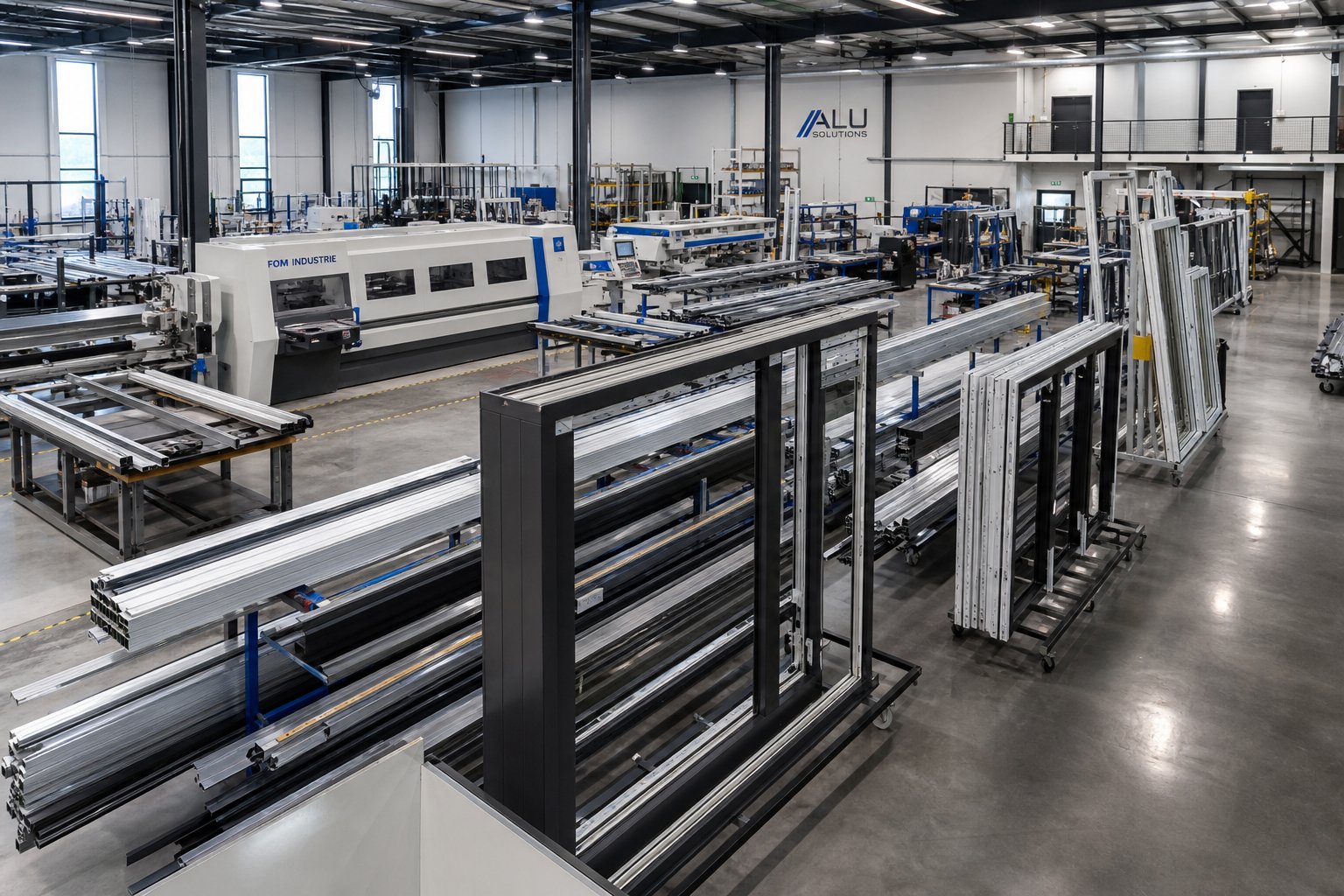
Fabricators purchase aluminium profiles from a system house and cut, machine, and assemble them into finished windows tailored to your project’s dimensions and specifications. A fabricator is where your drawings become physical products. They handle glazing, hardware fitting, and quality control on the finished unit. Most aluminium window manufacturers that builders and developers deal with in practice are actually fabricators operating under a system brand licence.
Distributors stock and resell finished or semi-finished windows. They do not manufacture or fabricate — they hold inventory of standard sizes and configurations for quick dispatch. Distributors suit straightforward replacements or small jobs where custom sizing is not critical.
A compiled window manufacturers list might include all three types without distinguishing between them, which is why buyers need to ask pointed questions about what a company actually does in-house.
How Supply Chain Position Affects What You Get
Your supplier’s position in the chain directly shapes the customisation available to you, the minimum order they will accept, how long you will wait, and what technical support comes with the sale. A fabricator working with aluminium window profiles can produce bespoke sizes and configurations for a single dwelling. A distributor offers speed but limited flexibility. A manufacturer may offer the deepest technical expertise but often requires higher minimum order quantities suited to larger developments.
| Criteria | Manufacturer (System House) | Fabricator | Distributor |
|---|---|---|---|
| Customisation Level | System-level (new profiles, bespoke engineering) | High (custom sizes, configurations, finishes) | Low (standard sizes and finishes only) |
| Minimum Order | High — typically project-scale or bulk | Flexible — single units to full developments | No minimum — individual units available |
| Lead Time | 6-12 weeks (design + production) | 3-6 weeks (fabrication + finishing) | 1-2 weeks (ex-stock dispatch) |
| Technical Support | Extensive (engineering, thermal modelling, compliance) | Moderate to high (specification advice, site coordination) | Basic (product data sheets only) |
| Price Range | Premium — reflects R&D and certification investment | Mid to premium — varies by system and complexity | Entry to mid — margin on standard product |
The practical takeaway: if your project requires non-standard openings, specific performance ratings, or coordination with an architect’s details, you need a fabricator or an aluminium window manufacturer with in-house production capability. If you are replacing a few standard-sized windows in an existing home, a distributor may serve you perfectly well at a lower cost and faster turnaround.
Knowing who you are actually talking to — and what they control versus what they outsource — is the first filter in any serious supplier evaluation. The next consideration is whether your project falls into the residential or commercial category, because that distinction reshapes the supplier landscape entirely.
Residential vs Commercial Supplier Requirements
A homeowner replacing three bedroom windows and a developer specifying glazing for a 40-unit apartment complex are both searching for aluminium doors and windows — but they need entirely different things from their supplier. The procurement process, performance expectations, compliance burden, and pricing structures diverge so sharply between residential and commercial aluminium windows that approaching the wrong type of supplier wastes weeks and produces quotes that miss the mark.
Some suppliers serve both markets capably. Others specialise in one segment and lack the systems, certifications, or flexibility to handle the other. Knowing which camp your project falls into — and which camp your shortlisted supplier operates in — saves considerable frustration.
What Residential Buyers Should Prioritise
Residential projects tend to involve smaller quantities, tighter aesthetic expectations, and homeowners who want a straightforward experience without managing complex logistics. Residential aluminium windows need to look good, perform thermally, and arrive on a schedule that aligns with a single builder’s program.
- Small order flexibility — Suppliers willing to fabricate one to ten windows without inflated per-unit pricing or excessive minimum order requirements.
- Aesthetic range — Colour options, slim sightlines, and frame profiles that suit Australian home styles from weatherboard cottages to contemporary renders. Metal windows for residential applications need to complement the architecture, not dominate it.
- Energy performance ratings — WERS-rated products with verified U-values and Solar Heat Gain Coefficients that satisfy NatHERS modelling for the relevant climate zone.
- Clear warranty terms — Written guarantees covering frame finish, hardware, sealed units, and thermal break integrity, typically ranging from 7 to 15 years depending on the component.
- Installation coordination — Willingness to liaise with the builder on delivery timing, site access, and any flashing or reveal details that affect fit.
Residential aluminium window manufacturers who excel in this space understand that their customer often has limited technical knowledge and values guidance through the specification process.
What Commercial and Project Buyers Need
Commercial aluminium windows and doors face a different reality. Larger openings, higher wind loads, stricter fire and impact ratings, and multi-storey installation sequences all demand suppliers with deeper engineering capability and production capacity. A compliance documentation trail — including AS 2047 test reports, AS 1288 glass certification, and AS 4055 wind load verification — becomes non-negotiable rather than optional.
- Engineering and technical support — Capacity to review architectural drawings, recommend appropriate systems, and provide structural calculations for large spans or high wind zones.
- Bulk pricing structures — Transparent volume-based pricing that scales across dozens or hundreds of openings without requiring individual quotes for each variation.
- Compliance documentation — Full test reports from NATA-accredited facilities, Window Compliance Certificates per AGWA templates, and any additional state-specific requirements such as Queensland’s supplementary forms.
- Project scheduling capability — Ability to align manufacturing and delivery with staged construction programs, delivering to multiple floors or buildings in sequence.
- Multi-stage delivery management — Logistics coordination for phased handovers that match the builder’s program rather than dumping an entire order on site at once.
The gap between these two buyer profiles explains why a supplier brilliant at servicing renovators may flounder on a commercial project — and why a large-scale commercial operation might quote a single homeowner reluctantly, if at all. Identifying where your project sits on this spectrum is the first step toward building a meaningful evaluation criteria list, which is exactly where capable suppliers distinguish themselves from the rest.
Key Criteria for Evaluating Aluminium Window Suppliers
Plenty of buyers shortlist suppliers based on whoever responds fastest or quotes lowest. That approach works fine for commodity purchases — but aluminium windows are not commodities. They are engineered building components that must perform thermally, structurally, and aesthetically for decades. The difference between a supplier delivering high quality aluminium windows and one delivering problems often comes down to a handful of verifiable criteria that most buyers never think to check.
Whether you are comparing the top window manufacturers in your region or evaluating a single local fabricator, the framework below gives you a structured way to separate genuine capability from polished marketing.
Certifications and Performance Standards to Verify
Certifications are not just paperwork — they are proof that a product has been independently tested and meets defined performance thresholds. In Australia, the key standards to verify include:
AS 2047 (Windows and External Glazed Doors) — This is the primary Australian Standard governing window performance. It covers structural adequacy, water penetration resistance, and air infiltration. Every aluminium window installed in a building subject to the National Construction Code must comply. Ask your supplier for the specific AS 2047 test report for the system they are quoting, not just a general claim of compliance.
AS 1288 (Glass in Buildings) — Covers glass selection and installation, including safety glazing requirements. Your supplier should confirm that their glazing specification meets this standard for your application.
WERS (Window Energy Rating Scheme) — Australia’s equivalent of an energy label for windows. WERS rates products on heating and cooling star ratings based on U-value and Solar Heat Gain Coefficient (SHGC). A supplier offering durable aluminium windows with verified WERS ratings gives you confidence that the thermal performance claims are independently validated, not self-assessed. For context, a U-value below 4.0 W/m²K with thermally broken frames and double glazing represents solid performance for most Australian climate zones, while premium configurations with argon-filled units and Low-E coatings can achieve U-values around 1.5 to 2.0 W/m²K.
Performance tier systems vary by profile brand, but generally progress from standard (non-thermally broken, single glazed) through to enhanced and premium tiers incorporating thermal breaks, double or triple glazing, and advanced weather seals. The tier your project requires depends on NatHERS modelling, climate zone, and orientation — a competent supplier will guide you through this rather than simply quoting their cheapest option.
Even among high end window brands, certification quality varies. Some hold current test reports from NATA-accredited laboratories; others rely on outdated results or generic system-level data that may not reflect the specific configuration being quoted. Always ask: is this test report for the exact window type, size range, and glazing configuration I am ordering?
Lead Times and Production Capacity
A beautiful specification means nothing if the windows arrive three weeks after your builder needed them on site. Production timelines for aluminium windows typically range from 4 to 8 weeks from order confirmation, though several factors push that window wider:
- Custom powder coat colours — Standard finishes (black, white, monument, surfmist) ship faster. Custom colours from the Dulux or Interpon range add 1 to 2 weeks for batch coating.
- Glazing complexity — Laminated, toughened, or specialty Low-E glass units may require separate procurement from the glass processor, extending the timeline.
- Order volume — A 50-unit apartment project competes for production capacity differently than a three-window bathroom renovation.
- Seasonal demand — Spring and summer construction peaks create backlogs. Ordering during quieter months (autumn and winter) often yields shorter lead times.
To assess whether a supplier can meet your schedule, ask direct questions: What is your current production lead time? How many units can you fabricate per week? Do you have capacity reserved for urgent orders? The best window manufacturers will give you a firm commitment date at quoting stage rather than a vague estimate that drifts once your deposit clears.
Warranty Terms and After-Sales Support
Warranty documentation reveals how much confidence a supplier has in their own product. Vague or overly restrictive warranties signal risk. Strong warranties are specific about what is covered, for how long, and what the claims process looks like.
Key elements to scrutinise:
- Frame and finish warranty — Powder coat finishes on quality aluminium frames should carry a minimum 7-year warranty against peeling, chalking, or fading. Premium marine-grade finishes for coastal areas often extend to 10 or 15 years.
- Sealed unit (IGU) warranty — Double-glazed units should be warranted against seal failure and internal fogging for at least 10 years.
- Hardware warranty — Handles, locks, hinges, and rollers typically carry 5 to 10 years depending on the component and brand.
- What is excluded — Common exclusions include damage from improper installation, lack of maintenance, exposure beyond stated environmental limits, and cosmetic wear. Understand these boundaries before you sign.
- Claims process — Who do you contact? The fabricator, the system house, or the installer? A clear chain of responsibility prevents finger-pointing when something fails.
Post-installation support matters just as much as the warranty document itself. Can the supplier provide replacement parts years later? Do they maintain stock of the hardware and gaskets used in your windows? A supplier who disappears after delivery — or who fabricates from a system that gets discontinued — leaves you stranded when maintenance is eventually needed.
Compiling a top 10 window manufacturers shortlist based on brand recognition alone misses the point. The largest window manufacturers are not automatically the best fit for your project. A smaller fabricator with current certifications, realistic lead times, and transparent warranty terms may outperform a household name that treats your renovation as an afterthought.
The Evaluation Checklist
Rank your shortlisted suppliers against these eight criteria, weighted by what matters most for your specific project:
- Current AS 2047 compliance — Verified test reports for the specific system and configuration quoted, from a NATA-accredited lab.
- WERS energy ratings — Independent thermal performance data matching your NatHERS or NCC requirements.
- Confirmed lead time — A written production and delivery schedule with a committed date, not an estimate.
- Production capacity alignment — Evidence the supplier can handle your order volume within your project timeline without overcommitting.
- Warranty clarity — Detailed written warranty covering frame, finish, hardware, and sealed units with a defined claims process.
- Technical support depth — Ability to advise on system selection, provide engineering details, and coordinate with your builder or architect.
- After-sales parts availability — Confirmed access to replacement hardware, gaskets, and components for the system being supplied.
- References and track record — Completed projects of similar scale and complexity, with contactable referees.
No supplier will score perfectly across every criterion. The goal is not perfection — it is informed comparison. A top 5 window manufacturers list means nothing if those companies cannot meet your timeline, serve your order size, or provide the documentation your certifier requires.
Evaluation criteria give you a framework for comparison, but they assume you already know what type of window your project needs. That decision — sliding, casement, awning, fixed — shapes which suppliers can even quote your job, because not every fabricator produces every window type.

Window Types and How They Shape Supplier Selection
Your window type requirements act as a filter on which suppliers can actually quote your project. A fabricator tooled up for aluminium sliding windows and casement units may not produce tilt-turn systems. A supplier specialising in commercial curtain wall glazing probably will not entertain a quote for three single hung aluminium windows in a bathroom renovation. Defining what you need before you approach the market saves everyone time.
Common Aluminium Window Types and Their Applications
Each window style brings a different balance of ventilation, weather sealing, and aesthetic character. Here is how the most common types map to real building scenarios:
Sliding windows move horizontally along a track, requiring no interior or exterior clearance to operate. Their simplicity and space-saving design make aluminium sliding windows the default choice for bedrooms, living areas, and anywhere a projecting sash would obstruct a walkway or patio.
Casement windows hinge on the side and swing outward via a crank or friction stay. Aluminium casement windows deliver the tightest seal of any operable type because the sash compresses against the frame when locked — making them ideal for kitchens, bathrooms, and any opening where air and water resistance matter most.
Double hung windows feature two sashes that slide vertically, allowing ventilation from the top, bottom, or both simultaneously. Aluminium double hung windows suit heritage-style homes and streetfront elevations where a projecting sash would breach setback requirements.
Single hung windows operate like a double hung but only the bottom sash moves. They are simpler, slightly cheaper, and common in multi-residential projects where consistent facade lines matter more than maximum ventilation flexibility.
Awning windows hinge at the top and push outward from the bottom, creating a canopy effect that allows airflow even during light rain. They work well as highlight windows above benchtops or in combination with fixed panes in commercial facades.
Fixed windows do not open at all. With no moving parts or seal breaks, they offer the best thermal and structural performance — which is why they dominate curtain wall systems, lobby glazing, and feature walls where unobstructed views take priority over ventilation.
Tilt-turn windows offer dual operation: tilting inward from the top for secure ventilation, or swinging inward from the side for full access and easy cleaning. Popular in European-influenced designs and multi-storey homes where external cleaning access is limited.
How Window Type Requirements Filter Supplier Options
Not every fabricator produces every type. A supplier focused on residential sliding aluminium windows and casement units operates different machinery, holds different hardware stock, and works with different profile systems than one engineering multi-storey curtain wall facades. Approaching a curtain wall specialist for a handful of residential awning windows is like asking a commercial builder to renovate your laundry — technically possible, but not their strength, and the pricing will reflect that mismatch.
The table below maps each window type to its strongest application, helping you identify which supplier specialisation aligns with your project:
| Window Type | Best Application | Ventilation | Weather Sealing | Typical Supplier Specialisation |
|---|---|---|---|---|
| Sliding | Bedrooms, living areas, multi-residential | Moderate (50% opening) | Good | Residential and mid-range commercial fabricators |
| Casement | Kitchens, bathrooms, high-performance homes | Excellent (full opening) | Excellent — compression seal | Residential and premium fabricators |
| Double Hung | Heritage homes, streetfront elevations | Good (top and bottom) | Good | Residential specialists with heritage capability |
| Single Hung | Multi-residential, apartments, budget projects | Moderate (bottom sash only) | Good | Volume residential and project fabricators |
| Awning | Bathrooms, highlight openings, schools | Moderate — rain-safe ventilation | Very good | Residential and institutional fabricators |
| Fixed | Feature walls, curtain walls, lobbies | None | Excellent — no moving parts | Commercial glazing and curtain wall specialists |
| Tilt-Turn | Multi-storey homes, European-style builds | Excellent (dual mode) | Excellent | Specialist importers and premium fabricators |
A project combining multiple window types — say, fixed glazing in the living room, aluminium casement windows in the kitchen, and sliding units in the bedrooms — needs a fabricator with breadth across residential systems. A commercial tower requiring hundreds of identical fixed panels and a unitised curtain wall facade needs an entirely different supplier with engineering depth and production volume capacity.
Matching your window type requirements to a supplier’s actual fabrication capability is a practical first step. But before locking in aluminium as your frame material altogether, it is worth confirming that it genuinely outperforms the alternatives for your specific situation — because that decision underpins everything that follows.
Aluminium vs Alternative Frame Materials
Confirming that aluminium is genuinely the right frame material for your project prevents wasted effort evaluating suppliers who fabricate a product you should not be buying. Aluminium dominates commercial construction and continues gaining ground in residential — but it is not the only option, and it is not always the best one. A clear-eyed comparison against vinyl (uPVC), timber, fibreglass, and composite frames helps you commit with confidence or pivot before you are locked in.
Where Aluminium Outperforms Other Materials
Aluminium’s exceptional strength-to-weight ratio allows slim frame profiles that maximise glass area — delivering the clean sightlines contemporary Australian architecture demands. Where timber or uPVC frames need bulky sections to span large openings, metal windows in aluminium achieve the same structural performance with profiles half the width.
Design flexibility is another standout. Powder coating offers virtually unlimited colour choices, including dual-colour options with different finishes inside and out. Corrosion resistance comes built in — aluminium naturally oxidises to form a protective layer, making it well suited to Australia’s harsh UV exposure and varied climates. With proper finishing, quality aluminium frames last 30 to 50 years with minimal maintenance beyond periodic cleaning and hardware lubrication.
Recyclability rounds out the case. Aluminium is infinitely recyclable without quality degradation, which matters increasingly as sustainability requirements tighten across Australian building codes and green rating tools.
For commercial applications — high-rise facades, large sliding doors, curtain wall systems — aluminium is often the only practical choice. Its fire resistance, structural capacity, and ability to support very large glass panels (3 to 4 square metres and beyond) put it in a category other materials simply cannot reach.
Where Alternatives May Be Preferable
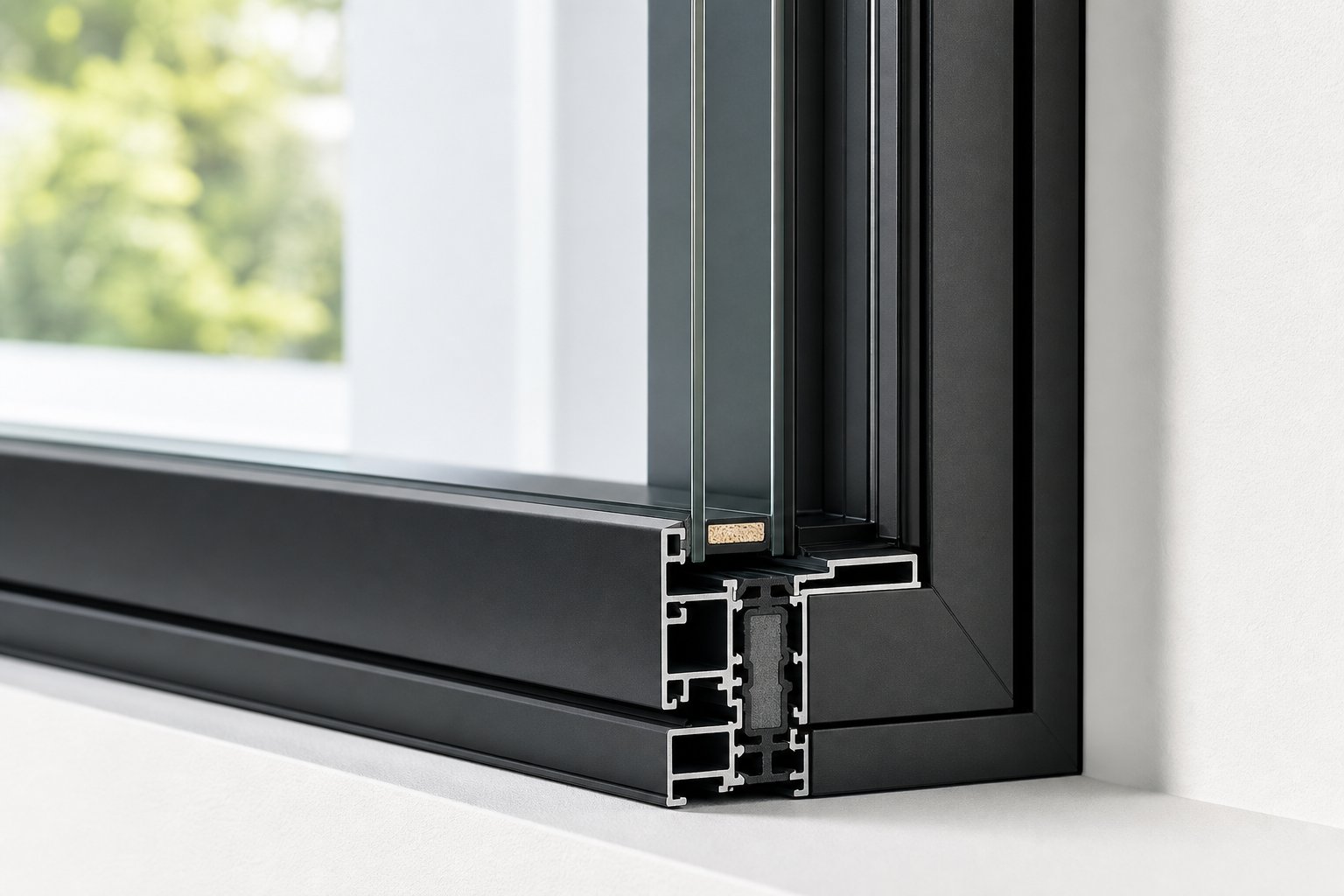
Aluminium’s primary limitation is thermal conductivity. It conducts heat roughly 1,000 times faster than uPVC or timber, creating thermal bridges that can undermine even premium double glazing. Modern thermally broken aluminium frames reduce this problem by 60 to 80 per cent, but they add 20 to 40 per cent to the cost — and even then, uPVC maintains a slight insulation advantage through inherent material properties.
For budget-conscious residential projects where slim sightlines are not critical, uPVC delivers solid thermal performance at a lower price point. Timber offers the best natural insulation of any frame material and suits heritage restorations where authenticity matters. Fibreglass bridges some gaps — strong, thermally efficient, and low maintenance — though it remains less common and more expensive in the Australian market.
Composite frames (blends of timber and polymer) offer longevity exceeding vinyl with less maintenance than solid timber, making them a middle-ground option for homeowners wanting durability without the upkeep.
Then there is the hybrid approach: aluminium clad wood windows combine a timber interior for warmth and insulation with an aluminium exterior shell for weather protection and low maintenance. This wood clad aluminium configuration gives you the thermal performance of timber where it matters most (the interior face) while eliminating the painting and refinishing cycle on the exposed exterior. An aluminium clad window suits homeowners who want authentic timber aesthetics inside without sacrificing durability outside — though the price premium reflects the complexity of combining two materials.
| Criteria | Aluminium | Vinyl (uPVC) | Timber | Fibreglass | Composite |
|---|---|---|---|---|---|
| Durability | 30-50 years; excellent structural integrity | 20-25 years; prone to warping over time | 20-60 years if maintained; susceptible to rot | 30-50 years; minimal degradation | 30-40 years; resists warping |
| Thermal Performance | Poor without thermal break; adequate to good with thermal break | Very good — inherently low conductivity | Excellent — natural insulator | Very good — low conductivity | Good — better than vinyl, less than timber |
| Cost (Supply and Install) | Mid to premium ($800-$2,000+ per opening) | Entry to mid ($600-$1,200 per opening) | Premium ($1,500-$3,500+ per opening) | Mid to premium ($1,200-$2,500+ per opening) | Mid to premium ($1,100-$2,200+ per opening) |
| Design Flexibility | Excellent — slim profiles, unlimited colours, large spans | Limited — thicker frames, fewer colour options | High — paintable, stainable, natural grain | Moderate — can mimic wood or smooth finish | Moderate — limited standard colours |
| Maintenance | Very low — periodic cleaning only | Very low — no painting required | High — regular painting, sealing, inspection | Very low — similar to vinyl | Low — occasional cleaning |
| Recyclability | Excellent — infinitely recyclable | Limited — difficult to recycle, degrades | Good — biodegradable, reusable | Poor — difficult to separate fibres | Limited — mixed materials complicate recycling |
The right material depends on your priorities. If you need large openings, slim frames, design versatility, and decades of low-maintenance performance — particularly in commercial or contemporary residential builds — aluminium remains the strongest all-round choice for Australian conditions. If maximum thermal insulation at minimum cost is the priority and you can accept thicker frames, uPVC or clad aluminium hybrids deserve consideration.
Settling on aluminium as your frame material is one decision. Choosing a reliable supplier to fabricate and deliver it is another — and that second decision carries its own set of risks that are not always obvious from a polished quote or a professional-looking website.
Red Flags and Common Mistakes When Choosing Suppliers
A polished website and a competitive quote can mask serious problems. Some of the worst supplier experiences start with everything looking perfectly reasonable on paper — until windows arrive with thin profiles, failing seals, or hardware that degrades within months. Knowing what to watch for before you commit protects your project and your budget.
Pricing Red Flags That Signal Quality Risks
There is a meaningful difference between competitive pricing and suspiciously cheap aluminium windows. When a quote comes in 30 to 40 per cent below comparable suppliers, something has been sacrificed. Common cost-cutting tactics include using thinner wall profiles (below 1.8 mm), substituting PA66 nylon thermal breaks with inferior PVC strips that crack over time, fitting unbranded hardware with limited cycle life, and reducing glass thickness below what the opening size demands structurally.
Buyers replacing old aluminium windows from the 1970s or 1980s sometimes gravitate toward the cheapest aluminium windows for sale, assuming any modern product will outperform their existing single pane aluminium windows. That is often true — but a rock-bottom replacement can deliver thermal performance barely better than the old aluminium window frames it replaces, particularly if the thermal break is compromised or the sealed unit uses basic clear glass without Low-E coatings.
Aluminium retrofit windows should represent a genuine performance upgrade. If the price seems too good to be true, request the profile cross-section drawing. This document reveals wall thickness, number of internal chambers, and thermal break width — the details that separate a durable product from one engineered purely to hit a price point.
Communication and Process Warning Signs
Pricing is not the only indicator. How a supplier communicates during the quoting phase often predicts how they will perform during production and delivery. Watch for these red flags:
- Vague or shifting lead time estimates — A reliable fabricator commits to a specific production timeline. “Around 4 to 6 weeks, depending” without clarifying what it depends on is a warning.
- Reluctance to provide physical samples — Suppliers confident in their product welcome inspection. Resistance suggests the finished quality may not match the catalogue.
- No test reports available — If a supplier cannot produce current AS 2047 test data for the system being quoted, the product may never have been independently verified.
- Missing or vague warranty documentation — A verbal promise of “10 years” means nothing without written terms specifying what is covered, what is excluded, and how claims are processed.
- Inability to provide project references — Established suppliers have completed projects they are happy to reference. No references usually means no track record.
- No engineering or technical support — If the supplier cannot advise on system selection, wind load requirements, or glazing specifications, they are likely a reseller without fabrication expertise.
- Inconsistency between samples and production — Quality-focused manufacturers maintain consistency between sample units and mass production through documented QC processes. Ask how they ensure batch-to-batch uniformity.
- Pressure to commit without full specification — A supplier pushing for a deposit before confirming all details (colour, hardware, glazing, flashing) is prioritising their cash flow over your project accuracy.
Ask directly about quality control processes during manufacturing. A credible supplier will explain their inspection points — incoming material checks, dimensional verification after cutting, surface treatment testing, assembly audits, and final unit inspection before dispatch. Factories operating disciplined QC systems answer these questions confidently because they have real processes in place.
Red flags tell you who to avoid. The next question is what a professional supplier engagement actually looks like when it goes right — from your first inquiry through to windows arriving on site ready for installation.
What to Expect From Your Aluminium Window Supplier
Knowing what a good supplier looks like on paper is one thing. Understanding how the actual engagement unfolds — from your first email through to windows arriving on site — is something most buyers only learn through experience. The process for custom aluminium windows differs significantly from ordering off-the-shelf products, and the level of coordination involved often surprises first-time project buyers.
The Quoting and Specification Phase
A professional supplier engagement starts with you providing clear project information. At minimum, this means architectural drawings (elevations and floor plans showing window locations), a window schedule listing sizes and opening types, your preferred aluminium window frame profile and finish, glazing performance targets (U-value, SHGC), quantities, and your construction timeline. The more complete your brief, the more accurate the quote.
What separates a capable supplier from a basic order-taker is what happens next. A strong response includes system recommendation — advising which profile series suits your performance and aesthetic requirements — plus engineering coordination for complex openings, wind load verification, and glazing specification review. These value-adds cost the supplier time, but they prevent expensive mistakes downstream. If your project involves aluminium window replacement on an existing building, the supplier should also discuss reveal dimensions, flashing interfaces, and whether the new aluminium window framing integrates with the existing structure or requires modification.
Expect a detailed quote breaking down frame, glazing, hardware, finish, and delivery as separate line items. Vague lump-sum pricing makes it impossible to compare suppliers meaningfully or identify where costs can be optimised.
Manufacturing Through to Delivery
Once specifications are locked and a deposit is placed, the production workflow follows a defined sequence. Project-based supply — where every window is fabricated to your drawings rather than pulled from stock — requires tighter coordination than most buyers anticipate. Each stage has quality control checkpoints that prevent errors from compounding.
For replacement aluminium windows or new-build projects alike, the typical process runs as follows:
- Drawing approval — The supplier produces shop drawings confirming every dimension, opening direction, hardware position, and glazing specification. You sign off before anything is cut.
- Material calculation and procurement — Profile lengths, glass units, hardware, gaskets, and thermal break components are calculated and ordered based on approved drawings.
- Fabrication — Profiles are cut, machined, and assembled into finished frames. CNC machinery ensures precision across repeated units, which matters enormously on multi-unit projects.
- Surface treatment — Powder coating or anodising is applied and inspected for colour consistency, adhesion, and film thickness.
- Glazing and hardware installation — Sealed glass units are fitted, hardware is mounted, and weather seals are checked for correct compression.
- Quality control inspection — Finished units are checked against the approved drawings for dimensional accuracy, operation, appearance, and completeness before packaging.
- Packaging and labelling — Each window is protected with corner guards, film, and foam, then labelled to match your window schedule for easy identification on site.
- Logistics and delivery — Dispatch is coordinated with your build program, whether that means a single delivery or staged drops aligned to construction progress.
This end-to-end process — from system recommendation through engineering, manufacturing, QC, and logistics — is what distinguishes project-based supply from simply buying a product. Suppliers like MEICHEN structure their service model around this full workflow, supporting builders, developers, and contractors from initial drawings through to site delivery with engineering coordination and quality control built into every stage.
For buyers managing an aluminium frame window replacement across multiple openings or a new development with dozens of custom units, this structured process is not optional — it is what keeps the project on track. Skipping steps (particularly drawing approval and pre-dispatch QC) is where most delivery disputes originate.
Understanding the production process gives you realistic expectations about timing and communication touchpoints. The final piece is matching all of this knowledge — supply chain position, evaluation criteria, window types, and engagement process — to your specific project scale and taking confident next steps.
Matching Your Project to the Right Aluminium Window Supplier
Every project has a supplier that fits — and several that do not. A bathroom renovation, a new family home, and a 60-unit apartment complex each demand different things from their aluminium window supplier, and the mismatch between project scale and supplier capability is one of the most common reasons buyers end up frustrated, over-quoted, or under-served.
The evaluation criteria, supply chain knowledge, and process understanding covered throughout this article all converge on a single practical question: which type of supplier matches what I actually need?
Matching Project Scale to Supplier Capability
Think of aluminium window companies as operating in tiers — not quality tiers, but capability tiers defined by the project scale they are built to serve.
Small renovations (1 to 5 openings) — A homeowner replacing a few windows needs a supplier willing to handle small orders without inflated pricing. Distributors stocking standard sizes offer speed. Local fabricators with flexible minimum orders provide customisation without the overhead of a large-scale operation. Searching for aluminium windows near me often surfaces these smaller, regionally focused businesses — and proximity matters when you need responsive communication and straightforward delivery logistics.
New homes and medium renovations (6 to 30 openings) — This is where fabricators shine. You need custom sizing, a range of window types, colour matching across the project, and coordination with your builder’s program. The supplier should offer specification advice, produce shop drawings for approval, and deliver on a committed timeline. Most aluminium windows specialists operating in the residential space are geared for exactly this volume.
Multi-unit developments and commercial projects (30+ openings) — At this scale, you need a supplier with genuine production capacity, engineering support, staged delivery capability, and a documented quality control process. An aluminium windows company serving this market should demonstrate experience with projects of comparable complexity, provide compliance documentation without being chased, and coordinate logistics across multiple delivery stages aligned to your construction program.
Approaching a large commercial fabricator for three replacement windows is likely to get you a slow response and premium pricing — their systems are not designed for that volume. Equally, asking a small residential workshop to deliver 200 units across a staged program risks overwhelming their capacity and blowing your timeline. The fit matters as much as the quality.
Taking the Next Step With Confidence
You have the framework. Here is how to put it into action. Whether you are searching for aluminum window suppliers in your area or evaluating a shortlist already in hand, these steps turn knowledge into a decision:
- Define your specifications clearly — Prepare drawings, a window schedule with sizes and types, your preferred performance level (thermally broken, double glazed, WERS targets), and your construction timeline. The more precise your brief, the more accurate and comparable the quotes you receive.
- Shortlist suppliers by capability, not just price — Match your project scale to the supplier tier that fits. Confirm they fabricate the window types you need, serve your market segment, and have capacity for your timeline.
- Request detailed, itemised quotes — Insist on line-item breakdowns covering frame, glazing, hardware, finish, and delivery separately. Lump-sum quotes hide cost drivers and make meaningful comparison impossible.
- Verify credentials and documentation — Ask for current AS 2047 test reports, WERS ratings, warranty terms, and references from completed projects of similar scale. A credible aluminium window supplier provides these without hesitation.
- Assess communication quality — The responsiveness, clarity, and technical depth of a supplier’s quoting phase is a reliable predictor of their performance during production and delivery. If they are vague or slow before they have your money, expect worse after.
- Evaluate the full service scope — For projects beyond simple replacements, look for suppliers offering end-to-end support: system recommendation, engineering coordination, manufacturing, quality control, and logistics. MEICHEN’s services page illustrates what this full-scope partnership looks like in practice — from drawings through to delivery — for builders, developers, and contractors who need project-based supply with integrated engineering and manufacturing support.
The right supplier is not necessarily the cheapest, the fastest, or the biggest. It is the one whose capability, communication, and process align with what your project actually demands. Armed with the distinctions covered in this article — supply chain position, evaluation criteria, window type specialisation, material confidence, red flag awareness, and process expectations — you are equipped to make that decision on evidence rather than guesswork.
Frequently Asked Questions About Aluminium Window Suppliers
1. What is the difference between an aluminium window manufacturer, fabricator, and distributor?
Manufacturers (system houses) design and produce the aluminium profiles and hardware systems. Fabricators purchase those profiles and assemble them into finished windows custom-sized to your project drawings. Distributors stock and resell standard-sized finished windows without fabricating anything in-house. Each offers a different balance of customisation, lead time, and pricing. Fabricators typically provide the best mix of flexibility and technical support for most residential and commercial projects in Australia.
2. How long does it take to get custom aluminium windows from a supplier?
Standard lead times for custom-fabricated aluminium windows in Australia range from 3 to 6 weeks after order confirmation. Factors that extend this include custom powder coat colours (add 1-2 weeks), specialty glazing like laminated or Low-E glass, large order volumes competing for production capacity, and seasonal demand peaks during spring and summer. Distributors offering standard sizes can dispatch in 1-2 weeks, while manufacturer-level orders involving new engineering may take 6-12 weeks.
3. What certifications should I check when evaluating an aluminium window supplier?
In Australia, verify AS 2047 compliance (structural adequacy, water resistance, air infiltration) with test reports from a NATA-accredited laboratory for the specific system and configuration quoted. Check AS 1288 compliance for glass selection and safety glazing. Look for WERS (Window Energy Rating Scheme) ratings that independently validate thermal performance claims. A credible supplier provides these documents without hesitation and can confirm the reports match the exact window type, size range, and glazing configuration being supplied to your project.
4. How do I know if an aluminium window supplier is unreliable?
Key warning signs include quotes 30-40% below comparable suppliers (indicating inferior profiles or hardware), vague lead time estimates without firm commitment dates, reluctance to provide physical samples or AS 2047 test reports, missing written warranty documentation, inability to supply project references, no engineering or technical support capability, and pressure to pay a deposit before all specifications are confirmed. Requesting the profile cross-section drawing is a quick way to verify quality — it reveals wall thickness, chamber count, and thermal break width.
5. Should I choose a different supplier for residential versus commercial aluminium windows?
Often, yes. Residential projects prioritise small-order flexibility, aesthetic variety, energy ratings for NatHERS compliance, and builder coordination. Commercial projects demand engineering support, bulk pricing, full compliance documentation (AS 2047, AS 1288, AS 4055), staged delivery management, and production capacity for large volumes. Some suppliers serve both markets well, but many specialise. Approaching a commercial curtain wall specialist for a three-window renovation — or asking a small residential fabricator to deliver 200 units on a staged program — typically results in poor service or inflated pricing.
More Window & Door Guides