What Aluminium Window Manufacturer Actually Means in Melbourne
Search for aluminium window manufacturers Melbourne and you will find dozens of businesses claiming the title. Some genuinely design and produce complete window systems under one roof. Others purchase pre-cut components and bolt them together. A few simply resell products made by someone else entirely, slapping their own branding on the box. These are three very different business models, and the one you choose shapes everything from pricing flexibility to who picks up the phone when something goes wrong.
Manufacturer vs Fabricator vs Reseller
A true manufacturer either extrudes aluminium profiles in-house or purchases raw profiles directly from an extrusion supplier, then handles every subsequent step — cutting, machining, powder coating, assembly, glazing, and quality testing — within their own facility. They control the full production chain and can modify profile designs, tooling, and finishes to suit project-specific requirements.
A fabricator sits one level removed. They purchase pre-designed aluminium window systems (profiles, hardware kits, gaskets) under licence from a system supplier, then assemble finished windows to order. The product may carry a well-known system brand, but the fabricator does not control the design, and their capacity for customisation is limited to what the system allows.
A reseller operates further still from the production floor. They take orders, coordinate delivery, and handle customer contact — but the windows are manufactured elsewhere. Resellers add margin without adding production capability, and they rarely hold compliance documentation or test data themselves.
- Pricing: Manufacturers offer factory-direct pricing without intermediary markups. Fabricators add assembly margins. Resellers layer additional distribution costs on top.
- Customisation: Manufacturers can produce non-standard sizes, bespoke configurations, and custom finishes. Fabricators work within the constraints of their system supplier’s catalogue. Resellers offer only what is already available.
- Quality control: Manufacturers run internal testing and hold direct accountability for every unit produced. Fabricators depend on consistent component supply. Resellers have limited visibility into production quality.
- Lead times: Manufacturers schedule production internally and can adjust timelines. Fabricators rely on third-party component deliveries. Resellers add coordination time between multiple parties.
- Accountability: With a manufacturer, one company owns every stage from raw material to finished product. With fabricators and resellers, responsibility can become fragmented across multiple businesses.
Why the Distinction Matters for Your Project
When buyers search specifically for aluminium windows Melbourne suppliers who manufacture, they are looking for direct access to production capability. That access matters most when a project involves custom sizing for renovations, non-standard configurations like oversized openings or unusual angles, or compliance requirements such as BAL ratings or marine-grade finishes for coastal suburbs.
Working directly with a manufacturer means one point of contact owns the outcome. There is no disconnect between the company quoting the job and the team actually building the product. If a window arrives with an issue, you are dealing with the people who made it — not a middleman pointing fingers at someone else’s factory. For window suppliers Melbourne builders and homeowners rely on, this single line of accountability often proves more valuable than any price difference.
Understanding where a business sits in this hierarchy is the first filter to apply when evaluating any window supplier in Australia. Everything that follows — thermal performance, compliance, pricing, lead times — depends on who is actually making the product and how much control they have over the result.
How Aluminium Windows Are Actually Made
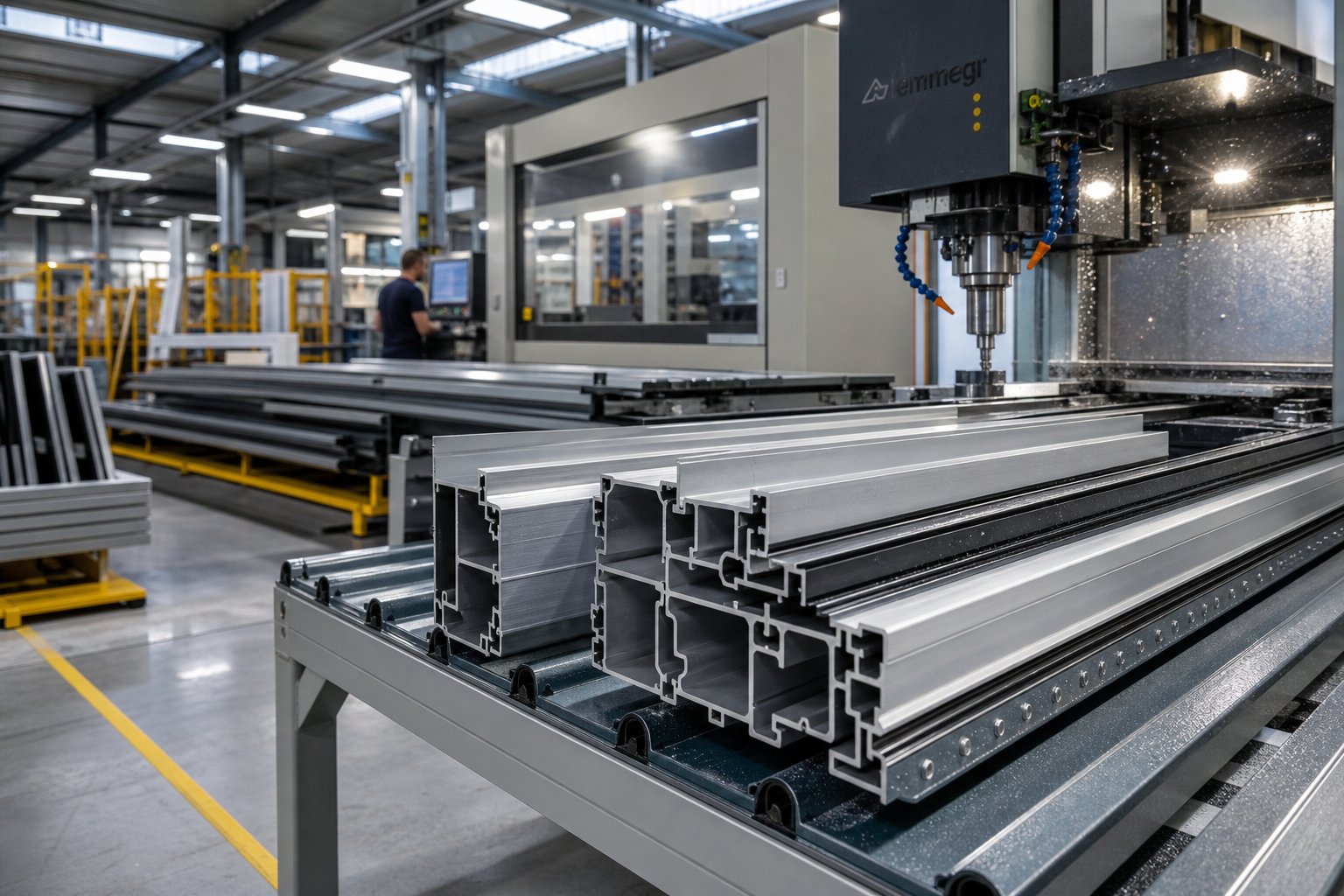
Knowing who makes the product is one thing. Understanding how they make it gives you a sharper eye for quality — and a better sense of why one manufacturer’s quote differs from another’s. The aluminium window manufacturing process involves a sequence of precision stages, each adding cost, complexity, and performance value to the finished frame. Most buyers never see this side of the industry, yet it directly determines how well your windows perform over the next 30 years.
From Aluminium Billet to Extruded Profile
Every aluminium window frame starts life as a cylindrical billet — a solid log of aluminium alloy roughly 200 mm in diameter. The billet is heated to between 400 and 500 degrees Celsius until it becomes malleable, then forced under immense hydraulic pressure through a steel die. That die contains the precise cross-sectional shape of the window profile, complete with hollow chambers, gasket channels, and hardware slots. The aluminium flows through the die opening and emerges as a continuous length of profile, which is then cooled, straightened, and cut to stock lengths.
The alloy grade matters here. Window profiles across Australia typically use 6063 aluminium alloy — sometimes called the “architectural alloy” — because it extrudes smoothly into complex thin-walled shapes and accepts surface finishes exceptionally well. Some manufacturers use 6060, which offers slightly different mechanical properties but similar workability. Both alloys contain magnesium and silicon, which form compounds that provide moderate strength and natural corrosion resistance. After extrusion, profiles undergo T5 or T6 heat treatment to reach their final strength — a yield strength of approximately 160 to 230 MPa depending on temper.
This extrusion step is where aluminium extrusion windows Australia manufacturers gain their flexibility. Custom dies allow bespoke profile geometries for specific projects, which is why true manufacturers can offer non-standard configurations that fabricators and resellers simply cannot.
Powder Coating and Surface Finishing
Raw extruded aluminium has a dull silver appearance and needs surface treatment for both protection and aesthetics. The dominant method for aluminium window frames Melbourne projects specify is powder coating, a multi-stage process that produces the durable coloured finish buyers see on the final product.
The process begins with pre-treatment: profiles are cleaned, degreased, and chemically converted to create a surface that bonds strongly with the coating. Next, dry powder particles — finely ground polymer resin mixed with pigments and hardeners — are applied electrostatically. The charged particles cling uniformly to the grounded aluminium surface, wrapping around edges and into recesses. The coated profiles then enter a curing oven at around 180 to 200 degrees Celsius, where the powder melts, flows, and chemically cross-links into a hard, continuous film typically 60 to 120 micrometres thick.
This finish resists UV degradation, chalking, and corrosion for decades. Manufacturers offer any colour from the RAL system — matte, satin, or gloss — plus specialty textures and metallic effects. For projects in coastal or industrial zones, powder coating conforming to AS3715 provides the durability required to handle salt spray and pollution.
Anodising is an alternative finish where an electrochemical process grows a thick oxide layer directly from the aluminium surface. It produces a harder, more scratch-resistant finish with a distinctive metallic appearance, though the colour range is narrower. Some high-end custom aluminium windows Melbourne architects specify use anodised frames for their refined aesthetic and superior hardness in high-traffic applications.
Assembly and Glazing Integration
Coated profiles arrive at the assembly stage cut to precise lengths with mitered corners at 45-degree angles. Corner cleats — metal brackets inserted into the hollow chambers of adjoining profiles — join the frame together, secured by crimping or mechanical fasteners to create rigid, weather-tight joints. Hardware is then fitted: hinges, locks, stays, rollers, or multi-point locking mechanisms depending on window type.
Glazing integration follows. Sealed glass units — whether single, double, or triple glazed — are installed into the frame with compression gaskets and glazing beads that hold the glass securely while allowing for thermal expansion. For thermally broken profiles, the polyamide insulating strip that separates inner and outer frame sections must align precisely with the glazing system to maintain the thermal barrier.
Quality manufacturers run each completed window through a series of performance checks before it leaves the factory. These typically include water penetration testing (simulating driven rain at specified pressure), air infiltration testing (measuring how much air leaks through closed seals), and operating force measurements (confirming that sashes open and close within acceptable effort limits). These tests validate that the aluminium window manufacturing process has produced a unit meeting its rated performance class.
- Billet heating and extrusion — raw aluminium alloy forced through precision dies to form profile shapes
- Heat treatment — T5 or T6 tempering to achieve specified mechanical strength
- Pre-treatment and surface preparation — cleaning, degreasing, and chemical conversion
- Powder coating or anodising — applying the protective and decorative finish
- Profile cutting and machining — CNC cutting to size, drainage slots, and hardware prep
- Frame assembly — corner joining, hardware installation, and seal fitting
- Glazing — installing sealed glass units with gaskets and beads
- Quality testing — water, air, and operational performance verification
Each of these stages adds labour, equipment, and expertise. A manufacturer controlling all eight steps in-house can identify and correct issues at any point. A basic assembler handling only steps five through seven has far less influence over the finished product’s performance — and far less data to back up their claims. That difference in production depth becomes especially relevant when Melbourne’s climate demands specific performance levels from every window on a project.
Melbourne Climate and Regulatory Factors That Shape Your Choice
Melbourne does not let you get away with generic window specifications. The city straddles a unique combination of weather patterns — cold winters with persistent wind-driven rain, hot summers with intense UV and occasional heatwaves, salt-laden air sweeping inland from Port Phillip Bay, and bushfire risk creeping through its outer green wedges. Each of these pressures lands squarely on your window frames and glass, and each one filters the list of aluminium window manufacturers capable of delivering a product that actually performs here.
Climate Zone 6 Requirements and Energy Ratings
Melbourne falls within NCC climate zone 6, a classification that reflects its cool-temperate conditions — mild summers paired with winters cold enough to demand serious insulation. Under Part 13.3 of the ABCB Housing Provisions, external glazing must meet thermal performance benchmarks that limit heat loss in winter and control solar gain in summer. For new builds and major renovations, this increasingly pushes specifications toward double glazed windows Melbourne energy assessors model into their NatHERS ratings.
Glass selection in climate zone 6 is not one-size-fits-all. Orientation drives the conversation. North-facing windows benefit from higher Solar Heat Gain Coefficient (SHGC) glass that lets winter sunlight warm interior spaces passively, reducing heating loads. West-facing windows demand the opposite: low-SHGC glass with tinted or low-E coatings to reject the brutal afternoon heat that drives summer cooling costs through the roof. South-facing glazing prioritises low U-values above all else, since it receives minimal direct sun yet loses heat readily in winter.
For aluminium frames specifically, climate zone 6 makes thermally broken profiles the practical standard for any project chasing a 7-star NatHERS rating or above. Standard aluminium conducts heat rapidly — roughly 200 W/mK compared to timber’s 0.15 W/mK — so without thermal breaks, even expensive double glazing Melbourne homes invest in gets undermined by heat bleeding through the frame. A capable manufacturer understands these interactions and recommends frame-glass combinations calibrated to each facade orientation, not a blanket specification applied everywhere.
Coastal Corrosion and Bushfire Ratings
Beyond thermal performance, Melbourne’s geography introduces two additional hazards that directly affect how windows must be specified and finished.
Bayside suburbs from Williamstown around to Frankston, plus the entire Mornington Peninsula coastline, sit within moderate to high corrosion environments classified under AS/NZS 2312. Properties within one to three kilometres of tidal water typically fall under category C4 (high), while those closer to open surf or within direct salt spray range may reach C5 (very high). In these zones, standard powder coating degrades within a few years — blistering, chalking, and white oxidation at cut edges. Marine-grade powder coating at 80 microns or greater, applied over chrome-free immersion pre-treatment, becomes essential. Some manufacturers also offer marine-grade aluminium alloys (5052 or 5083 series) with higher magnesium content for superior chloride resistance in suburbs like Brighton, Sandringham, and Portsea.
Melbourne’s outer growth corridors tell a different story. Suburbs pushing into the Dandenong Ranges, Kinglake, the Yarra Valley, and across to the You Yangs border designated Bushfire Prone Areas. The Victorian Building Authority requires all new homes in these areas to meet a minimum BAL-12.5 construction standard, with many sites assessed at BAL-19, BAL-29, or higher depending on vegetation proximity and slope. At each level, windows must be tested and certified to resist increasing radiant heat exposure — from ember protection at BAL-12.5 up to potential flame contact at BAL-FZ. Manufacturers supplying these areas need BAL-rated window systems with appropriate glazing (typically toughened or wired glass), sealed frames resistant to ember ingress, and metal mesh screens at higher ratings.
For builders and homeowners navigating double glazing windows Melbourne projects, the table below breaks down what each sub-region demands:
| Melbourne Sub-Region | Corrosion Category (AS/NZS 2312) | BAL Requirement | Recommended Frame Treatment |
|---|---|---|---|
| Inner city and general suburban (5km+ from coast) | C2 — Low | Generally not applicable | Standard powder coat (60+ microns), standard 6063 alloy |
| Bayside/coastal (Brighton, Sandringham, Mornington Peninsula) | C4 to C5 — High to Very High | Generally not applicable | Marine-grade powder coat (80+ microns), chrome-free pre-treatment, consider 5052 alloy, 316 stainless fixings |
| Bushfire-prone outer suburbs (Dandenongs, Kinglake, Yarra Valley, Macedon) | C2 — Low | BAL-12.5 minimum; BAL-19 to BAL-40 common | Standard powder coat, BAL-rated glazing and seals, ember guard screens, metal frames (aluminium inherently non-combustible) |
| Coastal + bushfire overlap (Anglesea, Lorne, parts of Mornington Peninsula hinterland) | C3 to C4 — Medium to High | BAL-12.5 to BAL-29 typical | Marine-grade finish plus BAL-rated system, dual compliance documentation required |
This regional variation is precisely why working with a manufacturer who understands Melbourne’s patchwork of exposure conditions matters. A manufacturer producing windows in-house can adjust alloy selection, pre-treatment processes, coating thickness, and glazing configurations on a per-project basis. A reseller offering a single standard product line cannot adapt to a Brighton beachfront the same way they service a Ringwood renovation — and the consequences show up as premature failure, voided warranties, or non-compliant installations that a building surveyor will flag.
These climate and compliance layers also cascade into the type of window you select for each opening — because not every window style handles weather exposure, ventilation needs, and energy ratings equally well.
Aluminium Window Types and Where Each One Works Best
Every window style handles ventilation, weather sealing, and spatial constraints differently. Yet most supplier websites list window types as a flat catalogue — awning, casement, sliding, double hung — without ever explaining which one actually suits your bathroom, your bedroom, or that west-facing wall copping afternoon sun. For Melbourne homes dealing with wind-driven rain one month and 40-degree heatwaves the next, matching the right window type to each room is not a cosmetic decision. It is a performance one.
Awning and Casement Windows for Ventilation Control
Awning and casement windows both belong to the hinged family, and both use compression sealing — meaning the sash presses firmly against the frame when locked shut, creating a tighter air and water barrier than track-based systems. The critical difference is hinge position, and that small detail changes everything about where each type belongs in your floor plan.
Aluminium awning windows Melbourne homes use extensively are hinged at the top and swing outward from the bottom. When open, the glass panel acts like a canopy, deflecting light rain away from the opening while still allowing air to flow in from below. This makes them a natural fit for rooms that need constant ventilation regardless of weather: bathrooms where moisture control is essential, kitchens where cooking steam needs an escape route, and laundries where tumble dryers pump warm humid air into the space. They also work well positioned high on a wall, since they can be operated with a winder mechanism without requiring full arm reach.
The trade-off is airflow volume. Because the sash opens at a limited angle — typically 30 to 45 degrees — awning windows move less air than a casement of equivalent size. They suit controlled, steady ventilation rather than rapid air exchange.
Casement windows flip the equation. Hinged on one vertical side, they swing outward like a door and can open to 90 degrees or more. This wide opening captures side breezes effectively — the open sash acts almost like a sail redirecting lateral air currents into the room. For bedrooms where fresh air circulation directly affects sleep comfort, and for living areas where cross-ventilation relies on windows working together across opposite walls, casement windows deliver the highest effective airflow of any standard window type.
The practical consideration? Casement windows project outward when open, so they need clear exterior space. That rules them out along narrow side passages, above paths where pedestrians might walk into a protruding sash, or on upper-storey facades facing public walkways. In those situations, awning windows serve the same ventilation purpose without the spatial conflict.
Sliding and Double Hung for Space Efficiency
Where exterior clearance is tight or interior furnishings sit close to the window line, neither awning nor casement designs work well. Aluminium sliding windows Melbourne builders commonly specify solve this by operating entirely within the plane of the wall — no sash projects inward or outward at any point during operation.
A sliding window runs one or two sashes horizontally along a track. The mechanism is simple, the operation is intuitive, and the profile suits wide openings where a horizontal emphasis complements contemporary architecture. Laundries, hallways, rooms facing side boundaries, and any opening adjacent to a deck or walkway benefit from this format. Since the sash never protrudes, you can place furniture, blinds, or landscaping right up to the window without interference.
The limitation is ventilation area. In a standard two-panel slider, only half the frame width is ever open at once. For many utility spaces, that is perfectly adequate. For a main living area where maximum airflow matters on a hot evening, it may not be enough.
Double hung windows offer a different take on the same space-efficient principle, but with vertical operation. Two sashes slide up and down within the frame — the bottom sash lifts and the top sash drops. This dual-sash arrangement provides versatile ventilation patterns: open the bottom for cooler air entry, the top for warm air escape, or both for a gentle stack effect that naturally circulates air without any mechanical assistance. Bedrooms, streetside elevations, and traditionally styled homes across Melbourne’s inner suburbs favour double hung windows for their classic proportions and flexible airflow control.
Maintenance differs between the two. Sliding windows rely on clean tracks and quality rollers; debris in the lower channel is the most common cause of stiff operation over time. Double hung windows depend on balance mechanisms that support sash weight — spring or spiral balances in modern aluminium systems — plus well-maintained seals along the vertical slides. Both types benefit from regular cleaning and periodic hardware checks, but neither demands the same level of attention as hinged systems with complex multi-point locks.
Bi-Fold and Stacker Doors for Indoor-Outdoor Living
Melbourne’s lifestyle leans heavily toward blurring the boundary between house and garden. Alfresco dining, outdoor entertaining areas, and open-plan kitchens flowing onto decks are standard expectations in new builds and renovations alike. Achieving that seamless connection requires large-format openings — and that is where bi-fold and stacker sliding doors come in.
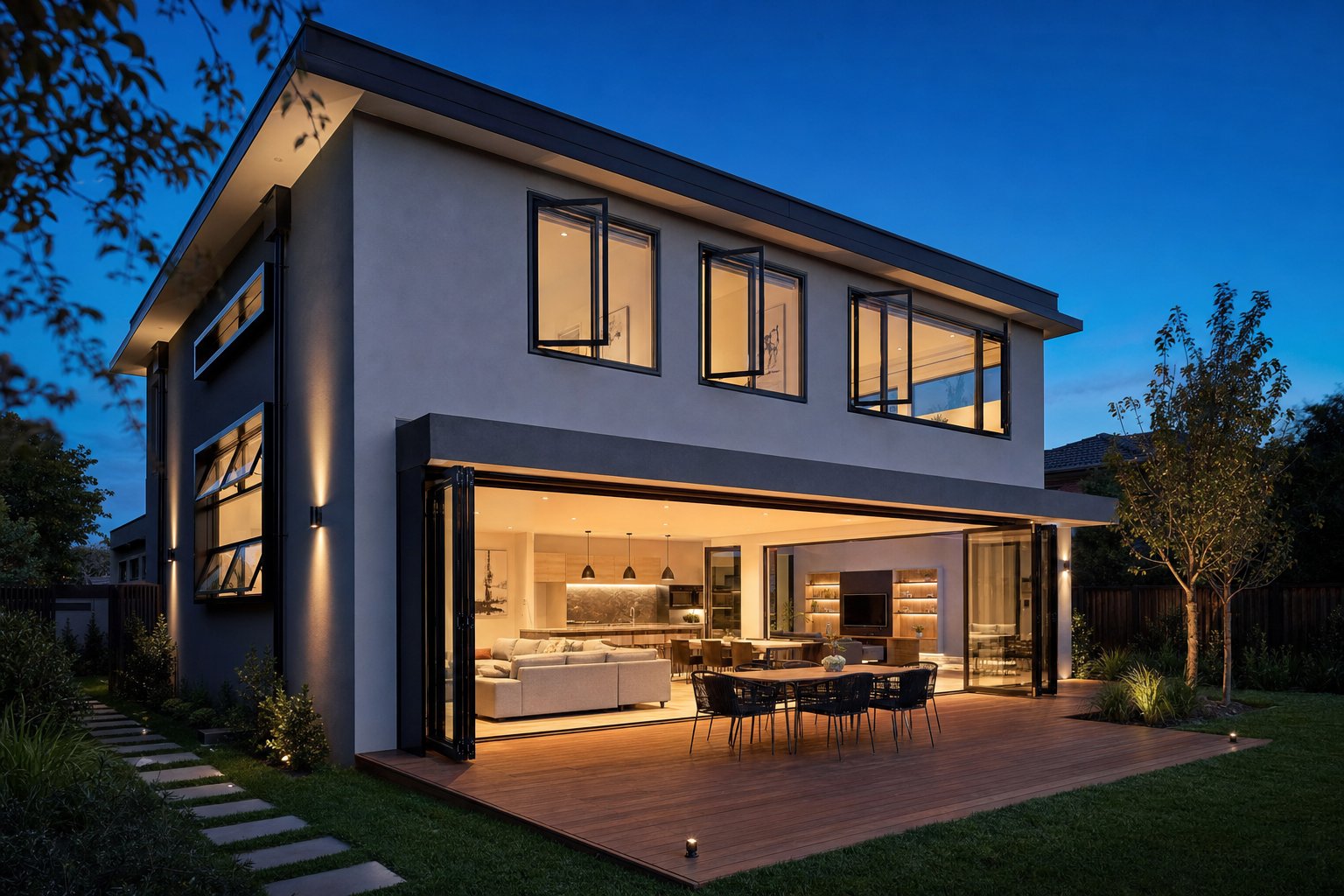
Bi-fold doors use multiple aluminium-framed panels connected by hinges, folding and stacking neatly to one or both sides of the opening. A well-engineered system can span openings of 6 metres or more, creating an uninterrupted passage between indoor and outdoor living zones. The best double glazed doors in this category use thermally broken aluminium frames with insulated glass units, maintaining energy performance across what would otherwise be a massive thermal weak point in the building envelope.
Structural requirements increase significantly with size. Bi-fold systems need robust head tracks — often top-hung designs where the majority of panel weight is carried from above rather than rolling along a floor rail. This demands adequate structural support in the lintel or header beam, engineered specifically for the combined panel weight and dynamic loads as the door is operated. Floor thresholds must handle water drainage, wheelchair accessibility requirements, and the precision alignment that keeps multiple panels folding smoothly over years of daily use.
Stacker sliding doors take a different approach. Instead of folding, multiple panels slide behind one another and stack at one or both ends of the opening. They suit situations where the fully-open position needs a clean, unobstructed threshold — no folded panels sitting perpendicular to the wall. Double glazed doors Melbourne homeowners choose in stacker configurations can span similarly wide openings while maintaining a flush floor detail that bi-folds cannot always achieve.
Both systems demand precision manufacturing. Panel alignment, roller quality, multi-point locking, weather sealing across wide spans, and glass weight management all require a manufacturer with CNC machining capability and rigorous quality testing. These are not products where a basic assembler can deliver consistent results — the tolerances are too tight and the structural loads too significant.
| Window/Door Type | Best Room Applications | Ventilation Rating | Weather Sealing | Relative Cost |
|---|---|---|---|---|
| Awning | Bathrooms, kitchens, laundries, high-wall positions | Moderate — controlled airflow at limited opening angle | Excellent — compression seal plus rain deflection when open | Low to moderate |
| Casement | Bedrooms, living areas, any room needing cross-ventilation | High — wide opening captures side breezes effectively | Excellent — compression seal when closed | Moderate |
| Sliding | Laundries, hallways, rooms along boundaries or walkways | Moderate — limited to open sash area (typically 50%) | Good — depends on interlock and weatherstrip quality | Low to moderate |
| Double Hung | Bedrooms, streetside facades, traditional-style homes | Good — flexible top/bottom ventilation patterns | Good — depends on balance system and seal condition | Moderate |
| Bi-Fold Doors | Living-to-deck transitions, alfresco areas, entertaining zones | Very high — near-complete opening when fully folded | Good when closed — multiple panel seals require quality hardware | High |
| Stacker Sliding Doors | Open-plan living, wide garden openings, pool areas | High — large sliding panel area | Good to excellent — fewer hinge joints than bi-folds | High |
The right choice comes down to matching each opening’s orientation, room function, spatial constraints, and performance requirements. A well-briefed manufacturer will recommend different window types across a single project — awning windows in the ensuite, casement in the master bedroom, sliders along the side passage, and bi-folds across the rear living zone. That mix is not indecision; it is precision specification. And it is the kind of tailored guidance you get from working directly with a manufacturer who understands how each system performs under Melbourne’s specific climate loads — particularly when thermal performance enters the equation.
Thermal Performance and Energy Efficiency Explained
Aluminium conducts heat roughly 1,000 times more readily than timber. That single fact has fuelled decades of criticism — and it is entirely valid when applied to standard, unbroken aluminium frames. But the conversation has shifted. Modern thermally broken aluminium windows Melbourne projects now specify routinely close the performance gap to a degree that surprises most buyers encountering the technology for the first time. The key lies in understanding what sits between the inner and outer halves of the frame.
How Thermal Breaks Work in Aluminium Frames
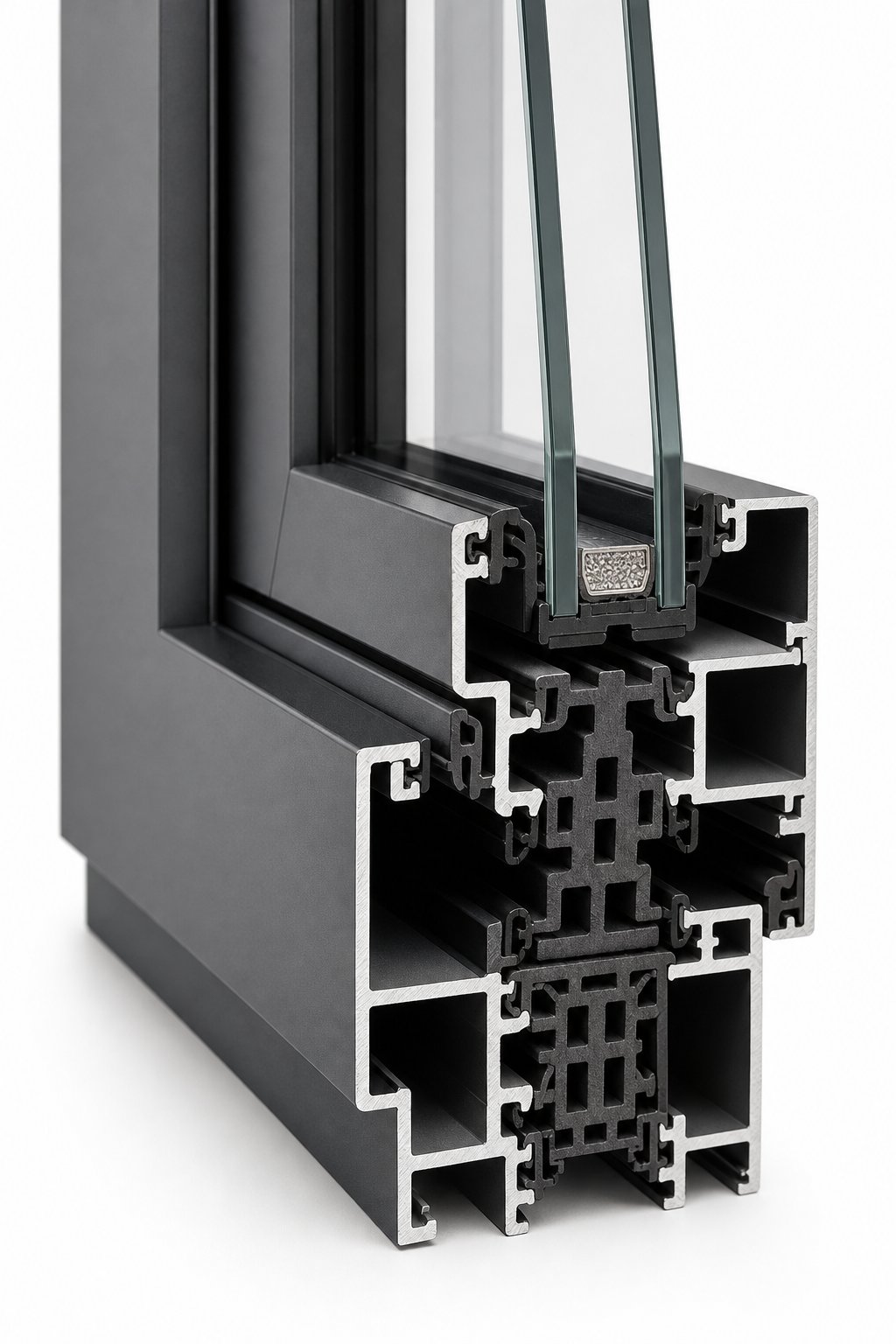
A thermal break is a continuous strip of insulating material — typically glass-fibre-reinforced polyamide (nylon) — mechanically crimped between the exterior and interior aluminium profiles. This strip physically separates the two metal sections so that heat cannot conduct straight through the frame from one side to the other.
Think of it as cutting a metal bridge in half and filling the gap with plastic. The aluminium on the outside still absorbs summer heat or winter cold, but that energy hits a wall of polyamide before it can reach the interior profile. Polyamide’s thermal conductivity is 500 to 1,000 times lower than aluminium’s, so even a strip as narrow as 20 to 35 mm creates a substantial insulation zone within the frame.
The structural integrity of the window is not compromised. Specialised crimping techniques bond the polyamide to both aluminium sections while accommodating different thermal expansion rates between the materials. The result is a frame that looks and handles identically to standard aluminium — slim sightlines, high strength-to-weight ratio, long span capability — but with thermal performance approaching timber or uPVC equivalents.
For retrofit double glazing Melbourne homeowners pursuing in older aluminium-framed homes, the absence of thermal breaks in existing frames is often the weakest link. Upgrading the glass alone to an insulated unit helps, but the frame still bleeds energy at its edges. Where budgets allow, replacing the entire window with a thermally broken system delivers a step-change improvement that glass-only upgrades cannot match.
Understanding U-Values and Melbourne’s Energy Requirements
U-value measures how quickly heat passes through a building element — expressed in watts per square metre per degree of temperature difference (W/m2K). A lower number means less heat transfer, which translates to better insulation. When applied to windows, three U-values matter:
- Uf — the thermal transmittance of the frame alone
- Ug — the thermal transmittance of the glass unit
- Uw — the whole-of-window value combining frame, glass, and edge effects
Two windows can use identical double glazed units yet deliver very different Uw values purely because one frame conducts heat far more readily than the other. This is the double glazed window U-value Australia energy assessors plug into NatHERS modelling — it is the Uw figure that determines whether your windows help or hinder your star rating.
Indicative Uw ranges for double glazed windows in Australian residential applications, based on typical system data:
- Non-thermally broken aluminium: around 3.0 W/m2K or above
- Thermally broken aluminium: approximately 2.0 to 2.7 W/m2K
- uPVC: approximately 1.8 to 2.4 W/m2K
- Timber: approximately 1.8 to 2.5 W/m2K
Melbourne sits in NCC climate zone 7 for commercial buildings (zone 6 under the residential housing provisions), where energy efficiency requirements are tightening with each code cycle. Section J and Part 13 increasingly push glazing specifications toward lower U-values and controlled solar heat gain. For residential projects chasing 7-star NatHERS ratings or above, non-thermally broken aluminium frames rarely model favourably — the frame Uf penalty drags the whole-of-window number too high. Thermally broken frames paired with quality double glazing are now the practical baseline for energy efficient windows Melbourne new builds need to achieve compliance.
Aluminium vs Timber vs uPVC Frame Comparison
No single frame material wins on every metric. The honest comparison below covers the factors that matter most for Melbourne homes — durability in local conditions, thermal performance with double glazing, ongoing maintenance, cost positioning, and practical suitability.
| Factor | Aluminium (Thermally Broken) | Timber | uPVC |
|---|---|---|---|
| Thermal performance (indicative Uw with double glazing) | 2.0 – 2.7 W/m2K | 1.8 – 2.5 W/m2K | 1.8 – 2.4 W/m2K |
| Durability | Excellent — powder coat resists UV, moisture, and corrosion for 20+ years with appropriate finish grade | Good if maintained — vulnerable to rot, termite damage, and UV degradation without regular recoating | Very good — does not rot, rust, or require repainting; UV-stabilised compounds resist degradation |
| Maintenance | Low — periodic cleaning and hardware lubrication only | High — requires sanding and repainting every 5–10 years; more frequent in exposed locations | Low — wash-down cleaning and hardware checks |
| Maximum span and sightlines | Superior — highest strength-to-weight ratio allows slimmer profiles and wider openings | Moderate — larger profiles needed for equivalent structural spans | Moderate to limited — multi-chamber profiles tend toward bulkier frames; steel reinforcement needed for larger spans |
| Design flexibility | Extensive — any RAL colour, metallic finishes, custom profiles, curved frames possible | Good — natural timber aesthetic, stainable, but colour options limited compared to powder coat | Good — foil wraps and colour-through options available, though range narrower than aluminium |
| Coastal suitability (Melbourne bayside) | Excellent with marine-grade coating — purpose-designed for salt exposure | Poor to moderate — moisture penetration and salt accelerate timber decay | Good — inherently resistant to salt corrosion, though hardware must be specified accordingly |
| Bushfire suitability | Excellent — non-combustible; certified BAL-rated systems readily available | Poor — combustible material; not suitable at higher BAL ratings without extensive modification | Limited — melts at lower temperatures than aluminium; fewer BAL-rated options available |
| Cost positioning (supply only, standard residential sizes) | Moderate to high — thermal break technology adds cost over standard aluminium | High — material and labour-intensive manufacturing | Moderate — competitive with thermally broken aluminium on a performance-per-dollar basis |
| Recyclability | Excellent — aluminium is infinitely recyclable with no loss of properties | Moderate — reusable but typically downcycled at end of life | Limited — recyclable in theory but less established recycling infrastructure in Australia |
Standard aluminium’s thermal weakness is real — a Uf of 5.5 to 7.0 W/m2K in non-thermally broken form is simply not competitive with timber or uPVC for energy performance. But thermally broken aluminium windows Melbourne manufacturers produce today close that gap substantially, landing within a similar Uw range while offering superior span capability, slimmer frames, lower maintenance, and full bushfire and coastal compliance options that neither timber nor uPVC can consistently match across Melbourne’s varied exposure conditions.
The practical takeaway: if a manufacturer quotes standard (non-thermally broken) aluminium for a new build or major renovation, question whether the product can meet current NCC energy requirements for your specific project. Conversely, if thermal performance is the primary concern, thermally broken aluminium paired with appropriate double glazing delivers the energy efficiency Melbourne’s code demands without sacrificing the structural and aesthetic advantages that make aluminium the dominant commercial and residential frame material across Australia. The real question becomes not which material, but which level of compliance and certification sits behind the product — a topic that separates genuine manufacturers from everyone else in the supply chain.
Australian Standards Every Buyer Should Verify
Compliance is the sharpest filter you have when separating credible aluminium window manufacturers Melbourne has to offer from businesses trading on marketing alone. Australian Standards are not optional recommendations — they form a legal framework that governs how windows are designed, tested, manufactured, and installed. Understanding which standards apply and what documentation to demand gives you a concrete way to assess whether a supplier genuinely controls their product quality or simply passes along someone else’s paperwork.
AS2047 Window Classification and What It Guarantees
AS2047 is the primary Australian Standard governing the performance of external windows and doors in buildings. It does not tell manufacturers how to build a window — it tells them what the finished product must achieve. Specifically, every window system must be tested and classified across three core performance areas:
- Water penetration resistance — how well the closed window prevents water ingress under simulated wind-driven rain at specified pressure levels
- Wind resistance — the structural capacity of the frame and glazing to withstand wind pressure without excessive deflection or failure
- Operating force — how much effort is required to open and close the sash, ensuring usability over the product’s lifespan
Testing is conducted by accredited laboratories, and results are documented in formal test reports tied to specific window configurations — meaning a particular frame profile, hardware set, glazing type, and size range. Generic certificates that do not match the actual product being supplied are worthless, yet they circulate frequently. A legitimate manufacturer holds reports that correspond precisely to the systems they produce.
Two certification pathways signal genuine AS2047 window compliance Australia buyers can trust. A WaterMark licence confirms that the product has been independently tested and is subject to ongoing surveillance audits. CodeMark certification goes further, providing a deemed-to-satisfy pathway under the NCC — meaning building surveyors can accept the product without requiring additional evidence of code compliance. Either pathway demands investment in testing infrastructure and ongoing quality management that basic assemblers and resellers rarely maintain.
The Australian Glass and Window Association (AGWA) publishes technical fact sheets and administers accredited rating label programs that support consistent compliance across the industry. Their labelling system requires manufacturers to display correct wind pressure and water penetration resistance values on each window — a practice that gives builders and inspectors an immediate verification tool on site.
NCC and BCA Section J Energy Compliance
Beyond structural and weather performance, the National Construction Code imposes energy efficiency requirements that directly shape window specification. For residential buildings (NCC Volume Two and the Housing Provisions), Part 13 sets thermal performance benchmarks that glazing must meet. For commercial and multi-residential buildings, Section J of NCC Volume One controls facade thermal performance, solar admittance, and air-tightness.
Energy assessors model window performance using U-values, Solar Heat Gain Coefficients, and air infiltration data — all drawn from manufacturer-supplied technical documentation. If a manufacturer cannot provide verified performance data for their specific systems, the assessor must fall back on default penalty values that assume worst-case performance. Those defaults almost always push a project below its target star rating, forcing compensatory measures elsewhere in the building envelope that add cost.
For Melbourne projects in NCC climate zone 6, the energy provisions increasingly push toward thermally broken aluminium frames with double glazing as a baseline. Manufacturers meeting current aluminium window standards Melbourne projects demand will hold WERS (Window Energy Rating Scheme) data or equivalent modelled performance figures for each system in their range. This data feeds directly into NatHERS assessments for residential builds and JV3/Verification Method modelling for commercial work.
The standards ecosystem does not operate in isolation — each requirement connects to others. The key window certification requirements Australia mandates for compliant construction include:
- AS2047 — window and door performance classification (water, wind, operating force)
- AS1288 — glass selection and installation, including safety glazing requirements for human impact areas
- AS/NZS 2208 — safety glazing materials specification (referenced by AS1288)
- AS3715 — powder coating of aluminium and aluminium alloys, governing finish durability and corrosion resistance (updated 2025 edition with enhanced performance benchmarks)
- BAL rating certification — bushfire-rated window systems tested and certified to AS3959 for properties in designated Bushfire Prone Areas
- NCC compliance — energy efficiency provisions under Section J (commercial) or Part 13 Housing Provisions (residential)
Here is the critical distinction: a genuine manufacturer holds these certifications against their own products and can produce the corresponding test reports, compliance statements, and technical data on request. They have direct relationships with testing laboratories and maintain the quality systems that underpin ongoing certification. A reseller, by contrast, may show you a certificate — but it belongs to someone else’s product made in someone else’s factory. If that factory changes a component, updates a profile, or loses its certification, the reseller may not even know about it until a problem surfaces on your project.
When evaluating any supplier claiming to meet these standards, ask one simple question: can you show me the AS2047 test report for the exact system you are quoting? A manufacturer who controls their production will hand it over without hesitation. Anyone who deflects, delays, or offers generic documentation is telling you something important about where they sit in the supply chain — and how much accountability they actually carry if something goes wrong. That accountability gap becomes even more apparent when you dig into warranty structures and manufacturing capabilities, the practical evaluation criteria that separate marketing claims from verifiable quality.
How to Evaluate and Compare Melbourne Manufacturers
Certifications confirm a product meets minimum legal thresholds. But choosing between manufacturers requires a broader lens — one that examines production capability, warranty substance, and operational transparency alongside compliance documentation. The best aluminium window company Melbourne buyers can work with is not necessarily the one with the slickest showroom. It is the one whose claims hold up under scrutiny when you ask the right questions.
Certifications and Manufacturing Capabilities to Check
Start with industry membership. An active Australian Window Association (AWA) or AGWA membership signals that a manufacturer participates in industry accreditation programs and subjects their products to third-party oversight. It is not a guarantee of excellence, but absence is a red flag — reputable manufacturers have little reason to avoid industry bodies that validate their quality systems.
Beyond membership, dig into what actually happens inside their facility. The following capabilities separate a genuine manufacturer from a business that assembles or rebrands:
- In-house powder coating — manufacturers who coat on-site control colour consistency, film thickness, and pre-treatment quality directly. Outsourced coating adds lead time and removes a key quality checkpoint from the manufacturer’s hands.
- CNC machining capability — computer-controlled cutting and routing ensures profiles are machined to sub-millimetre tolerances, which directly affects frame squareness, drainage function, and hardware fit over decades of use.
- On-site testing facilities — a manufacturer with their own water penetration rig and air infiltration chamber can verify every batch against AS2047 parameters without relying on external lab schedules.
- Years of continuous operation — longevity in business does not guarantee quality, but a manufacturer operating for 15 or 20 years has survived market cycles, supply disruptions, and the accountability that comes with long-term warranty obligations still in force.
- Direct extrusion supply relationships — ask whether they purchase profiles directly from the extruder or through distributors. Direct supply typically means better alloy traceability and priority access during tight supply periods.
Any aluminium window manufacturer comparison Melbourne buyers undertake should weight these operational factors alongside price. A lower quote from a supplier lacking CNC machining or in-house testing may reflect corners cut in places you cannot see at handover — but will feel within a few years of installation.
Warranty Structures and What They Actually Cover
A headline warranty figure means little without understanding its internal structure. Most manufacturers break coverage into separate terms for each component, and the differences between suppliers often hide in the fine print rather than the brochure.
Typical window manufacturer warranty Australia structures look something like this:
- Aluminium frame — 20 to 30 years against structural defects, warping, or corrosion that compromises integrity
- Powder coat finish — 10 to 15 years covering peeling, flaking, or premature chalking beyond normal weathering
- Hardware — 5 to 10 years on hinges, locks, handles, and friction stays
- Glazing seals (IGU units) — 10 to 15 years against seal failure resulting in inter-pane condensation
Each component warranty mirrors that part’s expected service life rather than the frame’s overall longevity. Research on aluminium window lifespans confirms that frames themselves can last 60-plus years while seals, hardware, and glazing units cycle through shorter replacement intervals. Your warranty should reflect that reality rather than obscure it behind a single number.
Watch for these common exclusions that void or limit coverage:
- Coastal installation without marine-grade powder coat specified at the time of order
- Installation by unlicensed or non-approved contractors
- Failure to demonstrate regular maintenance (cleaning, lubrication, seal checks)
- Prorated terms that reduce coverage percentage year by year — a 25-year prorated warranty may leave you paying 50 per cent of repair costs by year twelve
- Delayed defect reporting — waiting months to notify the manufacturer of condensation or seal failure can give grounds for denial
Ask for the full warranty document before committing, not just the summary card. Compare the structure component by component. A shorter non-prorated warranty with clear terms and full labour inclusion often delivers better real-world protection than a longer headline figure riddled with carve-outs.
Common Mistakes When Choosing a Manufacturer
Certain errors repeat across Melbourne projects regardless of budget or scale. Recognising them upfront saves time, money, and the headache of discovering the problem mid-build or after handover.
Confusing an installer with a manufacturer. Many window installation businesses present themselves as manufacturers when they actually purchase finished products from a third party. Trusted window installers double glazing Australia homeowners rely on may do excellent fitting work — but that does not mean they control production quality, hold test reports, or can modify specifications. Ask directly: where are the windows made, and who owns that facility?
Choosing solely on price without checking compliance documentation. The cheapest quote often reflects absent compliance costs — no independent testing, no ongoing quality audits, no BAL certification where required. A low price is only an advantage if the product actually meets the standards your project demands. Request the AS2047 test report specific to the quoted system before comparing numbers.
Overlooking thermal performance requirements. Specifying non-thermally broken frames for a project that needs to achieve 7-star NatHERS creates an energy compliance problem that surfaces during assessment — often too late in the build timeline to change course without costly delays.
Not confirming actual manufacturing location. Some businesses market themselves as Melbourne manufacturers while sourcing product interstate or overseas. This matters for lead time reliability, warranty enforcement, and site support when issues arise during installation. Ask for their factory address and whether you can visit the production floor.
Ignoring hardware and finish specification in favour of frame focus. The frame may last 60 years, but hardware failing at 5 years and a powder coat chalking at 8 years will define your experience of that window long before frame longevity becomes relevant.
Use the checklist below as a working tool during your evaluation process:
- Confirm AWA or AGWA membership and ask for membership number
- Request AS2047 test reports matching the exact system quoted
- Verify whether powder coating is performed in-house or outsourced
- Ask about CNC machining and quality testing capabilities
- Request the full warranty document — not a summary — and compare component by component
- Confirm manufacturing location and ask whether factory visits are available
- Check whether the quoted system meets NCC energy requirements for your climate zone and star rating target
- Ask about BAL certification if your property sits in a designated Bushfire Prone Area
- Verify hardware brand, grade, and whether marine-grade stainless is specified for coastal sites
- Confirm who installs the product, their licensing, and whether the manufacturer’s warranty requires approved installation
This checklist does not guarantee a perfect outcome — no evaluation framework can eliminate all risk. But it shifts the conversation from marketing claims to verifiable facts, and it quickly reveals which suppliers welcome scrutiny versus which ones deflect it. The manufacturers who answer every point confidently and produce documentation without delay are telling you something about how they operate — and that operational transparency extends naturally into how they handle pricing, lead times, and the practical realities of project delivery.
Understanding Pricing Factors and Realistic Lead Times
Every manufacturer willing to answer detailed questions about their capabilities and certifications will eventually face the one question buyers care about most: what does it actually cost? The frustrating reality is that almost no competitor content gives Melbourne buyers meaningful pricing context. You will find vague phrases like “contact us for a quote” but zero explanation of why one window costs three times more than another of the same physical size. That gap leaves buyers comparing numbers without understanding what those numbers contain — or what they leave out.
Rather than inventing dollar figures that would be meaningless without knowing your project’s specifics, here is a breakdown of the variables that genuinely move aluminium windows cost Melbourne homeowners and builders encounter when requesting quotes.
What Influences Aluminium Window Pricing
Window pricing is not a single line item. It is a stack of decisions, each one adding or subtracting cost from the final figure. Two windows of identical external dimensions can differ in price by 100 per cent or more depending on what sits inside the frame, what finish covers it, and what compliance documentation accompanies it.
The primary cost drivers break down as follows:
- Window type and operating style — a fixed pane costs less than a casement, which costs less than a bi-fold. More moving parts mean more hardware, more complex fabrication, and more quality testing. Large-format sliding or bi-fold systems carry higher price points than standard awning or sliding windows of equivalent glass area.
- Size and custom dimensions — standard modular sizes that align with common extrusion lengths minimise material waste and fabrication time. Non-standard dimensions require individual cutting setups and produce more offcuts. However, going direct to a manufacturer for a custom aluminium window quote Melbourne projects need can actually cost less than buying through a reseller who marks up a standard product then charges again for modification.
- Glass specification — this is where double glazed windows Melbourne price differences become most apparent. Single glazing sits at the lowest price point. Step up to a sealed double glazed unit and cost increases by 40 to 60 per cent for the glass component. Add a low-E coating for improved thermal performance and the glass cost rises further. Specify laminated glass for safety compliance or acoustic control, and you add another premium. Triple glazing — still uncommon in Melbourne’s climate zone but occasionally specified for extreme noise or thermal targets — pushes costs higher again.
- Frame finish — standard powder coat colours (typically white, black, monument grey, and a handful of other popular RAL shades) are priced into base quotes because the manufacturer batches them regularly. Custom colours require separate coating runs with dedicated setup, cleanup, and sometimes minimum order quantities. Specialty finishes like woodgrain sublimation, anodising, or dual-colour frames (different colours inside and outside) each add cost layers.
- Hardware grade — entry-level friction stays, basic cam locks, and standard rollers versus premium European multi-point locking, stainless steel hinges rated for coastal environments, or heavy-duty track systems for oversized sliding doors. Hardware might represent only 10 to 15 per cent of the window cost, but the impact on long-term performance and usability far outweighs its price share.
- Thermal break inclusion — thermally broken profiles cost 20 to 35 per cent more than standard aluminium frames of equivalent size. That premium reflects the additional polyamide insulating strips, dual-section profile engineering, and specialised crimping processes involved. For projects chasing NCC energy compliance in climate zone 6, this is rarely optional — it is a baseline requirement that must be budgeted from the start.
- Compliance requirements — BAL-rated windows for bushfire-prone areas carry certification costs embedded in the product price: specific glazing types, ember-resistant seals, tested assemblies. Marine-grade powder coating at higher film thicknesses for coastal suburbs adds finishing cost. Each compliance layer represents real engineering and testing investment by the manufacturer.
One pattern catches most buyers off guard: the assumption that going direct to a manufacturer is the expensive route, reserved for commercial projects or large volume orders. In practice, the opposite is often true. Resellers add distribution margins of 15 to 40 per cent without adding production capability. A manufacturer quoting the same specification eliminates that intermediary cost — and can often suggest value-engineered alternatives (a different glazing build-up that meets the same U-value target at lower cost, or a profile change that achieves the required span without stepping up to a heavier section) because they understand the system’s capabilities intimately.
Lead Times and Project Planning Realities
Price captures only half the picture. The other half — one that derails more Melbourne projects than budget overruns — is timing. Custom-manufactured aluminium windows are not shelf products. Every order enters a production queue shaped by current workload, material availability, and the complexity of what has been specified.
Typical window manufacturing lead times Australia builders should plan around range from 4 to 10 weeks for residential orders, depending on several factors:
- Colour availability — standard colours align with regular powder coating schedules and move faster. A custom RAL shade may require a dedicated batch run that only happens when enough volume accumulates, potentially adding 1 to 3 weeks.
- Glass lead times — standard clear double glazed units are generally held in stock or produced on short cycles. Specialty glass — low-E coatings on uncommon substrates, laminated configurations, acoustic interlayers, or oversized panes — carries its own procurement timeline from the glass supplier, sometimes 3 to 6 weeks independently of the frame manufacturer.
- Order volume and complexity — a single replacement window for a renovation moves through production faster than a full house lot of 25 windows across multiple types and sizes. Larger packages require more coordination at every stage, from technical drawing approval to batched fabrication and staged quality checks.
- Approvals and drawing sign-off — production cannot begin until specifications are locked. If architectural drawings change, dimensions shift during site measurement, or glazing specifications are revised after order placement, the quoted lead time resets from that point. Many delays blamed on “slow manufacturers” actually originate from late or incomplete approvals on the buyer’s side.
- Peak demand periods — Melbourne’s construction cycle creates seasonal pressure on window manufacturers. Spring and early summer see the highest order volumes as projects push toward lock-up before the wet months. Ordering during peak periods can extend lead times by 2 to 4 weeks simply due to production queue depth.
For builders managing construction programmes, windows sit on the critical path to weather-tightness. A delayed window package holds up internal linings, painting, floor coverings, and every fit-off trade that follows. The cost of that delay — in site overheads, subcontractor rescheduling, and potential liquidated damages — almost always exceeds whatever savings prompted a last-minute procurement approach.
Engaging a manufacturer during the design phase rather than post-tender can reduce both cost and lead time through value engineering. Early involvement allows the manufacturer to recommend system selections that balance performance, budget, and production efficiency — adjusting glass specifications, consolidating frame types, or standardising dimensions to reduce waste and streamline fabrication. Projects that treat window procurement as a design-phase decision rather than a construction-phase purchase order consistently achieve better pricing and more reliable delivery schedules.
This principle — borrowed from value engineering methodology used across the construction industry — applies directly to aluminium window procurement. A manufacturer engaged early can identify where a minor specification adjustment saves significant cost without compromising performance. They can flag long-lead glass items before they become programme risks. They can schedule production slots in advance rather than competing for capacity once construction is already underway and urgency drives decisions.
The practical advice is straightforward: bring your window manufacturer into the conversation when architectural drawings are being developed, not after tenders close and the build programme is set. That single change in timing often delivers 10 to 20 per cent cost improvement through smarter specification choices, plus 2 to 4 weeks of recovered programme time through early procurement planning. Both outcomes depend on working with a manufacturer who offers genuine project support from drawings through to delivery — a full-service workflow that the next section examines in detail.
The Full Process From Drawings to Delivery
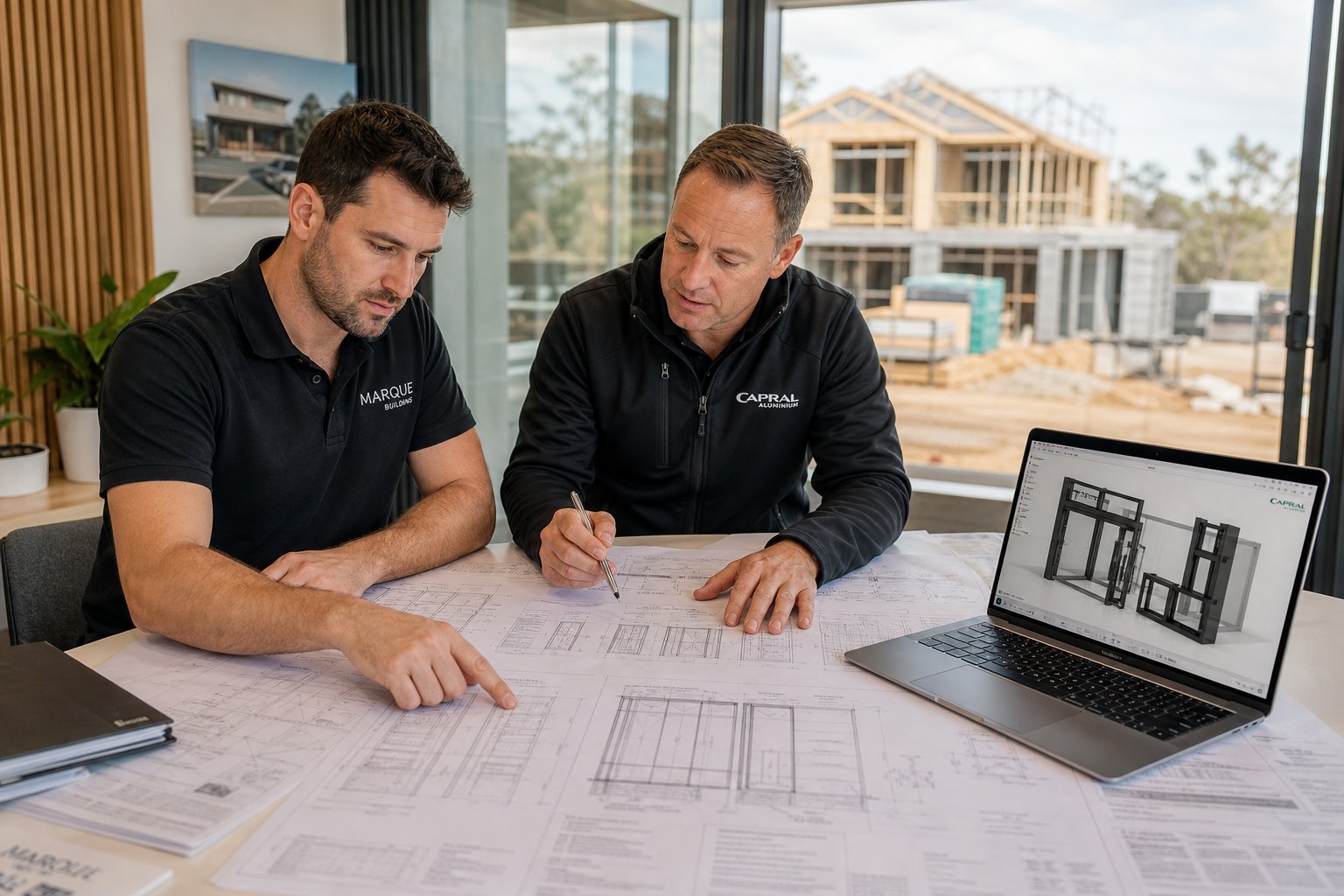
Early engagement only delivers value if the manufacturer has a structured workflow to support it. A phone call during design development means nothing if the business lacks the systems to translate that conversation into coordinated production, quality assurance, and timed delivery. What separates a capable manufacturer from one that simply takes orders is the depth of their project support — how they move from a set of architectural drawings to windows arriving on site exactly when the build programme requires them.
For builders, developers, and architects sourcing commercial aluminium windows Melbourne projects demand, understanding this workflow helps you evaluate whether a manufacturer can genuinely partner on a project or whether they are simply quoting a product catalogue and hoping for the best.
From Design Drawings to System Recommendation
A manufacturer with genuine project capability does not wait for a finalised specification to land on their desk. They engage actively with architectural drawings — reviewing elevations, floor plans, and sectional details to identify where different window systems best serve each opening. A west-facing living room wall with a 4-metre span needs a different solution than a bathroom window above a shower, and a manufacturer who understands their product range will recommend accordingly rather than applying one system everywhere.
This stage typically involves several layers of coordination. The manufacturer assesses structural requirements for large openings and liaises with the project’s structural engineer on lintel sizing, load paths, and fixing details. They calculate material quantities — profile lengths, glass unit sizes, hardware counts, and flashing requirements — generating a comprehensive schedule that locks down scope before production begins. For aluminium window supply Melbourne builders rely on across multi-dwelling or staged developments, this material calculation phase prevents the costly variations and site delays that arise from incomplete scoping.
System recommendation also accounts for compliance. A manufacturer reviewing drawings for a Mornington Peninsula coastal site will flag marine-grade finish requirements before they become a post-order surprise. One assessing a Kinglake project will confirm BAL rating requirements at tender stage rather than discovering them during building surveyor inspection. This proactive technical input is where direct manufacturer engagement pays for itself — problems identified on paper cost nothing to solve, while problems discovered on site cost everything.
Manufacturing Through to Project Delivery
Once specifications are locked and the order enters production, a structured manufacturer follows a defined sequence that protects both quality and programme timing. The aluminium window installation process Melbourne builders coordinate around depends entirely on windows arriving complete, correct, and on schedule — which means the manufacturing workflow must be disciplined at every checkpoint.
- Technical drawing approval — detailed shop drawings showing exact dimensions, hardware positions, glazing specifications, and finish codes are issued for sign-off before any material is cut. This is the last point where changes cost nothing.
- Material procurement and scheduling — profiles, glass units, hardware, and seals are ordered against confirmed specifications and allocated to a production slot that aligns with the project’s required delivery date.
- Profile cutting and machining — CNC equipment cuts and routes profiles to exact dimensions, preparing drainage slots, hardware pockets, and thermal break assembly points.
- Surface finishing — powder coating or anodising is applied per the specified colour and grade, with film thickness and adhesion verified before profiles proceed to assembly.
- Frame assembly and hardware fitting — profiles are joined, hardware installed, seals fitted, and each unit checked for square, plumb, and correct operation.
- Glazing — sealed glass units are installed with appropriate gaskets, and the completed window is inspected for visual defects, seal integrity, and operational compliance.
- Quality control and testing — finished windows undergo performance verification against AS2047 parameters, with results documented per unit or batch.
- Packaging and staged delivery — completed windows are protectively wrapped and scheduled for delivery in stages that match the construction programme, not shipped in a single bulk drop that clutters the site and risks damage during storage.
That final point — staged, project-based delivery — matters more than most buyers realise. Window manufacturer project delivery Melbourne construction sites need means windows arrive when the frame is ready to receive them, not three weeks early when they will sit exposed to trade traffic, or two weeks late when every downstream trade is held up waiting for weather-tightness. A manufacturer with logistics capability schedules deliveries floor by floor, building by building, or stage by stage depending on project scale.
For a practical example of how this workflow looks when documented transparently, MEICHEN’s services and solutions page outlines their full project process from system recommendation through engineering coordination, material calculation, manufacturing, quality control, and project-based supply. Reviewing a manufacturer’s stated workflow before engaging gives builders and procurement teams a concrete basis for comparing operational capability — not just product specifications or price points. When a manufacturer publishes their process openly, it signals confidence in their systems and willingness to be held accountable against a defined standard of service.
Whether your project is a single residential renovation or a multi-storey commercial development, the underlying principle holds: a manufacturer who controls every stage from drawings to delivery owns the outcome completely. There is no gap between the team quoting the project and the team building the product and scheduling the truck. That continuity — from first drawing review to final unit arriving on site — is ultimately what buyers searching for aluminium window manufacturers Melbourne can rely on are paying for. Not just a product, but a production partnership that protects their programme, their budget, and their accountability to their own clients.
Frequently Asked Questions About Aluminium Window Manufacturers in Melbourne
1. What is the difference between an aluminium window manufacturer and a fabricator in Melbourne?
A true manufacturer controls the entire production chain — from purchasing raw aluminium profiles through cutting, machining, powder coating, assembly, glazing, and quality testing — all within their own facility. A fabricator purchases pre-designed window systems under licence from a system supplier and assembles finished windows to order, limiting their customisation to what that system allows. The practical impact for buyers is significant: manufacturers offer factory-direct pricing without intermediary markups, can produce non-standard sizes and bespoke configurations, and hold direct accountability for every unit produced. When evaluating suppliers, ask where the windows are physically made and whether you can visit the production floor.
2. How much do aluminium windows cost in Melbourne?
Aluminium window pricing in Melbourne varies substantially based on window type, glass specification, frame finish, hardware grade, and compliance requirements. A fixed pane costs less than a casement, which costs less than a bi-fold system. Stepping from single glazing to a sealed double glazed unit increases glass cost by 40 to 60 per cent, while thermally broken profiles add 20 to 35 per cent over standard frames. Custom colours, BAL-rated systems for bushfire areas, and marine-grade finishes for coastal suburbs each add further cost layers. Going directly to a manufacturer often proves more cost-effective than purchasing through resellers who add 15 to 40 per cent distribution margins without adding production capability. MEICHEN’s services page outlines how early manufacturer engagement during the design phase enables value engineering that can reduce overall project costs.
3. Do aluminium windows meet energy efficiency requirements in Melbourne’s climate zone?
Standard non-thermally broken aluminium frames struggle to meet current NCC energy requirements for Melbourne’s climate zone 6, with whole-of-window U-values typically around 3.0 W/m2K or above. However, thermally broken aluminium windows — featuring polyamide insulating strips between inner and outer frame sections — achieve U-values of approximately 2.0 to 2.7 W/m2K with double glazing, comparable to timber and uPVC alternatives. For projects targeting 7-star NatHERS ratings or above, thermally broken frames paired with appropriate double glazing are now the practical baseline. A capable manufacturer will recommend frame-glass combinations calibrated to each facade orientation rather than applying a blanket specification.
4. What Australian Standards should aluminium windows comply with in Melbourne?
The primary standard is AS2047, which requires windows to be tested and classified for water penetration resistance, wind resistance, and operating force. Additional standards include AS1288 for glass selection and safety glazing, AS3715 for powder coating durability, and AS3959 for bushfire-rated systems in designated Bushfire Prone Areas. Genuine manufacturers hold WaterMark licences or CodeMark certifications demonstrating independent testing and ongoing surveillance audits. When evaluating any supplier, request the AS2047 test report specific to the exact system being quoted — not generic documentation. A manufacturer who controls their production will provide this without hesitation, while resellers may not have access to this data.
5. How long does it take to get custom aluminium windows manufactured in Melbourne?
Custom-manufactured aluminium windows typically require 4 to 10 weeks for residential orders, depending on colour availability, glass lead times, order volume, and specification complexity. Standard powder coat colours move faster as they align with regular coating schedules, while custom RAL shades may add 1 to 3 weeks. Specialty glass with low-E coatings or laminated configurations carries its own 3 to 6 week procurement timeline. Peak demand periods in spring and early summer can extend timelines by an additional 2 to 4 weeks. Engaging a manufacturer during the design phase rather than post-tender typically recovers 2 to 4 weeks of programme time through early procurement planning and avoids the delays that arise from last-minute specification changes.
More Window & Door Guides