What Are Aluminium Window Hinges and Why They Matter
Aluminium window hinges are the engineered mechanical connections that join a window sash to its aluminium frame, enabling the sash to pivot, swing, or tilt in a controlled arc while bearing its full weight. They are not generic shelf hardware. These hinges are purpose-designed to work with the specific profile geometry, wall thickness, and thermal behaviour of aluminium extrusions, which sets them apart from hinges intended for timber or uPVC frames.
Whether you are a homeowner staring at a sagging casement that no longer closes flush, or a builder specifying hardware across a multi-storey project, hinge selection determines three things simultaneously: how smoothly a window operates day to day, how securely it resists forced entry, and how long the entire assembly lasts before requiring service. Get the hinge wrong, and the consequences ripple outward into seal compression, lock engagement, and frame stress.
What Aluminium Window Hinges Actually Do
At the most basic level, aluminium hinges perform four mechanical jobs at once. They support the full weight of the glazed sash, preventing it from dropping or distorting over time. They control the opening angle, dictating how far the window swings and whether it holds position at any point in that arc. They enable smooth, repeatable movement so the window feels effortless rather than stiff or jerky. And when closed, they help maintain the compression needed for weathertight seals to perform against wind-driven rain and air infiltration.
A casement window hinge, for example, must bear the sash weight while allowing outward movement and maintaining alignment over years of repeated use. That load-bearing role distinguishes window hinges from decorative or lightly loaded hardware found elsewhere in a home. Stainless steel construction is preferred for this reason, offering the strength and corrosion resistance that aluminium frames demand.
Why Material-Specific Hinges Matter
Aluminium frames have characteristics that make generic hinges a poor fit. The profiles are typically narrower than uPVC, with shallower rebate depths and thinner wall sections that accept fixings differently. Aluminium also expands and contracts at a rate distinct from other framing materials. As fabrication specialists note, aluminium expands more than steel under the same temperature change, and outdoor installations experience significant daily movement as the sun heats the frame and night-time temperatures cool it again.
A hinge engineered for a deep uPVC multi-chamber profile simply will not seat correctly in a slim aluminium section. The screw-fixing method differs, the stack height may be wrong, and the thermal movement tolerance may be inadequate. Dedicated aluminium-compatible hinges account for all of this from the outset.
Aluminium window hinges must match the frame’s thermal movement characteristics to prevent binding or gap formation over the window’s lifespan. A mismatch of even a few millimetres in stack height or fixing centres can compromise seal compression, lock engagement, and long-term durability.
That engineering specificity is exactly what makes hinge selection more than a hardware-store decision. The variety of hinge mechanisms available, from friction stays to concealed pivots, each brings a different set of capabilities suited to particular window configurations and performance demands.
Window Hinges Types and How They Differ
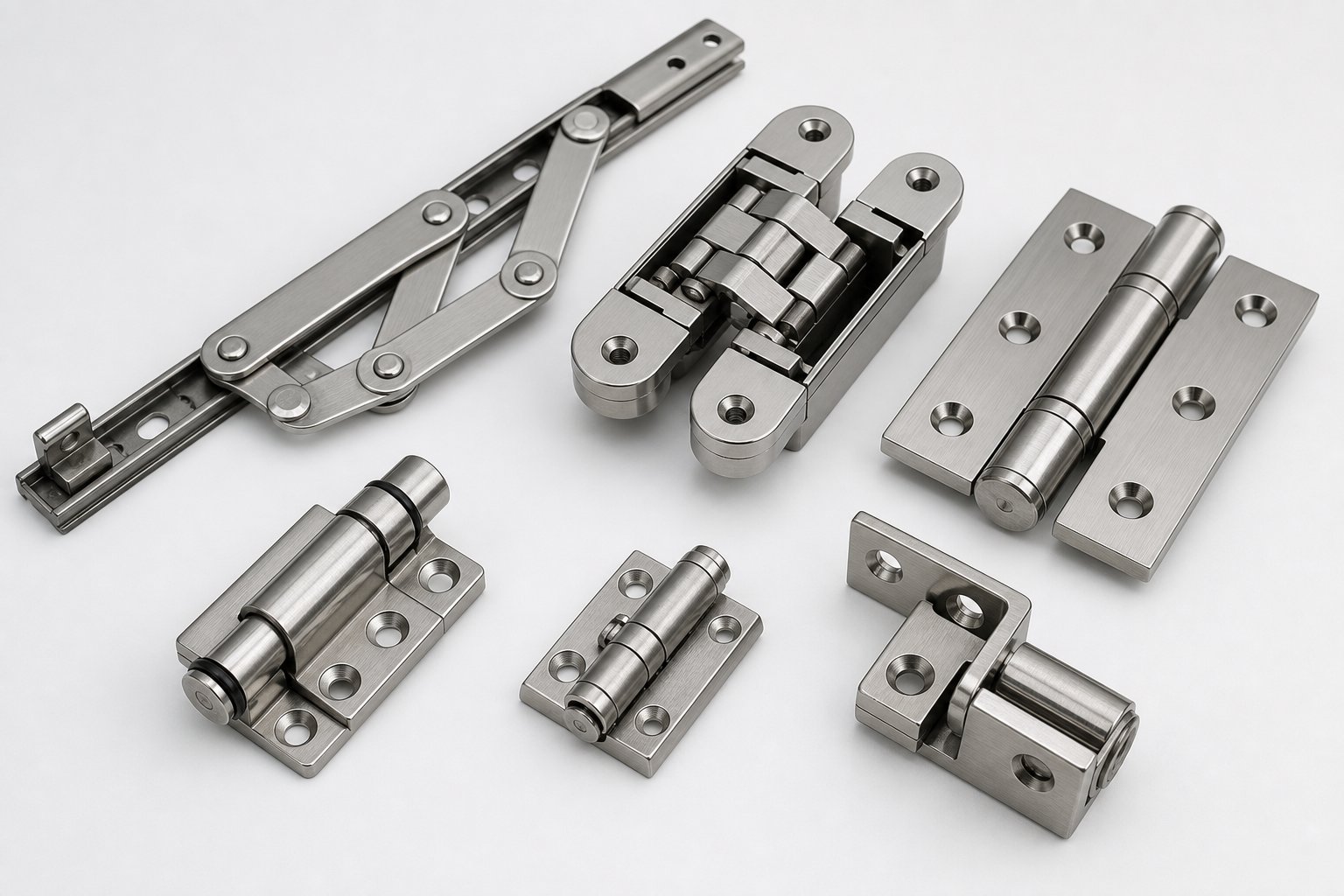
That variety of mechanisms mentioned earlier is broader than most people expect. Aluminium frames accommodate several distinct hinge categories, each engineered for a specific window configuration, load requirement, and aesthetic outcome. Rather than sorting by brand or price, the clearest way to understand your options is by mechanism type, because the mechanism dictates what the hinge can and cannot do.
Friction Stay Hinges for Casement Windows
Friction stays are the dominant hinge type for modern aluminium casement windows across Australian residential and commercial builds. They come in side-hung and top-hung variants, with sizes typically ranging from 200 mm (8 inches) through to 600 mm (24 inches) to suit different sash dimensions and weights.
The defining feature is positional hold. A friction stay uses a resistance mechanism to keep the sash at whatever angle you open it to, without the need for a separate casement stay or prop. Open the window halfway for ventilation and it stays put, even in a breeze. This contrasts sharply with traditional butt hinges, which rely on gravity alone and let the sash swing freely unless physically restrained.
Top-hung friction stays suit awning-style windows common in bathrooms and kitchens where rain protection during ventilation matters. Side-hung variants handle standard casement openings, offering wider clear apertures and easier cleaning access from inside. The friction level can often be adjusted over time as the mechanism beds in or wears slightly.
Butt Hinges and Parliament Hinges for Special Applications
Traditional butt hinges still appear on aluminium-framed doors and some older window styles. They consist of two plates connected by a fixed pin, providing a simple pivot with no positional hold. For windows, they require a separate casement stay to prop the sash open.
Parliament hinges solve a specific geometric problem. Their extended knuckle projects the sash away from the frame, allowing it to swing clear of deep external reveals, thick wall build-ups, or projecting sills. This makes them useful for heritage renovations where aluminium replacement windows sit within substantial masonry openings. Load capacity is lower than friction stays, so they suit lighter sashes or doors rather than large glazed panels.
Concealed and Pivot Hinges for Contemporary Designs
Concealed hinges hide entirely within the frame profile when the window is closed. No visible hardware interrupts the sightlines, which appeals to architects specifying minimalist facades. These hinges sit inside routed channels in the aluminium extrusion, and their installation is typically factory-done rather than site-fitted.
Pivot hinges enable tilt-and-turn operation, where the sash tilts inward from the top for ventilation or swings inward from the side for full opening and cleaning. The pivot mechanism rotates around a single axis point rather than along a hinge edge, allowing dual-mode operation from one set of hardware. Tilt-and-turn systems are growing in popularity for Australian apartments and multi-storey homes where external access for cleaning is impractical.
Heavy Duty Hinges for Large Format Windows
Standard friction stays handle sashes up to roughly 20 to 25 kg, depending on arm length and manufacturer specifications. Beyond that threshold, heavy duty aluminium hinges become essential. These feature reinforced rivets, thicker slide channels, and higher-grade stainless steel construction to cope with the increased leverage that large, heavy glazed panels place on the hinge arm.
Large format windows, think floor-to-ceiling casements with double-glazed units or acoustic glass, can push sash weights well above 40 kg. At those loads, a standard-duty friction stay will fatigue prematurely, leading to sash drop at the opening side and eventually compromised seal compression. Heavy-duty variants are sized and load-rated specifically for these demanding applications.
| Mechanism Type | Typical Application | Load Range | Opening Control Method | Aesthetic Visibility |
|---|---|---|---|---|
| Friction Stay (Side-Hung) | Standard casement windows | 12 – 25 kg (standard) / 25 – 50 kg (heavy duty) | Friction shoe holds sash at any angle | Visible on frame edge when open |
| Friction Stay (Top-Hung) | Awning windows, high-level ventilators | 10 – 30 kg | Friction shoe holds sash at any angle | Visible on frame edge when open |
| Butt Hinge | Aluminium doors, older casement styles | 15 – 60 kg (depending on bearing type) | None; requires separate stay | Knuckle visible on hinge side |
| Parliament Hinge | Windows and doors with deep reveals | 10 – 30 kg | None; requires separate stay | Knuckle projects visibly from frame |
| Concealed Hinge | Minimalist/architectural windows | 20 – 50 kg | Varies (often friction or detent positions) | Completely hidden when closed |
| Pivot Hinge (Tilt-and-Turn) | Multi-mode windows, apartments | 30 – 80 kg | Dual-mode: tilt for ventilation, turn for full opening | Minimal; recessed into profile |
| Heavy Duty Friction Stay | Large format casements, double-glazed panels | 25 – 60+ kg | Reinforced friction mechanism | Visible on frame edge when open |
Each category addresses a different combination of sash weight, opening geometry, and visual priority. Friction stays dominate because they solve the most common scenario, a moderately sized casement that needs to hold position, but the other types of hinges for aluminium frames fill genuine gaps where friction stays cannot perform or where aesthetics demand invisibility.
Knowing which category your window falls into is only half the picture. The internal mechanics of each hinge type, particularly friction stays, involve specific terminology and measurements that determine whether a given hinge actually fits your aluminium profile and works with your locking hardware.
Inside the Aluminium Window Hinge Mechanism and Key Terminology Explained
Catalogue pages list stack heights, espagnolette compatibility, and egress compliance as if every reader already knows what those terms mean. Most do not. This section unpacks the aluminium window hinge mechanism in plain language so you can confidently assess whether a given hinge fits your frame, works with your locks, and satisfies building code requirements.
How Friction Stays Generate Controlled Resistance
Inside every friction stay is a slide-channel assembly. A friction shoe, a small block of engineered material, is pressed firmly against an internal track by a spring or friction washer. As you swing the sash open, this shoe drags along the track at a consistent resistance, holding the window at any point in its arc without external props or catches. That controlled drag is what separates a friction stay from a traditional butt hinge, which pivots freely and relies entirely on gravity.
The resistance level can usually be adjusted via a concealed screw or Allen key. Heavier sashes need higher friction to prevent creeping closed; lighter sashes benefit from a softer setting for easy one-handed operation. Over time, grit or corrosion in the track channel increases drag unevenly, which is why periodic cleaning matters for long-term smoothness.
A critical measurement here is stack height: the distance the hinge projects from the frame face when the window is closed. As trade references explain, stack height determines how the sash sits within the frame’s rebate depth. If the stack is too tall, the sash sits proud of the frame and fails to compress the weatherseal, causing draughts. Too short, and the sash binds against the frame on closing or the hinge fouls the rebate. Common stack heights range from roughly 13 mm to 25 mm, and different aluminium profiles demand different values based on their rebate geometry and glazing bead depth.
Understanding Espagnolette Compatibility and Engagement
An espagnolette is the multi-point locking mechanism fitted along the opening edge of a window sash. When you turn the handle, a central gearbox drives locking cams or mushroom pins into striker plates fixed to the frame at multiple points, pulling the sash tight against its seals.
Hinge geometry must align precisely with those striker positions. If the aluminium hinge holds the sash at an incorrect offset or angle when closed, the locking cams cannot engage their strikers fully. The result is either a lock that feels stiff and forces the handle, or one that appears to close but fails to compress weatherseals properly, allowing air and water infiltration. In a worst-case scenario, mismatched hinges prevent the espagnolette from engaging at all, leaving the window unsecured even when the handle is in the locked position.
This is why hinges and locking hardware are best specified as a matched set within the same window system rather than sourced independently from different suppliers.
Egress Compliance and Opening Geometry
Egress refers to the minimum clear opening a window must provide for emergency escape. Under Australian requirements, bedroom windows designated as emergency exits must achieve a clear opening of at least 450 mm x 450 mm. The hinge you choose directly determines whether the sash can swing far enough to deliver that clear aperture.
Friction stay length and the maximum opening angle work together here. A short hinge on a tall sash may physically limit travel to 60 or 70 degrees, falling short of egress requirements. Specialist egress hinges are designed to release beyond their normal friction hold at full extension, allowing the sash to reach 90 degrees or more for compliant escape openings. Some use a detent mechanism that clicks past a resistance point, while others feature a quick-release that lets the sash fold fully clear of the frame.
Key terminology reference: Stack height is the hinge projection from frame face when closed, determining rebate fit. Espagnolette is the multi-point lock that requires precise hinge alignment to engage. Egress is the minimum clear opening for emergency escape, governed by hinge length and maximum opening angle. These three measurements, stack height, lock engagement geometry, and opening arc, collectively define whether an aluminium hinge will function correctly in a given frame.
These mechanical details matter most at the point where aluminium and uPVC systems diverge. The frame profiles are built differently, the tolerances are different, and the consequences of ignoring those differences show up as binding, leaking, or non-compliant windows.
Aluminium vs uPVC Window Hinges and Why They Are Not Interchangeable
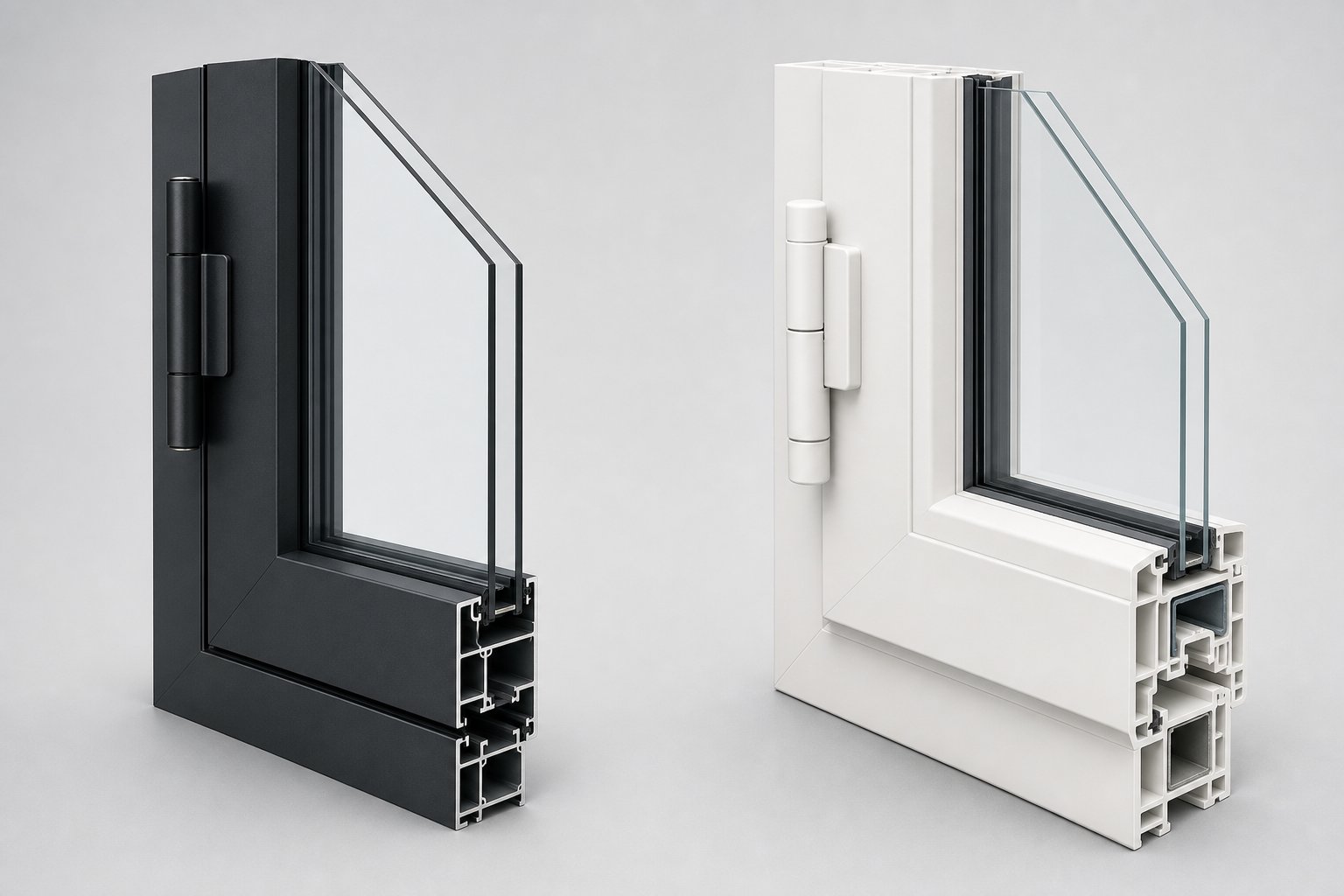
Those divergences between frame systems are not minor technicalities. They are fundamental engineering differences that make aluminium vs uPVC window hinges genuinely incompatible, not merely a bad match. Grabbing a friction stay from the uPVC shelf and bolting it to an aluminium frame is one of the most common mistakes in window replacement projects, and the consequences range from poor seal compression to outright hardware failure within months.
The two frame types are constructed from entirely different materials, with different internal geometries, different fixing methods, and different physical behaviours under heat and moisture. Hinges for aluminium window frames must account for all of these variables simultaneously.
Frame Profile Differences That Affect Hinge Fit
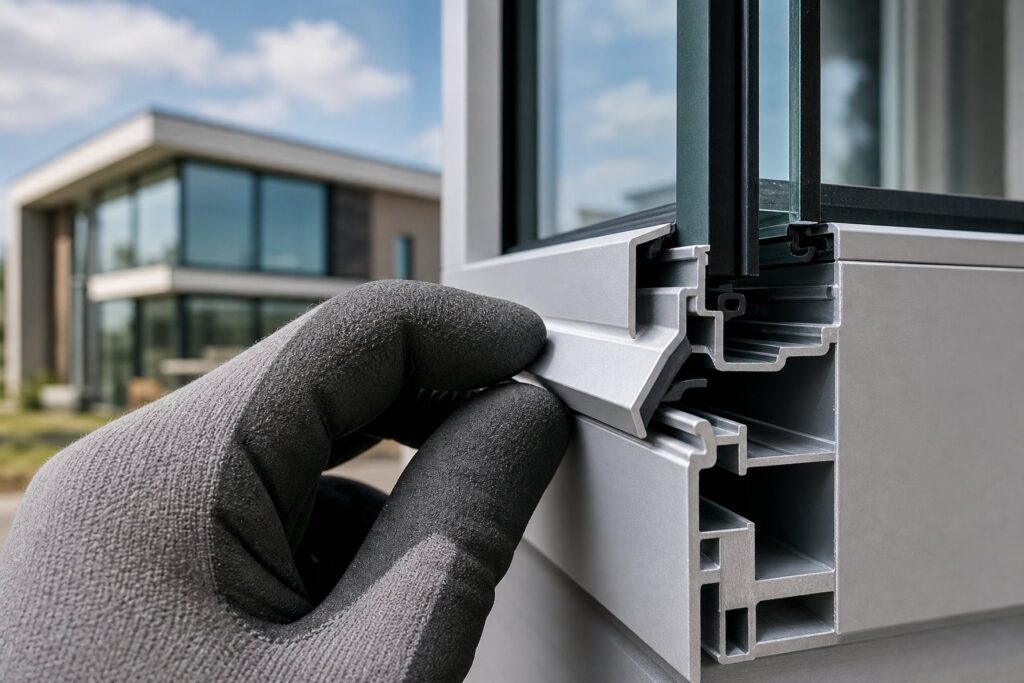
Aluminium window profiles are slim by nature. The material’s inherent strength allows thinner wall sections and narrower frame faces, which is precisely why architects favour it for maximising glass area. But that slimness translates to shallower rebate depths, typically in the range of 13 mm to 20 mm, compared with the deeper, multi-chambered rebates found in uPVC profiles.
A hinge designed for uPVC assumes it has a deeper recess to sit within. Fit that same hinge into an aluminium frame and the stack height is wrong: the sash sits proud of the seal line, or the hinge arm fouls the frame on closing. Fixing centres are different too. uPVC frames incorporate dedicated screw ports, pre-formed channels within the internal chambers that accept long screws biting into thick plastic walls or the galvanised steel reinforcement inside. Aluminium extrusions have no such internal chambers. Fixings go directly into thin-walled alloy, typically 1.6 mm to 2.5 mm thick, using self-tapping screws specifically threaded for metal substrates. Use a uPVC-length screw in aluminium and it either bottoms out on the opposite wall or strips the thread in the thin section, leaving the hinge loose from day one.
Thermal Expansion and Corrosion Considerations
Both materials move with temperature, but they move at different rates and in different ways. Research from Tangram Technology shows that uPVC expands approximately 2.5 times the rate of aluminium under the same temperature change. Darker uPVC frames absorb more solar radiation and can reach surface temperatures above 70 degrees Celsius, amplifying expansion further. Aluminium moves less, but it still moves, and its movement is more linear and predictable.
A hinge designed for uPVC tolerances assumes that expansion range. Fit it to aluminium and the clearances are wrong: too much play in winter when the frame contracts less than expected, too little room for the modest expansion aluminium does experience. The result is either rattling in cold weather or binding and stiffness on hot summer days. Neither scenario delivers the smooth, consistent operation a properly matched hinge provides year-round.
Then there is corrosion. When dissimilar metals sit in direct contact in the presence of moisture, galvanic corrosion occurs. Industry specialists at Rapierstar note that combining aluminium frames with carbon steel fasteners or hinge components creates a chemical reaction that can degrade the fastener in a matter of months in aggressive coastal environments. The aluminium itself suffers mainly cosmetic damage, but the hinge hardware weakens until it fails structurally. This problem simply does not exist with uPVC frames because plastic is electrochemically inert: no galvanic cell forms regardless of what metal the hinge is made from.
For aluminium frames, the solution is straightforward: use only austenitic stainless steel hinges and fixings. Grade 304 suffices for most inland locations, while grade 316 is worth the premium in coastal or industrial zones where salt or chemical exposure accelerates corrosion. The tiny additional cost at purchase prevents expensive remedial work and hardware replacement later.
Load Capacity and Frame Rigidity Differences
Aluminium frames are inherently more rigid than uPVC. They do not flex under load the way plastic profiles do, even with steel reinforcement. This rigidity changes how forces transfer through the hinge. In a uPVC frame, the slight flex of the profile absorbs some dynamic load as the sash swings open and closed. In aluminium, nearly all that force passes directly through the hinge pivots and fixings without damping. Hinges designed for the softer, more forgiving behaviour of uPVC may fatigue faster when subjected to the sharper load transfers aluminium creates.
Here is a scannable breakdown of the key differences:
- Profile depth: Aluminium rebates are shallower (13-20 mm typical) versus uPVC (20-28 mm typical), requiring different hinge stack heights.
- Fixing method: Aluminium uses self-tapping screws into thin-walled extrusion; uPVC uses longer screws into deep screw ports or steel reinforcing.
- Thermal expansion rate: uPVC expands 2.5 times more than aluminium, meaning clearance tolerances built into uPVC hinges are oversized for aluminium frames.
- Corrosion risk: Aluminium frames create galvanic corrosion with carbon steel components; uPVC has no galvanic interaction with metals.
- Required hinge material: Austenitic stainless steel (304 or 316) is essential for aluminium; uPVC frames tolerate a wider range of hinge materials.
- Frame rigidity: Aluminium transmits dynamic loads more directly through hinge fixings, requiring hardware rated for those sharper force transfers.
- Lifespan expectation: Aluminium frames last 40 to 60 years; hinges must be durable enough to match, not merely adequate for a 20-year uPVC lifecycle.
The bottom line is this: aluminium door hinges and window hinges occupy their own specification category for sound engineering reasons. Treating them as interchangeable with uPVC hardware is a false economy that leads to premature wear, compromised weatherproofing, and potential security failures. Matching the hinge to the frame material is not a preference. It is a structural requirement.
With that material distinction clear, the practical question becomes: how do you identify the right hinge for a specific aluminium window when variables like sash weight, opening direction, and security requirements all pull the specification in different directions?
How to Choose Aluminium Window Hinges for Your Project
Sash weight, opening direction, security expectations, and the window system itself all compete for priority during hinge specification. Without a structured approach, it is easy to over-specify and waste budget, or under-specify and create a maintenance problem within two years. This aluminium window hinge size guide walks through each variable in the order that matters most.
Matching Hinge Size to Window Sash Weight and Dimensions
The single most important factor is sash weight. Every friction stay has a rated load capacity, and exceeding it leads to hinge arm fatigue, sash drop at the opening side, and accelerated wear on the slide channel. Heavier and taller sashes demand longer friction stays because a longer hinge distributes the load across a greater area of the frame, reducing stress concentration at the fixing points.
If sash weight is unknown, a reasonable estimate comes from calculating the glazed area in square metres, multiplying by the glass weight factor (roughly 2.5 kg per square metre per millimetre of glass thickness for standard float glass), and adding the aluminium frame weight. A typical 600 mm x 1000 mm casement with 5 mm single glazing weighs around 10 kg; the same dimensions in 24 mm double-glazed units push closer to 20 kg.
As a practical guide, 250 mm (10-inch) friction stays suit small, lightweight sashes. The popular 300 mm (12-inch) size handles most standard residential casements. Larger openings call for 350 mm or 400 mm stays, while heavy duty aluminium hinges with reinforced rivets become necessary once sash weight exceeds roughly 25 kg or sash height pushes past 1200 mm.
Opening Direction and Ventilation Requirements
Side-hung, top-hung, and bottom-hung configurations each require specific hinge orientations. A side-hung casement needs friction stays mounted on the hinge stile, while a top-hung awning window mounts them across the head rail. Fitting a side-hung stay in a top-hung position changes the load geometry entirely and risks premature failure.
Upper-floor installations introduce child safety obligations. Under Australian requirements, windows above a certain height must restrict openings to 125 mm unless fitted with a child-resistant release mechanism. Integrated restrictor hinges build this limitation directly into the friction stay, providing a clean solution without external cables or bolted-on restrictors. For rooms needing trickle ventilation, some hinges offer a detent notch at a narrow first position, allowing controlled airflow without full opening.
Security Ratings and Insurance Compliance
Hinges contribute more to window security than most homeowners realise. Dog-bolts, small steel pins that engage with the frame when the window closes, prevent the sash from being levered off from the hinge side even if the locking edge is compromised. Hinge-side security pins serve a similar anti-lift function. These features are not cosmetic additions. In security-rated window systems, hinge-side resistance is tested alongside lock performance, and the entire assembly must pass as a complete unit. For properties where insurance requires demonstrated security hardware, specifying hinges with integrated dog-bolts avoids a compliance gap that could surface during a claim.
Working with Integrated Window Systems
Sourcing hinges, locks, seals, and frames from separate suppliers creates compatibility risk at every junction. The most reliable path, particularly for new builds and full window replacements, is specifying within an established aluminium window system where hardware is pre-matched to profiles. Integrated systems from manufacturers like MEICHEN eliminate the guesswork by engineering hinge stack heights, fixing centres, espagnolette alignment, and seal compression as a single tested assembly. For trade professionals, this means fewer site callbacks; for homeowners, it means confidence that every component works together from day one.
Pulling these variables into a logical sequence, here is how to choose aluminium window hinges step by step:
- Identify your window type — casement, awning, tilt-and-turn, or pivot — as each demands a specific hinge mechanism.
- Measure or calculate sash weight — glass area multiplied by thickness factor, plus frame weight — to establish the minimum load rating required.
- Determine sash height and width — taller sashes need longer friction stays to distribute load and maintain alignment.
- Confirm opening direction — side-hung, top-hung, or bottom-hung — and verify that the hinge orientation matches.
- Assess safety requirements — restricted opening for upper floors, child safety compliance, and security features like dog-bolts.
- Check stack height against your frame profile — measure the rebate depth and confirm the hinge sits flush when closed.
- Verify espagnolette compatibility — ensure the hinge geometry aligns with the locking cam positions on your multipoint lock.
- Select material grade — stainless steel 304 for most locations, 316 for coastal or high-corrosion environments.
- Consider an integrated system — where possible, specify hinges within a complete aluminium window package to guarantee hardware-to-frame compatibility and warranty coverage.
Following this sequence catches the issues that ad-hoc purchasing misses. Each step narrows the field until you arrive at a hinge specification that fits your frame, supports your glass, satisfies your code obligations, and lasts the distance. Still, even a perfectly chosen hinge operates within a regulatory framework, and the compliance standards governing aluminium window hardware in Australia carry their own set of requirements worth understanding before you finalise any specification.
Aluminium Window Hinge Compliance Standards and Building Regulations
Regulatory requirements shape hinge specification just as much as sash weight or frame geometry. In Australia, the National Construction Code and supporting Australian Standards set mandatory performance thresholds for window hardware, covering fall prevention, emergency egress, and resistance to forced entry. Trade professionals and developers ignore these at their peril: a non-compliant window can halt a building inspection, void insurance coverage, or create genuine safety risk for occupants.
This section consolidates the key aluminium window hinge compliance standards into a single reference, connecting abstract regulation numbers to the practical hardware decisions they govern.
Australian Building Code Requirements for Window Hardware
The NCC (National Construction Code) addresses window safety primarily through clause D3D29, which targets fall prevention from openable windows. The regulation applies to any openable window situated 2 metres or more above the surface beneath it, with particular focus on bedrooms in Class 2 and Class 3 buildings, Class 4 parts of buildings, and Class 9b early childhood centres.
For hinge specification, the critical requirement is this: windows in those locations must restrict the passage of a 125 mm sphere through any opening. Friction stay hinges achieve this either by physically limiting the opening arc to less than 125 mm, or by incorporating a restrictor mechanism that holds the sash at the restricted position until deliberately released.
Where a restrictor allows the window to open beyond 125 mm, it must include a child-resistant release mechanism. Child resistance under the NCC can be achieved through requiring a tool, a key, or simultaneous two-handed operation. The restrictor must also withstand a 250 N outward force applied against the window sash without releasing, preventing a young child from forcing the window past its restricted position.
If the lowest openable portion of the window sits at least 1.7 metres above the finished floor level, no additional restriction is required regardless of the building’s height. This exemption applies to high-level ventilators and clerestory windows where occupants physically cannot reach the opening.
AS 2047, the Australian Standard for windows and external glazed doors, governs the broader performance requirements including structural adequacy, weatherproofing, and operation under load. Hinges form part of the tested assembly: a window that passes AS 2047 testing with a specific hinge model may not maintain compliance if that hinge is substituted with an untested alternative. This matters when replacing worn hardware on existing windows, as like-for-like replacement maintains the original certification, while switching brands or models may not.
Fire Egress and Emergency Escape Requirements
Bedroom windows designated as emergency exits must provide a clear opening sufficient for a person to escape during a fire or for firefighters to gain access. The generally accepted minimum clear dimensions are 450 mm in both height and width, with a minimum clear openable area of 0.33 m². Maximum sill height is typically 1100 mm above floor level to allow occupants to reach and climb through the opening without assistance.
Hinge selection directly determines whether these thresholds are met. A friction stay that limits opening angle to 60 degrees on a narrow sash may fail to deliver the required 450 mm clear width. Longer friction stays allow wider opening arcs, and specialist egress hinges include a release mechanism that lets the sash travel beyond normal friction hold to reach 90 degrees or greater.
Some egress-rated friction stays use a detent that clicks past a resistance point at full extension, while others feature a quick-release tab that disengages the friction shoe entirely. Either way, the release must be operable from inside without tools or specialist knowledge, ensuring that a panicked occupant unfamiliar with the hardware can still open the window fully in an emergency.
A tension exists here. Fall prevention requires restricting openings to 125 mm, while egress requires a minimum 450 mm clear dimension. The NCC resolves this by permitting restrictors that can be released by adults but resist child operation. Dual-function friction stays that incorporate both a 125 mm restricted position and an adult-release full-egress position satisfy both requirements simultaneously, making them the preferred solution for upper-floor bedrooms that double as emergency exit routes.
Security Standards and Hardware Grading
Security performance is assessed at the whole-window level rather than hinge-by-hinge, but hinges contribute significantly to overall resistance. International standards such as EN 1627 to EN 1630 classify burglar resistance from RC1 (opportunist with body force only) through to RC6 (professional attackers with power tools). These ratings test the complete assembly including frame, glazing, locks, and hinges under simulated attack conditions.
In practical terms, a window rated to RC2 or RC3 level must demonstrate that hinges resist prying, levering, and extraction using tools such as screwdrivers, pliers, and crowbars within defined attack timeframes. Hinges with anti-lift pins, dog-bolts, and hardened pivot pins contribute to achieving these ratings. A window with strong locks but weak hinges will fail testing because the attacker simply targets the hinge side.
Door hinges for aluminium doors face additional requirements under access and security standards. External doors are higher-value targets, and their hinges must resist greater forces applied with longer leverage. Heavy-gauge stainless steel butt hinges with concealed bearings and interlocking leaves are common on security-rated aluminium doors, often paired with hinge-side bolts that engage automatically when the door closes.
For Australian residential applications, insurance companies increasingly reference these standards when assessing property security. While full EN 1627 certification is not universally required for residential windows, specifying hinges with demonstrated security features provides documented evidence of due diligence should a claim arise.
- Fall prevention (NCC D3D29): Verify hinges restrict openings to less than 125 mm or incorporate a child-resistant release mechanism rated to withstand 250 N outward force.
- Egress compliance: Confirm friction stay length and opening angle deliver a minimum 450 mm x 450 mm clear opening where emergency escape is required, and that the release mechanism operates without tools.
- AS 2047 certification: Ensure replacement hinges match the tested assembly specification, or verify that the substituted hardware has been independently tested to the same standard.
- Security contribution: Check for anti-lift features (dog-bolts, security pins, interlocking hinge leaves) where insurance or project security requirements demand demonstrated forced-entry resistance.
- Dual-function compliance: For upper-floor bedrooms, specify friction stays that satisfy both the 125 mm restriction for fall prevention and the full-opening release for emergency egress.
- Corrosion and durability: Select stainless steel grades appropriate to the installation environment (304 inland, 316 coastal) to ensure hardware maintains compliance performance over its service life rather than degrading within the warranty period.
These compliance checkpoints are not optional extras bolted onto the specification process at the end. They constrain which hinges are even eligible for a given installation before considerations like brand preference or budget enter the picture. A hinge that fails any one of these regulatory tests is simply not fit for purpose, regardless of how smoothly it operates or how neatly it fits the frame profile.
Compliance keeps a window legal. Maintenance keeps it functional. Even hardware that satisfies every standard at installation will degrade without periodic attention, and the signs of that degradation are worth learning to spot early.
Aluminium Window Hinge Maintenance to Extend Lifespan
Degradation rarely announces itself dramatically. A window that felt effortless in January develops a faint stiffness by August. A sash that once closed flush starts catching at one corner. These subtle shifts are the early language of hinge wear, and responding to them promptly is far cheaper than replacing hardware after it fails completely. Proper aluminium window hinge maintenance takes less than fifteen minutes per window annually, yet it can extend serviceable life by years.
Routine Cleaning and Lubrication Schedule
Dust, grit, and airborne salt gradually accumulate inside the friction stay track channel, the narrow slot where the friction shoe slides. That debris increases drag unevenly, making the window stiff in some positions and loose in others. Left unchecked, it scores the track surface and accelerates mechanical wear.
At minimum, clean and lubricate your hinges once per year. In coastal areas, near busy roads, or in industrial zones where airborne particulates are heavier, twice yearly is sensible. The process is straightforward:
- Open the window fully and wipe visible grit from the hinge arms and slide channel using a soft brush or damp cloth.
- Use a thin, stiff brush or compressed air to clear debris from inside the track channel where it collects behind the friction shoe.
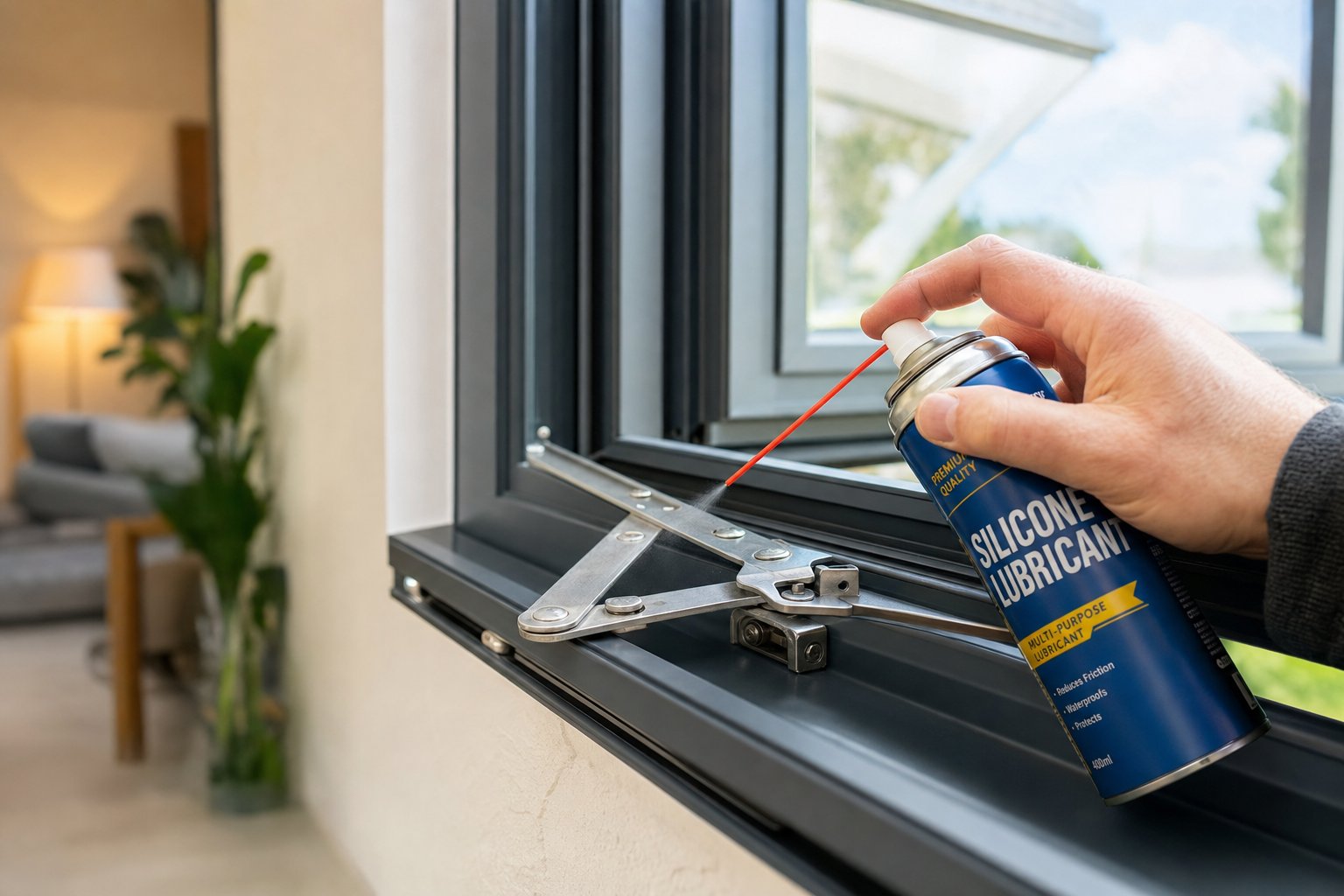
- Apply a light machine oil or silicone-based spray to pivot points and the friction track. A few drops is sufficient; excess attracts fresh dust.
- Open and close the window several times to distribute lubricant evenly along the full travel path.
- Wipe away any surplus oil from the frame face to prevent it staining adjacent seals or paintwork.
A common mistake is reaching for WD-40 as the default solution. It works as a short-term penetrant for seized components, but it evaporates relatively quickly and leaves minimal lasting lubrication. For ongoing protection, silicone spray or light machine oil are the appropriate choices because they remain in place between service intervals without attracting grit the way heavier greases do.
Facilities managers responsible for dozens or hundreds of windows benefit from scheduling hinge maintenance alongside annual window cleaning contracts. The windows are already open and accessible, making it efficient to clean tracks, apply lubricant, and check fixings across an entire building in a single pass.
Signs of Wear and When to Replace Hinges
Knowing how to lubricate aluminium window hinges only helps while the hardware is still structurally sound. Once wear passes a certain threshold, no amount of oil will restore proper function. Watch for these symptoms:
- Sash dropping at the opening side: When the free edge of the sash visibly tilts downward once opened, the hinge arm or rivets have stretched beyond tolerance. The sash weight is no longer fully supported.
- Difficulty closing flush: If the sash catches the frame on closing or requires force to seat against the seals, hinge geometry has shifted. Worn pivot points allow the sash to sit at a slight angle relative to its original position.
- Visible play or wobble in the hinge arm: Grab the opened sash near the hinge and push gently up and down. Any noticeable movement indicates worn rivets or elongated pivot holes.
- Stiff or inconsistent friction: A friction stay should offer smooth, even resistance throughout its arc. Stiff spots, sudden releases, or a grinding sensation suggest internal scoring or a damaged friction shoe.
- Rust staining from corroding rivets: Orange rust spots or white oxidation powder on the hinge surface indicate that internal corrosion has progressed significantly. By the time staining is visible externally, load-bearing capacity may already be compromised.
Critically, worn hinges do not fail in isolation. A sagging sash pulls unevenly on the espagnolette strikers, stressing the locking mechanism. It also deforms weatherseals by compressing them asymmetrically, leading to draughts and water ingress at one corner while leaving gaps at another. Replacing a single pair of hinges early prevents cascading damage to locks and seals that multiplies the repair cost.
Corrosion Prevention in Coastal and Industrial Environments
Australia’s extensive coastline means millions of windows sit within the salt-spray zone. Standard grade 304 stainless steel offers good general corrosion resistance, but it contains no molybdenum, the alloying element that resists chloride-induced pitting. In marine environments, grade 304 can begin showing pitting corrosion and tea-staining within a single winter season. The damage often starts at crevices, screw heads, and rivet joints where trapped moisture concentrates salt.
Grade 316 stainless steel, with its 2 to 3 percent molybdenum content, resists these attack mechanisms far more effectively. For any property within roughly 5 to 10 kilometres of the coast, or in exposed elevated positions further inland, 316 should be considered the default specification for aluminium door hinges and window hardware alike. The price premium over 304 is modest relative to the cost of replacing failed hardware and repairing surrounding corrosion damage after a few years.
Beyond material selection, two practical measures reduce corrosion risk regardless of stainless grade:
- Frame drainage: Ensure drainage slots in the aluminium frame remain clear so water does not pool around hinge fixings. Blocked weep holes trap moisture exactly where it does most harm.
- Surface coatings and isolation: Some hinge manufacturers apply additional coatings or use nylon washers to isolate steel fixings from direct aluminium contact, interrupting the galvanic cell. Verify these isolators remain intact during maintenance.
For buildings in industrial zones near chemical plants, refineries, or heavy transport corridors, airborne pollutants create an acidic surface film that accelerates corrosion similarly to salt. The same 316 specification and regular cleaning regime applies in these locations.
Pulling these practices into a single reference, here is a seasonal aluminium window hinge maintenance checklist:
- Spring: Clean track channels and hinge arms of winter debris. Lubricate pivot points with silicone spray or light machine oil. Check drainage slots are clear.
- Summer: Inspect for binding caused by thermal expansion. Verify friction holds the sash at mid-positions without creeping. Tighten any loose fixings.
- Autumn: Clear leaf litter and dirt from external hinge areas before wet season. Re-lubricate if in a coastal or high-pollution zone. Check for early rust staining on rivets.
- Winter: After heavy rains, verify no water is pooling around hinge fixings. Test window closure to confirm sash seats flush against seals without forcing. Note any new stiffness for investigation in spring.
Consistent attention to these basics keeps hardware operating within its design tolerances for the full expected lifespan of the aluminium frame itself. But maintenance addresses windows already installed. For anyone planning new builds or complete window replacements, the broader question is whether to source hinges as individual components or specify them within a complete, factory-matched window system, and what that choice means for long-term performance and warranty protection.
Putting It All Together for Your Next Aluminium Window Project
That choice between sourcing individual components and specifying a complete system is not simply a purchasing preference. It shapes warranty coverage, long-term reliability, and how much troubleshooting you absorb personally versus how much the manufacturer stands behind. Both paths have legitimate uses, but they suit fundamentally different situations.
Component Sourcing vs Integrated Window Systems
If you are replacing a worn friction stay on an otherwise sound aluminium window, sourcing an individual hinge from a hardware supplier makes sense. The frame is already installed, the profile geometry is fixed, and the task is a like-for-like swap. In this scenario, an aluminium window hinge replacement guide boils down to matching the existing hinge’s stack height, arm length, load rating, and fixing centres exactly. Photograph the old hinge, measure it, and order the same specification. Aluminum hinges suppliers who stock multiple brands and sizes make this straightforward for a single replacement.
The calculus shifts entirely for new builds and full window replacements. Here, you are not constrained by existing hardware. You have the opportunity to specify an integrated aluminium window hardware system where frame profiles, hinges, locking mechanisms, seals, and glazing are engineered and tested as a unified assembly. The advantages compound:
- Guaranteed compatibility: Stack heights, fixing centres, and espagnolette alignment are pre-resolved at the factory. No site guesswork.
- Single-source warranty: If a hinge fails, the system manufacturer owns the problem. Component-level purchasing splits responsibility across multiple suppliers, and warranty claims become arguments about whose part caused the failure.
- Tested compliance: The complete assembly carries AS 2047 certification, fall prevention compliance, and security ratings as a tested unit. Swapping in a third-party hinge can void that certification.
- Long-term performance consistency: Hardware matched to the frame’s thermal movement, load characteristics, and seal geometry maintains smooth operation across decades rather than degrading as mismatched tolerances accumulate wear.
The trade-off is flexibility. Component sourcing lets you mix and match; integrated systems lock you into one manufacturer’s ecosystem. For hinges for aluminium doors and windows on a new project, that lock-in is a feature, not a limitation, because it eliminates the compatibility risk that causes most hardware failures in the first place.
What to Expect from Quality Aluminium Window Hardware
Whether you source components individually or specify a complete system, certain characteristics distinguish well-engineered hardware from budget alternatives that look similar on a shelf but fail differently under load:
- Published and independently tested load ratings, not just marketing claims.
- Corrosion-resistant materials appropriate to Australian coastal and inland environments, with stainless steel grades clearly stated.
- Compliance documentation linking the hardware to specific NCC clauses, AS 2047 test reports, and security ratings.
- Hardware designed to integrate with the frame’s thermal and structural behaviour rather than treating the frame as a generic mounting surface.
For new projects or full window replacements, exploring MEICHEN’s aluminium window range offers a clear path from hardware decisions to project-ready specification. Their systems are designed for Australian conditions, where frame profiles, hinges, locking hardware, and seals are engineered as a complete unit rather than assembled from disparate catalogue parts. For homeowners, builders, and architects navigating the variables covered throughout this article, that system-level integration removes the highest-risk decisions from the process entirely.
A window is only as reliable as the weakest interface between its components. System-level thinking, where hinges, locks, seals, and frame profiles are matched at the design stage, consistently outperforms component-level purchasing for long-term window performance. The best hinge in isolation means nothing if it does not align with the lock, compress the seal, and move with the frame over a 40-year service life.
Aluminium window hinges sit at the intersection of mechanical engineering, material science, and building regulation. Getting them right is not glamorous work, but it is the difference between a window that operates smoothly for decades and one that binds, leaks, or fails its security obligations within a few short years. Start with the frame material, match the hinge to its specific demands, verify compliance, maintain what you install, and wherever possible, let the system do the thinking for you.
Frequently Asked Questions About Aluminium Window Hinges
1. Can I use uPVC window hinges on aluminium frames?
No. uPVC hinges have incorrect stack heights, oversized thermal expansion tolerances, and incompatible fixing methods for aluminium profiles. Aluminium frames use shallower rebates (13-20 mm versus 20-28 mm in uPVC) and require self-tapping screws into thin-walled extrusions rather than the deep screw ports found in uPVC. Using uPVC hinges on aluminium also introduces galvanic corrosion risk where dissimilar metals contact the aluminium surface. Always specify hinges engineered specifically for aluminium profiles to ensure correct seal compression, lock engagement, and long-term durability.
2. How often should aluminium window hinges be maintained?
At minimum, clean and lubricate aluminium window hinges once per year. Properties in coastal areas, near busy roads, or in industrial zones should increase this to twice yearly due to higher airborne salt and particulate levels. Maintenance involves clearing grit from the friction stay track channel, applying silicone spray or light machine oil to pivot points, and checking fixings for looseness. Avoid using WD-40 as a long-term lubricant as it evaporates quickly. Consistent annual care can extend hinge service life by several years and prevent cascading damage to locks and weatherseals.
3. What size friction stay hinge do I need for my aluminium window?
Friction stay size depends primarily on sash weight and height. A 250 mm (10-inch) stay suits small, lightweight sashes under 10 kg. The common 300 mm (12-inch) size handles most standard residential casements up to approximately 15-20 kg. Larger openings or heavier double-glazed sashes require 350-400 mm stays. Once sash weight exceeds 25 kg or sash height passes 1200 mm, heavy-duty friction stays with reinforced rivets become necessary. To estimate sash weight, calculate glazed area in square metres, multiply by 2.5 kg per square metre per millimetre of glass thickness, then add the aluminium frame weight.
4. What stainless steel grade should I choose for aluminium window hinges in Australia?
For most inland Australian locations, grade 304 stainless steel provides adequate corrosion resistance. However, properties within 5 to 10 kilometres of the coast or in exposed elevated positions should specify grade 316 stainless steel, which contains 2-3 percent molybdenum for superior resistance to chloride-induced pitting. Grade 304 hinges in marine environments can show pitting corrosion within a single winter season. The modest price premium of 316 is far less than the cost of replacing failed hardware and repairing surrounding corrosion damage after a few years of salt exposure.
5. Do aluminium window hinges affect building code compliance in Australia?
Yes, significantly. Under the NCC (National Construction Code), hinges must restrict window openings to less than 125 mm where fall prevention applies (windows 2 metres or more above ground level), unless fitted with a child-resistant release mechanism rated to withstand 250 N of outward force. For emergency egress in bedrooms, friction stay length and opening angle must deliver a minimum 450 mm x 450 mm clear opening. Hinges also contribute to security ratings and AS 2047 certification. Replacing hinges with untested alternatives can void the window’s original compliance certification, so like-for-like specification is essential for existing installations.
More Window & Door Guides