Why Aluminium Dominates Australian Window Framing
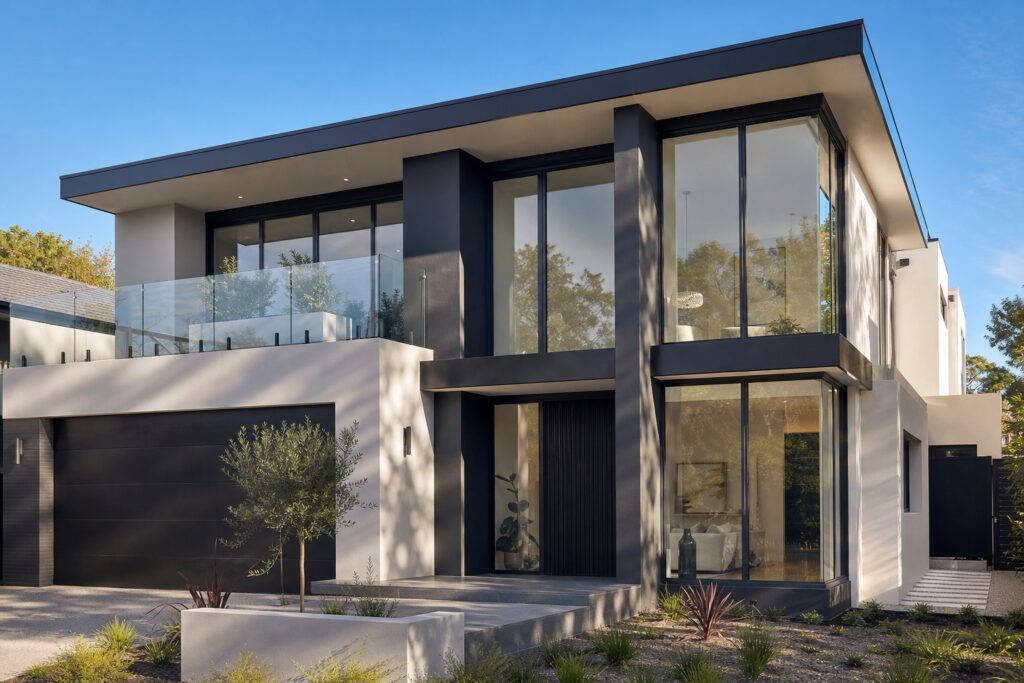
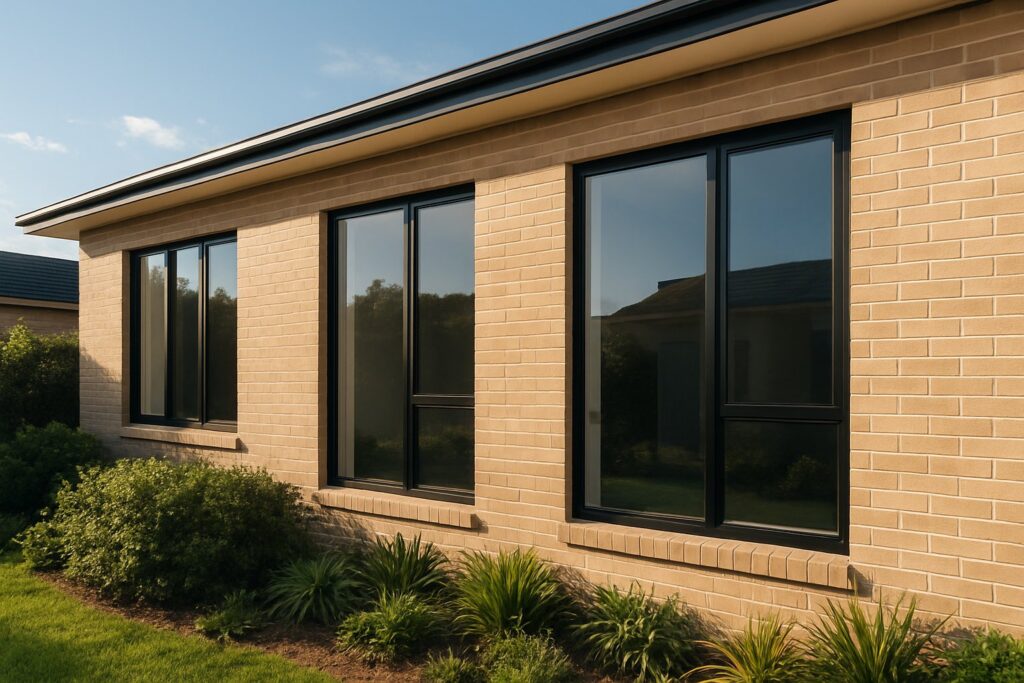
Walk through any new housing estate from Perth to Brisbane and you will notice the same material framing nearly every window opening. Aluminium has quietly become the backbone of Australian fenestration, installed in the majority of residential and commercial builds across the country. Its combination of low weight, natural corrosion resistance, and structural strength makes it a practical match for a continent where sun, salt, and storm test every building material relentlessly.
What Are Aluminium Window Frames
An aluminium frame window starts life as a cylindrical billet of aluminium alloy, typically 6063-grade. Manufacturers heat this billet until malleable, then force it through a precision-engineered steel die under immense hydraulic pressure. The result is a continuous extruded profile with a consistent cross-section, hollow chambers for rigidity, and integrated channels for seals and glazing. These profiles are cut to length, mitred or mechanically joined at the corners, and assembled into a complete frame ready to accept glass. The extrusion process allows complex shapes that would be impossible to achieve with other materials at comparable cost, giving designers freedom to create slim sight lines and large openings without sacrificing load-bearing capacity.
Why Aluminium Leads the Australian Market
Several factors explain why aluminium framed windows account for such a dominant share of Australian installations. Availability is one. A well-established network of local fabricators operates in every state, meaning lead times stay short and supply remains consistent even during building booms. Design flexibility is another. Aluminium profiles can be powder-coated in virtually any colour, shaped into sliding, awning, casement, or fixed configurations, and engineered to span wide openings that lighter materials cannot handle.
Aluminium accounts for an estimated 70 to 80 percent of all window frames installed in Australian residential construction, a market position built on decades of proven performance across every climate zone on the continent.
Compatibility with common Australian construction methods seals the deal. Whether the home is brick veneer with a timber stud frame, lightweight weatherboard, or clad in modern panel systems, windows in aluminium integrate cleanly with standard flashing details and reveal depths. Builders know how to install them. Certifiers know how to approve them. Homeowners know they will not need repainting every few years.
How This Guide Helps You Make Better Decisions
This article takes a climate-first approach to aluminium window frames in Australia. Rather than listing product specs in isolation, each section connects frame performance to the conditions your home actually faces, from tropical humidity and cyclone loads in the north to coastal salt spray, arid UV extremes, and alpine cold further south. The goal is straightforward: give you the knowledge to specify windows that suit your location, your energy targets, and your budget, without relying on guesswork or sales pitches alone.
How Aluminium Frames Perform Across Australian Climates
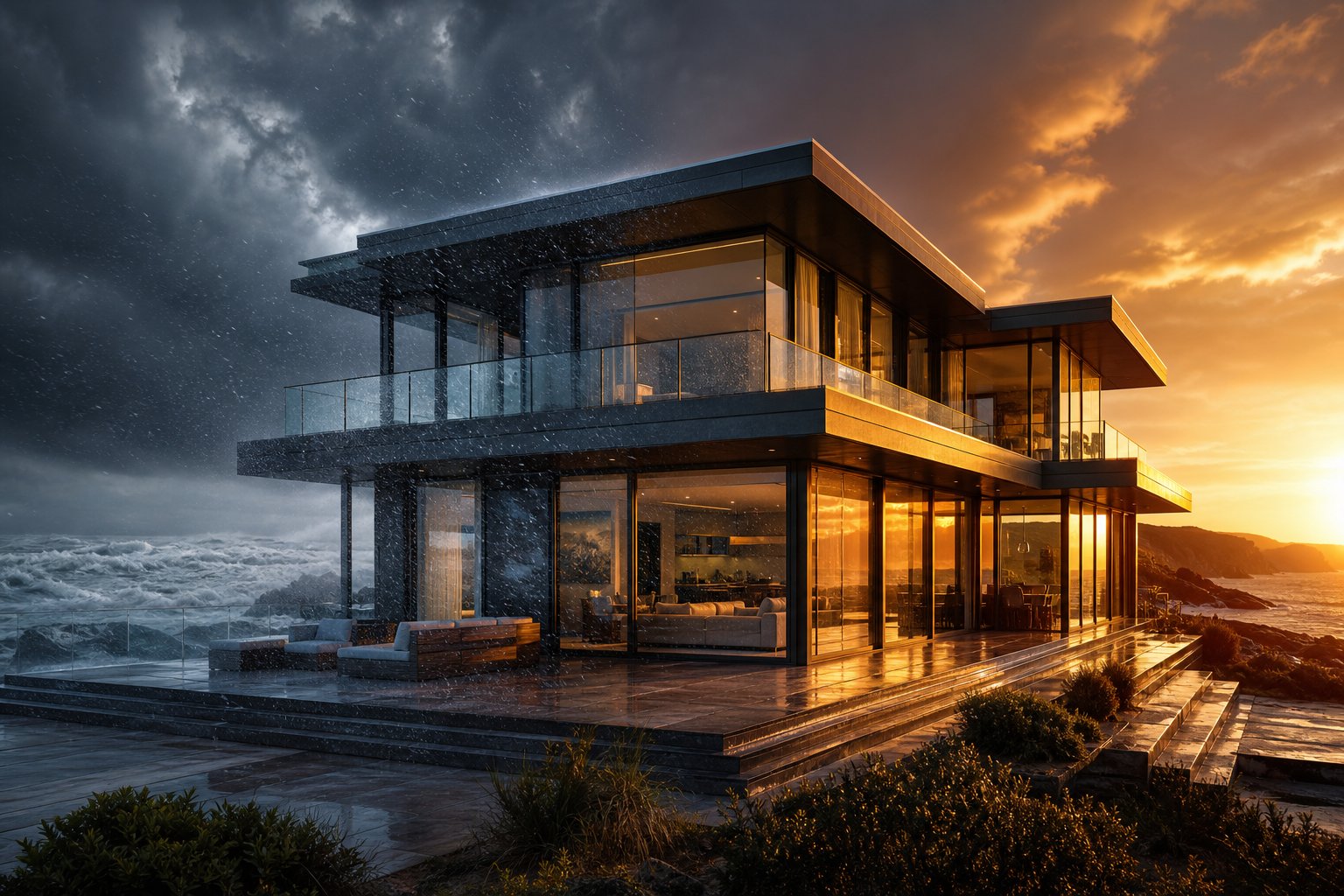
A window that works brilliantly in Hobart can fail spectacularly in Darwin. Australia spans multiple climate zones, each placing different stresses on building materials, and aluminium frames respond to those stresses in distinct ways. Choosing a frame system based purely on appearance or price ignores the single factor that matters most: where the window will live for the next 30 to 40 years. Location and exposure should drive every specification decision before colour swatches ever come into play.
Aluminium itself offers a useful baseline for all zones. When exposed to oxygen, the metal forms a thin, self-healing oxide layer that resists further corrosion. This natural defence gives aluminium frames an inherent advantage over timber and steel in moisture-rich environments, though additional protection through powder coating or anodising is still essential for long-term performance in aggressive exposures.
Tropical and Subtropical Performance
Northern Australia, from Cairns through to Darwin and across coastal Queensland, combines relentless humidity with intense storm events. Timber frames in these regions can swell, warp, and attract mould within a few years. Aluminium resists all three. It will not absorb moisture regardless of how many wet seasons it endures, and it provides the structural rigidity needed for cyclone-rated window assemblies that must withstand extreme wind pressures without deforming.
Ventilation is equally critical in tropical homes. Aluminium’s slim profile maximises the operable glass area in louvre and casement configurations, promoting cross-flow airflow while maintaining weather seals during storms.
- Humidity resistance — aluminium will not rot, swell, or support mould growth
- Cyclone compliance — frames engineered to meet wind load ratings for Region C and D zones
- Ventilation design — slim sight lines allow larger operable openings for natural airflow
- Low maintenance — no repainting or retreating required in high-moisture environments
Arid and Inland Conditions
Central and western Australia present the opposite challenge. Daytime temperatures can exceed 45 degrees Celsius before dropping sharply overnight, creating thermal cycling that repeatedly expands and contracts frame materials. Aluminium handles this well due to its dimensional stability and tolerance for temperature extremes, though seals and gaskets must be specified for UV resistance to avoid premature degradation.
Australia receives some of the highest UV radiation levels globally, and inland regions cop the full intensity with little cloud cover for relief. Powder-coated finishes on aluminium frames resist UV-driven fading and chalking far longer than painted timber or unprotected uPVC, which can become brittle and discolour under prolonged sun exposure.
- Thermal cycling tolerance — aluminium maintains structural integrity through extreme day-night temperature swings
- UV-stable finishes — architectural-grade powder coatings resist fading in high-radiation zones
- Seal specification — EPDM rubber gaskets rated for sustained heat outperform standard options
- Dust and debris management — simple frame profiles are easier to clean in dusty inland conditions
Temperate, Coastal, and Alpine Zones
The temperate south, including cities where homeowners search for aluminium windows Adelaide, sydney aluminium windows, and aluminium windows Melbourne options, faces a more balanced but still demanding mix. Energy efficiency becomes the primary concern as both heating and cooling loads apply across the year. Thermally broken aluminium frames paired with Low-E double glazing achieve competitive U-values that support 7-star NatHERS targets without sacrificing the durability and design flexibility aluminium provides.
Coastal properties from the Mornington Peninsula to the Adelaide coastline add salt spray into the equation. Salt air accelerates corrosion on unprotected metals, but aluminium’s oxide layer combined with quality powder coating or marine-grade anodising provides robust protection when correctly specified for the distance from the shoreline.
In alpine areas like the Snowy Mountains or parts of the Victorian highlands, condensation management is the priority. Cold external surfaces cause moisture to form on the interior side of frames, but thermally broken profiles keep the inner aluminium warmer, reducing condensation risk while handling snow loads that lighter materials cannot support.
- Energy efficiency — thermally broken frames meet stringent NCC Section J requirements in cooler climates
- Salt spray resistance — enhanced coating systems protect frames within coastal corrosion zones
- Condensation control — thermal breaks raise internal surface temperatures to reduce moisture buildup
- Snow and wind loads — aluminium’s strength-to-weight ratio handles structural demands in alpine regions
Each climate zone asks something different of a window frame, and aluminium’s adaptability is precisely why it remains the go-to material nationwide. The key is matching the right specification — coating grade, thermal break inclusion, seal type, and hardware rating — to the specific conditions your home faces. That specification process starts with understanding the standards and comparisons that inform it.
Aluminium vs Timber vs uPVC Frames for Australian Homes
Matching the right specification to your climate zone is only half the decision. The other half is choosing the frame material itself. Four options dominate the Australian window market: aluminium, timber, uPVC, and composite (typically aluminium-clad timber or fibreglass). Each brings genuine strengths and genuine trade-offs depending on your priorities, your location, and how much maintenance you are willing to accept over the life of the home.
A fair comparison requires looking beyond a single metric. A window aluminium frame outperforms timber on durability and maintenance, but timber offers superior natural insulation. uPVC beats both on thermal conductivity, but cannot match aluminium’s slim profiles or fire resistance. There is no universally perfect material — only the right material for your specific project.
Durability and Maintenance Compared
In Australian conditions, longevity depends heavily on how a material handles UV, moisture, pests, and temperature extremes. Aluminium frames routinely last 30 to 40 years with nothing more than an occasional wipe-down. The powder-coated finish resists chalking and fading, and the metal itself will not rot, warp, or attract termites regardless of climate zone.
Timber delivers a similar structural lifespan in theory, but only with consistent upkeep. Expect to sand, repaint, or re-stain timber frames every three to five years, more frequently in coastal or humid areas. Termite risk adds another layer of ongoing vigilance, particularly in Queensland and northern NSW where pest pressure is highest.
Quality uPVC systems last 30-plus years without painting or sealing, and they will not corrode or rot. The trade-off is potential UV degradation in regions with extreme sun exposure. Lower-grade uPVC formulations can become brittle or discolour in northern Australia’s intense radiation, though premium UV-stabilised profiles handle these conditions far better than early generations of the material.
Composite and fibreglass frames sit in between. They resist rot and thermal cycling well, require minimal maintenance, and hold their shape under extreme temperatures. Availability in the Australian market is more limited than aluminium or uPVC, which can affect lead times and replacement options.
Thermal and Energy Performance
This is where aluminium’s reputation takes a hit, and it is worth being direct about it. Aluminium conducts heat roughly 1,000 times more readily than uPVC — a thermal conductivity of 160 to 200 W/m·K compared to just 0.15 W/m·K for uPVC. Without a thermal break, a standard aluminium frame can produce frame U-values of 5.5 to 7.0 W/m²K, undermining the insulating benefit of even premium double glazing.
Thermally broken aluminium narrows the gap significantly, achieving frame U-values around 2.5 to 4.0 W/m²K. That is a substantial improvement, though still behind uPVC at 1.5 to 2.5 W/m²K. For Australian homes targeting higher NatHERS star ratings or pursuing Passive House certification, uPVC or composite frames often deliver the thermal performance needed without relying entirely on glazing upgrades to compensate.
Timber falls somewhere in the middle, offering natural insulating properties without engineered thermal breaks. Its thermal conductivity sits around 0.12 to 0.16 W/m·K — comparable to uPVC — making it an effective insulator in cooler climates like Tasmania and the Victorian highlands.
The honest takeaway: if energy performance is your single highest priority and slim sight lines are negotiable, uPVC or timber may outperform aluminium in cooler zones. Where aluminium wins is in balancing thermal performance (with thermal breaks) against structural strength, fire resistance, and design flexibility across all climate zones.
Cost, Availability, and Design Flexibility
Upfront cost varies by specification, but the broad picture for windows Australia-wide looks like this: standard aluminium frames sit in the low-to-mid price range, making them accessible for most residential budgets. Thermally broken aluminium costs more, typically adding 20 to 40 percent over standard profiles. uPVC double glazed windows in Melbourne currently run $2,300 to $3,500+ per window fully installed, landing in a comparable band to thermally broken aluminium depending on configuration.
Timber frames command a premium, particularly for hardwood species suited to Australian conditions, and the total cost of ownership climbs further when you factor in repainting and pest treatment every few years. Fibreglass and composite systems tend to carry higher upfront pricing and limited local fabrication options, which can extend lead times for regional projects.
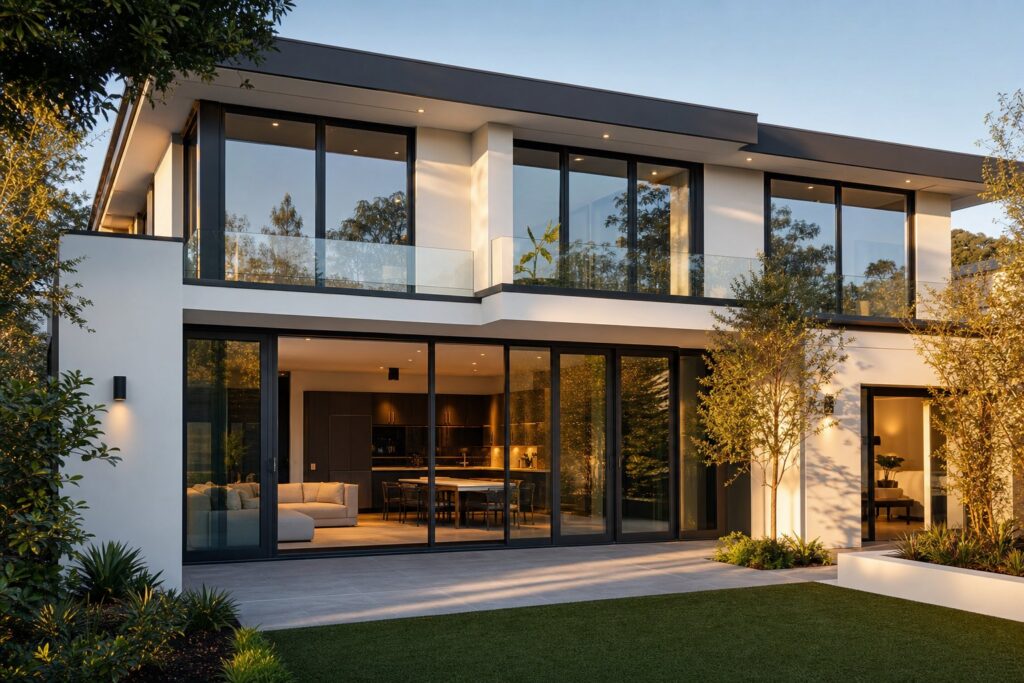
From a design standpoint, aluminium is difficult to beat. It supports the slimmest profiles of any frame material, meaning more glass area and less visual obstruction. Large sliding doors, expansive fixed panels, and multi-panel bi-fold configurations rely on aluminium’s strength-to-weight ratio to span openings that uPVC profiles simply cannot achieve at the same dimensions. For architects and builders working on contemporary Australian homes where indoor-outdoor flow drives the design, this flexibility is often the deciding factor.
Supply chain reliability also matters. Aluminium fabricators operate across every state, so whether you are building in regional Western Australia or suburban Sydney, sourcing an australian window in aluminium is rarely a logistics challenge. uPVC fabrication is growing but remains more concentrated in capital cities, and composite options are still a niche segment of the market.
| Criteria | Aluminium | Timber | uPVC | Composite / Fibreglass |
|---|---|---|---|---|
| Typical lifespan | 30–40+ years | 30+ years (with maintenance) | 30+ years (quality systems) | 30–40+ years |
| Frame U-value (Uf) | 2.5–4.0 W/m²K (thermally broken); 5.5–7.0 without | 1.5–2.5 W/m²K | 1.5–2.5 W/m²K | 1.5–2.2 W/m²K |
| Maintenance | Minimal — occasional cleaning | High — repaint/re-stain every 3–5 years, pest treatment | Minimal — occasional cleaning | Low — occasional cleaning |
| Upfront cost (indicative) | Low to mid (standard); mid to high (thermally broken) | Mid to high | Mid to high | High |
| Fire resistance | Excellent — non-combustible, meets BAL ratings | Poor — requires additional treatment for BAL compliance | Self-extinguishing but melts under extreme heat | Good — fibreglass is non-combustible |
| Design flexibility | Excellent — slimmest profiles, largest spans | Good — limited span without bulky profiles | Moderate — wider profiles, smaller max openings | Good — moderate profile widths |
| Recyclability | Excellent — infinitely recyclable without degradation | Moderate — biodegradable, limited recycling | Moderate — recyclable but limited infrastructure in Australia | Limited — mixed materials complicate recycling |
| Best-suited climate zones | All zones (with correct specification) | Temperate and cooler climates; avoid high-humidity tropics | Temperate and cooler zones; caution in extreme UV areas | Alpine, extreme-temperature, and bushfire zones |
No single material wins every category. The right choice depends on weighing the factors that matter most for your build — whether that is fire resistance for a bushfire-prone block, thermal performance for a southern passive build, slim aesthetics for a coastal contemporary home, or low lifetime cost for a family property that needs to perform for decades without fuss. What matters equally is the technology inside the frame — particularly thermal breaks and glazing — which determine how well any material actually performs once installed.
Thermal Break Technology and Double Glazing Explained
Aluminium conducts heat efficiently. That is precisely what makes it brilliant for cookware and problematic for window frames. A standard aluminium profile creates a direct thermal bridge between the inside and outside of your home, allowing conditioned air to escape in winter and external heat to pour in during summer. It is the single most common objection raised against the material, and it is entirely valid — for frames without a thermal break.
Modern engineering solves this problem decisively. Thermally broken aluminium and double-glazed aluminium windows now achieve energy performance figures that rival uPVC systems while retaining every structural and design advantage the material offers.
What Is a Thermal Break and How Does It Work
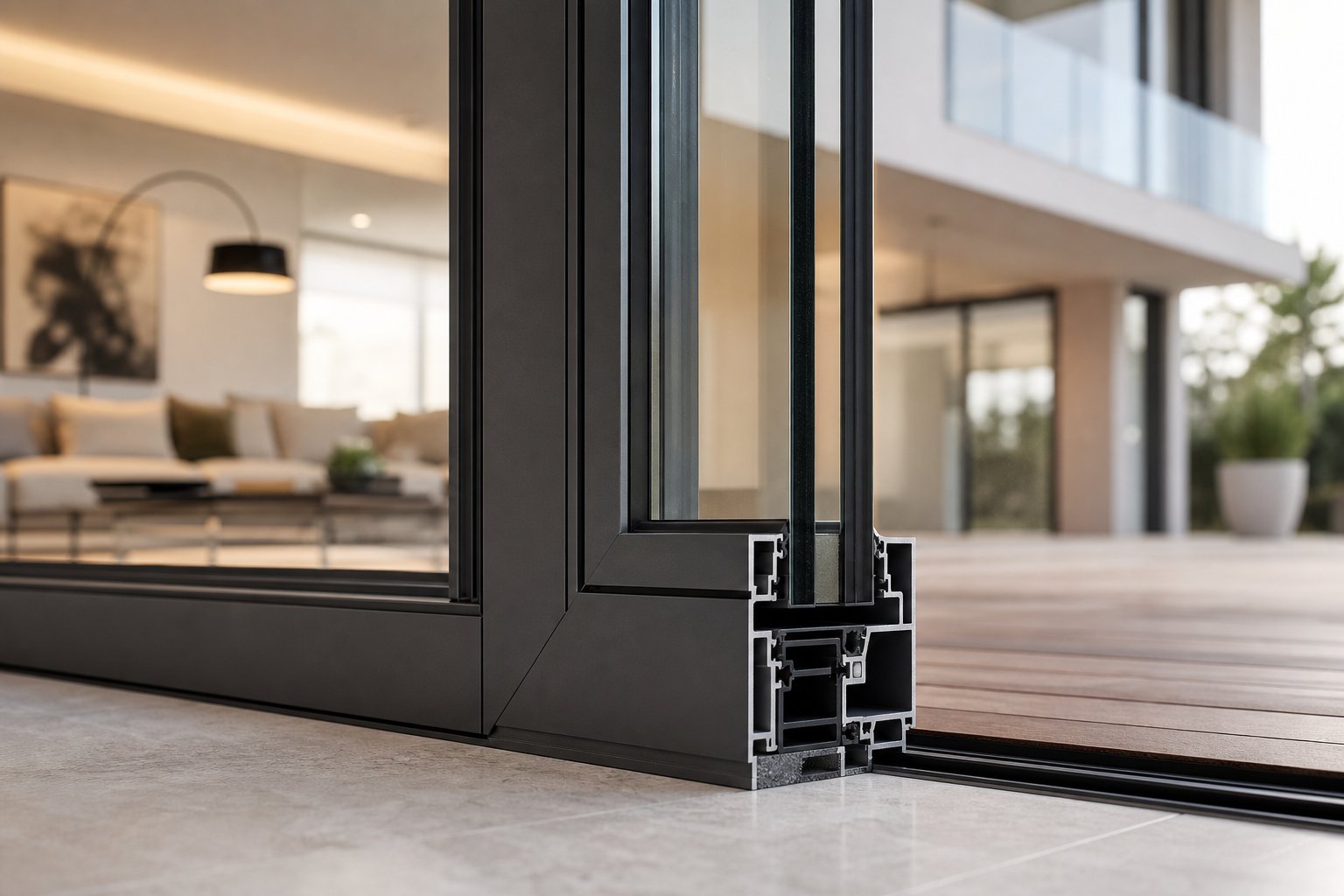
Picture a standard aluminium frame in cross-section. It is one continuous piece of metal connecting the cold exterior face to the warm interior face. Heat flows through it like water through a pipe. A thermal break interrupts that path by splitting the frame into two separate aluminium profiles — one facing outside, one facing inside — connected by a strip of reinforced polyamide (a type of nylon) that carries the structural load without conducting heat.
Polyamide has thermal insulation properties roughly 1,000 times better than aluminium. By mechanically joining the inner and outer profiles through this insulating polymer, manufacturers effectively break the thermal bridge that would otherwise bleed energy through the frame. Modern high-performance systems use polyamide strips 24 mm or wider, providing substantial separation between the two aluminium sections.
The result is dramatic. A standard aluminium frame carries a U-value around 6.7 W/m²K in single-glazed form. A quality thermally broken frame drops that to the 2 to 4 W/m²K range, closing much of the gap with timber and uPVC alternatives.
When Australian Homeowners Need Thermal Breaks
Not every project demands thermally broken profiles. In tropical northern Australia where cooling loads dominate and windows stay open much of the year, standard aluminium with appropriate glazing often satisfies compliance requirements. The investment in thermal breaks delivers the greatest return in specific scenarios:
- Homes in NCC climate zones 6, 7, and 8 — temperate to cool regions including Melbourne, Canberra, Hobart, and alpine areas where winter heating loads are significant
- South-facing and east-facing elevations that receive minimal direct solar gain and lose heat readily through the frame
- Projects targeting the 7-star NatHERS minimum now required for new homes and major renovations — a substantial step up from the previous 6-star benchmark
- Large glazing areas where the cumulative effect of thermal bridging becomes too significant for other building elements to compensate
- Rooms where condensation on cold frame surfaces creates comfort or mould concerns during cooler months
For homes pursuing 8-star ratings or higher, thermally broken aluminium double glazed windows become essentially non-negotiable. Without them, energy assessors are forced to restrict glazing area or demand additional insulation elsewhere in the building envelope.
Double Glazing and Aluminium Frame Synergy
A thermally broken frame only reaches its potential when paired with a properly specified insulated glazing unit (IGU). Double glazing creates an insulating air gap between two panes of glass, and performance improves further with targeted enhancements. Standard double glazing delivers a glass U-value around 2.5 to 3.0 W/m²K. Adding a Low-E coating — a microscopically thin metallic layer that reflects radiant heat — brings that down to 1.5 to 2.0 W/m²K. Fill the cavity with argon gas instead of air and use warm-edge spacer bars to reduce conduction at the glass perimeter, and the whole-window system tightens further.
Paired together, thermally broken frames and high-performance IGUs routinely achieve whole-window U-values of 1.8 to 2.5 W/m²K. That is competitive territory with mid-range uPVC systems — while aluminium retains its slim sight lines, structural spanning ability, and fire resistance.
Solar heat gain coefficient (SHGC) adds another layer to the specification. SHGC measures how much solar radiation passes through the window on a scale of 0 to 1. A skilled energy assessor will specify different SHGC values by orientation — higher on north-facing glazing to capture free winter warmth, lower on west-facing windows to block summer afternoon heat. The frame technology remains constant; the glass does the fine-tuning.
Glass typically accounts for 80 percent or more of total window area. This means glazing specification — Low-E coatings, gas fills, SHGC selection — drives the majority of a window’s overall thermal performance. The frame matters, but the glass matters more.
This is why double-glazed aluminium windows with thermally broken frames represent the practical sweet spot for most Australian builds. The frame eliminates the thermal bridge. The glass handles the rest. Together, they deliver compliance-ready performance without forcing compromises on opening size, design intent, or long-term durability. What remains is understanding the standards and rating systems that verify these performance claims — the regulatory framework that turns specification into certified compliance.
Australian Building Standards and Energy Ratings
Specifying a thermally broken, double-glazed aluminium window is one thing. Proving it performs as claimed is another entirely. Australia has a layered regulatory framework that governs every aluminium glazed window installed in an external wall — from its ability to resist wind and rain through to its contribution to whole-house energy efficiency and its survival in a bushfire. These standards are not optional extras. They are mandatory benchmarks that determine whether a window can legally be installed in your home.
Understanding how these systems connect gives you a genuine edge when evaluating quotes and specifications. A window that meets one standard but falls short on another is not compliant, full stop.
AS2047 and Structural Compliance
AS 2047 Windows and external glazed doors in buildings is the foundational standard. It sets the mandatory minimum specification for every window and glazed door in an external wall across Australia, and it includes compliance with AS 1288 for glass selection and installation.
The standard covers five core performance areas, each verified through rigorous laboratory testing under the AS 4420 test series:
- Wind load resistance — positive and negative pressures applied to confirm the frame holds its shape without excessive deflection or structural failure at the design wind speed for your location
- Water penetration resistance — tested to ensure no leaks occur through the frame or glazing at the required pressure, critical for storm-exposed sites
- Air infiltration — measures how much air passes through the closed window, directly affecting energy efficiency and acoustic comfort
- Operating force — confirms that operable sashes open and close without undue effort, particularly important for accessibility requirements
- Ultimate strength — verifies the assembly will not catastrophically fail under extreme wind events
Every compliant window carries a performance label on the inside of the frame or head, displaying its wind and water ratings in Pascals. If a window arrives without this label or a corresponding certificate of compliance, send it back. Non-compliant windows au expose you to safety risk, insurance complications, and potential legal penalties — the NCC directly references AS 2047, making it enforceable law rather than simply a guideline.
Wind ratings are location-specific. A home on an exposed coastal ridge in South Australia faces different design wind pressures than a sheltered suburban block in inner Melbourne. The purchaser nominates the required wind rating based on site conditions, and the manufacturer verifies the product meets that rating. Getting this right at the specification stage avoids expensive remediation later.
WERS Star Ratings and NCC Energy Requirements
Where AS 2047 confirms a window can withstand physical forces, the Window Energy Rating Scheme (WERS) quantifies its energy impact. Managed by the Australian Glass and Window Association (AGWA), WERS rates whole-window products — frame and glass together — for their annual energy performance on a model house in any Australian climate.
WERS uses a 0 to 10 star scale, rating heating and cooling performance separately. More stars means less energy consumed. A basic single-glazed aluminium window might achieve 0 to 1 stars for heating, while a thermally broken aluminium frame with Low-E double glazing and argon fill could reach 6 to 8 stars depending on the specific configuration and the climate zone being assessed.
The scheme generates several performance metrics for each rated product:
- Whole-window U-value (Uw) — total heat transfer including frame, edge-of-glass, and centre-of-glass contributions
- Whole-window solar heat gain coefficient (SHGCw) — how much solar radiation passes through the complete assembly
- Visible transmittance (Tvis) — how much natural light the window admits
- Air infiltration rate — measured at standardised pressure
WERS ratings are designed to plug directly into NatHERS-accredited energy modelling software. When your energy assessor models the home to demonstrate NCC Section J compliance, they input the actual WERS data for your specified windows au rather than relying on generic default values. This matters because default assumptions are deliberately conservative — using WERS-rated products often unlocks additional glazing area or reduces the insulation burden elsewhere in the building envelope.
The NCC now requires a minimum 7-star NatHERS rating for new homes in most jurisdictions. Achieving that target with large glazed openings — the hallmark of contemporary Australian design — typically requires windows with at least moderate WERS star ratings. Thermally broken aluminium frames paired with performance glass are often the pathway that balances energy compliance with the design intent for light-filled, open-plan living.
Bushfire and Cyclone Compliance for Aluminium Frames
For homes in designated bushfire-prone areas, window specification adds another layer of mandatory compliance. Bushfire Attack Level (BAL) ratings classify a property’s exposure from BAL-LOW (negligible risk) through BAL-12.5, BAL-19, BAL-29, BAL-40, and up to BAL-FZ (flame zone, the most extreme category). Each level imposes progressively stricter requirements on glazing, frame material, seals, and screening.
Aluminium frames hold an inherent advantage here. The metal is non-combustible with a melting point above 650 degrees Celsius, meaning it will not ignite or fuel a fire the way timber frames can. Standard aluminium windows typically comply up to BAL-29 with appropriate glazing (toughened glass as a minimum). At BAL-40 and BAL-FZ, requirements escalate to bushfire-resistant seals, metal mesh screens, and specific glazing combinations — all achievable with aluminium systems but requiring careful specification from the outset.
In cyclone-prone regions of northern Australia (wind regions C and D), aluminium windows must meet elevated wind load classifications under AS 2047. Manufacturers produce specific cyclone-rated frame profiles with reinforced mullions and heavier glazing to resist the extreme positive and negative pressures generated during tropical cyclone events. These systems undergo the same AS 4420 testing but at significantly higher pressures than standard residential products.
| Standard / Scheme | What It Covers | Key Metrics | Relevance to Aluminium Frame Specification |
|---|---|---|---|
| AS 2047 | Structural performance, water resistance, air infiltration, operating force | Wind rating (Pa), water resistance (Pa), air infiltration (L/s·m²) | Mandatory for all external windows — confirms the frame withstands site-specific weather loads |
| AS 1288 | Glass selection, installation, and human impact safety | Glass type, thickness, safety classification | Works with AS 2047 — determines glazing type required for each application |
| WERS | Whole-window energy performance | Heating stars (0–10), cooling stars (0–10), Uw, SHGCw, Tvis | Provides certified data for NatHERS modelling — higher-rated aluminium systems support NCC compliance |
| NCC Section J | Building envelope energy efficiency requirements | NatHERS star rating (minimum 7 stars for most new homes) | Sets the energy target that window specification must support — drives demand for thermally broken frames |
| BAL (AS 3959) | Construction in bushfire-prone areas | BAL-LOW through BAL-FZ | Aluminium’s non-combustible nature provides inherent compliance advantage up to BAL-29; higher levels require specific configurations |
| Wind regions (AS/NZS 1170.2) | Design wind speeds by geographic location | Wind regions A to D, terrain categories | Determines the wind load rating required for AS 2047 compliance — cyclone regions demand reinforced aluminium profiles |
These standards do not operate in isolation. A single aluminium glazed window installed on a bushfire-prone coastal property in northern NSW might need to satisfy AS 2047 for structural and weather performance, carry WERS ratings that support the home’s 7-star NatHERS target, comply with BAL-29 requirements for bushfire resistance, and handle salt spray corrosion from its coastal exposure — all simultaneously. Understanding this layered compliance landscape helps you ask the right questions of any supplier and ensures the windows you select are genuinely fit for purpose rather than simply the cheapest option that arrives on time.
Powder Coating Colours and Coastal Durability
Compliance gets your window approved. Colour makes it yours. But the powder-coated finish on an aluminium frame is far more than a cosmetic choice — it is the primary protective barrier between the raw metal and decades of Australian sun, salt, and weather. Choosing the right coating specification and colour matters as much for performance as it does for kerb appeal.
How Powder Coating Protects Aluminium Frames
Powder coating works by electrostatically applying a dry pigmented powder to the aluminium surface, which is then oven-cured at around 200 degrees Celsius to form a hard, uniform finish. Unlike traditional liquid paint, it creates a thicker, more consistent barrier with no solvent-based emissions during application.
The critical variable is what happens before the powder hits the metal. Quality fabricators use a chemical pre-treatment process — increasingly chrome-free formulations due to tightening Australian environmental regulations — that cleans the aluminium and creates a bonding layer for the coating to grip. Full-immersion pre-treatment covers all surfaces including internal corners and cut edges, while cheaper spray-applied systems can miss recessed areas that later become corrosion initiation points.
Coating thickness separates standard from architectural-grade performance. The minimum for external architectural applications under AS 3715 is 60 microns. In moderate environments — suburban inland locations classified as C2 under AS/NZS 2312 — this thickness performs reliably for 15 to 20 years. For coastal properties or high-exposure sites, 80 microns or greater is recommended, with premium coastal specifications reaching 100 to 120 microns for beachfront installations. Warranty terms reflect the distinction: standard powder coatings typically carry 7 to 10 year finish warranties, while architectural-grade systems from suppliers like AkzoNobel and Dulux extend to 15 years or more when applied to properly pre-treated substrates.
Popular Colours and Their Thermal Impact
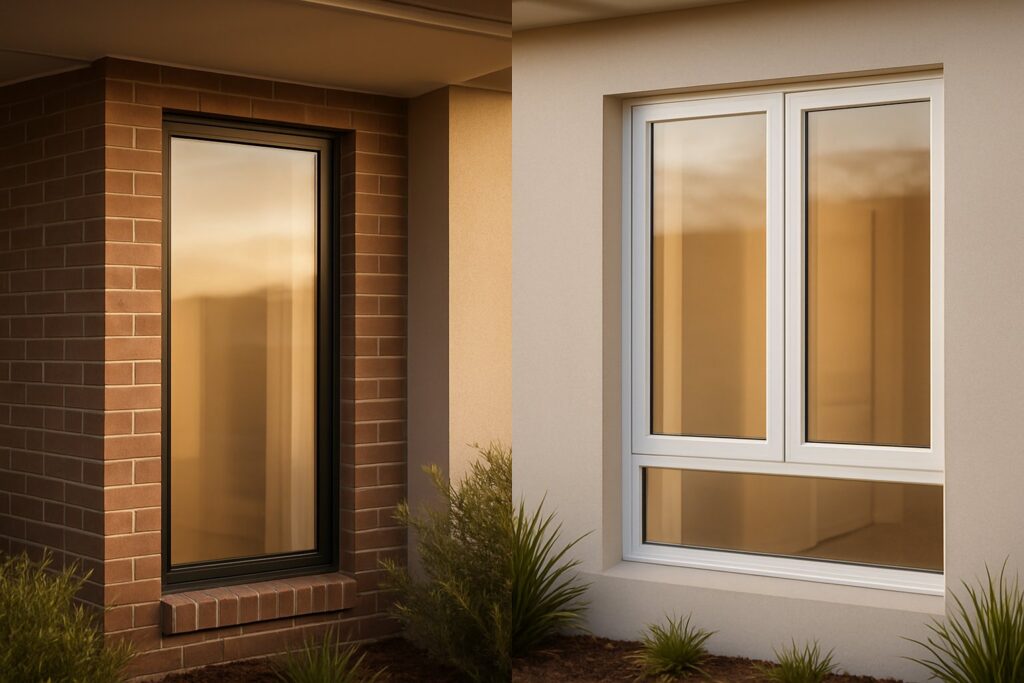
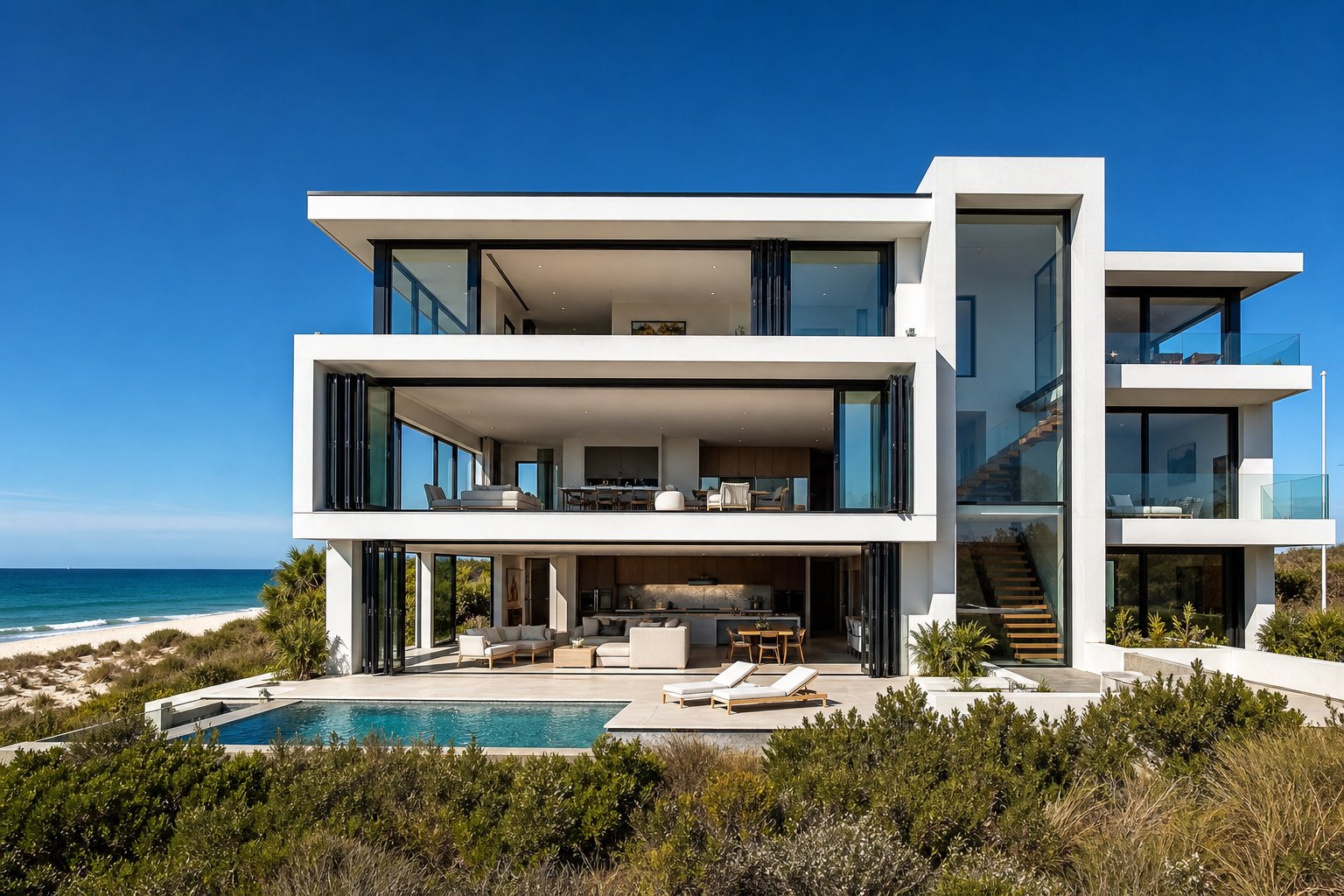
Australian homeowners have gravitated toward a handful of dominant tones in recent years, driven largely by contemporary architectural trends that favour contrast and clean lines. Black aluminium windows — particularly in matt and textured finishes — have become a defining feature of modern Australian homes, creating bold frames against light-rendered walls and maximising visual impact on large openings. Grey aluminium windows in Monument Matt sit equally popular, offering a softer contrast that pairs well with both warm and cool external palettes. White aluminium windows in Surfmist or Pearl White remain a staple for coastal, Hamptons-style, and traditional builds where frames should recede rather than dominate.
- Darks (Monument Matt, AZ Custom Black Matt, Black Textura): contemporary homes, feature windows, aluminium black windows that create strong visual contrast against lighter facades
- Neutrals (Dune, Paperbark, Jasper): brick veneer homes, heritage-sensitive renovations, earth-toned exteriors
- Lights (Surfmist Matt, Pearl White Gloss, Classic Cream): coastal builds, traditional designs, homes in hot climates seeking reduced heat absorption
- Metallics and textures (Precious Silver, Anodic Grey, Textura range): industrial-influenced architecture, commercial builds, premium residential features
Colour choice carries a practical consequence beyond aesthetics. Darker finishes absorb significantly more solar radiation, running hotter and experiencing greater thermal cycling — repeated expansion and contraction — across Australian summers. Over time, this can stress the coating at cut edges and fixing points. It does not mean you should avoid dark tones, but it is worth factoring into maintenance expectations, particularly on west-facing elevations that cop prolonged afternoon sun. Lighter colours reflect more energy and generally place less thermal stress on the frame, which is why they remain popular in Queensland and northern builds.
For homeowners seeking non-standard finishes beyond the typical colour chart, suppliers like MEICHEN offer custom colour capabilities across their aluminium window range, allowing project-specific matching to existing joinery, cladding, or architectural features. Custom colours may involve longer lead times and minimum order considerations, so confirm availability early in the specification process.
Coastal Corrosion Resistance and Salt Spray Zones
Australia’s coastline is where powder coating specification matters most — and where under-specification shows up fastest. AS/NZS 2312 classifies atmospheric corrosion environments from C1 (very low, heated interiors) through to C5 (very high, close to surf) and Cx (extreme, offshore). Two properties in the same suburb can carry different classifications depending on their proximity to open water, prevailing wind direction, and whether the coastline is sheltered harbour or exposed ocean beach.
As a practical guide for Australian coastal properties:
- Beyond 10 km from the coast (C2): standard 60-micron architectural powder coating performs well with minimal maintenance
- 3 to 10 km from tidal water (C3): 60 to 80 micron coating recommended, with attention to pre-treatment quality and fixing materials
- 1 to 3 km from surf coast (C4): 80-micron minimum coating on marine-grade or quality architectural aluminium, 316-grade stainless steel fixings, and periodic fresh-water rinsing
- Within 1 km of surf, particularly under 500 m (C5): 80 to 120 micron coating, full-immersion chrome-free pre-treatment, marine-grade alloy consideration, and all fixings in 316-grade stainless steel isolated from dissimilar metals
Marine-grade anodising presents an alternative to powder coating for extreme exposure sites. The anodising process builds a thicker, harder oxide layer directly into the aluminium surface rather than sitting on top of it. The trade-off is a more limited colour palette — typically silver, bronze, or charcoal metallic tones — but anodised finishes offer excellent long-term corrosion resistance where the aesthetic suits the project.
Regardless of coating type, maintenance in salt zones is straightforward: rinse frames with fresh water regularly to prevent salt crystal buildup, particularly around drainage slots and hardware. Properties within direct salt spray range benefit from quarterly inspections of fixing points and seal interfaces where corrosion initiates first. The investment in correct specification upfront is modest. The cost of replacing prematurely failed frames is not.
Cost Factors and Long-Term Ownership Value
Coating grade, colour, and corrosion classification all feed into one question every homeowner eventually asks: what will this actually cost? The answer is frustratingly variable because aluminium window pricing depends on a stack of specification choices rather than a single list price. Two windows of identical dimensions can differ by hundreds of dollars depending on what sits inside the frame and how the glass is configured. Understanding which decisions move the needle most helps you allocate budget where it genuinely improves performance rather than spreading money evenly across upgrades that deliver diminishing returns.
What Drives Aluminium Window Frame Pricing
Every aluminium window quote reflects a combination of six core variables. Some carry far more weight than others. Here they are ranked from largest to smallest impact on your total project spend:
- Glass specification — this is consistently the biggest cost lever. Moving from single clear glass to aluminium double glazed units adds roughly 25 to 35 percent to the window cost. Stepping further to Low-E coatings adds another 40 to 45 percent above the base price, while laminated acoustic glass pushes 50 percent or more. For most Australian homes, glass specification accounts for more of the total window budget than the frame itself.
- Window size and operating style — larger openings cost more due to additional material, heavier hardware, and higher structural demands. Operating style matters too. A fixed pane is the most affordable option, while sliding, casement, and awning configurations progressively increase cost due to added hardware, seals, and engineering. Supply-only pricing for standard aluminium awning windows in Sydney and nationally can range from around $220 for a compact unit up to $788 or more for larger sizes — before any upgrades are applied.
- Frame profile type — standard aluminium profiles sit at the entry level. Thermally broken frames add 20 to 40 percent over standard profiles due to the polyamide strip, additional extrusion complexity, and tighter manufacturing tolerances. For projects requiring aluminium double glazed windows to meet 7-star NatHERS targets, the thermally broken premium is effectively non-negotiable in cooler climates.
- Installation complexity — new builds with clean openings framed to standard dimensions keep installation labour straightforward. Renovations involving removal of existing frames, structural modifications to openings, waterproofing remediation, or access difficulties (upper storeys, tight lots) can add 30 to 50 percent to the install component. Supply-only pricing and supply-and-install quotes tell very different stories.
- Powder coating grade — standard 60-micron architectural coating adds a modest cost above mill-finish aluminium. Stepping up to 80-micron coastal specifications, custom colours, or textured finishes increases the coating line item, though the increment is typically small relative to overall window cost.
- Hardware quality — hinges, locks, stays, rollers, and handles vary from builder-grade to commercial-grade. Premium hardware improves daily operability and longevity but usually represents a smaller percentage of total cost than glass or frame profile choices.
Where to Save and Where to Invest
The ranking above reveals a clear pattern: glass drives cost more than frame, and frame drives cost more than finishes. This creates a practical strategy for budget-conscious builds.
Invest in glass first. A standard aluminium frame paired with quality Low-E double glazing will outperform a thermally broken frame with basic single glazing in almost every energy scenario. The glass accounts for 80 percent or more of the window area, so it dominates thermal performance regardless of what holds it in place. If budget forces a choice between upgrading the frame or upgrading the glass, choose the glass.
Invest in thermal breaks where they matter. South-facing windows in Melbourne or Canberra lose meaningful energy through un-broken frames. North-facing windows in Brisbane, where solar gain management is the priority, gain less benefit from a thermally broken profile. Target the upgrade to the elevations and climate zones where the physics justify the spend.
Save on operating style where function allows. Fixed windows cost substantially less than operable ones. A design that combines large fixed panels with smaller operable sashes for ventilation delivers both openness and airflow without the cost of making every pane swing or slide.
Lifespan, Maintenance, and Total Cost of Ownership
Upfront cost tells only part of the story. Aluminium frames routinely last 30 to 50 years with virtually no maintenance beyond occasional cleaning. Compare that to timber, which demands repainting or re-staining every three to seven years at several hundred dollars per window each cycle, plus periodic termite inspections and potential seal repairs. Over a 30-year ownership period, a timber window’s total cost of ownership can exceed double its purchase price in maintenance alone.
Warranty structures in the Australian market reflect this durability gap. Most reputable aluminium window manufacturers offer 7 to 10 year warranties on powder-coated finishes, with frame structural warranties extending further. Thermally broken systems from premium fabricators often carry longer coverage again. Timber warranties tend to be shorter and conditional on documented maintenance — miss a repainting cycle and the warranty may be void.
The practical implication is straightforward. Aluminium’s upfront cost sits in the low-to-mid range for standard profiles and mid-to-high for thermally broken systems. But because nothing degrades, nothing needs retreating, and nothing attracts pests, the total ownership cost over the home’s life consistently lands below timber and competitive with uPVC. Factor in aluminium’s high scrap value at end of life — frames are almost always recycled rather than landfilled — and the financial equation tilts further in its favour.
Cost is a legitimate consideration, but it should not be the only lens. The specification decisions you make today determine not just the purchase price but how the windows perform, how long they last, and how much ongoing attention they demand across decades of Australian conditions. Those same decisions also depend heavily on project type — and the gap between a renovation specification and a new build specification is wider than most homeowners expect.
Specifying Aluminium Windows for Your Build Type
A renovation in a 1920s Californian bungalow and a new-build contemporary home on a greenfield lot demand entirely different specification approaches — even when both end up with aluminium frames. The existing structure, compliance obligations, and design freedom available at the start of a project shape which profiles, glazing combinations, and hardware make sense. Getting the specification right at this stage prevents costly remediation, avoids compliance headaches at inspection, and ensures the windows perform as intended across decades of service.
Renovation Versus New Build Considerations
Renovations introduce constraints that new builds simply do not face. Existing structural openings are rarely standard dimensions. Brick veneer homes built in the 1970s and 80s often have reveals that differ from modern framing sizes, and weatherboard cottages may carry openings that have shifted slightly over decades of movement. Measuring must account for these irregularities — a 5 mm discrepancy across a wide opening creates real problems for weather sealing and frame alignment.
Heritage overlays add another layer. Properties in heritage conservation areas, common across inner-city suburbs in Sydney and Melbourne, may require windows that replicate original proportions, sash configurations, or glazing bar patterns. Local council heritage advisors often mandate that new aluminium frames match the profile depth and sight lines of the originals. Heritage-style aluminium or uPVC windows that retain period details while meeting current energy and structural standards have become a specialised segment of the market, requiring suppliers with both fabrication precision and heritage design understanding.
Compliance upgrades complicate renovation specifications further. Replacing windows in an existing home often triggers NCC energy requirements for the new work. A window-for-window swap that simply replaces old single-glazed aluminium with new single-glazed aluminium may not satisfy a building certifier if the scope qualifies as a major renovation. Check with your certifier early to understand which energy targets apply before locking in specifications.
New builds offer the opposite situation: complete freedom. You can orient glazing to maximise northern solar access, size openings to suit the view rather than fitting into existing masonry, and specify frame profiles from the ground up without legacy constraints. This freedom comes with responsibility — every window position, size, and specification feeds into the NatHERS model, so decisions made at the design stage directly determine whether the home achieves its energy target or needs expensive late-stage changes.
Frame Profile, Glass, and Hardware Selection Framework
Three decisions define the specification for every aluminium window opening. Get these right and everything else — colour, supplier, lead time — falls into place.
Frame profile depth. Profile depth determines structural capacity. A shallow 52 mm residential profile suits moderate spans in sheltered wind zones (regions A and B). Larger openings, upper-storey installations, or exposed coastal and cyclone-prone sites demand deeper profiles — 72 mm, 100 mm, or purpose-engineered sections with reinforced mullions. The required wind load rating under AS 2047 dictates the minimum profile depth. Over-specifying costs money; under-specifying fails certification.
Glass combination. Orientation drives glazing selection more than any other factor. North-facing openings in temperate climates benefit from a higher SHGC glass that admits free winter warmth — clear or lightly tinted Low-E double glazing works well here. West-facing and east-facing windows need lower SHGC to block unwanted summer heat gain, typically requiring a tinted or reflective Low-E coating in the IGU. South-facing glass in cooler zones should prioritise the lowest possible U-value since it receives minimal beneficial solar gain. Your energy assessor will model specific combinations, but starting with orientation logic narrows the options quickly.
Hardware selection. Hinges, rollers, locks, and stays determine how the window operates daily and how secure it is when closed. For aluminium windows and doors in Melbourne, Sydney, and other capital cities where security ratings matter, look for hardware that meets or exceeds the AS 5039 forced-entry resistance standard. Coastal installations need 316-grade stainless steel hardware or marine-coated alternatives to avoid premature corrosion. Operating style — awning, casement, sliding, bi-fold — should match ventilation needs and furniture placement rather than defaulting to the cheapest configuration.
Working with Suppliers and Getting Quotes
The phrase “Australian-made” carries different meanings in the aluminium window industry, and understanding the distinction matters for lead times, quality control, and after-sale support. Raw aluminium billets are typically smelted and extruded by major producers who supply standard architectural profiles to the market. Fabricators then cut, machine, assemble, glaze, and finish these profiles into complete window units. Some fabricators also design proprietary extrusion dies for their own profile systems, giving them greater control over dimensions and performance. A few vertically integrated operations handle everything from extrusion through to finished product.
For most residential projects, the critical question is not where the raw extrusion originated but where the fabrication, glazing, and quality control happen. A locally fabricated window means shorter lead times, easier communication on custom requirements, and accessible warranty support if something goes wrong. It also means the product was assembled under Australian workplace standards with local compliance knowledge built into every decision.
When comparing aluminium window suppliers in Sydney, Melbourne, or any Australian market, a structured evaluation helps separate capable suppliers from those offering little more than competitive pricing. Ask these questions before committing:
- Are your windows tested and certified to AS 2047, and can you provide test reports or AGWA accreditation documentation?
- What WERS ratings do your standard and thermally broken systems achieve, and can you supply product-specific data for energy modelling?
- Which powder coating system and pre-treatment process do you use, and what finish warranty applies for my site’s corrosion classification?
- Do you fabricate locally or import finished units, and what are current lead times for standard and custom configurations?
- What BAL or cyclone ratings can your systems achieve if my site requires bushfire or wind region compliance?
- Do you offer site measurement, or do you work from builder-supplied dimensions only?
- What is included in your warranty — frame structure, hardware, seals, glass, and finish — and what maintenance conditions apply?
- Can you supply shop drawings or section details for certifier and builder review before manufacture?
Any reputable supplier will answer these without hesitation. Evasion on testing documentation or vague responses about compliance ratings is a red flag worth taking seriously.
For homeowners, builders, and project teams ready to explore specific aluminium window options — including custom configurations across sliding, awning, casement, and fixed types — MEICHEN’s aluminium window range offers project-ready systems with multiple frame profiles, performance tiers, and custom colour options suited to Australian residential and commercial builds. Their product pages cover window types alongside specification guidance, making them a useful starting point for comparing what is available before finalising quotes.
Specification is where budget meets performance meets compliance. Get it right and the windows serve the home quietly for decades. Get it wrong and you discover the gap between a cheap quote and a compliant installation the hard way — usually at the certification stage or the first heavy storm. The care taken during specification also determines the environmental footprint of those windows across their full lifecycle, from raw material extraction through decades of service and eventual end-of-life recovery.
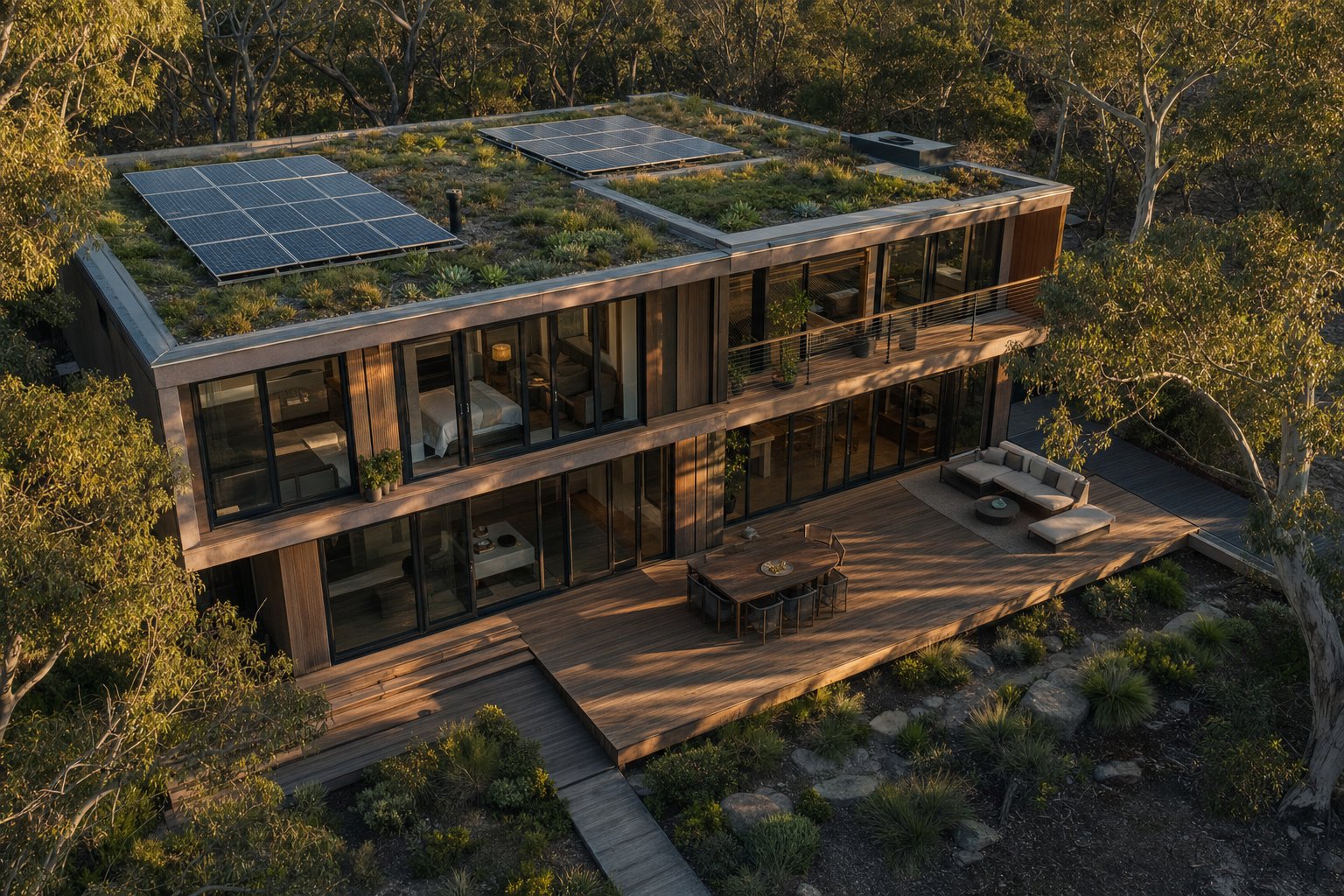
Sustainability and Recyclability of Aluminium Frames
That lifecycle footprint deserves a closer look — particularly for homeowners who weigh environmental impact alongside performance and cost. Aluminium sits in a unique position among building materials. Its production is energy-intensive, yet its longevity and recyclability create a sustainability story that unfolds over decades rather than at the point of purchase. For the growing segment of Australian buyers who want durable aluminium windows that also align with circular economy principles, the material’s credentials hold up to scrutiny once you look beyond the initial manufacturing stage.
Aluminium’s Infinite Recyclability Advantage
Unlike plastics, which degrade each time they are mechanically recycled, aluminium is a permanent material. Its atomic structure — a crystalline metallic bond — remains fundamentally unchanged through melting and reformation. A window frame fabricated from recycled aluminium carries the same strength, corrosion resistance, and workability as one made from virgin metal. There is no generation limit. No downgrading. No loss of essential properties.
Approximately 75 percent of all aluminium ever produced is still in productive use today. It can be recycled again and again without compromising any of its unique properties, and recycling saves around 95 percent of the energy required for primary production.
That 95 percent energy saving is not a theoretical projection — it reflects real-world industrial data tracked by the Australian Aluminium Council and the International Aluminium Institute. When an aluminium window frame reaches the end of its service life — typically 30 to 50 years after installation — the metal retains high scrap value. This economic incentive ensures frames are almost always collected and recycled rather than sent to landfill, creating a genuine closed-loop pathway that few other building materials can match.
In Australia, companies like Capral Aluminium and Rio Tinto have successfully trialled closed-loop recycling systems that convert pre-consumer aluminium scrap back into extrusion billet. While domestic remelting capacity remains limited — more than 95 percent of Australia’s scrap aluminium is currently exported for recycling — industry and government are actively working to build local circular infrastructure that would keep more of this valuable material cycling within Australian supply chains.
Lifecycle Thinking for Sustainable Window Choices
Sustainability is not just about what a material is made from. It is about how long it lasts and what it demands while in service. A window australia homeowners install once and never replace for four decades generates far less waste, transport emissions, and manufacturing impact than one that needs replacing every 15 to 20 years.
Aluminium frames require no painting, no chemical treatments, and no ongoing interventions to maintain their structural integrity. Timber frames, by contrast, consume litres of paint or stain every few years — products that carry their own manufacturing emissions and VOC profiles. uPVC performs well in temperate zones but can degrade under extreme Australian UV exposure, potentially shortening its effective service life in northern regions and necessitating earlier replacement.
Research by KieranTimberlake and the International Aluminium Institute found that the most impactful sustainability decision architects can make with aluminium is to detail it for extended service life and eventual recyclability. In practical terms for Australian homes, this means specifying appropriate coating grades for your corrosion zone, using stainless steel fixings that will not cause galvanic corrosion, and choosing frame systems designed for straightforward disassembly at end of life. Durability is itself a sustainability strategy — not merely a convenience benefit.
Embodied Energy and the Long-Term Equation
The common critique is fair: primary aluminium production is energy-intensive. Smelting requires significant electricity, and globally much of that electricity still comes from fossil fuel sources. On a per-kilogram basis, virgin aluminium carries higher embodied energy than timber, uPVC, or steel.
But embodied energy measured at the factory gate tells an incomplete story. Lifecycle assessment — the methodology used by researchers and standards bodies worldwide — spreads that initial energy investment across the product’s full useful life. A material that serves 40 to 50 years without degradation, requires zero maintenance inputs, and is recovered at near-100 percent efficiency at end of life amortises its embodied energy far more effectively than a material with lower initial impact but shorter service or higher maintenance demands.
Australia’s aluminium smelters also draw heavily on hydroelectric power. Facilities like the Tomago smelter in NSW and Bell Bay in Tasmania operate within a grid mix that includes substantial renewable generation, reducing the carbon intensity of domestically produced aluminium compared to global averages. As Australia’s electricity grid continues its transition toward renewables, the embodied carbon of locally produced aluminium will fall further — making an already strong lifecycle case even more compelling for eco-conscious homeowners choosing austral windows and building materials.
The bottom line is straightforward. If you are choosing window frames based on environmental performance, look past the factory gate. Consider how long the material lasts, what it demands while in service, and what happens when the building eventually comes down. On all three measures, aluminium’s combination of infinite recyclability, maintenance-free longevity, and high end-of-life recovery rates makes it one of the most genuinely sustainable choices for window Australia conditions demand.
Frequently Asked Questions About Aluminium Window Frames in Australia
1. How long do aluminium window frames last in Australian conditions?
Aluminium window frames typically last 30 to 50 years in Australian conditions with minimal maintenance — just occasional cleaning. Unlike timber frames that require repainting every three to five years, aluminium resists rot, warping, termites, and UV degradation. The powder-coated finish holds up against Australian sun and salt air when correctly specified for the site’s corrosion classification. This extended lifespan, combined with high end-of-life scrap value ensuring recycling rather than landfill, makes aluminium one of the lowest total-cost-of-ownership options available.
2. Are thermally broken aluminium windows worth it in Australia?
Thermally broken aluminium windows are worth the investment in cooler Australian climate zones (NCC zones 6, 7, and 8) including Melbourne, Canberra, Hobart, and alpine areas. The polyamide strip separating inner and outer frame profiles reduces frame U-values from around 5.5-7.0 W/m²K down to 2.5-4.0 W/m²K. They are particularly valuable for south-facing elevations, homes targeting 7-star or higher NatHERS ratings, and large glazing areas where cumulative thermal bridging is significant. In tropical northern Australia where cooling loads dominate and windows stay open frequently, standard aluminium with quality glazing often meets compliance without the thermal break premium.
3. What Australian standards must aluminium windows comply with?
All external aluminium windows in Australia must comply with AS 2047 for structural performance, water resistance, and air infiltration. They must also meet AS 1288 for glass selection and safety. Energy performance is assessed through WERS (Window Energy Rating Scheme) star ratings that feed into NatHERS modelling to demonstrate NCC Section J compliance — currently a minimum 7-star rating for most new homes. Properties in bushfire-prone areas require BAL compliance under AS 3959, where aluminium’s non-combustible nature provides inherent advantage up to BAL-29. Cyclone regions demand elevated wind load ratings under AS/NZS 1170.2. Suppliers like MEICHEN provide AS 2047-certified aluminium window systems across their product range.
4. How do I protect aluminium window frames from coastal corrosion in Australia?
Protection depends on distance from the coastline, classified under AS/NZS 2312. Properties beyond 10 km from the coast need standard 60-micron architectural powder coating. Between 1 and 3 km from surf, specify 80-micron minimum coating with 316-grade stainless steel fixings. Within 500 metres of surf, use 80 to 120 micron coating with full-immersion pre-treatment and marine-grade alloy. Marine-grade anodising is an alternative for extreme exposure sites. Regardless of coating type, regular fresh-water rinsing prevents salt crystal buildup, and quarterly inspections of fixing points catch early corrosion before it spreads.
5. Is aluminium or uPVC better for windows in Australia?
Neither material wins every category — the best choice depends on your priorities and location. uPVC offers superior thermal insulation (frame U-values of 1.5-2.5 W/m²K versus 2.5-4.0 for thermally broken aluminium) making it strong for passive house builds in cooler climates. However, aluminium delivers slimmer sight lines, larger maximum spans for sliding and bi-fold doors, non-combustible fire resistance for BAL-rated properties, and proven UV durability in northern Australian sun where lower-grade uPVC can become brittle. Aluminium also has a more established fabricator network across all Australian states, meaning shorter lead times and broader supply chain access for regional projects.
More Window & Door Guides