What Aluminium Windows Actually Cost in Australia
Budgeting for aluminium windows in Australia means dealing with a wide spread of numbers. A small fixed window might sit around $150 supply-only, while a large bi-fold configuration can push well past $1,250 per square metre. That gap catches a lot of homeowners off guard, and it is the reason a single “average price” rarely tells the full story.
This guide is built as a neutral budget-planning resource. It is not tied to any single supplier’s price list. Instead, it pulls together real aluminium windows prices from across the market to help you understand where every dollar goes, whether you are pricing a full new build, a single-room renovation, or a multi-storey development.
What Aluminium Windows Typically Cost Across Australia
Based on current supply-only pricing data, standard aluminium windows generally fall within these ballpark ranges:
Expect to pay roughly $150 to $800 per window for standard sizes in common configurations (fixed, sliding, awning), supply only. Double glazed, powder-coated, or custom-sized options push costs higher, with premium units reaching $820 to $1,250+ per square metre.
Those figures cover the window unit itself. Installation, glazing upgrades, custom fabrication, and compliance requirements all layer on top, which is why two seemingly similar projects can end up with very different final invoices.
Why Prices Vary So Much Between Projects
The cost of aluminum windows depends on a handful of core variables working together. Window type matters: a fixed pane is the cheapest to manufacture, while operable styles like sliding, casement, and bi-fold carry progressively higher hardware and engineering costs. Glazing choice plays a major role too. Single-pane windows run roughly 25 to 35 percent less than their double-glazed equivalents, but energy compliance rules in many climate zones now make double glazing the practical minimum.
Size, colour, location, and project scope round out the picture. A standard off-the-shelf unit is significantly cheaper than a custom-fabricated opening. Metro installations tend to cost less in labour than regional jobs where travel time factors into the quote. And ordering ten windows at once generally delivers better per-unit pricing than replacing one at a time.
Throughout this article, we will reference both per-window and per-square-metre pricing frameworks. Per-window figures are useful for quick comparisons, but per-square-metre pricing gives you a fairer basis when comparing different sizes, types, and suppliers against each other. Together, they form the most reliable way to build an accurate aluminum windows price list for your specific project, regardless of scale.
Aluminium Window Prices by Type and Configuration
Every window style carries its own cost profile. The frame material might be the same, but the hardware, engineering, and fabrication complexity behind each configuration create real pricing differences. A straightforward aluminium sliding window costs far less to produce than a bi-fold unit with multiple panels, heavy-duty tracks, and precision hinges. Understanding where each type sits on the price spectrum helps you allocate budget before you even request a quote.
Sliding and Casement Window Price Ranges
Aluminium sliding windows are consistently the most affordable operable style on the Australian market. Their simple track-and-roller mechanism requires fewer moving parts than hinged alternatives, which keeps both manufacturing and installation costs down. Based on current supply-only pricing, a standard sliding aluminium window starts around $165 for a compact 514 x 610mm unit and ranges up to approximately $680 for a larger 2057 x 2650mm opening.
Casement and awning windows sit a step above. The hinged mechanism, friction stays, and weathersealing add material and labour to the build. Expect hinged casement windows to start from around $180 for a 600 x 600mm unit and reach $380 or more at 600 x 1200mm. Awning windows follow a similar pattern, ranging from roughly $220 for a small 514 x 850mm panel up to $788 for an 800 x 2650mm configuration. The premium over sliding aluminium windows of equivalent size typically sits between 10 and 30 percent, depending on hardware grade and glazing choice.
Bi-Fold and Specialty Window Costs
Bi-fold windows and doors represent the top end of aluminium window pricing. Each panel needs its own hinge set, the track system must handle significantly more weight, and alignment tolerances are tighter to ensure smooth operation across the full span. Industry pricing for bi-fold aluminium systems runs around $1,250 per square metre supply-only, making them roughly two to three times the per-square-metre cost of a standard sliding unit.
Tilt-and-turn windows, increasingly popular for their dual-opening flexibility, land around $820 per square metre. These are less common in mainstream Australian residential builds but appear frequently in architecturally designed homes where European-style ventilation control is a priority.
Fixed and Louvre Window Pricing
Fixed aluminium windows are the cheapest configuration available because they have no operable hardware at all. A 600 x 600mm fixed unit starts at approximately $150, while a large 1800 x 1810mm panel sits around $755. For projects where ventilation is handled elsewhere, fixed panes deliver maximum glass area at minimum cost per square metre.
Aluminium louvre windows occupy a different pricing tier. Even basic fixed louvre systems typically range from $400 to $850 per square metre depending on blade profile and spacing. Operable louvres with manual adjustment push to $650 to $900 per square metre, and motorised versions can exceed $1,100 per square metre. The cost reflects specialised extrusion profiles, pivot mechanisms, and the precision required for consistent blade alignment.
| Type | Typical Size | Indicative Price Range (Supply Only) | Best Application |
|---|---|---|---|
| Fixed | 600 x 600mm to 1800 x 1810mm | $150 – $755 per window | Feature walls, highlight windows, areas not requiring ventilation |
| Sliding | 514 x 610mm to 2057 x 2650mm | $165 – $680 per window | Bedrooms, living areas, budget-conscious projects |
| Awning | 514 x 850mm to 800 x 2650mm | $220 – $788 per window | Bathrooms, kitchens, rain-safe ventilation |
| Casement (hinged) | 600 x 600mm to 600 x 1200mm | $180 – $380 per window | Side-hung openings, maximum airflow |
| Tilt and Turn | Varies | ~$820 per m² | Architecturally designed homes, dual-mode ventilation |
| Bi-fold | Multi-panel spans | ~$1,250 per m² | Indoor-outdoor living, wide openings, entertaining areas |
| Louvre (fixed) | Custom panel sizes | $400 – $850 per m² | Privacy screening, sun shading, ventilation |
| Louvre (operable) | Custom panel sizes | $650 – $1,100 per m² | Adjustable airflow and light control |
Notice that the table includes both per-window and per-square-metre figures. This distinction matters. A $680 sliding aluminium window covering 2057 x 2650mm works out to roughly $125 per square metre of glass area, while a bi-fold at $1,250 per square metre represents ten times the rate for the same coverage. Per-square-metre pricing is the fairer comparison tool when you are evaluating different sizes and types side by side, particularly for larger openings where a single per-unit figure can mask just how much glass you are actually getting for the money.
These indicative ranges assume standard single glazing and common powder-coat colours. The moment you specify double glazing, premium finishes, or non-standard dimensions, the numbers shift. That glazing decision alone can add 25 to 35 percent to the base price of any configuration listed above.
Single Glazed Versus Double Glazed Aluminium Pricing
That 25 to 35 percent glazing premium mentioned above is not a minor line item. It often represents the single biggest cost variable within an aluminium window price, and it is driven entirely by what sits between the frame: one pane of glass or two.
Single Glazed Aluminium Window Costs
Single glazed aluminium windows remain the cheapest entry point. All those indicative figures in the previous section assume single glazing as the baseline. For a standard sliding window at around $350 supply-only, the glass itself accounts for a relatively small portion of the total unit cost. The frame, hardware, and fabrication do the heavy lifting on price.
Single glazing still makes sense in limited scenarios: internal partition windows, garage openings, or projects in NCC climate zone 1 (tropical areas like Darwin and Cairns) where U-value requirements are relaxed. Outside those situations, choosing single glass increasingly means choosing a product that will not meet compliance for new builds or major renovations.
Double Glazed Upgrade Premiums
Upgrading to double glazing on an aluminium glazed window typically adds 25 to 35 percent to the aluminium windows price. On a $400 single-glazed unit, that translates to roughly $100 to $140 extra. Across a full house with 15 to 20 openings, the premium stacks up to $1,500 to $2,800 in additional glass costs alone.
The premium covers two panes of glass, an argon or air-filled cavity between them, edge spacer seals, and often a Low-E coating on one surface. Each layer adds material, manufacturing steps, and weight, which in turn may require upgraded hardware.
Then there is the frame itself. Standard aluminium conducts heat rapidly, which undermines the insulating benefit of double glazing. Thermally broken aluminium frames solve this by inserting a polyamide or polyurethane barrier between the interior and exterior sections of the profile. According to industry data, thermally broken frames add a further 25 to 40 percent over standard aluminium framing. Combined with double glazing, the total uplift from a basic single-glazed unit can reach 50 to 75 percent.
Under NCC 2022, climate zones 2 through 7 require approximately 20 percent better U-values and 30 percent better SHGC performance compared to NCC 2019 standards. In practice, this makes double glazing with thermally broken frames the minimum compliant specification for most new builds across Sydney, Melbourne, Adelaide, Brisbane, Perth, and Hobart.
That regulatory shift is important context for anyone budgeting today. The cheapest aluminium window price on the market is irrelevant if it cannot pass energy compliance in your climate zone. Builders and renovators in zones 4 through 7 especially should treat double glazed, thermally broken aluminium as the realistic starting point, not an optional upgrade.
The benefits that justify this higher upfront cost are tangible and measurable:
- Thermal performance: thermally broken frames can reduce heat transfer through the frame by up to 60 percent compared to standard aluminium
- Energy savings: lower heating and cooling loads translate directly to reduced electricity and gas bills year-round
- Condensation control: the warmer interior glass surface and insulated frame virtually eliminate winter condensation, protecting reveals and sills from moisture damage
- Acoustic insulation: the sealed air gap between panes significantly reduces external noise transmission, particularly beneficial near roads or flight paths
- Longevity: reduced thermal stress on seals and components extends the service life of the entire window unit
- Resale value: energy-efficient glazing is increasingly valued by buyers and can improve a home’s NatHERS star rating
For projects where budget is tight, a practical middle ground exists. You can specify double glazing on north and west-facing openings where solar heat gain is highest, and use single glazing on smaller south-facing windows in milder climate zones where compliance allows it. This selective approach balances the aluminium windows price against performance where it counts most.
Of course, glazing choice does not exist in isolation. The frame material, powder coating, hardware grade, and whether the window is a standard or custom size all layer onto the final figure, and each one of those factors carries its own cost story.
How Aluminium Compares to Timber and uPVC on Cost
Frame material is one of those layered cost drivers that shapes not just the purchase price but the total spend over the life of the window. Aluminium is the dominant choice across Australia for good reason, yet it is not the only option. Timber, uPVC, and composite frames each occupy different price points, and comparing them purely on upfront cost misses the bigger picture.
Aluminium Versus Timber Frame Costs
Timber windows carry a wide pricing range depending on species and finish. Expect to pay roughly 20 to 40 percent more than equivalent aluminium for hardwood frames in standard configurations, with premium species like Western Red Cedar or Spotted Gum pushing higher still. The appeal is largely aesthetic: timber offers warmth, paintability, and a classic look suited to heritage or character homes.
The catch sits in maintenance. Timber frames need repainting or resealing every three to five years to prevent rot, warping, and insect damage. Over a 30-year period, those recurring costs add thousands to the true lifetime expense. Aluminium, by contrast, needs little more than an occasional wipe-down. Its powder-coated finish resists fading, peeling, and corrosion without ongoing intervention, making it far better suited to the harsh UV exposure and variable weather conditions typical across window Australia markets from coastal Queensland to inland NSW.
Aluminium Versus uPVC and Composite Options
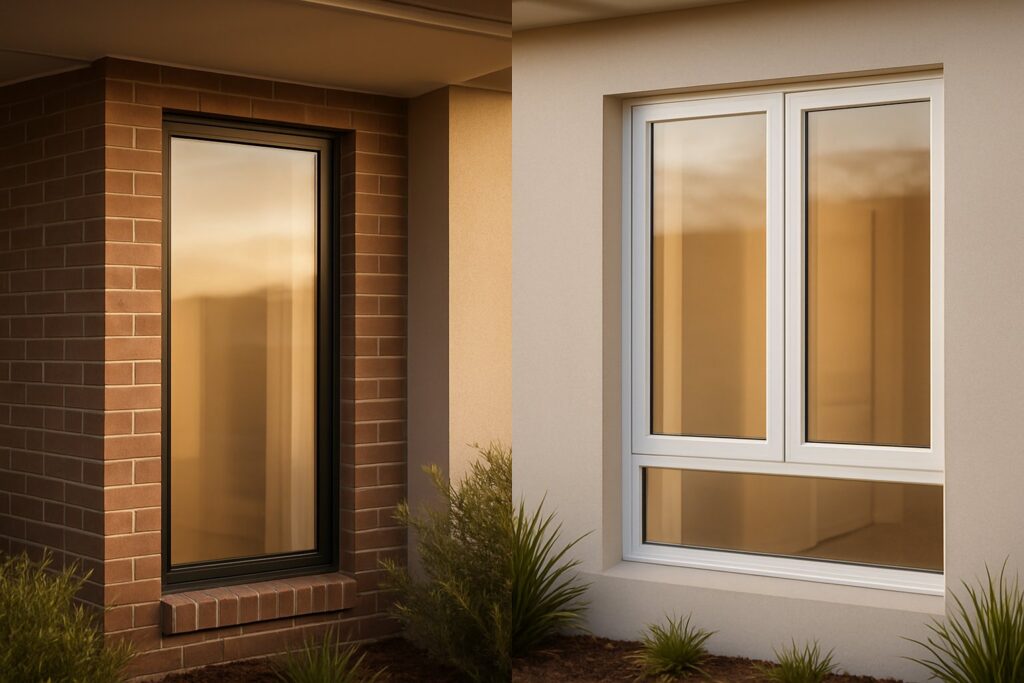
uPVC windows generally cost less upfront than aluminium, often sitting 10 to 25 percent below equivalent aluminium units for standard sizes. They deliver strong thermal insulation without needing a thermal break, which removes one cost layer entirely. For budget-focused projects where energy performance is the priority, uPVC presents a compelling case.
However, the question of how long do aluminum windows last tilts the value equation. Aluminium frames typically deliver a service life of 30 to 45 years, compared with 20 to 35 years for uPVC. That extra decade or more of performance means fewer replacement cycles over the life of a building. Aluminium also handles larger spans and slimmer sightlines, which matters for contemporary AU windows designs featuring floor-to-ceiling glass and expansive openings that uPVC profiles struggle to support structurally.
Composite frames, combining timber interiors with aluminium exterior cladding, attempt to offer the best of both worlds. They deliver the warmth of wood inside with the weather resistance of aluminium outside, but at a significant premium, often 30 to 50 percent above straight aluminium. Their niche tends to be high-end architectural projects where neither pure timber nor aluminium alone achieves the desired result.
| Material | Indicative Price Range (per window, standard size) | Lifespan | Maintenance Cost (over 30 years) | Climate Suitability |
|---|---|---|---|---|
| Aluminium | $300 – $800 | 30 – 45 years | Low (occasional cleaning) | All Australian climates; excellent coastal and bushfire performance |
| Timber | $450 – $1,100 | 20 – 40 years (maintenance dependent) | High (repainting/resealing every 3–5 years) | Temperate zones; vulnerable in tropical and coastal conditions |
| uPVC | $250 – $650 | 20 – 35 years | Very low (periodic cleaning and lubrication) | Good across most zones; limited structural span for large openings |
| Composite (timber/aluminium) | $500 – $1,200 | 30 – 45 years | Moderate (interior timber requires attention) | All zones; premium solution for design-led projects |
Recyclability adds another dimension. Aluminium is infinitely recyclable without loss of quality, and Australia’s aluminium recycling infrastructure is well established. At end of life, old frames hold genuine scrap value. uPVC is technically recyclable but far less commonly processed in Australia, while timber is biodegradable but rarely reclaimed in usable form from demolition sites. For projects where sustainability credentials matter, whether for Green Star ratings, corporate ESG reporting, or simply personal values, aluminium’s circular material story carries measurable weight.
Taken together, aluminium occupies the middle ground on upfront cost but leads on durability, design flexibility, and whole-of-life value. It handles Australian conditions, from salt air to extreme UV to bushfire zones, without the compromises that other materials demand. That resilience is precisely why it dominates new residential and commercial construction across the country.
Still, even within aluminium, the final price is far from fixed. The specific choices you make during specification, from standard versus custom sizing to powder-coat colour and hardware grade, create their own cost layers that deserve closer attention.
Key Factors That Drive Your Final Window Price
Choosing aluminium as your frame material sets the foundation, but the specification decisions that follow can shift your final cost by 30 to 80 percent in either direction. Some of these choices are aesthetic. Others are dictated by site conditions or regulatory compliance. Understanding which ones carry the most financial weight helps you spend strategically rather than discovering unexpected premiums at quoting stage.
Ranked from greatest to least impact on your bottom line, here are the factors that shape pricing:
- Custom sizing versus standard dimensions — the single largest cost lever for most projects
- Glazing specification — single, double, Low-E coatings, and laminated options (covered in the previous section)
- Bushfire Attack Level (BAL) compliance — mandatory for properties in designated zones
- Powder coating colour selection — standard versus non-standard versus specialty finishes
- Hardware grade and security features — from basic to commercial-grade locking systems
- Flyscreen and accessory integration — fixed mesh, retractable, or security screen additions
Custom Sizing and Standard Size Cost Differences
Standard aluminium windows follow fixed sizes and configurations that manufacturers produce in volume. This repetitive production keeps costs down, shortens lead times, and makes replacement parts easy to source. A standard off-the-shelf unit can be manufactured efficiently and sold at lower prices because the tooling, cutting templates, and assembly jigs are already set up for that exact dimension.
Custom aluminium windows, by contrast, are designed and manufactured to project-specific sizes and performance requirements. Every non-standard opening needs its own cutting schedule, individual quality checks, and often unique weatherseal configurations. The premium for custom fabrication typically ranges from 20 to 50 percent above an equivalent standard unit, depending on complexity. Irregular shapes, arched tops, or unusually narrow profiles push closer to the upper end of that range.
For budget-conscious projects, the practical advice is straightforward: design openings around standard sizes wherever the architecture allows. Reserve custom fabrication for feature windows, unusual wall window frame dimensions, or openings where precise fitment to an existing structure demands it. A renovation with heritage-era openings rarely aligns with modern standard sizes, but a new build has the flexibility to plan around them from the start.
Powder Coating and Hardware Upgrades
Aluminium sliding windows material arrives at the fabricator in mill finish, a raw silver appearance that requires coating before installation. Powder coating provides the durable, coloured finish you see on the finished product. The cost of that coating depends heavily on which colour you choose.
Standard colours, typically matt black, white, and a handful of popular greys, are the cheapest option because manufacturers can source extrusions pre-coated in these colours from their suppliers. Non-standard colours require local powder coating of mill-finish stock, adding a surcharge per frame. Specialty colours, such as heritage greens, custom-matched architectural tones, or metallic finishes, cost considerably more again and may carry minimum order requirements.
The price difference is not trivial. A standard colour adds nothing beyond the base frame cost if the extrusion comes pre-coated. A non-standard colour might add $15 to $30 per frame section requiring coating. Specialty finishes can push surcharges higher still, and across a full house of 15 to 20 windows, those per-item additions compound quickly.
Hardware follows a similar tiered structure. Basic residential handles and cam locks represent the baseline. Upgrading to keyed locks, multi-point locking systems, or commercial-grade stainless hardware for sliding windows aluminum configurations adds $30 to $120 per window depending on the system. Security-rated hardware compliant with AS 5039 or AS 5041 sits at the higher end, but delivers measurable improvement in forced-entry resistance.
Bushfire and Compliance Cost Additions
Properties located in designated bushfire-prone areas must comply with AS 3959, which assigns a Bushfire Attack Level rating from BAL-LOW through to BAL-FZ (Flame Zone). Each step up the scale imposes stricter requirements on glazing type, frame construction, seals, and screening.
At BAL-12.5 and BAL-19, the additional cost is relatively modest: upgraded seals, metal mesh screens over openable sections, and tempered glass. From BAL-29 upward, the requirements intensify. Toughened or laminated glass becomes mandatory, gaps and joints need specific protection, and the window system must demonstrate compliance through tested configurations. BAL-40 and BAL-FZ demand fire-resistant glazing systems that can add 40 to 100 percent to the base aluminium window price.
These costs are non-negotiable. If your property sits within a designated zone, the BAL rating determined by your bushfire assessment report dictates the minimum specification. Budgeting from the compliance minimum upward, rather than pricing a standard window and adding bushfire upgrades as an afterthought, avoids the sticker shock that catches many homeowners in bushfire-prone parts of NSW, Victoria, South Australia, and the ACT.
Geography shapes more than just bushfire requirements, though. Whether your project is a renovation replacing old frames or a new build with clean openings introduces an entirely separate set of cost variables that the base window price never reflects.
Renovation Replacements Versus New Build Window Costs
A window’s sticker price tells only part of the story. The context it gets installed into, whether a brand-new wall cavity or an existing opening in a 1970s brick-veneer home, determines how much additional work and cost sits around that unit. Replacing aluminium frame windows in a renovation project typically costs 30 to 50 percent more per opening than fitting the same product in new construction, and the reasons are largely about what happens before and after the window itself goes in.
Additional Costs When Replacing Existing Windows
An aluminium window replacement introduces labour and material costs that simply do not exist on a new build. Old frames need to come out, reveals need repair, and the unexpected often lurks behind decades-old cladding. Based on current market data, retrofitting windows runs approximately $800 to $1,800 per window installed, compared with $600 to $1,500 for equivalent new-build installations.
The additional line items that apply specifically to replacement projects include:
- Removal and disposal of existing frames — extracting old timber or aluminium windows without damaging surrounding brickwork or cladding, plus tip fees for waste disposal
- Making good of reveals and sills — patching render, replacing damaged brickwork, re-plastering internal reveals, and repainting to match existing finishes
- Structural modifications — if existing openings are being widened or repositioned, steel lintels, temporary props, and bricklaying work add significant cost
- Asbestos identification and removal — homes built before the mid-1980s may contain asbestos in eaves, cladding, or window surrounds. Licensed removal is mandatory and can cost $500 to $2,000+ depending on the extent
- Flashing and waterproofing upgrades — older openings rarely meet current weatherproofing standards, requiring new flashings and sealant systems
- Council approval and permit fees — changing window sizes or positions during a renovation can trigger a development application (DA), adding $300 to $1,500+ in permit costs and weeks to the timeline
That last point catches many renovators by surprise. A like-for-like replacement aluminium window in the same opening typically does not need council approval. But the moment you alter dimensions, add a new opening, or change the elevation facing a street or boundary, most local councils require at a minimum a complying development certificate (CDC), and in some cases a full DA. Heritage overlays or conservation areas layer on further requirements and review fees.
New Build Window Pricing Advantages
New construction sidesteps virtually all of those extras. Openings are framed precisely to suit the specified window size. There is no demolition, no patching, no asbestos risk, and no council approval specifically for the windows themselves since they form part of the broader building approval. Installation labour is faster because access is unobstructed and multiple openings can be fitted in sequence without working around existing finishes.
Labour rates for window installation generally sit between $150 and $300 per window, but that range shifts based on location. Metro installers in Sydney, Melbourne, and Brisbane charge toward the upper end due to higher overheads, yet competition among tradespeople keeps rates somewhat contained. Regional and rural projects face a different equation: fewer available installers, longer travel distances, and minimum call-out fees that effectively raise the per-window labour cost even though hourly rates may be comparable.
Upper-floor access adds another variable. Ground-floor aluminium window replacement is straightforward scaffold-free work. Second-storey or multi-level openings require scaffolding or elevated work platforms, adding $500 to $2,000+ per elevation depending on height and site constraints. New builds typically handle this within the existing construction scaffold, while renovation projects often need purpose-hired equipment just for the window phase.
The takeaway for anyone budgeting a renovation is clear: price the project, not just the product. A $500 window can easily become an $1,100 installed opening once removal, making-good, and compliance costs are accounted for. Getting a detailed scope from your installer that breaks out these ancillary items, rather than accepting a single lump-sum figure, helps you understand exactly where the money goes and where savings might be found.
Location and project type shape what you pay for installation, but they are not the only external forces acting on your budget. Building regulations, specifically NCC energy efficiency requirements, set a compliance floor that varies dramatically depending on which part of Australia your project sits in.
How NCC Energy Rules Affect Your Window Budget
Australia’s National Construction Code divides the country into eight climate zones, and each zone imposes distinct thermal performance requirements on glazing. These are not suggestions. They are mandatory minimums that determine the lowest-specification window your project can legally install. That compliance floor directly dictates the starting price of every aluminium window in your build.
NCC Energy Requirements by Climate Zone
The differences are substantial. In climate zone 1 (Darwin, Cairns, tropical north Queensland), any U-value is acceptable because reducing heat conduction through frames matters far less where cooling dominates year-round. That means standard aluminium frames with single glazing can still comply, keeping costs at their lowest.
Move south into zones 4 through 7, covering Sydney, Melbourne, Adelaide, Perth, and Hobart, and the picture changes sharply. NCC 2022 requires approximately 20 percent better U-values and 30 percent improved SHGC compared with the previous code. In practice, aluminium windows in Sydney and aluminium windows in Melbourne now need double glazing and controlled solar admittance as a baseline. Aluminium windows in Adelaide face similar thresholds. Meanwhile, climate zone 8 (alpine regions) allows any SHGC to maximise passive solar heating, but demands frames that minimise conductive heat loss through winter.
Thermally broken aluminium frames have become effectively mandatory in cooler zones to achieve the required U-values. Standard aluminium profiles simply conduct too much heat to pass compliance without that insulating polyamide barrier splitting the frame.
How Compliance Shapes Your Minimum Budget
Your budget should start from the compliance-minimum specification for your climate zone, not from the cheapest product on the market. A window that cannot pass NCC energy requirements is not a saving; it is a product you cannot legally install.
This means a like-for-like window quote in Darwin and Hobart will never produce comparable numbers. The Darwin project might legitimately specify single-glazed standard aluminium at $200 per opening. The Hobart project starts at double-glazed thermally broken aluminium, potentially $450 or more for the same size and style, simply because the code demands it.
For builders and homeowners, the practical lesson is to confirm your climate zone and its glazing requirements before comparing any supplier pricing. Your energy assessor or the ABCB Glazing Calculator will identify the minimum U-value and SHGC your windows must achieve. That figure becomes your true price floor, and any quote below it likely reflects a non-compliant specification.
Compliance sets the minimum. The strategies you use above that floor, from sizing choices to supplier relationships and ordering approach, determine whether you pay more than you need to.
Smart Strategies to Reduce Your Aluminium Window Costs
Knowing what drives pricing is one thing. Using that knowledge to spend less without cutting corners is where real budget control happens. Every strategy below works within the bounds of NCC compliance and product quality. They are ranked by how much they typically save on a full-project basis, from the biggest impact down to the smaller wins that still add up across multiple openings.
Standard Sizes and Bulk Order Savings
- Design around standard window dimensions — This remains the single most effective cost lever. Custom fabrication adds 20 to 50 percent over equivalent standard sizes. For new builds, coordinating with your architect or designer early to align openings with manufacturer stock dimensions avoids that premium entirely. Even on renovations, choosing a slightly smaller standard unit with adjusted reveals often works out cheaper than ordering custom.
- Order in bulk for full-house or multi-unit projects — Purchasing ten or more windows at once unlocks volume-based pricing that individual orders cannot access. Bulk purchase discounts reduce the cost per unit because the fabricator amortises setup, cutting, and logistics across a larger run. Builders and developers working on multi-dwelling projects can push this further by consolidating window schedules across several homes into a single production order.
- Work with a fabricator who manages the full process — Fragmented supply chains add cost at every handoff. When one party handles drawings, material calculation, manufacturing coordination, and delivery planning, there is less margin stacking between intermediaries. For builders, developers, and procurement teams running larger scopes, engaging a project-capable fabrication partner that supports the workflow from window schedules through to delivery can streamline both pricing and timelines compared to sourcing through multiple middlemen.
- Time your purchase strategically — Aluminium window suppliers in Sydney, Melbourne, and other capital cities experience seasonal demand peaks around spring and early summer when renovation activity surges. Ordering during quieter months, typically late autumn through winter, can result in shorter lead times and occasionally better pricing as fabricators look to maintain production flow through slower periods.
- Consolidate colour selections — Limiting your project to one or two standard powder-coat colours (matt black, white, or monument grey) avoids the surcharges that come with non-standard or custom-matched finishes. Every additional colour in a project means a separate coating run, and those setup costs get passed through to the order.
- Prioritise glazing upgrades where they matter most — Rather than specifying the highest-performance glass uniformly across every opening, target double glazing and Low-E coatings on the elevations with greatest thermal exposure (typically north and west). Smaller south-facing windows in milder zones may comply with a lower glazing spec, saving the premium where it delivers less measurable benefit.
Supply-Only Versus Full-Service Pricing
One of the first decisions that affects your total spend is whether to buy supply-only or supply-and-install. The difference is not just about installation labour. It shapes who carries responsibility for measurement accuracy, freight risk, and warranty coverage if something does not fit.
Supply-only pricing, the figures referenced throughout this article, covers the manufactured window unit delivered to site. You or your builder then arrange a licensed installer separately. This approach can save 15 to 25 percent compared with a fully bundled supply-and-install quote because you are sourcing labour independently and can shop around for competitive installation rates. It works best when you already have a trusted glazier or window installer on your team.
The risk sits in coordination. If the window arrives and the opening is not quite right, the supplier points to your measurements while the installer points to the product. Full-service supply-and-install packages cost more upfront, but the supplying company takes end-to-end responsibility for measuring, manufacturing, delivering, and fitting. Any discrepancy between frame and opening becomes their problem to solve.
For owner-builders and small renovations, supply-only paired with a local installer often delivers the best price. For larger projects, particularly multi-unit developments or homes with 15-plus openings, the efficiency of a single supplier managing the entire workflow from technical review to site delivery typically offsets the apparent savings of splitting the scope. Sydney aluminium windows suppliers and fabricators who handle volume orders frequently bundle project management into their pricing, giving you one point of accountability rather than juggling three or four contractors.
The common thread across all these strategies is preparation. The more detail you bring to the quoting process, the tighter and more competitive the pricing you receive. Vague requests produce padded estimates. Detailed window schedules with sizes, configurations, glazing specs, and colour selections give fabricators what they need to price accurately, and that precision is exactly what separates a reliable quote from a rough guess.
How to Get Accurate Aluminium Window Quotes
Preparation is the difference between a quote you can trust and a ballpark figure padded with contingencies. Suppliers price what they can see. When the brief is vague, they protect themselves with wider margins. When the brief is detailed, they can sharpen their numbers because the unknowns shrink. For anyone serious about controlling the cost of aluminium windows in Australia, the quoting stage is where that control actually gets exercised.
What Suppliers Need to Quote Accurately
A reliable first-round quote depends less on having perfectly finished architectural drawings and more on communicating clear project context. Based on industry quoting guidance, even without final plans, fabricators can produce useful pricing when the buyer shares opening sizes, quantities, location, building type, glazing intent, finish expectations, and timing assumptions.
Before reaching out to suppliers, gather as much of the following as your project stage allows:
- Window schedule — a list or spreadsheet identifying each opening by ID, dimensions (height x width in mm), quantity, and preferred operation type (sliding, awning, fixed, casement, bi-fold)
- Architectural drawings or elevations — even draft versions help the supplier understand context, adjacencies, and structural constraints
- Glazing specification — single or double glazed, Low-E requirements, laminated or toughened where applicable, and any acoustic performance targets
- Powder coat colour selections — confirm whether you are specifying standard colours (matt black, white, monument) or non-standard finishes that require separate coating
- Performance requirements — NCC climate zone, BAL rating if bushfire-prone, cyclone region designation, or any specific U-value and SHGC targets from your energy assessment
- Hardware and security preferences — standard residential, keyed locks, multi-point systems, or compliance with AS 5039/AS 5041
- Flyscreen requirements — fixed mesh, retractable, or security-grade screening
- Delivery details — site address, access constraints, floor level, crane or lift requirements, and preferred delivery timeframe
- Scope clarification — whether you need supply-only or supply-and-install, and whether measurement is included or handled by your builder
You do not need every item finalised before requesting a quote. What matters is being explicit about what is fixed, what is estimated, and what remains undecided. A supplier who knows which decisions are still open can price accordingly and flag where those open items might shift the number, rather than burying assumptions you never agreed to.
Reading and Comparing Window Quotes
The most common mistake when comparing aluminium window quotes is focusing on the bottom-line figure without checking whether the offers actually contain the same thing. Industry analysis shows that seemingly similar quotes can differ by 20 to 30 percent simply because of variations in glazing spec, hardware standard, installation scope, and warranty terms.
Before comparing totals, verify that each quote reflects:
- The same number of units and identical dimensions
- The same glazing configuration (single versus double, glass type, coatings)
- The same colour or finish
- The same hardware and locking specification
- A clearly defined scope, whether supply-only or supply-and-install
- Inclusion or exclusion of delivery, flashings, and making-good
If at least three of those details are missing or unclear in a quote, the price is not yet comparable. Ask for clarification before drawing conclusions. A lower figure might reflect a thinner specification rather than genuine value. A higher one might include items the cheaper quote expects you to source separately.
The real quote drivers that separate one offer from another go beyond the window unit itself. They include the profile system (not all aluminium extrusions perform equally), glass specification and source, hardware brand and grade, fabrication complexity for non-standard shapes, logistics and freight to your site, and lead time. A quote that itemises these elements gives you transparency. One that bundles everything into a single line per window makes comparison nearly impossible.
For builders, developers, architects, and procurement teams managing larger scopes across windows Australia, the quoting process works best when the supplier can support more than just pricing. A fabrication partner that handles the full workflow, from reviewing your drawings and recommending appropriate systems through to material calculation, quality control, and coordinated delivery planning, reduces the back-and-forth that inflates timelines and introduces errors. That end-to-end capability means the quote you receive reflects real manufacturing intent, not a generic estimate that falls apart once production starts.
Accurate quoting is not about finding the cheapest sliding aluminum window on a price list. It is about getting a number you can hold a supplier to, built on a specification you actually need, delivered within a timeline that fits your programme. The effort you invest in preparing a clear brief pays back directly in tighter pricing, fewer variations during production, and a final installed cost that matches what you budgeted from the start.
Frequently Asked Questions About Aluminium Window Costs in Australia
1. How much do aluminium windows cost per square metre in Australia?
Aluminium window pricing per square metre varies significantly by configuration. Standard sliding windows work out to roughly $125 per square metre of glass area, while tilt-and-turn units sit around $820 per square metre and bi-fold systems reach approximately $1,250 per square metre supply-only. These figures assume single glazing and standard powder-coat colours. Adding double glazing increases costs by 25 to 35 percent, and thermally broken frames add a further 25 to 40 percent on top of that. Your NCC climate zone also dictates the minimum glazing specification, which directly sets the price floor for your location.
2. Are aluminium windows cheaper than timber or uPVC in Australia?
Aluminium sits in the middle ground on upfront cost. uPVC windows are typically 10 to 25 percent cheaper per unit, while timber frames cost 20 to 40 percent more than equivalent aluminium. However, lifetime cost tells a different story. Aluminium frames last 30 to 45 years with minimal maintenance, compared to 20 to 35 years for uPVC and 20 to 40 years for timber that requires repainting every three to five years. When you factor in maintenance expenses over three decades, aluminium generally delivers the best whole-of-life value for Australian conditions, particularly in coastal, high-UV, and bushfire-prone areas.
3. How long do aluminium windows last in Australian conditions?
Aluminium windows typically deliver a service life of 30 to 45 years in Australian conditions. The powder-coated finish resists UV fading, corrosion, and peeling without requiring repainting or resealing. Coastal properties benefit from aluminium’s natural resistance to salt-air corrosion, though marine-grade powder coating is recommended within 500 metres of the coastline. Proper installation, quality hardware, and occasional cleaning of tracks and drainage slots help maximise lifespan. At end of life, aluminium frames are infinitely recyclable without loss of quality, giving them genuine scrap value.
4. What is the cost difference between single and double glazed aluminium windows?
Double glazing adds approximately 25 to 35 percent to the price of a single-glazed aluminium window. On a $400 unit, that translates to roughly $100 to $140 extra per window. Across a full house with 15 to 20 openings, the total premium ranges from $1,500 to $2,800 in additional glass costs. If thermally broken frames are also required for NCC compliance, the combined uplift from a basic single-glazed unit can reach 50 to 75 percent. Under NCC 2022, most climate zones covering Sydney, Melbourne, Adelaide, Perth, and Hobart now require double glazing as the minimum compliant specification for new builds.
5. How can I reduce the cost of aluminium windows for my project?
The most effective strategy is designing openings around standard manufacturer sizes, which avoids the 20 to 50 percent premium that custom fabrication adds. Ordering in bulk for full-house projects unlocks volume pricing, and working with a project-capable fabrication partner who manages drawings, material calculation, and delivery planning reduces margin stacking between intermediaries. Consolidating powder-coat colours to standard options like matt black or white eliminates coating surcharges. Timing purchases during quieter months (late autumn through winter) can also yield shorter lead times and occasionally sharper pricing from fabricators maintaining production flow.
More Window & Door Guides