Understanding Aluminium Window Corrosion and Why It Matters
What Is Aluminium Window Corrosion
Aluminium window corrosion is the electrochemical degradation of aluminium window frames caused by exposure to moisture, airborne salts, contact with dissimilar metals, or alkaline building materials such as concrete and mortar. It appears as white powdery deposits, pitting, staining, or coating failure on frame surfaces.
That definition covers the basics, but the reality runs deeper. Aluminium corrosion is not a single process. It is a family of related reactions, each triggered by different environmental conditions and each producing distinct damage patterns on your window frames. The common thread is an electrochemical reaction that breaks down the thin protective oxide layer aluminium naturally forms when exposed to air.
Under normal conditions, this oxide layer is remarkably effective. It self-heals within milliseconds of being scratched. It resists most neutral-pH environments without any help. That performance is exactly why aluminium became the dominant window frame material across Australian homes and commercial buildings in the first place.
Why This Matters for Australian Properties
Here is the problem: corrosion resistance is not corrosion immunity. Too many property owners treat their aluminium frames as maintenance-free, only discovering window corrosion once white deposits crust over joints or pitting eats through profiles. By that stage, repair options narrow quickly and costs climb.
Australia’s combination of extensive coastlines, high UV exposure, tropical humidity in the north, and alkaline soils inland creates conditions that test aluminium frames harder than most temperate climates. A frame performing well in suburban Melbourne may deteriorate rapidly when specified for a beachfront property in Queensland without the right alloy grade, coating system, or maintenance schedule.
This guide takes a full lifecycle approach to aluminium corrosion on window frames. It covers how to identify each corrosion type, what environmental factors accelerate damage, how to prevent problems at the specification and installation stage, and how to decide between treatment, repair, and replacement when corrosion has already taken hold. The goal is practical knowledge you can act on, whether you are building new, renovating, or simply protecting what you already have.
Does Aluminium Actually Rust or Corrode
One of the most common questions homeowners ask when they notice discolouration on their window frames is whether aluminium has rusted. The short answer: no. Aluminium will never rust, not in water, not in salt air, not in a century of tropical downpours. Rust is chemically impossible without iron, and aluminium contains none. But that fact often breeds a dangerous assumption — that the frames are invincible. They are not.
The Difference Between Rust and Aluminium Oxidation
Rust and aluminium corrosion are both oxidation reactions, yet they behave in fundamentally opposite ways. When iron or steel reacts with oxygen and moisture, it forms iron oxide — the familiar red-orange flaking you see on old gate hinges or neglected steel lintels. That iron oxide layer is porous and loose. Rather than shielding the metal underneath, it actually accelerates further attack by holding moisture against the surface. Rust never stops on its own. Left alone, it eats through an entire steel section.
Aluminium takes a completely different path. Within milliseconds of exposure to air, it forms a thin, transparent film of aluminium oxide (Al₂O₃) that bonds tightly to the surface. This layer is dense, non-porous, and — crucially — self-healing. Scratch it, and it reforms almost instantly. Under neutral conditions, this passive film keeps the metal beneath in near-pristine condition for decades.
So when someone describes their aluminium frames as rusty aluminium, what they are actually seeing is a different process entirely — typically a white or grey powdery residue, localised pitting, or dark staining from galvanic contact with other metals. The damage can be just as serious as rust on steel, but the mechanism, appearance, and treatment differ at every level.
| Characteristic | Iron/Steel Corrosion (Rust) | Aluminium Corrosion |
|---|---|---|
| Appearance | Red-orange flaking, scaly deposits | White powder, grey dulling, pitting, or thread-like tracks under coatings |
| Oxide layer behaviour | Porous and loose — accelerates further corrosion | Dense and self-healing — protects the substrate |
| Progression | Continuous and self-accelerating until metal is consumed | Typically localised; halts once conditions stabilise |
| Speed in mild environments | Visible within weeks to months | May take years to become visible |
| Reversibility | Structural loss is permanent; heavy rust requires cutting out affected sections | Mild surface corrosion is often treatable with cleaning and re-coating |
| Trigger | Oxygen + moisture (almost any environment) | Chlorides, pH extremes, galvanic contact, or sustained trapped moisture |
When the Protective Oxide Layer Fails
If aluminium’s oxide film is so effective, why does aluminium window corrosion happen at all? Because certain conditions overwhelm the film’s ability to repair itself faster than it is being attacked.
Chloride ions are the primary culprit for Australian coastal properties. Salt-laden air delivers chlorides directly onto frame surfaces, where they penetrate the oxide film and initiate pitting — small, deep craters that concentrate corrosion into localised spots rather than spreading evenly. This is why a window frame 500 metres from the surf can corrode in ways a frame 10 kilometres inland never will.
pH extremes present a second pathway. Aluminium’s oxide layer is stable between roughly pH 4 and pH 9. Drop below that range (acidic industrial pollution, for example) or rise above it (fresh concrete runoff, mortar splash, alkaline cleaning products), and the film dissolves chemically. Construction-phase damage from wet cement sitting against frames is one of the most common — and most preventable — causes of early corrosion on new builds.
Galvanic contact rounds out the trio of major threats. When aluminium sits in direct contact with a more noble metal like copper or stainless steel, and an electrolyte such as rainwater bridges the joint, the aluminium becomes the sacrificial anode. It corrodes preferentially at the contact point, often producing dark staining and accelerated pitting around screws, brackets, or flashing junctions.
None of these failure modes produce rust. But each can aluminium corrode to the point of structural compromise if left unaddressed. Recognising that the threat is real — and understanding which specific conditions trigger it — is what separates proactive maintenance from costly replacement down the track.
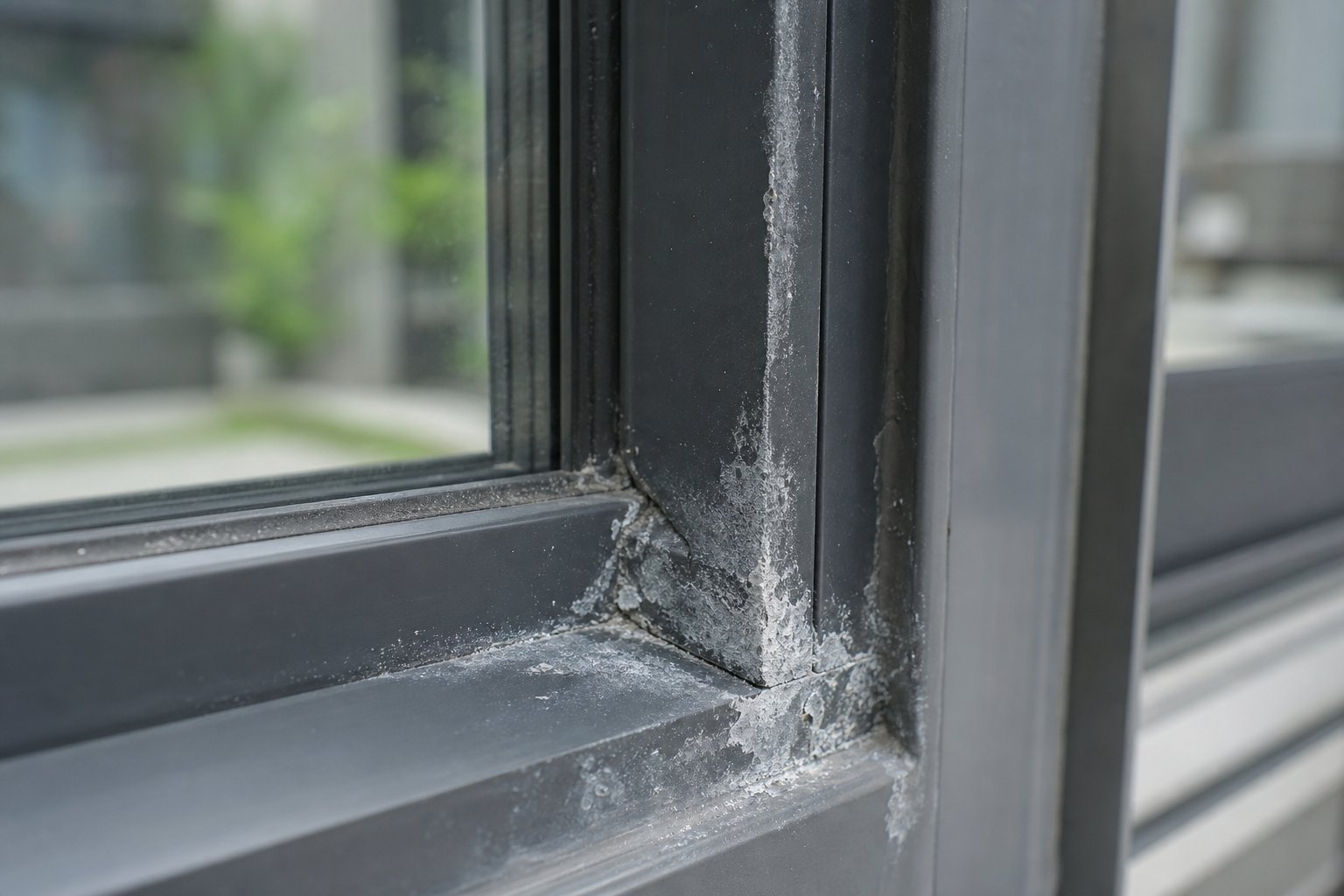
Five Types of Corrosion That Attack Aluminium Windows
Chlorides, pH extremes, and galvanic contact explain why aluminium corrodes — but they do not explain how the damage actually shows up on your window frames. The types of aluminium corrosion differ in mechanism, location, and severity, and each one leaves a distinct signature. Knowing the difference matters because the right response to pitting is not the same as the right response to filiform attack beneath your powder coating.
Pitting and Galvanic Corrosion in Window Frames
Pitting corrosion is the most common form affecting aluminium windows in coastal Australia. Chloride ions from salt-laden air penetrate the protective oxide film at weak points — micro-scratches, coating defects, or areas where salt deposits concentrate. Once through, they create tiny electrochemical cells that eat downward into the metal rather than spreading across the surface. The result is small craters, often barely visible early on, that deepen over time. Pitting corrosion on aluminium windows typically appears on exposed horizontal surfaces like sills and bottom rails where salt spray settles and moisture lingers after rain.
Galvanic corrosion window frames experience stems from direct contact between aluminium and a dissimilar metal. Steel screws fastening hardware to an aluminium sash, copper flashing lapped over a frame head, or zinc brackets supporting a reveal — any of these combinations creates a galvanic cell when moisture bridges the joint. The aluminium, being less noble, corrodes preferentially at the contact point. You will usually spot it as dark staining or accelerated pitting radiating outward from screw holes, hinge plates, or flashing overlaps. Severity depends on the area ratio between the two metals and how often the junction stays wet.
Crevice, Filiform, and Stress Corrosion Explained
Crevice corrosion occurs wherever two surfaces overlap and trap a thin film of moisture — mitred frame corners, mullion junctions, drainage slots, and the gap between a frame and its sub-sill. Inside that crevice, oxygen depletes while chloride concentration rises, creating a localised acidic environment that attacks the aluminium aggressively. Because the damage is hidden within the joint, crevice corrosion often goes unnoticed until moisture weeps from a sealed corner or a frame section loosens.
Filiform corrosion is a different beast altogether. It initiates at a scratch, chip, or pinhole in a thin organic coating — typically powder coating or paint — and propagates as thread-like filaments beneath the surface. Each filament is a mobile electrochemical cell with an acidic, chloride-rich head and a tail of white aluminium hydroxide corrosion product. Filiform corrosion on powder coating shows up as fine worm-like tracks or small blisters on painted frame faces, especially where stone chips or installation scratches have breached the finish. It thrives in warm, humid conditions (around 80% relative humidity), making northern Australian climates particularly prone.
Stress corrosion cracking (SCC) is the rarest but most serious form found on window frames. It requires three simultaneous conditions: a susceptible aluminium alloy, a corrosive environment (typically chloride-bearing moisture), and sustained tensile stress. On a window, that stress might come from a structurally loaded mullion, an over-tightened corner cleat, or building movement transferred through the frame. SCC produces branching cracks that propagate along grain boundaries within the metal — often with no visible surface corrosion until sudden failure. It is uncommon in standard residential frames but worth understanding for large commercial openings or multi-storey curtain-wall applications.
| Corrosion Type | Visual Appearance | Common Location on Window | Severity Rating |
|---|---|---|---|
| Pitting | Small craters or pin-holes on bare metal; white powdery deposits around pits | Sills, bottom rails, exposed horizontal surfaces | Moderate to high |
| Galvanic | Dark staining, localised pitting radiating from metal contact points | Around screws, hinges, brackets, flashing junctions | Moderate to high |
| Crevice | Hidden attack; moisture weeping from joints, white residue at seams | Mitred corners, mullion junctions, drainage channels | High (often undetected until advanced) |
| Filiform | Thread-like tracks or blistering beneath powder coating or paint | Painted or coated frame faces, especially near chips or scratches | Low to moderate (cosmetic initially, progressive if untreated) |
| Stress corrosion cracking | Fine branching cracks with minimal surface deposits; possible sudden fracture | Structural mullions, loaded corners, curtain-wall transoms | Very high (risk of structural failure) |
Most residential aluminium windows in Australia will encounter pitting or galvanic corrosion long before the other forms become relevant. Coastal properties face the highest combined risk, often dealing with pitting and crevice attack simultaneously. Filiform tends to surface on older powder-coated frames where the coating has been damaged and left unrepaired. Stress corrosion cracking, while rare, underscores why alloy selection and installation detailing matter for commercial and high-load applications.
Each of these five types leaves clues — if you know where to look and what the early signs actually mean.
Environmental and Building Material Triggers You Should Know
Knowing the five corrosion types is useful, but what actually sets them in motion? The answer almost always comes back to the local environment and what your frames are touching. Some conditions nibble away at the oxide layer over years. Others strip it within days. The difference between a frame that stays sound for decades and one that pits within a few seasons often has less to do with the aluminium itself and more to do with what surrounds it.
Coastal, Humid, and Polluted Environments
Aluminium is not rust proof in the way many homeowners assume. It resists general atmospheric corrosion well, but specific environmental aggressors overwhelm its defences at different rates. Here they are, ranked from most to least severe for Australian properties:
- Salt-laden coastal air (within 1 km of surf) — The single greatest threat. Breaking waves launch chloride-laden aerosols that travel well inland and concentrate on horizontal frame surfaces. Within weeks, unprotected aluminium exposed to heavy salt deposition begins pitting. Properties inside the first kilometre from the waterline sit in the most aggressive zone, though significant chloride levels have been measured much further away.
- High humidity and condensation cycles — Tropical regions like Queensland and the Northern Territory deliver sustained relative humidity above 80%, which keeps surfaces wet for extended periods. Repeated wetting and drying concentrates salts and pollutants on the metal. Condensation forming inside frame cavities — especially around thermal bridges — creates crevice conditions even in areas with low airborne salt.
- Industrial pollution (SO₂ and NOₓ) — Sulphur dioxide and nitrogen oxides from vehicle exhaust and industrial emissions dissolve in rainwater to form mildly acidic solutions that attack the oxide film from the low-pH side. Urban corridors in Sydney, Melbourne, and industrial precincts compound the problem when pollution combines with coastal salt exposure.
- Alkaline soil dust (inland regions) — Arid areas across Western Australia, South Australia, and inland NSW produce fine alkalite and calcium-rich dust. Deposited on damp frame surfaces, this dust pushes the local pH above the safe range for aluminium’s protective film. It is a slower mechanism than salt attack but often overlooked during specification.
The critical takeaway: aluminium is corrosion resistant, not corrosion immune. Whether your property faces salt, humidity, acid rain, or alkaline dust determines which protective measures — alloy grade, coating system, maintenance frequency — need to be specified from the start.
How Concrete and Mortar Damage Aluminium Frames
Environmental exposure is not the only trigger. Some of the worst corrosion damage occurs during the construction phase itself, long before any weather gets a chance to act.
Fresh concrete and mortar generate highly alkaline runoff, typically between pH 10 and 13. When that alkaline water contacts an aluminium frame — splashing during bricklaying, cement slurry dripping from an upper-storey pour, or wet mortar squeezed against a sill during installation — it dissolves the oxide layer chemically. The aluminium beneath is left unprotected and vulnerable to every other corrosion mechanism simultaneously.
This is not a theoretical risk. It is one of the most frequently reported causes of premature corrosion on new Australian builds, particularly where windows are installed early in the construction sequence and left unprotected through brickwork and rendering stages. Cement dust settling on damp frames produces the same alkaline chemistry on a smaller scale.
The practical lesson is straightforward: if your frames sit in contact with fresh mortar, concrete, or their runoff — even briefly — the protective layer aluminium relies on for its long service life is already compromised. Understanding these local and construction-phase triggers puts you in a far stronger position to spot early damage before it spreads.
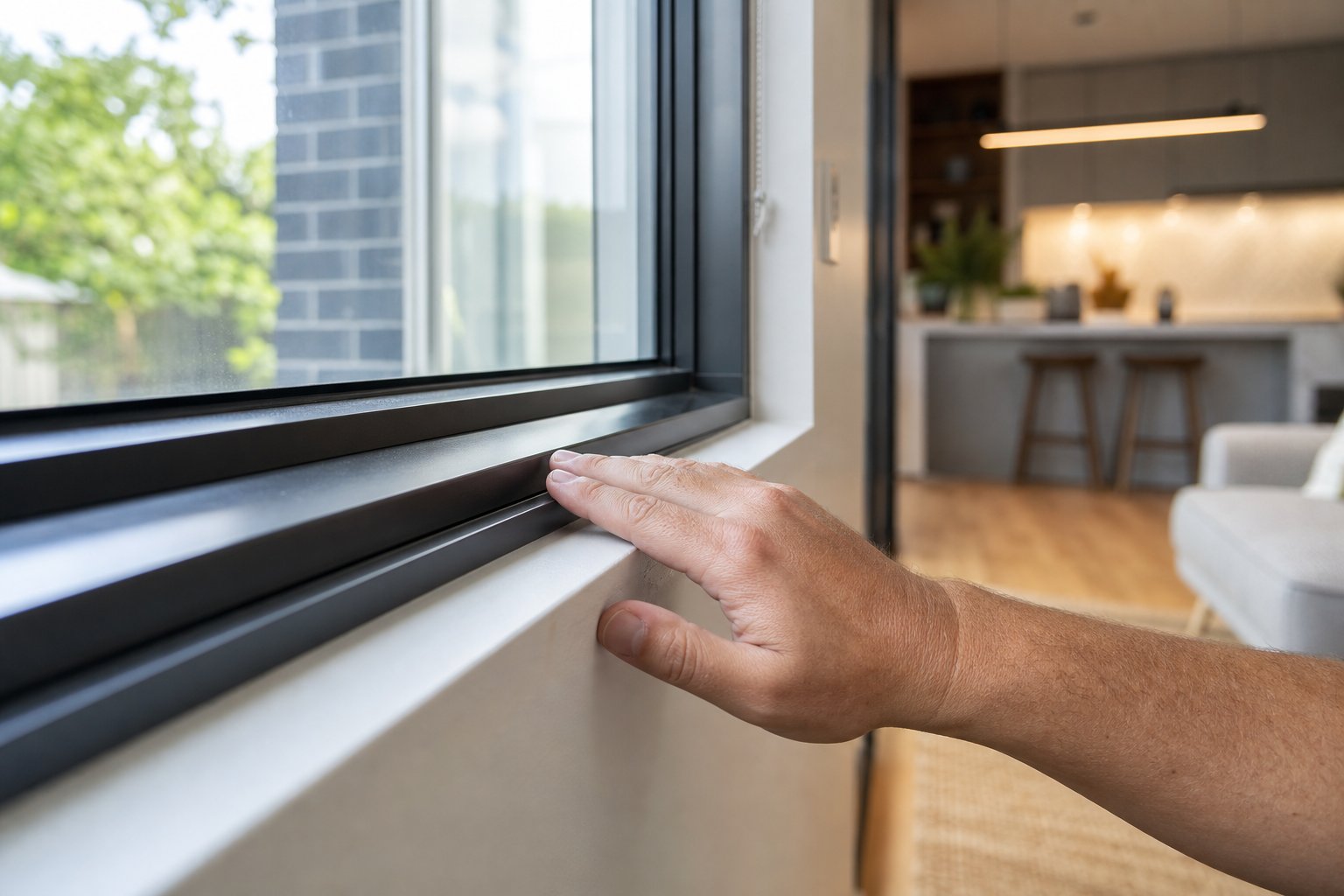
Early Warning Signs and How to Spot Aluminium Window Corrosion
Triggers and corrosion types are one thing on paper. Out in your backyard, staring at a window frame in afternoon light, the question is far more practical: what am I actually looking for? Most homeowners walk past early signs of aluminium corrosion for months — sometimes years — because no one has shown them what the damage looks like before it becomes obvious. By the time a frame feels rough to the touch or a seal starts weeping, the corrosion has already progressed well beyond its earliest, most treatable stage.
A few minutes of inspection each season can save thousands in repair or replacement costs. Here is what to look for, and exactly how to do it.
Visual Signs of Corrosion on Window Frames
Each corrosion type produces a distinct visual fingerprint. Learning to read these signs is simpler than most people expect.
White powder on aluminium windows is the most common and most recognisable indicator. It appears as a chalky, powdery residue — sometimes gritty to the touch — on exposed frame surfaces. This white deposit is aluminium hydroxide, the corrosion product left behind when the protective oxide layer has broken down and the bare metal reacts with moisture. You will typically spot it first on sills, bottom rails, and any horizontal surface where water pools or salt deposits accumulate. A light wipe with a damp cloth will remove the powder temporarily, but if it returns within a few weeks, active corrosion is underway.
Small pits or craters on the metal surface signal pitting corrosion. Early-stage aluminium window frame pitting can be surprisingly subtle — pinprick-sized depressions that catch the light at certain angles. Run your fingertip along the frame surface. Healthy aluminium feels smooth and uniform. Pitted aluminium has a sandpaper-like texture, even if the individual pits are hard to see. Coastal properties should pay particular attention to the underside of sill profiles and the bottom third of side jambs, where salt spray concentration is highest.
Dark staining around screws, hinges, or metal contacts points directly to galvanic corrosion. The stain typically appears as a grey or blackish halo radiating outward from where a steel screw, copper flashing, or zinc bracket meets the aluminium frame. If you notice localised pitting concentrated around these contact points — deeper and more aggressive than pitting elsewhere on the same frame — galvanic activity is almost certainly the cause.
Bubbling or thread-like tracks beneath powder coating or paint indicate filiform corrosion. Look closely at painted frame faces, particularly around stone chips, installation scratches, or edges where the coating is thinnest. The filaments often resemble fine worm trails snaking across the surface just beneath the finish. In early stages, you might only notice a slight lifting or blistering of the coating. In advanced cases, the tracks become clearly visible and the coating flakes away when pressed.
Moisture weeping from sealed frame joints is one of the harder signs to identify because it mimics condensation or poor drainage. Crevice corrosion hides inside mitred corners, mullion junctions, and drainage channels. The first external clue is often a persistent damp line or white crusty residue along a joint that should be sealed. If a corner joint that was once tight begins to feel spongy or shows visible separation, corrosion within the crevice may have already weakened the connection.
A Simple Seasonal Inspection Routine
You do not need specialist equipment to identify window corrosion early. A systematic walk-around each season — roughly every three months — catches most problems while they are still treatable. Here is a straightforward routine that covers the key risk areas:
- Examine all frame surfaces in natural light. Start with the exterior. Look for white powdery deposits, discolouration, or any change in surface texture. Pay extra attention to horizontal surfaces like sills and bottom rails where moisture and salt deposits collect. Wipe a finger along the profile — roughness or grittiness that was not there before is worth investigating further.
- Inspect hardware contact points. Check around every screw head, hinge plate, lock strike, and bracket. Look for dark staining, pitting concentrated near fixings, or any sign that a steel or copper component is corroding against the aluminium. Lift handles and latches to check hidden surfaces beneath.
- Clear and check drainage holes. Most aluminium window frames include weep holes or drainage slots in the bottom rail to let trapped water escape. Use a thin brush or compressed air to clear any blockages. Blocked drainage turns the frame cavity into a crevice corrosion environment. While clearing, check for white residue around the slot openings — a sign that moisture has been sitting inside the frame.
- Assess seals and gaskets. Run your eye along the perimeter seals between the frame and the glass, and between the frame and the building structure. Cracked, shrunk, or missing seals allow moisture into joints where crevice corrosion thrives. Press gently on corner joints to check for any sponginess or movement.
- Check coating integrity. Look for chips, scratches, bubbling, or the fine thread-like tracks that mark filiform corrosion beneath powder coating. Focus on exposed edges, the bottom rail, and anywhere tradespeople may have nicked the finish during construction or renovation work. Any breach in the coating is a potential initiation point for corrosion.
Properties within a few kilometres of the coast should consider running this check monthly rather than quarterly — salt deposition accelerates every corrosion mechanism, and early detection makes a genuine difference to your options. Inland properties in low-pollution areas can usually rely on quarterly inspections, stepping up to monthly during extended wet seasons.
The key principle is straightforward: most aluminium window corrosion is treatable if you catch it before it progresses beyond the surface. White powder can be cleaned and the frame re-protected. Shallow pitting can be stabilised. A damaged coating can be repaired. But once corrosion penetrates deeply into the profile or compromises a structural joint, the conversation shifts from maintenance to something more involved — and more expensive.
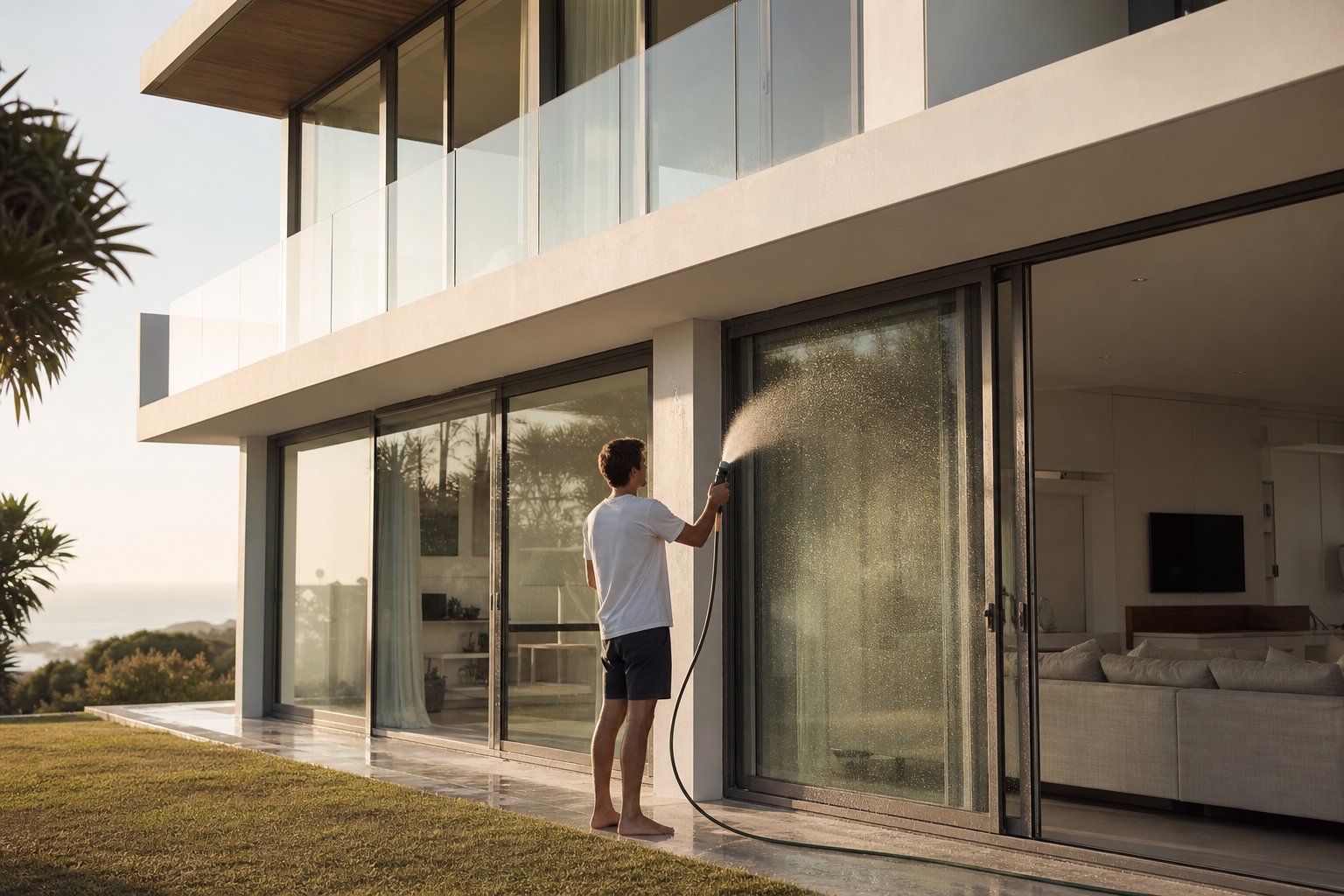
How to Prevent Aluminium Window Corrosion at Every Stage
Catching corrosion early saves money. Preventing it from starting in the first place saves far more — in repair costs, in disruption, and in the lifespan you ultimately get from your frames. The good news is that how to prevent aluminium corrosion is not a mystery. It comes down to three decision points: what you specify, how it gets installed, and what you do once the frames are in service. Each stage carries its own risks, and each offers its own opportunities to shut corrosion out before it gains a foothold.
Prevention at Specification and Installation
Protection begins on paper, long before anyone picks up a drill. The decisions made during specification lock in a frame’s corrosion resistance for its entire service life — or its vulnerability.
Alloy and coating selection. Standard 6063-T6 aluminium alloy handles most Australian environments well, provided the coating system matches the exposure. For properties within one kilometre of the coast, the best coating for aluminium windows is a high-performance powder coat applied at 80 to 120 microns — roughly double the 40 to 60 micron thickness found on standard inland-grade frames. Frames destined for beachfront sites benefit from coatings meeting AAMA 2605 or equivalent performance ratings, which are tested specifically for salt-spray resistance. Anodising offers an alternative, though the protective layer needs to be at least 20 microns thick for serious coastal duty.
Thermal break design. Condensation forming inside a frame cavity is invisible but corrosive. Thermally broken profiles reduce surface condensation by isolating the cold outer face from the warm interior, limiting the moisture that drives crevice and filiform attack in humid climates like coastal Queensland or the Top End.
Sealant selection during installation. This is where many builds go wrong. Acetic-cure silicones — the cheap tubes that smell of vinegar — release acetic acid as they cure. That acid directly attacks uncoated aluminium and can undermine powder coating adhesion at the joint edge. Neutral-cure silicone or MS polymer sealants are the professional standard for aluminium frame perimeter joints. They bond reliably to both the frame and surrounding substrates without producing corrosive by-products, and quality neutral silicone achieves 20 to 25 years of service life in a properly designed joint.
Isolating dissimilar metals. Every steel screw, copper flashing, or zinc bracket in contact with an aluminium frame is a potential galvanic corrosion site. The fix is simple isolation: nylon washers beneath screw heads, EPDM gaskets between frame and bracket, or a coat of bituminous paint on concealed contact surfaces. Grade 316 stainless steel fasteners are the preferred choice for coastal properties — they sit much closer to aluminium on the galvanic scale and resist chloride attack themselves.
Drainage design. Water pooling inside a frame or on a sill creates the standing moisture that drives pitting and crevice corrosion. Frames should be installed with properly aligned weep holes, clear drainage paths, and slight outward falls on sill profiles so water sheds rather than sits.
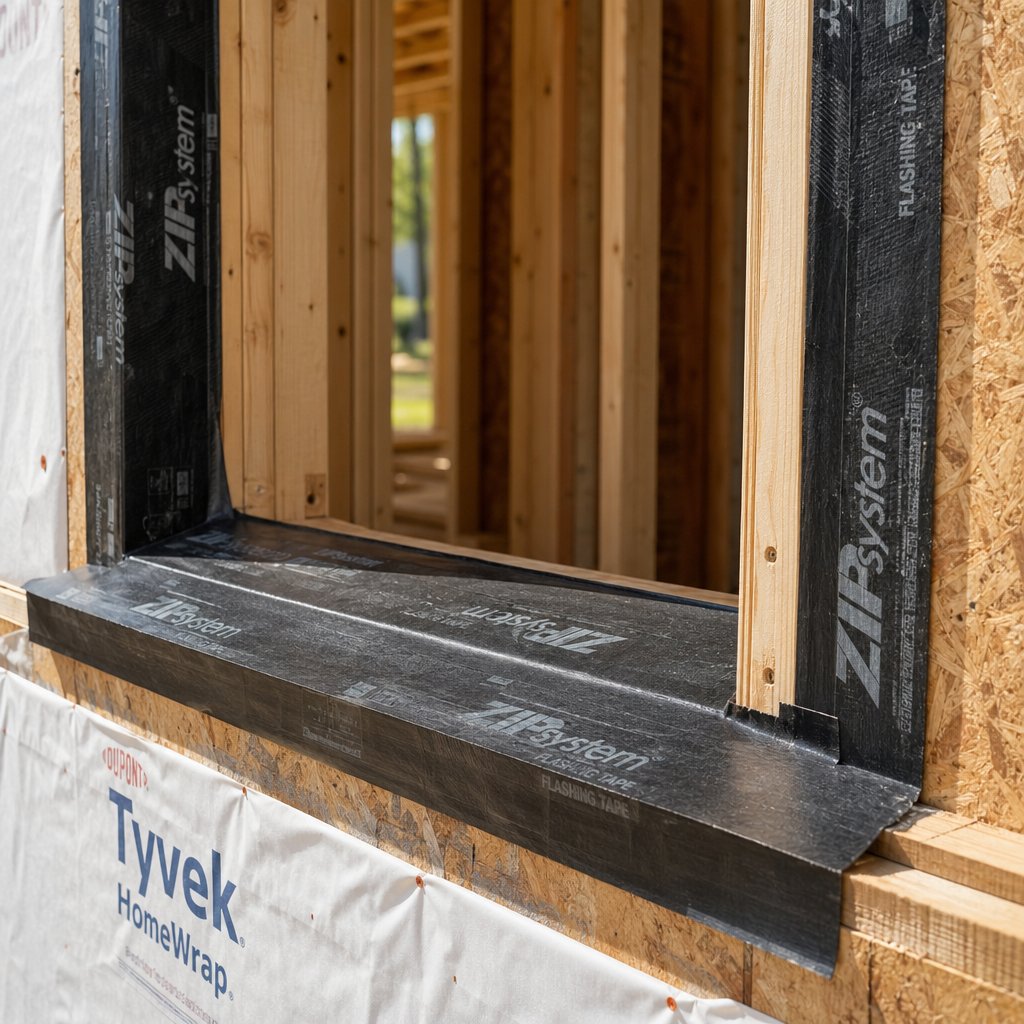
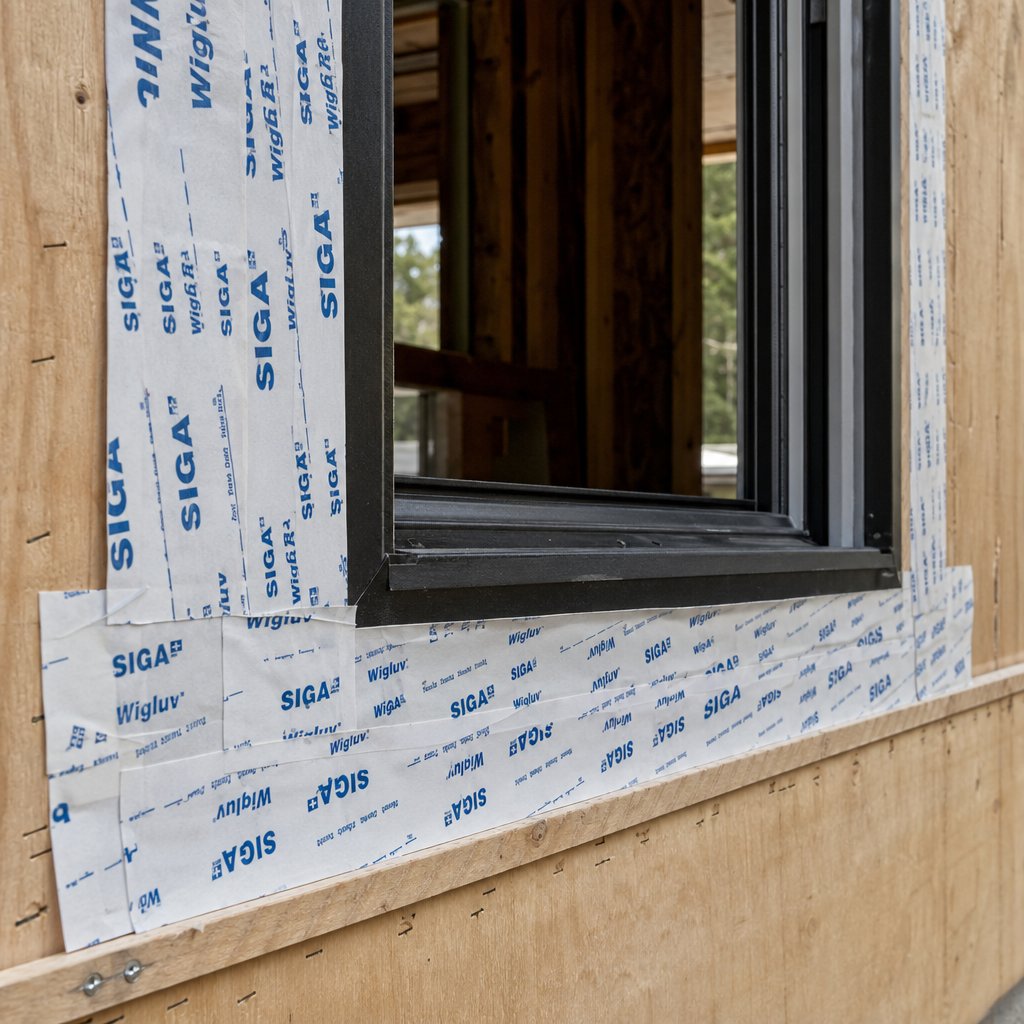
Construction-phase protection. Until brickwork, rendering, and concrete pours are complete, frames need physical shielding. Protective tape or adhesive film over exposed profiles prevents mortar splash and cement dust from attacking the oxide layer during what is often the most vulnerable period of a window’s life.
Maintenance Schedules for Different Environments
Even perfectly specified and installed frames need ongoing care. The aluminium window maintenance schedule that works for an inland suburban home is not frequent enough for a beachside apartment. The table below lays out a practical framework based on exposure level.
| Environment Type | Frame Wash Frequency | Hardware Lubrication | Full Seal and Coating Inspection | Professional Check |
|---|---|---|---|---|
| Coastal — under 1 km from surf | Monthly (fresh water rinse, full clean every 4-6 weeks) | Every 6 months | Every 6 months | Annually |
| Coastal — 1 to 5 km from surf | Every 6-8 weeks | Every 6 months | Annually | Every 2 years |
| Urban / industrial | Every 2-3 months | Annually | Annually | Every 2-3 years |
| Rural / inland | Every 3-4 months | Annually | Every 2 years | As needed |
A few principles apply regardless of environment:
- Use pH-neutral, non-abrasive cleaners only. Harsh alkaline or acidic products strip the oxide layer you are trying to protect. A soft cloth or sponge with mild soapy water does the job. Rinse thoroughly with fresh water afterward.
- Protect frames from salt air proactively. For properties in the front-line coastal zone, the single most effective maintenance step to protect aluminium windows from salt air is a simple fresh-water rinse after heavy weather. It takes two minutes with a garden hose and removes the chloride deposits that initiate pitting.
- Lubricate hardware with silicone-based products. Avoid petroleum-based sprays — they attract dust and grit that grinds into moving parts. A light application of silicone lubricant to hinges, rollers, and locking mechanisms keeps them functioning smoothly and prevents corrosion at metal-to-metal contact points.
- Inspect seals and touch up coating damage promptly. A cracked gasket or chipped powder coat is not just a cosmetic issue — it is an entry point for moisture that will start crevice or filiform corrosion in weeks, not years. Small touch-up kits matched to your frame colour address chips before they spread.
The pattern is clear: the harsher your environment, the more frequently you need to clean and inspect. But even the most basic quarterly routine adds years to a frame’s service life and keeps minor surface issues from developing into the kind of damage that forces a much harder conversation about repair versus replacement.
Treatment Options and When Full Replacement Makes Sense
Prevention and maintenance keep corrosion at bay. But what happens when damage has already set in — when the white powder keeps returning, the pitting has deepened, or the coating is lifting in sheets? The decision shifts from how to stop aluminium corrosion to how far it has progressed and what that means for your next step. Not all corrosion warrants the same response. Mild surface attack responds well to DIY treatment. Moderate damage needs professional intervention. And beyond a certain threshold, no amount of repair restores the frame to a safe, functional state.
Treatment Options for Mild and Moderate Corrosion
If your inspection reveals early-stage damage — white deposits, shallow roughness, or minor coating blemishes — the frame is almost certainly salvageable. Here is how to fix corroded aluminium windows at each severity level.
Mild corrosion (surface oxidation and light pitting under 1 mm deep):
Start by cleaning the affected area with a phosphoric acid-based aluminium cleaner. These products dissolve corrosion products without attacking the underlying metal aggressively, and they leave behind a thin conversion coating that temporarily re-passivates the surface. After cleaning and rinsing thoroughly, apply a chromate-free conversion coating or a quality aluminium primer to re-establish a stable protective barrier. Finish by re-sealing any joints or coating breaches with neutral-cure silicone to prevent moisture re-entry. This aluminium window corrosion treatment suits homeowners comfortable with basic surface preparation and costs relatively little in materials.
Moderate corrosion (pitting between 1 and 2 mm, widespread coating failure, or hardware degradation):
At this stage, professional attention delivers better results. A specialist can strip and re-apply powder coating to affected sections — or the entire frame — restoring both protection and appearance. Hardware showing galvanic staining or seized operation should be replaced outright, ideally with Grade 316 stainless steel components that will not restart the galvanic cycle. Perished gaskets and weather seals need renewal at the same time, since cracked rubber invites the trapped moisture that caused the crevice attack in the first place. Professional re-coating combined with hardware and seal replacement can extend a moderately corroded frame’s life by a decade or more — provided the underlying aluminium profile retains its structural cross-section.
When Repair No Longer Makes Sense
There is a point where continued repair becomes false economy. Recognising it saves you from pouring money into frames that will fail regardless.
The following criteria signal that replacement — rather than further treatment — is the rational path forward:
- Structural pitting beyond surface depth. Once pits exceed 2 to 3 mm or penetrate more than a third of the wall thickness, the profile has lost meaningful structural capacity. Filling and coating over deep pits does not restore strength.
- Stress cracking at corners or welded joints. Branching cracks at mitred corners or around corner cleats indicate stress corrosion cracking. This is a structural failure mode — it cannot be treated with surface repair, and the crack will propagate under load.
- Failed thermal breaks. If the polyamide or polyurethane thermal break strip has delaminated or the surrounding aluminium has corroded at the break interface, the frame’s thermal and structural performance are both compromised beyond practical repair.
- Widespread corrosion covering more than 40 to 50 percent of frame surfaces. At this extent, the cost of stripping, treating, and re-coating approaches or exceeds the cost of a new frame — without offering the same longevity.
- Corroded hardware mounting points. When screw threads no longer grip because the surrounding aluminium has been consumed, hardware cannot be reliably re-fixed. The frame is functionally spent.
- The corrosion source cannot be eliminated. If your property sits in an aggressive coastal zone and the original frame was specified without adequate coating thickness or alloy grade, repair buys time but does not change the outcome. The same environment will re-attack the same vulnerable frame.
Several broader factors also weigh on the repair or replace corroded windows decision. A frame that is already 20 to 25 years old and showing moderate corrosion has less remaining service life to justify expensive professional re-coating. Frames with poor energy performance — single-glazed, non-thermally-broken profiles — offer an opportunity: replacement delivers both corrosion resistance and a substantial upgrade in thermal and acoustic comfort. And if the corrosion is localised to one or two windows rather than spread across an entire elevation, targeted replacement of those units often makes more sense than a whole-house approach.
The honest answer is that no single threshold applies universally. But if structural integrity is in question, or if repair costs climb above 60 to 70 percent of replacement cost for a frame already past its mid-life, replacement typically delivers better value over the following decade. That replacement, of course, only delivers if the new frames are specified to handle the conditions that corroded the originals — which is where material selection and engineering become the focus.

Selecting Aluminium Windows Built to Resist Corrosion
Material selection and engineering — those two words closed the previous section for good reason. A replacement frame only outperforms the one it replaces if the specification addresses the exact conditions that caused the original failure. Whether you are replacing corroded windows or specifying for a new build in a demanding environment, the criteria below separate corrosion resistant aluminium windows from frames that will repeat the same cycle within a decade.
What to Look for in Corrosion-Resistant Window Systems
Modern aluminium window engineering has evolved specifically to counter the vulnerabilities outlined throughout this article — pitting from chlorides, galvanic attack at fixings, crevice conditions in frame cavities, and filiform propagation beneath coatings. The best aluminium windows for coastal areas integrate solutions at every layer of the system rather than relying on a single line of defence.
Here are the key specification criteria to confirm with any window supplier before committing:
- Alloy grade appropriate to exposure. Standard 6063-T6 suits most inland and moderate urban environments. For properties within 1 to 3 kilometres of the coast — classified C4 or C5 under AS/NZS 2312 — ask whether marine grade aluminium window frames (5052 or 5083 series with higher magnesium content) are available or whether the alloy’s corrosion performance is supplemented by enhanced coating systems.
- Powder coating thickness and certification. For architectural exterior use, look for a minimum average of 60 microns in standard environments. In C4 and C5 coastal zones, 80 microns or greater is preferable, with beachfront projects ideally specified at 110 microns using a primer-plus-topcoat system compliant with Qualicoat Seaside specifications. Ask the supplier whether their coatings meet Qualicoat Class 2 (super durable) or equivalent — these withstand three times more UV and weather exposure than standard Class 1 finishes.
- Chrome-free pre-treatment with full immersion. The pre-treatment step before powder coating determines long-term adhesion and edge protection. Full immersion processes cover internal corners, cut edges, and recesses that spray systems miss — the exact locations where filiform corrosion initiates. Confirm the pre-treatment method and whether the supplier backs it with a meaningful finish warranty (10 years minimum for coastal applications).
- Thermal break technology. Thermally broken profiles using polyamide (PA66 GF25) strips between inner and outer aluminium sections reduce frame U-values dramatically while eliminating the interior condensation that feeds crevice corrosion inside frame cavities. Multi-chamber designs add dedicated drainage chambers that manage water pressure equalisation — keeping moisture moving outward rather than pooling internally.
- Engineered drainage channels. Look for frames with clearly defined weep paths, pressure-equalised cavities, and drainage slots positioned to shed water under all wind conditions. Poor drainage is the silent enabler of crevice attack in otherwise well-coated frames.
- Dissimilar metal isolation as standard. Every fastener, bracket, and hardware component contacting the aluminium frame should be isolated — nylon bushes beneath screw heads, EPDM gaskets at bracket interfaces, and 316-grade stainless steel fixings as the baseline for aluminium windows for salt air environments. This should be part of the system design, not an afterthought left to the installer.
- Compliance with AS 2047. Australian Standard AS 2047 governs window performance including water penetration resistance and structural adequacy. Confirm the window system is tested and certified to this standard for the wind and water loads relevant to your site.
Specifying Windows for Coastal and Harsh Environments
Coastal specification is not simply about picking a tougher frame — it is about ensuring the entire system, from alloy to gasket to fixing, works as an integrated corrosion defence. The engineering advances in current-generation aluminium window systems mean that a well-specified frame can deliver decades of reliable service even within direct salt spray zones, provided the specification matches the exposure from the outset.
For homeowners and project teams exploring corrosion-resistant options suited to Australian coastal and urban conditions, MEICHEN’s aluminium window range offers custom configurations with performance considerations designed around these principles — from coating systems and hardware selection through to thermal break integration and project-specific environmental demands.
Regardless of which supplier you choose, the non-negotiable step is this: match the specification to the corrosion classification of your site. A conservative approach at the point of purchase costs comparatively little. Replacing frames that were underspecified from the start costs far more — in money, in disruption, and in the years of performance you never received.
Frequently Asked Questions About Aluminium Window Corrosion
1. Does aluminium rust or corrode?
Aluminium cannot rust because rust requires iron, which aluminium does not contain. However, aluminium absolutely can corrode. It forms a protective oxide layer that shields the metal under normal conditions, but chlorides from salt air, pH extremes from concrete or mortar contact, and galvanic reactions with dissimilar metals like steel screws or copper flashings can break down this barrier. The resulting corrosion appears as white powdery deposits, pitting, dark staining, or coating failure rather than the red-orange flaking associated with iron rust.
2. What does aluminium window corrosion look like?
Aluminium window corrosion presents differently depending on the type. White chalky powder on frame surfaces indicates general surface oxidation. Small craters or a sandpaper-like texture signal pitting corrosion, common in coastal areas. Dark grey or black staining around screws and brackets points to galvanic corrosion from dissimilar metal contact. Thread-like tracks or blistering beneath powder coating reveal filiform corrosion. Moisture weeping from sealed frame joints suggests hidden crevice corrosion inside the frame cavity.
3. How do you stop corrosion on aluminium window frames?
Stopping aluminium window corrosion depends on its severity. For mild surface corrosion, clean with a phosphoric acid-based aluminium cleaner, apply a conversion coating, and re-seal any exposed joints with neutral-cure silicone. For moderate damage, professional powder coat re-application and hardware replacement with Grade 316 stainless steel components is recommended. Prevention is most effective: rinse frames with fresh water monthly in coastal areas, use pH-neutral cleaners, keep drainage holes clear, and repair any coating chips or cracked seals promptly before moisture penetrates the frame.
4. How often should aluminium windows be cleaned to prevent corrosion?
Cleaning frequency depends on your environment. Properties within one kilometre of the surf need a fresh water rinse monthly and a full clean every four to six weeks. Between one and five kilometres from the coast, cleaning every six to eight weeks is sufficient. Urban and industrial areas require cleaning every two to three months, while rural and inland properties can maintain frames every three to four months. After storms or heavy weather in coastal zones, an immediate hose-down removes salt deposits before they initiate pitting.
5. When should corroded aluminium windows be replaced rather than repaired?
Replacement becomes the better option when pitting exceeds two to three millimetres deep or penetrates more than a third of the profile wall thickness, when stress cracks appear at corners or welded joints, when thermal breaks have delaminated, or when corrosion covers more than 40 to 50 percent of frame surfaces. If repair costs exceed 60 to 70 percent of replacement cost on a frame already past its mid-life, or if the original specification was inadequate for your environment and the same conditions will re-attack the repaired frame, replacement with properly specified corrosion-resistant aluminium windows delivers better long-term value.
More Window & Door Guides