The Short Answer and Why It Needs Context
Are aluminium windows cheaper than timber? At the point of purchase, yes — aluminium window frames typically cost less per unit than their timber equivalents. But that straightforward answer masks a more complex reality. The material that’s cheaper to buy isn’t always the material that costs less to own.
Most cost comparisons you’ll find online come from companies selling one material or the other. That bias shapes which numbers get highlighted and which get buried. A timber window supplier will emphasise longevity and natural insulation. An aluminium window supplier will point to lower upfront pricing and minimal upkeep. Both are telling partial truths.
The honest answer depends on whether you’re measuring cost over five years, fifteen, or thirty — and what you factor into that calculation beyond the invoice price.
Why the Simple Answer Is Misleading
Raw purchase price comparisons ignore the variables that actually determine what you’ll spend over the life of your windows. Maintenance cycles, climate exposure, window style, and energy performance all shift the equation. Aluminium frames for windows in a coastal Queensland home face different demands than timber frames on a sheltered Melbourne terrace. A like-for-like price tag at the point of sale tells you almost nothing about total expenditure.
What This Cost Comparison Covers
This article breaks the question into five measurable categories: upfront purchase price, installation labour, ongoing maintenance, energy efficiency impact, and expected lifespan. Each section compares aluminium and timber windows across real-world scenarios relevant to Australian homeowners, renovators, and builders.
Total cost of ownership — not sticker price — is the only meaningful comparison metric for a decision that lasts decades.
The gap between these two materials isn’t fixed. It shifts depending on your project, your property, and your priorities. The numbers that follow will help you figure out where it lands for you.
Upfront Purchase Price Compared
So what does the price gap actually look like at the point of sale? For standard-sized windows in Australia, aluminium consistently comes in below timber on a per-unit basis. The difference isn’t marginal either — depending on the specification, timber can cost anywhere from 40% to over 100% more than an equivalent aluminium unit.
That premium reflects real manufacturing differences. Timber windows require careful species selection, kiln drying, precision machining of joints, and multiple coats of primer, paint, or stain before they leave the factory. Aluminium extrusions are produced at scale, cut to size, assembled with mechanical fixings, and finished with a single powder-coat or anodising process. Less handwork means lower labour content per window.
Standard Size Price Ranges
For a standard double-glazed casement or awning window in common residential sizes (around 600 mm x 1200 mm to 1200 mm x 1200 mm), aluminium windows prices in Australia generally fall between $400 and $1,200 per unit supply-only. Timber equivalents for the same openings typically range from $800 to $2,500 or more, depending on species and finish.
Softwood timber (such as treated pine or meranti) sits at the lower end of the timber range, while hardwoods like western red cedar or spotted gum push costs significantly higher. On the aluminium side, a basic powder-coated frame occupies the budget tier, while thermally broken profiles with premium hardware move toward the upper end. The price gap narrows when you compare cheap aluminium windows against entry-level softwood, and widens dramatically when hardwood timber faces off against standard aluminium.
What Drives Price Variation Within Each Material
Quoting a single number for either material is misleading because the price spread within each category is enormous. Several factors drive that variation:
- Frame profile and thickness — heavier-duty aluminium sections for larger spans cost more; thicker timber profiles require more raw material and machining time
- Finish type — powder-coat is standard for aluminium, but premium colours, woodgrain finishes, or anodising add cost; timber can be painted, stained, or oiled, each with different labour requirements
- Hardware quality — budget friction stays versus premium multi-point locking systems affect both materials equally
- Glazing specification — single glazing is rare in new installations; double glazing is standard, and triple glazing adds a significant premium regardless of frame material
- Off-the-shelf vs custom — standard sizes from stock are far cheaper than bespoke units made to non-standard dimensions
Slimline aluminium windows, for example, use narrower frame profiles to maximise glass area — a design choice that can increase cost slightly due to engineering requirements, yet remains well below equivalent slim-profile timber. Similarly, aluminium sash windows involve more complex counterbalance mechanisms than a simple casement, pushing their price higher within the aluminium range while still undercutting timber sash equivalents.
Style-Specific Price Differences
The cost gap between aluminium and timber isn’t uniform across all window styles. Manufacturing complexity varies — a fixed-lite window is straightforward in both materials, while aluminium bifold windows or operable sash units demand more intricate engineering. The table below shows the general cost positioning for each material across common Australian window styles.
| Window Style | Aluminium Cost Tier | Timber Cost Tier | Typical Price Gap |
|---|---|---|---|
| Casement (aluminium casement windows) | Budget to Mid | Mid to Premium | Moderate |
| Awning (aluminium awning windows) | Budget to Mid | Mid to Premium | Moderate |
| Sliding (aluminium sliding windows) | Budget to Mid | Mid to Premium | Moderate to Wide |
| Double-hung / Sash | Mid | Premium | Wide |
| Bifold | Mid to Premium | Premium | Moderate |
| Tilt-and-turn | Mid | Premium | Wide |
| Fixed lite | Budget | Mid | Moderate |
Sash and tilt-and-turn styles show the widest gap because their mechanical complexity amplifies timber’s higher labour costs. Simpler styles like fixed lites and casements keep the difference more contained. Across the board, though, the pattern holds: aluminium occupies a lower cost tier than timber for the same window style and comparable glazing specification.
Price, of course, only captures one moment in the window’s life. What happens after the invoice is paid — during installation and across years of use — reshapes the cost picture considerably.
Installation Costs and Why They Differ
The invoice for your windows is only part of the project spend. Getting them into the wall adds a second layer of cost — and that layer isn’t equal for both materials.
Aluminium window installation is generally faster and less labour-intensive than timber. A standard aluminium frame weighs roughly 40% to 50% less than a comparable timber unit, which translates directly into easier handling on site, quicker positioning, and less physical strain for installers. For a single ground-floor window, the difference might save 20 to 30 minutes. Multiply that across a full house with 15 or 20 openings, and the labour savings become substantial.
Timber frames demand more care during fitting. They’re heavier, more susceptible to damage from rough handling, and require precise shimming and sealing to prevent moisture ingress at the junction between frame and wall. Many builders prefer — or insist on — installers experienced with timber joinery, which can limit your options and increase hourly rates.
Labour Time and Access Considerations
Access complexity amplifies the weight difference. On a single-storey home, both materials are manageable without special equipment. Add a second storey, scaffolding, or awkward access points — think narrow side passages or elevated gable windows — and the lighter aluminium frame becomes a genuine cost advantage. Scaffolding hire is charged by the day or week, so faster fitting times with aluminium reduce not just labour hours but equipment rental as well.
Projects with a large number of windows see the gap compound. A ten-window job might absorb the difference easily; a thirty-window project can see installation savings of several thousand dollars when you fit aluminium windows instead of timber.
New Build vs Renovation Installation
In new construction, both materials slot into prepared openings during the framing stage, and the installation cost gap narrows. Builders work with clean, square openings and unobstructed access, making the process efficient regardless of frame material.
Renovations tell a different story. When you replace aluminium windows or swap out old timber for new, the existing opening rarely cooperates perfectly. Replacement windows aluminium tends to be more forgiving here — lighter frames are easier to manoeuvre through furnished rooms, and standard aluminium sizing often matches common opening dimensions without major structural modification.
Replacement aluminium windows in period homes or heritage-listed properties can still involve custom work, but timber replacements in these settings frequently require bespoke profiles to match original detailing. That custom fabrication, combined with specialist heritage installers, can push timber aluminium window replacement costs well above standard rates.
- Frame weight — lighter aluminium reduces manual handling time and fatigue
- Fitting time — aluminium typically requires fewer adjustments during installation
- Specialist labour — timber may need joiners or heritage-experienced installers at higher rates
- Access equipment — scaffolding and elevated access cost more when installation takes longer
- Structural preparation — renovations often need opening modifications, especially for timber in non-standard sizes
These variables stack differently on every project, but the pattern is consistent: aluminium’s lighter weight and simpler fitting process keep installation budgets lower in most scenarios. The real question is what happens after the windows are in — because that’s where the long game of maintenance begins to reshape the numbers.
Ongoing Maintenance and Its True Cost
A window’s purchase price is a one-time event. Maintenance is a recurring obligation — and for timber, it’s one that never stops. This is where the cost comparison between aluminium and timber shifts most dramatically over time, because the labour and materials required to keep timber windows functional accumulate year after year while aluminium asks almost nothing of you.
Timber is an organic material. It absorbs moisture, expands and contracts with temperature changes, and degrades under UV exposure. Without regular intervention, these natural processes lead to paint failure, seal breakdown, rot, and eventually structural compromise. Aluminium, by contrast, is inert in most environments. Its factory-applied finish handles the weather without cyclical human effort.
Timber Maintenance Cycles and Costs
Traditional hardwood windows typically require a full external repaint every five to seven years, with minor touch-ups needed every two to three years in between. That cycle isn’t optional — it’s the price of keeping timber windows intact. Each repaint involves sanding back the existing finish, priming any bare or weathered sections, and applying fresh coats of exterior paint or stain. Skip a cycle, and you’re not just dealing with cosmetic decline. Moisture penetrates unprotected timber, causing swelling, warping, and eventually rot that compromises the frame’s structural integrity.
Professional repainting in Australia typically costs between $250 and $350 per window when you factor in labour, preparation, and quality exterior coatings. Over a 30-year period, that translates to five or six full repaint cycles — a cumulative spend of roughly $1,500 to $2,100 per window on maintenance alone. For a home with 15 windows, you’re looking at $22,000 to $31,000 in painting costs over three decades.
Neglect changes the equation further. Timber windows that miss even one maintenance cycle in a harsh climate can deteriorate to the point where repainting won’t save them. Water ingress rots the frame from within, hardware seizes, and glazing seals fail. At that stage, the only option is full replacement — wiping out any upfront savings the timber may have offered and resetting the cost clock entirely.
Aluminium Maintenance Requirements
So how do you clean aluminium window frames? Warm water, a soft cloth, and mild detergent. That’s genuinely the extent of routine care for most aluminium windows. The powder-coated or anodised finish applied during manufacturing resists UV degradation, moisture, and general weathering without any recoating. You won’t find yourself sanding, priming, or painting aluminium windows on a five-year rotation.
Can you paint aluminium windows if you want to change the colour down the track? Technically yes — specialist primers and topcoats exist for the purpose — but it’s a cosmetic choice rather than a structural necessity. Understanding how to repaint aluminium window frames matters only if you’re after a colour refresh after 15 or 20 years, not because the finish has failed and left the frame vulnerable.
The one legitimate concern is aluminium window corrosion, which can occur in severe coastal environments where salt-laden air attacks the protective coating over extended periods. Modern marine-grade powder coatings and anodised finishes are specifically engineered to resist this. Anodised aluminium forms a layer of aluminium oxide that’s integral to the metal itself — it can’t peel, chip, or flake, and routinely lasts 40 years or more even in aggressive coastal conditions. For homes within a few hundred metres of the shoreline, specifying a higher-grade coating adds a small upfront premium but eliminates corrosion as a maintenance concern.
The Hidden Cost of Your Time
Many homeowners plan to handle timber maintenance themselves to save on professional labour. That’s a valid strategy — but it’s not free. Sanding, masking, priming, and painting a single window takes two to four hours of careful work, spread across multiple days to allow drying between coats. A full house of 15 windows represents 30 to 60 hours of weekend labour every five to seven years. That’s time you could spend on other projects, with family, or simply not on a ladder.
Cost comparisons rarely account for this. The table below puts both materials side by side over a 30-year ownership period, including the time investment that DIY maintenance demands.
| Factor | Aluminium Windows | Timber Windows |
|---|---|---|
| Maintenance frequency | Annual wash (30 minutes per window) | Full repaint every 5-7 years; touch-ups every 2-3 years |
| Typical tasks | Wipe down frames with soapy water; check seals and hardware | Sand, prime, repaint or re-stain; inspect for rot; replace failed seals |
| Professional cost per window (30 years) | $0 – $150 (occasional seal replacement) | $1,500 – $2,100 (5-6 repaint cycles) |
| DIY time investment (30 years, 15 windows) | ~15 hours total | 150 – 360 hours total |
| Risk if maintenance is skipped | Cosmetic dulling only; no structural risk | Rot, warping, seal failure, potential full replacement |
| Coating lifespan | 25-40+ years (powder coat / anodised) | 5-7 years per paint cycle |
The numbers paint a clear picture. Can you paint aluminium window frames if you choose to? Yes. Do you need to? No. Timber demands ongoing investment of money, time, or both — and the penalty for falling behind is severe. Aluminium’s maintenance profile is essentially flat: a quick clean keeps it looking sharp, and the protective finish outlasts most mortgage terms without intervention.
Maintenance costs are only one piece of the long-term puzzle, though. When you layer them on top of purchase price and installation, then factor in how each material performs thermally over decades of heating and cooling bills, the total cost of ownership picture comes into sharper focus.
Total Cost of Ownership Over 10 to 30 Years
Purchase price, installation, and maintenance don’t exist in isolation. They compound. And the material that looks cheaper at any single point in time isn’t necessarily the one that costs less when you tally everything up at the end. The only way to answer the cost question honestly is to run the numbers across defined time horizons — because a window isn’t a consumable you replace every few years. It’s a decades-long commitment built into your walls.
Let’s layer the costs together using the data from previous sections, applied to a single standard double-glazed window as a baseline. The figures below reflect typical Australian pricing for mid-range specifications in both materials.
The 10-Year Cost Picture
At the ten-year mark, timber’s total spend has already pulled ahead of aluminium — but not dramatically. A mid-range aluminium double glazed window might cost $800 supply-only, plus $300 for installation, plus effectively zero in maintenance beyond the occasional wipe-down. That’s roughly $1,100 per window over a decade.
A comparable timber unit starts at around $1,500 supply-only, adds $400 to $500 for installation (reflecting the heavier handling and longer fitting time), and accumulates one to two maintenance cycles — either $500 to $700 in professional repainting or 4 to 8 hours of your own labour per window. Total: approximately $2,400 to $2,700.
Timber is still well within its prime performance window at this stage. The frames are structurally sound, seals are intact, and the aesthetic remains strong if maintenance has been kept up. For homeowners who value timber’s warmth and plan to sell within a decade, the premium may be justified by the property’s presentation and character appeal.
The 20 to 30 Year Cost Picture
This is where the gap widens into territory that’s hard to ignore. Between years 10 and 30, timber demands three to four additional repaint cycles — each adding $250 to $350 per window professionally, or significant DIY hours. Cumulative maintenance spend per timber window reaches $1,500 to $2,100 over 30 years, as outlined in the previous section.
Aluminium’s cost line stays essentially flat. No repainting. No rot remediation. The powder-coated finish on quality aluminium window profiles is engineered to last 25 to 40 years without intervention. The aluminium window frame extrusions themselves — the structural core of the system — don’t degrade, warp, or lose dimensional stability over time.
There’s also the replacement risk to consider. Timber windows that miss maintenance cycles — a common reality when properties change hands or budgets tighten — can require full replacement well before their theoretical 30 to 60 year lifespan. Industry data suggests aluminium frames reliably reach 45 years or more with minimal care, while timber’s actual lifespan is heavily conditional on consistent upkeep. Old aluminium windows from the 1980s and 1990s are still functioning in homes across Australia — often outlasting timber frames installed in the same era that have since been replaced due to rot or seal failure.
Over 30 years, the per-window total cost comparison looks roughly like this:
| Cost Component | Aluminium (30-Year Total) | Timber (30-Year Total) |
|---|---|---|
| Supply (per window) | $800 – $1,200 | $1,500 – $2,500 |
| Installation | $250 – $350 | $400 – $550 |
| Maintenance | $0 – $150 | $1,500 – $2,100 |
| Potential early replacement | Unlikely | Possible if neglected |
| Estimated 30-year total | $1,050 – $1,700 | $3,400 – $5,150 |
For a home with 15 windows, that difference translates to somewhere between $25,000 and $50,000 in additional lifetime cost for timber over three decades. The aluminium window frame extrusions you pay for once continue performing without asking for further investment.
Energy Efficiency and Heating Bill Impact
One area where timber has traditionally held an advantage is thermal performance. Wood is a natural insulator — its cellular structure resists heat transfer far more effectively than bare metal. Standard aluminium conducts heat roughly 1,000 times more readily than timber, which historically made it the poorer performer in heating and cooling efficiency.
That gap has narrowed substantially. Thermal break aluminium windows use polyamide strips inserted between the interior and exterior aluminium sections, severing the conductive pathway through the frame. This technology brings aluminium’s thermal performance close to — and in some configurations equal to — timber. A quality thermally broken aluminium frame can achieve U-values between 1.6 and 2.2 W/m²K for the complete window unit, which satisfies NatHERS requirements across most Australian climate zones.
In practical terms, the energy cost difference between thermal break aluminium windows and well-maintained timber windows is modest — perhaps $30 to $80 per year for a typical home, depending on climate zone and the number of windows. Over 30 years, that’s $900 to $2,400 in additional heating and cooling costs for standard (non-thermally-broken) aluminium. Specify thermally broken aluminium window profiles and the energy penalty shrinks to near zero.
It’s worth noting that timber’s thermal advantage only holds while the seals and glazing remain intact. Ageing timber frames with deteriorating weatherstrips and failed putty lose their insulating edge — sometimes dramatically. A well-sealed thermally broken aluminium window at year 25 will likely outperform a poorly maintained timber window of the same age.
The “cheaper” material depends entirely on the timeframe you’re measuring. Over 10 years, the gap is manageable. Over 20 to 30 years, aluminium’s lower maintenance and longer effective lifespan typically deliver a significantly lower total cost of ownership.
These numbers represent general scenarios, though. The real-world answer shifts depending on where you live, what kind of property you’re working with, and how many windows your project involves — factors that can tip the balance decisively toward one material or the other.
When Aluminium Wins on Cost and When Timber Does
Averages are useful, but nobody lives in an average house. Your project has a specific location, a specific number of openings, a specific architectural style, and a specific owner with a specific tolerance for weekend maintenance. Those specifics determine which material actually costs less — not the generalised figures above.
Here’s how the decision plays out across common real-world scenarios.
When Aluminium Is the Clear Cost Winner
Certain project types push the cost equation so firmly toward aluminium that timber barely enters the conversation. The savings compound fastest when multiple factors align — and in practice, they often do.
- Large-scale projects with many windows — the per-unit savings on both supply and installation multiply across 20, 30, or 40 openings, creating a gap that can reach tens of thousands of dollars
- Coastal or high-humidity locations — salt air and moisture accelerate timber degradation, shortening repaint cycles and increasing the risk of premature replacement
- Rental and investment properties — maintenance minimisation is a financial priority; aluminium windows and doors eliminate the cyclical repainting that tenants won’t do and landlords don’t want to fund
- Modern architectural styles — clean lines and slim profiles are inherent to aluminium, avoiding the cost of engineering timber into shapes it doesn’t naturally suit
- Multi-storey buildings — lighter frames reduce scaffolding time and handling complexity at height
- Long-term owner-occupiers prioritising value — if you plan to stay 20+ years, aluminium’s flat maintenance curve delivers the lowest total spend
Aluminium’s versatility reinforces its cost advantage here. A single material covers sliding aluminium windows for living areas, an aluminium casement window for bedrooms, aluminium louvre windows for bathrooms and laundries, and aluminium tilt and turn windows where you want both ventilation control and easy cleaning. You’re not paying a premium to switch between systems — one supplier, one material, one consistent finish across every opening.
For homeowners who identify with these scenarios, suppliers like MEICHEN offer the full range of aluminium window systems — sliding, awning, casement, fixed, and thermal break — allowing you to compare options across styles and get project-specific pricing by submitting your drawings or window schedules. It’s a practical way to move from general cost estimates to real numbers for your exact project.
When Timber May Justify Its Premium
Timber isn’t always the more expensive choice in the ways that matter most to the buyer. In certain contexts, its premium buys something aluminium can’t replicate — and the cost difference becomes an investment rather than an overspend.
- Heritage or conservation areas — many councils require like-for-like replacement with traditional materials; planning restrictions in conservation zones often mandate timber, making the cost comparison irrelevant because aluminium isn’t an option
- Single high-feature windows — a statement bay window or a handcrafted arched frame where aesthetic value outweighs per-unit economics
- Owner-occupiers committed to regular maintenance — if you genuinely enjoy the upkeep and plan to maintain a strict repaint schedule, timber’s lifespan can match aluminium’s
- Properties where natural insulation matters — in climate zones where thermal performance is critical and the budget doesn’t stretch to thermally broken aluminium, timber’s inherent insulating properties deliver good U-values without the thermal break premium
- Smaller projects with few windows — when you’re replacing two or three windows, the total dollar difference may be modest enough that personal preference should drive the decision
Timber works best when the owner treats it as a material that rewards attention. Neglect it, and the premium you paid upfront compounds into an even larger total cost. Maintain it faithfully, and it can deliver decades of performance with a warmth and character that aluminium doesn’t naturally offer.
The Alu-Clad Timber Hybrid Option
There’s a third path that splits the difference. Aluminium clad windows pair a timber interior — retaining the natural warmth and grain you see from inside — with an aluminium exterior shell that handles the weather. The aluminium cladding is powder-coated and requires no repainting, while the internal timber can be oiled or stained to match your interior joinery.
The trade-off is upfront cost. Aluminium clad windows typically sit 20% to 40% above pure aluminium and can match or exceed hardwood timber pricing. But their maintenance profile tracks closer to aluminium than timber — you’re not sanding and repainting the exterior every five to seven years. Over a 30-year period, the reduced maintenance can offset much of the initial premium.
Alu-clad suits homeowners who want timber’s interior aesthetic without accepting timber’s exterior maintenance burden. It’s particularly popular in contemporary builds targeting high thermal performance, where the composite construction achieves U-values as low as 0.7 to 1.1 W/m²K with triple glazing — outperforming both standalone materials.
The right choice isn’t universal. It’s shaped by your climate, your property type, and how long you expect these windows to serve you — variables that deserve their own closer look.
How Climate and Location Change the Cost Equation
Where your home sits on the map doesn’t just affect your lifestyle — it directly reshapes what each window material will cost you over its lifetime. A timber frame sheltered under deep eaves in temperate Melbourne faces a completely different maintenance reality than one battered by salt spray on the NSW Central Coast. Climate doesn’t change the purchase price, but it dramatically accelerates or slows the ongoing costs that determine which material is genuinely cheaper for your situation.
Coastal and High-Humidity Environments
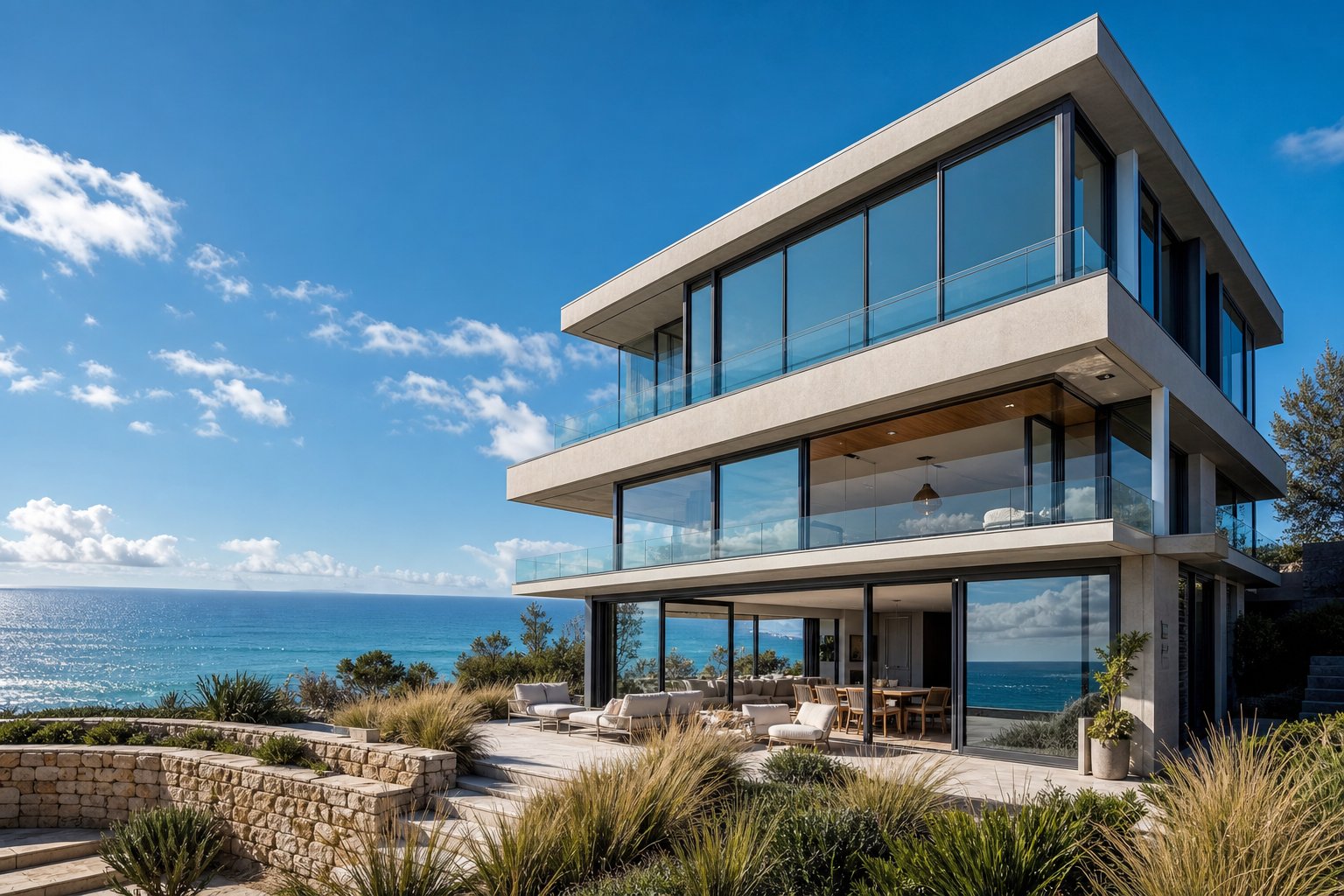
Salt-laden air is timber’s most aggressive enemy. Coastal homes from Queensland down through Sydney and into Victoria’s surf coast experience constant salt deposition on exterior surfaces. That salt draws moisture into timber grain, breaks down paint films faster, and accelerates swelling, paint breakdown, and rot — particularly on exposed elevations facing the prevailing weather. Repaint cycles that might stretch to seven years inland can shrink to three or four years near the shore, roughly doubling the maintenance cost over a window’s life.
Aluminium handles coastal conditions with far less drama. Marine-grade powder coatings are specifically formulated for salt exposure, and homes within a few hundred metres of the waterline can specify higher-durability finishes that add a modest upfront premium but eliminate corrosion as an ongoing concern. Aluminium window corrosion does occur in extreme coastal exposure — pitting or white oxidation on unprotected surfaces — but modern coating systems make this manageable rather than inevitable. For coastal projects, the maintenance cost gap between materials widens significantly in aluminium’s favour.
Extreme Heat, Cold, and UV Exposure
UV radiation is the silent cost driver for timber in sun-drenched Australian climates. Intense sunlight degrades paint and stain finishes faster, meaning north and west-facing timber windows in Perth, Brisbane, or inland NSW need recoating more frequently than those on shaded southern elevations. Timber in hot, dry locations can also experience cracking and distortion from repeated heating and cooling cycles — damage that goes beyond cosmetic touch-ups into structural repair territory.
Aluminium handles heat and UV without finish degradation, though extreme temperature swings do cause thermal expansion in aluminium profiles. Well-engineered systems account for this movement through clearance tolerances and flexible gasket design, so operation remains smooth across seasons. In cold and alpine regions — think Canberra, Tasmania, or the Victorian highlands — condensation becomes the key concern. Standard aluminium frames conduct cold inward, creating moisture on interior surfaces. Aluminium windows external thermal break BAL-29 compliant systems solve both problems simultaneously: the polyamide thermal break interrupts heat conduction to reduce condensation, while the BAL-rated construction meets bushfire compliance for homes in designated zones.
For homes in Melbourne’s outer suburbs or alpine areas, thermally broken aluminium eliminates the energy penalty that once made standard aluminium a poor performer in cold weather — closing the gap with timber’s natural insulation while maintaining aluminium’s maintenance-free exterior.
Property Type Considerations
The type of project you’re undertaking shifts the cost balance as much as geography does. New builds allow both materials to be installed efficiently, but renovations — especially on double-storey homes where scaffold access is needed — amplify aluminium’s weight and handling advantages. Commercial aluminium windows dominate multi-unit developments and retail fitouts precisely because the maintenance-free profile scales economically across dozens or hundreds of openings where cyclical repainting would be logistically impractical.
Standard sizing also matters. If you’re searching for aluminium windows near me or comparing aluminium sliding windows Sydney suppliers against Melbourne options, you’ll find that standard aluminium sizes are widely stocked across both markets. Timber in equivalent sizes often requires ordering lead times. Custom sizing widens the price gap further — bespoke timber demands handcrafted joinery, while aluminium extrusions can be cut to non-standard dimensions with less cost impact. Even aesthetic choices play a role: aluminium black windows have become a dominant design trend in contemporary Australian homes, and achieving that consistent matte black finish is straightforward with powder coating — whereas staining timber to a uniform dark tone requires more labour and ongoing maintenance to prevent UV fading.
The aluminium window trim details, hardware finishes, and profile options available off the shelf mean fewer custom charges on most residential projects.
- Coastal salt exposure — shifts the balance toward aluminium by increasing timber’s maintenance frequency and rot risk
- High UV and extreme heat — accelerates timber finish breakdown; aluminium coatings remain stable
- Cold and alpine climates — thermally broken aluminium matches timber’s insulation; standard aluminium underperforms
- Bushfire-prone areas — BAL-rated aluminium systems meet compliance without the combustibility concerns of timber
- Multi-storey or difficult access — aluminium’s lighter weight reduces installation and future maintenance costs at height
- High-humidity regions — timber swells and paint fails faster; aluminium remains dimensionally stable
- Heritage overlays — may mandate timber regardless of cost; check council requirements before comparing
Climate and property type don’t just nudge the numbers — in many cases, they make the decision for you. But even with a clear material preference, the final step is translating these general patterns into an accurate quote for your specific project.
Making the Right Choice for Your Budget and Property
General cost patterns only take you so far. The figures in this article reflect typical Australian scenarios, but your project isn’t typical — it has a specific number of openings, a specific location, specific access constraints, and a specific owner with specific priorities. The only way to know which material is genuinely cheaper for you is to run the comparison against your actual requirements.
Your Cost Decision Checklist
Before requesting quotes from aluminium window suppliers or timber joinery companies, work through these variables. Each one shifts the cost balance — and skipping any of them leaves gaps in your comparison.
- Define your timeframe — are you optimising for the lowest upfront spend, or the lowest total cost over 20 to 30 years of ownership?
- Assess your climate exposure — coastal salt air, high UV, extreme heat, or alpine cold all affect maintenance frequency and material longevity differently
- Determine your maintenance commitment — be honest about whether you’ll maintain a strict repaint schedule for timber, or whether a low-maintenance material better suits your lifestyle
- Check local planning restrictions — heritage overlays and conservation zones may mandate timber regardless of cost preference
- Count your windows and note custom sizing — the more openings you have, the more aluminium’s per-unit savings compound; bespoke aluminium windows still cost less than bespoke timber in most configurations
- Factor in resale value — consider whether your buyer pool values timber character or low-maintenance practicality, and how window condition at sale affects perceived property value
Getting Accurate Project-Specific Pricing
Online cost comparisons — including this one — provide a framework for thinking, not a substitute for real quotes. Accurate pricing requires submitting your actual window schedules, elevation drawings, or at minimum your opening sizes and preferred styles to aluminium window manufacturers and timber suppliers alike. The variables that drive cost (custom sizing, glazing spec, access complexity, finish selection) only resolve into real numbers when a supplier prices your specific scope.
Get quotes for both materials where possible. Even if you’re leaning toward one, having comparable numbers for the same openings removes guesswork and confirms whether the general patterns hold for your project. Most aluminium window companies can turn around pricing relatively quickly from drawings or schedules, while timber quotes may take longer due to species selection and custom machining considerations.
For those exploring aluminium, MEICHEN accepts drawings and window schedules for project-specific recommendations across their full range of systems — sliding, awning, casement, fixed, and thermal break. Submitting your project details gives you comparable pricing for your exact requirements rather than relying on ballpark figures.
The cheapest option is always project-specific. It depends on your location, your timeframe, your maintenance tolerance, and the number of windows you’re pricing. General guidance points you in the right direction — but only a real quote for your real project gives you the answer.
Whether aluminium or timber ends up being the right call for your budget, the decision is stronger when it’s built on actual numbers rather than assumptions. Get your drawings together, reach out to suppliers in both materials, and compare like for like. That’s how you find the genuinely cheaper option for your home.
Frequently Asked Questions About Aluminium vs Timber Window Costs
1. How much cheaper are aluminium windows than timber in Australia?
For standard double-glazed units in common residential sizes, aluminium windows typically cost between $400 and $1,200 per unit supply-only, while equivalent timber windows range from $800 to $2,500 depending on species and finish. The gap widens further when you factor in installation and ongoing maintenance. Over 30 years, aluminium’s total cost of ownership can be $2,000 to $3,500 less per window due to its near-zero maintenance requirements compared to timber’s cyclical repainting needs.
2. Do aluminium windows require less maintenance than timber?
Significantly less. Aluminium windows need only an occasional wipe-down with warm soapy water to stay in good condition. Their powder-coated or anodised finish lasts 25 to 40 years without recoating. Timber windows require full external repainting every five to seven years, with touch-ups in between. Over 30 years, professional maintenance for timber can cost $1,500 to $2,100 per window, while aluminium maintenance costs sit between $0 and $150 for occasional seal replacement.
3. Are thermally broken aluminium windows as energy efficient as timber?
Modern thermally broken aluminium windows come very close to timber’s natural insulating performance. The polyamide thermal break strips inserted between interior and exterior aluminium sections interrupt heat conduction, achieving U-values between 1.6 and 2.2 W/m²K for complete window units. This satisfies NatHERS requirements across most Australian climate zones and reduces the annual energy cost difference to roughly $30 to $80 compared to well-maintained timber — a gap that shrinks to near zero with quality thermally broken profiles.
4. When is timber a better choice than aluminium for windows?
Timber may justify its premium in heritage or conservation areas where council regulations mandate traditional materials, for single statement windows where aesthetic value outweighs cost, in smaller projects where the total dollar difference is modest, or for committed owner-occupiers who enjoy regular maintenance. Timber also offers natural insulation without requiring thermal break technology, which can matter in cold climates where the budget doesn’t stretch to thermally broken aluminium systems.
5. How long do aluminium windows last compared to timber?
Aluminium windows reliably reach 45 years or more with minimal care, and many aluminium frames from the 1980s and 1990s remain functional in Australian homes today. Timber windows have a theoretical lifespan of 30 to 60 years, but this is heavily conditional on consistent maintenance. Missed repaint cycles — common when properties change hands — can lead to rot, warping, and seal failure that forces full replacement well before the frame reaches its potential lifespan.
More Window & Door Guides